By
John Sassman, B.S.
A Project Submitted in Partial Fulfillment o f the Requirements for the Degree of
M ASTER OF EDUCATION in
ELEMENTARY EDUCATION
University o f Alaska Fairbanks December 2016
APPROVED:
Cindy Fabbri, Ph.D., Committee Chair Denise Thorsen, Ph.D., Committee M ember Kathleen Wright, M.Ed., Committee M ember Cindy Fabbri, Ph.D., Chair
Table of Contents Title Page... Table o f Contents... Acknowledgements... Explanation o f Terms A bstract... Introduction... Rationale... 8-10 2-3 6 1 4 7 5 Personal Significance N eed fo r the Project Educational Significance
Literature Review 11-17
STEM and Elementary Students STEM and Elementary Teachers STEM and Jobs
STEM and Curriculum STEM and Integration STEM and Learning Styles
Statement o f B ias...18 Participants and Limitations...19-20
Participants Limitations
Student Populations
Methods and Findings... 21-25
Philosophical Perspective Action Research
Timeline o f Activities Content Workshops University Classes
Extending the Lessons Share with a P al University Experts Conclusion 26-30 Success or Failure Self-reflection
The Research Process
Contributions to the Field o f Education
What does a standards-based, user friendly, STE M lesson/kit look like? What does increased STEM interest and literacy look like in an Intermediate Elementary classroom? Inspiration External Considerations Project Extensions W hat’s Next. 31-32 Potential Dissemination More Kits
List o f Figures and Tables... References... Appendices/Products... Lesson One - Towers... Lesson Two - Brooklyn Bridge K ’NEX Lesson Three - Exploding Canisters... Lesson Four - Egg D rop...
Lesson Five - Egg Crate... 90-100
34-37 39-55 56-67 68-79 80-89 38 33
Acknowledgements
I would like to thank Dr. Cindy Fabbri, the chair o f my committee, for her guidance, support, and wisdom throughout this process. I feel fortunate to have had her as a professor, mentor, and advisor. She has had a large part in this project and its outcome, and I am proud to have worked with her for the past two years. I would also like to thank Dr. Denise Thorsen and Mrs. Kathleen W right for serving on my committee, and for their assistance and flexibility in helping me bring this project to fruition. The lessons and kits created would not be nearly as comprehensive nor clever if other professional teachers were not willing to contribute to them, so thank you to my fellow esteemed educators. The principal at Pearl Creek Elementary School, Katherine LaPlaunt, has encouraged my endeavors and provided me with valuable feedback in a positive and constructive way. I would also like to express my gratitude to the University of Alaska Fairbanks’ College o f Mining and Engineering, and the Alaska Space Grant Program, for providing me with funds to produce and supply the Science, Technology, Engineering, and Mathematics kits. Additionally, several organizations including the Pearl Creek Elementary
School Parent-Teacher Association, Delta Kappa Gamma Honor Society, and the Alaska Science Teachers Association provided me with mini-grants for which I am truly grateful; these funds helped to replenish the STEM kits during piloting and dissemination. Lastly, I would like to thank my wife Meagen, for being supportive o f my continuing education, and for her willingness to take on extra responsibilities in our personal lives during this project. I would not have been able to complete this project without her patience and perseverance.
Explanation of Terms/Acronyms
Common Core State Standards - The CCSS are a set of standards, describing the
recommended content to be covered by teachers o f students spanning from kindergarten through twelfth grade. These standards include specific instructions for English/Language Arts,
Mathematics, History/Social Studies, Science, and Technical subjects. The National Governors Association (NGA) and the Council o f Chief State School Officers created these sets of
standards in 2010, and to date, forty-two states and the District o f Columbia have adopted them. The State o f Alaska did not choose to adopt the CCSS in its original format, however the state has implemented a modified version o f the protocol (Common Core State Standards Initiative, 2015). In 2012, the Alaska State Standards were initiated, offering similar guidance with nuanced changes for “Clarity, Alaskan Context, and standards that Alaskan teachers value” (Alaska Department o f Education & Early Development, 2012).
N ext Generation Science Standards - The final versions o f the NGSS were published in 2013. They are intended for kindergarten through twelfth grade students, and were created by a collaboration o f the National Research Council (NRC), National Science Teachers Association (NSTA), American Association for the Advancement o f Science, and Achieve. To date, fifteen states have officially adopted them. Over forty states have individual districts that have adopted the NGSS as part o f their curriculums, and twenty-six states are considered “Lead Partners” (Next Generation Science Standards, 2016). In 2016, The Fairbanks North Star Borough School District revised its science standards, and aligned them closely with the NGSS.
STEM - This is an acronym for the subjects o f Science, Technology, Engineering, and Mathematics. If you asked ten different science, technology, engineering, or math teachers how they would define ‘STEM’ they will most likely offer a variety o f responses. According to the National Science Teachers Association (2012), STEM education is an interdisciplinary approach to learning where rigorous academic concepts are coupled with real-world lessons as students apply science, technology, engineering, and mathematics in contexts that make connections between school, community, work, and the global enterprise enabling the development o f STEM literacy and with it the ability to compete in the new economy.
FNSBSD - An acronym for the Fairbanks North Star Borough School District.
Abstract
The primary purpose o f this project was to increase elementary students’ STEM literacy and interest in STEM-related fields. The secondary purpose o f this project was to improve educator self-efficacy to teach STEM in their own classroom. To do this, I created, tested, and revised a series o f STEM lessons and kits appropriate for Intermediate elementary students. Participants in this project included: eight through twelve year-old elementary students, three “Highly Qualified” certified elementary teachers from the FNSBSD, and other teacher collaborators from California and New Jersey. This project also enlisted the help o f several expert students and faculty from the University o f Alaska Fairbanks. The method used was a collaborative, cyclical, anecdotal, and highly reflective Action Research approach. The final product is a series o f five STEM lessons and kits that can be used in an Intermediate elementary classroom. The lessons and kits have been tested and revised many times, and are ready for dissemination for other educators to use. I recommend that teachers become familiar with the content included in the lessons and kits, particularly because national standards have recently changed, and these lessons offer methods for teaching this new material. The accompanying kits are also intended to be user-friendly. It is my hope that these kits find their way into many classrooms, and bring students and teachers knowledge and joy. I will continue working on integrated STEM lessons and kits in the future.
Introduction
For this project, I investigated STEM resources available to elementary teachers in the Fairbanks North Star Borough School District. Listening to discourse in multiple Intermediate classrooms, I found evidence that students lacked foundational knowledge and/or interest in STEM because o f under-exposure to STEM-related fields. I garnered opinions from colleagues about their proficiencies and attitudes towards teaching STEM subjects. I specifically looked for areas o f apprehension and asked how I could help. I also probed for successes and advice from other professionals about what worked for them, and how to build on those principles. I
concluded that I wanted to provide Intermediate elementary students with rich, well-rounded, STEM experiences in the classroom, while giving teachers valuable instructional lessons that they could use for years to follow.
The purpose o f this project was to increase students’ STEM interest and literacy, while improving teacher self-efficacy to teach STEM in an elementary classroom. After creating engaging, comprehensive, standards-based lessons and associated kits, I shared these with four colleagues and we tested them in our PLCs and classrooms. I used my experiences and feedback from this process o f analyzing, reflecting, and refining, to create highly effective lessons. The outcome is an understanding o f what standards-based, user-friendly, STEM lessons and kits look like.
W hat does a standards-based, user-friendly, STEM lesson/kit look like? I sought to answer this question and share my project with colleagues. Three other Intermediate grade level teachers cooperated on this project. It was highly reflective and collaborative by nature.
Qualitative, anecdotal feedback was the foundation for many o f the modifications.
W hat does increased STEM interest and literacy look like in an Intermediate elementary classroom? I sought to address this question in the same way I approached my appraisal to the need for this project. I asked the students. I conducted classroom conversations following the lessons to improve the modules, their design, and teacher delivery. Lastly, I gave qualitative, summative assessments, and utilized comments from students to measure interest and guide learning.
Rationale
Personal Significance - There is growing concern nationwide that we are not adequately preparing students, teachers, and practitioners in the areas o f STEM (Sorenson, 2010). This quote was personally significant to me. As a recent graduate o f a teacher licensure education program, I was required to take both science and mathematics methods courses at the graduate level and I found them to be o f great value and interest. Technology today is ever-evolving and intertwined in our society and classrooms in many different forms, and I am confident teaching it, and utilizing it. However, when I started my teaching career, I had little-to-no experience with engineering as a teacher or student. If I had had an option for a STEM course or elective during my teacher preparation program, I would have opted for that as well.
I feel my studies through the University o f Alaska Fairbanks’ School o f Education were excellent and left me well prepared to lead students through their elementary years, but I am always striving to be a better educator for my students. One field in particular that interests me is STEM, and this was a large motive for this endeavor. I chose to produce a project, because I wanted to have a useful end-product that would benefit my class, and could be shared with colleagues to generate positive outcomes for more students. Equally, this was an opportunity to develop professionally and study challenging content.
As a teacher in the Fairbanks North Star Borough School District, I am fortunate to have a multitude o f STEM resources and materials available to me from the Library M edia Services Department at our downtown administrative building. However, I have often been apprehensive to explore the options obtainable, as they are cumbersome and overwhelming in size, content, and scope. In addition, my content knowledge was limited when I started this project, and I did not have the confidence or knowhow to teach STEM in my classroom. I imagined other
educators were experiencing similar reservations, so this endeavor sought to address these issues, by creating simple, integrated STEM lessons and kits for the benefit o f Intermediate students and teachers alike. This idea is loosely based on the FNSBSD’s Art Kit Program, where small, focused kits are circulated across schools from the administration building.
N eed fo r this project - After facilitating discourse and conducting informal formative assessments with students across three years o f instruction - including student teaching - I concluded that the majority o f children at the fourth grade level were perplexed and
underexposed to STEM-related fields. Furthermore, students seemed to question the
interconnected nature o f these fields. I hypothesized that those students who lacked interest and foundational knowledge during our conversations were not exposed to STEM subjects in previous years. In some instances, I had students who had come from other school districts, where science and technology were “optional” components o f the curriculum at the elementary level, and engineering was omitted entirely. Math appeared to be the only STEM subject with which students consistently demonstrated competence, albeit at varying proficiencies.
Over the past decade, there has been a trend in elementary schools toward spending less time on science and more time on reading and mathematics (Blank, 2012). This may be because o f the growing pressure put on teachers to have their students perform “well” on standardized tests, and many requirements that are tied to reading and math performance. In conversation with another professional educator from the Lower 48, this question was posed to me: “If my kids are being tested in English/Language Arts and Math, and I have limited amounts o f time for
instruction or prep, why should I even teach science or STEM, they’re not tested and I am not evaluated on STEM scores?”
This was a sad moment o f realization for me. My response was: “Is this the way we need to teach? To the test?” “I prefer to teach the entire child, and from my passions and heart, across all subjects. The kids will be able to tell what is genuine and worthy, and therefore inherently have maximum buy-in.” “In addition, STEM subjects are very much interrelated, and the implementation o f it in the classroom may invigorate students about learning.” “Lastly, when kids are involved in STEM activities, they practice collaboration, communication, critical thinking, and creativity, which is pertinent in all aspects o f school and life.” Needless to say, I did not see eye-to-eye with this other teacher.
Beyond philosophical differences, it is also an equity issue. A lack o f science education during elementary years puts students at a disadvantage down the road. They are missing foundational concepts about how the world works and is understood (Personal Communication, Cindy Fabbri, 2016).
Educational Significance - This project was aimed at creating integrated, user-friendly, STEM lessons/kits for elementary students and schoolteachers alike. The primary purpose of generating this collection o f lessons was to enhance child engagement and enthusiasm, while building foundational exposure to the aforementioned fields.
The secondary purpose o f this project was to provide educators with new and relevant resources in a simplified way, so that they might successfully obtain enhanced background knowledge and confidence on each topic. The introduction to STEM-related fields is
accomplished through a hands-on, exploratory format that is integral to the program’s success. The value for educators are: concise lessons that are fresh, relevant, and aligned to current learning objectives. The future o f STEM education in Fairbanks, Alaska, is intertwined with the Next Generation Science Standards (NGSS) and the Common Core State Standards (CCSS). In 2014, The Fairbanks North Star Borough School District (FNSBSD) adopted a new math curriculum aligned closely with the CCSS, and in 2016 the District revised its science standards to closely match the NGSS. The project also ventured to provide resources necessary to
transition from a traditional science curriculum to stand-alone lessons to teach a more comprehensive, integrated, STEM experience that meet the intent o f the new standards.
The final product is a set o f five STEM lessons, with the accompanying kits, that can be used by any teacher in an Intermediate elementary classroom.
Literature Review
STEM and Elementary Students - It is important to create a foundation o f STEM-related language and context, and generate excitement in STEM fields at an early age. A study by Yoon et al. (2014) suggests that elementary school is the point where students start losing interest in science. This project intended to engage students at the elementary level in a STEM approach to address this problem, and also to help students to recognize that STEM subjects are very much interrelated. This project aimed for students to see themselves as Scientists, Technicians, Engineers, and Mathematicians at a young age, and to gain confidence by using real-world problems/concepts to facilitate learning.
Integrating STEM education into elementary classrooms has the power to impact learning and attitudes toward these subjects at a pivotal age, through a hands-on, inquiry based
approaches to learning, while simultaneously increasing academic achievement (Hernandez, 2014). There has been a buzz about the term STEM for longer than a decade, and the
implementations o f it in elementary classrooms are constantly evolving and exciting. STEM lessons have been some o f my most enjoyable teaching moments, and I feel that my students pick up on this. I believe that my positive energy has transferred to my kids and created significant learning for all types o f learners. The lessons and kits for this project have been designed to include auditory, visual, and kinesthetic methods of delivery. This has resulted in effective teaching and learning experiences for teachers and students.
The Trends in International Mathematics and Science Study (TIMSS) puts U.S. fourth graders and eighth graders about average among industrialized and rapidly industrializing countries (Gonzales et al., 2009). We simply need to do better than this and it starts with early education and exposure. We have the ability to get kids interested in STEM fields, asking questions, and prolong interest for their later years in education. A study from Sullivan (2006) goes further by suggesting that, “ Specifically, elementary STEM education is critical to instill, because cognitive development theories, and that early exposure can result in prolonged interest in STEM fields. Ultimately producing more professionals in the respected fields.” Sullivan continues,
“Exposure to engineering may be most profound in grades 3 through 8. In these formative years, hands-on engineering experiences, conveyed through inquiry-based,
design-oriented instructional methodologies, can support the learning o f standards-based science and mathematics while stimulating student learning and making engineering come alive.” (p. 7-8, 2006).
Although Sullivan’s study was conducted ten years prior to this project, the evidence is both compelling and relevant, and it supports the theory, that early STEM in the classroom is a benefit for students’ development and interest in STEM fields.
Essential skills such as critical thinking, creativity, communication, and collaboration are the foundations on which STEM is built, and this needs to be emphasized early in a child’s educational career (Hernandez, 2010). This project aimed to have students involved in
communicating, collaborating, and thinking critically and creatively. Furthermore, it has been shown that these are areas o f overlap in math, English/language arts, and science standards, and therefore learning in one area also facilitates learning in the others.
Public education in Fairbanks is at a critical point; decisions regarding which standards should and should not be taught to students by educators are in flux, and there is a strong push for individualized learning, while maintaining a cooperative element. This project and its tools offer opportunities and time to highlight individual originality, inspiration, and innovation while sharing and interacting with others.
STEM and Elementary Teachers - Some integrated STEM education programs target in service teachers rather than or in addition to students, often through professional development activities tied to a specific curriculum. Goals for these programs frequently aim to build teachers’ knowledge o f subject-matter and pedagogical content knowledge relevant both to individual STEM subjects and to making connections between and among them. A related goal is to boost educators’ pedagogical skills in subjects to which they may have had little exposure. This is especially true for professional development programs targeted to afterschool educators, who typically have little coursework in mathematics, science, or engineering (Honey et al, 2014). W hat happens when there is not a plan in place for teachers to participate in professional
development tied to STEM? It would be ideal for districts to have trainings, but in the event they do not, it is up to the classroom teacher to educate and train themselves.
Elementary teachers are the gatekeepers to fostering the gifts and talents o f future STEM innovators (Cotabish et al., 2013). In order for teachers to cultivate interests in STEM fields in their students, they must know how to teach in an integrated way, and they must know how
students learn STEM concepts. Teachers also need to be familiar with the language o f STEM, and have an understanding o f STEM-related fields.
According to the President’s Council o f Advisors on Science and Technology, the most important factor in ensuring excellence is great STEM teachers, with both deep content
knowledge in STEM subjects and mastery o f the pedagogical skills required to teach these subjects well (President’s Council o f Advisors on Science and Technology, 2010). Implications o f Fairbanks teachers being under-prepared to deliver STEM education to their classrooms and bring our kids to the forefront o f the global workforce could result in Fairbanks students not being leaders in the global workforce. International comparisons o f U. S. students’ performance in science and mathematics place the United States in the middle o f the pack or lower
(President’s Council o f Advisors on Science and Technology, 2010).
A study by Honey et al., STEM integration in the K-12 classroom stated that the role o f a teacher in a STEM classroom is (2014, P. 93):
“Teachers can provide effective instruction by engaging students in learning with the support and guidance they need (without doing the thinking for them). They should be attentive to learners’ needs as they work with them, individually and in groups, and be able to ensure the positive and productive involvement o f all as well as facilitate
engagement when group work breaks down. They should also have techniques to guide (or redirect, as necessary) learners toward achieving the learning goal. It is important to recognize that requests for help are evidence o f active engagement in learning and not an indication o f a deficit. Teachers also need to be prepared to offer hints that steer
individual and group learners toward insight into problems without being overly directive.”
This was a major objective in this project. That eventually the classroom teacher will be familiar with the content, anticipate problems/issues, guide when and where necessary without being overbearing, and allow for the kids to grow and explore on their own.
It was important that this study was approached in a strategic manner for the betterment o f the students and development o f educators, while diminishing apprehension to integrating STEM lessons. Fairbanks elementary public school teachers are already required to teach across all subjects: including, but not limited to English/Language Arts, Math, Science, Technology, Health, Social Studies, and Art. Learning new content, creating new cross-curricular lessons,
combined with time restraints can be a daunting task. It can create a sense o f anxiety and lead to avoidance altogether; especially in an environment o f high-stakes standardized testing. A study done by the M innesota P-20 Education Partnership (2011, p. 36) states:
“The values and belief systems o f pre-service and in-service teachers might be obstacles to the teaching and learning process o f STEM. Many elementary teachers are
“generalists” and are primarily concerned with nurturing a child’s development of language and mathematical skills along with a general development o f students’ academic competency. M ost elementary teachers do not have a STEM mindset (for a number o f reasons) and are therefore unprepared to create the inquisitive atmosphere necessary for the development o f STEM learning. Students may also catch these attitudes.”
For this project to be successful, I had to create meaningful and interesting lessons. I had to make sure that the lessons were authentic and based on real-world concepts. Students are intuitive and capable o f deciphering teacher signals both verbal and non-verbal. The impacts o f a highly involved, knowledgeable, and passionate educator can elevate a classroom to higher levels o f engagement and learning.
There have been studies that highlight the value o f STEM integration in the classroom as well as the effects on teacher self-efficacy. (Yoon et al., 2008) states that a teacher’s content knowledge (pertaining to STEM) directly correlates to self-efficacy, and a more self-confident a teacher makes a stronger impact in the classroom. However, it is simply not possible for every elementary teacher to become a STEM expert, however all elementary schools can and should have at least one expert teacher in STEM education (Levy et al., 2008). If a STEM expert in a particular school can serve as a leader in their realm, they can be a source o f expertise and guidance to their colleagues. Elementary schools could also benefit from high-quality, research- based materials, like the user-friendly lessons and kits that were created. It is necessary for such resources to be readily available with a clearly defined lesson plan and the appropriate materials included, delivering stimulating opportunities for STEM learning (Levy et al., 2008).
Participation in a group activity to design specific lessons can be an effective professional development opportunity (Penuel et al., 2007). Teacher collaboration was essential for this project; therefore, professional development was inherently present. Contributors to this project participated in Professional Learning Committee meetings that were focused on the STEM
lessons and kits. Teachers provided valuable feedback and suggestions for modifications, conversations, observations, and note taking about lessons and kits. Teachers learned alongside o f their students. By the end o f the project, one objective was to have improved, comprehensive, and refined standards-based, integrated STEM lessons that are available for elementary school students and teachers in the Fairbanks North Star Borough School District. This goal was met, with slight variances. Instead o f a “ STEM Unit,” there were separate lessons, that targeted
specific learning objectives, set forth by the new science standards.
STEM and Jobs - Fostering the development o f students’ interest and identity in STEM is an important potential outcome o f integrated STEM experiences. Interest and identity are
thought to lead to continued engagement in STEM-related activities as reflected in course selection and choice o f out-of-school activities, college major, and career path (Honey et al., 2014). This may be an immeasurable long-term goal o f this project and even the possibility of this being a reality, is enough to produce STEM lessons and kits suitable for teaching.
An increasing number o f jobs at all levels— not just for professional scientists— require knowledge o f STEM (Lacey & Wright, 2009). According to the U.S. Bureau o f Statistics, STEM jobs are projected to grow rapidly and substantially. While all jobs are expected to grow by
10.4%, STEM jobs are expected to increase by 21.4%. Similarly, 80% o f jobs in the next decade will require technical skills (BLS, 2008). Additionally, the U.S. will have over one million job openings in STEM-related fields by 2018; yet, according to the U.S. Bureau o f Statistics, only
16% o f U.S. bachelor’s degrees will specialize in STEM. W hat does this mean? As a nation, we are not graduating nearly enough STEM majors to supply the demand (BLS, 2008). The National Academy o f Sciences, National Academy o f Engineering, and Institute o f Medicine have linked K-12 STEM education to continued scientific leadership and economic growth in the United
States (2011). “Between 2010 and 2020, the United States will experience a major talent meltdown.” (Gordon, 2009). This is a major concern, considering the impacts o f STEM
education are far reaching, and touches the lives o f many people in our nation. The majority of jobs in the world today are connected to STEM-related fields on one way or another. “The
primary driver o f the future economy and concomitant creation o f jobs will be innovation, largely derived from advances in science and engineering . . . four percent o f the nation’s
workforce is composed o f scientists and engineers; this group disproportionately creates jobs for the other 96 percent” (National Academy o f Sciences, National Academy o f Engineering, and
Institute o f Medicine, 2011). This project did not aim to deliver scientists and engineers to the doors o f universities, but rather expose kids to the foundations o f the respected fields in many ways, so that they may hold interest beyond that o f elementary years. This may translate to continued interest and further pursuit of higher education in STEM-related fields.
STEM and Curriculum - The state o f Alaska has rejected the adoption o f the Common Core Education Standards and has created the Alaska State Standards, which are very similar to those o f the Common Core. In the FNSBSD, the math, science, and technology curricula are not integrated. Furthermore, the District recently adopted new subsets of math, science, and
technology standards, and only now does the science curriculum have components of
engineering, which is a key element o f STEM. Each field is separate in and o f itself, and at Pearl Creek, it is up to the classroom teacher to design appropriate, efficient, and user-friendly
instruction. Engineering materials are available through the D istrict’s Library Media Services Department; however, they are arduous, and a formalized curriculum is still being developed for this essential component o f STEM.
Levy, Pasquale, & Marco (2008) concluded that elementary teachers face constraints in teaching STEM that include insufficient content knowledge and lack o f confidence, lack of materials and facilities, and lack o f support from their schools. While there is not currently a lack o f materials and resources, I found that many o f them were often overwhelming and time
consuming in both preparation and delivery. In addition, the newly adopted standards do not align comprehensively with what is available for use; the resources are becoming dated or labeled for different grade levels. This was a unique time to introduce new lessons and kits that coincide with the newly adopted standards.
Improvements were warranted in STEM curriculum development and integration within the Fairbanks North Star Borough School District. For this project, I sifted through resources at the D istrict’s offices, attended professional development conferences for STEM-related fields, met with educator mentors, university faculty and students, and scoured the web for usable information. After sorting through what I had found, I chose and adopted what I thought were engaging activities that aligned with the standards that were going to be implemented in the coming school years.
STEM and Integration - One hallmark o f integrated approaches, though not unique to them, is the use o f real-world situations or problems. They can bring STEM fields alive for
students and deepen their learning, but they may also pose particular challenges for them (Honey et al., 2014). The lessons and kits for this project were designed to integrate STEM into an Intermediate elementary classroom using real-life issues and situations, so that the kids would be able to relate and identify with the scenarios presented to them. This was an extremely important aspect o f the lesson designs and activities, and subsequently resulted in higher engagement and greater understanding.
STEM and Learning Styles - Class sizes at Pearl Creek Elementary School are increasing rapidly and each year I have had more kids. When I first started my teaching career, I had
twenty-five students, and most recently I have thirty-one. Managing classes with large numbers presents its own challenges, one o f which is appealing to all learning styles, so that all students may be successful. Each lesson and kit have aspects that touch on visual and auditory learning, but it was my intention to have the kids engaged in hands-on activities as much as possible. For kinesthetic learners in the room, which I believe that most elementary kids are, this was optimal. Integrated STEM experiences typically call on students to engage in activities that involve the use o f tools or manipulation o f objects, and claims have been made that this use enhances learning (Honey et al., 2014). All o f the kits have kids creating, manipulating, and/or engaged with activities associated with tools or objects in order to build understandings and explanations based on evidence.
Statement of Bias
I approached this project with two years of experience teaching in the school district. I was also a youth development volunteer in the United States Peace Corps for two years in Albania previous to my certification. Prior to my classroom career, I was an expert data analyst for a large real estate developer in New Jersey. My own personal experiences in the business world and overseas have shaped the educator I am, and my approach to preparation and
execution. I am in the early stages o f my teaching career and I am the first in my family enter the education profession. While my business background required me to integrate math and
technology often, I mostly deferred to scientists and engineers for expert advice, but never really understood the basics behind their respected fields. This was a new and refreshing area for me to explore and I was eager to rekindle science training I had been exposed to, and to learn basic engineering concepts. I had never been exposed to engineering or STEM as a child learner.
It should also be noted that part o f my philosophy o f education is, that a strong emphasis o f communication, collaboration, creativity, and critical thinking foster a foundation for learning and growth in an elementary classroom. This project was a direct reflection o f my beliefs about how children learn and retain knowledge, while being fully engaged in their environment and activities.
Lastly, this project took a large amount o f time and investment. Funding from grants provided the means to start and maintain the kits. W ithout the grants and my commitment, producing this many lessons and kits would not have been possible. I am proud o f the final products and happy to share them.
Participants and Limitations
Participants - This study was not part o f any initiatives at any o f the schools in the FNSBSD. I used guidelines set forth by The University of Alaska Fairbanks’ Research Policies. There were three sets o f participants: Intermediate grade level students, Intermediate grade level Teacher-researchers, and students from the University o f Alaska Fairbanks’ School o f Mining and Engineering. Professional Learning Committee sessions were confidential, conducted with teacher-researchers only, and were not measured as high risk. Minors are considered a vulnerable population. Data on student achievement was used only to evaluate effectiveness o f the lessons under development and were not disseminated to a wider audience.
There were a total o f three “Highly Qualified,” Certified, elementary teachers that participated in this project. For logistical reasons, this study was purposefully limited to three teachers that teach Intermediate grade level students in the FNSBSD, and their students. In addition, faculty and students from the University o f Alaska Fairbanks’ College o f Mining and Engineering provided valued feedback on lesson content and design to the researcher. Lastly, two elementary teachers from California and New Jersey provided constructive criticism for additional modifications.
Classroom demographics varied greatly in this study. At Pearl Creek Elementary School, several kits were used in straight fourth grade classes (just fourth grade students), multi-age (fourth, fifth, and sixth graders in the same class), and mixed-age (combination o f two grades in one room). In California, it was a straight fourth grade class, and in New Jersey, it was a mixed- age class (fourth and fifth graders).
Teacher classroom experience for this study varied from twenty-two years to less than a year o f service; so pedagogic skills and content knowledge were wide-ranging for this project. This was by design, as wisdom and proficiency from a diverse group o f professionals were key components to the processes and outcomes. New teachers and student teachers offered important feedback, while seasoned educators provided detailed insights from their years o f instruction. Improvements were made to the lessons and kits after comments and anecdotes were received from all the educators involved.
I was the primary researcher in this project, and I asked for the assistance o f four additional, Intermediate grade teachers for the purpose o f diversity and differentiation. Often,
variation is a skill that a teacher must master, and widening this project to other schools outside o f Alaska helped this project to be more adaptive. Collaborative group sessions were held during allocated times, and participation was voluntary.
Limitations - The STEM lessons and kits pertained specifically to the fourth grade science curriculum adopted in 2016, and fourth grade math curriculum adopted in 2014, by the FNSBSD. They were also designed for differentiation, so that teachers in grades three, five, and six, could easily adapt them into their classes. The curriculum and standards that the FNSBSD have adopted are similar to those in the other states where the kits were used.
Student Populations - The Fairbanks North Star Borough School District (FNSBSD) currently has 13,716 students enrolled in 40 schools, including three charter schools, in Alaska’s interior (Hughes, 2014). Pearl Creek Elementary is a public school that serves approximately 485 students, ranging from kindergarten to sixth grade, and 70 are in fourth grade. (Hughes, 2014). The student population at Pearl Creek in 2014 consisted o f 72.4% Caucasian, .2% African- American, 4.3% Hispanic, 1.2% Asian, 9.1% Alaskan Native, .2% Hawaiian Pacific Island, 1% American Indian, and 11.5% two races or more (Hughes, 2014). This project was first piloted with Intermediate teachers at Pearl Creek Elementary School in Alaska. Subsequently, the lessons and kits were shared with teachers and students in other Intermediate classes in
California and New Jersey. Demographic information has not been determined o f the additional schools and Intermediate grade teachers included in this project. In the 2014-15 school year, the average fourth grade class size in the Fairbanks North Star Borough School District was 27.9 students. At Pearl Creek, it was 28.4 students (Hughes, 2014). This is a small sample size when compared to the district-wide grade-four student population, but was sufficient to build well- rounded final products.
Methods and Findings
Philosophical Perspective - Constructivist and Social Constructivist frameworks were the theoretical basis’ for this project. Teacher collaboration was, in many ways, the foundational tool for which this project relied on. Schwandt (2007, p. 38-39) states,
“Constructivism means that human beings do not find or discover knowledge so much as construct or make it. We invent concepts, models or schemes to make sense of
experience, and we continually test and modify these constructions in the light o f new experiences. Furthermore, there is an inevitable and sociocultural dimension to the construction. We do not construct our interpretations in isolation but, rather, against a backdrop o f shared understandings, practices, language, and so forth.”
To delve deeper into constructivism, Schwandt (2007, p. 39) continues to elaborate on strands o f constructivism and writes, “A second strand o f constructivism focuses more on social process and interaction and is generally known as social constructivism.” Finally, he states that social constructivism, “Emphasizes the actor’s definition o f the situation; that it seeks to understand how social actors recognize, produce, and reproduce social actions and how they come to share an inter-subjective understanding o f the specific life circumstances.” This project builds on the philosophy o f social constructivism because o f its anecdotal, collaborative, and communicative characteristics.
Action Research - An Action Research Design (Creswell, 2015; Mertler, 2014; Sagor, 2000) was implemented in this study to facilitate a cooperative, cyclical, learning experience that is relevant to the participants because the focus was determined by the researchers and modified for improvements. This approach employed a team-based inquiry process to study newly
developed local resources and focused on lesson revision and enhancement.
Creswell (2015) states that Action Research is ongoing process that is highly reflective and cyclical in nature. For two years, this study flowed from teacher-researcher, project design, implementation, reflection, and revision, and this matches the description o f an Action Research (Mertler, 2012) approach to collecting and analyzing information using primarily qualitative methods (Figure 1).
W h a t A c t i o n R e s e a r c h Is a n d Is N o t
1 What it is... 1 What it is not... j
A p r o c e s s t h a t i m p r o v e s e d u c a t i o n t h r o u g h c h a n g e P r o b l e m - s o l v i n g C o l l a b o r a t i v e D o i n g r e s e a r c h o n o r a b o u t p e o p l e C y c l i c a l L i n e a r P r a c t ic a l a n d r e l e v a n t C o n c l u s i v e W i t h i n c o n t e x t o f t e a c h e r ’s e n v i r o n m e n t G e n e r a l i z i n g t o la r g e r p o p u l a t io n s H o w w e c a n d o t h i n g s b e t t e r W h y w e d o c e r t a in t h in g s E x p l o r e s , d i s c o v e r s a n d s e e k s to fin d c r e a t i v e s o l u t io n s T h e i m p l e m e n t a t i o n o f p r e d e t e r m i n e d a n s w e r s A w a y to i m p r o v e in s t r u c t io n a l p r a c t i c e b y o b s e r v i n g , r e v i s i n g , a n d r e f le c t in g A fa d
Figure 1. W hat Action R esearch is and is not (M ertler, 2009).
In everyday practice, I am a reflective teacher, and I believe that most educators are. In addition, I feel that teachers naturally want to share their ideas, anecdotes, and improve their overall efficacy. Again, Action Research is highly reflective, recurrent, and collaborative. R iel’s Action Research Model (Mertler, 2009) illustrates the process and describes the actions that were taken in this project (Figure 2). The plan o f action and cyclical reflection used in this project was ongoing (e.g., intermittent meetings for two years), and it was a useful approach as it enabled the involved teacher-researchers to be more successful at what they care most about - improving their teaching and enhancing learning opportunities for their students.
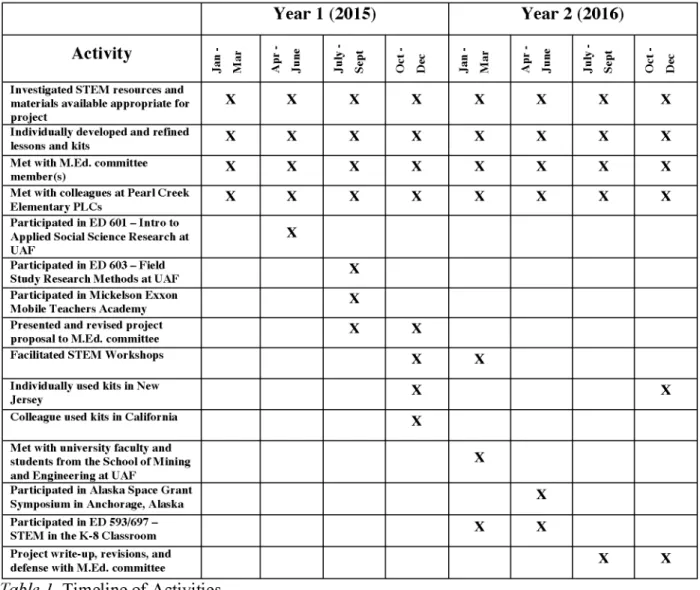
Timeline o f Activities - Table 1 is a visual aid that shows the sequence o f events followed for this project. This was helpful for the outcome o f the project, reflection, and to stay on track.
Year 1 (2015) Year 2 (2016) Activity Ja n -M a r A p r -J u n e Ju ly -S e p t O ct -D e c Ja n -M a r A p r -J u n e u e J S Oct -D e c
Investigated STE M resources and m aterials available appropriate for project
X X X X X X X X
Individually developed and refined
lessons and kits X X X X X X X X M et with M .E d. com m ittee
m em ber(s) X X X X X X X X M et with colleagues at P earl Creek
E lem entary PL C s X X X X X X X X Participated in E D 601 - Intro to
A pplied Social Science R esearch at U A F
X
Participated in E D 603 - Field
Study R esearch M ethods a t U A F X Participated in M ickelson E xxon
M obile Teachers A cadem y X P resented and revised project
proposal to M .Ed. com m ittee X X
Facilitated STE M W orkshops X X Individually used kits in N ew
Jersey X X
C olleague used kits in C alifornia X M et with university faculty and
students from the S chool o f M ining and E ngineering at UA F
X
Participated in A laska Space G rant
Sym posium in A nchorage, A laska X Participated in E D 593/697
-STE M in the K -8 C lassroom X X P roject w rite-up, revisions, and
defense with M .E d. com m ittee X X
Table 1. Timeline o f Activities
Content Workshops - I applied to the Mickelson Exxon Mobile Science Teachers Academy in Houston, Texas and was accepted to participate in a week-long training and exploration o f science and STEM-related activities and lessons. I chose some o f the major concepts and activities that I participated in there, and applied them to my class, and found that some o f them were appropriate and engaging, while equally, some o f the activities were difficult to translate and reduce into a kit. There were also several times when I found a lesson or concept that was great, but I was not able to make it user-friendly or reduced in size to accommodate my goals, so I returned to the drawing board. Lastly, I was selected to facilitate a STEM Workshop back in Fairbanks, Alaska, for other teachers in the district. This was a weekend event in the fall o f 2015, where I shared lessons, content knowledge, and information that I attained during the
Mickelson Exxon Mobile Science Teachers Academy. I also piloted two kits with the participants at the event.
University Classes - Another method o f collaboration that I used was a course called: K- 8 STEM in the Classroom, through the University o f Alaska Fairbanks’ School of Education. This proved to be a valuable resource and learning experience. I was able to communicate online with other educators around the country and share ideas and lessons via Black Board. I was able to get feedback on potential plans for implementation, and in the end, the instructor created a spreadsheet o f resources and lessons compiled from the class o f 32 students.
Professional Learning Committees - The National Commission on Teaching and
America’s Future (2013) found that effective STEM learning teams have shared goals, scheduled times for meetings, collective responsibility, and a goal of increasing student achievement. During the 2015-2016 school year, certified elementary school teachers at Pearl Creek and throughout the District are required to meet for Grade Level Professional Learning Committees. In simpler terms, this is an allotted time and opportunity for teachers that work in the same grade levels to discuss collaborations, issues, logistics, field trips, and any other pertinent information that may contribute to the betterment o f the overall education o f their students or themselves. I chose to utilize this as a chance to solicit “testers” o f the kits and ask for feedback. This proved to be a valuable opportunity for me to get input from other teachers on lessons.
Extending the Lessons - Originally, I thought that logistically, the lessons and kits could only effectively be tested using teachers working at one particular grade level, at one particular school, and then disseminated for additional vetting thereafter, where students would not have a “Repeated” experience. For example, I piloted a kit in my own class - the “Towers” lesson - during the 2014-2015 school year, and subsequently made my first kit from that content and material. A fifth grade teacher at the same school used the kit in her class, with some o f my former students and most o f the students that were in my fourth grade class the year before, recalled the lesson immediately, and were able to work through the activity quickly with optimum proficiency while being natural leaders in their respected groups. This was part o f the feedback I received. At first, I thought this to be a problem, but during the defense o f my project, a committee member had a wonderful suggestion. She stated that as students progress beyond my class, future teachers may be able to use previous knowledge and experiences to expand and prompt additional skills, and provoke critical thinking skills. This could be advantageous,
particularly because the students already have foundational knowledge and familiarity with the concepts and materials in the kits, and learning extensions may be added; new lessons and content-specific lesson enhancements may be proposed. For instance, a lesson on force and motion on a horizontal plane can be extended by creating a new challenge on a vertical plane.
Share with a P a l - A colleague o f mine at Pearl Creek went to California on a personal trip and while she was there, she met up with her pen pal class and was asked to bring a lesson or activity with her to do with the class. She chose to bring the “Towers” lesson (see appendix Lesson One) and did it with the classes that she visited. She was amazed with the different designs that kids came up with, especially based on their location and experiences, particularly referring to water-type towers, which are a lot less prevalent here in Alaska. In California, water towers are common, and the students were able to connect the real-world application almost immediately. As for the Alaskan students, there were several kids that connected the tower with “W atchtowers,” that are used for hunting in the fall.
I was also fortunate to visit our pen pal class in New Jersey to facilitate two lessons over a two-year period. I was the primary facilitator for the lessons, accompanied by their classroom teacher. W hen I visited, I was comfortable delivering the lessons and kits without the assistance o f the written guides and materials. It was a great feeling to be able to do so confidently and efficiently, and at that point, I realized that other professional educators could have the same successes and acquisition o f knowledge. It was apparent that once I learned the way I wanted to teach the lesson, the content and foundations stayed the same. It was also at that point that I realized that I could deliver this lesson many times, and each time, I would/could refine something to make it place-based or locally relevant.
University Experts - In addition to the guidance o f certified elementary educators, professional and content advice was given to the researcher from students and faculty at the university level as well. The “Towers” lesson was piloted with a team o f scientists and engineers for the purpose o f accuracy and engagement across multiple levels o f skill. I was invited to try my kit with high-level engineers and physicists from the University o f Alaska Fairbanks and this proved to be a paradigm shift in many ways. Until that meeting, one o f the main purposes o f my lesson was to help students understand the major differences between science and engineering, but I was enlightened, when a participant pointed out that they are actually a lot more the same and inter-connected, and that should be the driving point.
Conclusion
Success or Failure - The main goal o f this project was to create an interest, excitement, and foundational knowledge in STEM-related fields among Intermediate grade level students. The secondary goal was to offer teachers a user-friendly resource that could help them teach STEM- related lessons in their class and get more comfortable with the content. I believe that the outcome o f this project was a success for my students and colleagues, but if I were to offer a truly objective reflection, there are several things I would do differently in the future should the project be
replicated and expanded. A reoccurring obstacle emerged throughout the series o f lessons, and this was timeliness. I tried to fit as many standards into my lessons, to make them all-around, fully integrated, rich lessons. As I move forward and continue to develop STEM lessons for my students, I will scale them down and isolate one particular field, and let the other subsequent fields fall into place naturally. I would also use the multitude o f lessons already out there, and not try to combine them for more substance. I often had to remind myself: the kids being taught range from ages eight to twelve, so keep it simple.
Self-reflection - As a teacher, I am always applying self-reflection practices and
continuously tweaking lesson plans, schedules, materials, and other such classroom procedures to make them better. Because o f this, informal research will be ongoing throughout my career. My aim for this project was to provide a fully-integrated STEM Unit that is engaging to elementary
students, user-friendly, and standards-based, for teachers across the Fairbanks North Star Borough School District. I discovered by the end o f my project, that sometimes I pushed too hard for full- integration o f all the respected STEM fields, and this may not have been necessary. For example, if I needed to target a particular math standard, I would simply add a budget to the lesson, but in some instances, a budget was not called for or appropriate. I realized that if I let the STEM fields fall naturally in their places for the lesson and not cramming in as many standards as I could, I would have more impactful lessons and improved learning experiences.
Prior to the start o f this project, I was ashamed to admit that I did not really understand all the aspects o f STEM-engineering in particular. One o f the main reasons I chose this path, was to educate myself, surround m yself with professionals in the field, and better my knowledge for the benefit o f those I educate and for myself. I am proud to say that I now have a strong foundation in
all o f the STEM-related fields as a result o f this project, and I will continue to expand on this knowledge. I enjoyed the entire process, even the struggles and long hours. With the first quarter of
the 2016/2017 school year just coming to a close, I am only beginning to see the remarkable payoff o f the project on my new group o f students, and on Pearl Creek Elementary as a whole.
The Research Process - During this project, I learned a tremendous amount about the process o f research. Specifically, the courses ED 601 Introduction to Social Science Research, and ED 603 Field Study Research Methods at University o f Alaska Fairbanks were particularly
challenging, but were instrumental parts in the outcome o f this project.
As for my experiences researching, I began this endeavor, trying to find literature that would match my goals and objectives, but I now realize that I should have done the opposite. I should have reviewed the literature surrounding my subject, and approached my project differently. In the end, I am pleased with the information that I found to back up my project, but this could have been a lot simpler o f a process. I feel strongly that I have contributed to the betterment o f my students, my colleagues, and my own professional development, and I am always striving to be more efficient and effectual in my activities.
Contributions to the Field o f Education - A colleague of mine revealed to me that she is relieved to have kits like these available to her. She also noted that she feels that she is able to confidently and skillfully integrate newly adopted standards into her class better. She now calls her “ Science Block,” a “ STEM Block.” It is my hope that other educators feel this way using these STEM kits. For the future o f my own classroom, I will use these tools for many years, and even if standards change again, the aspects o f collaboration, creativity, communication, and critical- thinking are ongoing and present in the lessons.
I also hope that these kits find their way to the teacher-preparation program at the University o f Alaska Fairbanks. I would be proud and honored if student-teachers vetted and/or used them with their classes, and furthermore, would be inspired to make their own. I would greatly appreciate any constructive criticism, suggestions for enhancements, or propositions for enrichment that they would offer.
What does a standards-based, user friendly, STE M lesson/kit look like? - In the beginning o f this project, I asked the question, “W hat does a standards-based, user friendly, STEM lesson/kit look like?” I believe that I have answered this question with this project and after many rounds of revisions, I believe my final products provide the proper evidence. Each kit was designed to be engaging, simple, and compact. I spent a lot o f time scrutinizing and selecting appealing activities that matched the content I was supposed to be teaching. I believe this was an extremely important
part o f the project, because if the activities were interesting, engagement would be optimal, and the lessons would have more impact on student achievement.
Logistically, I had custom canvas bags made that were two-feet by two-feet in size. All the contents o f the lesson needed to fit, or the lesson was not viable for the project. At times, this was also a constraint. Each kit comes complete with a four-part binder, and most, if not all, of the required materials. Part one o f each binder consists of: Lesson Information - the focus, summary, objectives, and acknowledgements. Part two contains: Materials and Procedures - an articulated copy o f items in the kit or that the teacher will need, recommended time allotment, and
recommended actions to follow. Part three has: Background Information - content and
communication pertinent to the particular lesson, so the user is able to learn and be more confident about the concepts included in the kit. Part four o f each kit includes:
Standards/Assessments/Differentiation. Teachers often have to reference what standards that they are teaching to administration and for their own records. Part four also provides all the formally articulated standards and where they came from. Teachers are frequently held accountable for measuring student learning. Each kit provides multiple levels and methods for assessment, therefore providing differentiation and proper documentation. Lastly, each kit gives suggestions for
enrichment and scaffolding support for different types and levels o f learners.
What does increased STEM interest and literacy look like in an Intermediate Elementary classroom? - I also asked the question, “W hat does increased STEM interest and literacy look like in an Intermediate elementary classroom?” I am proud to report that I have seen and heard first hand, answers to this inquiry. On several occasions, I witnessed children utilizing key concepts and practices taught in lessons that were given. For example, after one o f our bridge building sessions, several students in class had asked if they could stay after class, and build other structures that could hold weight and serve a real-world purpose using the K ’NEX pieces from the bridge building kit. I was immediately curious about what they had in mind and excitedly said yes. The students
subsequently built towers. They used information and knowledge they had gained from the “Towers,” lesson and replicated the lesson, using different materials, on their own time (recess), while showing genuine interest and literacy in key STEM concepts. The conversations that I overheard - as they were working - were amazing, and included relevant STEM language. They even made a new budget and came up with a new challenge for their classmates.
I was also surprised when I observed two students using problem-solving skills that they acquired during one o f our lessons, out on the playground. I was on recess duty, and I saw that two
o f my students could not agree on which would have first turn on a particular swing. Earlier that morning, the same two students could not agree which would be the “Banker” first, and which would be the, “Builder” first. We talked, and I suggested that they simply, flip a coin, accept the outcome, and move on, taking turns. They came up to me on the playground and asked me for the coin we used earlier, because they wanted it to be “Fair,” and that they were “Working together, to work it out.” In this particular instance, they were able to take a strategy that we used in one o f our STEM lessons, and apply it to the real-world, to solve a problem that they were having,
collaborating to get it done, and communicating their feelings and needs creatively. While this conflict had nothing to do with any o f N ewton’s Laws o f Motion, it was a proud moment of validation for me as their teacher, because there was evidence o f an impact from our lesson. It showed that STEM-related skills had transferred to a real-life situation, literally in our own backyard.
Inspiration - This project gave me some o f the defining and uplifting moments, and I was immediately hooked. I heard a group of young girls (fourth graders) chatting during an activity and one girl said, “This STEM stuff is so cool, I want to be an engineer when I grow up.” These are the words a teacher loves to overhear. On another occasion, I had a student tell me, “I never knew that STEM is everywhere, that’s so cool, Mr. Sassman.” For that particular student, on that particular day, he realized how important and connected STEM fields are, and how much our world is reliant on experts in those areas. I am sure that there were comments I did not hear from students, but I know I have reached a few students and that validates my efforts and goals.
Another substantial moment I had was when a colleague o f mine decided to bring one o f my kits with her on a trip. She had been collaborating with another class through pen pal letters and was visiting their area in California. She was asked to teach a lesson and she decided to bring the
Towers kit. She had given the lesson before and was familiar with it, and she chose to share that lesson - from a multitude which she could have - and the kids loved it. Her feedback was invaluable and I was honored that she shared her knowledge and experiences when she returned. Furthermore, she said the kit traveled well through several airports.
External Considerations - Classroom time with students is limited, often interrupted with several outside influences - all good reasons - such as band, orchestra, tutoring, Response to Intervention, Special Education, specials, counselors, and other school wide events. Classroom instruction time is precious, and to choose succinct, impactful lessons are imperative. I often found that time constraints were often my most significant limiting factor, and given the opportunity, I
would have preferred to modify all my lessons to span a longer time frame. I would have also spent less time on each individual lesson for development. I realize that I often over-prepare and indulge in additional details when it comes to lesson planning, and this project was no exception. I found that I spent too much time on the first two lessons, trying to perfect them, so they would universally fit into any class and include all aspects o f STEM. As the project progressed, I also knew that I had to create more, pilot more, refine and edit less, and pick lessons that were engaging and effective. Every group o f students and every teacher are different, so I must allow the natural flow and management to be more fluid, less scripted. This is why the last two lessons in the project are simplified in the procedural areas. Furthermore, I realized that not every lesson needs to have a tremendous amount o f standards attached to them. Simple lessons were often the most impactful.
Project Extensions - After the defense of this project and discussion with my M.Ed. Committee members, it is apparent that this project can take on new and different dimensions beyond that o f what I had anticipated or saw at the end o f this process. It was suggested to me that teachers at different grade levels can use the kits and expand on prior lessons and content
knowledge, and expand students’ higher level thinking and be creative with the materials they are given. For example, one suggestion was to take a kit that was meant for teaching force and motion, and have the kids use what they learned and know form the previous lessons to create
demonstrations or solutions to new problems that they may encounter associated with force and motion. Perhaps on day I will be teaching in a multi-age class, and this would be a particularly important observation and modification to my lessons/kits.
W hat’s Next
Potential Dissemination - It seems as though National, State, and local teaching standards are ever-evolving and there is not one correct way to teach STEM in the classroom, however, it is my hope that other teachers find value in my project and elect to utilize the lessons and kits to expose their elementary students to STEM fields. I hope to generate excitement and foundational knowledge for students, but also for the betterment o f teacher instruction. I understand that the kits I have made will always be tweaked formally and informally, and teachers will find successes in their own ways.
The D istrict’s Library M edia Services Department, which is the center for teachers to check out resources for their rooms, may be the best avenue to reach more educators. At a minimum, I will use these kits at my school for my own classroom instruction and for other teachers to use with their students. I am fortunate to have a storage room in my class, so I am able to keep learning materials and supplies there. It is handy and convenient, especially for ongoing projects. The trick is, not to fill it with clutter, but worthwhile content.
A few obstacles I see with maintaining the kits m yself are the replenishment and
management o f the kits. Currently, the district has an entire department dedicated to this function for the Art Center and its curriculum materials. I would be willing and able to do this for my school, and logistically it would be possible to do for others through the D istrict’s Inner mailing system, but I am not sure as to how time consuming this would or could be. Potentially, it could also get to be very expensive to keep replenishing materials and time consuming reorganizing the kits after they are returned. I will however, keep refining my kits and perhaps chose others to be selected for implementation with the FNSBSD.
If I could suggest a method to offering these kits to the greater public with restocking and replenishment, I would ask either the Art Department or the Library Media Services to take these on and put them into their operations and system.
M ore Kits - I would like to keep going! Ideally, it would be great to keep creating five to six kits per year hereafter. Realistically, my aim is to create one or two high-quality kits per year and spend time in my class testing them. I would follow a similar path to vetting the lessons and ask colleagues in my building to test them for me as well. Additionally, I would design the lessons before ordering the bags that they go in. This was an issue at times, because I limited my lesson developments to what materials could fit in the carrying cases that were custom made.
I have passions for STEM, elementary education, and my kids. I believe that these types of activities and projects add to my class and the overall elementary experience. M ost importantly, my lessons and kits engage students in important fields that will affect our future, promote critical thinking, collaboration, communication, and creativity. Lastly, my efforts create foundational STEM knowledge, excitement for learning, and help my fellow educators be the best they can be.
List of Figures and Tables
Figure 1 - W hat Action Research is and is not. Page 22.
Figure 2 - R iel’s Action Research model. Page 22.
References
Alaska Department o f Education & Early Development. Retrieved from: http://education.alaska.gov
Blank, R. K. (2012). What is the impact o f decline in science instructional time in elementary school. Washington, D.C. Paper prepared for The Noyce Foundation. Retrieved from: http://www.csss-science.org/downloads/NAEPElemScienceData.pdf
Bureau o f Labor Statistics (BLS). (2008a). Employment projections from the, ESA
calculated the projected employment growth o f STEM occupations. BLS’s Employment Projections Program’s. Retrieved from: http://www.bls.gov/emp
Bureau o f Labor Statistics (BLS). (2008b). Employment projections from the, ESA
calculated the projected employment growth o f STEM occupations. Detailed occupational projections. Retrieved from: http://www.bls.gov/emp/ ep table 106.htm
Cotabish, A., Dailey, D., Robinson, A., & Hughes, G. (2013). The effects o f a STEM
intervention on elementary students' science knowledge and skills. School Science and Mathematics, 113(5), 215-226. Retrieved from:
http://search.proquest.com/docview/1509085704?accountid=14470
Creswell, J. W. (2015). Educational research: Planning, conducting and evaluating quantitative and qualitative research (5th ed.). Upper Saddle River, NJ: Pearson. Common Core State Standards Initiative. (2015). Complete Timeline. Retrieved from:
http://www.corestandards.org/about-the-standards/development-process/
Fabbri, C., (2016). M.Ed. Advisory Committee Chair. School o f Education Graduate Program Chair. Personal Communication. University o f Alaska Fairbanks School o f Education. Fairbanks, Alaska.