A Thesis
Submitted to the Faculty of
Purdue University by
William Connor Horne
In Partial Fulfillment of the Requirements for the Degree
of
Master of Science Electrical and Computer Engineering
August 2019 Purdue University Indianapolis, Indiana
THE PURDUE UNIVERSITY GRADUATE SCHOOL
STATEMENT OF THESIS APPROVAL
Dr. Zina Ben Miled, Chair
Department of Electrical and Computer Engineering Dr. Lauren Christopher
Department of Electrical and Computer Engineering Dr. Maher Rizkalla
Department of Electrical and Computer Engineering
Approved by:
Dr. Brian King
ACKNOWLEDGMENTS
I would like to thank my advisor Dr. Zina Ben Miled. Her advice and support have been invaluable. I would also like to thank my committee members Dr. Lau-ren Christopher and Dr. Maher Rizkalla. The previous work by Zachary King was valuable to the success of this thesis. The IUPUI ECE and CS departments are ap-preciated for helping me develop my knowledge. Special thanks to the Naval Research Laboratory and Dr. Judson Hervey for supporting my graduate education. I would also like to thank all the students who have been my friends for these past two years.
TABLE OF CONTENTS
Page
LIST OF TABLES . . . .viii
LIST OF FIGURES . . . ix ABBREVIATIONS . . . xii GLOSSARY. . . xv ABSTRACT . . . xvi 1 INTRODUCTION . . . 1 1.1 Health Records . . . 2 1.2 Proposed Framework . . . 3 2 RELATED WORK . . . 5
2.1 Personal Health Record. . . 11
2.2 Peer-to-Peer Networks . . . 14
2.2.1 Distributed Transactions . . . 19
2.2.2 Blockchain . . . 21
2.2.3 Applications of P2P Networks to Health Records . . . 22
2.3 Application Layer Protocol. . . 24
2.4 EHR Datamining . . . 25
2.4.1 Predictive Models and Bayesian Statistics . . . 27
2.4.2 Bayesian Applications to EHR Datamining . . . 28
2.4.3 EHR Datasets . . . 31
3 ARCHITECTURE . . . 33
3.1 Network Actions . . . 36
3.2 Transactions . . . 42
3.2.1 Authorization and Operation . . . 43
Page
3.3 Hypertension Prediction Service . . . 49
3.3.1 Data Set . . . 50
3.3.2 Preprocessing . . . 54
3.3.3 Algorithm . . . 56
3.3.4 Training and Testing . . . 56
4 IMPLEMENTATION . . . 58
4.1 Index Server . . . 58
4.1.1 Database . . . 58
4.1.2 API and Handlers . . . 61
4.2 Peer Client . . . 62 4.2.1 FHIR Client . . . 71 4.2.2 P2P Subsystem . . . 71 4.2.3 TCP Library . . . 76 4.3 Service Client . . . 79 4.4 Network . . . 80 4.4.1 Registration . . . 80 4.4.2 Login. . . 82 4.4.3 Resource Lookup . . . 84 4.4.4 Posting Documents . . . 85
4.4.5 Requesting and Approving Transactions . . . 86
4.5 Transaction . . . 89
4.5.1 Get . . . 92
4.5.2 Push . . . 93
4.5.3 Service . . . 94
4.6 Hypertension Prediction Service . . . 96
4.6.1 Naive Bayes Model . . . 97
4.6.2 Performance . . . 99
Page
REFERENCES . . . 103
APPENDIX A Hypertension Survey Info . . . 119
APPENDIX B Example Feature Vector . . . 121
APPENDIX C Example Client Usage of System . . . 124
C.1 Provider Requesting a Patient Health Record . . . 130
LIST OF TABLES
Table Page
3.1 Selected Condition Features . . . 50
3.2 Selected Consolidated Features . . . 53
4.1 Classifier Performance with Panels 17, 18, and 19 . . . 99
LIST OF FIGURES
Figure Page
2.1 Types of Network Architectures . . . 16
2.1 Types of Network Architectures (continued.) . . . 17
2.2 MEPS Panel Design . . . 32
3.1 System Architecture . . . 34
3.2 Client Document . . . 35
3.3 Registration . . . 36
3.4 Heartbeat Process . . . 37
3.5 Search for Network Resources . . . 38
3.6 Fetch FHIR Documents from Portal. . . 39
3.7 Record Registration . . . 40
3.8 Registration and Approval of Service . . . 41
3.9 Network Transaction . . . 42
3.10 Transaction Request Data . . . 43
3.11 Transaction Request and Approval . . . 43
3.12 Transaction Data . . . 44
3.13 Update Data . . . 44
3.14 Get Protocol . . . 46
3.15 Push Protocol . . . 47
3.16 Service Protocol . . . 48
3.17 MEPS Data Preprocessing Pipeline . . . 54
3.18 Feature Vector . . . 56
4.1 Index Server Classes . . . 59
4.2 Database Collection . . . 60
Figure Page
4.4 Peer Client Subsystems. . . 62
4.5 Peer Client Collections . . . 63
4.6 Network and WUI Classes . . . 65
4.7 WUI Paths . . . 66
4.8 Registration . . . 66
4.9 Login . . . 66
4.10 Record . . . 67
4.11 Account Page . . . 67
4.12 Network Documents and Transaction Request . . . 69
4.13 Transaction Page . . . 70
4.14 Peer Records Table . . . 70
4.15 FHIR Query . . . 71
4.16 Peer-to-Peer Classes . . . 72
4.17 Job Classes . . . 74
4.18 TCP library . . . 76
4.19 Service Client Subsystems . . . 79
4.20 Transaction Process . . . 89
4.21 Hypertension Prediction Classes . . . 96
C.1 Welcome Page . . . 124
C.2 Patient Registration . . . 125
C.3 Patient Login . . . 125
C.4 Network Page . . . 126
C.5 Portal Selection . . . 126
C.6 Downloading Records from a Registered Portal . . . 127
C.7 Viewing Records . . . 128
C.8 FHIR Data for a Single Record and Posting to Network. . . 129
C.9 Provider: Network Records . . . 130
Figure Page
C.11 Provider: Sending Request for Get Transaction . . . 131
C.12 Patient/Provider: Transaction Waiting for Approval. . . 131
C.13 Patient: Approving Transaction . . . 132
C.14 Provider/Patient: Transaction Complete . . . 132
C.15 Provider: Viewing Peer Records . . . 133
C.16 Provider: Transferred Peer Record . . . 133
C.17 Patient Filling out Survey for Service . . . 134
C.18 Survey as a Record . . . 135
C.19 Survey Posted to Network . . . 135
C.20 Selecting Service Transaction . . . 136
C.21 Requesting Service Transaction . . . 136
C.22 Service Transaction Finished . . . 137
ABBREVIATIONS ALS Amyotrophic Lateral Sclerosis
ARHQ Agency for Healthcare Research and Quality ASIC Application-specific Integrated Circuit BFT Byzantine Fault Tolerance
BMI Body Mass Index
BNP Bayesian Non-Parametric
BSON Binary JSON
CAD Computer-aided Diagnosis
CEHRT Certified Electronic Health Record Technology CMS Centers for Medicare and Medicaid Services DAG Directed Acyclic Graph
DBN Dynamic Bayesian Network DHT Distributed Hash Table EM Expectation Maximization EVM Ethereum Virtual Machine
FHIR Fast Healthcare Interopability Resources
FN False Negative
FP False Positive
FTP File Transfer Protocol GPI Generic Product Identifier GUI Graphical User Interface HHS Health and Human Services HIE Health Information Exchange
HITECH Health Information Technology for Economic and Clinical Health Act
HTML Hypertext Markup Language HTTP Hypertext Transfer Protocol
ICD-10 International Classification of Diseases Revision 10
ICD-10-CM International Classification of Diseases Revision 10 Clinical Mod-ification
ICD-9 International Classification of Diseases Revision 9
ICD-9-CM International Classification of Diseases Revision 9 Clinical Modi-fication
ICU Intensive Care Unit
IHIE Indiana Health Information Exchange IP Internet Protocol
JSON JavaScript Object Notation LSTM Long Short-Term Memory MAP Maximum a Posteriori
MEPS Medical Expenditure Panel Survey
MR Medical Record
NAT Network Address Transaction
ONC Office of National Coordinator for Health Information Technology
P2P Peer-to-Peer
PHR Personal Health Record
POW Proof-of-Work
PPV Positive Predictive Value
REST Representational State Transfer RFI Request for Information
RMSE Root Mean Squared Error
RTT Round-Trip-Time
SDA Stack Denoising Autoencoder
SEER Surveillance, Epidemiology, and End Results Program SHA2 Secure Hash Algorithm 2
SHA3 Secure Hash Algorithm 3
SMOTE Synthetic Minority Over-sampling Technique SMR State Machine Replication
SNAT Symmetric Network Address Translation SSP SAS Transport File
STUN Session Traversal Utilities for NAT TCP Transmission Control Protocol
TN True Negative
TP True Positive
TURN Traversal Using Relay around NAT UDP User Datagram Protocol
ULMS Unified Medical Language System VA Department of Veteran Affairs
WEKA Waikato Environment for Knowledge Analysis WUI Web User Interface
GLOSSARY
Begnin fault a distributed fault such as message loss or a peer crash Byzantine fault a distributed fault such as a malicious or faulty peer posterior probability of an event given evidence
prior probability of an event using previous information consensus agreement on a single value among distributed peers features input data dimensions for a machine learning model index server the central server used to progress and ensure transactions job a work unit to carry out a transaction
liveness the distributed system does not halt in progress panel a survey period in MEPS
patient person that is the recipient of healthcare services
peers a program that is participating in a peer to peer network, acts as both a client and server
provider person or organization that provides healthcare services quorum the number of peers necessary to agree for consensus record a health record in the network
requester the peer requesting a transaction
safety only correct actions are taken in a distributed network target the peer that is the target of the transaction request third-parties agent that needs access to the healthcare information
ABSTRACT
Horne, William Connor. M.S.E.C.E., Purdue University, August 2019. Peer-to-Peer Personal Health Record. Major Professor: Zina Ben Miled.
Patients and providers need to exchange medical records. Electronic Health Records and Health Information Exchanges leave a patient’s health record fragmented and controlled by the provider. This thesis proposes a Peer-to-Peer Personal Health Record network that can be extended with third-party services. This design en-ables patient control of health records and the tracing of exchanges. Additionally as a demonstration of the functionality of a potential third-party, a Hypertension Predictor is developed using MEPS data and deployed as a service in the proposed framework.
1. INTRODUCTION
Patients and healthcare providers need to exchange electronic health records. This exchange is necessary for patients to inform providers of their health and for multiple health care providers to collaboratively provide the care needed by each patient. Traditionally, health record exchanges have primarily focused on provider-to-provider exchanges and with a common strategy being the use of a data warehouse called a Heath Information Exchange (HIE). However, these strategies and the associated HIE often do not involve the patient. Exchanges are limited to a given region or target only large institutions. Therefore, patients that seek health services from small health providers or move from one region to another will have a fragmented health record.
To overcome the above issues, this thesis proposes a Peer-to-Peer (P2P) Personal Health Record (PHR) that enables the exchange of patient data between patients and health providers. The system consists of a transaction-based model with patients authorizing access to their records. The network logs each transaction, enabling the trace of accesses to each record. Providers can post new records thereby updating the patient’s PHR. Moreover, both patients and providers can access third party network services to perform operations on these records. The advantages of the proposed PHR include:
• patient control of his/her health records
• a common platform for the exchange of health data that can offer a continuum of medical history for each patient
• ease of access to historical data for new health providers added to the system • ability to keep the health record for each patient up-to-date and accessible in
real time to all concerned
In addition, an efficient representation of the health record will help the patient make informed decisions about their health. In order to act upon the information in the PHR, the proposed system is augmented with a prediction service. The prediction service uses a Bayesian Network to predict a patient’s risk of developing Hypertension based on a submitted health record. This predictor serves as an example of the types of services that can enhance the utility of the proposed PHR.
1.1 Health Records
A patient’s electronic health record documents the health of a patient and their interactions with healthcare providers. Though implementations vary, the FHIR on-tology [11] contains a generalization of the information captured in health records. It details roles, workflows, and financial information that documents the patient’s interaction with a provider. The provider records the observations, symptoms, and conditions for each patient. Diagnoses in FHIR are standardized according to various ontologies including ICD-10 [165], the International Classification of Diseases used for medical diagnosis. In summary, the FHIR ontology includes definitions for:
1. Individuals and their roles in the system (e.g., patient, provider, related, etc.) 2. Entities such as organizations, locations, or devices
3. Workflows such as tasks or appointments
4. Management of the encounter between a patient and a health provider 5. Clinical information such as observations, conditions, and medications 6. Financial information including billing
Several initiatives have attempted to overcome the fragmentation of patient health records across multiple institutions. One such initiative is the provider’s use of a Health Information Exchange (HIE) [59]. HIE are data warehouses that aggregate health records from different providers. Providers can then pull the aggregated records from the HIE to update their internal information. However, while HIE collect infor-mation from large providers, they are often unable to reach out to smaller providers.
Moreover, HIE are generally limited to a certain region and unable to aggregate health records from outside their hub of providers.
In 1996, the United States government passed HIPPA, which mandated a pa-tient’s right to access their own health record [156]. To fulfill this requirement, some providers have created online portals for patients to view their records. Patients can access their records but the service is ineffective. Providers control and define the representation of the records limiting the service’s usefulness to the patient [92, 170]. Records from multiple portals are often incompatible with each other, making it hard to build a comprehensive view of a patient’s health. An alternative to this approach of provider controlled medical records is a Personal Health Record.
A Personal Health Record (PHR) [109] is an inversion of the provider-centric ap-proach to health records. The patient stores and maintains the health record and the provider contacts the patient for record access. This patient-centric approach engages the patient and allows him or her to choose services from providers. Moreover, the PHR provides a platform for customized services such as appointment notifications, research related to a patient’s specific conditions, treatment options, and a connection to social networks for information sharing [50].
Researchers have estimated that a move to PHRs in the United States will result in a benefit of $11-19 billion annually [74, 144]. However, despite this economic benefit, PHR’s have experienced low uptake. This is attributed to a lack of patient awareness about PHRs, provider misgivings, and issues in interoperability [88, 147].
1.2 Proposed Framework
This thesis proposes a Peer-to-Peer (P2P) network for the aggregation and ex-change of patient health records. The network consists of:
• A P2P network of users that is maintained by an index server
• A client that the patient or provider can use to interact with the network • A protocol for exchanging records between the members of the health network
• A callable network service that implements a Bayesian model to predict a pa-tient’s risk for Hypertension, exemplifying how services can be added to the proposed platform
The proposed PHR system avoids the central governance and the overhead asso-ciated with maintaining an HIE. Indeed, in the proposed system, the provider can directly contact the patient. Moreover, the patient has control over his or her data and can selectively authorize access to this data. Finally, by leveraging the under-lying P2P communication network, third party providers can offer additional health services to the patient such as the prediction of a patient’s risk to develop a condition from their health record.
The remainder of this thesis is organized as follows. The second chapter summa-rizes the current state of health record systems, peer-to-peer architectures, distributed transactions, EHR datamining, and Bayesian approaches. The third chapter describes the design of the proposed system, including system architecture, client features, and the dataset and algorithm used for predicting a patient’s risk of developing Hyper-tension. Chapter four presents the system implementation. Chapter five concludes with an analysis of the proposed system, its limitations, and potential extensions.
2. RELATED WORK
Patients, providers, and third parties are roles in the healthcare system. A patient is an individual who is seeking, receiving, or received medical care from a provider. A healthcare provider is the direct giver of care, usually a hospital, doctor’s practice, or medical institution. This exchange of service to improve the patient’s health is healthcare. A third party is an agent that needs access to information on the ex-change of care between the patient and the provider but is not a direct beneficiary. Common third parties include, but are not limited to: referred specialist, researchers, government agencies, insurers, and family of the patient. The interactions between the patient and the provider are documented in the patient’s health record.
The stakeholders in healthcare, the patients, providers, and third-parties, have differing requirements that a health record needs to fulfill. A patient needs unre-stricted access to their health record. Indeed, a patient may need to transfer this information to a new provider. A provider has similar requirements with a greater emphasis on managing the patient’s EHR, interacting with various payment outlets, providing a legal record, and tracking resources. Third party requirements are more diverse. For instance, a diagnostic service might need partial access to lab results and payment information in order to perform the service on behalf of the provider. A research group or government organization may want to analyze and track statistics for a population of patients. A patient’s descendants may want to preserve a fam-ily member’s record to document medical history. Thus, an EHR must balance and flexibly handle each party’s needs.
According to [120], a health record contains the following information: • Administrative and billing data
• Progress notes • Vital signs • Medical history • Diagnosis • Medications • Immunizations • Allergies • Radiology images • Lab and test results
The patient medical information in EHRs conforms to various standards. The current diagnosis standard is the World Health Organization’s ICD-10 medical clas-sification list [165]. This specification standardizes the naming of diseases, symp-toms, and medical terms. Older records use the earlier ICD-9 standard [164]. Gaps in the standard have caused countries, medical groups, and EHR software develop-ers to create extensions such ICD-10-CM [27]. Other organizations have developed ontology’s such as SNOMED-CT [154] and the Unified Medical Language System (ULMS) [86, 157], to encode the semantic meaning of the medical terminology. Some encodings are proprietary such as the Generic Product Identifier (GPI) [162], which codes prescription drugs and groups.
Hospitals and care providers have been digitizing health records for the past three decades [16]. The resulting electronic health records (EHR) consist of the patient’s history, encounters with providers, and the patient medical record (MR) (e.g., pro-cedure, lab reports, prescriptions, etc.). Several countries require providers to use EHRs [16] or heavily incentivize their adoption [16, 45]. In the United States, EHRs are certified by the Centers for Medicare and Medicaid Services (CMS) and Office of the National Coordinator for Health Information Technology (ONC) through the Certified Electronic Health Record Technology (CEHRT) certification [58,119]. More-over, CMS and ONC promote the adoption of a certified EHR through Medicare and Medicaid funding programs. EHR developers have created various electronic
health-care solutions, often tailored to individual providers. Example commercial EHR sys-tems include: EPIC [43], Cerner [29], and Meditech [98], which together comprise 66% of the market [149]. These systems adopt different representations of electronic health records. Therefore, transferring records between these EHRs requires using protocols such as HL7 [63] or the more recent FHIR [11]. To support these proto-cols, vendors must implement a mapping of the EHR’s internal representation to the protocol’s representation. Developing this mapping may be costly and tedious [52].
The expense and vendor lock-in associated with commercial EHR’s has created interest in open EHR standards. The openEHR foundation proposed an open spec-ification of templates and archetypes to implement an EHR, rather than purchase a proprietary solution [124]. Several implementations have been deployed [123], but none in the United States. Another standard is the ISO13606, Health informatics -Electronic health record communication [69]. A benefit of these open specifications is the ease of development of novel solutions that are customized to providers or specific fields [37]. However, these standards leave implementation details unanswered, often leading to wildly varying solutions [49]. Moreover, the implementation of these stan-dards requires software expertise which is tangential to the core business of healthcare providers.
To facilitate the exchange of records between providers, States and providers have created Health Information Exchanges (HIE) [59]. HIE are third party brokers that aggregate health records for various regional providers, handle the conversion of the various records to a common data representation, and transfer records to requesting third parties. HIE fulfill three types of transfer [161]:
• Direct Exchange: Securely send and receive patient information between providers.
• Query Exchange: Find information related to an unknown patient. • Consumer Mediated Exchange: Intake records directly from the patient.
The ONC has incentivized the development of HIEs with grants from the Health Information Technology for Economic and Clinical Health act (HITECH) [2,59]. As of 2017, 69% of hospitals had agreements with an HIE [71] but this number is misleading. The coverage is patchwork, with access to only members of the HIE network resulting in providers needing multiple HIE agreements to service patients. Furthermore, it is difficult to transfer records across multiple HIEs and the capabilities of the exchanges are often inadequate, making it difficult for providers to integrate HIEs with their local EHR [117]. In Indiana, the Indiana Health Information Exchange (IHIE) [68] encompasses most of the major providers in the state but has yet to include rural health providers. In Illinois, established regional exchanges prevented the success of a statewide exchange [139]. At the national level, the ONC has sponsored the creation of eHealth Exchange [42] to facilitate interstate transfers. As of 2019, 75% of US hospitals and 59 HIEs had agreed to participate in eHealth Exchange. When these mechanisms are absent, the patient needs to facilitate the transfer of records between providers.
The ONC has expressed interest in making EHRs interoperable [118]. CMS has created the Promoting Interoperability Program to incentivize providers [28]. Several EHR vendors and HIE have agreed to increase interoperability under Carequality [24], an effort and standard to ease the difficulty of transfer and conversion. HL7 proposed the Fast Healthcare Interoperability Resources (FHIR) [11,18] as a standard to transfer records between providers. FHIR has two major components, a generalized ontology to represent the various aspects of an EHR and a Representational State Transfer (REST) protocol to exchange the information. Application developers can target the standard to create services based on the ontology and interact with servers that adhere to the REST representation. HL7 has continued development of services using FHIR under the Argonaut project [64]. One service is SMART [95], a patient approved access framework for third parties using OAuth2 [36]. Carequality has recently supported FHIR [150] and it is likely that FHIR will become the industry standard for EHR transfer.
Public sector development has focused on enhancing the Blue Button program. Blue Button is a CMS and US Department of Veterans Affairs (VA) initiative that started in 2010 [104] to enable patients to download their records. Blue Button sup-ports access to Tricare, the VA, and Medicare but has also garnered support from the private sector. Over the years, CMS has updated Blue Button several times to reflect new EHR developments. Originally, downloaded records were text files. An update called Blue Button Plus, includes an option to export the record as HL7 CDA XML and supports online push/pull requests [20, 104]. A supporting Department of Health and Human Services (HHS) project called Blue Button Connector [1] provided an on-line website to help patients search for accessible records. The connector later grew to include a service lookup component for developers. The connector was discontinued in May 2017. The development of FHIR generated a 2015 HHS pilot project to sup-port the standard [61, 142]. CMS continued this work and released Blue Button 2.0 in 2018 [26]. Blue Button 2.0 supports FHIR v3.0.0 and allows developers to register clients for the service. Approved clients can access Tricare, VA, and Medicare Part A, B, and D records.
All the above initiatives are institution-centric and in support of provider record ownership. The ownership and control of Health Records is controversial. A 2014 study [22, 140, 152] of primary care patients who had been given granular control of their records found that 43% of patients enabled some restriction on their record. Primary care providers could override patient wishes, with 10 overrides of restricted records out of 126 overrides. In surveying the patients, 93% agreed with restrict-ing part of their record and 95% with restrictrestrict-ing persons from accessrestrict-ing the record. The corresponding responses for providers were lower at 54% and 42%, respectively. Follow-up responses supported this patient/provider disparity.
In the United States, patients are guaranteed access to their records under HIPAA [156]. To fulfill this requirement, hospitals have begun offering online portals, some-times called tethered PHR, for patients to extract and view their records [77]. In a 2017 review of patient portals [170], the United States Government
Accountabil-ity Office (GAO) interviewed providers who reported that 91-92% of their patients were offered electronic access to their health information. However, these numbers are not supported by other studies. For example, Lyes [92] reported that 33% to 45% of patients recalled being directly offered this access. Other studies in 2016 and 2018 [13, 127] reported offer access rates of 34 to 60.3% 1. Peacock and
An-thony [13, 127] found that uptake was heavily influenced by the provider’s explicit offer and that both men and minorities were offered access at lower rates despite both groups expressing the same level of interest as their peers. The GAO also interviewed patients about their portal experiences and found that patients were frustrated by incomplete or incorrect records and poor user interfaces. Patients expressed interest in aggregating records from multiple portals and viewing their longitudinal records.
A portal has limited usefullness to a patient and is oriented towards fulfilling regu-latory requirements. Indeed, the provider still controls and defines the representation of the health records. Portal records downloaded from multiple providers often have incompatible formats, preventing the aggregation of these records. If a portal is not in place, it can take months to access this health data. Access can also be costly to the patient, and is often non-compliant with the patient’s wishes [92].
2.1 Personal Health Record
A Personal Health Record (PHR) makes the patient, rather than the provider, the custodian of his or her health information. A PHR stores and manages the health records from various providers, creating a single access point for the patient. Though the definition of a PHR has been historically ill-defined [116], a CMS Request for Information (RFI) suggested that a PHR has the following attributes [109]:
• owned and controlled by the patient • contains lifetime health information
• stores health information from all healthcare providers for each patient • accessible from any place at any time
• private and secure
• transparent, where the patient can track access to his or her health data by others
• facilitate the exchange of health information between health providers
A PHR resolves several issues inherent to provider-centric approaches. A single access point to a patient creates a hub for providers. This resolves the conformance issues between various EHRs and provides a communication bus between providers. The provider solutions of HIE and EHR systems consist of distributed architectures making it difficult to achieve a single consistent view of the patient’s records. More-over, EHR and HIE have difficulties in of correctly aggregating records from external sources as patient records lack a primary key [44]. To correctly identify patient records, providers must resort to heuristic and probabilistic methods with error rates around 15-38% [44]. A PHR eliminates this issue by making the PHR the master view of the patient’s health records.
For patients, a PHR can provide access to curated health information, enable the easy tracking of chronic conditions, and facilitate communicate with providers [147]. Services and home instruments can connect and update the health record. Moreover, the records, transfers, and communications between various providers is transparent
to the patient. The patient can control access to their records, dictate the terms of access, and trace accesses by providers. This can provide a patient evidence of HIPAA violations. For caregivers, a PHR provides a framework to help manage the health of the patient [147].
Providers and third parties can benefit from PHRs. PHRs can help providers engage with patients to improve outcomes, transfer health records between different EHR systems, and get real time feedback from patients [147]. It also provides a common access point, eliminating the need to rely on HIE [147]. Moreover, PHR are theorized to provide economic benefit. A 2008 economic projection study [74, 144] of PHR adoption in the United States found the economic benefits depend on the PHR used. Portal solutions with each provider implementing their own and with no interoperability were estimated to be an annual net negative of $29 billion with an initial cost of $130 billion. Third party and interoperable PHRs were projected to provide $11-19 billion in benefit with initial cost between $3.7-21 billion. The study’s authors noted that third party PHRs were highly scalable and that interopablilty was key to reducing cost and providing benefit.
There are several challenges to PHR adoption: PHRs are difficult to implement and deploy [88,145,147]; Patients are often unaware of existing PHR systems and may be concerned that their records would be insecure [88, 145, 147]; Not all patients want or need a proactive role in their health management [115, 145]; and Providers have concerns about workflow integration, patient interpretation, PHR validity, liability, and incentive [88,115,147]. In addition, independent PHRs limit institutional control of health data which is counter to the business model of these institutions [147]. The bearer of cost is also unresolved [147]. Recently, several high-profile PHR systems failed including Google Health [89], Microsoft Health Vault [101], and Dossia [40]. All three of these programs were targeted at the sponsoring company’s employees in hopes of decreasing the company’s healthcare cost. In light of these concerns and issues, it is important that both patients and providers see immediate benefits to
using a PHR. PHR and PHR-like systems are beneficial to patients with long-term conditions but have had issues with cost and accessibility [145].
CMS conducted a Personal Health Record Pilot called MYPHRSC for Medicare enrollees in South Carolina from 2009-2011 [115]. The PHR consisted of a web-based application from HealthTrio that provided users summaries of health information, medications, claims, calendars, and more. An outreach program contacted 100,000 Medicare beneficiaries in South Carolina and attempted to generate interest with demonstrations and adverts. The study conducted follow up surveys and interviews with beneficiaries. Overall, 4,114 beneficiaries registered and 3,041 used the PHR more than once. Pilot users expressed interest in the improved communication with providers, health summary information, and the printable wallet card with informa-tion on health, medicainforma-tions, and emergency contact. Even though the study focused on patients with chronic conditions, these users were not more likely to use the PHR. The lack of uptake among this group might have been caused by the short time period of the pilot and the lack of results tracking. Other cited issues were inaccurate claims data, usability issues, and lack of integration with beneficiaries’ workflows.
MyHealtheVet (MVH) [153] is a tethered PHR system operated by the VA which was launched in 2003 and is still in operation. Veterans can refill prescriptions, look at health records, search for health information, message the VA, and more. A 2011 usability survey of MVH [56] reported that patients were interested in the prescription refill feature and in printing their health information. However, there was negative feedback in regards to the search function and usability. MVH added the Blue Button feature in 2010. MyHealtheVet is not a true PHR. Patients must manually share their information downloaded through Blue Button with a third party. The third party is then responsible for correctly extracting the information.
Third-party applications have started to integrate with the updated Blue Button service. One application is iBlueButton, a PHR by Humetrix [65]. It is a mobile-based PHR that allows a patient to access and locally store their health records from government Blue Button providers. The application allows the patient to make
notes and check for drug conflicts. The application is limited as it strictly targets government Blue Button projects. Additionally, the application can only pull records and can’t post updates back to the provider.
Patient’s Like Me is an online social network for patients with chronic condi-tions [126]. Originally the program targeted patients with Amyotrophic lateral scle-rosis, ALS, but has since grown to encompass more conditions. Users can share information on conditions and treatments [50,160]. However, users do not control the shared information and the information is subject to research datamining to fund the program. Several services can be added to a PHR in order to enhance its benefits to the patients. For example, a service that enables the prediction of risk factors for chronic disease. An example of such a service for Hypertension is demonstrated in this thesis. Another service that might be integrated into a PHR is facilitated provider-patient communication. For example, providers can monitor medication adherence and disease conditions. A 2011 study found that testing and screening reminders helped increase patient medication adherence [166]. A commercial application based on this idea is care.coach [23]. In care.coach, a provider can communicate with pa-tients through an online 3D avatar thereby limiting the need for doctor’s visits.
2.2 Peer-to-Peer Networks
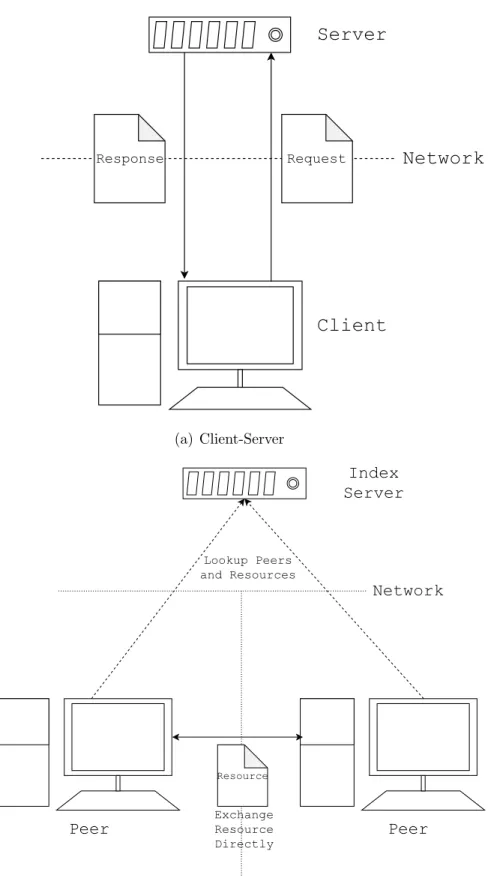
There are two different common types of network communication, Client-Server and Peer-to-Peer (P2P) (Fig. 2.1). In a Client-Server architecture (Fig. 2.1(a)), clients connect to a central server [78]. The central server controls access to informa-tion and clients exchange informainforma-tion by way of the central server. A Peer-to-Peer network architecture has clients called peers, who communicate directly with each other [78]. These peers must operate as both client and server in the network.
Network design and topology play key roles in the design of a P2P architecture. There are several models: centralized, pure, and hybrid. These designs have advan-tages and disadvanadvan-tages.
A centralized P2P model (Fig. 2.1(b)) uses an index server (also called a central server) to provide resource lookup for the network [67]. Clients search the index server to find peer resources and then contact the target peer in order to exchange data directly. Benefits of this system are ease of deployment and fast resource lookup. Drawbacks include a reliance on the index sever and limited scalability.
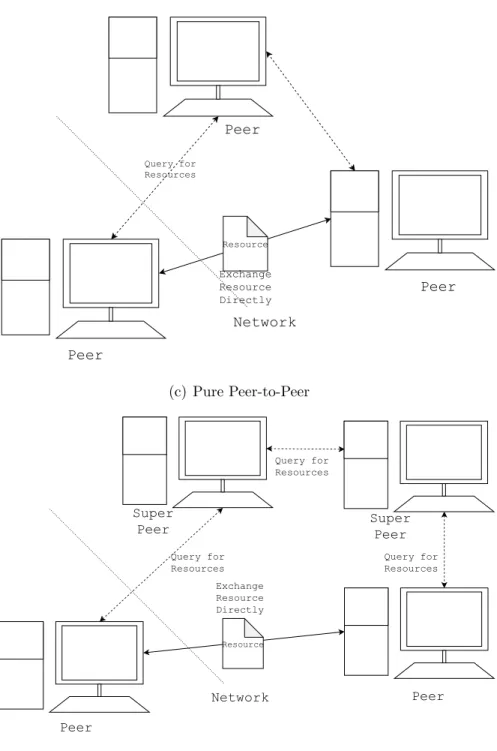
A pure P2P network (Fig. 2.1(c)) has no index server and clients must query other peers to discover resources [67]. To search for a resource, the client either floods the network with a query [67] or accesses a distributed hash table (DHT) [67, 78] maintained by the peers which lists the resources and owner. The primary benefit of a pure P2P system is an equal relationship among the peers, with peers sharing costs and resources fairly. However, drawbacks include slow lookup and high network complexity. Pure P2P networks such as Guntella [134] had issues with network traffic until the development of DHTs.
The hybrid P2P model (Fig. 2.1(d)) selects some peers in the network to act as supernodes [67]. Other peers connect to the network through these supernodes. Supernodes route peer messages to other supernodes who then deliver the messages. This design has a faster lookup than a pure model and is more resilient than the centralized model. However, the hybrid P2P model is difficult to implement. Skype prior to 2016 [151] used a hybrid P2P model [67].
Request Response
Server
Client
Network
(a) Client-Server Index Server Peer Network Peer Resource Exchange Resource Directly Lookup Peers and Resources (b) Centralized Peer-to-PeerPeer Network Peer Resource Exchange Resource Directly Peer Query for Resources (c) Pure Peer-to-Peer Peer Network Super Peer Exchange Resource Directly Peer Query for Resources Super Peer Resource Query for Resources Query for Resources (d) Hybrid Peer-to-Peer
There are three stages to P2P communication: accessing the network, connecting to peers, and searching for a resource. Each stage has challenges that the network design must overcome.
During the first stage when accessing the network, the peer has no initial knowl-edge of the network topology. A standard method to locate other peers is a signaling server. A signaling server has a predetermined location and holds a list of networked peers and their IPs. The client application queries this server for networked peers and attempts to connect to one of the peers using the peer’s IP. With IPV4, port forward-ing, and Symmetric Network Address Translation (SNAT), it is not always possible to connect directly to another peer. TCP Hole punching [146] and STUN/TURN protocols [94] can overcome these issues. The communication between the peers is usually a custom application protocol built on top of TCP or UDP. Once connected to the network, the peer can search for resources in the network. The lifecycle of a search varies according to the network topology. In pure and hybrid P2P models, the query can flood the network or access the DHT maintained by peers. In a centralized model, the client sends the query to the index server. The index server has a list of resources in the network and can direct the client to the owner. The client can then connect to the target peer and exchange the resource directly or by routing the data through the network.
P2P networks have several advantages over Client-Server architectures. P2P net-works are scalable [78]. Compute, network, and storage cost are shared by the peers and not concentrated in a single server. Lastly, P2P networks are resilient against network failure [67]. Despite interest in P2P networks, the architecture has several issues that limit its adoption. SNAT requires a third-party server to facilitate rout-ing of data between peers [94]. Moreover, peer-churn [78], where peers enter and leave the network, can lead to network degradation when too few peers are available. To counteract this, peers must be properly incentivized to remain in the network. Lastly, P2P file-sharing networks such as BitTorrent are heavy used to illegally share copyrighted works, which limits business support of P2P models [67].
2.2.1 Distributed Transactions
In a distributed network, transactions among peers takes the form of consensus. A distributed environment is unreliable, creating the need for a protocol that solves consensus in a bounded time2. The performance of a distributed system is measured
by its safety and liveness [7]. Safety means that an incorrect action does not occur, and liveness refers to the system’s ability to progress in state. Fischer, Lynch, and Paterson [48] proved that there is no protocol that satisfies both. The focus changes to providing a best effort protocol. Another issue with distributed systems is the reliability of the individual parts. Processes can lie or fail, an error called aByzantine
fault 3. A Byzantine fault can be malicious or as a result of a failure to follow the
protocol. In contrast, a Benign fault is a unintentional crash or message loss [25]. Ignoring the unreliability of the connection, Byzantine Fault Tolerance is possible but only if more than 23 of the peers are working correctly.
The simplest solution to consensus is to have a central server manage the state of the system [93]. The server is the global view of the system and acts as the synchro-nization between clients. Clients replicate the state of the server upon connecting and post updates to the server. The server checks the updates against its own internal copy and broadcast state updates periodically to the clients. This architecture is used in distributed simulations [93, 113]. This design provides some benefits. Incorrect ac-tions are not possible, and it does not assume client trust. Moreover, client failure does not block progress of the server’s state and thus the network. However, there are limitations with this centralized architecture. For instance, clients may need to repeat actions if they are out of date. Clients can keep up with the state of the system at the cost of a Round Trip Time (RTT) [78]. The central authority is a point of failure in the network and the design suffers from limited scalability. Modified P2P versions can remove this issue at the cost of safety [113].
3Consensus is commonly illustrated as the allegory of the two-general problem [55]. 3This is in reference to the allegory of the Byzantine General Problem [84].
The Two-Phase-Commit [55] protocol is a commonly used protocol for consensus in which clients post to a central authority.
• The authority asks if the clients want to commit • Clients post their messages and wait
• Authority verifies the transaction
• Authority broadcasts the commit to the Clients • Clients acknowledge the broadcast
This protocol is safe in most scenarios but is reliant on the central authority. If the authority fails the clients will never release their resources. The Three-Phase-Commit protocol builds on this protocol by adding a timeout to make the protocol nonblocking but with a loss of safety.
The Paxos algorithm [82] is a complex algorithm that guarantees safety and good liveness. The protocol uses periods called rounds, each with a ballot ID and 3 phases. On each round, a process or multiple processes can act as the leader. Each leader queries the other processes for their ballot ID. If the proposed leader has the highest ID then they are the leader for the round. The next phase has the new leader push a new value to the group. The group responds to the leader. If the leader receives a majority of the responses, called aquorum, it broadcasts to the group that the round is complete. Otherwise, the leader moves onto the next round. Paxos is noted for its cost and complexity to implement and variations have been proposed [83, 122]. Further it can only protect against Benign faults. A program that implements a variation of Paxos is Apache Zookeeper [66].
State Machine Replication (SMR) [81, 138] can provide protection against Byzan-tine Faults. A state machine is a computation model in which a machine executes actions to transform its current state. In SMR, each client runs a replica of the same state machine executing the same actions. When a byzantine failure occurs, as long as more than 3 healthy replicas of the faulted process exists [84], the system is fault tolerant. However, a naive implementation of SMR can fail to protect against Byzan-tine faults [25]. A ByzanByzan-tine Fault Tolerant system needs a replication algorithm with
proper creation, coordination, and verification. The first implementation of such a system was the Practical Byzantine Fault Tolerant (BFT) algorithm [25].
2.2.2 Blockchain
Blockchain is another architecture designed to solve Byzantine Faults. Unlike BFT replication protocols, it achieves its resiliency though hashing. Blockchain uses strong cryptography and Proof-of-Work (POW) [15] to provide an append only ledger [99] consisting of blocks. The proof-of-work prevents Byzantine faults by making network peers find cryptography hashes before committing transactions. These blocks are linked together by these hashes, making rewrites of the transaction tree increasingly difficult. Blockchains differ from BFT replication protocols. Though they both pro-vide protection against byzantine faults, Blockchains are open to new users while BFT systems need a prior verification. Blockchains are also more resistant to Sybil attacks, where an attacker directs a large number of hidden nodes to disrupt the sys-tem. High-profile Blockchain applications include the cryptocurrencies Bitcoin [111] and Ethereum [163].
Bitcoin [111] is a digital currency that uses a Blockchain to maintain a distributed record of transactions and owners ofbitcoins. The goal of the application is to provide a decentralized, secure, and anonymous method for exchanging assets. Each owner is identified by a public key. The coin’s value is tied to the market’s demand. Units of bitcoins can be transferred from one client to another by issuing a transaction to the network. The owner signs the transaction request with their private key. The system verifies the owner using the public key. Transaction requests are pooled together into blocks to be verified and appended to the ledger. Nodes in the network calledminers
verify a block by finding a hash of variable strength, a proof-of-work. After a hash is found, the block is added to the chain and the miner is rewarded a bitcoin for the proof-of-work. Bitcoin implements a stack-based language to support dynamic
transactions [85]. To prevent transactions from not completing, the stack language does not implement loops and is not Turing Complete 4.
Ethereum [163] is another cryptocurrency aimed at providing verified electronic contracts called smart contracts. It is similar in design to Bitcoin but has several key differences. One of Bitcoin’s issues is the hashing race between miners. Over time miners have upgraded from CPUs to GPUs to ASICs in order to increase their hashing output. This has contracted the market of miners, putting the network at-risk. To combat this issue, Ethereum’s block hashing algorithm was changed from SHA2 to an ASIC-resistant version of SHA3 [10]. To implement electronic contracts, Ethereum implements the Ethereum Virtual Machine (EVM) in place of Bitcoin’s stack language. EVM is Turing Complete, allowing arbitrary programs to execute on the network. To prevent programs from running indefinitely, each program is charged the cost of its execution steps. The verification of valid EVM programs has been hard to implement in practice [19].
Blockchain systems are difficult to evaluate. Cryptocurrencies such as Bitcoin and Ethereum have noted issues with high-transaction cost [79], illegal activities [31], and market-volatility [79, 129]. Furthermore, the word Blockchain is used to market alternative products. Hyperledger [148] is a series of industry-sponsored projects that are marketed as private blockchains. However, most of these projects are append-only BFT systems. An append-only BFT does not use POW and users are verified.
2.2.3 Applications of P2P Networks to Health Records
Both peer-to-peer and blockchain applications have been previously proposed. King [76] proposed a peer-to-peer PHR utilizing Blue Button Plus and FHIR. The system uses a client-server architecture and a series of subnetworks. Peers can
4A Turing complete language can approximate any Turing machine (an idealized computer), or equivalently, create any algorithm that can run on a Turing machine [87]. A Turing complete language does not comment on the difficulty of implementation or the computational cost of a target program. A non-Turing complete language has limitations in what programs can be represented and in the case of bitcoin, is purposefully chosen to prevent unsafe programs.
request access to a patient’s subnetwork. The architecture proposed in this thesis extends this previous work by providing full PHR functionality as well as integration with third-party service providers.
Roehrs [135] proposed a distributed PHR called OmniPHR. It uses the Chord algorithm to manage a series of encrypted blocks of health records over a set of peers. Each block is digitally signed. Each peer translates the records into open standards, distributes the blocks to peers, validates a peer’s blocks, and manages communication between peers. Roehrs tested the system’s network dynamics by increasing the number of nodes and “backbone” routers. He found that the Chord algorithm scaled with the number of peers and did not have increased latency. Roehr’s system is similar to the PHR proposed in this thesis. However, Roehrs is focused on the performance analysis of the Chord algorithm. The focus of this thesis is on the functionalities needed to facilitate interactions between patients and health providers. Xia [167] proposes a cloud-based health record sharing system that uses a Blockchain style ledger to track transfers of health records. Peers upload health record data to a shared cloud repository. Peers request and grant access to records through a trans-action. A node selects transactions and computes a proof-of-work hash. After the proof-of-work is completed, the request is granted. An exchange protocol is then used to access the shared repository. This system benefits little from the Blockchain solution. Another issue of this solution is that data is stored off chain which removes the benefit of a Merkle tree [100]. Indeed, the transactions and hashes of the data are increasingly secure, but the data itself is not. The participants of the network need to trust the hash of the data and cannot verify it until reading, at which point it could be corrupted.
Urovi [155] proposed a Peer-to-Peer framework to exchange records across HIEs and the use of semantics to enable dynamic queries. The study explores integrating the Swiss healthcare system without reliance on a central authority. The model has a few limitations. For example, a provider needs predefined knowledge on where target records are stored and changes to a record are not propagated to providers.
Com-munication is based on a tuple space architecture called TuCSoN [121], a derivative of Linda [51]. A tuple space is a distributed shared memory programming paradigm that creates a series of shared objects between parties called tuples. The TuCSoN triple store ontology was modeled in OWL. This allowed the distributed objects to be defined and resolved at runtime. The underlying P2P architecture is a pure model that uses TOM P2P [21], a Kademlia DHT, for resource discovery. Each node, called a community, contains a replica of the tuple primitives with agents reacting to tu-ple changes. The imtu-plementation consists of three basic agents: log, update, and search. For each community, a single coordinator called a Policy Tuple Center is used to meditate the tuple actions. The available actions included connect, subscribe, and search. The system could query the network for a resource and then use the network’s response to access the record. The agents could also respond to network requests. Three types of subscriptions were modeled: events, service changes, and policy changes. The implemented model was tested on Amazon cloud. The net-work’s search complexity was in line with theoretical estimates but experienced extra latency as more communities subscribed. Overall, the use of tuple space offers a flexible distributed programming model whose definitions can be injected at runtime. However, several issues have been overlooked. For example, consensus, security, and data representation of current health domain ontologies have not been addressed.
2.3 Application Layer Protocol
Peer-to-peer networks are application protocols built on top of the transport layer of the OSI model [78]. Programs exchange data in the application layer in a known format and exchange pattern. Example application layer protocols are HTTP [46, 78] and FTP [78, 131]. The underlying transport layer delivers packets between appli-cations. There are two common methods for packet delivery in the transport layer, TCP and UDP.
TCP is a connection-oriented protocol between a client and a server [8, 78]. It provides error-corrected and in-order delivery of packets. TCP provides a guarantee of the delivery of a message. A connection under the TCP protocol is a safe and reliable method to transfer data, at the cost of increased overhead.
UDP is a connection-less protocol [78, 130]. The sender sends packets to the re-ceiver in a best-effort approach. The protocol cannot guarantee the arrival of a packet. The application protocol must re-request missing packets. The receiver verifies the packets with a checksum. This makes UDP suitable for real-time applications where low latency is a priority. It is up to the application layer to provide any additional guarantees.
2.4 EHR Datamining
Predicting a patient’s future medical conditions is beneficial to patients, providers and the healthcare system. Patients can take proactive measures to prevent con-ditions, providers can recommend tests to perform, and the healthcare system can plan for future health needs. Identifying at-risk patients before conditions occur can lower the cost of medicine and saves lives. Current clinical research uses either randomized trials [32, 75] or cohort studies [32, 33, 96] to understand conditions and symptoms. This supports the approach of diagnosing patients by domain experts and Computer-aided Diagnosis (CAD) [39]. However, these methods are expensive, difficult to design, and suffer from selection bias [32, 75, 96].
Health providers have generated millions of patient records. Providers primarily use these records to treat patients and create workflows. This collection is valuable as it contains detailed health information for a population of patients rather than a small group. Researchers have proposed to use this wealth of data for the secondary purposes of clinical research, prediction systems, and clinical decision systems [34, 70, 108]. Present research into EHR datamining has had mixed results due to varying quality, encoding differences, and missing data [60, 159]. Researchers have proposed
the standardization and quality assessment of EHR data to overcome these issues [17]. Despite the problems with mining EHR repositories, researchers have conducted several large-scale studies [102]. They have used a variety of methods, such as Neural Network, Bayesian Statistics, Trees, and K-Nearest Neighbor [169]. However, medical institution control of the research data [90] makes evaluating these studies difficult.
Yadav [169] surveys the current research in EHR datamining. Applications of EHR datamining include: medical trajectories, cohort studies, risk prediction, intervention modeling, clinical guidelines, and detecting adverse events. Each of these applications have varying levels of implementation difficulties, with intervention modeling being notably difficult. EHRs contain three forms of health data with decreasing structure: structured, workflows, and clinical notes. Issues with EHR data include: difficulty in extraction, unobserved data, data fragmentation, bias, and irregular data.
Several recent papers propose utilizing Neural Networks to mine EHRs. Recent Neural Network approaches focus on many nested hidden layers of “neurons” to ap-proximate complex functions. Given enough data, neural networks show a good performance on a variety of health modeling problems. Miotto et al. [102] and Trang et al. [128] approach EHR datamining from an unsupervised perspective with Neural Networks.
Miotto et al. [102] presents a large-scale study using Stack Denoising Autoencoders (SDA) and Random Forest to diagnose conditions such as diabetes, congestive heart failure, and schizophrenia. The authors choose autoencoders to counteract noise in EHR data and create a reduced representation of the patient records. The study used a heavily processed EHR repository of 700,000 patients. The authors annotated the dataset with the Open Biomedical Annotator [72] and extracted topics from clinical notes using regular expressions and Latent Dirichlet Allocation. EHR data needs heavy preprocessing to achieve good results [102] and the reduction of the feature space is key as EHR data has thousands of sparse features.
Trang et al. [128] proposed modeling a chronic patient’s long-term outlook using Long Short-Term Memory (LSTM) neural networks. A LSTM is a variation of Re-current Neural Network in which nodes store internal lossy data to replicate memory. The authors used a modified LSTM to model long term health trends and improve on methods like Hidden Markov Model for chronic conditions [128]. The authors trained and tested the LSTM with 12 years of EHR data comprising two datasets, with each dataset covering approximately 12,000 patients and 53,000 hospital admissions. The authors noted that the model struggled with patients who had small records.
2.4.1 Predictive Models and Bayesian Statistics
In this thesis, a Bayesian model is used to demonstrate predictive medical diag-nosis as a service. Bayesian Statistics are probabilistic methods that model systems using Bayes theorem [125]. Bayes Theorem (Eq. 2.1) is used to infer the probability of events based on prior observations. These methods can be classifiers or generative models.
P(Outcome|Data) = P(Data|Outcome)P(Outcome)
P(Data) (2.1)
where: [P(Outcome|Data)] is the Posterior, [P(Data|Outcome)] is the Likelihood, and [P(Outcome)] is the Prior.
The simplest approach is Naive Bayes [136]. Naive Bayes is a classifier that models a set of features as random variables (RV) with the “naive” assumption that each is conditionally independent (Eq. 2.2). This simplifies learning and the inference process. Naive Bayes can perform well despite this simplification [136] and is used heavily in text mining [141].
P(C, En) =P(C)Y
i
P(Ei|C) (2.2)
Another approach is Bayesian Network. Bayesian Network are Directed Acyclic Graph (DAG) with nodes representing RVs [136]. The space modeled is the joint distribution of the RVs but in a compact form. A connection between nodes indicates conditional dependency. The combined connections and probabilities create a model of the system representing interrelated events and their probabilities. By using Bayes Theorem and the graph structure, a query can traverse the network to infer the conditional probabilities of events given evidence. Bayesian Networks have advantages over Naive Bayes. The structure intuitively models the relationships between features and can represent complex models with conditional dependencies. Moreover, experts can use domain knowledge to define the graph structure, thereby bootstrapping the network. This is helpful as deriving the graphical structure of the Bayesian Network is otherwise NP-Hard [136].
Inferencing, computing the probabilities of an event given data, in complex Bayesian models is NP-Hard [136]. To overcome this issue, models can be trained using Ex-pectation Maximization (EM) [136], Gibbs Sampling (a variation of Markov Chain Monte Carlo) [136], or Variational Methods [73]. The EM algorithm iteratively finds the probability distributions but can converge to local optima. Gibbs Sampling and Variational Methods use randomization or optimization techniques to approximate the distributions in order to avoid converging to a local optima.
2.4.2 Bayesian Applications to EHR Datamining
Lucas et al. [91] presents a review of Bayesian Networks for medical diagnosis. The representation of probabilistic knowledge as a graph creates a formalism that mirrors how medical domain experts see cause and effect relationships. It is an intuitive model, with easy to understand relationships and probabilities. Clinical experts can bootstrap the model allowing the application of prior diagnoses knowledge. Lucas demonstrates a theoretical application of Bayesian Networks to diagnose ventilator-associated pneumonia.
Sexias et al. [143] proposes using Bayesian Networks for Clinical Decision Sup-port Systems targeting Dementia, Alzheimer’s, and Mild Cognitive Impairment. The authors reviewed similar CDSSs that used Bayesian Network, Neural Networks, and Multiple Criteria Decision Analysis. The study used 1,804 patient neuropsychological tests from four institutions for the dataset. The authors also used Synthetic Minority Over-sampling Technique (SMOTE) [30] to balance the dataset. Another process-ing step was the removal of attributes not related to diagnosis and records missprocess-ing values. An expert predefined the network structure. The expert noted that several features that were removed for low counts were highly relevant to the classification. The authors generated five Bayesian Networks using the Waikato Environment for Knowledge Analysis (WEKA) software [57] along with the GeNIe Modeler and SMILE Engine [41]. The Bayesian Networks used a three-level template and the Dirichlet Distribution for the nodes. The expert-defined Bayesian network outperformed the auto-generated Bayesian Network but had similar performance to other methods. This study shows the benefit of using an expert to bootstrap the network.
Other approaches use Dynamic Bayesian Network (DBN) to account for time. Dynamic Bayesian Network are a generalization of Bayesian Networks and Hidden Markov Model that can model a system over time. Nachimuthu et al. [110] used DBNs to predict sepsis, a rapidly progressing condition in Intensive Care Units (ICU). The authors chose DBNs to account for the increase in evidence over time in an ICU. The study used 3,100 patients from an Intermountain Healthcare ICU dataset. The data was skewed towards control patients by 4 to 1 and was in various unstructured formats. The researchers extracted lab and vital signs for the first six hours. To reduce sparseness, the researchers aggregated the data to 1-hour intervals. The authors did not remove records with missing data and all variables were discretized. The input space to the model was a set of time increasing vectors of clinical data and observations for each patient. A physician labeled the data for sepsis diagnosis. The researchers created the DBN using Projeny, a front end to MATLAB’s Bayes Net Toolbox, and trained the network using the EM algorithm. The DBN structure was defined by
the researchers and used two time slices. Overall the network performed well, with all performance measures improving over time. Despite the promising performance, this study does have limitations. The authors noted that missing data prevented the diagnosis of specific types of sepsis such as septic shock.
Xu et al. [168] propose using a Hierarchical Bayesian Non-Parametric (BNP) to model patient’s responses to treatment. Patients have varied responses to treatments over time which motivated Xu to consider BNPs. The stated novel aspects were a continuous response over time, flexibility in modeling, and probability estimates at the patient level. The paper notes that longitudinal EHR data has the “time-varying confounding issue”, where treatments are present at a higher rate in sicker patients. This creates the impression that treatment caused the condition. Xu used the G-computation formula as a guide for creating the BNP. The dataset consisted of EHR time series data of 123 patients from the Boston Beth Israel Deaconess Medical Cen-ter. The patients averaged a 20.75-day stay and totaled 6,992 observations. The BNP modeled the patient’s kidney function in response to Ischemic Heart Disease treat-ments and Continuous Renal Replacement Therapies. The authors trained the model using Gibbs Sampling and Metropolis-Hastings, another MCMC method. Results were measured with Root Mean Squared Error (RSME) for Creatinine (a measure of renal health) and compared against baseline responses from the model using different distributions. The model performed well against fully and partially observed data. Overall, this paper presents interesting ideas related to modeling noise, using BNPs for time series data, and the issue of cause and effect in longitudinal data. Gaps in this paper were the failure to examine the scalability of the BNP method and effects of the small population size on the produced results.
2.4.3 EHR Datasets
Current EHR repositories have known issues with quality and sparseness. Weiskopf et al. [158] and Hersh et al. [60] reviewed the quality of EHR data. Weiskopf [158] examined 3.9 million patient records from the New York Presbyterian Hospital for completeness. The study tested records for documentation, breadth, number of visits, and predictive quality using logistical regression. The authors found that clinical notes increased after EHR adoption. Many records were sparse, only 45% included diagno-sis and 13% included medication. The repository had limited longitudinal value, only 23% of the records had 5 follow-up visits after the initial visit. The author concludes that only 0.6 % of the records are complete but recommends not generalizing the re-sults to other hospital systems. Hersh [60] summarized the EHR issues from multiple studies. The author found common themes of inaccurate data, incomplete records, poor semantic encoding, data unrecoverable for research, unknown provenance, insuf-ficient granularity, and incompatibility with research protocols. Both authors paint a dim outlook on using EHR data for clinical research. Moreover, Hersh [158] notes the limited usefulness of the International Classification of Diseases Revision 9 Clinical Modification (ICD-9-CM) [112] for studies.
The Health Insurance Portability and Accountability Act of 1996 (HIPAA) pro-tects patient medical records from unauthorized access [156]. The majority of the reviewed literature on EHR datamining used a restricted dataset provided by a hos-pital. Yadav et al. [169] mentions that large scale studies before EHRs, used insurance claims data. Several open datasets target single conditions. Delen et al. [38] used the Surveillance, Epidemiology, and End Results Program (SEER) for predicting breast cancer survival rates. However, SEER is not a substitute for an EHR as it only covers cancer statistics in the United States. Xu et al. [168] used an open ICU EHR dataset, however, it does not include long term changes.
The Medical Expenditure Panel Survey (MEPS) [4] is a yearly survey of house-holds by the Agency for Healthcare Research and Quality (ARHQ). ARHQ’s goal is
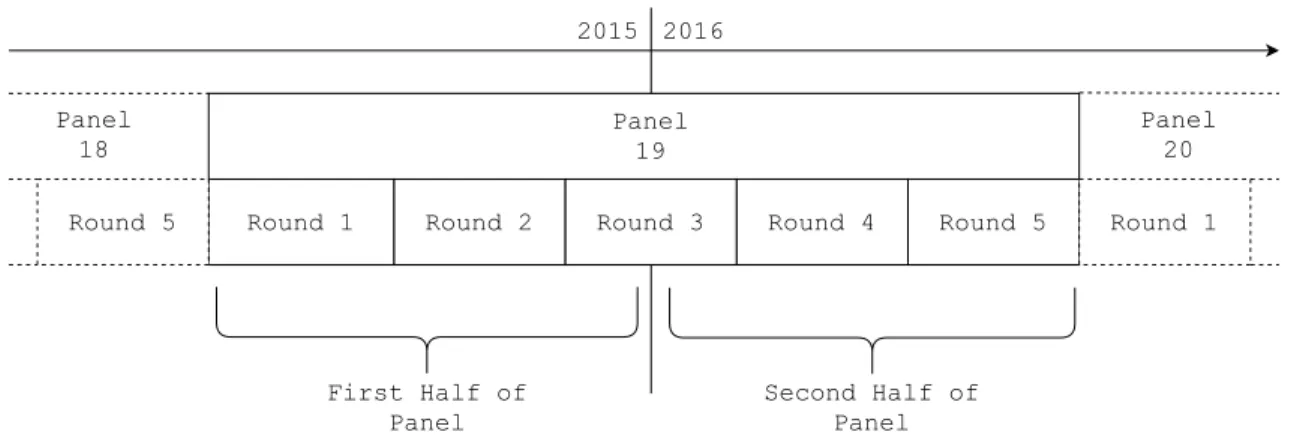
to survey current patient healthcare in the United States. In each survey, ARHQ asks households questions about conditions, providers, costs and medication. Each survey group is followed over a two-year period termed apanel with questions over 5 rounds (Fig. 2.2). There are currently 20 panels available, starting from 1996. Each panel includes approximately 15,000 households with a subset of the previous year’s respondents carried over. ARHQ warns that MEPS data is missing values, which affects the overall quality of the data. For example, in Panel 19, only 50% of the participants responded. ARHQ made attempts to address this issue by altering the survey design but the result is inconclusive. The questions and recorded information vary over the years.
ARHQ hosts the surveys online and provides the data files in SSP and fixed length format. Each survey is by year with two active panels per year [6](Fig. 2.2). ARHQ groups the information by household and event components. The household component covers survey questions while the event component tracks patient reported medical events. The household component contains tables covering topics such as con-ditions and medications. The link between the tables is the respondent’s DUPERSID, a concatenation of the respondent’s ID and the household ID.
Round 1 Round 2 Round 3 Round 4 Round 5 Panel 19 Panel 18 Panel20 Round 1 Round 5 2015 2016 First Half of
Panel Second Half ofPanel
3. ARCHITECTURE
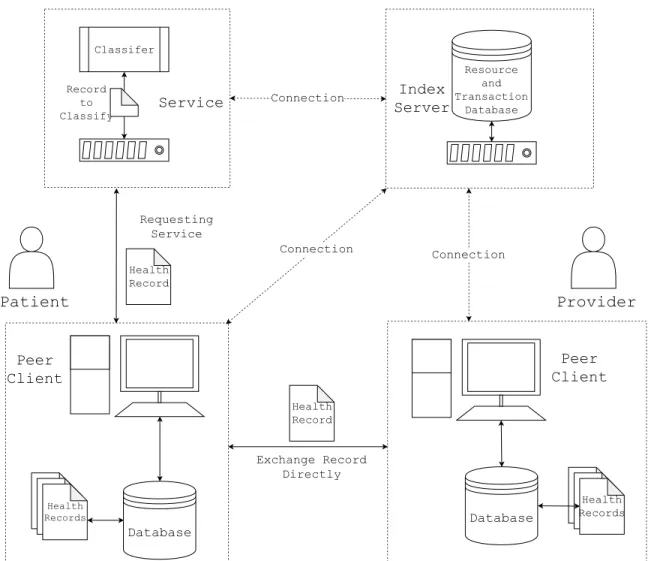
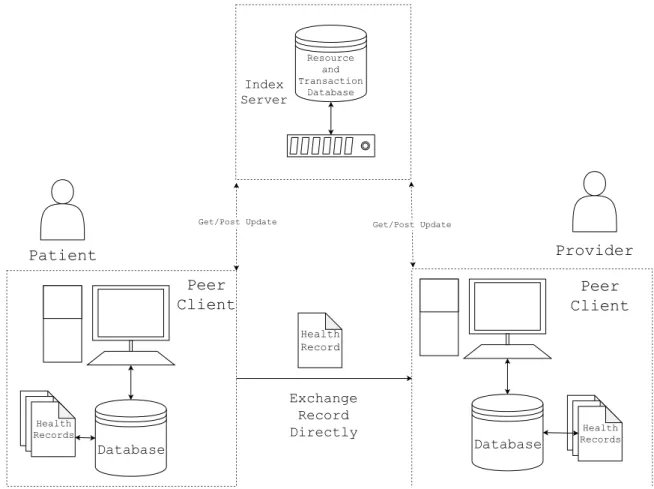
The architecture (Fig. 3.1) of the proposed system is a centralized Peer-to-Peer model, consisting of: an index server, a peer client, and registered network services. The peer client is an application with a Graphical-User-Interface (GUI) for patients and providers to manage health records and interact with the network. The index server controls network access and provides resource lookup for the peers. Once con-nected to the network, a peer can post document metadata and request transactions. The target peer can then authorize the transaction. Peers periodically pull autho-rized transactions from the network. A peer carries out the transaction by directly contacting the target peer.
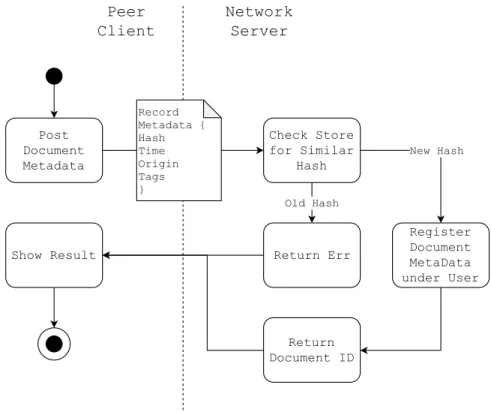
The user stores their health records on their own computer. Each new record has associated metadata (Fig. 3.2). The metadata includes the origin, creation time, and a SHA256 [9] hash of the data to establish its uniqueness. It is this metadata that is uploaded to the network for discovery, not the underlying record. Access is only granted by following the established transaction protocol and with the approval of the owner. This makes the user in control of their health records and the system a Personal Health Record.
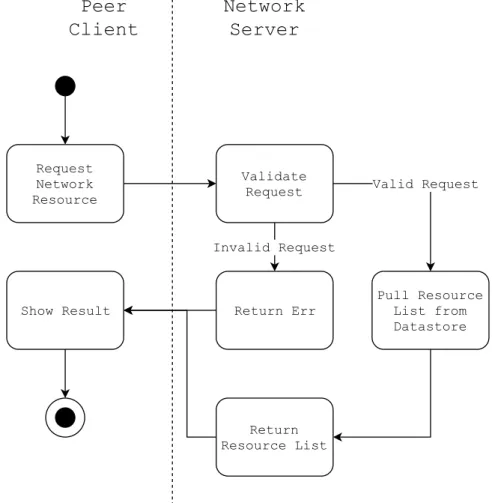
The index server manages the network for the peers and performs the signal-ing, signup and lookup services for the network. This centralized model tracks the registered users, peer IP addresses, documents, transactions, and services.
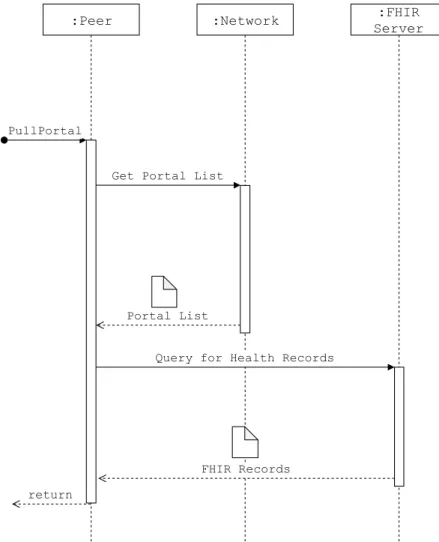
Patients and Providers use the peer client to register in the network, login, manage local health records, lookup documents and services, upload records into the network, and issue requests for transactions. In addition, the client operates a P2P client-server subsystem to carry out approved transactions.
A service client is a special peer client for network services. Regular peers can request these services, which are logged and carried out as transactions. The service