by
Daryl Wade Swanepoel
Thesis presented in fulfilment of the requirements for the degree of Master of Public Administration in the Faculty of Economic and Management Sciences at Stellenbosch
University
Supervisor: Dr Firoz Khan
ii
DECLARATION
By submitting this thesis electronically, I declare that the entirety of the work contained therein is my own, original work, that I am the sole author thereof (save to the extent explicitly otherwise stated), that reproduction and publication thereof by Stellenbosch University will not infringe any third-party rights and that I have not previously in its entirety or in part submitted it for obtaining any qualification.
Copyright © 2018 Stellenbosch University All rights reserved
iii
Abstract
The South African Department of Small Business Development (DSBD) facilitates small and micro-enterprises’ (SME) participation in trade exhibitions abroad, using Trade and Investment South Africa (TISA) as implementing agent. In this way, it intends to help SMEs succeed in the export market.
This research primarily aimed to assess the public value derived from expending taxpayer resources on these endeavours. Public value was assessed in terms of (i) contribution to the SMEs’ growth in export turnover, and (ii) development of the SMEs’ export capacity. A secondary examination was devoted to (i) the role of export-readiness selection criteria in the success or failure of the outbound trade missions programme for SMEs, and (ii) searching for alternative export promotion techniques that may augment DSBD’s current practices so as to create greater public value.
Twenty SMEs who had participated in TISA-organised national pavilions abroad from 2014 to 2016 were selected. To address the primary research question, data was obtained through personal interviews with the enterprises. Enterprise Ireland’s export-readiness checklist provided the basis for determining the degree of improvement in these SMEs’ export capabilities pre-mission to post-mission.
Moving to the secondary study, the widely supported characteristics of an export-ready
SME as defined by Pickernell (2016) were used as a benchmark to assess DSBD’s
criteria for enlisting SME participation. In search of possible alternatives for DSBD to consider, a literature search and subsequent study visits were conducted.
Regarding export growth, the research found that reasonable public value was derived as a result of the SMEs’ participation in the national pavilions. When including SMEs’ own efforts, public value improved considerably. However, in terms of improving the SMEs’ export capabilities, the research revealed complete public-value failure on the part of DSBD/TISA, as no improvement could be ascribed to their efforts.
On the question of selection criteria, the research confirmed the validity of the Pickernell characteristics, having – for the most part – been present in all but one of the enterprises that had registered material export growth. On the other hand, enterprises that had failed to register exports, also failed to display the Pickernell characteristics. Whilst there was near perfect compliance in TISA’s adherence to its own selection criteria, TISA set very low standards compared to those of Pickernell.
iv
In searching for alternative models for DSBD to consider, the study discovered six internationally proven export promotion techniques. All six contain elements that could help address the identified deficiencies in DSBD/TISA’s current practices.
The research concludes with a number of recommendations aimed at enhancing DSBD’s offering and the public value it creates. These include the continuation of national pavilions, though with added measures to support enterprises with the proven ability to generate export sales. It is also recommended that TISA’s selection criteria be aligned with the Pickernell characteristics, and that their exhibition selection methodology be revised. Finally, DSBD would be well advised to augment their current practices with a more holistic SME export promotion technique, for which a concept is provided to aid further in-depth research, modelling and testing.
v
Opsomming
Die Suid-Afrikaanse Departement van Kleinsakeontwikkeling (DSBD) fasiliteer klein en mikro-ondernemings (KMO’s) se deelname aan handelskoue oorsee, met Trade and Investment South Africa (TISA) as implementeringsagent. Sodoende wil DSBD dié ondernemings die uitvoermark suksesvol help betree.
’n Primêre oogmerk van hierdie navorsing was om te bepaal hoeveel publieke waarde geskep word deur belastingbetalersgeld aan hierdie inisiatiewe te bestee. Publieke waarde is gemeet aan die hand van (i) die bydrae tot groei in die KMO’s se uitvoeromset, en (ii) die ontwikkeling van die KMO’s se uitvoervermoë. ’n Sekondêre ondersoek is gewy aan (i) die rol van uitvoergereedheidskriteria in die sukses of mislukking van die uitwaartse handelsendingsprogram vir KMO’s, en (ii) ’n soektog na alternatiewe uitvoerbevorderingstegnieke ter aanvulling van DSBD se huidige praktyke ten einde groter publieke waarde te skep.
Twintig KMO’s is gekies wat van 2014 tot 2016 aan TISA-georganiseerde nasionale uitstallings oorsee deelgeneem het. Om die primêre navorsingsvraag te ondersoek, is data deur persoonlike onderhoude met die ondernemings bekom. Enterprise Ireland se kontrolelys vir uitvoergereedheid het die grondslag gebied om te bepaal in watter mate hierdie KMO’s se uitvoervermoëns van voor tot ná hulle deelname verbeter het.
Vir die sekondêre studie het Pickernell (2016) se kenmerke van ’n uitvoervaardige KMO, wat wyd ondersteuning geniet, as rigpunt gedien vir die beoordeling van die kriteria waarvolgens DSBD ondernemings vir deelname kies. In die soeke na
moontlike alternatiewe wat DSBD kan oorweeg, is ’n literatuurstudie en
daaropvolgende buitelandse studiebesoeke onderneem.
Met betrekking tot uitvoergroei bevind die navorsing dat redelike publieke waarde
geskep is na aanleiding van die KMO’s se deelname aan die nasionale uitstallings.
Wanneer groei weens KMO’s se eie pogings ingesluit word, verbeter publieke waarde aansienlik. Wat die verbetering van KMO’s se uitvoervermoë betref, toon die navorsing egter dat DSBD/TISA geheel en al misluk het om publieke waarde te skep omdat geen verbetering aan hulle pogings toegeskryf kon word nie.
Op die vraag oor keuringskriteria bevestig die navorsing die geldigheid van die Pickernell-kenmerke, wat op een uitsondering na grotendeels teenwoordig was by al die ondernemings wat beduidende uitvoergroei aangeteken het. Daarteenoor het
vi
ondernemings wat nié uitvoere kon bewerkstellig nie, ook nie oor die Pickernell-kenmerke beskik nie. Hoewel TISA se voldoening aan hulle eie keuringskriteria byna foutloos blyk te wees, stel hulle uiters lae standaarde vergeleke met dié van Pickernell.
Om DSBD van alternatiewe modelle vir moontlike oorweging te voorsien, stel die studie ses internasionaal bewese uitvoerbevorderingstegnieke voor. Elk bevat elemente wat die geïdentifiseerde tekortkominge in DSBD/TISA se huidige praktyke kan help oorbrug.
Die navorsing sluit af met ’n aantal aanbevelings ter versterking van DSBD se aanbod en die publieke waarde wat dit skep. Dít sluit in die voortsetting van nasionale uitstallings, dog met bykomende maatreëls ter ondersteuning van ondernemings met die bewese vermoë om uit te voer. Daar word ook aanbeveel dat TISA hulle keuringskriteria met die Pickernell-kenmerke versoen, en hulle metodologie vir die keuse van skoue hersien. Laastens is dit gerade vir DSBD om hulle huidige praktyke met ’n meer holistiese uitvoerbevorderingstegniek vir KMO’s aan te vul, waarvoor hierdie navorsing ’n konsep voorsien om verdere diepgaande studie, modellering en toetsing te ondersteun.
vii
Acknowledgements
I would like to thank the many individuals and institutions that have availed themselves to make this study a reality: the representatives of the enterprises and institutions that formed part of the research, the Department of Trade and Industry, the Japan External Trade Organisation, and the Embassy of the Federal Republic of Germany.
I would also like to register my appreciation to the broader administrative and academic staff of Stellenbosch University’s School of Public Leadership for their collective support and guidance. In particular, I express my indebtedness to Dr Firoz Khan, my supervisor, who deserves special mention for his forthright guidance and resolute motivation.
My soulmate, Hendrien, thank you for your professional input, patience, sacrifice and unwavering support.
Finally, I am thankful for the divine guidance that I relied on and abundantly received in completing this task.
viii Table of contents Declaration ... ii Abstract………...….…. iii Opsomming……….………. …….. v Acknowledgements ………..……vii
List of tables……….……….…….…….. xiv
List of figures……….………....…. xvii
List of abbreviations………...…xviii
Chapter 1: Introduction ... 1
1.1 Background ... 1
1.2 Research problem and objectives ... 3
1.3 Research questions ... 4 1.4 Research design……….….…...……….5 1.5 Research methodology………6 1.5.1 Research subjects……….7 1.5.3 Data collection ... 7 1.5.4 Data analysis……….8 1.5.5 Ethics ... 9 1.6 Outline of chapters………...9
Chapter 2: Public value and promoting exports for SMEs: a literature review ... 10
2.1 Introduction ... 10
2.2 Theory and application of public value...13
2.2.1 Understanding public value ... 13
2.2.2 Measuring public value ... 14
2.2.3 Recognising public value ... 15
2.3 International trade: meaning, theories, benefits and the role of government ... 17
2.3.1 Meaning of international trade ... 17
ix
2.3.3 Creating public value: the benefits of international trade ... 20
2.3.4 Models of internationalisation ... 22
2.3.5 International trade: the role of government in supporting exports ... 23
2.4 SMEs in the export market ... 26
2.4.1 SMEs and their potential contribution to national exports ... 26
2.4.2 Barriers to SME export market entry ... 28
2.4.3 Characteristics of successful exporting SMEs ... 31
2.5 Alternative mechanisms for promoting SME exports ... 33
2.5.1 Subcontracting……….33
2.5.2 Working with trading companies.………...……….……….34
2.5.3 Chambers abroad………...……34
2.5.4 Specialised export-sector-focused promotion activities………35
2.5.5 SME Service Centre of Wantran……….……….…………36
2.5.6 Dongguan Commodity South Africa Display Centre/South Africa Commodity Dongguan Display Centre……….….……….36
Chapter 3: A review of South African legislation and policy ………...388
3.1 The National Development Plan ... 388
3.2 The Industrial Policy Action Plan ... 388
3.3 National Small Business Act ... 39
3.4 The Integrated National Export Strategy ... 400
3.4.1 The third objective of INES: increasing export capacity and strengthening exporter performance through the NEDP………...40
3.4.2 The fourth objective of INES: strengthening the export promotion mechanisms through enhancing South Africa's value proposition……….….……….41
Chapter 4: Research design and methodology………...43
4.1 Introduction……….….43
x
4.3 Identifying data requirements and measuring performance on export growth,
export capacity and export-readiness selection criteria……….…….45
4.3.1 Measurement 1 - SME export growth……….….46
4.3.2 Measurement 2 - development of SME export capacity………...50
4.3.3 Measurement 3 - assessing DSBD's export-readiness selection criteria….….56 4.4 Identifying data requirements on potential alternative export promotion techniques………..…69
4.5 Identifying other-source data requirements……….….….…71
4.5.1 Participating enterprises' data………..………71
4.5.2 TISA selection policy……….…….72
4.5.3 Financial expenditure relating to the export promotion missions ..….…………72
4.6 Collecting the data: content and design of interview questionnaires………….…72
4.6.1 Enterprise interview questionnaire……….73
4.6.2 Interview guide in relation to alternative export promotion techniques……....74
4.6.3 TISA interview guide………..….….74
4.7 Limitations………74
4.8 Ethical considerations……….….….75
4.9 Conclusion….……….….75
Chapter 5: Findings in relation to the creation of public value and the role of export-readiness selection criteria………..…78
5.1 Introduction……….……….…78
5.2 Results relating to SME export growth……….….….79
5.3 Results relating to the development of SME export capacity……….….84
5.4 Results relating to DSBD's export-readiness criteria………86
xi
5.4.2 Step 2: Assessing compatability between SME characteristics and Pickernell
characteristics………..….…88
5.4.3 Step 3: Defining the fit……….……..89
5.4.4 Step 4: Ascertaining compatability between TISA selection criteria and Pickernell characteristics.……….….…..…90
5.4.5 Step 5: Assessing DSBD/TISA's adherence to own selection criteria…...96
5.5 Conclusion………...…97
Chapter 6: Exploring alternative SME export promotion techniques ………...99
6.1 Introduction……….…99
6.2 Japanese discipline……….100
6.2.1 Indirect exporting through subcontracting………101
6.2.2 Trading houses, or the "sogo shosha"……….…..….………..105
6.3 German precision……….114
6.3.1 Specialised export-sector-focused promotion activities……….…....114
6.3.2 German Chambers Abroad Network……….118
6.4 Chinese pragmatism………123
6.4.1 Embracing the e-commerce era: SME Service Centre of Wantran……….….123
6.4.2 Dongguan Commodity South Africa Display Centre/South Africa Commodity Dongguan Display Centre……….... 128
6.5 Conclusion……….133
Chapter 7: Analysis and discussion of findings………...………..135
7.1 Introduction………135
7.2 Analysis and discussion of findings relating to export growth………...…...135
7.3 Analysis and discussion of findings relating to the development of export capacity………...…...….……….138
xii
7.4 Correlation between the performance of subject enterprises and their
export-readiness……….….…142
7.5 Analysis and discussion of findings relating to DSBD/TISA's export selection criteria………...……...….154
7.6 Analysis and discussion of findings relating to national pavilion selection………..……….155
7.7 Identifying the shortcomings in the current export promotion programme based on discussion and analysis of findings………...….156
7.8 Analysis and discussion of findings relating to the identified alternative techniques………...157
7.9 Conclusion……….….…….….162
Chapter 8: Conclusions and recommendations……….….…...…...165
8.1 Introduction……….….….165
8.2 Conclusions………...………...165
8.2.1 On promoting export growth………166
8.2.2 On developing export capacity………...167
8.2.3 On DSBD's selection criteria………..……….……168
8.2.4 On TISA's choice of exhibitions……….….169
8.2.5 On the applicability of the alternative export promotion techniques explored 170 8.3 Recommendations………...171
8.3.1 With regard to promoting export growth………171
8.3.2 With regard to developing export capacity………172
8.3.3 With regard to DSBD/TISA selection criteria………172
xiii
8.3.5 With regard to augmenting the current export promotion offering - imagining a new, holistic model………...173
8.3.6 Conclusion……….180
References………..…181
Annexure A: Enterprise interview questionnaire………192 Annexure B: Checklist for testing an enterprise's export-readiness: individual enterprise analysis……….….200
xiv
List of tables
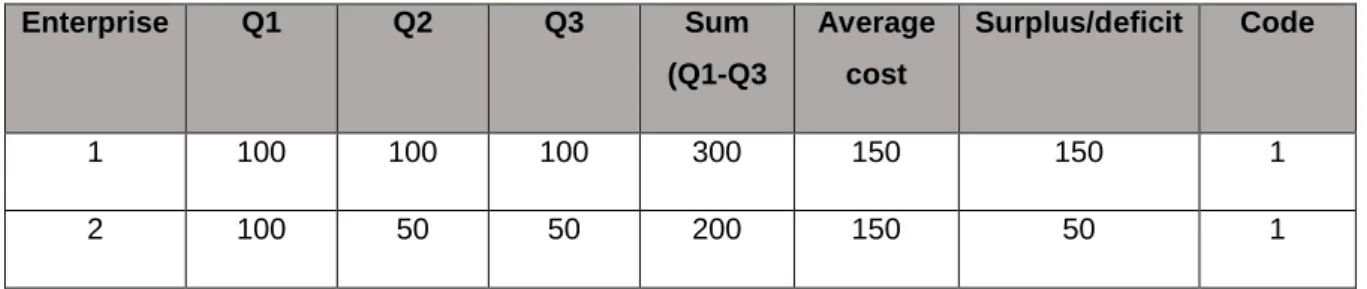
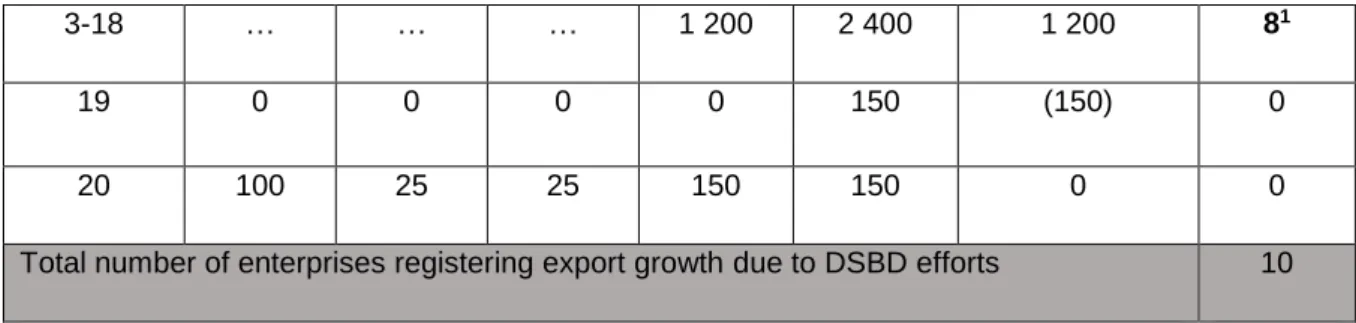
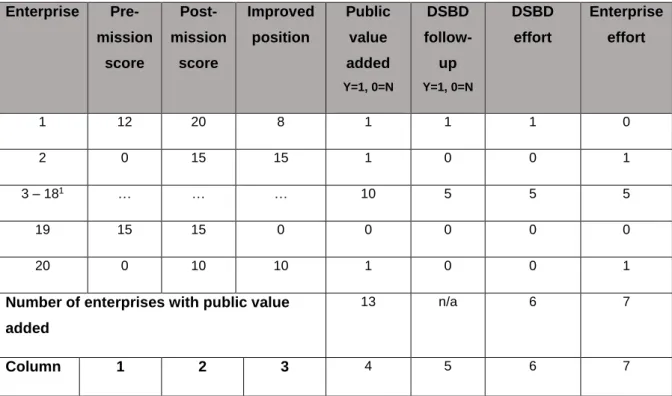
Table 4.1: Table designed to analyse public value added as represented by export
growth due to DSBD efforts….….………47
Table 4.2: Measure of success in creating public value through export growth………48
Table 4.3: Table designed to analyse public value added as represented by export growth due to enterprises’ own efforts……….……….….49
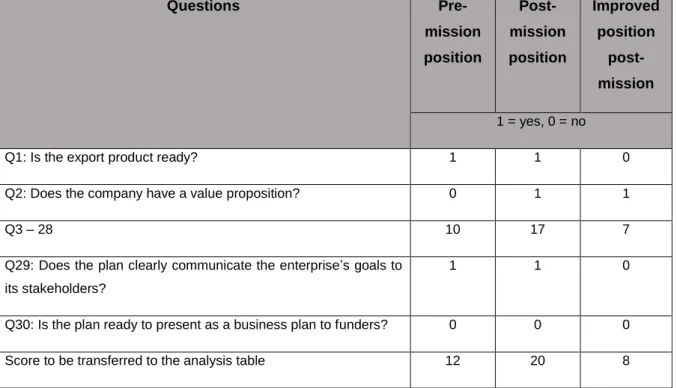
Table 4.4: Calculation of pre-mission and post-mission export capabilities score.….54 Table 4.5: Table designed to analyse public value added with regard to export capacity development……….….55
Table 4.6: Measure of success in creating public value through export capacity development………...………...55
Table 4.7: Research findings that support Pickernell and colleagues’ characteristics of an export-ready SME………...….61
Table 4.8: Classification of enterprises by turnover……….62
Table 4.9: Classification of enterprises by number of employees………. 63
Table 4.10: Characteristics of subject SMEs………….……….……….….…65
Table 4.11: Comparative analysis of subject SMEs and Pickernell qualifiers………...…….….66
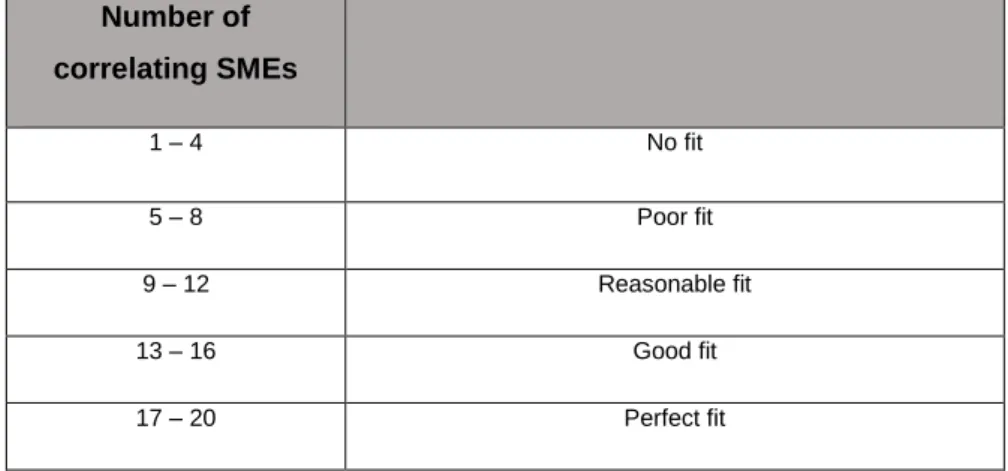
Table 4.12: Measure of degree to which subject SMEs fit characteristics of export-ready SMEs………..……….66
Table 4.13: Comparative analysis of TISA’s selection criteria against the Pickernell characteristics of an export-ready SME……….…..….68
Table 4.14: Subject SME characteristics seen against TISA selection criteria……..68
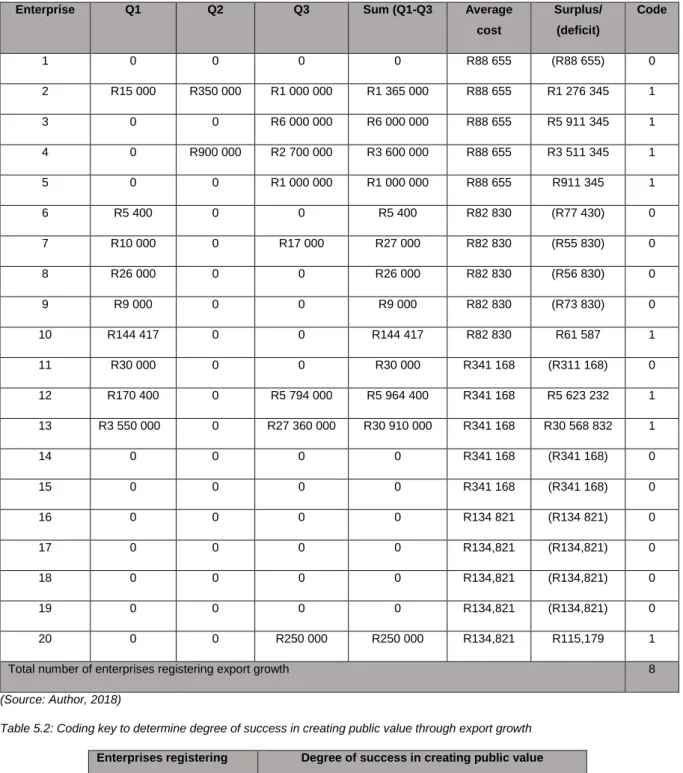
Table 5.1: Findings relating to public value achieved as a consequence of DSBD efforts, as represented by export growth………82
Table 5.2: Coding key to determine degree of success in creating public value through export growth……….82
Table 5.3: Analysis of public value added, as represented by export growth due to enterprises’ own efforts……….83
Table 5.4: Analysis of findings on public value added, as represented by export capacity development……….….85
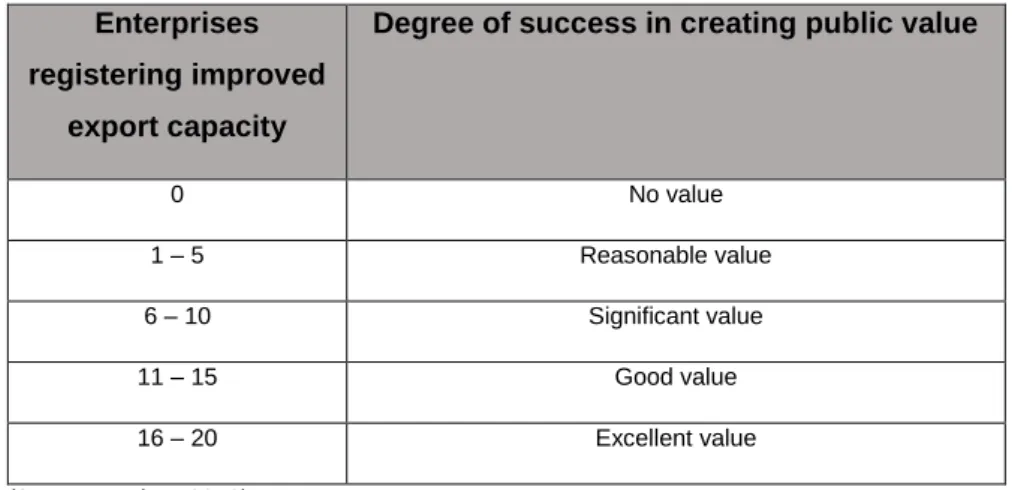
Table 5.5: Coding key for determining the degree of success in creating public value through export capacity development……….86
xv
Table 5.7: Findings – comparative analysis of subject SMEs and Pickernell qualifiers……….…88 Table 5.8: Coding key to determine degree to which subject SMEs fit characteristics of export-ready SMEs……….….….89 Table 5.9: Financial benefits granted to companies participating in TISA missions: SMMEs vs other-sized enterprises……….…92 Table 5.10: Comparative analysis of TISA’s selection criteria against the Pickernell characteristics of an export-ready SME………....96 Table 5.11: Subject SME characteristics seen against TISA selection criteria….….96 Table 7.1: Enterprises registering positive net export sales due to DSBD efforts…..136 Table 7.2: Analysis of enterprises registering positive export growth due to own efforts………....137 Table 7.3: Analysis of enterprises registering public value added with regard to export capacity development……….138 Table 7.4: Level of compliance with criteria for export-ready enterprise …………. .139 Table 7.5: Level of export-readiness compliance pre-mission and post-mission ....139 Table 7.6: Number of enterprises meeting export-readiness sub-criteria pre-mission and post-mission……….………...141 Table 7.7: Comparative analysis of Pickernell characteristics and export success, applying sector as qualifier ……….….144 Table 7.8: Comparative analysis of Pickernell characteristics and export success, applying firm size as qualifier ……….……….….145 Table 7.9: Comparative analysis of Pickernell characteristics and export success, applying firm age as qualifier ……….….146 Table 7.10: Comparative analysis of Pickernell characteristics and export success, applying technology as qualifier ……….………..……….….147 Table 7.11: Comparative analysis of Pickernell characteristics and export success, applying external networks as qualifier ……….……….….148 Table 7.12: Comparative analysis of Pickernell characteristics and export success, applying owner/manager age as qualifier ……….………....149 Table 7.13: Comparative analysis of Pickernell characteristics and export success, applying owner/manager qualification as qualifier ……….….150 Table 7.14: Comparative analysis of Pickernell characteristics and export success, applying owner/manager international trade experience as qualifier ……….….….151 Table 7.15: Summary of correlations between Pickernell characteristics and export success ……….….……….152
xvi
Table 7.16: Summary of correlations between Pickernell characteristics and export failure ……….….……….153 Table 7.17: Analysis of individual enterprises’ correlation with Pickernell characteristics……….…………154 Table 7.18: Applicability of subcontracting as an alternative export promotion technique……….….…159 Table 7.19: Applicability of trading houses as an alternative export promotion technique……….….…...……159 Table 7.20: Applicability of specialised export-sector-focused promotion activities as an alternative export promotion technique……….160 Table 7.21: Applicability of chambers abroad as an alternative export promotion technique……….….……160 Table 7.22: Applicability of an SME service centre as an alternative export promotion technique……….….………161 Table 7.23: Applicability of a display centre as an alternative export promotion technique……….….…161 Table 8.1: Calculating extent of export generation dependence on DSBD…………167
xvii
List of figures
Figure 1.1: Illustration of research questions ... 5 Figure 2.1: Illustration of theoretical framework….. ... 11 Figure 2.2: Illustration of Moore's Strategic Triangle………...………15
Figure 2.3: Schematic depiction of a public value account………….….……..………16
Figure 4.1: Checklist for testing an enterprise's export-readiness: an adaptation of Enterprise Ireland's "Steps to Exporting"……….….…52
Figure 4.2: Characteristics of an export-ready enterprise……….….60
Figure 6.1: The functioning of the subcontracting model……….…………102
Figure 6.2: The funding and operational process of the specialised export-sector-focused promotion programme……...………...…………..…………117
Figure 6.3: DIHK public funding and reporting model………...120
Figure 6.4: Functioning of the SME Service Centre of Wantran ……….….…..126
Figure 6.5: The display centres under construction in Dongguan and in operation in Durban……….….132
xviii
List of abbreviations
BRI Belt and Road Initiative
BRICS Brazil, Russia, India, China and South Africa
DGCC Dongguan Guangdong Commodity Display Centre
DIHK Deutscher Industrie- und Handelskammertag
DSBD Department of Small Business Development
DTI Department of Trade and Industry
FDI foreign direct investment
GDP gross domestic product
GTC general trading company
GVC global value chain
EMIA Export Marketing and Investment Assistance
INES Integrated National Export Strategy
IPAP Industrial Policy and Action Plan
NDP National Development Plan
NEDP National Exporter Development Programme
OECD Organisation for Economic Cooperation and Development
PV public value
PVT public-value theory
SACC South Africa Commodity Display Centre
SEDA Small Enterprise Development Agency
SME small and micro-enterprise
1
Chapter 1: Introduction
This study set out to assess the expenditure of taxpayers’ money on trade missions of the Department of Small Business Development (hereinafter “DSBD”) to facilitate small and micro-enterprise (SME) participation in international trade exhibitions abroad. Given the mandate of DSBD to promote and develop small and micro-enterprises, medium-sized enterprises do not form part of this study.
Its primary objective was to consider whether funding of these missions could be considered justifiable in relation to their public-value outcomes, more specifically in relation to their contribution to SMEs’ growth in exports and the development of SMEs’ export capacity.
As secondary objectives, the research firstly aimed to establish the (in)appropriateness of DSBD’s export-readiness selection criteria in the success (or failure) of these SME outbound trade missions programme. In developing the standards against which the selection criteria could be evaluated, the characteristics of successful exporting SMEs were determined through a literature review. The characteristics of an export-ready SME as defined by Pickernell et al. (2016:37-40) formed the criteria against which the participating enterprises were evaluated. Secondly, the study aimed at identifying potential alternative export promotion techniques that DSBD might wish to consider so as to bolster its public-value creation.
1.1 Background
To grow South African SMEs’ exports and contribute to a positive national trade balance, DSBD has initiated outbound trade missions aimed at opening up international markets for local SMEs’ products and services. These missions are arranged under the Department’s Export Marketing and Investment Assistance (EMIA) scheme (DTI, n.d.(a)). In addition, the missions are in line with the Integrated National Export Strategy (INES), which includes in DSBD’s offering the provision of assistance to SMEs with individual exhibition participation and primary market research, including the sourcing of foreign direct investment (DTI, 2015a).
Examples of these missions include those organised for local crafters to participate in the India International Trade Fair in New Delhi (DTI, 2012) as well as in AmericasMart in Atlanta, Georgia (RSA, 2016).
2
Through EMIA, the Department covers the cost of the SMEs’ participation, including their flights, accommodation, subsistence allowances and exhibition space (DTI, n.d.(a)). Significant other indirect costs include ministerial and departmental travel costs to enable political and governmental participation in the event; departmental organisational, logistical and administrative costs prior to the mission; and costs attached to follow-up activities subsequent to the mission to establish participants’ success rate in the endeavour.
EMIA has as one of its stated objectives the provision of assistance to SMEs “to develop new export markets and grow existing export markets” (DTI, n.d.(a)). In the same vein, in addition to increasing South African exports, the National Exporter Development Programme (NEDP) states the objective of SME export promotion as assisting these businesses to further develop through access to international markets (DTI, 2013). This research set out to test whether these objectives were indeed being achieved by DSBD’s outbound trade missions aimed at facilitating SME participation in international trade exhibitions abroad. Firstly, it aimed to establish whether participating SMEs could ascribe any subsequent growth and export capacity development in their businesses – and thus, public-value creation – to their participation in the exhibitions. Secondly, it sought to assess the (in)appropriateness of DSBD’s selection criteria to identify participants that were indeed ready to enter the export market. Finally, the research explored potential alternative export promotion techniques that may be deployed in pursuing DSBD’s objectives.
Literature suggests that international trade holds a number of benefits for a country (Caballero, Quieti & Maetz, 2000) and that governments play an important role in supporting exports (Winter-Nelson, 2007:60-61).
Although relatively few SMEs participate in export activities, exporting can be an important tool for particular niche markets, sectors and within certain regions (Gumede, 2000:9; Gumede & Rasmussen, 2002:3; Pickernell et al., 2016:33-34). Yet there are numerous barriers to export-market entry (Narayanan, 2015:106-117), and not all SMEs are suited for the export market. Successful exporting SMEs display specific characteristics (Pickernell et al., 2016:37-40) that DSBD may have to factor in when developing criteria for considering enterprises for their missions. In this thesis,
3
these characteristics form the basis on which the export-readiness of the enterprises that participated in DSBD organised trade exhibitions are evaluated.
In the course of the literature review, it became evident that there is a dearth of studies practically assessing the correlation between the South African government’s SME export promotion programmes and the growth and development recorded by participating SMEs. Similarly, very little exists in terms of studies evaluating the public value derived from government’s expenditure on such missions. This shortage of research was confirmed by the Chief Operating Officer of Trade and Investment South Africa (TISA), DSBD’s implementing partner, who suggested that no such study involving the work of TISA had been made from an independent academic perspective (Le Roux, 2018a). TISA intended to undertake studies in this regard as from 2019. This thesis could well be the first attempt (Le Roux, 2018a). Therefore, public policymakers could potentially benefit from the findings of this research to evaluate and calibrate future export promotion programmes for the targeted enterprises.
1.2 Research problem and objectives
With close to thirty national pavilions being organised per year, each of which is a multi-million Rand endeavour (DTI, n.d.(d); DTI, n.d.(e); DTI, n.d.(f), DSBD expends significant amounts of taxpayers’ money on facilitating SMEs’ participation in international exhibitions. The intention is to promote growth in SMEs’ exports so as to contribute more to the country’s export output, and to help them develop their export capacity. As is the case with many other government programmes, and as confirmed by the Chief Operating Officer of TISA (Le Roux, 2018a), there is a dearth of empirical research evaluating the outcomes of the DSBD export promotion programme. Therefore, this research aimed to fill that void.
A first objective was to ascertain whether public value and benefit (i.e. an increase in the nation’s trade exports and the development of SMEs) was being achieved from the public funds allocated to DSBD for supporting SME participation in South Africa’s national pavilions at international trade exhibitions. The intention was to assess the extent of the public value added; not to evaluate the impact of the programme on the nation’s export market. A survey of the theory and application of public value served as point of departure. Thereafter, the achievement of public value and benefit was
4
measured against the DSBD export development programme’s contribution to (i) growth in exports and (ii) the development of export capacity for participating SMEs.
Closely connected to the above, the second objective was to evaluate the (in)appropriateness of DSBD’s selection criteria in (not) achieving the desired public value and benefit. In working towards this objective, a comparative analysis was undertaken of the characteristics of SMEs that had participated in trade exhibitions through DSBD’s facilitation, against the characteristics of export-ready SMEs as argued by Pickernell and colleagues (2016:37-40). These included factors such as the sector, size and age of the enterprise, and owner/manager-specific characteristics (e.g. age and experience).
A final objective was to identify potential alternative export promotion techniques that might supplement or perhaps replace DSBD’s current practices in order to create greater public value.
To keep the pursuit of these objectives focused and structured, the study sought to answer the primary and secondary questions formulated below.
1.3 Research questions
Primary research question
Does DSBD’s current outbound trade missions programme for SMEs, which is intended to facilitate SMEs’ participation in international trade exhibitions abroad, create sufficient public value measured in terms of (i) its contribution to the SMEs’ growth in export turnover; and (ii) the development of the SMEs’ export capacity?
Secondary research questions
Based on the above, (i) what is the role of export-readiness selection criteria in the success or failure of the outbound trade missions programme for SMEs, and (ii) are there alternative export promotion techniques that may supplement or replace DSBD’s current practices in order to create greater public value?
The four elements flowing from the study are illustrated in Figure 1.1. The two primary
research questions related to public-value creation – whether the SMEs had grown
their exports and developed export capacity subsequent to the DSBD intervention. The first of the two secondary questions related to the role of DSBD’s export-readiness
5
selection criteria, for which the characteristics as determined by Pickernell et al.
(2016:37-40) – fully interrogated in Chapter 4 – were used as a benchmark against
which to evaluate the enterprises. The second of the two secondary questions dealt with alternative export promotion techniques that DSBD could consider to supplement or replace their current practices.
Figure 1.1: Illustration of research questions (Source: Author, 2018) 1.4 Research design
The research adopted a pragmatic approach, entailing the study of the “actions, situations, and consequences, rather than antecedent conditions (as in postpositivism)” (Cresswell, 2014). Pragmatism, Cresswell says, is not committed to any one system of philosophy and reality with inquirers drawing from both quantitative and qualitative assumptions. As such, the study was based on evidence and data obtained through enquiry and observation of the actual performance of SMEs that had participated in DSBD’s trade missions.
In addition, since the data was mainly collected or existing data analysed, the study was, for the most part, empirical (Mouton, 2016:xiii). Data was collected through a researcher-administered questionnaire during interviews with SMEs that had participated in DSBD’s international trade missions organised by DSBD itself and/or the Department of Trade and Industry (DTI). The empirical study drew mainly on primary data (Mouton, 2016:62), using a mixed method that is both qualitative and quantitative (Cresswell, 2014). The questionnaire included the solicitation of
pre-6
programme intervention data (baseline information), against which the change attributed to the intervention could be assessed.
Moreover, alternative export promotion techniques were identified that DSBD could further explore as an addition to or replacement of their current export promotion offering. For this portion of the research, a non-empirical approach was followed (Mouton, 2016:xiii). This consisted of a desktop review of the literature, as well as structured interviews with a range of international trade promotion agencies identified through, inter alia, discussions with the China Council for the Promotion of International Trade and the Japanese External Trade Organisation. This non-empirical section of the study was aimed at identifying alternative SME export promotion techniques and to gain an understanding of their functioning. This did not require any technical measurements, collection instruments or analysis. The results of this section of the research are presented in a simple, reflective narrative style, which DSBD could then consider and commission further research on for potential application in the South African SME environment.
1.5 Research methodology 1.5.1 Research subjects
The subjects of this study were SMEs that had participated in South Africa’s national pavilions at international trade exhibitions held abroad.
The first step in the process of obtaining data was to establish from DSBD what national pavilions they had organised over the three years 2014 to 2016, considering that DSBD was only established in 2014. The number of missions interrogated through the research was limited to four missions over the three-year period, spread relatively evenly over the period.
The second step comprised an appropriate sample of SMEs that had participated in these exhibitions. While it was not possible – within the timeframe of the research – to interrogate all SMEs that had participated, probability sampling was applied – a “method of sampling that utilizes some form of random selection” (Trochim, 2006). Five subjects per trade mission were selected by means of systematic sampling using the formula k=N/5, where “k” represented the interval size, “N” the total number of
7
SMEs in a trade exhibition, and “5” the sample size per exhibition. The first delegate was randomly selected, and was thereafter followed by every kth unit (Trochim, 2006).
1.5.2 Conceptualisation of measurements
The study used three measurements.
The first was whether the SMEs that participated in DSBD’s national pavilions abroad had subsequently registered growth in export turnover. This called for quantitative data, or measurable numeric information (OSU, n.d.). Enterprises were required to indicate what export income had been achieved since participating in a particular trade mission. Furthermore, in order to link the export figures back to the trade events, they were asked to indicate the source of their export customers, i.e. either contact at/from the trade exhibition, or other sources unrelated to the trade exhibition. Extracts from the financial records of the enterprises served as secondary data to substantiate the reported growth.
The second measurement related to whether the particular SMEs had further developed their export capacity since participating in the trade exhibitions. To this end, qualitative data – descriptive and judgmental information (OSU, n.d.) – was obtained to analyse the development of their export processes and capacities subsequent to their participation in the exhibitions.
The third measurement, which was qualitative in nature, related to the role of DSBD’s export-readiness selection criteria in the success or failure of the outbound trade missions. To this end, the characteristics of the participating SMEs were considered against the characteristics of exporting SMEs as identified by Pickernell and colleagues (2016:37-40).
1.5.3 Data collection
Firstly, quantitative data was collected by requesting each selected SME to complete a researcher-administered questionnaire. Once quantitative data was captured, a reliability analysis, as suggested by Mouton (2016:83), was done through the running of standard validation checks (e.g. frequencies, marginals, checks for missing values, checks for range of values) to ensure that the dataset was free of errors.
8
Secondly, qualitative data was collected by means of structured interviews with open and close-ended questions. The interview schedule consisted of (i) questions to probe the development of the SMEs’ export growth and capacity since participating in the trade exhibition, and (ii) questions aimed at comparing the SMEs’ characteristics to the characteristics of an export-ready SME. Interview responses were validated in terms of relevance, including a verification that the respondent within the sample SME had sufficient knowledge of the enterprise’s export programme.
1.5.4 Data analysis
Three analyses were performed on the data collected:
Firstly, a quantitative financial analysis framework was developed to assess the value of export sales that had been generated by each of the SMEs since their participation in DSBD’s trade exhibitions. The framework was structured so as to indicate what value of exports could be ascribed to the SMEs’ participation in the trade exhibitions, for example from sales generated and/or orders taken or flowing from the SMEs participation in the exhibitions, and what could be ascribed to other efforts. This enabled a conclusion on whether DSBD’s programme was truly promoting SME export growth (primary research question). The results of this analysis also helped separate the successful exporting SMEs from the unsuccessful ones – a necessary component for determining the role of export-readiness selection criteria in the success or failure of DSBD’s outbound trade missions (secondary research question).
Secondly, a qualitative analysis framework was developed to evaluate whether the participating SMEs had built export capacity. This framework relied on predefined thematic coding – “an interpretive process, whereby data is systematically searched to identify patterns” (Smith & Firth, 2011:3) – as well as deductive coding – which is directed by existing concepts or ideas (University of Auckland, n.d.). Once again, the analysis was designed so as to separate the development of export capacity through DSBD’s efforts from export capacity developed through other, non-related interventions. This enabled a conclusion on whether the DSBD programme was contributing towards developing export capacity for SMEs that participated in their facilitated missions (primary research question).
Thirdly, a qualitative comparative analysis framework was developed. This framework was “conjunctural” in its logic, examining the various ways in which specified factors
9
interact and combine to yield particular outcomes (Ragin, 1987:49). This was used to determine how the successful and unsuccessful SMEs that had taken part in DSBD’s missions measured up against the characteristics of successful exporting SMEs identified in the literature review. In turn, this enabled a finding on whether DSBD’s selection criteria were adequate to achieve their desired outcome (secondary research question).
1.5.5 Ethics
The study required the collection of data not readily available in the public domain, and involved direct interaction with individuals, enterprises and government. For this reason, written consent was sought from the participating SMEs, while ethics approval was sought from the Department of Trade and Industry (DTI), whose Trade and Investment South Africa (TISA) agency implements the missions on their behalf.
1.6 Outline of chapters
This chapter of the thesis introduces the topic and the rationale behind the research. Chapter 2 comprises a literature review on public value and export promotion for SMEs, while Chapter 3 examines the South African legislative and policy framework governing small businesses, exports and export promotion. Chapter 4 provides a detailed explanation of the research design, data collection and analysis tools. Chapter 5 and 6 are devoted to a description of the research findings – the former sets out the findings in respect of export growth, export capacity and export-readiness criteria; the latter describes the findings in respect of alternative export promotion techniques. Chapter 7 delves deeper into the findings, interpreting and analysing the results so as to arrive at answers to the research questions. Finally, Chapter 8 is devoted to conclusions and recommendations for the way forward in terms of DSBD’s SME export promotion offering.
10
Chapter 2: Public value and promoting exports for SME’s: a literature review 2.1 Introduction
The literature review covered in this chapter sets out to create a proper understanding of public value and international trade; and how the latter can help create and enhance the former. Then, considering the particular focus of this study on the public value created by DSBD’s programme to facilitate SMEs’ engagement in international trade exhibitions, the review hones in on SMEs – their characteristics, potential for and barriers to engaging in the export market, and the essentials of an export-ready enterprise. In addition, the literature is scrutinised for alternative techniques used across the globe to promote SMEs’ participation in exports.
Using the public value embedded in international trade as a criterion to determine the success or failure of DSBD’s export support programme for SMEs requires a firm grasp on what public value means. This is explored in the beginning of the literature review. In a nutshell, the literature confirms that public value extends beyond market economic considerations (i.e. financial return on investment), also encompassing ecological, political, social and cultural dimensions of value, all of which add value to the public sphere (Bennington, 2009:237). It includes embracing economic value through the generation of economic activity.
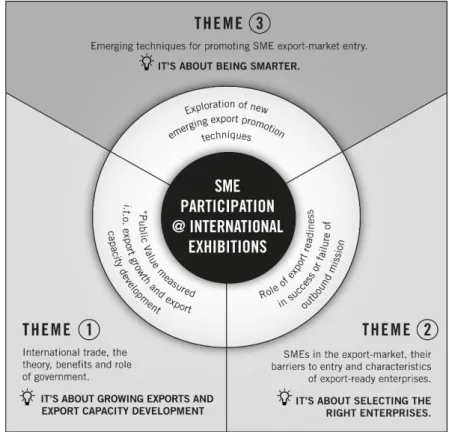
With this as background, the theoretical framework anchoring the rest of the literature review then constitutes three broad themes (see Figure 2), which are briefly unpacked below in Figure 2.1.
11
Figure 2.1: Illustration of theoretical framework (Source: Author, 2018)
Theme 1: International trade – the theory, benefits, role of government, and the public value it creates
In studying the promotion of export trade and the value it creates, this research accepts as its point of departure that international trade has become an invaluable feature of the modern world (Volders, 2001:iv). Yet different policies and strategies on international trade inevitably draw on different underlying theories. Therefore, to grasp the public-value potential of DSBD’s export promotion programmes for South African society, one needs to start with a proper understanding of the notion of international trade and all its underpinning theories.
Literature on the various models of internationalisation is examined, including the incremental or stages model, the ‘born globals’, the network model, the contingency model and the resource-based model. The review then delves into the question as to why international trade is important, advancing arguments on the benefits it holds. In the final instance, the review seeks to grasp and understand the role of government in promoting international trade.
12
Theme 2: SMEs in the export market, their barriers to entry, and the characteristics of export-ready enterprises
Under this theme, the literature review turns the spotlight on SMEs in particular – their potential contribution to the economy in general (specifically through exports) and their barriers to export-market entry. This leg of the review also conceptualises the characteristics of an export-ready SME.
The importance of SMEs in the export market is examined from both an international and a South African perspective. Evidence suggests that in the South African context, the contribution by SMEs is small, which is somewhat out of kilter with international trends (Anand, Perelli & Zhang, 2016:6). Therefore, the study grapples with the dichotomy that whilst SMEs’ contribution to total exports remains small, the export market itself is an important avenue for SMEs to expand in particular niche markets, sectors and regions.
The review also endeavours to understand the characteristics of successful exporting SMEs. Assessing the characteristics of successful exporting SMEs may firstly prove useful in determining where public value can be added through the implementation of government’s export promotion programme. Secondly, it may assist in creating a benchmark against which DSBD-sponsored SMEs participating in international trade exhibitions can be measured. In this way, one is able to ascertain whether the programme is assisting in breaking down the barriers to SME export-market entry, and whether DSBD’s selection criteria are adequate.
In addition, the literature review examines both the internal and external barriers that SMEs face in entering the export market. Acknowledging the various obstacles SMEs need to overcome to engage in exports, it then follows that enabling these enterprises to participate in international trade exhibitions may not in itself be sufficient to assist them in accessing export markets. Alternative or supplementary tools may need to be explored, which explains the need for theme 3.
Theme 3: Alternative techniques for promoting SME export-market entry
Under this theme, the literature review explores alternative techniques for SME trade promotion that are being implemented internationally and may be considered as a replacement for or supplement to DSBD’s current initiatives.
13
Six such new initiatives are identified and expounded on, which may serve as a platform for future DSBD SME export assistance exploration.
2.2 Theory and application of public value 2.2.1 Understanding public value
In reviewing the authoritative publication Recognizing Public Value by Moore (2013), Kavanagh (2014:57) reports Moore as arguing that
… [p]ublic value asks public officials to consider the benefits and costs of public services not only in terms of … [rands] and cents, but also in terms of how government actions affect important civic and democratic principles such as equity, liberty, responsiveness, transparency, participation, and citizenship.
Public value goes beyond the ‘bottom line’ that is analogous to the private sector – instead, “it is about the net benefit of government actions” (Kavanagh, 2014:57).
In a similar vein, Prebble (2015:475) explains public value as deriving from “actions of the government (and associated entities) that affect the lives of people – the public” and “a net concept which measures the gain to the public from government activity”.
Public value theory (PVT) attempts to create a dialogue between public officials and citizens about the values that public endeavours should pursue, and to fully consider combining economic efficiency and organisational forms. Because citizens are at the forefront of consideration, PVT involves more than cost-efficiency; it is also concerned with achieving goals (Turkel & Turkel, 2016:3). It follows, then, that public value extends beyond market economic considerations, and also encompasses ecological, political, social and cultural dimensions of value – all that adds value to the public sphere (Benington, 2009:237). Benington (2009:234) goes on to explain that the focus of PVT is not simply the individual interest, but also the broader public interest; PVT does not simply focus on “the needs of current users, but also on the longer-term public good”, including the needs of future generations.
However, contrary to Moore’s assertion that public value always involves the use of public authority (Prebble, 2015:474), Benington (2009:237) argues that it is not only the public sector that pre-eminently creates public value. Public-value outcomes can also be generated by the private sector, the voluntary sector and informal community organisations, as well as by governments. Benington also suggests that in the pursuit
14
of public-value goals, the primary role of government can be to rally the combined powers and resources of the state, the market and civil society behind a common purpose and/or strategic priority.
In the South African SME export promotion context, if one is to argue that export promotion assistance to SMEs does indeed create public value through growing their exports and developing their export capabilities, then Benington is correct, since government undertakes SME export promotion activities both independently and in association with private chambers of commerce. This study, however, was restricted to the efforts of the public authorities – in this instance, DSBD.
2.2.2 Measuring public value
Moore (in Prebble, 2015:474) suggests that public value is about using public authority to redirect resources from individuals to achieve value for the common good. Public value entails public officials understanding what individuals’ desires and perceptions are, and it accrues when the collective gains outweigh the personal sacrifices. Viewing it from this perspective, “[m]easuring public value is analytically unresolvable”. Yet Moore (in Prebble, 2015:474) proposes that “representative democracy allows society to create a ‘we’ from a collection of free individuals”, which can become common cause. Although the appraisal of public value includes facets of public satisfaction, it also goes beyond it. Such an appraisal will probably also include factors not easily registered in individual satisfaction surveys (Benington, 2009:239), including ecological, political, economic and social value added to the public sphere.
PVT highlights the importance of outcomes and processes. It is about what value is
being added to the public sphere, by whom and how, and not merely about “inputs
and outputs, or … input/output ratios and productivity” (Benington, 2009:238). To explain, Benington (2009:238) cites the example of public-value perspectives that focus on improving public health rather than on the numbers of patients treated or by how many names or minutes waiting lists and times are reduced. Therefore, the measuring of public value often focuses on the processes by which public value is “created or co-created, and the outcomes for whom and with whom” (Benington, 2009:240).
Clearly, measuring public-value outcomes is complex and contested, and often requires balancing good and bad, and weighing up competing priorities.
15
In balancing and weighing its SME export promotion programme, DSBD should give consideration to the three important issues raised in Moore’s concept of the ‘strategic triangle’ (Figure 2.2). It argues that public managers should focus their minds on what the important public value is that it wants to advance, what sources of legitimacy they would depend on to provide the resources required to sustain the endeavour, and whether the organisation has the necessary organisational capabilities to deliver the desired public-value results (Moore, 2012:25,30, Moore & Khagram, 2004:1).
Figure 2.2: Illustration of Moore’s Strategic Triangle (Source: Moore & Khagram, 2004)
In line with Benington’s rationale above, however, it is proposed that since export promotion is inarguably a clear economic activity, increased export turnover and the development of SMEs’ export capacity would be reliable criteria to measure the creation of public value in the DSBD context.
2.2.3 Recognising public value
In an attempt to find an alternative path for the development of measures that could capture the value being produced by government, meet public requirements for accountability and promote the use of performance measurement systems, Moore (2012:11) proposes a “different path”. This path:
(i) takes a developmental, strategic approach (Moore, 2012:11);
(ii) recognises the different types of managerial work done in creating a valuable performance measurement system, i.e. technical work, managerial work, philosophical work and political work (Moore, 2012:13-15); and
16
(iii) entails bringing together “the worlds of politics, external accountability, and performance measurement systems” (Moore, 2012:21).
To this end, Moore argues for the development of a “public value account” that will have to recognise:
(i) that the assets government employs to promote “socially valuable results are
not restricted to money” (Moore, 2012:21);
(ii) “that individuals and their satisfaction are not necessarily the appropriate arbiter of public value” (Moore, 2012:21); and
(iii) That government actions “will be judged by deontological standards of fairness and justice as well as utilitarian standards of satisfying individual clients or achieving desired social outcomes” (Moore, 2012:22).
Figure 4 below depicts what such a “public value account” may look like, bringing together the financial costs, the achievement of desired outcomes, client satisfaction, and “the degree to which state authority was being used, and … government agencies were acting fairly” in pursuing a prosperous society (Moore, 2012:24).
17
In addition to the “public value account”, Moore (2012:25) proposes that a “public value scorecard” also be introduced. Such scorecard should include the “public value account”, as well as the measures that direct management attention to “the current position of the organisation in its environment, whether and how operations can be sustained, and how both current operations and future positioning might be improved through particular investments that embodied the continuous learning of the organization” (Moore, 2012:25).
In determining whether DSBD’s export promotion programme for SMEs delivers the requisite public value, this thesis drew on the adoption of the principles contained in Moore’s arguments above.
2.3 International trade: meaning, theories, benefits and the role of government 2.3.1 Meaning of international trade
International trade can be defined as “the exchange of goods and services across international borders or territories” (Abedini, 2011). The important contribution of international trade to the economic growth of individual nations seems irrefutable. In fact, the Global Policy Forum predicts that until 2030, “60[%] of the world economy will be exchanged internationally” and “the share of the rest of the world in each national economy will be more than the share of his own domestic economy” (Abedini, 2011).
2.3.2 Theories of international trade
The explanation above is however overly simplistic. International trade is underpinned by substantial theory, which economists, businesses and governments use as guidelines to design their own policies and strategies for regulating and promoting international trade.
In exploring the theories underpinning international trade, this research accepts as its point of departure that these underpinning theories are all premised on the notion that international trade is a feature of the modern world. It is also acknowledged that in the real world, policies and strategies inevitably draw on different aspects from various theories. Nevertheless, in order to understand what drives policy thinking, the notions contained in the various theories ought to be examined.
18
2.3.2.1 Classical or country-based trade theories
Mercantilism
Mercantilism developed in the sixteenth century, when economists argued that a country’s wealth was based on the amount of gold and silver it held as reserve. To increase the country’s wealth, the objective was to increase those holdings. Mercantilists believed that this could be achieved by increasing exports and discouraging imports. If one country traded goods with the other, the difference in value needed to be settled in gold and silver. Therefore, the objective was for the country to have a trade surplus – with exports exceeding imports – or, stated differently, to avoid a trade deficit (Carpenter & Dunung, 2012:58-59).
Absolute advantage
The foundations of the theory of absolute advantage were laid by Adam Smith in 1776 (Carpenter & Dunung, 2012:59). The theory focuses on a country’s ability to produce products or services more efficiently than other nations. The rationale was that trade between countries should not be restricted or regulated, but should arise naturally according to market forces. Through specialisation, countries could use their comparative advantages to specialise, which led to greater efficiencies as workers became more skilled. Production too became more efficient, given the motivation to increase specialisation by creating faster and better production methods. Increased efficiencies, the theory suggested, would encourage trade for the benefit of people in both trading nations (Carpenter & Dunung, 2012:59).
Comparative advantage
Those disputing the theory of absolute advantage argue that whilst some countries had an advantage in many areas, others had no discernible absolute advantage. In 1817, David Ricardo responded to this challenge by developing the theory of comparative advantage.
The basic distinction between absolute and comparative advantage lies in the argument that even though two countries may be able to produce the same products, trade could still ensue between them when each focuses on the product it can produce at a lower opportunity cost instead of producing both goods itself (Carpenter & Dunung, 2012:60; Kling, 2008). Comparative advantage, therefore, concentrates on
19
relative productivity differences, while absolute advantage looks at absolute productivity.
Factor proportions
Building on Ricardo’s theory of comparative advantage, the two Swedish economists Eli Heckscher and Bertil Ohlin developed a theory on how a country may gain comparative advantage by deploying its abundant factors, such as land, labour or capital. Products manufactured making intensive use of abundant factors (resources) give a country comparative advantage and could be successfully exported. Conversely, a country will import products that require scarce factors to manufacture, yet are in high demand (Carpenter & Dunung, 2012:60-61; Kling, 2008).
2.3.2.2 Modern or firm-based trade theories
Similarity theory
The similarity theory attempts to explain intra-industry trade. It suggests that consumers in countries at similar stages of development share certain preferences. Companies first produce with domestic consumption in mind. Therefore, when they start considering exporting, the countries that offer the most potential for trade are often those where customer preferences are similar to preferences back home.
The similarity theory also asserts that intra-industry trade in manufactured goods is most common between countries with similar per-capita incomes (Carpenter & Dunung, 2012:62).
Product lifecycle theory
The product lifecycle theory is a modern, firm-based international trade theory that states that a product lifecycle can be divided into the three distinct stages of new product, maturing product and standardised product. Different stages can be executed in different countries. Carpenter and Dunung (2012:62) cite the example of the personal computer, of which the innovation stage was based in the United States, whereas the current standardisation stage occurs in low-cost countries, such as those in Asia.
Global strategic rivalry theory
Firms only boast a competitive advantage over global competitors because they have purposely developed that competitive advantage. This is done by optimising the
20
barriers to entry, such as research and development, the ownership of intellectual property rights, economies of scale, unique business processes or methods, extensive experience in the industry, as well as the control of resources or favourable access to raw materials (Carpenter & Dunung, 2012:63).
National competitive advantage theory
This new and minimally tested theory asserts that a nation’s competitiveness depends on the capacity of its industries to innovate and upgrade. It explains why some nations are more competitive in certain industries. Four determinants play a role, namely local market resources and capabilities, market demand conditions, suppliers and complementary industries, and firm characteristics. This leads to healthy rivalry between local firms, which in turn spurs innovation and competitiveness. In addition, by its actions and policies, government also has a role to play in increasing the competitiveness of firms and, occasionally, entire industries (Carpenter & Dunung, 2012:63).
It is argued that, in the real-world economy, it is not one of the modern trade theories that applies to a country’s economy, but instead a combination of theories – as Van
Berkum and Van Meijl (2000:506) put it: “There no longer exists one general theory of international trade.” In the South African context, for example, the similarity theory would apply to certain products, such as wine, which exceeds domestic demand and is now being exported to other developing countries, including India and China. At the same time, the product lifecycle theory combined with the global strategic rivalry theory also apply, which can for instance be seen in the competitive local manufacturing of the BMW 3 Series and C-Class Mercedes for the global market.
2.3.3 Creating public value: the benefits of international trade
International trade accounts for a good part of a country’s gross domestic product (GDP), particularly for developing countries, where it is one of the most important sources of revenue and a major driver of economic growth (Economy Watch, 2010). Nations with strong international trade have become prosperous and can strongly influence the global economy. Whilst the opposite may also hold true, global trade can become one of the major contributors to the reduction of poverty (Economy Watch, 2010).
21
Caballero, Quieti and Maetz (2000) advance the following three reasons why international trade is important. It is proposed here that these very reasons also explain the significance of global trade as a conduit for creating public value.
(i) International trade contributes to economic growth.
Firstly, international trade allows a country to buy goods and services from destinations where this costs less to produce. This releases resources that would otherwise have been tied up locally in the production of the now imported goods and services. The freeing up of resources can in turn enable a comparative increase in the production of other important goods or the delivery of value-added services (Caballero, Quieti & Maetz, 2000). On the other hand, however, for developing economies, it can have a negative impact on economic growth, for example, should local producers be side-lined due to them not being able to adapt to new technologies (Zahonogo, 2016:43).
Secondly, global trade creates economies of scale. While many enterprises find that the domestic market is not large enough to manufacture a particular product feasibly, finding an external market enables expansion of the domestic market. This provides for the production of a greater number of the particular product. In this way, production becomes more feasible because production of a number of units reduces the average product cost (Caballero, Quieti & Maetz, 2000).
Finally, when countries open up their markets to international trade, they compel their local industries to compete with goods and services that are produced abroad. This necessitates producers to become more efficient and competitive, often leading to lower prices, which can be passed on to the consumer (Caballero, Quieti & Maetz, 2000).
(ii) Trade enhances a greater choice and diversity of goods.
International trade allows for an array of goods and services to be made available to the national market, which would not have been available otherwise. Since these goods and services include capital goods, global trade not only favours consumers, but can also assist in the development of local production capacity (Caballero, Quieti & Maetz, 2000).