1
A Framework for Operational Security Metrics Development for Industrial
Control Environment.
Uchenna P Daniel Ani1,Hongmei (Mary)He2 and Ashutosh Tiwari3
1,2Manufacturing Informatics Centre, School of Aerospace, Transport, and Manufacturing, Cranfield University, Bedford, United Kingdom.
3Airbus / RAEng Research Chair in Digitisation for Manufacturing, Department of Automatic Control and Systems Engineering Amy Johnson Building, The University of Sheffield.
[email protected] , [email protected]2 , [email protected]3
Abstract
Security metrics are very crucial towards providing insights when measuring security states and susceptibilities in industrial operational environments. Obtaining practical security metrics depend on effective security metrics development approaches. To be effective, a security metrics development framework should be scopedefinitive, objective-oriented, reliable, simple, adaptable, and repeatable (SORSAR). A framework for Operational Security Metrics Development (OSMD) for industry control environments is presented, which combines concepts and characteristics from existing approaches. It also adds the new characteristic of adaptability. The OSMD framework is broken down into three phases of: target definition, objective definition, and metrics synthesis. A case study scenario is used to demonstrate an instance of how to implement and apply the proposed framework to demonstrate its usability and workability. Expert elicitation has also be used to consolidate the validity of the proposed framework. Both validation approaches have helped to show that the proposed framework can help create effective and efficient ICS-centric security metrics taxonomy that can be used to evaluate capabilities or vulnerabilities. The understanding from this can help enhance security assurance within industrial operational environments.
Keyword:
OSMD Framework, Security Metrics, Operational Security Metrics, Industry Control Environments, Security Measurement
1.
INTRODUCTION
The increasing occurrence of targeted cyber-attacks and successful incidences on Industrial Control Systems (ICSs) have stirred industrial control system engineers and owners to make effort on securing their critical industrial infrastructure platforms and setups. Deploying security solutions alone does not guarantee utter security and safety from malicious intruders, it has become very crucial to understand the degree of contextual security inherent in a system, and to grasp the state and capability enabled within the ICS domain. Security objectives in an industry control environment can be prominently achieved through Regularly checking the performance of systems and the environment, guided by security metrics derived from the security objectives. Quantitative security metrics are always preferred by system developers and owners, as quantitative metrics could provide a good way to compare the levels of security assurance, hence easily aid the resolution of trade-offs in security solutions [1].
Increasing complexities are introduced as a result of the convergence of divergent initially separated technologies and protocols into modern ICS, and the pressure from security and privacy legislations are swelling the need for sufficient validations of security features and solutions [2]. Evidence to support such security validations (assurances) could easily be obtained through the application of systematic approaches for measuring security. There are few ICS-specific security metrics development approaches that are holistic enough to meet the multifaceted nature of security in the Industrial environment. There is the absence of clarity in the outline of quantitative, effective security metrics in relations to current security standards and guidelines. There is also the lack of suitable and all-encompassing methods to guide ICS organisations to clearly outline security objectives, metrics, and measurements for mitigating current cyber malicious actions [3], [4].
It is difficult to setup apt and effective security metrics, as attackers’ efforts are non-linear, even where enterprises and organisations are required to put in exponential efforts on security [5]. Also, security metrics developers should think themselves as pioneers, and be prepared to fine-tune their approaches as circumstances and experiences dictate [6]. Another notable issue is the lack of domain-specific methods for security metrics generation to guide the organisation in line with acceptable security frameworks requirements, like NIST SP 800-82 [6], NIST Framework for Improving Critical Infrastructure Cybersecurity [7], and Security of Industrial Control System Good Practice Guide [8]. Most current work focuses on Information Technology security metrics developments as in ISO/IEC 27001 guidelines [3], [4], [9], [10]. Although useful, the ISO guide does not specifically address the peculiar nature and characteristics of security in ICS domains. It is hypothesized that practical and relevant security metric quantities can be better achieved from holistic security metric development approaches that are contextual in scope and security objectives, reliable, adaptable, repeatable, and adaptive to dynamic changes in the security landscape. The methodology used in this
2
research is analytical, especially in the framework development phase and the resulting metric quantities. A real environment use case scenario is used for the practical validation of the proposed framework and example metrics, and further supported by expert opinion evaluations. The novelty and contributions made by this study include:
i. The study puts forwards and elaborates some essential characteristics of a good metrics development framework, which include being: scope-definitive, objective-oriented, reliable, simple, adaptable, and repeatable (SORSAR). These characteristics as expressed and prescribed in this work do not appear in their entirety in any any prior metrics development framework. Thus, these characteristics provide new and valuable insights into the significant and comparative attributes of ICS security metric development frameworks, existing deficiencies of existing frameworks, and requirements that should be considered in the development or adoption of any security metrics frameworks for metrics generations. The study also offers route guides for future metric development advances.
ii. The study also presents a new ICS-centric framework of Operational Security Metrics Development (OSMD) instance that typifies the good development framework characteristics prescribed in contribution (i). The framework incorporates several essential framework components and features such as security environment dimensions, security objectives, and control capability variations, which collectively offer a holistic guidance to the development of security metrics for the industrial control system environment
The rest of this paper is organised into the following sections. Section 2 reviews related work. Section 3 describes the OSMD framework. Section 4 provides the validation of the proposed OSMD framework, and section 5 gives conclusions and future work.
2.
RELATED WORKS
Security metrics are designed to arrive at measure that facilitate decision-making, and improve performance and accountability through evaluations (collection, analysis, and reporting) of relevant system status [11]. They are also supportive for predicting system security states [12], [13]. Security metrics represent measurable properties of a system that quantify the degree to which system security objectives or goals are achieved [14]. It is a popular thought that except a thing can be measured, the knowledge of it remains essentially insufficient. Security metrics is useful in the management of cyber risks and the evaluation of security states or susceptibilities in an enterprise, in respects of processes, people, and technologies. Security metrics are crucial for performing security test of systems, determining security assurance levels of system constituents, and undertaking adaptive security monitoring and management [13], [15]. From an economic perspective, security metrics can be used to illustrate the business impacts of security, thus enabling the integration of security functions into the overall business process [16].
However, the development of an effective security metrics need to be guided by an effective, carefully planned and designed effective approach, which should be feasible, flexible, and adaptive to a wide range of ICS audience, including technical and non-technical audience. An effective security metrics should not only be SMART (i.e. specific, measurable, attainable, repeatable, and time-specific) [16], [17], but also be actionable [18], cost-efficient [3], [19], objective [20], operational [21], relevant, reproducible, and provide a basis for comparison and claim [22]. Moreover, the effectiveness of a security metric lies in its ability to specify the degree to which security objectives are being met, and to drive actions towards improving the security state of an organisation or system. This work emphasises the need for the clear articulation of the characteristics of a metric development approach. Characteristics that could guide the development of metrics formulation approaches, give basis, relevance, and acceptability to designed approaches, and their usefulness towards enhancing security assurance.
Generally, security metrics could be developed through adoption and adherence to customised, pre(existing) organisational/operational frameworks, or through the adoption of compliance-based approaches hinged on standards and best practices. In either case, directional process-adoption methods like top-down or bottom-up are considered when determining desirable assessment metrics [23]. The top-down approach starts with the goals and questions of the operators as a focus for outlining the metrics. Thus, the security objectives are first articulated, processes worked down to identify specific security metric quantities that meet the objectives, and the measurements needed to generate the security metrics. For instance, the Balanced Scorecard (BSC), is a top-down approach that has gained wide support and acceptability for measuring and reporting details on enterprise Information [24]–[26]. The Goal-Question-Metric (GQM) is yet another widely advocated method for prioritizing metrics, though from a software engineering perspective. It has got the potentials to be extended over a broader spectrum to cover organizational viewpoint [27]. This method has further seen improvements into what is called the GQM+ Strategies [28] addressing the limitations of the initial GQM in relations to higher-level objectives metric connections, and applicability to generic organizational structures. The bottom-up approach adopts a reverse process, categorising existing, easy-to-obtain data as a starting point for outlining the metric quantities, and working up to the security objectives of a target system accordingly [23], [29]. An example of this is the security posture evaluation approach in [23] where measurements that could be collected are first derived, followed by the determination of metrics that could be generated from the measurements, and finally determine the association between the derived metrics and established overall security objectives.
The I3P security metrics development report [24] [25] discusses seven broad stages for metrics development, which include: (i) identification of target audience, (ii) identification of metrics objectives for each target audience, (iii) measuring attribute components, (iv) comparing with benchmarks, (v) visualising results, (vi) interpreting security
3
result levels, and (vii) making decision. Although a useful guide, the outlined stages of this step-wise approach more practically describe a metric-based security analysis process rather than a metrics development process. Thus, the development perspective of the approach seems superficial yet compelling; such that adopting the process coerces one into engaging into security analysis, even if it is not intended in the development objective. It forcefully binds security analysis with metrics development, when these are ideally distinct processes with distinct objectives. It is important to distinguish security metrics development approach from metrics-driven security analysis/evaluation approach. The I3P security is devoid of clarity in clearly specifying the points in the process where security metrics are generated, and decision strategy for generating security metrics. Such phenomenon introduces subjectivity as weaknesses in the development process.
The work by [23] tried to resolve some of the gaps in [24] by putting forward a seven-step usable guide to the process of establishing a security metric program. These include; (i) Defining security metrics program goals and objectives, (ii) Deciding which security metrics to be generated, (iii) Developing strategies for generating the security metrics, (iv) Establishing security metrics benchmarks and targets, (v) Determining how the security metrics will be reported, (vi) creating an action plan and acting on it, (vii) Establishing a formal program review/refinement cycle [23]. It improves upon previous method by clarifying the point where metrics are generated (i.e., step 4). It also includes the part for formulating and implementing action plans, and the establishment of a refinement programme that takes cognisance of recurrent changes and updates. Although seemingly an improvement, the model does not capture some relevant security requirement trends such as the enumeration or primary, secondary security objectives. It rather proffers steps that cover high-level system specification. Also, left out is the feature for enumerating target system scope in the event that an ICS to be assessed could be a subsystem (sub-network) being part or connected to a larger enterprise system (network) to reduce complexity. It would be better to have a model that enables target system scoping, and the potentials for predictive capabilities.
In [15] the enhanced version of an earlier security metrics development approach [26] was presented. This revised model provides an iterative process for metric generation aimed at achieving balanced and comprehensive security metrics taxonomy for any given system. The model consists of seven (7) steps: (i) threat and vulnerability analysis (optional), (ii) application of suitable metrics taxonomies and/or ontologies, (iii) definition and prioritisation of security requirements attack modelling, (iv) decomposition, modelling, and integration, (v) definition of measurement architecture, (vi) integration of security metrics and selected Basic Measurable Components (BMC), and (vii) the balanced and detailed collection of security metrics. Although the steps are structured into an iterative form, introduced feasibility analysis as a separate stage linking to measurement architectures, individual metrics, and metrics taxonomy. It used a distributed message system GENOM for a case study, and demonstrated the smooth integration of a risk-based assessment of BMCs, a security-based trust model, and a trust-based security model into a single framework for evaluating the trustworthiness of the development of measurable security metrics.
In [28], a security metrics development framework based on operational system attributes is presented, and it is applicable to the ICS environment. The model combines the concepts of security and dependability, studying operational system’s interaction with its environment via the system boundaries concepts [27]. The model regroups conventional security and dependability attributes into 3 attributes: protective, behavioural, and correctness. The relevant processes in the respective attributes are engaged, the outputs of one attribute process becoming the inputs of the next attribute process. The object system and possible environmental influences like threats, vulnerabilities, attacks, and/or system failures, are defined. The processes are used to achieve the enumerated attributes. The model provides capabilities for generating at least two possible types of security metrics: protective, which relates to the system input, and behavioural, which relates to the system output. The authors have not presented any opinion or approach through which correctness could be qualified, or presented any related metrics. However, they have explained correctness to mean a possible template state considered desirable of the system, and against which measures of actual deviation can be deduced. This template state can be viewed as an ideal state suggested in [20], and describing the state of metric quantities that is representative of the best and desirable security state of the system or entity being evaluated. This ideal-driven concept essentially blocks the gaps of the operational system model as described in [28].
An Adversary View Security Evaluation (ADVISE) model-based security metrics approach is presented in [1]. The approach tried to create an executable model that combines system information, adversary information, and desired security metrics to produce quantitative metrics data. ADVISE captures a certain adversary’s attack preferences, attack goals, and attack skills, and uses them in conjunction with a sequence of attack steps (from an attack execution graph) to mimic the likely attack behaviour of the adversary. The model is able to stochastically determine the outcome of each attack step attempted, in terms of the cost of the attacks and the probabilities of detection. The resulting metrics generated by ADVISE indicate the measurements recorded from discrete-event simulation, and are used to assess the probability of compromise within a specific time period. The metrics also give insight to the speed of compromise, and possible attack steps. A state look-ahead tree (SLAT) is used to recursively compute how future attack decisions could influence the attractiveness values of the current attack step options. The feasibility of ADVISE has been demonstrated with a case study on a SCADA system. ADVISE provides an approach to compare security strength or capability of system architecture variants, and analyse disparate adversarial threats.
4
A technical-centric security metrics development model for SCADA (TSMM SCADA) systems is presented in [30], guiding the generation of metrics used to measure the effectiveness of network security management controls and services such as firewalls, and Intrusion detection prevention systems (IDPS) in the protection of SCADA systems. The model adopts a four-step process of: Plan, Do, Check, and Act (PDCA), and the resultant metrics are basically targeted at meeting compliance requirements of ISO/IEC 27001 Information security management system (ISMA) standards. In the Plan phase, controls are selected, and both functional and non-functional constructs of the system are defined. The Do phase involves the analysis of risk-based threats, vulnerabilities and controls, and the resolution of priorities based on the most critical controls with high impacts. In the Check phase, ethnographic research methods are employed to measure expert perceptions of the security state in compliance with prescribed standard. The Act phase involves the evaluation of developed technical security measures and metrics in compliance with the prescribed standard.
Another metrics development approach in [25] proffers a framework that explores data mining techniques for creating predictive model encompassing historical data and security metrics. This is broken down into process stages as follows: filtering of historical data, future event predictions, security assessments, identification of system security state, and reporting/triggering of alarm to management. A key aspect of modern adaptive security concept, ‘prediction’ is involved automatically. However, the step-wise procedures from one stage to another is unclear due to process automation. Hence, the difficulty in clearly establishing the security objectives targeted, and the system scope.
A resilience-centric approach to security metrics development for cyber infrastructure was presented in [31]. A matrix framework [32] was used to develop and organise effective resilience metrics for improving cyber security in cyber systems. The metrics formulation approach is such that policy goals are linked to certain system measures, translating resource allocation decisions into actionable interventions and investments. The developed matrix of resilience metrics combines the four stages of system event management cycle for resilience by the National Academy of Science (NAS) (Plan/Prepare, Absorb, Recover, Adapt), and the Network-Centric Warfare doctrine’s situational awareness and decentralised decision-making domains (Physical, Information, Cognitive, and Social) [32]. In the system event management cycle, ‘Plan/Prepare’ sets the base for keeping services available and assets functioning during any disruptive event that emerges from attacks or malfunctions; ‘Absorb’ involves sustaining critical services and assets functioning while isolating or repelling disruptions; ‘Recover’ emphasises the ability to restore all service and asset functionalities to their prior disruptive event status, and ‘Adapt’ emphasises the application of event knowledge, system configuration, personnel training, etc., to achieve better resilience. These strategies collectively integrate actual data, technical judgement, literature-based measures to access system resilience across physical, information, cognitive, and social domains of a cyber system [31]. This approach enables actions in specific areas or domains to enhance the system’s capacity to plan/prepare, absorb and recover from incidents, as well as adapt to various attacks. The merit of this approach lies in its applicability. It provides a multi-criteria decision-making aid and a scorecard for qualitative resilience information capture, and hence helps identify security gaps in systems [21].
An ASPIRE (Aim, Select, Prepare, Introduce, Report, Establish) metric development approach was presented in [16]. Although IT-centric, the addressed metrics are slightly related to the industrial environment. The model includes the following steps: define the aim and objectives of a metric program, select the metrics to be generated in line with business goals, prepare strategies for generating the metrics, introduce measurable performance targets, report the plan for metrics, establish the implementation plan, review and refine the plan as necessary. These steps provide organisations a defense-in-depth approach to managing and mitigating operational risks through the deployment of business information security program. A key advantage of ASPIRE is that it can be utilised in security programme formulation yet without upsetting existing system setups or processes.
The review of existing metrics development approaches/programs reveal some benefits and gaps as outlined in Table 1. It also unveils the need for an improved method that would be clear; proffering an inclusive, concise step-wise methods for developing cyber security metrics that would be aligned to prevailing trends and features. An improved model could be achieved through the aggregation of strengths in existing development models, and building upon existing vulnerabilities accordingly. Reviewed metrics development models are not robust enough to meet or adapt to the dynamic nature of security in the ICS domain. The best approach towards achieving or obtaining effective security metrics starts with getting the development approach right. The quality of being right would be determined by the ability to not leave out or leave ambiguous necessary features that would lead to the continual relevance of an adopted approach. A methodology that allows for the clear definition and scoping of the target system and objectives, allow for measurements and comparisons, refinements and predictions to guard against potential future harms, such a methodology would need to be adaptive, flexible, and holistic.
Table 1: Summarised benefits and gaps in security metrics development approaches
No/Label Methodology Strength Gap
MT1 I3P security metrics
development [24] [25] i.) Combines security analysis with security metrics development. i.) Lack of clarity in clearly specifying the points in the process where security metrics are generated, and decision strategy for generating security metrics.
5
No/Label Methodology Strength Gap
MT2 Guide to establishing a security metric program [23]
i.) Improvement in MT1 : by clarifying the point where metrics are generated (i.e., step 4). ii.) Includes a section for
formulating and implementing action plans.
iii.) Also includes establishment of refinement programmes accounting for recurrent changes and updates.
i.) Lacks inclusion of some relevant security requirement trends like enumeration of secondary objectives in line with adaptive security paradigms, and target system scoping.
MT3 Enhanced security metrics development using threat and vulnerability analysis approach [26]
i.) Requirement-Centric Approach i.) Non-generic application potential
MT4 In [28], a security metrics development framework based on operational system attributes
i.) Multi-dimensional attribute
approach for security metrication i.) Lack practical approach for the evaluation of correctness (ideal state) or any related metrics
MT5 Adversary View Security Evaluation (ADVISE) model-based security metrics approach [1]
i.) Uses the aggregation of multiple data sources to stochastically determine the outcome of an attempted attack step. ii.)Outcomes evaluated in terms of
attack costs and probabilities of detection
i.) Uses Attack/Adversarial analysis approach, and ignores defensive analysis.
MT6 Metrics development framework via data mining technique [25]
i.) Speedy application due to
Automated Approach i.) Unclear step-wise transition from one stage to another. ii.) Indistinct establishment of
security objectives. MT7 A technical-centric security
metrics development model for SCADA (TSMM SCADA) systems is presented in [30]
i.) Driven by security standards and requirements (ISO/IEC 27001 and 27002)
i.) Control requirement driven, No explicit security requirement definitions.
ii.) Scoped to technical security controls alone, does not account for process and people control measures.
MT8 Resilience-centric approach to security metrics development for cyber infrastructure [31]
i.) Enables multi-criteria decision-making aid and a scorecard for qualitative resilience information capture, and security gaps analysis in systems
ii.) Combines risk and resilience management processes iii.) Enables transparent connectivity
of domains across an event management cycle. iv.) metrics developed are
generalizable across many systems and can be used for comparative evaluation of system resilience
i.) Resulting metrics from the resilience matrix ii.) Framework cannot be
measured directly, but via system-by-system specification basis.
MT9 ASPIRE metric
development approach[16]. i.) A managing and mitigating defense-in-depth approach to operational risks
ii.) Applicable in security programme formulation yet without upsetting existing system setups or processes.
i.) Lacks key metrics development aspect of scope definition with respect to security dimensions, segments, and constituents.
3.
The Proposed OSMD Framework
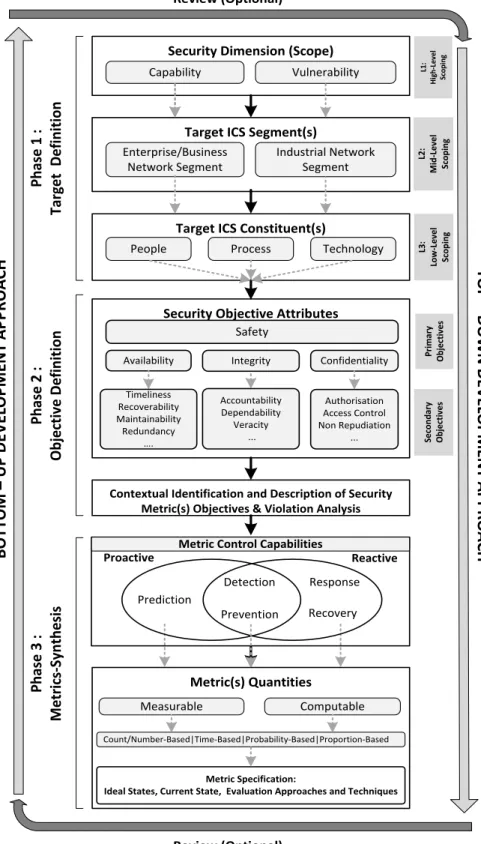
A framework for Operational Security Metrics Development (OSMD) is presented with focus on the industrial environment (Figure 1). This OSMD framework tends to unify existing security metrics development approaches and methodologies with the improvement of adaptability. To eliminate the gaps in existing models, the OSMD framework combines the features of existing security metrics development frameworks, and best practice standards and guidelines, such as NIST SP 800-53 [33], NIST SP 800-82 [6], ISO/IEC 27001 [9], and NIST Framework for Improving Critical Infrastructure Cybersecurity v.1.0. [7]. It adopts the advantages from: top-down and bottom-up concepts in [23], [29], ideal-driven model [20], adaptive capability concept [25], [31], [34], hierarchical interdependency model [35], review and refinement concept [23], control and compliance-driven models in TSMM [30], and defense-in-depth strategy [16]. The OSMD framework aims to overcome the weakness of a lack of clarity and methodical guidance for producing security metrics in response to clearly defined security objectives by organisations.
6
A security metric development approach should be clearly contextual, easily adoptable, iterative, and adaptive, in response to the dynamic nature of ICS environment in terms of security targets and objectives. The process of security metrics development includes three phases: (i) Target definition, (ii) Objective definition, and (iii) Metrics Synthesis (See Figure 1). These offer a holistic and integrated approach for the development of security metrics for varied scopes, dimensions, and attributes. Typically, it is believed that good security metrics are products of a good development approach, and in the dynamic field of ICS security, a good metrics development approach should have some essential characteristics such as: scope-definitive, objective-oriented, reliable, simple, adaptable, and repeatable (SORSAR). Scope-definitive property of a security metrics development framework should make for the specification of scopes and constraints in relation to the dimension of security (offensive or defensive) for which metrics are required, target network segment (enterprise or industrial control), and the precise system constituents (people, processes, technologies) to be measured. Objective-oriented characteristic provisions for the precise articulation of security objectives targeted by the metrics. These could include both the primary (safety, availability, integrity, confidentiality, and accountability) and secondary (decomposed) security objectives, and the articulation of the violation principles being considered. Reliable outlines the requirement of a development framework to yield desired and consistent metrics in line with consistent objectives and scope. Simple emphasises the characteristic of framework to be easy to understand and straightforward to employ or use. Adaptable defines the requirement of a development framework to be easily bent or tractable. A good framework should be adaptable to different security scenarios, objectives, and tweaked to suite varied and dynamic dimensional changes. Repeatable emphasises the need for a development framework to provision for the repetitions of process and procedures where necessary; in response to the need for modifications and improvements in metric quantities of the outcomes of measurements. The concept of iterations is a necessary to meet the dynamisms that might emerge. While developing a security metrics frameworks, it is pertinent for experts and developers to consider these properties, as they contribute to achieving a holistic and robust framework structure that can meet the ever-dynamic changes in the current security landscape. A metrics development framework with the SORSAR properties is more likely to avoid weak metrics that slack in meeting objective capabilities drawn by system owners. The uniqueness and strength of the OSMD framework is that it assembles all the SORSAR framework characteristics into its structure by logically harnessing varied strengths of existing approaches, and producing an improved approach for security metrics development with relativity to the ICS environment.
3.1 Target Definition
This involves delineating the attributes that give clearer information about the target system or environment for which security metrics are being generated. It includes defining the measurement scope, the target segment and the specific constituent(s) from which metrics will be derived.
A) Security Dimension (L1 Scoping)
This outlines the possible viewpoints through which security can be rationalised. Traditionally, security can be construed in two lookouts: Capability and Vulnerability. The security state of a system can be measure based on how strong or weak the system can be circumvented. It is, therefore, important to articulate the dimension of security especially at the beginning of every metrics development process. This concept presents a high-level (L1) scope definition that marks the beginning of carving out a clear direction for the security metrics development process.
i. Capability
Security capability characterises the might to uphold a protected state, and is measured by how difficult it is (or will be) to circumvent inherent protected capacities [36]. Metrics for evaluating security capability or strength try to measure the time, effort, and other resources necessary to breach a system’s protections, and can be observed when taking the perspective of an attacker or adversary. For instance, the use of attack graphs and trees, and other security analysis paradigms [37]–[40] to arrive at metric attributes for evaluating system protective states. Attack graphs and tress typically characterise probable attacker actions in the light of a system scope or configuration. Understanding a system’s security capability can support the decision to improve processes to make systems even stronger, and help the differentiation of more secure systems from the less secure ones [36].
ii. Vulnerability
This is the flip side of security capability, and emphasises the inability to achieve or sustain a certain protected state. Technically, it is referred to as ‘vulnerability’, and it outlines the ease of rupturing a system’s security state observed from a defensive point of view. For instance, defense trees [41], [42], the CVSS paradigm [43]– [45], the change-point detection evaluation approach [46], etc., have been used to derive metric values used to represent system susceptibilities to potential threats and attacks. Similarly, the knowledge of these vulnerabilities can help the easy identification and appropriation of security controls and efforts.
B) Network Segmentation (L2 Scoping)
This involves defining the section of an overall sy stem architecture for which security perspectives are desired, and metrics required. Typically, modern ICS architectures encompass a wide area network (WAN) integrating industrial operational technology (OT) networks with enterprise information technology (IT) networks [6]. The two networks are different in technologies and control protocols, and most times require different approaches,
7
metric quantities, and policy priorities for evaluating security features and states. These variations often account for application incompatibilities, hence the need to clearly specify the ICS network segment of focus for metrics development. Other segment delineation approaches could be based on asset/system functionality, configurations, or security requirement [47]. This is considered a mid-level (L2) scope definition that informs of the specific section of a larger ICS network to which security evaluation is focused.
C) System Constituent (L3 Scoping)
With an understanding of the target segment of a metrics development process, it is also necessary to identify the constituent of the segment being focused upon. Because a network segment would basically be made up of several constituents or entities. Both enterprise and industrial segments of an ICS are essentially information operations and management systems (IOMS), and are made up three inter-operating value provisioning structural constituents: people, process, and technology [48]–[50]. Every emergent metric quantity would measure characteristics of one or more of these three constituents, and express corresponding capabilities. Since security objectives may vary at different times for different system or organisations, it becomes necessary at every metric development stage to delimit the constituent focus of interest. This will help simplify the task of generating and analysing metric quantities, and generally speedup the development process. With this, it becomes possible to isolate the security states of one constituent from another for decision-making. This is quite helpful in situations where measures and insights into security status of specific/singular constituents are needed rather than the combined states of the three. This is considered a low-level (L3) definition of scope.
3.2 Objective Definition
Metric quantities should typically provide information that guides towards the attainment of defined or pre-conceived security goal and objectives. Such goal-oriented security metrics requires defining security objectives first.
A) Primary and Secondary Objectives
In the ICS domain, safety is as important as security and should be considered a necessary critical objective, since it seeks to preserve from death, injury, occupational illness, damage to or loss of equipment or property, or damage to the environment [6]. On the other hand, security emphasises the protection of technologies, processes, and data from malicious compromise in the contexts of availability, integrity, and confidentiality [51], [52], which in this study are considered as primary objectives. The scope of this work does not extend in-depth to the concept of safety, but focuses on security.
For clarity in development process and outputs, where possible, it is also necessary to decompose the primary security objectives into corresponding secondary objectives in line with business/operational objectives, and the envisaged security violations that potentially threaten the actualisation of the desired business/operational objectives. These secondary objectives specify deeper actionable security principles targeted in the metrics development process. For instance, availability objectives could be decomposed into timeliness, recoverability, redundancy, etc. Integrity objective could be decomposed into accountability, authentication, non-repudiation [53], dependability, veracity, etc., while confidentiality objective could be decomposed to authorisation, access control, etc. [6], [10], [15], [33].
B) Contextual Description
The objective definition phase is concluded with a contextual description of the final state of the security objective to be achieved by resultant metrics, and the analysis of violation concepts. It is a good concept to have a single objective statement that plainly states the end towards which all measurement and metrics gathering efforts should be directed [23] in line with pre-defined primary and secondary security objectives. For instance, a contextual security objective description could read ‘to provide security metrics that plainly and easily communicate the degree to which system technologies can effectively control security threats, vulnerabilities, and attacks, to guard against operational disruptions’. Here, a primary objective could be ‘availability’ and ‘integrity’, and a secondary objective could be ‘redundancy, reliability, and access control’. It is required that contextual security objective descriptions be clear enough to enable the derivation of prospective action plans for the attainment of prescribed security objectives. Contextual description could be guided by relevant security standards like NIST SP 800-53 [33], NIST SP 800-82 [6], ISO/IEC 27001 [9], and NIST Framework for Improving Critical Infrastructure Cybersecurity v.1.0. [7], etc.
3.3 Metrics Synthesis
This phase describes the process of articulating dimensions to security metrics, and by dimension imply the focus for security control.
A) Control Capabilities
Existing security control efforts and implementations basically take on one of two broad control capabilities: proactivity and reactivity [53], [54]. Security metrics should thus mirror the same dimensions. Metrics could adopt proactive capability, where measures are derived to give perspectives about future security or vulnerability states [45], [55], [56], or would help guard against potential future security threats and risks. Proactive control capability attributes include: prediction, detection, and prevention. Security control efforts could also assume reactive
8
dispositions, in which case metric derivations are obtained to give outlooks to current states [57], what is required to control or counteract the effects and impacts of security compromises that already occurred. Control capabilities in this regards include detection, prevention, response, and recovery. Furthermore, security metrics could combine both capabilities into what is termed a ‘hybrid’ capability that yields measures and metrics that capture the perspectives of both proactivity and reactivity. The occurrence of detections and preventions in both dimensions indicates their importance and relevance in any security metrics development process. Any security metric taxonomy should capture among others, quantities that articulate capacities for both detection and prevention. In a broader scale, a security objective could target both proactive and reactive dimensions, in which case all five (5) control attributes are considered in the development strategy.
B) Metric Quantities
With a clear definition of desired metrics control dimensions, it becomes easier to generate specific metric quantities and specify quantity constituent attributes. Metric quantities could be derived computationally applying mathematical concepts, or via measurements using scales and instruments. The outcomes can be as single measurable attribute that is representative of the state of a system or security phenomenon. For instance the security evaluation deficiency count, known vulnerability days, and password crack time metrics in [58]. However, metrics could also be derived from the combination of two or more disparate attributes, from which a single quantity emerges and is representative of the security perspective desired. This is referred herein as ‘composite metrics’ [59]. Metric quantities can be further defined based on the unit/base for measurement, and accordingly can be count/number-based, time-based [20], [55], probability-based [44], [60], proportion-based [61], or cost-based [62], [63]. It is appropriate to openly clarify these units in relation to each metric quantity in the taxonomy to be generated, and to understand the interpretation of each metric in relation to pre-defined security objectives of the system.
C) Metric Specification.
A metric specification profile is required for every metric quantity generated during the development process. A metric specification is described as a function of its current state/value (quantitative or qualitative), an ideal state specification, and an evaluation technique for obtaining the metric measures. These are relevant in describing a metric since consistency; expressed by the gain of repeatable results in measurement technique is considered of higher priority than the decision of measurement subjectivity or objectivity [64] and a characteristic of good metrics [16]. Since the goal of any measurement is to determine if a system constituent meets its security objective as defined in the metrics profile description, such descriptions help proffer quicker and clearer understanding and interpretation of each metric, and the corresponding implications in relations to targeted objectives.
3.4 Structural Flow and Review
The proposed model supports the top-bottom approach of metrics development. Nonetheless, it could still be adapted to a bottom-up approach as well, hence the reason for indicating two directional arrows (one directing up and the other directing down) surrounding the framework structures. The choice of direction should be entirely dependent on organisational convenience, expertise, and the perception of a most suiting approach towards achieving targeted goals. However, for easy, better structured, and most appropriate synthesis of security metrics, the top-down approach is recommended. It might be better that the security metrics development should follow the system development life cycle, where, the system in a broad concept can refer to security metrics of industry control environment. Effectiveness of development can be achieve with a good understanding of requirements, expectations, and outcomes of successive phases of the development lifecycle.
It is also pertinent to engage formal reviews and reassessments of metrics taxonomy periodically, to check the relevance and appropriateness of current metrics taxonomy in relations to evolving security trends and the operational dynamics of the industrial environment. The two directional arrows at the top and bottom of the framework structure are used to capture review and reassessment requirements accordingly. It is crucial to resolve questions about continual relevance, accuracy and reliability of metrics, and their usefulness in determining new courses of actions for the overall attainment of pre-defined security objectives [23]. The review will also assess the worth of efforts and techniques for generating metrics, and the reassessment of emergent external security metrics, standards, and best practices for improving existing internal metrics taxonomy. This study lends voice to the works in [6], emphasising that as trends continue to emerge and evolve in security threats, vulnerabilities, breach patterns and techniques, and impacts, it is important for metrics and their development approaches to take-on adaptive natures, adjusting to strategies as circumstances change.
3.5 Symbolic Representation
Symbolic representations offer an easy way to capture and make visible concepts, ideas, and attributes by showing the various attributes that encompass those concepts and their relationship structure. Hence, for easier understanding, the OSMD framework can be represented symbolically as a septenary set comprising seven state vectors, namely {D, S, d, PO, SO, CC, M}based on the relationship among the three (3) development phases and their corresponding sub-phases as shown in Figure 1, and described in details as follows:
9
D : {Cap, Vul} is a set of all security dimension for metrics development, where Cap and Vul represent
capabilities and vulnerabilities respectively.
S : {Entr, Indr} is a set of all target network segments within the ICS network for which security metrics are
required. Entr and Indr represent Enterprise and Industrial Network segments respectively.
d : {d = 1, 2,3, …, n} is a set of all system constituents or devices for a target network segment.
PO : {A, I, C} is a set of all primary security objectives targeted by the metrics development approach, where A, I,
and C represent availability, integrity, and confidentiality respectively.
SO : {soi|i=1…n, soiàA ∪ I ∪ C}a set of all secondary security objectives related to a targeted primary objective.
CC : {Prd, Det, Prv, Rsp, Rcv} is a set of all control capabilities, where Prd, Det, Prv, Rsp, andRcv represent
Prediction, Detection, Prevention, Response, and Recovery respectively.
Md : {mj | j =1, 2, …, n} is a set of all metric quantities deducible from constituent d.
With this, a metric specification (subsection 3.3c) for a resulting metric quantity can also be represented using a quinary set comprising of five state vectors, namely {Md, d, I, C, E}, such that:
(Md) = f (Id , Cd , Ed)
where:
Id : {s1, s2, s3,…,sn} is the set of all respective ideal state values for the metric quantities Md. The value of I is
defined based on acceptable security states of Mdfrom prescribed security requirements.
Cd : {c1, c2, c3,…,cn} is the set of all respective current state values for the metric quantities Md. The value of C is
derived via measurements or computationally.
10
Figure 1: Operational Security Metrics Development (OSMD) Framework
3.6 Implementation and Application Concept
The OSMD framework can be implemented in various instances. The black-shaded phase and sub-phase transition arrows indicate mandatory implementation flow transitions, while the grey-shaded sub-phase transition arrows indicate optional/selective transition inclusions. By these, it means that it is not in all cases that that all phase and transion features will be reflected in a metrics generation process. Rather, the application environment’s target security objective(s), choiced/desired security dimension, and control capabilities of interest, would determined the phase and sub-phase transition to be followed, and subsequently, also determine the varied security metric quantities that can emerge. For example, for an environment whose security improvement focus is fronm the people (human) perspectives, the security metric quantities that would be derived using the approach would clearly differ from the environment with
Security Dimension (Scope) Capability Vulnerability
Target ICS Segment(s) Enterprise/Business
Network Segment Industrial Network Segment
Target ICS Constituent(s)
People Process Technology
Security Objective Attributes
Availability Integrity Confidentiality
Safety
Contextual Identification and Description of Security Metric(s) Objectives & Violation Analysis
Metric(s) Quantities
Measurable Computable
Count/Number-Based|Time-Based|Probability-Based|Proportion-Based
Metric Specification:
Ideal States, Current State, Evaluation Approaches and Techniques
Ph as e 1 : Ta rg et D ef in iti on Ph as e 2 : O bj ec tiv e De fin iti on Ph as e 3 : M et ric s-Sy nt he si s
BO
TT
O
M
–
U
P
DE
VE
LO
PM
EN
T
AP
PR
O
AC
H
TO
P –
D
O
W
N
D
EV
EL
O
PM
EN
T A
PP
RO
AC
H
L1 : Hi gh -L ev el Sc op in g L2 : M id -L ev el Sc op in g L3 : Lo w -L ev el Sc op in g Pr im ar y O bj ec tiv es Se co nd ar y O bj ec tiv esMetric Control Capabilities
Proactive Reactive Recovery Detection Prevention Prediction Review (Optional) Review (Optional) Authorisation Access Control Non Repudiation ... Accountability Dependability Veracity ... Timeliness Recoverability Maintainability Redundancy …. Response
11
focus on technology security postures. Similarly, an organisation that desires to evaluate security capability of its system via a combined technology and process perspective, would most often use different security metric measures from the organisation that desires to learn organisational security vulnerability of technology, process, and people dimensions.
Typically, variations in the security objectives of organisations would also yield variations in corresponding and relevant security metric quantities. Hence, why it is not considered binding for all dimensions to be reflected in a metric generation process. The proposed framework presents an open approach to the enumeration of key dimensions, objectives, and control capabilities that can be considered in a security metrics development process. Security Capabaility and Vulnerability both represent different viewpoints through which security evaluations can be engaged. Such evaluations can focus on either the business network or the industrial operations network, or both. Similarly, people, process, and technologies, all represent distinct constituents where security evaluations can be focused. In some cases, security evaluations can includes any combination of the three. Regardless of the dimensions and control capabilities, the proposed framework emphasises adherence to a structured analysis process that allows for considering all possible security dimesnsions, objectives, an control capabilities to influence the correct identification and appropriate generation of security metric quantities that suit specific environments and situations. The key end goal is to ensure that suitable security metric quantities that suite every case scenario and(or) objectives be achieved using the prescribed framework in its totality or in parts, thus portraying the flexibility and adapatability property earlier emphasised.
4.
VALIDATION
The proposed framework offers an easy way to generate cyber security metrics; the articulation of objectives for a narrowed target system scope, and precisely defining system attributes and constructs necessary for considerations prior and during the security metrics development process. However, it is necessary to justify the usefulness and relevance of the proposed framework via validation means. Validation describes the process of assuring that a model, framework, or structure is sufficiently or reasonably accurate to suit the purpose at hand [65]. In other words, a procedure for ensuring that the right model or framework is being built [66].
A two-level validation approach was adopted for the evaluation of the framework. The first level validation involved the adoption of a use case scenario that demonstrated the practical application of the proposed framework for security metrics development. The aim of the case study is to demonstrate the use of the framework, and assess the effectiveness of the framework for guiding cyber security metrics development process, yielding metric quantities, definitive attributes and measures that can be used to evaluate security capabilities, and providing information that can help improve security assurance based on pre-defined security objectives. The second level validation involved the use of expert intuitions/opinions undertaken using an online questionnaire validation tool which was targeted at expert personnel with understanding and (or) experience in security metrics generation, evaluations, and applications in relations to industrial cyber/information/network security metrics. This approach is generally supported and used in computer science for validating models and frameworks from previous research [67], [68], and especially as related to experts characterised in small samples [68], [69]. The significance of expert knowledge and disposition is also acknowledged in [70]. The reliability of this approach is also demonstrated in [71] and [72] with outcomes that showed that human-centred evaluation processes integrating expert opinions can significantly outdo simple function point models. Thus, this validation aimed at eliciting the views of experts other than the authors of this work on the validity of the proposed framework in the contexts described after careful examination. These views are also aimed at corroborating or contradicting the outcomes of level 1 validation outcomes.
4.1 Verification with a Case Study
This validation level involves the case study scenario on human capability evaluation for cyber security in critical industrial infrastructure [50].This scenanrio assumes the existence of adequate technology and process capability valuations within the case study manufacturing ICS environment. It also assumes the desire to learn of the security capacities of the case study environment people (workforce), and further characterise the security capability attributes of each workforce individual, and use same to influence security improvement decisions. In prior work, metric quantities were developed as part of a modelled approach for evaluating the cyber security capability of the human (people) constituents of an industrial working environment. There is an rapid rise in cyber-attacks on industrial networks and platforms, and particularly targeting the users (human constituents) of the system [50], [73], [74]. The employees within industrial environments are viewed to be weakest links in both the operations and supply chain [75], and they are the most vulnerable vectors of industry cyber cyber-attacks. The motivation for developing cyber security metrics in relation to the evaluation of human security capabilities is to show the security levels of human weak-links by determining their security capacities and vulnerabilities, and hence put necessary guided control efforts on security, thus to enhance security assurance of enterprises. It is essentially a formative decomposition validation technique for the proposed framework.The subsections below will demonstrate the process of generating the cyber security metrics in relations people (human) workforce security capacity following the structured flow of the proposed framework.
12
A) Phase 1: Target Definition
In line with phase 1 of the proposed framework, the following descriptions represent the outcomes of the scenario described above:
i. Security Dimension (L1 Scoping): Security metrics intended to capture both capability and vulnerability security dimension of the workforce (users). From the work in [50], determining workforce knowledge and skills emphasises capabilities in the people entities, while the weakest link objective describes a weakness status.
ii. Target ICS Segment: This focuses on the Industrial Network Segment, which defines the working domain of all the workforce members in the scenario.
iii. Target ICS Constituent: this identifies the precise entities upon which measurements and evaluations are will be carried out. In this case, the focus is on the people (Human Users) in the industrial network segment. B) Phase 2: Objective Definition
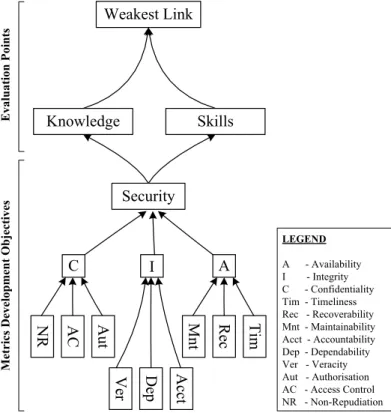
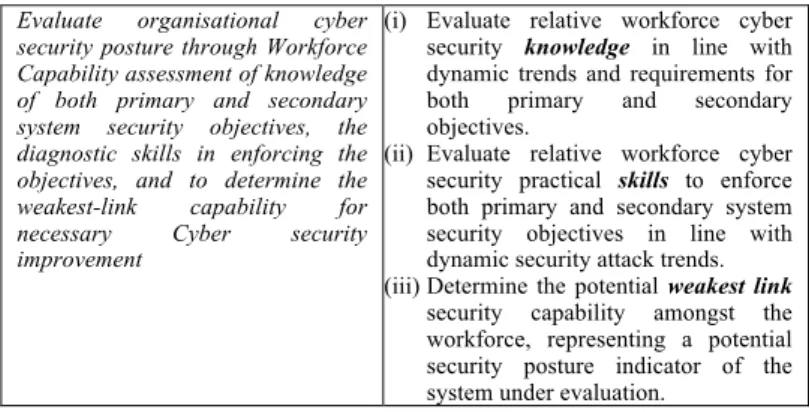
Based on the outlined objectives, safety though relevant is considered a silent requirement in this context since it is not the focus of this study. In terms of security, knowledge capability seeks to determine individual workforce acquaintance to the requirements of availability, integrity, and confidentiality within the system, and skills capability measure the level of practical capability to enforce the primary objectives as understood. In terms of availability, knowledge capability seeks to ensure that workforce members are aware and understand the relevant policies and trends that relate to timeliness, maintainability, and recoverability of their operating infrastructure in the face of a cyber-attack. Integrity ensure workforce members’ awareness of relevant integrity policies and trends in relations to accountability, dependability, and veracity, etc, while confidentiality strives the same feet for authorisation, access control, and non-repudiation. The skills capability requirement seeks to determine the workforce practical aptitude to implement or enforce essential security policies in line with both primary and secondary objectives. Accordingly, a relationship can be identified between the security metrics development objectives (primary and secondary) and the contextualised evaluation points. This is represented in Figure 2, while Table 2 expands on the metrication contexts accordingly.
Figure 2: Mapping Relationship between Development and Metrication Objectives
Table 2: Metrics Development Objective Definition for Workforce Capability Evaluation Contextual Definition
Metrication Aim Evaluation Points
LEGEND A - Availability I - Integrity C - Confidentiality Tim - Timeliness Rec - Recoverability Mnt - Maintainability Acct - Accountability Dep - Dependability Ver - Veracity Aut - Authorisation AC - Access Control NR - Non-Repudiation Weakest Link Knowledge Skills Security A I C R ec Tim M nt D ep Acct V er A C Aut N R E va lu at io n P oi n ts M et ri cs D ev el op m en t O b je ct iv es
13 Evaluate organisational cyber security posture through Workforce Capability assessment of knowledge of both primary and secondary system security objectives, the diagnostic skills in enforcing the objectives, and to determine the weakest-link capability for necessary Cyber security improvement
(i) Evaluate relative workforce cyber security knowledge in line with dynamic trends and requirements for both primary and secondary objectives.
(ii) Evaluate relative workforce cyber security practical skills to enforce both primary and secondary system security objectives in line with dynamic security attack trends. (iii)Determine the potential weakest link
security capability amongst the workforce, representing a potential security posture indicator of the system under evaluation.
C) Phase 3: Metrics Synthesis
Based on the contextual description contained in the aim and objectives in table 1, the metric control capabilities of need include; detection, prevention, response, and recovery. The control capabilities depict the organisation’s desire to knowledge and skill measure to evaluate both individual and organisation to detect, respond, prevent, and recover from potential attacks when they occur. Accordingly, two essential sole metric quantities are deduced via a computation means from the target and objective definitions of Knowledge Capability (Kc) and Skills Capability (Sc) [50].
Knowledge capability is defined as the measure awareness and theoretical understanding about recurrent cyber threats, vulnerabilities, attack patterns and impacts to the target system that a user, employee or operator is working with, while skills capability outlines the measure of ability to use accrued knowledge either from experience or training to spot cyber-attack attempts, patterns and techniques, and the degree to which the user can respond, prevent or recover timely with appropriate countermeasures [50].
These two metrics are computable as number-based quantities that are dependent on the specific evaluation techniques, i.e., there measure are discrete values derived based on the nature and type od evaluation (questionnaire, survey, gamification, etc) approach adopted. Their respective maximum values represent their ideal states. Another metric referred to as Organisational Capability Rating for one person (CRp) is used to represent the assumed organisational
workforce capability potential, obtained from the harmonisation of Kc and Sc metrics for all workforce members into a
set A = {CR1,…, CRn), and the identification of the least value in A, which is the weakest-linkCRp. Therefore, CRp =
min (A) = min (CR1,…, CRn), CRpϵ A, n = number of workforce members under evaluation. CRp is thus acomposite
metricsince it requires the combination of two metric quantities. The profile description of the three-metrics taxonomy for workforce cyber security capability evaluation are presented in Table 3. The ideal situation is the desirable state of every workforce member, while the current state would indicate the actual state of each workforce member after the questionnaire, statistical analysis, and weakest-link analysis evaluation approaches have been employed. These invariably aid the accomplishment of the initial security objectives, and toward towards attaining the pre-defined security aim of developing the metrics.
Table 3: Metrics Profile Description for Human Capability Evaluation Metric
No.
Name Symbol Metric Specification f (Id, Cd, Ed)
M1 Knowledge Capability (Kc) SP(Kc) = f(Kcmax, Kcp, QA)
M2 Skill Capability (Sc) SP(Sc) = f(Scmax, Scp, QA)
M3 Organisational Capability Rating (CRp) SP(CR) = f(CRmax, min(A),WLA)
I = Ideal State, C = Current State, E = Evaluation Approach, QA =Questionnaire Analysis, WLA=Weakest Link Analysis
D) Application and Analysis
The generated people-centred metrics outlined in table 3 were further evaluated using a real scenario involving a six-member team of postgraduate students undertaking a research project for the development of physical demonstrator of cyber security in manufacturing. The team’s objective was to develop and keep operational a physical prototype manufacturing SCADA infrastructure, and explore the potentials for executing cyber-attacks on the prototyped systems with impact observations and recommendations for enhancing cyber security.
In this scenario, the goal of ‘keeping operational’, ‘executing cyber-attack’, and making ‘impact observations and recommendations’ all depend on the security knowledge and skills capabilities of the team members, which in turn describe the team members’ knowledge and skills in actualising the primary and secondary security objectives. Hence,
14
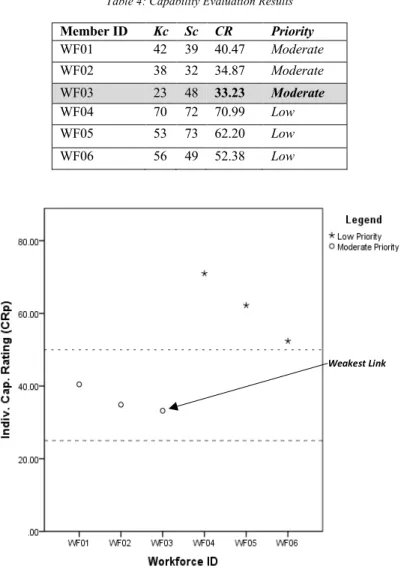
prior to the team’s evaluation, the following assumptions were made; (i) the team represents a small-scale industrial (manufacturing) workforce, (ii) all the members of the team had equal capabilities in security knowledge and skills to achieve the prescribed objectives of the project. For this metrication scenario, all the objective attributes outlined in Table 1 were adopted, and an evaluation tool (questionnaire) was developed using the UK’s ‘10 steps to cyber security’ guidelines [76]. The questionnaire comprised of 40 security capability test questions (20 for knowledge, and 20 for skills). The evaluation tool was administered to each team member and responses analysed using the workforce capability evaluation approach, and corresponding knowledge and skills capability ratings derived using the appropriate evaluation functions [50]. Accordingly, the capability priority rankings included: 20.00 ≤ h ≤ 33.33 for high, 33.33 < m ≤ 66.67 for moderate, and 66.67 < l ≤ 100.00 for low. The low priority range of scores represented the ‘Ideal state’
I
of the metric quantities. The result of the evaluation of capabilities is presented in table 4.Table 4: Capability Evaluation Results
Member ID Kc Sc CR Priority WF01 42 39 40.47 Moderate WF02 38 32 34.87 Moderate WF03 23 48 33.23 Moderate WF04 70 72 70.99 Low WF05 53 73 62.20 Low WF06 56 49 52.38 Low
Figure 3: Workforce Capability Visualisation Chart
The evaluation yielded different levels of capabilities in knowledge, skills, and normalised capabilities for the team members and easily showed the team members’ weak levels in cyber security (table 3 and figure 3). If an organisation is potentially as weak as its weakest link, then the resulting weakest link value herein represents the security capability of the small-scale industrial organisation or enterprise. Identifying such weak links reveals to organisations their easier compromise vector of successful attacks, since attacks typically target the most vulnerable points of an organisation or enterprise. Hence, organisation should improve the security assurance from this point. It can be assumed that the security capability of the weakest link potentially represents the security capability of the organisation. If such weakest link is identified, then it potentially provides the easiest means for compromising the organisation. In this scenario, the weakest link capability is attributed to the team member ID WF03(Kc = 23, and Sc = 48) with a normalised capability rating CR = 33.23. Therefore, organisations or enterprises need to ensure that the weakest link will be as strong as possible against cyber-attacks or crimes
4.2 Validation by Experts
The second level validation adopted an approach for validating improvement structures, frameworks, and measurement mechanisms by eliciting a group of experts to complete a detailed questionnaire, or respond to oral structured interviews. The online questionnaire approach offers ample time and opportunity for completion to the experts, while