Calhoun: The NPS Institutional Archive
Theses and Dissertations Thesis Collection
2009-09
A study on improving defense
acquisition through the application of
Defense Acquisition Workforce
Improvement Act (DAWIA) concept to
defense industry workforce
Choi, Davis I.
Monterey, California. Naval Postgraduate School
NAVAL
POSTGRADUATE
SCHOOL
MONTEREY, CALIFORNIA
THESIS
Approved for public release; distribution is unlimited A STUDY ON IMPROVING DEFENSE ACQUISITION THROUGH THE APPLICATION OF DEFENSE ACQUISITION WORKFORCE IMPROVEMENT ACT (DAWIA) CONCEPT TO
DEFENSE INDUSTRY WORKFORCE
by Davis I. Choi September 2009
Thesis Advisor: Walter Owen
REPORT DOCUMENTATION PAGE Form Approved OMB No. 0704-0188
Public reporting burden for this collection of information is estimated to average 1 hour per response, including the time for reviewing instruction, searching existing data sources, gathering and maintaining the data needed, and completing and reviewing the collection of information. Send comments regarding this burden estimate or any other aspect of this collection of information, including suggestions for reducing this burden, to Washington headquarters Services, Directorate for Information Operations and Reports, 1215 Jefferson Davis Highway, Suite 1204, Arlington, VA 22202-4302, and to the Office of Management and Budget, Paperwork Reduction Project (0704-0188) Washington DC 20503.
1. AGENCY USE ONLY (Leave blank) 2. REPORT DATE
September 2009
3. REPORT TYPE AND DATES COVERED Master’s Thesis
4. TITLE AND SUBTITLE A Study on Improving Defense Acquisition through the Application of Defense Acquisition Workforce Improvement Act (DAWIA) Concept to Defense Industry Workforce
6. AUTHOR(S) Davis I. Choi
5. FUNDING NUMBERS
7. PERFORMING ORGANIZATION NAME(S) AND ADDRESS(ES) Naval Postgraduate School
Monterey, CA 93943-5000
8. PERFORMING ORGANIZATION REPORT NUMBER
9. SPONSORING /MONITORING AGENCY NAME(S) AND ADDRESS(ES) N/A
10. SPONSORING/MONITORING AGENCY REPORT NUMBER
11. SUPPLEMENTARY NOTES: The views expressed in this thesis are those of the author and do not reflect the official policy or position of the Department of Defense or the U.S. Government.
12a. DISTRIBUTION / AVAILABILITY STATEMENT Approved for public release; distribution is unlimited
12b. DISTRIBUTION CODE A 13. ABSTRACT (maximum 200 words)
The Department of Defense (DoD) believes that acquisition workforce is the most important asset to assure long-lasting reform of the defense acquisition system, and to optimize the expenditure of ever-decreasing acquisition resources. The Defense Acquisition Workforce Improvement Act (DAWIA) is the basis of defense acquisition workforce policy. As a part of the FY 1991 National Defense Authorization Act, the DAWIA requires the DoD to establish and manage career development through establishment of education and training standards, requirements, and courses for the DoD civilian and military acquisition workforce.
Defense acquisition leadership in general recognizes that cross-organizational collaboration and disciplined communication are pivotal to successful program acquisition. However, they have not yet completely grasped the control and management of defense industry establishments and activities. The DoD and defense industry are yet to recognize how much they know and don’t know each other. This thesis evaluates the Defense Acquisition Workforce Improvement Act (DAWIA) principle, investigates the adaptation of DAWIA concept to defense industry
establishment, and provides recommendations to the defense acquisition community.
15. NUMBER OF PAGES
121 14. SUBJECT TERMS
Defense Acquisition, Defense Acquisition Workforce, Defense Acquisition Workforce Improvement Act, Certification, Professionalization, Workforce, Defense Industry Workforce, Program
Management, Project Management 16. PRICE CODE
17. SECURITY CLASSIFICATION OF REPORT Unclassified 18. SECURITY CLASSIFICATION OF THIS PAGE Unclassified 19. SECURITY CLASSIFICATION OF ABSTRACT Unclassified 20. LIMITATION OF ABSTRACT UU
NSN 7540-01-280-5500 Standard Form 298 (Rev. 2-89) Prescribed by ANSI Std. 239-18
Approved for public release; distribution is unlimited
A STUDY ON IMPROVING DEFENSE ACQUISITION THROUGH THE APPLICATION OF DEFENSE ACQUISITION WORKFORCE IMPROVEMENT
ACT (DAWIA) CONCEPT TO DEFENSE INDUSTRY WORKFORCE
Davis I. Choi
Senior Project Engineer, Boeing Integrated Defense Systems B.S., United States Air Force Academy, 1981
M.S., University of Southern California, 1985 M.S., Troy State University, 1989
Submitted in partial fulfillment of the requirements for the degree of
MASTER OF SCIENCE IN SYSTEMS ENGINEERING MANAGEMENT
from the
NAVAL POSTGRADUATE SCHOOL September 2009
Author: Davis I. Choi
Approved by: Walter Owen Thesis Advisor
John A. Sarakatsannis Second Reader
David H. Olwell
ABSTRACT
The Department of Defense (DoD) believes that acquisition workforce is the most important asset to assure long-lasting reform of the defense acquisition system, and to optimize the expenditure of ever-decreasing acquisition resources. The Defense Acquisition Workforce Improvement Act (DAWIA) is the basis of defense acquisition workforce policy. As a part of the FY 1991 National Defense Authorization Act, the DAWIA requires the DoD to establish and manage career development through establishment of education and training standards, requirements, and courses for the DoD civilian and military acquisition workforce.
Defense acquisition leadership in general recognizes that cross-organizational collaboration and disciplined communication are pivotal to successful program acquisition. However, they have not yet completely grasped the control and management of defense industry establishments and activities. The DoD and defense industry are yet to recognize how much they know and don’t know each other. This thesis evaluates the Defense Acquisition Workforce Improvement Act (DAWIA) principle, investigates the adaptation of DAWIA concept to defense industry establishment, and provides recommendations to the defense acquisition community.
TABLE OF CONTENTS
I. INTRODUCTION...1 A. BACKGROUND ...1 B. PURPOSE...3 C. RESEARCH QUESTIONS ...3 D. BENEFITS OF STUDY...4 E. SCOPE ...4 F. METHODOLOGY ...5 G. ORGANIZATION OF STUDY ...5 1. Chapter I–Introduction ...62. Chapter II–Review of Defense Acquisition Program Management ...6
3. Chapter III–Review of DAWIA and Civilian Organization Certifications, and Defense Industry Career Web Sites...6
4. Chapter IV–Research Analysis...6
5. Chapter V–Conclusions...6
II. REVIEW OF DEFENSE ACQUISITION MANAGEMENT ...7
A. INTRODUCTION...7
B. DEFENSE ACQUISITION...7
1. Program Management Framework...7
2. Defense Acquisition Program Management...10
3. Problems of Defense Acquisition ...10
C. DEFENSE ACQUISITION POLICY REVIEW...11
1. Evolution of 1970s Defense Acquisition Policy...12
a. 1971–David Packard Initiative ...12
b. 1975–Addition of DoDI 5000.2...13
c. 1977–Milestone “Demonstration and Validation” ...13
2. Evolution of 1980s Defense Acquisition Policy...14
a. 1980–Focusing on Cycle Time and Adding More Detail ...14
b. 1982–Carlucci Initiative ...14
c. 1985-86–Responding to the “Horror Stories” ...15
d. 1987–Implementing the Packard Commission ...15
3. Evolution of 1990s Defense Acquisition Policy...15
a. 1991–Policy Overhaul...16
b. 1996–Institutionalizing Acquisition Reform...16
4. Evolution of 2000s Defense Acquisition Policy...17
a. 2000–Last Clinton 5000 ...17
b. 2003–Paul Wolfowitz Change ...18
c. 2003–2004–National Security Space Acquisition Policy (NSSA)...18
d. 2005–2008–Defense Acquisition Performance Assessment (DAPA) ...19
D. DEFENSE ACQUISITION WORKFORCE POLICY ...22
1. Definition of Defense Acquisition Workforce...23
2. DAWIA Implementation Guides ...24
3. Defense Acquisition University (DAU)...27
E. CHAPTER SUMMARY...27
III. REVIEW OF DAWIA AND CIVILIAN ORGANIZATION CERTIFICATION, AND DEFENSE INDUSTRY CAREER WEB SITES ...29
A. INTRODUCTION...29
B. DAWIA CERTIFICATION...29
C. PROJECT MANAGEMENT INSTITUTE (PMI) ...32
1. Introduction to PMI...32
2. PMI Certification ...33
a. Project Management Professionals (PMP)...33
b. Certified Associate in Project Management (CAPM)...34
c. Program Management Professional (PgMP) ...35
d. PMI Scheduling Professional (PMI-SP) ...36
e. PMI Risk Management Professional (PMI-RMP) ...36
3. PMI Global Standards and Publications ...37
D. INTERNATIONAL COUNSEL ON SYSTEMS ENGINEERING (INCOSE)...38
1. Introduction to INCOSE ...39
2. INCOSE Certification ...39
a. Associate Systems Engineering Professional (ASEP)...40
b. Certified Systems Engineering Professional (CSEP) ...40
c. Certified Systems Engineering Professional (CSEP) with U.S. DoD Acquisition Extensions (CSEP-Acq) ...41
d. Expert Systems Engineering Professional (ESEP) ...42
3. INCOSE Standards and Publications ...42
E. INSTITUTE OF ELECTRICAL AND ELECTRONIC ENGINEERS (IEEE) COMPUTER SOCIETY (CS) ...43
1. Introduction to IEEE Computer Society (CS) ...43
2. IEEE Computer Society Certification ...44
a. Certified Software Development Associate (CSDA) ...44
b. Certified Software Development Professional (CSDP) ...44
3. IEEE Computer Society Standards and Publications ...45
F. NATIONAL CONTRACT MANAGEMENT ASSOCIATION (NCMA) ...45
1. Introduction to National Contract Management Association (NCMA) ...45
2. NCMA Certification ...46
a. Certified Federal Contracts Manager (CFCM)...46
b. Certified Commercial Contracts Manager (CCCM) ...46
c. Certified Professional Contracts Manager (CPCM) ...47
3. NCMA Standards and Publications ...48
1. Introduction to International Society of Logistics (SOLE)...48
2. International Society of Logistics (SOLE) Certification ...49
a. SOLE Certification and Recognition Programs ...49
b. Demonstrated Logistician Program ...49
c. Certified Master Logistician (CML)...51
d. Certified Professional Logistician (CPL)...52
3. SOLE Standards and Publications...52
H. REVIEW OF SELECTED DEFENSE INDUSTRY CAREER WEB SITES ...52
1. Selected Defense Industry Position Requirements by Company...53
a. Aerospace Corporation ...53 b. BAE...54 c. Boeing...55 d. General Dynamics...56 e. Lockheed Martin ...57 f. MITRE Corporation ...58 g. Northrop Grumman ...60 h. Raytheon...60
i. Science Application International Corporation (SAIC)...61
2. Comparison between the Companies for Selected Positions...63
a. Program/Project Management/Engineering ...63 b. Systems Engineering...64 c. Software Engineering ...66 d. Contract Management ...67 e. Logistics...68 I. CHAPTER SUMMARY...69
IV. RESEARCH ANALYSIS ...71
A. INTRODUCTION...71
B. RESEARCH QUESTION ANALYSIS ...71
1. Peculiarities and Trends of Defense Acquisition...71
2. Lessons of Defense Acquisition Program...73
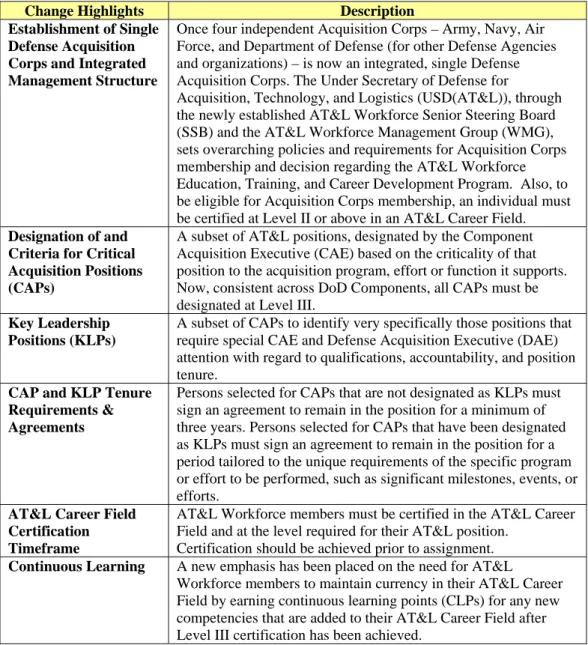
3. Motive behind Defense Acquisition Workforce Improvement Act (DAWIA)...75
4. Application of DAWIA Concept to Defense Industry ...76
5. Approach for Adaptation of DAWIA Concept to Defense Industry...77
C. OTHER RESEARCH FINDINGS ...78
1. Acquisition Reform...78
2. Defense Industry Workforce...79
D. CHAPTER SUMMARY...79
V. CONCLUSIONS AND RECOMMENDATIONS...81
A. INTRODUCTION...81
B. SPECIFIC LIST OF RECOMMENDATIONS ...81
2. New Policy Guidance on Defense Industry Workforce
Development ...82
3. Education and Training ...85
4. Knowledge Sharing...85
C. SUGGESTED AREAS FOR FURTHER RESEARCH ...85
1. Defense Industry Workforce Competency and Management ...86
2. Integrated Combined Joint Program Office between DoD and Defense Industry ...86
3. Directed Telescope ...87
D. SUMMARY ...88
LIST OF REFERENCES ...89
LIST OF FIGURES
Figure 1. Dimensions of Competency (From PMI PMCD, 2002, p. 3). ...9 Figure 2. 2003 vs. 2008 Defense Acquisition Management Framework (From Fazio,
2008, p. 7). ...22 Figure 3. Multi-Level Certification Concept (From INCOSE, 2009)...40 Figure 4. Professional Growth Path of Logistician (From SOLE, 2009)...50
LIST OF TABLES
Table 1. DAPA Panel Recommendations Overview (After DoD DAPA, 2006). ...20
Table 2. Current DAWIA Implementation Highlights (After DoDI 5000.66, 2005). ...26
Table 3. Comparison of AT&L Position Categories (After DoD 5000.52-M, 2005 & DAU, 2009). ...31
Table 4. AT&L Workforce Certification Level (After DoD Desk Guide, 2006). ...32
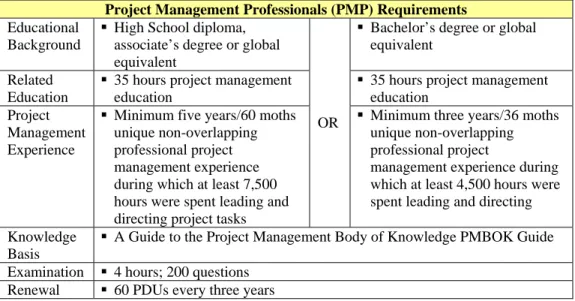
Table 5. PMP Requirements (After PMI PMP, 2009). ...34
Table 6. CAPM Requirements (After PMI CAPM, 2009). ...34
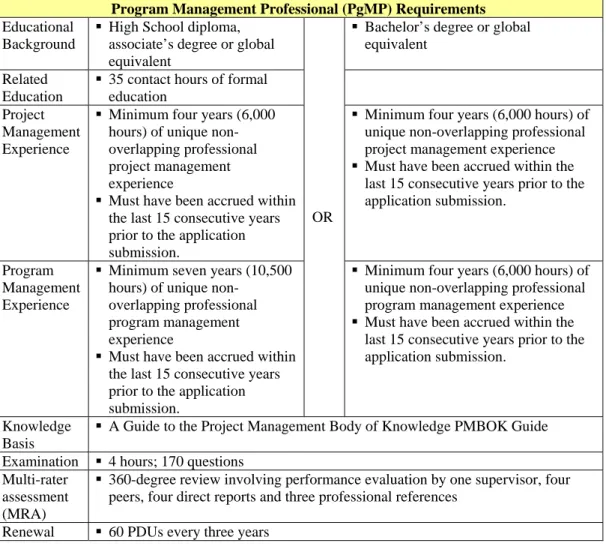
Table 7. PgMP Eligibility Requirements (After PMI PgMP, 2009)...35
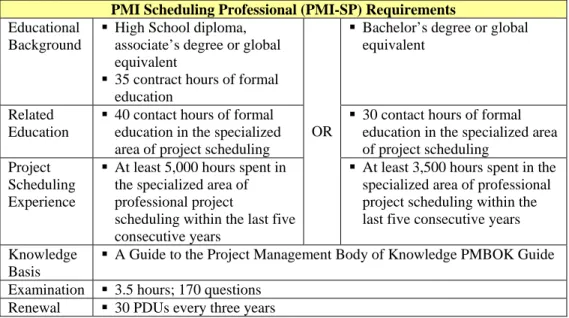
Table 8. PMI-SP Requirements (After PMI PMI-SP, 2009). ...36
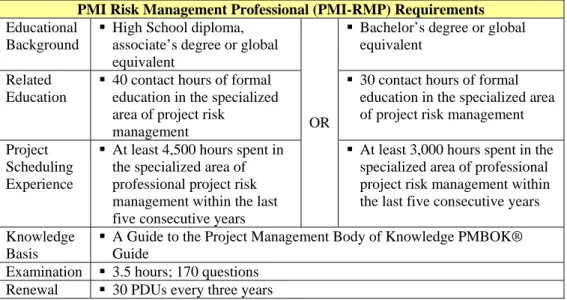
Table 9. PMI-RMP Requirements (After PMI PMI-RMP, 2009). ...37
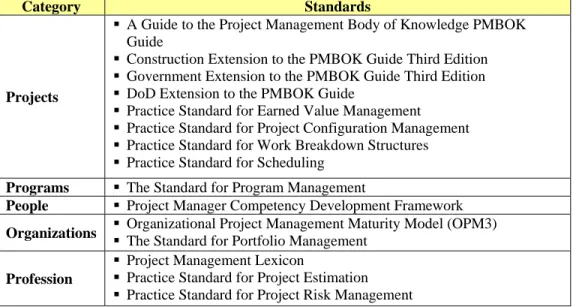
Table 10. PMI Global Standards (After PMI, 2009)...38
Table 11. ASEP Requirements (After INCOSE, 2009). ...40
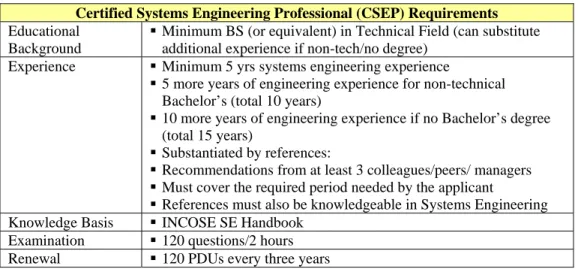
Table 12. CSEP Requirements (After INCOSE, 2009). ...41
Table 13. CSEP-Acq Requirements (After INCOSE, 2009). ...42
Table 14. INCOSE Products (After INCOSE, 2009)...43
Table 15. CSDA Requirements (After IEEE CS, 2009). ...44
Table 16. CSEP Requirements (After IEEE CS, 2009). ...45
Table 17. CFCM Requirements (After NCMA, 2009). ...46
Table 18. CCCM Requirements (After NCMA, 2009)...47
Table 19. CPCM Requirements (After NCMA, 2009). ...47
Table 20. NCMA Products (After NCMA, 2009). ...48
Table 21. DLP Requirements (After SOLE, 2009)...51
Table 22. CML Requirements (After SOLE, 2009)...51
Table 23. CPL Requirements (After SOLE, 2009)...52
Table 24. Aerospace Corporation Position Description (After Aerospace, 2009)...54
Table 25. BAE Position Description (After BAE, 2009)...55
Table 26. Boeing Position Description (After Boeing, 2009)...56
Table 27. General Dynamics Position Description (After GD, 2009). ...57
Table 28. Lockheed Martin Position Description (After LM, 2009). ...58
Table 29. MITRE Corporation Position Description (After MITRE, 2009). ...59
Table 30. Northrop Grumman Position Description (After NG, 2009). ...60
Table 31. Raytheon Position Description (After Raytheon, 2009). ...61
Table 32. SAIC Position Description (After SAIC, 2009). ...62
Table 33. Program/Project Management/Engineering Function Requirements. ...63
Table 34. Systems Engineering Function Requirements. ...64
Table 35. Software Engineering Function Requirements. ...66
Table 36. Contract Management Function Requirements. ...67
Table 37. Logistics Function Requirements. ...68
Table 38. Lessons of Past Defense Acquisition Programs...74
Table 39. Equivalency Comparison between Selected DAWIA Certifications and Civilian Organization Certifications. ...83
LIST OF ACRONYMS AND ABBREVIATIONS
Acronym Definition
AFIT Air Force Institute of Technology
AFSAB Air Force Scientific Advisory Board
AJAX Asynchronous JavaScript and XML
ANSI American National Standards Institute
ASEP Associate Systems Engineering Professional
ASQ American Society for Quality
AT&L Acquisition, Technology and Logistics
AUD Auditing
BUS-CE Business – Cost Estimating
BUS-FM Business – Financial Management
C4ISR Command, Control, Communications, Computers, Intelligence Surveillance and
Reconnaissance
CAE Component Acquisition Executive
CAIV Cost As an Independent Variable
CAP Critical Acquisition Position
CAPM Certified Associate in Project Management
CCCM Certified Commercial Contracts Manager
CD Concept Decision
CDD Capabilities Development Document
CFCM Certified Federal Contracts Management
CGAP Certified Government Auditing Professional
CIA Certified Internal Auditors
CML Certified Master Logistician
CON Contracting
CPCM Certified Professional Contracts Manager
CPD Capabilities Production Document
CPFF Cost Plus Fixed Fee
CPL Certified Professional Logistician
CQE Certified Quality Engineer
CR Concept Refinement
CSDA Certified Software Development Associate
CSDL Computer Society Digital Library
CSDP Certified Software Development Professional
CSEP Certified Systems Engineering Professional
CSEP-Acq Certified Systems Engineering Professional with US DoD Acquisition Extensions
CSIS Center for Strategic and International Studies
CSSBB Certified Six Sigma Black Belt
CSSGB Certified Six Sigma Green Belt
DAB Defense Acquisition Board
DAIP Defense Acquisition Improvement Program
DAPA Defense Acquisition Performance Assessment
DAU Defense Acquisition University
DAWIA Defense Acquisition Workforce Improvement Act
DCP Decision Coordinating Paper
DFAR Defense Federal Acquisition Regulation
DL Demonstrated Logistician
Acronym Definition
DSL Demonstrated Senior Logistician
DMR Defense Management Report
DoD Department of Defense
DoDAF Department of Defense Architectural Framework
DoDD DoD Directive
DoDI DoD Instruction
DOTMLPF Doctrine, Organization, Training, Materiel, Leadership and Education, Personnel
and Facilities
DSARC Defense Systems Acquisition Review Council
DSB Defense Science Board
DSP Defense Support Program
DUSD(AR) Deputy Under Secretary for Defense (Acquisition Reform)
DUSD(AT&L) Deputy Under Secretary of Defense Acquisition, Technology and Logistics
EA Evolutionary Acquisition
EMD Engineering & Manufacturing Development
ESEP Expert Systems Engineering Professional
EVMS Earned Value Management System
FAR Federal Acquisition Regulation
FASA Federal Acquisition Streamlining Act
FE Facilities Engineering
FFP Firm Fixed Price
FFRDC Federally Funded Research and Development Center
FY Fiscal Year
GAO Government Accountability Office (Name changed from General Accounting
Office effective on 7 July 2004)
GPRA Government and Performance Results Act
HTTP Hyper Text Transmit Protocol
JD Julius Doctor
JMSNS Justification for a Major Systems New Start
ICD Initial Capabilities Document
IEEE Institute of Electrical and Electronic Engineers
IEEE CS Institute of Electrical and Electronic Engineers Computer Society
IIA Institute of Internal Auditors
IMP Integrated Master Plan
INCOSE International Council on Systems Engineering
IND Industrial and/or Contract Property Management
IPPD Integrated Product Process Development
IPT Integrated Product Teams
IT Information Technology
ITAR International Traffic in Arms Regulations
KLP Key Leadership Position
LCL Life Cycle Logistics
MBA Master of Business Administration
MDD Materiel Development Decision
MENS Mission Element Need Statement
MILSPECs Military Specifications
MS Master of Science
MSA Materiel Solution Analysis
NCMA National Contract Management Association
NPR National Performance Review
Acronym Definition
NSSA National Security Space Acquisition Policy
OOA/D Object Oriented Analysis and Design
OSD Office of the Secretary of Defense
PAT Process Action Teams
PDU Professional Development Unit
PEOs Program Executive Officer
PgMP Program Management Professional
PM Program Management
PMBOK Project Management Body of Knowledge
PMCD Project Manager Competency Development
PMI Project Management Institute
PMI-SP PMI Scheduling Professional
PMI-RMP PMI Risk Management Professional
PMP Project Management Professional
POM Program Objectives Memorandum
PPBS Planning, Programming and Budgeting System
PQM-QA Production, Quality and Manufacturing – Quality Assurance
PQM-PM Production, Quality and Manufacturing – Production & Manufacturing
PUR Purchasing
RFP Request for Proposal
ROE Rules of Engagement
SAIC Science Applications International Corporation
SEP Systems Engineering Plan
SDD System Development and Demonstration
SOLE International Society of Logistics
SOW Statement of Work
SPRDE-S&TM Systems Planning, Research, Development & Engineering – Science and
Technology Manager
SPRDE-SE Systems Planning, Research, Development & Engineering – Systems Engineering
SPRDE-PSE Systems Planning, Research, Development & Engineering – Project Systems
Engineer
SSB Senior Steering Board
T&E Test and Evaluation
T&M Time and Material
TOC Total Ownership Costs
TSIR Total System Integration Responsibility
TSPR Total System Performance Responsibility
TT&C Telemetry, Tracking and Commanding
UML Unified Model Language
USD(A) Under Secretary of Defense for Acquisition
USD(AT&L) Under Secretary of Defense for Acquisition, Technology and Logistics
WMG Workforce Management Group
ACKNOWLEDGMENTS
I would like to thank God, our families and friends for all their support through this journey. Also, I would like to express gratitude to Professor Walter (Wally) Owen and John Sarakasannis (aka, BJ–Big John) for their support, and extensive review and scrutiny of this thesis.
I. INTRODUCTION
This chapter presents the purpose, problem statement, and research design for a study on improving defense acquisition through the application of Defense Acquisition Workforce Improvement Act (DAWIA) concept to defense industry. It identifies the research questions to answer and research methods. Finally, the significance, scope, and summary of the study are discussed.
A. BACKGROUND
The Department of Defense (DoD) has a long and inconsistent history of defense acquisition program successes and failures. When the programs and projects fail, causing cost overruns, schedule delays and performance shortfalls both the warfighters and tax payers are at loss. The repeated and growing failures in defense acquisition over the past decades, have been well documented and reported in numerous Government Accountability Office (GAO), Office of the Secretary of Defense (OSD), and various other agency reports, along with Congressional panels and commissions. The recurring and cited causes are: unclearly stated, inaccessible, and changing needs and requirements; unstable year to year funding; congressional and bureaucratic meddling; poorly established and tracked baseline; and insufficient investment in systems engineering and program management. Numerous studies and examinations have also produced similar observations regarding systemic shortfalls and recommended fixes. While the DoD’s acquisition policies and directives adopted many of the most substantive findings and recommendations of these reviews, the people managing the process lacked the will to carry through and implement them in program decisions.
DoD leaders are painfully aware of the fiascos that continue to plague the defense acquisition systems. In 2005, then-acting Deputy Secretary of Defense Gordon England authorized an integrated assessment of the defense acquisition process through the Defense Acquisition Performance Assessment (DAPA) project. Citing “many programs continue to increase in cost and schedule even after multiple studies and recommendations that span the past 15 years,” he directed a thorough assessment of the
defense acquisition process “to consider every aspect of acquisition, including requirements, organization, legal foundations, decision methodology, oversight, checks and balances—every aspect” (Christie, 2006, p. 30). The DAPA panel, led by retired Air Force Lieutenant General Ronald T. Kadish, reported the findings to the 109th Congress House Armed Services Committee on 29 March 2006. The DAPA panel found that the defense acquisition system’s problems “are deeply embedded in many of the acquisition management processes that we use in the Department of Defense and not just the traditional procurement system.” The panel proposed an integrated transformation of acquisition to “reduce costs and enhance overall acquisition performance.” This assessment found that the defense acquisition process is in need of fundamental reform to more clearly align responsibility, authority, and accountability within six major categories—workforce, acquisition, requirements, budget, industry and organization. Under the significantly different security environment government is facing, the panel pointed out that the defense acquisition processes needed to meet the demands of this environment, requiring flexibility and agility to respond to more dynamic security environments and rapidly changing needs. Furthermore, the panel emphasized that adapting the acquisition system to the realities of a new security environment cannot be considered independently of the organizations charged with its conduct and the system used to recruit, train, develop, and retain its workforce. In the end, the panel recommended rebuilding value and stabilizing the leadership in the acquisition workforce, and enhancing the training, education, certification, and qualifications of the entire acquisition workforce (DoD DAPA, 2006).
One major element of defense acquisition success, as with any other business and enterprise, is the people. The 8 May 1990 U.S. Congress Report, The Quality and Professionalism of the Acquisition Workforce, concluded that acquisition is such a complex process that professional skills and attributes are essential for the people performing acquisition functions. Thus, a comprehensive program is needed to ensure required improvement in the quality and professionalism of those individuals working in acquisition positions throughout the DoD. This report focused on four major questions:
1) Are the services appointing program managers, deputy program managers, and contracting officers with the experience, education, and training required by law and regulation, and are program managers being retained in their positions the mandatory four years or until they complete a major milestone?
2) Is there a career program structure to develop qualified and professional acquisition personnel-both military and civilian?
3) Is there an appropriate mix of military and civilian personnel within the work force?
4) What impediments exist that must be overcome to develop a quality, professional work force and how can that be accomplished? (U.S. Congress, 1990, p. 1)
Given the challenges and missions that defense acquisition community will face in the future, building a wide-ranging network of expert resources and robust defense acquisition workforce is critically important. Numerous previous studies and reviews heavily emphasized on the DoD acquisition community and its workforces. However, having robust DoD acquisition workforce may not enough to face the 21st century security challenges.
B. PURPOSE
The purpose of this study is to provide an understanding of underlying frameworks, issues, and lessons associated with the defense acquisition management. Specifically, this study reviews and analyzes the changes to defense acquisition and workforce policies and directives over the years. Additionally, it recommends the tools and methods to improve defense acquisition process, through adaptation of Defense Acquisition Workforce Improvement Act (DAWIA), for defense industry workforce. This research attempts to provide specific recommendations to the DoD leadership and defense acquisition community, for improved collaboration and communication with defense industry community, in support of the defense acquisition process.
C. RESEARCH QUESTIONS
Instituting practices and policies for DoD acquisition workforce to face the 21st century security challenge may not be enough. The DoD must turn its attention to the
entire defense acquisition establishment which includes DoD and its workforce, and defense industry and its workforces. Are they ready to meet such challenges? Answers to the following questions will provide the steps to elaborate specific recommendations:
1. What are the peculiarities and trends of defense acquisition? 2. What are the lessons of past acquisition programs and initiatives?
3. What is the motive behind Defense Acquisition Workforce Improvement Act (DAWIA)?
4. Can the Defense Acquisition Workforce Improvement Act (DAWIA) concept be applied to the defense industry?
5. If yes, how can the DAWIA concept be adapted to the defense industry community?
D. BENEFITS OF STUDY
This study provides specific recommendations to the DoD acquisition community for methods and tools to improve communication and collaborations with the defense industry community.
E. SCOPE
This study pertains to the lessons and issues of various defense acquisition programs, and the analysis of previous and existing acquisition policies, focusing on the applicability of Defense Acquisition Workforce Improvement Act (DAWIA) concept to the defense industry community. Specifically, this study provides the analysis and understanding of the evolution of DAWIA related to DoD workforce education, training, and certification, and investigates, compares, and contrasts DAWIA against selected civilian institutions providing similar services to the defense industry community. Specifically, this research analyzes the similarities and differences between the DAWIA concept and other civilian institutional training, education and certification practices available to the defense industry community, specifically Project Management Institute (PMI), and International Council on Systems Engineering (INCOSE), and provides
methods and tools to help enhance collaboration between the two to improve program management. The importance of collaboration in any business environment is well understood. In the DoD acquisition process, proactive involvement with defense industry early, and even before the initiation of the formal acquisition lifecycle, maximizes collaboration with contractors. This triggers its ability to create innovative design and development techniques. It can establish clear communication channels necessary for effective management and successful problem-solving approaches throughout the process.
F. METHODOLOGY
1. Conduct literature review of various acquisition programs from professional journals, books, government reports, prior theses, and various online sources in order to understand the recurring government acquisition program management issues and results.
2. Define the objective and research questions based on the literature review. 3. Conduct research and review of Defense Acquisition Workforce Improvement Act (DAWIA) concept and applicable civilian institution certifications such as Project Management Institute (PMI) and International Council on Systems Engineering (INCOSE).
4. Investigate and develop analogous application of Defense Acquisition Workforce Improvement Act (DAWIA) concept to defense industry community.
5. Develop recommendations for program acquisition management effectiveness adapting and modeling of Defense Acquisition Workforce Improvement Act (DAWIA) concept to improve collaboration and communication with defense industry community.
G. ORGANIZATION OF STUDY
This research study is broken down into five chapters. A description of each chapter is provided.
1. Chapter I–Introduction
This introductory chapter provides an introduction and overview of this study, the purpose, the research questions, the benefit, the scope, and the methodology of the thesis.
2. Chapter II–Review of Defense Acquisition Program Management
Chapter II reviews, discusses, and analyzes the defense acquisition program management framework. Next, it evaluates the evolution of the defense acquisition policy changes since the 1970s. Finally, this chapter provides the background and foundation to improve the reader’s awareness of the DoD’s attempt to professionalize the defense acquisition workforce.
3. Chapter III–Review of DAWIA and Civilian Organization Certifications, and Defense Industry Career Web Sites
Chapter III starts with the literature review of defense acquisition and workforce policy evolution, followed by major civilian professional organizations’ certification process, and requirements applicable to the Defense Acquisition Workforce Improvement Act (DAWIA) certifications. The selected professional organizations are PMI, INCOSE, IEEE CS, NCMA and SOLE. It also presents a current understanding of the defense industry’s effort for improving toward their workforce development trends and needs, along with a review of selected major defense industry career Web sites and associated documentation.
4. Chapter IV–Research Analysis
Chapter IV analyzes the research questions and provides results of the study and other findings.
5. Chapter V–Conclusions
Chapter V, the final chapter, consolidates all concepts presented in the previous four chapters and summarizes the material. Realizing that this project is limited in scope, it also provides opportunities for further study.
II.
REVIEW OF DEFENSE ACQUISITION MANAGEMENT
A. INTRODUCTION
This chapter begins with an overview of the defense acquisition program management framework, along with the generally accepted program/project management framework, to provide the nature and status of defense acquisition program management. Next, is a review of the evolution of defense acquisition policy since 1970 as related to the DoD 5000 series documents. Finally, a background showing the evolution of Defense Acquisition Workforce Improvement Act (DAWIA) is provided to address its motives as related to the acquisition policy and process changes implemented.
B. DEFENSE ACQUISITION
1. Program Management Framework
Striving for commonality across diverse business areas and product commodities, the Project Management Institute (PMI) Project Management Body of Knowledge (PMBOK) provides a generic framework structure for understanding project and program management as a discipline. Program and project terminology are often treated as synonyms. Some references associate a project as a subset of program. Projects and programs have a different recognition depending on the industry involved. The DoD prefers the term “program management.” Construction, public works, and product industries prefer the term “project management.” There is a growing acceptance of the differentiation of “project” from “program,” in that a program is usually much larger in scope, is activity oriented, and is not necessarily time limited. A program may encompass a number of projects. Program management is “the integration and management of highly interdependent projects to deliver a product, service, or infrastructure capability that contributes to the achievement of a company’s strategic objectives, and desired business results” (Martinelli, 2007, p. 1). The Project Management Institute (PMI) Project Management Body of Knowledge (PMBOK) and
Program Management Professional (PgMP) Credential Handbook defines project management is a subset of program management. The PMBOK defines that “project management is the application of knowledge, skills, tools, and techniques to project activities to meet project requirements” (PMI PMBOK, 2008, p. 6). On the other hand, the PMBOK defines the term program as “a group of related projects, managed in a coordinated way, to obtain benefits and control not available from managing them individually” (PMI PMBOK, 2008, p. 9). As such, the PgMP Credential Handbook states that “program managers define and initiate projects, assign project managers to manage cost, schedule, and performance of component projects, and oversee multiple projects directed at achieving a strategic goal” (PMI PgMP, 2009, p. 5).
Program management has evolved as an answer to some of the management problems resulting from today’s complex system, and the increasingly complex efforts required when solving those problems. It is the discipline that enables today's organizations to produce their products, services and infrastructure within cost, schedule, and technical performance requirements. The overall framework adopted for program management requires sound management discipline guided by fundamental management principles. Program management is the investiture in a single person with the responsibility for success or failure of the program. In Visualizing Program Management, the authors state, “there must be one person whose responsibility it is to make a project work—even as we acknowledge the importance of teamwork and worker empowerment in the modern workplace” (Forsberg, Mooz & Cotterman, 2000, p. viii). Program management is about people working together in joint participation and synchrony in order to achieve program goals. Developing effective team requires careful planning and support. This may be the most important action that the program manger takes because the success of the entire program will depend on the hard work and dedication, along with expertise, competency, and training and education of the team. The members of the program team come from different parts of the organization and may work part time or full time on the program. It is the job of the program manager to bond this heterogeneous group into a cohesive team, which can work closely together to meet program goals (Stuckenbruck, 1982).
Figure 1. Dimensions of Competency (From PMI PMCD, 2002, p. 3).
Even though the Project Management Institute (PMI) Project Manager Competency Development (PMCD) Framework addresses the key dimensions of project manager competency and the competencies that are most likely to impact project manager performance, the framework also applies to program manager. The PMCD Framework describes competency as three separate dimensions when applied to project management: 1) Project Management Knowledge (i.e., what they know about project management); 2) Project Management Performance (i.e., what they are able to do or accomplish while applying their project management knowledge); and 3) Personal Competency (i.e., how individuals behave when performing the project or activity; what are their attitudes and core personality traits) (PMI PMCD, 2002). This PMCD Framework is illustrated in Figure 1. It shows how the three dimensions of competence come together to help the project manager accomplish the level of project performance desired by the organization. However, the PMCD points out that the program success
depends not only on a competent project manager, but also organizational program management maturity and capability. Many organizational maturity factors and other contingencies will influence the outcome of the program as well. A competent project manager working within an immature organization could result in an unsuccessful project. Of course, an incompetent project manager in a mature organization could also result in an unsuccessful project (PMI PMCD, 2002).
2. Defense Acquisition Program Management
DoD Desk Guide for Acquisition, Technology, and Logistics Workforce Career Management Guide defines acquisition program as “the conceptualization, initiation, design, development, test, contracting, production, deployment, logistics support, modification, and disposal of weapons and other systems, supplies, or services (including construction) to satisfy DoD needs, intended for use in or in support of military missions” (DoD A Desk Guide, 2006, p. 11). In his Defense Acquisition Review Journal article,
Independent Program Oversight: an Answer for Major Weapons Systems’ Success? the author portrays program management as “a mature and proven discipline that represents a long history of business lessons learned” (Miller, 2008, p. 66). The program management best practices are constantly updated to reflect the latest management trends and best tools and procedures. It is valued by both the public and private sectors and widely implemented as a discipline that enhances successes (Miller, 2008). As stated in the previous section, program success depends on selecting the right person as a program manager. The importance of the program manager has long been noted in our nation’s military procurement establishment, which is traditionally the job to be among the most important and most difficult assignment.
3. Problems of Defense Acquisition
In early 1993, the General Accounting Office (GAO) published a report on the causes of persistent acquisition problems concluding that performance shortfalls, schedule delays and cost increases are the logical consequences of the acquisition culture (Fox, 1995). DoD investments in major weapons systems are significant: $157 billion in
fiscal year 2006 and a projected estimate of $188 billion in 2011 (Miller, 2008). Obviously, the management of these large investments is critical to the success of the DoD, and the nation as a whole. Yet, the GAO repeatedly describes problems with the development, acquisition, and delivery of major weapons systems. Since 1990, GAO has designated the DoD management of major weapon system acquisitions a high risk area. The DoD has taken actions over the years to improve acquisition outcomes, but its weapon programs continue to take longer, cost more, and deliver fewer capabilities than the originally planned (GAO Testimony, 2008). Critics of acquisition reform often say it is all tied up in politics and there is little hope of change in defense acquisition management. They suggest that with no change in the political process, there is little hope for real change in the acquisition process. Acquisition funds are too susceptible to political influence. However, in the Defense Acquisition Review Journal article, A Ten-Year Review of the Vision for Transforming the Defense Acquisition System, the authors point out that, while it is always true in the American model which gives ultimate control of the military to elected officials, it does not preclude the ability of a bureaucracy to change itself over time if driven by clear change visions (Rogers, 2004).
In 2005, the deputy defense secretary authorized an integrated assessment of the defense acquisition process through the Defense Acquisition Performance Assessment (DAPA) project. The DAPA panel found that the defense acquisition system’s problems were deeply rooted in many of the acquisition management processes. It proposed an integrated transformation of acquisition to reduce costs and enhance overall acquisition performance. This assessment found that the defense acquisition process was in need of fundamental reform to more clearly align responsibility, authority and accountability within six major categories—workforce, acquisition, requirements, budget, industry and organization (Congressional Testimony, 2006).
C. DEFENSE ACQUISITION POLICY REVIEW
The review of the DoD 5000 series evolution provides an unique opportunity to see both the stability and change evident in defense acquisition policy since 1970. The DoD Directive 5000.01 and the companion document, DoD Instruction 5000.2 describe
how to conduct the defense acquisition process. These have been the foundation of the defense acquisition process for over 30 years. The DoD Directive 5000.01 (Defense Acquisition System) on 20 November 2007 and Instruction 5000.02 (Operation of the Defense Acquisition) on 8 December 2008 are the most recent revision document of acquisition policy. The following paragraphs summarize the evolution of defense acquisition policy. The information in these paragraphs was extracted from U.S. Army Acquisition History Report (USA, 2004), Dr. Joseph Ferrara article in Acquisition Review Quarterly (Ferrara, 1995), and Dr. Edward Rogers and Colonel (Ret) Robert Birmingham article in Defense Acquisition Review Journal (Rogers, 2004).
1. Evolution of 1970s Defense Acquisition Policy
a. 1971–David Packard Initiative
While serving as the Deputy Secretary of Defense from 1969–1971, David Packard, a co-founder of Hewlett-Packard, recognized the need for a formal defense acquisition management system to control cost growth, especially in an environment of fiscal constraint as the Vietnam drawdown began and defense spending declined. In May 1969, Packard formed the Defense Systems Acquisition Review Council (DSARC) to serve as an advisory body to the Secretary of Defense on matters concerning acquisition of major weapon systems. In May 1970, Packard issued a policy memorandum on defense acquisition articulating many of the broad themes that would later become the foundation for the 5000 series, including decentralized execution, streamlined management structures, and use of appropriate contract mechanisms. According to Packard, the primary objective of the DoD oversight is to enable the services to improve the management of their programs. The May 1970 policy memo established broad guidance in five major areas: management, conceptual development, full scale development, production, and contracts. On 13 July 1971, the first DoD Directive 5000.1 was formally issued stating David Packard’s management approach to conducting defense acquisition. The 1971 DoD Directive 5000.1 emphasized the importance of competent people, rational priorities, and clearly defined responsibilities as a foundation of successful major defense systems. It paid a special attention to the need for competent
program managers to have sufficient authority to accomplish the program objectives. It also described the method of conducting defense acquisition, which has been articulated and updated in subsequent versions of the directive throughout the following 30 years (DoDD 5000.1, 1971). The intellectual heritage of many of today’s statutes, policies, and institutions such as the Defense Acquisition Workforce Improvement Act (DAWIA), the streamlined acquisition chain of command, and the Defense Acquisition University can be traced to the Packard’s document (Ferrara, 1996).
b. 1975–Addition of DoDI 5000.2
The first reissuance of 5000 was published in 1975. The big change in 1975 was the issuance of an accompanying instruction, DoD Instruction (DoDI) 5000.2. DoDI 5000.2 provided guidelines for the Decision Coordinating Paper (DCP) and the Defense Systems Acquisition Review Council (DSARC) for major programs clarifying David Packard's concept of DSARC and describing the use of the Decision Coordinating Paper (DCP). The DCP was a summary document that would support the DSARC review and the OSD decision-making process throughout the acquisition of a system program (USA, 2004).
c. 1977–Milestone “Demonstration and Validation”
The major change evident in the Ford administration issuance of a new set of 5000 documents on 18 January 1977 was the addition of a new milestone decision point called Demonstration and Validation between program initiation and full-scale development. Production and deployment were a part of a continuing trend to concentrate management effort on reducing technical risk early in a program’s lifecycle before initiation of full-scale development. In addition, the 1977 version replaced the Decision Coordinating Paper (DCP) with Mission Element Need Statement (MENS). The MENS is submitted by the DoD components to the Secretary of Defense prior to program initiation (Milestone 0) to identify and support the need for a new or improved
mission capability of the DoD components, based on the result of a projected deficiency or obsolescence in existing systems, a technological opportunity to seize, or an opportunity to reduce operating cost (USA, 2004).
2. Evolution of 1980s Defense Acquisition Policy
a. 1980–Focusing on Cycle Time and Adding More Detail
The 1980 version of the DoD 5000 documents incorporated a version of several important concepts including acquisition time and interaction between acquisition and budget process. The descriptive nature of the DoD Instruction 5000.2 was expanded with the DoD Directive 5000.23, System Acquisition Management Careers, DoD Directive 4105.62, Selection of Contractual Sources for Major Defense Systems, and DoD Instruction 7000.11, Contractor Cost Data Reporting. It also added Integrate Program Summary (IPS) at major milestone reviews to provide management overview of the entire program. Finally, the Defense Systems Acquisition Review Council (DSARC) Executive Secretary position was created to administer and coordinate the DSARC process (Ferrar, 1996).
b. 1982–Carlucci Initiative
The main impetus driving the issuance of the 1982 revisions was the establishment of the Defense Acquisition Improvement Program (DAIP), better known as the “Carlucci Initiatives.” The DAIP was a comprehensive reform effort aimed at improving numerous aspects of the defense acquisition process. The 1982 version made a change in milestone documentation, replacing the Mission Element Need Statement (MENS) with the Justification for a Major Systems New Start (JMSNS) to integrate JMSNS into the DoD Planning, Programming and Budgeting System (PPBS). As Dr. Ferrar pointed out, “the primary objective of this change was to more closely link the mission need determination process with the resource allocation process” (Ferrar, 1996, p. 119).
c. 1985-86–Responding to the “Horror Stories”
In response to widespread criticism of the DoD from media, various interest groups and Congress of high costs and cost overruns in defense acquisition, the 1985 version named the Deputy Secretary of Defense as the Defense Acquisition Executive to demonstrate that the DoD was taking acquisition management seriously (Ferrar, 1996).
d. 1987–Implementing the Packard Commission
In 1985, President Reagan chartered a blue ribbon commission (The Packard Commission) to study the defense acquisition process and to recommend improvements. Almost concurrently with the release of the Packard Commission report, President Reagan signed a directive to implement the recommendations. Congress passed the Goldwater-Nichols Act (1986) and Defense Acquisition Improvement Act (1986) which provided the reorganization within the DoD suggested by the Packard Commission. Reflecting the Packard Commission recommendation, the 1987 version included creation of new full-time Under Secretary of Defense for Acquisition (USD(A)) with broad powers to direct and oversee acquisition throughout DoD, Service Acquisition Executives, and Program Executive Officers (PEOs). It also institutionalized formal decision reviews in the trans- and post-production periods. Milestone IV review is created one to two year after initial deployment to assure operational readiness and support objectives. Also, Milestone V review is created five to ten year after initial deployment to evaluate operational effectiveness and determine the necessity of major upgrades (Ferrar, 1996).
3. Evolution of 1990s Defense Acquisition Policy
The 1991 and 1996 revisions of the 5000 documents are easily the most far-reaching changes enacted since the original 5000 were originally published in 1971. The 1991 documents represented a dramatic centralization of policy control and procedural
specificity. The 1996 version represents an equally dramatic reversal of these elements. Particularly, this era is noted as the birth of the defense acquisition workforce policy through evolutionary Defense Acquisition Workforce Improvement Act (DAWIA).
a. 1991–Policy Overhaul
Prompted by Secretary of Defense Dick Cheney’s 1989 Defense Management Report (DMR), the 1991 documents were the most comprehensive in 5000 history in terms of guidance and information provided to the field. The three documents—5000.1, 5000.2 and 5000.2-M Manual—spanned over 900 pages in length providing specific requirements for program documentation to bring discipline to the acquisition process by issuing clear guidelines and consolidating more than 50 Directives, instructions and policy memoranda into a unified set of acquisition guidance (Ferrar, 1996).
b. 1996–Institutionalizing Acquisition Reform
On 7 September 1993, Vice President Al Gore released his landmark report, “Creating a Government that Works Better and Costs Less: The Gore Report on Reinventing Government,” as part of the National Performance Review (NPR). For defense acquisition, the Gore report called for the need to change the culture of how the government conducts the business of defense. Following NPR guidance, Secretary of Defense William Perry released a mandate calling for a complete cultural change in how the DoD operates on 9 February 1994. After the Perry Mandate in 1994, a special office of Deputy Under Secretary for Defense (Acquisition Reform) (DUSD(AR)) was established to specifically deal with transformation issues and to ensure that change was made in an effective way. The DUSD(AR) has three specific initiatives— implementation of Process Action Teams (PAT), adoption of Integrated Product Teams (IPT), and efforts to capture lessons learned. A major focus was directed toward rewriting the DoD Directive 5000.1 and the DoD Instruction 5000.2 documents (Rogers, 2004).
The key change was the shift of Program Initiation moving from Milestone 0 to Milestone I after successful Concept Exploration (Phase 0) and before Program Definition and Risk Reduction (Phase I). While the same basic kinds of activities were occurring in each phase of this model, as in its predecessor, major policy thrusts towards reform were Integrated Product Process Development (IPPD), program stability, risk assessment and management, total system approach, total ownership costs (TOC), cost as an independent variable (CAIV), program objectives & thresholds, non-traditional acquisition, tailoring, continuous improvement, performance (versus military) standards and specifications, electronic commerce, environmental management, and a host of others (Dillard, 2003).
4. Evolution of 2000s Defense Acquisition Policy
The events of 11 September 2001 raised dramatically the urgency of solving acquisition problems. Rumsfeld’s vision emphasized commercial outsourcing to save money and a renewed emphasis on doing only the functions directly related to warfighting. With respect to technology, he called for new efforts to streamline the development process to catch up with private sector development cycles. Finally, he made a strong case for improving the retention of a quality workforce in the entire military from the uniformed personnel to the acquisition corps. On 30 October 2002, Deputy Under Secretary of Defense Acquisition, Technology and Logistics (DUSD(AT&L)) Paul Wolfowitz issued a memo to cancel all 5000 documents strongly indicating incremental and piecemeal programmatic approaches were not acceptable solutions to the transformation problem (Rogers, 2004).
a. 2000–Last Clinton 5000
The policy of this series emphasized science and technology, interoperability, time-phased requirements for evolutionary acquisition, integrated test and evaluation, logistics, transformation, cost as a military requirement, simulation-based acquisition and other tenets (Dillard, 2003).
b. 2003–Paul Wolfowitz Change
The 2003 version included language on evolutionary acquisition and spiral development taken from the National Defense Authorization Act of 2003 with an initiative to develop joint Integrated Architectures (systems of systems), cancellation of DoD 5000.2-R replaced by Defense Acquisition Guidebook. The entrance and exit criteria for each phase and work effort now incorporated the introduction of new requirements documents from the Joint Capabilities Integration and Development System (which had been evolving parallel to the acquisition system): the Initial Capabilities Document (ICD), the Capabilities Development Document (CDD), and the Capabilities Production Document (CPD) (Dillard, 2003).
c. 2003–2004–National Security Space Acquisition Policy (NSSA)
In October 2001, the Secretary of Defense directed the Office of Secretary of Defense (OSD) and the Air Force to take certain actions to consolidate authorities across the national security space community. In response to that direction, Mr. Peter Teets was delegated authority as the Air Force Acquisition Executive for Space for Air Force space programs and as the DoD Milestone Decision Authority for all DoD space Major Defense Acquisition Programs. He also assumed the role as Director of National Reconnaissance Office (NRO) (Congressional Testimony, 2003). In 2002, facing the national security space environment changes, caused by declining acquisition budgets, significant unintended consequences of acquisition reform, and increased dependence on space by an expanding user base, the DoD chartered the Defense Science Board (DSB)/Air Force Scientific Advisory Board (AF SAB) Joint Task Force (a.k.a. “The Young Panel”) to investigate systemic issues related to space systems acquisition and to recommend improvements to the acquisition of space programs (OUSD, 2003).
Implementing the recommendation of The Young Panel, the new National Security Space Acquisition (NSSA) Policy 03-01 dated 6 October 2003 was issued based on National Reconnaissance Office (NRO) Acquisition Management Directive 7 as a best practice. The NSSA Policy 03-01 falls under the authority of DoDD 5000.1 and replaces processes and procedures described in DoDI 5000.2 for space acquisition. The 2003
NSSA Policy 03-01 was replaced by the 27 Dec 2004 version reflecting lessons learned from the Space Based Infrared System and Future Imagery Architecture programs and the Defense Space Acquisition Board process. NSSA Policy 03-01 specifically states that mission success is the overarching principle behind all National Security Space programs and all program activities must be driven by this objective. Mission success must be the first consideration when assessing the risks and trade-offs among cost, schedule, and performance. It also provided the authority and assignment mandates for DoD Space Program Acquisition Execution Chain in accordance with the Defense Acquisition Workforce Improvement Act (NSSA, 2004).
d. 2005–2008–Defense Acquisition Performance Assessment (DAPA)
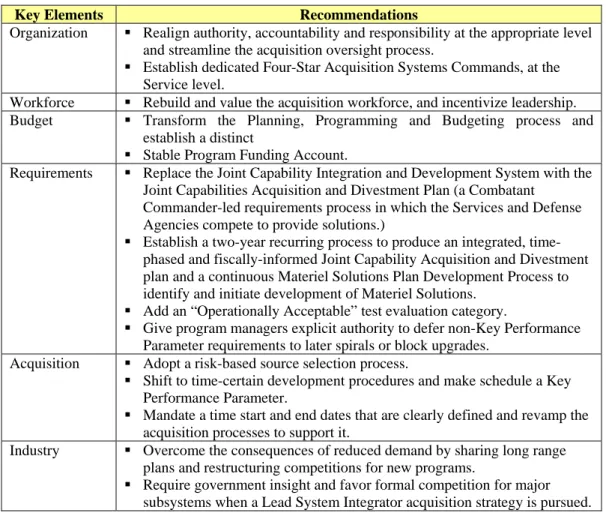
The Defense Acquisition Performance Assessment (DAPA) initiative was established by Acting Deputy Secretary of Defense Gordon England in a 7 June 2005 memo. He directed “an integrated acquisition assessment to consider every aspect of acquisition, including requirements, organizational, legal foundations (like Goldwater-Nichols, decision methodology, oversight, checks and balances—every aspect” (Spring, 2005, p. 1). In the end, the DAPA Panel proposed sweeping changes to dramatically improve the DoD’s ability to stabilize and integrate key elements of the acquisition system—organization, workforce, budget, requirements, acquisition and industry (DoD DAPA, 2006). During the testimony before the 109th Congress House Armed Services Committee on 29 March 2006, the DAPA panel chairman, Lt Gen (USAF Ret.) Ronald T. Kadish testified that “simply focusing on improvements to the ‘little a’ acquisition portion of this system, instead of the larger acquisition process, can not and will not substantially improve Defense Acquisition Performance” (Congressional Testimony, 2006, p. 5). The DAPA panel recommendations are summarized in Table 1.
Table 1. DAPA Panel Recommendations Overview (After DoD DAPA, 2006).
Key Elements Recommendations
Organization Realign authority, accountability and responsibility at the appropriate level
and streamline the acquisition oversight process.
Establish dedicated Four-Star Acquisition Systems Commands, at the
Service level.
Workforce Rebuild and value the acquisition workforce, and incentivize leadership.
Budget Transform the Planning, Programming and Budgeting process and
establish a distinct
Stable Program Funding Account.
Requirements Replace the Joint Capability Integration and Development System with the
Joint Capabilities Acquisition and Divestment Plan (a Combatant Commander-led requirements process in which the Services and Defense Agencies compete to provide solutions.)
Establish a two-year recurring process to produce an integrated, time-phased and fiscally-informed Joint Capability Acquisition and Divestment plan and a continuous Materiel Solutions Plan Development Process to identify and initiate development of Materiel Solutions.
Add an “Operationally Acceptable” test evaluation category.
Give program managers explicit authority to defer non-Key Performance
Parameter requirements to later spirals or block upgrades.
Acquisition Adopt a risk-based source selection process.
Shift to time-certain development procedures and make schedule a Key
Performance Parameter.
Mandate a time start and end dates that are clearly defined and revamp the acquisition processes to support it.
Industry Overcome the consequences of reduced demand by sharing long range
plans and restructuring competitions for new programs.
Require government insight and favor formal competition for major
subsystems when a Lead System Integrator acquisition strategy is pursued.
The DoD Directive 5000.01, certified to be current as of 20 November 2007, along with DoD Instruction 5000.02 dated 8 December is the most recent revision of acquisition policy incorporating the recommendations of Defense Acquisition Performance Assessment (DAPA) panel. The content of the current 5000.2 has grown from 37 to 79 pages since the 2003 version. The major differences between the 2003 and 2008 versions of the DoDI 5000.02 are the following:
The Materiel Development Decision (MDD) replaces the Concept Decision (CD). A MDD is required regardless of where the program intends to enter the acquisition process. The Materiel Solution Analysis Phase (MSA) replaces the
Technology Development phase now includes a mandatory requirement for competitive prototyping of the system or key-system elements.
Engineering and Manufacturing Development (EMD) replaces System Development and Demonstration (SDD). There is more emphasis on systems engineering and technical reviews.
Systems Engineering is much more robust throughout all phases with mandatory technical reviews.
Evolutionary Acquisition (EA) is now just one process. There is no “spirals.” Term “spiral” development is no longer used as an EA strategy term. “Spiral Development” is an engineering term that will continue to be used for software development. “Increments” are favored. Each increment is a militarily-useful
and supportable operational capability that can be developed, produced, deployed, and sustained. Each increment will have its own set of threshold and objective values set by the user. Block upgrades, pre-planned product improvement, and similar efforts that provide a significant increase in operational capability and meet an acquisition category threshold specified in this document shall be managed as separate increments (Fazio, 2008).
IOC Technology Development Production & Deployment Operations & Support FRP Decision Review FOC Materiel Solution Analysis Materiel Development Decision User Needs
Technology Opportunities & Resources
Defense Acquisition Management System - 2008 Program Initiation IOC B Concept Refinement System Development & Demonstration Production & Deployment Operations & Support C FRP Decision Review FOC Technology Development Program Initiation Design Readiness Review Concept Decision
User Needs & Technology Opportunities
B
A C
A
Defense Acquisition Management Framework- 2003
Focus of major changes
Engineering and Manufacturing Development Post-CDR Assessment Post PDR Assessment PDR or IOC Technology Development Production & Deployment Operations & Support FRP Decision Review FOC Materiel Solution Analysis Materiel Development Decision User Needs
Technology Opportunities & Resources
Defense Acquisition Management System - 2008 Program Initiation IOC B B Concept Refinement System Development & Demonstration Production & Deployment Operations & Support C C FRP Decision Review FOC Technology Development Program Initiation Design Readiness Review Concept Decision
User Needs & Technology Opportunities B B A A CC A A
Defense Acquisition Management Framework- 2003
Focus of major changes
Engineering and Manufacturing Development Post-CDR Assessment Post PDR Assessment PDR or
Figure 2. 2003 vs. 2008 Defense Acquisition Management Framework (From Fazio, 2008, p. 7).
D. DEFENSE ACQUISITION WORKFORCE POLICY
The basis of defense acquisition workforce policy is the Defense Acquisition Workforce Improvement Act (DAWIA) of 1990, which was the response to many years of frustration with numerous defense acquisition program failures to meet cost, schedule, and performance goals. In June 1990, legislation was introduced by Congressman Mavroules (D-MA), Chairman of the Subcommittee on Investigations, Committee on Armed Services, and the U.S. House of Representatives. He firmly believed that it was crucial to conduct the in-depth assessment of the qualifications—training, education, and experience—and professionalism of acquisition personnel, as well as a review of the DoD efforts to establish and manage the career development of the acquisition work force.