Kent Academic Repository
Full text document (pdf)
Copyright & reuse
Content in the Kent Academic Repository is made available for research purposes. Unless otherwise stated all content is protected by copyright and in the absence of an open licence (eg Creative Commons), permissions for further reuse of content should be sought from the publisher, author or other copyright holder.
Versions of research
The version in the Kent Academic Repository may differ from the final published version.
Users are advised to check http://kar.kent.ac.uk for the status of the paper. Users should always cite the published version of record.
Enquiries
For any further enquiries regarding the licence status of this document, please contact: [email protected]
If you believe this document infringes copyright then please contact the KAR admin team with the take-down
Citation for published version
Duncan, Alfred James Michael (2016) Private information and aggregate risk sharing. Discussion
paper. University of Glasgow
DOI
Link to record in KAR
https://kar.kent.ac.uk/70519/
Document Version
Private Information and
Aggregate Risk Sharing
∗
Alfred Duncan
†University of Kent
September 2017
When individuals have private information about their own luck and income, the sharing of idiosyncratic risks is hampered by moral hazard. This friction also affects the optimal sharing of aggregate risks. Optimal allocations restrict the exposure of low wealth agents’ consumption to business cycle risk. This encourages truth-telling by high wealth agents who have a high tolerance for aggregate risk, thereby increasing the extent to which idiosyncratic risks can be shared. Implementation of these optimal allocations requires restrictions in the trade of securities contingent on aggregate outcomes.
JEL Classification: D31, D52, D82.
Keywords: Incomplete markets, aggregate risk, distribution.
∗I would like to thank Richard Dennis, Michael Hatcher, Charles Nolan and Jonathan Thomas for very helpful discussions and suggestions. All errors are my own.
INTRODUCTION
Consumption inequality reduces during recessions, as the consumption of the high income households falls sharply and quickly relative to other households (Giorgi and Gambetti, 2017). This pattern is driven partly by the business cycle dynam-ics of labor market income across sectors (Parker and Vissing-Jorgensen, 2009), by government income insurance policy (Perri and Steinberg, 2012), and market allocations of risky assets (Meyer and Sullivan, 2013). This paper, taking market income as following an exogenous process within a two-period endowment econ-omy, provides a minimal working example of the interaction between income insur-ance and competitive aggregate risk sharing in an economy where market income is observed only by the recipient.
The presence of idiosyncratic risk is shown to affect the optimal sharing of ag-gregate risk, reducing consumption inequality in downturns relative to the com-petitive allocation of aggregate risk. The presence of aggregate risk also helps constrained efficient mechanisms identify individual agents’ idiosyncratic risk out-comes, increasing the extent to which idiosyncratic risks can be shared. This is the key result of the paper and is presented as Proposition 2.
The intuition behind Proposition 2 is as follows: high wealth agents are more tolerant of aggregate risk than low wealth agents.1 Optimal mechanisms prevent
low wealth individuals from accepting as much aggregate risk as they would prefer to accept in unrestricted trade. These optimal mechanisms deter high wealth agents from misrepresenting as low wealth agents, relaxing the incentive compatibility constraint. Consequently, optimal allocations permit some sharing of idiosyncratic risks even when these idiosyncratic risks are subject to private information.
The environment studied here is a two-period endowment economy, similar to those studied by Green and Oh (1991) and Kiyotaki (2010). The model can also be thought of as a two-period version of the model of Cole and Kocherlakota (2001).
1This step requires the assumption of Decreasing Absolute Risk Aversion (DARA). Under
DARA preferences, any increase in wealth will increase an agent’s desired holdings of risky as-sets.
Idiosyncratic risk is realised in the first period, while aggregate risk is realised in the second period. High endowment agents who report low income in the first period can use a hidden storage technology to delay consumption to the second period. Optimal mechanisms can identify misreporting high wealth agents by their demand for exposure to aggregate risk. In practise, the implementation of the optimal mech-anisms described by Proposition 2 might include high effective marginal tax rates on high-risk savings products held by recipients of social insurance transfers. Alter-natively, optimal allocations could potentially be implemented via the bundling of savings products by banks to restrict access to high-risk savings portfolios to clients with high declared net wealth.
This paper is closely related to Green and Oh (1991), who study an environ-ment where individuals’ storage is assumed to be publicly observable and optimal mechanisms can identify misreporting high wealth agents from their high demand for storage. Green and Oh (1991) show that optimal mechanisms require devia-tions in intertemporal marginal rates of substitution across high and low wealth agents, a result that mirrors our finding of deviations in across-state marginal rates of substitution across high and low wealth agents. In Green and Oh (1991), there is no aggregate risk. Phelan (1994) studies a dynamic environment with overlapping generations consumers, aggregate risk and incentive constraints relating to idiosyn-cratic risks. Phelan (1994) shows that the distribution of consumption depends on the history of aggregate risks. Landais et al. (2013), Mitman and Rabinovich (2015) and Williams and Li (2015) consider the problem of providing optimal unemploy-ment insurance over the aggregate with a focus on the efficiency costs of cyclical fluctuations in labour market tightness.
The desire to make ex post interventions to the distribution of aggregate losses (bailouts) or to make interventions restricting the ex ante allocation of aggregate risk (macroprudential policy, broadly speaking) stems from concerns about the ef-ficiency and/or fairness of market allocations of aggregate risk. This paper shows how sequential trade in aggregate risk securities can conflict with constrained effi-cient mechanisms of managing idiosyncratic risk. This result provides motivation
for intervention in the market allocation of aggregate risk.
In describing a theory of bailouts and/or macroprudential policy, this paper is related to a growing literature describing the interactions between allocations of aggregate risk and aggregate volatility. To date, studies have focused on the inter-action between optimal aggregate risk sharing and balance sheet externalities, or the interaction between aggregate risk sharing and aggregate demand externalities. Duncan and Nolan (2015) show in a generalised financial macroeconomics frame-work based on Bernanke, Gertler, and Gilchrist (1999) and Kiyotaki and Moore (1997) that when entrepreneurs or firm insiders are risk averse and firms’ idiosyn-cratic risk cannot be passed on to outside investors, there is a conflict between the competitive allocation of aggregate risk and the constrained efficient allocations. Competitive allocations leave firms’ balance sheets too exposed to aggregate risk, resulting in excessive volatility in leverage and resulting factor market wedges of in-efficiency.2 Farhi and Werning (2013) study competitive equilibrium allocations of
aggregate risk in an environment with New-Keynesian pricing rigidities. Competi-tive equilibrium allocations equate across-state consumption marginal rates of sub-stitution across agents. Constrained efficient allocations depart from competitive allocations by favouring transfers toward agents who have a high demand for those goods whose prices exhibit high markups, reducing the welfare costs of wedges of inefficiency deriving from the price-setting friction.
Comparing the predictions of the model with the stylised facts of the behaviour of consumption inequality over the aggregate requires strict assumptions about pref-erences. During the Great Recession of 2007-09, P90-P10 ratio measures of in-equality in consumption in the United States are documented to have fallen across a range of consumption measures (Fisher, Johnson, and Smeeding 2013; Meyer and Sullivan 2013; Perri and Steinberg 2012). This follows increases in consumption inequality prior to the Great Recession. Under the assumption of Constant
Rela-2
Duncan and Nolan (2015) can be thought of as a generalisation of the analyses of Carlstrom, Fuerst, and Paustian (2014), Krishnamurthy (2003) and Nikolov (2014) who consider specific fi-nancial macroeconomics models in which there is little or no conflict between the competitive and socially optimal allocations of aggregate risk.
tive Risk Aversion (CRRA) across agents, these trends in consumption inequality deviate from full consumption insurance—there may be gains from trade available to both high and low wealth agents if low wealth agents were to absorb a greater share of consumption risk over the aggregate. This paper suggests that this type of deviation from full consumption risk insurance over the aggregate could be ef-ficient, allowing more insurance of individual specific or firm specific risks than could be achieved if aggregate consumption risk were shared according to equation of variations in marginal utilities over the aggregate.
1 THE MODEL
A unit measure of ex ante identical agents live for two periods. Agents enjoy con-sumption with caccording to utility function U(c), where U is in the Decreasing Absolute Risk Aversion (DARA) class of preferences (U′,−U′′ > 0, A′(c) < 0,
whereA(c) = −U′′(c)/U′(c)is the Arrow-Pratt measure of absolute risk aversion).
The DARA class of preferences includes as a subset the class of utility functions exhibiting Constant Relative Risk Aversion (CRRA), where relative risk aversion is defined ascA(c).
Consider an agent solving a portfolio choice problem with one risky and one safe asset. DARA preferences ensure that the agent’s optimal holding of the risky asset increases in absolute terms as the agent’s wealth increases. When aggregate risk is introduced in Section 4, constrained efficient mechanisms use these vari-ations demand for exposure to aggregate risk to help identify misreporting high wealth agents.
Agents’ discount second period instantaneous utility by factor β. In the first period, individual agents receive endowment yl with probability πl and yh with
probability πh, where yl < yh and πl +πh = 1. In period 2, all agents receive
common endowmentz, where yl < z < πlyl+πhyh. That is, the second period
endowment received by all agents is less than the expected first period endowment, but greater than the first period endowment received by low income agents. This
assumption ensures positive gross savings. There exists a durable good, which converts the period 1 consumption good into the period 2 consumption good. First period savingsxreturnRxunits of the period 2 consumption good, whereR= 1/β. Without loss of generality, the consumption enjoyed by an individual agent earning
ylin period 1 is denotedc1l.
Within the class of problems we consider in this paper, the revelation principle holds. We can consider the constrained efficient allocations of any given problem to be attainable by a direct mechanism implemented by a benevolent social planner. The social planner aims to maximise the ex ante expected discounted utility of agents. There is no conflict between agents at time zero, before the idiosyncratic riskyis drawn. The planner’s objective function is
max
c,x πlU(c1l) +πhU(c1h) +β[πlU(c2l) +πhU(c2h)] (1.1)
The planner’s first and second period resource constraints are as follows and we attach Lagrange multipliersλ1, λ2 to them respectively:
πlyl+πhyh ≥πlc1l+πhc1h+x (1.2)
z+Rx ≥πlc2l+πhc2h (1.3)
The first period budget constraint (1.2) states that the sum of first period consump-tion across agents and savings (RHS) must be less than or equal to the total first period endowment income across agents (LHS). The second period budget con-straint (1.3) states that total second period consumption (RHS) cannot exceed the sum of second period income and the gross return to first period savings (LHS). It is clear that in constrained efficiency requires that both resource constraints (1.2,1.3) are binding. If either constraint were not binding, it must be the case that there is an individual agent whose consumption could be increased without violation of any of the constraints faced by the social planner.
2 PERFECT INFORMATION
With perfect information, the planner solves (1.1) subject to the resource constraints (1.2,1.3). The first order necessary conditions can be written as follows
c1i : λ1 =U′(c1l) =U′(c1h)
c2i : λ2/β=U′(c2l) = U′(c2h)
x: λ1 =Rλ2
From the first order necessary conditions, we can see that under the planner’s so-lution, agents enjoy full consumption insurance, with consumption equated across high and low income agents. Agents also enjoy perfect consumption smoothing, with
c1l=c1h =c2l =c2h =
1
1 +β [πlyl+πhyh+βz].
This solution characterises the first-best efficient allocations in our model. The incomes of high endowment and low endowment agents are shared, as though all agents hold equity shares in each others’ incomes. The storage technology is used to smooth the consumption of all households over the two periods.
3 PRIVATE INFORMATION
Now, consider the same model, but where the planner cannot directly observe which agents have received the high endowments, and which have received the low endow-ments. It is also assumed that individuals savings held in the durable good cannot be observed by the planner.3 Agents now have the option of lying about their
en-dowment to the planner, and saving any excess income they do not wish to consume
3The assumption that storage is hidden is important. When storage is observable, misreporting
high type agents are unable to smooth consumption. This inability to smooth consumption can be manipulated by the social planner to provide some consumption insurance across high and low type agents that is not possible when storage is hidden. See Green and Oh (1991) and Kiyotaki (2010) for details.
in the first period, earning return R on all savings. The revelation principle holds in our environment, and optimal allocations can be implemented by the planner, whose problem is now subject to the following truth-telling constraint to which we attach the Lagrange multiplierµ:
U(c1h) +βU(c2h) = V(c1l+yh−yl, c2l). (3.1)
The value function V represents the expected discounted utility obtainable by an agent who receives a high endowment and fraudulently declares a low endowment. In the first period, they recieve a transfer from the planner equal toc1l−yl, which
is added to their true endowment of yh. In the second period they receive transfer
c2l −z, which they can add to their endowment z and the gross return from any
private savings in the durable good.
It is clear to see that any similar constraint to ensure truth-telling from agents receiving a low endowment would not be binding under any optimal consumption plan. The primary objective of the planner is to provide insurance to agents receiv-ing low endowments, and it is always in the interest of those agents to declare their endowments truthfully.
We now solve for the value attainable by a recipient of a high endowment who misreports their endowment before returning to the planner’s problem.
3.1 THE VALUE OF MISREPORTING
Consider a recipient of a high endowment who reports a low endowment. We denote their consumption allocations in periods 1 and 2 by cˆ1 and ˆc2 respectively. As
storage is hidden, this agent can use the storage technology to smooth consumption across the two periods. The misreporting agent solves the following problem
V(c1l+yh−yl, c2l) = max
ˆ
subject to the resource constraints
c1l+yh−yl≥cˆ1+ ˆx,
Rxˆ+c2l ≥ˆc2.
The left hand side of the first resource constraint adds the difference between high and low endowments (the hidden part of the endowment) to the consumption al-location of a truth-telling low endowment agent. The left hand side of the second resource constraint adds the gross return of any hidden savings to the consumption allocation of a truth-telling low endowment agent. The solution to this problem is
ˆ c1 = ˆc2 = 1 1 +β [c1l+yh−yl+βc2l] V(c1l+yh−yl, c2l) = (1 +β)U 1 1 +β [c1l+yh−yl+βc2l] (3.2) 3.2 THE PLANNER’S SOLUTION
The planner maximises (1.1) subject to the resource constraints (1.2,1.3) and the truth-telling constraint (3.1) with the solution (3.2). The first order necessary con-ditions are c1l : πlλ1 =πlU′(c1l)−µU′ 1 1 +β[c1l+yh−yl+βc2l] c2l : πlλ2 =πlβU′(c2l)−µβU′ 1 1 +β[c1l+yh−yl+βc2l] c1h : πhλ1 =πhU′(c1h) +µU′(c1h) c2h : πhλ2 =πhβU′(c2h) +µβU′(c2h) x: λ1 =Rλ2
It is straightforward to verify that the solution to this problem is c1l=c2l = 1 1 +β[yl+βz], c1h =c2h = 1 1 +β[yh+βz]. (3.3)
3.3 COMPETITIVE EQUILIBRIUM WITH NON-CONTINGENT DEBT
The solution described by Equation 3.3 is consistent with consumption smoothing over time by individual agents (βU′(c
2l)/U′(c1l) = 1/R), which under our specific
restrictions on parameter values (notablyβ = 1/R) means that individual consump-tion paths are constant across time (c1j = c2j). But the solution also restricts the
total present value of consumption of each agent to be equal to the present value of their endowment paths (c1l+βc2l =yl+βz). This indicates that there is no sharing
of the idiosyncratic endowment shocks across agents. There is no redistribution of present value wealth after endowments are realised in period 1.
Proposition 1 shows that these constrained optimal allocations described in (3.3) can be implemented through decentralised trade in one period non-contingent loans, where this loan market opens after endowments have been realised in period 1. These loan markets enable agents to bring forward or delay consumption from and to the future, which offers an improvement in welfare terms relative to autarky, but little insurance against endowment risks.
Proposition 1. When aggregate income is constant, the constrained efficient allo-cations under private information with hidden storage can be implemented with decentralised trade in non-contingent one period debt contracts.
The proof of Proposition 1 is contained in Appendix A.
4
AGGREGATE RISKNow we introduce aggregate risk through an aggregate endowment shock in period 2. The common endowment received in period 2,z, can take the values zL < zH,
What we’re interested in is how the aggregate risk z is shared, and whether decentralised trade in the simple debt contracts we considered in the previous sec-tion can still implement constrained efficient allocasec-tions. We start by describing the planner’s problem and the planner’s first order necessary conditions before con-sidering whether these conditions can be satisfied by decentralised sequential trade in non-contingent or aggregate state-contingent debt securities. Then we return to solve the planner’s problem and derive the intuition behind our result that de-centralised trade in these simple contracts cannot implement constrained efficient allocations.
4.1 THE PLANNER’S PROBLEM
When the economy suffers from aggregate risk, the planner’s objective function takes expectations of individual utilities across individual agents and aggregate states (z). The planner’s objective function can be written as follows,
max
c,x πlU(c1l) +πhU(c1h) +βEz[π1U(c2l(z)) +πhU(c2h(z))],
subject to the budget constraints,
πlyl+πhyh ≥πlc1l+πhc1h+x, (λ1)
Rx+z ≥πlc2l(z) +πhc2h(z) z∈ {zL, zH}. (λ2(z))
The first period budget constraint is the same as in the earlier cases with no aggre-gate risk. The second period budget constraints are contingent on the realisation of the common shock (z).
The incentive compatibility constraints also change. Agents report their endow-ments following realisation in period 1. Therefore, when deciding whether or not to report truthfully, they must take expectations over the allocation policy rule (c2l(z))
con-straint is
U(c1h) +βEU(c2h(z))≥V(c1l+yh−yl, c2l(z)), (µ)
where V(c1l +yh −yl, c2l(z)) describes the value obtainable to a an agent who
receives a high endowment in the first period but declares a low income to the social planner.
4.1.1 KEY FEATURES OF CONSTRAINED EFFICIENT ALLOCATIONS
Derivations of the equations in this section are contained in Appendix B.
A useful object that we will be relying on to compare allocations is the con-sumption marginal rate of substitution between high and low realisations of the aggregate shock,z.
Definition 1. The across-state consumption marginal rate of substitution of indi-vidual agentiis defined as follows:
U′(c
2i(zH))
U′(c2i(zL)).
For all of the allocations we consider, the across-state consumption marginal rate of substitution will be between zero and one, with U′(c2i(zH))
U′(c2i(zL)) = 1corresponding to the situation where agenti’s consumption is independent of the realisation ofz, and with U′(c2i(zH))
U′(c2i(zL)) <1corresponding to situations where the period 2 consumption of agentiis greater upon the realisation of the boom,z =zH, than upon the realisation
of the recession,z=zL.
Misreporting agents receive the same transfer from the planner in period 2 as truth-telling low type agents. However, bringing forward any savings from the pre-vious period leaves them with greater expected consumption. Under the assumption of DARA preferences, the across-state consumption marginal rate of substitution
for misreporting agents is strictly less than that of truth-telling low reporting agents: U′(ˆc 2(zH)) U′(ˆc2(zL)) > U′(c 2l(zH)) U′(c2l(zL)). (4.1)
The planner can use this difference in consumption marginal rates of substitution to attain greater insurance against idiosyncratic risks while retaining truth-telling: A small perturbation in consumption allocations that reduces the absolute difference in period two low type consumption allocations|c2l(zH)−c2l(zL)|offers a relatively
large welfare gain to truth-telling low types, at the incentive cost of a relatively small welfare gain to misreporting agents. In incentive terms, it is best to insure ex ante idiosyncratic risks through access to aggregate risk insurance, rather than through expected consumption.
This result is summarised by Proposition 2. Constrained efficient allocations re-strict the volatility of low endowment agents’ consumption in response to aggregate risk to such an extent that these agents’ across-state consumption marginal rate of substitution is greater than that of high endowment agents.
Proposition 2. When agents’ preferences exhibit DARA, then under the constrained efficient allocations, the period 2 across-state consumption marginal rate of substi-tution of low wealth agents is greater than that of high endowment agents:
U′(c 2l(zH)) U′(c2l(zL)) > U′(c 2h(zH)) U′(c2h(zL)). (4.2)
A proof of Proposition 2 is contained in Appendix B.
Allocations consistent with Proposition 2 cannot be implemented via mecha-nisms that allow for unrestricted trade in aggregate risk insurance before the real-isation of the common shock in period 2. The inequality described by 4.2 shows that if these markets were to open, there would be gains from trade available from the sale of exposure to aggregate risk from the high endowment agents to the low endowment agents. Unfortunately, this ex post trade would increase the value at-tainable by agents who misreported their income ex ante, and the mechanism would
no longer be incentive compatible. Whether through a direct mechanism with tax or regulatory restrictions on business cycle risk contracts, or through a decentralised mechanism with voluntary restrictions on trade in aggregate risk contracts, strained efficient mechanisms must somehow restrict trade in aggregate risk con-tracts.
It is also important to note that as misreporting agents have access to the private storage technology, their ex ante intertemporal marginal rates of substitution bind at the rate of return offered by the storage technology, and are unaffected by small perturbations in consumption allocations around the constrained efficient solution. It follows that constrained efficient allocations are consistent with high and low type agents’ ex ante intertemporal marginal rates of substitution equating to the rate of return to the storage technology.
EzβU′(c2i(z))
U′(c1i) =
1
R. (4.3)
One corollary of this result is that the constrained efficient allocations can be imple-mented via a mechanism that allows for unrestricted side trading in non-contingent debt contracts.
4.2 COMPETITIVE EQUILIBRIUM WITH NON-CONTINGENT DEBT
In period 1, upon realisaton of endowments, individual agent in receipt of endow-mentyican buy (+) or offer (-) unlimited quantities of non-contingent debtbi, each
unit of which returns one unit of the consumption good in the second period. The agent’s problem can be written as follows:
max
ci,xi,bi
U(c1i) +βU(c2i)
subject to the resource constraints
Rxi+bi+z ≥c2i(z). (λ2i(z))
In symmetric equilibrium, the total supply of one period bonds must be equal to zero:
πlbl+πhbh = 0.
The first order necessary conditions are
c1i : λ1i =U′(c1i)
c2i : λ2i =βU′(c2i(z))
x: λ1i =REλ2i(z)
b : Qλ1i =Eλ2i(z)
The problem with the non-contingent debt contracts is that while they do pro-vide some intertemporal insurance in the form of consumption smoothing, they do not provide sufficient insurance against aggregate risks. Creditors (receivers of high endowments) and debtors (low endowments) face identical absolute consump-tion risks in the second period with respect to the aggregate risk. But debtors have higher expected marginal utility in the second period than debtors, and any abso-lute decrease in consumption results in a greater proportional increase in marginal utility than that suffered by a creditor following the identical absolute change in consumption (under DARA preferences).
Proposition 3. With aggregate risk present and DARA preferences, and with trade in non-contingent debt contracts only, the period 2 across-state consumption marginal rate of substitution of low wealth agents is less than that of high endowment agents:
U′(c 2l(zH)) U′(c 2l(zL)) < U ′(c 2h(zH)) U′(c 2h(zL)) . (4.4)
Corollary 1. With aggregate risk present and under DARA preferences, the com-petitive equilibrium with sequential trade in non-contingent debt only is not con-strained efficient.
Proof. The proof of Corollary 2 follows directly from consideration of equation 4.4, which contradicts equation 4.2.
It is this difference in how each group’s marginal utilities respond to the aggre-gate risk that indicates that a market for aggreaggre-gate risk insurance, or an allocation mechanism replicating the missing aggregate risk insurance could yield a Pareto welfare gain. Low endowment agents have a relatively low across-state marginal rate of substitution compared with high endowment agents. It follows that if a mar-ket in aggregate risk insurance were to open before the realisation of the aggregate riskz, gains from trade would be possible from trade in this market, with low en-dowment agents purchasing aggregate risk insurance from high enen-dowment agents. Now, we introduce a market for aggregate risk insurance into our competitive environment.
4.3 THE COMPETITIVE EQUILIBRIUM WITH STATE-CONTINGENT DEBT CON
-TRACTS
We’ve shown that simple non-contingent debt contracts cannot implement con-strained efficient allocations when our endowment economy suffers from aggregate or aggregate risk. Ex ante, all individual agents are identical, but after the realisa-tion of idiosyncratic risk, some agents have greater wealth and consumprealisa-tion than others. These low wealth individuals are less able and willing to bear aggregate risk than the higher wealth individuals. Since the outcome of the aggregate risk is com-mon knowledge, the planner is able to construct a superior mechanism that does provide low wealth agents with some insurance against the aggregate risk shock, resulting in a Pareto welfare improvement.
In this section, we consider whether decentralised trade could achieve con-strained efficient allocations, if individual agents were able to trade a richer set
of securities that allowed for payoffs that respond to the outcome of the aggregate risk.
In period 1, upon realisaton of endowments, individual agent in receipt of en-dowment yi can buy (+) or offer (-) unlimited quantities of state-contingent debt
bi(z′), each unit of which returns one unit of the consumption good in the second
period if and only if the realisation ofzisz =z′. Each securityb(z′)trades at price
Q(z′)in period 1.
The agent’s problem can be written as follows: max
ci,xi,bi
U(c1i) +βU(c2i)
subject to the resource constraints
yi ≥c1i+xi+Q(z)bi(z), (λ1i)
Rxi+bi(z) +z ≥c2i(z). (λ2i(z))
In symmetric equilibrium, the total supply of bonds contingent on state z must be equal to zero:
πlbl(z) +πhbh(z) = 0 ∀z.
The first order necessary conditions are
c1i : λ1i =U′(c1i)
c2i : λ2i =βU′(c2i(z))
x: λ1i =REλ2i(z)
b(z) : Q(z)λ1i =λ2i(z) ∀z
We can see straight away that the agents in our economy do in fact utilise the state-contingent contracts. There is full consumption risk sharing with respect to the aggregate risk,z:
Proposition 4. With trade in both non-contingent debt and one period securities contingent on the aggregate shockz, the period 2 across-state consumption marginal rate of substitution of low wealth agents is equal than that of high endowment agents: U′(c 2l(zH)) U′(c 2l(zL)) = U′(c2h(zH)) U′(c 2h(zL)) . (4.5)
Proof.From the agents’ first order necessary condition for borrowingb(z), we have
λ2l(zH)/λ2l(zL) = λ2h(zH)/λ2h(zL) = Q(zH)/Q(zL). From here, we can make
the substitutionλ2i =βU′(c2i(z))to complete the proof.
Corollary 2. With aggregate risk present, the competitive equilibrium with sequen-tial trade in non-contingent debt and aggregate risk insurance securities is not con-strained efficient.
Proof. The proof of Corollary 2 follows directly from consideration of equation 4.5, which contradicts equation 4.2.
When aggregate risk markets are open, and loan contracts can be written to be contingent on the aggregate state, there is full consumption insurance. High income and low income agents experience the same variation in marginal utilities across aggregate states.
5 NUMERICAL EXAMPLE
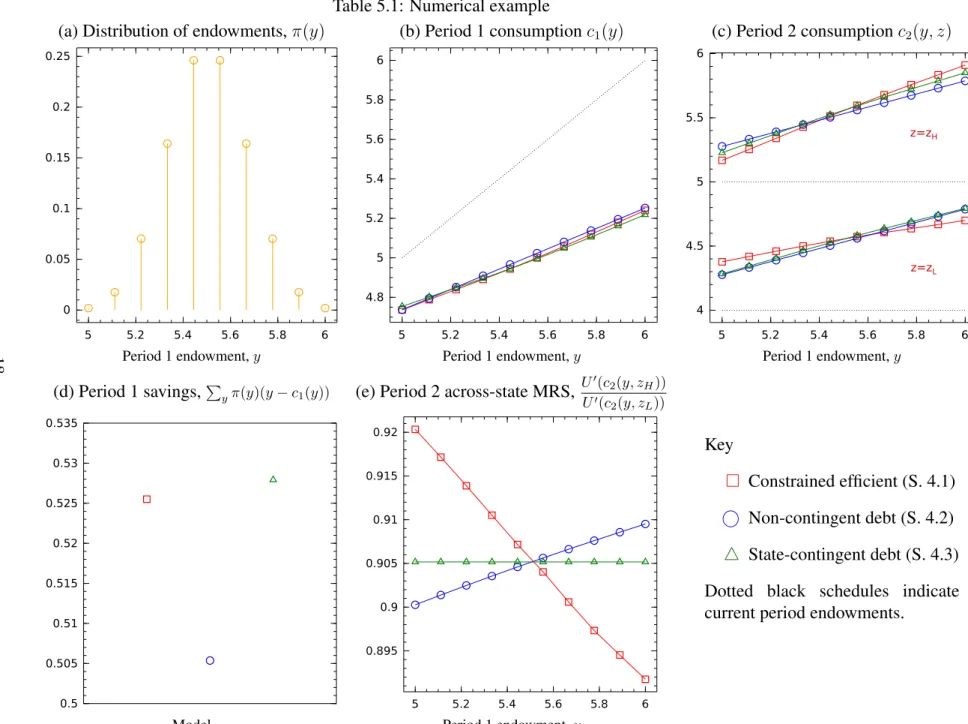
Table 5.1 presents the results of numerical simulations of the model with con-strained efficient allocations (Section 4.1), non-contingent debt contracts (Section 4.2) and aggregate state contingent debt contracts (Section 4.3). The idiosyncratic risk state space has been extended from a high-low shock(y∈ {yl, yh})to a vector
of ten possible realisations(y∈ {y1, y2, ..., y10}). Otherwise, the model is identical
to earlier sections.
Period 1 endowments are drawn as follows: yi = 5 + (i− 1)/9 and
Table 5.1: Numerical example
(a) Distribution of endowments,π(y) (b) Period 1 consumptionc1(y) (c) Period 2 consumptionc2(y, z)
0 0.05 0.1 0.15 0.2 0.25 5 5.2 5.4 5.6 5.8 6 4.8 5 5.2 5.4 5.6 5.8 6 5 5.2 5.4 5.6 5.8 6 z=zH z=zL 4 4.5 5 5.5 6 5 5.2 5.4 5.6 5.8 6
Period 1 endowment,y Period 1 endowment,y Period 1 endowment,y
(d) Period 1 savings,P
yπ(y)(y−c1(y)) (e) Period 2 across-state MRS, U′(c 2(y, zH)) U′(c 2(y, zL)) 0.505 0.51 0.515 0.52 0.525 0.53 0.535 0 0.9 0.905 0 0 0 Key Constrained efficient (S. 4.1) Non-contingent debt (S. 4.2) △ State-contingent debt (S. 4.3) Dotted black schedules indicate current period endowments.
probabilityπi = i−91
1
2
9
. The common period 2 endowment z is zL = 4 with
probabilityP(zL) = 1/2, and zH = 5 otherwise. Agents enjoy consumption
ac-cording to U(c) = √c. Agents discount second period expected utility according to factorβ= 0.95, and the storage technology provides gross returnR = 1/β.
Table 1(e) exhibits the across-state consumption marginal rates of substitution, defined as U
′(c
2(y, zH))
U′(c
2(y, zL))
. Consistent with equations 4.2, 4.4 and 4.5, the across-state consumption MRS is decreasing in initial endowments under the constrained effi-cient allocations, increasing under non-contingent debt, and constant under state-contingent debt. This pattern is also shown in panel (c), which plots period 2 con-sumption allocations. Under the constrained efficient allocations, the sensitivity of period 2 consumption to period 1 endowments is low (high) when the common shock is low (high). In other words, the distribution of consumption across agents widens in the boom state and tightens in the recession state.
Total period 1 savings are low when the contract space is restricted to non-contingent debt (panels b and d). The intuition behind the increase in savings under the constrained efficient and contingent debt allocations is that these mechanisms enable the economy to mobilise the savings of high wealth agents. When the con-tract space is restricted to non-contingent debt only, these high wealth agents have little motive for precautionary savings. When aggregate risk markets are open, higher endowment agents can use these markets to increase their exposure to ag-gregate risk in return for higher second period consumption. At the same time, low endowment agents can insure their aggregate risk for a small reduction in expected consumption.
6 DISCUSSION
Under the optimal allocations studied here and characterised by Proposition 2, ag-gregate risk allocations depart from full risk sharing in the sense that more wealthy agents experience wilder swings in expected marginal utility over the aggregate than low wealth agents. The problem of efficiently sharing the burden of the
ag-gregate over the population conflicts with the problem of idiosyncratic risk sharing either through social insurance or private risk sharing arrangements.
The optimal allocations derived in this paper could be achieved either through long term private contracts, or through state intervention with taxation, transfers and financial regulation instruments. The important challenge faced by either competi-tive or social mechanisms aimed at implementing allocations consistent with opti-mality in our environment is whether or not these mechanisms can effectively deter, tax or eliminate side-trades in securities contingent on aggregate risk between indi-vidual pairs of agents. These side-trades if permitted would result in the equating of across-state marginal rates of substitution, tightening the incentive compatibility constraint with respect to the reporting of individual specific risk outcomes.
REFERENCES
Ben S. Bernanke, Mark L. Gertler, and Simon Gilchrist. The financial accelera-tor in a quantitative business cycle framework. In J. B. Taylor and M. Wood-ford, editors,Handbook of Macroeconomics, volume 1, Part C, chapter 21, pages 1341–1393. Elsevier, 1 edition, 1999.
Charles T. Carlstrom, Timothy S. Fuerst, and Matthius Paustian. Optimal Contracts, Aggregate Risk, and the Financial Accelerator. Working Paper 1420, Federal Reserve Bank of Cleveland, October 2014.
Harold L Cole and Narayana R Kocherlakota. Efficient Allocations with Hidden Income and Hidden Storage. Review of Economic Studies, 68(3):523–42, July 2001.
Alfred Duncan and Charles Nolan. Systemic Risk Markets and the Financial Ac-celerator. Working paper, November 2015.
Emmanuel Farhi and Ivan Werning. A Theory of Macroprudential Policies in the Presence of Nominal Rigidities. NBER Working Papers 19313, National Bureau of Economic Research, Inc, August 2013.
Jonathan D. Fisher, David S. Johnson, and Timothy M. Smeeding. Measuring the Trends in Inequality of Individuals and Families: Income and Consumption.
American Economic Review, 103(3):184–88, May 2013.
Giacomo De Giorgi and Luca Gambetti. Business Cycle Fluctuations and the Dis-tribution of Consumption. Review of Economic Dynamics, 23:19–41, January 2017. doi: 10.1016/j.red.2016.07.005.
Edward J. Green and Soo-Nam Oh. Can a “credit crunch” be efficient? Quarterly Review, (Fall):3–17, 1991.
Nobuhiro Kiyotaki. A mechanism design approach to financial frictions. September 2010.
Nobuhiro Kiyotaki and John Moore. Credit Cycles. Journal of Political Economy, 105(2):211–48, April 1997.
Arvind Krishnamurthy. Collateral constraints and the amplification mechanism.
Journal of Economic Theory, 111(2):277–292, 2003.
Camille Landais, Pascal Michaillat, and Emmanuel Saez. Optimal unemployment insurance over the business cycle. Discussion Papers 1303, Centre for Macroe-conomics (CFM), 2013.
Bruce D. Meyer and James X. Sullivan. Consumption and Income Inequality and the Great Recession. American Economic Review, 103(3):178–83, May 2013. Kurt Mitman and Stanislav Rabinovich. Optimal unemployment insurance in an
equilibrium business-cycle model. Journal of Monetary Economics, 71(C):99– 118, 2015.
Kalin Nikolov. Collateral amplification under complete markets. Journal of Eco-nomic Dynamics and Control, 45(C):80–93, 2014.
Jonathan A. Parker and Annette Vissing-Jorgensen. Who Bears Aggregate Fluctu-ations and How? American Economic Review, 99(2):399–405, May 2009. Fabrizio Perri and Joseph Steinberg. Inequality and redistribution during the great
recession. Economic Policy Paper 12-1, Federal Reserve Bank of Minneapolis, 2012.
Christopher Phelan. Incentives and aggregate shocks. Review of Economic Studies, 61(4):681–700, 1994.
Noah Williams and Rui Li. Optimal unemployment insurance and cyclical fluc-tuations. FRB Atlanta CQER Working Paper 2015-2, Federal Reserve Bank of Atlanta, 2015.
A PROOF OF
PROPOSITION
1
Proof. In period 1, upon realisaton of endowments, individual agent in receipt of endowmentyican buy (+) or offer (-) unlimited quantities of non-contingent debtbi,
each unit of which returns one unit of the consumption good in the second period. The agent’s problem can be written as follows:
max
ci,xi,bi
U(c1i) +βU(c2i)
subject to the resource constraints
yi ≥c1i+xi+Qbi, (λ1i)
Rxi+bi +z ≥c2i. (λ2i)
In symmetric equilibrium, the total supply of one period bonds must be equal to zero:
πlbl+πhbh = 0.
The first order necessary conditions are
c1i : λ1i =U′(c1i)
c2i : λ2i =βU′(c2i)
x: λ1 =Rλ2
b: Qλ1 =λ2
The agents’ first order necessary conditions can be rearranged to show that agents’ optimal consumption profile exhibits constant consumption over periods 1 and 2:
c1h =c2h,
The value ofc1ithat satisfiesc1i =c2i and the individual budget constraints for the
agent receiving endowmentiis
c1i =
1
1 +β[yi+βz],
which is identical to the solution 3.3.
B P
ROOF OFPROPOSITION
2
Proof. The first step in solving the planner’s problem is to consider the value at-tainable by high endowment agents who misreport their endowment.
B.1 THE VALUE OF MISREPORTING
A recipient of a high endowment who reports a low endowment solves the following problem
V(c1l+yh−yl, c2l(z)) = max
ˆ
c,x U(ˆc1) +βEU(ˆc2(z))
subject to the resource constraints
c1l+yh−yl ≥cˆ1+ ˆx, (ˆλ1)
Rxˆ+c2l(z)≥cˆ2(z) ∀z, (ˆλ2(z))
and the non-negative storage constraint, ˆ
x≥0. (ˆν)
It is clear that under any optimal consumption plan, the period 1 and period 2 re-source constraints are binding (ˆλ1,λˆ2(z) > 0). Whether or not the non-negative
storage constraint is binding will depend on the allocationsc1l, c2l(z)and the
From the period 2 budget constraints, we can see that the difference in state-contingent consumption allocations of the misreporting agents are equal to those same differences for low reporting truth-telling agents. That is,
ˆ
c2(zH)−cˆ2(zL) = c2l(zH)−c2h(zL). (B.1)
The agent’s first order conditions are ˆ
c1 : λˆ1 =U′(ˆc1)
ˆ
c2(z) : λˆ2(z) =βU′(ˆc2(z))
x: λˆ1 =REλˆ2(z) + ˆν
and the complementary slackness condition relating to savings is ˆ
xνˆ= 0.
We’ll see in the next section that under constrained efficient allocations, low endow-ment agents’ intertemporal MRS will bind with respect to the gross return to the savings technology. Consequently, misreporting agents will wish to save a strictly positive fraction of their period 1 resources. This allows us to restrict attention to cases wherex >ˆ 0,νˆ= 0. Formally, Lemma 1 describes the key results that follow: Lemma 1. Under any allocation where low endowment agents’ ex ante intertem-poral marginal rates of substitution are equated to the gross return on the savings technology U′(c 1l) βEzU′(c2l(z)) =R , it follows that
(a) any misreporting agent saves a strictly positive amount of their first period wealth,x >ˆ 0.
equated to the gross return on savings,
U′(ˆc 1)
βEzU′(ˆc2(z))
=R. (B.2)
(c) Under DARA preferences, the across state marginal rate of substitution of misreporting agents is strictly greater than that of truth-telling low endow-ment agents, U(ˆc2(zH)) U(ˆc2(zL)) > U(c2l(zH)) U(c2l(zL)) . (B.3)
Proof.(a) Assume thatxˆ= 0. In accordance with the resource constraints,ˆc2(z) =
c2l(z)and ˆc1 > c1l. Given U′(c 1l) βEzU′(c2l(z)) =R , it follows that U′(ˆc1) βEzU′(ˆc2(z)) < R . By the complementary slackness condition, ν >ˆ 0, which after substitution into the agent’s first order necessary condition forxˆ, yields U′(ˆc1)
βEzU′(ˆc2(z)) > R
, which contradicts the previous inequality.
(b) From part (a), optimal savings are positive,x >ˆ 0,νˆ= 0. After substitution into the agent’s first order necessary condition forxˆwe have
U′(ˆc 1) βEzU′(ˆc2(z)) =R . (c) From the misreporting agent’s resource constraints, we see that if xˆis pos-itive, ˆc2(z) > c2l(z). Combining this with Equation B.1 and the assumption of
DARA preferences completes the proof.
As we’ll see, the inequality described in Lemma 1 part (c) creates an opportunity for the planner to implement some insurance against idiosyncratic risks. Specifi-cally, aggregate risk insurance plans that are desirable to low wealth individuals are undesirable to high endowment individuals, who have greater tolerance for ag-gregate risk. Constrained efficient mechanisms can use this information to elicit truth-telling from high endowment agents even when revelation of a high endow-ment motivates a transfer of wealth to low endowendow-ment agents.
Solving the planner’s problem will require the use of the envelope theorem. We denote as follows the partial derivatives of the misreporting agents’ value functions
with respect to the low endowment agents’ consumption allocations: V1 = ∂V ∂c1l =U′(ˆc 1), V2z = ∂V ∂c2l(z) =βP(z)U′(ˆc 2(z)).
B.2 THE PLANNER’S FIRST ORDER NECESSARY CONDITIONS
The planner’s first order necessary conditions are described by the following:
c1l: 0 =πlU′(c1l)−πlλ1−µV1(c1l+yh−yl, c2l(z))
c1h : 0 =πhU′(c1h)−πhλ1+µU′(c1h)
x: 0 =λ1−REλ2(z)
c2l(z) : 0 =P(z)πlβU′(c2l(z))−P(z)π1λ2(z)−µV2z(c1l+yh−yl, c2l(z))
c2h(z) : 0 =P(z)πhβU′(c2h(z))−P(z)πhλ2(z) +µβP(z)U′(c2h(z))
Eliminatingµfrom the planner’s first order conditions with respect to the con-sumption allocations of high endowment individuals yields
U′(c 1h) λ1 = βU ′(c 2h(z)) λ2(z)
Which ensures first that high endowment agents receive aggregate risk consumption insurance commensurate with the planner’s marginal value of second period wealth,
U′(c 2h(zH)) U′(c 2h(zL)) = λ2(zH) λ2(zL) (B.4)
and second, when combined with the first order condition for aggregate savings
x, that the high endowment agents’ intertemporal marginal rates of substitution equate to the intertemporal marginal rate of transformation specified by the storage
technology,R,
EzβU′(c2h(z))
U′(c1h) =
1
R.
Turning to the low endowment households, eliminatingµfrom the first order con-ditions for their consumption allocations yields
U′(c 1l)−λ1 V1(c1l+yh−yl, c2l(z)) = U′(c2l(z))−λ2(z) V2z(c1l+yh−yl, c2l(z))/P(z) . (B.5) From here we proceed as follows: First, we assume that equations B.2 and B.3 hold. We then verify that the ex ante intertemporal marginal rate of substitution equates to the gross return to the storage technology, EzβU′(c2l(z))
U′(c
1l) =
1
R. If true, then by Lemma
1, equations B.2 and B.3 must hold.
Let equations B.2 and B.3 hold. Substituting (B.2) and (B.3) into (B.5) yields
EzβU′(c2l(z)) U′(c1l) = 1 R. (B.6) and U′(c 2l(zH)) U′(c 2l(zL)) > λ2(zH) λ2(zL) (B.7) Equation B.6 verifies that (B.2) and (B.3) hold by Lemma 1. Equation B.7 when combined with (B.4) shows that low endowment agents are protected from aggre-gate risk (z), to such an extent that their second period marginal utility is less sen-sitive to aggregate risk than that of high endowment agents:
U′(c 2l(zH)) U′(c 2l(zL)) > U ′(c 2h(zH)) U′(c 2h(zL)) . (4.2)
C P
ROOF OFPROPOSITION
3
Proof. Consider a mechanism that replicates the consumption allocations that are identical to those enjoyed by agents under the competitive equilibrium with non-contingent debt. Non-non-contingent debt does not allow for transfers of wealth con-tingent on the common shock z. Given this, and the fact that the first order con-ditions of the individual agents under competitive trade with non-contingent debt result in the gross interest rate being equated to the gross return to hidden savings (1/Q=R), solving the value function of misreporting agents yields the following:
V1(c1l+yh−yl, c2l(z)) =U′(c1h)
V2z(c1l+yh−yl, c2l(z)) =βP(z)U′(c2h(z)).
Substituting these solutions into the planner’s first order necessary conditions, we obtain the following:
µ=πl U′(c 1l)−λ1 U′(c1h) =πh λ1−U′(c1h) U′(c1h) µ=πl βU′(c 2l(z))−λ2(z) βU′(c2h(z)) =πh λ2(z)−βU′(c2h(z)) βU′(c2h(z)) ∀z.
These conditions can be rearranged to obtain
λ1 U′(c1h) − λ2(z) βU′(c2h(z)) = 0 U′(c 1l) U′(c1h) = U′(c 2l(zH)) U′(c2h(zH)) = U′(c 2l(zL)) U′(c2h(zL)). (C.1)
As non-contingent debt does not allow transfers between agents contingent on z, the individual agents’ budget constraints specify that the absolute difference in
con-sumption across the common shock (z) is equated across individual agents:
c2l(zH)−c2l(zL) =c2h(zH)−c2h(zL).
But, as non-contingent debt also does not allow transfers of wealth across agents, the consumption smoothing by individual agents specified by their individual first order necessary conditions means that
c2l(z)< c2h(z) ∀z.
Under DARA preferences, it can be shown that U′′′(c) > 0. It follows that under
the competitive equilibrium under non-contingent debt contracts,
U′(c 2l(zH)) U′(c2l(zL)) < U′(c 2h(zH)) U′(c2h(zL)). (4.4)