Atmel SMART Microcontrollers
SAM4S Xplained Pro
USER GUIDEPreface
The Atmel® SAM4S Xplained Pro evaluation kit is a hardware platform to evaluate the SAM4SD32C microcontroller.
Supported by the Atmel Studio integrated development platform, the kit provides easy access to the features of the Atmel SAM4SD32C and explains how to integrate the device in a custom design.
The Xplained Pro MCU series evaluation kits include an on-board Embedded Debugger, and no external tools are necessary to program or debug the SAM4SD32C.
The Xplained Pro extension series evaluation kits offers additional
peripherals to extend the features of the board and ease the development of custom designs.
Table of Contents
Preface... 1 1. Introduction... 3 1.1. Features... 3 1.2. Kit Overview... 3 2. Getting Started...52.1. Xplained Pro Quick Start... 5
2.2. Design Documentation and Relevant Links... 5
3. Xplained Pro... 6
3.1. Embedded Debugger... 6
3.2. Hardware Identification System...6
3.3. Power Sources... 7
3.4. Xplained Pro Standard Headers and Connectors... 8
3.4.1. Xplained Pro Standard Extension Header... 8
3.4.2. Xplained Pro LCD Extension Connector...9
3.4.3. Xplained Pro Power Header...11
4. Hardware Users Guide... 12
4.1. Connectors... 12
4.1.1. Xplained Pro Extension Headers...12
4.1.2. LCD Extension Connector... 14
4.1.3. Current Measurement Header... 16
4.1.4. Other Headers... 16 4.2. Peripherals... 17 4.2.1. NAND Flash...17 4.2.2. SD Card Connector... 18 4.2.3. Crystals...18 4.2.4. Mechanical Buttons... 19 4.2.5. LED...19 4.2.6. Analog Reference... 19
4.3. Embedded Debugger Implementation...19
4.3.1. Serial Wire Debug...19
4.3.2. Virtual COM Port...20
4.3.3. Atmel Data Gateway Interface...20
5. Hardware Revision History and Known Issues...21
5.1. Identifying Product ID and Revision... 21
5.2. Revision 5...21
5.3. Revision 4...21
6. Document Revision History... 23
1.
Introduction
1.1.
Features
• Atmel ATSAM4SD32C microcontroller
• Embedded debugger (EDBG)
– USB interface
– Programming and debugging (target) through Serial Wire Debug (SWD)
– Virtual COM-port interface to target via UART
– Atmel Data Gateway Interface (DGI) to target via synchronous SPI or TWI
– Four GPIOs connected to target for code instrumentation
• Digital I/O
– Two mechanical buttons (user and reset button)
– One user LED
– Three extension headers
• LCD display header
• USB interface for host and device function (target)
• 2Gb NAND Flash for non-volatile storage
• SD card connector
• Adjustable analog reference
• Three possible power sources
– External power
– Embedded debugger USB
– Target USB
• 12MHz crystal
• 32kHz crystal
1.2.
Kit Overview
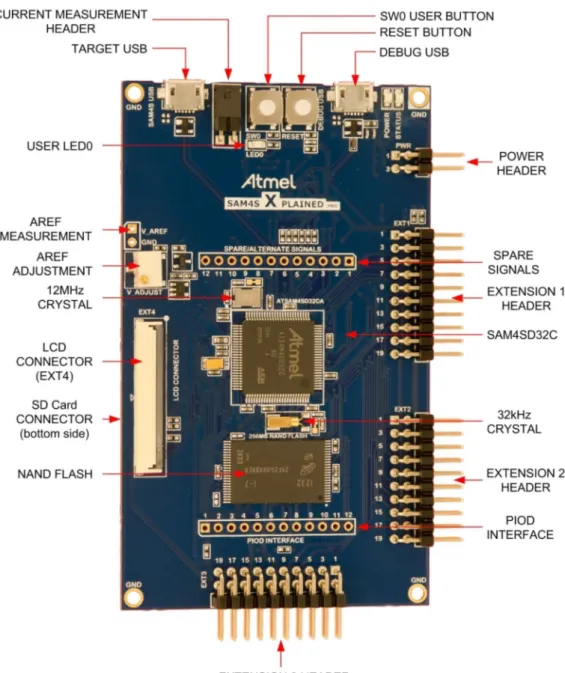
The Atmel SAM4S Xplained Pro evaluation kit is a hardware platform to evaluate the Atmel ATSAM4SD32C.
The kit offers a set of features that enables the ATSAM4SD32C user to get started using the
ATSAM4SD32C peripherals right away and to get an understanding of how to integrate the device in their own design.
2.
Getting Started
2.1.
Xplained Pro Quick Start
Three steps to start exploring the Atmel Xplained Pro platform: 1. Download Atmel Studio.
2. Launch Atmel Studio.
3. Connect a USB cable (Standard-A to Micro-B or Micro-AB) between the PC and the DEBUG USB port on the kit.
4. Connect SAM4S Xplained Pro to a Xplained Pro MCU board and connect a USB cable to DEBUG USB port on the Xplained Pro MCU board.
When the Atmel SAM4S Xplained Pro is connected to your computer for the first time, the operating system will do a driver software installation. The driver file supports both 32-bit and 64-bit versions of Microsoft® Windows® XP, Windows Vista®, Windows 7, and Windows 8.
Once the Xplained Pro MCU board is powered the green power LED will be lit and Atmel Studio will auto detect which Xplained Pro MCU- and extension board(s) are connected. Atmel Studio will present relevant information like datasheets and kit documentation. The kit landing page in Atmel Studio also has the option to launch Atmel Software Framework (ASF) example applications for the kit. The SAM4S device is programmed and debugged by the on-board Embedded Debugger and therefore no external programmer or debugger tool is needed.
2.2.
Design Documentation and Relevant Links
The following list contains links to the most relevant documents and software for SAM4S Xplained Pro:
• Xplained Pro products - Atmel Xplained Pro is a series of small-sized and easy-to-use evaluation kits for Atmel microcontrollers and other Atmel products. It consists of a series of low cost MCU boards for evaluation and demonstration of features and capabilities of different MCU families.
• Atmel Studio - Free Atmel IDE for development of C/C++ and assembler code for Atmel microcontrollers.
• Atmel sample store - Atmel sample store where you can order samples of devices.
• EDBG User Guide - User guide containing more information about the on-board Embedded Debugger.
• IAR Embedded Workbench® for ARM - This is a commercial C/C++ compiler that is available for ARM. There is a 30 day evaluation version as well as a code size limited kick-start version available from their website. The code size limit is 16KB for devices with M0, M0+, and M1 cores and 32KB for devices with other cores.
• Atmel Data Visualizer - Atmel Data Visualizer is a program used for processing and visualizing data. Data Visualizer can receive data from various sources such as the Embedded Debugger Data Gateway Interface found on Xplained Pro boards, and COM ports.
• Design Documentation - Package containing CAD source, schematics, BOM, assembly drawings, 3D plots, layer plots etc.
• Hardware Users Guide in PDF format - PDF version of this User Guide.
3.
Xplained Pro
Xplained Pro is an evaluation platform that provides the full Atmel microcontroller experience. The platform consists of a series of Microcontroller (MCU) boards and extension boards that are integrated with Atmel Studio, have Atmel Software Framework (ASF) drivers and demo code, support data
streaming, and more. Xplained Pro MCU boards support a wide range of Xplained Pro extension boards that are connected through a set of standardized headers and connectors. Each extension board has an identification (ID) chip to uniquely identify which boards are connected to an Xplained Pro MCU board. This information is used to present relevant user guides, application notes, datasheets, and example code through Atmel Studio.
3.1.
Embedded Debugger
The SAM4S Xplained Pro contains the Atmel Embedded Debugger (EDBG) for on-board debugging. The EDBG is a composite USB device of three interfaces; a debugger, Virtual COM Port, and a Data Gateway Interface (DGI).
Together with Atmel Studio, the EDBG debugger interface can program and debug the SAM4SD32C. On SAM4S Xplained Pro, the SWD interface is connected between the EDBG and the SAM4SD32C. The Virtual COM Port is connected to a UART on the SAM4SD32C and provides an easy way to
communicate with the target application through terminal software. It offers variable baud rate, parity, and stop bit settings. Note that the settings on the SAM4SD32C must match the settings given in the terminal software.
The DGI consists of several physical interfaces for communication with the host computer.
Communication over the interfaces are bidirectional. It can be used to send events and values from the SAM4SD32C or as a generic printf-style data channel. Traffic over the interfaces can be timestamped on the EDBG for more accurate tracing of events. Note that timestamping imposes an overhead that reduces maximal throughput. Atmel Data Visualizer is used to send and receive data through DGI.
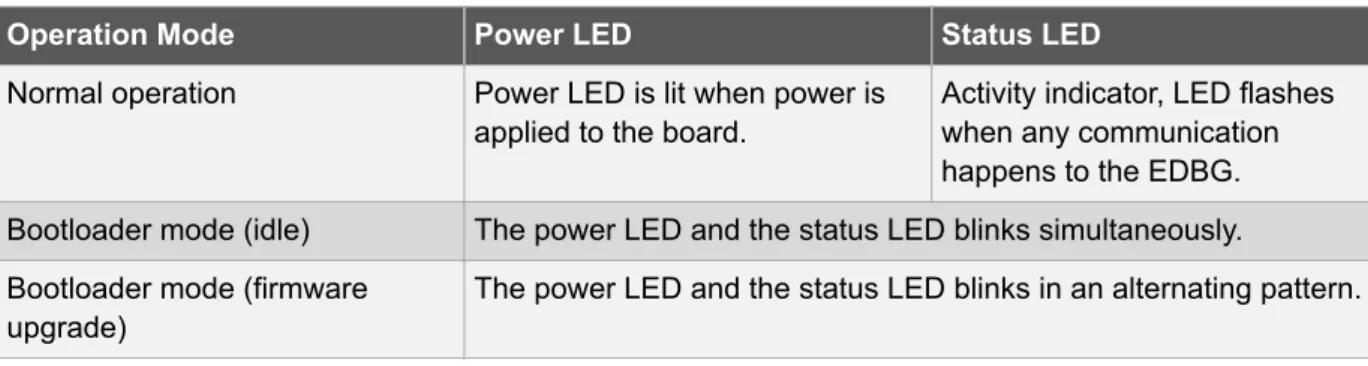
The EDBG controls two LEDs on SAM4S Xplained Pro; a power LED and a status LED. Table 3-1 EDBG LED Control on page 6 shows how the LEDs are controlled in different operation modes.
Table 3-1 EDBG LED Control
Operation Mode Power LED Status LED
Normal operation Power LED is lit when power is
applied to the board.
Activity indicator, LED flashes when any communication happens to the EDBG.
Bootloader mode (idle) The power LED and the status LED blinks simultaneously.
Bootloader mode (firmware upgrade)
The power LED and the status LED blinks in an alternating pattern.
For further documentation on the EDBG, see the EDBG User Guide.
3.2.
Hardware Identification System
All Xplained Pro compatible extension boards have an Atmel ATSHA204 CryptoAuthentication™ chip mounted. This chip contains information that identifies the extension with its name and some extra data. When an Xplained Pro extension is connected to an Xplained Pro MCU board the information is read and
sent to Atmel Studio. The Atmel Kits extension, installed with Atmel Studio, will give relevant information, code examples, and links to relevant documents. Table 3-2 Xplained Pro ID Chip Content on page 7 shows the data fields stored in the ID chip with example content.
Table 3-2 Xplained Pro ID Chip Content
Data field Data type Example content
Manufacturer ASCII string Atmel'\0'
Product Name ASCII string Segment LCD1 Xplained Pro'\0'
Product Revision ASCII string 02'\0'
Product Serial Number ASCII string 1774020200000010’\0’
Minimum Voltage [mV] uint16_t 3000
Maximum Voltage [mV] uint16_t 3600
Maximum Current [mA] uint16_t 30
3.3.
Power Sources
The SAM4S Xplained Pro kit can be powered by several power sources listed in Table 3-3 Power Sources for SAM4S Xplained Pro on page 7.
Table 3-3 Power Sources for SAM4S Xplained Pro
Power input Voltage requirements Current requirements Connector marking
External power 5V ± 2% (± 100mV) for
USB host operation. 4.3V to 5.5V if USB host operation is not
required.
Recommended minimum is 1A to be able to provide enough current for connected USB devices and the board itself.
Recommended maximum is 2A due to the input protection maximum current specification. PWR Embedded debugger USB 4.4V to 5.25V (according to USB spec) 500mA (according to USB spec) DEBUG USB
Target USB 4.4V to 5.25V (according
to USB spec)
500mA (according to USB spec)
TARGET USB
The kit will automatically detect which power sources are available and choose which one to use according to the following priority:
1. External power.
2. Embedded Debugger USB.
Info: External power is required when 500mA from a USB connector is not enough to power a connected USB device in a USB host application.
3.4.
Xplained Pro Standard Headers and Connectors
3.4.1. Xplained Pro Standard Extension HeaderAll Xplained Pro kits have one or more dual row, 20-pin, 100mil extension header. Xplained Pro MCU boards have male headers, while Xplained Pro extensions have their female counterparts. Note that all pins are not always connected. All connected pins follow the defined pin-out description in Table 3-4 Xplained Pro Standard Extension Header on page 8.
The extension headers can be used to connect a variety of Xplained Pro extensions to Xplained Pro MCU boards or to access the pins of the target MCU on Xplained Pro MCU boards directly.
Table 3-4 Xplained Pro Standard Extension Header
Pin number Name Description
1 ID Communication line to the ID chip on an extension board.
2 GND Ground.
3 ADC(+) Analog to digital converter, alternatively positive part of differential
ADC.
4 ADC(-) Analog to digital converter, alternatively negative part of differential
ADC.
5 GPIO1 General purpose I/O.
6 GPIO2 General purpose I/O.
7 PWM(+) Pulse width modulation, alternatively positive part of differential
PWM.
8 PWM(-) Pulse width modulation, alternatively negative part of differential
PWM.
9 IRQ/GPIO Interrupt request line and/or general purpose I/O.
10 SPI_SS_B/
GPIO
Slave select for SPI and/or general purpose I/O.
11 I2C_SDA Data line for I2C interface. Always implemented, bus type.
12 I2C_SCL Clock line for I2C interface. Always implemented, bus type.
13 UART_RX Receiver line of target device UART
14 UART_TX Transmitter line of target device UART
15 SPI_SS_A Slave select for SPI. Should preferably be unique.
16 SPI_MOSI Master out slave in line of serial peripheral interface. Always
Pin number Name Description
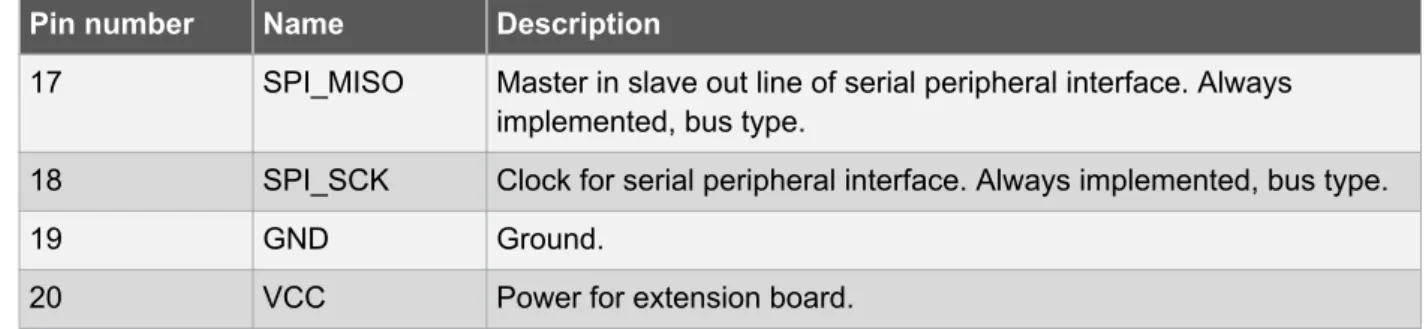
17 SPI_MISO Master in slave out line of serial peripheral interface. Always
implemented, bus type.
18 SPI_SCK Clock for serial peripheral interface. Always implemented, bus type.
19 GND Ground.
20 VCC Power for extension board.
3.4.2. Xplained Pro LCD Extension Connector
The LCD connector provides the ability to connect to display extensions that have a parallel interface. The connector implements signals for a MCU parallel bus interface and a LCD controller interface as well as signals for a touch controller. The connector pin-out definition is shown in Table 3-5 Xplained Pro LCD Connector on page 9. Note that usually only one display interface is implemented, either LCD
controller or the MCU bus interface.
A FPC/FFC connector with 50 pins and 0.5mm pitch is used for the LCD connector. The connector XF2M-5015-1A from Omron is used on several Xplained Pro designs and can be used as a reference.
Table 3-5 Xplained Pro LCD Connector
Pin number Name RGB interface description MCU interface description
1 ID Communication line to the ID chip on an extension board
2 GND Ground 3 D0 Data line 4 D1 Data line 5 D2 Data line 6 D3 Data line 7 GND Ground 8 D4 Data line 9 D5 Data line 10 D6 Data line 11 D7 Data line 12 GND Ground 13 D8 Data line 14 D9 Data line 15 D10 Data line 16 D11 Data line 17 GND Ground 18 D12 Data line 19 D13 Data line
Pin number Name RGB interface description MCU interface description 20 D14 Data line 21 D15 Data line 22 GND Ground 23 D16 Data line 24 D17 Data line 25 D18 Data line 26 D19 Data line 27 GND Ground 28 D20 Data line 29 D21 Data line 30 D22 Data line 31 D23 Data line 32 GND Ground 33 PCLK / CMD DATA SEL
Pixel clock Display RAM select. One
address line of the MCU for displays where it is possible to select either register or data interface.
34 VSYNC / CS Vertical Synchronization Chip select
35 HSYNC / WE Horizontal Synchronization Write enable signal
36 DATA ENABLE /
RE
Data enable signal Read enable signal
37 SPI SCK Clock for serial peripheral interface
38 SPI MOSI Master out slave in of serial peripheral interface
39 SPI MISO Master in slave out of serial peripheral interface
40 SPI SS Slave select for serial peripheral interface. Preferably a dedicated
pin.
41 ENABLE Display enable
42 I2C SDA I2C data
43 I2C SCL I2C clock
44 IRQ1 Interrupt 1
45 IRQ2 Interrupt 2
46 PWM Backlight control
47 RESET Extension reset
Pin number Name RGB interface description MCU interface description
49 VCC 3.3V power supply for extension board
50 GND Ground
3.4.3. Xplained Pro Power Header
The power header can be used to connect external power to the SAM4S Xplained Pro kit. The kit will automatically detect and switch to any external power if supplied. The power header can also be used as supply for external peripherals or extension boards. Care must be taken not to exceed the total current limitation of the on-board regulator when using the 3.3V pin.
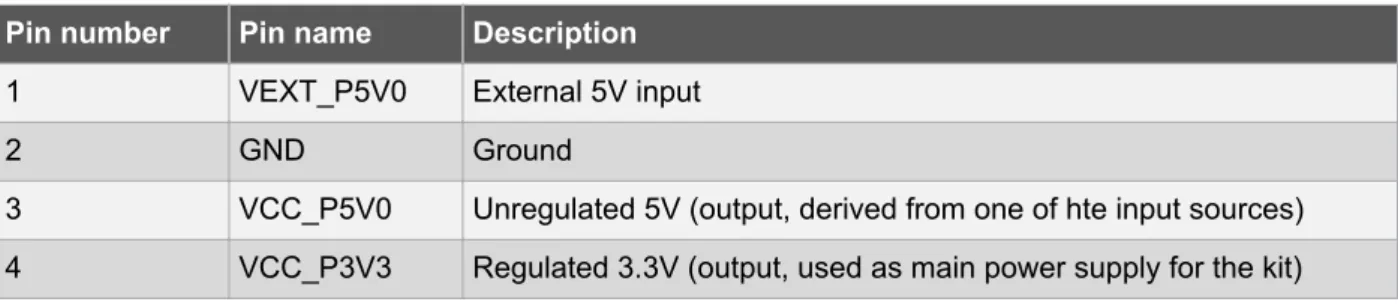
Table 3-6 Xplained Pro Power Header
Pin number Pin name Description
1 VEXT_P5V0 External 5V input
2 GND Ground
3 VCC_P5V0 Unregulated 5V (output, derived from one of hte input sources)
4.
Hardware Users Guide
4.1.
Connectors
This chapter describes the implementation of the relevant connectors and headers on SAM4S Xplained Pro and their connection to the SAM4SD32C. The tables of connections in this chapter also describes which signals are shared between the headers and on-board functionality.
4.1.1. Xplained Pro Extension Headers
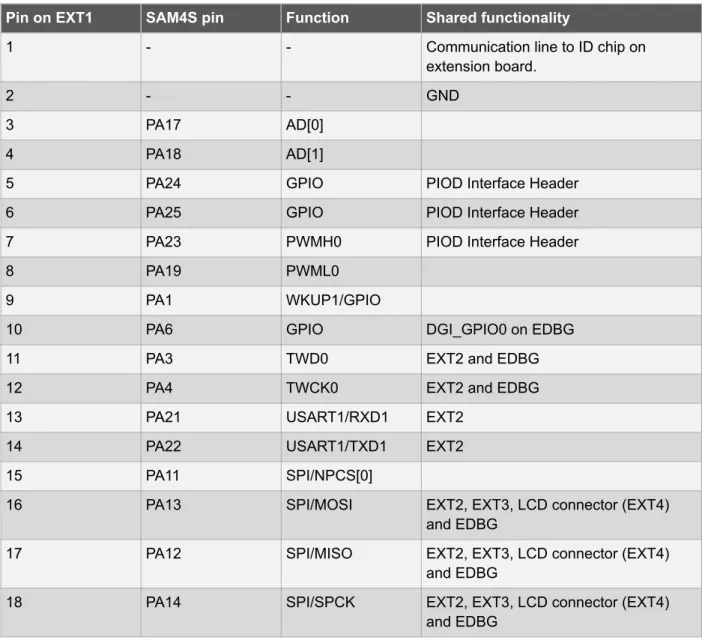
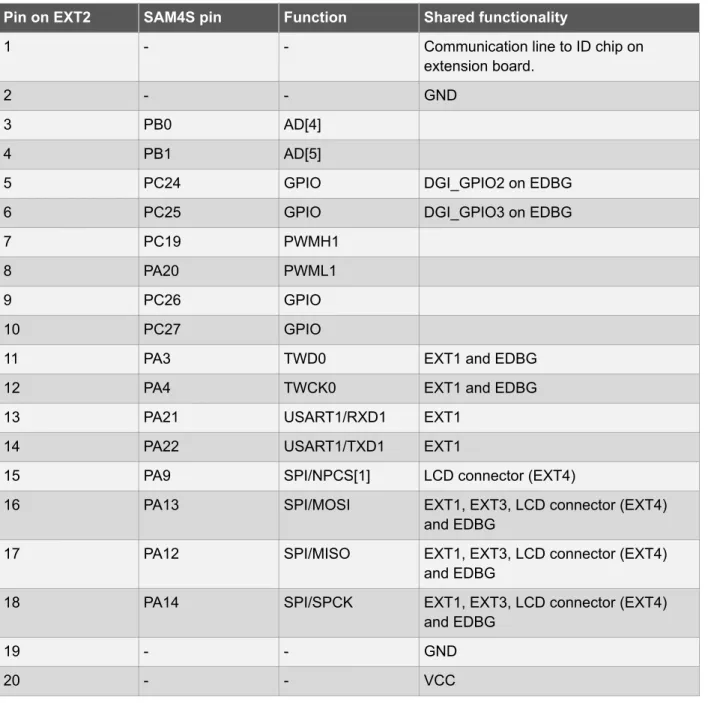
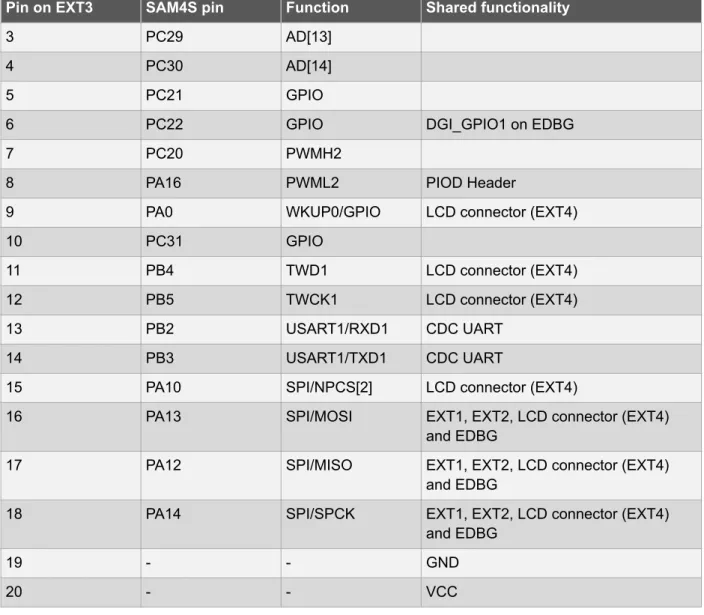
The SAM4S Xplained Pro headers EXT1, EXT2, and EXT3 offers access to the I/O of the microcontroller in order to expand the board e.g. by connecting extensions to the board. These headers all comply with the standard extension header specified in Xplained Pro Standard Extension Header on page 8. All headers have a pitch of 2.54mm.
Table 4-1 Extension Header EXT1
Pin on EXT1 SAM4S pin Function Shared functionality
1 - - Communication line to ID chip on
extension board.
2 - - GND
3 PA17 AD[0]
4 PA18 AD[1]
5 PA24 GPIO PIOD Interface Header
6 PA25 GPIO PIOD Interface Header
7 PA23 PWMH0 PIOD Interface Header
8 PA19 PWML0
9 PA1 WKUP1/GPIO
10 PA6 GPIO DGI_GPIO0 on EDBG
11 PA3 TWD0 EXT2 and EDBG
12 PA4 TWCK0 EXT2 and EDBG
13 PA21 USART1/RXD1 EXT2
14 PA22 USART1/TXD1 EXT2
15 PA11 SPI/NPCS[0]
16 PA13 SPI/MOSI EXT2, EXT3, LCD connector (EXT4)
and EDBG
17 PA12 SPI/MISO EXT2, EXT3, LCD connector (EXT4)
and EDBG
18 PA14 SPI/SPCK EXT2, EXT3, LCD connector (EXT4)
Pin on EXT1 SAM4S pin Function Shared functionality
19 - - GND
20 - - VCC
Table 4-2 Extension Header EXT2
Pin on EXT2 SAM4S pin Function Shared functionality
1 - - Communication line to ID chip on
extension board.
2 - - GND
3 PB0 AD[4]
4 PB1 AD[5]
5 PC24 GPIO DGI_GPIO2 on EDBG
6 PC25 GPIO DGI_GPIO3 on EDBG
7 PC19 PWMH1
8 PA20 PWML1
9 PC26 GPIO
10 PC27 GPIO
11 PA3 TWD0 EXT1 and EDBG
12 PA4 TWCK0 EXT1 and EDBG
13 PA21 USART1/RXD1 EXT1
14 PA22 USART1/TXD1 EXT1
15 PA9 SPI/NPCS[1] LCD connector (EXT4)
16 PA13 SPI/MOSI EXT1, EXT3, LCD connector (EXT4)
and EDBG
17 PA12 SPI/MISO EXT1, EXT3, LCD connector (EXT4)
and EDBG
18 PA14 SPI/SPCK EXT1, EXT3, LCD connector (EXT4)
and EDBG
19 - - GND
20 - - VCC
Table 4-3 Extension Header EXT3
Pin on EXT3 SAM4S pin Function Shared functionality
1 - - Communication line to ID chip on
extension board.
Pin on EXT3 SAM4S pin Function Shared functionality
3 PC29 AD[13]
4 PC30 AD[14]
5 PC21 GPIO
6 PC22 GPIO DGI_GPIO1 on EDBG
7 PC20 PWMH2
8 PA16 PWML2 PIOD Header
9 PA0 WKUP0/GPIO LCD connector (EXT4)
10 PC31 GPIO
11 PB4 TWD1 LCD connector (EXT4)
12 PB5 TWCK1 LCD connector (EXT4)
13 PB2 USART1/RXD1 CDC UART
14 PB3 USART1/TXD1 CDC UART
15 PA10 SPI/NPCS[2] LCD connector (EXT4)
16 PA13 SPI/MOSI EXT1, EXT2, LCD connector (EXT4)
and EDBG
17 PA12 SPI/MISO EXT1, EXT2, LCD connector (EXT4)
and EDBG
18 PA14 SPI/SPCK EXT1, EXT2, LCD connector (EXT4)
and EDBG
19 - - GND
20 - - VCC
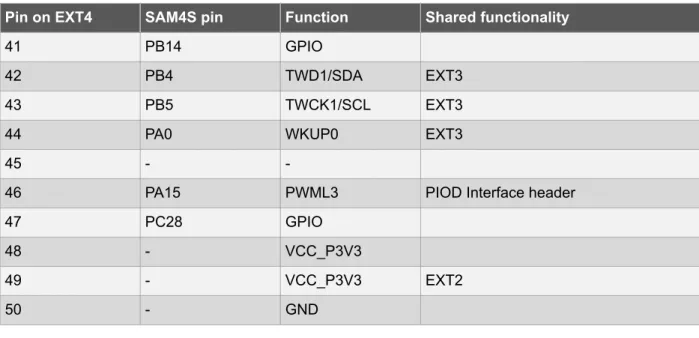
4.1.2. LCD Extension Connector
Extension connector EXT4 is a special connector for LCD displays. The physical connector is an Omron Electronics XF2M-5015-1A FPC connector.
Table 4-4 LCD Connector EXT4
Pin on EXT4 SAM4S pin Function Shared functionality
1 - - Communication line to ID chip on
extension board. 2 - - GND 3 PC0 D0 NAND Flash 4 PC1 D1 NAND Flash 5 PC2 D2 NAND Flash 6 PC3 D3 NAND Flash 7 - - GND
Pin on EXT4 SAM4S pin Function Shared functionality 8 PC4 D4 NAND Flash 9 PC5 D5 NAND Flash 10 PC6 D6 NAND Flash 11 PC7 D7 NAND Flash 12 - - GND 13 - -14 - -15 - -16 - -17 - - GND 18 - -19 - -20 - -21 - -22 - - GND 23 - -24 - -25 - -26 - -27 - - GND 28 - -29 - -30 - -31 - -32 - - GND 33 PC18 A0 34 PC15 NPCS[1] 35 PC8 NWE 36 PC11 NRD 37 38 39 40
Pin on EXT4 SAM4S pin Function Shared functionality
41 PB14 GPIO
42 PB4 TWD1/SDA EXT3
43 PB5 TWCK1/SCL EXT3
44 PA0 WKUP0 EXT3
45 -
-46 PA15 PWML3 PIOD Interface header
47 PC28 GPIO
48 - VCC_P3V3
49 - VCC_P3V3 EXT2
50 - GND
4.1.3. Current Measurement Header
An angled 1x2, 100mil pin-header marked with MCU current measurement is located at the upper edge of the SAM4S Xplained Pro. All power to the SAM4SD32C is routed through this header. To measure the power consumption of the device remove the jumper and replace it with an ammeter.
Caution: Removing the jumper from the pin-header while the kit is powered may cause the SAM4SD32C to be powered through its I/O pins. This may cause permanent damage to the device.
4.1.4. Other Headers
In addition to the Xplained Pro extension headers, SAM4S Xplained Pro has two additional headers with spare signals that offers access to the I/O of the microcontroller which are otherwise not easily available elsewhere or might be favorable to have collected together. All headers have a pitch of 2.54mm.
Table 4-5 SPARE SIGNALS Header
Pin on header SAM4S pin Function Shared functionality
1 PA2 DATRG User button, SW0
2 PA9 PWMF10 EXT2
3 PA26 TI0A2 SD Card and PIOD Interface header
4 PA27 TI0B2 SD Card and PIOD Interface header
5 PA28 TCLK1 SD Card and PIOD Interface header
6 PA29 TCLK2 SD Card and PIOD Interface header
7 PA31 PCK2 SD Card and PIOD Interface header
8 PB0 RTCOUT0 EXT2
9 PB1 RTCOUT1 EXT2
Pin on header SAM4S pin Function Shared functionality
11 PB14 DAC1
12 - - GND
Table 4-6 PIOD INTERFACE Header
Pin on header SAM4S pin Function Shared functionality
1 PA15 PIODCEN1 LCD connector
2 PA16 PIODCEN2 EXT3
3 PA23 PIODCCLK EXT1
4 PA24 PIODC0 EXT1
5 PA25 PIODC1 EXT1
6 PA26 PIODC2 SD Card and SPARE Signals header
7 PA27 PIODC3 SD Card and SPARE Signals header
8 PA28 PIODC4 SD Card and SPARE Signals header
9 PA29 PIODC5 SD Card and SPARE Signals header
10 PA30 PIODC6 SD Card
11 PA31 PIODC7 SD Card and SPARE Signals header
12 - - GND
4.2.
Peripherals
4.2.1. NAND FlashThe SAM4S Xplained Pro kit has one 2Gb NAND Flash connected to the external bus interface of the SAM4S.
Table 4-7 NAND Flash Connections
SAM4S pin Function NAND flash function Shared functionality PC0 D0 IO0 LCD connector PC1 D1 IO1 LCD connector PC2 D2 IO2 LCD connector PC3 D3 IO3 LCD connector PC4 D4 IO4 LCD connector PC5 D5 IO5 LCD connector PC6 D6 IO6 LCD connector PC7 D7 IO7 LCD connector
SAM4S pin Function NAND flash function
Shared functionality
PC10 NANDWE WE (active low)
PC13 GPIO R (active high)/ B
(active low)
PC14 NCS[0] CE (active low)
PC16 NANDALE ALE (active low)
PC17 NANDCLE CLE
4.2.2. SD Card Connector
The SAM4S Xplained Pro kit has one SD card connector which is connected to High Speed Multimedia Card Interface (HSMCI) of the SAM4S.
Table 4-8 SD Card Connections
SAM4S pin Function SD card function Shared functionality
PA26 MCDA2 DAT2 SPARE Signal and PIOD Interface
headers
PA27 MCDA3 DAT3 SPARE Signal and PIOD Interface
headers
PA28 MCCDA CMD SPARE Signal and PIOD Interface
headers
PA29 MCCK CLK SPARE Signal and PIOD Interface
headers
PA30 MCDA0 DAT0 PIOD Interface header
PA31 MCDA1 DAT1 SPARE Signal and PIOD Interface
headers
PC12 GPIO Card Detect
4.2.3. Crystals
The SAM4S Xplained Pro kit contains two crystals that can be used as clock sources for the SAM4S device. Each crystal has a cut-strap next to it that can be used to measure the oscillator safety factor. This is done by cutting the strap and adding a resistor across the strap. More information about oscillator allowance and safety factor can be found in appnote AVR4100.
Table 4-9 External 32.768kHz Crystal
Pin on SAM4S Function
PA49 XIN32
Table 4-10 External 12MHz Crystal
Pin on SAM4S Function
PB9 XIN0
PB8 XOUT0
4.2.4. Mechanical Buttons
SAM4S Xplained Pro contains two mechanical buttons. One button is the RESET button connected to the SAM4S reset line and the other is a generic user configurable button. When a button is pressed it will drive the I/O line to GND.
Table 4-11 Mechanical Buttons
Pin on SAM4S Silkscreen text
NRST RESET
PC24 SW0
4.2.5. LED
There is one yellow LED available on the SAM4S Xplained Pro board that can be turned on and off. The LED can be activated by driving the connected I/O line to GND.
Table 4-12 LED Connection
Pin on SAM4S LED
PC23 Yellow LED0
4.2.6. Analog Reference
An adjustable voltage reference is implemented on the kit to have a reference for the ADC or DAC. The reference can be adjusted with the on-board multiturn trimmer potentiometer. Next to the potentiometer, a 2-pin header is available to measure the reference voltage for the AREF pin of the SAM4S. The voltage output range for the reference is 0V - 3.36V.
4.3.
Embedded Debugger Implementation
SAM4S Xplained Pro contains an Embedded Debugger (EDBG) that can be used to program and debug the ATSAM4SD32C using Serial Wire Debug (SWD). The Embedded Debugger also include a Virtual Com port interface over UART, an Atmel Data Gateway Interface over SPI and TWI and it monitors four of the SAM4S GPIOs. Atmel Studio can be used as a front end for the Embedded Debugger.
4.3.1. Serial Wire Debug
The Serial Wire Debug (SWD) use two pins to communicate with the target. For further information on how to use the programming and debugging capabilities of the EDBG, see EDBG User Guide.
Table 4-13 SWD Connections
Pin on SAM4S Function
PB7 SWD clock
Pin on SAM4S Function
PB5 SWD trace output
PB12 Erase
4.3.2. Virtual COM Port
The Embedded Debugger act as a Virtual Com Port gateway by using one of the ATSAM4SD32C UARTs. For further information on how to use the Virtual COM port see Embedded Debugger on page 6.
Table 4-14 Virtual COM Port Connections
Pin on SAM4S Function
PB3 UART TXD (SAM4S TX line)
PB2 UART RXD (SAM4S RX line)
4.3.3. Atmel Data Gateway Interface
The Embedded Debugger features an Atmel Data Gateway Interface (DGI) by using either a SPI or TWI port. The DGI can be used to send a variety of data from the SAM4S to the host PC. For further
information on how to use the DGI interface see Embedded Debugger on page 6.
Table 4-15 DGI Interface Connections when using SPI
Pin on SAM4S Function
PA5 Slave select (SAM4S is Master)
PA12 SPI MISO (Master In, Slave Out)
PA13 SPI MOSI (Master Out, Slave in)
PA14 SPI SCK (Clock Out)
Table 4-16 DGI Interface Connections when using TWI
Pin on SAM4S Function
PA3 SDA (Data line)
PA4 SCL (Clock line)
Four GPIO lines are connected to the Embedded Debugger. The EDBG can monitor these lines and time stamp pin value changes. This makes it possible to accurately time stamp events in the SAM4S
application code. For further information on how to configure and use the GPIO monitoring features see
Embedded Debugger on page 6.
Table 4-17 GPIO Lines Connected to the EDBG
Pin on SAM4S Function
PA6 GPIO0
PC22 GPIO1
PC24 GPIO2
5.
Hardware Revision History and Known Issues
5.1.
Identifying Product ID and Revision
The revision and product indentifier of Xplained Pro boards can be found in two ways; through Atmel Studio or by looking at the sticker on the bottom side of the PCB.
By connecting a Xplained Pro MCU board to a computer with Atmel Studio running, an information window will pop up. The first six digits of the serial number, which is listed under kit details, contain the product identifier and revision. Information about connected Xplained Pro extension boards will also appear in the Atmel Kits window.
The same information can be found on the sticker on the bottom side of the PCB. Most kits will print the identifier and revision in plain text as A09-nnnn\rr where nnnn is the identifiser and rr is the revision. Boards with limited space have a sticker with only a QR-code which contains ta serial number string. The serial number string has the following format:
"nnnnrrssssssssss" n = product identifier r = revision
s = serial number
The product indentifier for SAM4S Xplained Pro is A09-1803.
5.2.
Revision 5
On this revision, the SPI clock net is improved to reduce any issues that might be caused by reflections. The SPI has been removed from the LCD (EXT4 connector) to reduce load on the clock net. The remaining clock lines have been divided into four terminated nets for each SPI source (EXT1, EXT2, EXT3, and EDBG) and routed in a star like layout. A series terminator resistor of 43ohm is placed on each clock net, close to the SPI clock pin. This reduces any issues that might be caused by reflections coming back from unterminated/unused clock lines. It also reduces the rise/fall time of the clock edges and that will also help to reduce any reflection issues.
Known issues
• There is no LC filter on the VDDPLL supply pin on the kit. This may cause excess ripple on the supply voltage which can cause the 48MHz PLL to not lock, which means USB applications may not work. For more information see the AT03463 SAM4S Schematic Checklist.
5.3.
Revision 4
Known issues
• SAM4S has an on-die series termination of the SPI CLK which makes this signal not usable for a multi drop clock distribution because all devices along the line will see a fraction of VCC until the signal is reflected from the end of the transmission line. On the SAM4S Xplained Pro revision 4 this signal is routed to each extension connector with EXT1 at the end of the line. That means
non-monotinic edge caused by relections and the fraction of VCC that is present for a short time until the reflection comes back from the end of the line.
Workaround:
– By slowing down the clock rise time with a capacitor, and thus effectively increasing the line length at which point it becomes a transmission line, it is possible to remove the clock issue. A 56pF capacitor has been mounted on the bottom side of the board between the SPI clock and GND. This however reduces the maximum SPI clock speed and it is recommended to not run this faster than 30MHz (this also depends on how much additional capacitance is added by connected extensions and needs to be checked case by case). The capacitor was added on revision 4 on the bottom side of the EXT3 header.
6.
Document Revision History
Doc. rev. Date Comment
42075C 05/2015 Table 4-17 GPIO Lines Connected to the EDBG on page 20 now lists the
correct GPIO names, changed PA6, PA22, PA24, and PA25 to PA6, PC22, PC24, and PC25. Added errata about missing LC filter on the VDDPLL pin.
42075B 03/2013 Added information about changes done on Revision 5 on page 21 of the
kit.
7.
Evaluation Board/kit Important Notice
This evaluation board/kit is intended for use for FURTHER ENGINEERING, DEVELOPMENT, DEMONSTRATION, OR EVALUATION PURPOSES ONLY. It is not a finished product and may not (yet) comply with some or any technical or legal requirements that are applicable to finished products, including, without limitation, directives regarding electromagnetic compatibility, recycling (WEEE), FCC, CE or UL (except as may be otherwise noted on the board/kit). Atmel supplied this board/kit "AS IS," without any warranties, with all faults, at the buyer's and further users' sole risk. The user assumes all responsibility and liability for proper and safe handling of the goods. Further, the user indemnifies Atmel from all claims arising from the handling or use of the goods. Due to the open construction of the product, it is the user's responsibility to take any and all appropriate precautions with regard to electrostatic discharge and any other technical or legal concerns.
EXCEPT TO THE EXTENT OF THE INDEMNITY SET FORTH ABOVE, NEITHER USER NOR ATMEL SHALL BE LIABLE TO EACH OTHER FOR ANY INDIRECT, SPECIAL, INCIDENTAL, OR
CONSEQUENTIAL DAMAGES.
No license is granted under any patent right or other intellectual property right of Atmel covering or relating to any machine, process, or combination in which such Atmel products or services might be or are used.
Mailing Address: Atmel Corporation 1600 Technology Drive San Jose, CA 95110 USA
Atmel Corporation 1600 Technology Drive, San Jose, CA 95110 USA T: (+1)(408) 441.0311 F: (+1)(408) 436.4200 | www.atmel.com
© 2015 Atmel Corporation. / Rev.: Atmel-42075C-SAM4S-Xplained-Pro_User Guide-06/2015
Atmel®
, Atmel logo and combinations thereof, Enabling Unlimited Possibilities®
, AVR®
, QTouch®
, and others are registered trademarks or trademarks of Atmel Corporation in U.S. and other countries. Microsoft®
, Windows®
, and Windows Vista®
are registered trademarks of Microsoft Corporation in U.S. and or other countries. ARM®
is a registered trademark of ARM Ltd. Other terms and product names may be trademarks of others.
DISCLAIMER: The information in this document is provided in connection with Atmel products. No license, express or implied, by estoppel or otherwise, to any intellectual property right is granted by this document or in connection with the sale of Atmel products. EXCEPT AS SET FORTH IN THE ATMEL TERMS AND CONDITIONS OF SALES LOCATED ON THE ATMEL WEBSITE, ATMEL ASSUMES NO LIABILITY WHATSOEVER AND DISCLAIMS ANY EXPRESS, IMPLIED OR STATUTORY WARRANTY RELATING TO ITS PRODUCTS INCLUDING, BUT NOT LIMITED TO, THE IMPLIED WARRANTY OF MERCHANTABILITY, FITNESS FOR A PARTICULAR PURPOSE, OR NON-INFRINGEMENT. IN NO EVENT SHALL ATMEL BE LIABLE FOR ANY DIRECT, INDIRECT, CONSEQUENTIAL, PUNITIVE, SPECIAL OR INCIDENTAL DAMAGES (INCLUDING, WITHOUT LIMITATION, DAMAGES FOR LOSS AND PROFITS, BUSINESS INTERRUPTION, OR LOSS OF INFORMATION) ARISING OUT OF THE USE OR INABILITY TO USE THIS DOCUMENT, EVEN IF ATMEL HAS BEEN ADVISED OF THE POSSIBILITY OF SUCH DAMAGES. Atmel makes no representations or warranties with respect to the accuracy or completeness of the contents of this document and reserves the right to make changes to specifications and products descriptions at any time without notice. Atmel does not make any commitment to update the information contained herein. Unless specifically provided otherwise, Atmel products are not suitable for, and shall not be used in, automotive applications. Atmel products are not intended, authorized, or warranted for use as components in applications intended to support or sustain life.