About this plan
This plan describes Airservices Australia’s strategic agenda and future direction for the period 2014–19. It is designed to ensure that Airservices meets the Government’s and the Australian public’s aviation safety and service delivery expectations. The plan positions Airservices to contribute more effectively and efficiently to the management of aviation safety risks and improving relationships with the key industry participants within a strong governance framework.
The plan is presented for tabling in both Houses of Parliament of the Commonwealth of Australia. © Airservices Australia 2014
This work is copyright. Apart from any use as permitted under the Copyright Act 1968, no part may be reproduced by any process without prior written permission from Airservices Australia. Requests and inquiries concerning reproduction rights should be addressed to:
Manager, Corporate Communication Airservices Australia
GPO Box 367 Canberra City ACT 2601 Telephone (02) 6268 4867 Fax (02) 6268 5688
AirservicesCorporate Plan 2014–19 03
Contents
Letter of transmittal 05
From the Chair 06
Airservices role 08
Outlook 10 Strategy 15
Government’s expectations 17
Financial plan 26
Governance and risk management 30
Performance against previous plan 32
Appendix A: Minister’s Statement of Expectations 44
Appendix B: The Board’s Statement of Intent and alignment of key initiatives 50
Appendix C: Current ministerial directions 55
AirservicesCorporate Plan 2014–19 05
Letter of transmittal
Chair
GPO Box 367, Canberra ACT 2601 25 Constitution Avenue, Canberra ACT 2601
t: 02 6268 4189
f: 02 6268 5686
www.airservicesaustralia.com ABN 59 698 720 886
The Hon Warren Truss MP Deputy Prime Minister
Minister for Infrastructure and Regional Development Parliament House
CANBERRA ACT 2600 Dear Deputy Prime Minister
Corporate Plan 2014-19
The Board of Airservices Australia is pleased to submit to you the Airservices Australia Corporate Plan for the period 1 July 2014 to 30 June 2019.
The Corporate Plan has been prepared in accordance with the statutory provisions of section 13 of the Air Services Act 1995 and section 17 of the Commonwealth Authorities and Companies Act 1997.
Yours sincerely
Air Chief Marshal Angus Houston AC, AFC (Ret’d) Chair
From the Chair
As the Chair of Airservices Australia I am delighted to present the organisation’s 2014-19 Corporate Plan. This plan sees the organisation maintain a clear focus on achieving Airservices 2020 Vision, ‘Connecting the Australian aviation industry to deliver world best industry performance’ and is underpinned by Airservices ongoing commitment to deliver safe, customer focused, efficient and environmentally sustainable air navigation and aviation rescue fire fighting (ARFF) services. I am pleased with Airservices ongoing safety performance. The organisation was ranked second in an international safety benchmarking study undertaken by the Civil Air Navigation Services Organisation which assessed fifty individual air navigation service providers’ performance against a range of metrics including loss of separation, runway incursion statistics and safety management system (SMS) maturity. This result is reflective of the continual improvement, review and validation approach that Airservices applies to its operations and procedures to ensure the ongoing safety of the Australian aviation industry. This was supported this year by a comprehensive Normal Operations Safety Survey (NOSS) program, and the establishment of a taskforce to review and implement a range of new initiatives to prevent loss of separation events.
A new Work Health and Safety (WHS) strategy was also launched which simplifies processes and paperwork, reinforces principles of ‘safety by design’ and drives initiatives that are delivering improved outcomes to Airservices workers with a focus on wellbeing at work as well as a reduction in incidents.
The organisation along with the Department of Defence continues to evaluate tenders for the joint delivery of a world-leading, civil-military harmonised national Air Traffic Management (ATM) system by 2020, with a successful respondent to be announced next financial year. The new system will ensure that Australian aviation remains at the forefront of technology and a global leader in ATM service delivery.
To get ready for this significant change we are focused on transformational changes to not only the organisation’s operational systems, but also its workforce capability, future business operations and the way in which it works with industry partners to align future interests and needs. Recognising the importance of its people in realising these changes Airservices has embarked on a long-term ‘Our People Our Future’ program. This program continues current leadership development and will align organisational culture to facilitate an improved customer-centric ethos driven by customer value and industry collaboration.
Airservices has an increased focus on delivering environmentally responsible services which appropriately consider aircraft emissions and noise management. Significant improvements to the way community issues are managed, as well as Airservices ability to deploy a range of tools to better understand the impacts that changes to aircraft operations may have, continue to be progressed in this plan.
AirservicesCorporate Plan 2014–19 07 By way of example, following wide consultation
Airservices is trialling a modified flight path in Perth to reduce the impact of aircraft noise on more than 4000 Roleystone residents by moving the flight path over mostly rural areas. The noise impacts of the moved flight path will be assessed before deciding whether to make the change permanent.
To meet the significant challenge of the ATM network-wide increase in demand over the next five years and beyond Airservices continues to reform its operations to optimise the management of Australia’s airspace and aerodromes and the use of aviation infrastructure.
Airservices is highly cognisant of the financial constraints within which industry participants operate. Through increased collaborative decision-making, the introduction of tailored procedures, user preferred routes and improved flow management Airservices continues to strive to provide the required services in a way that enhances efficiency and improves cost-effectiveness.
In December 2013 Airservices celebrated the 10th anniversary of the use of Flex Tracks between Dubai and Sydney. Airservices now produces 17 Flex Tracks between Australia and airports in Asia and the Middle East, resulting in significant fuel savings for airlines and a significant reduction in CO2 emissions.
The organisation is building on its unique position within the Australian aviation industry to help industry realise the full benefits of collaborative decision making from a customer service, cost saving and environmental perspective. As Airservices initiatives begin to remove constraints from the Australian ATM system, we are also working to reduce the constraints of the physical airspace route structures to enable our customers to better realise benefits.
Unprecedented growth in both passenger numbers and aircraft movements presents a significant challenge. Air traffic growth, combined with the introduction of larger, more modern aircraft fleets, has triggered legislated
requirements to provide five new ARFF services as well as category increases at Adelaide, Mackay, Launceston, Brisbane and Perth. This service line expansion is forecast to continue in this plan.
As a Registered Training Organisation Airservices relies on internal skill development for the specialist and operational roles it performs and the Airservices Learning Academy has responded to the challenge of increased air traffic control and aviation rescue fire fighting workforce demands by increasing the volume of trainees. In 2013–14 there was a 31 per cent and 150 per cent increase in scheduled courses respectively, on the previous financial year’s approved forward training schedule.
The unprecedented demand for ARFF trainee fire fighters grew 76 per cent, increasing from 68 recruits in 2012–13 to 120 for 2013–14 in response to new ARFF services supporting regional growth and maintaining safety standards, which we have catered for through a $35 million training infrastructure program.
Airservices continues to work with a range of government agencies and industry to deliver the Government’s long term policy objectives as well as meet operational expectations. I am pleased with the progress that Airservices has made to strengthen its positive relationship with both the regulator and the investigator to facilitate productive improvements for the industry while maintaining required safety levels.
The Board and I look forward to helping
Airservices professional and dedicated employees to achieve the organisation’s 2020 Vision.
Angus Houston Chair
Airservices role
Airservices is a Government owned corporation and a monopoly service provider of air navigation services across Australian and oceanic airspace, covering 11 per cent of the earth’s surface, for over 4 million aircraft movements and 140 million regular passenger transport movements each year.Airservices manages the safe and efficient passage of aircraft from two major centres in Melbourne and Brisbane and locally at 29 international and regional airports across Australia. These services are supported by a national network of communications, surveillance and navigation facilities and infrastructure. We also provide aviation rescue fire fighting (ARFF) services at 22 of Australia’s busiest airports. Airservices is funded through charges levied on our customers and borrowings from debt markets. Our prices are set by the Board and subject to economic oversight by the Australian Consumer and Competition Commission. Airservices does not receive any Government appropriations.
Mission
To provide safe, secure, efficient and environmentally responsible services to the aviation industry
Airservices is a Commonwealth statutory authority established by the Air Services Act 1995.
In exercising our powers and performing our functions, we are required to have safety of air navigation as our most important consideration. Airservices primary role is to provide air navigation and ARFF services under the regulatory
supervision of the Civil Aviation Safety Authority
and subject to independent investigation by the Australian Transport Safety Bureau.
Our air navigation services are subject to the provisions of the Civil Aviation Safety Regulations 171, 172 and 173. The organisation adopts a performance-based air traffic management (ATM) framework that is aligned with International Civil Aviation Organization standards and focuses on enhancing performance in safety, minimising environmental impacts, matching traffic demand and capacity, optimising flight efficiency and improving cost effectiveness.
ARFF services are subject to the provisions of Civil Aviation Safety Regulation 139H and are equipped to respond to aircraft incidents and fires at aviation-related facilities at major Australian airports.
To support the delivery of safe, secure, efficient and environmentally responsible air navigation and ARFF services, Airservices engages customers and stakeholders through regular consultation to develop a common understanding and agreement on current and future service delivery requirements. Ongoing performance monitoring is an essential component of our commitment to continual service improvement. With strong activity growth in the aviation industry, there is an increasing need to promote environmentally responsible services and manage the impact of aircraft noise and emissions on local communities and the environment. Airservices continues to work closely with the community, aviation industry and government to minimise the environmental impact of aircraft operations and its own footprint as it strengthens its environmental focus.
AirservicesCorporate Plan 2014–19 09
Vision
Connecting the Australian aviation industry to deliver world best industry performance Airservices position within the Australian aviation industry provides the organisation with a unique, whole-of-industry perspective. The organisation is well placed to facilitate improved connectivity across the industry.
Our access to information is vital to measuring and improving the performance of the industry and provides a line of sight across the interconnection of aircraft, airport, ATM and navigation services and systems.
In an operating environment with growing demand and limited capacity, we aim to efficiently connect the component parts of the Australian aviation industry by 2020 to allow all airspace users to enjoy the benefits of safe, efficient and cost-effective passenger and freight movement.
Values
Excellence, Inclusion, Cohesion, Initiative, Courage
Airservices values define the behaviours it seeks from its people in its goal to connect the Australian aviation industry and to deliver world best industry performance. These behaviours support the development of a high-performance culture that places the customer at the centre of all our activities and ensures we work as one team while investing in and engaging our people.
Courage has been added to the organisational values. The value of Courage supports a culture of doing what is right, supports openness and honesty, and importantly supports our people to have the courage to think boldly, to push for change and to make a difference.
Excellence – We work to make everyone successful by engaging with others, delivering on our commitments and always looking for the best possible outcome.
Inclusion – We foster a welcoming, diverse and professional workplace where everyone is able to contribute to or understand the decisions that affect them in an open and transparent way. Cohesion – We work together to connect our organisation and our industry by actively engaging with others drawing on experience, and sharing knowledge and information.
Initiative – We make a difference by
identifying innovative solutions and seeking to continuously improve.
Courage – We do what is right and speak up. We challenge ourselves, others and the status quo.
Outlook
Growth
It is expected that air traffic passenger numbers will grow at similar rates to real gross domestic product (GDP), which is in line with the historical correlation between aviation activity and economic growth. Based on forecast GDP growth, air traffic volumes are projected to grow at around 3 per cent over the life of the plan. While the outlook is for steady growth over the longer term, there is some volatility risk from year to year. Although we expect continued growth from international air operations, there is some uncertainty about the extent to which domestic growth will ease in comparison to previous periods, and we are now seeing competition for domestic market share and resources-led growth soften, impacting previously high levels of new capacity.
Domestic growth has been soft over the past 12 months and we expect that trend to continue over the life of the plan. Major domestic carriers are looking to improve business performance, and we expect some reductions in services as a result of airline plans now underway to change and reduce fleets and routes to maximise revenue load factors. We expect that carriers will look to maintain their domestic market share and preserve services capacity, which will offset some of the planned service reductions.
Throughout 2013–14, international traffic operations in Australia have continued to outperform previous growth forecasts. While activity in the Australian international aviation market is primarily driven by the performance of operations through Asia, in the past twelve months growth in international traffic has been led by the Middle East, India and
New Zealand markets. There is some risk to the international aviation market outlook, depending on the growth in the China market.
In the short term, however, lead indicators such as the performance of air cargo activity and Asian carrier planned activities to expand fleets and services to Australia suggest that growth in air activity and air traffic passenger movements will continue.
Air passenger movements through Australian airports are projected to grow by 50 per cent over the next 20 years.1 The challenge for the aviation industry is to work together to accommodate this growth safely and taking on the challenges of existing airport and surveillance infrastructure by improving efficiency and capacity, while investing in new and improved infrastructure and services to meet the industry’s long term needs.
Safety and service
Traffic volume growth, coupled with increasingly diverse aircraft performance and technology capabilities, presents the industry with some significant capacity management challenges across Australia’s aviation network.
Airservices will remain vigilant via its safety management system and continue to focus on improving our safety performance and supporting infrastructure to meet industry expectations.
National aviation policy
The Government’s aviation policy has set out a number of important measures to develop an Australian aviation sector that is safe, reliable, efficient and competitive.
AirservicesCorporate Plan 2014–19 11 Figure 1: Aircraft movements through Australian airports
Scheduled international Scheduled intercapital Scheduled regional Non-scheduled Total Actual Forecast Air
craft movements (thousands)
0 300 600 900 1200 1500 1800 2029–30 2028–29 2027–28 2026–27 2025–26 2024–25 2023–24 2022–23 2021–22 2020–21 2019–20 2018–19 2017–18 2016–17 2015–16 2014–15 2013–14 2012–13 2011–12 2010–11 2009–10 2008–09 2007–08 2006–07 2005–06 2004–05
Source: Bureau of Infrastructure, Transport and Regional Economics and Airservices data.2
Combined with the current Ministerial Statement of Expectations, Airservices has been contributing to a number of these measures through a range of initiatives that are contained in this and previous plans including:
a major infrastructure investment program introducing new technology and procedures
to improve operational efficiency, airspace utilisation and minimise traffic delays supporting greater civil-military
aviation harmonisation
minimising the environmental impacts of aviation operations.
Future Service Delivery
The Future Service Delivery group (FSD) was established in July 2013 to deliver and realise Airservices future air traffic management capability. FSD is responsible for the planning, development and implementation of our next-generation services, including the future civil–military ATM system through the OneSKY Australia program, which is a joint activity with the Department of Defence.
FSD is leading the fundamental organisational and industry transformation required to maximise the benefits and value of the future joint ATM system expected by our customers and other stakeholders. The group is assisting Airservices and its industry partners to prepare for the future transition to the new operating system and to operate in what will continue to be a very complex aviation landscape.
Through stakeholder engagement and strategic planning, acquisition and implementation, FSD will enable us to deliver a world-leading harmonised national ATM system to ensure that Australian aviation remains at the forefront of technologically advanced ATM and a global leader in ATM service delivery.
Operations
The significant challenge to Airservices over the next five years and beyond will be the ability to cope with an ATM network-wide increase in demand.
Projected air traffic growth and increased complexity in the operating environment, presents challenges to Airservices to meet aviation safety, demand and capacity requirements in a timely and cost efficient manner while minimising environmental impacts and planning for future capabilities.
In response, Airservices continues to reform its operations to optimise the management of Australia’s airspace, aerodromes and use of aviation infrastructure.
To effectively manage forecast air traffic growth over the next two decades, Airservices ATM network will be moving towards a fully integrated, collaborative air and ground system that consistently manages aircraft according to network optimised trajectories and agreed traffic schedules. Airservices will continue to collaborate with industry to achieve this approach.
Airservices will continue to build on the Airport Capacity Enhancement (ACE) program initiatives already implemented at Brisbane, Melbourne and Perth airports.
Additionally, Airservices will collaborate with the Sydney Airport Strategic Planning Group to identify and deliver initiatives to access latent capacity in the Sydney ATM system and respond to any future developments in Sydney Basin airport capacity.
The key to the safety, capacity and efficiency of Australia’s airspace and airports infrastructure is the management of the flow of traffic and the balance of demand and capacity. Airservices is working collaboratively with airlines and airports on a broad range of initiatives to manage demand and capacity strategically (when schedules are developed), pre-tactically (up to 24 hours ahead when accurate weather forecasts are able to
AirservicesCorporate Plan 2014–19 13 predict the capacity of the airspace and airport)
and tactically (when the flight is underway). One example is our collaboration with airports on the concept of airport collaborative decision-making (A-CDM). A-CDM aims to improve operational efficiency at airports by improving the predictability of events during the turnaround process by sharing accurate and timely operational information and adapting and connecting operational procedures and systems. This results in improved efficiency, reduced taxi time, fuel savings and better schedule reliability for airline passengers.
As Airservices initiatives begin to remove constraints from the Australian ATM system, we continue to work to reduce the constraints of our physical airspace route structures to enable our customers to better realise the benefits. Airport upgrades and new airports will further drive the need for unconstrained route models.
Airservices is developing the Future Airspace Strategy Deployment plan (FAS-d) with input from stakeholders, including air traffic control, airlines, airports and the Civil Aviation Safety Authority to ensure a consistent and clear focus on safe, efficient service delivery. FAS-d will describe the architecture required to minimise constraints and remove operational choke points, as well as the process to achieve those goals.
Unprecedented growth in both passenger numbers and aircraft movements also presents a significant challenge for our airport services. Air traffic growth, combined with the introduction of larger, more modern aircraft fleets, has triggered legislated requirements to provide: new ARFF services at two remote locations
(Newman and Port Hedland) and three regional areas (Gladstone, Coffs Harbour and Ballina)
category increases at Adelaide, Mackay, Launceston and Brisbane and an increase to a Category 10 service at Perth during 2014.
As a consequence, Airservices: is constructing new ARFF facilities
has increased the number of fire trucks (by 19 per cent), supporting vehicles and vessels (the introduction of Category 10 services triggers the requirement for specialist vehicles) has undertaken additional fire fighter
recruitment and training
has delivered more Certificate IV and diploma training courses for fire officers.
To inform a continuous improvement approach to our services, we engage with leading international ARFF service providers to understand and contribute to international trends in the provision of ARFF services.
Domestically, Airservices participates actively in airport emergency planning committees to improve emergency response procedures. We also perform an advisory role for airport operators where ARFF services are required but not yet established.
Labour market
Airservices must develop as an innovative, learning organisation to meet the challenges of growth, technological change, workforce changes and economic pressures. To meet these challenges, Airservices is committed to building workforce capability by attracting, developing and retaining our people for the future.
As a high-performing organisation, we will deliver the organisation’s objectives and services by having a highly skilled, capable, diverse and flexible workforce able to achieve the highest standards of safety and excellence.
We employ around 4200 staff, including
approximately 1050 air traffic controllers and 850 fire fighters (which makes the organisation one of the world’s largest providers of ARFF services). Our staff includes around 900 qualified technical and operational professionals to maintain existing infrastructure and deliver our extensive capital assets program.
Airservices expects the composition of the workforce over the next five years to be influenced by increased service provision at new locations, the ongoing delivery of new capital assets, technology changes and the delivery of a civil-military harmonised ATM system.
In line with broader Australian employment market trends, significant segments of our workforce are mature-aged. We are focused on building and enhancing our workforce planning, talent management, leadership development and workforce capability strategies to secure and retain talent in an increasingly competitive market. The Airservices Workforce Plan 2013–20 identifies key workforce risks, controls and strategies to mitigate current and future challenges. Airservices is committed to fostering and increasing the diversity of its workforce. Consistent with the Airservices Diversity Strategy 2012–2016, initiatives to address these issues include:
identifying and removing barriers to the progression of women into senior positions and improving the proportion of women in operational roles
implementing the Airservices Reconciliation Action Plan (RAP), which acknowledges and celebrates a range of culturally significant events and is being progressed under guidance from the RAP Reference Group through our Diversity Council, providing
leadership on diversity and promoting accountability for improved diversity outcomes across each business group.
AirservicesCorporate Plan 2014–19 Airservices Corporate Plan 2014–19 15
15
Strategy
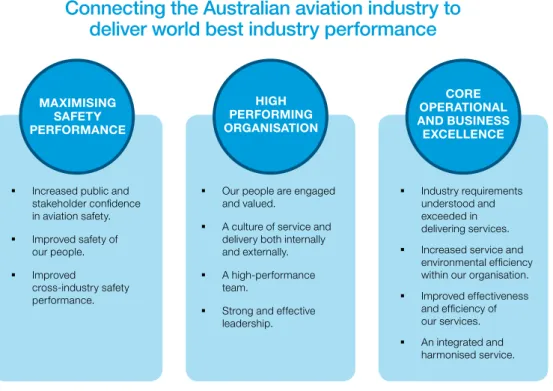
Airservices corporate strategy map (Figure 2) outlines the organisation’s three strategic themes and the core outcomes that will support delivery of the organisation’s vision over the next five years and beyond.
The core outcomes are arranged under the three strategic themes of:
maximising safety performance
high-performing organisation
core operational and business excellence.
These themes and the respective core outcomes inform the development of Airservices key initiatives aimed at meeting the Government’s aviation policy and current
Ministerial Statement of Expectations, meeting customer expectations, delivering process improvements and efficiency as well as continuing the development of its people and systems.
The themes, the core outcomes and the key initiatives are described in detail in the following pages.
Key achievements for the past 12 months are set out in the ‘Performance against previous plan’ section.
Figure 2: Airservices corporate strategy map
Connecting the Australian aviation industry to
deliver world best industry performance
Maintain safety as the highest priority for our people and services
Government expectations
Deliver safe, efficient and effective operations Maintain a financially viable and
sustainable organisation
Minimise the environmental impact of our and aircraft operations
Foster civil aviation Develop services that support the
overall efficiency of the industry
MAXIMISING SAFETY PERFORMANCE
Increased public and stakeholder confidence in aviation safety. Improved safety of our people. Improved cross-industry safety performance. HIGH PERFORMING ORGANISATION
Our people are engaged and valued.
A culture of service and delivery both internally and externally. A high-performance
team.
Strong and effective leadership. CORE OPERATIONAL AND BUSINESS EXCELLENCE Industry requirements understood and exceeded in delivering services. Increased service and
environmental efficiency within our organisation. Improved effectiveness
and efficiency of our services. An integrated and
AirservicesCorporate Plan 2014–19 17
Government’s expectations
Consistent with the current Statement ofExpectations (Appendix A) and the Government’s aviation policy, Airservices aims to efficiently and effectively perform its statutory functions to deliver safe and high-quality air navigation and related services for the benefit of the Australian community.
In delivering these services, Airservices will maintain a financially viable and sustainable organisation that supports planned investment in infrastructure, equipment, training and personnel to meet future demands. Airservices will continue to work with the community, industry and government to minimise the environmental impact of aircraft operations and its own environmental footprint.
Airservices regards the safety of air navigation and its people as its most important consideration.
The relationship between the Statement of Expectations and specific initiatives within the plan is described in Appendix B.
The Government’s aviation policy will also be delivered through the strategic initiatives set out in this plan. These include:
a major infrastructure investment program introducing new technology and procedures
to improve operational efficiency, airspace utilisation and minimise traffic delays supporting greater civil-military
aviation harmonisation
minimising the environmental impacts of aviation operations.
Objectives
Airservices will deliver on the expectations of the Government and maximise its performance within the Australian aviation industry by:
maintaining safety as the highest priority in the delivery of its services and performance of its functions
delivering efficient and effective operations
maintaining a financially viable and sustainable organisation minimising the environmental impact of aircraft operations.
01
Maximising safety
performance
The safety and integrity of Australia’s air navigation system, along with the wellbeing of our people are Airservices most important considerations. Airservices safety performance is reliant on the delivery of safe and resilient aviation services and effective industry and regional collaboration to reduce risk. The safety of all who use and contribute to the delivery of these services is integral to Airservices safety performance.
Airservices strategic theme of maximising safety performance continues to build on the two high level themes to reduce the risk associated with key operational and workplace hazards and to deliver targeted safety benefits to the travelling public, the aviation industry and communities located near airport operations.
Airservices is delivering initiatives that will maintain and enhance its current high levels of safety as traffic levels grow and operational complexity increases, by optimising airspace design, delivering new services at regional aerodromes and enhancing operational analysis.
Initiatives under this theme also emphasise the importance of continually improving work health and safety (WHS) culture and outcomes.
Airservices manages a diverse range of WHS risks through its corporate integrated reporting and risk information system.
We host a range of local, national and regional safety collaboration activities and forums to enhance sharing of safety information and lessons learned.
A key foundation of our operational and workplace safety approach is risk management. We use our risk management framework to identify hazards and threats to safety and actively implement mitigation strategies to manage those risks to as low a level as is reasonably practicable.
Core outcomes
When considering the theme of maximising safety performance, there are three core outcomes that should be achieved. These outcomes and outcome descriptions are outlined below.
Outcomes Descriptions
Increased public and stakeholder confidence in
aviation safety. Measurable improvement in the level of public and stakeholder confidence in Airservices and its safety performance through targeted and measured safety promotions, communications, community engagement and alignment.
Improved safety of our people. Aligned organisation work health and safety (WHS) plan and training program that is delivering measurable safety improvements making Airservices a safer place to work.
Improved cross-industry safety performance. Enhanced internal and external safety performance through the delivery of air traffic management and aviation rescue fire fighting services.
AirservicesCorporate Plan 2014–19 19
Key initiatives and indicators
The following key initiatives are central to achieving the core outcomes. Key initiatives
1.1 Continual optimisation of localised airspace design to enhance operational safety, efficiency and environmental outcomes. 1.2 Continual improvement to safety at regional aerodromes through the delivery of new services (Surveillance Arrangements For Regional Airports - SAFRA). 1.3 Improve awareness and confidence in Airservices safety performance.
1.4 Collaborate locally and internationally to support the integrity of our operations and whole-of-industry safety outcomes. 1.5 Enhance our safety management system (SMS) and safety culture.
1.6 Enhance hazardous material management.
The following key indicators guide organisational performance as Airservices moves towards achieving its core outcomes.
Key indicators Target Trend
ATS attributed en route LoS rate
Air Traffic Service attributed number of en route loss of separation occurrences (LoS) per 100,000 flight hours.
0 Improvement on current levels ATS attributed terminal area LoS rate
Air Traffic Service attributed number of terminal area loss of separation occurrences (LoS) per 100,000 movements.
0 Improvement on current levels ATS attributed tower LoS rate
Air Traffic Service attributed number of tower loss of separation occurrences (LoS)
per 100,000 movements. 0
Improvement on current levels ATS attributed runway incursions
Number of ICAO Class A or B Airservices Air Traffic Service attributable runway incursions.
0 Improvement on current levels ATS attributed aircraft in critical proximity
Number of Air Traffic Service attributable instances where evasive action required (within 250 feet/150 metres).
0 Improvement on current levels Lost time injury frequency rate
Lost time injury is defined as an occurrence that resulted in time lost from work of one
day/shift or more, permanent disability or fatality. 0
Improvement on current levels WHS incident rate
Occurrences per 100 staff per month. 0
Improvement on current levels Safety management system maturity benchmark
External assessment of the maturity of Airservices’ Safety Management System (SMS) against the Civil Air Navigation Service Organisation (CANSO) Standard of Excellence in SMS.
Top industry
02
High-performing
organisation
The achievement of Airservices vision is dependent on its people, leadership and culture. To achieve this objective, Airservices needs to attract and retain talented people; build a flexible, empowered and engaged workforce; and develop inspiring, values-based leadership.
Airservices strategic theme of a high-performing organisation reflects its commitment to deliver efficient and effective services through an engaged, high-performance workforce guided by strong and effective leadership.
Over the next five years, our staff numbers are expected to increase modestly in net terms in response to demographic trends and industry growth demands. The organisation also faces challenges to maintain skilled and capable staff as its age profile produces an increasing rate of retirements.
The Airservices Workforce Plan 2013–20 builds on earlier work to focus on critical roles in order to identify potential skills and capability gaps. Evidence-based workforce planning, combined with internal capability building through targeted recruitment and training, is needed to ensure that the workforce supply matches current and future demands.
As a Registered Training Organisation, Airservices delivers nationally recognised and accredited qualifications in air traffic control, aviation rescue fire fighting and management through the Airservices Learning Academy. These technical, operational, safety and corporate training requirements support our highly specialised and skilled workforce.
Initiatives under this theme emphasise the importance of building and fostering the management and leadership capability within the organisation and proactively implementing a number of initiatives focused on employee engagement and greater collaboration.
Core outcomes
When considering the theme of high-performing organisation, there are four core outcomes that should be achieved. These outcomes and outcome descriptions are outlined below.
Outcomes Descriptions
Our people are engaged and valued. A diverse workforce that is enthusiastic about its work and the future of the organisation’s shared vision. This is reflected in continual improvement, both in respect to the work being undertaken and in the interactions across the organisation.
A culture of service and delivery both internally
and externally. A fully developed and embedded service delivery philosophy that clearly supports the role we all play in delivering services both internally and externally.
A high-performance team. An organisation where all employees share a core set of values, work collaboratively, have clearly defined roles and are supported by people systems that identify, develop and retain talent.
Strong and effective leadership. Leaders, at all levels, who live the values, working collaboratively to deliver the organisations vision. A leadership team that is diverse, bringing together experience across the business and new knowledge.
AirservicesCorporate Plan 2014–19 21
Key initiatives and indicators
The following key initiatives are central to achieving the core outcomes. Key initiatives
2.1 ‘Our People, Our Future’ program to align culture and business imperatives.
2.2 Improve the alignment of key systems, processes and accountabilities through an integrated management system (IMS). 2.3 Develop and implement an organisation productivity framework.
2.4 Implement the Airservices Training and Education Strategy.
2.5 Implement the Airservices Diversity Strategy.
2.6 Refine and improve the workforce model.
2.7 Enhance management and leadership capability.
2.8 Continue to collaborate with the Department of Defence to progress harmonisation opportunities under the Australian Civil–Military ATM Committee (AC-MAC).
The following key indicators guide organisational performance as Airservices moves towards achieving its core outcomes.
Key indicators Target Trend
Employee engagement survey – values focused
Engagement score expressed as a percentage of satisfaction and specific values
related results. 75% Not applicable
Increased diversity
Increase in the number of women in non-traditional roles
Increase in the participation of Airservices workforce by Indigenous Australians and people with disabilities.
> increase
Improvement on current
levels Training demand
Number of qualifications issued against accredited training (ARFF)
Number of ATS recruits endorsed (ATC). ARFF 175
ATC 80
ARFF 90% of target ATC 100% of
03
Airservices strategic theme of core operational and business excellence underpins our commitment to improve service efficiency within the organisation as well as the effectiveness of our services by better understanding industry requirements.
Our core operation is the delivery of safe, efficient and effective ATM and ARFF services in a way that minimises impacts on the environment. Our operational strategy is focused on increased automation and the implementation of a range of new systems and tools across the organisation’s ATM system.
This focus will enable us to better meet domestic, international and regional demand while
concurrently improving efficiency and safety. The key considerations include:
the need for flexible services in remote locations (particularly driven by the resources sector)
demand exceeding capacity at capital city airports.
Airservices will continue working collaboratively across the industry to anticipate, understand and plan for future needs through innovation, new services and technology. Collaborative decision-making through data analysis and information sharing provides a unique opportunity to create greater connection between airlines, airports and ATM and to harmonise navigation services and systems.
Airservices provides industry with updates on its performance and delivery through the Services Charter, which articulates measurable targets and commitments to customers and stakeholders. Initiatives under this theme focus on meeting industry requirements with an integrated and efficient service that is capable of meeting expected future demand.
Core operational and
business excellence
Airservices performance is focused on enhancing safety, improving capacity, cost-effectiveness and realising environmental benefits, while meeting customers’ current needs and creating new value for industry. The delivery of agreed priorities in an efficient, effective and predictable manner is essential to the financial viability and sustainability of the organisation.
Core outcomes
When considering the theme of core operational and business performance, there are four core outcomes that should be achieved. These outcomes and outcome descriptions are outlined below.
Outcomes Descriptions
Industry requirements understood and exceeded in
delivering services. Services Charter that clearly articulates industry and stakeholder requirements and expectations, with measurable targets that drive organisational performance.
Increased service and environmental efficiency within our organisation.
Measurable improvements in efficiency and quality through aligned and fit-for-purpose systems, processes and behaviours that meet internal and external customer requirements.
Improved effectiveness and efficiency of our services. Embedded systems and processes that deliver service availability which exceeds internal/external requirements in the medium term. An integrated and harmonised service. An operational platform and service that recognises the
AirservicesCorporate Plan 2014–19 23
Key initiatives and indicators
The following key initiatives are central to achieving the core outcomes. Key initiatives
3.1 Implement a harmonised core ATM system in collaboration with the Department of Defence.
3.2 Deliver new regional ARFF services.
3.3 Develop and implement demand and capacity management capabilities.
3.4 Improve capacity management through Airport Capacity Enhancement (ACE).
3.5 Implement aircraft noise management to support ATM service delivery.
3.6 Improve environmental measurement, modelling and reporting.
3.7 Optimise procurement outcomes through supplier category management (SCM) and supplier relationship management (SRM). 3.8 Improve the environmental management system and reduce energy, water and waste footprint.
3.9 Improve alignment in airport master planning outcomes.
3.10 Improve the delivery of the CAPEX project delivery.
3.11 Develop an aligned strategic planning framework.
3.12 Investigate scalable core service delivery options.
3.13 Implement an aligned global sustainability reporting framework.
3.14 Implement an information management framework and data model.
3.15 Develop sustainable facilities and site master plans for key locations.
3.16 Embed an integrated Airservices assurance framework.
The following key indicators guide organisational performance as Airservices moves towards achieving its core outcomes.
Key indicators Target Trend
Capital Project Delivery
Percentage of major and significant other projects delivered on time, within budget and within scope.
> 90% Not applicable ATS availability
Hours of Air Traffic Service availability as a percentage of total hours of coverage. > 99.9% Not applicable Aircraft holding
Percentage total of airbourne holdings compared to ground holding at all locations where a ground delay program has been introduced.
40% : 60% Not applicable ATS attributable delays
Total number of Air Traffic Service attributable flight delay events (where the delay is
greater than 10 minutes, and demand is less than airport capacity). < 7 per quarter Not applicable Runway capacity achieved
Percentage of maximum runway movement capacity delivered during peak periods. > 95% Not applicable ARFF operational preparedness
Percentage of time ARFF resources were available to meet required category according
to the regulated service category for the aerodrome. > 99.9% Not applicable ARFF response time
Percentage of total responses to aircraft incidents on the aerodrome movement area within 3 minutes.
100% Not applicable NCIS compliance
Noise Complaints and Information Service (NCIS) compliance to prescribed response times for complaints and enquiries.
≥ 95% Not applicable Noise Improvements Investigated
Number of noise improvement proposals Investigated. 25 annually Not applicable Noise Information
Aircraft Noise Information and Complaint Reports made available to the community and industry.
Reports for 10 locations every
quarter Not applicable Stakeholder satisfaction
Percentage of key stakeholders across international and domestic airlines, airports, government agencies and key industry bodies who are satisfied to very satisfied with their relationship with Airservices and the organisation’s service delivery.
> 80% satisfaction >75% response
rate
Financial plan
This five-year financial plan supports Airservices strategic objectives and builds on the financial outcomes programmed in previous corporate plans.
Updates have been incorporated to reflect the latest economic outlook. Key capital investment activities remain focussed on the replacement of Airservices core air traffic management system. Whilst additional resources have been added into the plan to support the transition to the new system, the OneSKY transition costs and staffing requirements are not yet known and will be subject to the final systems design and implementation rollout that will be negotiated with the final successful tender. These costs have been largely offset by revenue growth
experienced over the last 18 months. On balance, this plan maintains the financial rates of return forecast in the previous plan.
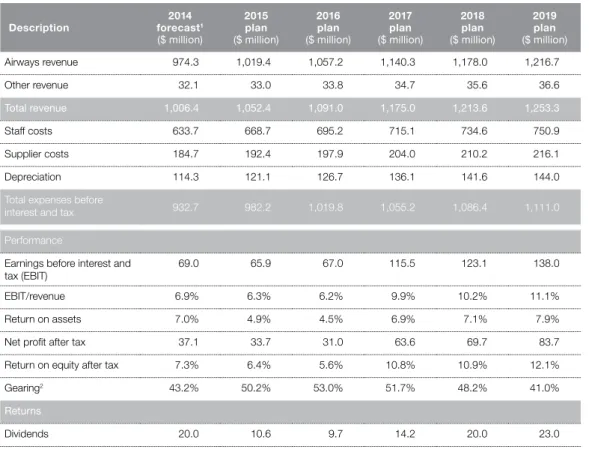
The five year operating projections and performance measures are expected to track broadly in line with regulated return targets (Table 1).
AirservicesCorporate Plan 2014–19 27
Pricing
The prices for Airservices core airways services are subject to the price notification provisions of the Competition and Consumer Act 2010. Any increase in prices must be notified to the Australian Competition and Consumer Commission (ACCC) for its review.
Airservices sets its prices with airlines and other customers using a five-year Long Term Pricing Agreement (LTPA). The current LTPA was established by Airservices and not objected to by the ACCC in October 2011. This allows pricing to recover all reasonably incurred costs (including a return on capital employed) relating to the delivery of services. This agreement provides price certainty for customers through to June 2016.
Table 1: Five-year operating and performance projections
Description forecast2014 1 ($ million) 2015 plan ($ million) 2016 plan ($ million) 2017 plan ($ million) 2018 plan ($ million) 2019 plan ($ million) Airways revenue 974.3 1,019.4 1,057.2 1,140.3 1,178.0 1,216.7 Other revenue 32.1 33.0 33.8 34.7 35.6 36.6 Total revenue 1,006.4 1,052.4 1,091.0 1,175.0 1,213.6 1,253.3 Staff costs 633.7 668.7 695.2 715.1 734.6 750.9 Supplier costs 184.7 192.4 197.9 204.0 210.2 216.1 Depreciation 114.3 121.1 126.7 136.1 141.6 144.0
Total expenses before
interest and tax 932.7 982.2 1,019.8 1,055.2 1,086.4 1,111.0 Performance
Earnings before interest and
tax (EBIT) 69.0 65.9 67.0 115.5 123.1 138.0
EBIT/revenue 6.9% 6.3% 6.2% 9.9% 10.2% 11.1%
Return on assets 7.0% 4.9% 4.5% 6.9% 7.1% 7.9%
Net profit after tax 37.1 33.7 31.0 63.6 69.7 83.7
Return on equity after tax 7.3% 6.4% 5.6% 10.8% 10.9% 12.1%
Gearing2 43.2% 50.2% 53.0% 51.7% 48.2% 41.0%
Returns
Dividends 20.0 10.6 9.7 14.2 20.0 23.0
1. February 2014 forecast
Beyond the expiration of the Long Term Pricing Agreement, pricing increases have been factored into the plan from 2017 to target Airservices ACCC regulated rates of return.
Operating performance
The five-year operating and performance projections are provided in Table 1.
Financial performance is projected to achieve an average 6.3 per cent return on assets and a 9 per cent per annum average return on equity. Revenue growth performed strongly throughout 2013–14 driven by international air traffic operations. Over the same period growth in domestic air traffic has remained soft. The plan anticipates that domestic growth will continue to be slow over the planning period with the revenue performance being driven by international aviation activity.
The plan incorporates operational expenditure increases to deliver new ARFF and ATC services
to support regional operations in the resources sector. The timing of some of the new ARFF services has been brought forward as a result of high passenger growth experienced in the last 18 months. New ATC services have been added to the plan alongside these ARFF operations to address traffic growth. Overall four new aviation rescue fire fighting services will be established at Gladstone, Newman, Coffs Harbour and Ballina during 2014–15 and 2015–16. Four new tower services are planned to be established at Port Hedland in 2015–16 and at Gladstone, Ballina and one other location to be determined over the 2017–18 to 2019–20 financial years.
Costs for the impact of training and transiting to a new air traffic management system have been included in the plan. The cost impact of transitioning to the new system will be refined once the tender evaluation process is finalised. With capital investment cycles reaching their peak midway through this plan as major infrastructure replacement projects complete, the level of investment and depreciation costs are projected to flatten over the latter half of the plan.
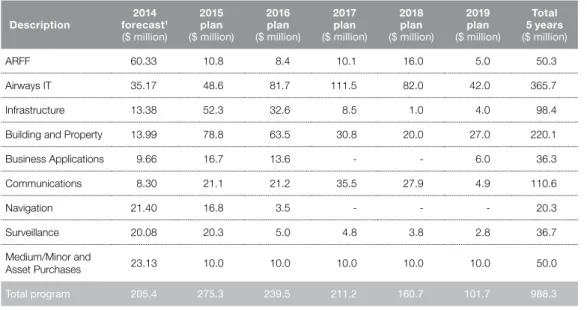
Table 2: Five-year capital expenditure projections
Description forecast2014 1 ($ million) 2015 plan ($ million) 2016 plan ($ million) 2017 plan ($ million) 2018 plan ($ million) 2019 plan ($ million) Total 5 years ($ million) ARFF 60.33 10.8 8.4 10.1 16.0 5.0 50.3 Airways IT 35.17 48.6 81.7 111.5 82.0 42.0 365.7 Infrastructure 13.38 52.3 32.6 8.5 1.0 4.0 98.4
Building and Property 13.99 78.8 63.5 30.8 20.0 27.0 220.1 Business Applications 9.66 16.7 13.6 - - 6.0 36.3 Communications 8.30 21.1 21.2 35.5 27.9 4.9 110.6 Navigation 21.40 16.8 3.5 - - - 20.3 Surveillance 20.08 20.3 5.0 4.8 3.8 2.8 36.7 Medium/Minor and Asset Purchases 23.13 10.0 10.0 10.0 10.0 10.0 50.0 Total program 205.4 275.3 239.5 211.2 160.7 101.7 988.3 1. February 2014 forecast
Airservices Corporate Plan 2014–19 29
Capital expenditure
The five-year capital expenditure projections are provided in Table 2.
Capital investment has been held in line with the previous plan with expenditure of $1.0 billion planned over the next five years.
The capital investment profile includes a number of large rolling programs, some that commenced a number of years ago. These involve significant investment in back-up
navigation aids, surveillance equipment upgrades, communications, infrastructure, buildings/services refurbishments (including control towers and fire stations) and IT platforms renewal.
The sequencing and interdependencies of projects related to OneSKY Australia program have been a key consideration in the planning of the program. The program includes a total of 37 additions totalling $231 million (23 per cent) to support new initiatives such as provision of a new service or product. It also includes $485 millon (49 per cent) for asset renewals including replacement or improvement projects to enhance operational capability.
Returns, dividends and gearing
The five-year returns, dividends and gearing projections are provided in Table 1. Over the term of the plan:
earnings before interest and tax will average $102 million per annum
returns over revenue are forecast at an average annual rate of 9 per cent
returns over assets are projected at 6 per cent per annum.
With a continuing substantial capital expenditure program, this plan proposes to maintain current dividend payout ratios at 30 per cent of net profit after tax. This is projected to return an average of $15 million in dividends each year.
Through sustained levels of profitability, dividend planning and management of capital expenditure funding, gearing is projected to remain within target levels and average 49 per cent over the term of the plan, declining to 41 per cent by 2018–19.
Governance and risk management
Governance
Airservices is accountable to the Australian Parliament through the Minister for Infrastructure and Regional Development and our operations are regulated by the Civil Aviation Safety Authority (CASA).
The Minister provides a Statement of Expectations (Appendix A) and ministerial directions (Appendix C), which are a notice of strategic direction concerning the operation and performance of Airservices. Airservices Statement of Intent (Appendix B) and this plan respond to the Australian Government’s expectations by identifying the organisation’s key strategic priorities and initiatives.
The Board of Airservices oversees a functionally based business structure:
The two operational groups, Air Traffic Control and Aviation Rescue Fire Fighting, are supported by the Projects and Engineering group and corporate support groups. The Board Audit and Risk Committee and Board Safety Committee provide oversight on the integrity and safety of Airservices operations.
The Board Environment Committee provides oversight on environmental compliance and initiatives, environmental regulatory functions and organisational strategy to address environmental issues.
The Board Remuneration and Human Resources Committee provides oversight of staffing-related matters and remuneration of executives.
The Airservices Board of Training provides oversight and governance of the delivery of quality training outcomes.
Risk management
Airservices manages risk through the application of an enterprise risk management framework that establishes and structures processes to ensure the rigorous identification and management of risks across the organisation, and to maximise opportunities for the attainment of business objectives.
Risks and their associated management activities are centrally recorded, and are subject to quarterly review and acceptance at the group and executive levels. These reviews focus on ensuring that controls commensurate with the level of risk are in place and effective, and that the risk is acceptable. A risk report, comprising of the enterprise risk profile and details of changes in the preceding period, is provided to the Board Audit and Risk Committee quarterly.
AirservicesCorporate Plan 2014–19 31 Table 3: Major loss event categories
Major loss event Risk type Significant controls/mitigation
Operational safety Airservices manages the identification and management of hazards within the Air Traffic Management and Aviation Rescue Fire Fighting Services groups that have potential to result in loss of life or injury due to an aircraft accident.
A comprehensive safety management system and associated safety practices exist within the organisation. This includes operational risk assessments, safety change management, safety controls assurance, safety training and certification, audit, safety incident investigations, cross–industry safety groups and forums.
Work Health and Safety Airservices manages a diverse range of risks for Work Health and Safety associated with our work locations, nature of work and workforce. High-risk work includes construction, electrical works, work at heights, emergency rescues and remote works.
Work Health and Safety is managed under a strategic systematic improvement program. Process controls are governed through the Safety Management System. Specialist resources support managers to address risks. Monitoring and management review programs (for risks and health of workers) identify any deficiencies and improvement opportunities.
Environment Airservices manages a diverse range of environmental risks associated with the facilitation of national aviation (e.g. noise and aircraft emissions) and with Airservices operational installations (e.g. site management).
A comprehensive environment management system (EMS) provides governance for the management of Airservices environmental obligations. This includes assessment of changes to aircraft operations, development and review of environmental site plans, management of site-specific environmental hazards, delivery of training and conduct of assurance reviews.
In relation to noise management, a national Noise Complaint and Information Service is staffed, an independent Aircraft Noise Ombudsman has been in place since September 2010 and a range of community and airport noise consultation forums are participated in on a regular basis.
Finance Financial exposures may arise through a potential loss of revenue via a decline in traffic volumes as a consequence of economic conditions; the ongoing requirement to support defined benefit superannuation fund liabilities; foreign exchange fluctuations; lease and contract commitments; and the need to support a substantial capital works program.
Airservices maintains a financial strategy that identifies areas of expenditure that could be deferred to support Airservices cash position should the economy experience significant shocks. In addition, ongoing monitoring and review occurs on all known financial exposures to ensure that appropriate hedging or mitigation strategies are in place.
Service delivery Airservices must identify and control the potential for disruption of air traffic control, aviation navigation and fire and rescue services and their associated impact on our key stakeholders.
Through its strategic planning, Airservices ensures that it continues to provide a professional service to the aviation industry. Airservices continues to invest in aviation infrastructure through its capital works program.
Reputation Management of reputation risk is concerned with the identification and treatment of risks to Airservices and the Government’s reputation through consideration of the potential to adversely impact on stakeholder relations and loss of goodwill.
Airservices is committed to open and timely communication with our stakeholders and the community. This is managed through a strategic approach, which utilises multiple communication channels including a comprehensive communication and consultation protocol.
Performance against previous plan
Airservices Corporate Plan 2013–18 outlined three strategic themes: maximising safety performance high-performing organisation
core operational and business excellence.
In addition to providing an update against the key initiatives by strategic theme in the Corporate Plan 2013–18, this section outlines other major achievements for 2012–13.
01 Maximising safety performance
Update against key initiatives in the Corporate Plan 2013-18
Optimise localised airspace design to enhance operational safety and efficiency. Airservices completed several airspace review processes aimed at improving air traffic safety and efficiency including consultation for the Adelaide Basin Airspace and the first phase of the Brisbane Basin Airspace review, with the second phase underway.
The Future Airspace Strategy Deployment plan (FAS-d) is under development replacing what was previously known as the Common Operating Plan for Terminal Airspace (COPTA). It will describe the architecture required to minimise constraints and remove operational choke points as well as describing the process to achieve this end state. Improve safety at regional aerodromes through the delivery of new services (Surveillance Arrangements For Regional Airports - SAFRA).
Airservices has implemented the following: Surveillance Advisory Service (SAS)
commenced for Sunshine Coast in November 2013 and for Alice Springs in December 2013 with the NAVAID monitoring section commissioned on 31 March 2014 and 30 April 2014 respectively.
Regional Approach Service (RAPPS)
introduced radar approach services in Mackay in January 2014 and additionally implemented the combined console for Rockhampton and Mackay.
Traffic growth risk assessments have been undertaken for Albury, Alice Springs, Broome, Coffs Harbour, Hamilton Island, Karratha and Tamworth.
Improve awareness and confidence in Airservices safety performance.
Airservices continues to upgrade its external website to improve public access to safety performance information, and has also:
developed and delivered an ‘Air Traffic Control (ATC) 101’ education program which promotes the activities of the organisation. The program was delivered to key airline and airport communications staff as well as targeted media outlets.
delivered an awareness campaign to industry on the Automatic Dependent Surveillance Broadcast (ADS-B) technology mandates.
AirservicesCorporate Plan 2014–19 33 Collaborate locally and internationally to
support the integrity of our operations and whole-of-industry safety outcomes. Airservices continues to deliver safety and capacity-building programs to air navigation services providers (ANSPs) in our region through ongoing support and direct provision of services. This year there was a renewed focus by Australia and Indonesia on safety collaboration and boundary coordination. This has included: both organisations signing a memorandum
of cooperation on safety and a letter of agreement on the exchange of safety information in Jakarta in July 2013 the development of a shared safety
investigation framework and implementation of the Safety Management System
positive discussions on potential expansion of our ADS-B data-sharing arrangements to increase surveillance coverage on our airspace boundary.
Additionally the Indonesia Transport Safety Assistance Package, an Australian Government funded initiative supported by Airservices is designed to improve transportation safety within Indonesia. We have supported the transition to the single ANSP, Air Nav Indonesia, which was formed on 16 January 2013. Key activities have included:
supporting the transfer of staff and assets facilitating a corporate planning workshop,
which supported the establishment of one and five-year plans as well the key objectives for the new organisation.
Airservices continues to support Papua New Guinea (PNG) through a memorandum of understanding for cooperation. In September 2013, we began a review of the Maintenance, Engineering and Project Management Unit of PNG Air Services Ltd (PNGASL). The review will determine PNGASL’s future capability needs and support its infrastructure modernisation program.
Airservices participated in the 10th South West Pacific Safety Forum, which was hosted by PNGASL in Papua New Guinea. The objective of the forum was to maintain and improve the safety and services of civil aviation in the region and respond to the changing needs of the aviation industry. Other participating countries included Fiji, Nauru and Solomon Islands.
The forum reviewed ATS occurrences for each country to identify and develop solutions to improve ATS coordination. During the forum, new terms of reference were signed and the standing agenda was amended to include workshops on safety-related topics.
Airservices continues to provide upper airspace management throughout the region under a: ten-year agreement with the government
of the Republic of Nauru. The agreement renews arrangements for the provision of upper airspace management services in the Nauru Flight Information Region from our Brisbane centre.
five-year agreement with Solomon Islands that renews the arrangement for the provision of upper air space management in the Honiara (Solomon Islands) Flight Information Region from our Brisbane centre. Under the agreement, Airservices will assist the Solomon Islands Government with the development of capability to deliver lower level airspace services.
Airservices has also replaced the Aeronautical Fixed Telecommunications Network gateways access system with a Comsoft Aeronautical Data Access System (CADAS) for the neighbouring states of Nauru, Solomon Islands, Timor-Leste and Vanuatu. This upgrade provides capability for new ICAO flight plan formatting, reduces compliance problems for Airservices interfaces and fulfils commitments to the countries involved and the ICAO Regional Office.
Enhance operational analysis through development of predictive tools and reporting frameworks.
Airservices has focused on delivering baseline capability to create a unified and tested source of data during the first phase which is designed to enhance Airservices capability to undertake complex operational analysis. Progress has specifically been made on flight, sector and route metrics for reporting on ATC workload, emissions, fuel burn, airspace operational risk and airspace usage.
Improve Workplace Health and Safety (WHS) culture and outcomes.
The new WHS strategy launched in July 2013 is designed to improve our risk management approach and further engage our workforce. A focus has been on reducing the lost time injury frequency rate, with particular emphasis on ARFF through the ARFF Injury Reduction and Recovery Program.
Enhance our safety management system (SMS) and safety culture.
In the continuous improvement of our SMS, Airservices has reviewed the system, and we are in the process of implementing agreed actions, including:
progressing assurance tools, including Normal Operations Safety Survey observations, across more than a hundred radar tower operations
ensuring that safety training programs are fit for purpose. Several generic and role-based safety training courses have been revised or launched and the safety training matrix has been updated.
Other major achievements Runway safety program
Airservices has commenced a significant runway safety program and has been leading work with industry partners (including ICAO and CANSO) to improve runway safety globally. This has included Airservices chairing the Australian Runway Safety Group in order to facilitate the implementation of local runway safety teams at aerodromes and to produce a range of safety promotions and educational material to improve runway safety. As part of the runway safety program, Airservices sponsored the Australian International Pilots Association to conduct an airline liaison representative course in Perth in August 2013. The course was developed to train pilots about aerodrome and airport operations to enable them to assist airports with their safety and operational enhancement programs. The course was well received by 23 participants from Airservices, major airports, general aviation, major and regional airlines, the Royal Australian Air Force and the Civil Aviation Safety Authority (CASA). Normal Operations Safety Survey
Following the success of the Normal Operations Safety Survey in 2012–13, Airservices rolled out a similar program in 2013–14 for the ATC towers in Sydney, Brisbane, Perth, Adelaide and Cairns. In association with ICAO and the University of Texas, we developed best-practice methodology to proactively capture threats to safety that arise during everyday operations as they occur. The threats are captured by a series of observations of normal ATC operations over a specific period of time by specially trained controllers.
Airservices obligations and compliance Airservices launched a new Corporate Integrated Reporting and Risk Information System (CIRRIS) module centred on obligation and compliance management in September 2013. This module is a key component of our legal compliance framework and, with the launch, CIRRIS is a fully integrated system for managing legal and regulatory obligations and risks within Airservices.