Improving Integrity and
Accountability in the
Workers’ Compensation
System
2014 Annual Report to the Legislature
January 2015Table of Contents
Executive Summary ... 1
Introduction ... 4
Detecting and Targeting Fraud ... 5
Detecting Worker Errors, Fraud and Abuse ... 5
Detecting Employer Errors, Fraud and Abuse ... 5
Targeting Provider Fraud and Abuse ... 8
Data-Sharing ... 9
Audits and Investigations ... 10
Worker Fraud Investigations ... 10
Employer Audits ... 12
Provider Audits and Investigations ... 15
Collections ... 16
Efforts to Prevent Errors and Fraud ... 18
Employer Services Program ... 18
Education and Outreach ... 19
Innovations and Initiatives ... 23
Firm Appeals ... 23
New Services and Programs ... 24
Underground Economy Advisory Committee ... 26
Special Initiatives ... 27
Completed Initiatives ... 29
Future Initiatives ... 30
Conclusion ... 31
How To Report Fraud ... 31
Executive Summary
The Department of Labor & Industries (L&I) makes information and services available to help employers, workers and healthcare providers understand and comply with the requirements of the Washington’s workers’ compensation system. Despite these considerable efforts to prevent violations and make it easy to do business with L&I, the department finds thousands of errors and violations every year. Most violations do not qualify as fraud – involving deliberate deception intended to secure unfair or unlawful gain. Nevertheless, fraudulent business practices, injured worker claims and inappropriate medical billing amount to millions of dollars each year.
L&I is committed to cracking down on dishonest behaviors. The department uses discovery tools, interagency partnerships and public tips to find, detect and deter fraud.
About this report
The purpose of L&I’s workers’ compensation fraud prevention efforts is to preserve the integrity of the workers’ compensation funds. This is done to ensure money is used to pay for needed injured worker benefits and to help reduce premium costs for both workers and employers.
This annual report summarizes the agency’s efforts to find and eliminate accidental errors as well as deliberate fraud in the workers’ compensation system. As requested in state law (RCW 43.22.331), the report includes actual and estimated cost savings resulting from these activities, where possible. It also describes the agency’s efforts to provide education and assistance intended to prevent “honest mistakes.” It does not describe the results of L&I’s investigations into fraudulent labor practices (e.g., minimum wage, overtime and other pay requirements, as well as meal and rest breaks). L&I is not always able to separate fraudulent numbers from non-fraudulent numbers. For example, not all unpaid workers’ compensation premiums identified through employer audits were the result of deliberate fraud.
Key results
In fiscal year (FY) 2014, L&I continued to make employers, workers and providers think twice about committing fraud. Here are some of the key results:
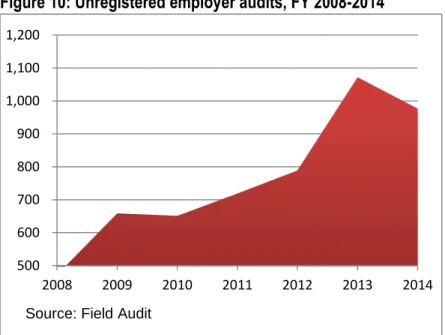
Audited 3,917 employers, of which 977 were unregistered.
Determined, through improved audit selection, that 83 percent of audited employers owed debts to L&I. Altogether, employer audits identified $19.4 million* in workers’
compensation premiums owed.
Collected $153.2 million in delinquent employer premiums.*
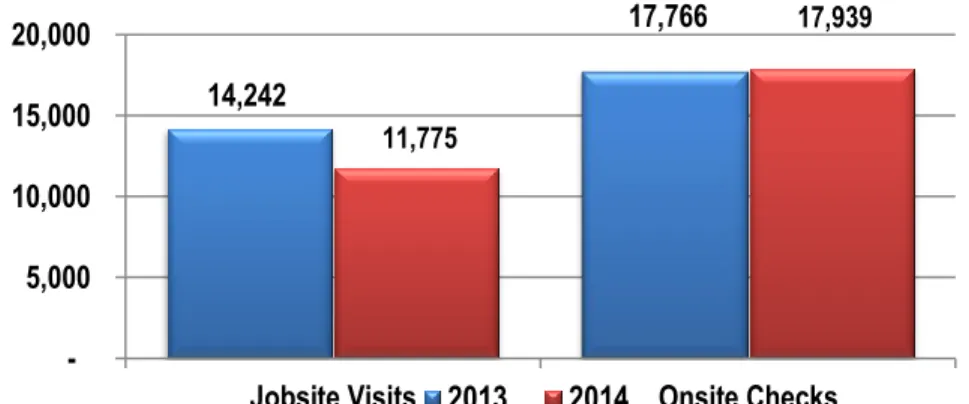
Conducted compliance checks at 17,766 construction sites. Of 2,095 violation notices issued, 88 percent involved underground economy violations.
Completed 3,854 injured worker investigations, which turned up $3.6 million in fraudulently claimed benefits.
Identified $3.4 million in healthcare provider overpayments, of which 24 were identified as potential fraud.
Reviewed 3,857 public works contracts worth $5.6 billion to ensure workers’ compensation premiums were paid.
* While most of this amount was from standard collection activities and not the underground economy, this money helps keep rates low by ensuring all employers pay their fair share.
Return on investment
As shown in Figure 1, L&I employed 305.1 full time equivalents (FTEs) in detecting, investigating and taking enforcement action against workers’ compensation errors and fraud in FY 2014. For every dollar spent on these efforts, L&I returned $8.34. This is 86 cents less than 2013, a result of increased operating costs and slightly reduced collections. (Note: Return on investment compares the division’s operating costs to the money recovered, money collected and expenses avoided during the year. Operating costs include salaries, benefits and capital outlays.)
L&I also offers extensive training programs, direct customer service and awareness campaigns aimed at preventing errors and fraud by making sure customers know the rules.
Figure 1: Fraud prevention, detection and enforcement FTEs
Major initiatives in 2014
In last year’s report, L&I identified 13 objectives and initiatives for 2014 connected to deterring, detecting and prosecuting workers’ compensation fraud. Five of those initiatives have been completed, seven have been implemented and are ongoing and one is still under development. A status summary of each project is reported in the Innovations and Initiatives chapter.
Major initiatives for 2015
In 2015, L&I will continue pursuing workers’ compensation fraud and abuse in the following ways: Develop and implement an improved stop work order process.
Seek funding for a special unit to investigate and develop more cases for criminal prosecution.
Activity FTEs
Detecting and targeting fraud 12
Employer audit 79.6
Construction contractor compliance 37 Worker investigations 65 Provider audits and investigations 9.5
Collections 85
Employer appeals 10
Administration 7
Review processes and eliminate gaps that make it difficult to pursue criminal prosecutions. Analyze and improve effectiveness of compliance efforts, including escalation strategies and
deterrents.
Establish a Premium Advice Unit where customers can obtain advice in “consultation letters” about workers’ compensation premiums, classification and compliance concerns.
Conclusion
L&I is continuing to implement new and innovative ways to identify and prevent unintentional errors as well as deliberate fraud, both of which drive up costs in the workers’ compensation system. The agency’s labor and business stakeholders, as well as the state Legislature, will remain valued partners in these efforts.
Introduction
Cheating the workers’ compensation system is not a
victimless crime. Both employers and workers pay insurance premiums into the system – and they all pay the price if costs are escalated unnecessarily due to fraud.
Workers’ compensation fraud comes in the form of employers who don’t pay their workers’ compensation premiums, false injury and disability claims made by employees, and
dishonest billing by healthcare providers. These fraudulent activities can force higher premium rates that dig into
workers’ wages, lower businesses’ profits, and increase prices for consumer goods and services.
L&I’s first priority is to prevent unintentional mistakes and deliberate fraud by offering access to services, information and training which help employers, providers and workers comply with requirements. Nevertheless, it’s also necessary to protect the public’s interests by operating an integrated array of programs focused on various aspects of fraud and
compliance in the workers’ compensation system.
This report begins by describing how L&I targets and detects errors and fraud by workers, employers and medical
providers. The Detecting and Targeting Fraud chapter goes into greater detail about how the department investigates and audits suspected violations, most of which do not constitute fraud. Subsequent chapters discuss the agency’s efforts to collect past due debt, improve the employer appeals process, prevent fraud and implement innovative programs and tools.
Workers’ compensation is a form of insurance that helps pay costs resulting from work-related injuries and illness. The 168,000 employers and 2.5 million workers covered by the program share risk by paying premiums to fund the system.
Insurance premiumsare based on the risk associated with the type of work employees perform. This is referred to as the “risk class.”
Premium ratesare adjusted based on the cost of injuries employees report and the number of worker hours reported. This is referred to as the employers’ “experience factor.” Hazardous work activities with an increased risk of injury require a higher premium rate. Companies that experience more injuries will pay increased rates.
Detecting and Targeting Fraud
L&I has a variety of sources and tools for detecting fraud. Employees scour databases using
discovery software, and they share data with other agencies. Tips from the public and other programs are also reviewed and may lead to in-depth audits and investigations.
DETECTING WORKER ERRORS, FRAUD AND ABUSE
Worker fraud generally involves someone collecting workers’ compensation benefits despite being able to work. The Worker Fraud Detection Unit looks for fraud by analyzing data, reviewing
individual claims and following up on tips from the public. There is a dedicated phone line for fraud tips and an easy online referral form.
In FY 2014, the unit received and reviewed more than 1,048 public tips regarding potential worker fraud. Based on these tips and other detection sources, the unit reviewed 25,022 claims, which resulted in about 845 worker investigations. Of these, 103 cases were determined to merit more in-depth fraud investigations.
TARGETING EMPLOYER ERRORS, FRAUD AND ABUSE
Ten years ago, fewer than half the employers audited owed premiums to L&I. Since then, L&I has improved its detection and targeting capabilities. In FY 2014, 83 percent of the employers audited were found to owe premiums.
To identify businesses most likely to owe premiums, L&I relies on tips from the public, sharing data and information with other agencies and interested parties, and using available data to send our audit resources to the right businesses. Perfecting the detection methods is a better use of L&I’s resources, and it saves time and hassle for employers who follow the rules. In FY 2014, L&I received more than 1,500 of these leads. The resulting reviews and audits led to $2.1 million in premium assessments. L&I also has units which specialize in detecting fraud in the construction industry in general, as well as public works contractors and electrical installers.
Construction contractors in the underground economy
L&I employs various tactics to identify unregistered contractors – also known as the underground economy. The compliance detection staff reviews consumer complaints and referrals from other L&I programs, and scrutinizes online and other sources (e.g., Craigslist, online ads, business cards, home shows, websites) to identify unregistered contractors.
By nature, the underground economy doesn’t operate on an 8 to 5, Monday through Friday schedule. L&I’s compliance teams – all based in L&I field offices – conduct surprise sweeps, with the
capability of visiting multiple jobsites over the course of a weekend.
Figure 2: Construction Compliance presence in the field
14,242 17,766 11,775 17,939 5,000 10,000 15,000 20,000
Jobsite Visits 2013 2014 Onsite Checks
Source: Contractor Compliance
THE HARM OF BEING UNREGISTERED
An unregistered contractor typically has no liability insurance, no bond and pays no taxes or workers’ compensation premiums. That leaves consumers unprotected and exposes reputable contractors to unfair competition.
Contractor registration requires contractors to carry at least a minimum level of bonding and insurance coverage. If a contractor doesn’t have a bond and something goes wrong, consumers have nowhere to turn to recover their money.
L&I makes it easy to verify online whether a contractor is registered. The online search also shows if there are lawsuits against a contractor’s bond and if the contractor has been cited for violating construction laws governed by L&I. A quick online search can help protect consumers from shoddy work and liens against their property if a contractor fails to pay for supplies or work.
For the business community, contractor registration levels the playing field, because unregistered contractors who skip the expense of protecting consumers can underbid their competition.
Jobsite visits are sites visited by an inspector.
Onsite checks are compliance checks while on the jobsite (could be multiple per jobsite visit)
Figure 3: Geographic distribution of compliance visits to construction jobsites, FY 2014
Compliance inspectors watch for all types of violations on job sites. They enforce plumber and electrical licensing and certification laws, check contractor registrations and even identify employers that owe significant debt to L&I. They confirm the status of worker’s compensation accounts and refer cases to L&I auditors. They also make referrals for potential violations of workplace safety, prevailing wage and Department of Revenue rules.
Of 2,095 violation notices issued by contractor compliance inspectors in FY 2014, 88 percent were underground economy violations.* Five egregious cases were referred to the Attorney General’s Office and local prosecutors for criminal prosecution,
and charges were filed in all five cases. The inspectors also made 1,448 audit referrals and 1,670 collection referrals based on the results of their visits.
*Underground Economy violations include: Unregistered contractors bidding or working in Washington, contractors that are not properly paying for workers’ compensation insurance and contractors not paying prevailing wage or agreed upon wages and overtime when required.
Electrical compliance
Improperly installed electrical wiring can cause fires and electrocution. L&I’s Electrical Program is responsible for ensuring that electrical installations meet the state’s safety standards and installers are properly licensed and certified. The program’s efforts make it easier for honest businesses and workers by focusing compliance on the underground economy and on those who take unfair competitive advantage by violating the law. In addition to electrical inspectors, the department has licensing auditors and electrical compliance outreach, regulation and education (E-CORE) staff, who primarily investigate tips and referrals about unlicensed electrical contractors and uncertified
workers.
SUCCESS IN ELECTRICAL COMPLIANCE While performing an electrical inspection for new lighting at an apartment complex in
Vancouver, an electrical inspector discovered employees of an unlicensed electrical contractor from California installing wiring in the apartment units.
Twelve citations and warnings were issued to the contractor for performing electrical work without being licensed in Washington; failing to obtain electrical permits; employing uncertified electricians; and energizing wiring without an inspection.
The project was taken over by a licensed electrical contractor employing certified electricians.
Potential violators are identified in a variety of ways:
Referrals from legitimate electricians and inspectors from other jurisdictions. Tips from property owners unhappy with the work of unlicensed contractors.
Tips about unlicensed out-of-state contractors working on multiple-site projects for large retailers.
During requested inspections.
L&I’s electrical inspectors also watch for signs of electrical work while traveling between scheduled inspections. They may stop and check any project site for proper licensing, certification and permits. If they discover unregistered contractors or safety violations not involving electrical work, they make referrals to other L&I programs for further investigation.
During FY 2014, L&I’s Electrical Program had 110 electrical inspectors, leads and supervisors, two auditors and five E-CORE staff. Figure 4 shows the total number of citations issued by these staff for all electrical law violations, “focused” electrical violations (lack of required licenses, certifications or permits) as well as referrals for industrial insurance violations (usually for not being registered with L&I) in FY 2014.
Figure 4: Electrical compliance results
Total citations and warnings
Focused citations and warnings*
Industrial insurance referrals
Electrical inspectors 4,376 2,013 30
E-CORE and auditors 2,580 1,315 26
Total 6,956 3,328 56
*Focused citations include unlicensed electrical contractors, uncertified electricians and lack of required electrical permits. These numbers are included in the “Total citations and warnings” figures to the left.
Source: Electrical Program
TARGETING PROVIDER FRAUD AND ABUSE
Medical and vocational service providers commit fraud when they charge for fictitious services. L&I has one employee dedicated to looking for inconsistent billing patterns and reviewing leads from the public. Some examples include billing for more hours than there are in a day, and “upcoding” (billing a 15-minute appointment as one hour). Public tips come from a variety of sources, including the internet, other providers and even injured workers who are being treated.
The staff also now reviews new applicants to L&I’s Medical Provider Network to be sure a provider applying to treat injured workers does not have a history of billing fraud.
In FY 2014, this one-person detection unit received 374 tips or complaints about providers. Through these tips and technology assisted data-mining efforts, the employee identified nearly $3.4 million in estimated overpayments, and referred 24 suspected fraud cases to the provider fraud investigators for a closer look.
DATA-SHARING
Sharing and cross-matching L&I data with data from other agencies and organizations is a good way of catching inconsistent reporting or duplicated claims that may indicate fraud. Here are a couple of ways L&I is using data-sharing in its fraud fighting efforts.
National information exchange
In 2011, the Legislature directed L&I to participate in a national information exchange with other insurers. The purpose is to avoid duplication of claims and benefits.
In July 2012, L&I signed a contract with ClaimSearch, which requires L&I to share data and
provides L&I with access to other participating insurers’ claims information. In 2013, the Legislature provided partial funding for the contract.
L&I worked to develop a method for sharing and receiving the large data runs associated with the database. This work was completed in FY 2014, and L&I is now using this tool to detect and investigate potential fraud. To date, the cross-match has proved to be a valuable tool for identifying third party insurers to L&I claims (for example, when a worker is injured in a car accident, etc.). In these instances, L&I is able to recoup funds and mitigate costs to the workers’ compensation system. Cross-agency collaboration
L&I partners with the Department of Revenue (DOR) and Employment Security Department (ESD) by sharing information across the agencies. In FY 2014, the three agencies exchanged 36,184 tips and leads through electronic data matches. The agencies also work together to improve training and education, so their staff understands what signs to look for and what information to share when making a referral. Working together to remove information silos makes all three agencies effective in the fight against fraud.
Audits and Investigations
Most workers’ compensation violations are a result of unintentional errors, not deliberate fraud. To find the fraudulent cases, L&I first has to find and sort through all potential violations. Even “honest mistakes” must be resolved, and sometimes carry penalties. L&I has units specializing in employer audits, workers’ compensation claims and provider billing investigations.
WORKER FRAUD INVESTIGATIONS
L&I receives tips from many different internal and external sources about potential workers’ compensation fraud and abuse. If an initial review suggests there may be anomalies, the tip is referred to the Investigations Program. Fraud Adjudicators gather evidence and issue administrative fraud orders (AFO) to assess penalties and recover money paid on fraudulent benefits.
“Worker fraud” involves any individual who lies in order to obtain benefits through deliberate misrepresentation. Fraud investigations may result in workers having to repay benefits and penalties, and in some cases, even face criminal convictions. The types of investigations conducted by L&I investigators are as follows:
Validity: Was there a work related accident that resulted in injury? Validity checks examine the facts surrounding a claim for benefits.
Activity: Is the injured worker still unable to work? Activity checks investigate the current level of a worker’s activities to see if he or she is still injured or exceeding the documented medical condition.
Other: Other investigations can include requests by claim managers who need information to manage a claim, such as retrieving medical records or checking to see if an individual is in jail.
Figure 5: Breakout of investigations by type, FY 2014
Type of referral Percentage of all referrals
Activity 53%
Other 27%
Validity 16%
Fraud 3%
Employer or claim reopening 1%
The Investigations Program received 3,758 referrals in FY 2014 and completed 3,854
investigations.* Altogether, investigators issued 151 worker fraud AFOs totaling $3.6 million. In addition, 24 of these cases were referred to the Office of the Attorney General and local prosecutors.
Figure 6: Worker fraud investigations: referrals vs. completions, FY 2009-2014
* Investigations often are not completed in the same year as the referral, so the numbers typically do not match each year.
Figure 7: Geographic distribution of completed worker fraud investigations, FY 2009-2014
Investigations do more than identify debts owed to L&I; they also help avoid unnecessary expenses. When an investigation determines someone is not entitled to workers’ compensation, L&I stops paying the benefits. L&I estimates that $10.4 million in future workers’ compensation costs were avoided through these efforts.
The Investigations Program also looks into industrial insurance discrimination and claim
suppression. These occur when an employer either interferes with an injured worker’s right to file a claim or retaliates against an injured worker for filing an injury claim.
1,000 2,000 3,000 4,000 5,000 6,000 2009 2010 2011 2012 2013 2014 Referrals Completions
EMPLOYER AUDITS
Field auditsAudits are an important tool to ensure employers report their worker hours correctly and pay appropriate workers’ compensation premiums. L&I has a standard audit process that involves checking business records and conducting interviews to determine facts. Examinations may include verifying the number of workers reported and that all hours are reported in the correct risk class. Reviewing the records helps an auditor determine if fraud is occurring.
Employer audits are conducted by auditors located in field offices throughout Washington, thus the name “field audits.” After completing an audit, L&I offers a closing conference with the employer. Typically, this involves a phone conversation, but sometimes it’s an in-person meeting. This post-audit conference is an important part of the process and is required on every post-audit. It provides employers with an opportunity to better understand the reporting process. Auditors supply
educational materials and explain how to keep better records. It’s also a chance to answer questions the employer may have, helping to prevent recurring problems. Figure 9 shows the geographic location of employer audits conducted statewide in FY 2014.
Figure 8: Geographic location of employer audits, FY 2014
As discussed in the Detecting and Auditing Fraud chapter, L&I directs the focus of audits to
employers that are most likely to owe workers’ compensation premiums. Out of the 3,917 employer audits completed in FY 2014, 83 percent of employers owed money to L&I. L&I assessed $19.4 million in premiums found through those audits. As shown in Figure 9, slightly more than half of the assessments involved unregistered employers – the “underground economy.”
Figure 9: Premium Assessments, FY 2014
Unregistered employers
Over the last five years, L&I has expanded efforts to curb the underground economy. These are businesses which fail to register with L&I and/or fail to accurately report worker hours and pay related workers’ compensation premiums.
Since 2008, the number of audits of unregistered businesses has grown by 105 percent, as shown in Figure 10. During that time, the amount of premiums assessed has more than doubled.
Figure 10: Unregistered employer audits, FY 2008-2014
$9,122,451 $10,300,222 Registered employers Unregistered employers Source: Field Audit
977 audits 500 600 700 800 900 1,000 1,100 1,200 2008 2009 2010 2011 2012 2013 2014
Source: Field Audit
2,940 audits
Misclassifications and underreporting
Misrepresentation penalties occur when employers intentionally misclassify or underreport employees for workers’ compensation insurance. In FY 2014, L&I assessed 35 misrepresentation penalties, totaling $799,054. This was in addition to workers’ compensation premiums owed.
Public works contracts
Every public works project worth more than $35,000 is reviewed to determine whether appropriate workers’ compensation premiums were paid. On these projects, the final five percent of payments is withheld until certain tax payments are verified. This ensures that contractors follow the law and pay taxes, including L&I debt.
In FY 2014, L&I reviewed 3,857 public works contracts, valued at $5.6 billion. L&I found just over $185,000 in debt owed for work on public projects during the year.
The reviews are not restricted to workers’ compensation owed on the public works project. If L&I discovers a contractor owes workers’ compensation premiums for other types of projects, the department may pursue other debts owed to L&I. The department found an additional $515,000 in premiums owed by public works contractors this way.
Collecting unpaid premiums sometimes takes time. During FY 2014, L&I’s Collections Program recovered just over $1.6 million in past due debt discovered by reviewing public works contracts, most of it found prior to FY 2014.
L&I works with contractors to resolve reporting discrepancies. If there’s a problem, contractors can voluntarily amend their companies’ workers’ compensation reports and make the required payments. Not all cases can be resolved voluntarily; a small number require an audit. In FY 2014, 107 firms were audited, and 85 percent of those audits revealed debt owed to L&I.
CASE IN POINT
The owner of a Tacoma landscaping business must serve nearly a year of probation and perform community service for failing to provide workers’ compensation coverage for an employee.
The employer pleaded guilty to a gross misdemeanor for operating his landscaping business without workers’ compensation insurance, and to a felony count of false reporting by an employer.
Authorities were alerted to the case when an employee was injured and filed a workers’ compensation claim while working for the business in October 2012. The worker told an L&I investigator that the employer threatened him and his family if he filed a claim with L&I.
PROVIDER AUDITS AND INVESTIGATIONS
Provider investigationsProvider investigations typically are complex and labor intensive. In FY 2014, the department identified $550,405 in financial loss from improper billing. It issued nine orders and notices of violations, with penalties and interest totaling more than $1.7 million. Additionally, 12 civil orders were issued, totaling $2.1 million. These efforts helped to avoid an estimated $320,656 in costs. The department referred six cases to prosecutors for potential criminal charges, two of which pled guilty.
Provider credentialing and compliance
The Provider Credentialing and Compliance (PCC) Unit audits medical billing for services paid by the state workers’ compensation fund. The purpose of the audits is to notify providers of the applicable laws, regulations and L&I policies that affect the billing and reimbursement of services provided to injured workers. The audits also are intended to enforce compliance with L&I’s medical-aid rules and fee schedules. In FY 2014, the program completed 67 medical provider reviews and assessed $869,890 for improper billing.
Private sector rehabilitation services
The role of Private Sector Rehabilitation Services (PSRS) is to ensure that Washington’s injured workers get high quality vocational rehabilitation services that comply with applicable state laws, regulations and L&I policies. PSRS does this by monitoring and auditing how providers deliver their services, what the services consist of and how they’re billed.
The PSRS Program is part of L&I’s Insurance Services Division. In FY 2014, the program completed 60 vocational provider reviews and assessed $38,225 in penalties related to violations of WAC 296-19A, concerning the provision of vocational rehabilitation services.
Collections
The Collections Program gets involved when employers, workers or providers are delinquent in paying money they owe to L&I. The program tracks down debtors and collects what’s owed – whether it’s workers’ compensation premiums, penalties or overpayments to providers or injured workers. The program also collects and distributes unpaid wages owed to workers (handled through L&I’s Employment Standards Program). Figure 11 shows collections for delinquent workers’ compensation premiums over the past six fiscal years.
Figure 11: Delinquent premiums collected, FY 2009-2014
Employer Assistance Program
The department’s goal is to help all employers comply with L&I rules and requirements. In response to the economic recession, L&I began the Employer Assistance Program (EAP) for employers with a clean record who struggled to pay their premiums. The program has been extended indefinitely to make it easier to do business with L&I.
Employers that haven’t been delinquent in the past four years may qualify for a “90 days same as cash” plan. In these cases, accrued penalties and interest are waived once the firm has successfully paid its premiums as agreed. Firms may take advantage of extended payment plans if they need more time to pay. These arrangements do not include an automatic waiver of penalties and interest. This program helps employers be compliant with L&I requirements, and avoid further collection actions while making their payments.
L&I revenue agents work with employers to resolve their debts to L&I. As of June 30, 2014, there were 7,684 employers in payment agreements, an increase of 173 from the same time the prior year. During FY 2014, 21,203 employers came into collections that had never been delinquent or had not been delinquent in the past four years.
$124 $127 $135 $164 $157 $153 $0 $20 $40 $60 $80 $100 $120 $140 $160 $180 2009 2010 2011 2012 2013 2014 M ill io n s Fiscal Year
Figure 12: Distribution of delinquent money collected, FY 2014
Premiums: Revenue agents collect unpaid premiums from employers.
Other debts: Revenue agents collect unpaid contractor and other penalties, safety and health citations, Right-to-Know billings and Retrospective Rating Program billings.
Provider overpayments: Revenue agents recover monies paid due to inappropriate billings identified through provider reviews or audits.
Injured worker overpayments: Revenue agents recover monies from injured workers who were overpaid workers’ compensation benefits.
Unpaid wages: Under the 2006 Wage Payment Act, L&I recovers employees’ unpaid wages for distribution to the workers. The amount shown reflects only the amount collected by the Collections Program after L&I’s citation and notice of assessment becomes final and binding.
Employer Premiums - $153.2 Million
Injured Worker Overpayments -$5.9 Million
Other Debts - $3.9 Million Unpaid Wages - $1 Million Provider Overpayments - $.8 Million
$164.8
Efforts to Prevent Errors and Fraud
The Department of Labor & Industries (L&I) wants to help employers, workers and medical providers avoid making mistakes that are costly for them and the workers’ compensation system – and potentially lead to fraud. The department offers a wide array of programs and services with this goal in mind.EMPLOYER SERVICES PROGRAM
The Employer Services Program is a service center connecting L&I to more than 168,000 Washington businesses. The staff of 115 helps employers establish L&I accounts and sign up for workers’ compensation coverage. Staff maintains the workers’ compensation classification rating system and provides employers with information about how claims impact their costs.
The program collects approximately $2 billion annually in employer premiums, which pay for the cost of injured worker benefits and the administrative costs of the workers’ compensation system. Employer Services consists of the following three working units:
Account Services
Account Services staff works with employers to create and service their workers’ compensation accounts. Account managers are responsible for assigning the appropriate classification to businesses based on the risk of injury for their particular work activities and for verifying there is an
employer/employee relationship for all workers’ compensation claims that are filed. Account Services plays a critical role in educating employers to correctly classify their workers, report workers’ hours and pay quarterly premiums.
Retrospective Rating
Retrospective Rating (Retro) is an optional financial incentive program for employers covered by the workers’ compensation state fund. Participating employers and employer groups may receive
premium refunds if their claim costs are lower than expected. However, participation comes at the risk of having to pay assessments if claim costs are higher than expected.
Classification Services
This specialty unit maintains the state’s industrial insurance classification system (more than 1,000 risk classifications) to help ensure each employer’s workers’ compensation rates are fair and equitable. This unit includes specialty account managers who work with select high-hazard industries, such as taxis for-hire and logging. An outreach team educates employers to properly report premiums and accurately determine whether a worker is an independent contractor. Misclassified independent contractors are a significant cause of underreporting of premiums.
EDUCATION AND OUTREACH
L&I is working hard to help businesses understand all the laws and rules they must follow to work in Washington. By helping businesses reduce simple reporting errors and understand the laws and rules they need to follow, L&I can focus its investigation and enforcement activities on businesses which intentionally subvert the system.
Education for new businesses hiring independent contractors
When companies register with the state, they’re asked if they plan to use independent contractors or if they plan to report compensation with a federal 1099 form. Employer Services Outreach staff contact and provide educational materials to every applicant indicating plans to hire independent contractors.
In FY 2014, this amounted to 21,454 business owners. Of those, 2,006 employers needed to open a workers’ compensation account, as their independent contractors would be considered employees. This accounted for $1,107,028 in new premiums for the first quarter these employers reported. Additionally, when a new business indicates it’s not hiring employees, L&I reaches out to make sure the business owner understands Washington’s independent contractor rules, provides educational materials and offers to help set up workers’ compensation accounts, if warranted. In FY 2014, this involved 21,949 businesses, of which 410 needed to open a workers’ compensation account. This accounted for $100,542 in new premiums during the first quarter these employers reported.
Figure 13: Top 10 industries possibly hiring independent contractors, based on their business applications, FY 2014
Industries # of business registrations
Clerical office 2,358
Woodframe building construction or alteration 1,679 Building repair, remodeling, carpentry 1,258
Sales personnel – outside 894
Interior finish carpentry 812
Painting building interiors; wallpaper hanging/removal 542
Road construction or repair 496
Floor covering or countertops 407
Painting exterior buildings or structures 404
Computer consulting 314
In addition to using information from business applications to target employer outreach efforts, L&I uses the information to identify businesses in industries that are prone to independent contractor issues. The staff also meets regularly with L&I account managers, classification services, small
issues, based on their data and experience. The information helps guide outreach to specific industries. Figure 14 summarizes the team’s outreach efforts in FY 2014.
Figure 14: FY 2014 business outreach
Trade presentations Attendance
14 251
Trade publications Membership
Washington Restaurant Association 4,500 members Towing and Recovery Association of Washington 148 members
Pacific Northwest International Society of Arborists 400 Washington members
Trade shows Attendance
Governor’s Health and Safety Conference 1,100 Contractor Training Days (8) 200 Seattle Business Trade Show 1,000 Washington State Tax Consultants Annual Conference 85 Small Business Fair in Renton 400 New employer reviews
Starting a new business can be daunting. Opening a workers’ compensation account is an important task that is often overlooked or confusing.
To help business owners, L&I offers new employer reviews. These reviews take the form of instructional audits which are available to businesses that have been operating for six months. They’re designed to teach new businesses about reporting and recordkeeping, without the threat of penalties or fines. The program establishes a relationship between the new employer and L&I, connecting individual employers with designated points of contact. They can ask L&I questions common to new firms and learn the requirements specific to their industries. Ultimately, this avoids long-term misreporting and expensive mistakes. Figure 15 shows the percentage of new employer reviews for each of the target industries.
Figure 15: New employer reviews, by industry, FY 2014 Industry Percentage Construction 59% Retail/wholesale 9% Restaurants 7% Janitorial 7%
Service & repair 5% Property management 4% Trucking 4% Delivery 3% Real estate 3% Towing 0% Contractor training
The department educates contractors on almost every aspect of their business at the highly rated Contractor Training Days. Attendees can learn about everything from how to properly report and pay workers’ compensation insurance to how to keep a safe workplace, market their business, write an effective contract and more. L&I makes it easy for contractors to register, with step-by-step instructions and explanations of laws and rules online.
Figure 16: Contractor training events
Year Events Estimated contractors trained
2011 9 More than 1,100 2012 8 More than 1,200 2013 8 More than 1,300
2014 8 Nearly 1,300
Partnering with several other state agencies and colleges, L&I held its second Agriculture Business Day in November 2013. More than 120 small agricultural businesses in Washington were trained about labor contractor rules, breaks and meal periods, workers’ compensation insurance, taxes, safety of minor workers and much more.
L&I also offers all new employers an “Employer’s Introduction to L&I” workshop. These are held across the state and were attended by 539 new businesses in FY 2014.
Guide to Hiring Independent Contractors translated to Spanish
In FY 2013, an improved Independent Contractor Guide was developed to further help businesses classify their employees correctly. In FY 2014, L&I translated the guide into Spanish to help Spanish-speaking business owners understand laws about hiring independent contractors.
Independent contractor training
L&I is developing an online version of its independent contractor training for L&I staff. The e-learning tool will provide training essentials for auditors, litigation specialists and other staff to help improve consistency and achieve the highest degree of accuracy and fairness. This effort also
includes ensuring that training for our customers is consistent. Staff education and continued training are another way L&I is striving to “make it easy to do business with L&I.”
Provider outreach
L&I offers workshops and other assistance to help providers understand L&I’s billing requirements, documentation requirements and the Medical Provider Network. Step-by-step instructions and examples are provided, such as when to send a corrected claim or when to adjust a bill. Outreach provides hands-on demonstrations on how to use L&I resources and, most important, allows providers to ask questions about their special billing needs.
Innovations and Initiatives
FIRM APPEALS
The mission of the Firm Appeals Program is to provide employers with an efficient, convenient forum to resolve disputes and to promote high-quality, consistent decisions based on Washington’s laws and regulations.
When a firm receives a Notice and Order of Assessment (NOA), 30 days are given to request that L&I reconsider the assessment decision. A litigation specialist in the Firm Appeals Program reviews the firm’s information and may vacate, lower, affirm or even increase the assessment.
In recent years, this process took an average of 441 days to complete. While awaiting a decision, interest accrues on the employer’s assessment.
In March 2013, the Firm Appeals Program sponsored a Lean process improvement project to evaluate and shorten the reconsideration process.
The goal was to reduce the reconsideration process to 90 days. During the pilot phase, the process time was reduced to 67 days - 23 days below the target. Statewide implementation began in
September 2013. During the first year of statewide implementation (Figure 17), the average days to process a reconsideration increased by only eight days, for an average of 75 days - 83 percent faster than the original process.
Firm Appeals held a follow-up Lean event in May 2014 to make additional improvements. These changes took effect in September 2014. Initial results are expected by the end of 2014. Through this project, Firm Appeals is meeting the agency’s goal of “making it easy to do business with L&I” by simplifying the process, decreasing wait times and saving employers’ interest accrual.
Figure 17: Reduction in reconsideration timeline, before and after, FY 2013 vs. FY 2014
0 50 100 150 200 250 300 350 400 Average days to complete after Lean (FY2014) Average days to complete prior Lean (FY2013)
NEW SERVICES AND PROGRAMS
Verify a contractor, tradesperson or businessIn December 2013, L&I used a customer-centered approach to launch a redesigned and mobile-ready application called “Verify a Contractor, Tradesperson or Business,” which makes it easier for anyone to verify details about a contractor or an employer.
The new application combined several of L&I’s most heavily used applications and incorporated information not previously available online. With one easy search, customers can verify contractor registration, citations, licenses and workers’ compensation premium status, and can view employers’ workplace safety inspections and violations. Each month, the site is viewed more than a million times.
L&I took significant steps to test the new application with real users, design it for use on mobile devices and incorporate enhanced search capability to help users who may have only partial information when beginning a search.
Logger Safety Initiative (LSI)
The manual logging industry has experienced catastrophic and costly workers’ compensation claims. At the same time, these employers tend to underreport worker hours. This leads to unsustainable workers’ compensation premium rates for the industry as a whole. In effort to build a safer work environment in a high-risk industry, L&I is offering incentives for manual logging companies to operate safely, report correctly and improve the future of logging.
The Logger Safety Initiative (LSI) is a partnership between government and private industry leaders to improve safety and reduce workers’ compensation costs for loggers. In March 2013, the Logger Safety Taskforce was initiated to create a logger safety program that establishes industry-wide safety standards for worker training, performance and supervision. Primary goals include:
Improve safety performance.
Reduce the frequency and severity of injuries, and prevent deaths. Create a culture of safety throughout the logging industry.
Increase proper reporting of worker hours. Explore options to reduce costs in the industry.
Ensure every worker comes home safely at the end of the day.
A logging company can reduce its workers’ compensation premiums by up to 20 percent by:
Participating in a comprehensive L&I safety consultation to verify the company’s compliance with workplace safety standards.
Undergoing an L&I audit to ensure it’s accurately paying workers’ compensation premiums. Passing an independent, third-party safety audit to verify compliance with LSI requirements.
Submitting monthly supplemental reports documenting hours and job duties for manual logging, and reporting to L&I when starting work at new logging sites.
In FY 2014, the LSI team conducted 107 voluntary technical audits and 38 compliance audits. LSI technical audits examine only the last two quarters of reporting history, while a compliance audit looks at a minimum of one year of reporting. A firm which chooses to participate in the voluntary technical audit is not subject to additional penalties or interest if it misreported hours. This incentive allows a firm to further invest money into the safety aspect of the business.
ProtectMyHome.net
L&I’s ProtectMyHome.net shows how education can prevent fraud and help consumers. This comprehensive website enlists consumers in the battle against the underground economy by
providing tools to check out contractors and tips to plan home renovations and repairs. Education is one of the most successful tools available on ProtectMyHome.net. In FY 2014, the site added a HireSmart worksheet for consumers hiring plumbers, and an additional worksheet is being developed for consumers who need to hire people to work on their manufactured homes.
The site debuted in February 2013, promoted by cable TV, radio and web ads that attracted more than 10,000 visits during the 14.5 week campaign. Mike Holmes, a contractor with the nationally syndicated cable TV show “Holmes on Homes,” appeared in the commercials for free, educating consumers about the importance of hiring reputable registered contractors and the effect it can have on fighting the underground economy. The effort resulted in visitors staying on the site longer and viewing more pages than the industry average.
After the campaign, website traffic plummeted from a high of 4,104 in March 2013 (during the campaign) to just several hundred a month. Working with a more limited budget, the 2014 campaign focused solely on cable and broadcast TV, once again featuring the Holmes TV commercials. During the 21-week campaign, monthly website traffic more than tripled from the post-2013 campaign months. At its conclusion, the 2014 campaign drew more than 13,000 visits.
Pay a balance due
For years, employers have been asking for the option to pay their delinquent balances with a credit card. In response, L&I has developed an online “Pay a Balance Due” application, which became available in December 2014. The new service allows debtors to pay most types of L&I debt by ACH (e-check) or credit card. L&I expects to increase collections and resolve delinquent accounts quicker, which in turn will allow liens to be satisfied and/or contractor registrations to be reinstated or
renewed.
Claims recovery
The Claims Recovery Unit collects money from injured worker overpayments and claims fraud. In FY 2014, it participated in a process improvement effort which increased productivity and the amount of money collected. A stable account inventory (caseload) system was developed, allowing an increase in the overall number of accounts worked. A renewed emphasis on directly contacting
increased customer contact led to a 27 percent increase in dollars collected by the unit in FY 2014 compared to FY 2013.
Figure 18: Claims
Recovery Unit collections, FY 2013 vs. FY 2014
UNDERGROUND ECONOMY ADVISORY COMMITTEE
Construction Underground Economy Advisory Committee
It takes a strong network of partners to battle the underground economy. In July 2013, L&I brought together the Department of Revenue, Employment Security Department and leaders from the business, labor and consumer communities to create the Construction Underground Economy Advisory Committee (CUEAC).
The committee’s charge is to combat the underground economy in construction. To do that, the group identified and prioritized more than two dozen problems that stakeholders regularly encounter in their work. Next, the group started developing possible solutions for each problem.
For instance, one identified problem is the lack of greater consequences for repeated violations of contractor related laws. In response, L&I has begun analyzing each of its compliance programs – starting with contractor compliance – and improving strategies to increase corrective actions for repeat violations. L&I is using current agency resources to implement recommendations.
Committee members have praised the group as an effective means to share information and have an effect on state programs. In March 2014, L&I staff and the committee members were invited to talk about the committee’s work at a work session of the Labor & Workforce Development Committee in the state House of Representatives. The advisory committee continues to meet quarterly.
$4.9 $6.2 $0 $2 $4 $6 $8 FY2013 FY2014 M ill ion s
SPECIAL INITIATIVES
Improved audit lettersIn 2013, L&I’s desk audit team began sending letters to potentially unregistered employers after receiving referrals from compliance inspectors. The letters requested records that would help determine if they met L&I criteria to be considered employers.
Sixteen percent of employers responded to the letters. The response rate didn’t improve much after L&I sent a second letter. As a result, nearly half the individuals referred to L&I wound up with a subpoena, forcing them to provide the requested information.
In an effort to improve the response rate of employer audit letters, the team set up a pilot project with L&I's in-house plain-talk expert. Over December 2013 and January 2014, the team worked together to improve the audit letter. The goals were to make the directions for returning records clear, while ensuring the employers understood that L&I wanted to provide help.
The redrafted letter took a less accusatory tone, and it generated substantially better results. Customer response increased from 16 percent for the first letter to a 41 percent response rate on the revised letter – a 25 percentage point increase. Additional revisions are in the works to further increase the response rate. This is another example of how L&I is “making it easier to do business with L&I.”
Statewide marketing campaign: Suspect Fraud
L&I joined with the departments of Employment Security and Revenue to sponsor a statewide SuspectFraud campaign. During the month-long marketing effort from mid-May to mid-June 2014, ads and news stories raised awareness among consumers and business about the tools to report fraud. They drove traffic to SuspectFraud.com, a permanent website sponsored by the three agencies. The site is loaded with links to each department’s website, where users can learn about the types of fraud each agency handles, consumer tips and how to report suspected fraud. The L&I website,
Lni.wa.gov, includes tips to avoid getting scammed by construction contractors.
websites, Pandora radio, KIRO TV and KOMO TV newscasts, televised Mariners games and Weisbaum’s KOMO radio show.
The three agencies have collaborated on the campaign for several years. The 2014 campaign was particularly effective, with 6,905 visits to SuspectFraud.com in May and June, a nine-fold increase from the same two months in 2013.
Figure 19: Website visits during SuspectFraud.com campaign
Source: Department of Revenue
0 1,000 2,000 3,000 4,000 5,000 6,000 7,000 8,000 May-June 2013 May-June2014 Visits to SuspectFraud.com
COMPLETED INITIATIVE S
In the 2013 fraud prevention report to the Legislature, L&I identified several objectives and initiatives for FY 2014. Here’s a summary of their status:
Objective Status
Continue to collaborate with Construction Compliance staff to improve processes and tools that leverage information from field inspectors to find
employers in the underground economy. Complete Accept online ACH and credit card payments for debts owed to L&I. Complete in 2014 Develop an integrated case management system for detecting contractor
fraud and generating leads for compliance field inspectors. Complete Participate in the nationwide ISO ClaimSearch database to identify individuals
who may be claiming workers’ compensation benefits from other systems. Complete Finish developing advanced fraud analysis software for detecting employer
misclassification and fraud, including the use of IRS data to identify
unregistered and misreporting employers. Ongoing Develop and implement a new triage system for referrals to ensure issues are
handled at the appropriate level. Identify when a referral needs an audit, when
it needs account manager attention and when it requires other actions. Ongoing Develop automated letters for employers who appear to be misreporting, but
are not at a level that requires an audit or Employer Services intervention. In development Use Lean to improve the speed and responsiveness of criminal investigation
processes and increase cases referred for criminal prosecution. Ongoing Launch an educational effort to increase consumer awareness of the
underground economy. Ongoing
Use Lean to increase the speed and quality of workers’ compensation claims
investigations. Ongoing
With Department of Revenue, Employment Security Department, business and labor, create a Construction Underground Economy Advisory Committee
to identify effective strategies for combating the underground economy. Ongoing Improve the quality and number of referrals between the Prevailing Wage
Program and Construction Compliance Program. Complete Continue surprise construction jobsite sweeps during off hours. Ongoing
FUTURE INITIATIVES
The Department of Labor & Industries will continue to aggressively pursue fraud and abuse in the workers’ compensation system. Looking ahead to FY 2015, the agency will employ the following strategies:
Develop and implement an improved stop work order process.
Request funding for a Special Investigations Unit (SIU) to investigate and develop cases for criminal prosecution relating to workers’ compensation, wage and hour laws, safety and health violations, construction compliance and prevailing wage laws.
Implement an agency-wide effort to analyze current compliance efforts, including fraud, wage enforcement and safety; to analyze effectiveness of current escalation strategies and deterrents; and to employ strategic data analysis, identify trends and develop customized solutions.
Enhance L&I’s ability to enforce consequences against egregious intentional violators by reviewing processes and eliminating gaps to pursuing criminal prosecutions.
Establish a Premium Advice Unit, a mechanism for customers to seek and receive advice in “consultation letters” about workers’ compensation premiums, classification and compliance concerns.
Conclusion
Fighting fraud remains a priority at L&I. Requiring a range of initiatives – including increased innovation, regulatory actions and collective resources – the fight against fraud can strengthen while producing measurable results. Continued Lean process improvements are cultivating results for customers and making greater use of agency resources. Moving forward, L&I remains engaged with stakeholders to develop new methods for combatting the underground economy in the construction industry.
Return on investment
L&I employed 305.1 FTEs in detecting, investigating and taking enforcement action against workers’ compensation errors and fraud during fiscal year 2014. For every dollar spent on these efforts, L&I returned $8.34. This is 86 cents less than 2013 due to increased operating costs and slightly reduced collections. (Note: Return on investment compares the division’s operating costs to the money recovered, money collected and expenses avoided during the year. Operating costs include salaries, benefits and capital outlays.)
The department also supports extensive training programs, direct customer service and awareness campaigns aimed at preventing fraud by making sure customers know the rules. Those employees are in addition to the 305.1 FTEs cited above.
ANYONE CAN REPORT FRAUD; HERES HOW
Anyone can help stop workers’ compensation fraud by reporting situations that may be fraudulent and telling others how to report:
Fraud Hotline: 888-811-5974
Report a Contractor: reportacontractor.Lni.wa.gov Fraud Website: www.Fraud.Lni.wa.gov
Employers can help state government’s efforts to detect workers’ compensation and unemployment insurance fraud by workers. Report newly hired workers at www.dshs.wa.gov/newhire. The
information will be shared with L&I and the Employment Security Department to ensure employed workers aren’t claiming benefits they’re not entitled to.
Contact information
For more information about this report, please contact:
Elizabeth Smith, Assistant Director, L&I Fraud Prevention and Labor Standards 360-902-5933
Glossary of Terms
Assessment – A dollar amount identified as owed and payable to L&I, including premiums, overpaid benefits, penalties and interest.
Audit – An official review of accounts and legally required business records.
Benefit – The medical coverage and/or wage replacement received by an injured worker. Contractor – Anyone offering to perform construction-related work. including constructing,
altering or repairing real property; developing or improving residential property for sale (e.g., “flipping”); installing cabinets; removing trees; and paving.
Costavoidance – The amount of benefits that would have been paid to a claimant found to have committed fraud. Costs recouped from inappropriate medical billing are not usually included in this term.
Employer – Any person or business engaged in work in Washington covered by the state’s Industrial Insurance Act and employing or contracting with one or more workers.
Fiscal year – Washington state government defines a fiscal year as the period from July 1 through June 30. For purposes of this report, all years displayed are fiscal years.
Fraud – A willful misrepresentation of facts for profit or to gain unfair advantage.
Worker – An individual who, through employment, is covered under workers’ compensation laws.
Infraction – An initial finding that the contractor registration law (RCW 18.27), plumbing law (RCW 18.103) or Factory Assembled Structures law (RCW43.22) have been violated. Infractions carry fines ranging from $250 to $10,000, depending on the violation.
Lead/tip – Potential fraud reported to Labor & Industries for investigation.
Premium – Amount to be paid by employers and employees for workers’ compensation coverage.
Provider – Any person or legal entity providing any kind of services for treating an industrially injured worker.
Referral – A verified lead that is forwarded for an investigation, audit or other action. Undergroundeconomy – Businesses or individuals who fail to either record, report or
register a significant part of their business activities with the proper authorities as required by law.
Worker – A person hired to work for compensation.
Workers’compensation/industrial insurance – A form of no-fault insurance providing medical benefits and wage replacement to workers injured on the job.