ANALYSIS OF THE EMERGING ANDROID MARKET
A Final Project Report Presented to
The Faculty of the Department of General Engineering San José State University
In Partial Fulfillment
of the Requirements for the Degree Master of Science in Engineering
by Bimal Gadhavi
Khushbu Shah (Group 4)
© 2010 Bimal Gadhavi
Khushbu Shah ALL RIGHTS RESERVED
SAN JOSÉ STATE UNIVERSITY
The Undersigned Master’s Project Committee Approves the Master’s Project Titled ANALYSIS OF THE EMERGING ANDROID MARKET
by Bimal Gadhavi
Khushbu Shah
APPROVED FOR THE DEPARTMENT OF GENERAL ENGINEERING
William Weinberg Linuxpundit.com Date
Dr. Joel West Department of Organization and Management, SJSU Date
Dr. Ali Zargar Department of General Engineering Date
APPROVED FOR THE UNIVERSITY
ABSTRACT
ANALYSIS OF THE EMERGING ANDROID MARKET by Bimal Gadhavi
Khushbu Shah
This master’s project addresses the study of the recently launched Google Android platform, and its online application marketplace, called the “Android Market.” The project examines the paths to success for third-party developers building applications for Android by comparing them with application development for the Apple iPhone. In addition, the project also includes a study of the Android business ecosystem. Research on related topics shows that this mobile ecosystem benefits third-party developers and those application vendors play a critical role in contributing to the success of Android.
ACKNOWLEDGEMENT
We would like to extend our heartfelt gratitude to many people who helped and supported us in successfully completing this project. We wish to thank our academic advisor Dr. Joel West (professor of innovation and entrepreneurship, SJSU) for his support and guidelines for preparing this project. Thanks to William Weinberg (Principal Analyst & Consultant, Linuxpunidt.com) for giving us an opportunity to work with him and providing valuable guidance. We would like to thank to Lecturer, Dr. Ali Zargar for guiding us during the entire part of this project and imparting us with the knowledge and skills necessary to make this project successful. Thanks to the people who provided us the useful and necessary information needed for this project. We would also like to thank our family, friends and well wishers.
- Bimal Gadhavi - Khushbu Shah
TABLE OF CONTENTS
INTRODUCTION... 1
1.0 SCOPE OF THE PROJECT ... 3
1.1 Objective ... 3
1.2 Hypothesis ... 4
1.3 Experimental Procedures ... 4
1.4 Resources Utilized ... 5
2.0 LITERATURE REVIEW ... 6
2.1 Introduction of Literature Review... 6
2.2 Overview of the Mobile Ecosystem ... 6
2.3 Overview of Platform Leadership ... 11
2.4 Fundamentals behind Open Source Platform ... 13
2.5 Introduction of Smartphone ... 15
2.6 Summary of Literature Review ... 20
3.0 APPLE iPhone AND APPLICATION STORE ... 21
3.1 Introduction to Apple iPhone ... 21
3.2 Apple iPhone Application Store ... 22
4.0 GOOGLE ANDROD AND ANDROID MARKET ... 25
4.1 Google Android ... 25
4.2 Android Market ... 27
5.0 APPLICATION DATABASE ... 29
5.1 Introduction to Application Data... 29
5.2 Importance of Application Database ... 30
5.3 iPhone and Android Applications Volume per Category ... 30
5.4 Observations from Collected Application Data ... 33
6.0 MOBILE APPLICATION DEVELOPERS INTERVIEW ... 34
6.1 Attending Mobile Industry Conferences ... 34
6.2 Summary of One-on-One or Phone Interview ... 35
7.0 SURVEY DATA AND ANALYSIS ... 41
7.1 Introduction ... 41
7.2 Summary of the Average Responses (Descriptive Statistics) ... 42
7.3 Correlations between Questions (Crosstab Results) ... 51
7.4 Summary from Survey Results ... 57
8.0 ECONOMIC JUSTIFICATION ... 60
8.1 Executive Summary ... 60
8.3 Solution or Value Proposition ... 61 8.4 Market Size ... 62 8.5 Competitors... 62 8.6 Customers ... 62 8.7 Cost Summary ... 63 8.8 Price Point ... 66 8.9 SWOT Analysis ... 67
8.10 Investment Capital Requirements ... 67
8.11 Personnel ... 68
8.12 Business and Revenue Model ... 68
8.13 Strategic Alliance/Partners ... 69
8.14 Profit & Loss ... 69
8.15 Exit Strategy ... 72
9.0 CONCLUSION ... 73
REFERENCES ... 74
APPENDIX I – Team and Committee Information ... 78
APPENDIX II – Project Schedule ... 79
APPENDIX III – Android Device Analyses ... 81
APPENDIX IV – iPhone Application Volume ... 83
APPENDIX V – Android Application Volume ... 84
APPENDIX VI – Platform Application Categories and Volumes ... 85
APPENDIX VII – iPhone and Android Application Database ... 86
LIST OF FIGURES
Figure 1: Mobile/Wireless Business Ecosystem Life Cycle ... 8
Figure 2: App Store (Third Party Development Model) ... 23
Figure 3: Amount of new applications by month ... 28
Figure 4: iPhone App Store – Number of Applications/category/month ... 31
Figure 5: Android Market – Number of Applications/category/month ... 32
Figure 6: Number of Applications/common category/month on iPhone App Store & Android Market ... 33
Figure 7: Job Title Response Count ... 48
Figure 8: Response Counts for Years of Experience ... 49
Figure 9: Size of the Company/Developer Group ... 50
Figure 10: Percentage of applications in different categories ... 64
Figure 11: SWOT Assessment ... 67
Figure 12: Break-even Analysis... 68
Figure 13: Profit & Lost Graph for 1 year ... 70
Figure 14: Funding profile over time ... 71
LIST OF TABLES
Table 1: Worldwide Smartphone Sales ... 16
Table 2: Worldwide Smartphone Sales to End Users by Operating System in 2009 (Thousands of Units)... 17
Table 3: Application Database ... 29
Table 4: List of Attended Conferences ... 35
Table 5: Most Important Mobile Platforms ... 42
Table 6: Mobile Platforms ... 43
Table 7: Important Factors for Application Development ... 44
Table 8: Biggest Problem in Developing Application ... 44
Table 9: Useful Resources for Making Development Decisions ... 45
Table 10: Level of Knowledge about Android ... 45
Table 11: Android Features ... 46
Table 12: Type of the Company ... 46
Table 13: Annual Marketing Expenditure ... 47
Table 14: Respondents’ Job Title ... 47
Table 15: Years of Experience as Developer ... 48
Table 16: Size of the Company/Developer Group ... 49
Table 17: Location of the Company’s Headquarter ... 50
Table 18: Profit & Loss Statement... 69
INTRODUCTION
Based on the evolution of communications and computer industry, a vision of mobile convergence devices emerged in the 1990s that provided voice and data communications in a mobile computing-enabled device. These devices arose from the confluence of mobile phone and personal digital assistant (PDA) design paths. Today this category is normally referred to as the “smartphone” segment of the mobile phone market.(Joel and Michael, 2009, p. 8)
Over the past few years, the battle between heavyweights like Nokia (Symbian OS), Apple (iPhone OS), Microsoft (Windows Mobile), RIM (RIM OS for Blackberry), and Google (Android) for smartphone operating systems market share has been
escalating. Also, the popularity and availability of SDKs, development tools and active promotion of the application developer community by all the major OS vendors
highlights the fact that applications and user interface have emerged as critical factors. These factors help developers in selecting the platform for application development and help end-users in smartphone device selection.
Android, Inc., developing software for mobile phones was acquired by Google in July 2005. In November 2007, with the establishment of the Open Handset Alliance (OHA), Google announced its entry into the mobile world, not as a handset manufacturer but as an OSV (operating system vendor) offering the Android platform.
Android is a free and rapidly growing mobile platform. It also provides a rich platform for third-party developers to build innovative applications with its available set of APIs. (Application Programming Interfaces) Android offers a complete platform to mobile operators, developers, and handset manufacturers for constructing world-class innovative devices, software, and services.
According to iSuppli (Vinita, 2010) today, all major OS vendors are working to create an active ecosystem of application developers that can help build attractive applications for their OS platforms.
1.0SCOPE OF THE PROJECT 1.1Objective
Our project work focuses on the study of the Android ecosystem and how it differs from other mobile ecosystems such as those surrounding the iPhone. This project includes the study of the Android Market, (online mobile application store for Android users) application developers, and which factors developers consider for selecting a platform for application development. To understand application development trends across Android and iPhone platforms, we compared the Android market with the iPhone App Store, the leading application store in current mobile market, and how different kinds of developers are working for the Android, the iPhone, or for both the platforms. Apple launched an online application marketplace called the “iPhone App Store” before launching iPhone 3G. Currently, this store has more than 195,000 applications. To match or surpass the success of iPhone App Store, Apple rivals such as Google and Blackberry introduced their own application downloading stores called “Android
Market” and “Blackberry App World” respectively. The Android Market is similar to the iPhone App Store or to any other application store; it boasts a catalog of applications, services and tools available for the user to purchase download and use. Today, the Android Market also has around 49,000 applications. Thus, the comparison between iPhone and Android application stores will help explain the new challenges faced by these two application stores, and also the demand for these stores in the near future. This study will help understand why third-party developers choose the Android over the iPhone, what determines their success, which large companies are directly involved in
developing applications for Android, and which factors they consider for developing an application.
1.2Hypothesis
For developing any application, development tools are the most important.
For small Independent Software Developers, (ISVs) market size is the most important.
1.3Experimental Procedures
This project is based on a semi-automatically collected application database and surveys to obtain necessary information for proving the hypothesis.
(A) Website Data
Firstly, application data were collected semi-automatically from the Android Market and iPhone App Store (iTunes store) and other mobile applications related websites, for e.g., Androlib.com, iPhoneapplicationlist.com. This gathered application database includes a list of the application categories on both platforms, number of applications in each category, and application information for the selected categories. (B) Interview Data
Next, we interviewed mobile application developers to understand and know their views about Android/iPhone platforms and the ecosystem. To get in touch with mobile application developers, we attended the mobile conferences where they gather to share their views.
(C) Survey Data
Lastly, all the relevant facts about application developers from the interview data helped us prepare a survey. This web-based survey was prepared and conducted using SurveyMonkey.
1.4Resources Utilized
The main resources used during this project were our industrial advisor, our academic reader, Android and iPhone application database, interviews and surveys from mobile application developers.
2.0LITERATURE REVIEW 2.1Introduction of Literature Review
In order to achieve success in project implementation, the first step is to research and find information already available. During research, we found many articles related to our topic. This paper is based on the content from these articles. We have divided the this section in four main areas: (a) Overview of the Mobile Ecosystem (b) Overview of Platform Leadership (c) Fundamentals behind the Open Source Platform (d) Introduction to the Smartphone
2.2Overview of the Mobile Ecosystem
As we know, mobile phone usage has been increasing dramatically over the last several years. Globally, if a usage comparison can be carried out between PCs and mobile devices; mobile devices have approximately 3.5 times more usage then PCs. These mobile devices have become a platform to support wide variety of data applications such as capturing and sharing photos, downloading, recording, and sharing audios and videos, and gathering information from the Internet, to list but a few. At the same time the way people use their mobile phones has also been changing noticeably, from voice calling and text messaging to data applications. This trend arises from falling handset price, larger phone screen size, better and faster mobile processors, affordable price of storage, etc. Thus, the mobile phone has become a complex system requiring integration of a wide range of component suppliers and an equally complex distribution system. By reviewing a paper written by Dr. Joel West and David Wood, (2008) this section is divided further:
2.2.1 Mobile/Wireless - Business Ecosystem
Any firm’s performance depends on success of their own business
ecosystems, which can be larger than the firm itself. A mobile/wireless ecosystem typically contains network of suppliers, distributors, product or service makers, and technology providers which have an effect on, or are affected by the creation and delivery of a company’s own benefits. Moreover, a mobile/wireless
ecosystem is highly interdependent among member firms (and other bodies) and some of these ecosystem members, being well-located, play a crucial role in connecting ecosystem members and catalyzing links between other members. (Joel and David, 2008) Also to optimize performance, a complex product
ecosystem requires alignment of interest among various members and partition of the technical and business responsibilities among these members. The following figure gives an idea of how the mobile business ecosystem life cycle works:
Figure 1: Mobile/Wireless Business Ecosystem Life Cycle
(Source: Weinberg, W., (2009). Mobile Handset Teardown: Designing and Deploying with Mobil Virtualization. Retrieved on November, 2009, from Linuxpundit.com website: http://www.linuxpundit.com/documents/white_paper_motorola_evoke_teardown.pdf.)
2.2.2 Categories in the Mobile/Wireless Business Ecosystem The major categories include:
Original Equipment Manufacturers (OEMs). They create new devices or handsets for end users by combining externally sourced or internally developed hardware and software.
Semiconductor Manufacturers. They provide compatible hardware and drivers for their respective hardware components.
Operating System Vendors. (OSVs) They provide platform, SDK, and features to OEMs. They also promote and support application developer
dealing directly with users. Most UI code is distributed through platform operating system vendors (OSVs) (e.g., ACCESS, Google), original equipment manufacturers (OEMs) (Apple, Motorola) or via open source projects (e.g., GNOME, Enlightenment), or even handset OEMs (e.g., Motorola and MOTOBLUR)
Wireless Network Operators. They provide distribution channels for phones in different countries, and also determine what software components should be preloaded on phones. Operators also have their developer program that includes Software Development kit (SDK) and app stores. e.g., Sprint Developer Program, AT&T Developer Program.
Enterprise Software Developers. They develop company compatible software for its own employees that use company’s phones.
Other Software developers. They can also be referred to as independent software vendors. (ISVs) There are large ISVs, (e.g., Google, eBay, Amazon) small ISVs and individual developers who make user applications and also middleware components such as database.
Consultancies and training centers. They include firms that are licensed by specific mobile phone companies to provide training courses based on firm’s software development kit. It plays minor role in the ecosystem. In many cases, however, it happens that members of a mobile phone ecosystem, for e.g., Symbian ecosystem, are also members of competing mobile phone ecosystems such as Windows Mobile, Google’s Open Handset Alliance, etc.
2.2.3 Study of Mobile/Wireless Ecosystem Tradeoffs
The firm that sponsor a business ecosystem, also inherit issues such as how to collect the ecosystem requirements for a new product, how to balance between interested participants and ecosystem leader, and how to prioritize the conflicting needs of various ecosystem participants (Joel & David, 2008). To overcome these above mentioned difficulties, firms have to face a series of tradeoffs in managing ecosystem relationships. These tradeoffs could be made under conditions of limited sources, time, and knowledge of the future which include:
Breadth vs. Depth. A sponsor, who participates in the mobile/wireless ecosystem, can deeply engage with a limited number of key partners to maximize their chance of success without increasing amount of time and money. Or a sponsor can engage with a large group of partners to make sure that all possible important partners are addressed.
Scale. The sponsor can provide personal attention, but it has a limited reach. A large mobile/wireless ecosystem will provide less personal attention compared to a small mobile/wireless ecosystem, but it can reach a large audience. So the firm has to consider economy of scale during implementation of their own business ecosystem.
Customization vs. Standardization. The customized business programs, made to fulfill individual needs, could be more effective but less efficient.
Prioritization and Tiering. A random distribution of partner importance can result in unbalanced attention by giving an importance of two-to-four levels. To tier this business program, the sponsor needs a number of decisions such as how many partners should be in each category, how much resources need in each category, what is the potential revenue, what is the size of channel, etc. If an important partner is neglected by sponsor, it could turn out as a missing an unfamiliar one.
The biggest challenge for a real business ecosystem is how to capture loyalty and attention of its partners who could be members of multiple competing ecosystems. In mobile phone ecosystem, these partners include software
developers, handset manufacturers, operators, etc. Thus, a mobile/wireless business ecosystem is the interdependence of technical and economical relationships, and it has a significant degree of variation between firms. 2.3Overview of Platform Leadership
As mentioned above, a mobile phone ecosystem is very complex; it requires the involvement of many participants with different expertise. There are two fundamental forces behind the creation of a complex product – interdependency and innovation. These high-tech companies are able to produce what they want, by getting the required
components from suppliers. Sometimes, these suppliers deliver some other
complementary products so called “complements” along with main components. So the main product made by firm has interdependency with these complements. Platform leaders have to work very closely with other firms to built innovative and new generation of complement products in their competitive market. In order to achieve platform
leadership, firms can use a framework called “the Four Levers” to design a platform leadership strategy, more effectively (Gawer, A. & Cusumano, M (2002).
1. Scope of the Firm:
This lever determines what things are necessary for a firm to understand such as, what complements should be produced inside the firm, which complements depend on outside the firm, and whether make them with the help of a new group of firms or already exist one.
These decisions help platform leader to recognize their dependency on their own business ecosystem to produce these complements. To do so, they need a clear vision of what they want to produce in order to create a valuable platform in evolving industry or technology.
2. Product Technology:
This lever helps platform leaders take decisions regarding the architecture of their products or platform. Basically, it helps to take decisions about how much
information they want to disclose outside the firm, what degree of openness need for their platform, etc. This lever can be carried out to make decisions in architecture, intellectual property, and interfaces.
3. Relationships with external complementors:
This lever helps to determine what kind of relationships a platform leader should need with their complementors. It also helps in resolving conflicts with their partners and arriving at a common decision.
4. Internal Organization:
This lever helps organization to deal with internal or external conflicts. An organization can form a special group having specific goals to deal with these conflicts.
2.4Fundamentals behind Open Source Platform 2.4.1 Introduction to Open Source Platform
“Open source software is typically created within open source software projects, often initiated by an individual or a group that wants to develop software product to meet the needs of the consumer.” (Krogh et al., 2006, p. 975)The concept of open source software can be traced well before the start of the 80s. In early 1970s computer manufacturers had a control over both the hardware and software implementation. The manufacturers called these as their standards for that particular computer system. Later, with the invention of the UNIX operating system by AT&T, intended for internal use and use by technical and academic peers, the era of open source software began. (Joel & Jason, 2007, p. 4)
In open source platforms, application developers develop and perform code check-in via a development kit in an effective and timely manner. The developed application source code can then be used by any developer who wants to develop a new application. On Open Source Software, (OSS) with source code freely available, new application development process becomes fairly easy and attractive. A developer can send a quick update to the consumers via distribution channel. There are also certain standard rules and procedures agreed upon by all
the members in that particular community using or wanting an access to the open source code for developing a new application.
2.4.2 Advantages of Open Source Platforms
Open source platform can accommodate various features and applications which are made by different groups of developers. It gives users the freedom from the vendors and their policies, but it can subject them to the policies of the
project/developer group. Some applications are free and users do not have to buy a license for them, which makes this more viable and it can make it fairly easy for the industry to work on and adopt this. With different groups of developers coming together, open source platforms can provide the best cutting edge technology in terms of features and applications. With the help of the developer community, code can be of superior quality and can also be delivered much faster than any other development projects. One of the advantages of using an open source software is that one can ask for the source code directly from the person developing it, and can add/modify it according to his/her requirements provided he/she meets the license obligations for the supply.
An open source platform enables developers to implement their ideas easily and also allows them to extend it in the future. An open source platform like Linux is one such example of this revolution.
2.4.3 Limitations of Open Source Platform
issue, some developers may not provide immediate support to the open source package. The tendency towards fragmentation in open source platforms may create interoperability issues with other platforms which may lead to cost increase and additional overhead.
2.5Introduction of Smartphone
2.5.1 Worldwide Smartphone Adoption
In 1973, Motorola introduced a first cellular telephone, and then no one had imagined that this would ignite a whole new technological change: “The Mobile Revolution.” Typical “cell phones” were used only for voice calling and later for text messaging, but with growth in mobile phone adoption, “cell phones” are now available with a number of different features like e-mail, video and audio facilities, internet access, etc. Thus, a whole new change in this mobile sector happened and the smartphone race began. This race also created competition between operators and handset manufacturers in getting more returns from mobile phone equipment and services. The rise in the smartphone segment accompanies the mobile internet revolution. However, the main reasons are better margins for Original Equipment Manufactures (OEMs) and higher Average revenue per user (ARPU) for operators. The smartphone is basically a combination of operating system, application, and handset manufacturers. In addition, due to the increase in the application market of the smartphone and the growing popularity of OS used for mobile systems, it can be said that the near future will witness the most power-full application running on phones with high powered operating systems.
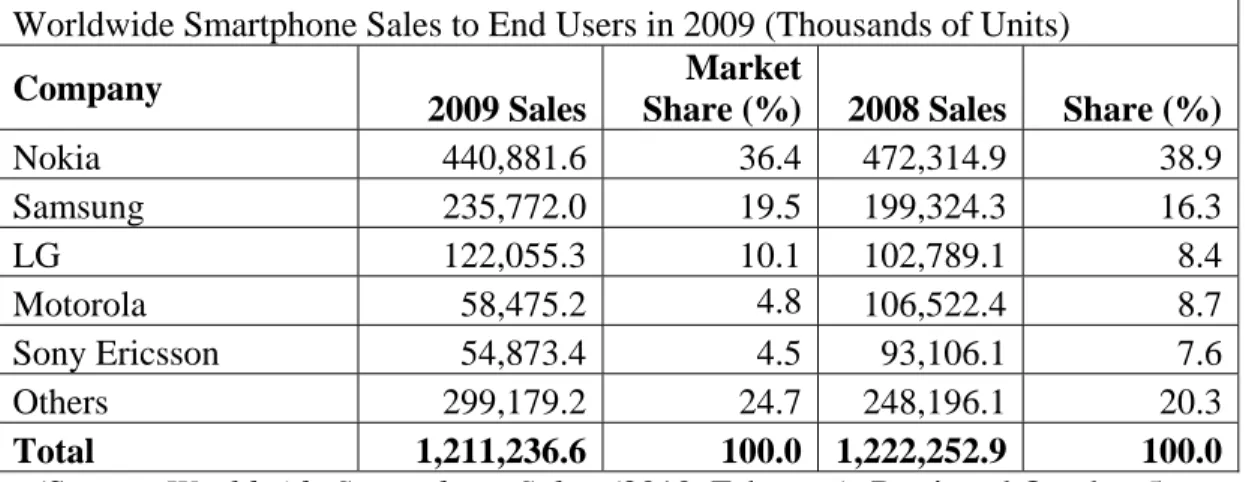
least 18-20% by 2011 according to iSuppli.Following table shows sales of smartphones during year 2008 and 2009.
Table 1: Worldwide Smartphone Sales
Worldwide Smartphone Sales to End Users in 2009 (Thousands of Units) Company
2009 Sales
Market
Share (%) 2008 Sales Share (%)
Nokia 440,881.6 36.4 472,314.9 38.9 Samsung 235,772.0 19.5 199,324.3 16.3 LG 122,055.3 10.1 102,789.1 8.4 Motorola 58,475.2 4.8 106,522.4 8.7 Sony Ericsson 54,873.4 4.5 93,106.1 7.6 Others 299,179.2 24.7 248,196.1 20.3 Total 1,211,236.6 100.0 1,222,252.9 100.0
(Source: Worldwide Smartphone Sales. (2010, February). Retrieved October 5, 2009, from Gartner web site: http://www.gartner.com/it/page.jsp?id=1306513.) 2.5.2 Overview of Different Smartphone Operating Systems
Before moving to Android and iPhone, it is necessary to understand existing smartphone operating systems in the market. Here is the list of mobile operating systems: (1) Symbian OS (2) WebOS (3) RIM OS for Blackberry (4) iPhone OS (5) Windows Mobile (6) Android (7) Others. The table below shows these operating systems market share and their respective deployments during year 2008 and 2009.
Table 2: Worldwide Smartphone Sales to End Users by Operating System in 2009 (Thousands of Units) Company 2009 Units 2009 Market Share (%) 2008 Units 2008 Market Share (%) Symbian 80,878.6 46.9 72,933.5 52.4 Research In Motion 34,346,6 19.9 23,149.0 16.6 Windows Mobile 15,027.6 8.7 16,498.1 11.8 iPhone OS 24,889.8 14.4 11,417.5 8.2 Android 6,798.4 3.9 640.5 0.5 Linux 8,126.5 4.7 10,622.4 7.6 WebOS 1,193.2 0.7 NA NA Other OSs 1,112.4 0.6 4,026.9 2.9 Total 172,373.1 100.0 139,287.9 100.0 (Source: Worldwide Smartphone Sales with Operating System Market Share.
(2010, February). Retrieved April 15, 2010, from Gartner web site: http://www.gartner.com/it/page.jsp?id=1306513.)
An operating system is the core software which manages hardware and software resources in any smartphone. Complete platforms have an operating system, middleware and applications while the others only include lower levels and need other platforms help to provide a complete structure. Below is a brief introduction of all operating systems.
1. Symbian OS:
Symbian OS is the dominant platform in the market, available in around more than 120 different models of phones. This platform covers only two lower levels software stacks - kernel and middleware and application platforms like UIQ (User Interface Quartz), MOAP, and Series 60 provide the upper layers for
2. WebOS:
WebOS runs on Linux kernel with the proprietary components developed by Palm. The Palm Pre is a first device with WebOS and both were released in June, 2009. There is also a WebOS software development kit available called Mojo. This OS has a built-in application catalog, and APIs for extending JavaScript in order to access hardware features of the device. (Kairer, 2009) 3. RIM OS for Blackberry:
RIM (Research in Motion) owns and provides the entire software stack including kernel, middleware and many applications. This platform offers different development tools for writing Java ME applications for Blackberry smartphone. RIM platform supports multiple third-party applications operation by using Blackberry API (Application Program Interface) classes.
4. iPhone OS:
Apple iPhone and iPod touch are developed by using iPhone OS based on Mac OS X (itself built on the Darwin project for Berkeley UNIX). The
programming languages used for iPhone OS are Objective-C and Xcode. All iPhone and iPod touch applications are offered only via the Apple app store. 5. Windows Mobile:
The Windows Mobile OS includes the entire software stack – an operating system, middleware, and applications. Windows Mobile 6 is the latest version of this platform. It is compatible with the Microsoft Office suite of programs.
6. Android:
Android is a Linux-based open source platform. It is backed by Google with the foundation of Open Handset Alliance includes 65 technical leader companies like HTC, Intel, Qualcomm, NVIDIA, T-Mobile, etc. The G1 the first Android-based phone was launched in 2008 by HTC. The Android Development Kit is available for Windows, Linux and Mac OS. Applications are developed in Android using a version of the Java programming language running on the Dalvik virtual machine.
7. Others:
Linux operating system: Linux is used as a basis for a number of
different mobile platforms developed by OSVs (ACCESS, Azingo, et al.), by community projects (e.g., OpenMoko) and through consortia like the LiMo Foundation. Many handset OEMs deploy Linux-based hardware, including Motorola, NEC, NTT DoCoMo, Panasonic, Samsung and Vodafone.
MeeGo: It is a new Linux-based mobile operating system combining the best of existing Moblin and Maemo platforms and targets both ARM and Intel Atom-based devices. Its UI merges APIs for GTK+, Qt and Clutter. It was unveiled by Nokia and Intel at the 2010 Mobile World Congress in Barcelona.
Bada: It is a mobile operating system which is still in development from Samsung Electronics. The handsets using this OS will be available in the second half of 2010.
LiMo: It is a software platform for mobile phones and other handheld devices developed by LiMo Foundation. (a group of cellular handset makers and network operators) It uses Linux as its operating system. 2.6Summary of Literature Review
This literature survey gave us a good background of many new topics which was helpful in implementing our project. The mobile phone ecosystem helped in
understanding how companies implement their own ecosystem strategy to gain market advantage, the categories of the mobile/wireless ecosystem, and their tradeoffs. Next, it gave a brief understanding about open source software; how the concept of open source platform came into existence, the various advantages of the implementing an open source platform, how it could help make a company successful by using various tools and cool applications developed using open source code, and limitations of using open source platforms. Additionally, this literature review helped in understanding platform
leadership concepts that could help any company to gain competitive advantage over its rivals. Reading through lots of articles helped learn about smartphone adoption and a brief overview of different smartphone operating systems. Also, we understood many concepts of the mobile industry which helped us implement our project and conduct interviews with “third-party developers” who build an application for Android and iPhone.
3.0APPLE iPhone AND APPLICATION STORE 3.1Introduction to Apple iPhone
One ongoing issue for mobile internet arises from expectations for a wired internet user experience. The desktop browsing experience, in particular, was built for large screens and keyboards, and is not suitable for mobile phones with small screens. To overcome this issue and to create a better end-user experience, Apple introduced iPhone with single OEM and operator rather than multiple vendors and operators in the mobile market by focusing on re-creating the mobile phone from already existing wired web mature ecosystem rather than recreating new Internet ecosystem. The iPhone 3G was launched on July 11, 2008 and came pre-loaded with iPhone OS 2.0 with App store support. It gained rapid success in the United States and Europe. Apple has already developed market position with iPod music player and iPhone is an integrated device of existing value systems – iTune music and video service. Apple further extended its iPhone strategy by providing updated models and operating system software which brought a better web browsing, application development platform, improved phone hardware, and improved delivery channel for third-party software and services (Joel West & Michael Mace, 2009).
The Apple iPhone operating system follows a complete closed system by
including operating system, hardware, built-applications, and online services. It is based on a variant of the same Darwin operating system core that is found in Mac OS X. It is therefore a Unix-like operating system by nature. iPhone OS has four layers: the Core OS layer, the Core Services layer, the Media layer, and the Cocoa Touch layer. This
compatible with this OS are also made by Apple. To be more specific, iPhone OS can not be used by any other handset manufacturer company and is not compatible with other available smartphones.
Being a closed system, Apple has big advantages with its smartphones. One is that Apple’s engineers know exactly what the hardware is being used to run their OS and how they can make OS most efficient on that hardware. In addition, this operating system and related software are developed by only one company which helps fulfill company’s goals for its own products. The developers who develop codes for closed system
operating system do not have to worry about meeting the needs of various companies. However, even though iPhone got a rapid success; there are some limitations in using iPhone for example; it works only with limited devices with limited input; it has a built-in memory but no external memory slots, so one can not add additional memory.
3.2Apple iPhone Application Store
On July 10, 2008 via an update to iTunes, Apple released an online market place for applications, called “App Store.” It is a service for the iPhone, iPod touch, and now the iPad. By using this app store, iPhone users can download any apps they want through iTunes or directly from their phones to take advantage of all available iPhone features. As of May 4, 2010, iPhone App Store has more than 195,000 third-party applications with over 4 billion total downloads. The Application Store is basically a centralized collection of all different applications. Currently, it has around 20 different categories which help users select and download the exact application they are looking for. The
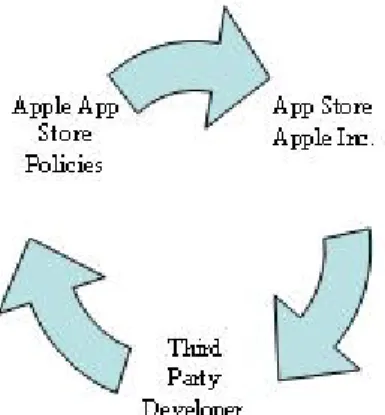
application. The figure below shows a third-party development model for any online application marketplace.
Figure 2: App Store (Third Party Development Model)
Once the developer decides to build an application for the iPhone, he/she must consider and follow something called the iPhone Developers Program. This program has 3 main contents namely: (1) Develop, (2) Test, and (3) Distribute (“iPhone Developer Program,” n.d.)
1. Develop: This includes all the development tools and resources needed for building an application using the iPhone’s SDK. (Software Development Kit) Basically, the development tools include: Xcode, iPhone Simulator, Instruments, and Interface Builder. The development resources provide developers an access to the Apple developer forums, getting started videos & documents, iPhone
reference library, and coding resources.
2. Test: This allows developers to test their applications to see how they will
perform in the real environment. This program also includes two technical support incidents: (I) Apple engineers provide the developers with code-level assistance and helpful guidance which would help the developers (II) Directions for the
issues that developers are facing. This includes test in real-time; test over-the-air; and technical Support.
3. Distribute: Apple has two distribution channels: App Store Distribution and Ad Hoc Distribution. These are the only way users can get access to the applications. Users can download their applications using an iPad, iPhone, or iPod touch via the iTunes store. With App Store Distribution, any app developed and published on the app store can reach millions of customers. While with the Ad Hoc
Distribution, the application can install on up to 100 devices without going through the App Store. Developers are forced to use ‘Ad Hoc’ distribution so that apps can be tested prior to submission to the iTunes App store (Ben, 2008). The Apple method requires pre-registration of beta testers. In order to register them, developers need to know Unique Device Identifier (UDID) for their devices and then create a mobile provisioning file - a security certificate that authorizes that unique device to run the app being tested. (Ben, 2008)
Apple uses the 70/30 model for splitting the revenue generated from the App Store, between the developer and itself. The App Store has helped 3rd party developers to solely focus on developing creative and innovative applications and not worry about its distribution process. The marketing of the applications is handled by the App Store which serves as the distribution channel for these apps. Thus, Apple has created a huge demand for the platform as well as the App Store (Bill, 2007).
4.0GOOGLE ANDROD AND ANDROID MARKET 4.1Google Android
To create a mobile phone OS, Google acquired Android Inc. in July, 2005 and appointed Andy Rubin as their Director of the mobile platforms group. After that Google entered into the mobile market not as a handset manufacturer, but by launching a new OS called as “Android” on November 5, 2007.
The main reason why Goggle entered this market is to sell more ads in the emerging mobile form factor and also with the dream that its OS could run any device manufactured by different handset vendors like Samsung, LG, Motorola, HTC, etc. The customers can buy Android powered phones from any carrier operators like T-mobile, Verizon Wireless, Sprint, etc.
Goggle introduced Android as an OS which runs the powerful applications and gives the users a choice to select their applications and their carriers. The Android platform is made by keeping in mind various sets of users who can use the available capacity within Android at different levels; like basic users who demand only calling option, going one step higher, users who use many of the available applications up to a certain extent, and going even higher, the ones who use all of the available applications and also want to develop or suggest their own multipurpose applications or tools which can be useful not only to them, but also to their peers. The Android source code is available to all the software developers for future upgrades and addition to the existing platform or code.
Goggle has a vision that Android based cell phone will have all the functions available in the latest PC. In order to make this effort possible, Goggle launched the Open
Handset Alliance. Today, the open handset alliance is a group of around 65 technological companies coming together to promote open source software, which is powered by Google. These 65 companies are split into different groups: 1) Handset Manufacturers like HTC, Motorola, and Samsung etc., 2) Software Developers like eBay, Goggle, livewire etc., 3) Mobile Operators like T-mobile, Sprint, Do Co Mo, etc., and 4) Chip manufacturers like Broadcom, QUALCOMM, Marvell, Intel, etc. These companies have come together with common goal which is to make the platform viable for mobile and also to publish the code as an open source.
The Android platform consists of several layers which provide a complete software stack. The extreme bottom layer is the Linux Kernel, then the system libraries, Dalvik which is a virtual machine, the application framework, and all the applications on top of that. The Android platform use a lot of open source libraries like the Webkit, and harmony, Open SSL, Apache http components, etc. In the libraries they have 2D and 3D graphics for the mobile systems. The most powerful part in the platform is the Dalvik virtual machine, which interprets and executes portable Java-style byte code which is optimized to operate on the mobile platform. As most of the applications these days are related to the web, the first two layers are written in Java. With all these functionalities, Android is complemented by the application layer which includes a web browser, touch screen, GPS, instant messaging, camera for the phone, etc. One of the best features of this platform is that they have put in hooks, which the developers can extend in ways which nobody has even thought of yet. Thus, it can be said that it is a complete feature or a
4.2Android Market
The Android Market, an online software store, is developed by Google for Android devices. It was announced on August 28, 2008 and was made available to users on October 22, 2008. Most of the Android devices come with preinstalled “Market” application which allows users to browse, buy, download, and rate different available applications and other content for mobile phones equipped with the open-source operating system.
Unlike with the iPhone App Store, there is no requirement that Android apps should be acquired from Android Market. Android apps may be obtained from any source including a developer's own website. Also, Android developers can create their own application market. Google does not have a strict requirement for the application to show up on the Android Market compared to the “Ad Hoc” process used by Apple. This
process is much more open then Apple’s App Store. Lastly, the Android Market follows a 70/30 revenue-sharing model for applications developed by developers. The developers of priced applications receive 70% of the application price and remaining 30% distributes between carriers (if authorized to receive a fee for applications purchased through their network) and payment processors. Developers get the earned revenue from the Android Market via Google Checkout merchant accounts. Moreover, priced application support for Android Market was made available in mid-February 2009 for US users and UK users got a facility to purchase priced application on 13 March 2009(“Android Market,” n.d.).
After launching, there were about 2,300 applications available in the Android Market in March 2009. As of May 04, 2010, Android apps hit around 49,000 applications which were around 12,500 in August 2009 and 20,000 in December 2009. The growth
rate of new applications in the Android Market have shown in the below figure. Recent months in 2010 have shown a growth rate of approximately 8,000 additional applications per month.
Figure 3: Amount of new applications by month
(Source: Application Statistics. (n.d.). Retrieved April 30, 2010, from AndroLib web site: http://www.androlib.com/appstats.aspx.)
5.0APPLICATION DATABASE 5.1Introduction to Application Data
As a part of the research, this project compiled an applications database, i.e. a collection of applications from the iPhone and Android online applications marketplace using semi-automated and manual data collection techniques.
The iPhone applications data has been collected from the iTunes App Store and iPhoneapplicationlist.com. This data has been collected using WinHTTrack Website Copier, free and easy-to-use offline browser utility software, which allows downloading a World Wide Web site from the internet into the local directory of a computer. After downloading web pages using this software, these files have been imported into Excel with the help of Software Developer.
Android apps, paid or free, from Android Market have been collected using an Android phone, Google online marketplace or from the website androlib.com. The reason for using two websites (iPhoneapplicationlist.com and androlib.com) is that the
applications showcased here are identical with the iPhone App store and Android Market, respectively. Also, the information on this website is up-to-date.
The application database contains the application name, ranking, # of downloads, the developer name, etc. as shown in the table below. (Also see Appendix VII)
Table 3: Application Database
It includes the name of a developer along with his ranking because “most users
Application
Name Ranking Released Date Free/Paid cost # of Downloads Ratings Version Developer Name Other
apps developed
iPhone’s, and the app store rankings are based on the total number of downloads over a short period of time. (~24hrs)” (Mario, 2010)
5.2Importance of Application Database
This database would help understand the number of new applications developed on both the platforms and also compare the growth of number of applications on
individual platforms in the near future. Apart from knowing application growth, it will also help understand which developers are common or different for both the platforms. The information on application developers also helped get more responses for a survey. From the available 20 different categories and more than hundreds of applications in each category on iPhone and Android platforms, the application information under “Travel” category has been gathered because of the following reasons:
• Some applications have an identical name on the both platforms.
• It has an identical concept along with some of the same name applications on the both platforms.
• It has seen upward trends with the introduction of big giants like Google with Google-Maps app.
5.3iPhone and Android Applications Volume per Category 5.3.1 iPhone Application Volume
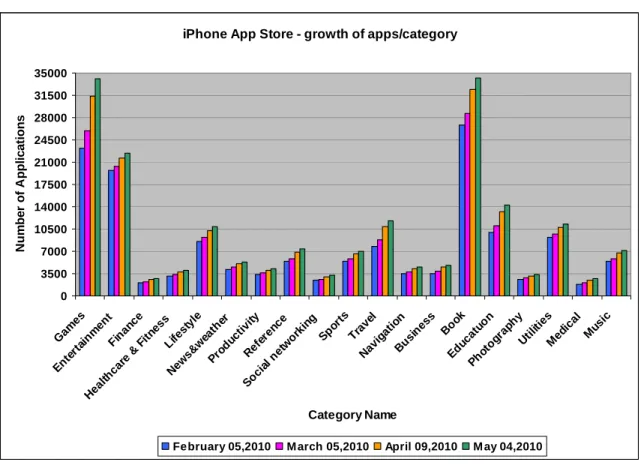
The figure below shows the number of application in each category by month. In January of 2010 there were around 23,000 applications in the Games category and reached around 34,000 by April of 2010, i.e., over 11,000 new
applications by May 2010. Considering the current growth in the new
applications, we can say that there would be an increase of 8-10% growth in the App Store.
iPhone App Store - growth of apps/category
0 3500 7000 10500 14000 17500 21000 24500 28000 31500 35000 Gam es Ente rtai nm ent Fina nce Healt hcar e & Fitn ess Lifest yle New s&w eath er Pro duc tivity Refe renc e Soci al n etw orki ng Spor ts Trave l Navi gatio n Busi nes s Book Educatu on Photog raphy Utili ties Medi cal Mus ic Category Name Nu m b e r o f Ap p li c a ti o n s
February 05,2010 M arch 05,2010 April 09,2010 M ay 04,2010 Figure 4: iPhone App Store – Number of Applications/category/month 5.3.2 Android Application Volume
The figure below shows the number of application in each category by month. In January of 2010 there were around 3,800 applications in the Games category and reached around 6,300 by April of 2010, i.e., over 2,600 new applications were added in this category within a period of 4 months. The Entertainment category which was earlier at around 4,400 in January 2010, reached to around 9,500 plus applications by April 2010. Considering the current growth in the new applications, we can say that there would be an increase of
18-20% growth in the App Store. We can see that some of the categories like comics, entertainment, travel, tools, themes, etc. are also increasing at an exponential rate.
Android Market - growth of apps/category
0 500 1000 1500 2000 2500 3000 3500 4000 4500 5000 5500 6000 6500 7000 7500 8000 8500 9000 9500 Game s com ics com muni catio ns Ente rtai nm ent Financ e Heal th Lifes tyle News &w eat her Pro ducti vity Refe renc e sho ppi ng Socia l Spor ts Theme s ToolsTrav el Dem o Soft war e Li brar ies Mul time dia Category Name N u m b e r o f A p p lic a tio n s
February 05,2010 March 05,2010 April 09,2010 May 04,2010
Figure 5: Android Market – Number of Applications/category/month 5.3.3 Comparision of iPhone and Android Application Volume
The figure below shows the common categories by month on both iPhone and Android. The total 12 categories are common on both the application stores. As shown below under game category, there were around 23,000 applications on iPhone App Store compared to 4,000 applications on Android Market in January 2010.
iPhone & Android Applications growth under common category 0 2000 4000 6000 8000 10000 12000 14000 16000 18000 20000 22000 24000 26000 28000 30000 32000 34000 Gam es Enter tain men t Fina nce Heal th Lifes tyle New s&w eath er Pro duc tivity Refe renc e Socia l ne two rkin g Spor ts Trav el
Category Name ( Jan'10- April'10)
N u m b e r of A ppl ic a ti ons iPhone Android Figure 6: Number of Applications/common category/month on iPhone App Store & Android Market
5.4Observations from Collected Application Data
From the application data collected for Jan, Feb, March, and April of 2010, we saw an increase of approximately 15-20% growth in the Android Market. On the other hand, for iPhone we saw around 8-10% growth in the App Store.
6.0MOBILE APPLICATION DEVELOPERS INTERVIEW 6.1Attending Mobile Industry Conferences
Basic information on the different mobile platforms and their application developers are collected by attending different events like the Mobile Monday Silicon Valley (MoMo), Meetup group events organized by sfandroid group and IEEE Computer Society. Mobile Monday (MoMo) is a Silicon Valley based group and their mission is “to help tech professionals based in the San Francisco Bay Area learn more about mobile industry through monthly presentations and networking events.” (MobileMonday, 2010) The San Francisco Android User group is an interactive group about Android mobile platform focusing on latest developments in this space. Their discussion is focused on the trends in technology, business, and job outlook. (“San Francisco Android User Group, 2009)
These events helped in gaining an insight and an understanding of how the new mobile applications are more customer-centric, and how the developers find the ways to promote their applications in the global market. Moreover, a conversation with different industry folks and developers gave an insight on mobile application marketplace and why the developers build applications for more platforms (cross-functional platforms) to gain market leadership.
One of the attended events was about “Looking at different trends in check-in apps, their social impacts and monetization opportunities.” t was focused on how cool applications like cause world are; by not just creating new check-ins for customers but
Inc. at the conference spoke about how these big brands are turning their marketing dollars into charitable donations. Reno Marioni, Nokia Strategic Internet
Partnerships promoted the apps store concept and also made an announcement that Nokia was open for partnerships for such cools applications. The other attended event,
organized by the Santa Clara Valley Chapter of the IEEE Computer Society at Microsoft Research, was about an overview on Android business ecosystem by Mike Demler and Android technical lecture by Marko Gargenta. The summary of the attended conferences is also shown in the below table.
Table 4: List of Attended Conferences
Date Sponsor Topic
03/08/2010 Mobile Monday Check-in Apps/Social Location - Social Impacts and Monetization Opportunities 04/13/2010 IEEE Computer
Society of Silicon Valley
Android: A 9,000-ft Overview
Additionally, we got an opportunity to showcase this research paper towards the end of the first event with a 2 minute long speech. Thus, by attending these events we met and shared our reseach idea with professionals working in mobile industry. 6.2Summary of One-on-One or Phone Interview
For this research, 9 interviews were conducted with mobile application
developers, product managers, and business developers to know their views on various mobile platforms and understand the ecosystems of the iPhone as well as the Android. These interviews have served as a preliminary set of information for the research. Most of the interviews were either telephonic or one-on-one discussions. Sections below
summarize the developers’ opinions on various aspects of application development for iPhone/Android platforms.
6.2.1 Factors for selecting iPhone/Android Platform
When askedabout the factors that facilitate to work on iPhone/Android platforms, most of iPhone developers answered thatthe iPhone is much more mature market and platform compared to other mobile platforms for application development. Other facilitating factor for iPhone is its complete available SDK package including user interface, architecture framework, APIs, development tool, libraries, etc. Also, the iPhone development community is very large to bring the products to market easily. The number of customers, applications and number of revisions facilitate the developers to build an application on this platform much easily.
Discussing about Android development, most of the developers said that Android is growing at a faster rate compared to iPhone and they would like to switch to Android in near future. As per their views, Android being open source also offers a complete SDK package with architectures, APIs, libraries etc., but its development tools are not well advanced and are required to add more enhanced features in near future to increase more application development.
6.2.2 Negative Factors on iPhone/Android Platform
When asked about how these platforms do not meet one’s needs as a developer, most of the interviewees said that Apple has lack of transparency with
notifying the developers. Another negative factor is the application approval process of the iPhone App Store. Other dissatisfying issue is that Apple does not give any clear indication of application acceptance or rejection. Apart from this, according to the developers, there are no particular software related issues for developing an application other than an approval process.
For Android, one of the main shortfalls is development tools for building an application. Android Market is still in the development phase so there are no other negative factors as of now.
6.2.3 Developer and Application Approval Process on iPhone/Android Platform
Asking few developers about the iPhone App Store approval process, they said that the first step is to enroll in the Apple Developer Programs and register as a developer, then select the programs based on the platform an individual wishes to develop on, and complete the purchase by receiving an e-mail from the Apple developers support team which has all the information about how to access the program. One can enroll as an individual or as a company. As an individual developer, he/she is a sole developer and his/her name appears as the seller. On the other hand, if one enrolls as a company, he/she can add additional developers to form a team and the company’s name appears as the seller. On the other side, there is no such type of approval process for those who want to develop an application on the Android platform.
In response to the question asked about the App Store’s application approval process, most of the interviewees said that though the first step is to
submit an app to Apple store by following their policies, Apple sometimes does not share the changes of its rules/policies, if any, with the developers and the application approval process has no clear rules. Another issue is the lack of proper guidelines given about procedures to be followed in order to know applications acceptance and rejection on the application marketplace. They also mentioned that earlier the whole approval process was used to take 3-4 weeks but from last few months it took only 1-2 weeks. Though Apple has very strict rules and policies for an application to get approved on the App Store, at the end of the day these rules help the developers build better applications and gain huge profits via the sales of these applications and benefit the end user by making the user experience better.
While asking the same question about Android, most of the interviewees answered that Google has not yet created any typical approval process or policies to get an application on the online marketplace. To sell an Android application, there are multiple markets available other than Android Market and developers can also create an application market with a whole bunch of their own apps. For this, they do not require permission from Google or anyone. Thus, the application approval process for the Android is not as strict as compared to the iPhone App Store “Ad Hoc Distribution.” It currently helps developers develop and show up their apps on the Android Market within a day or two.
companies/developers said that they first understand the business model and their target customers by conducting market analysis. After that they follow standard norms to decide the product/application price i.e., they build products/applications which have bigger audience and then decide the price by comparing them with competing applications. Many interviewees mentioned an exciting strategy for arriving at their product price. It is like this: first, introduce an application as a free application from the app store, then monitor the number of downloads for the same application. 1) if the numbers are staggeringly high, introduce a premium version of that application for a few dollars. 2) if the numbers are significantly low, update or modify the look-and-feel of the application to gain more
downloads. According to them, the free applications also contain explicit advertising information of the paid premium version of the application that eventually bring in more sales/revenue. There are various business models for advertising the applications like:
I. Freemium: It offers minimum charges for the premium version of application; most of interviewees were using this business model II. Ad-supported (like Google Radio): It advertises the applications
developed by the developers who want to earn higher revenue for their developed apps using ads; very few of the interviewees were using this business model
III. Paid Applications: It charges money for downloading the apps; many interviewees were using this business model.
Talking about the Android, they mentioned that there is no such price deciding method on Android Market. Most of them decide the product price after market analysis of a similar kind of product on same or other platforms.
6.2.5 Future Development
According to most of the application developers, considering the current market, iPhone is much more mature compared to other platforms but Android would definitely be a lot more mature market in the future with lots of more features. They also mentioned that after the launch of windows mobile 7, the whole mobile application market, competition would change between these 3 platforms.
In summary, the iPhone developers would like to continue working on the iPhone
platform, but are also willing to shift on Android if it gains a larger market share with the implementation of new development tools. The most important factors taken into account when selecting a platform for developing a new application are money, market share, market size, number of customers, development tools, and ease of publishing.
7.0SURVEY DATA AND ANALYSIS 7.1Introduction
Preliminary interview helped gain some understanding regarding the iPhone/Android app stores; the factors most important for development on these platforms are approval process, channel distribution process, etc. After completing the preliminary interviews, the survey was developed based on the information from the application data and interviews. It was required to bring a clear understanding about the 3rd party application development. The survey was posted on SurveyMonkey, an online tool to create and publish custom survey, which was ideal for this research project.
The conferences we attended and contacts with developers during the preliminary interview helped reach a bigger and targeted audience. Our advisors also gave us the right directions in finding appropriate audience. The survey was shared amongst friends, colleague and posted on groups such as online Yahoo-groups for Mobile Monday
(MoMo), Google-groups for Android, San Francisco Developers Meetup group, various LinkedIn developers’ groups. This survey was filled out by different professionals like developers, product manager, engineers, etc., who work on iPhone/Android platform and has a deep understanding about the trends and future of these platforms. At the end, we got 63 responses which is a significant sample size for this project. The results from the survey are explained below.
7.2Summary of the Average Responses (Descriptive Statistics)
A summary of the average of the questions which give general information about the responders has shown below.
Question 1:
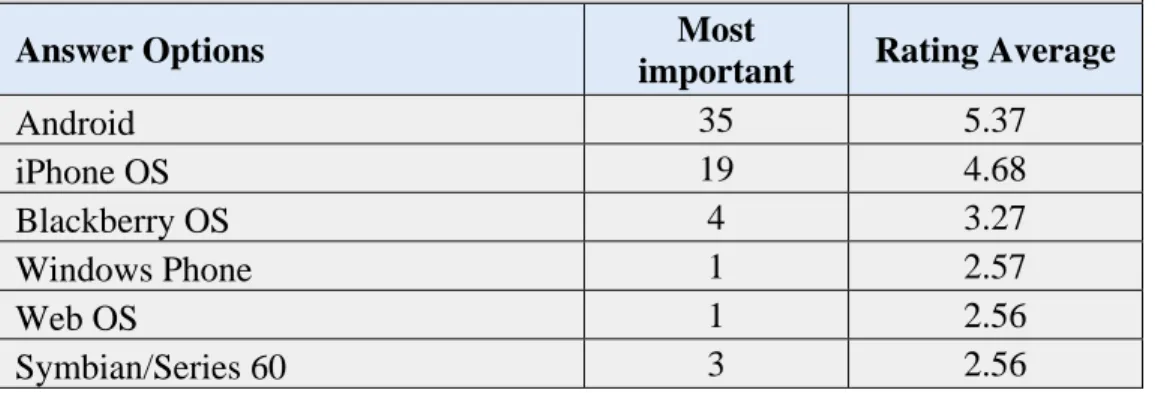
From the below table, it shows that the Android is the most important mobile platform than the iPhone for most of the respondents. For respondents working on iPhone, it is the most important platform, and Android is the next important platform for them and vice versa.
Table 5: Most Important Mobile Platforms
Which mobile platforms are most important to your company?(Rank them: Being 1 - Least important and Being 6 - Most important)
Answer Options Most
important Rating Average
Android 35 5.37 iPhone OS 19 4.68 Blackberry OS 4 3.27 Windows Phone 1 2.57 Web OS 1 2.56 Symbian/Series 60 3 2.56
Question 2:
From the below table and graph, we can say that most of the respondents are working on Android.
Table 6: Mobile Platforms
What mobile platforms do you work on?
Answer Options Response Percent Response Count Android 90.5% 57 iPhone OS 44.4% 28 Blackberry OS 23.8% 15 Symbian / Series 60 14.3% 9 Windows Phone 11.1% 7 Web OS 7.9% 5 Question 3:
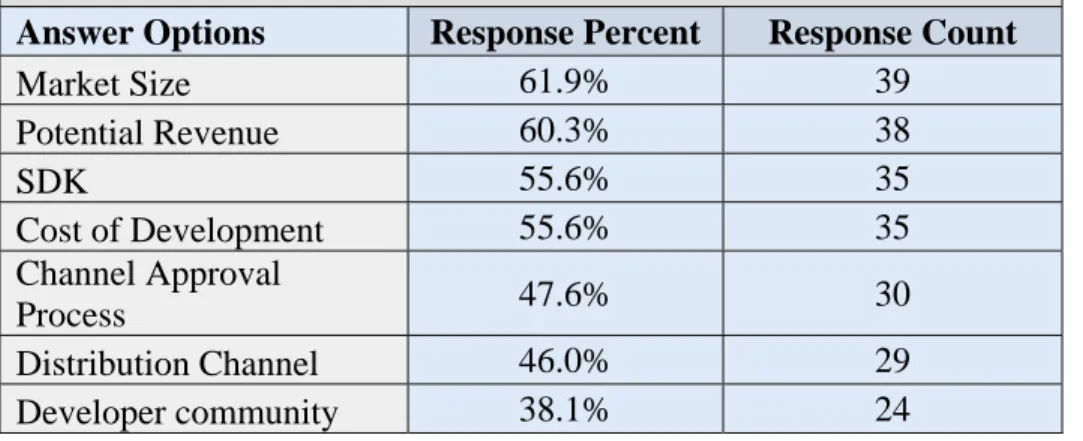
The below table says as per most of the respondents, market size and potential revenue are the most important factors for developing an application. In addition, other respondents also mentioned that development time, cost vs. return and security model are the considerable factors for developing an application, In particular, for Android, being an open source provides stable and flexible architecture and design for development. Also, Google’s flexibility for approval process for Android Developers to try out an app in their own phones before pushing in the Android Market attracts them to choose Android over iPhone.
Table 7: Important Factors for Application Development For developing an application, which factors do you consider most?
Answer Options Response Percent Response Count
Market Size 61.9% 39 Potential Revenue 60.3% 38 SDK 55.6% 35 Cost of Development 55.6% 35 Channel Approval Process 47.6% 30 Distribution Channel 46.0% 29 Developer community 38.1% 24 Question 4:
Here, we can conclude that according to most of the respondents software issues are the biggest problem for mobile development. Some of the respondents also mentioned that as Android is available on different devices with different versions creates
interoperability, platform fragmentation, and replication user issues and these issues increase the development time.
Table 8: Biggest Problem in Developing Application
Which is/are the biggest problems you have experienced for mobile development?
Answer Options Response Percent Response Count
Software issues 61.4% 35
Hardware issues 31.6% 18
Support from Platform Developers 29.8% 17
Question 5:
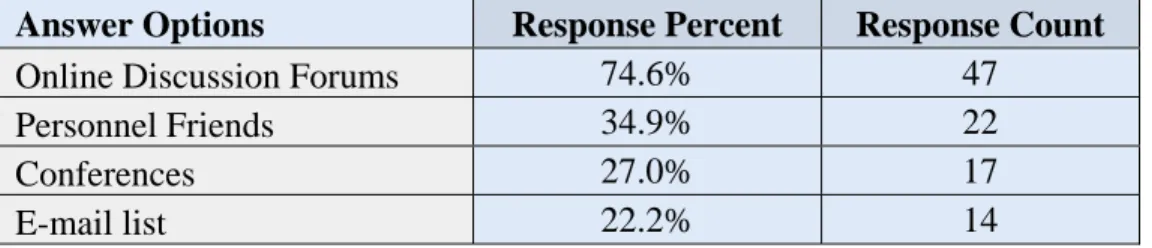
From the table, we can say that online discussion forums are the most useful resources as seen from the table and graph below. Also other respondents feel that manual is one of the useful resources.
Table 9: Useful Resources for Making Development Decisions
For making development decisions, what are the most useful resources from the following?
Answer Options Response Percent Response Count
Online Discussion Forums 74.6% 47
Personnel Friends 34.9% 22
Conferences 27.0% 17
E-mail list 22.2% 14
Question 6:
On asking about level of expertise in Android, we can conclude that here most of the respondents fall under the scale of 3 & 4.
Table 10: Level of Knowledge about Android
How knowledgeable are you about Android on the scale of 1 to 5?
Answer Options Response Percent Response Count
1-Novice 4.8% 3
2 12.7% 8
3 33.3% 21
4 31.7% 20
Question 7:
Here, from the table we can say that APIs are the most important feature to respondents developing on any platform. Other respondents also consider open source, open platform and support from platform vendors as important factors for Android. Table 11: Android Features
Which are the most important Android features to you?
Answer Options Response
Percent Response Count
APIs 77.8% 49
Development Tools 58.7% 37
Platform Architecture 55.6% 35
Developer Community 44.4% 28
Access to Hardware Features 42.9% 27
Too complicated to learn/use 6.3% 4
Poor Enterprise Integration 3.2% 2
Question 8:
The table below shows that application development is the prime focus for the respondents. Few respondents also mentioned that their company’s focus is more on the devices running Android.
Table 12: Type of the Company What is the focus of your company?
Answer Options Response Percent Response Count
Application Development 71.4% 45
Software 22.2% 14
Hardware 6.3% 4