IFA-Coding-System
Transport Logistics Specification
Version: 1.00
Date of issue: December 2012
Automatic identification of transport units
in the pharmaceutical supply chain
Table of Contents
1
Foreword and Introduction
3
2 Scope
3
3
Shipping Label
4
3.1 General
4
3.2 Basic Shipping Label
4
3.3 Extended Shipping Label
4
4
Data content and requirements
5
4.1 General
5
4.2 License Plate
5
4.3 Data Identifier License Plate
6
4.4 Data Identifier "Ship to"
6
4.5 Additional data elements
6
5
Marking with Code und Clear text
7
5.1 Symbology
7
5.2 Further Definitions
7
5.3 Code Examples
7
All contents copyright © securPharm e.V. | English V 1.00 Page 3
1
Foreword and Introduction
As part of the "securPharm" project framework, to develop and pilot a system to implement the requirements of the European Directive 2011/62/EU to protect against counterfeiting of drugs for the German associations of pharmaceutical, manufacturers, whole-salers and pharmacists (Stakeholders), the need arose to transform the German reimbursement number (PZN), as defined in social legislation, into a globally unique product number.
In this context, the "Informationsstelle für Arznei- spezialitäten GmbH (IFA)" [http://www.ifaffm.de] (German Information Center for Medicinal Products) which manages the allocation of PZN, has acquired the status of an Issuing Agency and has created a coding system (IFA Coding System).
While securPharm system focused on drug packaging to meet the specific legislative requirements, IFA Coding System extended the securPharm system firstly to cover all common pharmacy products (eg food supplements). Secondly, it covers the identification of: - Retail packages and
- transport units.
This specification has been prepared on behalf of the associations represented by IFA:
• ABDA - Bundesvereinigung Deutscher Apothekerverbände (German Federal Association of Pharmacists)
• Bundesverband der Arzneimittel-Hersteller e.V. (BAH) (German Medicines Manufacturers` Association)
• Bundesverband der Pharmazeutischen Industrie e.V. (BPI) (German Pharmaceutical Industry Association)
• Bundesverband des Pharmazeutischen Großhandels – PHAGRO e.V. (Association of Pharmaceutical Wholesalers)
• Pro Generika e.V. (Association of Generic Medical Manufacturers)
• Verband Forschender Arzneimittelhersteller e.V. (vfa) (Association of Research-Based Pharmaceutical Companies)
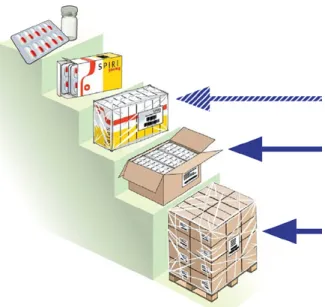
Figure 1 illustrates a typical packing cascade, starting with the single component (for example, a blister pack or a bottle) through to the transport pallet. For both stages of retail packaging and transport units, IFA has corresponding coding specifications, referred to as IFA Coding System.
2
Scope
This document is the specification for the identification of transport units for logistical purposes, ie. for ship-ping containers, shipship-ping pallets and possibly bundle packaging (see arrows in Figure 1)
The retail packaging specification is available under www.ifa-coding-system.org or directly at:
http://www.ifa-coding-system.org/downloads/de/PPN_ Code_Handelspackung_IFA_Spec_EN.pdf.
This document specifies the elements of a shipping label according to the European Standard EN 1573 (Bar coding - Multi-industry transport label) and the International Standard ISO 15394 (packaging bar code and two-dimensional symbols for shipping, transport and receiving labels) providing the sender, transporter and receiver unam- biguous information and at the same time allowing an automated process.
The details of the marking and identification of the shipping units are based on the rules of transportation companies. This information is essential to allow tracking of transport units within the logistic chain.
This specification does not address the relative assignment of the packaging units themselves (parent-child relation-ship), which is required in aggregation. For this application refer to the standard "ANSI MH10.8.2; Section VI".
3
Shipping Label
3.1 General
As a shipping label either the Basic Shipping Label or the Extended Shipping Label should be used. The Basic Shipping Label includes necessary logistics information for the sender, transporter and receiver. The Extended Shipping Label contains optional additional information.
3.2 Basic Shipping Label
The Basic Shipping label contains a unique identi- fication of the transport unit. This identification is called "License Plate" (see Section 4.2). The structure is based upon the ISO registration procedures and the relevant underlying international standards (see Appendix B 1, 2 and 3).
If all other data e.g. the return address and the recipient‘s address are present in the databases and available in the EDI data exchange, then the license plate is the only mandatory prescribed barcode.
If the License Plate provides no link to the databases of the sender and the receiver, then these relationships must be made through additional data in the shipping label (see Extended Shipping Label section 3.3).
3.3 Extended Shipping Label
If the data in the Basic Shipping Label is insufficient then the Extended Shipping Label should be used. In addition to the License Plate (refer to Section 4.2), the Basic Shipping Label can carry the following addi-tional encoded data:
• Transporter notes (e.g. Transport regulations) • Shipper‘s address
• Receiver‘s adress
• Information relating to content (e.g. product
number, batch details, size or weight details) Information on data content and structures can be found in Section 4 and the symbology in Section 5.1.
All contents copyright © securPharm e.V. | English V 1.00 Page 5
4
Data content and requirements
4.1 General
In order that the data can be interpreted unambiguously in data carriers they are to marked with Data Identifier (DI). The necessary DI are defined in the international data structure standard ISO / IEC 15418 (relating to ANSI MH10.8.2; Data Identifier and Application Identifier Standard).
In this chapter, the applicable Data Identifier (DI) is described and the respective associated data contents.
4.2 License Plate
4.2.1 General Rules
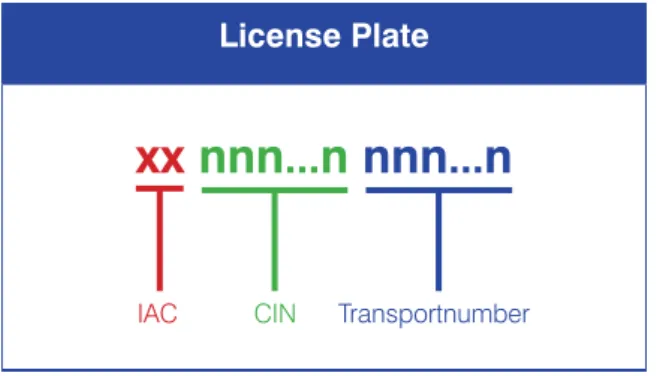
To provide globally unique identification, the License Plate is generated based on ISO / IEC 15459-1. This is a unique identification number for each transport unit. The following character blocks are arranged without separation (structure see Figure 2).
License Plate
xx
nnn
...
n
nnn...n
IAC CIN Transportnumber
Figure 2: Basic structure of License Plate
1. In the first position is the Issuing Agency Code (IAC). This code is specific to the Issuing Agency (IA) as assigned by the Dutch Standards Institute (NEN) on behalf of ISO .
2. The second position is the identification (Company Identification Number - CIN) of the company creating the License Plate. If license plate creation is contracted out then the client's CIN should be used. The CIN is assigned by the IA.
3. The third position is the company‘s uniquely genera-ted shipment number.
4.2.2 Creation using the IAC of the IFA
The creation of a License Plate using the IAC of the IFA on the basis of the above rules is illustrated below:
License Plate
PP
12345
nnn...n
IAC CIN Transportnumber
Figure 3: Structure of a License Plate using the IAC of the IFA
1. The assigned Issuing Agency Code (IAC) "PP" of the IFA as Issuing Agency is used as the License Plate prefix. 2. This is followed by the IFA assigned account number (also termed "supplier number") in the form of five-digit Company_ID. This is part of the IFA Information Services (attribute "B00ADRNR"; Field Description: "Address number."), including related address and contact information. The IFA clients may request their supplier number at the following email address: [email protected].
3. In the third position, the number assigned by the company to the license plate. The company is respon-sible for ensuring the allocation of a unique number. The total length of the license plate must have no more than 20 characters. This means that the shipment number may have up to 13 alphanumeric characters.
License Plate using the IFA’s IAC, refer to Chapter 5.3 Example 1.
4.3 Data Identifier License Plate
Data Identifier: "J"
Data Identifier (DI) for the License Plate are according to the standard ANSI MH10.8.2 (reference from ISO / IEC 15418) assigned to the the Data Identifier of group "J". The ISO / IEC 15459-1 allows the use of the DI J and 1J to 6J.
In the standard application, the Data Identifier "J" should be used.
The License Plate is formed as per Section 4.2.2
Example:
DI
Data
J PP123456012345678901
When it is required to differenciate between various levels of packaging (carton, pallet, container), this may be achieved using the Data Identifier 1J to 6J.
4.4 Data Identifier "Ship to"
This Data Identifier designates the recipient‘s address according to a standard agreed upon between logistic partners.
Usually this is a combination of country code plus postal code plus additional address information.
The Data Identifier DI "2L" is used for this combination is specified in ANSI MH10.8.2.
Example:
DI
Data
2L DE06618+04000000
Alternative:
An alternative of the recipient address can be formed through the combination of the Issuing Agency Code (IAC) from the IFA and the Company_ID of the recipient. Data Identifier - DI "25L" used is per the standard ANSI MH10.8.2.
DI
Daa
25L PP12345
• "PP" is the IAC of IFA.
• "12345" stands for the IFA-assigned Company_ID (Customer/Supplier Number) IFA. The complete address details are available from the IFA Informa-tion Services.
IFA Clients can request their Company_ID by email to: [email protected].
4.5 Additional data elements
In the case of the Extended Shipping Label where more data elements are required, they are to be agreed upon between the logistics partners. Data Identifiers should be used as per ANSI MH10.8.2 and applied as appro-priate.
For hierarchical structured and EDI-compatible data content in 2D-code, the use of "PapierEDI" is recom-mended.
(Source: Specification Paper EDI: www.eurodatacouncil.org).
All contents copyright © securPharm e.V. | English V 1.00 Page 7
5
Marking with Code
und Clear text
5.1 Symbology
The License Plate can be coded in Code 128 or in Code 39. Code 128 in accordance with ISO/IEC 15417 is usually used.
In the Extended Shipping Label, information additional to the License Plate can be presented in 2D Codes. We recommend using the Data Matrix code according to ISO / IEC 16022 in the 06 Format as per ISO / IEC 15434.
5.2 Further Definitions
The code sizes result from the selected module size (bar width) and the data contained in the code. All sizes and shapes allowed within the specified standards may be used.
The specifications for code size, quiet zone (light zone), positioning, clear text information and label sizes can be found in ISO 15394. In addition, the requirements of the transport service must be observed.
5.3 Code Examples
Example 1
License Plate
with IFA IAC "PP" and Company IdentificationCode "21435" (equivalent to IFA Customer Number/Supplier Number) followed by the transport number "T987368X9"
Example 2
License Plate
according to DHL-Spezifikation (Source: Barcode-Spezifikation DHL Paket V 2.2_15. März 2012)
Example 3
ShipTo Code (above) and License Plate (below)
Symbology used in the examples: Code 128 according to ISO/IEC 15417.
5.4 Print Quality
Essential for code usability is, that it can be read reliably and that the content complies with the established rules. The practical readability depends on the scanner and the operating and ambient conditions. To ensure the overall readability of a code requires a minimum print quality, defined according to a standard metho-dology.
The current technical standards for the determination of print quality are the international standards ISO /IEC 15415 for 2D matrix codes and ISO / IEC 15416 for Bar-codes.
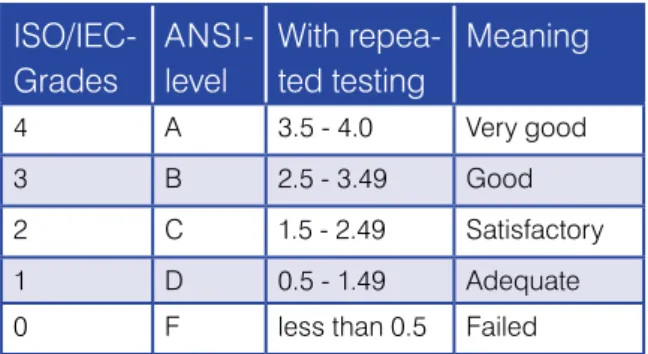
The classification of print quality is carried out using the table according to ISO/IEC 15415 and 15416.
ISO/IEC-Grades
ANSI-level
With
repea-ted testing
Meaning
4 A 3.5 - 4.0 Very good 3 B 2.5 - 3.49 Good 2 C 1.5 - 2.49 Satisfactory 1 D 0.5 - 1.49 Adequate0 F less than 0.5 Failed
Figure 4: Quality grades according to ISO/IEC 15415 and 15416
The print quality should meet the requirements of ISO 15394 and the needs of the transport services.
All contents copyright © securPharm e.V. | English V 1.00 Page 9
AppendixA
Glossar
As a matter of principle the terms and definitions of ISO / IEC 19762 apply and the specification http://www.ifa-coding-system.org/downloads/de/PPN_Code_Handelspackung_IFA_Spec_EN.pdf.
Appendix B
Bibliography
1 ISO 15394Packaging -- Bar code and two-dimensional symbols for shipping, transport and receiving labels 2 ISO/IEC 15459-1
Information technology -- Unique identifiers -- Part 1: Unique identifiers for transport units 3 ISO/IEC 15459-2
Information technology -- Unique identifiers -- Part 2: Registration procedures 4 EN 1573
Bar coding - Multi industry transport label) (Bar coding - Multi industry transport label 5 ISO/IEC 19762
Information technology -- Automatic identification and data capture (AIDC) techniques -- Harmonized vocabulary
6 ISO 15417
Information technology -- Automatic identification and data capture techniques -- Code 128 bar code symbology specification
7 ISO/IEC 15418
Information technology -- Automatic identification and data capture techniques -- GS1 Application Identifiers and ASC MH10 Data Identifiers and maintenance 8 ANSI MH10.8.2
Data Identifier and Application Identifier Standard 9 ISO/IEC 15434
Information technology -- Automatic identification and data capture techniques -- Syntax for high-capacity ADC media
10 ISO/IEC 16022
Information technology -- Automatic identification and data capture techniques -- Data Matrix bar code symbology specification
11 ISO/IEC 15415
Information technology -- Automatic identification and data capture techniques -- Bar code symbol print quality test specification -- Two-dimensional symbols 12 ISO/IEC 15416
Information technology -- Automatic identification and data capture techniques -- Bar code print quality test specification -- Linear symbols
Appendix C
Document Maintenance Summary
Version Date
Type of Change
Change
V 1.0 2012-11-30 First release
Appendix D
Imprint
IFA GmbH Informationsstelle für Arzneispezialitäten Hamburger Allee 26 - 28 60486 Frankfurt am Main Postfach 15 02 61 60062 Frankfurt am Main Phone: +49 69 / 97 99 19-0 Fax: +49 69 / 97 99 19-39 E-Mail: [email protected] Internet: http://www.ifaffm.deThe content has been created with great care. If you discover any errors or omissions, please inform us.
Remark on the preparation of this specification:
The following have been involved in the creation of this specification (in alphabetical order by surname):
• Klaus Appel, Informationsstelle für Arzneispezialitäten(IFA), (Information Center for Medicinal Products) Frankfurt/Main
• Dr. Ehrhard Anhalt, Bundesverband der Arzneimittel-Hersteller (BAH), (German Medicines Manufacturers` Association), Bonn
• Heinrich Oehlmann, Eurodata Council, Naumburg / Den Haag
• Paul Rupp, (formerly Sanofi-Aventis), Schwalbach am Taunus