Job/Task Analysis for a
Facility Manager:
Public Comment Draft
September 2011
Facility
Manager
Job
Description
A Facility Manager is a building maintenance specialist and property administrator
who conducts building operations and maintenance activities, coordinates facility
programs and projects, and supervises building personnel; by inspecting the facility,
analyzing building data, forecasting future needs, solving problems, and
communicating with others; to ensure the efficient and sustainable operations of the
facility and the satisfaction of the facility occupants.
A proposed content outline resulting from this Job/Task Analysis follows.
Facility Manager
A
Managing Facility O&M Programs
B
Managing People/Personnel
C
Managing Other Internal/External Facility Programs
D
Managing Facility Projects
E
Managing Facility Finances
F
Conducting Strategic Planning Activities
G
Managing Facility Assets
H
Managing Facility Resources
This Job/Task Analysis used input from a broad group of industry practitioners and
was facilitated by Professional Testing, Inc. for the National Renewable Energy
Laboratory and the U.S. Department of Energy.
Contents
1.0 Introduction ... 52.0 Subject Matter Expert Selection Process... 5
3.0 Job/TaskAnalysisWorkshop...6
4.0 Results...6
5.0 References... 6
6.0 Nomenclature ... 7
7.0 ProposedContentBlueprint...8
8.0 Knowledge... 10
9.0 Skills,Abilities,andAttributes...15
10.0 Tools,Equipment,andResources... 17
1.0 Introduction
TheNationalRenewableEnergyLaboratorysecuredtheservicesofProfessionalTestingtohelpdevelop
ajob/taskanalysis(JTA)forfacilitymanagers.
JTAisaprocedureforanalyzingthetasksperformedbyindividualsinanoccupation,aswellasthe
knowledge,skills,andabilitiesrequiredtoperformthosetasks. Specifically,aJTAcanbedefinedas
“anysystematicprocedureforcollectingandanalyzingjob‐relatedinformationtomeetaparticular
purpose”(Raymond2001). JTAcanbeusedtodescribe,classify,andevaluatejobs;ensurecompliance
withlegalandquasi‐legalrequirements;developtraining,promoteworkermobility,planworkforces,
increaseefficiencyandsafety,andappraiseperformance(Brannicketal.2007).
JTAistraditionallyusedbysecondaryandpostsecondaryeducators,testdevelopers,andbusiness,
industry,government,andmilitarytrainerstohelpidentifycoreknowledgeareas,criticalwork
functions,andskillsthatarecommonacrossarepresentativesamplingofcurrentpractitioners.
Thisprojectusedthe“developingacurriculum”(DACUM)methodtoconductaJTA. DACUMisan
occupationalanalysisledbyatrainedfacilitator,wherepractitionersinaspecificoccupationcome
togetherforamultidayworkshoptoprovideinputaboutthespecifictasks,knowledge,andskills
neededtoperformtheirjob.
Thisdocumentprovidesdraftresultsoftheanalysisandwillformthebasisforasubsequent“industry
validation”phase,wherealargergroupofindustrypractitionerswillevaluatethelistofjob‐related
tasks. Thisgroupwillensurethattheidentifiedtasksandweightingfactorsaccuratelyrepresentthejob
ofafacilitymanager. Thisstepwillalsoprovideanopportunityforindustrytoidentifyanymissedtasks
oranythatwereincludederroneously.
Thecontentpresentedinthisdocumentwascreatedbyindustrypractitionersandisintendedtoportray
thejobofafacilitymanagerascurrentlypracticed.
2.0 Subject Matter Expert Selection Process
ProfessionalTestinghelpedtoestablishthecriteriaforselectingtheDACUMpanelofsubjectmatter
experts(SMEs). Tobeeligiblefortheworkshoppanel,applicantswererequiredtosubmitanelectronic
applicationandtodemonstratethattheywereactivepractitionersintheirfield. Tocreatea
representativepanelofpractitioners,ProfessionalTestingselectedSMEsfromalargerapplicantpoolto
ensure:
Geographicdiversity
Representationofawiderangeofexperiencelevels(novicetoexpert)
Nosingleorganizationororganizationsizedominatedthegroup
Allsectorswererepresentedwithnosinglesectordominating(public versusprivate)
Diversityofindustry‐relatedcredentials,representedbythepanelists.
TwelveapplicantsmeetingtheabovecriteriawereselectedtocreatethefacilitymanagerSMEpanel.
3.0 Job/Task Analysis Workshop
ThefacilitymanagerJTAworkshopwasheldinGreenwoodVillage,Colorado,June7‐9,2011.
Day1consistedofanintroductiontotheDACUMprocess. ThetrainedDACUMfacilitatorexplainedthe
TheDACUMPhilosophy:
• Practitionerscandescribeand definetheirjobsmoreaccurately thananyoneelse.
• Oneofthemosteffectivewaysto defineajobistodescribethe taskspractitionersperform.
• Alljobscanbeeffectivelyand sufficientlydescribedintermsof thetaskssuccessfulworkers perform.
• Alltasks,tobeperformed correctly,demandcertain knowledge,skills,abilities, attributes,andtools.
JTAprocessandprovidedtheSMEpanelwithdutyand
taskstatementdefinitions. Adutyreflectsalargearea
ofworkforaspecificprofession;multipletasks
describehowtoperformeachduty. Thepresentation
thenshiftedtoadiscussionaboutfacilitymanagers,
morespecificallythe“who,how,what,andwhy”of
theprofession. TheSMEpanelistscompiledthis
informationintoacomprehensivelisttocapturekey
facilitymanagerjobcomponents.
Thenextstepwastoidentifyduty(ordomain)areas.
OncetheSMEpanelistsreachedconsensusonthe
dutyareas,theydelineatedeachdutybyidentifying
therequiredtasks.
OnDay2,thefacilitatorprojectedaspreadsheetthat
containedtheidentifieddutyareasandcorresponding
taskstatements. TheSMEswereaskedtolistthe
stepsundereachtaskandtoidentifytheknowledge,
skills,abilities,andtoolsneededtocompleteeach
task.
OnDay3,workconcludedwiththeSMEsfinalizinganoverarchingjobdescriptionforfacilitymanagers.
4.0 Results
Thisdocumentpresentsaspectsofafacilitymanager,ascapturedbythe12‐memberpanelduringthe
June7‐9,2011JTAworkshopinGreenwoodVillage,Colorado. Thetablesthatfollowreflectjob
requirementsandaremeanttoprovideaclearunderstandinganddetaileddescriptionofthework
performed.
5.0 References
Brannick,M.T.,Levine,E.L.,&Morgeson,F.P.(2007).Jobandworkanalysis:Methods,researchand
applications for human resource management.ThousandOaks,CA:Sage.
Raymond,M.R.(2001).Jobanalysisandthespecificationofcontentforlicensureandcertification
6.0 Nomenclature
Table1providesalistoftheacronymsandabbreviationsusedinthisdocument. Inadditionto
increasingtheefficiencyofcommunications,manytechnicalandprocessacronymsareusefulin
memoryretentionandlearning. Occupationalacronymsarethereforeofinteresttotrainersand
curriculumdesigners.
Table 1: List of Acronyms and Abbreviations
Nomenclature Definition
AED Automaticexternaldefibrillator
AHJ Authorityhavingjurisdiction
ASHRAE AmericanSocietyofHeating,Refrigerating,andAir‐ConditioningEngineers
BAS Buildingautomationsystem
CAFM Computerassistedfacilitymanagement
CMMS Computerizedmaintenancemanagementsystem
CPM Criticalpathmethods
CPR Cardiopulmonaryresuscitation
CSP Criticalspareparts
DACUM Developingacurriculum
EPP Environmentallypreferredproduct
ESCO Energyservicecompany
F Fahrenheit
FAR FederalAcquisitionRegulation
FFE Furniture,fixtures,equipment
FMEA Failuremodeeffectsanalysis
GAAP Generallyacceptedaccountingprinciples
HAZMAT Hazardousmaterials
HR Humanresources
HVAC Heating,ventilation,andair‐conditioning
IT Institutionaltechnology
JTA Job/taskanalysis
KPI Keyperformanceindicator
MAC Moves,adds,changes
MMS Maintenancemanagementsystems
MSDS Materialsafetydatasheet
O&M Operationsandmaintenance
OBM Occupantbehavioralmodification
RFI Requestforinformation
RFP Requestforproposal
RIF Reductioninforce
ROI Returnoninvestments
SME Subjectmatterexpert
SLA Servicelevelagreements
SOX SarbanesOxley
SWOT Strengths,weaknesses,opportunities,andthreats
7.0 Proposed Content Blueprint
TheSMEsratedthelistofjob‐relateddutiesandtasksdefinedduringtheJTAworkshopbasedonatwo‐
factorscale: theimportanceofthedutyareaortasktooveralljobperformanceandthefrequencywith
whichdutiesandtasksareperformed. Theresultisaweightedrankingofthedutiesandtasksknownas
a content blueprint.
Theproposedcontentblueprintprovidesaninitialbasisfromwhichanassessment(e.g.,acertification
orlicensureexamination)maybeconstructedandprovidescurriculumdeveloperswithamodeltoalign
trainingtothecoreneedsoftheoccupation.
Table 2: Proposed Content Blueprint for Facility Managers
DutiesandTasks Weighting
A ManagingFacilityO&MPrograms 32%
1 2 3 4 5 6 7 8 9 10
ManagetheWorkOrderProgram 3%
ManageMMSPrograms(CMMS,CAFM,etc.) 3%
ManageBuildingAutomationSystems 3%
ManageAccessControlSystems(mechanicalandelectrical) 3%
ManageSecuritySystems 3%
ManageFireandLifeSafetySystems 3%
ManagethePreventativeMaintenanceProgram 3%
CoordinatewithPublicUtilities 3%
ManagetheBuildingSystems 4%
ManagetheBuildingServices 4%
B ManagingPeople/Personnel 15%
1 2 3 4
ConductOperationalMeetings(personnel,staff,planning,etc.) 4%
ConductStaffDevelopmentActivities 3%
PerformHRActivities 4%
ConductRelationshipManagementActivities 4%
C ManagingOtherInternal/ExternalFacilityPrograms 15%
1 2 3 4 5
DevelopanEnterpriseRiskManagementStrategy 3%
ManageAmenityPrograms 3%
ManageSustainabilityPrograms 3%
ManageTenant/LandlordRelatedPrograms 3%
ManageProcurementPrograms 3%
D ManagingFacilityProjects 10%
1 2 3
InitiateaFacilityProject 3%
ExecuteFacilityProject 4%
CloseOutFacilityProjects 3%
E ManagingFacilityFinances 11%
1 2 3
DevelopFacilityBudgets 4%
AdministertheBudget 4%
ReconciletheBudget 3%
F ConductingStrategicPlanningActivities 5%
1 2
GatherReferenceInformationforStrategicPlanning 2%
Table 2 (Continued): Proposed Content Blueprint for Facility Managers
DutiesandTasks Weighting
H ManagingFacilityResources 5%
1 ManageAdministrativeResources 3%
2 ManageEquipment,Tools,andSupplies 2%
Total 100%
8.0 Knowledge
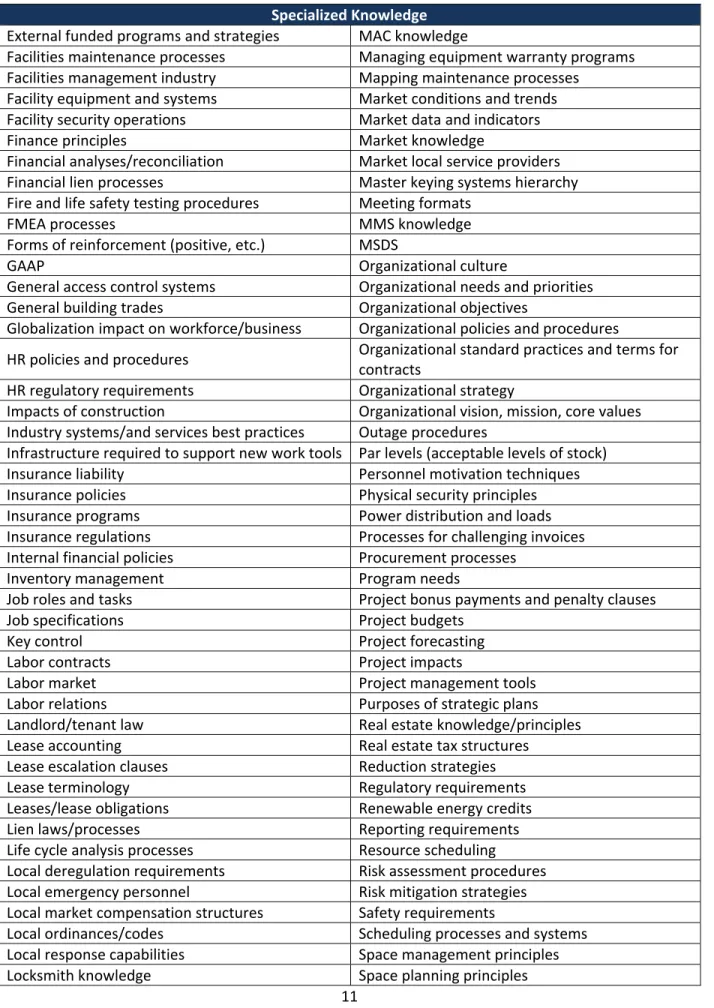
TheSMEsidentifiedandcategorizedspecifictypesofknowledgeneededtobeaproficientfacility
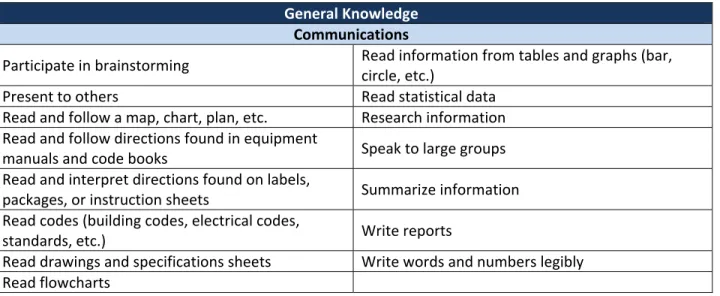
manager(Table3). Generalknowledgeareas(calculations,basicmeasurements,andcommunications),
althoughnotexclusivetothisoccupation,werealsoidentifiedusingagroupconsensusprocess(Table
4). Thepanelistsconcludedthatapractitionermustmastertheknowledgeinbothtablestobe
competentasafacilitymanager.
Table 3: Specialized Knowledge Required of Facility Managers
SpecializedKnowledge
Accountingprinciples Businessstrategy
AHJregulationsandrequirements Capitalplanning
Alternativesourcesoffunding/revenue Capitalsourcesandfundingbasis
Alternativeworkstrategies Changeorderprocesses
Amenitybudgets Characteristicsofprogramconsumer/enduser
Auditrequirements Commandandcontrol
Availableamenityprograms Commissioningprocesses
BASknowledge Communicationsplans
Baselineenergyconsumption Computerskills
Basic facilityprocesses Conductspecializedmeetings
Basicaccountingprinciples/systems Conservationstrategies
Basiccontractlaw Constructionclose‐outprocesses
Basicdocumentmanagement Constructionmanagementprocesses
Basicenvironmentalregulations Constructionprocesses/practices
Basicfireandlifesafetycodes Consultant/servicecontracts
Basicfireandlifesafetysystems Contractadministration/management
Basichumanpsychology Contractlaw
Basicmaterialsandpractices Contractrequirements
Basicordinancesandregulations Contractspecifications
Basicprinciplesoffinance Contractterminology
Basicrealestatelaw Contractorcapabilities
Basicsecurityoptions Controlsequences
Basicsuppressionsystemcapabilitiesandrisks Corebusinessindustry
Basicthreatsfacingfacilities Corporatecorevaluesandmissionstatements
Bestindustrypractices Corporatevision
Bidprocesses CPRandutilizeAEDs
Budgetingprocesses Criticalinfrastructures
Buildingcertifyingentities CSP(criticalspareparts)program
Buildingcodes Currentandpendingregulations
Buildingfunctions Databaseusage/management
Buildingservices(trash,roomsetups,etc.) Deferredmaintenanceimpact
Buildingservicesandcontractobligations Detailedmechanicalsystems
Buildingservices/operations Documentretentionpolicies
Buildingsystemoperations Economics
Table 3 (Continued): Specialized Knowledge Required of Facility Managers
SpecializedKnowledge
Externalfundedprogramsandstrategies MACknowledge
Facilitiesmaintenanceprocesses Managingequipmentwarrantyprograms
Facilitiesmanagementindustry Mappingmaintenanceprocesses
Facilityequipmentandsystems Marketconditionsandtrends
Facilitysecurityoperations Marketdataandindicators
Financeprinciples Marketknowledge
Financialanalyses/reconciliation Marketlocalserviceproviders
Financiallienprocesses Masterkeyingsystemshierarchy
Fireandlifesafetytestingprocedures Meetingformats
FMEAprocesses MMSknowledge
Formsofreinforcement(positive,etc.) MSDS
GAAP Organizationalculture
Generalaccesscontrolsystems Organizationalneedsandpriorities
Generalbuildingtrades Organizationalobjectives
Globalizationimpactonworkforce/business Organizationalpoliciesandprocedures
HRpoliciesandprocedures Organizationalstandardpracticesandtermsfor
contracts
HRregulatoryrequirements Organizationalstrategy
Impactsofconstruction Organizationalvision,mission,corevalues
Industrysystems/andservicesbestpractices Outageprocedures
Infrastructurerequiredtosupportnewworktools Parlevels(acceptablelevelsofstock)
Insuranceliability Personnelmotivationtechniques
Insurancepolicies Physicalsecurityprinciples
Insuranceprograms Powerdistributionandloads
Insuranceregulations Processesforchallenginginvoices
Internalfinancialpolicies Procurementprocesses
Inventorymanagement Programneeds
Jobrolesandtasks Projectbonuspaymentsandpenaltyclauses
Jobspecifications Projectbudgets
Keycontrol Projectforecasting
Laborcontracts Projectimpacts
Labormarket Projectmanagementtools
Laborrelations Purposesofstrategicplans
Landlord/tenantlaw Realestateknowledge/principles
Leaseaccounting Realestatetaxstructures
Leaseescalationclauses Reductionstrategies
Leaseterminology Regulatoryrequirements
Leases/leaseobligations Renewableenergycredits
Lienlaws/processes Reportingrequirements
Lifecycleanalysisprocesses Resourcescheduling
Localderegulationrequirements Riskassessmentprocedures
Localemergencypersonnel Riskmitigationstrategies
Localmarketcompensationstructures Safetyrequirements
Localordinances/codes Schedulingprocessesandsystems
Localresponsecapabilities Spacemanagementprinciples
Locksmithknowledge Spaceplanningprinciples
Table 3 (Continued): Specialized Knowledge Required of Facility Managers
SpecializedKnowledge
Standardmaintenanceintervals Techniquesforfosteringrelationships
Strategicplandevelopment Tenantdemographics
Supplychain Typesoftrainingavailableforstaff
Sustainabilitybestpractices Useofvariousfacilities
SWOTanalyses Utilityratestructures
Systemfailures Utilityrebates
Technicalaspectsoffacilities Utilityresponsibilitiesversusfacility
responsibilities
Techniquesforempoweringstaff Valueengineeringprocesses
Securitysystems/hardware Vendorandsuppliers
Servicelevelrequirements(minimumair
temperatures,etc.) Warrantymanagementprocesses
Siteplanning Workpriorities(routine,emergency,etc.)
SOXrequirements Workscopedevelopment
Techniquesforfosteringpositivemorale Zoningandpermittingrequirements
BuildingSystems
Accesscontrolsystems Lightingsystems
Architecturalsystems Mechanicalsystems
Communicationsystems Parkingcontrolsystems
Controlsystems Plumbingsystems
Electricalsystems Securitysystems
Fire/LifeSafetysystems Structuralsystems
Foundation/subsurfacesystems Verticaltransportationsystems
Hardscapesystems Windowwashingsystems
Irrigationsystems
BuildingServices
Catering/dietary/foodservice O&M
Concierge Pestcontrol
Environmentalhealthandsafety Parkingmanagement
Eventsupport Printing
Finishcarpentry Recycling
Fleetmanagement Security
Janitorial Switchboard
Landscaping Transporters
Lifesafety Trashremoval
Locksmith Utilities
Mailroom Verticaltransportation
Metal,stoneandwood Wellness
Table 4: General Knowledge Required of Facility Managers
GeneralKnowledge
Calculations
Changenumbersfromfractionsintodecimalsand
back Performmathematicaloperationswithfractions
Changenumbersfrompercentagesintodecimals
andback Performsimplemathoperationsofaddition
Collectinformationtosolveaproblem Performsimplemathoperationsofdivision
Comparenumbers Performsimplemathoperationsofmultiplication
Figureaverages Performsimplemathoperationsofsubtraction
Makeroughestimates Solvepercentproblems
Multiplyandfactoralgebraicexpressions Solveproblemswithgraphs
Performmathoperationsusingsigned(positive
andnegative)numbers Solveratioproblems
Performmathoperationsusingsingleandmultiple
digitnumbers
Transfernumbersequencesfromasourceintoa
column
Performmathematicaloperationswithdecimals Useacalculator
BasicMeasurements
Calculatetheperimeterandareasofcommon
figures Measuretemperaturetowithin1degreeF
Convertmeasurementsfromoneunitintoanother
(Englishtometric,etc.) Measurevolume(cubicinches,liters,etc.)
Estimateandapproximatemeasurements Measureweightsusingdevicescalibratedin
ounces
Finddistancesanddirectionsonlandmaps Measureweightsusingdevicescalibratedin
pounds
Findthedimensionsofanobjectfromascale
drawing
Readandapplycoefficientmeasurements
indicatedinatableorchart
Makesimplescaledrawings Readandusethescaleofadrawing
Measurearea(squareinches,squarecentimeters,
etc.)
Readmeasurementstakenwithcommon
measuringtools
Measureboardfeet Read,interpret,andusesize‐scalerelationships
Measurelengthto1/32ofaninch Recordmeasurements,usingappropriateunit
notations(feet,yards,etc.)
Measurelineardistances(length,width,etc.) Usetoolstomeasurequantitiesandsolve
problemsinvolvingmeasurements
Communications
Applyassertiveness Evaluateoptions/alternatives
Askquestions Evaluatesolutions
Communicateusingthevocabulary/terminologyof
arelatedtrade Explainprocedures
Communicatewithco‐workersand/orbusiness
peopleinwriting(letters,memos) Findinformationincatalogs
Communicatewithco‐workersand/orbusiness
peopleverbally(face‐to‐face)
Findinformationinreferences(machinery
handbooks,tap/drillcharts,etc.)
Communicatewithco‐workersand/orbusiness
peopleverbally(telephone,radio) Followverbaljobinstructions
Comparenames Listen
Table 4 (Continued): General Knowledge Required of Facility Managers
GeneralKnowledge
Communications
Participateinbrainstorming Readinformationfromtablesandgraphs(bar,
circle,etc.)
Presenttoothers Readstatisticaldata
Readandfollowamap,chart,plan,etc. Researchinformation
Readandfollowdirectionsfoundinequipment
manualsandcodebooks Speaktolargegroups
Readandinterpretdirectionsfoundonlabels,
packages,orinstructionsheets Summarizeinformation
Readcodes(buildingcodes,electricalcodes,
standards,etc.) Writereports
Readdrawingsandspecificationssheets Writewordsandnumberslegibly
9.0 Skills, Abilities, and Attributes
Aproficientworkerpossesseskeyskills,abilities,andattributesthatinfluencejobsuccess. Skillsare
developedthroughexperienceandtrainingandmayapplytoawiderangeoftasks;properskillsenable
workerstoperformtheirtaskswithprecisionandquality.
Abilitiesandattributesaremorefundamentalthanknowledgeandskills;theyrepresentunderlying,
enduringtraits,bothcognitiveandphysical,thatsupportthesuccessfulperformanceofawiderangeof
jobtasks.
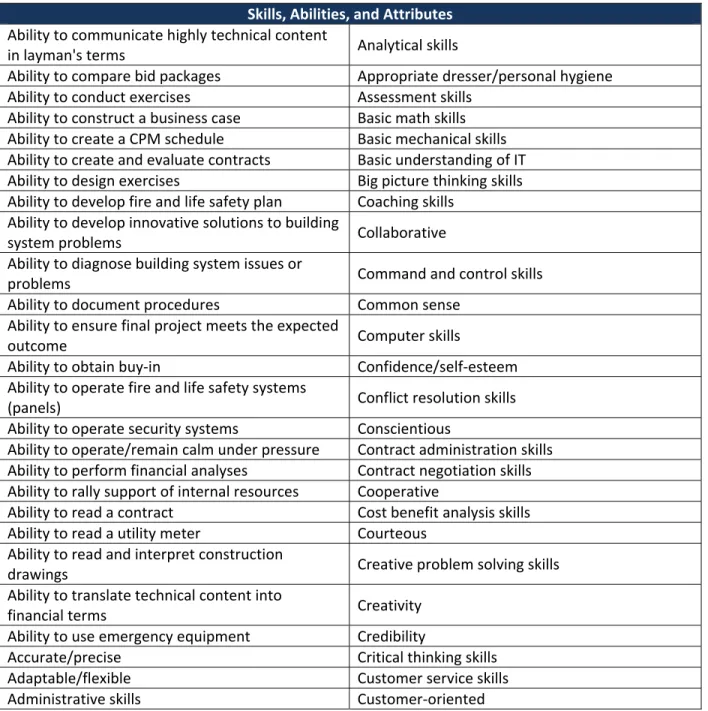
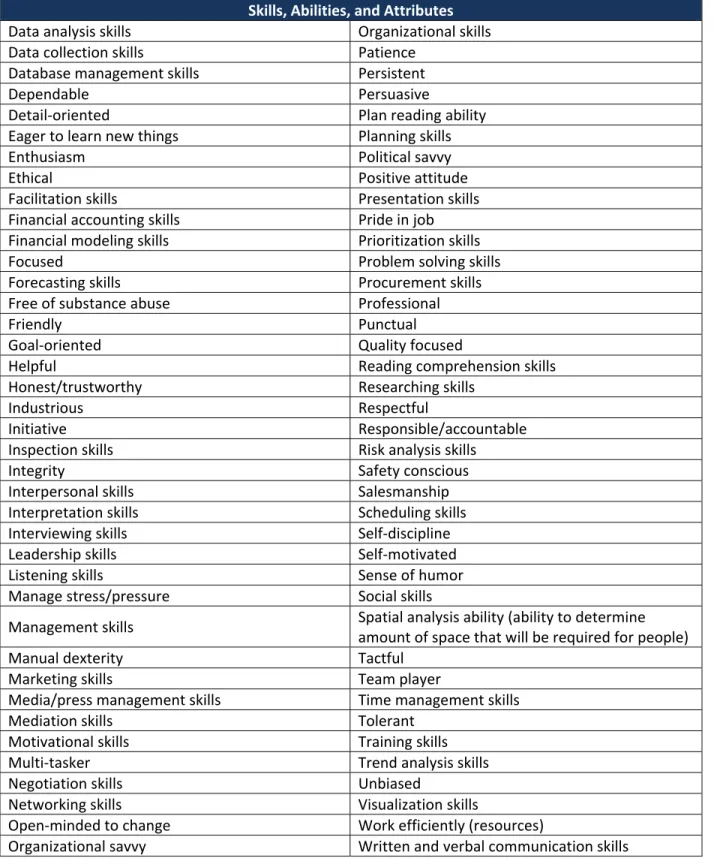
Thepanelistsidentifiedtask‐specificskillsandabilities,aswellasbroadattributes(e.g.,analytic,
creative,patient),todefinetherecommendedtraitsafacilitymanagershouldpossess(Table5).
HumanResourceprofessionalsandjobanalystsoftenanalyzeskills,abilities,andattributestocompare
jobsintermsofworkercharacteristics.
Table 5: Skills, Abilities, and Attributes Required of Facility Managers
Skills,Abilities,andAttributes
Abilitytocommunicatehighlytechnicalcontent
inlayman'sterms Analyticalskills
Abilitytocomparebidpackages Appropriatedresser/personalhygiene
Abilitytoconductexercises Assessmentskills
Abilitytoconstructabusinesscase Basicmathskills
AbilitytocreateaCPMschedule Basicmechanicalskills
Abilitytocreateandevaluatecontracts BasicunderstandingofIT
Abilitytodesignexercises Bigpicturethinkingskills
Abilitytodevelopfireandlifesafetyplan Coachingskills
Abilitytodevelopinnovativesolutionstobuilding
systemproblems Collaborative
Abilitytodiagnosebuildingsystemissuesor
problems Commandandcontrolskills
Abilitytodocumentprocedures Commonsense
Abilitytoensurefinalprojectmeetstheexpected
outcome Computerskills
Abilitytoobtainbuy‐in Confidence/self‐esteem
Abilitytooperatefireandlifesafetysystems
(panels) Conflictresolutionskills
Abilitytooperatesecuritysystems Conscientious
Abilitytooperate/remaincalmunderpressure Contractadministrationskills
Abilitytoperformfinancialanalyses Contractnegotiationskills
Abilitytorallysupportofinternalresources Cooperative
Abilitytoreadacontract Costbenefitanalysisskills
Abilitytoreadautilitymeter Courteous
Abilitytoreadandinterpretconstruction
drawings Creativeproblemsolvingskills
Abilitytotranslatetechnicalcontentinto
financialterms Creativity
Abilitytouseemergencyequipment Credibility
Accurate/precise Criticalthinkingskills
Adaptable/flexible Customerserviceskills
Administrativeskills Customer‐oriented
Table 5 (Continued): Skills, Abilities, and Attributes Required of Facility Managers
Skills,Abilities,andAttributes
Dataanalysisskills Organizationalskills
Datacollectionskills Patience
Databasemanagementskills Persistent
Dependable Persuasive
Detail‐oriented Planreadingability
Eagertolearnnewthings Planningskills
Enthusiasm Politicalsavvy
Ethical Positiveattitude
Facilitationskills Presentationskills
Financialaccountingskills Prideinjob
Financialmodelingskills Prioritizationskills
Focused Problemsolvingskills
Forecastingskills Procurementskills
Freeofsubstanceabuse Professional
Friendly Punctual
Goal‐oriented Qualityfocused
Helpful Readingcomprehensionskills
Honest/trustworthy Researchingskills
Industrious Respectful
Initiative Responsible/accountable
Inspectionskills Riskanalysisskills
Integrity Safetyconscious
Interpersonalskills Salesmanship
Interpretationskills Schedulingskills
Interviewingskills Self‐discipline
Leadershipskills Self‐motivated
Listeningskills Senseofhumor
Managestress/pressure Socialskills
Managementskills Spatialanalysisability(abilitytodetermine
amountofspacethatwillberequiredforpeople)
Manualdexterity Tactful
Marketingskills Teamplayer
Media/pressmanagementskills Timemanagementskills
Mediationskills Tolerant
Motivationalskills Trainingskills
Multi‐tasker Trendanalysisskills
Negotiationskills Unbiased
Networkingskills Visualizationskills
Open‐mindedtochange Workefficiently(resources)
10.0 Tools, Equipment, and Resources
Eachoccupationrequiresauniquesetofsupportmaterials. Itisimportanttoidentifythetools,
equipment,andothertangibleobjects,aswellastheresources(e.g.,informationtechnologies,codes
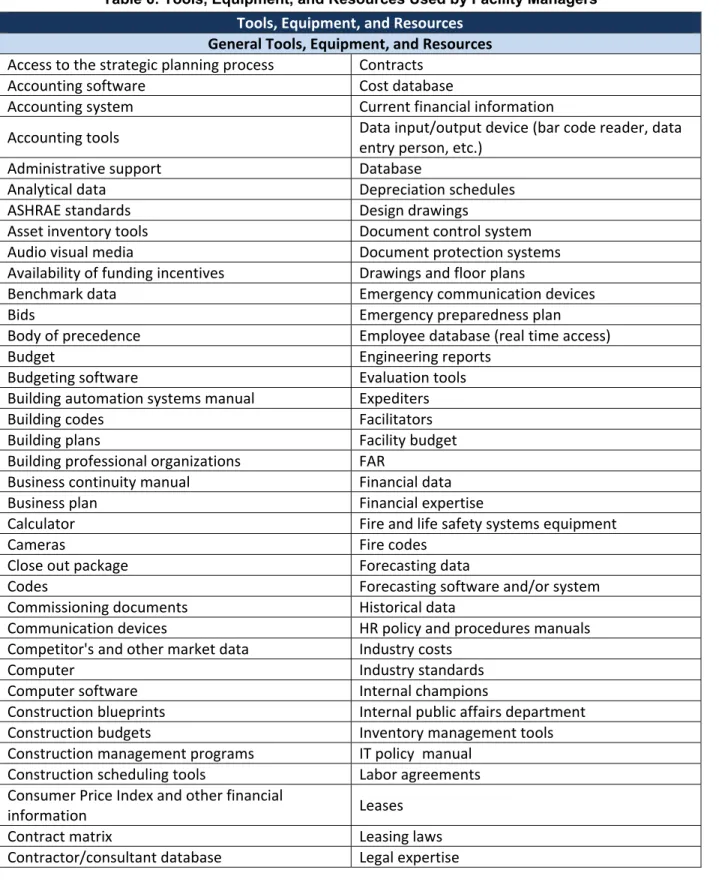
andstandards)requiredforaworkertoeffectivelyaccomplishtasks. Table6liststhepanelist‐identified
inventoryoftools,equipment,andresourcesnecessarytoperformtheidentifiedtasks.
Table 6: Tools, Equipment, and Resources Used by Facility Managers
Tools,Equipment,andResources
GeneralTools,Equipment,andResources
Accesstothestrategicplanningprocess Contracts
Accountingsoftware Costdatabase
Accountingsystem Currentfinancialinformation
Accountingtools Datainput/outputdevice(barcodereader,data
entryperson,etc.)
Administrativesupport Database
Analyticaldata Depreciationschedules
ASHRAEstandards Designdrawings
Assetinventorytools Documentcontrolsystem
Audiovisualmedia Documentprotectionsystems
Availabilityoffundingincentives Drawingsandfloorplans
Benchmarkdata Emergencycommunicationdevices
Bids Emergencypreparednessplan
Bodyofprecedence Employeedatabase(realtimeaccess)
Budget Engineeringreports
Budgetingsoftware Evaluationtools
Buildingautomationsystemsmanual Expediters
Buildingcodes Facilitators
Buildingplans Facilitybudget
Buildingprofessionalorganizations FAR
Businesscontinuitymanual Financialdata
Businessplan Financialexpertise
Calculator Fireandlifesafetysystemsequipment
Cameras Firecodes
Closeoutpackage Forecastingdata
Codes Forecastingsoftwareand/orsystem
Commissioningdocuments Historicaldata
Communicationdevices HRpolicyandproceduresmanuals
Competitor'sandothermarketdata Industrycosts
Computer Industrystandards
Computersoftware Internalchampions
Constructionblueprints Internalpublicaffairsdepartment
Constructionbudgets Inventorymanagementtools
Constructionmanagementprograms ITpolicy manual
Constructionschedulingtools Laboragreements
ConsumerPriceIndexandotherfinancial
information Leases
Contractmatrix Leasinglaws
Contractor/consultantdatabase Legalexpertise
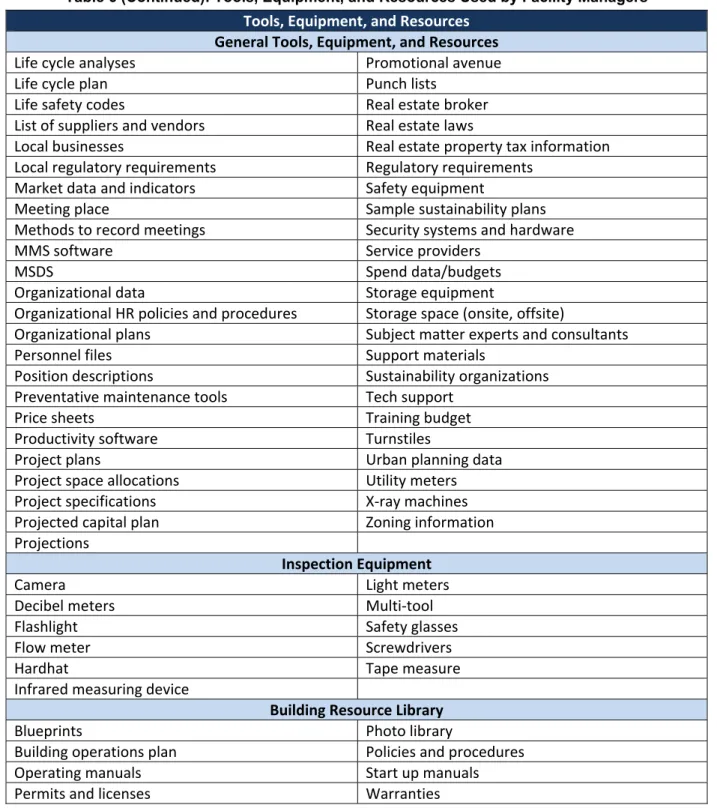
Table 6 (Continued): Tools, Equipment, and Resources Used by Facility Managers
Tools,Equipment,andResources
GeneralTools,Equipment,andResources
Lifecycleanalyses Promotionalavenue
Lifecycleplan Punchlists
Lifesafetycodes Realestatebroker
Listofsuppliersandvendors Realestatelaws
Localbusinesses Realestatepropertytaxinformation
Localregulatoryrequirements Regulatoryrequirements
Marketdataandindicators Safetyequipment
Meetingplace Samplesustainabilityplans
Methodstorecordmeetings Securitysystemsandhardware
MMSsoftware Serviceproviders
MSDS Spenddata/budgets
Organizationaldata Storageequipment
OrganizationalHRpoliciesandprocedures Storagespace(onsite,offsite)
Organizationalplans Subjectmatterexpertsandconsultants
Personnelfiles Supportmaterials
Positiondescriptions Sustainabilityorganizations
Preventativemaintenancetools Techsupport
Pricesheets Trainingbudget
Productivitysoftware Turnstiles
Projectplans Urbanplanningdata
Projectspaceallocations Utilitymeters
Projectspecifications X‐raymachines
Projectedcapitalplan Zoninginformation
Projections
InspectionEquipment
Camera Lightmeters
Decibelmeters Multi‐tool
Flashlight Safetyglasses
Flowmeter Screwdrivers
Hardhat Tapemeasure
Infraredmeasuringdevice
BuildingResourceLibrary
Blueprints Photolibrary
Buildingoperationsplan Policiesandprocedures
Operatingmanuals Startupmanuals
11.0 DACUM Chart
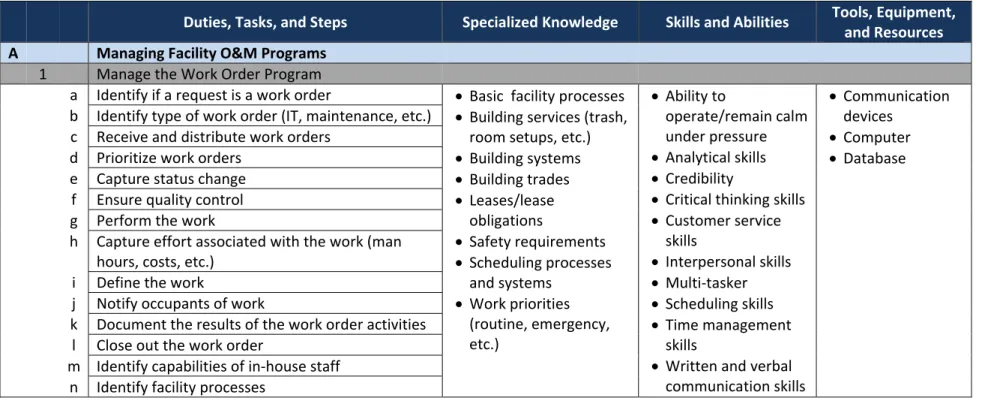
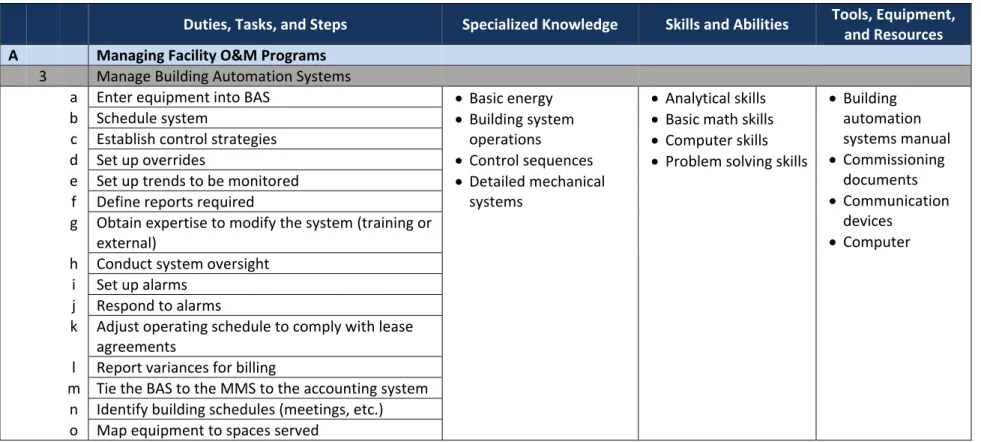
TheDACUMchart(Table7)isatabularrepresentationoftheJTA. Capitallettersidentifymajorjobduty
areas. Numbersidentifytasks,andlowercaselettersidentifythestepsrequiredtoaccomplisheach
task. Movinghorizontallyacrossthechart,adjacentcolumnsdetail(1)specializedknowledge,(2)skills
andabilities,and(3)tools,equipment,andresourcesrequiredtoperformeachtask. Theinformation
containedinthesecolumnsisrelatedtoeachtaskanddoesnotnecessarilycorrespondtoaspecific
step.
TheimportanceoftheDACUMchartistoshowtherelationshipbetweenjobtasksandthespecialized
knowledge,skillsandabilities,andtools,equipment,andresourcesrequiredtoperformeachtask. This
concept,called job‐relatedness,isessentialtocompliancewithkeylegalandprofessionalvalidity
standardspertainingtotheuseofJTAinformationinemployeeselection. Suchinformationisalso
criticaltothedevelopmentofhigh‐stakesassessmentsforoccupationallicensingandcertification
examinations.
TheDACUMchartdepictsthejobelementrelationshipsassociatedwitheachtask,andcantherefore
easilybeusedtoassesstherelevanceofcurrentprograms(curriculum),developinstructionalobjectives
andtrainingcontent,sequenceinstructionalmaterials,anddevelopexamination,competency,and
performanceevaluationinstruments.
Table 7: DACUM Chart for Facility Managers
Duties, Tasks, and Steps Specialized Knowledge Skills and Abilities Tools, Equipment, and Resources
A ManagingFacilityO&MPrograms
1 Manage the Work Order Program
a b c d e f g h i j k l m n
Identify if a request is a work order Basic facility processes
Building services (trash, room setups, etc.)
Building systems Building trades Leases/lease obligations Safety requirements Scheduling processes and systems Work priorities (routine, emergency, etc.) Ability to operate/remain calm under pressure Analytical skills Credibility
Critical thinking skills
Customer service skills Interpersonal skills Multi‐tasker Scheduling skills Time management skills
Written and verbal communication skills
Communication devices
Computer
Database Identify type of work order (IT, maintenance, etc.)
Receive and distribute work orders Prioritize work orders
Capture status change Ensure quality control Perform the work
Capture effort associated with the work (man hours, costs, etc.)
Define the work
Notify occupants of work
Document the results of the work order activities Close out the work order
Identify capabilities of in‐house staff Identify facility processes
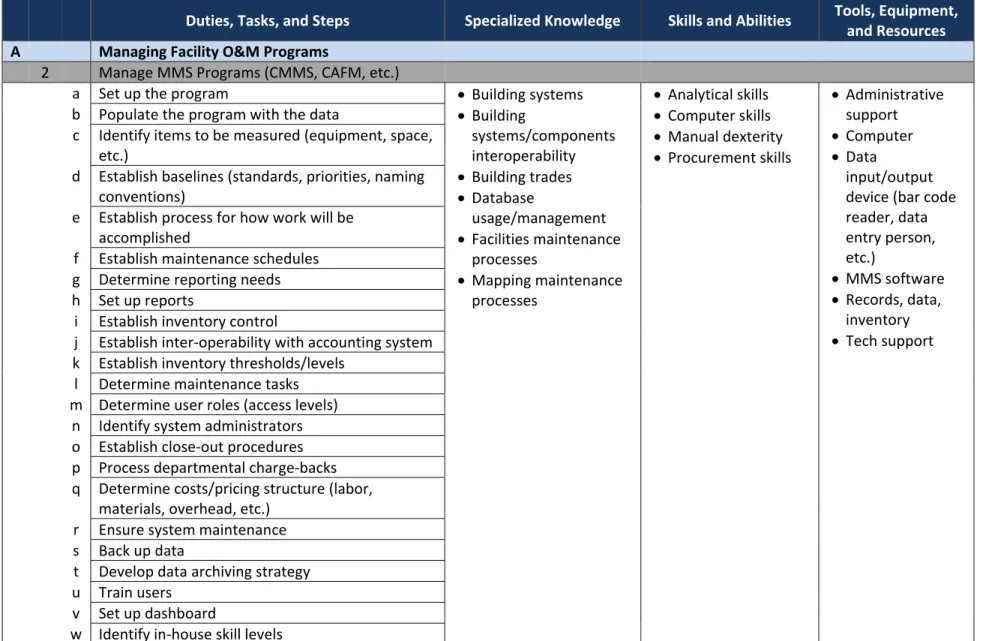
Table 7 (Continued): DACUM Chart for Facility Managers
Duties, Tasks, and Steps Specialized Knowledge Skills and Abilities Tools, Equipment, and Resources
A ManagingFacilityO&MPrograms
2 Manage MMS Programs (CMMS, CAFM, etc.)
a b c d e f g h i j k l m n o p q r s t u v w
Set up the program Building systems
Building systems/components interoperability Building trades Database usage/management Facilities maintenance processes Mapping maintenance processes Analytical skills Computer skills Manual dexterity Procurement skills Administrative support Computer Data input/output device (bar code reader, data entry person, etc.) MMS software Records, data, inventory Tech support Populate the program with the data
Identify items to be measured (equipment, space, etc.)
Establish baselines (standards, priorities, naming conventions)
Establish process for how work will be accomplished
Establish maintenance schedules Determine reporting needs Set up reports
Establish inventory control
Establish inter‐operability with accounting system Establish inventory thresholds/levels
Determine maintenance tasks Determine user roles (access levels) Identify system administrators Establish close‐out procedures Process departmental charge‐backs Determine costs/pricing structure (labor, materials, overhead, etc.)
Ensure system maintenance Back up data
Develop data archiving strategy Train users
Set up dashboard
Identify in‐house skill levels
Table 7 (Continued): DACUM Chart for Facility Managers
Duties, Tasks, and Steps Specialized Knowledge Skills and Abilities Tools, Equipment, and Resources
A ManagingFacilityO&MPrograms
3 Manage Building Automation Systems
a b c d e f g h i j k l m n o
Enter equipment into BAS Basic energy
Building system operations Control sequences Detailed mechanical systems Analytical skills
Basic math skills
Computer skills
Problem solving skills
Building automation systems manual Commissioning documents Communication devices Computer Schedule system
Establish control strategies Set up overrides
Set up trends to be monitored Define reports required
Obtain expertise to modify the system (training or external)
Conduct system oversight Set up alarms
Respond to alarms
Adjust operating schedule to comply with lease agreements
Report variances for billing
Tie the BAS to the MMS to the accounting system Identify building schedules (meetings, etc.) Map equipment to spaces served
Table 7 (Continued): DACUM Chart for Facility Managers
Duties, Tasks, and Steps Specialized Knowledge Skills and Abilities Tools, Equipment, and Resources
A ManagingFacilityO&MPrograms
4 Manage Access Control Systems (mechanical and electrical) a b c d e f g h i j k l m n o p q r
Define levels of access Computer skills
General access control systems
Key control
Locksmith knowledge
Master keying systems hierarchy
Physical security principles
Computer skills Computer
Computer software Contractor/ consultant database Design drawings Employee database (real time access) Fire codes
Life safety codes Define specifications for particular levels of access
Enter personnel data into control system Conduct audits of access
Qualify personnel for access (citizenship, etc.) Program access cards/keys
De‐program access cards/retrieve keys/change locks
Map access points Prepare access reports Interface to security system Manage access records/documents Design access control system
Manage access control design documents (wiring diagrams, etc.)
Conduct maintenance activities with access control system
Troubleshoot problems
Identify interface between access control system and alarm systems
Physically set locks on doors
Define controls of primary and secondary access systems
Table 7 (Continued): DACUM Chart for Facility Managers
Duties, Tasks, and Steps Specialized Knowledge Skills and Abilities Tools, Equipment, and Resources
A ManagingFacilityO&MPrograms
5 Manage Security Systems
a b c d e f g h i k l m n o p q
Assess current security situation Basic ordinances and
regulations
Basic security options
Basic threats facing facilities Facility security operations Local response capabilities Security systems/hardware Ability to operate security systems Analytical skills Assessment skills Collaborative Command and control skills
Critical thinking skills
Training skills
Written and verbal communication skills Cameras Security systems and hardware Turnstiles X‐ray machines Determine security equipment
Determine security staffing
Audit personnel monitoring security
Determine type of security personnel desired (uniforms, coat/tie, etc.)
Determine type of reporting desired Determine frequency of reporting
Document escalation procedures (post orders) Maintain security hardware
Train security personnel
Collaborate with local authorities Develop a security plan
Determine third party monitoring needs Back up data
Evaluate surrounding environment Conduct background checks on personnel
Table 7 (Continued): DACUM Chart for Facility Managers
Duties, Tasks, and Steps Specialized Knowledge Skills and Abilities Tools, Equipment, and Resources
A ManagingFacilityO&MPrograms
6 Manage Fire and Life Safety Systems
a b c d e f g h i j k l m n o p q r s t u v w x
Conduct regular testing of fire alarms and systems AHJ regulations and requirements
Basic fire and life safety codes
Basic fire and life safety systems
Basic suppression system capabilities and risks
CPR and utilize AEDs
Enforcement expectations
Fire and life safety testing procedures
Local emergency personnel
Ability to develop fire and life safety plan
Ability to operate fire and life safety systems (panels) Ability to operate/remain calm under pressure Ability to use emergency equipment Collaborative Persuasive
Plan reading ability
Training skills
Written and verbal communication skills
Fire and life safety systems equipment
Life safety codes Maintain fire alarm and system certifications
Conduct fire drills
Conduct evacuation drills Conduct life safety drills Create fire and life safety plans Post evacuation routes
Communicate fire and life safety plans Participate in fire Marshall, insurance, etc. inspections
Maintain code compliance of the fire and life safety system
Review fire and life safety design
Inspect all components of the fire and life safety systems (exit lights, fire extinguishers, emergency light bulbs, etc.)
Implement interim life safety measures Identify fire wardens
Train fire wardens
Create personnel accountability system Direct emergency response team Establish communications plan
Test emergency generator/power backup systems Identify locations for people with mobility
disabilities and create evacuation plan
Establish occupancy levels for meeting spaces and community spaces
Monitor occupancy during events Ensure clear egress
Conduct HAZMAT drills
Table 7 (Continued): DACUM Chart for Facility Managers
Duties, Tasks, and Steps Specialized Knowledge Skills and Abilities Tools, Equipment, and Resources
A ManagingFacilityO&MPrograms
6 Manage Fire and Life Safety Systems
y z
Document fire and life safety drills, tests and activities
Identify person to respond to incidents
7 Manage the Preventative Maintenance Program
a b c d e f g h i j k l m n o
Identify equipment or assets to be maintained Building systems
Building
systems/components interoperability
Facility equipment and systems FMEA processes Managing equipment warranty programs Resource scheduling Standard maintenance intervals System failures Ability to diagnose building system issues or problems Ability to document procedures Analytical skills Basic mechanical skills
Critical thinking skills
Organizational skills
Written and verbal communication skills ASHRAE standards Preventative maintenance tools
Build and maintain an inventory for preventative maintenance
Identify maintenance procedures Identify maintenance frequencies
Obtain manufacturer's recommendations
Customize the manufacturer's recommendations based on an FMEA or facility needs
Identify resources required for preventative maintenance (tools, time, equipment, manpower, etc.)
Conduct a job/hazard assessment for the task Establish maintenance philosophy
Document maintenance procedures
Report results of the preventative maintenance program
Analyze results of the preventative maintenance program
Ensure equipment history for all tasks performed Follow up on issues identified during preventative maintenance
Table 7 (Continued): DACUM Chart for Facility Managers
Duties, Tasks, and Steps Specialized Knowledge Skills and Abilities Tools, Equipment, and Resources
A ManagingFacilityO&MPrograms
8 Coordinate with Public Utilities a b c d e f g h i j k l m n
Identify utilities Basic environmental
regulations
Energy management
Local deregulation requirements
Outage procedures
Power distribution and loads
Renewable energy credits
Utility rate structures
Utility rebates Utility responsibilities versus facility responsibilities Ability to read a utility meter
Basic math skills
Negotiation skills
Written and verbal communication skills
Utility meters Identify options to utilities
Identify utility suppliers
Identify utility supplier contacts Validate utility billing
Obtain copies of utility rate schedules Identify utility meters
Read utility meters
Identify local utility programs (curtailment, ESCO, etc.)
Negotiate rate contracts and discounts Establish utility access procedures
Establish utility emergency procedures/contacts Coordinate planned consumption with utilities Coordinate work with utility departments (locate hidden lines)
Table 7 (Continued): DACUM Chart for Facility Managers
Duties, Tasks, and Steps Specialized Knowledge Skills and Abilities Tools, Equipment, and Resources
A ManagingFacilityO&MPrograms
9 Manage the Building Systems
a b c d e f g h i j k
Develop a building operations plan BAS knowledge
Basic accounting principles/systems
Building codes
Building functions
Building services and contract obligations Building systems Building systems/components interoperability Contract terminology Deferred maintenance impact Industry systems/and services best practices
Market local service providers MMS knowledge Service level requirements (minimum air temperatures, etc.) Ability to develop innovative solutions to building system problems Ability to diagnose building system issues or problems
Ability to read and interpret construction drawings Analytical skills Computer skills Contract administration skills Critical thinking skills
Data analysis skills
Data collection skills
Management skills
Negotiation skills
Problem solving skills
Written and verbal communication skills Building resource library Codes Computer Construction blueprints Database Manage the architectural systems
Manage carpeting/flooring maintenance Manage mechanical systems (HVAC, plumbing, etc.)
Manage the elevator program Manage the electrical systems
Conduct painting and carpentry maintenance Conduct building envelope maintenance Manager vendor contracts
Create and maintain building systems documents Implement a continual improvement plan
Table 7 (Continued): DACUM Chart for Facility Managers
Duties, Tasks, and Steps Specialized Knowledge Skills and Abilities Tools, Equipment, and Resources
A ManagingFacilityO&MPrograms
10 Manage the Building Services
a b c d e f g h i j k l m n o p q
Maintain common areas Bid processes
Budgeting processes Building services/operations Contract requirements Contractor capabilities Regulatory requirements Scheduling processes and systems Tenant demographics
Use of various facilities
Ability to read a contract Contract negotiation skills Customer service skills Problem solving skills
Written and verbal communication skills Building resource library Computer Contracts MSDS
Manage the landscaping program Manage the grounds program Manage the cafeteria program Manage the janitorial program Manage the parking program
Set up rooms for conferences and meetings Manage the pest control program
Manage the facility fleet Manage the recycling program Manage the trash program Manage vendor contracts Identify building services
Negotiate contracts for building services Develop SLAs and KPIs
Identify in‐house capabilities versus outsourced services
Identify obligations of ownership versus service provider
B ManagingPeople/Personnel
1 Conduct Operational Meetings (personnel, staff, planning, etc.) a b c d e f
Develop resourcing requirements Conduct specialized
meetings HR policies and procedures Meeting formats Project forecasting Facilitation skills Interpersonal skills Organizational skills
Written and verbal communication skills Audio Visual media Meeting place Methods to record meetings Support materials Determine who needs to attend the meeting
Develop the purpose for the meeting Develop an agenda for the meeting Identify capabilities and limitations of staff Allocate time for attendance at meetings
Table 7 (Continued): DACUM Chart for Facility Managers
Duties, Tasks, and Steps Specialized Knowledge Skills and Abilities Tools, Equipment, and Resources
B ManagingPeople/Personnel
2 Conduct Staff Development Activities
a b c d e f g h i j k l
Conduct team building activities Forms of reinforcement
(positive, etc.)
Job roles and tasks
Personnel motivation techniques Techniques for empowering staff Techniques for fostering positive morale Types of training available for staff
Interpersonal skills
Written and verbal communication skills Training budget Organizational HR policies and procedures Conduct staff brainstorming sessions
Conduct cross‐training activities Provide training opportunities for staff Counsel/mentor facility personnel
Communicate expectations/goals to personnel Provide growth goals and opportunities for personnel (employee development assignments) Conduct a personnel gap analysis
Develop a workforce plan Identify aspirations of staff
Identify strengths and weaknesses of staff Reinforce organizational culture
Table 7 (Continued): DACUM Chart for Facility Managers
Duties, Tasks, and Steps Specialized Knowledge Skills and Abilities Tools, Equipment, and Resources B ManagingPeople/Personnel 3 Perform HR Activities a b c d e f g h i j k l m n o p q r s t u v
Recruit facility personnel Basic human
psychology Consultant/service contracts Employee work environments HR regulatory requirements Labor contracts Local market compensation structures Organizational policies and procedures Coaching skills Conflict resolution skills Contract negotiation skills Creative problem solving skills Interpersonal skills Interviewing skills Mediation skills Motivational skills
Written and verbal communication skills Body of precedence Document control system HR policy and procedures manuals Labor agreements Personnel files Position descriptions Hire facility personnel
Negotiate personnel contracts
Create job descriptions including scopes of authority
Assign personnel tasks
Perform personnel performance evaluations Counsel facility personnel
Negotiate personnel grievances Arbitrate personnel disputes Fire facility personnel Conduct RIF activities
Investigate employee complaints Manage personnel and work remotely Develop performance award criteria Establish compensation ranges
Establish employee incentive programs Establish departmental culture
Enforce personnel policies and procedures Develop succession plans
Implement a performance improvement plan Manage staffing coverage
Obtain expert HR assistance
Table 7 (Continued): DACUM Chart for Facility Managers
Duties, Tasks, and Steps Specialized Knowledge Skills and Abilities Tools, Equipment, and Resources
B ManagingPeople/Personnel
4 Conduct Relationship Management Activities
a b c d e f g h i
Interact with the media/press Local ordinances/codes
Techniques for fostering relationships Interpersonal skills Media/press management skills Networking skills Organizational savvy Presentation skills
Written and verbal communication skills
Interact with professional trade associations Work with supervisors to obtain a common goal Liaise with neighbors
Liaise with other departments
Maintain relationships with AHJ (fire marshal, code enforcement, etc.)
Respond to complaints
Coordinate activities with other organizations Manage political activism programs
Table 7 (Continued): DACUM Chart for Facility Managers
Duties, Tasks, and Steps Specialized Knowledge Skills and Abilities Tools, Equipment, and Resources
C ManagingOtherInternal/ExternalFacilityPrograms
1 Develop an Enterprise Risk Management Strategy
a b c d e f g h i j k
Manage an IT security plan Command and control
Communications plans Critical infrastructures Emergency escalation protocols Emergency response procedures Insurance policies Insurance programs Regulatory requirements Risk assessment procedures Risk mitigation strategies SWOT analyses Ability to conduct exercises Ability to design exercises Ability to develop a plan Ability to document procedures Ability to operate/remain calm under pressure
Basic understanding of IT
Multi‐tasker
Prioritization skills
Written and verbal communication skills Business continuity manual Communication devices Computer Emergency communication devices Emergency preparedness plan IT policy manual Manage business continuity programs
Manage communication programs Manage compliance programs
Manage crises managem