WO R K I N G PA P E R S E R I E S
N O. 5 0 1 / J U LY 2 0 0 5
MEASURING
COMOVEMENTS
BY REGRESSION
QUANTILES
In 2005 all ECB publications will feature a motif taken from the €50 banknote.
W O R K I N G PA P E R S E R I E S
N O. 5 0 1 / J U LY 2 0 0 5
This paper can be downloaded without charge from http://www.ecb.int or from the Social Science Research Network electronic library at http://ssrn.com/abstract_id=742507.
MEASURING
COMOVEMENTS
BY REGRESSION
QUANTILES
1by Lorenzo Cappiello,
2Bruno Gérard,
3© European Central Bank, 2005
Address
Kaiserstrasse 29
60311 Frankfurt am Main, Germany
Postal address
Postfach 16 03 19
60066 Frankfurt am Main, Germany
Telephone +49 69 1344 0 Internet http://www.ecb.int Fax +49 69 1344 6000 Telex 411 144 ecb d All rights reserved.
Reproduction for educational and non-commercial purposes is permitted provided that the source is acknowledged.
C O N T E N T S
Abstract 4
Non-technical summary 5
1 Introduction 6
2 The comovement box 8
3 The econometrics of the comovement box 10
3.1 Time-varying regression quantiles 11
3.2 Estimation of the conditional probability 12
4 Measuring contagion 15
5 Data 18
6 Empirical results: an application to
Latin America 20
6.1 Economic variables 27
7 Summary and conclusions 28
References 31
Appendices 34
Tables 44
Abstract
This paper develops a rigorous econometric framework to investigate the structure of codependence between random variables and to test whether it changes over time. Our approach is based on the computation - over both a test and a
bench-mark period - of the conditional probability that a random variable yt is lower
than a given quantile, when the other random variable xt is also lower than its
corresponding quantile, for any set of prespecified quantiles. Time-varying condi-tional quantiles are modeled via regression quantiles. The condicondi-tional probability is estimated through a simple OLS regression. We illustrate the methodology by investigating the impact of the crises of the 1990s on the major Latin American
eq-uity markets returns. Our results document significant increases in equity return
co-movements during crises consistent with the presence offinancial contagion.
Keywords: codependence, semi-parametric, conditional quantiles.
Non-technical summary
Precise measures of asset comovements are important for a broad spectrum of applications, which range from portfolio allocation, risk management, to monitoring financial stability. An accurate measure of financial comovements constitutes an indispensable instrument in the toolbox of practitioners, researchers and policy makers alike. Nevertheless, measuring codependences across financial markets remains one of the open issues in international macroeconomics and finance.
This paper, whose focus is mostly methodological, develops a rigorous econometric framework to measure codependence between two random variables. The approach is based on the estimation of the conditional probability that a random variable falls below a given threshold, when another random variable is also falling below the same threshold. The estimation is implemented through a simple OLS regression of appropriately specified indicator variables. Thresholds are identified using time-varying conditional univariate quantiles, which allow to account for heteroscedasticity. In this framework, the stronger the codependence between the two random variables, the higher the conditional probability of comovement. We derive a test to assess whether comovement likelihoods change over time and across market conditions.
The estimated codependence can easily be visualized in what we call “the comovement box.” The comovement box is a square of unit side, where the conditional probabilities are plotted. When the plot of the conditional probability lies above the 45° line, which represents the case of independence between two random variables, there is evidence of positive comovements. When the conditional probability of comovements for a test and benchmark periods are plotted in the same graph, differences in the intensity of comovements can be identified directly. From this insight, rigorous econometric tests for changes in codependence are derived and implemented.
We illustrate our methodology by investigating the impact of some of the major crises of the Nineties on the main Latin American equity markets. One key unresolved issue is whether the Tequila crisis, the Asian flu and the Russian worm were episodes of financial contagion. In the finance literature, contagion is broadly defined as an increase in financial market comovements during periods of financial turbulence. The issue is particularly important because the presence of contagion increases the likelihood that financial crises spread over from one country to another. Policy intervention would have different scope whether one detects contagion or simple interdependence. Our results show that, on average, over turbulent times, comovements in equity returns across national markets tend to increase significantly, consistent with the existence of financial contagion.
A number of questions can be addressed within the framework we propose. For instance, a persistent issue in the literature is whether the increase in financial markets comovements is due to economic linkages and common macro-economic conditions or to investor behaviour unrelated to these fundamental links. A possible strategy to investigate this
1
Introduction
This paper develops a rigorous econometric framework to measure codependence be-tween two (possibly heteroscedastic) random variables. The approach is based on the estimation of the conditional probability that a random variable yt falls below a
given conditional quantile, when the other random variable xt is also falling below
its corresponding quantile. Conditional quantiles are estimated via regression quan-tile (Koenker and Bassett, 1978). In this framework, the stronger the codependence between xt and yt, the higher the conditional probability of comovement. We
esti-mate this conditional probability through a simple OLS regression involving quantile co-exceedance1 indicators and derive a test to assess whether comovement likelihoods change over time and across market conditions.
A large body of empirical work investigates codependence among financial asset returns. Extensive surveys are provided by de Bandt and Hartmann (2000), Dungey, Fry, González-Hermosillo, and Martin (2003), and Pericoli and Sbracia (2003). In essence, one can distinguish between two different approaches: modellingfirst and/or second moments of returns (see, for instance, Forbes and Rigobon, 2002, King, Sentana and Wadhwani, 1994, Ciccarelli and Rebucci, 2003), and estimating the probability of co-exceedance (see, among others, Longin and Solnik, 2001, Hartmann, Straet-mans and de Vries, 2003, Bae, Karolyi and Stulz, 2003, Rodriguez, 2003, and Patton, 2004). Each of these methodologies suffers from several drawbacks. Correlation-based models and Generalized Autoregressive Conditional Heteroscedastic (GARCH)-type approaches assume that realizations in the upper and lower tail of the distribution are generated by the same process. Probability models generally analyze only single points of the support of the distribution and adopt a two-step estimation procedure without correcting the standard errors.
We propose a semi-parametric strategy based on regression quantiles to estimate codependence. This has several advantages. First we show that the coefficients of a simple OLS regression of a quantile co-exceedance indicator variable on a constant and economic indicator variables provide consistent estimates of comovement probability and of the changes thereof. Second, casting the econometric framework in term of regression quantiles permits to make proper inference. Third, we are able to measure codependence over any subset of the support of the joint distribution, and asymmetries in comovement in the positive and negative parts of the distribution can be tested for. Fourth, one can test whether economic variables significantly increase the probability of comovement. In particular, our methodology permits to combine variables of different frequencies (e.g., monthly macro-economic data with daily financial returns). Fifth,
since regression quantile is a semi-parametric technique, there is no need to impose any distributional assumption on the series under investigation.
The estimated codependence can easily be visualized in what we call “the co-movement box”. The coco-movement box is a square of unit side, where, for any set of
θ-quantiles, θ ∈ (0,1), the conditional probabilities are plotted against θ. When the plot of the conditional probability lies above the 45◦ line, which represents the case of independence between two random variables, there is evidence of positive comove-ments. When the conditional probability of comovements for the test and benchmark periods are plotted in the same graph, differences in the intensity of comovements can be identified directly. From this insight, rigorous econometric tests for changes in codependence are derived and implemented. In the process we obtain a new result in the regression quantile literature. We show that the asymptotic covariance matrix of the estimated probabilities depends on the joint bivariate distribution evaluated at the quantiles. This can be interpreted as the bivariate extension of the height of the density function that typically appears in the standard errors of regression quantiles. We illustrate our methodology by investigating the impact of some of the major crises of the Nineties on the main Latin American equity markets. One key unresolved issue is whether the Tequila crisis, the Asianflu and the Russian worm were episodes of financial contagion. In the finance literature, contagion is broadly defined as an increase infinancial market comovements during periods offinancial turbulence. The issue is particularly important because the presence of contagion increases the likeli-hood thatfinancial crises spread over from one country to another. Policy intervention would have different scope whether one detects contagion or simple interdependence. An accurate measure of financial comovements constitutes therefore an indispensable instrument in the researcher or policy maker toolbox.
The focus of this study is mostly methodological, and its applications are not limited to the specific issue of testing for contagion. For instance, for strategic allo-cation purposes, risk-averse investors could use the comovement box to select those asset classes which exhibit lowest comovements. Economists and policy makers are also interested in measuring cross border dependence and changes thereof among as-set returns and economic variables: if economies are largely interconnected through financial markets and crises spill over despite sound fundamentals, there would be limited scope for intervention. As a result, financial stability could be in danger and alternative strategies need to be implemented. Our methodology can also be used to develop measures of financial integration, as recently proposed by Cappiello, De Santis, Gerard, Kadareja and Manganelli (2005).
The paper proceeds as follows. In Section 2 we introduce our framework, while the formal econometrics is developed in Section 3. Section 4 illustrates how our approach can be used to study financial contagion, relating it to the existing empirical contri-butions. Section 5 describes the data. Section 6 reports the results of the analysis and section 7 concludes.
2
The comovement box
In this section we develop an analytical framework to measure comovements between two random variables. The probability of comovements will be conveniently repre-sented in a square with unit side, the “comovement box”.
Letytandxtdenote two different random variables. LetqYθtbe the timet θ-quantile
of the conditional distribution ofyt. Analogously, forxt, we defineqXθt.
Denote the conditional cumulative joint distribution of the two random variables by Ft(y, x). Define Ft−(y|x)≡Pr(yt≤y|xt≤x) and Ft+(y|x)≡Pr(yt≥y|xt≥x).
Our basic tool of analysis is the following conditional probability:
pt(θ)≡ ( Ft−¡qY θt|qθtX ¢ ifθ≤0.5 Ft+¡qYθt|qθtX¢ ifθ >0.5 . (1) This conditional probability represents an effective way to summarizes the charac-teristics of Ft(y, x)2,3.
If we think of{xt}Tt=1and{yt}Tt=1as the time series returns of two different markets,
for each quantileθ,pt(θ)measures the probability that, at timet, the return on market
Y will fall below (or above) its θ-quantile, conditional on the same event occurring in market X.
The characteristics of pt(θ) can be conveniently analyzed in what we call the
“comovement box” (see Figure 1). The comovement box is a square with unit
2We could study bothF−
t (y|x)andF
+
t (y|x)for the whole range ofθbetween 0 and 1,0≤θ≤1.
However forθ= 1, Ft−(y|x) = 1and forθ= 0, F
+
t (y|x) = 1.Hence most of the interesting information
about the co-movements ofxt andyt is provided byFt−(y|x)forθ≤0.5and byF
+
t (y|x)forθ >0.5.
3
For hedging purposes, we would be interested in the likelihood that the hedge asset returns are high when the returns on the asset to be hedged are low. We would defineG−
t(y|x)≡Pr(yt≥y|xt≤x)
andG+
t(y|x)≡Pr(yt≤y|xt≥x).The conditional probability of interest is then
st(θ)≡ ⎧ ⎨ ⎩ G−t qY 1−θt|qXθt if θ≤0.5 G+t q Y 1−θt|q X θt if θ >0.5 .
side, where pt(θ) is plotted against θ. The shape of pt(θ) will generally depend on
the characteristics of the joint distribution of the random variables xt and yt, and
therefore for generic distributions it can be derived only by numerical simulation. There are, however, three important special cases that do not require any simulation: 1) perfect positive correlation, 2) independence and 3) perfect negative correlation. If two markets are independent, which implies ρY X = 0, pt(θ) will be piece-wise linear,
with slope equal to one, forθ∈(0,0.5), and slope equal to minus one, forθ∈(0.5,1). When there is perfect positive correlation between xt and yt (i.e. ρY X = 1), pt(θ) is
a flat line that takes on unit value. Under this scenario, the two markets essentially reduce to one. The polar case occurs for perfect negative correlation, i.e. ρY X =−1. In this casept(θ) is always equal to zero: when the realization ofyt is in the lower
Figure 1
The comovement box
Thisfigure plots the probability that a random variableytfalls below (above) itsθ-quantile conditional
on another random variable xt being below (above) its θ-quantile, for θ < 0.5 (θ ≥ 0.5) . The
case of perfect positive correlation (co-monotonicity), independence, and perfect negative correlation (counter-monotonicity) are represented.
0.0 0.2 0.4 0.6 0.8 1.0 0.0 0.2 0.4 0.6 0.8 1.0 Counter-monotonicity Independence Co-Monotonicity θ ) (θ p
This discussion suggests that the shape of pt(θ)might provide key insights about
the dependence between two random variablesxtand yt. Indeed, pt(θ)satisfies some
basic desirable properties, as summarized in the following theorem (all proofs are in Appendix B). LetFtY(y)and FtX(x)denote the cdf of the random variables ytandxt,
respectively.
Theorem 1 pt(θ) for θ∈(0,1)satisfies the following properties:
1. Ft−¡qYθt|qθtX¢=Ft−¡qθtX|qYθt¢,
Ft+¡qYθt|qθtX¢=Ft+¡qθtX|qYθt¢ (Symmetry)
2. pt(θ) = 1 for θ∈(0,1) ⇐⇒ Ft(y, x) = min{FtY(y), FtX(x)} (Co-monotonicity)
3. pt(θ) = 0 for θ ∈ (0,1) ⇐= Ft(y, x) = max{0, FtY(y) +FtX(x)−1}
(Counter-monotonicity)
4. pt(θ) =θ for θ∈(0,1) ⇐= Ft(y, x) =FtY(y)FtX(x) (Independence)
According to Theorem 1 our measure of conditional probability allows us to recog-nize joint random variables characterized by co-monotonicity, which includes the case of perfect positive correlation. For independence and counter-monotonicity (of which perfect negative correlation is a special case), we can only derive a necessary condition. This is the price we have to pay for looking only at comovements associated to the same quantiles. Of course, one could look at different quantiles simultaneously, thus recovering the entire information contained in the joint distribution of the two random variables. Such information, however, could not be displayed in the simple comovement box illustrated above, but would rather require a “comovement cube”. Our measure aims at striking a reasonable compromise between simplicity and completeness.
3
The econometrics of the comovement box
Constructing the comovement box and testing for differences in the probability of co-movement requires several steps. First, we estimate the conditional univariate quan-tiles associated to the economic series of interest. Second, we construct, for each series and for each quantile, indicator variables which are equal to one if the observed return is lower than the conditional quantile and zero otherwise. Finally, we conduct a simple OLS regression of the product of theθ—quantile indicator variables for seriesY andX
on a constant and appropriate dummies. The regression coefficients provide a direct estimate of the conditional probabilities of comovements.
In subsection 3.1 we briefly review the estimation of time-varying quantiles, and derive their joint distribution. Next, in subsection 3.2 we discuss the estimation of the conditional probabilities and their asymptotic properties.
3.1
Time-varying regression quantiles
Let qt(βθ) denote the time-varying quantile conditional on Ωt, the information set
available at time t, where βθ denotes the vector of parameters to be estimated. The unknown parameters of the model are estimated via the regression quantiles loss func-tion,first introduced by Koenker and Bassett (1978). Define ρθ(λ)≡[θ−I(λ≤0)]λ, where I(·) denotes an indicator function that takes on value one if the expression in parenthesis is true and zero otherwise. The unknown parameters of the quantile spec-ification can be consistently estimated by solving the following minimization problem:
min βθ T−1 T X t=1 ρθ(zt−qt(βθ)). (2)
Engle and Manganelli (2004) provide sufficient conditions for consistency and as-ymptotic normality results.
For the purpose of the present paper, we need to derive the joint distribution of the regression quantile estimators of the two different time series, yt and xt. Let
βθi ≡[β0θ
iY, β
0
θiX]
0 denote the (p
Y +pX)-vector containing the θi-quantile regression
parameters forytand xt, andβ ≡[β0θ1, ..., β 0
θm]
0, where0< θ1 < . . . < θm <1. Define also the following matrices:
DθZ pZ×pZ ≡E " T−1 T X t=1 hθZt (qtZ(β0θZ)|Ωt)∇qZt(β0θZ)∇0qZt (β0θZ) # (Z =Y, X), (3) Dθ (pY+pX)×(pY+pX) ≡diag[DθY, DθX],
where hθYt (qYt (β0θY)|Ωt) and hθXt (qtX(β0θX)|Ωt) are the value of the density functions
of yt and xt evaluated at the θ-quantile and∇qtZ(β0θZ) is the gradient of the quantile
function. Finally, let∇qt(β0θi) ≡[∇
0qY
t (β0θiY), ∇
0qX
t (β0θiX)]
0. The following corollary derives the joint asymptotic distribution of the regression quantile estimators.
Corollary 1 Under assumptions C0-C7 and AN1-AN4 in Appendix A,√T A−1/2D(ˆβ−
D m(pY+pX)×m(pY+pX) ≡diag(Dθi) i= 1, ..., m, A m(pY+pX)×m(pY+pX)≡ £ (min{θi, θj}−θiθj)Aij ¤m i,j=1, Aij (pY+pX)×(pY+pX) ≡EhT−1PTt=1∇qt(β0θi)∇ 0q t(β0θj) i i, j= 1, ..., m.
Engle and Manganelli (2004) provide asymptotically consistent estimators of the variance-covariance matrix (see their theorem 3).
3.2
Estimation of the conditional probability
Notice that pt(θ) =θ−1Ft¡qYθt, qXθt¢(or pt(θ) = (1−θ)−1Pr¡yt> qθtY, xt> qXθt¢ ifθ >
0.5). Therefore, an estimate of p¯(θ) ≡ T−1PTt=1pt(θ) can be derived directly from
an estimate of T−1PTt=1Ft
¡
qθtY, qXθt¢, which in turn can be obtained by running the following regression: ItY X(β0θ i) =αθi+ t, i= 1, ..., m, whereItY X(β0θi)≡I¡yt≤qtY(β0θiY) ¢ ·I¡xt≤qXt (β0θiX) ¢
. The econometrics is compli-cated by the fact that we observe only estimated quantities. In practice, one can run only the following regression:
ItY X(ˆβθi) = ˜αθi+ ˜t, i= 1, ..., m,
where the hat indicates that the expression is evaluated at the estimated regression quantile parameters.
In many cases, the researcher’s interest is to test whether the average conditional probability p¯(θ) changes across time periods. A simple way to do so is to include dummy variables Dt for the different periods in the regression. To incorporate these
dummies, it is convenient to rewrite the regression in a more general form:
ItY X(ˆβθi) =Wtα˜θi+ ˜t. (4)
whereWt≡[1, Dt]. The dummyDtcan be a vector itself, indicating several
alterna-tive time periods. Here for the sake of simplicity we assume it is a scalar. Letα0 ≡[α0θ
1
0, ..., α0
θm
0]0 be the vector of true unknown parameters to be estimated. Similarly, define αˆ˜ ≡ [ˆα˜θ10, ...,αˆ˜θm0]0, where αˆ˜θi is the OLS estimator of (4). The
following theorem shows thatαˆ˜θi is a consistent estimator of the average conditional
probability p¯(θi)in different time periods.
Theorem 2 (Consistency) - Assume that C/T T−→→∞ k, where k ∈ (0,1) is the
total number (T) of periods. Let αˆ˜θi ≡[ˆα˜ 1 θi, ˆ ˜ α2θ i]
0 be the OLS estimator of (4). Under
the same assumptions of Corollary 1,
¯ θ−i 1αˆ˜1θ i p →E[pt(θi)|benchmark period]≡p¯N(θi) i= 1, ..., m, ¯ θ−i 1hαˆ˜1θ i + ˆα˜ 2 θi i p →E[pt(θi)|dummy period]≡p¯C(θi) i= 1, ..., m. where ¯θi ≡ ⎧ ⎨ ⎩ θi if θi≤0.5 (1−θi) if θi >0.5 . ˆ ˜ α1θ
i is the parameter associated with the constant and, as such, it converges to the
average probabilities in the benchmark period. Similarly, sinceαˆ˜2θ
i is the coefficient of
Dt, the sum of αˆ˜1θi + ˆα˜2θi converges in probability to the average probabilities in the
dummy period. According to this theorem, testing for an increase of the conditional probability in alternative periods is equivalent to testing for the null that α2
θi is equal
to zero. Indeed, it is only whenα2θ
i = 0that the two conditional probabilities coincide.
Otherwise, if α2θ
i is less than zero, the conditional probability in alternative periods
will be lower than the conditional probability during the benchmark period. By the same token, if α2θ
i is greater than zero, the conditional probability over the dummy
period will be higher than the conditional probability estimated during the benchmark period. Define W T×2≡[1, Dt] T t=1, R 2m×T ≡[gt(β 0)]T t=1, gt(β0) 2m×1 ≡ h ¯ θ−i 1£ItY X(β0θ i)−E[I Y X t (β0)], ItY X(β0θi)Dt−E[I Y X t (β0)|dummy] ¤0im i=1, ItY X(β0θi)≡ItX(β0θi)ItY(β0θi) Ψ m(pY+pX)×T ≡[ψt(β0)]Tt=1 ψt(β0) m(pY+pX)×1 ≡[ψt(β0θi)]mi=1 ψt(β0θ i) (pY+pX)×1 ≡£(θi−ItY(β0θi))∇ 0qY t (β0θi), (θi−I X t (β0θi))∇ 0qX t (β0θi) ¤0
Denote by Ir the identity matrix of dimensionr. The asymptotic distribution of the
Theorem 3 (Asymptotic Normality) - Under the assumptions of Corollary 1, √ T M−1/2Q³αˆ˜−α0´→d N(0, I2m), (5) where Q 2m×2m≡ [T−1diag(W0W)]mi=1, (6) M 2m×2m≡E[T −1(R+GD−1Ψ)(R+GD−1Ψ)0], (7) G 2m×(pY+pX)m ≡[diag(Gθi)] m i=1, (8) Gθi 2×(pY+pX) ≡ E ( T−1 T X t=1 Wt0 " ∇0qXt (β0θi) Z qY t (β0θi) −∞ ht(qtX(β0θi), y)dy+ (9) +∇0qtY(β0θi) Z qX t (β0θi) −∞ ht(x, qtY(β0θi))dx #) , D is defined in Corollary 1 and ht(x, y) is the joint pdf of (xt, yt).
This result is new in the regression quantile literature. Without the correction term GD−1Ψ in the matrix M, we would get the standard OLS variance-covariance matrix. The correction is needed in order to account for the estimated regression quantile parameters that enter the OLS regression. This correction term is similar to the one derived by Engle and Manganelli (2004) for the in-sample Dynamic Quan-tile test. The main difference is related to the composition of the matrix G. Since two different random variables (xt and yt) enter the regression, Gcontains the terms
RqY t (β0θi)
−∞ ht(qtX(β0θi), y)dy and
RqX t (β0θi)
−∞ ht(x, qtY(β0θi))dx, which can be interpreted as
the bivariate analogue of the height of the density function evaluated at the quantile that typically appears in standard errors of regression quantiles.
The variance-covariance matrix can be consistently estimated using plug-in estima-tors. The only non-standard term isGθi, whose estimator is provided by the following
theorem.
Theorem 4 (Variance-Covariance Estimation) - Under the same assumptions
of Theorem 3 and assumptions VC1-VC3 in Appendix A, Gˆθi
p →Gθi, where ˆ Gθi ≡(2TˆcT)− 1 PT t=1 n I(|xt−qtX(ˆβθi)|<ˆcT)I(yt−q Y t (ˆβθi)<0)W 0 t∇0βqtX(ˆβθi) +I(|yt−qYt (ˆβθi)|<ˆcT)I(xt−q X t (ˆβθi)<0)W 0 t∇0βqtY(ˆβθi) o ,
Using theorem (3) and (4), a test of linear restrictions on the estimated comovement likelihood can be easily constructed.
Corollary 2 Suppose that α is subject to the r (≤ 2m) linearly independent
restric-tions Rα0 = b, where R is an r×2m matrix of rank r and b is an r-vector. Under the assumptions of Theorem 4
√
T(RQˆ−1MˆQˆ−1R0)−1/2³Rαˆ˜−b´→d N(0, Ir)
which can be equivalently restated as a Wald test
T(Rαˆ˜−b)0(RQˆ−1MˆQˆ−1R0)−1(Rαˆ˜−b)→d χ2(r)
where theˆ indicates estimated quantities.
This result is useful to test for changes in the comovement likelihood. For example, one could be interested in testing whether comovements differ in the upper tail relative to the lower tail, or whether comovements changed in the test period with respect to the benchmark period.
4
Measuring contagion
While p¯(θ) can be used to measure the dependence between different economic vari-ables, the interest of the researcher often lies in testing whether this dependence has changed over time. In this section we show how the comovement box can be used to test forfinancial contagion.
To motivate our definition of contagion, consider the following analogy with epi-demiology. In epidemiology contagion is associated to any disease which is easily transmitted by contact. Whether a disease is contagious or not can be tested by iden-tifying a “control group” and an “experimental group.” In the experimental group, unlike in the control group, subjects are exposed to carriers of the potentially conta-gious disease (for example, because they work in the same environment). Next, one would compute the conditional probability that one subject contracts the disease, pro-vided that another one is already sick. The presence of contagion would imply that this conditional probability would be higher in the experimental than in the control group. Consider running this experiment with two different diseases, high blood pres-sure and flu. When the disease under study is high blood pressure, the probability that the subjects get sick is the same in the control and experimental group, since the
disease is not contagious. When the experiment is applied to flu, on the other hand, the probability of observing both subjects being sick will be higher in the experimental group relative to the control group. The more contagious the disease, the higher the increase in probability.
The analogy with economics is straightforward: “subjects” can be replaced by “markets” and “sick” by “quantile exceedance”. The control group is given by the set of returns in “tranquil times”, while the experimental group by the set of returns in “crisis periods”. Testing forfinancial contagion is equivalent to testing if the conditional probability of comovements between two markets increases over crisis periods versus tranquil times. This is indeed the spirit of the “very restrictive” definition of the World Bank.4
The framework of the comovement box can be used to formalize this intuition. Let ¯
pC(θ)≡C−1P
t∈{crisis times}pt(θ)andp¯N(θ)≡N−1Pt∈{tranquil times}pt(θ), whereC
andN denote the number of observations during crisis and tranquil times, respectively. We adopt the following working definition of contagion:
Definition 1 (Contagion) - There exists contagion in a given interval [θ,¯θ] if
δ¡θ,¯θ¢=Rθ¯θ[¯pC(θ)−p¯N(θ)]dθ >0.
δ¡θ,¯θ¢measures the area between the average conditional probabilitiesp¯C(θ) and ¯
pN(θ) over the interval £θ,θ¯¤. Unlike correlation-based measures, δ¡θ,¯θ¢ permits to analyze changes in codependence over specific quantile ranges of the distribution. For instance, it may occur thatδ(0,1)is quite small just because of positive codependence on the left tail of the distribution and negative on the right tail, so that the two values tend to offset each other.
We can describe existing contributions to the contagion literature in terms of the comovement box. First, our approach has direct ties with Extreme Value Theory (EVT). Indeed, limθ→0pt(θ) is exactly the definition of “tail dependence” for the
lower tail used in the EVT literature (similar result holds for the upper tail). Exist-ing contributions (e.g., Longin and Solnik, 2001 and Hartmann, Straetmans and de Vries, 2003) differ from ours on two important aspects. First, they only consider the distribution beyond an (extreme) treshold. Second, in the light of Definition 1, they fail to compare this distribution to some benchmark against which contagion can be
4The World Bank’s “very restrictive” definition states that “contagion occurs when cross-country
correlations increase during ‘crisis’ times relative to correlations during ‘tranquil’ times.” See http://www1.worldbank.org/economicpolicy/managing%20volatility/contagion/definitions.html.
measured. Moreover, it is not obvious how these approaches can be modified to control for economic variables.
Our methodology is also close to the logit/probit literature (e.g., Eichengreen, Rose and Wyplosz, 1996, Bae, Karolyi and Stulz, 2003, and Gropp and Moerman, 2004). The value of pt(θ) can in principle be estimated through the logit/probit approach.
The main issue with this methodology is that it adopts a two-step procedure and it is not obvious how correct inference can be made.
A third strand of the literature use copula methods (see, for instance, Rodriguez, 2003, Patton, 2004, and Chollette, 2005) to study dependence structure between mar-kets. Loosely speaking, a copula is a function which relates univariate marginal dis-tribution functions. Empirically, this approach is heavily parametrized, using a single parameter to determine the shape of the copula. Further, one can either allow forfl ex-ible time variation in the copula parameter whilefixing the univariate marginals and hence not accommodating the time variation in volatilities (Patton, 2004), or one can accommodate volatility regimes while limiting the variation in the copula (Rodriguez, 2003, and Chollette, 2005). Lastly, while one could conduct tests of the difference in the parameters of the copula, the approach does not lead to straightforward test of changes in comovements. In essence, our approach is a semi-parametric estimation of the copula and permits to conduct well defined tests.
Finally, previous research (see, for instance, Longin and Solnik, 1995, Karolyi and Stulz, 1996, De Santis and Gerard, 1997, and Ang and Bekaert, 2002) suggests that correlation increases when returns are large in absolute value, and in particular over bear markets. However, as pointed out by Longin and Solnik (2001), Forbes and Rigobon (2002) and Ball and Torous (2005), among others, the difference in estimated correlation between volatile and tranquil periods could be spurious and due to heteroscedasticity. By modelling conditional probabilities with regression quantiles, our approach is robust to this problem.
It is instructive to see how the comovement box fits the framework used by Forbes and Rigobon (2002). They propose the following model for contagion:
yt = βxt+εt,
xt = ut.
According to this model, an increase inβwould induce a higher degree of comovements between the two markets X and Y. In terms of the comovement box, this requires that the conditional probability Pr[yt> qθtY | xt> qθtX]is increasing in β. If εt and ut
suitable constant independent of β. This conditional probability can be rewritten as follows: θ−1Pr£yt> qθtY, ut> qXθt ¤ = = θ−1Pr£βut+εt>¯εt+βqθtX, ut> qXθt ¤ = θ−1Pr£ut> qXθt+ (¯εt−εt)/β, ut> qθtX ¤ = θ−1{Pr£ut> qθtX+ (¯εt−εt)/β ¤ Pr[εt<¯εt] + Pr £ ut> qXθt ¤ p[εt>¯εt]}.
The derivative of the above expression with respect toβ is positive for allθ.
5
Data
The empirical analysis is carried out on returns on equity indices for four Latin Ameri-can countries, Brazil, Mexico, Chile and Argentina. We choose these equity markets for two reasons. First, they are considered to be emerging markets and therefore believed to be less robust to external shocks than fully developed markets. Second, the four equity markets are open over the same hours during the day. Hence the daily returns we investigate are synchronous, avoiding the confounding effects that non synchronous returns can have on the measurement of comovements (see Martens and Poon, 2001, and Sander and Kleinmeier, 2003). Equity returns are continuously compounded and computed from Morgan Stanley Capital International (MSCI) world indices in local currency, which are market-value-weighted and do not include dividends. The data set covers the period from December 31, 1987 to June 3, 2004 for a total of 4226 days on which at least one of the markets is open. Although the four equity markets in our sample are almost always open simultaneously, there are instances in which markets are closed in one country and opened in the other, as national holidays and administrative closures do not fully coincide. To adjust for these non-simultaneous closures, for each pair of country, we include only the returns for the days on which both markets were open that day and had been open the day before.5
5We also implemented an alternate way to adjust for non—simultaneous market closures. We
retained the returns on the day after the market closure for the market that did close. However, since the return on the day after a market closure is in fact a multi—day return, we adjusted the returns on the market that did not close by cumulating the daily returns over the period the other market closed plus the day it reopened. Lastly we divided the two returns by the number of days of closure plus one. This procedure added between 10 and 25 observations to the different pairs and did not materially affect the results.
Descriptive statistics for the asset data and the sample characteristics are given in Table 1. In Panel A the overall sample univariate statistics are reported. There is strong evidence of excess skewness and leptokurtosis at 1% significance level, a clear sign of non-normality. This is confirmed by the Jarque-Bera normality test. The second part of Panel A reports, for each pair of countries, sample correlations on the first line and sample size on the second line. When considering each market individually (diagonal elements), we have a maximum of 3,975 valid daily returns for Chile and a minimum of 3,883 returns for Brazil. The off-diagonal elements report bivariate correlations and sample size. For example, over the whole period, there are 3,718 days for which both the Argentinian and Mexican equity markets were open simultaneously, and neither was closed on the preceding day. Bivariate sample sizes vary from a maximum of 3,749 for Chile and Argentina to a minimum of 3,682 for Brazil and Argentina. Over those days on which both market in each pair was open, the average correlation of daily returns is 0.25.
We use the definitions of Forbes and Rigobon (2002) to determine the timing of crisis periods. In our sample, they cover three sub-periods: November 1, 1994 to March 31, 1995 (Tequila crisis); June 2, 1997 to December 31, 1997 (Asian crisis); and August 3, 1998 to December 31, 1998 (Russian crises). The crisis sample includes 371 potential trading days. Excluding market closures and the subsequent day, we have a maximum of 347 valid crisis daily returns for Argentina and a minimum of 343 returns for Brazil. Panel B and C report univariate sample size and volatilities (diagonal elements) and bivariate sample size and correlations (off-diagonal elements) for both tranquil and crisis periods. What is striking from Panel B and C is that correlations increase dramatically between tranquil and crisis periods: the average correlation is approximately 0.19 over tranquil days and approximately 0.68 for days of turbulence. Based on this type of evidence traditional tests of correlation would have indicated the presence of contagion. However, the table also documents that for all countries, except Argentina, returns volatility increased dramatically in crisis over tranquil periods. This highlights the heteroscedasticity problem identified by Forbes and Rigobon (2002) and casts doubts on the reliability of the correlation evidence.
In the following section we investigate these issues with the comovement box and provide a more robust and nuance answer to the question.
6
Empirical results: an application to Latin America
In this section, we report the results of the comovement box methodology to the analysis of comovements across some Latin American equity markets.6 We investigate if the probability of comovement over crisis times versus tranquil periods increases for Brazil, Mexico, Chile and Argentina. To illustrate the methodology, we first plot the conditional probability of tail events, p¯(θ), against the benchmark of independence. Next, we compare these probabilities to those obtained from simulations of typical bivariate returns distributions calibrated to match sample moments. Finally, in a second group of charts, we report estimated conditional probabilities of comovements between equity return pairs during tranquil and crisis times, and provide tests of the difference in comovement incidence between the two periods. Crisis periods are first determined exogenously and then as periods of high returns volatility.
To characterize the shape ofp¯(θ)it would be necessary to have knowledge about the joint distribution of security returns. Natural benchmarks are the normal or Student−t
distribution, in the case fat tails need to be accommodated. Therefore, in the sim-ulation exercise, we assume that returns are either bivariate normal or Student−t
withfive degrees of freedom. The distributions are calibrated with the unconditional correlation and volatility of the relevant sample returns. In the same set of charts we also report a conditional probability estimated according to equation (4) where time-varying quantiles are used. When estimating this probability we use the whole sample period, which includes both crisis and tranquil times. More importantly, no assumption about the distribution of returns is needed. A visual comparison allows to detect whether estimated probabilities deviate from what would be expected if the true data generating process followed a normal or a Student−tdistribution. Take as an example the country pair Brazil-Argentina displayed in figure 2. For θ60.5,that is, for returns below the median, the estimated conditional probabilities of comovements are significantly higher than those obtained from the simulation. In contrast, for the right tail, i.e. for θ > 0.5, the probability curve obtained with regression quantiles approximately coincide with the comovement probability generated by the simulation. If comovements were analyzed through correlation estimates, it would not be possible to detect this asymmetry between right and left tails of a distribution.
We estimate the time-varying quantiles of the returns, zt, by using the CAViaR
specification proposed by Engle and Manganelli (2004).7 The CAViaR model
parame-6All programs used to produce the results described in this section are available at
http://www.simonemanganelli.org/papers.htm.
Figure 2
Brazil—Argentina simulated and estimated tail codependence
Thefigure plots the estimated probability that the second country equity index returns falls below (above) itsθ-quantile conditional on thefirst country index returns being below (above) itsθ-quantile, forθ≤0.5
(θ >0.5). The quantiles of each returns series are estimated using conditional quantile regressions. The dashed lines are the two standard error bounds for the estimated co-indidence likelihood. The estimated co-incidence likelihood is compared to a benchmark of independence or to simulated tail co-dependence based on either a bivariate normal or a bivariate student−t distribution with 5 degrees of freedom. The simulations are calibrated to match the sample volatilities and correlation of the returns series. Daily index returns are from MSCI for the period January 1, 1988 to June 4, 2004 (n= 3682).
0.0 0.2 0.4 0.6 0.8 1.0 0.0 0.2 0.4 0.6 0.8 1.0 p(θ) Student (5) Normal θ ) (θ p
trizes directly a time-varying quantile, using an autoregressive structure. Letztbe the
random variable of interest. The evolution of the time-varying quantiles is specified as follows: qt(βθ) =βθ0+ q X i=1 βθiqt−i+ p X j=1 l(βθj, zt−j,Ωt). (10)
whereΩt denotes the information set available at timet.
The autoregressive terms βθiqt−i(βθ) ensure that the quantile changes slowly over
time. The rationale is to capture the volatility clustering typical offinancial variables.
l(·), which is a function of a finite number of lagged values of observables that be-long to the information set at timet, establishes a link between these predetermined variables and the quantile. This is the means by which variables characterizing the financial and economic conditions of the market under scrutiny are allowed to affect the characteristics of the returns’ distribution.
We estimate the time-varying quantiles of the returns, zt, using the following
CAViaR specification:
qt(βθ) =βθ0+βθ1Dt+βθ2zt−1+βθ3qt−1(βθ)−βθ2βθ3zt−2+βθ4|zt−1|. (11)
The rationale behind this parametrization lies in the strong autocorrelation (both in levels and squares) exhibited by our sample returns. This CAViaR model would be correctly specified if the true DGP were as follows:
zt=γ0+γ1zt−1+εt εt∼i.i.d.
¡
0, σ2t¢, (12)
σt=α0+α1Dt+α2|zt−1|+α3σt−1.
We add the dummy variable Dt to the CAViaR specification to ensure that we have
exactly the same proportion of quantile exceedances in both tranquil and crisis peri-ods.8 For each market we estimate model (11) for 99 quantile probabilities ranging from 1% to 99%.
To check whether the parametrization we propose is sensible, we carry out the in-sample Dynamic Quantile (DQ) test of Engle and Manganelli (2004). The DQ statistic tests the null hypothesis of no autocorrelation in the exceedances of the quantiles as correct specification would require. The DQ test is implemented with 20 lags of the “hit” function (see Theorem 4 of Engle and Manganelli, 2004, for details). We report in figures 3A-3B the p-values of the DQ test statistic for the 99 estimated quantiles of Argentinian and Brazilian returns. For comparison, we show in the same picture the DQ test associated to the unconditional quantiles. Unconditional quantile specifications are rejected most of the times, while CAViaR models are not.
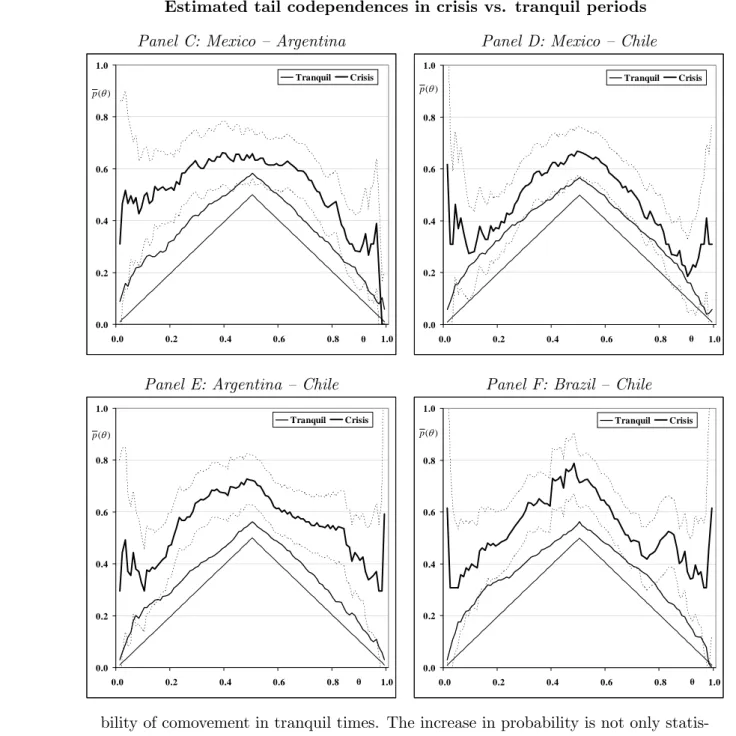
Figures 4A-4F represent the estimated conditional probabilities of comovement over crisis and tranquil times for all the country pairs. Notice that conditional prob-abilities are represented over the whole distribution and not only for lower and upper quantiles. Our approach permits to explore how and if the conditional probability
8Asymptotically, correct specification would imply the same number of exceedances in crisis and
tranquil periods. However, infinite samples, this need not to be the case. Failure to account for this fact would affect the estimation of the conditional probabilities.
of comovements changes for any interval in the support of the distribution. The at-tractiveness of inspecting all the quantiles lies in the fact that one does not need to arbitrarily specify a large absolute value return as a symptom of a crisis.
Figure 3
P-values of the Dynamic Quantile test
Thesefigures plot the p-values of the in-sample DQ test statistic of Engle and Manganelli (2004). The DQ statistic tests the null hypothesis of no autocorrelation in the exceedances of the quantiles, as the correct specification would require.
Panel A: Argentina 0 .0 0 .2 0 .4 0 .6 0 .8 1 .0 0 .0 0 .2 0 .4 0 .6 0 .8 1 .0 C A V ia R U n c o n d itio n a l p-v a l. θ Panel B: Brazil 0 .0 0 .2 0 .4 0 .6 0 .8 1 .0 0 .0 0 .2 0 .4 0 .6 0 .8 1 .0 C A V ia R U n c o n d itio n a l θ p-v a l.
Infigures 4A-4F two solid lines are plotted together with the case of independence. The thin line indicates the conditional probability of comovements under the
bench-mark or, equivalently, over tranquil times. This line is the graphical representation of p¯N(θ) in Definition 1. The thick line, instead, shows the conditional probability of comovements during crisis times and plots p¯C(θ). The confidence bands associated to plus or minus twice the standard errors are plotted as dotted lines. When the bold line lies above the benchmark, this can be interpreted as evidence for increased comovements or contagion. When the two lines approximately coincide, there is no difference in comovements between the two periods. Finally, if the thick line lies be-low the benchmark, during crises time the comovements between two different markets actually decrease.
The results for Argentina and Brazil (Panel A) show striking evidence of contagion for most quantiles. Only in the extreme upper and lower parts of the distribution, where standard errors become wider due to the limited number of exceedances, the probability of comovement in crisis time is not statistically different from the
proba-Figure 4
Estimated tail codependence likelihood in crisis vs. tranquil periods Thefigures plot the estimated probability that the second country equity index returns falls below (above) itsθ-quantile conditional on the first country index returns being below (above) itsθ-quantile forθ≤0.5
(θ > 0.5), in crisis and in tranquil periods. The quantiles of each returns series are estimated using conditional quantile regressions. The dashed lines are the two standard error bounds for the estimated co-exceedance likelihood in crisis periods. Daily index returns are from MSCI for the period January 1, 1988 to May 31, 2004 (nM ax=3,749, Chile-Argentina,nM in=3,682, Brazil-Argentina). The crisis sample
includes a maximum of 338 (Min: 322) observations and cover the sub periods November 1, 1994 to March 31 1995 (Tequila crisis), June 2, 1997 to December 31, 1997 (Asian crisis), and August 3, 1998 to December 31, 1998 (Russian crisis).
Panel A: Brazil — Argentina Panel B: Mexico — Brazil
0.0 0.2 0.4 0.6 0.8 1.0 0.0 0.2 0.4 0.6 0.8 1.0 Tranquil Crisis θ ) (θ p 0.0 0.2 0.4 0.6 0.8 1.0 0.0 0.2 0.4 0.6 0.8 1.0 Tranquil Crisis θ ) (θ p
Figure 4 - continued
Estimated tail codependences in crisis vs. tranquil periods
Panel C: Mexico — Argentina Panel D: Mexico — Chile
0.0 0.2 0.4 0.6 0.8 1.0 0.0 0.2 0.4 0.6 0.8 1.0 Tranquil Crisis θ ) (θ p 0.0 0.2 0.4 0.6 0.8 1.0 0.0 0.2 0.4 0.6 0.8 1.0 Tranquil Crisis θ ) (θ p
Panel E: Argentina — Chile Panel F: Brazil — Chile
0.0 0.2 0.4 0.6 0.8 1.0 0.0 0.2 0.4 0.6 0.8 1.0 Tranquil Crisis θ ) (θ p 0.0 0.2 0.4 0.6 0.8 1.0 0.0 0.2 0.4 0.6 0.8 1.0 Tranquil Crisis θ ) (θ p
bility of comovement in tranquil times. The increase in probability is not only statis-tically but also economically significant. For instance, the probability of comovement associated to the 10%-quantile jumps from about 24% in tranquil times to about 60% in crisis times. This implies that in quiet periods one should expect Brazilian and Argentinian equity returns to simultaneously exceed the 10%-quantile only one day out of four. In crisis periods, instead, this event will occur on average two days out of three. Similar patterns characterize the other country pairs, although the increases in
The interest may lie in testing whether specific parts of the distribution are subject to contagion. Rigorous joint tests for contagion which follow from the Definition 1 can be constructed as follows: b δ¡θ,¯θ¢ = (#θ)−1 P θ∈[θ,¯θ] [pC(θ)−pN(θ)] (13) = (#θ)−1 P θ∈[θ,¯θ] ˆ ˜ α2θ i,
where #θ denotes the number of addends in the sum andαˆ˜2
θi is defined in Theorem
2. For each country pair, table 2 contains the standard errors associated with the sum of αˆ˜2θ
i over θ. Panels A, B, and C report the test statistics computed over different
intervals ofθ.
Three interesting points emerge from a close examination of the table. First, the evidence of contagion is weakest between Mexico and Chile and Mexico and Brazil. The tests do not detect statistically significant increase in comovements during crisis periods for respectively, four and five of the 10 quantile ranges we consider. For all other country pairs there is evidence of contagion for most parts of the distribution. Second, there are instances where one part of the distribution is subject to contagion, while others are not. This is the case for Mexico and Brazil, for example where the test indicates statistically significant increases in comovements during crises for the lower tail but no increase in comovements in the upper tail. Notice that this analysis could not be carried out with tests based on the estimation of correlation coefficients (Forbes and Rigobon, 2002). Third, the tests get weaker as the range of θ for the tests is selected closer to the tails (see Panel C). This suggests that using only single quantiles may reduce the possibility of finding significant contagion and that a wider spectrum of quantiles is needed.
Overall, the table suggests that the distributions are characterized by strong asym-metries, which cannot be detected by simple correlation. Interestingly, the overall picture which emerges from table 2 is not in line with that of Forbes and Rigobon (2002), who did not find evidence of contagion between Mexico and the other Latin American countries.
6.1
Economic variables
Our methodology allows the researcher to control for common factors which may drive asset return comovements. Crisis and tranquil periods can be defined in terms
of economic variables, instead of being determined arbitrarily ex-post as in Forbes and Rigobon (2002). Potential control variables could be,inter alia, interest rate and bond yield differentials, return volatilities or cross-borderfinancial flows (an extensive list of potential control variables is given in Eichengreenet al., 1996). In equation (5) the dummy variableDtdetermining the crisis periods can be defined as those times where
each control variable takes a value above it100×kth percentile (wherekis defined as in Theorem 2, section 3.2).
As an illustration, in figure 5 we present an example of how to introduce eco-nomic variables in the comovement box. We define turbulent and quiet times in terms of high and low volatility, respectively. We compute the volatility of the aver-age returns on Argentinian and Brazilian stock markets as an exponentially weighted moving average (EWMA) with decay coefficient equal to 0.97. Next we identify as crisis periods the 10% number of observations with highest EWMA volatility, i.e.
DC t ≡I ³ σ2 EW M A,t> q0σ.290 EW M A ´
. In contrast to the findings of Bae, Karolyi and Stulz (2003), figure 5 shows that comovement likelihoods are not higher in periods of high return volatility: the estimated probability of comovements is lower when volatility is high. Hence periods of high returns volatility do not necessarily coincide with periods of crisis and cannot account for the contagion effects we document infigure 4.
7
Summary and conclusions
In this study we propose a new methodology to measure codependence across random variables. Our approach is based on conditional quantiles and permits to investigate whether codependence across series of interest changes over time or across economic environments. We compute, for all quantiles, the conditional probability that realiza-tion of one series fall in the left (or right) tail of their own distriburealiza-tion provided that the realization of the other series have fallen in the same tail of their own distribution. We estimate these conditional probabilities through a simple OLS regression of quan-tile co-exceedance indicator variables on a constant and economic indicator variables. We derive a simple but rigorous test of changes in comovements across time periods and market conditions. The fullrange of conditional codependence is conveniently visualized in what we call “the comovement box”.
As an illustration, we use our methodology to investigate the possible presence of contagion during crisis periods across the most important Latin American equity markets. Our results show that, on average, over turbulent times, comovements in equity returns across national markets tend to increase significantly, both in the left
Figure 5
Volatility Crisis for Brazil and Argentina
Thisfigure plots the probability of co-movements between Argentina and Brazil in high and low volatil-ity periods. 0.0 0.2 0.4 0.6 0.8 1.0 0.0 0.2 0.4 0.6 0.8 1.0
Low Volatility High Volatility
θ
) (θ
p
and in the right tail of the distributions, consistent with the existence of financial contagion.
A number of questions can be addressed within the framework we propose. For instance, a persistent issue in the literature is whether the increase infinancial markets comovements is due to economic linkages and common macro-economic conditions or to investor behavior unrelated to these fundamental links.9 A possible strategy to investigate this question would be to define the crisis periods in terms of a set of economic variables and then testing whether the associated coefficient is significantly different from zero. Surprisingly, when we define crisis as periods of high volatility, we find that returns comovements in the lower tail of the distribution are lower in high volatility periods than in times of low volatility.
The approach we advocate is very general. In finance applications, it can be useful for studies of financial contagion or financial stability, as well as for portfolio
9See Yuan (2005) for an example of a rational expectation model of contagious crisis unrelated to
allocation and risk management. The methodology allows the researcher to estimate the probability of comovements for different ranges of the return distribution and for different market conditions, while taking into account local and global economic forces that may drive returns comovements.
Other issues related to market linkages can be addressed as well. In the context of the European Union, for instance, there is strong interest in measuring and monitoring the degree of financial integration. Insights about this can be gained by investigating how the inter-relations among “New” and “Old” EU Member States’financial markets have evolved after accession.
References
[1] Ang, Andrew and Geert Bekaert, 2002, International asset allocation with regime shifts, Review of Financial Studies 15, 1137-1187.
[2] Bae, Kee-Hong, G. Andrew Karolyi, and René M. Stulz, 2003, A new approach to measuringfinancial contagion,Review of Financial Studies 16, 717-763. [3] Ball, Clifford A. and Walter N. Torous, 2005, Contagion in the presence of
sto-chastic interdependence, mimeo, UCLA.
[4] Cappiello, Lorenzo, Roberto De Santis, Bruno Gerard, Arjan Kadareja, and Si-mone Manganelli (2005), Financial convergence and integration of new EU mem-ber states, mimeo, ECB.
[5] Chernozhukov, V., and L. Umantsev (2001), Conditional Value-at-Risk: Aspects of Modeling and Estimation, Empirical Economics 26(1), 271-293.
[6] Chollette, Lorán, 2005, Frequent extreme events? A dynamic copula approach, mimeo, NHH Bergen
[7] Ciccarelli, Matteo and Alessandro Rebucci, 2003, Measuring contagion with a bayesian, time-varying coefficient model, ECB Working Paper No. 263.
[8] D’Agostino, Ralph B., Albert Belanger and Ralph B. D’Agostino Jr., 1990, A suggestion for using powerful and informative tests of normality, The American Statistician 44, 316-321.
[9] de Bandt, Olivier and Philipp Hartmann, 2000, Systemic risk: A survey, ECB Working Paper No. 35.
[10] De Santis, Giorgio and Bruno Gerard, 1997, International asset pricing and port-folio diversification with time-varying risk, Journal of Finance 52, 1881-1912. [11] Dungey, Mari, Renée Fry, Brenda González-Hermosillo, and Vance L. Martin,
2003, Empirical modelling of contagion: A review of methodologies, IMF Working Paper WP/03/84.
[12] Eichengreen, Barry J., Andrew K. Rose, and Charles A. Wyplosz, 1996, Conta-gious currency crises,Scandinavian Journal of Economics 98, 463-84.
[13] Engle, Robert F. and Manganelli, Simone, 2004, CAViaR: Conditional autore-gressiveValue at Risk by regression quantiles, Journal of Business & Economic Statistics 22, 367-381.
[14] Forbes, Kristin J. and Roberto Rigobon, 2002, No contagion, only interdepen-dence: Measuring stock market comovements,Journal of Finance 57, 2223-2261. [15] Gropp, Reint and Gerard Moerman, 2004, Measurement of contagion in banks’
equity prices,Journal of International Money and Finance 23, 405-459.
[16] Hartmann, Philipp, Stefan Straetmans and Casper G. De Vries, 2004, Asset mar-ket linkages in crisis periods,The Review of Economics and Statistics 86, 313-326. [17] Karolyi, G. Andrew, 2003, Does international financial contagion really exist?,
International Finance 6, 179-199.
[18] Karolyi, G. Andrew and René M. Stulz, 1996, Why do markets move together? An investigation of U.S.-Japan stock return comovements,Journal of Finance 51, 951-986.
[19] King, Mervyn, Enrique Sentana and Sushil Wadhwani, 1994, Volatility and links between national stock markets,Econometrica 62, 901-933.
[20] Koenker, Roger and Gilbert Bassett Jr. (1978), Regression quantiles, Economet-rica 46, 33-50.
[21] Longin, Francois and Bruno Solnik, 1995, Is the correlation in international equity returns constant: 1970-1990?, Journal of International Money and Finance 14, 3-26.
[22] Longin, Francois and Bruno Solnik, 2001, Extreme correlation of international equity markets,Journal of Finance 56, 649-76.
[23] Martens, Martin, and Ser-Huang Poon, 2001, Returns synchronization and daily correlation dynamics between international stock markets, Journal of Banking and Finance 25, 1805-1827.
[24] Patton, Andrew J., 2004, On the out-of-sample importance of skewness and asym-metric dependence for asset allocation,Journal of Financial Econometrics 2, 130-168.
[25] Pericoli, Marcello and Massimo Sbracia, 2003, A primer on financial contagion,
Journal of Economic Surveys 17, 571-608.
[26] Rodriguez, Juan Carlos, 2003, Measuringfinancial contagion: A copula approach, mimeo, CENTeR , University of Tilburg.
[27] Sander, Harald, and Stefanie Kleimeier, 2003, Contagion and causality: an empir-ical investigation of four Asian crisis episodes,Journal of International Financial Markets, Institutions and Money 13, 171-186.
[28] Yuan, Kathy, 2005, Asymmetric price movements and borrowing constraints: A rational expectations equilibrium model of crises, contagion and confusion, Jour-nal of Finance 60, 379-411.
Appendix A - Assumptions
Consistency Assumptions
C0. (Ω, F, P) is a complete probability space, and {yt, xt, ωt},t= 1,2, ...are random
variables on this space.
C1. The functions qtZ(βθiZ), Z =Y, X, i = 1, ..., m, a mapping from B (a compact subset of<p) to<are measurable with respect to the information setΩtand continuous
in B, for any given choice of explanatory variables {zt−1, ωt−1, ..., z1, ω1}, where zt =
yt, xt and ωt∈Ωt.
C2. hZt (z|Ωt) - the conditional density of zt - is continuous.
C3. There existsh >0such that, for all tand for alli= 1, ..., m,hθiZ
t (qtZ(βθ0iZ)|Ωt)≥
h. C4. |qZ
t (βθiZ)|< K(Ωt)for allβθiZ ∈B and for allt, whereK(Ωt)is some (possibly)
stochastic function of variables that belong to Ωt, such that E[K(Ωt)]≤K0 <∞.
C5. E[|zt|]<∞ for all t.
C6. {ρθi(zt−qtZ(βθiZ))} obeys the uniform law of large numbers.
C7. For every ξ > 0, there exists a τ > 0 such that if ||β −β0θiZ|| ≥ ξ, then lim infT→∞PP[|qtZ(βθiZ)−q
Z
t (β0θiZ)|> τ]>0.
Asymptotic Normality Assumptions
AN1. qZt (βθiZ),Z =Y, X, is differentiable inB and for allβ andγin a neighborhood
υ0 of β0θiZ, such that||βθiZ−γθiZ||≤dfordsufficiently small and for allt:
(a)||∇qZt(βθiZ)||≤F(Ωt), whereF(Ωt)is some (possible) stochastic function of
variables that belong to Ωtand E[F(Ωt)3]≤F0 <∞, for some constantF0.
(b) ||∇qZt (βθiZ)− ∇qtZ(γθiZ)||≤M(Ωt, βθiZ, γθiZ) =O(||βθiZ−γθiZ||), where
M(Ωt, βθiZ, γθiZ) is some function such that E[M(Ωt, βθiZ, γθiZ)
2]
≤ M0||βθiZ −
γθiZ|| < ∞ and E[M(Ωt, βθiZ, γθiZ)F(Ωt)] ≤ M1||βθiZ−γθiZ|| < ∞ for some
con-stants M0 andM1.
AN2. (a)hZ
t(z|Ωt)≤H <∞ ∀t.
(b)hZt(z|Ωt) satisfies the Lipschitz condition|hZt (λ1|Ωt)−hZt (λ2|Ωt)|≤L|λ1−
λ2|,∀t, for some constantL <∞.
AN3. The matricesAij andDθiZhave smallest eigenvalue bounded below by a positive
constant forT sufficiently large. AN4. The sequences {T−1/2PT
t=1[θi−I(zt≤qtZ(β0θiZ))]∇q
Z
t (β0θiZ)}obey the central
Variance-Covariance Matrix Estimation Assumptions
VC1. cˆT/cTp
→ 1, where the non-stochastic positive sequence cT satisfies cT = o(1)
andc−T1 =o(T1/2).
VC2. E[F(Ωt)4]≤F1<∞,∀t, whereF(Ωt) was defined in assumption AN1(a).
VC3. (a)T−1PTt=1∇qtZ(β0θiZ)∇0qtZ(β0θjZ)→p Aij (b)T−1PTt=1hθiZ t (qZt(β0θiZ)|Ωt)∇q Z t(β0θiZ)∇ 0qZ t(β0θiZ) p →DθiK (c)T−1PTt=1Ut h ∇0qtX(β0θi)R−∞0 ht(qXt (β0θi), y)dy+∇ 0qY t (β0θi) R0 −∞ht(x, q Y t (β0θi))dx i p → Gθi
Appendix B - Proofs of theorems in the text
Proof of Theorem 1
1. Symmetry: Ft−¡qY θt|qθtX ¢ ≡ Pr(yt≤q Y θt, xt≤q X θt) Pr(xt≤qXθt) = Pr(yt≤qYθt, xt≤qθtX) Pr(yt≤qYθt) ≡ F − t ¡ qX θt |qθtY ¢ , becausePr¡xt≤qXθt ¢ = Pr¡yt≤qθtY ¢=θ. Similar reasoning holds for Ft−¡qθtY |qXθt¢.
2. Co-monotonicity Lety1=qYθt and x2 =qθtX. ⇐=Supposefirst thatθ≤0.5. pt(θ)≡Ft− ¡ qY θt|qθtX ¢ =θ−1Ft ¡ qY θt, qθtX ¢ =θ−1FY t ¡ qY θt ¢ = 1. Suppose now that θ > 0.5. Note that Pr(yt ≥ qθtY, xt ≥ qθtX) = 1−Pr(yt ≤
qθtY)−Pr(xt≤qθtX) + Pr(yt≤qθtY, xt≤qθtX) = 1−θ. Therefore: pt(θ)≡Ft+ ¡ qYθt|qθtX¢= (1−θ)−1Pr(yt≥qYθt, xt≥qθtX) = (1−θ)−1(1−θ) = 1. =⇒ Let y1 = qYθ 1t, y 2 = qY θ2t, x 1 = qX θ1t and x 2 = qX θ2t, where θ1 < θ2. Sup-pose first that θ1 ≤ 0.5 and note that Pr(xt < x2|yt < y1) = Pr(x1 < xt <
x2|yt < y1) + Pr(xt < x1|yt < y1) = Pr(x1 < xt < x2|yt < y1) + 1. This
im-plies that Pr(x1 < xt < x2|yt < y1) = 0 and Pr(xt < x2|yt < y1) = 1. Therefore,
Ft(y1, x2) = θ1Pr(xt< x2|yt < y1) = θ1 = min{FtY(y1), FtX(x2)}. Suppose now that
θ1>0.5. Note thatPr(yt> y1|xt> x2) = Pr(y1< yt< y2|xt> x1) + Pr(yt> y2|xt>
x2) = Pr(y1 < yt< y2|xt> x2) + 1, which implies that Pr(y1 < yt< y2|xt > x2) = 0
andPr(yt> y1|xt> x2) = 1. Therefore,Ft(y1, x2) = Pr(xt> x2, yt> y1)+1−Pr(yt> y1)−Pr(xt > x2) = (1−θ2) Pr(yt > y1|xt > x2) + 1−(1−θ1)−(1−θ2) =θ1 = min{FtY(y1), FtX(x2)}. 3. Counter-monotonicity Lety1=qY θ1t,y 2 =qY θ2t,x 1=qX θ1t and x 2 =qX θ2t, where θ1< θ2.
⇐=There are two possible cases. 1) FtY(y1) +FtX(x2)≤1, which necessarily implies that θ1 ≤ 0.5. Therefore, Ft(y1, x1) ≤ Ft(y1, x2) = 0, implying Ft(y1, x1) = 0 and
pt(θ) = 0. 2) FtY(y1) +FtX(x2) > 1, which implies that θ2 > 0.5. Pr(yt > y1, xt > x2) = 1−FY t (y1)−FtX(x2)+Ft(y1, x2) = 1−FtY(y1)−FtX(x2)+[FtY(y1)+FtX(x2)−1] = 0. But since Pr(yt> y2, xt> x2)≤Pr(yt> y1, xt> x2) = 0,Pr(yt> y2, xt> x2) = 0 and therefore pt(θ) = 0. 4. Independence: ⇐= By independence Ft(y1, x1) = FtY(y1)FtX(x1). So Pr(yt ≤ y1 | xt ≤ x1) = Pr(yt≤y1) Pr(xt≤x1) Pr(xt≤x1) =θ. Q.E.D.
Proof of Corollary 1- Rewrite equation (B2) in the proof of theorem 2 of Engle
and Manganelli (2004) for yt,xt and allθi:
Dθ1YT 1/2(ˆβ θ1Y −β 0 θ1Y) d →T−1/2PT t=1ψt(β0θ1Y) Dθ1XT 1/2(ˆβ θ1X−β 0 θ1X) d →T−1/2PTt=1ψt(β0θ1X) .. . DθmYT 1/2(ˆβ θmY −β 0 θmY) d →T−1/2PT t=1ψt(β0θmY) DθmXT 1/2(ˆβ θmX−β 0 θmX) d →T−1/2PTt=1ψt(β0θmX) where ψt(β0θiY) ≡ [θi −I(yt ≤ qtY(β0θiY))]∇q Y t (β0θiY), i = 1, ..., m and ψt(β 0 θiX) is
defined analogously. Definingψt(β0θ
i)≡[ψt(β
0
θiY)
0, ψ
t(β0θiX)
0]0 and stacking every pair
Y and X together: Dθ1T 1/2(ˆβ θ1 −β 0 θ1) d →T−1/2PTt=1ψt(β0θ1) .. . DθmT 1/2(ˆβ θm−β 0 θm) d →T−1/2PTt=1ψt(β0θm) Stacking once again these relationships together, we get:
D T1/2(ˆβ−β0)→d T−1/2 T X t=1 ⎡ ⎢ ⎢ ⎣ ψt(β0θ1) .. . ψt(β0θm) ⎤ ⎥ ⎥ ⎦
The result follows from application of the central limit theorem (assumption AN4). Q.E.D.
Proof of Theorem 2 - We denote with PN and PC the summation over the
observations in benchmark and test periods. The OLS estimators for a generic θi are:
ˆ ˜ α1θi = P NItY X(ˆβθi) T −C