
machine learning in malware C&C detection : a survey. ACM Computing
Surveys, 49 (3). ISSN 1557-7341 , http://dx.doi.org/10.1145/3003816
This version is available at
https://strathprints.strath.ac.uk/66222/
Strathprints is designed to allow users to access the research output of the University of Strathclyde. Unless otherwise explicitly stated on the manuscript, Copyright © and Moral Rights for the papers on this site are retained by the individual authors and/or other copyright owners. Please check the manuscript for details of any other licences that may have been applied. You may not engage in further distribution of the material for any profitmaking activities or any commercial gain. You may freely distribute both the url (https://strathprints.strath.ac.uk/) and the content of this paper for research or private study, educational, or not-for-profit purposes without prior permission or charge.
Any correspondence concerning this service should be sent to the Strathprints administrator: [email protected]
On the security of machine learning in malware C&C detection: a
survey
JOSEPH GARDINER and SHISHIR NAGARAJA, Security Lancaster Research Centre, Lancaster University
One of the main challenges in security today is defending against malware attacks. As trends and anecdotal evidence show, preventing these attacks, regardless of their indiscriminate or targeted nature, has proven difficult: intrusions happen and devices get compromised, even at security-conscious organizations. As a consequence, an alternative line of work has focused on detecting and disrupting the individual steps which follow an initial compromise and that are essential for the successful progression of the attack. In particular, a number of approaches and techniques have been proposed to identify the command and control (C&C) channel which a compromised system establishes to communicate with its controller.
A major oversight with many of these detection techniques is the design’s resilience to evasion attempts by the well-motivated attacker. C2 detection techniques make widespread use of a machine learning (ML) component. Therefore, to analyse the evasion resilience of these detection techniques we first systematize works in the field of C&C detection, and then, using existing models from the literature, go on to systematize attacks against the machine learning components used in these approaches.
Categories and Subject Descriptors: C [Computer Systems Organization]; C.2 [ COMPUTER-COMMUNICATION NETWORKS]; C.2.0 [General]: Security and protection ; I.2.6 [Learning]; D.4.6 [Security and Protection]: Invasive software
General Terms: Security, Algorithms, Performance
Additional Key Words and Phrases: Command and Control channels, botnets, network intrusion, data min-ing, machine learning
ACM Reference Format:
ACM Comput. Surv.V, N, Article A (January YYYY), 38 pages.
DOI:http://dx.doi.org/10.1145/0000000.0000000
1. INTRODUCTION
In this survey, we focus on the evasion resilience of the machine learning component(s) of command and control detection systems. Malware detection and mitigation is an established problem. In the last several years, the number of attacks, their sophistica-tion, and potential impact have grown substantially. On one hand, indiscriminate at-tacks have continued to flourish: these atat-tacks are financially motivated, are responsi-ble for the compromise of large numbers of machines, and result in the theft of financial data, such as credit card numbers and online banking account credentials [Franklin et al. 2007], or used in carrying out attacks including Distributed Denial of Service (DDoS). Opportunist attacks usually result in the formation of a botnet, a coordinated collection of infected hosts under the control of an attacker.
Author’s addresses: Joseph Gardiner and Shishir Nagaraja, School of Computing and Communications, InfoLab21, Lancaster University, Lancaster, UK, LA1 4WA; email:{j.gardiner1, s.nagaraja}@lancaster.ac.uk Permission to make digital or hard copies of part or all of this work for personal or classroom use is granted without fee provided that copies are not made or distributed for profit or commercial advantage and that copies show this notice on the first page or initial screen of a display along with the full citation. Copyrights for components of this work owned by others than ACM must be honored. Abstracting with credit is per-mitted. To copy otherwise, to republish, to post on servers, to redistribute to lists, or to use any component of this work in other works requires prior specific permission and/or a fee. Permissions may be requested from Publications Dept., ACM, Inc., 2 Penn Plaza, Suite 701, New York, NY 10121-0701 USA, fax+1 (212) 869-0481, or [email protected].
c
!YYYY ACM 0360-0300/YYYY/01-ARTA $15.00
At the same time, targeted attacks have emerged as a new threat. These attacks target specific organizations or individuals with the intent of obtaining confidential data, such as contracts, business plans, and manufacturing designs [Gardiner et al. 2014].
Statistics and anecdotal evidence indicate thatpreventingattacks, either
indiscrim-inate or targeted, is difficult. For example, news reports have indicated that even secu-rity conscious, well funded organizations have fallen victims to attacks [Gardiner et al. 2014].
Considering the difficulties in effectively preventing attacks, defenders have looked
at ways ofdetectinganddisruptingthe individual steps that follow an initial
compro-mise and which are essential for the successful progression of an attack. This is the so-called kill chain approach to defence [Hutchins et al. 2010]. In particular, consid-erable effort has been spent in identifying the establishment of Command & Control (C&C) channels, i.e. the communication channel through which attackers control com-promised devices and receive feedback from them (for example any collected sensitive information).
A typical detection system consists of three main components: data collection, fea-ture extraction and a separation module. We discuss this in more detail in Section 3, but we provide a brief overview here. Data collection represents the measurement step - the collection of input to the system, for example netflow data from an network mon-itor. The feature extraction step processes this data into a form that is usable by the separation module. The output of this will usually be a set of data points representing entities that need to be separated, such as hosts on the network or observed domain names.
The separation module is responsible for making decisions based upon the data. This can take two approaches - one being to label data points as either benign or malicious (most systems will provide lower level detail for malicious points), the other is to group data points that share similar properties. This module is usually an implementation of a machine learning (ML) algorithm (in most cases, an existing, well known algorithm taken from the literature). The versions of these algorithms in use are not designed for an adversarial environment. Detection techniques using these algorithms do not consider the case where an adversary is actively attempting to avoid detection.
While some detection papers are providing discussion on evasion resistance, there is rarely any practical evaluation of the system’s evasion resilient properties. Meanwhile, there is a growing collection of literature discussing attacks against various machine learning algorithms. In Section 6, we bring out attack papers against a number of machine learning algorithms that are commonly used in C&C detection papers.
To achieve these goals, we start by providing a generalised model for C&C detection in section 3. Next, we review approaches for the detection of C&C activity, categorizing the different techniques in use (section 4). We then switch to an analysis of different techniques that attackers may use to evade existing defences by first looking at how to categorize attacks (section 5) and then by looking at existing literature in the space of attacks against machine learning (section 6), and finally identify open challenges and areas of research (Section 7).
Contributions:
— We provide a comprehensive review of C&C detection techniques (Section 4). — We identify weaknesses of the C&C detection systems by systematizing attacks
against the machine learning components (Sections 5 and 6), making use of models defined in the field of adversarial machine learning.
— We reason why secure ML algorithms are not in use in C&C detection systems (Section 7).
!"#$%%&'((&%#") *%'+&,) -$./0$.'(")
-$..&%1)&%1)
-$%20$,) 345,20&+$%)
Fig. 1. Malware attack life cycle.
— We identify open research challenges in the use of ML for C&C detection (Sec-tion 7.6).
2. THE COMMAND AND CONTROL DETECTION PROBLEM 2.1. Malware phases
Today, malware attacks are both indiscriminate, in the form of botnets, and targeted, evasive, and aimed at obtaining and exfiltrating sensitive data from specific individu-als or organisations. How are these attacks carried out in practice? While the specific attack steps and their naming may vary across publications, the literature agrees on the general structure of malware attacks, which is commonly represented as a se-quence of steps similar to those of Figure 1.
The command & control (C&C) phase is where the adversaries leverage the com-promise of a system. More precisely, comcom-promised systems are forced to establish a communication channel back to the adversary through which they can be directly controlled. The C&C channel enables an attacker to establish a “hands-on-keyboard” presence on the infected system (via so-called remote access tools), to install addi-tional specialized malware modules, and to perform addiaddi-tional malicious actions (e.g. spread to other machines or start a denial of service attack). This channel can either be centralised with a single (or small set of) control servers access by the malware, or decentralised in a peer-to-peer botnet where there is no central server present.
2.2. Focus of this paper
In this survey, we focus on the evasion resilience of the machine learning component(s) of command and control detection systems. Note that while we focus on the C&C phase, the data exfiltration stage uses many of the same channels as the C&C stage and so detection systems often cover both phases.
Command and control detection systems are distinct from host-based detection sys-tems. A C&C detection system will usually operate at a network gateway, where net-work traffic is collected, rather than on a per-host basis. The detection problem is particularly challenging due to the vast amount of legitimate network traffic gener-ated by normal network use (in a medium to large organisation this could easily reach terabytes a day). In the case of targeted malware attacks, the C&C traffic may only represent a minute percentage of the total traffic volume.
A further issue, in particular in the case of targeted attacks, is the desire of the attacker to remain undetected. While indiscriminate attacks (for example botnets) are relatively difficult to hide in the general case, it can be assumed that the well-motivated targeted attacker will put effort into evading the particular detection meth-ods in use.
A common feature of almost all C&C detection systems is the machine learning component used to make decisions about packets, or hosts, through the use of clas-sifying or clustering techniques. While detection systems do not purely comprise of a machine learning algorithm, it is one of the core components. It may not be possible for an attacker to evade the other stages of detection (as discussed in Section 3), so the logical next step is to attack the core machine learning component. However, in the research describing the design of such detection systems, there is little, if any,
(A) Data Generators (B) Data Aggregator Detection System (C)Pre-Processing (E) Data Reduction (F) Separation Module (G)Past Knowledge
Benign Points Malicious Points
(H) Output Processed Data Points
Raw Data
(D)Feature Extraction
Fig. 2. Generalised architecture of C&C detection systems
eration given to the security of the machine learning component. Meanwhile, there is an increasing volume of literature describing attacks against the ML algorithms used in these systems. While the attacks are often described in the non-specific scenario, many of the attacks could be transferable to the C&C case.
3. GENERALISED ARCHITECTURE FOR C&C DETECTION
We now present a generalised architecture for a typical C&C detection system, shown in Figure 2, and give a brief description of each component. This is a representation of a deployed system, where any training phases have already occurred.
3.1. Architecture
Data generators(A). The data generators represent the entities that produce the data evaluated by the detection system. These can take many forms. In the most common case, these will be individual hosts within a network that generate traffic, which can be assumed to be producing both malicious and benign data points. The data generators could also be honeynets or sandboxes, running malware in a con-trolled condition to extract it’s behaviour. In a large network, there could be tens or hundreds of thousands of traffic generators.
Data aggregator(B). The data aggregator collects data from the individual data generators into a single stream. The aggregator could be a network monitor on the edge of a large network, or on the ISP. Depending on the size of the monitored network, the aggregator may be hierarchical and be made up of different levels of aggregators at different vantage points. The aggregator could be the monitor around the honeynet/sandbox. It could also be covering external services, such as DNS. The data aggregator will usually apply the first round of filtering on the data. The major round of processing will be the removal of unwanted data. The unwanted data will be anything not needed for detection, and will typically be components such as the payload of packets. For example, if the aggregator is a traffic monitor, the monitor will often output the data as netflow records, and may apply sampling
(sflow) in order to control the amount of data collected due to storage/processing limitations.
It is important to note that the aggregator is outside of the detection system. The ag-gregator may be serving multiple detection systems, as well as network monitoring tools, simultaneously, and as such will be configured accordingly.
Pre-processing(C). The pre-processing step represents any processing of the data before the data goes through the feature extraction step. This could take many forms, for example removing data that is not useful for detection from packet data.
Feature extraction(D). This step extracts the features required for the machine learning component from the data to convert the processed data into a format that can be used by the selected algorithm. The features that are extracted are a design choice of the system, chosen to maximise the detection accuracy.
Optional: Data reduction(E). Some systems will often make use of extra steps in order to reduce the size of the data, and remove possible false positives. There are many techniques for doing this, but one of the most common is the use of whitelists in order to remove known benign data points, blacklists to remove known benign points (such as malicious domains) or use of a simple signatubased filter to re-move known, easy-to-detect malware.
Separation Module(F). The separation module is the key component of the detec-tion system, and is responsible for separating the input data points into a minimum of the broad classes of “benign” and “malicious”. In many systems this goes further, by splitting the two into finer categories, for example matching a malicious data point to a specific malware variant.
The separation module can take many forms. In some cases it may simply be an anomaly detector that identifies unusual behaviour compared to past behaviour. In the majority of cases it will be some form of machine learning algorithm, either supervised or unsupervised. For example, a supervised approach will use labelled data or signatures in order to assign categories to the new data points, while in the unsupervised approach clustering would be applied in order to separate the data. The separation module may apply multiple ML algorithms in multiple stages to achieve its goal.
If a classifier is in use, the classifier would have been trained using a labelled set of data before deployment. If an on-line clustering algorithm is in use, this module will include already clustered data to which the new point is added.
Past knowledge(G). The past knowledge component is used for supervised ap-proaches and represents the existing information which is fed into the system in or-der to classify the new data. In the case of an anomaly detection algorithm, the past knowledge would be previous behaviour that can be used for comparison purposes. If a classifier is used for the separation module, this could be a labelled dataset used to train the classifier, or a set of signatures. If a clustering algorithm is used, this past knowledge can be used to identify malicious and benign clusters.
Output(H). The system will usually, at the highest level, output two sets of points: malicious and benign. However, in many cases the separation will be more fine grained, with data points assigned more specific classes (for example malware vari-ant) in the supervised example, or groups of similar data points in the unsupervised example. In some cases, in particular in the case of an IDS, alerts will be outputted that identify hosts/entities that need to be investigated. These alerts may include extra information to assist network administrators in their investigations.
4. REVIEW OF CURRENT C&C DETECTION APPROACHES
Given the range of C&C design techniques, there is much interest in the design of techniques to localise C&C communication traffic by exploiting its special nature.
C&C detection falls broadly into three categories: signature-based, classifier-based and clustering–based. Signature-based detection systems attempt to recognise known pat-terns of behaviour in new behaviour, classifiers attempt to label samples using a model trained on past data, while clustering-based detection methods attempt to divide the malicious behaviour from the legitimate through statistical means.
We do not go into explicit discussion about C&C techniques in this survey, however we refer the reader to [Gardiner et al. 2014] for a survey on C&C techniques, including all those mentioned in this section.
4.1. Evaluation criteria
There are two primary measures of the success of a C&C detection system, the true positive (TP) rate and the false positive (FP) rate. The true positive rate measures the percentage of malicious samples that are labelled correctly as malware, while the false positive rate measures the number of legitimate samples that are incorrectly labelled as malware. There are of course other metrics used to evaluate machine learning, however the TP and FP rates are the most commonly provided amongst C&C detection literature and so we use these for comparison purposes. We also link the detection systems with the attacks against machine learning algorithms presented in Section 6.
4.2. Measurement and data collection
When detecting malware C&C, the selection of which data to collect and analyse is extremely important. For example, various detection methods require different lev-els of detail in the data. As networks scale, it will get progressively challenging to store all traffic — a requirement of most enterprise C&C detection techniques. Thus, if C&C traffic traces go unrecorded, then detection systems cannot work. While some techniques have been proposed to overcome the scalability limitations by developing sampling techniques, they do so without considering evasion resilience requirements. Also, little attention has been paid to tuning measurement in response to C&C evasion. Effective monitoring and data collection are crucial for detection techniques. Traffic monitoring is performed by routers, commonly using Netflow [Cisco Systems Inc. 2016] feature or the sFlow feature. Alternatively, standalone measurement devices observing traffic via network mirroring devices or splitters (optical or electrical) are more flexible than in-router methods [Cranor et al. 2003]. In both cases, traffic traces are exported to collectors which store the traces.
There are monitoring systems that claim to be able to store all of the data. This will be affected by scalability issues. Even if all of the data can be stored (which is not guaranteed on larger networks), the processing of the data (such as applying an C&C detection technique) is far less scalable and will almost certainly encounter issues on a large system.
4.3. Signature-based methods
In signature-based detection methods, malware C&C is detected by looking for known patterns of behaviour. Signatures are generated for known malware samples, and then new traffic is compared to these signatures [Jacob et al. 2011].
Signatures are generated by analysing confirmed C&C traffic collected from various sources. The primary sources are honeynets and sandboxes. Malware is run in con-trolled conditions, and its activity recorded. Most aspects of the malware’s network behaviour can be included in a signature, from statistical properties such as flow sizes, to detailed information such as packet contents.
4.3.1. Communication pattern detection.Malware variants often have very particular pro-tocols when it comes to communication. These are often noticeably different compared
to legitimate traffic, both in packet contents and in the behaviour of the communica-tion. This makes signature based detection methods very good for detecting known variants of malware. Many different pieces of malware may also be based upon a com-mon component, meaning that a single signature can be used to detect multiple pieces of similar malware. A popular method for detection is to produce signatures based upon the contents of packets. It is often the case that packets of data involved in the C&C of malware will be almost identical across multiple hosts. Even though some malware families use encryption in their communications, that encryption is usually a simple, lightweight algorithm (as the encryption is often for obscurity rather than security), so there are similarities among different ciphertexts. For example, in the work of Rieck et al. [2010], in which n-gram based signatures are generated for the payloads of malware that is run under controlled conditions in a sandbox. Signatures are also generated for legitimate traffic, and with this method the system can achieve detection rates of close to 95%, with a false positive rate of close to zero when running on a network gateway. Rossow and Dietrich [2013] extend this idea by providing a sys-tem for handling encrypted C&C channels. They leverage the fact that many malware variants use hard-coded, simple keys, and so they extract these keys through reverse engineering and attempt to decrypt all packets before pattern matching is applied.
Zand et al. [2014] propose a system for automatically generating text-based signa-tures for botnet detection. The system works by extracting common strings from ob-served traffic, and then ranking the collected strings by first clustering network traces, and then calculating the information gain for each string based upon the entropy of it’s appearance in clusters. The highly-ranked strings can then be used for generating sig-natures. The system is tested on traffic collected from 1.4 million malware samples. After manually analysing the top 100 strings, the system found 29 good signatures, 41 signatures for benign traffic and 30 unknown, which is an improvement on previous work [Kim and Karp 2004].
Further to this, Rafique and Caballero [2013] proposed a system for large-scale auto-matic signature generation. The system uses network traces collected from sandboxes and produces signatures for groups of similar malware, covering numerous protocols. This system is able to identify numerous malware examples with a high TP rate, and experiences a low false positive rate due to the specificness of the signatures gener-ated. The signatures are designed to be exported to intrusion detection systems such as Snort for use in on-line detection.
BotHunter [Gu et al. 2007] is a system for identifying compromised hosts based upon the actions they perform, more specifically the pattern of infection and initial connec-tion to a C&C server. There are 5 steps to this pattern: inbound scan, inbound exploit, binary download, outbound C&C communication and outbound infection scanning (for propagation). These steps are identified as being a good generalisation of the typical infection model for a botnet. Detection is performed by looking for combinations of these actions within a certain time period. Tested on a live campus network and the system is able to achieve a 95% TP rate and low false positive rate.
4.3.2. DNS traffic analysis.There has been a large amount of work which attempts to provide a detection mechanism that can identify domains associated with malware at the DNS level. As we have seen, DNS is used by a large amount of malware that makes use of a centralised command and control structure.
Nelms et al. [2013] propose ExecScent, a system for identifying malicious domains within network traffic. The system uses traces of known malware samples to create signatures. The signatures are not just based upon domains, but also the full HTTP requests associated with them. This system is unique, however, in that to reduce false positives the signatures are tailored to the network that they will be used on, based
upon the background network traffic. This accounts for the variance in the behaviour on different networks.
4.3.3. Malicious server detection. A slightly different approach is to attempt to detect the servers used for command and control directly. One approach for this is to use probing. Nappa at al. [2014] propose Cyberprobe, a system for automatically generating signa-tures for malware families by collecting traffic within a honeynets (and collecting data from public sources), clustering the traffic and creating a set of signatures for each clus-ter. The signatures are used to create probes. The system then probes IPs, and matches the responses to signatures to identify malicious servers. The system is extremely scal-able, and can perform a scan of the whole IPv4 address space. Xu et al. [2014] provide a follow-up piece of work which creates the signatures by applying dynamic binary analysis to malware samples. This has the benefit that signatures can be extracted without a working server (a limitation of network trace-based approaches). Both of these approaches were successful in identifying multiple new servers for certain mal-ware families, with 0% FP rates.
4.4. Classifier based methods
In a similar fashion to signature-based methods, classifier-based methods use past observations to assign labels to new samples. A classifier is trained using a dataset of labelled data with each point represented by a set of features. The labels for each data point in the dataset are known, making this an example of supervised learning.
The training data can be collected from many sources. Again, malicious data can be collected fro honeypots and sandboxes, or cam be collected from actual traffic that has been identified as malicious. Legitimate data is often collected from live network traffic that has any known maliciousness removed, or taken from known public sources. For example, sets of legitimate domains can be found by looking at the Alexa rankings.
4.4.1. Communication pattern detection. Rahbarinia et al. [2013] provide a two-step
sys-tem for identifying hosts participating in malicious P2P behaviour. First, a boosted
decision tree classifier identifies hosts that exhibit any P2P behaviour. Then, a 2-step process identifies the P2P network that the host belongs to. A classifier is trained for each different P2P application (the actual classifier is interchangeable, although
they test with theKNN,gaussian andparzenclassifiers), and then the host traffic
is passed through all classifiers. If one classifier outputs a score above a threshold, the
host is viewed as running that application. Arandom forestclassifier is used to solve
cases where two applications are matched. The first stage is able to identify P2P hosts with a TP rate of up to 90%, which can be boosted to 98.6% if the random forest clas-sifier is used with a short time window. The effectiveness of the application clasclas-sifiers varies effectiveness. For example, the legitimate applications and Zeus botnet can be identified with a 90% TP rate and at most 3% FP rate. The Storm and Waledac botnets achieve lower TP rates at 45% and 40% respectively, but with lower FP rates. The total misclassification error is 0.68%.
4.4.2. DNS traffic analysis. Exposure [Bilge et al. 2011] is a system for applying large-scale, passive DNS traffic analysis in order to identify malicious domains (not lim-ited to those related to C&C behaviour, rather those involved in any malicious be-haviour). The system extracts 15 features (time-based, DNS-based, TTL-based and do-main name based). A training set is built using sources of known benign and malicious
domains (Alexa ranking, blacklists etc). This is then used to train the J48classifier
(an implementation of C4.5 decision trees). The system is tested on 100 billion DNS queries, using 10-fold cross validation. The system achieves detection rates of up to 98.5%, with a false positive rate of around 1%. The authors state that an adversary
could possible evade the system through the use of rate-limiting DNS queries from infected hosts or by using uniform TTL values, although it is argued that these are unlikely to occur as they will lead to a drop in the performance of the malware.
Kopis [Antonakakis et al. 2011] makes use of the global view of the upper DNS hi-erarchy. In Kopis, a classifier is built that, instead of looking at the domains’ IP and name, looks at the hosts that make the DNS requests. This leverages the fact that malware-related domains are likely to have an inconsistent, varied pool of requesting hosts, compared to a legitimate domain which will be much more consistent. The geo-graphic location is also taken into account: requesters inside large networks are given higher weighting as a large network is more likely to contain infected machines. A
feature set representing this information is used to train arandom forestclassifier.
When tested on 5 months of data taken from two authoritative name servers, the sys-tem achieved up to a 98% TP rate with a 0.5% FP rate, and was even able to identify a new botnet based in China, which was later removed from the internet.
While not explicitly analysing DNS traffic, Ma et al. [2009] test the effectiveness of
three popular classifiers(bayes, SVM and logistic regression (LR)) in identifying
malicious domains. Datasets were created by combining blacklist data (for malicious domains) and online directory data (for benign domains) and then producing a dataset using a number of automatically extracted features. When tested using a 50-50 traing/testing split, the SVM and LR algorithms achieved error rates of 1-3%. The in-teresting point is that the Bayes classifier, often chosen for its speed and scalability, achieved a higher error rate of 2.5-5%. The authors also tested the case where test data from a different dataset (different directory and blacklist)to the dataset that was used for training is used. The error rate was increased to 44%, which shows that in some cases training and testing on data from the same source may not give accurate real-world results.
4.4.3. Malicious server detection.Probing is not the only technique used for detecting servers. Bilge et al. [2012] propose DISCLOSURE, a system for identifying malicious servers from netflow data, extracting features related to flow sizes, client access pat-terns and temporal behaviour. In particular, the system is designed to work on very large (ISP level) datasets, for which sampling may have been applied. Labelled netflow
records are used to train arandom forestclassifier, which is able to achieve detection
rates of 60-70%, with false positive rates of 0.5-1%. To reduce false positives, informa-tion about ASs (autonomous systems) is taken from three public malicious server lists (FIRE, EXPOSURE and Google Safe Browsing), and a reputation score is calculated for each AS using the information from all three sources. Servers found on networks with an AS score below a threshold are assumed to be false positives and so are ig-nored, as the associated network is assumed to not participate in malicious activities. The authors also test the evasion resilience of the system, by creating simulated net-flow traffic for two botnets that introduce random delays between network connections, and random padding to vary flow lengths, making the botnets appear more like benign servers. By feeding this netflow data into their classifier, they were able to a) success-fully detect the botnets, b) improve general detection rates and c) detect botnets that were not previously detected by their system (the netflow data that the detection was applied to was different to the data inputted into the classifier).
4.5. Clustering based methods
The main disadvantage of using a signature or classifier based detection method is that these systems are usually not as effective at detecting new, or updated, malware due to an inherent assumption of stationary data. As malware changes freuquently, every time a new variant of malware is discovered, or an existing piece updates itself,
the signatures have to be recreated or the classifier retrained. If the new variant is not discovered, then it is unlikely to be detected by these systems. Clustering based systems can account for unknown behaviour. In these systems, the algorithms attempt to separate different patterns of behaviour, without necessarily knowing itself what is malicious or benign. The output of clustering is often used to produce signatures.
One particular issue in detecting malware in large organisations is the problem of ”dirty” logs. This refers to the large variety in logs that are kept by different systems which are often incompatible and inconsistent, plus may also contain a large amount of duplication between different sets of logs. Yen at al. [2013] propose a solution to this in the form of Beehive. In Beehive, log data is first normalised; for example hosts are all mapped to IP addresses and timestamps are all converted to UTC. A set of features are then extracted for each host, which can be tuned to the setting, but as an example contain traffic volume information and enterprise policy breaches (for example
access-ing blocked pages). A iterative variant of k-meansclustering is then applied which
results in a set of outliers which are then labelled as suspicious. These hosts are then subject to manual investigation. When tested on a large enterprise network, the sys-tem produced alerts which were 25% malicious, 45% policy violations and 35% labelled as other.
Zhang et al. [2014] propose a system for detecting P2P botnets that differs from pre-vious attempts in that it is unsupervised, meaning no knowledge of existing malicious behaviour is required. The system first applies clustering of flows in order to identify hosts that have taken part in P2P activity, and then applies two layers of filtering and thenhierarchical clusteringin order to group hosts that are taking part in a mali-cious P2P network. They show that it can separate malimali-cious P2P traffic from benign with a 100% TP rate, and a low 0.02% FP rate.
In Botgrab, Yahyazadeh and Abadi [2014] also cluster flows using a custom online flow clustering algorithm, but then apply a reputation engine to identify hosts that have a negative reputation. Reputation is based upon participation in coordinated ac-tivities, an indication of botnet membership. The reputation engine can be combined with knowledge of hosts participating in malicious activities (for example DDoS) to achieve a true positive rate of at least 97% and FP rate of at most 2.3% (if malicious activities knowledge is not used this is reduced to 92% and 2.02%).
Yen and Reiter [2008] propose T ¯AMD, a system for identifying candidate groups of
infected computers within a network by aggregating similar flows. Three aggregators extract aggregates of hosts based upon communication destinations, packet payloads and the host platform (OS). In particular, the destination aggregator makes use of a
k-meansclustering variant. This system is able to identify all of the malicious hosts in most cases (when VM outputs are inserted into background traffic), except for an IRC botnet which achieved a 87% detection rate.
4.5.1. DNS traffic analysis.We have already discussed signature and classifier based detection systems that make use of DNS traffic analysis. We will now explore sys-tems that use clustering based methods. One proposed detection method is to make use of the reputation of domain names to decide if they are related to malicious ac-tivities [Antonakakis et al. 2010]. In this system (Notos), domains are clustered first by the IP addresses associated with them, and secondly according to similarities in
the syntactic structure of the domain names themselves. Thek-meansclustering
al-gorithm is used. These clusters are then classified as malicious or not based upon a collection of whitelists and blacklists: domains in a cluster that contains blacklist do-mains are likely to be malicious themselves. This system is run on local DNS servers and can achieve a true positive rate of 96% and a low false positive rate.
In an attempt to identify domains accessed as the result of a DGA, Schiavoni et al. [2014] apply clustering to domains extracted from DNS queries. The system first filters and removes domains that are human pronounceable, The remaining domains
are then clustered with those collected from blacklists using theDBSCANclustering
algorithm, using features related to the IPs that the domains resolve to. These clusters are used to extract fingerprints, which are used to match new domains to known DGAs. When tested on a 3-month dataset taken from the DNSDB, with Conficker, Torpig and Bamital domains inserted, the system could filter out 50%, 35% and 62% of the DGA domains respectively, resulting in recall between 81 and 94%. The system also contains an intelligence module, that is able to track the evolution of IPs that groups of domains point to in order to monitor changes in botnet behaviour.
4.5.2. Fast flux detection. In a fast flux network (FFSN) the command and control server is hidden behind a proxy of numerous compromised hosts. Performing DNS queries on the domain of the server will return a large, and constantly changing, set of IP addresses. As you may expect, this type of behaviour is relatively easy to detect.
There are some differences between fast-flux service networks (FFSNs) and content delivery networks (CDNs) [Holz et al. 2008]. To detect a FFSN is a simple process, due to the two characteristics of an FFSN: short TTL values in DNS responses and non-overlapping DNS responses.
It is also possible to automatically detect which domains belong to the same FFSN.
In Fluxbuster, Perdisci et al. [2012] applyhierarchicalclustering to domains so they
are grouped according to overlap in the returned IP addresses. By then comparing the
clusters to previously labelled data, they can be classified (using therandom forest
classifier as flux or non-flux, revealing domains that make use of the same network. Tested on five months of live traffic data, the system is able to identify domains with a less than 1% FP rate,
4.6. Hybrid detection systems
BotMiner [Gu et al. 2008] is a system for detecting infected hosts without previous knowledge of specific botnets. In this system, bots are identified by clustering hosts that exhibit similar communication and (suspected) malicious activities. Activities
are monitored using custom signatures for the Snort IDS. The clustering (x-means)
groups hosts according to the botnet that they belong to, using the fact that hosts within the same botnet are likely to exhibit similar communication patterns, and will usually perform activities synchronously (such as DDoS attacks). When tested on 10 days of university traffic, with the traffic of 8 botnets inserted, the system achieved a 100% TP rate for 6 out of the 8 botnets, with the other two achieving TP rates of 99% and 75%. The system achieves a low false positive rate.
Antonakakis et al. [2012] describe a system for identifying previously unseen do-main generation algorithms (DGAs) by taking advantage of the fact that DGAs result in large amounts of Non-Existent Domains (NXDomain) responses, and bots within the same botnet will generate similar NXDomain traffic. The system has a 3 step
pro-cess. First, domains are clustered in two different ways using thex-meansalgorithm,
first by string-based features of the domain name, and secondly by domains which share source hosts. These two sets of clusters are then combined through intersection, and any clusters small enough discarded. These clusters are then passed to a
filter-ing step, that makes use of a multi-class variant of theAlternating Decision Trees
(ADT) classifier (trained on previously discovered DGAs) to remove known DGAs. The system then produces a Hidden Markov Model (HMM) for each DGA that can be used to evaluate single domain names. When tested on the traffic data from a US ISP over a 15 month period 360,700 NXDomains were discovered, queried by 187,600 distinct
hosts. The system identified 12 DGAs, of which 6 were new. For assigning domains to known DGA algorithms using the HMMs, TP rates of 99.7% and FP rates of 0.1% can be achieved.
4.7. Graph-based detection
A slightly different approach for detection is to make use of graph based detection approaches. These are becoming important due to the ability of graphs to be able to naturally represent communication patterns. While these approaches do not directly relate to the discussion on ML attacks, we include to provide examples of upcoming non machine learning based detec-tion methods.
Several works [Collins and Reiter 2007; Iliofotou et al. 2008; Iliofotou et al. 2009; Zhao et al. 2009; Jelasity and Bilicki 2009] have applied graph analy-sis to detect botnets. The technique of Collins and Reiter [Collins and Reiter 2007] detects anomalies induced in a graph of protocol specific flows by a bot-net control traffic. They suggest that a botbot-net can be detected based on the observation that an attacker will increase the number of connected graph components due to a sudden growth of edges between unlikely neighbour-ing nodes. While it depends on beneighbour-ing able to accurately model valid network growth, this is a powerful approach because it avoids depending on proto-col semantics or packet statistics. However this work only makes minimal use of spatial relationship information. Additionally, the need for historical record keeping makes it challenging in scenarios where the victim network is already infected when it seeks help and hasn’t stored past traffic data. Il-liofotou et al. [2008; 2009] also exploit dynamicity of traffic graphs to classify network flows in order to detect P2P networks. It uses static (spatial) and dynamic (temporal) metrics centred on node and edge level metrics in ad-dition to the largest-connected-component-size as a graph level metric. Bot-grep [Nagaraja et al. 2010] proposes a data mining technique to discover P2P graphs based on searching for expander graphs using random walks. Boty-acc [Nagaraja 2014] performs a similar operation, by producing a dual graph of the communication graph, applying the Laplace-Beltrami operator to re-duce the dimensionality of the data and the applying random walks to ex-tract P2P networks. This can achieve detection rates of up to 99%, with an false positive rate below 0.1%.
Invernizzi et al. [2014] make use of a graph-based approach in order to detect the binary download stage of the malware infection process in large scale networks. Information collected from HTTP traffic is used to build undirected neighbourhood graphs, where nodes represent IP addresses, do-main names, FQDNs, URLs, URL paths, file names, and downloaded files (represented as hashes). A graph is generated for each host that exhibits malware-related behaviour (such as domain-fluxing). Graphs are then as-signed a metric, based upon the graph properties, on the likelihood that the candidate is malicious. When tested on a week-long ISP dataset, the system can achieve 60% precision and 90% recall on the malicious class, and 99.69% precision and 98.14% recall on the benign class, and is successful in identify-ing a large number of malicious downloads.
Manadhata et al. [2014] incorporate belief propagation into a graph model for detecting malicious domains. An undirected graph is produced, where nodes are hosts and domains, and edges go from hosts to domains they access. Using a ground truth instantiated from public whitelists and blacklists, be-lief propagation is applied until stabilisation occurs, with a domain labelled
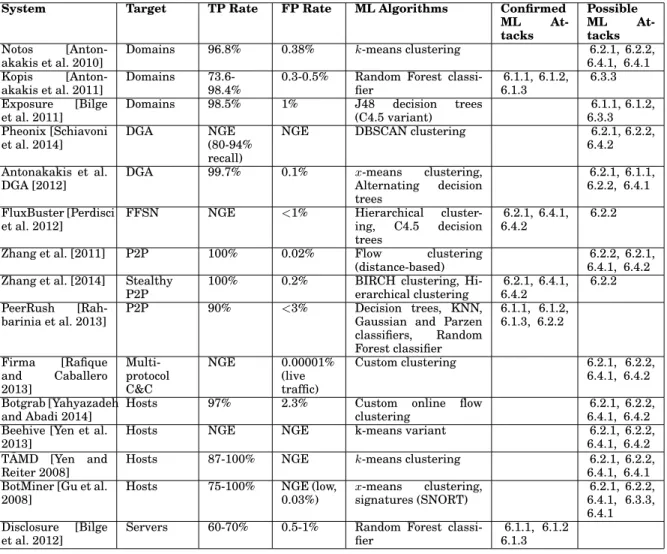
Table I. Performance, and ML technique, of a variety of detection systems. Final two colums represent section numbers in this survey (NGE = not explicitly given in paper)
System Target TP Rate FP Rate ML Algorithms Confirmed ML At-tacks Possible ML At-tacks Notos [Anton-akakis et al. 2010]
Domains 96.8% 0.38% k-means clustering 6.2.1, 6.2.2,
6.4.1, 6.4.1 Kopis
[Anton-akakis et al. 2011]
Domains 73.6-98.4%
0.3-0.5% Random Forest classi-fier 6.1.1, 6.1.2, 6.1.3 6.3.3 Exposure [Bilge et al. 2011]
Domains 98.5% 1% J48 decision trees
(C4.5 variant) 6.1.1, 6.1.2, 6.3.3 Pheonix [Schiavoni et al. 2014] DGA NGE (80-94% recall)
NGE DBSCAN clustering 6.2.1, 6.2.2,
6.4.2 Antonakakis et al.
DGA [2012]
DGA 99.7% 0.1% x-means clustering,
Alternating decision trees 6.2.1, 6.1.1, 6.2.2, 6.4.1 FluxBuster [Perdisci et al. 2012]
FFSN NGE <1% Hierarchical
cluster-ing, C4.5 decision trees
6.2.1, 6.4.1, 6.4.2
6.2.2
Zhang et al. [2011] P2P 100% 0.02% Flow clustering
(distance-based)
6.2.2, 6.2.1, 6.4.1, 6.4.2 Zhang et al. [2014] Stealthy
P2P
100% 0.2% BIRCH clustering,
Hi-erarchical clustering 6.2.1, 6.4.1, 6.4.2 6.2.2 PeerRush [Rah-barinia et al. 2013] P2P 90% <3% Decision trees, KNN,
Gaussian and Parzen classifiers, Random Forest classifier 6.1.1, 6.1.2, 6.1.3, 6.2.2 Firma [Rafique and Caballero 2013] Multi-protocol C&C NGE 0.00001% (live traffic) Custom clustering 6.2.1, 6.2.2, 6.4.1, 6.4.2 Botgrab [Yahyazadeh and Abadi 2014]
Hosts 97% 2.3% Custom online flow
clustering
6.2.1, 6.2.2, 6.4.1, 6.4.2 Beehive [Yen et al.
2013]
Hosts NGE NGE k-means variant 6.2.1, 6.2.2,
6.4.1, 6.4.2 T ¯AMD [Yen and
Reiter 2008]
Hosts 87-100% NGE k-means clustering 6.2.1, 6.2.2,
6.4.1, 6.4.1 BotMiner [Gu et al.
2008]
Hosts 75-100% NGE (low,
0.03%) x-means clustering, signatures (SNORT) 6.2.1, 6.2.2, 6.4.1, 6.3.3, 6.4.1 Disclosure [Bilge et al. 2012]
Servers 60-70% 0.5-1% Random Forest
classi-fier
6.1.1, 6.1.2 6.1.3
as malicious if the final belief value is above a threshold. This can achieve a TP-rate of 95.2% and an FP rate of 0.68%. They also show that the system can be run in near real time (processing 3 hours of data takes 16 minutes) mean-ing that malicious domains could be detected within 16 minutes of them first appearing.
5. CATEGORIZING ATTACKS AGAINST MACHINE LEARNING
As is evident in Section 4, many (if not most) detection systems make use of a machine learning algorithm (or set of algorithms) as the main component of the system for either identifying or isolating C&C traffic. Before we discuss specific attacks against the machine learning algorithms in section 6, we first discuss how to categorise attacks using various models from the literature. We also point out some of the weaknesses of the ML algorithms, and define the general threat model.
5.1. Weakness of ML algorithms
Early command and control detection systems were designed for detection of indis-criminate malware attacks, however the world has since changed. There has been an increase in more sophisticated, targeted malware attacks that specifically try to evade specific detection/ML systems. According to Verizon [Verizon RISK Team 2013], these now make up 25% of all attacks. The ML algorithms used in the early detection sys-tems as discussed in Section 4 is in their design intentions. The ML algorithms were designed for use in situations where an adversary is not trying to have an impact on the outcome of the algorithm. The same machine learning algorithms are still in use, even in work published within the last year, whereas the attack field has evolved from indiscriminate to targeted attackers. Even though the security community [Barreno et al. 2010; Barreno et al. 2008] agree that a threat model should be constructed be-fore the learning component is designed, this step is missing from the ML component design step in almost all detection systems. Performance of the learning component in ideal conditions is usually the primary consideration when choosing an algorithm. An interesting paper from Mersinal et al. [2015] discovers through surveying that IT security professionals (non-academics) are risk adverse, and will generally favour se-curity over operability. This contradicts what we see in C&C detection papers, where performance in terms of both processing time and TP and FP rates is the driving force behind the choice of algorithm, with a lack of proper security considerations.
5.2. Attacker
The attacks described in this section are, in most cases, too advanced for the indiscrim-inate attacker, for example an independent botmaster using a purchased rootkit. For the indiscriminate attacker, the target for attack is in the most case individuals and small businesses who are unlikely to have any sort of detection system past simple, consumer anti virus products that can be easily evaded.
For the well-resourced and well motivated (e.g. state sponsored) targeted attacker, these attacks are well within their capability. These attackers are knowledgeable pro-fessionals who can put in the effort required to carry out the attacks, due to the large “profit” (in terms of money, information and disruption depending on the target) that may be gained.
5.3. Categorising attacks
Barreno et al. [2006; 2011] devise a set of properties for categorising attacks against machine learning algorithms (in particular, supervised-learning algorithms) (Table II). Their categorisation takes into account the goals of the attack in terms of the specificity (targeted or indiscriminate), the security violation being instigated (integrityor
availability) and the influence of the attack (causativeorexploratory).
5.4. Attack goals
At the broadest level, the attacker will have one of two goals:
— The attacker will want to achieve anonymity in the sense that they want to hide their presence.
— The attacker wants to compromise the integrity of the detection technique so that it becomes unusable.
While both attacks will achieve the same end goal of the attacker avoiding detection, in the second case the defenders will be aware that they are under attack, alerting them to the attacker’s presence. In the first case, however, the attacker’s presence is not revealed.
Table II. Properties of attacks against supervised learning classifiers according to Bar-reno et al. [2006]
Description
Influence Causative Alter the training process through in-fluence over the training data Exploratory Do not change training data, but use
techniques such as probing or offline analysis to discover information Specificity Targeted Focus a particular point, or set of
points
Indiscriminate Attacker has flexible goal, such as to increase false positives
Security Violation Integrity Results in intrusion points being la-belled as normal (false negatives) Availability Results in many classification errors
that increases both false negatives and false positives, resulting in system be-coming unusable.
Feature Set Training
Dataset Classifier Algorithm O F FTC TC FC FT C T
Fig. 3. Levels of attacker knowledge according to Srndic and Laskov [ ˇSrndic and Laskov 2014]. O indicates attacker has little knowledge of any component.
These goals can be expressed more precisely using the Barreno model, and subse-quent expansion by Biggio et al. [2014b]. Biggio et al. expand the Barreno model to represent attacks against classifiers, but similar goals apply to attacks against clus-tering algorithms. The Biggio model makes use of the specificity and security violation classifications from the Barreno model, with the addition of the “privacy” security vio-lation, indicating a case where an attack will try to gain information from the classifier.
5.5. Attacker knowledge
One of the main considerations when discussing an attacker is the level of knowledge that an attacker has about the target system. In their attack against the PDFRate system, ˇSrndic and Laskov [2014] split this into knowledge about the classifier (and it’s parameters), the feature set in use and the training set. The attack knowledge is then a combinations of these, with knowledge of all three being the “perfect” case. This is illustrated in Figure 3. There is also the case that the attacker can gain no knowledge at all. This model can be transferred to the clustering example, by replacing “training dataset” with “test dataset” and “classifier algorithm” with “clustering algorithm”. It is worth noting, however, that knowledge of the test dataset in a clustering algorithm is different to that of the training data used in a classifier. The training data used within a classifier is pre-existing and may be publicly available so could easily be gained by the attacker. However, the input to a clustering algorithm (test dataset) includes all
the new data (in the network example the new traffic data) so is more likely to only be estimated by the attacker.
Biggio et al. [2014b]. classify attacker knowledge specifically for the classification setting with more detail. As well as knowledge of the (1) training data and (2) feature set, they also incorporate the knowledge of the (3) learning algorithm and its decision function, (4) the decision function and its parameters and (5) the feedback available from the classifier (for example the class labels applied to sample queries from the attacker).
The attacker knowledge can vary between systems. There is a difference in systems that stem from published research, to commercially designed systems. Research pa-pers that describe the design of systems are likely to, at a minimum, contain the ML algorithm in use, plus also the training/test data used (which may be publicly avail-able) and at least a subset of the features used. Any production system that is released as open source software reveals the ML algorithm and feature set, although the train-ing data may be user specific. For commercial, closed source software, probtrain-ing attacks or reverse engineering can be used in order to discover at least partial information about the system [Corona et al. 2013].
The targeted attacker can improve their knowledge through research and social en-gineering techniques. For example, the motivated attacker could learn of contracts between an organisation and detection system provider, leading them to learn the de-tection system in use.
5.6. Attacker Capability
It is also important to consider the capability of the attacker. We assume that the attacker has no access to the control (ML) algorithm itself, rather they are limited to modifying the input (training or testing) data.
The ability of the attacker to change the data is in part limited by the specific ap-plication under consideration. For example, in the case of PDF files certain features can be changed freely, while changing some features has a direct impact on other fea-tures [ ˇSrndic and Laskov 2014].
Biggio et al. [2014b] define the capability of an attacker (against classification algo-rithms) using four measures:
(1) The attacker influence in terms of causative or exploratory. (2) Whether (and to what extent) the attack affects the class priors.
(3) The amount of and which samples (training and testing) can be controlled in each class.
(4) Which features, and to what extent, can be modified by the adversary. This is also applicable to the clustering scenario (minus (2)).
5.7. Key terms
Some key terms that we will use throughout the rest of this section are as follows:
Learner. This refers to the machine learning algorithm
Surrogate learner. A surrogate learner is a copy of the learner produced by the ad-versary for testing attacks before they are carried out against the target. The sur-rogate has differing levels of completeness based upon the attacker knowledge. For example, the dataset in use could be an estimation of the one used by the target, or the learning algorithm, if unknown, could be substituted.
Production learner. The production learner is the instance of the learner in use by the target.
6. A SURVEY OF ATTACKS AGAINST MACHINE LEARNING ALGORITHMS
In this section we discuss attacks, taken from from the literature, against the machine learning algorithms used in the malware C&C detection systems found in Table I. We group attacks by their goal (evasion or poisoning), and by the group of algorithms affected (classifiers or clustering). We then present a number of techniques for each, give examples of demonstrated attacks from the literature and discuss any limitations of the attacks. Attacks are categorized according to the models defined in section 5. In section 7 we discuss the impact of these attacks in C&C detection problems.
We also look at some of the existing host-based techniques used by current malware to evade detection.
6.1. Evasion attacks - classifiers
6.1.1. Mimicry attack.Wagner and Soto [2002] introduced the idea of a mimicry attack, an attack in which the goal is to craft an attack point that appears as a benign point,
hence is an example of anexploratory, integrityattack, that can be eithertargeted
orindiscriminate. The attack either aims to move the attack point into the benign area (indiscriminate), or attempts to mimic a particular benign point (targeted). The attack attempts to modify the features of the attack point such that an anomaly de-tector or classifier labels the point as benign. The attack is limited by the ability of the attacker to modify the features under consideration by the learner. This attack typically does not require knowledge about the classification algorithm in use, as the attack is focused on exploiting knowledge of the distribution of malicious and benign points.
Affected algorithms.The mimicry attack works by effectively reducing the distance between the attack point and benign points. The attack has been demonstrated against the random forest, Bayes and SVM classifiers. As random forest is a multiple decision tree based classifier, the attack should also be effective against single decision tree-based algorithms such as C4.5. Biggio et al. [2013] demonstrate a gradient descent attack which theoretically works against any classifier with a differentiable discrimi-nant function, including SVMs and neural networks.
Demonstrated attacks.Wagner and Soto [2002] demonstrate the mimicry attack against a host-based IDS, with a goal of identifying any traces of system calls that are accepted by the IDS, but still carry out some malicious activity. The attack can be performed by either adding no-ops (system calls that have no side effect on the sys-tem) or by removing system calls that cause alarms by replacing them with a different sequence of calls, that achieve the same end result (in exploiting the system). An exam-ple of this is to replace a sequence that opens up a root shell, with one that adds a new root user to the shadow file. The attack is mimicry due to the fact that the attackers find a sequence of calls that are accepted (labelled as benign) by the IDS, and so the attack “mimics” a legitimate sequence of system calls. The attack is tested against the pH IDS [Somayaji and Forrest 2000], by modifying the autowx attack script exploit. The attack is shown to be able to successfully evade the IDS.
ˇSrndic and Laskov [2014] demonstrate a mimicry attack against PDFRate [Smutz and Stavrou 2012], a system for the detection of malicious PDF files. PDFRate uses the random forest classifier to assign a score to PDF files, indicating their mali-ciousness. The system extracts 202 features by reading the file at the byte level, and applying regular expressions to extract the feature values. By inserting data into to the space between the cross-reference table and the trailer in the PDF file, attacks can be performed that will influence the output of PDFRate, but will not affect the rendering of the file in a normal pdf reader, which will parse the file and skip that
data. To perform a mimicry attack,the modifiable features are set to match those of a benign file. The attack, using a surrogate classifier, tries different benign files until one is found that suitably reduces the score outputted by the surrogate. The paper focuses on attacks where the feature set is known (around 70% of the features are described in the original paper). Attacks are tested first on a local version of PDFRate that is built using the available knowledge based upon the adversary, and then the best strat-egy is applied and the result uploaded to PDFRate, with a goal of reducing the score assigned to the file. The attacker can modify the values of 35 features and increment a further 33. This is partly limited by the inter-dependability of the features. The at-tacks when applied onto files, which are then uploaded to PDFRate, can reduce the outputted score by 28-42% for attacks. Interestingly, when using a surrogate
classi-fier using SVMrather than random forest, and then uploading the attack points to
PDFRate, the scores outputted by PDFRate are still significantly reduced.
Biggio et al. [2013] demonstrate a mimicry attack with a gradient descent component
against theSVMclassifier and aneural network. The attack is considered in both
the perfect knowledge (PK) situation, where the attacker knows all components of the classifier, and the limited knowledge (LK), where they only know which classifier is in use and the feature set, but not the training data or trained classifier (although they can produce an estimated surrogate training set). The attack modifies feature values until the attack point changes label. This is performed using a gradient descent approach with a component that favours points that imitate benign points. Including the mimicry attack makes the attack sub-optimal (when compared to the non-mimicry version described in section 6.1.2). The attack is tested on two datasets, a dataset of handwritten digits (represented as grey scale images) for the perfect knowledge case using a linear SVM classifier, and for the case of malicious PDF detection (with features extracted according to previous work by Maiorca et al. [2012]) in both the PK and SK cases, using both SVM and neural networks. The handwritten digits were modified by changing the grey scale pixel values, which the PDF files were modified by adding objects (and therefore keywords). In the handwritten digits example using SVM with the linear kernel, the attack when containing the mimicry component is slower (requiring more iterations), but can cause the digits to appear as another, and in the limited knowledge case could lead to a higher probability of evading the target classifier, requiring up to 50 modifications to achieve a false negative (FN) rate of 1. In the malicious PDF example, using linear SVM, the mimicry attack is effective in both the PK and LK cases. 50 modifications (iterations of the gradient descent) increases the FN rate to 1 or 0.75 for the PK and LK cases respectively. For the RBF kernel, 15 modifications still increases the FN rate up to around 0.8 in the PK case, or 0.6 in the LK case.. The neural network is more susceptible to the mimicry attack, requiring only 20 modifications in the perfect knowledge case to result in an FN rate of 1, while in the limited knowledge case an FN rate of 0.5 can be achieved with 50 modifications. When not using the mimicry component, 50 modifications in the PK case only results in a FN rate of 0.2. It is explained that as the pure gradient descent only finds a local minimal, this may not be enough to evade, however when incorporating the mimicry component the attack point is drawn towards an area densely populated by benign points.
Traffic morphing, which shares similarities with the mimicry attack, has been shown
to be effective against the Bayesclassifier. Wright et al. [2009] show that it can be
enough to simply emulate the traffic feature(s) that is the focus of the detection system. They show that this works in the case of identifying web pages by traffic volume using the bayes classifier, for which the accuracy can be reduced from 98% to 4%, or 63% if the classifier is trained with attack samples.
Attack limitations.The attack is limited in two ways. First, there could be features that are not modifiable to the extent required to perform the attack. There is also a limit on how far the malicious sample can be changed — the sample still needs to serve it’s original, malicious purpose. For example, in network traffic destination IP addresses cannot be chosen arbitrarily. The attack also requires knowledge of what is seen as normal in the production learner, which may not be available (although this can usually be estimated).
6.1.2. Gradient descent attacks.The gradient descent attack is a relatively common at-tack within the literature. The gradient descent atat-tack is applied to both classifiers and clustering algorithms, and applies a gradient descent function in order to find a state for the attack point that achieves the desired result (point misclassified). Gra-dient descent is an optimisation algorithm that aims to minimise functions by itera-tively moving a point (by changing parameter values) in the negative direction of the
function gradient. In the evasion case, these are examples ofexploratory integrity
attacks. The typical approach is to generate an attack point and test its effectiveness on a surrogate learner. If the point is not sufficient, the gradient descent is applied, a new point generated and that tested until the desired result is achieved. In some cases, the gradient descent can be combined with a mimicry component to launch a targeted attack.
Affected algorithms.Because the gradient descent attack is not targeting a partic-ular design component of classifiers, the attack is applicable to most classifiers. The attack finds any attack point that achieves the desired result for the attacker. For ex-ample, the technique used by Biggio et al. [Biggio et al. 2013], while only tested using SVM and neural networks, is theoretically applicable to any classifier with a differen-tiable discriminant function. We found example works (discussed below) against the SVM and random forest classifiers, as well as neural networks.
Demonstrated attacks. ˇSrndic and Laskov [2014] apply a gradient descent-kernel
density estimation (GD-KDE) attack against the PDFRate system for detecting mali-cious PDF files (as described in section 6.1.1). The GD-KDE attack is used as a compar-ison to the mimicry attack. The GD-KDE attack is used to generate attack points using a surrogate classifier. They assume that the attacker does not know the classifier, and so replace the random forest classifier in their surrogate with an SVM classifier. The GD-KDE attack is able to reduce the score outputted by PDFRate by 29-35%,
demon-strating the effectiveness against both theSVMandrandom forestclassifiers.
Biggio et al. [2013] propose an attack based upon gradient descent that works at test time that theoretically works against any classifier with a differentiable
discrim-inant function, including SVMand neural networks. The gradient descent can be
combined with a mimicry component, as we discussed in section 6.1.1. When tested on the handwritten digits dataset in the perfect knowledge (PK) case using a linear SVM classifier, the attack is able to successfully change the outputted label with a limited number of iterations. In the malicious PDF detection example the attack is able to increase the FN rate to close to 1, with under 15 modifications to the attack point for the linear SVM with perfect knowledge (full knowledge of classifier, feature set and training data). With limited knowledge (knowledge of classifier and feature set only), 40 modifications are required, but 15 modifications still increases the FN rate up to 0.8. The results are only marginally worst for the RBF kernel. The neural network is more robust, 50 modification only increase the FN rate to around 0.3 for the perfect knowledge case, and 0.1 for the limited knowledge case. The authors mention that the gradient descent often does not successfully find an attack point for the neural network as for the majority of samples the local minimum found by the gradient descent is too
far from the decision boundary to cause misclassification, and so the gradient descent terminates early.
Attack limitations. As with the mimicry attack, this attack is limited by the amount the attacker can modify the feature values. The attack also requires enough knowledge in order to be able to build a surrogate classifier in order to test candidate attack points. The more accurate the surrogate, the higher the chance of success of the attack.
6.1.3. Other attacks.
Genetic programming.Xu et al. [2016] apply a genetic programming approach to evading PDF malware classifiers, more specifically PDFRate [Smutz and Stavrou
2012] and Hidost [ ˇSrndic and Laskov 2013] systems. PDFRate makes use of the
Ran-dom Forestclassifier (as described in section 6.1.1), while Hidost makes use ofSVM. Hidost, according to its authors, is robust against adversaries, only suffering from 2 ad-ditional false positives (out of 5000 samples) under the “strongest conceivable mimicry attack”. In contrast to previous work, the attack assumes no knowledge on behalf of the attacker, with the attacker only having access to a black box implementation of the target (the deployed system). Also in contrast to previous work, where it is assumed attackers can only increase feature values (in order to maintain malicious behaviour), the attacker in this scenario is able to modify feature values in many ways. The attack works by generating attack traces that represent series of operations of the original file to cause misclassification. Traces are computed using an iterative approach, with random operations applied to the file (such as inserting a page from a benign file). The modifications are evaluated using a fitness function, which incorporates the score from the target detector, and whether or not the file still carries out its intended malicious behaviour (evaluated using an oracle in the form of a sandbox). The attack is instanti-ated by taking a set of malicious files as an initial population, and then applying the modifications. Previously found successful traces are applied to some files to create new starting points to aid in finding attacks. The attack is tested on 1348 malicious pdf files, and is shown to be able to evade both PDFRate and Hidost with a 100% suc-cess rate. Attack traces generated for Hidost, but submitted to PDFRate, were able to evade detection in 77.6% of cases, whereas in the reverse case only 2 seeds were able to evade detection. The authors speculate this is due to the different feature sets in use by each system.
6.2. Evasion attacks - clustering
6.2.1. Mimicry attacks. The mimicry attack works by effectively reducing the distance between the attack point and benign points. While the attack has primarily been demonstrated against classifiers, it should also be effective against any clustering that uses a distance function. For example, the attack would be effective against the hi-erarchical clustering algorithm. The required effort on behalf of the attacker will in part depend on the cut parameter in use (this is the level in the hierarchy from which clusters are read, the lower the cut the more fine-grained the clustering), which in part dictates the distance between, and number of, clusters. The mimicry attack could also be used against the k-means clustering algorithm. The main limitation against
k-means is that if a sufficiently high value ofkis used, then the output clusters will
be tight, meaning that the attack point will have to mimic the target point almost completely.
Demonstrated attacks. Biggio et al. [2013] define an obfuscation attack against
single-linkagehierarchical clusteringthat is functionally equivalent to a mimicry

![Fig. 3. Levels of attacker knowledge according to Srndic and Laskov [ ˇ Srndic and Laskov 2014]](https://thumb-us.123doks.com/thumbv2/123dok_us/350832.2538600/16.918.232.689.167.597/levels-attacker-knowledge-according-srndic-laskov-srndic-laskov.webp)
