© 201
2
Springer Science - Business Media B.V
This document is published in:
J. Grid Computing
10 (2012) 1, pp. 185–209
DOI: 10.1007/s10723-012-9208-5
iCanCloud:
A
Flexible
and
Scalable
Cloud
Infrastructure
Simulator
AlbertoNúñez·JoseL.Vázquez-Poletti·AgustinC.Caminero·GabrielG.Castañé·Jesus
Carretero·IgnacioM.Llorente
A.Núñez(
B
)DepartamentodeSistemasInformáticosyComputación,UniversidadComplutensedeMadrid,Madrid,Spain
e-mail:[email protected]
J.L.Vázquez-Poletti · I.M.LlorenteDep.deArquitecturadeComputadoresyAutomática,FacultaddeInformática,
UniversidadComplutensedeMadrid,28040Madrid,Spain
J.L.Vázquez-Poletti
e-mail:[email protected]
I.M.Llorente
e-mail:[email protected]
A.C.Caminero
Dep.deSistemasdeComunicaciónyControl,UniversidadNacionaldeEducaciónaDistancia,Madrid,Spain
e-mail:[email protected]
G.G.Castañé · J.CarreteroDep.deInformática,UniversidadCarlosIIIdeMadrid,Madrid,Spain
G.G.Castañé
e-mail:[email protected]
J.Carretero
e-mail:[email protected]
Abstract Simulation techniques have become apowerful tool for deciding the best starting
con-ditions on pay-as-you-go scenarios. This is thecaseofpublic cloud infrastructures, wherea given
number and type of virtual machines (in short VMs) are instantiated during a specified time,
being this reflected in the final budget. Withthis in mind, this paper introduces and validates
iCanCloud, a novel simulator of cloud infrastruc-tures with remarkable features such as flexibility,
scalability, performance and usability. Further-more,theiCanCloudsimulatorhasbeenbuiltonthe
following design principles: (1) it’s targeted to conduct large experiments, as opposed to oth-ers
simulators from literature; (2) it provides a flexible and fully customizable global hypervisor for
integrating any cloud brokering policy; (3) itreproducestheinstancetypesprovidedbyagivencloud
infrastructure; and finally, (4) it contains a user-friendly GUI for configuring and launching
simulations, thatgoes from asingleVM to largecloudcomputing systemscomposedofthousandsof
machines.
Keywords Cloudcomputing·Cloudcomputingsimulator·Cloudhypervisor·Validation·
to solve a given computational problem. If the same software and configurations are needed, the VMs may be started using the same image. This way, a machine offered by a computing cloud may become whatever the user needs, from a stand-alone computer to a cluster or Grid node.
Nowadays, cloud computing systems are
in-creasing their role due to the fast (r)evolution
of computer networks and communication
tech-nologies. A very clear proof of this fact is that
veryimportantcompanies likeAmazon,Google,
Dell, IBM, and Microsoft are investing billions
of dollars in order to provide their own cloud
solutions[28].
Assoonasthescientificcommunityhadaccess
to cloud production infrastructures, the first
ap-plicationsstartedto runonthecloud[26,34]. In
many Research areas, the leap from traditional
clusterandGridcomputingtothisnewparadigm
has been mandatory, being the main reason an
evolution in the computational needs of the
ap-plications[10].Aremarkablefactfromthis
evolu-tionisthatinapre-cloudenvironment,hardware
definesthelevelofparallelismofanapplication.
In cloud computing, the level of parallelism is
defined by the application itself, as there is no
restrictioninthenumber ofmachines,and CPU
availabilityis100%guaranteedbystandard.
Therearetwomaincloudinfrastructuretypes. On the one hand, private clouds where the user’sinstitutionmaintainsthephysical infrastruc-ture. These cloudinfrastructures canbebuilt us-ing virtualization technologies like Nimbus [11], OpenNebula [20], or Eucalyptus [22]. On the otherhand,publiccloudswherethecloudservice can be outsourced by paying in a deployed VM per unit of time basis. Some examples of these public clouds are ElasticHosts1 and Amazon’s ElasticComputeCloud.2
In order to develop new proposals aimed at different topics related to clouds (for example, datacenter management [2], or provision of re-sources[15]),alotofworkandmoneyisrequired to set up an adequately-sized testbed including
1http://www.elastichosts.com/
2http://aws.amazon.com/ec2/
different data centers from different organizations and public cloud providers. Even if automated tools exist to do this work, it would still be very difficult to produce performance evaluation in a repeatable and controlled manner, due to the inherent variability of the cloud. Therefore, it is easier to use simulation as a mean of studying complex scenarios.
This paper presents iCanCloud, a simulation platform aimed to model and simulate cloud com-puting systems. This simulator has several design principles: (1) iCanCloud can conduct large exper-iments, as opposed to other simulators from liter-ature; (2) iCanCloud provides a flexible and fully customizable global hypervisor, which let users implement any brokering policies; (3) instance types provided by Amazon are included in the simulation framework.
The main contributions of this paper are: (1) the development of iCanCloud, a simulator for cloud computing environments, which is spe-cially focused on the simulation of Amazon in-stance types; (2) the design and implementation of a flexible hypervisor module that provides an easy method for integrating both existent and new cloud brokering policies; (3) the validation of the simulator, which has been carried out by conducting a set of experiments on the simula-tor and comparing them with actual results us-ing all the instance types provided by Amazon; (4) the comparison of iCanCloud with a mature cloud simulator (this being CloudSim [7]), which highlights iCanCloud’s scalability and capacity to simulate large size cloud environments.
2 Cloud Simulation Tools in Computer Science
As we mentioned previously, simulations are essential for carrying out research experiments in cloud systems. Simulations have been widely used indifferent fields of computerscience over the years. For instance, in the networking re-search area we can find NS-2 [31], DaSSF [18], OMNET++ [32], and OPNET [23], among oth-ers.Thesesimulatorsarefocusedonnetwork de-tails, such as network protocols, path discovery, latencies,orIPfragmentation,butlackthedetails
1 Introduction
Cloud computing is a paradigm which provides access to a flexible and on-demand computing infrastructure, by allowing the user to start a re-quired number of virtual machines (in short VMs)
to simulate virtualization-enabled computing re-sources and applications.
Thework[21]describesSIMCAN,asimulation
platform for modeling HPC architectures. This
platform is aimed to test both existentand new
designs of HPC architectures and applications.
SIMCANhasamodulardesignthateasesthe
in-tegrationofthedifferentsystemsonasingle
archi-tecture.Thedesignfollowsahierarchicalschema
thatincludessimplemodules,basicsystems
(com-puting, memorymanaging,I/Oand networking),
physical components (nodes, switches, etc) and
aggregationsofcomponents.
ForGrids,anothersetofsimulatorshavebeen developed, such as GridSim [3], OptorSim [1], SimGrid [13]and MicroGrid [19],among others. These toolscansimulatebrokerage ofresources, or executionof differenttypesofapplications on different types of computing resources, but as before they lack the details to simulate a cloud environment.
To theauthor’sknowledge,theonlytoolsthat cansimulatearealcloudsystemareCloudSim[7], MDCSim [17],and GreenCloud[16].In thecase of CloudSim [4], several research articles have been published with results obtained by using it [2, 5, 6, 15]. This tool was initially based ona Grid simulator[4] (this beingGridSim [27]).So, anewlayerontopofGridSimwas implemented to add the ability to simulate clouds. For later versions, in-depth re-implementationstook place including a full implementation of its simulation kernelsoitdoesnotrelyonGridSimanymore.
But CloudSim still has some drawbacks. One of the main drawbacks of CloudSim is related to the fact that it is written in Java, because Java can only handle at most 2 GB of memory in 32 bits systems. This fact heavily affects the design of experiments, which must be large enough to extract interesting conclusions, but on the other hand must be small enough to fit into 2 GB of memory. However, this limitation does not affect 64 bits systems. Conversely, one of the design principles of iCanCloud is the ability to conduct large experiments, and this is why iCanCloud is
written in C++. Thanks to this, iCanCloud can
use all the memory available on the machines run-ning the experiments, for 32 and 64 bits machines.
MDCSim [17] is anevent driven simulation— similarly to CloudSim. The main drawback of MDCSim is that it is not available for public downloadsinceitisbuiltonCSIM[9],a commer-cialproduct.
Regarding GreenCloud [16], this is an ex-tension to the NS2 [31] network simulator. GreenCloud is focused on simulating the com-munications between processes running in a cloud at packet level. In the same way as NS2, GreenCloud is written in C++ and OTcl, and this is adisadvantage of this tool—two different languages must beused to implement onesingle experiment.GreenCloudprovidespluginsthat al-low the use of physical layer traces which make experimentsmorereal,forinstance,apacketloss probability inthe optical fiberdepending onthe transmission range, which can be obtained via simulation of signal propagation dynamics and insertedintoGreenCloud.iCanCloudinturn pro-vides in-depth simulation of physical layer enti-tiessuchascache,allocation policiesformemory and file system models, which help iCanCloud to create truly accurate experiments, although no power consumption model is in place at the moment.
One of the key points of cloud computing is the power consumption of datacenters. Each simulation tool provides a different support for this. In CloudSim,no powerconsumption model is implemented, but they provide the necessary functions to allow users implement their own power consumption models [7]. MDCSim has a power consumption modelbased on[35]. In this model,forafixedoperatingfrequency,thepower consumption of theserver isapproximated using linearfunctionsof theserverutilization,which is calculated taking into account number of nodes, number of requests and average execution time ofrequests[17].GreenCloudisspeciallydesigned tosimulatepowerconsumptionsofthedatacenter components (server, switches and links), so that efficientpowerconsumptionstrategiescanbe de-veloped. Thepowerconsumption modelisbased on [8], and takes into account all the different components of a datacenter, such as chassis or line cards of a switch, or frequency of a CPU. RegardingiCanCloud,bynowitdoesnotprovide
models for power consumption, although this is included as future work.
None of the existing cloud simulator tools
(CloudSim, MDCSim and GreenCloud) have a
fullGUI.CloudSimhasCloudAnalyst[36],which
allowstheconfigurationofhighlevelparameters.
GreenCloudcanbesetto createtrace filesto be
read using the network animationNam [30],but
noconfigurationcanbedoneusingit.Asopposed
tothem,iCanCloudhasauserfriendlyGUIwhich
allowsuserscreateexperimentseasily.
Probably the main drawback of CloudSim,
MDCSimandGreenCloud, whichisotherofthe
design principles of iCanCloud, is the fact that
experiments on those simulators can only use
theresources ofone machine.For example,one
experiment can only use the processors of one
machine.So, ifaclusterof machinesisavailable
toconductexperiments,eachexperimentmustbe
executed in one machine. As opposed to them,
iCanCloudhasbeendesignedtoperformparallel
simulations, so one experiment can be executed
spanning several machines. Thanks to this, if a
clusterofmachinesisavailabletoconduct
exper-iments, and in the case that an extremely large
experimentisneeded,thisexperimentcanuseall
themachinesinthecluster.Theonlyrequirement
to conduct experiments spanning more than one
machine is that machines must have MPI [29]
installed.However,thisfeatureiscurrently
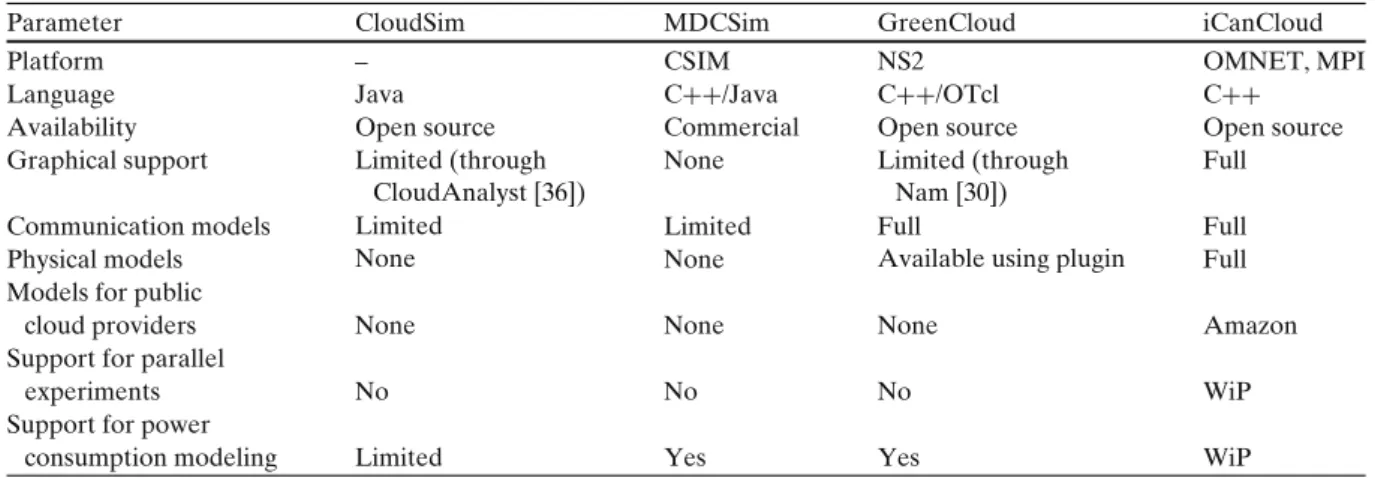
Work-in-Progress and it is not available yet. Table 1
depicts asummary of thecloud simulation tools
reviewedabove.
3 The iCanCloud simulation platform
The ever-increasing complexity of computing sys-tems has made simulators a very important choice for designing and analyzing large and complex architectures. In the field of cloud computing, sim-ulators become especially useful for calculating the trade-offs between cost and performance in
pay-as-you-go environments. Hence, this work
de-scribes a flexible and scalable simulation platform for modeling and simulating large environments that represent, both actual and non-existent cloud computing architectures.
iCanCloud is a simulation platform aimed to model and simulate cloud computing systems, which is targeted to those users who deal closely with those kinds of systems. The main objective of iCanCloud is to predict the trade-offs between cost and performance of a given set of applications executed in a specific hardware, and then pro-vide to users useful information about such costs. However, iCanCloud can be used by a wide range of users, from basic active users to developers of large distributed applications.
Although each user is intersected on different features provided by the cloud, all of them have the same objective: optimizing the trade-off be-tween cost and performance, which is the real hard task iCanCloud tries to alleviate. Thus, this simulation platform provides a scalable, flexible, fast and easy-to-use tool which let users obtain results quickly in order to help to take a decision for paying a corresponding budget of machines.
Table 1 Summary of cloud simulators
Parameter CloudSim MDCSim GreenCloud iCanCloud
Platform – CSIM NS2 OMNET, MPI
Language Java C++/Java C++/OTcl C++
Availability Open source Commercial Open source Open source
Graphical support Limited (through None Limited (through Full
Communication models Limited Full
Physical models CloudAnalyst[36]) Limited None None Nam[30]) Full
Availableusingplugin Full
Models for public
cloud providers None None None Amazon
Support for parallel
experiments No No No WiP
Support for power
The proposed features are desirable for any simulation platform, but their meaning can be blurry depending on the context in which they are used. Scalability means whether the correspond-ing simulator is able to simulate large-scale sys-tems without loosing performance. Likewise, per-formance determines the speed which a simulator executes a corresponding simulation. In general, the larger the size of the architecture to be simu-lated, the greater the time needed to execute the simulation. Moreover, a flexible simulator must let users build environments easily, using several component models with different levels of detail. In fact, the proposed hypervisor model let users to integrate any cloud brokering policy to manage a set of fully customizable VMs. Thus, different brokering policies can be fully customized by us-ing this simulation platform.
The simulated cloud computing scenarios are modeled using a set of existent components provided by iCanCloud; they represent the be-havior of real components that belong to real architectures like disks, networks, memories, file systems, etc. Those components are hier-archically organized within the repository of iCanCloud, which compose the core simulation engine. Besides designing simulated environments using components provided by iCanCloud, new components can be added to its repository. More-over, iCanCloud allows an easy substitution of components for a particular component. Those interchangeable components can differ in level of detail (to make performance versus accuracy trade-offs), in the functional behavior of the com-ponent, or both.
3.1 Features
The most remarkable features of the iCanCloud simulation platform include the following: 1. Both existing and non-existing cloud
com-puting architectures can be modeled and simulated.
2. A flexible cloud hypervisor module provides an easy method for integrating and test-ing both new and existent cloud brokertest-ing policies.
3. Customizable VMs can be used to quickly simulate uni-core/multi-core systems.
4. iCanCloud provides a wide range of config-urations for storage systems, which include models for local storage systems, remote stor-age systems, like NFS, and parallel storstor-age systems, like parallel file systems and RAID systems.
5. iCanCloud provides a user-friendly GUI to ease the generation and customization of large distributed models. This GUI is especially useful for: managing a repository of pre-configured VMs, managing a repository of pre-configured Cloud systems, managing a repository of pre-configured experiments, launching experiments from the GUI, and generating graphical reports. However, exper-iments can be executed also by using tradi-tional command line scripts.
6. iCanCloud provides a POSIX-based API and an adapted MPI library for modelling and simulating applications. Also, several meth-ods for modelling applications can be used in iCanCloud: using traces of real applications; using a state graph; and programming new ap-plications directly in the simulation platform. 7. New components can be added to the
reposi-tory of iCanCloud to increase the functional-ity of the simulation platform.
3.2 iCanCloud Design
The basic idea of a cloud computing system is
to provide users a pseudo-customizable
hard-wareenvironmentwheretheycanexecutespecific
software. Therefore, in order to model entire
cloud computing systems, the architecture of
iCanCloudhasbeendesignedbasedonthis
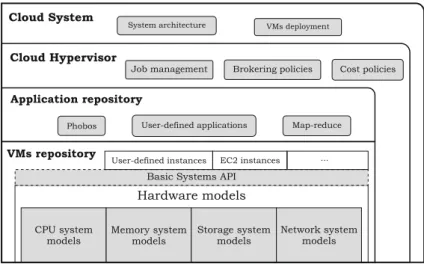
prin-ciple.Thus, Fig.1 shows thelayered architecture
ofiCanCloud.
The bottom of the architecture consists of the hardware models layer. This layer basically con-tains the models that are in charge of modeling the hardware parts of a system, like disk drives, mem-ory modules and CPU processors. Using those models, entire distributed systems can be modeled and simulated. In turn, this section consists of four groups, where each corresponds to a specific
Fig. 1 Basic layered
schema of iCanCloud architecture
basic system: processing system (CPU), memory system, storage system, and network system.
The basic system’s API module is directly con-nected with the hardware models layer. Basically this module contains a set of system calls which are offered as an API (Application Programming Interface) for all applications executed in a VM modeled using iCanCloud. Thus, those system calls provide the interface between applications and the services provided by the hardware models. Moreover, researchers can write applications to be simulated in iCanCloud using this API. In or-der to maintain a certain degree of compatibility, this API pretends to be a subset of POSIX.
Following, the set of functions provided by this API is described for each basic system (see Listing 1). Line 2 of Listing 1 shows a function for using the CPU service. Basically applications
which request CPU processing must invoke the
iCanCloud_cpu function to specify the
corre-sponding amount of instructions to be executed, measured in MIs (Million Instructions). The CPU can contain one or more CPU cores.
The main task of the memory system is to assign the corresponding amount of memory to each application that requires it. Thus, this sys-tem receives requests for memory allocation and calculates where and how this memory has to be assigned. This feature is very useful for analyzing the amount of memory used for each application, especially in large distributed environments.
In order to interact with the memory system, applications must use the functions specified in lines 5 and 6 of Listing 1. Basically this inter-face consists of two functions. First function, called iCanCloud_allocMemory, is in charge of
allocating memory. Second function, called iCan
Cloud_ f reeMemory, is in charge of freeing the
previously allocated memory. Parameter
memorySize indicates the amount of memory
required (measured in bytes) to perform the corresponding operation.
The storage system is in charge of managing all accesses to data. The set of functions shown in lines 9–14 of Listing 1 offers an interface to interact with the storage system, which basically consists of a set of functions for managing files.
Functions iCanCloud_open and iCanCloud_
close are in charge of opening and closing
respec-tively a file given its name.
Functions iCanCloud_create and iCanCloud_
delete are in charge of creating and removing
respectively a file given its name.
Finally, function iCanCloud_read is in charge of reading data in the file specified in the parameter called fileName. Similarly, function
iCanCloud_write writes data in a given file. The
amount of data to be read or written is specified in the parameter size. Finally, the parameter of fset specifies the starting point in the file where re-quested data is processed.
The network system is in charge of managing connections with other applications located in re-mote nodes, and also processing both the received and sent packets. The network system’s API is shown in lines 17–20 of Listing 1. Using this in-terface, applications can manage connections with remote nodes, and send and receive data through the network.
Function iCanCloud_createListenConnection
creates an incoming connection from a remote location. Otherwise, function iCanCloud_create
Connection establishes a connection with a
re-mote application.
Function iCanCloud_sendDataToNetwork
sends data through the network system to a
re-mote location. Similarly, iCanCloud_receiveData
FromNetwork receives data from a remote
location. First function is in charge of sending data from the application that invokes this function to a remote application specified in the message sm. Second function is in charge of receiving data from a remote application specified in the message sm.
Besides functions provided by this API, iCanCloud also provides a high level layer for developing distributed applications. This layer is placed in the application component and provides standard interfaces for executing distributed ap-plications. Currently iCanCloud has implemented an interface for executing MPI applications.
Upper layer consists of a VMs repository. This repository contains a collection of VMs previously defined by the user. Initially, the iCanCloud sim-ulator provides few models of existing VMs in well known clouds like Amazon (EC2). Moreover, users can add, edit or remove VMs from this repository. Each VM is modeled by configuring the corresponding underlying hardware models for each basic system.
In a cloud system, the VM is the most relevant component. Similarly in iCanCloud, a VM is a building block for creating cloud systems. The key of this simulation platform is modularity, which let nested complex modules using other mod-ules previously defined. Thence, the basic idea of iCanCloud consists on using VMs modules for building entire cloud computing systems.
In those systems, VMs are in charge of hiding the hardware details, providing to users a logic view that corresponds with the user requirements. Thus, the VMs models defined in this layer use the previously defined hardware components defined in the bottom layer.
Otherwise, the application repository con-tains a collection of pre-defined applications cus-tomized by users. Similarly to the repository of VMs, initially this repository provides a set of pre-defined application models. Those models will be used in order to configure the corresponding jobs that will be executed in a specific instance of a VM in the system. Moreover, new application models can be easily added to the system, because iCanCloud provides an API in order to ease the development of new application models.
Upper layer, called cloud hypervisor, consists of a module in charge of managing all incom-ing jobs and the instances of VMs where those jobs are executed. Once a job finishes its exe-cution, this module sets as idle the VMs where that job has been executed, and then re-assign the available resources in the system to execute
the remaining jobs. This module also contains cost policies in order to assign incoming jobs to a specific instance calculated by the corresponding heuristic.
Finally, at the top of the architecture is the cloud system module. This module contains a definition of the entire cloud system, which basi-cally consists on the definition of the hypervisor, and the definition of each VM that composes the system.
However, the key innovation of this simulation framework lies in a modular and flexible design.
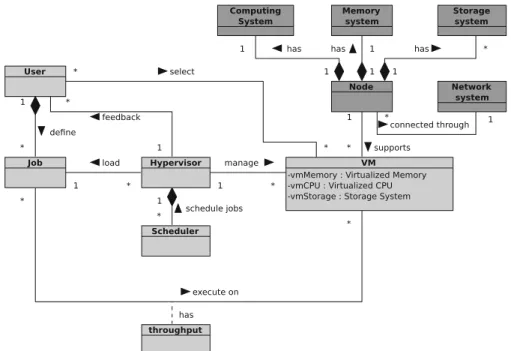
Figure2shows the UML 2.3 class diagram of the
iCanCloud simulation platform.
This model is split in two different parts. On the one hand, dark grey squares represent the hardware part of the cloud environment. On the other hand, the light grey squares represent those modules in charge of managing the cloud system. The VM class acts as a link among the physical resources of the cloud environment, such as nodes and networks, and the resources used by users, giving them an illusion of using directly the phys-ical resources to execute the corresponding jobs. Thus, depending of the configuration of each VM, those are mapped to the physical nodes existent in the cloud system model. The main module of this
section is the hypervisor, which is the center piece of the system.
3.3 The Hypervisor Module
The hypervisor module is the master key of the iCanCloud simulation core. Basically, this module is in charge of managing the VMs and executing the jobs defined by users. In order to accomplish this task, the hypervisor can be fully configured by integrating customized brokering policies.
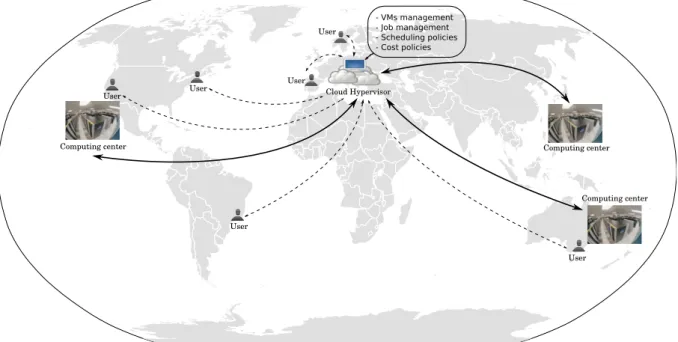
Figure 3 shows the global architecture of
a cloud computing system modeled using
iCanCloud.Thisfigureshowsthreemainentities:
users,hypervisoranddatacenters.Thehypervisor
moduleisinchargeofachievingfourmaintasks:
(1)managingtheVMsoftheentirecloudsystem,
(2) managingthe listof jobssubmittedbyusers,
(3) scheduling those jobs to be executed in the
corresponding VM instances, and (4) defining
cost policies for each VM instance type. Data
centers represent a set of Virtual Machines,
each one configured with apre-defined features
such as CPU, storage, memory, and network.
Finally, users are represented as entities that
submit a set of jobs to be executed on specific
VM instances. Those submissionsarrive directly
Fig. 2 UML class
diagram of iCanCloud simulation platform
Fig. 3 Global schema of a scenario built using iCanCloud
to the hypervisor module. Then, the list of jobs is managed by this module to be executed in the specific VM instances hosted in the corresponding data center. Once the list of jobs submitted by a user is completely executed, a report is sent back to that user.
The main goal of the proposed hypervisor is two-fold: First, to provide a set of brokering policies to be customized easily depending of the
system’s requirements. Second, to allow the inte-gration of custom brokering policies, such as cost-based policies, execution time-cost-based policies and resource allocation-based policies.
In order to accomplish those goals, the pro-posed hypervisor has been designed to provide a high level of flexibility and usability. This mod-ule is implemented as an abstract class called
CloudHypervisor. Also, this class provides a very
intuitive interface to deal with the main tasks for managing a cloud system. This interface is shown in Listing 2.
Basically, this interface is divided in two different parts. First part consists of a set of meth-ods implemented by CloudHypervisor (see lines 11–16 of Listing 2). Second part consists of a set of abstract methods that must be implemented by the corresponding subclass. Thus, in order to include a new brokering policy, users may just to create a class that inherits from CloudHypervisor and then implementing those methods shown in lines 20–24 of Listing 2. Of course, users may add new methods in the subclass.
The underlying idea of this subclass is to select the next job to be executed in the cloud, and the VM instances where that job will be executed. Thus, new scheduling policies can be easily inte-grated into the proposed hypervisor just by im-plementing the corresponding abstract methods. Hence, this subclass may also use methods pro-vided by the hypervisor and the relevant infor-mation of each job submitted to the system. This information is basically the number of instructions to be executed, the size of the data to be read, and the output data to be written, which can be retrieved from each job object.
Main data structures are shown in lines 4–7 (see Listing 2). This class has two queues that contain the jobs submitted. First queue, called
waitingQueue contains those jobs that have been
submitted by users, but have not started its ex-ecution yet. Second queue, called finishQueue, contains those jobs that have finished their exe-cution. The rest of queues must be declared in the subclass, which depend of the brokering policy implemented. For instance, using one queue for each VM instance type, or sharing a single queue for all jobs.
The method get_job_list() obtains a list of all submitted jobs; get_job (jobID) obtains the ob-ject associated with the identifier jobID; similarly,
get_vm (vmID) returns the object corresponding
to the VM vmID; insert_waiting_q (userID, jobID,
vmID) inserts the job jobID, submitted by the
user userID, to be executed in the VM vmID in
waitingQueue; run_job (vmID, jobID) executes
the job jobID in the VM vmID; finally, method
move_qSrc_to_qDst (jobID, qSrc, qDst) moves
the job jobID from the queue qSrc to queue qDst. The rest of the methods must be imple-mented in the corresponding subclass, such as
job_has_f inished (jobID, results), which indicates
that the job jobID has finished with the feedback
results; select_job() selects the next job to be
exe-cuted; similarly, select_vm() selects the VM to ex-ecute next job; job_has_been_inserted() indicates that a new job has been submitted by a user; Fi-nally, job_has_f inished(jobID) indicates that job
jobID has finished its execution.
Fig. 4 Basic schema
of the iCanCloud architecture
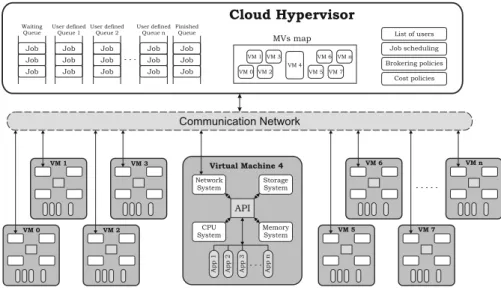
Figure 4 shows the basic schema of the pro-posed hypervisor module. Basically, the main parts of the hypervisor model are:
– Waiting queue: This queue handles jobs that have been submitted to the system, and are currently waiting to be executed.
– User-defined queues: Those queues contain those jobs that are currently being executed on any VM. Those queues must be declared on the subclass. Thus, depending of the bro-kering policy, the number of those queues may vary.
– Finished queue: This queue handles those jobs that have finished their execution.
– VMs map: This data structure contains rele-vant information of all those VMs that have been started up in the cloud system, such as the state of each VM, time-frame that each VM
has been in an idle state, current job that is being executed in each VM, etc.
– List of users: List of users that have submitted jobs to the cloud system.
– Job scheduling and brokering policy: Policies required to manage jobs and VMs. Those poli-cies must be implemented in the corresponding subclass of CloudHypervisor.
– Cost policy: Policy that establishes a price and budget to each VM instance type.
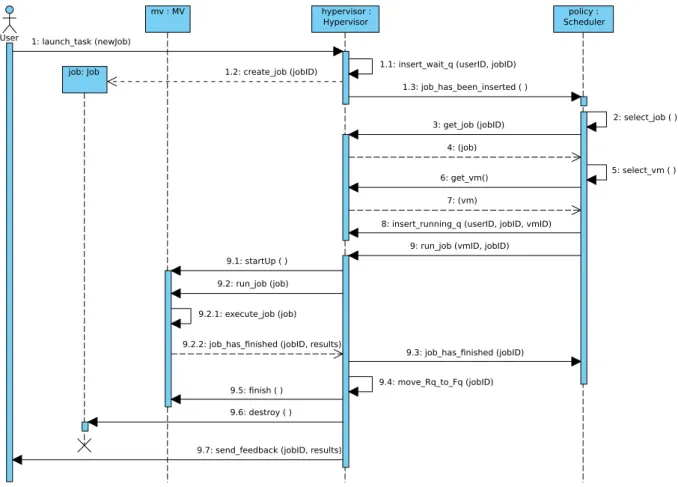
Figure5showsasequencediagramofatypical
usecase,sinceausersendsanewjobtothecloud
system,until thatjobisdoneandthehypervisor
collectsthecorrespondingresults.
3.4 iCanCloud Configuration
Creating simulated environments of distributed systems used to be a tedious and time-consuming
task. Basically this process consists on writ-ing configuration files that contains both the definition of the components involved in the sim-ulation, and a list of parameters that character-izes each one for a specific purpose. Moreover, the greater the size of the system to be mod-eled, the higher the complexity for modeling it. Thus, creating simulated environments requires both considerable amount of time and effort to be accomplished.
In this section, the process for creating simu-lated environments in iCanCloud is described in detail.
Simulated environments in iCanCloud are configured by using a .ned specification. Basically, this specification describes how many instances of each module have to be simulated. Moreover .ned specification is loaded at the beginning of the execution, whereof the simulation can be completely reconfigured without re-compiling the source code.
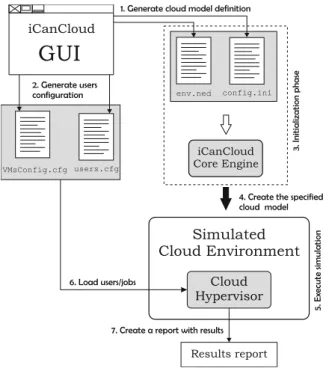
Figure6representsthe stepssinceacloud
en-vironmentismodeledusingtheGUIprovidedby
iCanCloud, until the simulation finishes its
execu-tionandthecorrespondingreportisgenerated.
Fig. 6 iCanCloud configuration process
In iCanCloud, the definition and configuration of a modeled cloud system is divided in two different sections: cloud model definition and users configuration. First section defines the configuration of the cloud system. Otherwise, sec-ond section is in charge of defining the users in the cloud system, the jobs submitted by each user, and the VM instances requested to execute those jobs. First section, denoted as cloud model defi-nition, consists of two plain-text files: env.ned and
conf ig.ini. File env.ned defines the environment of
the cloud model to be simulated. In other words, this file contains the name of the VM instances used in the cloud model, and the number of each instance to be simulated. This definition is specified using the NED language, which facili-tates the modular definition of a distributed sys-tem. Moreover, NED files can be loaded dynam-ically into simulation programs, or translated into
C++ by the NED compiler and linked into the
simulation executable. Listing 3 shows a portion of a env.ned file where the Standard On-Demand Instances of Amazon EC2 cloud are modeled. This file shows a cloud model that contains three types of instances, and a different number of VMs for each. Specifically, this cloud model, called cloudMode_AmazonEC2, contains 10K small in-stances, 2K large inin-stances, and 1K extra large instances.
Otherwise, file conf ig.ini contains the config-uration of each VM instance defined in the file
env.ned, and the definition of the cloud
hypervi-sor. Basically, the configuration of each instance consists on assigning values to the set of parame-ters of each basic system, such as CPU, memory and storage. Those parameters can take string,
numeric or boolean values, or can contain XML data trees. Numeric values include expressions using other parameters and calling C functions, random variables from different distributions, and values input interactively by the user. Numeric-valued parameters can be used to construct topologies in a flexible way. Listing 4 shows a por-tion of a conf ig.ini file where the instances defined in Listing 3 are configured. The configuration of the hypervisor basically consists on specifying the hypervisor type used in this simulation. In this example, the Min-Min_CloudHypervisor is used (see line 6 of Listing 4).
Second section, denoted as users configuration, contains information about the users, the list of jobs submitted to the cloud system, and the set of VMs requested to execute the previously defined jobs. Basically, this information is structured in two different plain-text files: users.cfg and
VM-sConf ig.cfg. Listings 5 and 6 show the syntax used
to create those files.
File users.cfg contains the list of users that are currently submitting jobs in the modeled cloud
Listing 5 Syntax of file users.cfg
system. Each user must define both a list of jobs to be executed in the cloud system, and the corresponding configuration of VMs where each
job must be executed. Thus, this file consists of different blocks, one for each user. Similarly, each block contains a set of jobs. Listing 5 shows the syntax used to create file users.cfg.
Each block in this file begins with the user ID. In this example, line 1 contains the definition of first user, denoted as User_1. Moreover, each block contains a set of jobs, whereof each job must contain two parts. First part consists of the name of the job, the type of VM instances where the job must be executed and the number of VMs used to execute the job (see line 5 of Listing 5). In this part, both instance types and the number of instances may be unset. Then the character ‘?’ is used. In this case, the hypervisor is in charge of calculating the corresponding instance type or/and the number of them to execute the corresponding job.
In fact, in many cases users have no expertise to select both the instance type and the number of instances to execute a given job. In such sit-uations, how many VMs of a particular instance are required to execute a job? 1000 small instances are enough? 100 large instances? Thus, depending of the brokerage policy used by the hypervisor, users have the option to delegate that responsibil-ity to the hypervisor, which provides a high level of flexibility because different policies must be used to schedule jobs and provisioning the idle resources if the cloud.
Finally, the second part of the job definition consists of a list of pairs (parameter’s name, rameter’s value) corresponding to the set of pa-rameters of current job. Thus, depending of the job type, different set of parameters must be configured.
File VMsConf ig.cfg contains the instance types and number of VMs existent in the cloud model. This information is basically an overview of the information contained in the file env.ned. But, due to practical reasons, this file has been created instead of writing a parser to read the env.ned file and gather such information.
Listing 6 Syntax of file VMsConfig.cfg
Thoseconfigurationfilesareautomatically
gen-erated by the iCanCloud GUI (to see some
screenshots check the website http://www.ican
cloudsim.org/). Once the user has configured
pro-perlythesimulatedcloudenvironment,thisGUI
performs two steps. In the first step, the
config-uration files corresponding to the cloud model
definition are generated: env.ned and config.ini
(see step 1 of Fig. 6). Then, files corresponding
to the user configuration section are generated:
VMsConfig.cfgandusers.cfg(seestep2).
Once those four configuration files are cre-ated, the iCanCloud simulation is launched, and then the initialization phase is performed (see step 3). In this phase, the iCanCloud core en-gine receives two files as input (env.ned and
conf ig.ini) which contain the definition of the
experiment. The objective of this phase is to use that information to create the simulated envi-ronment previously defined in the GUI, which is performed by the core engine of iCanCloud (see step 4). Note that different cloud envi-ronments with different configurations can be launched without re-compiling the simulation platform neither changing the source code. Only the configuration files have to be modified, but this task is performed automatically by the GUI, which is totally transparent to the user. Those files are processed before executing the simulated environment.
Thus,thesimulatedcloudenvironmentis
gen-erated, the simulation starts its execution (see step
5). In this step, all data structures are created
and initialized in run-time. The most important
module inthis stepis the cloud hypervisor.
Ba-sically, this module contains all the information
required to manage completely the cloud
sys-tem.This informationislocatedinthefiles
VM-sConfig.cfgand users.cfg. Thus, when the cloud
environment has beeninitialized, thehypervisor
modulereadsthosefilestocreateandinitializethe
corresponding data structures describedinFig.4
(seestep6).
Then, once the initialization phase has been fulfilled, the execution of the cloud model starts. This execution finalizes when all jobs defined in the file users.cfg have been executed completely. Then, a report containing the results of the simu-lation is generated (see step 7).
3.5 The iCanCloud Core Engine
The main principle of the iCanCloud simulation platform is to build a cloud computing system using Virtual Machines as building blocks, where each VM is defined by configuring the four basic systems: CPU, memory, storage and networking. Therefore, those basic systems are described in this section.
3.5.1 The CPU System
The computing system has been modeled in iCan-Cloud using 2 different components: the processor and the CPU scheduler. The strategy used for modeling this system is based on calculating the amount of time needed for executing the specific instructions invoked by applications. Therefore, CPUs are parameterized with a specific CPU processing power measured in MIPS (Million In-structions Per Second), which is a method of measuring the raw speed of a computer’s proces-sors. Similarly, the amount of computing in-voked by applications is measured in MIs (Million Instructions).
The processor is the component in charge of calculating the amount of time spent in executing instructions invoked by applications. Each proces-sor consists of a finite set of CPU cores, where the speed of all those cores is the same that the speed of its processor. Thus, several applications can be executed in parallel using the same processor, even when the number of applications executed at any given instant is greater than the number of CPU cores.
Otherwise, the CPU scheduler is the compo-nent in charge of managing all computing blocks to be executed in the corresponding CPU cores efficiently. Thus, this scheduler has been modeled using the time sharing technique, where several applications simulate their executions by multi-plexing the CPU time because the computing blocks belonging to the simulated applications are divided in slices. Therefore, in single-core proces-sors, only one application can be executed at any given instant.
Currently iCanCloud provides three different strategies for managing blocks in the simu-lated CPU scheduler: FIFO, Round-Robin, and
priority-based policy. Moreover, new strategies can be added to the simulation platform.
3.5.2 The Memory System
The memory system has been modeled using two different components. On the one hand, a com-ponent called physic memory is in charge of sim-ulating the physical characteristics of the mem-ory. Those characteristics include mainly the size of the memory space and latency times. On the other hand, another component called memory manager is in charge of managing the memory accesses. Currently, this component manages the memory accesses needed for applications and disk cache.
Moreover, the memory system divides the memory space for two different purposes: mem-ory used for application space and memmem-ory used for disk cache space. The main tasks performed by the memory manager are:
– Managing memory accesses from applications.
– Allocating memory pages required by
applications.
– Freeing memory pages requested by
applications.
– Managing a cache system for disk data.
3.5.3 The Storage System
The I/Osystem isusually asystem bottleneckin
mostofthecomputingsystems[24].IniCanCloud,
thestoragesystemhasbeenmodeledusingthree
modules: – File system. – Volume manager. – Disk drives.
File system is in charge of translating data re-quests from applications to a list of blocks which contains the requested data.
Volume manager is a software component in charge of performing read and write operations of data blocks, sent from file systems. Basically, this component receives data block requests from file systems and it must redirect the incoming data block requests to the disk that contains such data. Depending of the modeled architecture, this
component can use the appropriate strategies for scheduling data block requests, like FIFO, eleva-tor algorithm, and CSCAN.
Finally, disk drive is in charge of storing data blocks. Basically this component calculates the amount of time spent for processing the data block operations that came from volume manager.
Additionally, iCanCloud provides several
configurations for using parallel I/O architectures such as RAID systems and parallel file systems.
3.5.4 The Network System
In iCanCloud, the network system let applications executed in Virtual machines interchange data through a communication network.
In order to fulfill this task, the INET framework has been used. This framework contains modules for simulating completely a network system, in-cluding network protocols like TPC or UPD. The main advantage of this method is the high level of accuracy obtained, because all elements that compose a network are simulated. However, the main drawback is performance, because this high level of detail needs a considerably CPU power to be calculated.
Moreover, the INET framework provides a set of modules such as routers, switches and network protocols, for building a wide range of networks. Thus users can build several network architecture models like LAN (Local Area Networks) and WAN (Wide Area Network). Moreover, those networks can be configured as wired and wireless networks, using Ethernet and Wi-Fi respectively.
3.6 Proof Case: Implementation of Provisioning and Scheduling Algorithms
To illustrate the usefulness of this work, two provisioning and scheduling algorithms (namely, Cloud Min-Min and Cloud Max-Min) are imple-mented using iCanCloud. The algorithms are di-vided in two main phases:
1. Provisioning, where a specific type and num-ber of EC2 instances are deployed.
2. Scheduling, where tasks are matched with available resources.
In order to perform the provisioning,
[33] i n - troduced a metric named Cost per
Performance (C/P). This metric relates the
needed takes to execute a number of tasks in
Amazon EC2, withthe cost required to hire the
machines that pro-duce this execution time.
This way, the best in-frastructure setup would
bethatwhichproducedthelowestC/Pvalue.
3.6.1 Cloud Min-Min
IntheCloudMin-Minalgorithm,thentaskswith
shortest execution time are taken for obtaining its
bestvirtualinfrastructuredeployment. A
sweep-ing ismadewith differentvalues ofn toachieve
the best value for the C/P metric. In the case
of having similar values, decision turns to less
execution time or to less cost. Task scheduling
follows the same procedure as the original
Min-Minalgorithm[12].
The pseudocode of this heuristic shown in Algorithms 1, 2 and 3. Initially, an array of ex-ecution times is created following Algorithm 1, which uses the job size in millions of instructions (MI) and VMs power in millions of instructions per second (MIPS).
Algorithm 1 Creation of arrays of execution times.
1: Let N=the number of tasks.
2: Let x=the number of instance types of VM.
3: Let Tv = the task execution time vector for
the instance typev.
4: Let job I D=the identificator for a job.
5: Letv=the identificator for a VM.
6: Letvm=a VM.
7: Let job =a job.
8: job List=get_ job _list()
9: for job I D=0to job List.size()−1 do
10: forv=0to x−1 do
11: job =get_ job(job I D)
12: vm=get_vm(v)
13: Tv(job I D)= job.getMI()/vm.getMI PS()
14: end for
15: end for
After that, Algorithm 2 provides the resource provisioning phase. As the resource provisioning consists in choosing the best configuration, a loop is made for using a different number of j tasks
Algorithm 2 Resource provisioning phase.
1: Let N=the number of tasks.
2: Let x=the number of instance types of VM.
3: Let Tv = the task execution time vector for
the instance typev.
4: Let Vv,n = the set containing n virtual
ma-chines of avinstance type.
5: Let j=the number of tasks used each loop in
the resource provisioning phase.
6: Let C P=the vector that keeps the C/P
met-ric for each j for all the instance types.
7: Let C Ptemp=the temporary vector that keeps
the C/P metric for each instance type for a
given j.
8: Let Pv =the vector that keeps the execution
time for the j tasks with minimum execution
time for the instance typev.
9: Let itype=the instance type of VMs chosen.
10: Let n=the number of VMs chosen.
11: { *** Resource provisioning phase *** }
12: for j=N downto1 do
13: {Creation of temporal arrays of execution
times} 14: forv=0to x−1 do 15: Ttempv = Tv 16: end for 17: {Creation of Pvarrays} 18: for k=0to j do 19: forv =0to x−1 do
20: insert(Pv[k], min(Ttempv ))
21: remove(Ttempv , min(Ttempv ))
22: end for
23: end for
24: {Calculate the temporal CP metric}
25: forv=0to x−1 do
26: setN ( j,v)
27: C Ptemp[v]= time(Vv,n)×cost(Vv,n)
28: end for
29: {Finally, calculate the CP metric}
30: if|min(C Ptemp)|>1then
31: C P[j]= min(time(Vv,n)) or min(cost(Vv,n)) 32: else 33: C P[j]= min(C Ptemp) 34: end if 35: end for
36: createInstances(Vitype,n) producing min(C P)
Algorithm 3 Task scheduling phase.
1: Let minJob I D=the identificator for the job
with the lowest execution time.
2: Let job= the job with the lowest execution
time.
3: Let Vv,n = the set containing n virtual
ma-chines of avinstance type.
4: Let itype=the instance type of VMs chosen.
5: Let Titype=the task execution time vector for
the instance type itype.
6: Let n=the number of VMs chosen.
7: LetvmI D=the identificator of a VM.
8: {Initially, submit the first n jobs to the n VMs}
9: forvmI D=0to n do
10: minJob I D = getMin(Titype)
11: job = get_ job(minJob I D)
12: run_ job(vmI D,job)
13: vmI D+ +
14: end for
15: {If there are more jobs than VMs, submit jobs
to VMs as VMs become idle}
16: while get Job List().size>0do
17: if checkIdleV M(vmI D)==true then
18: minJob I D = getMin(Titype)
19: job = get_ job(minJob I D)
20: run_ job(vmI D,job)
21: end if
22: vmI D=select_vm()
23: end while
from the total tasks N to be scheduled (line 12). Then, temporal arrays containing the execution times of tasks in each VM instance are created, to be used during the execution of the algorithm (line 14).
Next, another loop creates a vector (Pv) for
each instance type v with the j shortest tasks
(line 20) and removes the shortest task from the
array of execution times of the given v (line 21).
As can be seen in line 20, each Pv is ordered
from the lowest execution time (held at Pv[0]) to
the highest (held at Pv[j−1]). This line is one of
the few differences between the Cloud Min-Min algorithm and Cloud Max-Min.
Then, a temporal CP metric is calculated. This loop is performed to set the number of instances for each instance type provided by
Amazon EC2 so that the j tasks are executed in parallel (line 26). This followed by the
calcula-tion of C/P metric, which is obtained for each
instance type (line 27). Being the smallest value for this metric the best one, it may happen that it is achieved by several combinations of n instances
of type x. At this point with equal C/P values, the
setup is chosen considering the shortest execution time or the lowest cost (line 31). If there is only one configuration of instance types yielding the
minimum C/P value, it is chosen as the C/P
metric for this j (line 33).
At the end of the provisioning main loop, there
will be a C P[j]vector that contains the best C/P
values from the previous iterations—this is, for each number of tasks j considered. To conclude this algorithm, the infrastructure with n machines
of type x with the minimum C/P value is then
instantiated (line 36).
Finally, the scheduling phase depicted by Algo-rithm 3 is performed. Initially, the jobs with the n lowest execution times are submitted to the n VMs (line 9). If there are more jobs than VMs, jobs are submitted to VMs as they become idle from the executions of previous jobs (line 16).
3.6.2 Cloud Max-Min
This algorithm is similar to Cloud Min-Min pre-sented above, and is not prepre-sented in detail for space limitations. The only differences are (1) in Algorithm 2, line 20, in which the job with the
lowest execution time is inserted at the end of Pv
array; and (2) in Algorithm 3, lines 10 and 18, which choose the job with the highest execution time.
4 Validation of iCanCloud
After a simulator has been developed, imple-mented, and debugged, it must be tested for cor-rectness and accuracy. However, determining that a simulator is absolutely valid over the complete domain of its whole intended field of applicability is a very hard and time-consuming task. Thus, the level of accuracy of a given simulator cannot be calculated for the entire domain this simulator is
targeted using a single value, because this accu-racy depends directly of the system to be modeled.
In the paper a validation process has been
conducted to demonstrate the applicability and
usefulness of the iCanCloud simulator. We
fo-cusedonacriticalapplicationusedbythe
Finnish-Russian-Spanish future Mission to Mars [14],
which calculates the trajectories of Phobos [25],
the Martian moon. Pertaining to the parameter
sweep execution profile, the application divides
theoveralltracingintervalinsubintervalsthatare
calculatedbythesubsequenttasksinthecloud–
thusthetracingintervalofataskisnotrelatedto
itsexecutiontime.Thetracingintervalprocessed
byeachtaskisthesameandthesystemperforms
dynamicschedulingwhereacontinuouspollingof
freecoresguaranteesaconstantresourceuse.
The present contribution culminatesthe
eval-uation process that started with the porting of
theapplicationtotheAmazonEC2publiccloud
infrastructure, formulation and validation of an
execution model and a metric combining cost
and performance [33]. This is accomplished by
firstly comparing the results obtained from the
mathematical modelwiththosefromiCanCloud.
Finally, results from real executions in the
AmazonEC2infrastructurewill bealsousedfor
thecomparison.
ThePhobosapplicationhasbeenchosenforthe
validation ofiCanCloudbecausethis application
has undergone a research path as follows. First,
thisapplicationhasbeenportedtoacloudsystem.
Next, a mathematical model of this application
has been developed [33]. And finally, using the
portedapplicationandthemathematicalmodel,a
validation oftheiCanCloudsimulation hasbeen
performed. Thanks to using this application, a
more detailed validation of the iCanCloud has
been performed, since we compare results from
iCanCloud with actual results from the ported
applicationand resultsfromthe validated
math-ematicalmodel.
As was explained before, the chosen cloud in-frastructure is Amazon EC2, which has become the de facto standard public cloud infrastructure for many scientific applications. The baremetal infrastructure providing the services is located in two locations in USA, one in Asia and another one in Europe. The users may choose from a wide
Table 2 Characteristics of the different machine types offered by Amazon EC2. C.U. corresponds to EC2 Compute Units
per core, the equivalent to a 1.0–1.2 GHz 2007 Opteron or 2007 Xeon processor
Machine type Cores C.U. Memory (GB) Platform (bit)
Standard on-demand instances
Small (Default) 1 1 1.7 32
Large 2 2 7.5 64
Extra large 4 2 15 64
High CPU on-demand instances
Medium 2 2.5 1.7 32
Extra large 8 2.5 7 64
rangeofmachineimagesthatcanbebootedinone
oftheofferedinstancetypes.Dependingthe
cho-seninstancetype,thenumberofCPUcore
num-ber, core speed, memory and architecture differ,
as shown in Table 2. The speed per CPU core
is measured in EC2 Compute Units,being each
C.U.equivalenttoa1.0–1.2GHz2007Opteronor
2007 Xeon processor. Nevertheless, accessing to
analmostinfinitecomputinginfrastructurehasits
price,whichdependsontheinstantiatedVMtype
perhour.
The paper which describes the porting of the
Phobos tracing application [33] introduced and
validatedanexecutionmodel,alongwithastudy
of the best infrastructure setup by means of
in-stance types and number. In order to deal with
the complexity level added by an infrastructure
following a pay-as-you-go basis, the used C/P
metricwasdefinedas:
C/P=CT = ChTexeI iN2 c TexeI iNvmNc (1)
where Texeis the task execution time, the values
of I and i correspond to the whole tracing interval and the tracing interval per task, that is, the grain
oftheapplication.Ontheotherhand,NvmandNc
arethenumberof VirtualMachinesandnumber
ofcoresperVirtualMachine,asshowninTable2
along with the machine’s usage price per hour
(Ch).Thisway,thebestinfrastructuresetupwould
bethatwhichproducedthelowestC/Pvalue.
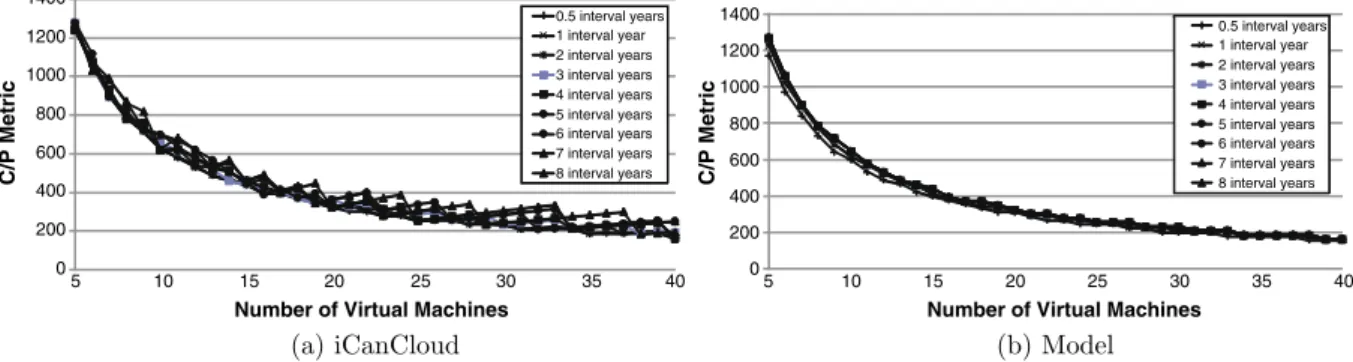
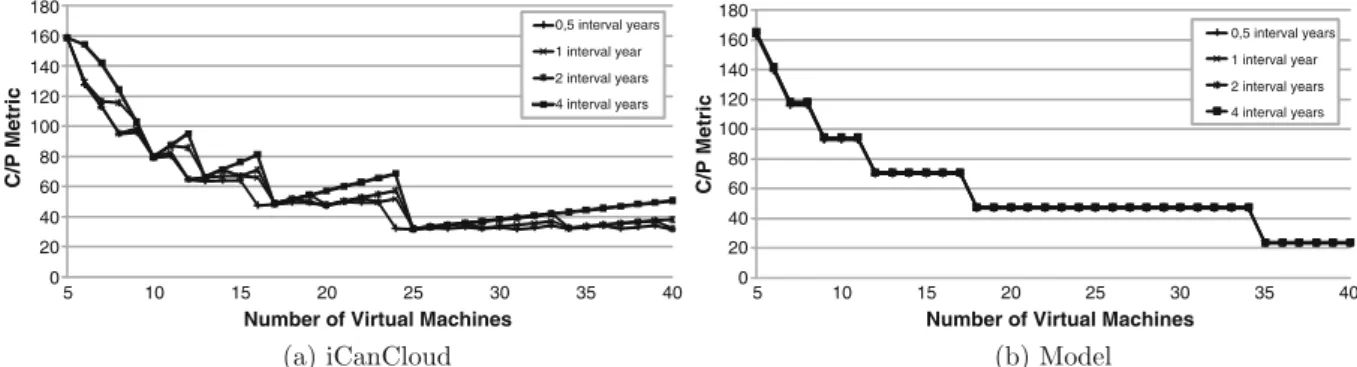
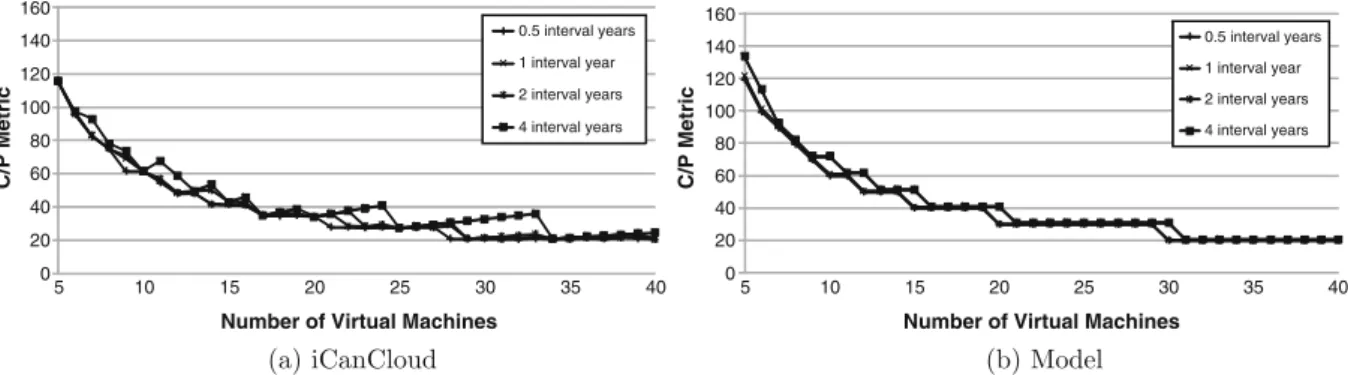
Figures 7, 8, 9, 10 and 11 present the results
obtainedbyexecutingthemodelofPhobos
appli-cationalongwiththeresultsofthesame
applica-tionimplementedoniCanCloud.Eachfigure
rep-resentstheC/Pmetricfortheexperiments,where
the small, large, extra large, high CPU medium
andhighCPUextralargeinstancetypesprovided
by Amazon are used, and number of VMs and
tracingintervalsarevaried.
Mainly, the most relevant difference between the iCanCloud and the mathematical model is the variations obtained when the number of VMs in-creases. In those results obtained using iCancloud, we can see that in some cases, using the same size for the interval (in years) and increasing the number of VMs, causes an increase in the C/P metric, which does not happen in experiments using the mathematical model of Amazon. This is mainly caused because the cost of the each VM is measured in completed hours, whereof an hour
0 200 400 600 800 1000 1200 1400 5 10 15 20 25 30 35 40 0.5 interval years 1 interval year 2 interval years 3 interval years 4 interval years 5 interval years 6 interval years 7 interval years 8 interval years C/P Metric C/P Metric 0 200 400 600 800 1000 1200 1400
Number of Virtual Machines
5 10 15 20 25 30 35 40
Number of Virtual Machines
0.5 interval years 1 interval year 2 interval years 3 interval years 4 interval years 5 interval years 6 interval years 7 interval years 8 interval years
0 50 100 150 200 250 300 350 0,5 interval years 1 interval year 2 interval years 3 interval years 4 interval years 5 interval years 6 interval years 7 interval years 8 interval years C/PMetric 0 50 100 150 200 250 300 350 C/PMetric 5 10 15 20 25 30 35 40
Number of Virtual Machines
5 10 15 20 25 30 35 40
Number of Virtual Machines
0,5 interval years 1 interval year 2 interval years 3 interval years 4 interval years 5 interval years 6 interval years 7 interval years 8 interval years
Fig. 8 Simulation versus mathematical model of Phobos using large instances
cannot be split in fractions. Then, increasing the number of VMs provides the same execution time, which produces a increasing of the cost for this configuration. Logically, the greater number of VMs used, the greater cost of the system. This effect only appears when the number of VMs gets higher. When the number of VMs is low, the performance gain when more VMs are used justifies the increase in the cost. Moreover, the mathematical model does not represent the time spent on performing I/O operations.
Thebestresultsareobtainedinthoseteststhat
usesmallandhighCPUmediuminstancesofVMs
(see Figs. 7 and 11). In those cases, the cost of
increasing the number of VMs for reducingthe
executiontimeandthenusinglesscompletehours
fortheexecutionissimilartothecostofusingless
VMs thatrequires more complete hours to
exe-cute the testbed. It can be shown by comparing the simulations and the model, whereof both results show practically the same shape.
Otherwise, Figs. 8, 9and 11show amore
no-ticeabledifferencebetweenthesimulationandthe
model.Thedifferencethatcanbeappreciatedin
thosechartsisbecausetheC/Pmetricvaluesare
low, and thenthe differencesbetweenthe
simu-lationand themodelareshownas peaks.Those
peaksbasically representthe maximumvalue of
C/P, which meansthatthe timerequired for
ex-ecuting this testbed consumes a little portion of
thelasthourofthetotalexecution time.Thus,it
means that using more VMsthe testbed can be
executed without requiringthatportion of hour,
andthenthereisnoneedofpayingforanentire
hour, obtaining a considerable drop in the C/P
value. 0 20 40 60 80 100 120 140 160 180 5 10 15 20 25 30 35 40 5 10 15 20 25 30 35 40 0,5 interval years 1 interval year 2 interval years 4 interval years C/P Metric 0 20 40 60 80 100 120 140 160 180
Number of Virtual Machines Number of Virtual Machines
C/P Metric
0,5 interval years 1 interval year 2 interval years 4 interval years
0 20 40 60 80 100 120 140 160 5 10 15 20 25 30 35 40 5 10 15 20 25 30 35 40
Number of Virtual Machines Number of Virtual Machines
0.5 interval years 1 interval year 2 interval years 4 interval years C/P Metric C/P Metric 0 20 40 60 80 100 120 140 160 0.5 interval years 1 interval year 2 interval years 4 interval years
Fig. 10 Simulation versus mathematical model of Phobos using high CPU medium instances
We can conclude that both iCanCloud sim-ulations and the mathematical model show the same tendency in the trade-offs between cost and performance. However, simulations show a more realistic behavior due to more details of the sys-tem are modeled. The main advantage of simula-tions versus the mathematical model is accuracy, and the main drawback is obviously the execution time, because iCanCloud requires to be executed in a computer, which is not required by the math-ematical model.
Figure 12 shows a dispersion chart that
com-parestheresultsofexecutingthePhobos
applica-tionintheAmazonEC2system,againstthe
anal-ogousmodelusingiCanCloud.Inthosetestsboth
differentintervalyearsandadifferentnumberof
VMshavebeenused.Resultsobtainedfromthose
tests executed in Amazon EC2 are represented
using hollow forms. Otherwise, iCanCloud results are shown using filled forms.
Initially, Phobos application has been launched using 0.5 interval years (represented as squares). This chart shows that both the results executed in the real environment and the results obtained using iCanCloud follows the same tendency. How-ever, those experiments that obtains lower C/P values fits better with the simulation.
Those experiments that use 1 interval year
are representedas triangles. In those cases, the
C/P value obtained is greater than using a 2
in-terval year. This is due to the behavior of the
Phobos applicationwith different interval years.
This asymmetry was already observed during its
firstportingontothecloud[33].
In general, in those tests that obtain the lower values of the C/P metric, iCanCloud obtains
0 5 10 15 20 25 30 35 40 45 5 10 15 20 25 30 35 40
Number of Virtual Machines
5 10 15 20 25 30 35 40
Number of Virtual Machines 0,5 interval years 1 interval year 2 interval years 4 interval years C/P Metric 0 10 20 30 40 50 60 C/P Metric 0,5 interval years 1 interval year 2 interval years 4 interval years
0 0,2 0,4 0,6 0,8 1 1,2 1,4 1,6 1,8 2 0 5 10 15 20 25 30 35 Number of VMs 0,5 int.Years (real) 0,5 int.Years (sim) 1 int. Year (real) 1 int. Year (sim) 2 int. Years (real) 2 int. Years (sim)
C/P Metric
Fig. 12 Simulation versus Amazon EC2 execution of
Pho-bos using small instances
practicallythesameresults.Otherwise,whenthe
C/P valueincreases,thereis aslightlydifference
between the real system and the simulation.
Fi-nally,allresultsobtainedbothfromtheAmazon
EC2 and iCanCloud follows a saw-tooth
wave-form, whichcanbealsoappreciatedinthe
previ-ouschartsshowninFigs.7–11.
5 Comparison with CloudSim
InordertoassessthefunctionalitiesofiCanCloud,
asetofexperimentshasbeenconductedusingit
andCloudSimwiththepurposetocompareboth
simulation tools. We have chosen CloudSim for
thiscomparisonbecauseitisamaturesimulation
toolwhich hasalreadybeenusedinanumberof
researchworks—asSection2depicts.
Jobs are modeled in CloudSim by configuring three parameters: (1) input size, (2) processing length, measured in Millions of Instructions (MI), and (3) output size. Input and output sizes refer to the size of input and output files of the job, and is a way to infer the time it takes to execute this job in a cloud resource (whose computing power is measured in Millions of Instructions Per Second—MIPS). Similarly, a new application model has been developed in iCanCloud to exe-cute the same functionality that those jobs do in CloudSim. Thus, the configuration of jobs used in the experiments described in this section is performed equally in both simulation platforms.
Those experiments use jobs whose input size is 5 MB, output size is 30 MB, and processing length is 1,200,000 MI. Also, cloudlets always uti-lize all the available CPU capacity. These exper-iments use VMs having 9,500 MIPS, which sim-ulate a standard small instance type provided by Amazon EC2. Those experiments have been ex-ecuted using an ASUS computer, model u33J Bamboo, which contains a CPU core i3 and 4 GB of RAM memory.
Figure 13 shows the comparison of
perfor-mancebetween CloudSim andiCanCloud.Chart
13ashowstheexecutiontimeofeachexperiment,
wherex-axisshowsthenumberofjobsexecutedin
eachexperiment,y-axisshowsthenumberofVMs
anditstype,andz-axisshowsthetimerequiredto
execute each experiment (measured in seconds)
usingalog-scale. 500 VMs cloudSim 500 VMs iCanCloud 1K VMs cloudSim 1K VMs iCanCloud 2,5K VMs cloudSim 2,5K VMs iCanCloud 5K VMs cloudSim 5K VMs iCanCloud 500 VMs cloudSim 500 VMs iCanCloud 1K VMs cloudSim 1K VMs iCanCloud 2,5K VMs cloudSim 2,5K VMs iCanCloud 5K VMs cloudSim 5K VMs iCanCloud 1 10 100 1000 10000 100000 1000 10000 50000 250000 Number of Jobs Number ofJobs
Execution time (sec.) in log-scale
0 500 1000 1500 2000 2500 3000 1000 10000 50000 250000 Memory consumption (MB)
(a) Execution time (b) Memory consumption
This chart shows that increasing the number of jobs require more execution time in both simula-tors, which is obvious. Otherwise, increasing the number of VMs has a different impact in each simulator. In iCanCloud, when more than 2500 VMs are used, the number of jobs has not a con-siderable impact on the execution time. Note that those experiments executed in iCanCloud have a uniform-like shape. That means that almost CPU power consumed by the simulator is processed for managing VMs. Instead, CloudSim’s performance depends directly on both parameters (number of VM and number of jobs). In fact, when the value of one of those parameters increases, exe-cution time increases as well. However, besides some experiments where the number of jobs is less or equal to 50000, iCanCloud is faster than CloudSim. Otherwise, in all tests that use 250K jobs iCanCloud is faster. That means that iCan-Cloud provides better scalability than iCan-CloudSim. The main reason of this is the initialization phase. While iCanCloud requires a considerable amount of time to initialize each component due to the great level of detail, cloudSim performs this phase quickly. However, in large-scale simulations, the time spent in this phase is practically insignificant.
Chart 13b shows the memory consumption of
each experiment. In this chart can be
appreci-atedthatiCanCloudrequiresmorememorythan
cloudSim.ThisiscausedbecauseiCanClouduses
ahigherlevelofdetailtomodeleachVMinstance.
As opposed to iCanCloud, which simulates low
level detailsof thecloud system beingsimulated
(asdetailedinSection3),CloudSimdoesnot
pro-videin-depthsimulationdetails.Upto1000VMs,
theamountof memoryrequiredbyboth
simula-torsissimilar.Butusingmorethan1000Vms,the
amountofmemoryrequiredbyiCanCloudgrows
muchfasterthanCloudSim.
In general, iCanCloud is faster in large scale experiments and provides better scalability, but require more memory than CloudSim.
6 Conclusions and Future Work
In this paper we have introduced the iCanCloud simulator. Its remarkable flexibility, scalability and performance have been proven through
vali-dation using an application pertaining to the High Performance Computing domain.
Having set up a complete simulation frame-work for cloud infrastructures, the present frame-work represents a first step of many. As future work, iCanCloud can be extended in many ways offering interesting research opportunities. For instance, other public cloud infrastructures than Amazon EC2, the one simulated in this paper, could be added. This way, different providers could be compared for an optimal execution of studied applications.
In the present paper we have simulated the ex-ecution of an application, but iCanCloud could be extended for simulating complete service levels. Thanks to the simulator’s modular design, both Platform as a Service and Software as a Service levels could be defined. Consequently, research on SLAs and Access Control strategies could be conducted using iCanCloud.
As a short term feature, we expect to include parallel simulations to improve performance of very large cloud models. Although iCanCloud has been designed to be parallel, this feature is not completely implemented yet. Moreover, in the mid term we are studying the possibility to in-clude environmental impact in a green computing context.
Finally, private clouds could be easily
simu-lated with an extension of iCanCloud. One of
the main directions would be to incorporate a
power consumption estimation module (like in
CloudSim[7]),enablingtheresearchonGreenIT
techniquesinvolvingcloudcomputing.
Software Availability
TheiCanCloudsimulatorisOpenSource(GNU
General Public License version 3) and it is
available at the following website: http://www.
iCanCloudSim.org/.
Acknowledgements This research was partially
sup-ported by the following projects: Spanish MEC project TESIS (TIN2009-14312-C02-01), and Spanish Ministry of Science and Innovation under the grant TIN2010-16497.