Creating
Effective Teaching
and Learning
Environments
FirsT rEsuLTs From TALis
Creating
Effective Teaching and
Learning Environments
First results From tAlis
ORGANISATION FOR ECONOMIC CO-OPERATION
AND DEVELOPMENT
The OECD is a unique forum where the governments of 30 democracies work together to address the economic, social and environmental challenges of globalisation. The OECD is also at the forefront of efforts to understand and to help governments respond to new developments and concerns, such as corporate governance, the information economy and the challenges of an ageing population. The Organisation provides a setting where governments can compare policy experiences, seek answers to common problems, identify good practice and work to co-ordinate domestic and international policies.
The OECD member countries are: Australia, Austria, Belgium, Canada, the Czech Republic, Denmark, Finland, France, Germany, Greece, Hungary, Iceland, Ireland, Italy, Japan, Korea, Luxembourg, Mexico, the Netherlands, New Zealand, Norway, Poland, Portugal, the Slovak Republic, Spain, Sweden, Switzerland, Turkey, the United Kingdom and the United States. The Commission of the European Communities takes part in the work of the OECD.
OECD Publishing disseminates widely the results of the Organisation’s statistics gathering and research on economic, social and environmental issues, as well as the conventions, guidelines and standards agreed by its members.
Cover illustration:
© Mike Kemp/Rubberball Productions/Getty Images
© Laurence Mouton/PhotoAlto Agency RF Collections/Inmagine ltb.
Corrigenda to OECD publications may be found on line at: www.oecd.org/publishing/corrigenda. © OECD 2009
You can copy, download or print OECD content for your own use, and you can include excerpts from OECD publications, databases and multimedia products in your own documents, presentations, blogs, websites and teaching materials, provided that suitable acknowledgment of OECD as source and copyright owner is given. All requests for public or commercial use and translation rights should be submitted to [email protected]. Requests for permission to photocopy portions of this material for public or commercial use shall be addressed directly to the Copyright Clearance Center (CCC) at [email protected] or the Centre français d’exploitation du droit de copie (CFC) at [email protected].
This work is published on the responsibility of the Secretary-General of the OECD. The opinions expressed and arguments employed herein do not necessarily reflect the official views of the Organisation or of the governments of its member countries.
3
Foreword
The challenges facing education systems and teachers continue to intensify. In modern knowledge-based economies, where the demand for high-level skills will continue to grow substantially, the task in many countries is to transform traditional models of schooling, which have been effective at distinguishing those who are more academically talented from those who are less so, into customised learning systems that identify and develop the talents of all students. This will require the creation of “knowledge-rich”, evidence-based education systems, in which school leaders and teachers act as a professional community with the authority to act, the necessary information to do so wisely, and the access to effective support systems to assist them in implementing change. The OECD’s Teaching and Learning International Survey (TALIS) provides insights into how education systems are responding by providing the first internationally comparative perspective on the conditions of teaching and learning. TALIS draws on the OECD’s 2005 review of teacher policy, which identified important gaps in international data, and aims to help countries review and develop policies to make the teaching profession more attractive and more effective. TALIS is conceptualised as a programme of surveys, with successive rounds designed to address policy-relevant issues chosen by countries.
With a focus in this initial round on lower secondary education in both the public and private sectors, TALIS examines important aspects of teachers’ professional development; teacher beliefs, attitudes and practices; teacher appraisal and feedback; and school leadership in the 23 participating countries.
The results from TALIS suggest that, in many countries, education is still far from being a knowledge industry in the sense that its own practices are not yet being transformed by knowledge about the efficacy of those practices. The 23 countries that have taken part in TALIS illustrate the growing interest in the lessons that might be learned from teacher policies and practices employed elsewhere. TALIS provides a first, groundbreaking instrument to allow countries to see their own teaching profession in the light of what other countries show can be achieved. Naturally, policy solutions should not simply be copies of other educational systems or experiences, but comparative analysis can provide an understanding of the policy drivers that contribute to successful teacher policies and help to situate and configure these policy drivers in the respective national contexts.
TALIS is a collaborative effort by member countries of the OECD and partner countries within the TALIS organisational framework. In addition, collaboration and support from the European Commission has helped TALIS address important information needs of the Commission in its monitoring of progress towards the Lisbon 2010 goals.
The report was produced by the Indicators and Analysis Division of the OECD Directorate for Education. The project has been led by Michael Davidson, who with Ben Jensen, co-ordinated the drafting and analysis for the report. The principal authors of the analytical chapters were: Michael Davidson (Chapter 3), Ben Jensen (Chapters 2, 5 and 7), Eckhard Klieme and Svenja Vieluf (Chapter 4), and David Baker (Chapter 6). Additional advice as well as analytical and editorial support was provided by Etienne Albiser, Tracey Burns, Ralph Carstens, Eric Charbonnier, Pedro Lenin García de León, Corinne Heckmann, Donald Hirsch, Miyako Ikeda, Maciej Jakubowski, David Kaplan, Juan Leon, Plamen Mirazchiyski, Soojin Park, Leslie Rutkowski, Andreas Schleicher, Diana Toledo Figueroa, Fons van de Vijver, Elisabeth Villoutreix and Jean Yip. Administrative support was provided by Isabelle Moulherat.
FOrEwOrD
The TALIS questionnaires were developed by an Instrument Development Expert Group (IDEG), led by the OECD Secretariat and comprising David Baker, Aletta Grisay, Eckhard Klieme and Jaap Scheerens. The administration of the survey and the preparation of the data underlying the report were managed by the Data Processing and Research Centre of the International Association for the Evaluation of Educational Achievement (IEA), the appointed international contractor, together with its consortium members Statistics Canada and the IEA Secretariat. Dirk Hastedt and Steffen Knoll acted as co-directors of the consortium. The development of the report was steered by the TALIS Board of Participating Countries, which is chaired by Anne-Berit Kavli (Norway). Annex A3 of the report lists the members of the various TALIS bodies as well as the individual experts and consultants who have contributed to this report and to TALIS in general.
Barbara Ischinger
Table of Contents
Foreword ...3 reader’s Guide ...15 Chapter 1 IntroductIon ...17 Overview of TALIS ...18Origins and aims of TALIS ...19
Design of the TALIS survey ...19
Population surveyed and sampling options ...20
Choosing the policy focus of the first round of TALIS ...20
Developing TALIS ...21
Interpretation of the results ...22
Organisation of the report ...22
Chapter 2 A ProfIle of the teAcher PoPulAtIon And the SchoolS In whIch they work ...25
Introduction ...26
A profile of lower secondary education teachers ...26
Demographic profile of teachers ...26
Teachers’ educational attainment...28
Teachers’ job experience and contractual status ...29
A profile of the schools in which teachers work...31
School sector ...31
School size ...31
School resources ...32
School admission policies ...34
School autonomy ...36 School climate ...39 Chapter 3 the ProfeSSIonAl develoPment of teAcherS ...47 Highlights ...48 Introduction ...49 Chapter outline ...51
Level and intensity of participation in professional development ...52
Participation rates ...52
Intensity of participation ...53
Are there trade-offs between participation and intensity? ...53
How much variation is there in the intensity of participation? ...54
How does participation vary by teacher and school characteristics? ...55
Types of professional development ...57
Unsatisfied demand and development needs ...59
What are the areas of greatest development need? ...60
TablE Of COnTEnTs
Support received by teachers for professional development ...64
Compulsory professional development ...64
Financial support ...65
Salary supplements ...66
Scheduled time ...66
What is the relation between support received and levels of participation? ...66
Induction and mentoring ...70
Barriers that prevent meeting demand ...72
No suitable development...72
Conflict with work schedule ...73
Too expensive ...73
Other barriers ...73
Impact of professional development...74
How does perceived impact relate to participation?...75
Conclusions and implications for policy and practice ...76
How much does the amount and profile of teachers’ professional development vary within and among countries? ...76
How well are teachers’ professional development needs being met? ...77
How best should unsatisfied demand for professional development be addressed? ...78
Further analysis of teachers’ professional development ...79
Additional material ...79
Chapter 4 teAchIng PrActIceS, teAcherS’ BelIefS And AttItudeS ...87
Highlights ...88
Introduction ...89
Theoretical background and analytical framework ...89
Chapter outline ...92
Beliefs about the nature of teaching and learning ...92
Country differences in profiles of beliefs about instruction ...94
Correlations between direct transmission and constructivist beliefs ...95
Variance distribution across levels ...96
Classroom teaching practice ...97
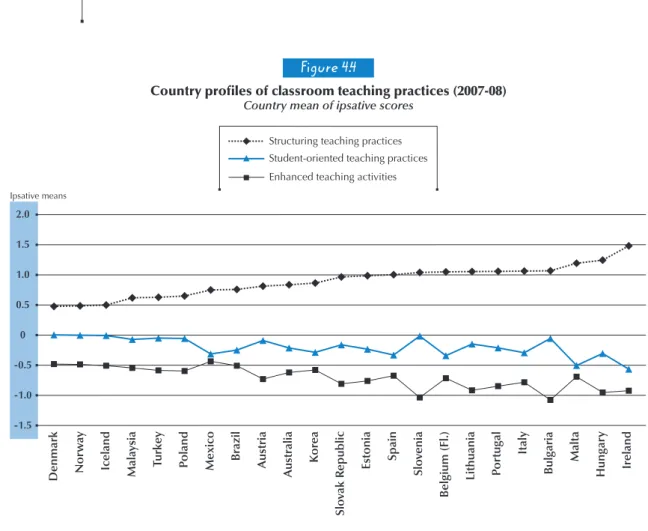
Country differences in profiles of classroom teaching practices ...97
Domain specificity of profiles of instructional practices ...99
Variance distribution across levels ...100
Teacher’s professional activities: co-operation among staff...101
Country differences in profiles of co-operation among staff ...101
Variance distribution across levels ...103
Classroom environment ...103
Country differences in classroom environment ...104
Variance distribution across levels ...107
School-level environment: school climate ...108
Country differences in teacher-student relations ...108
Variance distribution across levels ...110
Job-related attitudes: self-efficacy and job satisfaction...111
Country differences in self-efficacy and job satisfaction ...111
Understanding teachers’ professionalism: first steps in linking the school context and teachers’
beliefs and practices to teachers’ perceived efficacy and the quality of the learning environment...113
Significance of context and background variables ...113
Effects of professional development activities ...116
Effects of beliefs on instructional practices ...118
Effects of instructional practices on classroom disciplinary climate ...118
Effects of teachers’ co-operation on teacher-student relations ...119
Determinants of teacher job satisfaction ...119
Conclusions and implications for policy and practice ...120
Teachers generally support modern constructivist beliefs about instruction, but there is scope for strengthening this support ...120
Teachers need to use a wider range of instructional strategies and techniques ...121
There is scope to improve teacher effectiveness by extending teacher co-operation and linking this to an improved school climate ...122
Support of teachers’ classroom management techniques and a positive attitude towards the job ...122
Additional material ...123
Chapter 5 School evAluAtIon, teAcher APPrAISAl And feedBAck And the ImPAct on SchoolS And teAcherS ...137
Highlights ...138
Introduction ...139
Framework for evaluating education in schools: data collected in TALIS ...139
Data collected in TALIS ...140
Nature and impact of school evaluations ...142
Frequency of school evaluations...142
Focus of school evaluations ...144
Influence of school evaluations ...147
Publication of information on school evaluations ...148
Form of teacher appraisal and feedback ...149
Frequency of appraisal and feedback ...149
Focus of appraisal and feedback ...151
Teaching in a multicultural setting and teaching students with special learning needs ...153
Outcomes of feedback and appraisal of teachers ...154
Impact of teacher appraisal and feedback ...158
Teachers’ perceptions of the fairness of appraisal and feedback ...158
Impact of appraisal and feedback on teaching and teachers’ work ...159
Teacher appraisal and feedback and school development ...161
Links across the framework for evaluating education in schools ...163
Conclusions and implications for policy and practice ...169
Teacher appraisal and feedback has a positive impact on teachers ...169
School evaluation and teacher appraisal and feedback are relatively rare in a number of education systems, and do not always have consequences for teachers ...169
Teachers reported that they would receive little, if any, recognition for improving their teaching, as teacher effectiveness is not linked to the recognition and rewards they receive ...170
School evaluations can be structured so that they and teacher appraisal and feedback lead to developments in particular aspects of school education ...171
TablE Of COnTEnTs
Chapter leAdIng to leArn: School leAderShIP And mAnAgement StyleS ...189
Highlights ...190
Introduction ...191
From bureaucratic administrator to leader for learning ...191
Goals of the TALIS survey of principals ...192
Chapter outline ...193
Salient dimensions of secondary school management behaviour of school principals ...193
Management behaviour ...193
Management styles and school leadership ...195
Management styles and decision making ...196
Management styles and characteristics of principals and schools ...197
Management styles and characteristics of evaluations of school performance ...198
Aspects of teachers’ work and school management ...198
Beliefs about the nature of teaching and learning ...199
Classroom practices of teachers ...200
Teachers’ professional activities ...200
Teachers’ classroom environment and school climate for learning ...200
Teachers’ attitudes towards their job ...200
Teacher appraisal and feedback and school management ...201
Learning outcomes, teachers’ practices and professional development as appraisal criteria ...201
Objectives of the appraisal ...202
Feedback and consequences of the appraisal ...202
Teachers’ professional development ...202
Conclusions and implications for policy and practice ...203
New trends in school leadership are evident to varying degrees in countries’ educational systems ...203
While neither leadership style is consistently associated with teachers’ beliefs and practices, there is evidence to suggest that instructional leadership is related to important aspects of the management of effective instruction in schools ...204
Additional material ...205
Chapter 7 key fActorS In develoPIng effectIve leArnIng envIronmentS: clASSroom dIScIPlInAry clImAte And teAcherS’ Self-effIcAcy ...219
Highlights ...220
Introduction and conceptual framework ...221
Analytical model ...221
A focus on self-efficacy and classroom disciplinary climate ...222
Estimations of classroom disciplinary climate and teachers’ reported self-efficacy ...223
Modelling strategy: country-by-country analysis ...224
Descriptive statistics for teachers’ reported self-efficacy ...225
Descriptive statistics for classroom environment ...226
Teachers’ characteristics and classroom disciplinary climate and teachers’ self-efficacy ...227
Teachers’ professional development and classroom disciplinary climate and teachers’ self-efficacy ...229
Teaching practices, beliefs and attitudes and classroom disciplinary climate and teachers’ self-efficacy ...231
Teaching practices, beliefs and attitudes and classroom disciplinary climate ...231
Teaching practices, beliefs and attitudes and teachers’ self-efficacy ...233
School leadership and classroom disciplinary climate and teachers’ self-efficacy ...238
School autonomy and school climate and classroom disciplinary climate and teachers’ self-efficacy ...239
Conclusions and implications for policy and practice ...241
Additional material ...241
reFerenCes ...259
annex a1 technIcAl noteS on Survey ProcedureS And AnAlySIS ...267
Annex A1.1 Construction of indices and other derived measures ...268
Annex A1.2 TALIS sampling procedures and response rates ...277
Annex A1.3 Quality assurance ...280
Annex A1.4 Technical notes on multiple regression analyses ...282
annex a2 Selected chArActerIStIcS of dAtA collected from the netherlAndS ...299
TablE Of COnTEnTs
10
List of boxes
Box 1.1 The TALIS design ...20
Box 3.1 Types of professional development ...50
Box 4.1 Teachers’ beliefs about teaching ...93
Box 4.2 Cross-cultural validity of the indices for teachers’ beliefs, practices and attitudes ...93
Box 4.3 Computation of ipsative scores ...94
Box 4.4 Description of regression analysis ...114
Box 5.1 Path analysis methodology ...164
Box 7.1 Classroom disciplinary climate, teachers’ reported self-efficacy and the stability of employment ...229
Box 7.2 Professional development and classroom disciplinary climate and teachers’ reported self-efficacy...230
Box 7.3 Disciplinary climate and teachers’ reported self-efficacy and teaching practices and beliefs ...234
Box 7.4 Classroom disciplinary climate and teachers’ reported self-efficacy and teachers’ appraisal and feedback ...238
Box 7.5 Classroom disciplinary climate and teachers’ reported self-efficacy and school leadership ...239
Box 7.6 Classroom disciplinary climate and teachers’ reported self-efficacy and various school-level factors ...240
Box A1.4.1 Summary of four final models per country ...287
List of figures Figure 1.1 Countries participating in TALIS ...18
Figure 2.1 Gender and age of teachers (2007-08) ...27
Figure 2.2 Job experience of teachers (2007-08) ...30
Figure 2.3 Percentage of teachers in schools where the principal reported the following as pre-requisites or high priorities for admittance to school (2007-08) ...35
Figure 2.4 School autonomy factors (2007-08) ...37
Figure 2.5 Percentage of teachers whose school principal reported that the following teacher behaviours hindered the provision of instruction in their school a lot or to some extent (2007-08) ...39
Figure 3.1 Percentage of teachers who undertook some professional development in the previous 18 months (2007-08) ...52
Figure 3.2 Comparison of the level and intensity of participation in professional development (2007-08) ...53
Figure 3.3 Days of professional development taken – Interquartile range (2007-08) ...54
Figure 3.4 Participation rates by type of professional development activity (2007-08) ...57
Figure 3.5 Percentage of teachers who wanted more development than they received in the previous 18 months (2007-08) ...59
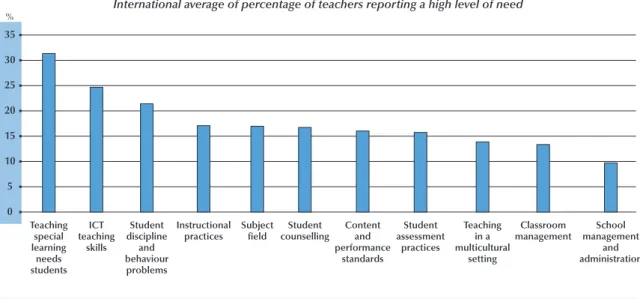
Figure 3.6 Areas of greatest development need (2007-08) ...60
Figure 3.7 Index of professional development need (2007-08) ...62
Figure 3.8 Comparison of unsatisfied demand for professional development and amount undertaken (2007-08) ...63
Figure 3.9 Types of support received for professional development (2007-08) ...65
Figure 3.10 Average days of development taken by teachers according to personal payment level (2007-08) ...67
Figure 3.11 Level of personal payment by type of development activity (2007-08) ...68
Figure 3.12 Percentage of teachers receiving scheduled time compared to average days of development undertaken (2007-08) ...69
Figure 3.13 Percentage of teachers in schools with no formal induction or mentoring programmes (2007-08) ...71
Figure 3.14 Reasons for not taking more professional development (2007-08) ...72
11
TablE Of COnTEnTsFigure 4.1 Framework for the analysis of teaching practices and beliefs ...91
Figure 4.2 Country profiles of beliefs about the nature of teaching and learning (2007-08) ...95
Figure 4.3 Distribution of total variance across the three levels of analysis for teachers’ beliefs about instruction (2007-08) ...96
Figure 4.4 Country profiles of classroom teaching practices (2007-08) ...98
Figure 4.5 Subject profiles of classroom teaching practices (2007-08) ...99
Figure 4.6 Distribution of total variance across the three levels of analysis for teaching practices (2007-08) ...100
Figure 4.7 Country profiles for co-operation among staff (2007-08) ...102
Figure 4.8 Distribution of total variance across the three levels of analysis for co-operation among staff (2007-08) ...103
Figure 4.9 Distribution of time spent in the classroom during an average lesson (2007-08) ...104
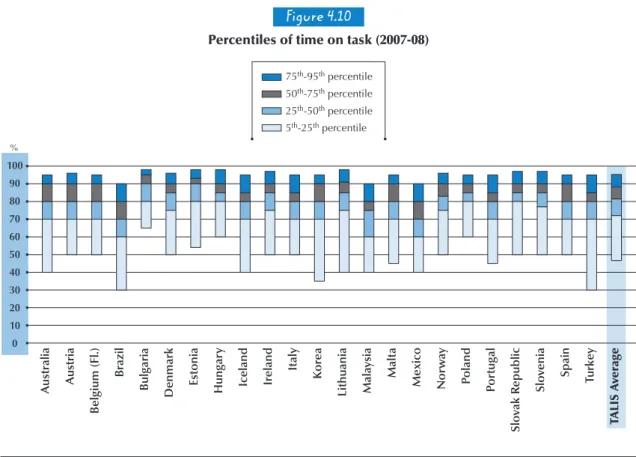
Figure 4.10 Percentiles of time on task (2007-08) ...105
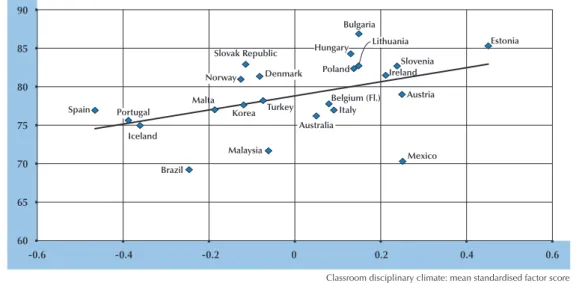
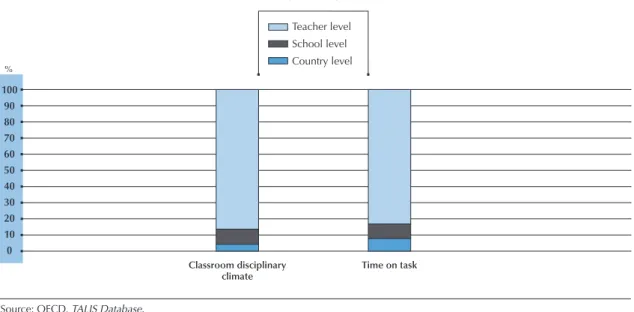
Figure 4.11 Country means for two indicators of the quality of the classroom environment (2007-08) ...106
Figure 4.12 Distribution of total variance across the three levels of analysis for indicators of classroom climate (2007-08) ...107
Figure 4.13 Teacher-student relations: precentiles of the standardised factor scores ...109
Figure 4.14 Distribution of total variance across the three levels of analysis for teacher-student relations (2007-08) ...110
Figure 4.15 Country means of teacher self-efficacy and job satisfaction (2007-08) ...112
Figure 4.16 Distribution of total variance across the three levels of analysis for self efficacy and job satisfaction (2007-08) ...112
Figure 5.1 Structure for evaluation of education in schools: data collected in TALIS ...142
Figure 5.2 Criteria of school evaluations (2007-08) ...145
Figure 5.3 Teachers who received no appraisal or feedback and teachers in schools that had no school evaluation in the previous five years (2007-08) ...150
Figure 5.4 Criteria for teacher appraisal and feedback (2007-08) ...153
Figure 5.5 Impact of teacher appraisal and feedback (2007-08) ...156
Figure 5.6 Impact of teacher appraisal and feedback upon teaching (2007-08) ...160
Figure 5.7 Perception of teachers of appraisal and feedback and its impact in their school (2007-08) ...162
Figure 5.8 Path analysis for teaching students with special learning needs ...165
Figure 5.9 Path analysis for teaching in a multicultural setting ...166
Figure 5.10 Path analysis for teachers’ classroom management ...166
Figure 5.11 Path analysis for teachers’ handling of student discipline and behaviour problems ...166
Figure 5.12 Path analysis for teachers’ knowledge and understanding of main subject field ...167
Figure 5.13 Path analysis for teachers’ knowledge and understanding of instructional practices in their main subject field ...167
Figure 6.1 Composition of the indices for instructional and administrative leadership ...195
Figure 6.2 School principals according to their management styles (2007-08) ...197
Figure 6.3 Effects of greater use of instructional or administrative leadership styles ...203
List of tabLes Table 2.1 Gender and age distribution of teachers (2007-08) ...41
Table 2.2 Teachers’ educational attainment (2007-08) ...41
Table 2.3 Employment status and job experience of teachers (2007-08) ...42
Table 2.4 School personnel characteristics and the percentage of teachers in public schools (2007-08) ...42
Table 2.5 School resources (2007-08) ...43
Table 2.6 School admission policies (2007-08) ...43
Table 2.7 School autonomy (2007-08) ...44
Table 2.8 School climate – teacher-related factors (2007-08) ...45
Table of conTenTs
12
Table 3.1 Participation of teachers in professional development in the previous 18 months (2007-08) ...80
Table 3.1a Amount of professional development undertaken by teachers in the previous 18 months (2007-08) – teacher characteristics ...81
Table 3.1b Amount of professional development undertaken by teachers in the previous 18 months (2007-08) – school characteristics ...82
Table 3.2 Types of professional development undertaken by teachers (2007-08) ...82
Table 3.3 Teachers who wanted to participate in more development than they did in the previous 18 months (2007-08) ...83
Table 3.4 Teachers’ high professional development needs (2007-08) ...84
Table 3.5 Support for professional development undertaken by teachers (2007-08) ...85
Table 3.6 Frequency of mentoring and induction programmes (2007-08) ...85
Table 3.7 Reasons for not participating in more professional development (2007-08)...86
Table 3.8 Impact of different types of professional development undertaken by teachers (2007-08) ...86
Table 4.1 Correlation between direct transmission and constructivist beliefs about teaching (2007-08) ...125
Table 4.2 Correlation between time on task and classroom disciplinary climate (2007-08)...125
Table 4.3 Relationship between teacher characteristics and teachers’ beliefs, attitudes and practices and the learning environment (2007-08) ...125
Table 4.4 Relationship between classroom context and teaching practices (2007-08) ...126
Table 4.5 Relationship between school context and teacher-student relations (2007-08) ...127
Table 4.6 Relationship between teachers’ professional development activities and their teaching beliefs about instruction (2007-08) ...128
Table 4.7 Relationship between teachers’ professional development activities and teaching practices (2007-08) ...129
Table 4.8 Relationship between teachers’ professional development activities and teacher co-operation (2007-08) ...130
Table 4.9 Relationship between teachers’ beliefs about instruction and teaching practices (2007-08) ...131
Table 4.10 Relationship between teaching practices and classroom disciplinary climate (2007-08) ...132
Table 4.11 Relationship between teacher co-operation and teacher-student relations (2007-08) ...133
Table 4.12 Relationship between teachers’ beliefs about instruction, classroom teaching practices, the learning environment, self-efficacy, and teachers’ job satisfaction (2007-08) ...134
Table 4.13 Relationship between classroom disciplinary climate, teacher-student relations and job satisfaction (2007-08) ...135
Table 5.1 Frequency and type of school evaluations (2007-08) ...174
Table 5.1a Criteria of school evaluations (2007-08) ...175
Table 5.2 Impacts of school evaluations upon schools (2007-08)...176
Table 5.2a Publication of school evaluations (2007-08) ...177
Table 5.3 Frequency and source of teacher appraisal and feedback (2007-08) ...177
Table 5.4 Criteria for teacher appraisal and feedback (2007-08) ...179
Table 5.5 Outcomes of teacher appraisal and feedback (2007-08) ...181
Table 5.6 Actions undertaken following the identification of a weakness in a teacher appraisal (2007-08)...182
Table 5.7 Teacher perceptions of the appraisal and/or feedback they received (2007-08) ...185
Table 5.7a Teacher perceptions of the personal impact of teacher appraisal and feedback (2007-08) ...186
Table 5.8 Impact of teacher appraisal and feedback upon teaching (2007-08) ...187
Table 5.9 Teacher appraisal and feedback and school development (2007-08) ...188
Table 6.1 School principal leadership behavioral items (2007-08) ...206
Table 6.2 School principal leadership behavioral indices (2007-08) ...206
Table 6.3 Management leadership styles (2007-08) ...207
Table 6.4 Relationship between school leadership style and teachers’ beliefs about instruction (2007-08) ...207
Table 6.5 Relationship between school leadership style and teaching practices (2007-08) ...208
Table 6.6 Relationship between school leadership style and co-ordination and professional collaboration among teachers (2007-08) ...209
Table 6.7 Relationship between school leadership style and classroom disciplinary climate, time on task and teacher-student relations indices (2007-08) ...210
13
TablE Of COnTEnTsTable 6.8 Relationship between school leadership style and teacher’s job satisfaction and self-efficacy (2007-08) ...211
Table 6.9 Relationship between school leadership style and objectives of teacher appraisals (2007-08) ...212
Table 6.10 Relationship between school leadership style and outcomes of teacher appraisals (2007-08) ...213
Table 6.11 Relationship between school leadership style and the professional development of teachers (2007-08) ...214
Table 6.12 Relationship between the background characteristics of the principals and their school and the use of instructional leadership style (2007-08) ...215
Table 6.13 Relationship between the background characteristics of the principals and their school and the use of administrative leadership style (2007-08) ...216
Table 6.14 Correlation between leadership styles and types of evaluation (2007-08) ...217
Table 7.1 List of independent variables ...243
Table 7.2 Index of self-efficacy (2007-08)...244
Table 7.3 Classroom disciplinary climate index (2007-08) ...244
Table 7.4 Significant variables and the direction of coefficients of Bloc 1 variables in the gross, net and final net models estimating classroom disciplinary climate ...244
Table 7.4a Significant variables and the direction of coefficients of Bloc 1 variables in the gross, net and final net models estimating teacher’s reported self-efficacy ...245
Table 7.5 Significant variables and the direction of coefficients of Bloc 2 variables in the gross, net and final net models estimating classroom disciplinary climate ...246
Table 7.5a Significant variables and the direction of coefficients of Bloc 2 variables in the gross, net and final net models estimating teacher’s reported self-efficacy ...247
Table 7.6 Significant variables and the direction of coefficients of Bloc 3 variables in the gross, net and final net models estimating classroom disciplinary climate ...248
Table 7.6a Significant variables and the direction of coefficients of Bloc 3 variables in the gross, net and final net models estimating teacher’s reported self-efficacy ...249
Table 7.7 Significant variables and the direction of coefficients of Bloc 4 variables in the gross, net and final net models estimating classroom disciplinary climate ...250
Table 7.7a Significant variables and the direction of coefficients of Bloc 4 variables in the gross, net and final net models estimating teacher’s reported self-efficacy ...252
Table 7.8 Significant variables and the direction of coefficients of Bloc 5 variables in the gross, net and final net models estimating classroom disciplinary climate ...254
Table 7.8a Significant variables and the direction of coefficients of Bloc 5 variables in the gross, net and final net models estimating teacher’s reported self-efficacy ...255
Table 7.9 Significant variables and the direction of coefficients of Bloc 6 variables in the gross, net and final net models estimating classroom disciplinary climate ...256
Table 7.9a Significant variables and the direction of coefficients of Bloc 6 variables in the gross, net and final net models estimating teachers’ reported self-efficacy ...257
Table A1.2.1 Unweighted participation rates weighted estimated size of the teacher population by country ...279
Table A1.4.1 List of independent variables in the Chapter 4 regression analyses ...289
Table A1.4.2 List of independent variables in the Chapter 6 regression analyses ...290
Table A1.4.3 Sample sizes for the Chapter 7 regression analyses ...291
Table A1.4.4 Between-school variance in classroom disciplinary climate and teachers’ reported self-efficacy for each country ...291
Table A1.4.5 List of independent variables in the Chapter 7 regression analyses ...292
Table A1.4.6 The percentage of missing cases for each country for each variable included in the Chapter 7 regression analyses ...293
Table A2.1 The professional development of teachers: selected data for the Netherlands...300
Table A2.2 Teaching practices beliefs and attitudes: selected data for the Netherlands ...300
Table A2.3 School evaluation, teacher appraisal and feedback, and the impact on schools and teachers: selected data for the Netherlands ...301
15
Reader’s Guide
statistics and analysis
This report presents statistics and analysis derived from the survey responses of teachers of lower secondary education (level 2 of the International Standard Classification of Education (ISCED-97)) and the principals of their schools.
classification of levels of education
The classification of the levels of education is based on the revised International Standard Classification of Education (ISCED-97). ISCED is an instrument for compiling statistics on education internationally and distinguishes among six levels of education:
• Pre-primary education (ISCED level 0).
• Primary education (ISCED level 1).
• Lower secondary education (ISCED level 2).
• Upper secondary education (ISCED level 3).
• Post-secondary non-tertiary level of education (ISCED level 4).
• Tertiary-type A education (ISCED level 5A).
• Tertiary-type B education (ISCED level 5B).
• Advanced Research Qualifications (ISCED level 6).
calculation of international average
A TALIS average was calculated for most indicators presented in this report. The TALIS average is calculated as the unweighted mean of the data values of the TALIS countries included in the table. The TALIS average therefore refers to an average of data values at the level of the national systems.
symbols for missing data
The following symbols are employed in the tables and charts to denote missing data:
a The category does not apply in the country concerned. Data are therefore missing. m Data are not available as the underlying data were either not collected or withdrawn.
abbreviations used in this report
The following abbreviations are used in this report: CFI Comparative Fit Index
ISCED International Standard Classification of Education RMSEA Root Mean Square Error of Approximation rxy Correlation coefficient
(S.E.) Standard error
REaDER’s GuiDE
16
rounding of figures
Because of rounding, some figures in tables may not exactly add up to the totals. Totals, differences and averages are always calculated on the basis of exact numbers and are rounded only after calculation.
All standard errors in this publication have been rounded to two decimal places. Where the value 0.00 is shown, this does not imply that the standard error is zero, but that it is smaller than 0.005.
territorial entities
In the whole document the Flemish Community of Belgium is referred to as “Belgium (Fl.)”.
further doCumentation
For further information on TALIS documentation, the instruments and methods, see the TALIS Technical Report (forthcoming) and the TALIS website (www.oecd.org/edu/TALIS).
This report uses the OECD’s StatLinks service. Below each table and chart is a url leading to a corresponding Excel workbook containing the underlying data. These urls are stable and will remain unchanged over time.
17
Introduction
C
hapter
1
18 Overview of TALIS 19 Origins and aims of TALIS 19 Design of the TALIS survey
20 Population surveyed and sampling options
20 Choosing the policy focus of the first round of TALIS 21 Developing TALIS
22 Interpretation of the results 22 Organisation of the report
chapter 1 IntroductIon
18
Overview Of TALiS
The OECD’s Teaching and Learning International Survey is the first international survey to focus on the working conditions of teachers and the learning environment in schools. Its aim is to help countries to review and develop policies that foster the conditions for effective schooling.
TALIS focuses on lower secondary education teachers and the principals of their schools and seeks to provide policy-relevant data and analysis on the following key aspects of schooling:
• the role and functioning of school leadership;
• how teachers’ work is appraised and the feedback they receive;
• teachers’ professional development; and
• teachers’ beliefs and attitudes about teaching and their pedagogical practices.
In view of the important role that school leadership can play in creating effective schools, TALIS describes the role of school leaders and examines the support they give to their teachers. Because retaining and developing effective teachers is a priority in all school systems, TALIS looks at how teachers’ work is recognised, appraised and rewarded and how well their professional development needs are being addressed. Finally, TALIS provides insights into the beliefs and attitudes about teaching that teachers bring to the classroom and the pedagogical practices that they adopt.
TALIS is a collaborative effort by member countries of the OECD and partner countries which has been conceptualised as a programme of surveys. This report presents the initial results from the first round of TALIS, which was implemented in 2007-08.
Figure 1.1
Countries participating in TALIS
OecD countries partner countries
Australia Brazil
Austria Bulgaria
Belgium (Flemish Community) Estonia
Denmark Lithuania Hungary Malaysia Iceland Malta Ireland Slovenia Italy Korea Mexico Norway Poland Portugal Slovak Republic Spain Turkey
Note: TALIS was also conducted in the Netherlands but as the required sampling standards were not achieved, their data are not included in the international comparisons.
19
IntroductIon chapter 1In all, 24 countries participated in this first round of TALIS (see Figure 1.1). However, as the Netherlands did not meet the sampling standards, their data are not included in the international tables and analyses. A summary of the results for the Netherlands can be found in Annex A2 of this report.
origins and aims of TaLis
TALIS has been developed as part of the OECD Indicators of Education Systems (INES) project. Over the past 20 years or so, INES has sought to create a coherent set of indicators that provide a reliable basis for the quantitative comparisons of the functioning and performance of education systems in OECD and partner countries. The main product from the INES project is the annual Education at a Glance (OECD, 2008a). Although the INES programme has made considerable progress over the years in developing indicators on the learning environment and organisation of schools, as well as learning outcomes, significant gaps in the knowledge base on teachers and teaching remained. As a result, the INES General Assembly in 2000 in Tokyo called for increased attention to teachers and teaching in future work. At the meeting of deputy Ministers of Education in Dublin in 2003, the need for better information on the quality of learning and how teaching influences learning was further affirmed.
To address these deficiencies, a strategy was developed to improve the indicators on teachers, teaching and learning. One aspect was an international survey of teachers, which evolved into the TALIS programme. Another important impetus for TALIS came from the OECD review of teacher policy, which concluded with the report Teachers Matter: Attracting, Developing and Retaining Effective Teachers (OECD, 2005) and emphasised the need for better national and international information on teachers. The framework used in that policy review and the specific gaps in the data and priorities it highlighted were instrumental in the design of TALIS.
The overall objective of the TALIS surveys is therefore to provide, in a timely and cost-effective manner, robust international indicators and policy-relevant analysis on teachers and teaching in order to help countries to review and develop policies that create the conditions for effective schooling. Cross-country analyses provide the opportunity to compare countries facing similar challenges and to learn about different policy approaches and their impact on the learning environment in schools.
The guiding principles underlying the survey strategy are:
• Policy relevance. Clarity about the policy issues and a focus on the questions that are most relevant for participating countries are both essential.
• Value added. International comparisons should be a significant source of the study’s benefits.
• Indicator-oriented. The results should yield information that can be used to develop indicators.
• Validity, reliability, comparability and rigour. Based on a rigorous review of the knowledge base, the survey should yield information that is valid, reliable and comparable across participating countries.
• Interpretability. Participating countries should be able to interpret the results in a meaningful way.
• Efficiency and cost-effectiveness. The work should be carried out in a timely and cost-effective way.
design of The TaLis survey
TALIS is conceived as a sequence of surveys which over time, will survey school teachers from all phases of schooling. Within this broad survey design, specific plans for further rounds of TALIS will be reviewed after the first round is completed.
chapter 1 IntroductIon
20
population surveyed and sampling options
The international sampling and operational parameters applied in TALIS are shown in Box 1.1 and further details, including teacher and school participation rates by country are given in Annex A1.2.
Box 1.1
The TALIS design
•International target population: lower secondary education teachers and the principals of their schools.
•Sample size: 200 schools per country, 20 teachers in each school.
•Within school samples: representative samples of schools and teachers within schools.
•target response rates: 75% of the sampled schools (school considered responding if 50% of sampled teachers respond), aiming for a 75% response from all sampled teachers in the country.
•Questionnaires: separate questionnaires for teachers and principals, each requiring around 45 minutes to complete.
•Mode of data capture: questionnaires filled in on paper or on line.
•Survey windows: October-December 2007 for Southern Hemisphere countries and March-May 2008 for Northern Hemisphere countries.
The participating countries decided that the main focus of the first round of TALIS should be teachers of lower secondary education (level 2 of the 1997 revision of the International Standard Classification of Education, ISCED 97) and their school principals. The design of the first round also proposed international options which allowed countries to survey as well a representative sample of teachers of primary and/or upper secondary education and the principals of their schools. Another option was to survey a representative sample of teachers of 15-year-olds in schools that took part in PISA 2006 and principals of these schools. As too few countries expressed an interest in these options, they were not covered at the international level; however, Iceland and Mexico adopted some national sampling options.
TALIS defines teachers of ISCED level 2 as those who, as part of their regular duties, provide instruction in programmes at ISCED level 2. Teachers in the schools sampled who teach a mixture of programmes at different levels, including ISCED 2 programmes, were included in the target population. There was no minimum cut-off for the amount of their ISCED level 2 teaching. The following were excluded from the teacher target population: teachers only teaching special need students; substitute, emergency or occasional teachers; teachers teaching adults exclusively; teachers on long-term leave; and teachers who were also the principals of their schools.
Choosing the poliCy foCus of the first round of talis
The original conceptual framework for the TALIS programme was developed by a joint taskforce comprising experts from the INES Network A (learning outcomes) and Network C (learning environment and school organisation). The taskforce was asked to develop a data strategy on teachers, teaching and learning in order to identify gaps in data at the international level and help make the coverage of the INES indicators more complete. A major part of that strategy was a survey programme which developed into TALIS.
21
IntroductIon chapter 1The original conceptual framework was adapted to the policy issues that had been studied in the OECD teacher policy review (OECD, 2005): attracting, developing and retaining effective teachers; school policies; and effectiveness and quality teachers and teaching (see the forthcoming TALIS Technical Report for details of the framework). On the basis of the indicators included in the framework, the participating countries chose the following themes as the policy focus of the first round of TALIS:
• school leadership;
• appraisal of and feedback to teachers; and
• teaching practices, beliefs and attitudes.
TALIS also chose the professional development of teachers as an important theme. In part this was because of synergies with the three main themes and in part because it allowed TALIS to serve as a way for countries of the European Union to collect information on teachers which the Education Council had identified as important to monitor progress towards the Lisbon 2010 goals. In particular, the data on professional development of teachers are relevant for monitoring the common objective of improving the education and training of teachers and trainers (Council (Education) of the EU (2002; 2005; 2007)).
Aspects of other themes were also included in the survey when they were seen to provide important complementary analytical value to the main themes. In particular, aspects of “School climate” and “Division of working time” and a single item on “Job satisfaction” were also included.
Separate questionnaires for teachers and the principals of their schools were prepared to explore the policy and analytical questions agreed by the participating countries under these policy themes. Considerable effort was devoted to achieving cultural and linguistic validity of the survey instruments, and stringent quality assurance mechanisms were applied both for their translation and for the sampling and data collection (see Annex 1.3).
deveLOping TALiS
The development of TALIS has been the result of productive co-operation between the member countries of the OECD and the partner countries participating in the first round. Engagement with bodies representing teachers and regular briefings and exchanges with the Trades Union Advisory Council at the OECD (TUAC) have been very important in the development and implementation of TALIS. In particular, the co-operation of the teachers and principals in the participating schools has been crucial in ensuring the success of TALIS.
A Board of Participating Countries, representing all of the countries taking part in the first round of TALIS, set out the policy objectives for the survey and established the standards for data collection and reporting. An Instrument Development Expert Group (IDEG) was established to translate the policy priorities into questionnaires in order to address the policy and analytical questions that had been agreed by the participating countries.
Participating countries implemented TALIS at the national level through National Project Managers (NPMs) and National Data Managers (NDMs), who were subject to rigorous technical and operational procedures. The NPMs played a crucial role in helping to secure the co-operation of schools, to validate the questionnaires, to manage the national data collection and processing and to verify the results from TALIS. The NDMs co-ordinated the data processing at the national level and liaised in the cleaning of the data.
The co-ordination and management of implementation at the international level was the responsibility of the appointed contractor, the Data Processing Centre of the International Association for the Evaluation of Educational Achievement (IEA). The IEA Secretariat was responsible for overseeing the verification of the translation and for quality control in general. Statistics Canada, as a sub-contractor of the IEA, developed the sampling plan, advised countries on its application, calculated the sampling weights and advised on the calculation of sampling errors.
chapter 1 IntroductIon
22
The OECD Secretariat had overall responsibility for managing the programme, monitoring its implementation on a day-to-day basis and serving as the secretariat of the Board of Participating Countries.
Annex A3 provides the list of contributors to TALIS.
inTerpreTATiOn Of The reSuLTS
It should be carefully borne in mind that the results derived are based on self-reports from teachers and principals and therefore represent their opinions, perceptions, beliefs and their accounts of their activities. This is powerful information, as it gives insight into how teachers perceive the learning environments in which they work, what motivates them, and how policies and practices that are put in place are carried out in practice. But, like any self-reported data, this information is subjective and therefore differs from objectively measured data. The same is true of school principals’ reports about school characteristics, which may differ from descriptions provided by administrative data.
In addition, as a cross-sectional survey, TALIS cannot measure causality. For instance, in examining the relationship between school climate and teacher co-operation, it is not possible to establish whether a positive school climate depends on good teacher co-operation or whether good teacher co-operation depends on a positive school climate. The perspective taken in the analysis, i.e. the choice of predicted and predictor variables, is purely based upon theoretical considerations, as laid out in the analytical framework. When a reference is made to “effects”, it is to be understood in a statistical sense – i.e. an “effect” is a statistical parameter that describes the linear relationship between a “predicted” variable (e.g. job satisfaction) and a “predictor” variable (e.g. participation in professional development activities) – taking effects of individual and school background as well as other “independent” variables into account. Thus, the “effects” reported are statistical net effects even if they do not imply causality.
Finally, the cross-cultural validity of the results is an important feature of the analysis, particularly with regard to the international scales and indices, developed mainly in Chapters 4 and 6 (see Annex A1.1). The analysis indicates the extent to which the indices can be directly compared among countries; where there appear to be limitations on the comparability of the indices, this is noted in the text. Full details of the cross-cultural validity analysis are provided in the TALIS Technical Report (forthcoming).
OrgAniSATiOn Of The repOrT
The following chapters of this report present the results and the analyses from the first round of TALIS.
• chapter 2 presents a description of the characteristics of the lower secondary teacher populations and the schools in which they work. In doing so, it provides an important context for the later analytical chapters.
• chapter 3 presents and analyses the TALIS data relating to teachers’ in-service professional development. It examines the extent to which teachers’ professional development needs are provided for and their patterns of participation, as well as the support they receive and the barriers they perceive regarding their participation. It finishes by considering the types of development teachers find most effective.
• chapter 4 turns to an examination of teaching practices and teachers’ beliefs and attitudes. Based on the conceptual model presented in the chapter, it analyses teachers’ beliefs about the nature of teaching and learning, classroom teaching practices, teachers’ professional activities, the classroom and school environments, and teachers’ perceptions of their self-efficacy and job satisfaction.
• chapter 5 is concerned with teacher appraisal and feedback. It begins with an analysis of the nature and impact of school evaluations and then considers key aspects of teacher appraisal and feedback: its frequency and focus, its outcomes, and its impacts on and for teachers. The link between school evaluations, teacher appraisal and feedback and how this impacts on teachers and their teaching is then examined.
23
IntroductIon chapter 1• chapter 6 turns to school leadership to present and compare management styles across countries. These are analysed in terms of the characteristics of the school principals and the schools in which they work. It then associates management styles to teachers’ professional development, their practices, beliefs and attitudes, and the appraisal and feedback they receive.
• chapter 7 draws on the findings from Chapters 2 to 6 to build statistical models to examine the determinants of two important characteristics of a positive learning environment: classroom disciplinary climate and teachers’ self-efficacy.
Chapters 2 to 7 all begin with a summary of the chapter’s key findings and conclude with a discussion of the implications of these findings for policy and practice.
25
A Profile of the Teacher
Population and the Schools
in Which They Work
C
hapter
2
26 Introduction
26 A profile of lower secondary education teachers 31 A profile of the schools in which teachers work
chapter 2 A Profileofthe teAcher PoPulAtionAndthe SchoolSin Which they Work
26
IntroductIon
TALIS examines key policy issues such as teachers’ professional development; teachers’ teaching practices, beliefs and attitudes; teacher appraisal and feedback; and school leadership. Data have been collected on a number of characteristics of schools and teachers which provide not only essential background information for analysis of these issues but also school- and system-level factors that are important for teachers and teaching. This chapter presents analyses of these characteristics, and helps set the scene for the following analytical chapters.
The chapter is divided into two sections. The first section presents a profile of lower secondary teachers and concentrates on their formal education and demographic and employment profile. The demographic profile focuses on the age and gender of teachers and school principals. Discussion of teachers’ employment profile includes data on teachers’ contractual status and job experience, including the contrast between permanent and short-term or temporary contract employment.
The second section provides a profile of the schools in which teachers work. It gives information on their personnel, resources, admission policies, autonomy and climate. TALIS includes this background information because of the influence of such factors on student learning and attainment, as a number of studies have demonstrated (OECD, 2007). TALIS does not collect data on student outcomes, but it has included variables which previous research has found to affect student learning, many of which are policy-relevant aspects of education systems. In reading this chapter, it should be borne in mind that TALIS focuses on teachers. Therefore, most of the tables and charts refer to teachers and their distribution among various types of schools. For example, Table 2.4 presents data of, among other things, the sector to which the school belongs and presents the percentages of teachers working in public schools across education systems rather than the percentage of public schools. Therefore, TALIS figures may not correspond to other, perhaps official statistics which are expressed in terms of the percentage of public schools or the percentage of students in public schools. They are intended to complement rather than contradict the official statistics.
A profIle of lower secondAry educAtIon teAchers
The demographic profile of teachers provides information on basic characteristics which are of interest in their own right and as a context for later analysis. For example, the amount of appraisal and feedback a teacher receives may be associated with such characteristics as age or length of employment as a teacher (see Chapter 5). In addition, a teacher’s formal education can influence their professional development (Chapter 3) and their response to leadership opportunities in their schools (Chapter 6).
demographic profile of teachers
Table 2.1 shows gender differences across countries. On average across TALIS countries, almost 70% of teachers were female, and in every TALIS country the majority were female. Females dominated particularly in Bulgaria, Estonia, Lithuania, the Slovak Republic and Slovenia, with between 80 - 85% of the teacher workforce. In these countries, concerns about the effects of the feminisation of teaching on education are potentially greater (OECD, 2005). In addition, when males only represent 15 to 20% of the teacher workforce, the potential supply of teachers could be broadened with greater gender equality.
Given the substantial gender gap in the distribution of teachers across TALIS countries, it is interesting to compare this with the gender distribution among school principals, as this provides insight into issues of gender equality in senior management and promotion opportunities. On average across TALIS countries, 45% of school principals were female compared to just fewer than 70% of teachers (Table 2.1). While TALIS data does not allow for identifying the source of this discrepancy, it seems clear that males far more readily move up the career ladder to become school principals. In this sense, a “glass ceiling” may exist in most TALIS countries, and particularly in Austria, Belgium (Fl.), Ireland, Italy, Korea, Lithuania, Portugal, and Turkey where the percentage of female school principals is over 30 percentage-points below the percentage of female teachers.
27
A Profileofthe teAcher PoPulAtionAndthe SchoolSin Which they Work chapter 2Figure 2.1
Gender and age of teachers (2007-08)
% It aly Austria Nor w ay Estonia
Denmark Lithuania Bulgaria
Slo
vak R
epublic Australia Spain Iceland Hungar
y TALIS A ve ra ge Ireland Slovenia Belgium (Fl.) Mexico Malt a K o re a Po
rtugal Poland Brazil
Mala
ysia
Tu
rk
ey
Age distribution of teachers in lower secondary education
%
Gender distribution of teachers and school principals in lower secondary education
It aly Austria Nor w ay Estonia
Denmark Lithuania Bulgaria
Slo
vak R
epublic Australia Spain Iceland Hungar
y TALIS A ve ra ge Ireland Slov enia Belgium (Fl.) Mexico Malt a K o re a Po
rtugal Poland Brazil
Mala ysia Tu rk ey Female teachers Female school principals
Countries are ranked in descending order, based on the percentage aged 50 or higher. Source: OECD, Table 2.1.
100 90 80 70 60 50 40 30 20 10 0 90 80 70 60 50 40 30 20 10 0
60 years old or higher 50 to 59 years old 30 to 49 years old Less than 30 years old
chapter 2 A Profileofthe teAcher PoPulAtionAndthe SchoolSin Which they Work
28
As Figure 2.1 and Table 2.1 show, more than half of teachers across TALIS countries are aged from 30 to 50 years old. Given concerns about an ageing teacher population it is significant that, on average, only 15% of teachers are less than 30 years of age and few teachers were under 25 years of age, perhaps owing to the education and qualification requirements that apply in most countries. That over one-quarter of teachers are over 50 years old is evidence of an ageing teacher population. Indeed in Austria, Italy and Norway at least 40% of teachers are over 50 years old, and in Estonia, Lithuania and Norway, around 10% of teachers are aged 60 or more (Figure 2.1).
An important aspect of an ageing teacher population is the budgetary impact. Staff remuneration is the largest component of education expenditure. In 2005 (the latest year for which data are available), on average across OECD countries, compensation paid to teachers represented 63% of current expenditure on secondary education institutions (OECD, 2008a). In most education systems, teachers with more experience receive a higher salary. In 2006 (the latest year for which data are available), the statutory salaries of teachers with 15 years of experience were, on average across OECD countries, 35% higher than starting salaries for lower secondary teachers (OECD, 2008a). For countries with a substantial proportion of teachers close to retirement age, total staff remuneration may, depending on the nature of the pension system, reduce over the coming years as these teachers are replaced by younger less expensive teachers.
Nevertheless, not all school systems have an ageing teacher population. The teacher population is slightly younger in Belgium (Fl.), Brazil, Ireland, Malaysia, Malta, Poland and Turkey with 50% or more of teachers below the age of 40 (compared to the TALIS average of 43%). Both Malta and Turkey have greater percentages of young teachers, with almost 33 and 44%, respectively, of teachers less than 30 years of age. In these countries, opportunities clearly exist to structure policies for a young teacher workforce (Boyd et al., 2008). Indeed, in Turkey, almost 80% of teachers were under the age of 40 years (Table 2.1).
teachers’ educational attainment
The level of teachers’ educational attainment is a combination of their pre-service training and additional qualifications they may have acquired in-service. The quantity and quality of teachers’ initial education is clearly important in shaping their work once they begin teaching in schools and should influence their further education and training requirements (see Chapter 3) and other aspects of their development. For example, a low level of formal education or one of poor quality may increase teachers’ need for professional development once they enter the profession. On the other hand, extensive formal education may spur greater interest in further education and training to further develop skills obtained during extensive formal education.
Table 2.2 summarises the highest level of formal education successfully completed by teachers and thus provides a context for interpreting teachers’ professional development and on-the-job training. Table 2.2 gives the percentages of teachers with various levels of formal education, defined according to the International Standard Classification of Education (ISCED) which identifies comparable levels of education across countries. ISCED level 5 represents the first stages of tertiary education and is split between ISCED levels 5A and 5B. ISCED level 5B programmes are generally more practically oriented and shorter than programmes at ISCED level 5A. ISCED level 5A can be further divided into first and second programmes, typically a Bachelor’s degree and a Master’s degree from a university or equivalent institution. ISCED level 6 represents further education at the tertiary level which leads to an advanced research qualification such as a PhD.
Very few teachers have not had at least some tertiary education. On average across TALIS countries, the highest level of education completed was below the tertiary level for only 3% of teachers. However, qualifications below ISCED level 5 were more common in Brazil (9% of teachers), Iceland (12%) and Mexico (10%). Differences among countries in the proportion of teachers with different levels of formal education can reflect both the
29
A Profileofthe teAcher PoPulAtionAndthe SchoolSin Which they Work chapter 2current and past structure of a country’s formal education system as well as the requirements for entering the teaching profession. The highest level of tertiary education completed was ISCED level 5B for over half of teachers in Austria (59%) and Belgium (Fl.) (84%) and reflects these countries’ qualification requirements. In Belgium (Fl.) an ISCED level 5B qualification is required to be fully certified to teach at ISCED level 2. On average across TALIS countries, just under one-third of teachers had completed a Master’s degree and just 1% had completed formal education above this level (Table 2.2).
Large majorities of teachers in Bulgaria (64%), Italy (77%), Poland (94%), the Slovak Republic (96%), and Spain (79%) have completed a Master’s degree (Table 2.2); this may reflect these countries’ qualification requirements for becoming a teacher or for progressing through the teaching career structure (e.g. a requirement for a specific promotion). Teachers’ levels of education may also reflect broader education trends within countries and the extent to which formal education is encouraged in schools and in the teaching profession. Chapter 3 also shows the extent to which teachers engage in qualification programmes as part of their ongoing professional development.
Teachers’ job experience and contractual status
In general, teaching can be viewed as a relatively stable career with strong job security (OECD, 2005). This can be attractive for those in the profession and those wishing to join it, but it can also create a risk of inertia and lack of flexibility if the teacher workforce becomes comprised largely of older and more risk-averse workers (Atkinson, 2005; Dixit, 2002; Ballou & Podgursky 1997; McKewen, 1995). At the same time, a number of countries are concerned about the decline in teachers’ job security and the increase in contract-based employment, particularly of a short-term nature (OECD, 2005), and the impact of teacher turnover (Boyd et al., 2008; Podgursky et al., 2004; Rockoff, 2004).
Table 2.3 shows that on average across TALIS countries, 85% of teachers were employed on a permanent basis. Portugal was the only country in which less than 70% of teachers were permanently employed, followed by Ireland, Brazil and Iceland, with less than 75%. Virtually all teachers were permanently employed in Denmark, Korea, Malaysia and Malta. Permanent employment can be viewed as a benefit of choosing a teaching career and could be linked to the issues discussed in chapter 5 such as the recognition they receive for their efforts and their motivation to improve their effectiveness as teachers.
On average across TALIS countries, only 16%