RESEARCH BRIEF #9
Assessment Tools for Language and Literacy Development of
Young Dual Language Learners (DLLs)
Center for
Early Care and Education Research
Dual Language Learners
I
N THE PAST DECADE, a dramatic increase in invest- ments in early childhood programs (Barnett et al., 2011) has been accompanied by an increase in the number of dual language learners (DLLs)—chil-GUHQIURPELUWKWRDJH¿YH\HDUVZKRDUHJURZLQJXS LQKRPHVZKHUHODQJXDJHVRWKHUWKDQRULQDGGLWLRQWR
English are spoken (Aud et al., 2012; Aikens et al., 2011; Vogel et al., 2011). For example, recent reports from the Family and Child Experiences Survey (FACES) 2009 cohort, the ongoing national study of children in Head Start, indicate that more than 31 percent of preschool-
HUVLQWKHSURJUDPOLYHLQKRPHVZKHUHDODQJXDJHRWKHU
than English is spoken (Aikens et al., 2011). This is also true of almost one-third of children in Early Head Start nationally (Vogel et al., 2011). Reliable and valid assess- ments for this population are needed for evaluations of
HDUO\FKLOGKRRGSURJUDPVDQGKRZZHOOWKH\DUHPHHW- ing the needs of DLLs.
All children need assessments that are fair, equitable,
DQGZHOOFRQVWUXFWHG7KHUHVXOWVVKRXOGUHSUHVHQW VNLOOVNQRZOHGJHDQGEHKDYLRUVRI'//VWKDWDUHLP- portant for their development and later school success. Since the questions and probes for most assessments re- quire the use of a single language, either by the assessor or the child, the results from an assessment of a child
ZKRLVOHDUQLQJWZRODQJXDJHVPD\QRWUHSUHVHQWIXOO\ KLVRUKHUNQRZOHGJHDQGVNLOOV
Examination of reliability and validity evidence helps us
VHOHFWPHDVXUHVE\SURYLGLQJLQIRUPDWLRQDERXWZKHQ DQGZLWKZKRPWKHDVVHVVPHQWZLOOSURYLGHWUXVWZRUWK\
and meaningful results. Information about reliability
FDQWHOOXVKRZGHSHQGDEOHWKHUHVXOWVDUHZKLOHHYL- GHQFHRIYDOLGLW\LQGLFDWHVZKHWKHUWKHDVVHVVPHQWLV PHDVXULQJZKDWLWLVVXSSRVHGWREHPHDVXULQJDQG ZKDWW\SHVRILQIHUHQFHVFDQEHGUDZQIURPWKHUHVXOWV %RWKUHOLDELOLW\DQGYDOLGLW\LQIRUPZKDWW\SHVRILQIHU- HQFHVFDQEHGUDZQIURPWKHUHVXOWV
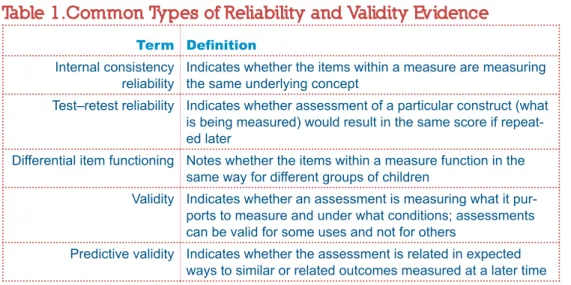
Typically, information about evidence of the reliability and validity of particular assessments is found in the technical manuals that accompany them (see Table 1 for examples).
2WKHUWKDQDIHZGHVLJQHGVSHFL¿FDOO\IRU'//VPRVWDV- sessments report about the reliability and validity evidence based on samples that are more representative of children
ZKRDUHPRQROLQJXDODQGPDNHXSWKHPDMRULW\RIWKH
standardization samples. Test development is expensive, and publishers usually do not invest in seeking evidence of validity for subgroups such as DLLs.
Assessments are validated by accumulating evidence in relation to different types of inferences. An assessment may be valid for a particular purpose or representative of the skills of one group of children but not another.
7KHNH\LVVXHLVZKHWKHUDQDVVHVVPHQWUHDOO\PHDVXUHV ZKDWLWGHFODUHVWRPHDVXUHZKHQXVHGZLWKDJURXS
of children similar to those in the study and for that particular purpose (for example, program evaluation,
UHVHDUFKDERXWFKLOGUHQ¶VGHYHORSPHQWRULGHQWL¿FD- tion of a child’s need for more intensive instruction or specialized intervention).
Different types of evidence can be collected to support interpretation of an assessment and the results ob- tained from it. The normative group (the sample used to develop comparison scores on the assessment) is a key component. An assessment may be valid for comparing
FKLOGUHQIURPWKHVDPHOLQJXLVWLFJURXSEXWXQIDLUZKHQ
A measure may include items that function in differen
ZD\VDFURVVOLQJXLVWLFJURXSVLQFOXGLQJGLIIHUHQFHVLQ GLI¿FXOW\GLVFULPLQDWLRQDQGRUIDFWRUORDGLQJV7KH
abilities of one group may not be validly represented by the scores derived from the items, redereing cross-group
FRPSDULVRQVXQIDLU,QDVLPLODUZD\DQDVVHVVPHQW
may not be valid for making critical decisions about children or the programs serving those children. For example, an English vocabulary or language assessment
ZRXOGEHDYDOLGLQGLFDWRURIZKHWKHUDFKLOGLVOHDUQLQJ
English, but using standard scores based on children
ZKRVSHDNRQO\(QJOLVKWRGHWHUPLQHLID'//KDVD ODQJXDJHGLVDELOLW\ZRXOGQRW
To extend the available information about assessments
XVHGZLWK'//VZHH[DPLQHGUHVHDUFKVWXGLHVSXE- lished in the last 10 years that included young DLLs.
7KLVEULHIGUDZVIURPDPRUHGHWDLOHGUHSRUWH[DPLQLQJ
language and literacy measures used in seven large- scale government studies and thirty research studies conducted in the past decade (Bandel et al., 2012).1 This brief highlights key issues noted in the report and em-
SKDVL]HVTXHVWLRQVWRFRQVLGHUZKHQHYDOXDWLQJWKHDS-
SURSULDWHQHVVRIDVVHVVPHQWWRROVXVHGZLWK'//VDQG
interpreting research that involves such assessments.
How reliable is the assessment?
Reliability information indicates to consumers of re-
VHDUFKWKHWUXVWZRUWKLQHVVRIWKH¿QGLQJVDQGUHVXOWV
can differ by sample and study. Poor reliability can limit the ability to detect change over time or associations
EHWZHHQFRQVWUXFWVIRUH[DPSOHEHWZHHQYRFDEXODU\ DQGHDUO\OLWHUDF\²SDUWLFXODUO\ZKHQWKHVDPSOHVL]HLV VPDOO²DQGFDQOHDGWRÀDZHGFRQFOXVLRQV0DQ\VWXGLHV LQRXUUHYLHZGLGQRWSURYLGHDQ\VWXG\VSHFL¿FHYL- dence of reliability but reported only the published evi-
GHQFHIURPWKHDVVHVVPHQWPDQXDO2XUUHYLHZVXJJHVWV
that more information is needed about the performance
RIPHDVXUHVZLWK'//V
Internal Consistency
The most commonly reported indicator of reliability is
LQWHUQDOFRQVLVWHQF\²WKDWLVKRZFRQVLVWHQWO\WKHLWHPV ZLWKLQDQDVVHVVPHQWPHD- sure the construct of inter-
HVW+RZHYHUPRVWRIWKH SHHUUHYLHZHGVWXGLHVGLG QRWLQFOXGHVWXG\VSHFL¿F
estimates (reporting only the published reliability estimates, if at all) or sepa- rate estimates by language group. Large-scale studies
ZHUHPRUHOLNHO\WRLQFOXGH VDPSOHVSHFL¿FHVWLPDWHV DQGKDGVXI¿FLHQWVDPSOH
sizes to report estimates by subgroups. When reported, the estimates of internal
FRQVLVWHQF\LQWKHVWXGLHVUHYLHZHGZHUHJHQHUDOO\ID-
YRUDEOHWKRXJKQRWDOZD\VZLWKLQDFFHSWDEOHUDQJHVIRU
Spanish assessments. For example, the reported reli- ability estimates for the Spanish version of the Story and Print Concepts used in the FACES 2000 and FACES
VWXGLHVZHUHPXFKORZHUWKDQWKHUHOLDELOLW\HVWL- mates for the English version.
Different factors can affect the reliability of measures
LQFOXGLQJKRZWDUJHWHGWKHLWHPVDUHWRWKHFRQVWUXFW
being measured and to the sample of children taking the
DVVHVVPHQWKRZZHOOLWHPVGLVFULPLQDWHDPRQJFKLO-
GUHQDQGWKHQXPEHURILWHPV8VXDOO\PHDVXUHVZLWK PRUHLWHPVZLOOGHPRQVWUDWHJUHDWHUUHOLDELOLW\WKRXJK ZHOOFRQVWUXFWHGDGDSWLYHDVVHVVPHQWVFDQDWWDLQKLJKO\
Table 1.Common Types of Reliability and Validity Evidence
Term 'HÀQLWLRQ
Internal consistency reliability
Indicates whether the items within a measure are measuring the same underlying concept
Test–retest reliability Indicates whether assessment of a particular construct (what is being measured) would result in the same score if repeat- ed later
Differential item functioning Notes whether the items within a measure function in the same way for different groups of children
Validity Indicates whether an assessment is measuring what it pur- ports to measure and under what conditions;; assessments can be valid for some uses and not for others
Predictive validity Indicates whether the assessment is related in expected ways to similar or related outcomes measured at a later time
UHOLDEOHHVWLPDWHVZLWKDOLPLWHGQXPEHURILWHPV0DQ\ RIWKHDVVHVVPHQWVZHUHDGDSWLYHDVVHVVPHQWVZLWK
items targeted to the children’s developmental levels.
+RZHYHUZKHQFRPSDUHGZLWKDQ(QJOLVKGRPLQDQW
sample, there may be greater differences in experiences, languages, and dialects among DLLs that affect their
UHVSRQVHVWRLWHPVLQZD\VXQUHODWHGWRZKDWLVEHLQJ
measured. In those cases, more items may be needed
WRREWDLQUHOLDEOHHVWLPDWHV7KRXJKRIWHQZHDNHUIRU
Spanish assessments, reported internal consistency
HVWLPDWHVZHUHXVXDOO\ZLWKLQDFFHSWDEOHUDQJHVZKHQ DJUHDWHUQXPEHURILWHPVZDVDGPLQLVWHUHG7KH ZHDNHUHVWLPDWHVRIUHOLDELOLW\RQVRPH6SDQLVKDV- sessments relative to the English assessments may be due in part to the number of items administered. For example, in FACES 2009, the reliability estimates for
WKH6SDQLVKOLWHUDF\DVVHVVPHQWVLQWKHIDOOZHUHZHDN OHVVWKDQEXWWKH\ZHUHEDVHGRQDQDYHUDJHRI
only 14 administered items, compared to the average of 17–26 items administered to the children (including
VRPH'//VWDNLQJWKHDVVHVVPHQWVLQ(QJOLVKZKLFK
had stronger internal consistency estimates (about .80). Because many assessments used in early childhood research are adaptive measures—that is, they present
LWHPVRILQFUHDVLQJGLI¿FXOW\XQWLOWKHFKLOGLQFRUUHFWO\ UHVSRQGVWRDVSHFL¿HGQXPEHURILWHPV²WKHQXPEHU
of items administered differs according to the child’s responses and the stop rules of the assessment (this is
HODERUDWHGRQEHORZ0RUHUHVHDUFKLVQHHGHGVSHFL¿- cally about the validity of stop rules themselves for dif-
IHULQJSRSXODWLRQV²LQSDUWLFXODUKRZUHOLDEOHDQGYDOLG WKH\DUHZKHQDGPLQLVWHULQJDVVHVVPHQWVWR'//V
Stability
The stability of a score, or test–retest reliability, indi-
FDWHVZKHWKHUDQDVVHVVPHQWRIDSDUWLFXODUFRQVWUXFW ZRXOGUHVXOWLQWKHVDPHVFRUHLIUHSHDWHGDZHHNODWHU
or, for more stable constructs, months or years later.
$PRQJWKHVWXGLHVZHUHYLHZHGWHVW±UHWHVWUHOLDELOLW\ ZLWKLQDIRXUZHHNWLPHSHULRGZDVUHSRUWHGIRURQO\
one bilingual measure, the Bilingual English Spanish Oral Language Screener (BESOS; Peña, Bedore, Gutier-
UH]&OHOOHQ,JOHVLDV *ROGVWHLQLQSUHSDUDWLRQZLWK
slightly stronger reliability indicated for the Spanish than for the English version.
Evidence of stability across longer periods of time
PRUHWKDQWKUHHPRQWKVZDVDYDLODEOHIRUVHYHUDO PHDVXUHVRIYRFDEXODU\DQGOLWHUDF\LQWKHUHYLHZHG
studies, but these may not be a good measure of stabil-
LW\SDUWLFXODUO\GXULQJWKHSUHVFKRRO\HDUVZKHQ'//V
are likely to have increased exposure to English via ed- ucational opportunities. For some children, preschool
PD\EHWKH¿UVWHGXFDWLRQDOH[SHULHQFHDQGWKH¿UVW
exposure for some DLLs to English. This makes it very
GLI¿FXOWWRGLVHQWDQJOHGLIIHUHQWLDWHWKHVWDELOLW\RIWKH
assessment from the responsiveness of different chil- dren to the educational opportunities and the sensitiv-
LW\RIWKHPHDVXUHWRLQWHUYHQWLRQ&KLOGUHQZKRDUH OHDUQLQJ(QJOLVKIRUWKH¿UVWWLPHPLJKWEHH[SHFWHG WRVKRZJUHDWHUFKDQJHLQWKHLUNQRZOHGJHRI(QJOLVK ZRUGVWKDQFKLOGUHQZKRKDYHEHHQOHDUQLQJLWIRUDQ
extended period of time. Thus, the stability estimates
RYHUDORQJSHULRGRIWLPHZRXOGEHORZHUWKDQRYHUD WZRZHHNSHULRGSDUWLFXODUO\ZKHQVDPSOHVKDYHERWK
simultaneous and sequential DLLs. With that caveat in mind, examination of correlations suggested that literacy measures might be less stable than vocabulary
PHDVXUHV'LFNLQVRQ0F&DEH&ODUN&KLDUHOOL :ROI +DPPHU'DYLVRQ/DZUHQFH 0LFFLR DOWKRXJKWKLVZDVQRWDOZD\VWKHFDVH$QWKRQ\HWDO +RZHYHUWKHVDPSOHVDQGWKHOHQJWKRIWLPH EHWZHHQDVVHVVPHQWVYDULHGPDNLQJLWPRUHGLI¿FXOWWR GUDZYDOLGLQIHUHQFHVIURPWKHHVWLPDWHV
How fair is the assessment?
Bias from a number of sources may render an assess- ment unfair or invalid for a particular group of children.
7KHTXHVWLRQVRUSUREHVPD\XVHIRUPDWVRUZRUGVWKDW
are unfamiliar in some cultures or the questions may
VDPSOHNQRZOHGJHWKDWLVVSHFL¿FWRDFHUWDLQFXOWXUH
or linguistic group. Under these conditions, the items
ZRXOGQRWEHUHSUHVHQWDWLYHRIWKHH[SHULHQFHVDQG NQRZOHGJHRIVRPHRIWKHFKLOGUHQDVVHVVHG,QVKRUW
the evidence suggests that some approaches to assess- ing young DLLs may not result in a fair representation
RIWKHFKLOGUHQ¶VNQRZOHGJH)RUH[DPSOHDVVHVVLQJWKH FRQFHSWXDOYRFDEXODU\RID'//²WKDWLVZKHWKHUDFKLOG KDVZRUGVIRUGLIIHUHQWREMHFWVDFWLRQVDQGFRQFHSWV²
ZRUGVWKHFKLOGNQRZV&KLOGUHQW\SLFDOO\DFTXLUHZRUGV IRUREMHFWVDQGDFWLYLWLHVH[SHULHQFHGDWKRPHLQWKHODQ-
JXDJHXVHGPRVWRIWHQDWKRPHDQGZRUGVIRUDFDGHPLF
concepts in the language used in school (Bialystok et al. 2010). Using one of the most commonly applied measures of English vocabulary (PPVT-III), Bialystok and colleagues (2010) noted that test items referring
WRKRPHREMHFWVDQGDFWLYLWLHVZHUHPRUHGLI¿FXOWIRU
Spanish-dominant children than for English-dominant
FKLOGUHQZKLOHVFKRROUHODWHGZRUGVSRVHGVLPLODUGLI-
¿FXOW\DFURVVJURXSV
Basal and Ceiling Rules
Implications of this phenomenon may go beyond the
FRUUHFWQHVVRILQGLYLGXDOLWHPVZKHQDVVHVVPHQWVRI
young children are adaptive, using basal and ceiling (or start and stop) rules. The items in adaptive assess- ments, as mentioned earlier, are generally ordered in
WHUPVRIGLI¿FXOW\EDVHGRQWKHUHVSRQVHVRIWKHQRUPD- tive sample, and the stop rules are designed so children
ZLOOKDYHDYHU\ORZSUREDELOLW\RIJHWWLQJDQ\LWHPV
beyond the stopping point correct; the scoring assumes responses to all subsequent items are incorrect. Because
LWHPVFRQFHUQLQJWKHQDPHVRIREMHFWVIRXQGLQWKH
home are easier for young children to correctly name, they are presented early in assessments of vocabulary.
&KLOGUHQZKRDUH'//VKRZHYHUPD\NQRZWKH(QJOLVK QDPHVIRUREMHFWVDQGDFWLYLWLHVUHODWHGWRVFKRRODQG DFDGHPLFVEXWQRWIRUWKRVHDVVRFLDWHGZLWKWKHKRPH
Using the published ceiling rules could, therefore, result in underestimates of their English vocabulary. None of
WKHUHYLHZHGVWXGLHVH[DPLQHGWKHDSSURSULDWHQHVVRI
basal and ceiling rules for young DLLs. 'LIIHUHQWLDO,WHP'LIÀFXOW\
Greater attention is needed for evaluating the fairness of individual items and tasks across subgroups. Some tasks may not have the same meaning in development
DFURVVVXEJURXSVRUWKHGLI¿FXOW\PD\YDU\DFURVV
languages. For example, rhyming is usually easier for
\RXQJFKLOGUHQZKHQWKHZRUGVKDYHRQO\RQHV\OODEOH
but English has many more one-syllable rhymes than
6SDQLVK/LPLWHGHYLGHQFHZDVSURYLGHGLQWKHUHYLHZHG
studies for the congruence of estimates of item- dif-
¿FXOW\DFURVVODQJXDJHVWKRXJKPDQ\RIWKHUHYLHZHG
UHVHDUFKVWXGLHVLQFOXGHGFKLOGUHQZKRVSRNHSULPDULO\ (QJOLVKDQGFKLOGUHQZKRVSRNHSULPDULO\6SDQLVKRU
another language. Although 74 percent of the studies assessed children in both languages, only one (Bialys- tok, Luk, Peets, & Yang, 2010) reported examination of
KRZLWHPVIXQFWLRQHGIRUGLIIHUHQWJURXSV3DUWLFXODUO\ ZKHQUHVHDUFKHUVWUDQVODWHLWHPVRUGHYHORSWKHLURZQ
assessments, attention is needed to assure that the as- sessments are fair representations of children’s skills,
NQRZOHGJHDQGDELOLW\7HVWGHYHORSHUVDQGUHVHDUFKHUV
should evaluate the items in tests to determine if they have the same meaning across groups—that is, indicat-
LQJZKHWKHUWKHLWHPVIXQFWLRQLQWKHVDPHZD\IRUGLI- ferent groups of children.
Parent and Teacher Reports
Some studies, particularly for children younger than
WZR\HDUVXVHGDVVHVVPHQWVEDVHGRQSDUHQWRUWHDFKHU
reports. Early childhood researchers often rely more on
WHDFKHUUHSRUWVWKDQSDUHQWUHSRUWVGXHWRHI¿FLHQFLHV LQGDWDFROOHFWLRQDQGSRWHQWLDOV\VWHPDWLFELDVZLWKSDU-
HQWUHSRUWLQJ3DQ5RZH6SLHU7DPLV/H0RQGD
Rescorla, Ratner, & Jusczyk, & Jusczyk, 2005; Reese & Read, 2000; Roberts Burchinal, & Durham, 1999). With English monolingual samples, correlations of teacher
UHSRUWZLWKGLUHFWDVVHVVPHQWVUDQJHIURPPRGHUDWHWR
high during the elementary school years, but suggest
SRWHQWLDOELDVHVZLWKWHDFKHUUHSRUWVSDUWLFXODUO\IRU LWHPVWKDWKDYHKLJKHULQIHUHQFHOHYHOV3HUU\ 0HLVHOV
1996). Less research is available for the infant-toddler
\HDUVDQGWKHUHVHDUFKZLWK'//VLVSDUWLFXODUO\OLPLWHG LQWKLVUHJDUG+RZHYHUDVWXG\E\9DJKDQGFROOHDJXHV 9DJK3DQ 0DQFLOOD0DUWLQH]VXJJHVWVWKDW
parents (rather than teachers) may provide the most valid information about DLLs’ vocabulary development.
$PRQJ'//VVWURQJHUUHODWLRQVKLSVZHUHIRXQGEH-
WZHHQSDUHQWUHSRUWVRIFKLOGUHQ¶VYRFDEXODU\DQGGLUHFW DVVHVVPHQWRIYRFDEXODU\WKDQEHWZHHQWHDFKHUUHSRUWV
of those children’s vocabulary and direct assessment of
WKHLUVNLOOV9DJK3DQ 0DQFLOOD0DUWLQH]
Conceptual Scoring
Other studies used measures that are conceptually
VFRUHG&RQFHSWXDOVFRULQJDOORZVSUREHVRUUHVSRQVHV LQPRUHWKDQRQHODQJXDJHDQGZLOOXVXDOO\SUHVHQW
DPRUHYDOLGDVVHVVPHQWZKHQPHDVXULQJFKLOGUHQ¶V NQRZOHGJHRIFRQFHSWVUDWKHUWKDQYRFDEXODU\LQD SDUWLFXODUODQJXDJH)RUUHFHSWLYHYRFDEXODU\KRZ- ever, comparisons across linguistic groups can be more
FKDOOHQJLQJ,I\RXSUHVHQWIRXUSLFWXUHVRIREMHFWVDQG
the name of one of them in one language (giving a 1 in 4 chance of selecting the correct picture) and the child
LVXQVXFFHVVIXOWKHQIROORZZLWKDSURPSWLQWKHRWKHU ODQJXDJHQRZJLYLQJDLQFKDQFHRIVXFFHVVWKH SUREDELOLW\RIVXFFHVVIDYRUVFKLOGUHQZKRNQRZWZR ODQJXDJHVRYHUFKLOGUHQZKRNQRZRQO\RQH7KLVLVQRW
a problem for expressive vocabulary because a child
FRXOGGUDZXSRQWKRXVDQGVRIGLIIHUHQWZRUGVWRQDPH
a picture.
It is important that researchers consider all sources of
SRWHQWLDOELDVZKHQSUHVHQWLQJDQGLQWHUSUHWLQJWKHLU ¿QGLQJVDQGZKHQIHDVLEOHFRQWULEXWHWRWKHNQRZO-
HGJHEDVHDERXWYDOLGLW\RIPHDVXUHVZLWK'//V
Does the Assessment
Answer the Questions of Interest?
If assessments of DLLs are to be valid for the goals of the research, care must be taken to select instruments
DQGPHWKRGVWKDWPDWFKWKHTXHVWLRQWREHDQVZHUHG )RULQVWDQFHLWLVLPSRUWDQWWRFRQVLGHUZKHWKHUWKHUH-
VHDUFKTXHVWLRQUHTXLUHVPHDVXUHPHQWRIVNLOOVNQRZO- edge, or behavior at a single point in time or if the focus
LVRQFKDQJHSDUWLFXODUO\LIWKHFKDQJHPD\UHÀHFWWKH
effectiveness of a program or intervention. In the latter case, researchers should consider the language used in the program or intervention and the possibility that they
ZLOOQHHGWRDVVHVVWKHFRQVWUXFWVRILQWHUHVWDWEDVHOLQH
in both the child’s home language and the language used in the program to have a valid estimate of the program’s effects. Without an assessment in the home language,
FKLOGUHQPD\DSSHDUWRODFNVNLOOVDWEDVHOLQHDQGVKRZ JDLQVLQPDQ\VNLOOVZKHQDVVHVVHGDWDODWHUSRLQWLQ WLPHZKHQWKHRQO\NQRZOHGJHWKDWWKH\DFTXLUHGZDV
comprehension of the questions in English. A program
ZLWKPDQ\'//VFRXOGDSSHDUWREHPDNLQJJUHDWHU JDLQVWKDQDSURJUDPLQZKLFKFKLOGUHQHQWHUZLWKRXW
any skills at all. For example, if the children already pos- sess understanding of a concept such as seriation (for example, tall, taller, and tallest), but cannot understand
WKHTXHVWLRQWKH\ZRXOGGRSRRUO\RQWKRVHLWHPVDW EDVHOLQHEXWGRZHOORQFHWKH\XQGHUVWDQGWKHTXHVWLRQ LQ(QJOLVK7KHFKDQJHZDVLQWKHLUXQGHUVWDQGLQJRI
English rather than their understanding of seriation. In
DQRWKHUSURJUDPFKLOGUHQPD\HQWHUZLWKRXWXQGHU-
VWDQGLQJRIVHULDWLRQDQGVRZRXOGQHHGWROHDUQERWK WKH(QJOLVKDQGVHULDWLRQ$WWKHHQGRIWKH\HDUZKHQ
children in both groups successfully responded to the seriation tasks, the program that taught the children the English, but did not extend mathematical thinking,
ZRXOGORRNDVWKRXJKLWKDGDJUHDWHUHIIHFWRQFRJQLWLYH
development than it actually did.
What Levels of Performance and
Progress Are Expected for DLLs
on Different Assessments?
0RUHLQIRUPDWLRQLVQHHGHGDERXWH[SHFWHGSHUIRU- mance of DLLs on assessments. To provide information about their expected performance on language mea- sures, developers should provide supplemental norms for DLLs or estimates of the mean and standard devia-
WLRQIRUWKHVXEVDPSOHRI'//V0DQ\VDPSOHVRI'//V LQWKHVWXGLHVZHUHYLHZHGZHUHUHODWLYHO\VPDOODQG
often the only norms the researchers had available for
LQWHUSUHWLQJWKHVFRUHVZHUHEDVHGRQVWDQGDUGL]DWLRQ VDPSOHVLQZKLFKPRVWRIWKHFKLOGUHQZHUHPRQROLQ- gual in either English or Spanish.
0RVWUHVHDUFKVWXGLHVFRQGXFWHGZLWK'//VLQWKH
United States in the last 10 years included primarily or
RQO\ORZLQFRPH6SDQLVK±(QJOLVK'//VOLPLWLQJWKH JHQHUDOL]DELOLW\RIWKH¿QGLQJVWRRWKHUJURXSVRI'//V 1DWLRQDOO\KRZHYHUWKHPDMRULW\RI\RXQJ'//VUHVLGH LQKRPHVZLWKOLPLWHGLQFRPHDQGKDYH6SDQLVKDVD
home language (Shin and Kominski, 2010).
,WZRXOGEHKHOSIXOLIUHVHDUFKHUVSDUWLFXODUO\IRUODUJH
scale studies) provided separate information about the mean scores and study characteristics of their DLL samples (including socioeconomic background, range of dialects represented, and age range) and their skills.
Vocabulary Assessments Used with DLLs in
Reviewed Studies
Assessment Abrieviations Title, Author, Date
English Vocabulary
CDI MacArthur-Bates Communicative Development Inventories (Fenson et al., 1993)
EOWPVT Expressive One-Word Picture Vocabulary Test (Brownell, 2000a) ROWPVT Receptive One-Word Picture Vocabulary Test (Brownell, 2000b) PPVT
PPVT–R Peabody Picture Vocabulary Test–Revised (Dunn & Dunn, 1981) PPVT–III Peabody Picture Vocabulary Test–III (Dunn & Dunn, 1997) PPVT–4 Peabody Picture Vocabulary Test–4 (Dunn & Dunn, 2007
WJ–III (Picture Vocabulary) :RRGFRFN/DQJXDJH3UR¿FLHQF\%DWWHU\±5HYLVHG(QJOLVK)RUP:RRGFRFN 1995)
Spanish Vocabulary
Inventario (CDI Spaish Edition) El Inventario del Desarrollo de Habilidades Comunicativas (Jackson-Maldona- do, Thal, Marchman, Newton, Fenson, & Conboy, 2003)
TVIP Test de Vocabulario en Imágenes Peabody (Dunn, Padilla, Lugo, & Dunn, 1986) WM–II (Vocabulario Sobre
Dibujos)
:RRGFRFN/DQJXDJH3UR¿FLHQF\%DWWHU\±5HYLVHG6SDQLVK)RUP:RRGFRFN Muñoz-Sandoval, 1995)
Conceptuall Scored (English & Spanish)
EOWPVT-SBE Expressive One-Word Picture Vocabulary Test: Spanish Bilingual Edition (Brownell, 2001a) ROWPVT-SBE Receptive One-Word Picture Vocabulary Test : Spanish Bilingual Edition (Brownell, 2001b) SEVC Spanish–English Vocabulary Checklist (Patterson, 1998)
Chiese Vocabulary
PPVT–R Chinese Peabody Picture Vocabulary Test—Revised: Chinese (Lu & Liu, 1998)
What Does the Score Mean and
How Can We Interpret the Results?
6WXG\UHVXOWVVKRXOGEHLQWHUSUHWHGDQGGLVFXVVHGZLWK
reference to the characteristics of the children in the study. When comparing differences in the performance and progress of groups of children, information about differences in opportunity to learn (due to different so- cioeconomic, cultural, or linguistic backgrounds) should be included. When discussing standard scores, research- ers should help readers understand the similarities and
GLIIHUHQFHVEHWZHHQWKHQRUPDWLYHJURXSDQGWKHVWXG\
sample. Even for the same sample of children, mean standard scores vary across different measures of the same construct.
The baseline information in FACES 2009 (Aikens et al., 2011), as one example, provides potentially different
LQWHUSUHWDWLRQVRI'//V¶NQRZOHGJHRIYRFDEXODU\DQG
concepts depending on the dimensions assessed and the norm group used for deriving standard scores. FACES 2009 assessed vocabulary—the area most commonly as- sessed among young DLLs (see Table 2)—using multiple measures and provided standard scores for 4-year-old DLLs based on the PPVT-4 (receptive English vocabu- lary), the English version of the EOWPVT (expressive vocabulary), and the Spanish bilingual version (EOW- PVT-SBE), in addition to scores on the TVIP, a Spanish receptive vocabulary measure. Although mean scores
IRUWKHSUHGRPLQDQWO\(QJOLVKVSHDNLQJ'//VZHUHLQD
similar range across the English assessments, the scores
IRUWKH6SDQLVKVSHDNLQJ'//VYDULHGPRUHZLGHO\RQWKH (QJOLVKDQGELOLQJXDODVVHVVPHQWVZLWKPHDQVWDQGDUG
scores of 56, 67, and 86 on the PPVT-4, and the English and bilingual norms for the EOWPVT-SBE, respectively.
6WDQGDUGVFRUHVIRU6SDQLVKVSHDNLQJ'//VZHUHPRUH VLPLODUEHWZHHQWKH79,3DQGWKH(2:3976%( DQGUHVSHFWLYHO\7KHVHODWWHUWZRPHDVXUHVKDYH
standard scores based on Spanish-speaking or bilingual
VDPSOHVRIFKLOGUHQZLWKKDOIRUPRUHRIWKHVDPSOHIURP KRPHVZLWKOLPLWHGPDWHUQDOHGXFDWLRQ7KHVHGLIIHUHQF-
HVDQGVLPLODULWLHVKLJKOLJKWWKHGLI¿FXOW\LQLQWHUSUHWLQJ FKLOGUHQ¶VVNLOOVZLWKRXWLQIRUPDWLRQDERXWWKHDVVHVV- ments and the normative samples used to generate the standard scores.
Do the Assessments Measure What They
Are Supposed to Measure?
The studies provided some additional evidence of valid-
LW\²WKDWLVWKDWWKHDVVHVVPHQWVPHDVXUHGZKDWWKH\ ZHUHVXSSRVHGWRPHDVXUH7KHW\SHRIHYLGHQFHPRVW IUHTXHQWO\LGHQWL¿HGIRUODQJXDJHDQGOLWHUDF\DVVHVV-
PHQWVRI'//VZDVDQDVVRFLDWLRQZLWKFKLOGUHQ¶VDJH
or exposure to English, including moderate correlations
RIYRFDEXODU\DQGODQJXDJHDVVHVVPHQWVZLWKDJHDQG SDUHQWUHSRUWHGH[SRVXUHWR(QJOLVKDVZHOODVHYLGHQFH
of an increase in assessment scores across time.
6LPLODUWRUHOLDELOLW\FRHI¿FLHQWVWKHUDQJHRIUHSRUWHG FRQFXUUHQWYDOLGLW\FRHI¿FLHQWVZDVZHDNHUZKHQFRP-
SDUHGWRFRHI¿FLHQWVIRXQGDFURVVPHDVXUHVLQVWXGLHVRI
young monolingual English samples.4 They ranged from
ORZPRGHUDWHWRVWURQJZLWKVWURQJHUHVWLPDWHVEHWZHHQ YRFDEXODU\DQGODQJXDJHPHDVXUHVDQGZHDNHUHVWLPDWHV EHWZHHQYRFDEXODU\DQGOLWHUDF\PHDVXUHV
Do the Assessments Support Understanding
of the School Readiness of DLLs?
9HU\OLPLWHGHYLGHQFHZDVDYDLODEOHIRUWKHSUHGLFWLYH YDOLGLW\RIHDUO\PHDVXUHVIRUODWHURXWFRPHVZKHQXVHG ZLWK'//V0RVWHYLGHQFHRIYDOLGLW\RIWKHPHDVXUHV XVHGLQWKHUHYLHZHGVWXGLHVZDVIRXQGZLWKVDPSOHV RIFKLOGUHQZKRZHUHDEOHWRWDNHDVVHVVPHQWVLQ(QJ- OLVKDQGLQWKRVHVWXGLHVWKH'//VZHUHFRPELQHGZLWK (QJOLVKRQO\VSHDNHUV7REHWWHUXQGHUVWDQGKRZWRVXS- SRUW'//VDQGPRQLWRUSURJUHVVWRZDUGVFKRROUHDGLQHVV VHSDUDWHYDOLGLW\DQDO\VHVZLWK'//VDUHQHHGHGDVZHOO DVPRUHLQIRUPDWLRQDERXWKRZWKH6SDQLVKYHUVLRQVRI DVVHVVPHQWVLQIRUPRXUXQGHUVWDQGLQJRIKRZFKLOGUHQ DUHSURJUHVVLQJWRZDUGVXFFHVVLQVFKRRO 1RQHRIWKHUHYLHZHGVWXGLHVSURYLGHGDQ\HVWLPDWHVRI
concurrent or predictive validity separately for monolin- gual and DLL children. The sample sizes of the peer-re-
YLHZHGUHVHDUFKVWXGLHVZHUHRIWHQWRRVPDOOIRUVHSDUDWH
subgroup analyses of validity. Other than the large-scale government studies, only three of the research studies had sample sizes greater than 200. Predictive validity
HYLGHQFHLQWKHVHVWXGLHVXVXDOO\H[DPLQHGZKHWKHUFKLO-
GUHQ¶VVFRUHVLQFUHDVHGDFURVVWLPHSRLQWVDQGZKHWKHU
earlier vocabulary and language assessments predicted later literacy.
The studies that provided information about the predic- tive validity of the measures in relation to school readi-
QHVVGLGQRWH[DPLQH¿QGLQJVIRUPHDVXUHVVHSDUDWHO\E\
subgroup. The report for FACES 1997 (Zill et al., 2003)
RQO\LQFOXGHGFKLOGUHQZKRWRRNWKH(QJOLVKDVVHVVPHQW DWHDFKWLPHSRLQWDQGGLGQRWFOHDUO\LQGLFDWHKRZPDQ\
of them had Spanish as a home language. One study of DLLs reported analysis of predictive relationships from
SUHVFKRROWR¿UVWJUDGHUHDGLQJLQ(QJOLVKZLWKWKHIXOO
sample and did not estimate differences by language
SUR¿FLHQF\5LQDOGL 3iH]:LWKWKHIXOOVDPSOH WKDWVWXG\LQGLFDWHGZHDNUHODWLRQVKLSVIRULQGLYLGXDO
subtests, although a combination of several subtests across both Spanish and English increased the amount of explained variance in English reading. Hammer and col- leagues (2007) used a combination of language measures
WRH[DPLQHWKHUHODWLRQVKLSEHWZHHQSUHVFKRROODQJXDJH
development and spring kindergarten reading, compar-
LQJWKHVNLOOVRI'//VZKROHDUQHG(QJOLVKDWKRPHSULRU WRVWDUWLQJSUHVFKRRO+HDG6WDUWWRWKRVHRI'//VZKR ZHUHLQWURGXFHGWR(QJOLVKDW+HDG6WDUW$OWKRXJKWKH
analyses provided estimates for each of the subgroups, the evidence cannot be attributed to a single measure, but rather to the component measures.5
0DQ\IDFWRUVFDQDIIHFWWKHVWUHQJWKRIYDOLGLW\FRHI-
UHODWLRQVKLSEHWZHHQDVVHVVPHQWVZLOOGHSHQGRQPDQ\
different factors, including the reliability of the assess- ment, similarity in mode of assessment, similarity in
WKHGLPHQVLRQVDQGFRQVWUXFWVDVVHVVHGWLPHEHWZHHQ
assessments, and age of the child (the younger the child
DW¿UVWDVVHVVPHQWWKHZHDNHUWKHUHODWLRQVKLS7KH
predictive validity evidence of early childhood assess- ments among English monolingual samples typically
GHPRQVWUDWHVORZWRPRGHUDWHSUHGLFWLYHFRUUHODWLRQ FRHI¿FLHQWVZLWKOHVVWKDQSHUFHQWRIWKHRYHUDOOYDUL- ance in early academic performance predicted from any single preschool measure (LaParo & Pianta, 2000). When samples include DLLs, the number of additional variables
WKDWFDQDIIHFWWKHVWUHQJWKRIWKHFRHI¿FLHQWLQFUHDVHV²
for example, the age of introduction to the language used, the amount of exposure to the language of assessment, and intervention or preschool experiences. Of the stud-
LHVUHYLHZHGYRFDEXODU\ZDVDVVHVVHGPRVWRIWHQ\HW HYLGHQFHRIDUHODWLRQVKLSWRVFKRRORXWFRPHVZDVIRXQG RQO\ZLWKODWHQWWUDLWVFRPELQLQJPXOWLSOHDVSHFWVRI ODQJXDJH+DPPHU/DZUHQFHDQG0LFFLR5LQDOGL DQG3iH]0RUHUHVHDUFKLVQHHGHGWRGHWHUPLQH KRZWRPRQLWRUWKHGHYHORSPHQWRI'//VWRHQVXUHODWHU
success in school.
Conclusions
0RUHLQIRUPDWLRQLVQHHGHGDERXWRXUFXUUHQWDVVHVV-
PHQWVDQGZKDWLQIHUHQFHVFDQEHGUDZQIURPWKHLUUH-
VXOWV$OVRQHHGHGDUHDVVHVVPHQWVIRUXVHZLWK'//VZKR
speak languages other than English. Researchers should
FRQVLGHUFDUHIXOO\ZKDWDVVHVVPHQWZLOODQVZHUWKHTXHV- tions of interest and report more information about the samples and measures.
Researchers need to consider if assessments are valid for the children in their samples. When samples include children from multiple linguistic back-
JURXQGVZLOOWKHPHWKRGVDQGLWHPVIDLUO\UHSUHVHQW DOOFKLOGUHQ¶VNQRZOHGJHVNLOOVDQGEHKDYLRUV"$UH
cultural or linguistic biases inherent in the use of the
DVVHVVPHQWZLWKDSDUWLFXODUJURXSRIFKLOGUHQ"(YHQ ZLWKLQDVLQJOHOLQJXLVWLFJURXSGLIIHUHQFHVLQGLDOHFW
may bias results unless the assessment accounts for them.
5HVHDUFKHUVVKRXOGFRQVLGHUZKHWKHUWKHVHOHFWHG DVVHVVPHQWVDUHELDVHGLQDQ\ZD\'RWKHWDVNVRU
items require similar levels of skill across languages
DQGFXOWXUHV",VWKHWDVNHTXDOO\UHSUHVHQWDWLYHRI VNLOOVDFURVVGLIIHUHQWJURXSV"
7HVWGHYHORSHUVLQFOXGLQJUHVHDUFKHUVZKRGHYHORS
forms in other languages) should provide evidence that the items are equivalent for children from differ- ent groups, that is, that the items contribute to mea-
VXUHPHQWRIWKHFRQVWUXFWLQWKHVDPHZD\VDFURVV JURXSVDQGWKDWWKHGLI¿FXOW\RIHDFKRIWKHLWHPVRU
tasks is the similar across groups.
0RUHSUHGLFWLYHYDOLGLW\HYLGHQFHLVQHHGHGSDUWLFX- larly for infant-toddler measures. While this is true for early childhood assessments in general, measures and evidence of predictive validity are particularly sparse for young DLLs.
(Endnotes)
1. 7KHUHYLHZLQFOXGHGSHHUUHYLHZHGMRXUQDODUWLFOHVSXE-
OLVKHGEHWZHHQDQGZLWKVDPSOHVIURPWKH United States or its territories and Canada that included at least one direct child assessment or standardized rating of the language or literacy development of DLL children prior to age 6 or kindergarten entry. To examine psycho- PHWULFSURSHUWLHVZHH[FOXGHGVWXGLHVZLWKOHVVWKDQ DLLs and those that only analyzed language samples, UHVXOWLQJLQSHHUUHYLHZHGUHVHDUFKDUWLFOHV6SDQLVK DQG(QJOLVKZHUHWKHPRVWFRPPRQO\UHSRUWHGODQJXDJHV in the samples, and more studies focused on preschoolers
WKDQRQLQIDQWVDQGWRGGOHUV:HDOVRUHYLHZHGJRYHUQ-
ment reports of large-scale studies of early childhood that included at least one direct child assessment of language DQGRUOLWHUDF\$PRQJJRYHUQPHQWUHSRUWVSXEOLVKHG LQWKHODVW\HDUVZHORFDWHGRQO\VHYHQODUJHVFDOH national studies that examined children’s language or literacy development prior to kindergarten entry and included DLLs in any of these assessments. Description of the sample characteristics and study purpose for each of the studies can be found in the full report (Bandel et DOZKLFKLVDYDLODEOHRQWKH&(&(5'//ZHEVLWH >KWWSFHFHUGOOISJXQFHGX@
2. Researchers and assessment developers often require that assessment tools have evidence of reliability values of 0.70 or higher to support inferences about the measure %DFRQ&RKHQ/LWZLQ1XQQDOO\ KRZHYHUWKHPLQLPDOUHFRPPHQGHGOHYHORILQWHUQDO consistency differs according to the type of inference that ZLOOEHPDGHDERXWWKHUHVXOWV
3. The reported reliability estimates for the Spanish version of the Story and Print Concepts used in the FACES 2000
DQG)$&(6VWXGLHVZHUHOHVVWKDQZKLOHUHOL-
DELOLW\HVWLPDWHVIRUWKH(QJOLVKYHUVLRQZHUHJUHDWHUWKDQ .70.
4. &RUUHODWLRQVZLWKWKH'//VDPSOHVUDQJHGIURPWR
.79. Among English-only samples, estimates are often stronger. Some examples of correlations among English DVVHVVPHQWVLQFOXGHWKH3/6DQGWKH&(/)3ZLWKU IRUWRWDOVFRUHVU IRUH[SUHVVLYHODQJXDJHVFRUHV from each of these assessments. Scores on the PPVT-4 UHFHSWLYHYRFDEXODU\ZLWKWKH([SUHVVLYH9RFDEXODU\ Test-Second Edition (EVT-2) ranged from .80 to .84.
5. 7KH(QJOLVKODQJXDJHFRPSRQHQWPHDVXUHZDVEDVHGRQ
the PPVT-III and the Receptive Language subtest of the 7(/'7KH6SDQLVKODQJXDJHFRPSRQHQWPHDVXUHZDV based on the TVIP and the Auditory Comprehension sub- WHVWRIWKH3/67KHVWXG\IRXQGWKDWWKHJURZWKRQWKH component measure during the preschool year predicted literacy scores at the end of kindergarten.
References
$LNHQV1+XOVH\/.0RLGXGGLQ(.RSDFN$7DN\L Laryea, A., Tarullo, L., & West, J. (2011). Data tables for FACES 2009 Head Start children, families, and pro- JUDPV3UHVHQWDQGSDVWGDWDIURP)$&(6UHSRUW$&) OPRE 2011-33b). U.S. Department of Health and Human 6HUYLFHV2I¿FHRI3ODQQLQJ5HVHDUFKDQG(YDOXDWLRQ Administration for Children and Families. Washington, '&86*RYHUQPHQW3ULQWLQJ2I¿FH $QWKRQ\-/6RODUL(-:LOOLDPV-06FKRJHU.' =KDQJ=%UDQXP0DUWLQ/ )UDQFLV'-'HYHORSPHQWRIELOLQJXDOSKRQRORJLFDODZDUHQHVVLQ 6SDQLVKVSHDNLQJ(QJOLVKODQJXDJHOHDUQHUV7KHUROHV RIYRFDEXODU\OHWWHUNQRZOHGJHDQGSULRUSKRQRORJLFDO DZDUHQHVV6FLHQWL¿F6WXGLHVRI5HDGLQJ(6), 535–564. $XG6+XVVDU:-RKQVRQ).HQD*5RWK(0DQ-
ning, E., … Zhang, J. (2012). 7KHFRQGLWLRQRIHGXFDWLRQ (NCES 2012-045). U.S. Department of Education, National Center for Education Statistics. Washington, '&86*RYHUQPHQW3ULQWLQJ2I¿FH
Bacon, D. (2004). The contributions of reliability and pretests to effective assessment. 3UDFWLFDO$VVHVVPHQW5HVHDUFK (YDOXDWLRQ(3).
Bandel, E., Atkins-Burnett, S., Castro, D. C., Wulsin, C. S., &
3XWQDP0([DPLQLQJWKHXVHRIODQJXDJHDQG
OLWHUDF\DVVHVVPHQWVZLWK\RXQJGXDOODQJXDJHOHDUQHUV Research report no. 1. Center for Early Care and Educa- tion Research–Dual Language Learners (CECER-DLL). &KDSHO+LOO8QLYHUVLW\RI1RUWK&DUROLQD)UDQN3RUWHU Graham Child Development Institute.
%DUQHWW:6&DURODQ0()LW]JHUDOG- 6TXLUHV-+ (2011). 7KHVWDWHRISUHVFKRRO6WDWHSUHVFKRRO\HDU-
ERRN1HZ%UXQVZLFN1-1DWLRQDO,QVWLWXWHIRU(DUO\
Education Research.
Bialystok, E., Luk, G., Peets, K. F., & Yang, S. (2010). Recep- tive vocabulary differences in monolingual and bilingual children. %LOLQJXDOLVP/DQJXDJHDQG&RJQLWLRQ(4), 525–531. %URZQHOO5D([SUHVVLYHRQHZRUGSLFWXUHYRFDEX- ODU\WHVW1RYDWR&$$FDGHPLF7KHUDS\3XEOLFDWLRQV %URZQHOO5E5HFHSWLYHRQHZRUGSLFWXUHYRFDEX- ODU\WHVW1RYDWR&$$FDGHPLF7KHUDS\3XEOLFDWLRQV %URZQHOO5D([SUHVVLYHRQHZRUGSLFWXUHYRFDEX-
lary test6SDQLVK%LOLQJXDO(GLWLRQ0DQXDO1RYDWR
&$$FDGHPLF7KHUDS\3XEOLFDWLRQV
%URZQHOO5E5HFHSWLYHRQHZRUGSLFWXUHYRFDEXODU\
test6SDQLVK%LOLQJXDO(GLWLRQ0DQXDO1RYDWR&$
Cohen, J. (1977).6WDWLVWLFDOSRZHUDQDO\VLVIRUWKHEHKDYLRUDO
sciencesUHYHG1HZ<RUN$FDGHPLF3UHVV
'LFNLQVRQ'.0F&DEH$&ODUN±&KLDUHOOL1 :ROI A. (2004). Cross-language transfer of phonological DZDUHQHVVLQORZLQFRPH6SDQLVKDQG(QJOLVKELOLQJXDO preschool children. $SSOLHG3V\FKROLQJXLVWLFV(03), 323–347.
Dunn, L., & Dunn, L. (1981). 3HDERG\SLFWXUHYRFDEXODU\ WHVW²UHYLVHG&LUFOH3LQHV01$PHULFDQ*XLGDQFH Service.
Dunn, L., & Dunn, L. (1997). 3HDERG\SLFWXUHYRFDEXODU\WHVW UGHG&LUFOH3LQHV01$PHULFDQ*XLGDQFH6HUYLFH Dunn, D., & Dunn, L. (2007). 3HDERG\SLFWXUHYRFDEXODU\WHVW
WKHG0LQQHDSROLV011&63HDUVRQ,QF
Dunn, L., Padilla, E. R., Lugo, D. E., & Dunn, L. (1986). Test
GHYRFDEXODULRHQLPDJHQHV3HDERG\&LUFOH3LQHV01 American Guidance Service.
Fenson, L., Dale, P., Reznick, S., Thal, D., Bates, E., Hartung, J., … Reilly, J. (1993). 0DF$UWKXUFRPPXQLFDWLYHGHYHO-
RSPHQWLQYHQWRULHV6DQ'LHJR&$6LQJXODU3XEOLVKLQJ +DPPHU&6/DZUHQFH)5 0LFFLR$:
Bilingual children’s language abilities and early reading outcomes in Head Start and kindergarten. /DQJXDJH 6SHHFKDQG+HDULQJ6HUYLFHVLQ6FKRROV(3), 237. +DPPHU&6'DYLVRQ0'/DZUHQFH)5 0LFFLR$
W. (2009). The effect of maternal language on bilingual children’s vocabulary and emergent literacy development during Head Start and kindergarten.6FLHQWL¿F6WXGLHVRI 5HDGLQJ(2), 99–121.
-DFNVRQ0DOGRQDGR'7KDO'-0DUFKPDQ91HZWRQ T., Fenson, L., & Conboy, B. (2003). (OLQYHQWDULRGHOGH-
VDUUROORGHKDELOLGDGHVFRPXQLFDWLYDV8VHU¶VJXLGHDQG WHFKQLFDOPDQXDO%DOWLPRUH0'%URRNHV3XEOLVKLQJ&R /D3DUR.0 3LDQWD5&3UHGLFWLQJFKLOGUHQ¶V FRPSHWHQFHLQWKHHDUO\VFKRRO\HDUV$PHWDDQDO\WLF UHYLHZ5HYLHZRI(GXFDWLRQDO5HVHDUFK(4), 443–484. /LWZLQ06+RZWRDVVHVVDQGLQWHUSUHWVXUYH\SV\- FKRPHWULFVQGHG7KRXVDQG2DNV&$6DJH3XEOLFD- tions, 2003.
Lu, L., & Liu, H. S. (1998). 7KH3HDERG\SLFWXUHYRFDEXODU\ WHVW²UHYLVHG&KLQHVH7DLSHL7DLZDQ3V\FKRORJLFDO Publishing. Nunnally, J. C. (1978). 3V\FKRPHWULFWKHRU\QGHG1HZ <RUN1<0F*UDZ+LOO 3DQ%$5RZH0/6SLHU( 7DPLV/HPRQGD& 0HDVXULQJSURGXFWLYHYRFDEXODU\RIWRGGOHUVLQ ORZLQFRPHIDPLOLHVFRQFXUUHQWDQGSUHGLFWLYHYDOLGLW\ of three sources of data. -RXUQDORI&KLOG/DQJXDJH 587-608.
Patterson, J. (1998). Expressive vocabulary development and ZRUGFRPELQDWLRQVRI6SDQLVK±(QJOLVKELOLQJXDOWRGGOHUV
$PHULFDQ-RXUQDORI6SHHFK±/DQJXDJH3DWKRORJ\(4), 46–56.
Peña, E., Bedore, L., Gutierrez-Clellen, V., Iglesias, A., & Goldstein, B. (in preparation). %LOLQJXDO(QJOLVK±6SDQLVK DVVHVVPHQW
3HUU\1( 0HLVHOV6-+RZDFFXUDWHDUHWHDFKHU
MXGJPHQWVRIVWXGHQWV¶DFDGHPLFSHUIRUPDQFH"(NCES :DVKLQJWRQ'&1DWLRQDO&HQWHUIRU(GXFDWLRQ Statistics. 5LQDOGL& 3iH]03UHVFKRROPDWWHUV3UHGLFWLQJ UHDGLQJGLI¿FXOWLHVIRU6SDQLVKVSHDNLQJELOLQJXDOVWX- GHQWVLQ¿UVWJUDGH/HDUQLQJ'LVDELOLWLHV(1), 71. 5HVFRUOD/5DWQHU1%-XVF]\N3 -XVF]\N$0 (2005). Concurrent validity of the language development
VXUYH\DVVRFLDWLRQVZLWKWKH0DF$UWKXU%DWHVFRPPX- QLFDWLYHGHYHORSPHQWLQYHQWRULHV:RUGVDQGVHQWHQFHV $PHULFDQ-RXUQDORI6SHHFKDQG/DQJXDJH3DWKRORJ\ (2), 156-163. 5HHVH( 5HDG63UHGLFWLYHYDOLGLW\RIWKH1HZ =HDODQG0DF$UWKXU&RPPXQLFDWLYH'HYHORSPHQW,QYHQ- WRUW\:RUGVDQG6HQWHQFHV-RXUQDORI&KLOG/DQJXDJH (2), 255-266. 5REHUWV-(%XUFKLQDO0 'XUKDP03DUHQWV¶ report of vocabulary and grammatical development of $IULFDQ$PHULFDQSUHVFKRROHUV&KLOGDQGHQYLURQPHQWDO associations. &KLOG'HYHORSPHQW92–106.
Shin, H. B., & Kominski, R. A. (2010). Language use in the
8QLWHG6WDWHVAmerican Community Survey 5HSRUWV$&686&HQVXV%XUHDX:DVKLQJWRQ'& 86*RYHUQPHQW3ULQWLQJ2I¿FH
9DJK6%3DQ%$ 0DQFLOOD0DUWLQH]-0HD-
VXULQJJURZWKLQELOLQJXDODQGPRQROLQJXDOFKLOGUHQ¶V HQJOLVKSURGXFWLYHYRFDEXODU\GHYHORSPHQW7KHXWLOLW\RI combining parent and teacher report.&KLOG'HYHORSPHQW (5), 1545-1563.
9RJHO&$%ROOHU.;XH<%ODLU5$LNHQV1%XUZLFN A., & Stein, J. (2011). /HDUQLQJDVZHJR$¿UVWVQDS-
VKRWRI(DUO\+HDG6WDUWSURJUDPVVWDIIIDPLOLHVDQG FKLOGUHQ (ACF-OPRE 2011-7). U.S. Department of Health DQG+XPDQ6HUYLFHV2I¿FHRI3ODQQLQJ5HVHDUFKDQG Evaluation, Administration for Children and Families. :DVKLQJWRQ'&86*RYHUQPHQW3ULQWLQJ2I¿FH
About CECER-DLL
&(&(5'//LVDQDWLRQDOFHQWHUWKDWLVEXLOGLQJFDSDFLW\IRUUHVHDUFKZLWKGXDOODQJXDJHOHDUQHUV'//VDJHVELUWK WKURXJK¿YH\HDUV&(&(5'//DLPVWRLPSURYHWKHVWDWHRINQRZOHGJHDQGPHDVXUHPHQWLQHDUO\FKLOGKRRGUHVHDUFK on DLLs, identify and advance research on best practices for early care and education programming, and develop and GLVVHPLQDWHSURGXFWVWRLPSURYHUHVHDUFKRQ'//V&(&(5'//LVDFRRSHUDWLYHDJUHHPHQWEHWZHHQWKH)UDQN3RUWHU *UDKDP)3*&KLOG'HYHORSPHQW,QVWLWXWHDW7KH8QLYHUVLW\RI1RUWK&DUROLQDDW&KDSHO+LOODQGWKH2I¿FHRI3ODQQLQJ 5HVHDUFK (YDOXDWLRQ235(LQWKH$GPLQLVWUDWLRQIRU&KLOGUHQ )DPLOLHV$&)LQFROODERUDWLRQZLWKWKH2I¿FHRI +HDG6WDUWDQGWKH2I¿FHRI&KLOG&DUH
Suggested citation
Atkins-Burnett, S., Bandel, E., & Aikens, N. (2012). 5HVHDUFKEULHI$VVHVVPHQWWRROVIRUWKHODQJXDJHDQGOLWHUDF\GH-
YHORSPHQWRI\RXQJGXDOODQJXDJHOHDUQHUV'//V&KDSHO+LOO7KH8QLYHUVLW\RI1RUWK&DUROLQD)3*&KLOG'HYHORSPHQW Institute, CECER-DLL. 7KLVEULHIVXPPDUL]HVUHVXOWVIURPDUHYLHZRIWKHOLWHUDWXUHVSRQVRUHGE\&(&(5'//FRQGXFWHGE\DUHVHDUFKWHDP FRQVLVWLQJRI(LOHHQ%DQGHO6DOO\$WNLQV%XUQHWW'LQD&&DVWUR&ODLUH6PLWKHU:XOVLQDQG0DULVD3XWQDPZLWK0DUJDUHW %XUFKLQDO/LVD/RSp]9HUD*XWLpUUH]&OHOOHQDQG(OOHQ3HLVQHU)HLQEHUJDVUHVHDUFKSDUWQHUV7KHZRUNZDVVXSSRUWHGE\ DFRRSHUDWLYHDJUHHPHQWIXQGHGE\WKH2I¿FHRI3ODQQLQJ5HVHDUFKDQG(YDOXDWLRQ235(86'HSDUWPHQWRI+HDOWK DQG+XPDQ6HUYLFHV3HUPLVVLRQWRFRS\GLVVHPLQDWHRURWKHUZLVHXVHLQIRUPDWLRQIURPWKLVGRFXPHQWIRUHGXFDWLRQDO purposes is granted, provided that appropriate credit is given.
$GGLWLRQDO5HVRXUFHV)RUDGGLWLRQDOLQIRUPDWLRQUHJDUGLQJWKLVUHVHDUFKEULHIVHHKWWSFHFHUGOOISJXQFHGX Woodcock, R. W. (1995). :RRGFRFNODQJXDJHSUR¿FLHQF\EDW- WHU\²UHYLVHG,WDVFD,/5LYHUVLGH3XEOLVKLQJ :RRGFRFN5: 0XxR]6DQGRYDO$):RRGFRFN ODQJXDJHSUR¿FLHQF\EDWWHU\²UHYLVHG²6SDQLVKIRUP ,WDVFD,/5LYHUVLGH3XEOLVKLQJ
Zill, N., Resnick, G., Kim, K., O’Donnell, K., Sorongon, A.,
+XEEHOO0F.H\5ZLWKRWKHUV+HDG6WDUW
)$&(6$ZKROHFKLOGSHUVSHFWLYHRQSURJUDP SHUIRUPDQFHU.S. Department of Health and Human 6HUYLFHV2I¿FHRI3ODQQLQJ5HVHDUFKDQG(YDOXDWLRQ Administration for Children and Families. Washington, '&86*RYHUQPHQW3ULQWLQJ2I¿FH