Learning Deep Sketch Abstraction
Umar Riaz Muhammad
1Yongxin Yang
2Yi-Zhe Song
1Tao Xiang
1Timothy M. Hospedales
1,2 1SketchX, Queen Mary University of London
2The University of Edinburgh
{u.muhammad, yizhe.song, t.xiang}@qmul.ac.uk, {yongxin.yang, t.hospedales}@ed.ac.uk
Abstract
Human free-hand sketches have been studied in various contexts including sketch recognition, synthesis and fine-grained sketch-based image retrieval (FG-SBIR). A funda-mental challenge for sketch analysis is to deal with drasti-cally different human drawing styles, particularly in terms of abstraction level. In this work, we propose the first stroke-level sketch abstraction model based on the insight of sketch abstraction as a process of trading off between the recognizability of a sketch and the number of strokes used to draw it. Concretely, we train a model for abstract sketch generation through reinforcement learning of a stroke re-moval policy that learns to predict which strokes can be safely removed without affecting recognizability. We show that our abstraction model can be used for various sketch analysis tasks including: (1) modeling stroke saliency and understanding the decision of sketch recognition models, (2) synthesizing sketches of variable abstraction for a given category, or reference object instance in a photo, and (3) training a FG-SBIR model with photos only, bypassing the expensive photo-sketch pair collection step.
1. Introduction
Sketching is an intuitive process which has been used throughout human history as a communication tool. Due to the recent proliferation of touch-screen devices, sketch is becoming more pervasive: sketches can now be drawn at any time and anywhere on a smartphone using one’s finger. Consequently sketch analysis has attracted increasing atten-tion from the research community. Various sketch related problems have been studied, including sketch recognition [9, 47, 46], sketch based image retrieval [11, 18, 45, 40], forensic sketch analysis [26, 33] and sketch synthesis [36, 15, 29].
These studies use free-hand sketches drawn by amateurs based on either a category name, mental recollection, or a reference photo of an object instance. A fundamental chal-lenge in analyzing free-hand sketches is that sketches drawn by different people for the same object category/instance
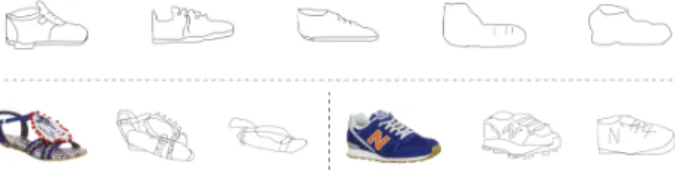
Figure 1: Sketch analysis is difficult because humans draw sketches at very different abstraction levels. Top: different shoe sketches drawn by different people given only the cat-egory name. Bottom: sketches are now drawn by different people with a reference photo.
often differ significantly, especially in their levels of ab-straction. Fig. 1 shows some examples of both category-level (drawn with only a category name) and instance-category-level (drawn with a reference photo) sketches. Clearly the large variation in abstraction levels is a challenge for either rec-ognizing the sketch or matching it with a photo. Variation in sketch abstraction level is expected: humans sketch to pro-vide an abstract depiction of an object, and how abstract a sketch is depends both on the task and the individual user’s overall and instantaneous preference.
We present the first model of deep sketch abstraction. Our approach to model abstraction is based on the insight that abstraction is a process of tradeoff between recogniz-ability and brevity/compactness (number of strokes). It is thus intuitive that abstraction should vary with task (e.g., sketching for instance- rather than category-level tasks per-mits less abstraction as the recognition task is more fine-grained), and that abstraction varies between people as their subjective perception (what seems to be recognizable), as might their relative preference for brevity vs identifiabil-ity. Based on the same insight, we develop a computational model that learns to abstract concrete input sketches and es-timate stroke saliency by finding the most compact subset of input strokes for which the sketch is still recognizable. We consider this similar to the human sketching process: be-fore drawing an object a human has a more detailed mental model of the object, then they work out which details can be safely removed in conveying a compact yet recognizable sketch depiction of the imagined object.
Specifically, we develop a recurrent neural network (RNN) based abstraction model, which learns to measure the importance of each segment and make a decision on whether to skip or keep it. The impact of any given part removal on recognizability is interdependent with which other parts are kept/removed. We model this dependency as a sequential decision making process. Our RNN uses bi-directional gated recurrent units (B-GRU) along with a moving window MLP to capture and extract the contextual information of each sketch-part at each time step. Such a model cannot be learned with conventional supervised learning. We propose a framework for training a sketch ab-straction model with reinforcement learning (RL) using a novel reward scheme that uses the classification rank of the sketch at each time step to make rewards more informative.
Using our abstraction model, we can address a number of problems: (1) Modeling sketch stroke saliency: We can estimate stroke saliency as a byproduct of learning to produce brief recognizable sketches. (2) Category-level sketch synthesis with controllable abstraction: Given an existing category-level sketch synthesizer, our model can be used to control the level of abstraction in the synthe-sized sketches. (3)Instance-level photo-to-sketch synthe-sis:We propose a new approach to photo→sketch synthe-sis motivated by human sketching rather than image trans-lation [36, 20]. Given a photo, we extract an edge-map and treat it as a sketch at the most concrete level. Our sketch abstraction model is then applied to abstract the edge-map into a free-hand style sketch. (4)FG-SBIR without photo-sketch pairs:The photo-to-sketch synthesis model above is used to synthesize photo-freehand sketch pairs using photo input only. This allows us to train an instance-level fine-grained SBIR (FG-SBIR) model without manual data anno-tation, and moreover it generates data at diverse abstraction levels so the SBIR model is robust to variable abstraction at runtime.
Our contributions are as follows: (1) For the first time, the problem of stroke-level sketch abstraction is studied. (2) We propose a reinforcement learning framework with novel reward for training a sketch abstraction model (3) Both category- and instance-level sketch synthesis can be per-formed with controllable abstraction level. We demonstrate that the proposed photo-to-sketch approach is superior than the state-of-the-art alternatives. (4) FG-SBIR can now be tackled without the need to collect photo-sketch pairs. Our experiments on two benchmark datasets show that the re-sulting FG-SBIR model is quite competitive, thus provid-ing the potential to scale FG-SBIR to an arbitrary number of object categories as long as sufficient photos can be col-lected.
2. Related Work
Sketch recognition Early work on sketch recognition fo-cused on CAD or artistic drawings [21, 31, 41]. Inspired by the release of the first large-scale free-hand sketch dataset [9], subsequent work studied free-hand sketch recognition [9, 37, 28] using various hand-crafted features together with classifiers such as SVM. Yuet al. [47] proposed the first deep convolutional neural network (CNN) designed for sketch recognition which outperformed previous hand-crafted features by a large margin. In this work we do not directly address sketch recognition. Instead we ex-ploit a sketch recognizer to quantify sketch recognizabil-ity and generate recognizabilrecognizabil-ity-based rewards to train our abstraction model using RL. In particular, we move away from the conventional CNN modeling of sketches [47, 46] where sketches are essentially treated the same as static photos, and employ a RNN-based classifier that fully en-codes stroke-level ordering information.
Category-level sketch synthesis Recently there has been a surge of interest in deep image synthesis [13, 39, 25, 34]. Following this trend the first free-hand sketch synthesis model was proposed in [15], which exploits a sequence-to-sequence Variational Autoencoder (VAE). In this model the encoder is a bi-directional RNN that inputs a sketch and outputs a latent vector, and the decoder is an autoregressive RNN that samples output sketches conditioned on a latent vector. They combine RNN with Mixture Density Networks (MDN) [14] in order to generate continuous data points in a sequential way. In this paper, we use the unconditional syn-thesizer in [15] in conjunction with our proposed tion model to synthesize sketches of controllable abstrac-tion level.
Instance-level sketch synthesis A sketch can also be synthesized with a reference photo, giving rise to the instance-level sketch synthesis problem. This is an instance of the well studied cross-domain image synthesis prob-lem. Existing approaches typically adopt a cross-domain deep encoder-decoder model. Cross-domain image syn-thesis approaches fall into two broad categories depend-ing on whether the input and output images have pixel-level correspondence/alignment. The first category includes models for super-resolution [27], restoration and inpainting [32], which assume pixel-to-pixel alignment. The second category relaxes this assumption and includes models for style transfer (e.g., photo to painting) [22] and cross-domain image-conditioned image generation [44]. Photo-to-sketch is extremely challenging due to the large domain gap and the fact that the sketch domain is generated by humans with variable drawing styles. As a result, only sketch-to-photo synthesis has been studied so far [36, 20, 29]. In this work, we study photo-to-sketch synthesis with the novel approach of treating sketch generation as a photo-to-sketch abstrac-tion process. We show that our method generates more
visu-ally appealing sketches than the existing deep cross-domain image translation based approaches such as [36].
Sketch based image retrieval Early effort focused on the category-level SBIR problem [10, 11, 17, 5, 6, 42, 19, 30, 18] whereby a sketch and a photo are considered to be a match as long as they belong to the same category. In con-trast, in instance-level fine-grained SBIR (FG-SBIR), they are a match only if they depict the same object instance. FG-SBIR has more practical use, e.g., with FG-FG-SBIR one could use sketch to search to buy a particular shoe s/he just saw on the street [45]. It has thus received increasing attention recently. State-of-the-art FG-SBIR models [45, 35] adopt a multi-branch CNN to learn a joint embedding where photo and sketch domains can be compared. They face two major problems: collecting sufficient matching photo-sketch pairs is tedious and expensive, which severely limits their scal-ability. In addition, the large variation in abstraction level exhibited in sketches for the same photo (see Fig. 1) also makes the cross-domain matching difficult. In this work, both problems are addressed using the proposed sketch ab-straction and photo-to-sketch synthesis models.
Visual abstraction The only work on sketch abstraction is that of [4] where a data-driven approach is used to study style and abstraction in human face sketches. An edge-map is computed and edges are then replaced by similar strokes from a collection of artist sketches. In contrast, we take a model-based approach and model sketch abstraction from a very different perspective: abstraction is modeled as the process of trading off between compactness and recogniz-ability by progressively removing the least important parts. Beyond sketch analysis, visual abstraction has been studied in the photo domain including salient region detection [7], feature enhancement [23], and low resolution image gener-ation [12]. None of these approaches can be applied to our sketch abstraction problem.
3. Methodology
3.1. Sketch abstraction
3.1.1 Sketch representation
Sketches are represented in a vectorized format. Strokes are encoded as a sequence of coordinates, consisting of 3 elements (∆x,∆y, p), as in [14] for representing human handwriting. We define data-segment as one coordinate and stroke-segment as a group of five consecutive coordinates. Each stroke thus comprises a variable number of stroke-segments.
3.1.2 Problem formulation
We formulate the sketch abstraction process as the sequence of decisions made by an abstraction agent which observes stroke-segments in sequence and decides which to keep or
remove. The sequence of strokes may come from a model [15] when generating abstract sketches, or a buffer when simplifying an existing human sketch or edge-map. The agent is trained with reinforcement learning, and learns to estimate the saliency of each stroke in order to achieve its goal of compactly encoding a recognizable sketch.
The RL framework is described by a Markov Decision Process (MDP), which is a tuple hS,A,T,Ri. Here: S
is the set of all possible states, which are observed by the agent in the form of data-segments representing the sketch and the index pointing at the current stroke-segment being processed. A = {0,1} is the set of binary action space representing skipping (0) or keeping (1) the current stroke-segment.T(st+1|st, at)is the transition probability density from current statest ∈ S to next statest+1 ∈ S when the
agent takes an action at ∈ A. It updates the index and the abstracted sketch so far. R(st, at, st+1)is the function
describing the reward in transitioning fromsttost+1with
actionat. At each time stept, the agent’s decision proce-dure is characterized by a stochastic policyπθ=π(at|st, θ) parametrized byθ, which represents the conditional proba-bility of taking actionatin statest.
At first time stept1,s1corresponds to the data-segments
of the complete sketch with index pointing at the first stroke-segment. The agent evaluatess1and takes an action
a1according to its policyπθ, making a decision on whether
to keep or skip the first stroke-segment. The transition
T(s2|s1, a1)says: ifa1= 0(skip), the next states2
corre-sponds to the updated data-segments which do not contain the skipped stroke-segment and with the index pointing to next stroke-segment. Ifa1 = 1 (keep), the next states2
corresponds to the same data-segments as ins1but with the
index pointing to the next stroke-segment. This goes on un-til the last stroke-segment is reached.
LetD = (s1, a1, ..., sM, aM, sM+1)be a trajectory of
lengthM, corresponding to the number of stroke-segments in a sketch. Then the goal of RL is to find the optimal policy
θ∗that maximizes the expected return (cumulative reward discounted byγ∈[0,1]): J(θ) =E M X t=1 γt−1R(st, at, st+1) πθ ! (1) 3.1.3 Model
Our RL-based sketch abstraction model is illustrated in Fig. 2(a). A description of each component follows. Agent It consists of two modules. In the first B-GRU module, data-segments corresponding to statest are input sequentially to a recurrent neural network (RNN), i.e., one segment at each time step t0 (as shown in Fig. 2(b)). We use bi-directional gated recurrent units [8] (B-GRU) in the RNN to learn and embed past and future information at each
(a) Reinforcement learning framework. (b) Agent architecture. Figure 2: Schematic of our sketch abstraction model.
time stept0. This module represents input data in a com-pact vectorized formatϕtby concatenating the outputs of all time steps. The secondmoving window moduleconsists of a multi-layer perceptron (MLP) with two fully-connected layers. The second layer is softmax activated, and generates probabilities for agent actionsφt. This module slides over the B-GRU module and takes as input those outputs cen-tered at the current stroke-segment under processing, using the index in statest. The architecture of our agent is shown in Fig 2(b).
Environment The environment implements state transi-tion and reward generatransi-tion. The state transitransi-tion module reads the action at and state st at each time step t, and transits the environment to state st+1 by updating
data-segments and index of the stroke-segment under process-ing. In case of a skip action, this update consists of elimi-nating the skipped data-segments, modifying the rest appro-priately given the created gap, and moving the index to the next stroke-segment. In case of a keep action, only the in-dex information is updated. The second module is a reward generator which assigns a reward to each state transition. We next describe in detail the proposed reward schemes.
3.1.4 Reward scheme
We want our agent to abstract sketches by dropping the least important stroke-segments while keeping the final remain-ing sketch recognizable. Therefore our reward is driven by a sketch recognizability signal deduced from the classifica-tion result of a multi-class sketch classifier. In accordance with the vectorized sketch format that we use for RL pro-cessing, we use a three-layer LSTM [16] classifier trained with cross-entropy loss and Adam optimizer [24]. Using this classifier, we design two types of reward schemes: Basic reward scheme This reward scheme is designed to encourage high recognition accuracy of the final ab-stracted sketch while keeping the minimum number of stroke-segments. For a trajectory of length M, the basic
rewardbtat each time steptis defined as:
Rt=bt= +1, ift < Mandat= 0 (skip) −5, ift < Mandat= 1 (keep) +100 ift=M and Class(st) = G −100 ift=M and Class(st) 6= G (2)
where G denotes the ground truth class of the sketch, and Class(st) denotes the prediction of the sketch classifier on abstracted sketch inst. From Eq. 2, it is clear thatRtis de-fined to encourage compact/abstract sketch generation (pos-itive reward for skip and negative reward for keep action), while forcing the final sketch to be still recognizable (large reward if recognized correctly, large penalty if not). Ranked reward scheme In this scheme we extend the basic reward by proposing a more elaborate reward com-putation, aiming to learn the underlying saliency of stroke-segments by integrating the classification rank information at each time stept. The total reward is now defined as:
Rt=wbbt+wrrt (3) rt= ( (wcct+wvvt)bt ift < M 0 ift=M (4) ct= 1− K−Ct K (5) vt= 1− K−(Ct−Ct−1) 2·K (6)
wherertis the ranked reward,wbandwrare weights for the basic and ranked reward respectively, Ct is the predicted rank of ground-truth class andK is the number of sketch classes. Thecurrent ranked rewardctprefers the ground-truth class to be highly ranked. Thus improving the rank of the ground truth is rewarded even if the classification is not yet correct – a form of reward-shaping [43]. Thevaried ranked rewardvtis given when the ground-truth class rank
improves over time steps.wcandwvare weights for current ranked reward and varied ranked reward respectively. For example, assumingwb =wr= 0.5, at time step t, ifat= 0 (skip), then Rt would be0.5when ct = 0,vt = 0, and
Rt= 1.0whenct= 1,vt= 1; on the other hand ifat= 1 (keep), thenRtwould be−2.5whenct = 0,vt = 0, and
Rt=−5.0whenct= 1,vt= 1.
The basic vs ranked reward weights wb ∈ [0,1] and
wr ∈ [0,1](wb+wr = 1) are computed dynamically as a functions of time stept. At the first time stept = 1,wr is 0; subsequently it increases linearly to the fixed finalwrf
value at the last time stept =M. Weightswcandwvare static with fixed values, such thatwc+wv = 1.
3.1.5 Training procedure
We use a policy gradient method to find the optimal pol-icyθ∗that maximizes the expected return value defined in Eq. 1. Thus the training consists of sampling the stochas-tic policy and adjusting the parametersθin the direction of greater expected return via gradient ascent:
θ←−θ−η∇θJ(θ), (7) whereη is the learning rate. In order to have a more ro-bust training, we process multiple trajectories accumulating
hst, at, Rt, st+1i in a Buffer B (see Fig. 2(a), and update
parametersθof the agent everyN trajectories. 3.1.6 Controlling abstraction level
Our trained agent can be used to perform abstraction in a given sketch by sampling actions at ∈ {1,0} from the agent’s output distributionφtin order to keep or skip stroke-segments. We attempt to control the abstraction level by varying the temperature parameter of the softmax function in themoving window moduleof our agent. However em-pirically we found out that it does not give the satisfactory result, so instead we introduce a shiftδin theφtdistribution to obtain different variants ofφt, denoted asφ∗t:
φ∗t = (φt(at= 0) +δ, φt(at= 1)−δ) (8) where,φt(at= 0) +φt(at= 1) = 1andδ∈[−1,1]. By varying theδvalue we can obtain arbitrary level of abstrac-tion in the output sketch by biasing towards skip or keep. The code for our abstraction model will be made available from the SketchX website: http://sketchx.eecs. qmul.ac.uk/downloads/.
3.2. Sketch stroke saliency
We use the agent trained with the proposed ranked re-ward and exploit its output distribution φt to compute a saliency valueS∈[0,1]for each stroke in a sketch as:
Sl=
Plmax
t=lminφt(at= 1) lmax−lmin
(9)
wherel ∈ {1,2,· · ·L} is the stroke index,L is the total number of strokes in a sketch,lminis the time step t cor-responding to the first stroke-segment in the stroke with in-dexlandlmaxcorresponding to the last one. Thus strokes which the agent learns are important to keep for obtaining high recognition (or ranking) accuracy are more salient.
3.3. Category-level sketch synthesis
Combining our abstraction model with the VAE RNN category-level sketch synthesis model in [15], we obtain a sketch synthesis model with controllable abstraction. Specifically, once the synthesizer is trained to generate sketches for a given category, we use it to generate a sketch of that category. This is then fed to our abstraction model, which can generate different versions of the input sketch at the desired abstraction level as explained in Sec. 3.1.6.
3.4. Photo to sketch synthesis
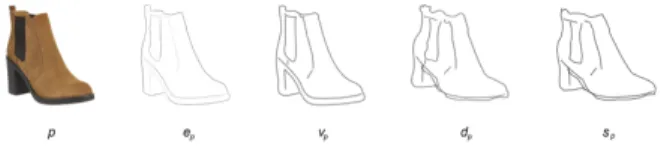
Based on our abstraction model, we propose a novel photo-to-sketch synthesis model that is completely different from prior cross-domain image synthesis methods [36, 20] based on encoder-decoder training. Our approach consists of the following steps (Fig. 3). (1) Given a photo p, its edge-mapep is extracted using an existing edge detection method [48]. (2) We do not use a threshold to remove the noisy edges as in [48]. Instead, we keep the noisy edge de-tector output as it is and use a line tracing algorithm [2] to convert the raster image to a vector format, giving vector-ized edge-mapsvp. (3) Since contours in human sketch are much less smooth than those in a photo edge-map, we ap-ply non-linear transformations/distortions tovpboth at the stroke and the whole-sketch (global) level. At global-level, these transformations include rotation, translation, rescal-ing, and skew both along x-axis and y-axis. At stroke-level they include translation and jittering of stroke curvature. After these distortions, we obtain dp, which has rougher contours as in a human free-hand sketch (see Fig. 3). (4) The distorted edge-maps are then simplified to obtain sp to make them more compatible with the type of free-hand sketch data on which our abstraction model is trained. This consists of fixed-length re-sampling of the vectorized repre-sentation to reduce the number of data-segments. (5) After all these preprocessing steps,spis used as input to our ab-straction model to generate abstract sketches corresponding to the input photop. Before that, the abstraction model is fine-tuned on pre-processed edge-mapssp.
3.5. Fine-grained SBIR
Armed with the proposed sketch abstraction model and the photo-to-sketch synthesis model presented in Sec. 3.4, we can now train a FG-SBIR given photos only.
Given a set of training object photo images, we take each photo pand generate its simplified edge-mapsp. This is
Figure 3: Pre-processing before photo-to-sketch synthesis.
Figure 4: The FG-SBIR model [45].
then fed into the abstraction model to get three levels of abstraction a1
p, a2p and a3p, by settingδ to−0.1, 0.0 and +0.1 respectively (see Eq. 8). This procedure provides three sketches for each simplified edge-map of a training photo, which can be treated as photo-sketch pairs for train-ing a FG-SBIR model. Concretely, we employ the triplet ranking model [45] illustrated in Fig. 4. It is a three-branch Siamese CNN. The input to the model is a triplet including a query sketchs, a positive photop+ and negative photo
p−. The network branches aim to learn a joint embedding for comparing photos and sketch such that the distance be-tweensandp+is smaller than that betweensandp−. This leads to a triplet ranking loss:
L% s, p+, p− = max(0,∆ +D f%(s), f% p+ −D f%(s), f% p− ) (10) where% denotes the model parameters,f%(·)denotes the output of the corresponding network branch,D(·,·)denotes Euclidean distance between two input representations and ∆ is the required margin between the positive query and negative query distance. During training we usesp,a1p,a2p
anda3pwith various distortions (see Sec. 4.4) in turn as the query sketchs. The positive photop+is the photo used to synthesize the sketches, and the negative photo is any other training photo of a different object.
During testing, we have a gallery of test photos which have no overlap with the training photos (containing com-pletely different object instances), and the query sketch now is a real human free-hand sketch. To deal with the variable abstraction in human sketches (see Fig. 1), we also apply our sketch abstraction model to the query test sketch and generate three abstracted sketches as we did in the training stage. The four query sketches are then fed to the trained FG-SBIR model and the final result is obtained by score-level fusion over the four sketches.
4. Experiments
4.1. Sketch abstraction
Datasets We use QuickDraw [15] to train our sketch ab-straction model. It is the largest free-hand sketch dataset to date. We select 9 categories (cat, chair, face, fire-truck, mosquito, owl, pig, purse, shoe) with 75000 sketches in each category, using 70000 for training and the rest for test-ing.
Implementation details Our code is written in Tensor-flow [3]. We implement the B-GRU module of the agent using a single layered B-GRU with 128 hidden cells, which is trained with a learning rateη of 0.0001. The RL envi-ronment is implemented using standard step and reset func-tions. In particular, the step function includes the data up-dater and reward generator module. The sketch classifier used to generate reward is a three-layer LSTM, each layer containing 256 hidden cells. We train the classifier on the 9 categories using cross-entropy loss and Adam optimizer, obtaining an accuracy of97.00%on the testing set. The pa-rameters of the ranked reward scheme (see Sec. 3.1.4) are set to:wrf = 0.5,wc= 0.8andwv = 0.2.
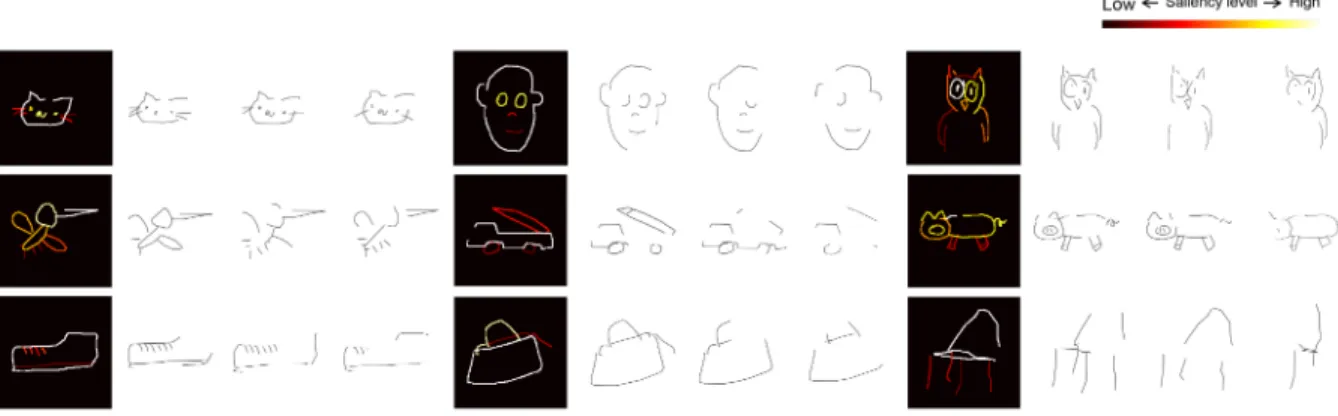
Baseline We compare our abstraction model with random skipping of stroke-segments from each sketch so that the number of retained data-segments is equal in both models. Results In this experiment, we take the human free-hand sketches in the test set of the 9 selected QuickDraw cate-gories and generate three versions of the original sketches with different abstraction levels. These are obtained by set-ting the model parameterδto−0.1,0.0 and+0.1 respec-tively (Eq. 8). Some qualitative results are shown in Fig. 5. It can be seen that the abstracted sketches preserve the most distinctive parts of the sketches. For quantitative evaluation, we feed the three levels of abstracted sketches to the sketch classifier trained using the original sketches in the training set and obtain the recognition accuracy. The results in Ta-ble 1 show that the original sketches in the test set has 64.79 data segments on average. This is reduced to 51.31, 43.33, and 39.48 using our model with different values ofδ. Even at the abstraction level 3 when around 40% of the original data segments have been removed, the remaining sketches can still be recognized at a high accuracy of 70.40%. In con-trast, when similar amount of data segments are randomly removed (Baseline), the accuracy is 6.20% lower at 64.20%. This shows that the model has learned which segments can be removed with least impact on recognizability. Table 1 also compares the proposed ranked reward scheme (Eq. 4) with the Basic Reward (Eq. 2). It is evident that the ranked reward scheme is more effective.
Measuring sketch stroke saliency Using Eq. 9, we can compute a saliency valueSfor each stroke in a sketch,
indi-cating how it contributes towards the overall recognizabil-ity of the sketch. Some example stroke saliency maps
ob-Figure 5: Examples of sketch abstraction and stroke saliency. For each object, the input human sketch annotated with stroke saliency (color coded) computed by model is shown with black background. Three corresponding sketches of different abstraction level (level 1 to 3, left to right) obtained with our model are shown with white background. Best viewed in color.
#DataSegments Accuracy Full Sketch 64.79 97.00% 1st Level Abstraction (δ=−0.1) Baseline 51.00 85.00% Basic Reward 51.12 87.60% Ranked Reward 51.31 88.20% 2nd Level Abstraction (δ= 0.0) Baseline 43.00 74.60% Basic Reward 43.09 78.80% Ranked Reward 43.33 80.80% 3rd Level Abstraction (δ= +0.1) Baseline 39.00 64.20% Basic Reward 39.37 68.00% Ranked Reward 39.48 70.40%
Table 1: Recognizability of abstracted human sketches. tained on the test set are shown in Fig. 5. We observe that high saliency strokes correspond to the more distinctive vi-sual characteristics of the object category. For instance, for shoe, the overall contour is more salient than the shoe-laces because many shoes in the dataset do not have shoe-laces. Similarly, for face, the outer contour is the most distinctive part, followed by eyes and then nose and mouth – again, dif-ferent people sketch the nose and mouse very difdif-ferently; but they are more consistent in drawing the outer contour and eyes. These results also shed some light into how deep sketch recognition models make their decisions, providing an alternative to gradient-based classifier-explanation ap-proaches such as [38].
4.2. Sketch synthesis
We train a sketch synthesis model as in [15] for each of the 9 categories, and combine it with our abstraction model (Sec. 4.1) to generate abstract versions of the synthesized sketches. Again, we compare our abstraction results with the same random removal baseline. From the quantitative results in Table 2, we can draw the same set of conclusions: the synthesized sketches are highly recognizable even at the most abstract level, and more so than the sketches generated with random segment removal. Fig. 6 shows some examples of synthesized sketches at different abstraction levels.
#DataSegments Accuracy Full Sketch 69.61 99.6% 1st Level Abstraction (δ=−0.1) Baseline 50.00 89.96% Basic Reward 50.43 92.60% Ranked Reward 50.08 94.20% 2nd Level Abstraction (δ= 0.0) Baseline 44.00 80.20% Basic Reward 44.13 88.40% Ranked Reward 44.32 90.80% 3rd Level Abstraction (δ= +0.1) Baseline 37.00 69.20% Basic Reward 37.15 73.20% Ranked Reward 37.56 79.40%
Table 2: Recognizability of category-level synthesized sketches.
Figure 6: Examples of synthesized sketches at different ab-straction levels. Top to bottom: increasing abab-straction lev-els.
4.3. Photo to sketch synthesis
Dataset We use the QMUL Shoe-V2 dataset [1]. It is the largest single-category FG-SBIR dataset with 1800 training and 200 testing photo-sketch pairs.
Implementation details As described in Sec. 3.4, we fine-tune our abstraction model, previously trained on the 9 classes of QuickDraw dataset, on the simplified edge-maps
spof the training photos from Shoe-V2.
Baseline We compare our model with our implementa-tion of the cross-domain deep encoder-decoder based syn-thesis model in [36]. Note that although it is designed for synthesis across any direction between photo and sketch,
Figure 7: Examples of synthesized sketches using [36] (third col) and ours (fourth) vs human sketch (second). only sketch-to-photo synthesis results are shown in [36]. Results We show some examples of the synthesized sketches using our model and [36] in Fig. 7. We observe that our model produces much more visually appealing sketches than the ones obtained using [36], which is very blurry and seems to suffer from mode collapse. This is not surprising: the dramatic domain gaps and the mis-alignment between photo and sketch makes a deep encoder-decoder model such as [36] unsuitable. Furthermore, treating a sketch as a 2D matrix of pixels is also inferior to treating it as a vectorized coordinate list as in our model.
4.4. Fine-grained SBIR
Dataset Apart from Shoe-V2, we also use QMUL Chair-V2, with 200 training and 158 testing photo-sketch pairs. Implementation details As described in Sec. 4.3, we generate 5 distortion representations dm
p, m ∈
{1,2,3,4,5}, for each input vectorized edge-mapvp. We then use allam,np representations and simplified edge-maps
smp to train the state of the art FG-SBIR model [45]. Baseline Apart from comparing with the same model [45] trained with the annotated photo-to-sketch pairs (‘Up-per Bound’), we compare with two baselines using the same FG-SBIR model but trained with different synthesized sketches. Baseline1 is trained with synthesized sketches us-ing the model in [36]. Baseline2 uses the simplified edge-mapssmp directly as replacement for human sketches. Results Table 3 shows that the model trained with syn-thesized sketches from our photo-to-sketch synthesizer is quite competitive, e.g., on chair, it is only 7.12% lower on Top 1 accuracy. It decisively beats the model trained with sketches synthesized using [36]. The gap over Baseline2 indicates that the abstraction process indeed makes the gen-erated sketches more like the human sketches. Some quali-tative results are shown in Fig. 8. Note the visual similarity between synthesized sketches at different abstraction levels and the corresponding abstracted human sketches. They are clearly more similar at the more abstract levels, explaining why it is important to include sketches at different abstrac-tion levels during both training and testing.
Shoe-V2 Chair-V2 Method Top1 Top10 Top1 Top10 Baseline1 [36] 8.86% 32.28% 31.27% 78.02% Baseline2 16.67% 50.90% 34.67% 73.99% Ours 21.17% 55.86% 41.80% 84.21% Upper Bound 34.38% 79.43% 48.92% 90.71% Table 3: FG-SBIR results. Top 1 and 10 matching accuracy.
Figure 8: Human and synthesized sketches at different ab-straction level used in the FG-SBIR experiments. For each object: First row: photo, sketch and the abstracted sketches. Second row: edge-map and synthesized sketches.
4.5. Human Study
In this study, 10 users were shown 100 pairs of ab-stracted sketches from the same 9 classes used in Sec. 4.1. Each pair consists of a sketch obtained using our frame-work and another sketch obtained by randomly removing stroke-segments. Each pair is shown side by side and the relative position of the two sketches is random to prevent any bias. The users were asked to choose the more aestheti-cally appealing sketch among each pair. Results in percent-age (Mean: 64.3±4.59, Min: 58, Max: 70) suggest that the abstracted sketches produced by our model are more vi-sually appealing to humans when compared with sketches with randomly removed stroke-segments.
5. Conclusion
We have for the first time proposed a stroke-level sketch abstraction model. Given a sketch, our model learns to pre-dict which strokes can be safely removed without affecting overall recognizability. We proposed a reinforcement learn-ing framework with a novel rank-based reward to enforce stroke saliency. We showed the model can be used to ad-dress a number of existing sketch analysis tasks. In par-ticular, we demonstrated that a FG-SBIR model can now be trained with photos only. In future work we plan to make this model more practical by extending it to work with edge-maps in the wild. We also intend to develop an end-to-end trained abstraction model which could directly sample a variable abstraction-level sketch.
References
[1] http://sketchx.eecs.qmul.ac.uk.
[2] Imagemagick studio, llc. https://www. imagemagick.org.
[3] M. Abadi, A. Agarwal, P. Barham, E. Brevdo, Z. Chen, C. Citro, G. S. Corrado, A. Davis, J. Dean, M. Devin, S. Ghe-mawat, I. Goodfellow, A. Harp, G. Irving, M. Isard, Y. Jia, R. Jozefowicz, L. Kaiser, M. Kudlur, J. Levenberg, D. Man´e, R. Monga, S. Moore, D. Murray, C. Olah, M. Schuster, J. Shlens, B. Steiner, I. Sutskever, K. Talwar, P. Tucker, V. Vanhoucke, V. Vasudevan, F. Vi´egas, O. Vinyals, P. War-den, M. Wattenberg, M. Wicke, Y. Yu, and X. Zheng. Tensor-Flow: Large-scale machine learning on heterogeneous sys-tems.https://www.tensorflow.org, 2015. [4] I. Berger, A. Shamir, M. Mahler, E. Carter, and J. Hodgins.
Style and abstraction in portrait sketching.TOG, 2013. [5] Y. Cao, C. Wang, L. Zhang, and L. Zhang. Edgel index for
large-scale sketch-based image search. InCVPR, 2011. [6] Y. Cao, H. Wang, C. Wang, Z. Li, L. Zhang, and L. Zhang.
Mindfinder: interactive sketch-based image search on mil-lions of images. InACM, 2010.
[7] M.-M. Cheng, J. Warrell, W.-Y. Lin, S. Zheng, V. Vineet, and N. Crook. Efficient salient region detection with soft image abstraction. InICCV, 2013.
[8] J. Chung, C¸ . G¨ulc¸ehre, K. Cho, and Y. Bengio. Empirical evaluation of gated recurrent neural networks on sequence modeling.CoRR, 2014.
[9] M. Eitz, J. Hays, and M. Alexa. How do humans sketch objects? TOG, 2012.
[10] M. Eitz, K. Hildebrand, T. Boubekeur, and M. Alexa. An evaluation of descriptors for large-scale image retrieval from sketched feature lines.Computers & Graphics, 2010. [11] M. Eitz, K. Hildebrand, T. Boubekeur, and M. Alexa.
Sketch-based image retrieval: Benchmark and bag-of-features descriptors.TVCG, 2011.
[12] T. Gerstner, D. DeCarlo, M. Alexa, A. Finkelstein, Y. Gin-gold, and A. Nealen. Pixelated image abstraction with inte-grated user constraints.Computers & Graphics, 2013. [13] I. Goodfellow. Nips 2016 tutorial: Generative adversarial
networks.arXiv preprint arXiv:1701.00160, 2016.
[14] A. Graves. Generating sequences with recurrent neural net-works.arXiv preprint arXiv:1308.0850, 2013.
[15] D. Ha and D. Eck. A neural representation of sketch draw-ings.arXiv preprint arXiv:1704.03477, 2017.
[16] S. Hochreiter and J. Schmidhuber. Long short-term memory. Neural Computation, 1997.
[17] R. Hu, M. Barnard, and J. Collomosse. Gradient field de-scriptor for sketch based retrieval and localization. InICIP, 2010.
[18] R. Hu and J. Collomosse. A performance evaluation of gra-dient field hog descriptor for sketch based image retrieval. CVIU, 2013.
[19] R. Hu, T. Wang, and J. Collomosse. A bag-of-regions ap-proach to sketch-based image retrieval. InICIP, 2011. [20] P. Isola, J.-Y. Zhu, T. Zhou, and A. A. Efros. Image-to-image
translation with conditional adversarial networks. CVPR, 2017.
[21] M. F. A. Jabal, M. S. M. Rahim, N. Z. S. Othman, and Z. Jupri. A comparative study on extraction and recognition method of cad data from cad drawings. InICIME, 2009. [22] J. Johnson, A. Alahi, and L. Fei-Fei. Perceptual losses for
real-time style transfer and super-resolution. InECCV, 2016. [23] H. Kang, S. Lee, and C. K. Chui. Flow-based image
abstrac-tion.TVCG, 2009.
[24] D. P. Kingma and J. Ba. Adam: A method for stochastic optimization.CoRR, 2014.
[25] D. P. Kingma, T. Salimans, R. Jozefowicz, X. Chen, I. Sutskever, and M. Welling. Improving variational infer-ence with inverse autoregressive flow.NIPS, 2016. [26] B. Klare, Z. Li, and A. K. Jain. Matching forensic sketches
to mug shot photos.TPAMI, 2011.
[27] C. Ledig, L. Theis, F. Huszar, J. Caballero, A. P. Aitken, A. Tejani, J. Totz, Z. Wang, and W. Shi. Photo-realistic single image super-resolution using a generative adversarial network.CVPR, 2017.
[28] Y. Li, T. M. Hospedales, Y.-Z. Song, and S. Gong. Free-hand sketch recognition by multi-kernel feature learning. CVIU, 2015.
[29] Y. Li, Y.-Z. Song, T. M. Hospedales, and S. Gong. Free-hand sketch synthesis with deformable stroke models.IJCV, 2017. [30] Y.-L. Lin, C.-Y. Huang, H.-J. Wang, and W. Hsu. 3d sub-query expansion for improving sketch-based multi-view im-age retrieval. InICCV, 2013.
[31] T. Lu, C.-L. Tai, F. Su, and S. Cai. A new recognition model for electronic architectural drawings.CAD, 2005.
[32] M. Mathieu, C. Couprie, and Y. LeCun. Context encoders: Feature learning by inpainting. InICLR, 2016.
[33] S. Ouyang, T. Hospedales, Y.-Z. Song, and X. Li. Cross-modal face matching: beyond viewed sketches. InACCV, 2014.
[34] S. Reed, A. v. d. Oord, N. Kalchbrenner, S. G. Colmenarejo, Z. Wang, D. Belov, and N. de Freitas. Parallel multiscale autoregressive density estimation.ICML, 2017.
[35] P. Sangkloy, N. Burnell, C. Ham, and J. Hays. The sketchy database: learning to retrieve badly drawn bunnies. TOG, 2016.
[36] P. Sangkloy, J. Lu, C. Fang, F. Yu, and J. Hays. Scrib-bler: Controlling deep image synthesis with sketch and color. CVPR, 2017.
[37] R. G. Schneider and T. Tuytelaars. Sketch classification and classification-driven analysis using fisher vectors. TOG, 2014.
[38] R. R. Selvaraju, M. Cogswell, A. Das, R. Vedantam, D. Parikh, and D. Batra. Grad-cam: Visual explanations from deep networks via gradient-based localization. In ICCV, 2017.
[39] C. K. Sønderby, T. Raiko, L. Maaløe, S. K. Sønderby, and O. Winther. Ladder variational autoencoders. InNIPS, 2016. [40] J. Song, Y. Qian, Y.-Z. Song, T. Xiang, and T. Hospedales. Deep spatial-semantic attention for fine-grained sketch-based image retrieval. InCVPR, 2017.
[41] P. Sousa and M. J. Fonseca. Geometric matching for clip-art drawing retrieval.VCIR, 2009.
[42] C. Wang, Z. Li, and L. Zhang. Mindfinder: image search by interactive sketching and tagging. InWWW, 2010.
[43] E. Wiewiora.Reward Shaping, pages 863–865. Springer US, Boston, MA, 2010.
[44] D. Yoo, N. Kim, S. Park, A. S. Paek, and I. Kweon. Pixel-level domain transfer. InECCV, 2016.
[45] Q. Yu, F. Liu, Y.-Z. SonG, T. Xiang, T. Hospedales, and C. C. Loy. Sketch me that shoe. InCVPR, 2016.
[46] Q. Yu, Y. Yang, F. Liu, Y.-Z. Song, T. Xiang, and T. M. Hospedales. Sketch-a-net: A deep neural network that beats humans.IJCV, 2017.
[47] Q. Yu, Y. Yang, Y.-Z. Song, T. Xiang, and T. Hospedales. Sketch-a-net that beats humans.BMVC, 2015.
[48] C. L. Zitnick and P. Doll´ar. Edge boxes: Locating object proposals from edges. InECCV, 2014.