Eckey, Lisa (2020)
DOI (TUprints): https://doi.org/10.25534/tuprints-00014041 License:
CC-BY 4.0 International - Creative Commons, Attribution Publication type: Ph.D. Thesis
Division: 20 Department of Computer Science Original source: https://tuprints.ulb.tu-darmstadt.de/14041
Secure Optimistic Protocols
Vom Fachbereich Informatik der
Technischen Universit¨at Darmstadt genehmigte Dissertation
zur Erlangung des akademischen Grades Doktor-Ingenieur (Dr.-Ing.)
von
Lisa Eckey, M.Sc. geboren in Hamm (Westf.)
Title: Blockchain Scalability through Secure Optimistic Protocols Ort: Darmstadt, Technische Universit¨at Darmstadt
Dieses Dokument wird bereitgestellt von tuprints, E-Publishing-Service der TU Darmstadt
http://tuprints.ulb.tu-darmstadt.de [email protected]
Bitte zitieren Sie dieses Dokument als: URN: urn:nbn:de:tuda-tuprints-140412
URI: https://tuprints.ulb.tu-darmstadt.de/id/eprint/14041 Die Veröffentlichung steht unter folgender Creative Commons Lizenz: Attribution 4.0 International (CC BY 4.0)
Hiermit versichere ich, die vorliegende Dissertation ohne Hilfe Dritter nur mit den angegebenen Quellen und Hilfsmitteln angefertigt zu haben. Alle Stellen, die aus Quellen entnommen wurden, sind als solche kenntlich gemacht. Diese Arbeit hat in gleicher oder ¨ahnlicher Form noch keiner Pr¨ufungsbeh¨orde vorgelegen.
Wissenschaftlicher Werdegang
Oktober 2009 bis September 2012 Studium der Wirtschaftsinformatik (Bache-lor of Science) an der Westf¨alischen-Wilhelms Universit¨at M¨unster
April 2013 bis April 2016 Studium der IT-Sicherheit/ Netze und Systeme (Mas-ter of Science) an der Ruhr-Universit¨at Bochum
April 2016 bis Oktober 2017 Beginn des Promotionsstudiums an der Ruhr-Uni-versit¨at Bochum in der Arbeitsgruppe f¨ur angewandte Kryptografie bei Prof. Sebastian Faust
November 2017 bis April 2020 Fortsetzung des Promotionsstudiums an der Tech-nischen Universit¨at Darmstadt am Lehrstuhl f¨ur angewandte Kryptografie bei Prof. Sebastian Faust
[30] R. B¨ohme, L. Eckey, N. Narula, T. Moore, T. Ruffing, and A. Zohar. “Responsible Vulnerability Disclosure in Cryptocurrencies”. In: Communications of the ACM (CACM). 10. 2020, pp. 62–71.
[59] P. Das, L. Eckey, T. Frassetto, D. Gens, K. Host´akov´a, P. Jauernig, S. Faust, and A.-R. Sadeghi. “FastKitten: Practical Smart Contracts on Bitcoin”. In: Pro-ceedings of the 28th USENIX Security Symposium. Santa Clara, CA, USA, 2019, pp. 801–818.
[67] S. Dziembowski, L. Eckey, and S. Faust. “FairSwap: How To Fairly Exchange Dig-ital Goods”. In:Proceedings of the 25th ACM SIGSAC Conference on Computer and Communications Security. Toronto, Canada, 2018, pp. 967–984.
[68] S. Dziembowski, L. Eckey, S. Faust, J. Hesse, and K. Host´akov´a. “Multi-party Virtual State Channels”. In: Proceedings of the 38th Annual International Con-ference on the Theory and Applications of Cryptographic Techniques. Darmstadt, Germany, 2019, pp. 625–656.
[69] S. Dziembowski, L. Eckey, S. Faust, and D. Malinowski. “Perun: Virtual Payment Hubs Over Cryptocurrencies”. In: Proceedings of the 40th IEEE Symposium on Security and Privacy. San Francisco, CA, USA, 2019, pp. 327–344.
[72] L. Eckey, S. Faust, and J. Loss. “Efficient Algorithms for Broadcast and Consen-sus Based on Proofs of Work”. In: IACR Cryptology ePrint Archive(2017).url: https://eprint.iacr.org/2017/915.
[73] L. Eckey, S. Faust, and B. Schlosser. “OptiSwap: Fast Optimistic Fair Exchange”. In: Proceedings of the 15th ACM Asia Conference on Computer and Communi-cations Security. Taipei, Taiwan, 2020, pp. 543–557.
The four years of being a doctoral student was a true journey for me – starting in Bochum and ending in Darmstadt, it brought me to many exciting destinations on the way. I am grateful to everyone who accompanied me on this path, guided, or enjoyed it with me. First of all, I thank my supervisor Sebastian Faust, who en-couraged me to pursue this path. He inspired my interest in cryptography research, and I highly appreciated his guidance and feedback. I also thank him and all my co-authors for sharing and discussing research ideas with me and many successful collaborations. I enjoyed being a part of the open and welcoming cryptography community, where I met so many inspiring researchers and practitioners.
I am grateful to my disputation committee and especially to Matteo Maffei, who co-refereed my thesis for the helpful comments and feedback. For the financial support, I thank the DFG as well as the Universities in Bochum and Darmstadt, which provided the necessary infrastructure and resources for my research. I am especially thankful for the great opportunities to travel to summer schools and conferences, which allowed me to broaden my personal and academic horizons. I am very grateful to Jacqueline Wacker for her pleasant and enormously helpful support in navigating the bureaucratic university processes.
I enjoyed all the great moments with my colleagues and friends that accompanied me during this journey. Thank you for making my time in Bochum and Darmstadt enjoyable through stimulating coffee break discussions, horrible movies, joint trips, and fun events. I cannot say how much your virtual encouragement video cheered me up right before my defense. In particular, I thank my dear colleagues, travel companions, and friends Clara Paglialonga and Kristina Host´akov´a. I am glad that the three of us experienced this together, and I will never forget the memories we created in and outside of work. Without your cheerful encouragement, I would not have overcome the exhausting and disappointing moments of the past years.
My deep gratitude goes to my friends and family that encouraged me on this path. I especially thank Mario and Hannah for their reassuring trust in my abili-ties, Stefan for his patience and moral support, and of course, my parents, brother, and sister for their unconditional love and support.
The results of this thesis are the outcome of collaborations and joint works with my supervisor Sebastian Faust and my co-authors, whom I would like to thank for inspiring discussions and contributions.
The results from Chapter 4 are based on the publication “Perun: Virtual Pay-ment Hubs Over Cryptocurrencies” [69], which was developed in collaboration with Stefan Dziembowski, Sebastian Faust, and Daniel Malinowski. The paper was rewritten many times to improve the comprehensibility and to simplify the model, which makes it hard to distinguish the independent contributions. The version that appears in this thesis has minor modifications in the protocol descrip-tion and explanadescrip-tions and a different structure, but otherwise contains verbatim passages from the published version [69] presented at the 40th IEEE Symposium on Security and Privacy (S&P) 2019. The high-level descriptions and the full se-curity proof do not appear elsewhere and are exclusively my contribution. The implementation was iteratively done by Daniel Malinowski and me.
The protocol, which is described in Chapter 5, also developed through intense and inspiring discussions with Sebastian Faust and Stefan Dziembowski, is based on the paper “FairSwap: How To Fairly Exchange Digital Goods” [67]. The spec-ification and write-up of this paper was primarily my contribution. In particular, this includes the modeling, the formal protocol description, the security proof, and implementation. Therefore, this thesis contains verbatim text from the original work [67] published in the proceedings of the 25th ACM SIGSAC Conference on Computer and Communications Security 2018.
The results of Chapter 6 are based on the publication “FastKitten: Practical Smart Contracts on Bitcoin” [59] (presented at the Usenix Security Symposium 2019) which is joint work with Poulami Das, Tommaso Frassetto, David Gens, Kristina Host´akov´a, Patrick Jauernig, Sebastian Faust, and Ahmad-Reza Sadeghi. My contribution to this paper was the overall idea and the protocol design. Lead-ing inputs of my co-authors can be summarized as follows: Kristina Host´akov´a played a leading role in contributing to the security definitions and proof. The implementation and benchmarking were provided by Tommasso Frassetto, who
enclave. To account for the split contribution, this thesis does contain verbatim text passages from the original paper except for the security and implementation sections (cf. Sections 7 and 8 of [59]).
The digital currency Bitcoin has become a popular payment technology since its invention in 2008. Countless other projects have adopted and expanded the func-tionality of the underlying blockchain technology. These so-called cryptographic currencies allow users to send financial transactions over a decentralized global network. Some of these currencies even support payments that are based on com-plex conditions, also called smart contracts. The biggest obstacle to the practical use of cryptographic currencies is their limited scalability. Without a solution to this problem, blockchain technology cannot support the continuously growing user base or compete with centralized payment providers. This thesis presents three approaches to scaling that increase the number of transactions or enable a cheaper and faster execution of smart contracts.
The first contribution of this thesis is the Perunprotocol, which allows a
net-work of users to send a large number of microtransactions at no cost. For this purpose, all users of the system open a so-called payment channel once and use it to send off-chain transactions without costs or delays. We will also show how to combine these channels in an off-chain manner to so-called virtual channels that connect even more users. The next contribution of this dissertation is the
FairSwap protocol, which aims at reducing the costs for the secure sale of large
digital goods. It improves the scalability of such “fair exchange” protocols by re-ducing both the storage requirements and the complexity of the underlying smart contracts. We then present another protocol called FastKitten, which uses a
Trusted Execution Environment (TEE) to secure the off-chain execution of smart contracts. A TEE provides a secure runtime environment in which programs are executed safely and correctly. This allows an operator to execute the smart con-tracts on inputs from the users off-chain, which makes the execution much faster and cheaper for all participants.
To guarantee the security of these protocols, each construction is accompanied by detailed formal security definitions and cryptographic proofs. Furthermore, we demonstrate the efficiency of the protocols by implementing and analyzing the costs of each protocol.
Die digitale W¨ahrung Bitcoin hat sich seit ihrer Erfindung im Jahr 2008 zu einer popul¨aren Zahlungstechnologie entwickelt. Das hohe Interesse an der zugrun-deliegenden Blockchain-Technologie wird vor allem durch die zahlreichen Pro-jekte verdeutlicht, die in den letzten zehn Jahren die Funktionalit¨at von Bit-coin ¨ubernommen und erweitert haben. Diese so genannten kryptographischen W¨ahrungen erm¨oglichen es, den Benutzern, finanzielle Transaktionen ¨uber ein globales, dezentralisiertes Netzwerk zu versenden. Einige dieser digitalen W¨ahrun-gen erm¨oglichen sogar ZahlunW¨ahrun-gen, die an komplexe BedingunW¨ahrun-gen gekn¨upft werden, welche durch sogenannte Smart Contracts beschrieben werden. Das gr¨oßte Hinder-nis f¨ur den praktischen Einsatz von kryptographischen W¨ahrungen ist ihre man-gelnde Skalierbarkeit. Ohne eine L¨osung f¨ur dieses Problem kann die Blockchain Technologie die st¨andig steigenden Nutzerzahlen nicht unterst¨utzen und nicht mit zentralisierten Zahlungsanbietern konkurrieren. In dieser Arbeit werden drei L¨osungsans¨atze zur Skalierung vorgestellt, die es erm¨oglichen viele Transaktionen und komplexe Smart Contracts g¨unstiger und schneller zu abzuwickeln.
Der erste Beitrag dieser Arbeit ist das Perun-Protokoll, das es einem
Netz-werk von Nutzern erlaubt, eine große Anzahl von Mikrotransaktionen kostenlos zu versenden. Zu diesem Zweck ¨offnen alle Benutzer des Systems einmalig einen soge-nannten Zahlungskanal und nutzen diesen, um Zahlungen zwischen den Nutzern direkt und ohne Kosten oder Verz¨ogerungen auszuf¨uhren. Das Perun Protokoll
erm¨oglicht es außerdem diese Kan¨ale ohne Blockchain Interaktionen zu so genan-nten virtuellen Kan¨alen zu kombinieren, die noch mehr Nutzer verbinden.
Der n¨achste Beitrag dieser Dissertation ist das FairSwap-Protokoll, das zum
Ziel hat die Kosten f¨ur den sicheren Verkauf von großen digitalen G¨utern zu senken. Dabei wird die Skalierbarkeit solcher “Fair Exchange”-Protokolle verbessert indem sowohl der Speicherbedarf als auch die Komplexit¨at der zugrundeliegenden Smart Contracts reduziert wird.
Der dritte Beitrag dieser Dissertation ist ein Protokoll namensFastKitten, das
Trusted Execution Environments (TEEs) verwendet, um die off-chain Ausf¨uhrung von Smart Contracts abzusichern. TEEs bieten eine abgesicherte
Laufzeitumge-der Benutzer lokal auszuf¨uhren und damit Kosten und Laufzeiten senkt.
Formale Sicherheitsdefinitionen und kryptographische Beweise garantieren die Sicherheit der entwickelten Protokolle. Des Weiteren zeigen wir die Effizienz der Protokolle indem wir eine Implementierung anfertigen und analysieren.
1 Introduction 1
1.1 Challenges for Blockchain Technology . . . 2
1.2 Goal of this Thesis . . . 5
1.3 Contribution . . . 6
1.4 Structure of this Thesis . . . 9
2 Cryptographic Preliminaries 11 2.1 Notation . . . 11
2.2 Provable Security . . . 12
2.3 Cryptographic Primitives . . . 14
2.4 The Universal Composability Model . . . 18
3 Blockchain Technology 23 3.1 Bitcoin . . . 24
3.1.1 Transactions . . . 24
3.1.2 Blocks and Mining . . . 25
3.1.3 Bitcoin Fees . . . 28
3.2 Ethereum and Smart Contracts . . . 29
3.2.1 Smart Contracts . . . 29
3.2.2 Designing Secure Contracts . . . 32
3.3 Scalability Solutions . . . 33
3.3.1 Changing Blockchain Parameters . . . 34
3.3.2 Scaling the Consensus Layer . . . 34
3.3.3 Scaling Through Off-Chain Protocols . . . 36
3.4 Formal Treatment of the Blockchain . . . 41
3.4.1 Security Provided by the Public Ledger . . . 42
3.4.2 Communication Model . . . 43
4 Virtual Payment Channel Hubs 45 4.1 Overview . . . 47
4.1.2 Related Work . . . 56
4.2 Preliminaries . . . 59
4.2.1 Channels Syntax . . . 60
4.2.2 The Ledger Functionality . . . 61
4.3 Ideal Functionality . . . 62
4.3.1 Restrictions to the Environment . . . 65
4.3.2 Perun Properties . . . 66
4.3.3 Formal Security Statement . . . 68
4.4 The PerunProtocol . . . 68
4.4.1 The Channel Smart Contract C . . . 70
4.4.2 The Πchannel protocol . . . 74
4.5 PerunSecurity Proof . . . 86
4.5.1 Ledger Channel Opening . . . 89
4.5.2 Channel Updating . . . 90
4.5.3 Ledger Channel Closing . . . 91
4.5.4 Virtual Channel Opening . . . 93
4.5.5 Virtual Channel Closing . . . 94
4.6 Implementation and Performance . . . 96
4.6.1 Execution Times . . . 96
4.6.2 Implementation and Gas Costs . . . 96
4.6.3 Channel Network Comparison . . . 98
4.7 Discussion and Extension . . . 98
4.7.1 Extensions and Impact . . . 99
5 Moving Complex Computation Off-Chain 103 5.1 Overview . . . 104
5.1.1 Intuition and Design Ideas . . . 105
5.1.2 Related Work . . . 111
5.2 Preliminaries . . . 113
5.2.1 Modeling Circuits . . . 113
5.2.2 The Ledger Functionality . . . 114
5.2.3 Global Random Oracle . . . 115
5.2.4 Constructing theFairSwapBuilding Blocks in the Random Oracle Model . . . 118
5.2.5 Commitment Scheme Construction . . . 121
5.4 FairSwap Protocol . . . 124
5.4.1 Witness and Transcript Encoding Scheme . . . 126
5.4.2 The Judge Smart ContractC . . . 130
5.4.3 The Witness Selling Protocol ΠFairSwap . . . 131
5.5 FairSwap Security Proof . . . 132
5.5.1 Informal Security Analysis . . . 133
5.5.2 Formal GUC Security Proof . . . 135
5.6 Implementation and Performance . . . 149
5.7 Discussion and Extension . . . 155
5.7.1 Countermeasure against Free-Riding . . . 155
5.7.2 Interactive Dispute . . . 156
5.7.3 Splitting Escrow and Judge Function . . . 156
5.7.4 Setting Financial Incentives for Honest Behavior . . . 158
5.7.5 FairSwap in Channels . . . 159
6 Off-Chain Smart Contracts on Bitcoin 161 6.1 Overview . . . 161
6.1.1 Intuition and Design Ideas . . . 163
6.1.2 Related Work . . . 167
6.2 Preliminaries . . . 171
6.2.1 Modeling the Blockchain. . . 172
6.2.2 Modeling the TEE. . . 173
6.3 Security Properties . . . 174
6.4 The FastKitten Protocol . . . 176
6.4.1 Setup Phase . . . 176
6.4.2 Round Computation Phase . . . 180
6.4.3 Finalize Phase . . . 181
6.5 Security Evaluation . . . 182
6.6 Implementation and Performance . . . 185
6.6.1 Implementation Challenges . . . 185
6.6.2 Performance . . . 186
6.7 Discussion and Extensions . . . 188
6.7.1 Privacy . . . 188
6.7.2 Applications . . . 189
6.7.3 Fees for the Operator . . . 190
6.7.4 Incentive-driven Adversary . . . 191
6.7.6 Multi-Currency Contracts . . . 192 7 Conclusion 193 List of Figures 197 List of Tables 199 List of Abbreviations 201 Bibliography 203
Blockchain technology emerged in 2008 when Satoshi Nakamoto proposed a cryp-tographic currency for trustless online payments called Bitcoin [151]. In contrast
to previously proposed electronic cash protocols [49, 50, 32], Bitcoin does not re-quire trust in a bank or otherwise centralized authority. Instead, the system is secured by a cryptographic protocol that is executed in an open peer-to-peer net-work. Motivated by the ongoing financial crisis, Bitcoin promised to be the “cash of the Internet”, which cannot be controlled by financial institutions.
The Bitcoin implementation was deployed in 2009, only a few months after Nakamoto published his protocol on a cryptography mailing list [150]. Initially, Bitcoin was mostly used by a handful of enthusiasts, but it gained considerable popularity over time when an increasing number of users adopted the currency1.
The technology also received widespread attention from both academia and in-dustry which lead to many projects analyzing, applying, or extending Nakamoto’s ideas. The broad interest in this technology is illustrated by the high amount of projects and research papers in this area, e.g., the original Bitcoin paper was cited around 9000 times [26] and its implementation was forked over 25 thousand times [182].
Bitcoin and its follow-up projects are also called cryptocurrencies ordistributed ledger technologies. Their foremost goal is to provide secure financial transactions
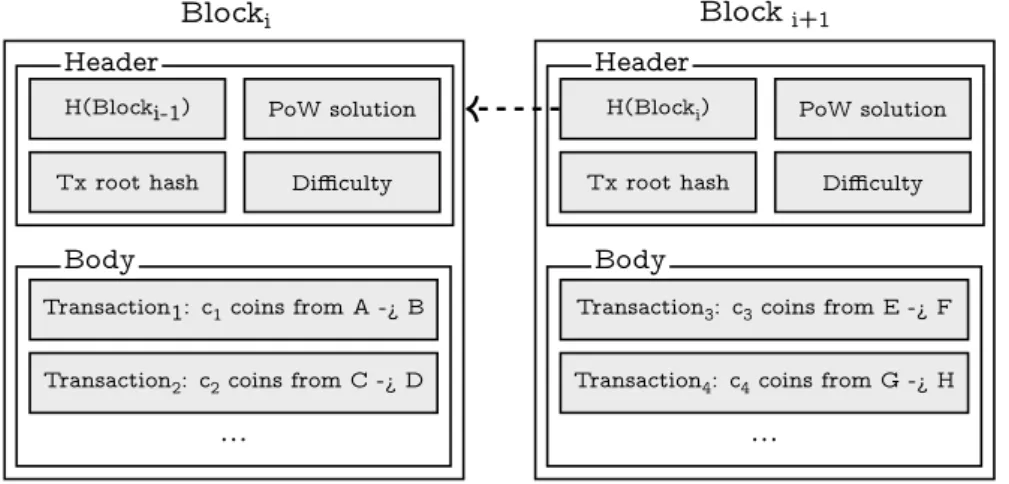
in decentralized, trustless networks. The main building block of cryptocurrencies is the blockchain, a public ledger, which stores the history of all transactions. Nodes
of the underlying peer-to-peer network, calledminers, collect transactions and
pub-lish them in new blocks, which extend the chain. Once transactions appear in this immutable public log, they are considered valid. The basis for distributed ledger technologies form established cryptographic primitives, i.e., digital signatures
au-thenticate the transfer of coins and hash functions link the blocks together. But
the main challenge of the system is that it requires all miners to reach consensus in an open and unregulated network. These,permissionless systems are often vul-1Today, Bitcoin’s market capitalization exceeds 140 billion euros, which is roughly equal to the
nerable to so-calledSybil attacks [65], in which miners get an unfair advantage by
creating new fake identities. Many cryptocurrencies protect against these attacks by letting miners solve a cryptographic puzzle, called a Proof of Work (PoW) [12]. PoWs ensure that the chance of proposing a new block is proportional to the computational resources a miner is willing to invest. The system’s security relies on the assumption that honest parties control the majority of the computational power.
Smart Contracts. Blockchain technology is also the basis for other promising innovations, most notably smart contracts, which allow users to deploy
program-ming code on the blockchain. Smart contracts can store data publicly, receive coins, and define rules on their redistribution. The blockchain enforces these rules, which allow developers to build self-enforcing trustless applications. While Bit-coin only has limited support for smart contracts, other cryptocurrencies, like Ethereum [186], have incorporated powerful contract programming languages in their design. Popular applications of smart contracts can be found in the shar-ing economy [18, 174], e-commerce [6], tradshar-ing [126, 10], online gamblshar-ing [82, 63] and digital rights management [66]. When designing protocols between mutually untrusted parties, smart contracts can be utilized in various ways to secure the correct and fair protocol execution.
1.1 Challenges for Blockchain Technology
While some have regarded Nakamoto’s original protocol as innovative and ground-breaking, it also received quite some negative attention, and countless projects work on adding additional features. Bitcoin and other cryptocurrencies have been associated with crime because of their pseudonymous user identification. For ex-ample, Bitcoin was the dominant payment method for online black markets [54] and ransom payments of extortion malware [113]. While some research papers (e.g., [143]) showed how law enforcement could follow the paths of pseudonymous transactions and deanonymize payments, other projects [146, 181, 171] proposed new currencies with advanced privacy features, that promise anonymous and un-likable payments. Another criticism that cryptocurrencies face is their enormous energy consumption. As more miners joined the network and invested their compu-tational power, the energy usage of the overall Bitcoin system increased drastically. Currently, the energy consumption and carbon footprint of Bitcoin equals that of a small country [64]. This waste of natural resources motivated a large body of
works that propose more sustainable cryptocurrencies, i.e., based on alternative mining puzzles [116, 149].
Scalability. But one of the biggest disadvantages of distributed ledger technolo-gies is their limited scalability, which also motivates this thesis. The original paper envisioned Bitcoin to provide “cheap and fast payments” [151] which, as the user base grew, quickly turned out to be unrealistic and can not be provided by the blockchain technology as it is in use today. Ethereum also suffers from limited scal-ability, which has been called a “big bottleneck”, that could hinder the system’s further adoption [129].
The limited scalability of cryptocurrencies results from two inherent factors: the
block creation timeand thefixed block size. The former factor influences the average
time between the creation of two blocks, and the later limits their maximum size. Both limitations are necessary as they ensure that blocks have sufficient time to be distributed in the peer-to-peer network. Even with both security measures in place, temporary blockchain forks can occur when two miners propose different blocks (somewhat) simultaneously. The consensus rules, which say that miners should always extend the longest chain, ensure that miners will eventually agree on one of the chains. To protect against this temporary uncertainty, users should only accept new blocks and the transactions inside them, once a few newer blocks extend it; i.e., in Bitcoin, it can take around 60 minutes until transactions are confirmed. In addition to the long delays, blocks can only include transactions up to a maximal block size. This parameter either upper bounds the data size (as in Bitcoin) or the complexity of instructions (as in Ethereum). However, in both cases, there is a limit to the overall transaction throughput, which indicates the number of transactions supported per second. In Bitcoin, it is said to be around seven transactions per second [58] and 15 for Ethereum [17]. These numbers are incomparable to the high throughput of centralized systems like the Visa credit card network, which support thousands of transactions per second [58]. During times of high transaction volume, many transactions compete for the limited space in blocks. As a result, transaction fees increase drastically as only the payments with the most lucrative fees are chosen by the miners. The combination of long confirmation delays and unpredictable and high transaction fees make blockchain technology unattractive for many applications.
Many research papers have focused on these scalability issues and have proposed solutions on multiple layers. The authors of [58] have analyzed the limits of how far the blockchain parameters can be tweaked to ensure that blocks can still propagate
fast enough in the underlying network. Some scaling proposals change the rules of the blockchain system, while others change the way that users interact with it. An example to a more scalable consensus proposal is sharding [133, 119, 189],
which partitions the blockchain into multiple shards, that are maintained by a subset of nodes. As every miner only has to verify a small subset of transactions and blocks, this approach can scale the overall transaction throughput, if the honest majority assumption holds for each sub-committee of the network. Another idea is to arrange transactions in a Directed Acyclic Graph (DAG) instead of a
blockchain [162], such that they directly reference (approve) previous transactions. This allows the network to be asynchronous and have (to some degree) different views on the currently approved transactions.
Another group of proposals build scaling improvements without changing the consensus rules and is often classified as second layer oroff-chainresearch. The key
idea of protocols proposed in this area is to reduce the on-chain transaction load by letting the parties interact directly with each other, instead of sending transac-tions to the blockchain. As a result transaction costs and confirmation times can be reduced. Examples of off-chain protocols are payment channels (e.g., Light-ing [161]), commit chains (e.g., Plasma [160]), and off-chain execution frameworks (e.g., TrueBit [177]).
Secure Protocol Design. As these protocols can become rather complex, it is challenging to design them without flaws. Severe attacks like the 47 million euros theft from the “DAO” smart contract [9] or the 30 million euros theft from Parity wallets [156] show the importance of secure contract and protocol design. The field of modern cryptography provides important tools necessary to achieve high confidence about the security of a protocol. By formally defining the properties of a system, we can quantify its security and describe the attacks we aim to protect against. Then we can build a protocol and prove that it satisfies these requirements. By writing formal proofs, we analyze the security of the protocol and capture possible attack vectors during the design phase.
The need for schemes that are secure by design is demonstrated by various
examples of flawed schemes, that have been designed in an ad-hoc fashion, without undergoing a thorough security analysis. A famous example for such a project is the initial proposal [98] of the Transport Layer Security (TLS) protocol and its predecessor, Secure Sockets Layer (SSL), which are essential cryptographic protocols securing communication over the Internet. It was later shown that the initial proposals included severe conceptual flaws and vulnerabilities [145]. In the
context of cryptocurrencies, the need for secure design has been highlighted by, e.g., the Zerocoin project [146], in which it was possible to destroy coins of honest users [170]. This flaw was not captured in the original proposal, despite the fact that it included a correct security proof, because its security definition did not capture such an attack.
1.2 Goal of this Thesis
The goal of this thesis is to increase blockchain scalability through the use of smart contracts. In order to ensure security, we apply the methods of modern cryptogra-phy and develop formal security definitions and proofs for our protocols. We utilize the existing blockchain protocols, in particular, Bitcoin and Ethereum, and build off-chain protocols that shift the main transaction load away from the blockchain. We apply a scaling technique from the area of Multi-Party Computation (MPC) that makes complex protocols more efficient. These so-called optimistic proto-cols [8] were initially proposed for fair exchange settings, where two parties want
to exchange two values. Fair exchange ensures that either both parties learn the respective values or neither party learns the input of the other. It has been shown that it is impossible to build such protocols without an (often expensive) Trusted Third Party (TTP) [155]. Optimistic protocols distinguish two cases: When both parties behave honestly, we call the protocol execution optimistic, while the pes-simistic case occurs when at least one player starts deviating from the honest
behavior. The idea is to rely on the trusted intermediary only in the pessimistic case, and make the optimistic case efficient and cheap. The design rationale behind this setup is that the optimistic case is much more likely to occur, and thus the protocol execution will be efficient in the standard case. The trusted intermediary can act as a judge in many cases and identify who of the participants misbehaved. This party could then be punished, and the other party can be compensated. This idea is often applied when optimistic protocols are used in the context of blockchain technologies where financial penalties and compensation is easy [23]. In the protocols designed in this thesis, we aim to minimize interaction with the blockchain in the optimistic case and only rely on it to judge on misbehavior in the pessimistic case.
An additional challenge for our protocols is that the concept of monetary trans-actions, coins, or financial security is traditionally not considered by modern cryp-tography. As these elements are crucial to the secure design of our protocols, we model the blockchain and the interface that we require from it. To this end, we
formally define the ledger system, which takes care of coins on the blockchain and ensures their correct transfer. We also provide a formal definition of smart con-tracts, which includes their functionality and all interactions with both the ledger and the protocol participants. The protocols we design are accompanied by formal proofs that show how we achieve the defined security guarantees. In particular, we ensure that a party will not lose its coins if it behaves honestly, even if all other involved parties do not follow the defined protocol. This means that no malicious party can benefit from cheating.
1.3 Contribution
We design three protocols in this thesis that use optimistic protocols for scaling blockchain technologies. We will discuss them in more detail in Chapters 4 to 6. In all of these protocols we will try to minimize (expensive and slow) interactions with the blockchain to reduce the costs. We provide formal security analysis for each of them and show feasibility through a proof-of-concept implementation. Chapter 4: Virtual Payment Channel Hubs. In Chapter 4, we present the
Perun protocol, based on the publication “Perun: Virtual payment hubs over
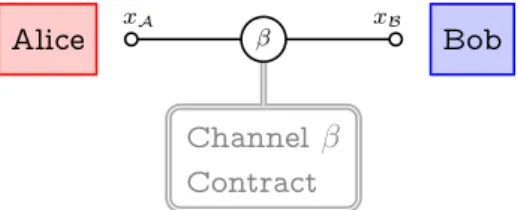
cryptocurrencies” [69] published at the 2019 IEEE Symposium on Security. In this work, the scalability of blockchains is improved by extending the functionality of payment channels. Payment channels were previously introduced by [61, 161, 148] and allow two parties to send transactions off-chain to each other directly instead of sending them on the blockchain. In Ethereum, payment channels are secured by a smart contract that is only required for the setup and closing of channels in the optimistic case, which makes this case very cheap and efficient. The pessimistic case occurs whenever the two channel participants disagree on the state of the channel, or if one of the two parties aborts. In this case, a party can start a dispute process and complain to the smart contract. However, we assume that the pessimistic case will rarely happen as no party can benefit from it. Thus, channels provide a very cheap and efficient way to send a large number of payments and reduce the number of interactions with the blockchain.
Our goal is to design a protocol for executing micropayments nearly instanta-neously. While the current blockchain mechanism is too expensive and slow to execute micropayment transactions, payment channels are a promising solution. However, while this technique nicely scales transactions between two parties, every new connection requires the setup of a new smart contract on the blockchain. To
reduce this overhead, payment networks, like the lightning network [161], re-use
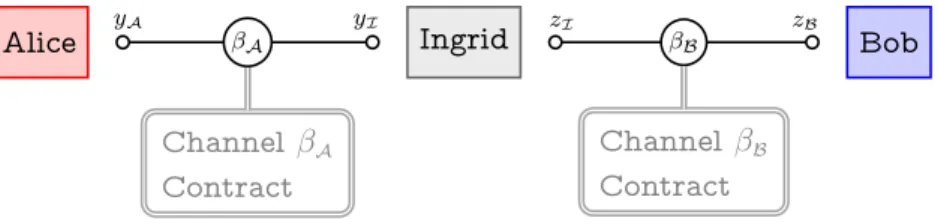
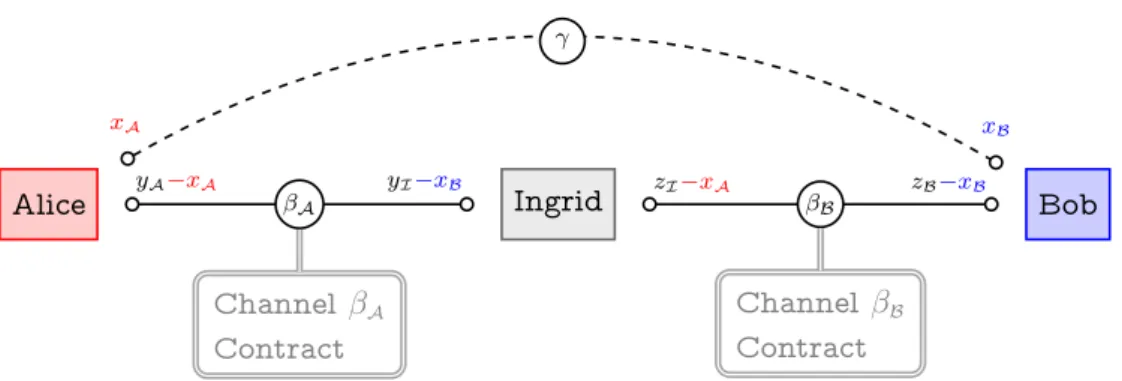
existing channels and route payments via one or more intermediaries off-chain. For example, consider a scenario where party Alice has an open channel with Interme-diary Ingrid, who, in turn, opened a channel with party Bob. This setup allows Alice to route a payment to Bob with Ingrid’s assistance. Alice promises to send the coins off-chain to Ingrid, but Ingrid will only be able to redeem this condi-tional payment if she sent the same sum to Bob through their channel. This setup allows Alice and Bob to send and receive payments off-chain without needing to trust Ingrid, who, at the same time, does not risk losing any funds. The problem with such previous constructions [161, 148, 165] is that they are inadequate for micropayments, as the routing over the intermediary adds additional delays and fees. The goal of this work is to find a new way of combining existing channels and allow the exchange of microtransactions without additional routing delays and costs.
To this end, we introduce Perun, a protocol for virtual payment channels,
that allows a faster and cheaper way of routing transactions. Virtual channels require the communication with untrusted intermediaries similarly to how direct channels use smart contracts: only during setup, closing, and in case of disputes. Since sending transactions in virtual channels does not require communication with the intermediaries, virtual payments are just as fast as payments though direct channels. We provide a detailed description of thePerunprotocol, formally
model its functionality, and prove its security in the global Universally Composable (UC) framework [45]. Additionally, we analyze its efficiency with a prototype implementation in Ethereum and discuss extensions. In particular, we briefly describe how the system can be extended to provide not just payments but generic smart contracts [71] and how to build multi-party virtual channels [68].
Chapter 5: Moving Complex Computation Off-Chain. While Chapter 4 pro-poses a scaling solution that allows users to send simple payments off-chain, in Chapter 5, we aim to move complex smart contracts away from the blockchain. Our goal is to reduce execution costs for complex smart contracts without compro-mising on the security. This is achieved by keeping large inputs off-chain instead of sending them to the smart contract and by reducing the on-chain complexity of contract code. TheFairSwap protocol does not only improve the scalability and
execution costs of complex contracts but also allows the evaluation of functions, which would be too large to execute directly in a smart contract. The protocol designed in this chapter is called FairSwap, and it is based on the paper
“Fair-Swap: How To Fairly Exchange Digital Goods” [67], which was presented at ACM Conference on Computer and Communications Security 2018.
In particular, we consider the case of a two-party smart contract, which runs a fair exchange of a (potentially large) digital commodity. This is the standard setting of a secure sale over the Internet, where a buyer is willing to pay a price of p coins to a seller if he receives a certain digital good x. This trade can be
implemented na¨ıvely by a smart contract, that takes p coins from the buyer and
the commodityxfrom the seller. Ifxis “correct”, the contract transfers the money
to the seller. In any other case, the money is sent back to the buyer. But in order for this to work, the contract needs to evaluate a predicate function φ, which
outputs 1 if x is correct and 0 otherwise. Such a smart contract ensures financial
fairness, which means that the price is only paid if and only if the buyer receives the correctx. However, ifxgets large or the verification functionφis complicated,
the contract gets too costly. Consider the example wherex is a digital file that is
identified by its publicly known hashh, i.e., the functionφoutputs 1 only if the file x hashes to h. If x is a multimedia file, its size is easily in the range of gigabytes.
A transaction that stores a single megabyte of data on the blockchain would cost approximately 319 euros in fees2 and would not fit into a single transaction.
We propose an optimistic protocol calledFairSwap, which guarantees the same
financial fairness as the straightforward solution and is efficient even for large x
and/or complex φ. The idea is that the seller sends the encrypted x directly to
the buyer, who will then lock the coins in the contract, thus confirming that he received the ciphertext. Only then will the seller reveal the key, which lets the buyer decrypt x. In case it is the expected file, the money goes to the seller, and
the sale is successfully completed. However, in case the file is wrong, the buyer can prove this fact to the smart contract using only a (relatively) small statement, called proof of misbehavior. FairSwap shows how both the size of this proof and
its verification inside the contract can be kept very small in comparison to the size of φ and x. We also evaluate the efficiency of the scheme by providing a proof of
concept implementation. We prove the security of this scheme by showing that if the file is wrong, the buyer can always expose the seller’s misbehavior. However, at the same time, a malicious buyer cannot produce such a statement if the file is correct, and the seller was honest. We additionally discuss extensions of the protocol [73], in particular how to make the proof of misbehavior interactive to make the optimistic case of the protocol even more efficient.
2We consider an exchange rate of 162.43 euros and a gas price of 3 GWei. More information on the Ethereum fee structure can be found in Section 3.2.1.
Chapter 6: Off-Chain Smart Contracts on Bitcoin. In this chapter, we inves-tigate another direction of scaling complex smart contracts. Instead of running the contract on-chain or letting all parties execute the code locally (as in the pre-vious proposals), we now outsource it to a Trusted Execution Environment (TEE) – a secure and trustworthy runtime environment for applications [159]. The re-sulting protocol is called FastKitten and has been presented in the publication
“FastKitten: Practical Smart Contracts on Bitcoin” [59] at the Usenix Security Symposium in 2019.
The main building block of this work is a TEE, such as Intel’s Software Guard Extension (SGX) [142, 99, 4], or the ARM TrustZone [7]. Such TEEs are specifi-cally designed to be tamper-resistant, which allows them to run code in protected computation environments that strictly isolate a specific application on a poten-tially untrustworthy machine. The TEE guarantees confidential and correct code execution. We call the host or owner of the TEE the operator, and while the TEE
itself is trusted, the operator can be malicious. This means he decides when to run the TEE, and he controls its inputs and outputs but cannot influence the computation inside the device or learn about its internal state. Based on the secu-rity of TEEs, we build the FastKitten protocol, which guarantees efficient and
fast evaluation of generic smart contracts that can interact with a fixed number of parties. Again, we minimize the interaction with the blockchain and only use it to lock the coins during the contract evaluation, and in the pessimistic case, to guarantee message delivery and penalize misbehaving players. Unlike the solutions in previous chapters, we show thatFastKitten only requires simple transactions
that are supported by blockchains without advanced scripting capabilities. We provide a construction that works on Bitcoin and analyze its efficiency and fees. We formally prove the security of the scheme and show that malicious parties cannot influence the computation of the contract or steal coins from it.
1.4 Structure of this Thesis
In Chapter 2, we introduce all cryptographic building blocks that we use in the protocols, i.e., hash functions, encryption, commitment, and signature schemes. We present the formal notation and definitions that we rely on in this thesis. Additionally, we discuss the concept and essential aspects of provable security and present the relevant formal models.
Chapter 3 gives a detailed introduction and explanation of blockchain technol-ogy and smart contracts. We also analyze their limited transaction throughput
and compare previous proposals that aim at improving scalability. Additionally, we focus on the formal properties of cryptocurrencies. In particular, we discuss the trust assumptions needed to build distributed ledgers and what security they can offer and present how we formally treat the handling of coins and the commu-nication with the blockchain.
In the following three chapters, we discuss the protocols Perun, FairSwap,
and FastKitten, that have been developed in this thesis. The content of each
chapter follows the same order. The contribution is summarized for each of them at the beginning. Then, we provide a more detailed overview, which presents the motivation and high-level design ideas for each scheme and discusses additional related work. A preliminary section in each chapter briefly presents additional for-mal notations and models, if necessary. Next, we define the security and construct the protocol. Following this, we present the security proof, and the benchmark-ing results from our implementation. Finally, we discuss the results and present extensions to the initial protocol design.
In the final Chapter 7 of this thesis, we compare the three proposed protocols from the previous chapters and discuss their advantages and shortcomings. We give an overview of what applications can benefit from their usage.
In this chapter we introduce the basic notions and formal cryptographic definitions that we will use in this thesis.
2.1 Notation
We denote the set of natural numbers 1, . . . , mas [m], the set of all binary strings
with the length of n bits as {0,1}n, the set of all bit strings as {0,1}∗, and the
n bit string comprised only of 1s as 1n. Whenever we consider a probabilistic algorithm A, then y ← A(x) denotes that the output y is generated by A using
internal randomness r. For deterministic algorithms or whenever we make this
internal randomness explicit we write y := A(x, r) instead. When a value x is
sampled uniformly at random from a set X we write x←−$X. We will use κ to
denote security parameters, and say that a function negl is negligible if for all
positive polynomialspoly there exists some constant κ0 such that for all κ > κ0 it
holds that negl(κ)< poly1(κ).
We denote algorithms Alg with upper case serif free fonts and parties Q with calligraphic letters. Parties are modeled as interactive Probabilistic Polynomial Time (PPT) Turing machines. Whenever parties send messages to each other, we will give each message a name, denoted with typewriter font, i.e., a message with valuex is denoted as (msgName, x).
The notion of computational indistinguishability [108] is a heavily used in mod-ern cryptography. We say two distributions X and Y are computationally indis-tinguishable if it is difficult to tell them apart (cf. formal Definition 1). We write X≈cY.
Definition 1(Computational indistinguishability). Letκ be a security parameter. Two distribution ensembles X = {X(κ)}κ and Y = {Y(κ)}κ are computationally
indistinguishable if for every PPT distinguisherA there exists a negligible function negl s.t.:
Pr[A(1κ, x) = 1]−Pr[A(1κ, y) = 1]
where the probability is taken over the randomness of algorithm A and the random sampling of x←−$ X and y←−$Y.
When we define security, we often consider experiments, that an algorithmA is trying to win. We will argue about the winning probability of A, where winning requires him to run the (randomized) experiment and produce a specific event. We denote this probability as
Pr[ event : experiment ]
where the probability is always taken over the randomness of that experiment.
2.2 Provable Security
The concept of provable security is used to formally argue about the security of cryptographic algorithms and protocols. The paradigm of the field of modern cryp-tography is to apply rigorous logical argumentation in the form of mathematical proofs, to show that the analyzed schemes cannot be attacked. Before such a proof can be conducted, the following has to be specified.
Adversary model: We need to describe any possible attacker that our protocol should protect against. Modeling this attacker includes a clear description of its power and capabilities. In this thesis we considercomputational security,
which models the adversary as a poly-time bounded1 algorithm which is
allowed to have a negligible probability of breaking the security (the attackers advantage). This means that the adversary can break the security with a negligible probability, i.e., by guessing or brute-force.
Formal definitions: The first step to a security analysis of every cryptographic scheme is a sound formal definition of its security. Such a definition captures the required properties of the scheme by defining the threat model. This is usually done by providing the adversary model, which defines the capabilities that an attacker has, i.e., what he can and what he cannot do. The goal of the adversary is formulated either in a game based or in a simulation based fashion. In game based security, a security property of the scheme is
1In particular we consider algorithms which require runtime that is polynomial in the secu-rity parameter and are successful with probability which is negligible in the same secusecu-rity parameter.
defined and analyzed over an adversary who has to win a predefined game or experiment in order to break the analyzed security property. We say the system is secure if the adversaries’ advantage (the probability of him winning the game) is at most negligible in the security parameter. In simulation based security definitions the adversary needs to distinguish between the original and a simulated version of the security experiment and his advantage describes the probability which with he wins the experiment apart from guessing.
Assumptions: The security of most cryptographic schemes relies on assumptions. Typically examples for such assumptions are that some mathematical prob-lem is hard to solve (e.g., factorization of large numbers) or on the existence of cryptographic primitives and their security. These assumptions should be easy to state and must be well studied by the cryptographic community. Security proofs are often non-trivial as we need to show that there does not exist an adversary that is able to break the stated security definition. Therefore, showing security against specific attackers would not be helpful in these proofs. Instead, we utilizereductions(a common proof technique of modern cryptography)
to show that the existence of an adversary would contradict our assumptions. We will often reduce the security of a scheme to the security of one of the primitives that we use. Thus, often security statements define a security property of a scheme in relation to the underlying assumptions.
Security of cryptographic protocols. In this thesis, we design and analyze in-teractive cryptographic protocols between two or more parties. At the beginning
of the protocol, parties get input, and at the end, they output some value. In general, we consider a static adversary that can choose which parties to corrupt
but only before the start of the protocol. A corrupted party is controlled by the adversary, who learns all its inputs and decides how it behaves. If the adversary possesses additional powers, they must be clearly defined.
In cryptography, we can choose from different models for conducting security proofs. In particular, we distinguish between thestandalone model and the Univer-sally Composable (UC) model in this thesis. In the standalone model, we analyze
the security of isolated single protocol execution. For this purpose, we define every security property of the protocol in the presence of a PPT adversary who tries to break this property. In Chapter 6, we follow this model and prove the security properties for a standalone protocol execution.
The main limitation of the standalone model is that it ignores a much more com-plicated world where multiple protocol instances are executed by many parties at the same time. To address this shortcoming, a different model for proving security of cryptographic protocols, called the Universally Composable (UC) framework, was proposed by Ran Canetti in 2000 [43]. The UC model captures the security of concurrent (parallel and sequential) protocol executions between many parties and even in composition with other protocols. In contrast to the standalone approach, protocols are analyzed by running them in the presence of an environment that initiates the protocol executions, selects all inputs, and controls the adversary’s behavior (and that of corrupted parties). Security in this model is defined through anideal functionality, which captures the ideal outcome of the protocol. This ideal
representation defines all security properties that the final protocol should have. Additionally, it models the inputs and outputs of every party, and all leakage and influence that each of them gets (including the adversary). The security proof then analyzes the differences in the execution of the ideal functionality and the proto-col, often called the real-world. The key idea is that if these executions cannot be distinguished (by the environment), then the protocol is just as secure as the ideal representation. We provide a more formal overview of the UC framework and its components below in Section 2.4, as this model is used in Chapters 4 and 5.
2.3 Cryptographic Primitives
Next, we present the basic cryptographic primitives that are required for the rest of this thesis. In particular, we define commitment, signature and encryption schemes as well as hash functions and their security.
Hash Functions
Cryptographic hash functions are important cryptographic primitives, which are heavily used by the schemes presented in this thesis as well as for cryptocurrencies in general. A hash functionH (as considered in this thesis) maps binary strings of
arbitrary length to binary strings of a fixed lengthµ. Formally, hash functions are
modeled as keyed hash functions, where a key generation algorithm Gen, which
takes as input the security parameter κ, selects a seed from a key-space K. This
seed is used to parameterize the deterministic hash function Hk. We require that the hash function Hk satisfies collision resistance [167] for a sufficiently large
Definition 2 (Collision Resistant Hash Functions). Letκbe a security parameter. A keyed hash function is a tuple of algorithms (Gen, Hk) where Genon input of 1κ
outputs a seedk∈K andHk indexed by the seedk outputs a hash valueh∈ {0,1}µ
on input of a value v ∈ {0,1}∗. A keyed hash function is collision resistant, if for
any PPT adversary A there exists a negligible function negl s.t.:
Pr[Hk(v) =Hk(v0) AND v 6=v0 :k ←Gen(1κ),(v, v0)← A(k)]≤negl(κ)
where the probability is taken over the randomness of algorithms Gen, Hk, and A. In this thesis we will follow the convention of writing H instead of Hk as it
simplifies the exposition of hash functions. In Chapter 5 we will model collision resistant hash functions as random oracles, which we will introduce in more detail in Section 5.2.
Merkle Trees Merkle trees [144], provide domain-extension for collision resistant hash functions. In particular, they allow to hash a large input string to a constant sized digest h ∈ {0,1}µ. This is particularly useful when many (say n) elements are hashed to a single value, as it is possible to generate a short proof that a certain element is part of the tree. The key idea is to create a complete binary tree, which has thenvalues as leaves, and every node is a hash of its children. The
root of that tree serves as a digest h of the n values, and whenever it needs to be
shown that a particular element was part of the tree, we open all values (i.e., the siblings) on the path between the node and the root hash, resulting in a number of dlog(n)eelements. In Section 5.2, we provide more details on how to construct Merkle trees using the algorithms MtreeH, MproofH, and MvrfyH.
Encryption Schemes
A symmetric or private key encryption scheme allows to encrypt a messagexfrom
a message spaceX under a secret key k, such that the ciphertext without the key
does not reveal information about x. Formally, a symmetric encryption scheme
for a message space X consists of three PPT algorithms (Gen,Enc,Dec). The key
generation algorithm Gen takes as input 1κ, where κ is the security parameter, and outputs a key k from key space K. The encryption algorithm Enc takes
as input a key k ∈ K and a message x ∈ X and outputs a ciphertext c from
ciphertext space C. The deterministic decryption algorithm Dec, which takes as
We require correctness of the scheme, i.e., that for all k ← Gen(1κ) and x ∈ X:
Dec(k,Enc(k, x)) = x.
In contrast to symmetric encryption schemes, asymmetric or public key en-cryption schemes allow anyone to encrypt a message x under a known public
key pk. But only the owner of the corresponding secret key sk, can decrypt the
ciphertext. Formally, an asymmetric encryption scheme for messages x∈ X
con-sists of three PPT algorithms (Gen,Enc,Dec). The key generation algorithm Gen
takes as input 1κ, where κ is the security parameter, and outputs a key pair (sk,pk)← Gen(1κ). The encryption algorithmEnc takes as input a public key pk
and a message x∈X and outputs a ciphertext c∈C. The deterministic
decryp-tion algorithm Dec, which takes as input a secret key sk and a ciphertext c ∈ C
outputs x or an error denoted as ⊥. We require correctness of the scheme, i.e., that for all (sk,pk)←Gen(1κ) andx∈X: Dec(sk,Enc(pk, x)) =x.
The asymmetric encryption scheme used in this thesis needs to be
indistinguish-able under chosen plaintext attacks (IND-CPA security) [108]. This means that
for any PPT adversary that chooses two messagesx0, x1 (of the same length) and
learns c = Enc(pk, xb) for a randomly chosen bit b, it must be hard to guess b correctly except with negligible advantage. The adversary in this case is called twice, once to provide two inputs x1, x2 and a second time to choose which of the
two inputs was encrypted. Note, that the adversary stores a state between these two calls and (as it gets the public key as input) can encrypt arbitrary messages. Definition 3 (IND-CPA Secure Encryption). Let κ be a security parameter. A public key encryption scheme (Gen,Enc,Dec) has is indistinguishable ciphertexts under chosen plaintext attacks (is IND-CPA secure) if for all PPT adversaries A
there exists a negligible function negl s.t.
Pr[b=b0 :(sk,pk)←Gen(1κ),(x0, x1)← A(1κ,pk),
b←−{$ 0,1}, c ←Enc(pk, xb), b0 ← A(c)]≤ 12 +negl(κ)
where the probability is taken over the randomness of algorithms Gen,Enc and A
and the random choice of b←−{$ 0,1}.
Digital Signature Schemes
Digital signatures allow a sender to authenticate messages with a secret key sk,
such that every recipient with knowledge of the corresponding public key pk can
be ensured that the message was sent by the sender. In particular, it is computa-tionally infeasible to generate a valid signature without the secret key. Formally,
a signature scheme for messages from a message space X is a triple of PPT
al-gorithms (Gen,Sign,Vrfy). The key generation algorithm Gen takes as input 1κ, where κis the security parameter, and outputs a key pair (sk,pk) from key space
K. The signature algorithm Sign takes as input a secret key sk and a message
x ∈ X and outputs a signature σ. The deterministic verification algorithm Vrfy
takes as input the public key pk, the message x, and the signature σ and outputs
1 if the signature is correct or 0 otherwise. Again, we require correctness of the scheme, i.e., that for all (sk,pk)←Gen(1κ) andx∈X: Vrfy(pk, x,Sign(sk, x)) = 1. We require that the signature scheme is existentially unforgeable against adaptive chosen message attacks (we will also say EUF-CPA secure). This means we protect against an adversary who can see valid signatures for messages of his choice. For-mally this is modeled as a signing oracle which on input of a value x outputs the
signature σ=Sign(sk, x). The task of the adversary is to produce a fresh message
(that has not been queried before to the signing oracle) and a valid signature with respect topk.
Definition 4 (Unforgeability Against Adaptive Chosen Message Attacks). Let
κ be a security parameter. A signature scheme (Gen,Sign,Vrfy) is existentially unforgeable against adaptive chosen message attacks if for all PPT adversaries
ASign with oracle access to the signing oracle Sign(sk,·), there exists a negligible function negl s.t.
Pr[Vrfy(pk, x, σ) = 1 AND x /∈Q:(sk,pk)←Gen(1κ)
(x, σ)← ASign(sk,·)(1κ,pk)]≤negl(κ),
where Q is the set of all queries thatA made to the signing oracle and the proba-bility is taken over the randomness of algorithms Gen,Sign and A.
Commitment Schemes
A commitment scheme allows a sender to convince a receiver that he fixed (or committed to) a message x by providing a commitment c, which does not reveal
information aboutx. At a later point he can reveal x and prove that it was
com-mitted to by providing an opening value d. Formally, a commitment scheme for
input values x ∈ {0,1}∗ consists of three algorithms (Gen,Commit,Open), where
the key generation algorithmGentakes as input 1κ, whereκis the security parame-ter, and outputs public parameterspp. The (probabilistic) algorithmCommitpp(x) is parameterized by these public parameters and outputs a commitment cand an
opening value d, and the algorithm Openpp(c, d) = x outputs x for a valid
com-mitment (c, d) ←Commit(x) and ⊥ otherwise. A commitment scheme is correct, if for all x∈X: Openpp(Commitpp(x)) =x with pp←Gen(1κ). Cryptographically secure commitment schemes [108] have to satisfy the hiding and binding
proper-ties. Hiding guarantees that for any two messages x, x0 and (c, d) = Commitpp(x) and (c0, d0) =Commitpp(x0), we have that c≈c c0.
Definition 5 (Computationally Hiding Commitments). Let κ be a security pa-rameter. A commitment scheme C = (Gen,Commit,Open) is hiding, if for any PPT adversary A there exists a negligible function negl s.t.:
Pr[b=b0 :pp←Gen(1κ),(x0, x1)← A(1κ, pp), b $
←−{0,1},
(c, d)←Commitpp(xb), b0 ← A(c)]≤ 1
2 +negl(κ)
where the probability is taken over the randomness of Gen,Commit and A.
The binding property prevents the commiter from being able to open the com-mitment to a different value than x. In particular, it requires that it is
com-putationally hard for any PPT adversary A to find a triple (c, d, d0) such that Openpp(c, d) = xand Openpp(c, d0) =x0 with x6=x0 and x, x0 6=⊥.
Definition 6 (Computationally Binding Commitments). Let κ be a security pa-rameter. A commitment scheme (Gen,Commit,Open) is binding, if for any PPT adversary A there exists a negligible function negl s.t.:
Pr[Openpp(c, d) = x AND Openpp(c, d0) =x0 AND x6=x0 AND x, x0 6=⊥:
pp←Gen(1κ)(c, d, d0)← A(1κ, pp)]≤negl(κ)
where the probability is taken over the randomness of Gen,Commit, and A as well as the random choice of b←−{$ 0,1}.
For simplicity we will often omit the public parameters and write Commit and Open without explicitly mentioning pp.
2.4 The Universal Composability Model
One common method to describe and analyze complex cryptographic protocols is the universal composability (UC) framework of Canetti [43]. We analyze a protocol Π which runs among a set of parties P, that are modeled as interactive
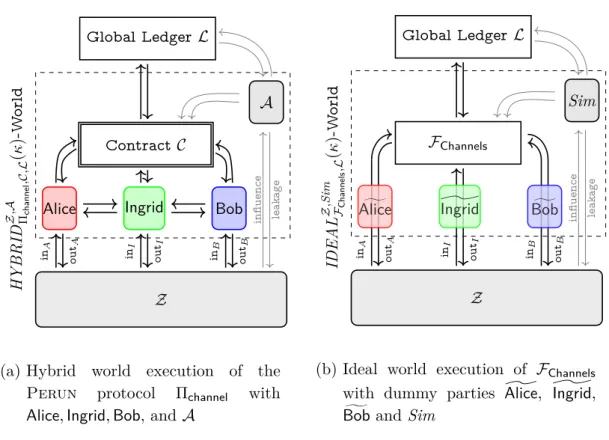
PPT Turing machines. In the UC framework, security of a protocol is analyzed by comparing its execution with an idealized and simplified trusted protocol execution F, which we call ideal functionalities. The case when the parties interact with the real protocol Π is called the real world execution while the ideal world means the
parties interact with the ideal functionality F instead. Both worlds are operated by a special party Z – the so-called environment, which selects inputs for the protocol participants and receives their outputs. In the real world Π is executed
among the set of parties P, which are connected by authenticated communication
channels that guarantee delivery of messages within one round. In addition, a special party called the adversary A may corrupt parties. Corruption of a party P ∈ P means that the adversary takes full control of P’s actions and learns his internal state. For simplicity, we consider a static adversary, where corruption only takes place at the beginning of the protocol. Formally, the output of the real world execution of protocol Π with inputx is denoted as
REALZΠ,A(κ, x).
To analyze the security of the protocol Π in the real world, we compare its execution with an idealized protocol execution. In the ideal world we consider a
dummy protocol where the parties from setP just forward their inputs to an ideal
functionality F. We call these parties dummy parties. The ideal functionality specifies the protocol’s interface and can be viewed as an abstract specification of what security properties Π shall achieve. In the ideal world, the ideal functionality can be attacked through its interface by an ideal world adversary – called the simulator Sim. Formally, we denote the output of the ideal world execution as
IDEALZF,Sim(κ, x).
The environment Z orchestrates both worlds by providing the inputs for all parties, and receiving their outputs. But this party acts as a distinguisher, which means that is does not know which of the worlds it is interacting with. We say a protocol Π is UC-secure if the environment Z cannot distinguish whether it is interacting with the ideal or real world. This indistinguishability must hold for all PPT environments Z. We prove this security formally by showing that for every real world adversary A we can construct an ideal world simulator Sim such that
for all environments Z and all inputs xthe following holds:
REALZΠ,A(κ, x)≈cIDEAL Z,Sim
Security in the UC framework implies that a protocol Π is at least as secure as the ideal functionality F. We will then also say that a protocol emulates the ideal
functionality.
We use a particularly useful property of the UC framework to modularize the design of our protocols. The universal composition theorem [43] allows us to use
ideal functionalities as subroutines in our protocols and later replace them by re-spective protocols that realizes these functionalities. A protocol which uses an ideal functionality F as a sub-routine is often said to run in the F-hybrid world. We will apply this technique to model interactions with smart contracts (cf. Sec-tion 3.2). To this end, we define a hybrid world where the protocol has access to an idealized smart contract functionality C. The execution of the functionality
is trusted and can only be influenced through its specified interface. If a hybrid functionality is used during the protocol execution we denote the output of this hybrid-world protocol execution as
HYBRIDZΠ,,CA(κ, x)
and show that it is indistinguishable from the output of the ideal world execution. Global UC model. A shortcoming of the UC framework is that – even though it models concurrent protocol executions – it does not allow that different executions share the same hybrid functionalities. This, however, leads to unwanted restric-tions when it comes to modeling a protocol component (like a random oracle [46] or a common reference string [45]) that is available in many different protocols. In the traditional UC model, security could only be guaranteed if, for every single protocol instance, a different and independent component is used. However, this does not correspond to how these components are implemented in practice. E.g., the random oracle is often replaced with the same hash function. To overcome this limitation, in [45], the authors propose an extension to the UC framework, which allows for global shared functionalities. In particular, these functionalities can be
accessed from both the ideal and real-world execution and store global state. In Chapters 4 and 5, we will use global functionalities to model the functioning of the ledger, which (for concurrent protocol executions) handles the secure coin transfer, as realized by blockchains. By modeling the ledger as a global functional-ity, we allow that our smart contracts (as hybrid functionalities) make changes on the ledger. These changes affect all concurrent protocol executions and are public to any observer. This modeling ensures that our protocols are secure, even if the balances on the ledger are affected by other concurrent executions of the same or
different protocols. In Chapter 5, we will additionally model the random oracle as a global functionality following the work of [41]. We provide detailed information on the model we use in Section 5.2.