© Penerbit Universiti Sains Malaysia, 2011
Selection of Project Managers in Construction Firms Using Analytic Hierarchy Process (AHP) and Fuzzy
Topsis: A Case Study
Fatemeh Torfi1 and *Abbas Rashidi2
Abstract: Selecting a project manager is a major decision for every construction company. Traditionally, a project manager is selected by interviewing applicants and evaluating their capabilities by considering the special requirements of the project. The interviews are usually conducted by senior managers, and the selection of the best candidate depends on their opinions. Thus, the results may not be completely reliable. Moreover, conducting interviews for a large group of candidates is time-consuming. Thus, there is a need for computational models that can be used to select the most suitable applicant, given the project specifications and the applicants’ details. In this paper, a case study is performed in which a Fuzzy Multiple Criteria Decision Making (FMCDM) model is used to select the best candidate for the post of project manager in a large construction firm. First, with the opinions of the senior managers, all the criteria and sub-criteria required for the selection are gathered, and the criteria priorities are qualitatively specified. Then, the applicants are ranked using the Analytic Hierarchy Process (AHP), approximate weights of the criteria, and fuzzy technique for order performance by similarity to ideal solution (TOPSIS). The results of the case study are shown to be satisfactory.
Keywords: Construction Firms, Fuzzy TOPSIS, Criteria, AHP, Project Manager INTRODUCTION
Project managers play a significant role in determining the quality, cost, and duration of construction projects. The project manager makes most of the major decisions. Thus, selecting the most suitable applicant is important.
1PhD Candidate, Department of Industrial Engineering,
Mazandaran University of Science and Technology, Babol, IRAN
2Lecturer, Islamic Azad University, Semnan Branch, IRAN
*Corresponding email: [email protected]
Traditionally, a manager is selected by interviewing applicants and considering their qualifications and the project requirements. The interviews are usually conducted by senior managers. In every human decision, there is the possibility of an error in judgment, so the results may not be dependable. Thus, there is a need for a method that can select the most suitable applicant for the post of project manager, given his/her capabilities and the senior managers’ opinions. In this paper, the Analytic Hierarchy Process (AHP) and Fuzzy TOPSIS (FTOPSIS) are used to
70/PENERBIT UNIVERSITI SAINS MALAYSIA
conduct a case study of the project manager selection procedure in a major Iranian construction company, the Polband Construction Company. The Fuzzy Multiple Criteria Decision Making (FMCDM) model presented here consists of the following steps:
Step 1: Determine all criteria and sub-criteria used by the senior managers of the company to select the project manager.
Step 2: Determine the approximate weight for each criteria with the AHP and by considering the senior managers’ opinions.
Step 3: Gather applicants’ information, and rank them using FTOPSIS.
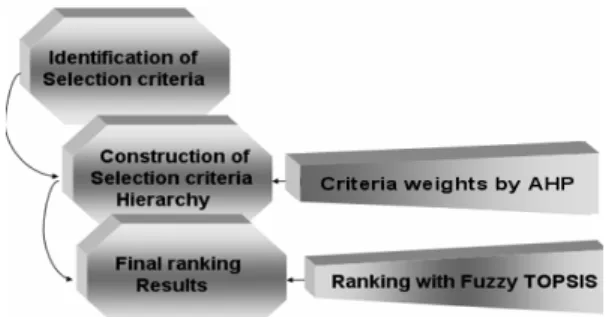
A schematic of the project manager evaluation and selection procedure is presented in Figure 1.
To evaluate the method and test its validity, its results were compared to those obtained by solving the problem using Data Envelopment Analysis (DEA), a valuable analytical research instrument, and a practical decision support tool, which is briefly discussed in the Model Assessment’s chapter.
Figure 1.Evaluation and Selection Procedure
In recent years, many studies have examined the application of MCDM modelling methods in decision-making processes, particularly in the construction industry. Obviously, these models cannot fully replace human decision making or management and control of a project. However, they can certainly be used as aids in the workplace.
LITERATURE REVIEW
MCDM involves finding the best opinion from all feasible alternatives in the presence of multiple, usually conflicting, decision criteria. Priority-based, outranking,
distance-based, and mixed methods are the primary approaches (Pomerol and Romero, 2000).
One of the most widely used MCDM approaches is the AHP (Saaty, 1986), which finds the relative weights of the factors and the total value of each alternative based on these weights. The AHP has widely been used in multi-criteria decision-making and has been successfully applied to many practical problems (Saaty, 2003). In spite of its popularity, it is often criticised because of its inability to handle uncertain decision-making problems (Cheng, 1999). TOPSIS, another MCDM method, is based on choosing the alternative that has the shortest distance from the positive-ideal alternative and the longest distance from the negative-ideal alternative (Hwang and Yoon, 1981).
In primitive forms of the AHP and TOPSIS, experts’ weightings of the criteria, sub-criteria, and alternatives are represented as exact numbers. However, in many practical cases, the experts are reluctant or unable to make numerical comparisons. FMCDM is a powerful tool for making in a fuzzy environment. Classical decision-making methods work only with exact data; there is no place for fuzzy or vague data. However, humans can perform qualitative data processing, which helps them to make decisions in a fuzzy environment. TOPSIS and fuzzy TOPSIS (FTOPSIS) have been applied in different situations and are commonly used to solve Multiple-Attribute
Decision-Making (MADM) (Yang and Chou, 2005; Yoon and Hwang, 1995).
Salehi (2009) used FTOPSIS for project evaluation. Cheng et al. (2009) discussed an application of fuzzy Delphi and fuzzy AHP to the evaluation of wafer suppliers in the semiconductor industry. Srdjevic (2007) linked the AHP and social-choice methods to support group decision-making in water management. Chu et al. (1996) used a heuristic method based on fuzzy logic for ranking projects. The AHP has been used by many authors for decision making in project selection (Wei et al., 2005; Dey, 2006; Lien and Chan, 2006). Aiello et al. (2008) focused on a clean agent selection approached with FTOPSIS. Dagdeviren et al. (2009) developed an evaluation model based on the AHP and TOPSIS to help managers in the defence industry select the optimal weapon in a fuzzy environment. Torfi et al. (2010) proposed an FMCDM approach to evaluate alternative options with respect to a user’s preferences. Two fuzzy procedures are proposed for solving the MCDM problem: the fuzzy AHP (FAHP) is applied to determine the relative weights of the evaluation criteria, and FTOPSIS is applied to rank the alternatives.
Our proposed method consists of two steps: first, the AHP is applied to determine the relative weights of the evaluation criteria, and second, FTOPSIS is applied to rank the alternatives. We chose the AHP and FTOPSIS for their
72/PENERBIT UNIVERSITI SAINS MALAYSIA
simplicity, popularity, and accuracy. The underlying concepts are easily understood, so they can easily be implemented in a construction company. Moreover, the computational overhead is relatively low, yet the results are precise. If the numbers of criteria and candidates increase, this will become important. We chose not to use fuzzy expert systems because they need considerable historical data to train the initial system. In our case study, insufficient historical data were available.
AHP AND FTOPSIS METHOD AHP
The AHP is a powerful decision-making method for determining priorities given different criteria. It encompasses six basic steps (Isiklar and Buyukozkan, 2006): Step 1. The AHP uses several small subproblems to represent
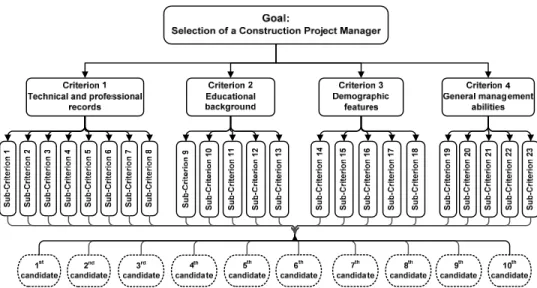
a complex decision problem. Thus, we first decompose the decision problem into a hierarchy with a goal at the top, criteria and sub-criteria at various levels, and decision alternatives at the bottom (see Figure 3).
Step 2. The comparison matrix D gives pairwise comparisons of the elements of the hierarchy. The aim is to set their priorities with respect to each of the elements one level higher.
11 12 1 21 22 2 1 2 n n m m mn x x x x x x D x x x (1)
The elements
x
ij can be interpreted as the degree of preference for the ith criterion over the jth criterion. Criteria can be weighted more reliably when the weighting is based on pairwise comparisons because it is easier to compare two attributes than to make an overall weight assignment. Before calculating the vector of the priorities, we normalise the comparison matrix to the [0, 1] range:1 ij ij n ij i
x
r
x
(2)11 12 1 21 22 2 1 2 n n n n nn
r r
r
r r
r
R
r r
r
(3)The comparison matrix involves the pair-wise comparison of elements of the constructed hierarchy. The aim is to set their relative priorities with respect to each of the elements at the next higher level.
Step 3. The AHP also calculates an inconsistency index (or consistency ratio) to reflect the consistency of the decision maker’s judgments during the evaluation phase. The inconsistency index for both the decision matrix and in the pair-wise comparison matrix can be calculated via (Aguaron et al., 2003): max
.
1
n
I I
n
(4)where I.I is the inconsistency index, n is the size of the comparison matrix, and λmax is the largest eigenvalue, which is calculated as:
max 1
1
( . / )
n iD R R
n
(5)The closer the inconsistency index is to zero, the greater is the consistency. The relevant index should be lower than 0.10 for the AHP results to be acceptable. If this is not the case, the decision-maker should redo the assessments and comparisons.
Step 4. Before calculating the vector of the priorities, the comparison matrix R must be normalised using Eq. (2).
Step 5. To find the weights of the criteria, the average of the elements of each row is calculated from the matrix R.
FUZZY SET THEORY
We briefly review fuzzy theory.
Definition 3.2.1. A fuzzy set
a
in a universe of discourse X is characterised by a membership function
ax
74/PENERBIT UNIVERSITI SAINS MALAYSIA
number in the interval [0, 1]. The function value
a
x
is termed the grade of membership of x ina
(Zadeh, 1965).The present study uses triangular fuzzy numbers. A triangular fuzzy number
a
can be defined by a triplet (a1, a2, a3). Itsconceptual schema and mathematical form are given by (Kaufmann and Gupta, 1985):
1 1 1 2 2 1 3 2 3 3 2 3 0 1 a x a x a a x a a a x a x a x a a a x a
(6)Definition 3.2.2. Let
a
a a a
1,
2,
3
and
b
b b b
1,
2,
3
be two triangular fuzzy numbers. Then, a vertex method is defined to calculate the distance between them, as shown in Eq. (7):
2
2
2 1 1 2 2 3 3 1 , 3 d a b a b a b a b (7)Property 3.2.1. Assuming that both
a
a a a
1,
2,
3
andb
b b b
1,
2,
3
are real numbers, the distance measurementd a b
,
is identical to the Euclidean distance (Chen, 2000).Property 3.2.2. Let a,b,and c , be three triangular fuzzy numbers. Then
a
is closer tob
than toc
if, and only if,
,
,
d a b
d a c
(Chen, 2000).The basic operations on fuzzy triangular numbers are as follows (Yang and Hung, 2007).
For multiplication:
1 1,
2 2,
3 3
a b
a
b a
b a
b
(8) For addition:
1 1,
2 2,
3 3
a b
a
b a
b a
b
(9)FUZZY MEMBERSHIP FUNCTION
Experts usually use a linguistic variable to evaluate the importance of the criteria and the rating of alternatives. The example in the present study has precise values for the performance ratings and the criteria weights. To illustrate the idea of fuzzy MACD, we deliberately transform the precise values to five levels of fuzzy linguistic variables: Very Low (VL), Low (L), Medium (M), High (H) and Very High (VH). The purpose of the transformation process is twofold: (1) to illustrate the proposed fuzzy MACD method and (2) to benchmark the empirical results against precise-value methods.
Triangular and trapezoidal fuzzy numbers are often adopted due to their simplicity in modelling and easy interpretation. Both triangular and trapezoidal fuzzy numbers are applicable to the present study. We assume that triangular fuzzy numbers can adequately represent the five-level fuzzy linguistic variables, and we use them for our analysis (see Table 1).
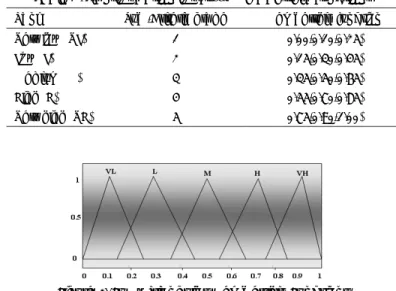
Each rank is assigned an evenly spread membership function that has an interval of 0.30 or 0.25. A transformation table can then be found, as shown in Table 1. For example, the fuzzy variable VL has an associated triangular fuzzy number with a minimum of 0.00, mode of 0.10, and maximum of 0.25. The same transformation is
then applied to the other fuzzy variables. Figure 2 illustrates the fuzzy membership function (Yang and Hung, 2007).
Table 1. Transformation for Fuzzy Membership Functions Membership function Sub -Criteria grade
Rank (0.00,0.10,0.25) 1 Very low (VL) (0.15,0.30,0.45) 2 Low (L) (0.35,0.50,0.65) 3 Medium (M) (0.55,0.70,0.85) 4 High (H) (0.75,0.90,1.00) 5 Very high (VH)
Figure 2. Fuzzy Triangular Membership Functions PRINCIPLES OF TOPSIS
TOPSIS is based on choosing the alternative with the shortest distance from the positive-ideal solution and the
76/PENERBIT UNIVERSITI SAINS MALAYSIA
longest distance from the negative-ideal solution; see Hwang and Yoon (1981).
FTOPSIS MODEL
It is often difficult for a decision-maker to assign a precise performance rating to an alternative for the criteria under consideration. A fuzzy approach assigns the relative importance of the criteria using fuzzy numbers instead of precise numbers. This section extends TOPSIS to the fuzzy environment. A fuzzy MCDM can be concisely expressed as a matrix: 1 2 3 1 11 12 13 1 2 21 22 23 2 3 31 32 33 3 1 2 3 n n n n m m m m mn C C C C A x x x x A x x x x A x x x x A x x x x (10)
1,
2,...,
n
W
w w
w
(11)where
x i
ij,
1, 2,..., ;
m j
1, 2,...,
n
andw
j,
j
1, 2,...,
n
arelinguistic triangular fuzzy numbers:
x
ij
a b c
ij,
ij,
ij
and
1,
2,
3
.
j j j j
w
a
b
c
Note thatx
ij is the performance ratingof the ith alternative, Ai, with respect to the jth criteria, and j
w
represents the weight of the jth criteria, Cj. The normalised fuzzy decision matrix is:ij m n
R
r
(12)The weighted fuzzy normalised decision matrix is:
mn n m n nv
v
v
v
v
v
v
v
v
V
~
~
~
~
~
~
~
~
~
2 1 2 22 21 1 12 11
1 11 2 12 1 1 21 2 22 2 1 1 2 2.
n n n n m m n mnw r w r
w r
w r w r
w r
w r w r
w r
(13) The benefit of using a fuzzy approach is that the relative importance of criteria can be assigned to fuzzy numbers instead of precise numbers. This section discusses the extension of TOPSIS to the fuzzy environment. TOPSIS is particularly suitable for solving the group decision-makerproblem in a fuzzy environment. The proposed FTOPSIS procedure is as follows:
Step 1: Choose the linguistic ratings
x
ij i=1, 2, …, m; j=1, 2,…, n for the alternatives with respect to the criteria and the appropriate linguistic variables
(
w
j,
j
1, 2,..., )
n
for the weights of the criteria. Thefuzzy linguistic rating
x
ij preserves the property that the normalised triangular fuzzy numbers are in the range [0, 1]; there is no need for a normalisation procedure. TheD
defined by Eq. (10) is equivalent to theR
defined by Eq. (12).Step 2. Construct the weighted normalised fuzzy decision matrix. The weighted normalised value
V
is calculated by Eq. (13).Step 3. Identify the positive-ideal (A*) and negative-ideal (A-) solutions. The fuzzy positive-ideal solution (FPIS, A*) and the fuzzy negative-ideal solution (FNIS, A-) are:
1, ,...,2 n
maxi ij 1,...,
, 1,2,...,
. A v v v v i m j n (14)
1, ,...,2 n
mini ij 1,...,
, 1,2,..., .
Av v v v i m j n (15)Step 4. Calculate the separation measures. The distance of each alternative from A* and A- can be calculated with:
1,
,
1, 2,...,
n i ij j jd
d v v
i
m
(16)
1,
,
1, 2,...,
n i ij j jd
d v v
i
m
(17)Step 5. Calculate the similarities to the ideal solution via:
i i i i d CC d d (18)
Step 6. Rank the preference order. Choose an alternative with maximum
CC
i or rank the alternatives78/PENERBIT UNIVERSITI SAINS MALAYSIA
Table 2. Criteria and Sub-Criteria Used for Project Manager Selection in Polband Construction Company
No. Sub-Criteria Possible-Option
1. Te c hn ica l a nd p ro fe ss io na l re co rd
s Total Job experience 0–30 years
2. Management experience 0–30 years
3. Work experience in the company 0–30 years
4. Work experience in similar projects 0–30 years
5. Work experience under projects owner's organisation 0–30 years
6. Work experience in similar projects 0–30 years
7. Having a share or being a member of managing board of the company Yes - No 8. Quality assessment of pervious projects 0–100 points 9. Ed uc ational back g round
Major Mechanical Engineering – Civil Engineering –Chemical Engineering- Electrical Engineering – Others
10. Degree BS-MS-PhD
11. Quality of the university where the application is graduated 0–100 points
12. Specialisation Design-Construction-Supervision-Managemant-others
13. Continual Professional Development 0–200 hours
14. Language ability (English) 0–100 points
15, Dem o graphi c fe atu res Gender Male-Female 16. Age 18–80 years
17. Physical and mental health Health-Unhealthy
18, Appearance 0–100 points 19. Gen e ra l ma na ge m e nt abil iti e s
Abilities in human resource management (Number of employees working
under his supervision) 0–500 persons
20. Abilities in Communicating effectively with project owner 0–100 points 21. Decision-making ability under critical circumstances 0–100 points
22. Accountability in task performing 0–100 points
DETERMINING CRITERIA FOR PROJECT MANAGER SELECTION
Determining the criteria for the project manager selection is the first step in developing the selection model. In general, any construction company has its own criteria for selecting a project manager. Expert researchers also have differing point of views on the main criteria for selecting a project manager (El-Saba, 2001). For example, Perini stresses the following points as the main requirements (Liao, 2007):
a) Possesses superior technical skills
b) Builds and maintains effective team dynamics c) Communicates effectively
d) Works hard
e) Focuses on client needs f) Makes safety a top priority g) Remains calm under pressure h) Always asks the right questions
i) Takes responsibility and appropriate risks to achieve excellence
j) Above all, leads by example.
Meredith et al. (1995) divided the main skills of project managers into six groups: team skills, organisational skills, communication skills, technical skills, coping skills, and leadership and building skills. Godwin, however, claimed that conceptual skills, technical skills, negotiation skills and
human skills are the four essential requirements (Goodwin, 1995), whereas Kats considered human skills, technical skills and conceptual skills to be essential (Pheng and Chuan, 2006). Despite some differences in the researchers’ opinions, there are many common selection criteria for project managers in construction companies.
In this study, we use the opinions of the senior managers of the Polband Construction Company in addition to those of other construction industry experts. This gives four main criteria and twenty-three sub-criteria for project manager selection, as shown in Table 2.
DETERMINING RELATIVE WEIGHT OF CRITERIA USING AHP
An overview of the project manager selection procedure for the Polband Construction Company case study is shown in Figure 3. There are four levels. On the first level, the goal is to select a project manager. The second level contains the four main criteria, and the third level contains the twenty-three sub-criteria. The fourth level contains the ten applicants. As mentioned earlier, the first step in the AHP is to compare pairs of criteria and sub-criteria to determine their relative weights.
80/PENERBIT UNIVERSITI SAINS MALAYSIA
Figure 3. Hierarchical Structure of Project Manager Selection Procedure Table 3. Pair-wise Comparison Matrix of the Criteria
No. C1 C2 C3 C4
C1 1 2 3 3
C2 1/2 1 2 2
C3 1/3 1/2 1 1
82/PENERBIT UNIVERSITI SAINS MALAYSIA
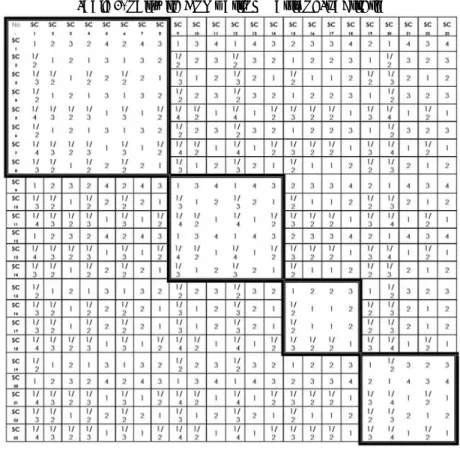
We asked the senior managers of Polband Construction Company to rank the importance of each criteria and sub-criteria. The results are given in Tables 3, 4, and 5. In the opinion
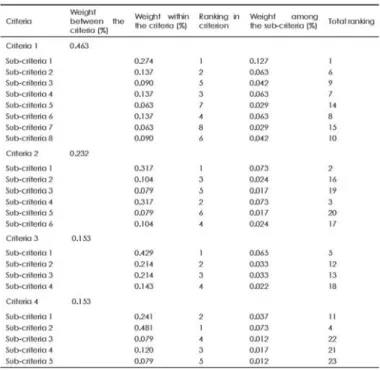
Table 5. Calculations of Relative Weights of Criteria and Subcriteria Using AHP
of the senior managers, the first criteria C1 is much more important than the second one C2. Thus, the preference of C1 over C2 is 2 (second row, third column), and consequently, the preference of C2 over C1 is 1/2 (third row, second column). On the other hand, C2 is more important than C3. Thus, the preference of C2 over C3 is 2 (third row, fourth column) and consequently, the preference of C3 over C2 is ½ (fourth row, third column). The weight of each criterion and each sub-criterion is based on these pair-wise comparisons. A summary of the calculations is shown in Table 5.
RANKING APPLICANTS USING FTOPSIS
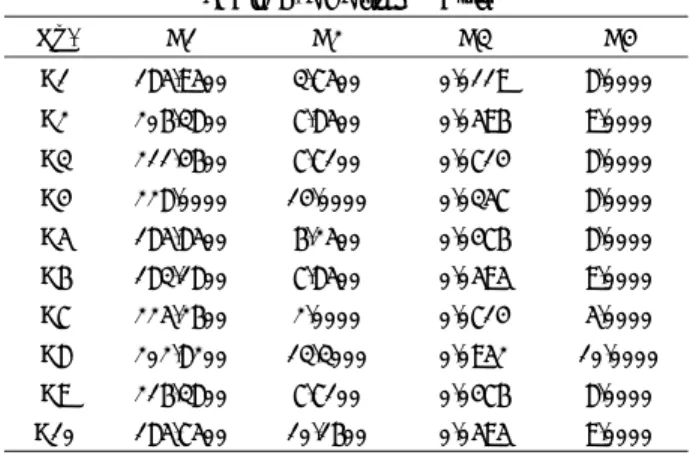
The first step when ranking applicants is to form the decision-making matrix, given an applicant’s status for every criterion. This leads to the decision-making matrix shown in Table 6.
To transform the performance ratings to fuzzy linguistic variables, as discussed in page 108, the performance ratings in Table 6 are normalised into the [0, 1] range via:
(1) If a larger rating is better: min{ } . max{ } min{ } ij ij ij ij ij x x r x x (19)
(2) If a smaller rating is better:
max{ } . max{ } min{ } ij ij ij ij ij x x r x x (20)
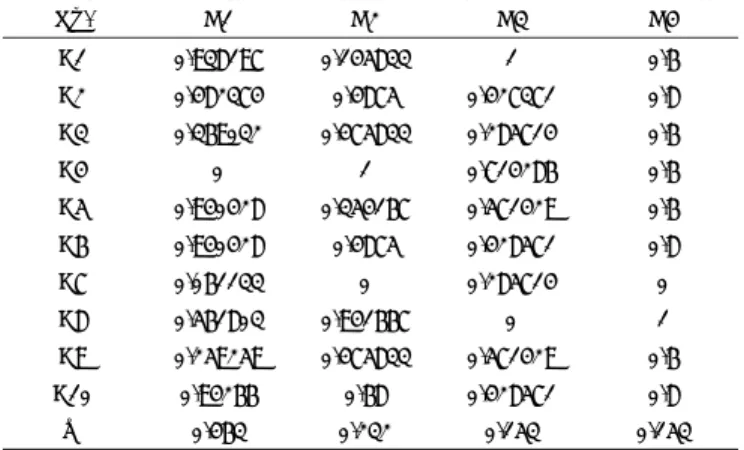
For the present study, C1 and C3 are better when they are smaller; the others are better when they are larger. The decision matrix of Table 6 can then be transformed into Table 7. The next step uses the fuzzy membership function discussed in page 75 to transform Table 7 into Table 8.
Table 6. Decision Matrix
C4 C3 C2 C1 No. 8.0000 0.0119 3.7500 185.9500 A1 9.0000 0.0596 7.8500 206.3800 A2 8.0000 0.0714 7.7100 211.4600 A3 8.0000 0.0357 14.0000 228.0000 A4 8.0000 0.0476 6.2500 185.8500 A5 9.0000 0.0595 7.8500 183.1800 A6 5.0000 0.0714 2.0000 225.2600 A7 10.0000 0.0952 13.3000 202.8200 A8 8.0000 0.0476 7.7100 216.3800 A9 9.0000 0.0595 10.1600 185.7500 A10
84/PENERBIT UNIVERSITI SAINS MALAYSIA
Table 7. Normalised Decision Matrix for FTOPSIS Analysis
C4 C3 C2 C1 No. 0.6 1 0.145833 0.938197 A1 0.8 0.427371 0.4875 0.482374 A2 0.6 0.285714 0.475833 0.369032 A3 0.6 0.714286 1 0 A4 0.6 0.571429 0.354167 0.940428 A5 0.8 0.428571 0.4875 0.940428 A6 0 0.285714 0 0.061133 A7 1 0 0.941667 0.561803 A8 0.6 0.571429 0.475833 0.259259 A9 0.8 0.428571 0.68 0.94266 A10 0.153 0.153 0.232 0.463 W
The fuzzy linguistic variable is then transformed into a fuzzy triangular membership function, as shown in Table 9. This is the first step of the FTOPSIS analysis. The fuzzy criteria weight is also given in Table 9. The second step in the analysis is to find the weighted fuzzy decision matrix. The fuzzy multiplication equation, Eq. (3), leads to the fuzzy weighted decision matrix given in Table 10. In Table 10, we know that the elements
v
ij,
i j
,
are normalised positive triangular fuzzy numbers in the closed interval [0, 1]. Thus, we can define the fuzzy positive-ideal solution and the fuzzy negative-ideal solution as *
1,1,1
j
v
andv
*j
0, 0, 0 ,
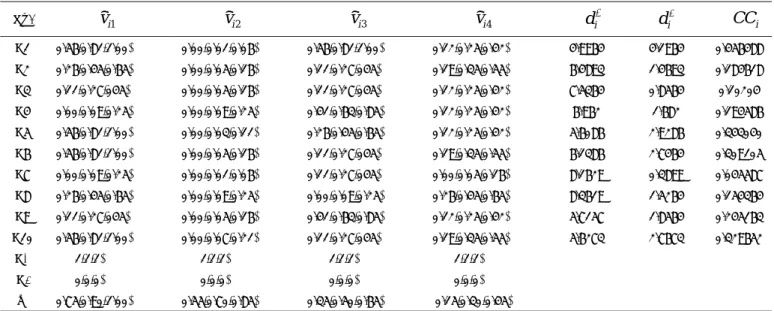
j = 1,2,…,n. This is thethird step of the FTOPSIS analysis. For the fourth step, the distance of each alternative from A* and A- can be calculated using Eqs. (16) and (17). The fifth step finds an ideal solution using Eq. (18). The resulting FTOPSIS analyses are summarised in Table 11.
Table 8. Decision Matrix Using Fuzzy Linguistic Variables
C4 C3 C2 C1 No. M VH VL VH A1 H L M M A2 M L M L A3 M H VH VL A4 M M L VH A5 H L M VH A6 VL L VL VL A7 VH VL VH M A8 M H M L A9 H L H VH A10 L M H VH W
The results obtained from Table 11 give the following preference order of the applicants:
Table 9. Fuzzy Decision Matrix and Fuzzy Criteria Weights
DEA APPROACH
DEA is a linear-programming-based technique developed by Charnes et al. (1978). DEA evaluates n Decision-Making Units (DMUs). In this study, the 10 candidates are the DMUs. Each DMU consumes varying amounts of m different inputs to produce s different outputs. The relative efficiency of a DMU is defined as the ratio of its total weighted output to its total weighted input (Yang and Hung, 2007). As mentioned in page 82, in this paper C1 and C3 could be considered
the inputs, and C2 and C4 could be considered the outputs.
Table 10. Fuzzy Weighted Decision Matrix
Assume that there are 10 DMUs to be evaluated (10 candidates). Each DMU consumes various amounts of m = 2 (inputs) to produce s = 2 (outputs). Let:
DMUk = the kth DMU, k = 1,2,…,10;
Xik = the ith input for the kth DMU, i = 1,3 and k= 1,2,…,10; Yrk = the rth output for the kth DMU, r = 2,4 and k = 1,2,…,10; vi = the associated weight for the ith input i = 1,3;
ur = the associated weight for the rth output r = 2,4; and hk = the efficiency score (hk
1).86/PENERBIT UNIVERSITI SAINS MALAYSIA Then, r rk k i ik
u Y
h
v X
(21)This definition requires a set of factor weights ur and vi, which are the decision variables. These weights can be obtained using linear programming or another appropriate method. In this paper, the relative weights of the criteria have been calculated using the AHP. After the calculation of hk for each applicant, the preference order is based on their efficiency scores.
A more detailed discussion of DEA is not included here, as it is outside the scope of this research. For more information, see Yang and Kou (2003), Seiford (1996), or Sinuany et al. (2000).
MODEL ASSESSMENT
To evaluate the proposed method and measure its validity, the preferred order of the candidates was calculated with DEA. The preference order of the top three applicants is given in Table 12. Both DEA and our model give the same top two choices.
It should be mentioned that, due to the MCDM nature of the problem, an optimal solution may not exist. In the case of an imprecise performance rating, FTOPSIS is recommended. DEA is a viable approach, but it constrains the number of decision-making units and is limited by the discrepancy between the performance frontiers (Yang and Hung, 2007). Therefore, the proposed method, a fuzzy systematic evaluation of the problem, can reduce the risk of a poor management decision and could be applied with confidence to the selection of project managers for the Polband Construction Company.
CONCLUSIONS AND FUTURE WORK
The selection of a project manager from a set of potential candidates is an important, difficult, and time-consuming task for the senior managers of any construction company. This problem worsens as the number of candidates increases. Moreover, there is a risk of human error in judgment and decision making. On the other hand, not interviewing all the candidates may mean missing some qualified applicants. Therefore, there is a need for computational models that can increase the accuracy of decisions and reduce the time required for the decision-making process.
Table 11. FTOPSIS Analysis Results i
CC
id
id
4~
iv
3~
iv
2~
iv
1~
iv
No. 0.456488 4.1964 4.9964 (0.12,0.25,0.42) (0.56,0.81,1.00) (0.00,0.01,0.06) (0.56,0.81,1.00) A1 0.184618 1.4693 6.4893 (0.19,0.35,0.55) (0.11,0.27,045) (0.00,0.05,0.16) (0.26,0.45,0.65) A2 0.10204 0.8564 7.5364 (0.12,0.25,0.42) (0.11,0.27,045) (0.00,0.05,0.16) (0.11,0.27,045) A3 0.194586 1.682 6.962 (0.12,0.25,0.42) (0.41,0.63,0.85) (0.00,0.09,0.25) (0.00,0.09,0.25) A4 0.343040 2.9286 5.6086 (0.12,0.25,0.42) (0.26,0.45,0.65) (0.00,0.03,0.11) (0.56,0.81,1.00) A5 0.309105 2.7464 6.1386 (0.19,0.35,0.55) (0.11,0.27,045) (0.00,0.05,0.16) (0.56,0.81,1.00) A6 0.045587 0.3899 8.1629 (0.00,0.05,0.16) (0.11,0.27,045) (0.00,0.01,0.06) (0.00,0.09,0.25) A7 0.154364 1.5264 8.3619 (0.26,0.45,0.65) (0.00,0.09,0.25) (0.00,0.09,0.25) (0.26,0.45,0.65) A8 0.245163 1.8564 5.7157 (0.12,0.25,0.42) (0.41,0.63,0.85) (0.00,0.05,0.16) (0.11,0.27,045) A9 0.329652 2.7673 5.6273 (0.19,0.35,0.55) (0.11,0.27,045) (0.00,0.07,0.21) (0.56,0.81,1.00) A10 (1,1,1) (1,1,1) (1,1,1) (1,1,1) A+ (0,0,0) (0,0,0) (0,0,0) (0,0,0) A- (0.15,0.30,0.45) (0.35,0.50,0.65) (0.55,0.70,0.85) (0.75,0.90,1.00) WTable 12. Comparison between Results Obtained from DEA and FTOPSIS
DEA AHP and FTOPSIS Preference Order A1 A1 1 A5 A5 2 A8 A10 3
88/PENERBIT UNIVERSITI SAINS MALAYSIA
In this paper, the authors propose a new method that provides a simple approach to the assessment of different candidates and helps the decision maker select the best applicant as the project manager. The AHP is used to determine the relative weights of the evaluation criteria, and FTOPSIS is used to rank the candidates. The proposed method is applied as a case study to a large Iranian construction company, and the results are found to be satisfactory. In the future, the authors intend to generalise the proposed method for use in a wider range of construction companies and to use other computational techniques, such as fuzzy AHP, to obtain more precise results. The development of a fuzzy expert system as a decision support system to solve the problem of selecting project managers in construction companies will be a research opportunity in the future.
REFERENCES
Aiello, G., Enea, M., Galante, G. and Scalia, G.L. (2008). Clean agent selection approached by Fuzzy TOPSIS Decision-Making method. Fire Technology, 45(4): 405–418.
Charnes, A., Cooper, W. and Rhodes, E. (1978). Measuring the efficiency of decision making units. European Journal of Operations Research, 2(6): 429–444.
Chen, C.T. (2000). Extensions of the TOPSIS for group decision-making under fuzzy environment. Fuzzy Sets and Systems, 114(1): 1–9.
Cheng, C.H. (1999). Evaluating weapon systems using ranking fuzzy numbers. Fuzzy Systems, 107(1): 25–35.
Cheng, J.H., Lee, C.M. and Tang. C.H. (2009). An application of Fuzzy Delphi and Fuzzy AHP on evaluating wafer supplier in semiconductor industry. WSEAS Transactions on Information Science and Applications, 5(6): 756–767.
Chu, P., Hsu, Y. and Fehling, M. (1996). A decision support system for project portfolio selection. Computer in Industry, 32(2): 141–149.
Dagdeviren, M., Yavuz, S. and Kılınc, N. (2009). Weapon selection using the AHP and TOPSIS methods under fuzzy environment. Expert Systems with Applications, 36(4): 8143– 8151.
Dey, P.K. (2006). Integrated project evaluation and selection using multiple-attribute decision-making technique.
International Journal of Production Economics, 103(1): 90–103.
El-Saba, S. (2001). The skills and career path of an effective project manager. International Journal of Project Management, 19(1): 1–7.
Goodwin, R.S.C. (1995). Skills required of effective project managers. Journal of Management in Engineering, 9(3): 217–226.
Hwang, C.L. and Yoon, K. (1981). Multiple Attribute Decision
Making: Methods and Applications. Heidelberg: Springer.
Isiklar, G. and Buyukozkan, G. (2006). Using a multi-criteria decision making approach to evaluate mobile phone alternatives. Computer Standards and Interfaces, 29(2): 265– 274.
Kaufmann, A. and Gupta, M.M. (1985). Introduction to Fuzzy
Arithmetic: Theory and Applications. New York: Van
Nostrand Reinhold.
Liao, S.S.C. (2007). Top ten qualities of project manager heroes.
Journal of Leadership and Management in Engineering, 7(2):
50–60.
Lien, C.T. and Chan, H.L. (2006). A selection model for ERP system by applying Fuzzy AHP approach. International
Journal of the Computer, the Internet and Management,
15(3): 58–72.
Meredith, J.R., Samuel, J. and Mantel, J. (1995). Project
Management: A Managerial Approach. New York: John
Wiley.
Pheng, L.S. and Chuan, Q.T. (2006). Environmental factors and work performance of project managers in the construction industry. Journal of Project Management, 24(1): 24–37. Pomerol, J.C. and Romero, S.B. (2000). Multi-criterion Decision in
Management: Principles and Practice. 1st Edition.
(Translation by Claude James from French). Norwell: Kluwer Academic Publishers.
Saaty, T.L. (1986). Axiomatic foundations of the analytic hierarchy process. Management Science, 32(7): 841–855. _______. (2003). Decision-making with the AHP: Why is the
principal eigenvector necessary. European Journal of Operational Research, 145(1): 85–91.
Salehi, M. (2009). Application of Fuzzy TOPSIS Technique for evaluation of project. World Applied Sciences Journal, 6(6): 776–783.
Seiford L.M. (1996). Data envelopment analysis: The evolution of the state-of-the-art 1978–1995. Journal of Production Analysis, 7(2/3): 99–137.
Srdjevic, B. (2007). Linked analytic hierarchy process and social choice methods to support group decision-making in water management. Decision Support Systems, 42(4): 2261–2273. Torfi, F., Farahani, R.Z. and Rezapour, S. (2010). Fuzzy AHP to
determine the relative weights of evaluation criteria and Fuzzy TOPSIS to rank the alternatives. Applied Soft Computing, 10(2): 520–528.
Yang, T. and Chou, P. (2005). Solving a multiresponse simulation-optimization problem with discrete variables using a multiple-attribute decision-making method. Mathematics and Computers in Simulation, 68(1): 9–21.
Yang, T. and Hung, C.C. (2007). Multiple-attribute decision-making methods for plant layout design problem. Robotics
and Computer-integrated Manufacturing, 23(1): 126–137.
Yang, T. and Kou, C. (2003). A hierarchical AHP/DEA methodology for the facilities layout design problem.
European Journal of Operational Research, 147(1): 128–36. Yoon, K.P. and Hwang, CL. (1995). Multiple Attribute Decision
Making. Thousands Oaks, CA: Sage Publication.
Wei, C.-C., Chien, C.F. and Wang, M.J.J. (2005). An AHP-based approach to ERP system selection. International Journal of Production Economics, 96(1): 47–62.