WORKING PAPERS
[
Agricultural Policies Agriculture and Rural DevelopmentDepartment The World Bank
June 1989 WPS 219
Rural Credit
in
Developing Countries
Avishay Braverman
and
J. Luis Guasch
The record on subsidized credit to farmers is dismal. It shows a
significant failure either to achieve an increase of agricultural
output cost-effectively or to improve rural income distribution
and alleviate poverty. Many of the financial institutions have
proven to be inept and to lack accountability.
Common features in success stories are tougher stands on
default; strict auditing and accounting procedures and financial
control; and some form of joint responsibility or liability by
small groups of farners, whereby default by one member
cancels future loans to the whole group.
The Policy, Planning, and Research Complex distnbutes PPR Working Papers to disserrunae the frndings of work in progress and to
encourage the exchange of ideas among BLank staff and all others ntcrested in development issues Tl.csc papers carry the namrn of the authors, reflect only their views, and should be used and cited accordmgl. The findings, interprtatimons, and conclusions arc Lhe auLhors' own They should not be attnbuted to the World Ban'k, its Board of DLrectors, its management, or any of its mcmnbercountncs.
Public Disclosure Authorized
Public Disclosure Authorized
Public Disclosure Authorized
Plc,Planning, and Research
Agricultural Policies
Subsidized formal credit to the agricultural * Strict auditing and accounting
proce-sector has been advocated as more efficient, dures and forceful enforcementi of penalties. equitabic, and casier to implement than, say.
land reform. But thc record on subsidized credit * Some form of joint responsibility or liability
to farmers is dismal. by 'small groups of farmers, whereby default by
onc member cancels future loans to Ihc whole Until recently, it was argued that imposing grc up.
low ceilings on intercst rates and allocating
massive amounts of credit to rural financial Policy reform should take accounit the inlsti-markets would yield rural development and tutional structure of the rura. cconomv- in-improve income distribution. But 20 years of cluding the difficulty ol asscssintg risk in rural subsidized credit have only made matters worse. borrowers or knowing hat tlhey do with
bor-rowed funds - and recogniitioni ol thie imipor-Low interest ceilings effectivel) distort the tance of existing infonnal (including sharccrop-real cost of investment and transfer incomc to per) credit markets.
large landowners (not Ihc poor); 5 perccnt of
borrowers reccive 80 percent of tihe credit. The Gctting credit to small-scale famiers has default rate is higi - particularly among largc becn difficult because of higher transaction costs landowners - everywhere but in East Asia, per dollar lent for small loans: lack of collateral partially because Lirmiers see the loans as granis and the belicf that small agenis arc I gcr risks or welfare and cnforcement is lax. And credi- than large agents: and patronage and arbitrary tors often cxchange loans for political favors. dccisions in favor of larger-scale farmers.
Agricultural credit is intrinsically difficult, Organized credit groups havc aiisen to over-because of the seasonal nature of the activity, the comc these problems, but their failure rate has peak-load demands, the convention of repay- bcen high. The key ingredients for lheir success ment once in harvest scason, and the fact that are a coherent system of incentives consistcnt bad luck can strike many borrowers at once. with the informational structure, and strong Common featurcs in the success stories re- cnforccment procedurcs. Somc forn of joint counted by Braverman and Guasch arc thcsc: liability structure is desirable for group lending.
Particular care needs to bc taken in the design ol With,lolding of new loans until old loans the group, regarding size and incentives.
arc repaid.
This paper is a p,oduct of the Agricultural Policies Division, Agriculture and Rural Dcvelopmcnt Dcpartment. Copies arc availablc free from the World Bank, 1818 H Strect NW, Washington DC 20433. Plcase contact Ciccly Spooncr, room J2-084, cxtension 37570 (39 pages).
The PPR Working Paper Scries disseminates the findings of work under way in thc Bank's Policy, Planning, and Rcsearch Complex. An objective of the series is to get these findings out quickly, even if presentations arc less than fully polished. The findings, intcrpretations, and conclusions in these papers do not necessarily represent official policy of the Bank.
Avishay Braverman and J. Luis Guasch
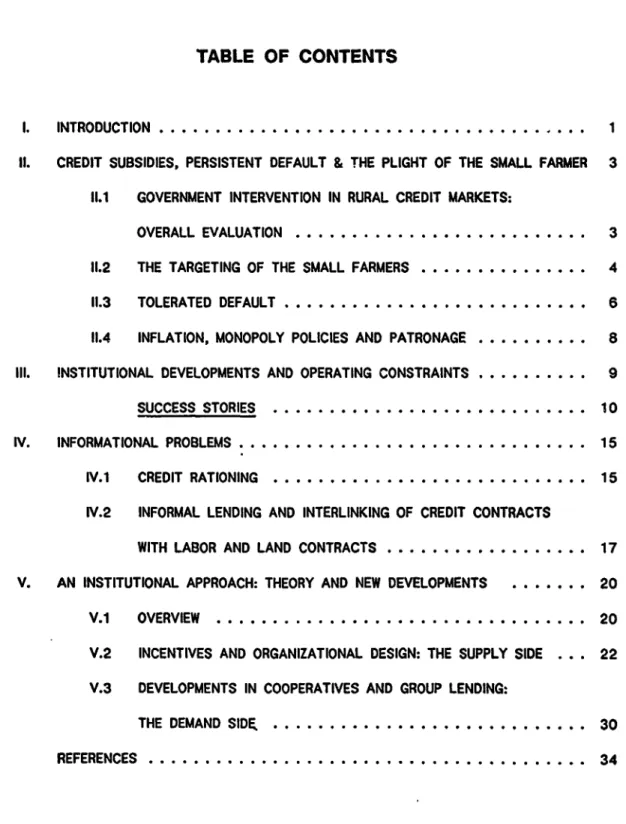
TABLE OF CONTENTS
1. INTRODUCTION. ... 1
11. CREDIT SUBSIDIES, PERSISTENT DEFAULT & THE PLIGHT OF THE SMALL FARMER 3
11.1 GOVERNMENT INTERVENTION IN RURAL CREDIT MARKETS:
OVERALL EVALUATION.
3
11.2 THE TARGETING OF THE SMALL FARMERS. 4
11.3 TOLERATED DEFAULT.
6
11.4 INFLATION, MONOPOLY POLICIES AND PATRONAGE. 8
III. INSTITUTIONAL DEVELOPMENTS AND OPERATING CONSTRAINTS. . 9
SUCCESS STORIES .10
[V. INFORMATIONAL PROBLEMS ... 15
IV.1 CREDIT RATIONING . ... 15
IV.2 INFORMAL LENDING AND INTERLINKING OF CREDIT CONTRACTS
WITH LABOR AND LAND CONTRACTS ... 17
V. AN INSTITUTIONAL APPROACH: THEORY AND NEW DEVELOPMENTS . .. 20
V.1 OVERVIEW .20
V.2 INCENTIVES AND ORGANIZATIONAL DESIGN: THE SUPPLY SIDE ... 22
V.3 DEVELOPMENTS IN COOPERATIVES AND GROUP LENDING:
THE DEMAND SIDE .30
REFERENCES ... 34
The authors are Division Chief, Agricuitural Policies, The Worid Bank, and Associate Professor, University of Califorria at San Diego, respectively.
We thank Bea ialassa, J.D. von Pischke, Jacob Yaron, Mark Gersovit, T.N. Srinivasan and J.E. Stlrtz for helpful discussions. For more elaborate exposition conceming past evidence and survqy of current theory. see Braverman and Guasch (1986). Also, a major source for ttie evidence presented in the paper is von Pischke, Adams and Donald (19813).
1. INTRODUCTION
In most LOCs, there Is clear evidence of "urban bias" that Is, government policies (price/tax, Investment) favor residents of the urban sector over rural Inhabitants.1 This
bias seems to exist In the allocation of credit as well.2 Nevertheless, In absolute terms,
the value of such credit to the rural sector has been quite considerable. The object of study Is not to Identify the reasons for the urban blas, an Important question In Itself, but rather to evaluate public credit policies In the rural sector.
Subsidized formal credit has been advocated on efficiency and equity grounds, but also as a much easier policy to Implement than, for example, land reform. However, the record on these policies Is quite dismal. Many formal Institutions have been designed to channel credit from official sources to rural agents (farmers, traders) and to address the perceived shortage of credit. Significantly, It Is the norm that the operation of the financial institutlons Is heavily regulated with controls that keep Interest rates below market rates. Although these Institutions differ from country to country, the operating assumptions and policies are surprlsingly uniform and as such a coierent analysis can ue Implemented.
Given the fairly general failure of credit pollcies In the past, a growing literature Is developing that seeks alternative forme In managing and channeling credit to rural marketp, that could eradlcate or at least significantly reduce the problems previously
encountered. A fair amount of that recent work has analyzed how alternative
1See Mkhael Upton (19771.
2The agricultural sector engages close to 65 percent of labor in most LDCs, and produces an
average of 30O percent to 40 percent of output. it receives, thou9h, only a very low share of public
redit, e.g., 10 percent in Bangladesh, 15 percent in Thailand, Philippines and Mexicn, and 27 percent
in India (see Lipton [1981]. Of course, these statistics are cast in average terms, and efficient allocation of investment is determineo by marginal terms. But it is highly unlikely that the marginal
contribution of investment in the urban sector exceeds those in the rural sector by such a significant
institutlonal forms could Improve the performance of credit policies, using the experlences from the fleld and promising developments In the thenry of credit and In the theory of Incentives and organizational design. 3
In this paper we Intend (I) to pinpoint the reasons behind the failure to achleve the stated objectives In rural credit allocatlon, many of them coming from within the
Institutions which were created to channel credit; and (ii) to review the recent
developments In the theory of Incentives and organizations In order to shed some light on the process of Institutional reform.
The structure of this paper Is as follows. In Section 11, we evaluate government
Interventlon In rural cr-dit markets. In particular, the targeting of small farmers, the
tolerated default, and the Imriact of subsidized credit. In Section III, we address the
evidence of the development of formal financlal institutlons, Including the success
stories. In Section IV, we address the Informational problems In rural credit markets, and
the role of informal credit markets and Interlinked land, labor and credit contracts In
llght of evidence and recent theory. In Sectlon V, we present a review and evaluatlon
of the current developments In the theory of Incentives and organizations and how they have been Incorporated Into the analysis of Institutlonal reform to find more effective ways to channel credit to rural markets.
3Another direction in the Iterature, although not the main subject of discussion here, has
focused on the interactive effects of credit with other, non-credi instruments to bring about the desired
objectives. Significantly, many past analyses of evaluating credit policy have altogether ignored its
comparison to alternative instruments. Two methods to compare alter.-Afive agricultural price policies
(taxes and subsidies) in developing countries have been recently developed. One is theoretical (Sah &StiglRtz (1984]) and the other is operational by Braverman & Hammer. See Braverman, Hammer &
Ahn [1983], and Braverman, Hammer & Gron (19871 for methodological discussions and kiferences to
various country studies. In order to modify either of these approaches so that credi subsidies can be
compared with other prica (tax) instruments, the fungibility of credi, the information failures and other
3
-IL. CREDIT SUBSIDIES, PERSISTENT DEFAULT AND
THE PLIGHT OF THE SMALL FARMER
11.1 GOVERNMENT INTERVENlnON IN RURAL CREDIT MARKETS: OVERALL EVALUATION Until recently, conventional wisdom held that Imposing low ceilings on Interest rates and allocating massive amounts of credit to rural financlal markets would yield rural development and Improve Income distribution. The arguments traditlonally set forth for government Interventlon In providing subsidized Interest rates have been numerous. The most prevalent are the following. It has been argued that wlthout subsidized Interest rates, adoptlon of technical Innovation would be delayed and there would be under-usage of costly Inputs like fertilizer. Such effects slow the growth of output and the development of the agricultural sector. It has also been claimed that since rural credit markets are notoriously Imperfect, access to credit by farmers, particularly small ones, Is severely limited, and that without government Intervention a high price of capital would prevail. This would further screen out the small farmers from credit markets, fostering poverty and worsening Income distribution. Lastly, It has been argued that because of distorted exchange rates, food price controls, Imports of cheap food and Inefficient markets, farmers receive low prices for their products, hampering their borrowing ability. The government might, further Intervene and attempt to compensate farmers for the adverse effects of those pollcies by providing subsidized credit. SIgnificar.tly, all of the above arguments can be seriously questioned.
The evidence of more than twenty years of subsidized credit pollcies Indicates a significant failure to achleve the desired objectives. In fact, most often they havy made matters worse. Low Interest rate ceilings provide Income transfers to loan recipients
undervalulng the real cost of capital In different sectors. To the standard cost of distorted resource allocatlon, add the specific costs and consequences of Implementing
credit programs in rural financlal markets for the full measare of Impact. The
administrative costs are not trivial since they can amount to over 20 percent of the
value of the loans made, weli In excess of the Intermediary Interest Income.4 As we
describe below, these credit po:lcy failures can be attributed to basic flaws, Intrlnsic to formal rural credit markets, out of which arise persistent problems largely based on accountability and Infornatlonal problems.
11. 2 THE TARGETING OF THE SMALL FARMERS
If Indeed one of the objectives of a credit program Is to reach a large number of targeted small rural farmers, then by and large most programs can be judged failures.
Despite the remarkable expansion of credit throughout rural areas In developing
countries over the last three decades, only a small fraction of the farmers In low Income
countries seem to have received or benefited by such credit. It has been estimated
that only 5 percent of farms In Africa and about 15 percent In Asia and Latin America
have had access to formal credit. Rather than equalizing Income Inequality, low Interest
rate credit programs have Increased It; 5 percent of borrowers have received 80
percent of the credit. Policies that allocate credit to farmers Indiscriminately provide
larger loans to larger landholders when all credit demands are fulfilled. This Is because
4The productivity effects of subsidized credit have not been clearly established. For example,
conventional wisdom states that operating expenses and investment per hectare are often higher per
borrower, bA that production differences and net farm income per hectare are not very significant A number of studies seem to have uncovered an inverse correlation between farm size and output per acre (see Deolallkar [1981] arnd Rao & Chotigeat [1981]). The reasons for such a relationship are
varied but the most predominant seem to be a disproportionately higher labor input, mosty coming
from family members, in the smaller plots (see Berry & Cline 119791, and Fader [19Bq for a
discussion of the farm size and farm productivity issue). It is still true, though, that there is no conclusive evidence on the relation between farm size and output per acre.
-5-larger landholders require -5-larger loans even If there are decreasing returns to credit
per hectare and per farm size. This Is also true If excess demand gives rise to
rationing.
If credit program Interest rates are not market rates--which Is the case for
most programs implemented In rural financia, ,narkets (RFM)--they do not reflect the true
cost of capital. This results In a subsidy' r Income transfer to loan recipients. The
larger the size of the loan, the larger will be the subsidy or Income trar.sfer. Thus,
larger landholders receive larger Income transfers and Income Inequality Increases. The problem Is exacertated because of axcess demand as rat!oning Is not Implemented
equl-proportlonti to demands. Because commerclal banks and speclalized farm credit
organizations tend not to be located In rural settings, they possess limited Information
about rural customers. Thelr credit allocatlon policies tend to be based on observable
wealth or aillity to provide collateral. Therefore, they are not likely to ration the large landholders. Moreover, the medium-sized landholders are more likely to be ratloned while
the small farmers are screened out. Substantlal costs In processing and administering
loans, with returns Increasing as a function of loan size, strengthen the Incentives to
maintain such policles.5
We have suggested that Interest rate restrictlons Induce banks and other
financlal institutlons to ration credit In a way that excludes small farmers from formal credit markets and thus generates undesirable Inequitles and worsens Income distribution.
However, we should note that a laissez-faire credit policy, no restrictions Imposed, will
.~~~~~~~~~~~~~~~~
5
To all these efficiency arguments in procuring loans we have to add patronage relationships between wealthy farmers and bankers that will further curtail the supply of credit to small farmers. Therefore, given the evidence, we are led to agree with many others that subsidized interest rate
programfs have had a regressive effect on income distribution. For example, Dale Adams, aaudio
whether or not Interest ratos are subsidized. The reasons are the substantial costs In processing and administerlng loans, with returns Increasing as a function of loan size. As well, It Is often presumed that larger and wealthier farmers are better credit risks, elther because of thelr ability to provide collateral, because of their better track records or because banks have better Information on them. Subsidized credit worsens the problem. It Increases the demand for loans at all levels and for all types and, given fixed supply of capital, the rationing to small farmers will be even more severe.
The consensus and natural Inference from most of the studies In this area Is that for public credit to reach the small farmers, a different set of policies Is required. Specific Incentives need to be provided for Institutions to channel funds to targeted groups along with the design of sensible monitoring procedures for information g&thering. Without the combination of those two factors, the problem Is likely to remaln.8 We further discuss this point In Section l11.
11.3 TOLERATED DEFAULT
Successful credit programs have high recovery rates. Subsidized credit programs also fall In this regard, with most studles reporting low recovery rates. Defining default as a loan overdue for repayment, these studies have Indicated default rates ranging, with a few exceptions, from 30 to 95 percent for credit programs In Africa, the Middle
East, and Latin America. Similar results have been reported In South and Southeast Asia. East Asla Is the exception: the high recovery rates for Korea, Taiwan, and Japan are frequently attributed to strong village cooperative systems which have provided a strong Incentive and enforcement system.
-7-Looking at the timing of default over the life of a credit program illustrates some of the Issues behind default rates. The history of programs not requiring any collateral--making all farmers eligible--shows that the recovery rate Is unusually high at the beginning, but declines gradually over a program's life. The reasons for this demise seem to be declining screening quality over time, lax supervislon, and stronger Incentlves to default as the prospect of future loans diminishes. For example, the BIMAS credit program In Indonesia, implemented In 1970, reports recovery rates of 95 percent for the first two years. After five years, however, recovery rates dropped to 60 percent.
To some extent, the reasons for those high levels of default can be attributed to a predominant self-serving confusion that exists on the farmer's part regarding the nature of credit. It Is not unusual that farmers perceive the loans as grants or welfare. In fact, as reported by Llpton 11980], In some South Asian languages the word used for loans from the government (tagal, taccarl) means "assistance, grant". Therefore, the reluctance to repay those loans should not be surprising. Growing evidence Indicates that the risks of default on loans are greater for large farmers who are nevertheless charged lower Interest rates than small farmers (see Ames E1974], Dadhich E1971]). Thus, those who benefit most from tolerated default are the big farmers whose default/loan ratlo Is highest as reported by Lipton (1981]. This distinction, of course exacerbates the regressive nature of subsidized credit policies.
Furthermore, the policies of loan and crop guarantees ought to be seen as partially responsible for those low recovery rates or tolerated default. Many countries (e.g., Mexico, Costa Rlca, Philippines,-Sri Lanka, India) provide some of that form of Insurance. The objective Is to Induce lenders to provide more loans to a target group by shifting part of the recovery risk to other agencles. Such policies have the effect
of weakening the incentives of financlal Institutions to collect and that clearly Impacts very strongly on recovery rates.
The conclusions of many of those stt dies Indicate that a much harder line ought to be taken on default particularly when the reasons are arbitrary, for the long-term
viability and effectiveness of credit pollcies. Enforcement, accountability and Incentive
design regarding loan size, term., renewals and new loans miust be implemened; otherwise
one could foresee a bleak future and unnecessary delays In the progress of rural
development and Improvement In the distributlon of Income.
IIA INFLATION. MONOPOLY POUCIES AND PATRONAGE
Subsidized loans are predictable generators of poor Investments, misallocatlons,
and borrowing for arbitrage. They clearly become more attractive and distortive In the
presence of high Inflatlon rates (e.g., L.atin America) since most of the loans are set In
nominal terms. (Although, ofl I In high Inflation countries, such as Brazil, loans tend to
be Indexed. But even In those cases Inaexation rarely provides complete Inflation risk
coverage.) Moreover, they provide significant leverage to the Individuals In charge of
their disbursement. Under these conditions It Is not surprising that credit Is allocated
as well In return for political benefit or as a compensation for favors rather than
according to need or efficlency. Examples of this phenomenon abound (see Landman &
Tinnermeir [1981] in Bolivia and Robert (1978] In India for a sampling). This condition Is reinforced by specialized farm credit Institutions which operate without active competition
and/or accountability. Monopoly power from non-profit Institutions along with subsidized
credit foster patronage, corruption and other forms of Inefficiency and Inequality
wherever markets lack the force of competition.7
9
-III. INSTITUTIONAL DEVELOPMENTS
AND OPE'7TING CONSTRAINTS
Slgnificant Institutlonal developments have taken place In rural credit markets durlng the last two decades. A plethora of distinct types of organizations has emerged, Including cooperatives, g. ernment-owned agricultural banks, rural private banks, multi-purpose development agencies with credit responsibillties, etc. The rationale for such undertakings has been the belief that the agricultural sector Is not well served In credit matters, that farmers have great difficulty accessing credit, and that when obtained It Is at a very high and usurious rate. The projected role of these institutlons was to provide finance for agricultural products and to stimulate agricultural Innovation and the development of the sector.
However, most of the changes made In Institutional design have been largely of a superficial, window dressing type, rather than substantial. The commitment made to them in tems of resources and accountability was rather weak. The evidence ;s In the large number of Institutional faliures In LDCs, however failure Is defined. The viability of these Institutions could have been questioned from the start, since they were perceived or designed to serve more like a welfare agency (often not for the poor) than a commerclal undertaking. There seems to have been little effort to Integrate deposit taking activities or to generate savings mobilizatlon, a vital activity for the long-run success of a credit Institution. Lastly, no provisions were made to deal with non-compliance, or to Implement a reasonable system of Incentives to both lenders and borrowers to Induce the desired objeetives.
Having Identified such broad failure, It might be worth noting the Intrlnsic difficulties of agricultural credit as distinct from credit for rural commerce, trade,
retailing, etc. Thi3 acceptance, of course, renders : lidity that the claim of the reluctance of private banks to engage In agricultural credit and of the need for government Intervention. Agricultural lending Is much more difficult on a financial organizatlon than commercial lending because of the more seasonal nature of the activity, the difficulty of serv!ng customers geographically dispersed, the consequent peak-load demands that are made on the organization for speedy disbursement, the conventlon that repayment for working capital can be required only once at harvest season, and because adversities often affect a large number of loan recipients simultaneously. The large covarlance among the returns of outstanding loans and the difficulty to Insure against It Is often claimed as one of the major reasons for the lack of Involvement of formal private Institutions.
Since commercial credit operates In a much smoother fashlon, It Is easier for lenders to diversify their portfolios to cushion against economic shocks. When shocks occur, their impact on the commercial borrower's ability to repay Is bound to be much less severe than on the agricultural borrower. Evidence reveals that Institutions seem to obtain a better performance In their commercial credit allocation than that of agriculture. A thorough comparison of these two lines of credit ought to help broaden understanding of which problems are caused by credit Institutions and pollcies themselves and which are caused by problems outside tne Institution relating to the special characteristics o,f agricultural lending.
SUCCESS STORIES
It Is encouraging to note that,there have been a number of success stories In the process of disbursing credit to rural credit markets. Identifying and explalning successes are valuable In the process of reform, In part because those cases had many
- 11
-of the attributes we associate with fallure. Worth mentioning Is the INVIERNO Development Bank program, Implemented In Nicaragua In 1975. It served the region containing the largest number of small farmers and the lowest rural family Income. Its results were extraordinary: participatlon rate of small farms was more than 80 percent; the maize yleld per hectare doubled that of traditlonal methods; the rate of adoption of modern technology was significantly high; and the delinquency rate was only about 10 percent. Internal auditing of local office operatlons, cost monitorlng, technical help for operational procedures and new methods were combined In a policy that supported these successes. Expeditious loan application and credit disbursement was also a major factor In the program's success, together with long-term credit policy suggested by efficlency arguments. Lines of credit were devised for a five-year period with flexible schedules with loan repayment built Into the contracts.
A different success story emphasizing savings and positive real rates of Interest located In the Republic of Korea (Lee, Kim & Adams
E1979])
Is fairly representative ofmost East Asian countries. In the 1960s, Korea Implemented
an extensive network of
rural cooperatives. They were organized
on three levels: primary cooperatives at the
township
level; county cooperatives;
and the National
Agriculture Cooperative
Federation
at the national level. Participation
rates reached nearly 80 percent. The cooperatives
provided farm Inputs, farm product marketing,
credit and savings deposit services, mutual
Insurance,
and technical education. The emphasis
on mobilizing
rural financial savings was
perhaps the most distinguishing
feature. While
deposits contributed only 20 percent of
loanable
funds In 1961, and government
funds nearly 60 percent, by 1975 the figures
reversed to 51 percent and 19 percent, respectively. A strong government
policy of
was crucial. Equally Important may have been the bottom-up design of the cooperative system which was quite effective in providing' secure and dependablo savings opportunities for small farmers.
Also noteworthy Is Kenya's Cooperative Saving Scheme, Initiated In 1970, that Is based on a system of forced savings (von Pischke [1983]). Cooperative members are mostly small coffee farmers. The scheme arranged payment to growers for coffee sales by crediting It to their accounts with the cooperative, rather than paying cash. Along with positive real Interest rates, the Cooperative's control of revenues generated a vlable lending organization--a kind of Implicit Insurance or collateral scheme which was very successful In achieving high participation rates and relatively low dellnquency rates.
A more recent success stories Is the GRAMEEN Bank In Bangladesh. Evidence of Its success Is a very high participatlon rate a.-id a very low default rate. While lending to some of the poorest people on earth, It has had one of the lowest default rates ever, less than 2 percent. Ninety-eight percent of the loans have been paid In full and on time. This repayment rate contrasts quite sharply with the 10 percent repayment rates experienced In Bangladesh on loans from International development banks and state banks. The three key Institutional Ingredients In the Grameen Bank's lending practices seem to be the following. First, Imposing a form of joint liability within very small groups of borrowers Induces an external effect on the group enforced by strong peer pressure and group counsel. Borrowers must first assemble 50 Individuals from different families to form a center In the village. They are then divided Into 10 groups with each group containing 5 persons. Each group discusses together the needs and loan uses of each of Its members. Initially, the two poorest members of each group receive the loans and only when they have been fully repaid, two other members of the group receive their
13
-loans, and so on. Weekly meetings of the group are used to track the effects of the loans, provide suggestions and support and implicitly Induce peer pressure to comply with the terms of the loans. The second Institutional Ingredient Is that lending takes place
at market or commerclal Interest rates. Finally, the only requirement imposed by the
bank for the use of the loan Is that It be Income producing (housing loans being
occasional exceptions). Similar programs featuring these Institutional Innovations are
being developed elsewhere In Malaysia, Indonesia, Rwanda, Kenya, Sri Lanka, Pakistan, Egypt and even In the United States (a neighborhood South Shore Bank In Chicago and the new good faith fund In rural Arkansas). This rapid expansion of the Grameen Bank In Bangladesh and Grameen-type banks elsewhere will test If the success of these institutlonal Innovations Is strongly linked with smaliscale operations or If It can witi;,tand largescale implementation with Its usually problem ridden and sometimes fatal (in
developing countries) bureaucratic apparatus.8
Other credit programs with related Institutional Innovations which have enjoyed
some success have been the voluntary joint liability and mandatory joint liability
programs In Zimbabwe. Under the former, loans are made and accounted for on an individual basis, but the farmer has to show membership In an active cooperative or
farming group. Emphasis Is placed on mutual ald and collective responsibility. In the
event of a member's default, the loan conditions do not require that the other members
cover the loan. Rather It stipulates that the whole group loses eligibility for future
loans. Under the alternate mandatory joint liability program, responsibility for loan
administration and repayment rests with the group as a whole. The group requests loans
8
and Is responsible for division among the members and for selling and marketing the group output. Therefore, there Is full joint liability, automatically enforced via the control of the product. Loan recoveries have been at the 70 percent range for the voluntary joint liability program and at the 80 to 92 percent range for the mandatory jolnt liability program. These loan recovery rates compare very favorably with those for farmers In the same region, based on individual liability. The recovery rates there were In the 50 percent range.9
Another recent success story has been the FUNDE credit program in Nicaragua. It reached very high participation rates and the default rates very significantly low. The strength of the program was the commitment by the government lending agency to conduct on-site periodic tralning and educational sessions for farmers, to have and Implement extensive monitoring and accounting procedures on the use of the funds, and to hold the loan recipients accountable. Moreover no new loans were to be given until old loans were repaid. 10
In summary, the critical common features In many of these programs were (I) that no new loans were to be given until old loans were repaid, Indicating that Intertemporal linking of loans Is an effective way to Induce compliance, (11) strict auditing and accounting procedures, suggesting the value of monitoring technologles for Inducing the desired behavior, and (111) some form of joint responsibillty or liability by small groups of farmers, whereby default of one of the members would Imply the cancellation of any future loans to the whole group.
9See Bratton [1986] for a detailed analysis of the Zimbabwe case study.
15
-IV. INFORMATIONAL PROBLEMS
IV. CREDIT RATIONING
In addition to the problems indigenous to rural credit markets described above, these markets also face the Informational problems so prevalent In any credit market, that result In rationing of loans In equilibrium with non-clearing market Interest rates. The two most common Info-rmational problems are adverse selection and moral hazard problems. While the former refers to the Inability of lending Institutions to know or Infer the risk characteristics of the borrowers, the latter refers to the Inability of knowing the actions taken by the borrowers, regarding thelr use of the funds and their care and effort on the Investment projects. In turn, these problems affect market Interest rates In the following fashion. First, the possibility ol default and Ilmited liabilities place a floor on the distributlon of net returns to borrowers. In a sense, this creates incentives to choose riskier projects since the down risk Is limited. BorrowereV Investment choices to some extent determine default risk. These choices cannot be observed by lenders and thus cannot be specified In loan agreements. Lending Institutions realize that high Interest rates and large principals are relatively more attractive to risky borrowers; this Is the adverse selectlon effect. Interest Is paid only when the borrower does not default. Second, there Is also the moral hazard effect.
Increases In the Interest rate, while raising the return on successful loans, may lead to adverse shifts In the risk composition of lenders' portfolios, Increasing the probability of default. It follows that Increases In the Interest rate may lead to a decrease In the expected returns to lenders. In sum, the moral hazard and adverse selection effects
may render a market-clearing interest rate non-optimal, leading to credit rationing.1 1in the context of RFMs, the moral hazard aspects concerning choice of projects Involve
choice of production technology, effort level, use of loans (production versus
consumptlon) and Input mix.
In the rural credit markets, the adverse selection problem seems less severe for
the Informal or village money lenders than for the organized commercial lending
Institutlons. The fact that the default rate for the latter Is much higher than for the
former Is an Indlcation of that observatlon. The Information available to the local money
lender about the loan applicants Is quite extensive, more accurate and easier to obtaln
than for the organized or formal Institution. And, Indeed, as the evidence Indicates, It
Is a significant problem for organized lending, especially for government backed
Institutions where screening borrower creditworthiness Is not carried out very
thoroughly.
Moral hazard problems are quite prevalent for both ttle organized and the Informal
credit markets. Monitoring cost can be quite large. The evidence suggests that a
significant portion of the loans ends up being used for consumption purposes or other
non-productive uses.1 2 Likewise, finiteness of borrower's wealth and Insufficient credit
Instruments to Induce the right actions are generic elements of rural credit markets. In particular, In many LDCs property rights are not well defined (e.g., Feder (1987] and Blnswanger & Mcintire (1986]), and therefore collateral Is not available on an extensive
l1See Stiglitz & Weiss [1981. 1983], Keeton [1979], and Allen [1983] for further elaboration on
these po.its.
1 2
- 17
-basis. In some areas, land, usually the primary asset of many farmers, Is not allowed as a collateral.
Thus, In Itself, a policy of freeing Interest rates on loans will neither eliminate the ratloning of the small farmers In the credit market nor necessarily Improve their rate of loan allocations as a direct effect. However, Indirectly the small farmers can benefit, since, at the higher Interest rate there might be a reduction In the demand for loans from the larger farmers, and thus the residual amount of funds available to small farmers mlght be larger (see Bell & Srlnivasan [1986] and Braverman & Guasch [1986b]). If nothing else, market rates will decrease the Incentives for patronage and arbitrary decisions, thereby improving the regressive nature of the current subsidized credit program.
Lifting Interest restrictlons will Induce, on efficlency grounds, an equilibrium Interest rate differentlal sensitive to the size of the land holding If It Is perceived to be correlated with rlsk of default and also sensitive to the size of the loan application, given the Increasing returns to scale of processing loans. Since equity Is one of the criteria we are concerned with, government Intervention to absorb the higher transactlon costs of small loan application might be warranted, but only when the "government failures", mentioned above, can be eliminated.
1V.2 INFORMAL LENDING AND INTERUNKiNG OF CREDIT CONTRACTS
WiTH LABOR AND LAND CONTRACTS
Informal lending was once the only form credit took In rural settings. Evidence suggests that as farm size Increases, private credit sources, village moneylenders and pawnbrokers, chit funds with an array of Implicit Interest rates and friends or relatives
become less Important than banks. With the Implementatlon of development plans, official lending complements but clearly does not supersede Informal sources.
Sample surveys supplying the Information on the extent of Informal lending practices Indicate that thelr volume Is far greater than that of organized Institutions. Informal lending Is characterized by a much shorter processing ti,r,e, better screening techniques or enforcement devices (noted In the lower default rate), and higher Interest rates, with a medlan neariy twice as high and a variance much higher than that of institutionalized credit rates (see Slngh [1968], Harris (1982], Bottomley (1975] and Desal (1983]).
The lower delinquency rates reported for Informal credit sources are to a large extent due to better assessment of creditworthiness, ability to exert social pressure for repayment, and the frequent practice of tying (interlinking) credit contracts with other Input or output contracts. Documentation of the use and characteristics of the latter practice Is quite extensive. Sharecropping contracts are quite often Interlinked with credit contracts (e.g., BharadwaJ [1974], Bhadarl (1977], Bardhan (1984J, Blnswanger et al. [1984], Bell & Srlnlvasan (1985]). Credit contracts between landlords and tenants are often In the form of production loans and tied to the purchase of fertilizer, seeds, and other forms of capital (see Singh, [1984, Ch. 10]; Braverman & Stigiltz [1986a]) with different tenants pa,ing different Interest rates on their loans (see Bardhan & Rudra [1978]). These Interlinkage practices have been viewed as a way to address the adverse selection problem (Braverman & Guasch (1984]) and the moral hazard problem Indigenous to these markets (e.g., Braverman & Srlnivasan [1981], Braverman & StiglItz (1982], Mitra (1982], and Bell & Zusman [1980]). (For an elaborate overview of this literature, see Braverman & Guasch (1986].)
19
-The main .concluslon pf the Interlinking theory for policy is as follows. Partial reforms In credit markets alone, such as ceilings on the Interest rate In the Informal market or disallowing credit linking, may decrease efficiency, often without Improvement In the distribution of Income. Sound policy reforms, therefore, r;aed to take account of tle Institutlonal structure of the particular rural economy. Simultaneous reforms In several markets are required as well as recognition of the Importance of existing Informal credit markets.
It should be remembered, however, that given the prevailing "urban bias" In most LDCs, Lhese arguments cannot be understood as advocating the Increase of overall subs!dization of the urban sector. Similar arguments concerning accountability and misuse of funds should be applied to the urban sector as well. In addition, the evaluation of a set of particular subsidies to agriculture should be conducted In the overall economic context. If there are sustained and successful political pressures to cibsldize the activities In the urban sector, which are often non-economic and regressive, utilizatlon of countervailing subsidies to the agricultural sector as "second best" Instruments are legitimate options to consider under acceptable Institutlonal structures.1 3 The "first best" alternative is clearlv to remove the urban bias directly.
13see Braverman & Kanbur [1986] for an analysis of agricultural price reform in the face of
V. AN INSTITUTIONAL
APPROACH:
THEORY AND NEW DEVELOPMENTS
V.1 OVERVIEW
From our analysis of the credit polllels undertaken In rural markets in LDCs durlng the last three decades, we can Infer that by and large the root of the problem see,iie to be the following. Flrst, the objectives of those policies are not altogether clear or expilclt. Second, even when they are, there seem to be confiltIng goals stated or an underlying Inconsistency. Third, the mechanism or technology to Implement these objectivos Is not well specifled. Furthermore, even when there Is a well-defined mechanism, the Incentive system for the Individuals or Institutions rosponsible for tholr undertaking Is not fully compatible wlth the proposed objectives. Therefore, the reported high failure rate of past credit pollcies should not be surprising. Perhaps the common perceptlon was that subsidized credit would be the magie wand which when waved would make everything turn out all right. But as we have seen, subsidized credit has made matters even worse.
The problems of objective definitlon ought to be easy to correct, but clearly conflicting goals cannot be expected to be obtalned simultaneously wlth a llmited set of pollcy Instruments. The main challenge, however, ought to come In the design of the Implementation technology, namely, the Institutional structure and the Incentive schemes most appropriate to Induce the desired objectives along with a strong enforcement policy. Unfortunately, llttle conceptual work to date has been devoted to this task In the economic professlon. Following the decline In attentlon to the "Institutlonal school", modern economic literature has largely overlooked the analysis of Institutions,
21
-inotitutional change and reform mochanisms In general, treating them as exogenous elements seldom analyzed wlth any rIgor.1 4
More recently with new developments In the theory of Incentivoe and institutlons, Internal organizatlon and ratlonallty, a flurry of new work In Institutional reforms is beginning to appear. Attentlon Is belng focused on soclal norms, historical patterns, legal systems, management procedures institutlonal deslgn and Incentive schemes. The process of reform is not an easy one, but It has to be confronted If slgnificant galns In development ought to occur. The Issue of the ratlonallty of Institutions and thelr resistance to reform has been very clearly stated by Glover 1198653
mIn understanding the logic of Institutlons, we must expand tholr definition of rationality.
most
structural
roforms
of Institutions
like pubi/c
enterprises
or
goernmnt
inlotrleo
ar
often short circulted bY the Informal managemnt procedwos and presswre fro the outoldo. It Is often In the Interest of bureaucrats to maintain compicated procedres, red tape,
departmentalism and so on. In order to maintaln control oer Information and control their power. A complicoted system gives old timers skillod manipulation power over clients and advantage over newaomers. Instltutlonal reform must therefore penetrate the Informal logic at work behind the formal structure and provide concrete and consistent Incentives for Individuals to modify thelr behavior.m
The search for alternativo Institutlons to promote change and rural development Is becoming of age and understandably so. As the East Asla experience and other success storles Indicate, the role of an appropriate institutlon as an enforcer and a
transmitter of incentives, motivatlon, and Inducer of savings Is essential for economic
development.
Even when the socio-political environment permits then, price mediated markets fall In the presence of Informational asymmetries and foster orportunitles for arbitrary
14Noted exceptions are Arrow's 1974] el uent exposhion of the benefits
and
llmits oforganizations, followers of the Simon school and Williamson [19751.
Institutional
aspectsare
also strongly emphasized in the works of North&
Thomas[1973],
Ruttan [1982] andSchultz
[1968].
This latter work is exposRted in Schuh's [1981] presidential address to the MEA.decisions. Thus more elaborate contractual arrangements have to be used in conjunction with the price system, or when prices do not exist, or fall to provide the correct signals as substitutes for the price system. Recent studies In the areas of Incentives and organizational design have provided highly significant Insights and have developed seemingly promising methodologies and results for Improving contractual arrangements and Institutional efficiency.
V.2 INCENTIVES AND ORGANIZATIONAL DESIGN: THE SUPPLY SIDE
In the context of the theory of organizations, credit dispensing Institutions are seen as intermediaries between several parties. The government or lending agency (principal) establishes the objectives to be accomplished and designs a contract or reward structure with the financial Institution (intermediary). The reward structure Is designed to be sensitive to the desired accomplishments. The financial Institution, in turn, generates another contract or sub-contract with the farmers (agents) or wlth a subset of them. The nature of that contract will, of course, be Influenced by the structure of the previous contract and by the Information available to all parties. The system can be viewed as a three or more tiered structure or as a sequence of nested principal/agent relationships. As well, the financial Institution itself Is a collection of overlapping prlncipal(s)/agent(s) relations. Each layer In the hierarchy of an organizatlon can be thought of as the agent for the level just above It and the principal for the layer below It.
The theory has been concerned with the organizational structure and the design of Incentive mechanisms most conducive to a reduction In Inefflencies In the undertaking of the objectives. Incentive design Is Implemented on at least two levels. First, It Is directed at the Institution Itself (i.e., managers, supervisors and loan officers) to Induce
- 23
-them to behave appropriately. Specifically, to contribute the desired or optimal amount of effort, reduce leakages from the system, eliminate or minimize patronage, screen loan appilcatdons according to bona fide economic principles and to comply with stated loan portfollo targets. Secondly, incentive design Is directed at the loan recipients, the farmers, to Induce them, when approprlate, to select the desired use for the loan and to comply with the repayment schedule.
Nested relationships have appeared mostly In the context of the theory of the firm and Its Internal organization (Calvo & Wellisz [1979], Stigiltz t1979], Rosen E1982], Milgrom & Geneakopoulos (1984], and Guasch (1985], among others). These agents In the multi-layered structure of the firms, however, were severely limited In the range of strategies they could Implement. Their behavior was rather passive. This literature has
shown how shirking and Inefficiency can trickle down a hierarchy. If Incentives are Inappropriate for the principal or head to monitor, a low supervisory effort will result In the middle tier, which leads to a low productivity effort In the bottom tier. This work also draws conclusions on the optimal span of control and size of the vertical structure as well as on wage differentials and Its implicatlons for Income distribution.
Principal/agent models offer a theoretical paradigm within which managerial Incentive problems can be studied. The agent's activities are usually represented by a stochastic technology that he operates. The agent's compensation scheme Is designed by the prlncipal to maxlmize his objectives subject to the constraint that the agent's opportunity costs are covered. For example, suppose the technology Is of the form x-x(a,z), where x Is output, a Is the agent's effort and z Is a stochastic variable not observable to any party. Then an Incentive scheme Is a sharing rule s(x). The principal's design problem Is one of Inducing the agent to take a particular action, a,
and finding the sharing rule that will cause the agent to take that action. Then a Pareto optimal design (a. s(a)) maxlmizes the principal objectives or welfare subject to the constraint that the agent covers his opportunity cost and that the sharing rule Induces the agent to select action a. That design gives rise to contractual arrangements that are Pareto optimal relative to Incentive constraints. That literature has contributed substantially to understanding the nature of the managerial relationship and to the type of contracts that should be used given Informational constraints (see Holmstrom & Tirole [1988]). Although it has been most concerned with two-tiered structures, principal(s) and agent(s), ignoring nested relationships of the sort exposed above and the Incentives they generate, It can be extended to higher dimension organizations. When there are more than two layers or nested principal/agent relationships and each element In the structure can take an active role In Issuing commands, designing reward structures and conveying Information, the possibility of collusion among two or more adjacent parties In the structure should not be ruled out. Evidence of coalitions and covert transfars within organizations Is quite ample (see Section II above and Crozier [1967] and Dalton [1959]). Informatlon can be routinely manipulated, either by concealment or distortion. Reciprocity and the sharing of favors seem to be qulte prevalent at all levels In organizations. Tirole [1986] has
analyzed the factors likely to induce this type of collusion. He considers mechanisms with built-in disincentives providing a basis for control of such behavior and establishes the tradeoffs of a centralized reward structure relative to a delegated or overlapping reward structure, or to a mixture of both types. He also provides a characterization of the collusion contracts. Such research Into the lncentiva and Informational structure In nested relationships can shed considerable light on the subject of Institutional refom.
25
-When thers Is more than one agent associated with a given principal (a choice In the context of organizatlonal design), or when the latter has access to performance data on other agents In analogous situations, new Incentive schemes, "contests" or "tournaments" which are based solely on observed performance rank, become feasible. Under a contest scheme the remuneratlon of any agent Is based on how well she has done relative to other agents In similar positions. The advantage of contests over more general schemes Is twofold. First, there are less nformational requ'rements. A contest rewards agents solely on their performance rank not on the value of the output Itself, a measurement not always avaliable. In sum, contests are based on ordinallty as opposed to cardinallty. Second, contests have the abillty to compensate automatically for common risks or shocks or changes In conditlons or risks common to all agents. As such, the agents or farmers behave as If they were not affected by that risk, ylelding a general gain In efficiency. Many firms, at least In the developed world, use these schemes Internally to Induce the desired actions or amount of effort. Also, It Is quite common for the remuneration of top managers to be llnked with their performance In relation to that of the average of the top third firms In the Industry. These commonly observed schemes have been studied by Lazear & Rosen (1981], Hoistrom (1982, 1983], Nalebuff & Stigiltz [1983], Green & Stokey (1982], Bhattacharya & Guasch (1988] and Guasch [1985]. These schemes can often approximate the first-best allocation, especlally when the number of agents Is large. The advantage of contests over other schemes Is greatest when the risk assoclated with the common environmental variable Is large because contests control for that kind of risk automatically. Overall, contests can be quite desirable and useful for Information gathering. Moreover, rural credit markets seem to possess many of the characteristics
that make contests effective. All lending institutions are faced with similar options and problems, all loan officers tend to face a similar pool of farmers and loan applicatlons and all farmers In a given area are subject to the same environmental risks. Of course, contests will be useful across areas where environmental risks differ, unless they can be properly handlcapped.
Furthermore, under these Incentive schemes significant devlations from optimal actlons are easily Inferable, unless there Is full collusion, an unlikely and quite unsustainable event. Those studies suggest that reorganizing Institutions Into sevei Al parallel divislons, forcing them to compete with each other, and basing rewards on relative performance In the disbursement of funds or loan -wrtfollo, can alleviate some of the problems associated with past credit policies, exposed above. In addition, a rotation policy of key employers would lessen the benefits those Individuals might derive from undesirable policies since the benefits of misallocation, patronage and collusive behavior would be short lived. While some efficiency derived from scale effects or learning, may be lost, the Incentives for misallocation and patronage can bs significantly reduced. Likewise, similar schemes can be used to allocate credit among farmers and Include Its desired use with the terms and renewals of new loan options based on thelr relative performarce In loan repayment or production levels.
A complementary approach developed by Sah & Stigiitz [1986], considers the architectural design of organizatlons and the quality of decision making. Presuming honesty but human error, they characterize the optimal architecture In terms of minimizing a function of Type-I and Type II errors. Their framework can easily be adapted to Include strategic behavior and multiple layers. Such a loan or project processing framework can be helpful In controlling for arbitrary decisions, quite
27
-pervasive In credit lending activitles, since the design of the organizational structure can affect the frequency of those decislons. Different methods In processing and evaluating loans affect the composition of the final portfolio and the incentives to promote arbitrary decisions. Two elements are particularly Important. One Is the number of units (loan officers) that have to approve a loan before It Is granted. The second element Is the number of outlets to which a loan application can be submitted. Of course, the penalty assessed to the loan officer found to be engaging In arbitrary decisions Is also of critical Importance. In those studies, a cost-marginal gain tradeoff of additional units Is used to determine the optimal organization.
Studies In this area (such as Sah & Stiglitz [1986], Guasch [1985], and Rosen t1982]) are generally concerned with the design of the Internal organization of the institutlons disbursing funds or selecting projects. Specifically, the Issues considered are the size and architecture of the system, the height of the hierarchy, the span of control, the assignment of responsibillties and the ratio of supervisors to supervisees. The general Idea Is to consider, given (I) a fixed supply of funds, (II) a set of obJectives, and (III) an estimated volume of loan applicatlons, how to design the organizatlon such that the final portfolio of loans conforms as closely as possible to the desired one In terms of structure and performance. If we denote by n the number of hierarchical layers, by s, the number of decision units at layer I and by
cjl the size and number of decisions units wlth j at layer 1, the theory's objective Is to solve for n, sl, and cjl. The Inputs at each node are budget levels, loan applications, and commands regarding targets and recommendations. The outpilts Include targeting budget levels, processing time, decision on loan applications and loan applicatlons themselves. The history and status of past and outstanding portfolio of
loans is used as well to describe the performance of each node for evaluation and Incentive design purpose. Clearly, the larger the number of nodes through which a loan application must pass, the more likely it Is to conform to the set of objectives (that Is, minimization of Type 11 errors) but also the larger the transaction costs In terms of time and human resources involved. In addition, the more centralized and linked to several nodes loan decisions are, the less the likelihood of arbitrary decisions regarding how allocation will be made. Also, specialization of nodes and chalns of the Institutions by size of loan applicatlon would facilitate the targeting of special groups, In particular small farmers, and would lower transaction costs.
This conception can be tied to the design of Incentive mechanisms to elicit the right behavior from the agents. Different architectural structures Induce different Information sets and since Incentives are largely based on generated or available Information, the links between incentive schemes and architectural design arise.
While stating the objectives to be accomplished by Incentive design Is quite clear, their implementation Is less so. Part of the Incentive design problem Is to decide which set of Instruments (variables) the principal ought to use. Clearly, the more Instruments the principal uses the more effective will be the Incentive scheme he can design for the agents. However, each Instrument requires monitoring some aspect of the agent's behavior and that Is costly. Therefore one should consider the set of feasible options and choose the most efficient among them. For example, the choice of Input versus output Incentive schemes or a mixture of the two Is not an obvious one when the monitoring costs are taken Into account. Thus the question of which Instrument subset and which monitoring technology one ought to use is of utmost importance In incentive design. The answer to that question clearly depends In part on the nature of
29
-Information flows, accounting procedures and the organizational structure of the institutlon. Since these elements can be affected by Institutional reform, one ought to consider them explicitly In any such analysis.
Lastly, In this subsection we address the effects of repeated Interactions. Since the re'ationship between any two adjacent links of the chain of disbursement Is often repeated, a dynamic framework in the design of Incentive contracts might be appropriate. As such, consideration of the distinction between the Incentive effects of short-term and long-term relationships Is warranted. Feasible long-term relationships are advantageous In Incentive design to the extent that they can escape the inefficlencies usually associated with the short-term equilibria or one shot deals. The literature In repeated moral hazard (Radner E1984]) or trigger-point strategies (Porter [1983]) Is quite useful In this context. Several rules for assessing the relative and absolute performance of different layers In the structure could be compared and evaluated In regard to the environmental constraints. Along these lines, In a long-term relationship (the length of which Is derived endogenously), an Incentive scheme can be designed to approximate an efficient allocation. This assertion does not Imply that short-term credit ought to be ellminated. In fact, a fair percentage of small borrowers seem to prefer such credit with low transaction costs (I.e., credit for working capital rather than for Investment) and It can be efficient. It does not rule out either the use of the lending Institution's use of discretionary power to use short-term credit as a screening or Informatlon gatherlng device. In such a situation, the principal offers a first term Incentive scheme and observes some measure of the agent's first term performance which depends on the agent's ability and contributed effort. In the second, term the principal updates the Incentive scheme and so on. In effect, a long-term relationship
could be governed by a sequence of short-term contracts. The argument, based on efficiency grounds, Is that long-term relationships generate desirable Incentives and that long-term credit contracts ought to be an option available to rural borrowers.
V.3 DEVELOPMENTS IN COOPERATIVES AND GROUP LENDING: THE DEMAND SIDE As described above the three principal obstacles to obtaining credit for the smallscale farmers have been
I. much higher transaction costs per dollar lent for small loans, a consequence of the large positive scale economies of the loan processing technology (processing costs of small loans can range from 10 to 40 percent of the loan vaiue, I.e., Adams & Nehman (1979], or Salto & Vllianueva [1981], and Braverman & Guasch t1987]). Also the long processing times for loans In the formal markets might rencier them Inapplicable;
II. lack of collateral and the bellef, real or perceived, that small agents are riskier In lending than larger ones (I.e., Gonzalez-Vega [1984], Carter [1987], and Braverman & Guasch [1987]); and ill. the patronage and arbitrary decisions of some lending
agents/institutions In favor of larger-s^ale farmers (i.e., Ladman & Tinnermeler [1981] and Robert [1978]).
To overcome these obstacles It has been common for farmers to resort, sometimes unilaterally and sometimes as a result of favorable government policles, to the formation of organized credit groups or cooperatives. There are many types of credit groups and cooperatives ranging from the purely nominal or umbrella organizatlons without much member interaction to those fully coordinated In all aspects of their operatlons Including production decisions among members. Motivation behind their Inceptlon, organizatlonal structure, Incentive schemes, enforcement procedures, tradition and cultural legacy are important factors In determining their effectiveness. While the
31
-credit groups are usually smaller In size and formed for purely borrowing purposes, reducing transactlon costs, the rlsk of default and the risk of Income variability, the cooperatives are larger In size and more encompassing. The acquisition of credit Is just one of their joint activities. For example, cooperatives usually pool resources for production and marketing purposes. In additlon, thelr degree of joint liability Is variable. While some cooperatives espouse joint liability, others show an absence of It or are very ambiguous about Its enforcement.
The advantages provided by credit groups and cooperatives are clearly understood, as evident In the large number that have been established In the agricultural sector In nearly all countries since their inception In Germany In 1847 (see, Von Plschke et aL, E1983], Braverman & Guasch E1988a], and Bratton [1986]). However, results have been mixed, with failures outnumbering successes. Perhaps that should not be terribly surprising for If the Incentive schemes and design are not set "right", groups are prone to encourage the wrong '.Ind of economic behavior. Joint liability and the fact that some of the actions taken by group members are not observable by the group, and thus cannot be contracted for, give rise to moral hazard problems fostering free riding behavior and thus significant inefficlencles. These problems are enhanced In the presence of economy-wide external shocks.15 Recent results In the theory of
15As the Israeli experience (Kislev, Lerman & Zusman (1988]) demonstrates, the viability of the
credit cooperative system to withstand extemal shocks may require limited joint liability. During the recent period of high inflation in Israel, many members of the various cooperatives borrowed extensively, behaving as "free riders" and expecting somehow that the umbrella organization would bail them out if conditions changed for the worst. In addilion to regularly extending subsidized credit, the government stood ready to bail out farmers and their cooperative organizations whenever they experienced financial strains. Assistance usually took the form of loan rescheduling, govemment guarantees, etc. Since the govemment consistently aided farmers in financial distress, lenders formed the expectations that such aid would always be forthcoming. The moral hazard phenomenon associated with joint liability and the control problems characterizing the cooperative system led then to abusive over investment. As a result the system collapsed following the control of inflation and the prevailing high interest rates. Thus unlimited joint liability without appropriate monitoring and enforcement has been proven ineffective.