E-learning in Higher Education: Design and
Implementation
Ashit Kumar Dutta1 ,Al-Adhaileh Mosley 2,Mohammad Mobin Akhtar 3 1 , 3 Department of Computer Science and Information System
Faculty of Information Technology SHAQRA University ,Shaqra , Saudi Arabia
2 Deanship of Academic Development King Faisal University
P.O. Box 380, Al-Hassa 31982, Saudi Arabia
Abstract
New e-learning models are continually emerging as new e-learning technology tools and new research findings in the different areas of e-learning become available. In this paper proposed a six step model for e-learning adoption in higher education. We highlight important issues that have to be considered and evaluated and incorporated in strategic e-learning planning and implementation. We look in this model to a wider point of view within the learning theoretical perspectives.
1.
Introduction
Universities are forced to respond to the emerging developments i n information and communication technology (ICT). The Internet is fast becoming an everyday tool for life activities. The use of internet for teaching and learning is becoming a normal extension. Students also have high expectations about the use of ICT in their education. The shift in learner expectations, changing demographics of learners, and the rapid development of subject knowledge forms challenges to universities (Ryan et al., 2000, Alexander, 2001).
E-learning can be defined as the use of information and communication technology to acquire knowledge and improve skills at times and on terms defined by each learner in an interactive and engaging environment. It covers
a spectrum of activities from blended and hybrid learning to learning that is entirely online (distance learning). E-learning mainly takes the form of online courses, where the dominant learning technology employed today is a type of system that organizes and delivers these courses. e-learning models are attempts to develop frameworks to address the concerns of the learner and present the technology challenges to deliver effective quality e-learning. When implementing e-learning model , it is very important not to take too narrow view of what constitutes e-learning and where its main value might lie. it is very important to widen our vision to what the added value the technology offer on the learning process. It allows remote learners to interact with the subject matter , subject material, and with each other in the form that could not be achieved for learners without technology. The role of technology is to get remote learners into a position to learn as though they were in-campus. And arguably, from the pedagogical view, it may provide a new way to achieve a d eep understanding of the subject. That is to say, using technology to achieve better outcomes, better engagement and interaction for the new digital generation, effective assessment and more cost-efficient way of bringing the learning environment to the
learners. E-learning models have evolved from classroom replication towards models that integrate technology and pedagogical issues. In this article we illustrate an e-learning model that emphasized the role of technology in providing electronic access services and rich contents, and focus on the pedagogical issues such online instructional design and the creation of online learning communities and social networks. This paper describes an e-learning model to deliver quality e-learning. The main goal is to identify the critical issues that should be addressed in the planning and implementation of e-learning initiatives.
2.
Literature Survey
This section will consider a range of e-learning models in relation to i nstructional design, engagement, interaction and feedback, and describe how with the technology would achieve effective learning.
Mason et al. (2005) have describe an e-learning approach for designing a course by learning objects, where the object is a u nit of study, representing a h olistic learning experience. An object describes a topic. Learners is offered arrange of readings, followed by individual and group activities, supported with discussion and feedback from a t eacher. This approach to learning objects has been very successful in terms of reusability, with several new courses and staff development applications, using the same objects with minor changes to adjust the activities for new audience.
The DialogPlus Model (Conole et al., 2004) places most emphasis on social processes, facilitated by the interaction among learners and teachers. This model focuses upon seven elements of learning scenario: requested elements (learning outcomes, set of attributes,
tasks and roles) optional elements (tools, resources, outputs)
The CANDLE consortium (CANDLE, 2003) are a European IST funded group exploring collaborative and network distributed learning environments. They delivered a p edagogical framework that focuses upon the interactions that take place between teachers and learners. Six dimensions are refined from the activity theory (leon'ev 1978) and rhetorical structure theory (Mann & Matthieson,1989): the activity purpose, the activity structure, the activity context, the activity used-tools, the activity objects, the participants' roles.
The Britain and Liber f ramework (Britain &Liber 2004) was primarily developed in order to facilitate the take-up and use of virtual learning environments across further education. This framework stresses on the effective management of organizational structures, where managers have used it as a planning tool for managing complexity at different procurement and implementation levels within the learning organization.
Laurillard conversational framework (Laurillard, 2002) considered academis learning as learning mediated through conversations between learners and teachers. This framework places more emphasis on the interaction between teachers and learners and stresses the need for meaningful intrinsic feedback to be a cen tral feature of e-learning. Laurillard considers how far current learning technology tools can help to meet the requirements for academic learning by analyzing each media form in terms of the conversational framework.
Collis and Moonen (2001) have produced flexible learning approach which is a comprehensive account of technology in the service of flexibility. They described nineteen
dimensions of learning flexibility . this approach is unusual in its attempt to deal with all issues (environment, Educational effectiveness, Ease of use, Engagement) of the implementation. Koper(2001) described the containing framework for units of study which has been taken up and developed by IMS (IMS Global Learning Consortium 2002). The IMS aims to work towards establishing specifications for describing the elements and structure of units of learning. Units include: resources, instructions, activities, templates for structured interaction, conceptual models, learning goals, objectives and outcomes, strategies, and assessment tools. IMS learning design is annotation system which specifies a time series of activities to be performed by learners and teachers, within an environment of learning objects and services.
3.
The Proposed e-learning Model
As presented in Section 2, e-learning models have evolved from models emphasized the role of technology in providing information and knowledge to models focus on pedagogical issues. In this section, we will present the six step model for delivering a quality e-learning which consider the sociality, technology and pedagogy in planning and implementation of e-learning.
1-
awareness
Recently we have seen a growing dependence on the technologies of cyberspace and digital, networked media for conducting our working and social lives. How does our immersion in this new digital world affect us socially and culturally, and how does it change us as teachers and learners.
The successful implementation of e-learning in an organization requires the
right people, the right place, and the right resources. The establishment of an appropriate culture and awareness is very important for the successful adoption of e-learning by an organization. Its acceptance by the stakeholders also constitutes a matter of high importance for its effectiveness. It is very important to develop a strategic plan to create awareness of e-learning and bring about acceptance of this new learning opportunity.
2-
Environment
Infrastructure is the foundation on which e-learning is built. Infrastructure, which includes technical infrastructure, software and hardware, and all web accessible technologies, are needed to support and enable e-learning in institutions(Figure 1). The infrastructure has to be reliable and secure. The technology will mix and match with the delivery options depending on the course design and other learning circumstances. The selection may even be related to the personal style of the teacher and students and the pedagogical issues.
3-
Domain
When we talk about the model domain, we focus primarily on the use of technology to create a co nvenient environment for learners to access anywhere, anytime. This issue needs attention in content
Figure 1: e-learning Environment Component.
Learning Management System
Synchronous Asynchronous
Online Testing and Assessment Content Authoring
In-House Developed Content
Branded Software E-Library
Customized Content Technolo
Content
development, pedagogy, and training of educators and learners. Many assume that delivering traditional content via the technology constitutes e-learning. Conrad (2000:11) defined effective e-learning as "… the integration of instructional practices and the internet capabilities to direct a learner toward a specified level of proficiency in a specified competency". Biggs(1999) described the task of good pedagogical design as the one that ensures no inconsistencies between the taught curriculum, the used teaching methods, the chosen learning environment and the adopted assessment. We need to start with carefully define the intended outcomes, then choose the learning and teaching activities that allow the students to achieve that learning outcomes, and then design the assessment tasks which will genuinely test whether the outcomes have been reached.
4-
Learning activities
The essence of a learning activity is that it must have one or more learning outcomes associated with it. In order to achieve the intended learning outcomes there are a sequence of tasks which must be completed. Those involved in the learning activity are assigned different roles when undertaking these tasks. (Conole et al., 2004)
The ability to provide a wide range of challenging activities and interactions is a feature of e-learning. T hese activities can be classified into two levels: For the basic levels of learning, where the activity requires learners mainly to understand and remember information. For the advanced levels of learning, where the activity requires learners to apply the knowledge, analyze results, transfer learning to another
situation, and interact with others. Activities lead to achieve the intended outcomes and can be performed through interaction with the facilitator, the learner group and the workplace.
5-
Services
Services should include the provision of the needed resources, any type of administrative and technical support, staff accessibility, responsiveness and hardware and software and staff training in the systems equipment.
6-
Assessment
Assessment is a continuous, ongoing process to measure achievement and monitor the e-learning process. It is important to always find effective and valid ways to assess the learning outcomes of students. Technologies offer a new range of tools and strategies and some exciting possibilities for adding new dimensions to the teaching and learning experience. They promise new capabilities for providing feedback, self-assessment, tracking and learning support for staff development and organizations. There should be a continuous assessment to determine current competencies, e-learning delivery and tracking, performance tracking based on learning activities, etc.
4.
HU Case Study
Hashemite University (HU) is a l eader in adopting e-learning and information technology in education in Jordan. Learning management system (LMS) was integrated into Hashemite University information system since 2003. To use e-learning effectively, HU enhances the technical proficiency of its staff, and develop a
reliable and robust technical infrastructure. The University established an e-learning center to develop learning infrastructure, training, e-course/curriculum development, and support practices.The Hashemite University e-Learning Initiative has four plans of action:
The deployment of the necessary infrastructure and equipment for sparking the growth of e-learning;
Specific training at all levels and particularly for teachers and trainers;
The creation of the necessary conditions for the development of quality educational contents and services;
Hastening the networking and co-operation at the national level.
4.1 HU Readiness and Awareness
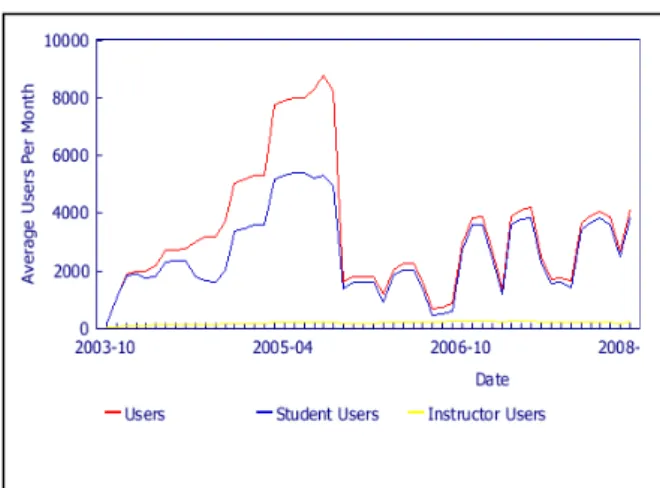
Statistics figures from HU Blackboard LMS show the number of the available courses and active courses (Figure 2) and the awareness of both the students and the academic staff in adopting technology in learning-teaching activities (Figure 3).
The number of students and instructors enrolled in LMS activities reflects the HU readiness for initiation a successful e-learning program.
Figure 2: Number of available courses and active courses on the Blackboard LMS.
Figure 3: Number of users and instructors on Blackboard LMS.
4.2 Infrastructure and Basic Amenities
In HU, there is a r eliable computer network serves broadband connectivity, fiber-optic backbones interconnect offices and departmental blocks in the University. Local Area Network (LAN) connects all university buildings and provides, at least, one network outlet in each office. The adopted LAN technology is Gigabit Ethernet with date rate 1 Gbps over fiber-optic cables between buildings, and 10/100 Mbps over UTP CAT-6 cables to desktop. The University is connected to the world through 18Mbps fiber-optic through Jordan University Network (JUN). HU provides its students with 7 opened-free labs with 900 PCs distributed through the university campus. These labs are mainly for browsing the internet, e-courses and conducting online examinations. Also, there is an opened –free lab with 200 PCs in the e-learning center dedicated for browsing the e-courses only. Beside what we mentioned there is computer labs dedicated for each faculty and it is opened for students. I n general, the university has around (3000) PCs distributed between labs, faculty staff, and administration.
As we mentioned earlier, HU established an e-learning center in 2006 and accredited by the Ministry of Higher Education and Scientific Research in 2007. The center provides a f ully integrated environment for e-learning. T he center combines the best tools to facilitate the adoption of e-learning in its learning environment. The following tools and technologies are incorporated for the development of state of the art e-learning center to offer world class user friendly online delivery.
a. Learning Management System. b. Integrated Content Capture System. c. Synchronous Collaboration Tool. d. Content Development Tool. e. Online Testing and Assessments. f. Multimedia software - beside the
e-learning software the center provides the needed software for audio, video and graphical design.
The e-learning center provides a wireless environment for the purpose of mobility in the center and research on mobile e-learning. The University
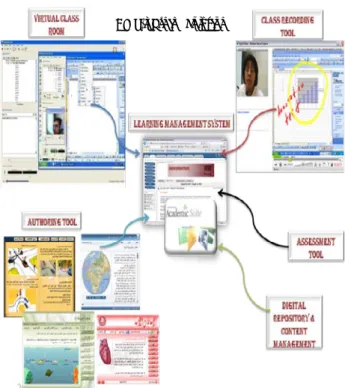
technology infrastructure is upgraded to support the adoption of e-learning and achieve the above e-learning objectives. Figure 4 depicts all the key components that are implemented in HU system for effective e-learning environment.
Figure 4: The HU fully integrated e-learning environment.
• LMS takes the learning content and organizes it in a way where courses divided into modules and lessons, supported with quizzes and tests and discussions and much more.
• Synchronous, which means "at the
same time", students involve with the faculty via the web in real time. Students accessing the courses at the same time as a faculty. HU will provide the student with synchronous live classes where students can interact with their instructors, watch, listen, and ask questions.
• Asynchronous, which means "not at the same time", allows students to complete the course on his own time and schedule, as many times as they want, without live interaction with their instructors. HU provides a class capturing tool that records the class
with all its activities and makes it available for their students on the LMS.
• For in-house content development, the university provides its staff with a productive authoring tool, easy to use and rich in features. Through this tool, instructors will be able to develop their own contents and publish it in different formats for students.
• HU has a high technology infrastructure supported with the rest mentioned components of e-learning, such as: online exam system, student information system, library system, portal system. The University also supports its infrastructure with brand software for students' and instructors' use.
4.3 HU e-learning Attentions
In HU, the focus is on t he quality of the educational content and the teaching methods. Although most of the resources made available for these priorities are at a national level. It encourages transnational cooperation, helps to disseminate its best practices and sets the basement for the creation of a regional market in the e-learning field. Beside what we have mentioned, the objectives of HU e-learning center are:
- Provides specialized infrastructure for learning and qualified trainers for e-learning technologies and tools towards development and support of faculty staff.
- Provides, Implements, administrates a robust integrated virtual learning environment.
- Development of e-learning contents.
- Creates a cu lture and awareness of e-learning.
- Provides a set of training packages for the faculty staff on the software, which provides the staff with knowledge on building courses online for different educational fields.
4.4 Challenges
The challenges when implementing an e-learning environment fall into three categories: technology, content and people. All these challenges must be addressed as the implementation process moves forward. Regarding the technology, Low bandwidth and slow transmission rates, even lack of readily available network. As reported in Section 2, HU establishes an infrastructure to overcome the challenges of technical readiness. HU has a fully integrated e-learning environment. For content and people, HU faced the following challenges:
• There is no motivation system to make teaching staff implement e-learning. • The large workload of teaching staff
and the lack of education technological proficiency for the development of e-learning.
• One of the challenges of e-learning can be the cost of course creation. A typical, well-designed, self-paced course can take up to 160 hours of development time per hour of instruction. The average cost per hour can be as high as $160.00. This brings the price of creating one self-paced course to almost $26,000.00
• personal theories about teaching are formed early in life implicitly, and do not change easily
HU tries to overcome these challenges through coordination and organization of e-learning training, on all proficiency levels of educational technology, for teaching staff and students. Also, organize professional sessions for training for trainers. HU e-learning center starts in-house content developments. HU through the e-learning center, successfully provides its services inside and outside the university.
5.
Conclusion
The explosion of information and communication technologies and internet provides a new trend for universities to introduce new teaching and learning environments. How effective these technologies will be used to enhance learning depends on adopting an e-learning strategy and a model that is not optimize the use of technology to create a reliable environment for learners, but also it should address the importance of the pedagogical issues in the implementation. The proposed six step model integrate between the social and cultural presence, technology and the pedagogical issues. An e-learning model should maximize the use of technology to enhance the teaching-learning process supported with the pedagogical and instructional design approaches to information delivery and assessments.
References
[1] Alexander, S 2001. E-learning developments and experiences. Education and Training, Bradford, 43(4-5):240-248.
[2] Biggs, J. (1999). Teaching for Quality Learning at University. Buckingham. Society for research in Higher Education. Open University Press. See also http://www.dmu.ac.uk/~jamesa/learning/solo.htm. Last accessed 23rd March 2004.
[3] Britain, S. and Liber, O. (2004). A Framework for Pedagogical Evaluation of Virtual Learning
Environments (Revised). JISC report. See:
http://www.jisc.ac.uk/uploaded_documents/VLEFull Report8.doc. Last accessed 23rd March 2004.
[4] CANDLE Consortium. (2003). ‘Collaborative and network distributed learning environment’. See: http://www.candle.eu.org, last accessed 29th September 2003.
[5] Collis, B. and Moonen, J. (2001). Flexible learning in a digital world. London. Kogan Page. [6] Conole, G., Dyke, M., Oliver, M. and Seale, J. (2004). 'Mapping pedagogy and tools for effective learning design', Computers and Education, 43 (1-2), 17-33
[7] Conrad, K & TrainingLinks 2000. Instructional design for web-based training. Amherst: HRD Press. [8] IMS Global Learning Consortium. (2002). IMS learning design: best practice and implementation guide. See:
http://www.imsglobal.org/learningdesign/ldv1p0pd/i msld_bestv1p0pd.html.
[9] Koper, R. (2001). Modelling units of study from a pedagogical perspective. The pedagogical meta-model behind EML. See:
http://www.learningnetworks.org/downloads/ped-metamodel.pdf
[10] Laurillard, D. (2002). Rethinking University Teaching. A conversational framework for the effective use of learning technologies. London: Routledge ISBN 0415256798 .
[11] Leont’ev, A. N. (1978). Activity, consciousness and personality. Englewood Cliffs. New Jersey. Prentice Hall.
[12] Mann, W. C. & Matthieson, C. (1989). ‘Rhetorical structure theory and text analysis’. ISI Technical report. Information Sciences Institute. California. United States.
[13] Mason, R., Pegler, C., & Weller, M. (2005), A learning object success story. JALN, 9(1), 97-105. [14] Ryan, S, Scott, B, Freeman, H & Patel, D 2000.
The virtual university: the Internet and resourcebase learning. London: Kogan Page.