From Cryptography to Practice
Dieter M. Sommer
From Cryptography to Practice
Vom Fachbereich Informatik
der Technischen Universität Darmstadt genehmigte
Dissertation
zur Erlangung des Grades Doktor-Ingenieur (Dr.-Ing.) von
Dipl.-Ing. Dieter M. Sommer
aus Bruck an der Mur (Österreich)
Tag der Einreichung: 18. Mai 2013 Tag der mündlichen Prüfung: 11. Juli 2013
Hochschulkennziffer: D 17
Darmstadt im Juni 2014 Referenten:
Prof. Dr. Michael Waidner Prof. Dr. Stefan Katzenbeisser Dr. Jan Camenisch
any means without prior explicit permission by the copyright holder. Typeset by the author in Computer Modern Roman 10 using LATEX 2ε.
First and foremost I would like to thank Jan Camenisch for making me consider a PhD thesis in the field of data privacy, for giving me guidance in my work, for always being available, when needed, for discussions related to my research, and for being my industry-side advisor for my PhD thesis. Large parts of the thesis work have been done while being in the team of Jan at IBM Research – Zurich in Switzerland. It has always been enjoyable and fruitful to work with Jan over the course of many years at IBM Research, whether in relation to this thesis or other aspects of my work, starting with my first internship at IBM Research over a decade ago.
I am very thankful to Prof. Michael Waidner for being the academic advisor of my thesis, giving me the opportunity to work as an external PhD student at his Institute for Secure Information Technology (SIT) at the Fachbereich Informatik of Technische Universit¨at Darmstadt, and for supporting me in my thesis-related work from the very beginning. I would also like to thank Prof. Stefan Katzenbeisser of Technische Universit¨at Darmstadt for agreeing to be the academic co-examiner of my thesis. Particular gratitude also goes to Mrs. Andrea P¨uchner, the personal assistant of Prof. Michael Waidner, for her continued support regarding the administrative processes related to a dissertation at Technische Universit¨at Darmstadt, which was particularly helpful when being an external PhD student living hours away from the university. Also I would like to thank all administrative staff at TU Darmstadt I had to do with for the always friendly service provided in answering questions or handling requests related to my promotion.
Also, I would like to thank Prof. Max M¨uhlh¨auser, Prof. Dieter Fellner, and Prof. Melanie Volkamer for being part of my PhD examination committee and for their time spent on this.
I am particularly thankful to my friends, office mates, and coworkers Patrik Bichsel and Franz-Stefan Preiss for having frequently helped out on LATEX-related
questions and having shared their opinions on my questions related to typesetting or phrasing sentences when time was tight in the final writing phase, for comments on my work, for the great and fun collaboration on projects and research papers, and particularly for the awesome time we have had in our office.
I would particularly like to thank Samuel M¨uller, a friend and former office mate at IBM, for the intense collaboration on security, privacy, and other aspects of electronic social networks and the otherwise great time during our stay at IBM in our shared office.
Furthermore, I would like to express my particular thanks to Samuel Burri and Maria Dubovitskaya, friends and former office mates at IBM, as well as Anthony Bussani and Kris Haralambiev, friends and colleagues from IBM Research, for the great time in our office, respectively for frequently trying to convince me to finally submit my thesis and stopping spending further time on it. Additionally, I would like to thank Stephan Krenn, a friend and colleague from IBM, for the few focused, yet excellent, discussions we had related to details of cryptographic mechanisms.
Especially, I am grateful to Sebastian M¨odersheim, a friend, colleagues, and coworker, formerly at IBM, for the collaboration on research as well as the fruitful discussions regarding my work, particularly the formal logic aspects thereof.
Furthermore, I would like to thank all my other friends at IBM, or formerly at IBM, not mentioned already, for having made my time in the IBM Zurich Re-search lab and my PhD work even more enjoyable, particularly Caroline Ander-sson, Robert Enderlein, C´edric Favre, Lukas Kull, Abhilasha Bhargav-Spantzel, Chris Vanden Berghe, Roger Zimmermann, Toke Meyer Andersen, Olya Ohrimenko, Ashish Garg, Carl Binding, abhi shelat, Lydia Chen, Mathias Bjorkqvist, Hari Ra-masamy, Thomas Groß, Clemens Schroedter, Annie Chen, Tadeusz Pietraszek, and all the others not mentioned here.
During my involvement in the PRIME research program, I had the opportunity to meet many great researchers and people. My gratitude goes to all those with whom I worked, mainly Giles Hogben of JRC, Thomas R¨ossler and Rigo Wenning of W3C, Stephen Crane, Marco Casassa Mont, Pete Bramhall, and Siani Pearson of HP Labs, Simone Fischer-H¨ubner and John-S¨oren Pettersson of Karlstad University, and Marit Hansen of ULD. Furthermore, appreciation goes to Eric Goderniaux of IBM and G´erard Lacoste of IBM for the excellent collaboration and for the great technical and other discussions and the great collaborativ atmosphere they have always created.
Particularly, the discussions with Prof. Andreas Pfitzmann of TU Dresden were fruitful in progressing work in the privacy domain during the PRIME time.
During my time as project manager, when my research activities were largely suspended, I also had the opportunity to meet a great group of researchers in the PrimeLife project. For the excellent collaboration, I would like to thank all of them, particularly, Maren Raguse, Ulrich Pinsdorf, Pierangela Samarati, Michele Bezzi, Stuart Short, and Harald Zwingelberg, and those who have been collaborators already in the PRIME project and mentioned above. Particularly I would like to thank also Karin Pletka-Waldvogel and Gabriella Galli for assisting me at IBM with a plurality of the project’s tasks.
Specifically, I would like to thank Karel Wouters and Ronald Leenes, friends and coworkers, with whom I worked in both the PRIME and PrimeLife projects, for the great, reliable, and dependable collaboration and being great colleagues during an extended period of time and for attending my PhD defense.
Particularly, I would like to thank Mario Verdicchio, a friend and coworker, for the fruitful discussions while collaborating in PrimeLife and for being a great colleague during his multiple research visits to IBM Research in Zurich during the PrimeLife project and beyond.
Appreciation goes to my managers Andreas Wespi, Douglas Dykeman, Phil Jan-son, and Michael Osborne at IBM who have supported my thesis-related work by making flexible working hours possible and giving me the time flexibility to align the thesis work with all the other project responsibilities, of which there were plenty during my time at IBM. Particularly, appreciation goes to Michael Osborne also for the fruitful and always very enjoyable collaboration on international standards related to privacy technologies within ISO/IEC.
Furthermore, I would like to thank Bernhard Jansen, a friend and colleague at IBM Research – Zurich, for the numerous and always interesting technical and other discussions we have been frequently having.
Needless to say, I appreciated the work with all my coauthors who have not yet been mentioned above. Furthermore thanks goes to all the other people whom I was working with or had to do with in other ways during my PhD time and who are not mentioned here for whatever reason.
Particularly, I would like to thank my friends Martin Schaffer, Anton J¨ager, and Christian Thurnhofer for the great time whenever we met on visits back home in Austria.
Last and definitely not least I would like to thank my family for always support-ing me dursupport-ing the time of my PhD thesis, in whatever form, and for the great time and food during my regular visits back home.
Dieter M. Sommer
Hiermit erkl¨are ich, diese Arbeit selbst¨andig und ausschließlich unter Verwendung der angegebenen Hilfsmittel erstellt zu haben.
Hiermit erkl¨are ich weiterhin, dass von mir bisher kein Promotionsversuch unter-nommen wurde.
Dieter M. Sommer
Z¨urich im Juni 2014
Conference and Workshop Publications
1. Patrik Bichsel, Jan Camenisch, and Dieter Sommer. A calculus for privacy-friendly authentication. In Proceedings of the 17th ACM Symposium on Access Control Models and Technologies (SACMAT’12), June 20–22, 2012, Newark, NJ, USA, ACM, 2012, pp. 157–166.
2. Jan Camenisch, Sebastian M¨odersheim, and Dieter Sommer. A formal model of Identity Mixer. In Proceedings of the 15th International Conference on Formal Methods for Industrial Critical Systems (FMICS’10), September 20– 21, 2010, Antwerp, Belgium, Springer, 2010, pp. 198–214.
3. Jan Camenisch, Sebastian M¨odersheim, Gregory Neven. Franz-Stefan Preiss, and Dieter Sommer. A card requirements language enabling privacy-preserving access control. In Proceedings of the 15th ACM Symposium on Access Control Models and Technologies (SACMAT’10), June 9–11, 2010, Pittsburgh, PA, USA, ACM, 2010, pp. 119–128.
4. Patrik Bichsel, Samuel M¨uller, Franz-Stefan Preiss, Dieter Sommer, and Mario Verdicchio. Security and trust through electronic social network-based interac-tions. In Proceedings of the 12th IEEE International Conference on Compu-tational Science and Engineering (IEEE CSE’09), August 29–31, 2009, Van-couver, BC, Canada, 2009, IEEE Computer Society, 2009, pp. 1002–1007. 5. Jan Camenisch, Abhi Shelat, Dieter Sommer, and Roger Zimmermann.
Secur-ing user inputs for the web. In Proceedings of the 2006 Workshop on Digital Identity Management (DIM’06), November 3, 2006, Alexandria, VA, USA, 2006, ACM, 2006, pp. 330–44.
6. Abhilasha Bhargav-Spantzel, Jan Camenisch, Thomas Groß, and Dieter Som-mer. User centricity: A taxonomy and open issues. In Proceedings of the 2006 Workshop on Digital Identity Management (DIM’06), November 3, 2006, Alexandria, VA, USA, 2006, ACM, 2006, pp. 1–10.
7. Christer Andersson, Jan Camenisch, Stephen Crane, Simone Fischer-H¨ubner, Ronald Leenes, Siani Pearson, John S¨oren Pettersson, and Dieter Sommer.
Trust in PRIME.In Proceedings of the Fifth IEEE International Symposium on Signal Processing and Information Technology (ISSPIT’05), December 18– 21, 2005, Athens, Greece, 2005, IEEE, pp. 552–559.
8. Jan Camenisch, Abhi Shelat, Dieter Sommer, Simone Fischer-H¨ubner, Marit Hansen, Henry Krasemann, G´erard Lacoste, Ronald Leenes, and Jimmy C. Tseng. Privacy and identity management for everyone. In Proceedings of the 2005 Workshop on Digital Identity Management (DIM’05), Fairfax, VA, USA, November 11, 2005, ACM, 2005, pp. 20–27.
9. Jan Camenisch, Dieter Sommer, and Roger Zimmermann. A general certi-fication framework with applications to privacy-enhancing certificate infras-tructures. In Proceedings of the IFIP TC–11 21st International Information Security Conference (SEC 2006), May 22–24, 2006, Karlstad, Sweden, IFIP, Springer, 2006, pp. 25–37.
10. Michael Backes, Jan Camenisch, and Dieter Sommer. Anonymous yet account-able access control. In Proceedings of the 2005 ACM Workshop on Privacy in the Electronic Society (WPES’05), Alexandria, VA, USA, November 7, 2005, ACM, 2005, pp. 40–46.
Journal Publications
1. Claudio Agostino Ardagna, Jan Camenisch, Markulf Kohlweiss, Ronald Leenes, Gregory Neven, Bart Priem, Pierangela Samarati, Dieter Sommer, and Mario Verdicchio. Exploiting cryptography for privacy-enhanced access control. A result of the PRIME project. In Journal of Computer Security vol. 18 (2010), no. 1, pp. 123–160.
2. Abhilasha Bhargav-Spantzel, Jan Camenisch, Thomas Groß, and Dieter Som-mer. User centricity. A taxonomy and open issues. In Journal of Computer Security vol. 15 (2007), no. 5, pp. 493–527.
Book and Book Chapters
1. Jan Camenisch, Ronald Leenes, and Dieter Sommer (eds.). Digital privacy – PRIME – Privacy and identity management for Europe. Lecture Notes in Computer Science (LNCS), vol. 6545, Springer, 2011.
2. Jan Camenisch, Markulf Kohlweiss, and Dieter Sommer. Pseudonyms and private credentials. In Jan Camenisch, Ronald Leenes, and Dieter Sommer (eds.),Digital privacy – PRIME – Privacy and identity management for Eu-rope, Lecture Notes in Computer Science (LNCS), vol. 6545, Springer, 2011, pp. 289–308.
3. Stephen Crane, Siani Pearson, and Dieter Sommer. Introduction: Privacy, trust, and identity management. In Jan Camenisch, Ronald Leenes, and Dieter Sommer (eds.),Digital privacy – PRIME – Privacy and identity management for Europe, Lecture Notes in Computer Science (LNCS), vol. 6545, Springer, 2011, pp. 141–149.
4. Dieter Sommer. Architecture. In Jan Camenisch, Ronald Leenes, and Dieter Sommer (eds.). Digital privacy – PRIME – Privacy and identity management for Europe, Lecture Notes in Computer Science (LNCS), vol. 6545, Springer, 2011, pp. 151–288.
Patents
1. Samuel Muller and Dieter M. Sommer. Negotiable information access in elec-tronic social networks. United States Patent Application Publication, No. US 2012/0297003 A1, November 22, 2012.
2. Samuel Muller and Dieter M. Sommer. Access to electronic social networks.
United States Patent, No. US 8,234,300 B2, July 31, 2012.
3. Chris Vanden Berghe, Tadeusz J. Pietraszek, Jan L. Camenisch, and Dieter Sommer. Privacy enhanced comparison of data sets. United States Patent, No. US 7,974,406 B2, July 5, 2011.
4. Chris Vanden Berghe, Tadeusz J. Pietraszek, Jan L. Camenisch, and Dieter Sommer. Privacy enhanced comparison of data sets. United States Patent, No. US 7,974,407 B2, July 5, 2011.
5. Samuel Muller and Dieter M. Sommer. Automated relationship management for electronic social networks. United States Patent Application Publication, No. US 2010/0235886 A1, September 16, 2010.
6. Samuel Muller and Dieter M. Sommer. Context-aware electronic social net-working. United States Patent Application Publication, No. US 2010/0228590 A1, September 9, 2010.
7. Carl Binding, Anthony Bussani, Jan Camenisch, and Dieter M. Sommer. In-teractive selection of identity information satisfying policy constraints. United States Patent Application Publication, No. US 2010, 0100926 A1, April 22, 2010.
8. Anthony Bussani, Dirk Husemann, Ansgar Schmidt, and Dieter Sommer.
Method, system, and computer program product for providing e-token based access control for virtual world spaces. United States Patent, No. US 8,132,235 B2, March 6, 2010.
9. Anthony Bussani, Jan L. Camenisch, Thomas R. Groß, Dirk Husemann, and Dieter M. Sommer. Confidential presentations in virtual world infrastruc-tures. United States Patent Application Publication, No. US 2010/0058443 A1, March 4, 2010.
10. Anthony Bussani, Jan L. Camenisch, Thomas R. Groß, Dirk Husemann, Ans-gar Schmidt, and Dieter Sommer. Method, system, and computer program product for virtual world access control management. United States Patent Application Publication, No. US 2009/0254968 A1, October 8, 2009.
11. Dieter M. Sommer and Samuel Muller. Hybrid profile management for elec-tronic social networks. United States Patent Application Publication, No. US 2009/0248844 A1, October 1, 2009.
12. Jan L. Camenisch, Abhi A. Shelat, Dieter M. Sommer, and Roger D. Zim-mermann. Method and computer system for performing transactions between a client and a server. United States Patent Application Publication, No. US 2007/0288750 A1, December 13, 2007.
13. Thomas R. Groß, Dieter M. Sommer, and Jan L. Camenisch. Assertion mes-sage signatures. International Patent Application, No. PCT/IB2007/051546, November 29, 2007.
Technical Reports
1. Patrik Bichsel, Carl Binding, Jan Camenisch, Thomas Groß, Thomas Heydt-Benjamin, Dieter Sommer, and Gregory Zaverucha. Cryptographic protocols of the Identity Mixer library. Technical Report IBM Zurich Research Report RZ3730, IBM Research – Zurich, March 19, 2009.
2. Giles Hogben and Dieter Sommer. A meta-data and reasoning framework for open assertion and evidence exchange and query. Technical Report RZ3674, IBM Research, Zurich Research Laboratory (joint research report with the Joint Research Centre (JRC)), October 2006.
3. Patrik Bichsel, Jan Camenisch, Franz-Stefan Preiss, and Dieter Sommer.
Dynamically-changing interface for interactive selection of information cards satisfying policy requirements. Technical Report RZ3756, IBM Research – Zurich, 2009.
People perform an ever increasing number of their interactions over electronic com-munication networks, which has induced a complex space of issues related to data privacy. The transition from manual record keeping to electronic data processing has greatly amplified privacy problems related to personal data processing due to powerful automated processing and knowledge induction capabilities. Users fre-quently need to reveal excessive amounts of personal data for obtaining access to services, typically being identified, while service providers and third parties exten-sively profile the users to commercially exploit their data as part of the so-called personal data economy.
The personal data required to be released in online interactions often exceeds the minimum that would be required for the service to be provided, and, worse, it typically identifies the user. This, together with the absence of widely deployed strong authentication systems, creates the risk of identity theft, e.g, based on user data leaked through privacy breaches, with severe consequences for both affected users and service providers. The personal data economy creates, due to the increas-ingly powerful automated induction of knowledge from (unstructured) data, further privacy problems, which are expected to worsen with the widespread adoption of Big Data analytics. The frequent mergers and acquisitions of service providers or data aggregators and related creation of large-scale databases further worsen the privacy issues.
In this thesis, we address user-centric privacy-enhanced identity management, with a focus on data-minimizing authentication of attribute statements about users, vouched for by third-party identity providers. Authenticated attributes allow for re-ducing the amount of data to be requested because they make background checks, e.g., for minimum age or creditworthiness verification based on identifying user attributes, obsolete. Data minimization benefits both users through stronger pri-vacy and service providers through the reduction of data-breach-related risks and increased data quality and fraud prevention through the certification of attributes. Main challenges for an open privacy-enhanced authentication system are realiz-ing data minimization, trust delegation, user accountability, and attribute delegation —all in a single system. That is, revealing exactly the data required for a trans-action, deciding on which parties to trust for certifying attributes or for providing other relevant knowledge, being able to hold non-identified users accountable for actions in case they violate agreed terms or for law enforcement, and allowing users
to delegate authority over certified attributes to parties they trust. Today’s avail-able systems or competing research proposals fail in addressing those challenges in an integrated manner. A system addressing those challenges needs to build upon complex composed cryptographic protocols to achieve the properties we require in a strong trust model, where each such protocol is a function of the data to be re-leased. The cryptographic data release semantics needs to be expressed in a formal language which abstracts from the details of the cryptographic protocols and ex-poses semantics at the level of identity management concepts, the authentication messaging between parties needs to be integrated with standards, and the human user must be involved in transactions through simple yet effective user interfaces.
The presented work has started, as a foundation, with available cryptographic protocols capable of the data-minimizing release of certified attribute data while reducing the trust assumptions in third parties. Our goal of this work has been bringing those cryptographic protocols towards practice. We address the above-mentioned challenges through proposing a comprehensive system, designed around those cryptographic protocols, to make them applicable as part of an open real-world identity management system.
As one main contribution, we propose logic-based languages for representing data requests (policies), statements, protocol interface elements, and knowledge in the form of ontologies. The languages allow for automated processing, e.g., computing a response statement to a data request, in a logic calculus. The languages are used to govern system behavior, while allowing for hiding the underlying cryptographic protocol semantics.
We propose an abstract authentication model for privacy-enhanced authentica-tion which expresses precondiauthentica-tions to authenticaauthentica-tion transacauthentica-tions and formalizes transformation rules for obtaining authenticated communication channels. The model formally specifies under which preconditions which authenticated commu-nication channels between parties can be established using our authentication pro-tocols. Authenticated attribute statements are expressed through the logic-based statement language.
We discuss how the cryptographic protocols to be executed for authenticating data-minimizing attribute statements are specified through formulae expressed in our logic-based languages and how multiple instances of the protocols relate to each other. We show how the cryptographic protocols realize the transformation rules of our authentication model.
A cryptographic protocol for releasing certified attribute statements is a pro-tocol from a family of propro-tocols and is a function of the statement to be authen-ticated. Because all protocols for all valid to-be-authenticated statements cannot be exhaustively specified, we propose a subsystem for compiling a protocol at run-time from the logic-based statement to be authenticated. This runrun-time generation results in cryptographic programs to be executed by a protocol interpreter. This has the advantages of handling the powerful semantics of our statement language through a multi-layer processing approach and allowing for aggressive performance improvements, among other things, through exploiting the instruction-level paral-lelism inherent to the derived programs at the cryptographic layer.
Those contributions give rise to an integrated system for data-minimizing au-thentication of certified attribute statements using cryptographic protocols, thereby solving the main challenges of data-minimizing authentication in an open system.
A major contribution of our work is the strong integration, on the one hand on the dimension of data minimization, trust delegation, accountability, and the further functionality crucial for an open privacy-enhanced authentication system, and on the other hand on the dimension of integration of the functionality into a single coherent system. Parts of our results have been validated with implementations and a use case prototype for an end-to-end authentication flow for a simplified system.
In addition to the abovementioned core contributions related to the authenti-cation system, we have obtained complementary contributions in the areas of user interfaces for identity selection as part of the authentication process, a formal-model-based verification of a fragment of the cryptographic protocols, a taxonomy of user centricity in identity management, and a discussion of the various notions of trust in an open identity management system.
Orthogonal to the authentication system, we have, among other issues, addressed the problem of access control in electronic social networks. The results can substan-tially contribute to user privacy by enforcing user preferences and thereby solve a main problem in the social network space. We also discuss how social networks can be leveraged to bootstrap a public key infrastructure, and how to automate profile management in social networks. We put forth an approach for integrating privacy-enhanced authentication with a virtual world system and for giving presentations in public areas therein while ensuring confidentiality of the content.
With our core contributions related to the privacy-enhanced authentication sys-tem and the additional contributions around and orthogonal to it, we address an important fraction of the overall space of privacy issues.
Ein wesentlicher Teil der Interaktionen von Menschen wird heutzutage ¨uber elek-tronische Kommunikationsnetzwerke abgewickelt, was zu einem komplexen Prob-lemraum im Bereich des Datenschutzes f¨uhrt. Der ¨Ubergang von manueller zu elektronischer Datenverarbeitung hat die Datenschutzprobleme, welche im Rahmen von Datenverarbeitung auftreten, durch automatische Datenverarbeitung und Ex-traktion von Wissen ¨uber die Benutzer massiv versch¨arft. Benutzer m¨ussen in vielen Interaktionen unverh¨altnism¨aßig viele Daten herausgeben, um Zugang zu Services zu erlangen und sind ¨ublicherweise identifiziert, wohingegen Diensteanbieter und Drittparteien extensive Profile von Benutzern anlegen und, als Teil der sogenannten Personal Data Economy, mit kommerziellem Nutzen auswerten.
Die pers¨onlichen Daten, welche in online-Interaktionen herausgegeben werden m¨ussen, ¨uberschreiten oftmals das Minimum an Daten, auf Basis dessen ein Service angeboten werden k¨onnte. Weiters werden die Benutzer typischerweise identifiziert, auch wenn es f¨ur den Service nicht notwendig w¨are. Zusammen mit der Tatsache, dass es keine weit verbreiteten Authentifikationssysteme f¨ur sichere Authentifika-tion im Internet gibt, kann das Identit¨atsdiebstahl, z.B. basierend auf von Hackern gestohlenen Datens¨atzen, beg¨unstigen – mit schwerwiegenden Folgen f¨ur Benutzer und Diensteanbieter. Weitere Datenschutzprobleme entstehen durch die Personal Data Economy selbst, v.a. durch die immer besser werdenden Mechanismen, Wis-sen aus (unstrukturierten) Daten abzuleiten. Diese Problematik wird durch die weite Verbreitung solcher Mechanismen in Zukunft versch¨arft werden.
In dieser Dissertation addressieren wir benutzerzentrisches, datenschutzfreund-liches Identitit¨atsmanagement, wobei der Fokus auf datenminimierende Authen-tifikation von Attributaussagen ¨uber Benutzer, welche von Zertifizierern gepr¨uft sind, gelegt ist. Authentifizierte Benutzerattribute erlauben es, die Menge ange-fragter Daten im Rahmen eines Sevices zu reduzieren, weil dadurch Hintergrund-checks basierend auf der Benutzeridentit¨at, z.B. f¨ur eine Alters- oder Kreditw¨ urdig-keits¨uberpr¨ufung, unn¨otig werden. Datenminimierung hilft dabei sowohl Benutzern, deren Privatsph¨are zu sch¨utzen, als auch Diensteanbietern, durch die Reduktion von erwarteten Kosten im Kontext mit der Exponierung von Kundendaten und durch erh¨ohte Datenqualit¨at durch zertifizierte Attributsinformation, was u.a. auch zur Verhinderung von Betrug benutzt werden kann.
Große Herausforderungen f¨ur ein offenes datenschutzfreundliches Authentifika-tionssystem sind die Realisierung von Datenminimierung, Delegierung von
trauensentscheidungen, Benutzer-Accountability und Delegierung von Attributen, unterst¨utzt durch ein integriertes System, d.h., die Bereitstellung von genau den ben¨otigten Attributinformationen durch Benutzer, die Entscheidung, welche Partei-en f¨ur das Zertifizieren von Attributen oder die Bereitstellung anderen maschinen-verarbeitbaren Wissens vertrauensw¨urdig sind, die M¨oglichkeit, Benutzer, welche gegen die Regeln eines Diensteanbieters verstoßen, haftbar machen zu k¨onnen, auch wenn sie anonym interagieren, und den Benutzern zu erlauben, Attribute an an-dere Benutzer, welchen sie daf¨ur vertrauen, zu delegieren. Heutige Systeme oder Forschungsresultate haben es nicht geschafft, all diese Punkte in einer integrieren-den Art und Weise zu adressieren. Ein System, welches all dies adressiert, muss auf aus Teilprotokollen komponierten kryptographischen Protokollen aufbauen, um die Datenschutzeigenschaften zu erreichen, wobei ein solches Protokoll eine Funktion ¨
uber die Daten ist, welche herausgegeben werden sollen. Die Semantik der Protokolle bzgl. Datenherausgabe muss in einer formalen Sprache, welche von kryptographis-chen Details abstrahiert und Semantik auf der Ebene von Identit¨atsmanagement hat, ausgedr¨uckt werden. Der Nachrichtenaustausch im Rahmen einer Authentifikation muss in ein standardisiertes Framework hierf¨ur passen, welches in der Praxis benutzt wird. Weiters m¨ussen einfache Benutzerinterfaces gebaut werden, um die Benutzer in den Identit¨atsmanagementprozess einzubeziehen.
Die Arbeit an dieser Dissertation hat mit den vorhandenen kryptographischen Protokollen zur datenminimierenden Herausgabe zertifizierter Attribute unter min-imalen Vertrauensannahmen bzgl. dritter Parteien begonnen, mit dem Ziel, diese n¨aher an die Praxis zu bringen. Wir adressieren die oben genannten Herausforderun-gen durch ein umfassendes System, welches um die kryptographischen Protokolle gebaut worden ist, um diese als Teil eines offenen Identit¨atsmanagementsystems f¨ur die Praxis nutzbar zu machen.
Als einen Hauptbeitrag definieren wir eine logikbasierte Sprache, welche Date-nanfragen (Policies), Aussagen, Protokollinterfaceelemente und Wissen in der Form von Ontologien ausdr¨ucken kann. Die Sprachen k¨onnen automatisch verarbeitet wer-den, z.B. um eine Attributaussage zu machen, welche eine Policy erf¨ullt. Formeln in den Sprachen dr¨ucken das Systemverhalten aus, wobei die technischen Details der kryptographischen Protokolle eingekapselt bleiben k¨onnen.
Wir definieren ein abstraktes Authentifikationsmodell f¨ur datenschutzfreundliche Authentifikation, welches mit seinen Regeln die notwendigen Bedingungen f¨ur die Durchf¨uhrbarkeit von Authentifikationstransaktionen ausdr¨uckt, d.h., Bedingun-gen, um einen authentifizierten Kommunikationskanal aufbauen zu k¨onnen. Au-thentifizierte Attributaussagen werden in der logikbasierten Aussagensprache aus-gedr¨uckt.
Wir diskutieren, wie die kryptographischen Authentifikationsprotokolle durch Formeln in den logikbasierten Sprachen spezifiziert werden und zeigen, wie man mit Hilfe der kryptographischen Protokolle die Kanaltransformationsregeln des Authen-tifikationsmodells realisieren kann.
Ein kryptographisches Protokoll zur datenminimalen Herausgabe zertifizierter Attributaussagen ist ein Protokoll aus einer Protokollfamilie und kann als Funktion ¨
f¨ur alle g¨ultigen zu authentifizierenden Attributaussagen ersch¨opfend anzugeben, diskutieren wir ein Subsystem zur Laufzeitgenerierung von kryptographischen Pro-tokollen aus den Attributaussagen. Diese Laufzeitgenerierung resultiert in kryp-tographischen Programmen, welche von einem Interpreter ausgef¨uhrt werden k¨ on-nen. Die Vorteile dieses Ansatzes liegen darin, dass die ausdrucksstarke Se-mantik der logikbasierten Sprache f¨ur Attributaussagen durch einen mehrstufi-gen Prozess zu einem Protokoll transformiert wird, und dadurch die Komplexit¨at der einzelnen Stufen ausreichend niedrig gehalten werden kann, und dass sp¨urbare Performanzsteigerungen f¨ur die Protokollausf¨uhrung, z.B. durch Ausnutzen des den kryptographischen Protokollen inh¨arenten Instruktionsparallelismus, erzielt werden k¨onnen.
Diese Resultate ergeben, zusammen betrachtet, ein integriertes System zur dat-enminimierenden Authentifikation zertifizierter Attributstatements mittels krypto-graphischer Protokolle und l¨ost damit einige große technische Herausforderungen offener datenminimierender Authentifikationssysteme.
Ein Hauptresultat dieser Arbeit ist die enge Integration, einerseits im Sinne einer Integration der Funktionen miteinander, und andererseits Integration in ein koh¨arentes System. Teile dieser Arbeit sind durch Prototypenimplementierungen validiert worden, u.a. einem Prototypen eines vereinfachten Systems, welcher einen vollst¨andigen Authentifikationsnachrichtenfluss realisiert.
Zus¨atzlich zu den oben genannten Hauptresultaten im Rahmen des Authentifika-tionssystems haben wir noch weitere Resultate komplement¨ar dazu erarbeitet. Diese Resultate umfassen Benutzerinterfaces f¨ur die Auswahl von Attributaussagen, eine Modellierung eines Teils der kryptographischen Protokolle basierend auf formalen Modellen, eine Taxonomie f¨ur benutzerzentrisches Identit¨atsmanagement, und eine Diskussion der unterschiedlichen Bedeutungen des Vertrauenskonzeptes im Rahmen eines Identit¨atsmanagementsystems.
Orthogonal dazu haben wir Zugriffskontrolle zu Profildaten in elektronischen sozialen Netzwerken behandelt, wobei unsere Resultate dem Datenschutz von Profil-daten zutr¨aglich sind. Ein weiteres Resultat behandelt das Bootstrappen von Public-Key-Infrastrukturen mittels elektronischer sozialer Netzwerke. Weiters wurde gez-eigt, wie man ein Authentifikationssystem, wie das hier behandelte, in virtuelle Welten integrieren kann und wie man Pr¨asentationen mit vertraulichem Inhalt in solchen virtuellen Welten halten kann.
Mit unseren Hauptresultaten im Rahmen des Authentifikationssystems und den weiteren komplement¨aren und orthogonalen Resultaten ist ein wichtiger Teil des Problembereiches Datenschutz in Kommunikationsnetzwerken adressiert worden.
1 Introduction 1
1.1 Motivation . . . 2 1.1.1 Data Disclosure . . . 2 1.1.2 Data Breaches . . . 3 1.1.3 Personal Data Economy . . . 5 1.1.4 Data Protection Regulations . . . 7 1.2 Privacy . . . 10 1.3 Data-minimizing Authentication . . . 11 1.3.1 Cryptographic Protocols . . . 11 1.4 Challenges of Data-minimizing Authentication . . . 14 1.5 Contributions . . . 16 1.5.1 Thesis Contributions . . . 16 1.5.2 Complementary Contributions . . . 24 1.5.3 Orthogonal Contributions . . . 25 1.5.4 Summary of Contributions . . . 29 1.6 The Need for Data-minimizing Authentication for the Future Internet 29 1.7 Thesis Outline . . . 30
2 Concepts and Terminology 33
2.1 Basic Terminology . . . 33 2.2 Data Minimization . . . 35 2.3 Pseudonyms . . . 37 2.4 Credentials . . . 38 2.5 Partial Identity . . . 39 2.6 Accountability . . . 40 2.7 Unconditional and Conditional Release . . . 41 2.8 Delegation . . . 42
3 Authentication Model 45
3.1 Introduction . . . 45 3.2 Related Work . . . 46 3.3 Maurer–Schmid Channel Model . . . 47 3.4 Extended Channel Model . . . 49
3.4.1 Pseudonyms . . . 49 3.4.2 Statement-based Party Annotations . . . 51 3.4.3 Authenticating a Statement . . . 51 3.4.4 Authentication and Confidentiality . . . 53 3.5 Channel Transformation Algebra . . . 57 3.5.1 Basic Transformations . . . 58 3.5.2 Statement-based Transformations . . . 60 3.6 Authentication vs. Authorization . . . 71 3.7 Evidence and its Verification . . . 73 3.8 Authentication with Credential Protocols . . . 74 3.9 Registration and Derived Authentications . . . 76 3.10 Future Work . . . 79
4 Data Representation, Logic, Ontologies, and Semantics 81
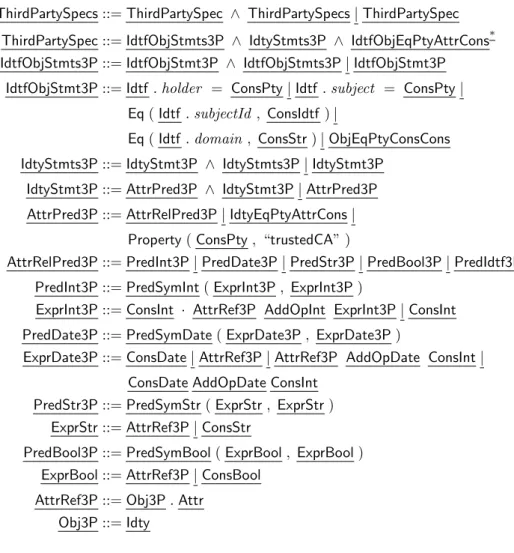
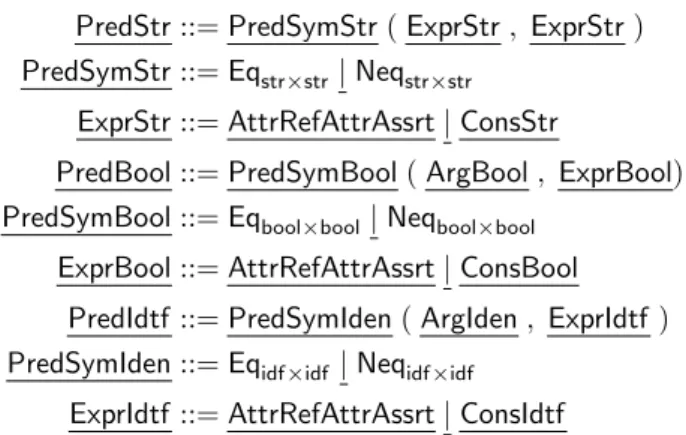
4.1 Introduction . . . 82 4.2 Related Work . . . 84 4.3 Architectural Preliminaries . . . 86 4.4 Data Model and Concepts . . . 87 4.4.1 Basics . . . 87 4.4.2 Connectives and Formulae . . . 89 4.4.3 Functions of Parties . . . 89 4.4.4 Identities . . . 91 4.4.5 Conditionally Released Identities . . . 95 4.4.6 Opaque Identities . . . 97 4.4.7 Identifier Objects . . . 98 4.4.8 Delegation of Attribute Authority . . . 100 4.4.9 Transfer of Identities . . . 101 4.4.10 Certification Metadata . . . 102 4.4.11 Type System . . . 107 4.4.12 Expressions . . . 120 4.4.13 Relation Predicates and Equality . . . 123 4.4.14 Property Predicates . . . 128 4.4.15 Other Predicates . . . 129 4.4.16 Features of an Identity . . . 129 4.4.17 Extension: Operators . . . 131 4.5 Data Statement Language . . . 133 4.5.1 Syntax . . . 134 4.5.2 Interoperability Aspects . . . 142 4.6 Data Request Language . . . 143 4.6.1 Syntax . . . 143 4.6.2 Meaning of Disjunctions and Ontological Concepts . . . 147 4.6.3 Examples . . . 148 4.6.4 Third-party Requests . . . 150 4.6.5 Authorization Policy Model . . . 151 4.7 Repository and Portfolio . . . 151
4.7.1 Identifier Relationships . . . 151 4.7.2 Identity Relationships . . . 153 4.7.3 Data Track . . . 156 4.7.4 Profile Data . . . 158 4.7.5 Implementation . . . 159 4.8 Applying the Data Model . . . 160 4.8.1 Establishing Objects and their Local Representations . . . . 160 4.8.2 Data Release . . . 165 4.8.3 Conventional Certificates . . . 171 4.8.4 Discussion . . . 173 4.9 Calculus . . . 173 4.9.1 Properties of the Logic . . . 174 4.9.2 Deductive System . . . 175 4.9.3 Axioms and Theories . . . 177 4.9.4 Machine Implementation . . . 179 4.9.5 Contradictions . . . 180 4.10 Ontologies . . . 182 4.10.1 Types of Ontologies . . . 183 4.10.2 Composition of Ontologies . . . 190 4.10.3 Trust in Ontologies . . . 192 4.10.4 Interoperability Challenges . . . 192 4.10.5 Distribution of Ontologies . . . 194 4.10.6 Discussion . . . 194 4.11 Semantics . . . 195 4.11.1 Types and Interpretation Domains . . . 196 4.11.2 Interpretation . . . 197 4.11.3 Predicates . . . 201 4.11.4 Interpretation for a System State . . . 205 4.11.5 Extension: Operators on Attributes . . . 209 4.11.6 Discussion . . . 210
5 Cryptographic Protocol Integration 213
5.1 Prerequisites . . . 214 5.1.1 Cryptographic Object Structures . . . 215 5.1.2 Dummy Identities and Certificates . . . 216 5.2 Establishing Identifier Relationships . . . 217 5.2.1 Protocol for Establishing a Registration Identifier Relationship 217 5.2.2 Protocol for Establishing an Identifier Relationship . . . 222 5.2.3 Multi-party and Public Pseudonyms . . . 224 5.2.4 Traditional Technology . . . 224 5.2.5 Relation to the Channel Model . . . 225 5.3 Establishing Identity Relationships . . . 225 5.3.1 Protocol for Establishing an Identity Relationship . . . 225 5.3.2 Protocol Interface . . . 231 5.3.3 Post Processing . . . 236
5.3.4 Relation to the Channel Model . . . 236 5.4 Release of Data . . . 238 5.4.1 Protocol for Releasing Data . . . 238 5.4.2 Term Derivation and Renaming . . . 244 5.4.3 Post Processing . . . 248 5.4.4 Architecture Aspects . . . 248 5.4.5 Relation to the Channel Model . . . 249 5.4.6 Construction ofφA . . . 250
5.4.7 Conventions for Requests . . . 261 5.4.8 Collateral Release . . . 262 5.4.9 Result Selection . . . 264 5.5 Discussion . . . 265 5.6 Realizing the Channel Calculus . . . 266 5.6.1 Cryptographic Objects . . . 267 5.6.2 Protocols . . . 270
6 Run-time Protocol Generation 279
6.1 Overview . . . 281 6.2 Low-level Identity Specification Language . . . 282 6.2.1 Predicates . . . 283 6.2.2 TransformationMLLL . . . 283 6.3 Abstract Protocol Language . . . 286 6.3.1 LanguageAPL . . . 286 6.3.2 TransformationMAPL . . . 287
6.3.3 Protocol Optimization . . . 289 6.4 Cryptographic Protocol Language . . . 290 6.4.1 LanguagesCPLandCPL∗ . . . 290 6.4.2 Cryptographic Building Blocks . . . 291 6.4.3 TransformationMCPL . . . 292 6.4.4 TransformationMCPL∗ toCPL∗ . . . 292
6.4.5 Proof Protocols . . . 293 6.4.6 Technical Realization . . . 296 6.4.7 Composability of Cryptographic Protocols . . . 297 6.5 Protocol Execution . . . 298 6.6 Future Work . . . 299
7 Implementation 301
7.1 Cryptographic Protocol Library . . . 301 7.2 WS-Trust Request-Response Flows . . . 303 7.3 User Interface . . . 303 7.4 End-to-end Privacy-preserving Access Control . . . 304 7.5 Ontology-based Reasoning . . . 305
8 Conclusions 307
8.1 Open Problems . . . 309 8.2 Outlook . . . 312
Chapter
1
Introduction
In the recent years, an increasing number of people’s interactions has been carried out over electronic communication networks. This has given rise to a complex set of issues related to privacy in the domain of user data being held and processed by organizations.
Using services on the Web leads to the release of a multitude of data items, some being released explicitly by the user, many implicitly without the user noticing. Explicit release of data is mainly performed through providing uncertified attributes, e.g., in Web forms, interactions through Web interfaces, or uploading any kind of content to service providers. Implicit release happens through mechanisms such as tracking based on cookies or the collection of clickstream data, with the purpose of building behavioral profiles about the users [OEC08]. When using services on the Web through a web browser, almost all implicit release of data happens on the application layer, that is, through Web technologies such as cookies, related application technologies, e.g., Flash Cookies, or code embedded in Web sites.1 At
the communication layer, the Internet Protocol (IP) addresses are revealed to the other communication endpoint as part of the communication protocol.
The use of the Web in people’s everyday interactions causes privacy problems of different kinds. A main issue is the lack of awareness of users regarding the implicit data release and the processing being performed, particularly the inference of knowledge through data mining, as well as the purposes of the data collection
1Note that we often use the termsWebandInternetsynonymously as is common practice.
and processing. Users are neither aware of the far-reachingness of the implicit data collection during their browsing activities, nor of the use of the data by the service providers and third parties. Related to this, the consent users give when using services may be seen as entirely insufficient. Another issue is the excessive collection of personal data, partly due to user-provided attributes not being authenticated. This leads to large collections of identifying personal data residing in databases of service providers, being at the risk of getting compromised, e.g., through hacking attacks.
This thesis defines, as its main contribution, a privacy-enhanced identity man-agement system with a focus on data-minimizing authentication of certified attribute statements. That is, we propose technology for minimizing the amount of data that needs to be released in electronic interactions, with the advantages of certified data, where minimal means exactly the data required for providing the service. Relying on minimal data possibly requires a redesign of the underlying business processes. We have thereby overcome substantial challenges with respect to integrating tech-nologies into a coherent system. We next motivate how such technology can help both users and service providers in today’s complex Web ecosystem and outline the regulatory context. We give an overview of how we achieve data-minimizing authentication based on cryptographic protocols, discuss the main challenges for this in an open system, and summarize our contributions in this space as well as additional results. We also clarify that such technology is a solution only to a part of the privacy problem in the complex ecosystem of today’s Internet.
1.1
Motivation
We motivate the need for data minimization through arguing how it can substan-tially improve the privacy of citizens and at the same time benefit service providers by reducing the expected risk-related cost by mitigating the effect of data breaches and potentially following identity theft and through the increased data quality, re-sulting in a reduction of the potential for e-commerce-related fraud as well. Also, we motivate how data minimization can help re-establish a balance in the light of the excessive information collection practices in today’s personal data economy. We discuss privacy regulations as a potential driver for the deployment of privacy-enhancing technologies and the recent dynamics worldwide in this field as an indi-cation that policy makers increasingly see the importance of data protection for the economy.
1.1.1
Data Disclosure
Today’s established approach of service providers acquiring required personal data is collecting attribute information the users disclose. Some of those data items are explicitly released as uncertified attribute claims the user makes to the service provider. Most prominently, this is done through Web interfaces today, potentially with support through form-filling tools, and, once released, the data are associated
with the user in a correspondinguser account. Users can log on to the account after its creation through an authentication mechanism, most prominently providing a username and password established during account creation. Further data needed for providing the service or for commercial exploitation of the data may be acquired by the service provider through profiling as explained later.
There are multiple privacy and trust problems associated with today’s approach: Users need to release more data than minimally required for the service in case the service provider needs to authenticate certain attributes of the user through on-line third-party services, thereby requiring the identification of the user through
excessive release of data not otherwise required for the service provision. This ex-cessive data release may be seen as a privacy concern, because of not following regulatory principles and creating the possibility of data being exposed. Examples for third-party-authenticated attributes are minimum age or credit rating of a re-quester. Furthermore, attributes cannot be reliably authenticated in this setting as no strong mechanism for binding the requester to the attributes is available. This poses a trust problem related to attribute data and may result in low data quality, meaning that attributes may comprise unintended errors or wrong attribute values may be provided by users on purpose, e.g., to protect their privacy when excessive data are requested or in the context of criminal actions related to identity theft.
The problems of excessive data release and low data quality are rooted in that attributes users provide are neither endorsed by third parties trusted for this pur-pose, also referred to as certifiers, nor linked to the users in a strong way in that only legitimate holders of attributes can make those attribute claims. Many of to-day’s online services could build on a small set of reliably certified attributes bound to their legitimate holders which those can authenticate to the service providers, instead of today’s excessive set of attributes, thus following the principle of mini-mizing data release. Defining a system for authenticating data-minimini-mizing attribute statements is the main contribution of this thesis.
1.1.2
Data Breaches
A data breach, orprivacy breach, is the unintended exposure of personal data held by a party through an attack or, in a minority of the cases, the exposure through error. Alone the annual report of a major international investigation organization reports that 174 million records were compromised through 855 confirmed breaches in 2011 [Ver12]. For 2012, the same investigations team reports 44 million compro-mised records in 621 confirmed data disclosures. From 2004 to 2012, a total of 2500 confirmed data disclosures lead to 1.1 billion compromised records [Ver13]. Those reports combine data from 19 global organizations researching data breaches—it is unclear what the fraction between reported and investigated breaches is among the total number of breaches happening. Particularly, it is not ensured that breaches are always detected or, if detected, reported and reflected in the statistics.
Most breaches are caused throughhacking, followed by usingmalwareandsocial engineering attacks [Ver13]. Data breaches may expose huge sets of personal data records, including financial data, such as credit card records. Data breaches through
hacking are mainly caused by financially motivated attackers, targeting assets such as payment data or other valuable personal data at rest [Ver13]. Not only large corporations are targets of hackers, lately smaller firms are increasingly targeted due to their easier-to-circumvent security measures [FW11].
Exploitation of the data for criminal activities through what is referred to as
identity theft may be an action following the breach [RSA10], particularly in the case of financially motivated organizations being the attackers.2 For example, financial
fraud or shopping online using stolen personal data and reshipping through a third party are common misuse actions [OEC08, Hed12]. Thus, data breaches through hacking attacks by financially motivated attackers may have a direct financial im-pact on citizens and cause them substantial additional trouble. Individuals subject to identity theft incur damage in terms of cost, time to restore reputation, repu-tation damage incurred from identity theft, and required efforts for re-establishing creditworthiness [OEC08] as a direct consequence of an identity theft and misuse incident.
Considering estimated damage figures, identity theft is a major problem having caused a direct financial damage of USD 49.3 billion to the affected consumers alone in the USA in 2006, with a total damage to the economy of USD 61 billion [RS09]. One reason why such substantial damage can be caused are the weak authentication requirements—often it is sufficient to know personal data attributes to conduct a transaction in the name of a party. Massive data breaches allow attackers to obtain large sets of records in a single attack, thereby providing potential of incurring substantial further damage through subsequent misuse of the data.
A major recent privacy breach within the Sony Playstation network has lead to the exposure of records of 77 million users, comprising personal data such as names, addresses, email addresses, dates of birth, and credit card data [BF11, SW11]. Ac-cording to Sony, 10 million credit card records may have been exposed [Osa11] in this breach. An additional breach preceding this one has lead to the exposure of addition personal data records, making a total of around 100 million records held by Sony being exposed within a few days.
A company being subject to a data breach is subject to cost in different cate-gories, such as forensic examination, breach notification, credit monitoring, public relations, legal defense, or penalties [Zur11]. The overall cost of the data breach for Sony is estimated to amount to around USD 1.25 billion resulting from, e.g., lost business, compensation cost, and new investments [Osa11]. The total costs of the breach are estimated to be substantially higher, including the decrease of the share price of the company [Osa11]. This shows that data breaches can have a substantial economic impact on a company and the financial ecosystem, which can be seen as a motivating argument for employing stronger privacy protection.
The fine, although considered high in terms of the applicable data protection legislation, imposed by the U.K. Information Commissioner on Sony related to the breach—with the reasoning that the security measures in place have not been suffi-cient, although the company would have had access to the knowledge and resources
2Attacks by activists are mostly targeted at causing disruption of operations of their victims,
to keep its customer data secure [Flo13]—is a negligible cost item compared to the overall breach cost. As of now, companies incurring data breaches are hardly penalized severely in the United States [Dow08b], thus, regulatory instruments do currently not incentivize investments in technical and organizational measures for data protection or data-minimizing identity management. The regulation proposal for the EU’s revision of its Data Protection Directive phrasing maximum penalties for non-compliance as a fraction of the annual world-wide turnover of the com-pany [Eur12] may be, if adopted, a driver for regulatory compliance and the implied technology investments and application of data minimization technologies. In the light of such penalty provisions in European legislation, storing less data and em-ploying data-minimizing authentication techniques may lead to lower expected costs due to reduced risks of data breaches.
Prevention of identity theft, or misuse of stolen identity information, can be ac-complished through the following approaches: Conservatively, identity theft result-ing from data breaches can be countered by investresult-ing in data security and reactresult-ing accordingly in case of a breach. Proactively, employing data minimization when collecting customer data can solve the problem of data breaches already in its roots. A system for data-minimizing authentication is discussed in this thesis.
This discussion on data breaches and related identity theft can be used as an ar-gument for data minimization—collecting and storing only the minimum amount of data needed—to reduce the expected cost of data breaches for companies. According to the Wall Street Journal, companies themselves have meanwhile realized advan-tages of data scarceness with respect to credit card data when data are not needed for clearly defined business purposes, and have realized that, in such case, storing data is creating additional risk without creating much additional value [Dow08a]. Such rethinking may lead to a change of today’s situation which is characterized by identifying personal data being collected by companies in excess and being insuffi-ciently protected against exposure [RS09].
According to Gartner, the concern of data breaches is expected to have conse-quences in the form of privacy policy revisions within companies because the value of privacy and sensitive personal information and the risk of financial losses is increas-ingly recognized [Gar11, Cas11]. Related to this, data growth has been identified by Gartner as a major technical challenge for companies: companies need to invest in data archiving and retirement and protection in the light of growing amounts of data [MA10, AM10]—holding data securely incurs a large overhead.
1.1.3
Personal Data Economy
With the rise of the Internet and its mostly Web-based applications, a personal data economy of multiple hundred billion dollars annually has been evolving and is growing fast. This economy builds on collecting data about users and exploiting the data for purposes such as directed advertising on the Web. In exchange, users get access to services such as email, social networks, and the like free of monetary charge—the currency users pay with is personal data.
originating from one entity (the user) with the purpose of computing knowledge about the entity. Crucial technologies for collecting data in the scope of behavioral profiling are tracking technologies such as HTML cookies, Flash cookies, beacons, and browser fingerprinting [Cas12, Eck10, RKW12]. Interacting with a single web site may involve dozens of third parties tracking the user and building behavioral profiles. Also the Internet Protocol (IP) address of a user may be used for practical tracking of a user’s interactions. In addition to Web tracking, profiling builds on data that service providers receive as direct consequence of the service provisioning model, e.g., emails, calendars, location data, or social network profiles. Profiling is done in relation to identified users holding accounts, as well as on Web sites where users do not need to have an account. Certain service providers, e.g., a leading mail and a leading social network provider, can associate extensive profiles to (weakly) identified customer accounts. As of today, it can be argued that the personal data economy has created a plethora of value-added services for users, though it can also be argued that the exploitation of personal data of users is going too far.
Profiling is about knowledge—and not only data—as the process inductively creates knowledge from the data obtained through profiling. This generation of knowledge which the profiled individuals do not have access to, shifts the balance of power between the profiling parties and the individuals being profiled [Hil06]. This asymmetry is seen as a problem as users cannot exert sufficient control over their data. It is expected that upcoming analytics over massive scales of data, also known as Big Data analytics, will increase the imbalance between profiling parties and those being profiled.
The knowledge inferred from profiles on the one hand gives service providers the ability of offering personalized services to the users, and on the other hand allows for serving personalized advertisements and further exploitation of the data. Personal-izing services and also advertising can, to a certain degree, be seen as desirable for users, though, users should, in our view, themselves be able to establish a balance between the collection and exploitation of data and personalization of services and advertisements, thereby realizinguser control.
Such user control over implicit release of personal data is possible to some ex-tent [RKW12], particularly also easy to accomplish for end users by using tools [VD10]. Certain categories of data, e.g., clickstream data and data directly required for the service, will still be revealed to the service provider during an interaction. A notable recent initiative in the tracking domain is W3C’sDo Not Track, which has attempted to allow users to specify a non-binding intention of an opt-out of Web tracking [Tra12]. The technical realization of the underlying policy mechanism is trivial—comprising essentially communcation of a single bit of information—while the semantics is still under intense discussion. Preventing the implicit release of information at the communication layer can be achieved with technologies such as onion routing as proposed by Dingledine et al. [DMS04] or mix networks, originally proposed by Chaum [Cha81]. Applying a combination of the mentioned approaches can help re-establish a balance between the interests of users, service providers, and third-party data aggregators, thereby replacing today’s rather imbalanced data economy.
Proponents of the unregulated exploitation of personal data frequently bring up the argument that exploiting personal data does not lead to privacy problems when data are anonymized. This argument is increasingly challenged by new results on the re-identification of anonymized records through linking them against external data sets [And09, Ohm10]. This argument is further underlined through the fre-quent mergers and acquisitions during the consolidation the Web industry has been subjected in recent years, and the resulting single points of data holdership and the implied integration of massive data sets.
1.1.4
Data Protection Regulations
Frequently, regulations are a main driver for a widespread adoption of technolo-gies in a market. For privacy technolotechnolo-gies this may apply as well, for which rea-son we discuss important regional and global regulations and recommendations for data protection next, with a focus on the European tradition. Notably, the first comprehensive national data protection regulation was theData Act 1973 in Swe-den [Gre12a].
An early instrument regulating data protection isThe European Convention on Human Rights of 1950 [Cou50] by the Council of Europe. Article 8 thereof stipulates that “Everyone has the right to respect for his private and family life, his home and his correspondence.” and also that interference by a public authority shall be limited for specific interests such as national security. Article 8 of the Convention can be seen as a foundation of data protection regulations. These provisions are generically applicable, that is, also to today’s electronic interactions.
The OECD has recognized the need for data protection as a prerequisite for transborder flows of personal data in the OECD Council Recommendation of 1980 [OEC80]. It has recognized that OECD members have different national laws and policies, though, “a common interest in protecting privacy and individual liberties, and in reconciling fundamental but competing values such as privacy and the free flow of information.” The goal of the non-binding recommendations is that member countries adopt them in their national regulations and thereby make them legally binding, with the aim of balancing free transborder flows of (personal) data and pri-vacy rights of individuals through an approach harmonized within OECD members. The OECD recommendations have set forth a number of basic principles for data protection: the collection limitation principle, data quality principle, purpose spec-ification principle, use limitation principle, security safeguards principle, openness principle, individual participation principle, and accountability principle. Those and related data protection principles are often referred to as Fair Information Practice Principles (FIPPs). In the context of this thesis, the collection limitation, data qual-ity, and purpose specification principles are of particular relevance as they relate to data-minimizing authentication.
TheConvention 108 of the Council of Europe [Cou81] is the first and only in-ternational legally binding instrument in the field of data protection [Cou10] with regard to automatic processing of personal data. The Convention needs to be imple-mented in national legislation by the countries acceding to it in order to apply the
convention’s principles. The principles stipulated therein are similar to those of the OECD recommendations. An addition are sanctions and remedies to be applied in case of non-compliance with the national instruments implementing the Convention. Convention 108 and its additional protocol on independent supervisory authorities and transborder flows of data are the baseline for currently 44 states in Europe and one in South America, which has acceded to the convention as the 45th and first non-European state in 2013 [Cou13]. A further trend towards internationalization can be observed in the current ambitions of the revision of Convention 108 [Con12]. Directive 95/46/EC [Eur95], the European Data Protection Directive, regulates the protection of personal data on the EU level. Being a Directive, it needs to be implemented through national regulations by the member states, e.g., the federal data protection law (Bundesdatenschutzgesetz) in Germany [Deu03] or the corre-sponding instrument in the U.K., to become effective. It attempts to balance the right to data protection of individuals with the free flow of data within EU member states. It defines general rules for lawfulness of personal data processing and stipu-lates, as part thereof, data protection principles similar to those of Convention 108. The Directive has been strongly influenced by the Convention 108 of the Council.
Directive 2002/58/EC [Eur02] has been issued as part of a wide legislative frame-work to regulate the electronic communications sector in the European Union. It regulates data retention of connection data, use of cookies, unsolicited email, and posting personal data in public directories. The European Data Retention Direc-tive put forth by the EU in 2006 [The06] marked a significant exception to Europe’s strong history of data protection by requiring that excessive amounts of traffic data related to electronic communication be stored by service providers, and thereby has opened the field for major discussions in the legal area.
Both the Convention 108 of the Council of Europe as well as Directive 95/46/EC of the EC are currently in the process of being revised. A reason for this is the recognition that changes in the technological landscape need to be considered in those instruments. The revision of Convention 108 [Con12] attempts, among others things, to further internationalize the convention with the goal of obtaining a global data privacy agreement [Gre12c, Gre12b]: “The call for global standards was repeat-edly expressed by business and civil society communities. . . ” [Cou10]. The update to the convention also attempts to take new information and communication tech-nologies into consideration [Cou10]. The revision of Directive 95/46/EC has lead to a proposal of substantial changes [Eur12]. The type of instrument will change from Directive to Regulation, that is, it is valid in the members states without the need of prior implementation in national laws, with the intention of a stronger har-monization within Europe than with Directive 95/46/EC. The proposal includes far-reaching changes, such as making the so-far implicit right to be forgotton ex-plicit, increasing penalties for severe violations to substantial levels, or to redefine the semantics of the role of data processor, to only name a few. Multiple provi-sions of the proposal have been under heavy critique from industry [AGBR13] and will continue to be so in the ongoing discussions and associated lobbying process of unprecedented intensity.
and the approach of balancing rights and interests between people, commercial institutions, and governments.
In the United States—the region of the world, where most personal data are stored and processed—no cross-sector privacy legislation for protecting consumers is in place—in contrast to the situation in Europe. There are multiple sector-specific regulations available, such as HIPPA [Con96] in the healthcare sector. Otherwise, the private sector is largely unregulated, having allowed today’s personal data econ-omy to establish. Only recently, a need for a more comprehensive protection of the consumers has been recognized by the publication of a White House report on a
Consumer Data Privacy Bill of Rights [The12] intended to also regulate the private sector, based on the widely accepted FIPPs principles—also comprising the data minimization, referred to as collection limitation, principle.
In the Asia-Pacific region, an overarching privacy framework has been published, referred to as APEC Privacy Framework [Asi05, Asi12]. A key goal thereof is bal-ancing privacy protection on the one hand with cross-border information flow on the other hand, with a potential to global applicability [Asi05, Asi12]. The framework is under critique and perceived to not be a very capable privacy protection framework for multiple reasons, e.g., its weakened principles compared to the already generic OECD principles, not being compatible with the EC approach, that is, not capable of fulfilling the adequacy requirement for data protection of the EC, or having little impact on ongoing policy development in the Asia-Pacific region [Gre03, Gre04]. Notable development in the region is Singapore’s Personal Data Protection Act 2012 [Rep12] requiring, among others, consent to personal data processing.
A notable exception to data protection legislation has always been national se-curity as already captured in Convention 108 as exception in Article 9, allowing for derogation from articles mandating data protection as far as it constitutes a necessary measure for “protecting State security, public safety, the monetary in-terests of the State” [Cou81]. National regulations incorporate such exceptions, resulting in different degrees of balance between surveillance and, for example, the right to privacy. Particularly some legislative acts in the USA as well as the Di-rective 2006/24/EC [The06] are notable in this domain. Although many privacy activists defend the opinion that some current surveillance regulations are going too far, certain measures can legitimately be argued for the national security purpose.
Contrasting the approaches to privacy regulations in the world’s regions, the European tradition balances different rights of the citizens, companies, and govern-ments, and uses so-called omnibus legislation applying to both the private sector and the public sector, while the United States has sector-specific legislation in place e.g., HIPPA [Con96] in the healthcare sector, leading to a cluttered, less effective, legal framework lacking private sector coverage. The recent proposal of a Privacy Bill of Rights [The12] is a notable development in the United States. Asia has not progressed as far in terms of privacy protection yet, with strong regulations having come up only recently, e.g., in Singapore [Rep12], and many countries being without privacy laws, at least in either the private or the public sector or both. The Central and South American region is catching up with regulations, with multiple countries in the region having enacted privacy laws in 2012 or planning to do so in the near
term, thereby mostly following the European tradition. Australia shows a strong engagement in privacy, rather building on the European value system than that of the Asia-Pacific region. Africa is, as developing region, rather slow in the adoption of privacy regulations.
On a world-wide scale, the observation is that the strongest data protection reg-ulations have evolved from the European value system. Another observation is that an increasing number of coutries in all regions of the world enact data protection legislation [Gre12a]. Reasons are not only the protection of citizens’ data, but also fostering economic development, e.g., through adequacy of data protection with the European requirements expressed by Directive 95/46/EC. Notably, provisions for data minimization and consent are prominently comprised as principles in regula-tions, for example, the regulations following the European tradition, as well as the proposal for a Consumer Privacy Bill of Rights in the United States. Those pro-visions may act as a driver for the technologies of data-minimizing authentication we propose in this thesis. Regulations usually mandate the use of state-of-the-art
technology for fulfilling protection provisions. Through research initiatives and pi-lot studies, new technologies become part of the state of the art and thus closer to being mandated by regulations, or at least recommended. Having observed the cryptographic techniques we build upon from their inception, over first practical instantiations, to today’s state, and considering the interest of key industry players and players in the policy debate in those technologies, we are optimistic that data-minimizing authentication technologies will be deployed within the mid-term future and that both regulators and private-sector demand will accelerate this process.
1.2
Privacy
We next give some background on what privacy means, based on earlier definitions in the literature body. The concept of privacy predates the existence of electronic communication and data processing systems. Privacy is a hard-to-define concept and, as a result, authors have proposed definitions varying in connotation and scope. Warren and Brandeis define privacy as “the right to be left alone” [WB90], a broad definition that has received substantial attention. Warren and Brandeis’ publication is the first one in the USA necessitating a right to privacy [Gla79]. Westin’s defini-tion of privacy is important in the field of modern informadefini-tion and communicadefini-tion technologies. Westin defines privacy as “the claim of individuals, groups or institu-tions to determine for themselves, when, how, and to what extent information about themselves is communicated to others.”[Wes67] In other words, privacy is about con-trol over the data related to a person through this person. This definition of privacy has influenced much of the discourse on privacy in electronic communication sys-tems and is closely related to the concept of informational self-determination, as originated in Germany. We use the term privacy with the connotation of Westin’s definition and stress that the possibility of data minimization implied by this defi-nition plays a strong role in our notion.
on in a Supreme Court decision in 1963 in the USA, where the judge has observed that “the fantastic advances in the field of electronic communication constitute a great danger to the privacy of the individual.”[Car10] This has related to surveillance of voice telephone communication, while it is more true than ever in today’s Internet, considering the increase of processing power, degree of interconnection, decrease of storage cost, automation of processing and generation of inferred knowledge, governmental surveillance, and the size of the massively growing economy around personal data.
Overall, the privacy issues have become substantially more complex since the rise of electronic data processing and communication compared to the times of non-electronic record keeping and processing. Automated data processing allows for unprecedented ways of induction of knowledge through data mining such that today’s concept of user consent is at stake. It can be argued that today’s tracking and automated data processing practices severely undermine users’ privacy.
In the government surveillance context, an argument frequently brought up against privacy is that government surveillance is not problematic if people have nothing to hide. This “nothing to hide” argument is so frequently used so that it has been investigated and found to be flawed in its roots because of assuming the equivalence of privacy and keeping (illegal) things secret [Sol07], while privacy in fact has a much broader connotation.
1.3
Data-minimizing Authentication
The issues of excessive data release and insufficient data quality related to the dis-closure of uncertified data to service providers as discussed in Sec. 1.1 can be ad-dressed by users releasingcertified data in an authenticated manner. Ideally, a user can authenticate exactly the attribute statement required by the service provider for providing the service to the requester, without revealing any excessive infor-mation to the transaction partner, a third-party identity provider, or further third parties. Because of the authentication property, no additional attributes need to be requested to perform a third-party-vouched authentication of the few attributes that are required authentically. Overall, this