Louisiana State University
LSU Digital Commons
LSU Doctoral Dissertations Graduate School
8-3-2017
Compiler and Runtime Optimization Techniques
for Implementation Scalable Parallel Applications
Zahra Khatami
Louisiana State University and Agricultural and Mechanical College, [email protected]
Follow this and additional works at:https://digitalcommons.lsu.edu/gradschool_dissertations Part of theOther Computer Engineering Commons
This Dissertation is brought to you for free and open access by the Graduate School at LSU Digital Commons. It has been accepted for inclusion in LSU Doctoral Dissertations by an authorized graduate school editor of LSU Digital Commons. For more information, please [email protected]. Recommended Citation
Khatami, Zahra, "Compiler and Runtime Optimization Techniques for Implementation Scalable Parallel Applications" (2017).LSU Doctoral Dissertations. 4091.
COMPILER AND RUNTIME OPTIMIZATION TECHNIQUES
FOR IMPLEMENTING SCALABLE PARALLEL APPLICATIONS
A Dissertation
Submitted to the Graduate Faculty of the Louisiana State University and Agricultural and Mechanical College
in partial fulfillment of the requirements for the degree of
Doctor of Philosophy in
The Department of Electrical and Computer Engineering
by Zahra Khatami
B.S., University of Zanjan, 2010
M.S., Amirkabir University of Technology, 2013 M.S., Louisiana State University, 2017
To my dear and lovely husband
Ali Moharrer.
Acknowledgements
Firstly, I would like to express my sincerest gratitude to my advisors, Prof. J. Ramanujam and Dr. Hartmut Kaiser. I am grateful to them for their consistent and invaluable support and guidance, which they provided me throughout my tenure as a PhD student at LSU. The beginning and completion of this long journey, full of challenges, would not have been possible without their generous support and efforts.
I want to express my special gratitude to all respected members of my advisory committee, Prof. Xin Li, Prof. Jianhua Chen, and Prof. Haitao Mo for their generous support and cooperation. Also, I would like to thank all my teachers of EECS for a great learning experience that I had during my graduate coursework at LSU.
I also wish to give my heartfelt thanks to my husband, Ali, who has been a constant source of support and encouragement during the challenges of graduate school and life. I am truly thankful for having you in my life.
Also, my deep and sincere gratitude to my family for their continuous and unparalleled love, help and support. Indebted to my mother and my father for giving me the opportunities and ex-periences that have made me who I am. I always knew that you believed in me and wanted the best for me. You selflessly encouraged me to explore new directions in life and seek my own destiny. Thank you for teaching me that my job in life was to learn, to be happy, and to know and understand myself; only then could I know and understand others.This journey would not have been possible if not for you.
Finally, I am obliged to my colleagues and friends who supported me during my PhD years. I thank Patricia Grubel, Adrian Serio, Steven Brandt, Sameer Abu-Asal, Lukas Troska, Bibek Wagle, Parsa Amini, Alireza Kheirkhah, Bryce Adelstein-Lelbach, Zach Byerly, Anton Bikineev, Sahar Navaz and Mohammad Rastegar Tohid for their warm friendship and support, who gave me the necessary distractions from my research and made my stay in Baton Rouge memorable.
Table of Contents
Acknowledgments . . . iii
Abstract . . . vi
Chapter 1: Introduction . . . 1
1.1 Motivation . . . 1
1.2 Improving OP2 Compiler with HPX Runtime System . . . 4
1.3 Improving HPX Runtime System with Clang Compiler . . . 7
1.4 Future Plan of Study . . . 10
Chapter 2: OP2 Optimization with Runtime Parallelization Techniques . . . 12
2.1 Introduction . . . 13
2.2 Op2 . . . 15
2.3 HPX . . . 20
2.4 HPX Implementation on an Airfoil application . . . 24
2.5 Experimental Results . . . 43
2.6 Conclusion . . . 51
Chapter 3: HPX Intelligent Parallel Algorithms . . . 53
3.1 Introduction . . . 53 3.2 Literature Review . . . 55 3.3 Learning Algorithm . . . 59 3.4 Proposed Model . . . 62 3.5 Experimental Results . . . 72 3.6 Conclusion . . . 89
Chapter 4: Artifact Description . . . 93
4.1 Description . . . 93
4.2 Installation . . . 95
4.3 Experiment Workflow . . . 96
4.4 Evaluation and Expected Result . . . 98
4.5 Experiment Customization . . . 98
Chapter 5: Summary . . . 99
5.1 Summary of Work . . . 99
Chapter 6: Future Work . . . 101
6.1 Improving OP2 Compiler with HPX Runtime System . . . 101
6.2 Improving HPX Runtime System with Clang Compiler . . . 102
Appendix A: Permissions . . . 110 Vita . . . 114
Abstract
The compiler is able to detect the data dependencies in an application and is able to analyze the specific sections of code for parallelization potential. However, all of these techniques provided by a compiler are usually applied at compile time, so they rely on static analysis, which is in-sufficient for achieving maximum parallelism and desired application scalability. These compiler techniques should consider both the static information gathered at compile time and dynamic analysis captured at runtime about the system to generate a safe parallel application. On the other hand, runtime information is often speculative. Solely relying on it doesn’t guarantee maximal parallel performance. So collecting information at compile time could significantly improve the runtime techniques performance.
The goal is achieved in this research by introducing new techniques proposed for both compiler and runtime system that enable them to contribute with each other and utilize both static and dy-namic analysis information to maximize application parallel performance. In the proposed frame-work, a compiler can implement dynamic runtime methods in its parallelization optimizations and a runtime system can apply static information in its parallelization methods implementation. The proposed techniques are able to use high-level programming abstractions and machine learning to relieve the programmer of difficult and tedious decisions that can significantly affect program behavior and performance.
Chapter
1
Introduction
1.1 Motivation
Using existing parallelization techniques, application developers are usually not able to utilize all available resources when parallelizing their applications; due to the hardware differences and applications properties. Since achieving expected scalability on each hardware requires efficient utilization of the available hardware resources, which needs a user to be aware of the details of the applied architectures. So user needs to spend a large portion of his time to study about each hardware and preparing his application to be compatible for that hardware; which is usually not feasible. The main motivation of this research is to provide a scalable framework for paralleliz-ing an application productively for a targeted underlyparalleliz-ing hardware. One of the solutions for this challenge is improving information provided with the compiler. Since most of the compiler op-timizations are based on the static information, so including dynamic analysis in those methods can improve those compiler techniques. Our first investigation in this research is improving OP2 compiler:
• Improving OP2 Compiler with HPX Runtime System. Unstructured grids are well stud-ied and utilized in various application domains. OP2 provides a framework for the parallel execution of these unstructured grid applications on different multi-core/many-core hard-ware architectures [1, 2]. It uses source-source translation to generate an application’s code for the targeted platform. The main goal of developing OP2 is to provide an abstraction level which allows users to parallelize their applications without having to worrying about architecture specific optimizations. This allows scientists to invest most of their time in un-derstanding their domain problems, without learning details of new architectures, and still achieve efficient utilization of the available hardware. Its framework is designed to achieve
the near-optimal scaling on multi-core processors [3, 4]. However, as the compiler only has a static and defined access pattern [5–7], its analysis is not enough to obtain desired par-allel scalability. In order to reach to this goal, OP2 needs to be able to extract parpar-allelism automatically at runtime. By extending the compiler to take advantage of runtime infor-mation, OP2 will be able to consider dynamic analysis as well as static information while generating codes for different platforms. In Chapter 2, we improve the parallel application performance generated by the OP2 compiler by leveraging HPX, a C++ runtime system, to provide runtime optimizations. These optimizations include providing asynchronous task-ing, loop interleavtask-ing, dynamic chunk siztask-ing, and data prefetching.
In Chapter 2, we illustrate how including dynamic analysis and asynchronous techniques can improve the OP2 compiler performance. However, the static information are missed in those pro-posed dynamic techniques. Since those methods perform only based on dynamic analysis about the system, which are insufficient. There are several existing publications on automatically tuning optimizations techniques based on static information extracted at compile time. Since manually tuning parameters becomes ineffective and almost impossible when too many analysis are given to the program. Hence, many researches have extensively studied machine learning algorithms which optimize such parameters automatically; such as studied done in [8–12]. However, most of these optimization techniques require users to compile their application twice, first compilation for extracting static information and the second one for recompiling application based on those extracted data. Also, none of these considers both static and dynamic information. So our goal is to optimize an application’s performance by predicting optimum parameters for its parallel algo-rithms by considering both static and dynamic information and to avoid unnecessary compilation. This leads us to our second investigation of this research, that is improving the HPX runtime techniques using static information provided with Clang compiler:
• Improving HPX Runtime System with Clang Compiler. The HPX runtime methods have been shown to be very effective in achieving better parallel scalability compared to the ex-isting parallel techniques as it is illustrated in Chapter 2, especially for highly dynamic ap-plications. However, as all of these HPX parallel algorithms perform based on the dynamic analysis provided at runtime, so they are unable to reach maximal parallel performance. The performance of an application depends on both the values measured at runtime and the related transformations performed at compile time. Collecting the outcome of static anal-ysis performed by the compiler could significantly improve the HPX algorithms runtime decisions and therefore the application’s performance. In order to reach this goal, HPX al-gorithms need to predict the optimum parameters by considering both static and dynamic information. In the current HPX algorithms, execution parameters should be selected by a user. Manually parallelizing all loops, however, may negatively effect an application’s parallel performance, as some of those algorithms cannot scale desirably to a large num-ber of threads. This leaves a user to execute each parallel algorithm of his/her application with different execution parameters to find the efficient parameter for that algorithm. This clearly is not an optimum approach. In Chapter 3, we illustrate how machine learning tech-niques can be applied to address these challenges. We improve the parallel performance of the applications written with HPX by automating such parameter selection which considers loops characteristics implemented with a learning model. Our results show that combining machine learning, compiler optimizations and runtime adaptation helps us to maximally utilize available resources and minimize execution time.
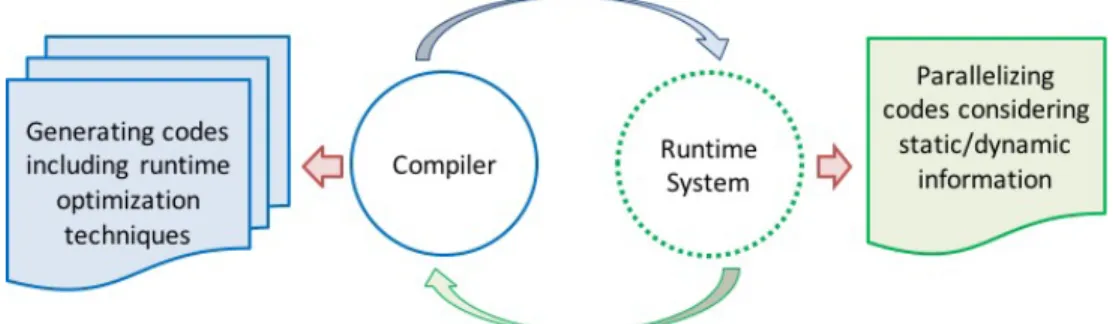
As it can be seen, the main motivation of this work is to develop a framework that utilizes both static and dynamic information about the system to make proper optimizations. As it is shown in Fig. 1.1, in this framework, both the compiler and the runtime exchange parameters that can be used to optimize their performance and achieve a safe parallelization. These optimizations are discussed briefly in the following subsections.
FIGURE 1.1. The main motivation of this work is to develop a framework that utilizes both static and dynamic information about the system to make proper optimizations. In this framework, both the compiler and the runtime exchange parameters that can be used to optimize their performance and achieve a safe parallelization.
1.2 Improving OP2 Compiler with HPX Runtime System
In Chapter 2, we propose different optimization methods that provide dynamic information for the code generated by the OP2 compiler. In that Chapter, we present the implementation of OP2 compiler that employs the proposed runtime techniques implemented using HPX to efficiently and automatically parallelize the dynamic applications. We show the algorithmic and implementation improvements using HPX in OP2 to hide the communication latencies and to achieve a desired scalability.
To our knowledge, we present a first attempt of redesigning OP2 to utilize the runtime tech-niques for improving performance of the parallel unstructured grid applications. The combination of these proposed techniques should yield a more portable and performant software stack for unstructured grid applications and enable the applications to properly scale to a higher level of parallelism compared to the existing OP2 implementation. The proposed optimization methods implemented in the developed framework can be summarized as follow:
1. Asynchronous task execution. 2. Dynamically setting chunk sizes. 3. Interleaving different loops together. 4. Prefetching data before its actual access
This hybrid framework provides the sufficient information for parallelizing an application to properly scale to a higher level of the parallelism compared to the existing OP2 implementation by combining task-based parallelism, grain size control, and prevalently asynchronous execution. The results in section 2.5 show that the parallelization performances are improved by around
40−50% for an Airfoil application compared to using current version of an OP2. We briefly discuss these optimizations in the subsequent sub-sections.
1.2.1 Asynchronous Task Execution
One of the performance optimizations achieved in this research is enabling OP2 to provide the asynchronous task execution by using HPX. In the current OP2 design, OpenMP is used for par-allel processing within a node and MPI is used for communication between different nodes. In these models, an implicit global barrier is present after each loop parallelization with OpenMP during thread synchronization [13]. Additionally, in MPI, there is an explicit barrier after nearly every step of the communication between different nodes. These two local and global synchro-nization barriers imposed by the programming models of OpenMP and MPI causes the parallel threads and processes to wait and results in impeding optimal parallelization. A closer analysis on the couple of unstructured applications reveals that only synchronization between small tasks are needed. So there is no need to wait for all computations and processes to be executed completely before going to the next steps.
Inblocking communicationapplied using“MPI_ Send()”and“MPI_ Recv()”, each node must
complete its current process before it can continue to the next step. On the other hand, in
non-blocking communicationapplied using“MPI_ Isend()”and“MPI_ Irecv()”, the communications
are not blocked even if the current process is not yet completed, which allows the other works to proceed. However,“MPI_ Wait()”or “MPI_ Probe()” should be used within this method to
confirm whether the communications are completed, which avoids achieving optimum scaling. Another problem in using MPI is related to granularity, which is defined as the amount of the
help in achieving better load balancing [14, 15], while on the other hand, coarse-grained tasks have large amount of computations. In MPI, the coarse-grained tasks are often chosen to obtain an optimal efficiency [16], but leads to load imbalances. Integrating OpenMP into MPI is ex-pected to increase the parallel performance, however the overheads added by loop scheduling and synchronization in OpenMP [17] in addition to creating unnecessary synchronization barriers and load imbalance issues mentioned above inhibit the promised speedup [16, 18].
In this research, HPX is used for both communication between different nodes and parallel pro-cessing within each node. It provides the dynamic parallel framework, which can easily optimize the parallelization of an unstructured grid applications. Thef utureconstruct used in HPX allows the system to start working on the next time step instead of waiting for all computations to be completed [19], which relaxes the global barriers, improves the parallel performance and enables an application to be executed asynchronously.
1.2.2 Dynamically Setting Chunk Sizes
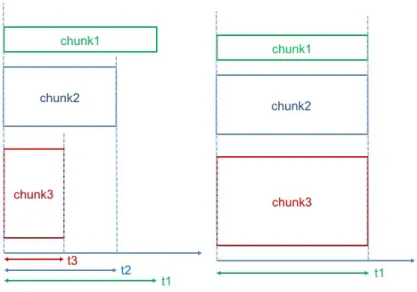
HPX is able to dynamically control the chunk size during the execution by automatically setting amount of work spawned by each chunk. This optimization can be used for dynamically determin-ing efficient chunk sizes of the loops generated by the OP2 compiler. Moreover, the new execution policy is proposed is this research that helps OP2 to make all chunk sizes of different dependent loops having same execution time, which decreases the waiting time between the chunks in those loops for obtaining better execution time. This method is discussed in more details in section 2.4.3.2.
1.2.3 Interleaving Loops Together
Usingf uture-based techniques in HPX enables threads to continue their executions without wait-ing for the results of the previous steps to be completed, which eliminates unnecessary implicit global barrier. The new future based task execution technique is proposed in this research that
enables OP2 to interleave different loops together at runtime by assigning output of each loop to a f uture and passing loop inputs as f utures as well. As a result, if the loops are not
de-pendent on each other, they can be executed without waiting for the previous loops to complete their tasks, however, if they depend on the results of the previous loops, they will wait until the previous loops complete their processes, which removes the unnecessary barrier synchronizations between different loops. So HPX enables highly efficient parallelization compared to the existing equivalent applications. The main advantage of this method is minimizing total synchronization by rescheduling overheads and executing function asynchronously. This method is discussed in more details in section 2.4.3.
1.2.4 Prefetching Data Before Its Actual Access
Although HPX increases the on-node parallelism available to the user, however it results in in-creasing complexity of the memory hierarchies. One of the solutions to this problem is data prefetching, which effectively reduces the memory accesses latency [20, 21]. Thereby, the new cache prefetcher used in HPX is introduced to aid prefetching data in each time step before its actual access is executed. This method is implemented in such a way that data of the next iteration step is prefetched into the cache memory using prefetching iterator called in each iteration within a loop. The main difference between this method and the other existing methods is that HPX im-plementation combines a thread based prefetching method with the asynchronous task execution, which results in having asynchronous execution while prefetching data of all the containers within a loop. This method is discussed in more details in section 3.4.4.3.
1.3 Improving HPX Runtime System with Clang Compiler
• In [22, 23] different policies for executing HPX parallel algorithms are studied. These poli-cies should be manually selected for each algorithm within an application, which may not be an optimum approach.
• Determining chunk size is another challenge in the current HPX algorithms. Chunk size is the amount of work performed by each task [19, 24] that is determined by either an
auto-partitionerexposed by the HPX algorithms or is passed as an execution policy’s parameter
1. the experimental results in [25] and showed that the overheads of determining chunk size usingauto_partitionerfor some of the loops negatively effects the application’s
scalability;
2. on the other hand, thestatic/dynamic_chunk_size should be chosen by a user, which
he/she may not know the optimum one and it can be achieved only by running appli-cation with different values of the chunk sizes and selecting the efficient one [22].. • In addition to these challenges, in the prefetching method proposed in [26], a distance
be-tween each two prefetching operations should also be manually chosen by a user for each new program.
Automating these mentioned parameters selections by considering loops characteristics imple-mented in a learning model can optimize the HPX parallel applications performances. In Chapter 3 a new technique is proposed that enables HPX runtime system to select its parallel algorithms parameters at runtime by implementing machine learning algorithm on the extracted static and dynamic information. In that proposed technique, the static information about the loop body col-lected by the compiler and the dynamic information as provided by the runtime system is used to a learning model enabling a runtime decision to obtain highest possible performance of the loop under consideration. The presented method relies on a compiler-based source-to-source transfor-mation, that transform a code and instructs the runtime system to apply a learning model to select either an appropriate code path (e.g. parallel or sequential loop execution) or certain parameters for the loop execution itself (e.g. chunk size or prefetching distance).
To the best of our knowledge, we present a first attempt in implementing learning models for predicting loop’s parameters at runtime, in which designing these runtime techniques and capturing learning model’s features are automatically performed at compile time. These proposed optimization methods discussed in Chapter 3 can be summarized as follow:
2. Determining efficient chunk size.
3. Determining efficient prefetching distance.
Our results show that combining machine learning, compiler optimizations and runtime adap-tation helps us to maximally utilize available resources. The evaluated results discussed in Sec-tion 3.5 shows that these proposed techniques improve the parallel performance performance by around 12% −35% for the Stream, Stencil, Matrix Multiplication and NBody application compared to setting their HPX loop’s execution policy/parameters manually or using HPX auto-parallelization techniques. We briefly discuss these optimizations in the subsequent sub-sections.
1.3.1 Determining Efficient Execution Policy
In order to predict the optimum execution policy (sequential or parallel), we implement a binary logistic regression model [27] with HPX which analyzes extracted information of a loop. This model deals with the problems in which their outputs can only be two different types, F alse or T rue. This method estimates the probability of the occurrence of each of these outputs by applying learned weights on a given characteristics set of a new loop. For implementing this learning model on a loop at runtime, we introduce a new HPX execution policypar_if that makes
runtime system to decide whether executes loop in sequential or in parallel. This technique is implemented by considering loop’s characteristics extracted with a Clang compiler and weights values learned with a binary logistic regression model. This method is discussed in more details in section 3.4.4.1.
1.3.2 Determining Efficient Chunk Size
In order to predict the optimum chunk size, we implemented a multinomial logistic regression model [27] with HPX which analyzes extracted information of a loop. This model can be con-sidered as an extension of the binary logistic regression model that allows considering problems with more than two categories. It deals with multiclass problems to predict the output of a new application by computing probabilities of the occurrence of each different classes. For
imple-menting this learning model on a loop at runtime, we introduce a new HPX execution policy parameteradaptive_chunk_sizethat makes runtime system to choose an efficient chunk size for a
loop. This technique is implemented by considering loop’s characteristics extracted with a Clang compiler and weights values learned with a multinomial logistic regression model. This method is discussed in more details in section 3.4.4.2.
1.3.3 Determining Efficient Prefetching Distance
Same as determining efficient chunk size, a multinomial logistic regression model is used here for determining efficient prefetching distance. For implementing this learning model on a loop at runtime, we introduce a new HPX execution policymake_prefetcher_policy that makes runtime
system to choose an efficient prefetching distance for a loop. This technique is implemented by considering loop’s characteristics extracted with a Clang compiler and weights values learned with a multinomial logistic regression model. This method is discussed in more details in section 3.4.4.3.
1.4 Future Plan of Study
• In this research we intend to improve the performance of the code generated with OP2 compiler by delaying some optimizations into the runtime and controlling some parameters of the tasks dynamically. Although the experimental results of theses OP2 optimizations show an improvement in an application scalability, however all of these techniques are proposed for implementing parallelization in one node, not on the distributed one. Including dynamic information and runtime techniques in the distributed OP2 optimizations can result in achieving higher performance from distributed unstructured grids applications.
• Moreover, we developed new techniques that are able to implement a logistic regression on a loop to determine an optimum execution policy, chunk size and prefetching distance for an HPX loop. These techniques are able to consider both static and dynamic features of a loop and to implement a learning technique at runtime to make an optimum decision for its execution without requiring extra compilation. As powerful as these techniques may be,
more work is needed to be done in order to fully realize the potential of this work. Notably, the breadth of performance characteristics needs to be more carefully studied to understand the core features that relate to performance. Additionally more research is needed to ensure that the characteristics measured here also are relevant for other architectures such as the new Knights Landing chipset.
Chapter
2
OP2 Optimization with Runtime Parallelization
Techniques
Increasing number of processors results in increasing amount of data exchanged between main memory and processors, which produces the overheads and avoids achieving desired parallelism level in an application. Optimizations techniques provided with OP2 compiler address this chal-lenge and are able to improve parallelization performance. OP2 is able to examine the specific sections of an application’s code for studying its parallelization potentials by considering its data dependencies. However, all of the information captured from these analysis are static and no dynamic information can be retrieved from them. So they are insufficient for obtaining desired scalability. To achieve better parallel performance with OP2 on modern multi-core/many-core hardware, some optimizations should be applied to intensify OP2’s parallelization techniques, which are obtained in this research by delaying some compiler optimizations to be managed at runtime. The main goal in this chapter1 is to show the OP2 compiler scalability improvement by using the proposed optimization methods implemented with the HPX, a C++ runtime system, to obtain a better parallelization performance. It is illustrated that the use of HPX’s parallelization methods instead of OpenMP helps avoiding unnecessary synchronization barriers that results in extracting more parallelism for the parallel applications.
In this chapter, we propose a new technique that implementing it on an OP2 compiler makes it to provide asynchronous tasking, loop interleaving, dynamic chunk sizing, and data prefetching
1Parts of this chapter have been previously published as: Z. Khatami, H. Kaiser, and J.
Ra-manujam, "Using hpx and op2 for improving parallel scaling performance of unstructured grid applications, ” in Parallel Processing Workshops (ICPPW), 2016 45th International Conference on. IEEE, 2016, pp. 190-199, Reprinted by permission. Z. Khatami, H. Kaiser, and J. Ramanujam, "Redesigning op2 compiler to use hpx runtime asynchronous techniques,” in Parallel and Dis-tributed Scientific and Engineering Computing (IPDPSW), 2017 18th IEEE International Work-shop on. IEEE, 2017, Reprinted by permission. Both reprinted by permission IEEE.
to improve a parallel performance of the unstructured grids applications. It is illustrated that dy-namic information obtained at runtime and static information obtained at compile time are both necessary to provide sufficient optimizations for optimal performance.
2.1 Introduction
Unstructured grids are well studied and utilized in various applications such as dense/sparse lin-ear algebra, spectral methods, N-body methods [26], and Monte Carlo. The main goal of OP2 in to provide a scalable framework for these applications parallel execution targeted on different multi-core/many-core hardware architectures [1, 2]. OP2 is able to provide an abstraction level for a user to parallelize his applications without having to worrying about architecture specific op-timizations. So he can invest most of his time in solving his scientific problems, without knowing details of the applied architectures and achieving efficient utilization of the available hardware re-sources. This framework is designed to achieve the near-optimal scaling on multi-core processors [3, 4]. However, as the compiler only has a static and defined access pattern [5–7], its analysis is not enough to obtain desired parallel scalability. In order to reach this goal, OP2 needs to be able to involve dynamic techniques in its parallelization techniques and to extract parallelism automatically at runtime.
In this research, we propose different optimization methods that provide dynamic information for code generated by the OP2 compiler, including providing asynchronous task execution, in-terleaving different loops together, dynamically setting chunk sizes of different dependent loops based on each other, and prefetching data. These proposed techniques are implemented using HPX runtime system via redesigning the OP2 framework in a way that employs both compiler’s static analysis and dynamic runtime information. HPX is a parallel C++ runtime system that fa-cilitates distributed operations and enables fine-grained task parallelism resulting in a better load balancing [28, 29]. It provides an efficient scalable parallelism by significantly reducing processor starvation and effective latencies while controlling overheads [30].
A closer analysis of unstructured applications reveals that synchronization is only required between small tasks. Prevalent parallelization paradigms, however, coerce users to join all tasks together before proceeding to the next step in the application. In HPX, we can utilize thef uture construct to allow every task to proceed as long as the values it depends on are ready [31].This feature allows the HPX to relax the global barriers, enable flexibility, and improve the parallel performance of applications. In this research, HPX uses f utures based techniques to develop a new task execution strategy for codes generated by the OP2 compiler which is the basis for asynchronous tasking and interleaving loops.
In order to control the overheads introduced by the creation of each task, it is important to control the amount of work performed by each task. This amount of work is known as thechunk size[19, 31]. In addition, to properly interleave loops it is important for each loop to have very similar execution times which allows the waiting time between the execution of each loop to be minimal. We propose to address these two obstacles by creating a new execution policy which will dynamically control the chunk sizes during the application’s execution. In addition, we also propose to create a new cache prefetcher that aids in prefetching data for each time step to reduce memory accesses latencies. This method is implemented in such a way that data of the next iteration step is prefetched into the cache memory using a prefetching iterator called in each iteration within a loop. The main difference between this method and the other existing methods is that HPX implementation combines a thread based prefetching method with the asynchronous task execution, which results in having asynchronous execution while prefetching data of all the containers within a loop.
To our knowledge, we present a first attempt of redesigning OP2 to utilize the runtime tech-niques for improving performance of the parallel unstructured grid applications. The combination of these proposed techniques should yield a more portable and performant software stack for unstructured grid applications and enable the applications to properly scale to a higher level of parallelism compared to the existing OP2 implementation. The results evaluated in Section 2.5
show that the parallelization performances are improved by around40−50%for an Airfoil ap-plication.
The remainder of this chapter is structured as follows: Section 2.2 briefly introduces OP2; Sec-tion 2.3 introduces the future and dataflow object in HPX; Section 2.4 the results from porting parallel simulation backend of OP2 to utilize HPX are studied as well as the details of implement-ing hpx::for_each, HPX asynchronous task execution methods, dataflow with a new execution policy, and the proposed prefetching method on an Airfoil application, and Section 2.5 evaluates the scaling speedup of the experimental tests. The conclusions and the future works can be found in Section 2.6.
2.2 Op2
OP2 is an active library that provides a parallel execution framework for unstructured grid applica-tions on different multi-core/many-core hardware architectures [1]. It utilizes a source-to-source translator for generating code which targets different hardware configurations [2, 3, 32]. OP2 pro-vides C/C++ and a Fortran API that translates an application into targeted back-end hardware implementation. The code can be transformed easily into different configurations such as serial, multi-threaded using OpenMP and CUDA, or heterogeneous which utilizes MPI, OpenMP, and CUDA [3]. Its goal is to decouple a scientific aspects and specifications of an application from its parallelization to help achieving near-optimal performance.
In general, OP2 splits an application into two parts:
1. Higher application level: Users can concentrate more on writing their code and solving their problems that will be the same and unchanged for different underlying hardwares.
2. Lower implementation level: This level optimizes an application execution process targeted different platform by analyzing data access patterns.
As a result, a user applies the same API statements for the functions calls while the generated code with OP2 is able to utilize the available resources of a target architecture efficiently. This methodology makes OP2 to be able to support for any future novel hardware architectures.
In this section, we first walk through a simple OP2 code to show its implementation details and then we introduce the Airfoil application which is used as a case study for this research.
2.2.1 Simple Code Implementation with OP2
This section generally shows how unstructured grids are defined with OP2. The OP2 API handles the data dependencies by providing mesh represented data layouts. The provided framework is defined based on sets, data on sets, mapping connectivity between the sets, and the computation on each set [2, 33]. Sets can be nodes, edges or faces. In these unstructured grids, the connectivity information is used to specify different mesh topologies. Figure 2.1 shows a mesh example that includes nodes and faces as sets. The value of data associated with each set is shown below each set and the mesh is represented by the connections between them.
FIGURE 2.1. The mesh represented data layouts provided with OP2.
OP2 API for the mesh in figure 2.1 is shown as follows, which is the C/C++ API and defines 4 edges, 8 boundary edges and 9 nodes:
o p _ s e t n o d e s = o p _ d e c l _ s e t ( 9 ," n o d e s ") ; o p _ s e t e d g e s = o p _ d e c l _ s e t ( 4 ," e d g e s ") ; o p _ s e t b e d g e s = o p _ d e c l _ s e t ( 8 ," b e d g e s ") ;
The mapping that declares the connection between2nodes is defined as follow:
i n t edge_map [ 2 8 ] = { 0 , 1 , 1 , 2 , 2 , 5 , 5 , 4 , 4 , 3 , 3 , 6 , 6 , 7 , 7 , 8 , 0 , 3 , 1 , 4 , 4 , 7 , 5 , 8 }
op_map p e d g e = o p _ d e c l _ m a p ( e d g e s , n o d e s , 2 , edge_map , pedge ," p e d g e ") ;
Also the following mapping declares how4nodes are mapped on1face:
i n t f a c e _ m a p [ 1 6 ] = { 0 , 1 , 4 , 3 , 1 , 2 , 5 , 4 , 3 , 4 , 7 , 6 , 4 , 5 , 8 , 7 } ;
op_map p f a c e = o p _ d e c l _ m a p ( f a c e s , n o d e s , 4 , f a c e _ m a p ," p f a c e ") ;
The values of each node and face are assigned as follow:
f l o a t v F a c e s [ 4 ] = { 0 . 1 2 3 , 0 . 1 5 1 , 0 . 4 2 0 , 0 . 1 1 2 } ;
o p _ d a t d a t a _ f a c e s = o p _ d e c l _ d a t ( f a c e s , 1 ," f l o a t ", v F a c e s ," d a t a _ f a c e s ") ;
f l o a t vNodes [ 9 ] = { 5 . 3 , 1 . 2 , 0 . 2 , 3 . 4 , 5 . 4 , 6 . 2 , 3 . 2 , 2 . 5 , 0 . 9 } ;
o p _ d a t d a t a _ n o d e s = o p _ d e c l _ d a t ( n o d e s , 1 ," f l o a t ", vNodes ," d a t a _ n o d e s ") ;
For this simple example assume that we want to update the value of allfaces with summing values of its surrounding4nodes. The simple loop for this implementation is shown as follow:
f o r(i n t i = 0 ; i < n u m b e r _ o f _ f a c e s ; i ++) {
f a c e s [ i ] = f a c e s [ i ] + n o d e [ f a c e s [ 4∗i ] ] + n o d e [ f a c e s [ 4∗i + 1 ] ] + n o d e [ f a c e s [ 4∗i + 2 ] ] + n o d e [ f a c e s [ 4∗i + 3 ] ] ;
This loop can be implemented in parallel by callingop_par_loopas follow and passingsumas a user’s kernel function as its first arguments:
o p _ p a r _ l o o p _ s u m (" sum ", c e l l s , o p _ a r g _ d a t ( f a c e s ,−1 , OP_ID , 1 ," f l o a t ", OP_WRITE ) , o p _ a r g _ d a t ( f a c e s ,−1 , OP_ID , 1 ," f l o a t ",OP_READ ) , o p _ a r g _ d a t ( n o d e s , 0 , p f a c e , 1 ," f l o a t ",OP_READ ) , o p _ a r g _ d a t ( n o d e s , 1 , p f a c e , 1 ," f l o a t ",OP_READ ) , o p _ a r g _ d a t ( n o d e s , 2 , p f a c e , 1 ," f l o a t ",OP_READ ) o p _ a r g _ d a t ( n o d e s , 3 , p f a c e , 1 ," f l o a t ",OP_READ ) ) ;
Each argument passed to each loop is generated based on data values used withop_arg_dat. These arguments are explicitly indicated that how each of the underlying data can be accessed in-side a loop:OP_READ(read only),OP_WRITE(write) orOP_INC(increment to avoid race
con-ditions due to indirect data access) [1]. For example, inop_arg_dat(nodes,0,pface,1,"double",OP_READ)
, OP_READmarks the data asread_only. This argument is created from its inputs, wherenodes
is the data,0indicates that the data is accessed indirectly and it is the first index value on a face,
pfaceis the mapping between the data,1is the data dimension, andfloatis the data type.
There are two different kinds of loop defined in OP2:indirectanddirectloops. A loop is an indirectloop if data is accessed through a mapping. Otherwise it is adirectloop. Using map as a third argument in anop_par_loopindicates indirect accessed argument and usingOP_ID indi-cates directly accessed argument. The more details about OP2 design and performance analysis can be found in [1] and [33], which shows that all unstructured grid applications can be easily de-scribed with sets and meshes as shown in the above example. These methods place no restriction on the algorithm and they allow the programmer to choose unique operations on each set.
o p _ p a r _ l o o p _ s a v e _ s o l n (" s a v e _ s o l n ", c e l l s , o p _ a r g _ d a t ( p_q ,−1 , OP_ID , 4 ," d o u b l e " ,OP_READ ) , o p _ a r g _ d a t ( p _ q o l d ,−1 , OP_ID , 4 ," d o u b l e " , OP_WRITE ) ) ; o p _ p a r _ l o o p _ a d t _ c a l c (" a d t _ c a l c " , c e l l s , o p _ a r g _ d a t ( p_x , 0 , p c e l l , 2 ," d o u b l e " ,OP_READ ) , o p _ a r g _ d a t ( p_x , 1 , p c e l l , 2 ," d o u b l e " ,OP_READ ) , o p _ a r g _ d a t ( p_x , 2 , p c e l l , 2 ," d o u b l e " ,OP_READ ) , o p _ a r g _ d a t ( p_x , 3 , p c e l l , 2 ," d o u b l e " ,OP_READ ) , o p _ a r g _ d a t ( p_q ,−1 , OP_ID , 4 ," d o u b l e " ,OP_READ ) , o p _ a r g _ d a t ( p _ a d t ,−1 , OP_ID , 1 ," d o u b l e " , OP_WRITE ) ) ;
FIGURE 2.2. The OP2 API functionsop_par_loop_save_soln and op_par_loop_adt_calc repre-sent two loops from an Airfoil application. op_par_loop_save_soln creates a direct loop and
op_par_loop_adt_calccreates anindirectloop.
2.2.2 Airfoil Application
In this research, we study an Airfoil application, which is a standard unstructured mesh, fi-nite volume, computational fluid dynamics (CFD) code, presented in [34], for the turbomachin-ery simulation and consists of over 720K nodes and about 1.5 million edges. As described in [34] and [25], it has both direct and indirect loops. We demonstrate direct and indirect loops in figure 2.7, which includes op_par_loop_save_soln and op_par_loop_adt_calc loops from Airfoil: op_par_loop_save_soln is a directloop that appliessave_soln on the cells based on the p_q and p_qold arguments, and op_par_loop_adt_calc is an indirect loop that applies
op_par_loop_adt_calc on the cells based on p_x,p_q, and p_adtarguments passed to the loop. All of the computations on each set are implemented within these loops by performing operations of the user’s kernels defined in a header file for each loop:save_soln.hforop_par_loop_save_soln
andadt_calc.hforop_par_loop_adt_calc. More details can be found in [2] and [32].
OP2 framework is designed to obtain an optimum scaling on multi-core processors [3, 4]. How-ever, as all of its analysis information are static [5–7], so they are not enough to achieve desired parallelism level. For this purpose, OP2 needs to be able to extract parallelism automatically at runtime. This challenge is addressed in this research by delaying some compiler optimizations to be managed at runtime. In this chapter, we propose different optimization methods that
pro-vide dynamic information for the parallelization techniques propro-vided by the OP2 compiler. These techniques makes an OP2 to provide asynchronous task execution, interleaving different loops together, dynamically setting chunk sizes of different dependent loops based on each other, and prefetching data. These proposed techniques are implemented using HPX runtime system via re-designing the OP2 framework in a way that employs both compiler’s static analysis and dynamic runtime information. The evaluation results in section 2.5 illustrate that HPX’s parallelization methods helps eliminating unnecessary synchronization barriers and enables OP2 to extract more parallelism for the parallel unstructured grids applications. In the next section, we briefly dis-cuss about how HPX provides the scalable framework that reduces the synchronizations and the latencies for implementing these proposed methods.
2.3 HPX
The ParalleX execution model [35, 36] addresses the challenges using conventional parallel tech-niques by implementing new forms of fine-grain task parallelism and enabling light weight syn-chronized message driven computation in a global address space. Its main goal is to improve efficiency and scalability compared to the conventional programming practices such as MPI. This goal is achieved in ParalleX model by reducing synchronization and increasing resource utiliza-tion through providing asynchronizautiliza-tion and employing adaptive scheduling.
HPX is the first implementation of ParallelX model and it is a parallel C++ runtime system that facilitates distributed operations and enables fine-grained task parallelism resulting in a better load balancing [28, 29]. It provides an efficient scalable parallelism by significantly reducing processor starvation and effective latencies while controlling overheads [30]. HPX [19] helps overcoming difficulties faced using conventional techniques by exposing a programming model that intrinsically reduces the SLOW factors [22, 37]. SLOW represents the main factors which inhibit the scalability of applications and they can be described as follow:
A. Starvation: poor utilization of the resources caused by a lack of available work. B. Latencies: time-distance delay of accessing remote resources.
C. Overhead: costs for managing parallel actions.
D. Waiting: costs imposed by oversubscription of the shared resources.
Also, HPX uses the light-weight threads, which have extremely short context switching times that results in reduced latencies even for very short operations.
Concurrency is defined to have several simultaneously concurrent computations touching same data, while on the other hand, by parallelism we refer to simultaneous execution of independent tasks [19]. HPX’s design focuses on parallelism rather than concurrency. As a results, HPX is able to expose both time and spatial parallelization [37], which enables asynchronous task execution.
In this research different dynamic optimizations are proposed for improving the performance of code generated by the OP2 compiler that are implemented using HPX runtime system, which has been developed to overcome limitations such as global barriers and poor latency hiding [29, 30] by embracing new ways of coordinating parallel execution, controlling synchronization, and im-plementing latency hiding utilizing Local Control Objects (LCO) [25, 38]. These objects have the ability to create, resume, or suspend a thread when triggered by one or more events. LCOs pro-vide traditional concurrency control mechanisms such as various types of mutexes, semaphores, spinlocks, condition variables and barriers in HPX. These objects improve the efficiency of an application by permitting highly dynamic flow control as they organize the execution flow, omit global barriers, and enable thread execution to proceed as far as possible without waiting. More details about LCO design and its performance can be found in [22, 30, 39].
The two implementations of LCOs most relevant to this research are thef utureconstruct and the dataflowtemplate. HPX provides a multi-threaded, message-driven, split-phase transaction, and distributed shared memory programming model usingf uturesanddataflowbased synchro-nization on the large distributed system architectures, which are explained in the following sec-tions.
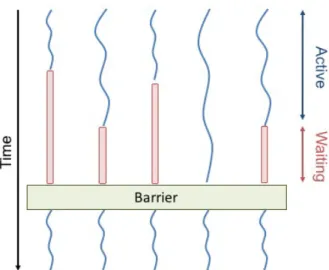
FIGURE 2.3. The global barrier prevents the progress of computation until all threads reaches that barrier.
2.3.1 Future
One of the main challenges faced in the conventional parallelization techniques is the existence of the implicit or explicit global barriers. This barrier prevents the progress of computation until all threads reaches that barrier. Then the reduction will be performed on one of those threads as shown in Fig. 2.3. HPX solves this challenge by eliminating unnecessary global barriers with implementingf uture-based parallelization techniques.
f uture is a computational result that is initially unknown but becomes available at a later time [31]. The goal of usingf utureis to let every computation proceed as far as possible. Using f utureenables threads to continue their executions without waiting for the results of the previous steps to be completed, which eliminates the implicit global barrier at the end of the execution of an OpenMP parallel loop.f uture based parallelization provides the rich semantics for exploit-ing higher level parallelism available within each application that may significantly improve its scalability.
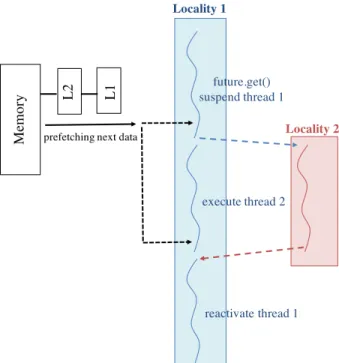
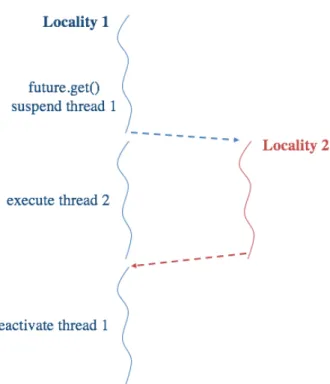
Figure 3.7 shows the scheme of thef uture performance with 2localities, where alocalityis a collection of processing units (PUs) that have access to the same main memory. It illustrates that the other threads do not stop their progress even if the thread, which waits for the value to be computed, is suspended. Threads access a f uturevalue by performing f uture.get(). When the
FIGURE 2.4. The principle of the operation of thef uture in HPX. Thread1is suspended only if the results from locality 2 are not readily available. Thread 1 accesses the f uture value by performingf uture.get(). If results are available, Tread1continues to complete the execution. result becomes available, thef utureresumes all HPX suspended threads waiting for that value. It can be seen that this process eliminates the global barrier synchronizations, as only those threads that depend on the f uture value are suspended. With this scheme, HPX allows asynchronous execution of the threads.
2.3.2 Dataflow Object
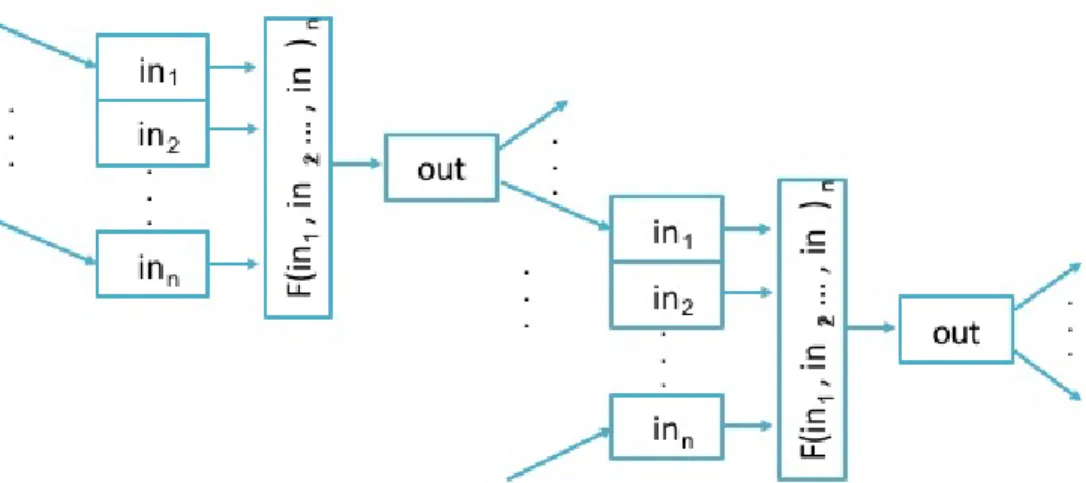
dataflow object provides a powerful mechanism for managing data dependencies without the use of global barriers [28, 40]. Figure 2.5 shows the schematic of adataflow object, which en-capsulates a function F(in1, in2, ..., inn)with n future or non-future inputs from different data
resources. If an input is a future, then the invocation of the function will be delayed. Non-future inputs are passed through. Adataflowobject waits for a set off uturesto become ready and as soon as the last input argument has been received, the functionF is scheduled for the execution [22]. Because thedataflowobject returns af uture, its result can be fed to other objects in the sys-tem including other dataflows. These chainedf utures, by their nature, represent a dependency
FIGURE 2.5. A dataflow object encapsulates a function F(in1, in2, ..., inn) with n inputs from
different data resources. As soon as the last input argument has been received, the function F is scheduled for an execution.
tree that automatically generates an execution graph. This graph is executed by the runtime system as each nodes dependencies are meet. As a result,dataflowminimizes the total synchronization by scheduling new tasks as soon as they can be run instead of waiting for entire blocks of tasks to finish computation.
2.4 HPX Implementation on an Airfoil application
As described in section 2.2, the Airfoil application [34] uses an unstructured grid and consists of five parallel loops:op_par_loop_save_soln,op_par_loop_adt_calc,op_par_loop_res_calc,
op_par_loop_bres_calc,op_par_loop_update, of whichop_par_loop_save_solnandop_par_loop_update
loops aredirectloops and the others areindirectloops, shown in figure 2.6. Saving old data val-ues, applying computation on each data value and updating them are implemented within these five loops. Each loop iterates over a specified data set and performs the operations with the user’s kernels defined in a header file for each loop:save_soln.h,adt_calc.h,res_calc.h,bres_calc.hand
update.h.
Figure 2.7 demonstrates op_par_loop_save_soln that applies save_soln on the cells based on the arguments generated with op_arg_dat using p_q and p_qold data values. The function
op_arg_dat creates an OP2 argument based on the information passed to it and the function
o p _ p a r _ l o o p _ s a v e _ s o l n (" s a v e _ s o l n ", c e l l s , o p _ a r g _ d a t ( d a t a _ a 0 , . . . ) , . . . , o p _ a r g _ d a t ( d a t a _ a n , . . . ) ; o p _ p a r _ l o o p _ a d t _ c a l c (" a d t _ c a l c " , c e l l s , o p _ a r g _ d a t ( d a t a _ b 0 , . . . ) , . . . , o p _ a r g _ d a t ( d a t a _ b n , . . . ) ; o p _ p a r _ l o o p _ r e s _ c a l c (" r e s _ c a l c " , e d g e s , o p _ a r g _ d a t ( d a t a _ c 0 , . . . ) , . . . , o p _ a r g _ d a t ( d a t a _ c n , . . . ) ; o p _ p a r _ l o o p _ b r e s _ c a l c (" b r e s _ c a l c ", b e d g e s , o p _ a r g _ d a t ( d a t a _ d 0 , . . . ) , . . . , o p _ a r g _ d a t ( d a t a _ d n , . . . ) ; o p _ p a r _ l o o p _ u p d a t e (" u p d a t e " , c e l l s , o p _ a r g _ d a t ( d a t a _ e 0 , . . . ) , . . . , o p _ a r g _ d a t ( d a t a _ e n , . . . ) ;
FIGURE 2.6. Five loops are used inAirfoil.cppfor saving old data values, applying computation, and updating each data value. save_soln and update loops are direct loops and the others are indirectone.
o p _ p a r _ l o o p _ s a v e _ s o l n (" s a v e _ s o l n ", c e l l s , o p _ a r g _ d a t ( p_q ,−1 , OP_ID , 4 ," d o u b l e " ,OP_READ ) , o p _ a r g _ d a t ( p _ q o l d ,−1 , OP_ID , 4 ," d o u b l e ", OP_WRITE ) ) ;
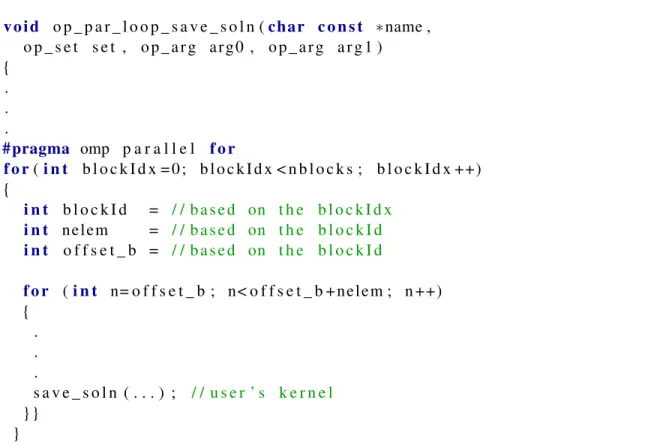
v o i d o p _ p a r _ l o o p _ s a v e _ s o l n (c h a r c o n s t ∗name , o p _ s e t s e t , o p _ a r g a r g 0 , o p _ a r g a r g 1 ) { . . . #pragma omp p a r a l l e l f o r f o r(i n t b l o c k I d x = 0 ; b l o c k I d x < n b l o c k s ; b l o c k I d x ++) { i n t b l o c k I d = / / b a s e d on t h e b l o c k I d x i n t n e l e m = / / b a s e d on t h e b l o c k I d i n t o f f s e t _ b = / / b a s e d on t h e b l o c k I d f o r ( i n t n= o f f s e t _ b ; n< o f f s e t _ b + n e l e m ; n ++) { . . . s a v e _ s o l n ( . . . ) ; / / u s e r ’ s k e r n e l }} }
The loop parsed with OP2 in figure 2.8 illustrates how each cell updates its data value by ac-cessing blockId, offset_b, and nelem data elements. The arguments are passed to the save_soln
user kernel subroutine, which does the computation for each iteration of an inner loop from off-set_btooffset_b+nelemof each iteration of an outer loop from0tonblocks. Also it illustrates that OpenMP is used for the parallel processing within a node. It is important to note that the outputs of the computations shown in figure 2.6 cannot be passed to the outside of the loop, therefore, the current OP2 design doesn’t provide a method for interleaving loops together. This creates im-plicit global barrier after each loop as the threads inside the loop must wait to synchronize before exiting the loop [13]. Barriers, naturally, impede optimal parallelization by causing the parallel threads and processes to wait. In order to solve this problem, this research sets out to optimize the performance of code generated by the OP2 compiler using the HPX runtime, which are three different HPX parallelization methods:
1. using parallelhpx::for_eachfor parallelizing loops generated with OP2,
2. using parallelhpx::for_eachwhile enabling asynchronous task execution, and
3. usingdataflowobject.
The comparison results of these methods with OpenMP are studied in Section 2.5.
2.4.1 hpx::for_each
The recently published C++ Extensions for Parallelism TS [41] specifies a comprehensive set of parallel algorithms for inclusion into the C++ standard library and applies the proven design concepts of the Standard Template Library to the parallel loop executions [19]. Almost all of these parallel algorithms are implemented with HPX, which have been extended to support the full spectrum of execution policies, combined with the full set of executors and executor parameters [37]. HPX provides the higher-level abstractions based on and derived from the current C++ standard.
hpx::for_each is one of the HPX parallel algorithms that is able to automatically control the chunk size during the execution. The auto_partitioner executor exposed by the hpx::for_each
TABLE 2.1. The execution policies defined by the Parallelism TS and implemented in HPX [41].
Policy Description Implemented by
seq sequential execution Parallelism TS, HPX
par parallel execution Parallelism TS, HPX
par_vec parallel and Parallelism TS vectorized execution
seq(task) sequential and HPX asynchronous execution
par(task) parallel and HPX asynchronous execution
algorithm is able to automatically control the amount of work spawned by each chunk by sequen-tially executing1% of the loop. Thereforehpx::for_eachhelps creating sufficient parallelism by determining number of the iterations to be run on each HPX thread. This optimization can be used for dynamically determining efficient chunk sizes of the loops generated withop_par_loop
by OP2. Moreover, HPX is able to execute loops in sequential or in parallel by applying execu-tion_policies, which are briefly described in Table 2.1 [22]. The concept of theexecution_policy
developed in HPX is used to specify the execution restrictions of the work items, in which calling with a sequential execution policy makes the algorithm to be run sequentially and calling with a parallel execution policy allows the algorithm to be run in parallel [38].
In this section, we usepar as an execution policy while executing hpx::for_eachto make the loops shown in figure 2.6 executing in parallel. We modified the OP2 source-to-source transla-tor with Python to automatically producehpx::for_each instead of using #pragma omp parallel for for the loop parallelization. In this method Airfoil.cpp (figure 2.6) and the OP2 API remain unchanged. Figure 2.9 shows the loop ofop_par_loop_adt_calcfunction parsed with OP2 using HPX for the loop parallelization.
It should be considered that if the computational time of a loop is too small, using auto-partitioner algorithm within HPX will not be efficient. Since for the small loops, 1% execu-tion time of the loop used for determining grain size will affect the applicaexecu-tion’s scalability. For solving this problem, HPX provides another way to avoid degrading scalability while using
v o i d o p _ p a r _ l o o p _ s a v e _ s o l n (c h a r c o n s t ∗name , o p _ s e t s e t , o p _ a r g a r g 0 , o p _ a r g a r g 1 ) { . . . a u t o r = b o o s t : : i r a n g e ( 0 , n b l o c k s ) ; hpx : : p a r a l l e l : : f o r _ e a c h ( p a r , / / e x e c u t i o n p o l i c y r . b e g i n ( ) , r . end ( ) , [ & ] ( s t d : : s i z e _ t b l o c k I d x ) { i n t b l o c k I d = / / b a s e d on t h e b l o c k I d x i n OP2 API i n t n e l e m = / / b a s e d on t h e b l o c k I d i n t o f f s e t _ b = / / b a s e d on t h e b l o c k I d f o r ( i n t n= o f f s e t _ b ; n< o f f s e t _ b + n e l e m ; n++ ) { . . . s a v e _ s o l n ( . . . ) ; / / u s e r ’ s k e r n e l } } ) ; }
FIGURE 2.9. Implementing hpx::for_each for the loop parallelization in OP2. HPX is able to control the grain size with this method. As a result, it helps in reducing processor starvation caused by the fork-join barrier at the end of the execution of the parallel loops.
v o i d o p _ p a r _ l o o p _ s a v e _ s o l n (c h a r c o n s t ∗name , o p _ s e t s e t , o p _ a r g a r g 0 , o p _ a r g a r g 1 ) { . . . s t a t i c _ c h u n k _ s i z e s c s ( SIZE ) ; a u t o r = b o o s t : : i r a n g e ( 0 , n b l o c k s ) ; hpx : : p a r a l l e l : : f o r _ e a c h ( p a r . w i t h ( s c s ) , r . b e g i n ( ) , r . end ( ) , [ & ] ( s t d : : s i z e _ t b l o c k I d x ) { i n t b l o c k I d = / / b a s e d on t h e b l o c k I d x i n OP2 API i n t n e l e m = / / b a s e d on t h e b l o c k I d i n t o f f s e t _ b = / / b a s e d on t h e b l o c k I d f o r ( i n t n= o f f s e t _ b ; n< o f f s e t _ b + n e l e m ; n++ ) { . . . s a v e _ s o l n ( . . . ) ; / / u s e r ’ s k e r n e l } } ) ; }
FIGURE 2.10. Implementinghpx::for_each for loop parallelization in OP2. HPX is able to avoid degrading scalability for small loops by defining static grain size with dynamic_chunk_size scs(SIZE)before the parallel loop execution.
before executing loop;scsis defined bystatic_chunk_size scs(SIZE). Figure 2.10 shows the loop of op_par_loop_adt_calc function with static chunk_size implemented with static_chunk_size scs(SIZE). In section 2.5 the performance of these two methods are studied.
So, what we achieve here by implementinghpx::for_eachwithin the loop execution is enabling compiler to control the chunk sizes dynamically. However, this method exposes the same dis-advantage as OpenMP implementation, which is representation of the fork-join parallelism that introduces the global barriers at the end of a parallel loop. In the next sections, we show how we overcome to this problem.
2.4.2 asyncandhpx::for_each
In this section we solve the problem described in the previous section by using asynchronous task execution while controlling chunk sizes dynamically within the loop executions. Asynchronous task execution means that a new HPX-thread will be scheduled. As a result it eliminates the global barrier synchronizations when usinghpx::for_each. For this purpose, we implement two different parallelization methods for the loops, based on their types:
1. For the directloops, async and hpx::for_each with par as an execution policy is imple-mented.
2. For theindirectloops,hpx::for_eachwithpar(task)as an execution policy is implemented.
The calls toasyncandpar(task)provide a newf utureinstance, which represents the result of the function execution, making invocation of the loop asynchronous.futurebased parallelization provides rich semantics for exploiting higher level parallelism available within each application that may significantly improve the scaling.
OP2 source-to-source translator with Python is modified and it automatically producesasync
and hpx::for_each with par for each direct loops and hpx::for_each with par(task) for each indirectloops within an Airfoil application. For example, in figure 2.11,asyncandhpx::for_each
withparis used forop_par_loop_save_soln, which is adirectloop and returns af uture repre-senting result of a function. Also, in figure 2.12,hpx::for_eachwithpar(task)is used for
op_par_loop_adt_calc, which is an indirectloop and returns a f uture representing result of a function. Thefutures returned from alldirectandindirectloops allow asynchronous execution of the loops. In this method, OP2 API is not changed butAirfoil.cppis changed as shown Figure 2.13. Each kernel function within op_par_loop returns a future stored in a new_data. Each fu-turedepends on thefuturein a previous step. So,new_data.get()is used to get allf uturesready before the next steps.
So, what we achieve here by implementingasyncwithin the loop execution is enabling compiler to:
hpx : : s h a r e d _ f u t u r e < o p _ d a t > o p _ p a r _ l o o p _ s a v e _ s o l n ( c h a r c o n s t ∗name , o p _ s e t s e t , o p _ a r g a r g 0 , o p _ a r g a r g 1 ) { . . . r e t u r n a s y n c ( hpx : : l a u n c h : : a s y n c , [ a d t _ c a l c , s e t , a r g 0 , . . . , a r g n 1 ] ( ) { a u t o r = b o o s t : : i r a n g e ( 0 , n t h r e a d s ) ; hpx : : p a r a l l e l : : f o r _ e a c h ( p a r , r . b e g i n ( ) , r . end ( ) , [ & ] ( s t d : : s i z e _ t t h r ) { i n t s t a r t =/ / b a s e d on t h e number o f t h r e a d s ; i n t f i n i s h =/ / b a s e d on t h e number o f t h r e a d s ; f o r ( i n t n= s t a r t ; n< f i n i s h ; n++ ) { s a v e _ s o l n ( . . . ) ; } } ) ; }
FIGURE 2.11. Implementingasyncandhpx::for_eachwithparfor adirectloop parallelization in OP2. The returnedf uturerepresenting result of a function.
hpx : : s h a r e d _ f u t u r e < o p _ d a t > o p _ p a r _ l o o p _ a d t _ c a l c ( c h a r c o n s t ∗name , o p _ s e t s e t , o p _ a r g a r g 0 , o p _ a r g a r g 1 , o p _ a r g a r g 2 , o p _ a r g a r g 3 , o p _ a r g a r g 4 , o p _ a r g a r g 5 ) { . . . a u t o r = b o o s t : : i r a n g e ( 0 , n b l o c k s ) ; hpx : : f u t u r e <v o i d> n e w _ d a t a ; n e w _ d a t a = hpx : : p a r a l l e l : : f o r _ e a c h ( p a r ( t a s k ) , r . b e g i n ( ) , r . end ( ) , [ & ] ( s t d : : s i z e _ t b l o c k I d x ) { i n t b l o c k I d =/ / b a s e d on t h e b l o c k I d x i n OP2 API i n t n e l e m =/ / b a s e d on t h e b l o c k I d i n t o f f s e t _ b =/ / b a s e d on t h e b l o c k I d f o r ( i n t n= o f f s e t _ b ; n< o f f s e t _ b + n e l e m ; n++ ) { . . . a d t _ c a l c ( . . . ) ; } } ) ; r e t u r n n e w _ d a t a ; }
FIGURE 2.12. Implementinghpx::for_each withpar(task)for anindirectloop parallelization in OP2. The returnedf uturerepresenting result of a function.
n e w _ d a t a 1 = o p _ p a r _ l o o p _ s a v e _ s o l n (" s a v e _ s o l n ", c e l l s , o p _ a r g _ d a t ( d a t a _ a 0 , . . . ) , . . . , o p _ a r g _ d a t ( d a t a _ a n , . . . ) ; n e w _ d a t a 2 = o p _ p a r _ l o o p _ a d t _ c a l c _ (" a d t _ c a l c " , c e l l s , o p _ a r g _ d a t ( d a t a _ b 0 , . . . ) , . . . , o p _ a r g _ d a t ( d a t a _ b n , . . . ) ; n e w _ d a t a 2 . g e t ( ) ; n e w _ d a t a 3 = o p _ p a r _ l o o p _ r e s _ c a l c (" r e s _ c a l c " , e d g e s , o p _ a r g _ d a t ( d a t a _ c 0 , . . . ) , . . . , o p _ a r g _ d a t ( d a t a _ c n , . . . ) ; n e w _ d a t a 4 = o p _ p a r _ l o o p _ b r e s _ c a l c (" b r e s _ c a l c ", b e d g e s , o p _ a r g _ d a t ( d a t a _ d 0 , . . . ) , . . . , o p _ a r g _ d a t ( d a t a _ d n , . . . ) ; n e w _ d a t a 3 . g e t ( ) ; n e w _ d a t a 4 . g e t ( ) ; n e w _ d a t a 5 = o p _ p a r _ l o o p _ u p d a t e (" u p d a t e ", c e l l s , o p _ a r g _ d a t ( d a t a _ e 0 , . . . ) , . . . , o p _ a r g _ d a t ( d a t a _ e n , . . . ) ; n e w _ d a t a 1 . g e t ( ) ; n e w _ d a t a 5 . g e t ( ) ;
FIGURE 2.13. Airfoil.cpp is changed while using async and par(task) for loop paralleliza-tion in OP2. new_data is returned from each kernel function after calling op_par_loop and
u s i n g hpx : : l c o s : : l o c a l : : d a t a f l o w ; u s i n g hpx : : u t i l : : u n w r a p p e d ; / / a u t o m a t i c a l l y r e t u r n s t h e a r g u m e n t a s a f u t u r e r e t u r n d a t a f l o w ( u n w r a p p e d ( [ & ] ( d a t a _ a , . . . ) { / / same a s o r i g i n a l o p _ a r g _ d a t r e t u r n a r g ; } } ) , d a t a _ a , . . . ) ;
FIGURE 2.14.op_arg_datis modified to create an argument as af uturethat is passed to a func-tion throughop_par_loopshown in figure 2.6.
Xset the chunk sizes dynamically, and Xproduce an asynchronous loop execution.
The place ofnew_data.get()depends on the application and the programmer should put them manually in the correct place by considering data dependencies between the loops. In order to completely generate a code automatically for implementing this method without using program-mer’s help, we change the OP2 API and we implement a dataf low method in HPX, which is studied in more details in the next section.
2.4.3 Dataflow
In this section, the new method is proposed for parallelizing loops generated with OP2, which is based ondataflowimplementation that solves the current challenges of OP2. In this method, the OP2 API is modified in such a way thatop_arg_datused in each loop in figure 2.6 produces an argument as af uturefordataflowobject inputs. Figure 2.14 shows the modifiedop_arg_dat, in which data_a,...expressed at the last line of the code invokes a function only once all of them get ready.unwrapped is a helper function in HPX, which unwraps thef uturesand passes along the actual results. This implementation also generates an output argument as a f uture and as a result, all of the arguments of each loop in figure 2.6 are passed as af utureto the kernel function throughop_par_loop.
2.4.3.1 Parallelizing Loops Usingfor_each
Parallelizing loops and controlling chunk sizes are implemented by using for_each algorithm and persistent_auto_chunk_size as an execution_policy respectively. In figure 2.15, dataflow is implemented with for_each for the loop in figure 2.8, that aids to parallelize the outer loop. It also illustrates thatarg0andarg1, which are created as af uturewithop_arg_datusingp_qand
p_qoldrespectively, are passed as af uturewithin a loop. This loop will be executed only if these arguments get ready. Then, the output argument, which is arg1in this example, is passed as a f utureto the outside of the loop and it is stored withinp_qoldshown in figure 2.16. This method
is implemented to all of the loops in figure 2.6, and as a result, each kernel function returns an output argument as af uture. The loop execution may depend on the results of the other previous loops. So by this method, the results of the loops can be passed as f uture inputs to the other loops, which makes OP2 able to interleave different loops. For example,p_qoldvalue updated in
op_par_loop_save_solnis used as an input argument forop_par_loop_updateas shown in figure 2.17, which using this proposed method makes it able to interleave this two loops together by passing output ofop_par_loop_save_solnas an input argument forop_par_loop_update.
Figure 2.18 shows generally that by implementing proposed method, thef utureoutput of each loop passed as an input of the other loops makes OP2 able to interleave different loops together at runtime. As a result, if the loops are not dependent on each other, they can be executed without waiting for the previous loops to complete their tasks, however, if they depend on the parameters from the previous loops, they will wait until the previous loops complete their processes. This proposed method removes the unnecessary barrier synchronizations between different loops and execute them asynchronously.
2.4.3.2 Controlling Chunk Sizes
As it is explained in section 2.4.3.1, figure 2.18 shows how dataflow provides a way of inter-leaving execution of different loops together. In a case of having dependent loops, the execution of each chunk in a loop depends on the execution of the chunks in the previous loop. By using
hpx : : s h a r e d _ f u t u r e < o p _ d a t > o p _ p a r _ l o o p _ s a v e _ s o l n (c h a r c o n s t ∗ name , o p _ s e t s e t , hpx : : f u t u r e < o p _ a r g > a r g 0 , hpx : : f u t u r e < o p _ a r g > a r g 1 ) { u s i n g hpx : : l c o s : : l o c a l : : d a t a f l o w ; u s i n g hpx : : u t i l : : u n w r a p p e d ; / / a u t o m a t i c a l l y r e t u r n s o u t p u t a s a f u t u r e r e t u r n d a t a f l o w ( u n w r a p p e d ([& s a v e _ s o l n ] ( o p _ a r g a r g 0 , o p _ a r g a r g 1 ) { . . . a u t o r = b o o s t : : i r a n g e ( 0 , n b l o c k s ) ; hpx : : p a r a l l e l : : f o r _ e a c h ( p o l i c y , r . b e g i n ( ) , r . end ( ) , [ & ] ( s t d : : s i z e _ t b l o c k I d x ) { f o r ( i n t n= o f f s e t _ b ; n< o f f s e t _ b + n e l e m ; n ++) { . . . s a v e _ s o l n ( . . . ) ; } r e t u r n a r g 1 ; } ) , a r g 0 , a r g 1 ) ; }
FIGURE 2.15. Implementingfor_each withindataflowfor the loop parallelization in OP2 for the loop in figure 2.8. It makes the invocation of a loop asynchronous by returning output as af uture.
dataflowallows automatically creating execution graph, which represents a dependency tree.
p _ q o l d = o p _ p a r _ l o o p _ s a v e _ s o l n (" s a v e _ s o l n ", c e l l s , o p _ a r g _ d a t ( p_q ,−1 , OP_ID , 4 ," d o u b l e " ,OP_READ ) , o p _ a r g _ d a t ( p _ q o l d ,−1 , OP_ID , 4 ," d o u b l e " , OP_WRITE ) ) ;
FIGURE 2.16. Airfoil.cpp is changed while using dataflow for the loop parallelization in OP2.
FIGURE 2.17. The proposed method makes OP2 able to interleave thses two loops together by passingp_qoldoutput ofop_par_loop_save_solnas an input argument forop_par_loop_update.
FIGURE 2.18. dataflow provides a way for interleaving execution of different loops together by generating output as af utureand passing all inputs asf utures as well.
![TABLE 2.1 . The execution policies defined by the Parallelism TS and implemented in HPX [41].](https://thumb-us.123doks.com/thumbv2/123dok_us/503941.2559457/35.918.234.679.143.348/table-execution-policies-defined-parallelism-ts-implemented-hpx.webp)