SOEPpapers
on Multidisciplinary Panel Data Research
The Impact of Education
on Personality
–
Evidence from
a German High School Reform
Sarah Dahmann and Silke Anger658
20
1
4
SOEPpapers on Multidisciplinary Panel Data Research at DIW Berlin
This series presents research findings based either directly on data from the German Socio-Economic Panel Study (SOEP) or using SOEP data as part of an internationally comparable data set (e.g. CNEF, ECHP, LIS, LWS, CHER/PACO). SOEP is a truly multidisciplinary household panel study covering a wide range of social and behavioral sciences: economics, sociology, psychology, survey methodology, econometrics and applied statistics, educational science, political science, public health, behavioral genetics, demography, geography, and sport science.
The decision to publish a submission in SOEPpapers is made by a board of editors chosen by the DIW Berlin to represent the wide range of disciplines covered by SOEP. There is no external referee process and papers are either accepted or rejected without revision. Papers appear in this series as works in progress and may also appear elsewhere. They often represent preliminary studies and are circulated to encourage discussion. Citation of such a paper should account for its provisional character. A revised version may be requested from the author directly.
Any opinions expressed in this series are those of the author(s) and not those of DIW Berlin. Research disseminated by DIW Berlin may include views on public policy issues, but the institute itself takes no institutional policy positions.
The SOEPpapers are available at http://www.diw.de/soeppapers Editors:
Jürgen Schupp (Sociology)
Gert G. Wagner (Social Sciences, Vice Dean DIW Graduate Center) Conchita D’Ambrosio (Public Economics)
Denis Gerstorf (Psychology, DIW Research Director) Elke Holst (Gender Studies, DIW Research Director)
Frauke Kreuter (Survey Methodology, DIW Research Professor) Martin Kroh (Political Science and Survey Methodology)
Frieder R. Lang (Psychology, DIW Research Professor) Henning Lohmann (Sociology, DIW Research Professor)
Jörg-Peter Schräpler (Survey Methodology, DIW Research Professor) Thomas Siedler (Empirical Economics)
C. Katharina Spieß (Empirical Economics and Educational Science)
ISSN: 1864-6689 (online)
German Socio-Economic Panel Study (SOEP) DIW Berlin
Mohrenstrasse 58 10117 Berlin, Germany
The Impact of Education on Personality –
Evidence from a German High School Reform
Sarah Dahmann (DIW Berlin)
Silke Anger (IAB Nuremberg, University of Bamberg, IZA)
∗May 6, 2014
Abstract
This paper investigates the short-term effects of a reduction in the length of high school on students’ personality traits using a school reform carried out at the state level in Germany as a quasi-natural experiment. Starting in 2001, academic-track high school (Gymnasium) was reduced from nine to eight years in most of Ger-many’s federal states, leaving the overall curriculum unchanged. This enabled stu-dents to obtain a university entrance qualification (Abitur) after a total of only 12 rather than 13 years of schooling. We exploit the variation in the length of academic-track high school over time and across states to identify the effect of schooling on students’ Big Five personality traits and on their locus of control. Using rich data on adolescents and young adults from the German Socio-Economic Panel (SOEP) study, our estimates show that shortening high school caused stu-dents on average to be more extroverted and less emotionally stable. Our estimates point to important heterogeneous effects. In addition to differences between East and West Germany, we find that male students and students from disrupted fam-ilies showed stronger personality changes following the reform: they became more agreeable and more extroverted, respectively. We conclude that the educational system plays an important role in shaping adolescents’ personality traits.
Keywords: Non-cognitive Skills, Big Five, Locus of Control, Skill Formation, High School Reform
JEL Classification: I21, I28, J24
∗We would like to thank Alexandra Avdeenko, Deborah Anne Bowen, Deborah Cobb-Clark, Thomas
Dohmen, Nabanita Datta Gupta, Peter Kuhn, Philip Oreopoulos, Erik Plug, Mari Rege, David Richter, and seminar participants at DIW Berlin, Maastricht University, NIW Hannover, the Berlin Network of Labor Market Research and the AMCIS Conference “Education Systems” for helpful comments and discussions. Corresponding author: Sarah Dahmann, German Institute for Economic Research (DIW Berlin), Mohrenstr. 58, 10117 Berlin, Germany, Tel: +49-30-89789-461, E-mail: [email protected].
1
Introduction
In recent years, a growing body of literature has emerged on the importance of personality traits as determinants of individual economic and social outcomes.1 Studies investigating the impact of personality on labor market outcomes show that certain characteristics such as emotional stability are rewarded with higher wages, while characteristics such as agreeableness are penalized with lower wages (Heckman et al., 2006; Nyhus and Pons, 2005; Heineck and Anger, 2010). Furthermore, personality has been shown to affect labor market success through occupational sorting (John and Thomsen, 2014) and job search behavior (Caliendo et al., 2014). Not only has personality been linked to specific labor market outcomes; it has also been found to affect educational success, as shown by studies on academic performance (Piatek and Pinger, 2010; Duckworth and Seligman, 2005) and school dropout probability (Coneus et al., 2011). Moreover, research shows that personality traits are at least as important as cognitive skills in determining social outcomes such as criminal behavior, marital stability, and health and mortality (Heckman et al., 2013; Roberts et al., 2007).
While the association between personality traits and economic and social outcomes is widely acknowledged, there is far less empirical economic research on the factors that affect the formation of these non-cognitive skills. The literature has identified two main channels that shape non-cognitive skill formation: nature, referring to the fact that per-sonality is strongly heritable, andnurture, encompassing all environmental factors such as culture, social factors, family background, and individual or situational factors which may influence personality. In their model of skill formation, Cunha and Heckman (2007) argue that it is the interaction of these mechanisms – natureand nurture – that determines skill formation, but that the two channels cannot be disentangled. Their model suggests that the development of skills takes place especially during the early (pre-)educational period in life. This is consistent with the psychology literature, according to which personality traits develop mainly during childhood and adolescence, and remain relatively stable later in life (Costa and McCrae, 1994). As a nurturing factor, education during childhood and
adolescence may therefore constitute a critical determinant in an individual’s long-term formation of personality. Yet, there is little direct evidence on the effect of schooling on personality traits. Most of the research focuses on the United States and investigates interventions targeting children at a relatively young age, such as the Perry Preschool Program, which is aimed at three- to four-year-old preschoolers (Heckman et al., 2013), and the Project STAR (Dee and West, 2008).
In the present paper, we focus on the impact of schooling on personality traits in adolescence. Our research question is threefold: First, we assess whether the educational system, and more specifically a reduction in the length of high school, affects adolescents’ personalities. Second, we examine heterogeneous effects by analyzing which students are most likely to exhibit changes in personality following the changes in the educational system. And finally, we investigate the underlying mechanisms by disentangling various potential channels of impact.
To address these questions, we use a nationwide educational reform carried out in Germany in the 2000s that shortened academic-track high school by one year, reducing the total number of years of school attendance from 13 to 12 years, leaving the overall curriculum unchanged, as an exogenous variation in schooling. We exploit the variation over time and across federal states to analyze causal effects of schooling on students’ personality traits, which are measured by the dimensions of the Big Five personality inventory (Openness, Conscientiousness, Agreeableness, Extraversion, Neuroticism), and locus of control. Using data on adolescents and young adults from the German Socio-Economic Panel (SOEP) study, we find that the reduction in the length of high school by one year led to considerably higher extraversion and lower emotional stability among high school students. Moreover, our estimates point to important heterogeneous effects. While the increase in extraversion was driven by students from non-intact families, the decrease in emotional stability was more pronounced among students in East Germany. Furthermore, male students and students from disrupted families were more agreeable and more open, respectively, following the reform. Children with non-working mothers faced a decline in openness, while students with migration background experienced an
increase in conscientiousness.
We find suggestive evidence that the reform effect is driven by the increased learn-ing intensity, which adversely affects school performance and emotions, and by stronger student-teacher or student-student interactions as a result of longer school days, and not by a change in leisure-time activities. We conclude that the educational system plays an important role in shaping adolescents’ personality traits.
Our paper adds to the existing literature in several ways. First, to the best of our knowledge, this is the first representative study that exploits a nationwide change in the educational system as quasi-natural experiment to analyze the causal effect of education on personality. In contrast to previous studies on the impact of schooling on the mal-leability of personality traits in young people, our treatment is large-scale and not locally restricted, as it affects students from almost an entire country. Second, to identify the causal effects of the educational reform, we exploit variation in schooling over time and across states. The high school reform has been gradually introduced in almost all of Germany’s federal states. Hence, we are able to isolate the causal effect of the change in the educational system from any other potential influential factors or policy changes. Furthermore, we reduce the risk that potential unobserved effects bias our estimates by including students who graduated several years before and after the reform, which enables us to establish a long-lasting effect of the reform rather than an artifact of its implementation. Third, our data provide rich information on individuals’ socio-economic backgrounds, which allows us to examine whether the personalities of particular groups of students were more malleable following the reform. Pre-reform characteristics of students and their families such as migration background, parental education, or household income may affect the ability to cope with reform-induced changes. As a consequence, different students may react differently to the high school reform in terms of both the likelihood of changes in personality traits and the type of personality traits affected. Fourth, by examining the malleability of personality in adolescence, we complement previous studies on skill formation that focused primarily on young children. Evidence on whether per-sonality is malleable even in adolescence is crucial for policy makers who may want to
target individuals who are too old for childhood interventions. Furthermore, educational policy should take potential second-order effects on students into account when imple-menting school reforms. Finally, by investigating effects of education on personality in Germany, we complement the previous largely US-based evidence. Differences in insti-tutional settings between the US and other countries could lead to different processes of skill formation, in which education, family factors, and other determinants of personality may play different roles. By comparing findings for Germany and the US, we are able to draw conclusions on the importance of educational settings for non-cognitive skills.
The next section presents the theoretical background on skill formation and gives an overview of previous research. Section 3 explains the reform and discusses potential effects on adolescents’ personality traits. Section 4 describes the data and the empirical strategy, and Section 5 presents the results. Section 6 elaborates on several robustness checks. Section 7 concludes and discusses the implications of our findings.
2
Theoretical Background and Previous Literature
Personality traits are a significant part of an individual’s non-cognitive skills.2 Both cognitive abilities and non-cognitive skills constitute personal skills, which belong to an individual’s overall human capital. A prominent approach to describe the formation of such skills has been developed by Cunha and Heckman (2007). They propose that an individual’s present skill stock depends on his or her past skill stock, previous investments, and environmental characteristics, according to the following model:
θt+1=ft(θt, It, h) (1)
where a vector of skill stocks at age t+ 1, θt+1, depends in some functional form f(·) on the past vector of skill stocks (with initial endowment θ1), on the investment in period t, It, and on parental, or more generally environmental, characteristics h. In this
model, Cunha and Heckman propose a multiplier effect driven by two mechanisms,
self-2Examples of further non-cognitive skills are trust and (e.g., time or risk) preferences (see, e.g.,
productivity and dynamic complementarity. The former, self-productivity, occurs when skills persist such that higher skills in one period create higher skills in the subsequent period. This is not restricted to one and the same skill, but also applies to cross effects between different skills, and is the case whenever ∂ft(θt, It, h)/∂θt > 0. The latter,
dynamic complementarity, manifests that the productivity of an investment is increasing with higher existing skills and occurs whenever ∂2ft(θt, It, h)/∂θt∂It0 > 0. Cunha and
Heckman (2008) test and verify both propositions empirically. The resulting multiplier effect suggests that investments are most productive in early stages in life, which implies that childhood constitutes a bottleneck period for skill formation.
Several intervention studies have therefore been targeted at children of preschool age. Even though most of these do not focus primarily on improving personality traits, they make it possible to study the impact of education on personality. A prominent example is the Perry Preschool Program, which provided extra classes and teacher visits at home to three- to four-year-olds. The program led to large benefits in later-life outcomes, such as improved labor market outcomes and a reduction in criminal incidence (Schweinhart et al., 2005). Though the program did not focus primarily on improving personality traits, Heckman et al. (2013) show that the reported benefits are fully attributable to a permanent improvement in non-cognitive skills, while there has not been any lasting effect on cognitive abilities. The project STAR revealed similar results; children who were randomly assigned to small kindergarten classrooms showed positive changes in personality, assessed by teacher-reviews measured in fourth grade (Dee and West, 2008). Other interventions, such as the PATHS program, focused more explicitly on improving non-cognitive skills and showed that personality traits are malleable during childhood (Bierman et al., 2010).
While Cunha and Heckman (2008) find a strong multiplier effect of early investments, their empirical results also reveal that the critical period of investment lasts longer in life for non-cognitive skills than for cognitive skills. Yet the evidence on malleability of personality traits in adolescence remains limited. Martins (2010) shows that a program targeted at 13- to 15-year-olds in Portugal improved student achievement by increasing
motivation, self-esteem, and study skills. Furthermore, the National Guard Youth Chal-leNGe program in the United States increased discipline and emotional stability among high school dropouts (Bloom et al., 2009). Exploiting changes in the compulsory mini-mum school leaving age in Australia, Li and Powdthavee (2014) find that an increased number of years of schooling raises individuals’ conscientiousness and internal locus of control, based on data on adult respondents from the Household, Income and Labour Dynamics in Australia (HILDA) Survey. Using data from the National Longitudinal Sur-vey of Youth 1979 (NLSY79) Heckman et al. (2006) find that locus of control is affected primarily by high school attendance and not by college attendance, which points towards a potential point of exhaustion of malleability in late adolescence.
B¨uttner et al. (2011) exploit the same high school reform as we do – the reduc-tion in the length of academic-track high school – in one East German federal state (Saxony-Anhalt).3 They do not find any significant effect of increased learning intensity on adolescent personality development. Their analysis focuses, however, on only one of Germany’s 16 federal states. Since this East German state prolonged high school by one year only shortly before the reform (following German reunification), the implementation and consequences of the reform may not be representative for the whole of Germany. Furthermore, since time and reform effects cannot be separated, their estimates might be biased by other factors affecting the region. Moreover, their analysis only takes into account the double cohort of graduates, that is, the last cohort graduating from high school with a total of 13 years of schooling and the first cohort graduating after 12 years. This double cohort of graduates undoubtedly features peculiarities that may lead to confounding effects and potentially offset true effects of the reform.4
Our study is unique in the sense that it uses a nationwide quasi-experiment and representative data to investigate the causal impact of education on personality.
Fur-3For a detailed description of the high school reform and the German education system in general,
see Section 3.
4For example, increased competition due to a limited number of available jobs may lead students who
graduate within 13 years to be worried or feel pressure because employers may prefer job candidates from the younger cohort given that they hold the same educational degree. As a consequence, any potential increase in stress among the younger cohort as a true effect of the reform, for example due to a higher workload, would therefore be offset and would not be measurable.
thermore, none of the previous studies investigated heterogeneous effects, distinguishing between subgroups of students that may have been affected differently by the educational reform. Finally, our rich information on individual characteristics and activities allow us to investigate potential mechanisms by which the reform affected personality traits.
3
The German High School Reform
3.1
Institutional Background
In Germany, educational policy is the responsibility of the federal states (Bundesl¨ander). In all of the states, children start elementary school at the age of six and continue to secondary school after four years in most cases.5 The German educational system com-prises three basic types of secondary school: Hauptschule, Realschule, and Gymnasium. These are listed in ascending order by the level of education provided; only successful completion of the Gymnasium (henceforth referred to as academic-track or simply high school) leads to theAbitur (henceforth referred to as high school diploma), the university entrance qualification. Some states also have comprehensive schools, which combine the aforementioned three secondary school types.
Until 2001, high school lasted nine years in almost all federal states (except for Saxony and Thuringia), resulting in a total of 13 years of schooling to obtain a high school diploma.6 The relatively long time spent in the university preparatory track compared to most other industrialized countries was considered a disadvantage for German graduates, who therefore entered the labor market later than in other countries. Starting in 2001, most federal states introduced a school reform to shorten the length of high school from nine to eight years for newly entering students, reducing overall schooling from 13 to
5An exception are the states Berlin and Brandenburg, where elementary school encompasses the first
six years of schooling. In Mecklenburg-West Pomerania, the four years of elementary school are followed by another two years of orientation phase. In these three states, the placement to different secondary school tracks thus takes place at grade seven, as opposed to grade five.
6In the former East, students finished secondary school after 12 years. Following reunification, the
East German states of Brandenburg, Mecklenburg-West Pomerania, and Saxony-Anhalt adapted to West German standards and increased total years of schooling from 12 to 13 in the 1990s. In contrast, Saxony and Thuringia have kept 12 years of schooling.
12 years.7 This reform allowed high school students earlier graduation and earlier labor market entry, which was attractive for several reasons.
First, the reform envisaged that graduating younger would help German school-leavers to be more competitive in the international labor market. Second, by shortening sec-ondary school duration, the reform was to make the German education system less costly per student and hence more efficient. Finally, the reform was meant to address the chal-lenges emerging in many Western countries due to demographic changes. By expanding the labor force by one birth cohort, the reform was designed not only to reduce the short-age of skilled workers but also to solve the problem of an increasing disparity between a reduced group of young workers contributing to the pension scheme and a rising share of an older population receiving pension benefits. In contrast, opponents of the reform feared that shortening the high school track would harm the quality of education.
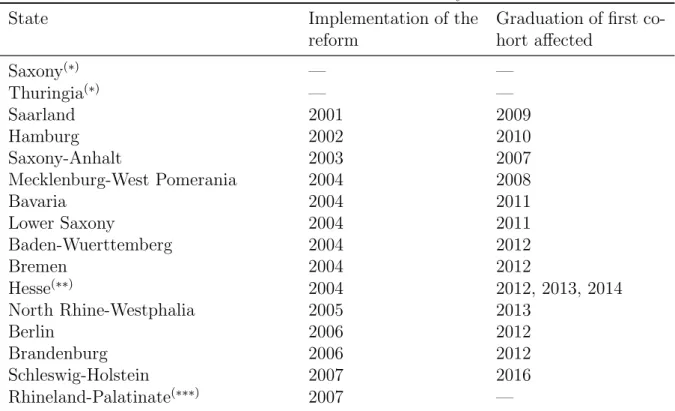
The German high school reform was introduced in most of the federal states between 2001 and 2007.8 Exceptions are Rhineland-Palatinate, where the length of high school has been reduced only in selected schools so far, and Saxony and Thuringia, which have not reduced the length of high school. The educational reform was first implemented in the state of Saarland in the 2001/2002 school year. Other states followed up to 2007. Since the reform was mandatory for all high schools within a state, it was almost impossible for students to avoid the change in the educational system.9 A detailed overview of the introduction of the reform and the first cohorts to be affected, broken down by federal state, is given in Table 1.
While it did reduce the total duration of schooling, the reform did not reduce the overall curriculum. The total number of hours required for graduation (265 year-week hours) between grade five and graduation were maintained (see KMK, 2013). The decision
7In the states of Berlin, Brandenburg, and Mecklenburg-West Pomerania, where tracking takes place
in grade seven, the reform reduced high school from seven to six years. In the following, whenever we refer to the year of high school entry, we mean the year in which students began grade five and pursued the academic track. Analogously, high school refers to the last eight (or nine) years of school from grade five until graduation.
8Currently, schools in some states can choose (by parental vote) whether to return to 13 years of
schooling. So far, however, almost no school decided to do so. In any case, this possibility has only been in existence for a very short time and therefore does not concern our sample of students described in Section 4.
Table 1: Introduction of the Reform by State
State Implementation of the
reform
Graduation of first co-hort affected Saxony(∗) — — Thuringia(∗) — — Saarland 2001 2009 Hamburg 2002 2010 Saxony-Anhalt 2003 2007 Mecklenburg-West Pomerania 2004 2008 Bavaria 2004 2011 Lower Saxony 2004 2011 Baden-Wuerttemberg 2004 2012 Bremen 2004 2012 Hesse(∗∗) 2004 2012, 2013, 2014 North Rhine-Westphalia 2005 2013 Berlin 2006 2012 Brandenburg 2006 2012 Schleswig-Holstein 2007 2016 Rhineland-Palatinate(∗∗∗) 2007 —
(∗)Saxony and Thuringia kept the 12-year school system after reunification.
(∗∗)Gradual introduction: school year 2004/05 (10% of all schools); 2005/06 (60%); 2006/07 (30%). (∗∗∗)In Rhineland-Palatinate, the reform has only been introduced in selected schools so far.
Source: Autorengruppe Bildungsberichterstattung (2010)
on how to distribute the total year-week hours over the remaining grades was left up to the individual schools, but the great majority of schools allocated the increase in hours to grades seven to nine, when students are aged 13 to 16. As a result, students attended up to 36 hours per week in school after the reform, compared to less than 30 before the reform.10 This increase in workload per unit of time led to a higher learning intensity (per week), and prolonged school days.11
3.2
Anticipated Effects of the Reform on Personality
Since the overall curriculum and the requirements for the German high school diploma were left unchanged, the policy reform increased the learning intensity for students
10Note that an increase in class hours is accompanied by an increase in homework. Therefore, the true
increase in workload per week is even higher than the pure increase in class hours.
11At the same time, there was a substantial increase in all-day high schools. By 2010, almost half
of all high schools had become all-day schools compared to only about 12% in 2002 (Autorengruppe Bildungsberichterstattung, 2012). In addition to the compulsory curriculum, most of these all-day schools offer further activities on a voluntary basis, which is, however, also the case for more traditional schools.
through a greater number of hours per school year. This might have had various un-intended consequences such as an increase in grade repetition or a decrease in mental health due to a higher stress level.
A similar change in the German education system took place in the 1960s, moving the start of the academic year to an earlier date. In 1966 and 1967, the academic year was shortened, reducing the total amount of time in school by two-thirds of a year for students enrolled in school at that time, while the basic curriculum was left unchanged. Pischke (2007) finds that there were no adverse effects of shorter school duration on earnings and employment later in life, and concludes that the more recent high school reform (the reform used in this study), which reduced the length of high school by one year, may not compromise labor market success of affected students in general. However, according to Pischke (2007) the shorter school years increased grade repetition in elementary schools and led to fewer students attending higher secondary school tracks. This may point to important heterogeneous effects, as the most poorly performing students appear to be less likely to keep up with the increased learning intensity. Furthermore, Pischke (2007) notes that the shorter instructional time may induce costs by shifting students’ time away from activities that are not directly linked to labor market outcomes such as voting or artistic pursuits.
Since the recent reduction in the length of high school by one year represented a much greater change than the shorted academic years of the 1960s, it may well be that it also impacted students’ personalities. In this study, we focus on the personality concept of the Five Factor Model (McCrae and Costa, 1999), which comprises five psychological dimen-sions, also known as the Big Five – openness to experience, conscientiousness, extraver-sion, agreeableness, and neuroticism. Openness to experience describes an individual’s creativity and imagination, while conscientiousness refers to the propensity to work effec-tively, efficiently, and thoroughly as opposed to being disorganized and lazy. Extraversion is defined as an individual’s tendency to be outgoing, sociable, and communicative rather than being reserved. Agreeableness describes individuals who are polite, forgiving, and kind to others. Neuroticism measures emotional instability, that is, whether a person
tends to worry and get nervous easily rather than coping well with stress and being re-laxed. In addition to these Big Five personality traits, we also include the concept of locus of control, which refers to an individual’s perception of control over his or her life (Rotter, 1966).
Each of these personality traits may be affected differently by the different conse-quences of the German high school reform. First, the higher workload may have in-creased the pressure on students, and hence dein-creased their emotional stability, that is, increased their neuroticism. At the same time, we hypothesize that the compression of the curriculum required a higher level of self-discipline, that is, it increased students’ conscientiousness about performing well in school. The reform may have had ambiguous effects on agreeableness, since, on the one hand, more cooperation may be required to cope with the higher workload, and on the other hand, students may become more selfish in a more competitive environment. Likewise, the effect on locus of control may be pos-itive or negative depending on whether students recognize that they are able to cope or not with the increased pressure induced by external factors. Second, spending more time in school and having less leisure-time may affect social skills, that is, the agreeableness, extraversion, and openness of students. Third, the exogenous enactment of the reform may have decreased students’ perceived control over their lives, that is, it may have re-sulted in a lower locus of control. A detailed overview of these theoretical considerations with the potential mechanisms at work is given in Table 2. Moreover, we expect to find heterogeneous effects for students from different socio-economic backgrounds. For exam-ple, for students from non-intact families, longer school days following the reform may have created a more stable environment due to more frequent interactions with teachers, allowing the young people to build relationships to additional adults who they can turn to for advice and support. On the other hand, these students may receive less support at home to cope with the increased workload and may therefore experience higher stress levels due to the shortening and increased intensity of high school.
It remains an empirical question which personality traits are affected by the educa-tional change and whether or not the reform’s effects vary by student characteristics.
Table 2: Potential Mechanisms and Anticipated Effects
Consequences of the reform and potential mechanisms Anticipated effects Higher requirements/ workload/ learning intensity
Increase in pressure and fear of failure(∗) N (+), LoC (–)
Increase in self-discipline required C (+)
Increase in cooperation or selfish behavior A (+/–)
Recognizing ability of coping/not coping(∗) LoC (+/–)
More time spent in school
Increase in social interaction with students and teachers(∗) A (+), E (+) Less leisure-time
Reduction in leisure-time activities O (–)
Reduction in time for social interaction outside school A (–), E (–)
Exogenous enactment of reform LoC (–)
Notes: Compare to B¨uttner et al. (2011); extensions denoted by(∗).
+ (–) denotes an anticipated increase (decrease) in terms of the score of the personality traits openness (O), conscientiousness (C), extraversion (E), agreeableness (A), neuroticism (N) and locus of control (LoC).
4
Data and Methods
4.1
Data
Our analysis is based on data from the German Socio-Economic Panel (SOEP) study, which is a representative household panel survey (Wagner et al., 2007) with more than 20,000 individuals in more than 11,000 households in the most recent wave. In addition to rich information on family background and childhood environment characteristics, the SOEP provides self-ratings of personality traits for 17-year-old adolescents and for adult respondents aged 18 and over in various waves since 2005. Hence, we use data from the years 2005 to 2012, and select all adolescents and young adult respondents up to the age of 21 who were attending high school at the time of the survey or had earned a high school diploma.12 To identify whether an individual was affected by the high school reform, we use information on the year of school entry and on the state of residence or, in cases where school has been already completed, the state where the high school diploma
12Students in the academic track at a comprehensive school are affected by the reform as well. However,
we exclude these students since we cannot unambiguously identify which tracks they have been in since entering secondary school. Furthermore, these students’ exposure to the reform would be difficult to identify since a transitional period has been provided for implementation of the reform and exceptions are allowed at comprehensive schools in some states. Compulsory schooling ends in Germany at age 16.
was obtained. In case of missings, the year of school entry was imputed from the date of birth.13 We exclude students from Saxony and Thuringia because both East German states were not affected by the reform, as they kept the eight-year high school track after reunification. Furthermore, we drop students from Rhineland-Palatinate from our sample because there the reform has been introduced only in selected schools to date. We also exclude individuals who we know repeated one or more grades to avoid noise from different levels of schooling experienced so far and from different learning intensities students were exposed to. Finally, we only include individuals who successfully answered the items from at least one of the personality dimensions14 and provided valid information on family background and home environment. The final sample consists of 1,058 individuals, of whom 211 were affected by the reform.15
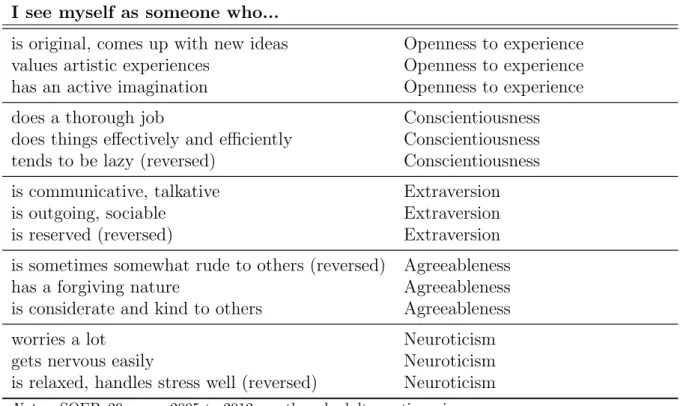
The SOEP provides self-ratings of personality traits in various waves since 2005 (Ger-litz and Schupp, 2005). These cover personality measures related to the Five Factor Model (McCrae and Costa, 1999), which comprises the dimensions of the Big Five – openness to experience, conscientiousness, extraversion, agreeableness and neuroticism. Each of these dimensions is measured with three items, which are answered on seven-point Likert-type scales.16 As a further personality concept we follow the approach by Specht et al. (2013) and construct a measure for internal locus of control from seven items, which reveal whether a person believes that events are the result of his or her own actions rather than of external factors. To construct measures for the respective personality trait, the items are averaged for each dimension and standardized separately by gender at mean zero and variance one. While for adolescents these personality measures are included in the Youth Questionnaire in every year between 2006 and 2012, adult respondents’ Big Five personality traits were surveyed only in the waves 2005 and 2009 and their locus of control in the waves 2005 and 2010. If an individual’s personality has been measured
13The year of school entry is available for 36 percent of the full sample. For these students, the imputed
year matched the actual year in 90 percent of all cases, and the assignment to treatment or control group was correct in 99 percent of all cases.
14These are more than 99 percent of all individuals in our sample of consideration.
15The average size of a birth cohort surveyed at age 17 is 269 in the years under observation; on average
41 percent of the individuals in a cohort are in the high school track.
twice, we use the personality measures at the youngest age possible, between 17 and 21 years, to guarantee a largely homogeneous sample and to avoid biased estimates through possible age effects.
To account for potential age effects we include age and age squared at the point in time of measurement in all estimations. Additionally, we control for several pre-reform individual characteristics in our preferred specification. These include demographic and socio-economic variables, such as gender, migration background, and whether the student has lived primarily in a rural area during childhood. We incorporate students’ previous educational performance based on the teacher’s recommendation at the end of elementary school. Variables related to family circumstances capture whether students come from a non-intact family, that is, whether they lived with only one parent up to the age of 15, the number of siblings, and birth order. Furthermore, the model accounts for parental characteristics including education, religion, the occupational status of the father, and the employment status of the mother at the time when the individual was ten years old.17 The summary statistics of the personality traits and the individual characteristics are shown in Tables 9 and 10 in the appendix.
4.2
Empirical Strategy
We exploit the German high school reform introduced in almost all federal states in the years 2001 to 2007 as a quasi-natural experiment to establish a causal effect of education on personality. The control group consists of students who entered high school prior to the reform and hence graduated after nine years of high school. Our treatment group, in contrast, consists of students who entered high school after the implementation of the reform and hence obtain their diploma after only eight years of high school. Individuals are assigned to the treatment and the control group based on their year of school entry and on either their state of residence or the state where their high school diploma was obtained. We exploit the variation in time and region to isolate the effect of the reform from other influential factors. To this end, we estimate the following model
yist,17 =αREFORMst +Xiβ+ X s γsSTATEs+ X t δtYEARt+εist, (2)
whereyist,17 is the personality measure at age 17 (or slightly older, as described in Section 4.1) of person i in state s who has entered high school in year t. Our prime variable of interest, REF ORMst, equals 1 if in state s students entering high school in year t are
affected by the reform, and 0 otherwise. ST AT Es is a set of state dummies and Y EARt
dummies indicating the year of high school entry. Xi is a vector of individual
character-istics, including age and age squared, gender, and a number of pre-reform charactercharacter-istics, which may be correlated with personality. These include the occupational status of the father, parental education, childhood environment, a dummy for non-intact family, and the employment status of the mother when the individual was ten years old. Further-more, we include indicator dummies for the different SOEP sub-samples and we cluster error terms at the state level.18
When estimating equation (2), our main parameter of interest is α, which indicates the impact of the high school reform on the respective personality trait. The key identi-fying assumption is that, in the absence of a reform, α will be zero, that is, the treated (REF ORMst=1) and the non-treated (REF ORMst=0) do not differ significantly in
terms of their personality traits. Our analysis, which resembles an extended difference-in-differences (DID) setting, hence assumes that there are no other policy changes or regional shocks that coincide with the implementation of the high school reform and af-fect students’ personality traits. Identification, therefore, requires that the outcome of interest, that is, the personality traits, of students affected by the reform and students not affected by the reform would have followed the same trend over time had the high school reform not been implemented. This common trend assumption boils down in our case to the assumption that the personality of high school students would have evolved similarly in the different federal states. While this is not testable, as the counterfactual
18To account for the small number of clusters, it may be necessary to use wild cluster bootstrapped
standard errors (see Cameron et al., 2008). Our estimations, however, show that the wild cluster boot-strap rather leads to even slightly lower standard errors if different at all. We therefore report the usual standard errors without bootstrapping, as it is the more conservative estimation method in our case.
observation in absence of the reform cannot be observed, we argue that the assumption is realistic and nonrestrictive. We exploit the variation in the introduction of the reform over time, as we compare high school students from different federal states in Germany and control for a potential time trend through year fixed effects. We believe this is the least restrictive possible comparison as the evolution of one student’s personality is likely to most closely resemble that of another student in the same school track (high school) even if the two are from different states (as opposed to students from the same state but different school tracks). As we control for state fixed effects, students from different federal states are allowed to differ in their levels of personality traits.
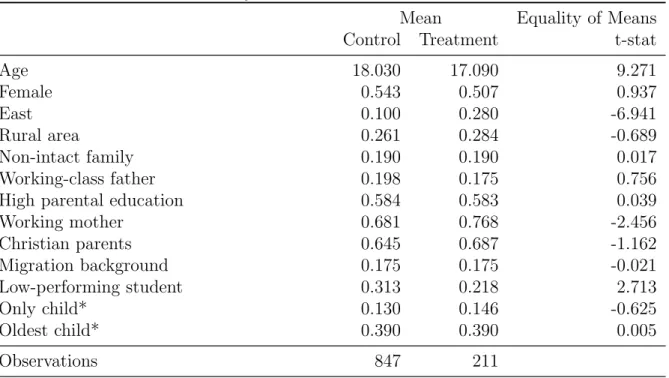
Moreover, crucial for the causal interpretation of the reform effect is that the variation in schooling is truly exogenous to serve as a quasi-natural experiment. This assumption would be violated if there were self-selection into either the treatment or the control group or if the assignment were not random. In this analysis, neither should be an issue. Since the reform was introduced in an entire state at one time, the only possibility to avoid the reform, that is, to self-select into the control group, would have been to move to a different state.19 Given the high costs associated with moving a whole family to another state, this seems highly unlikely.20 This is also confirmed by the descriptive statistics on individual characteristics of the control group and the treatment group, which are provided in Table 10 in the appendix. Mean comparisons of the treatment and control groups show that no (pre-reform) variables exhibit severe differences on average, apart fromage and East. These differences can be explained by the composition of the sample and the earlier introduction of the reform in the East German states.
The timing of the high school reform may be related to specific state characteristics. Since we control for state fixed effects in our analysis, it is not necessary that the timing of state reforms be unrelated to state characteristics (see Black et al., 2005). Nevertheless, we investigate whether the timing of the implementation of the new education system
19The only exception to this is Hesse, where there are double graduating cohorts in three consecutive
years, 2012, 2013, and 2014. We therefore only include students from Hesse who were not affected by the reform and who graduated in 2012 or earlier and students who graduate in 2014 or later and were affected by the reform.
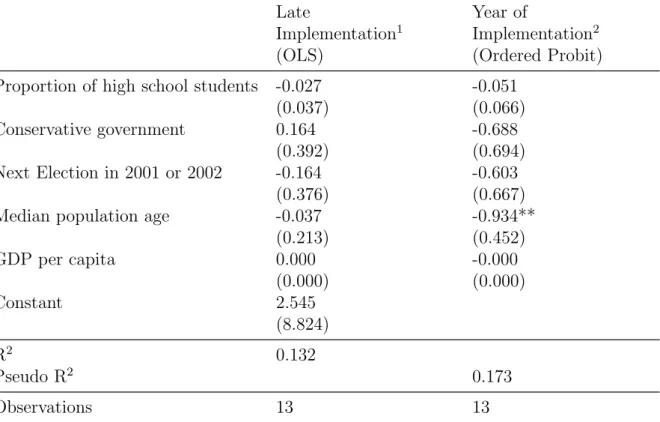
followed some pattern. For this purpose, we ran OLS and ordered probit regressions of the timing of state school reforms (late implementation, year in which the reform was implemented) on various pre-reform state characteristics (see Table 11). The analysis shows that there is no such pattern, as the timing of the reform is not related to the per-centage of high school students in a state’s population, to whether the state government is conservative, to whether the next state elections were scheduled for 2001/2002, or to the state’s GDP per capita. There is some evidence that states with a higher median age of residents adopted the high school reform slightly earlier, which is an artifact caused by the older population in East German states.
Next, we have to address the exact treatment of the high school reform effect that we are able to measure. Since the majority of our sample was surveyed the year they turned 17 and in most cases were still enrolled in high school, we do not measure the effect of a decrease in years of overall school duration per se. Instead, the focus of our study is the compression of learning achievement and how this shapes personality traits during adolescence. Hence, the treatment implied by the reform is a higher workload in school, especially between ages of 13 and 16. Affected students therefore experienced a higher learning intensity during these years, spent more time per day in school, and had a higher level of learning achievement by age 17 because of more cumulative hours of school.
5
Results
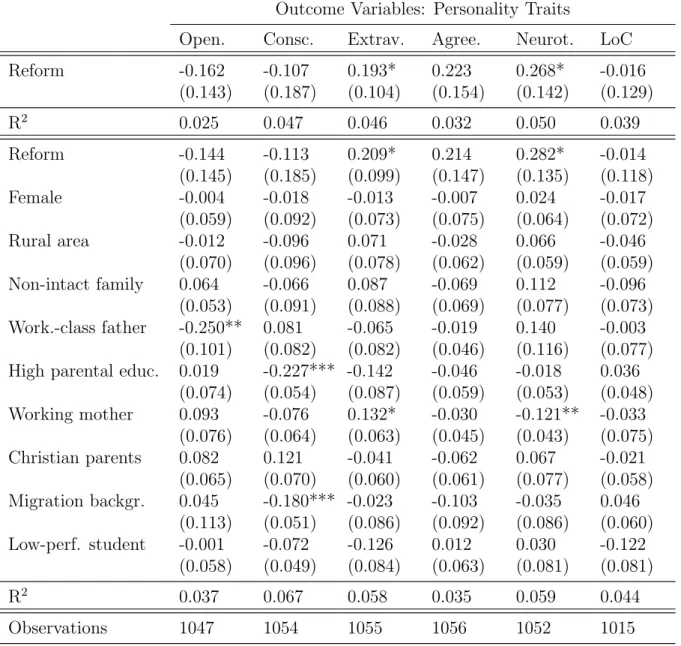
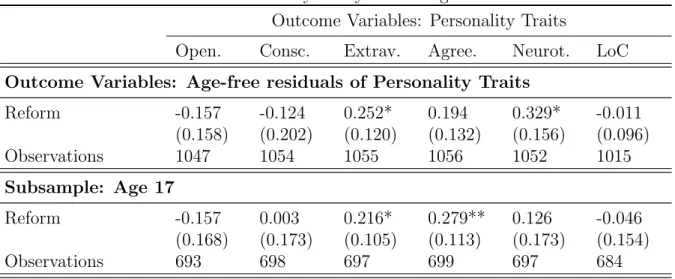
The results of our OLS estimates of equation (2) are provided in Table 3.21 The first specification does not control for any individual characteristics apart from age and age squared to account for any potential age effects, while the second specification addition-ally controls for gender and other individual pre-reform characteristics. The parameter estimates of the reform effect are almost identical in both specifications. This manifests the validation of using the high school reform as a quasi-natural experiment, as individual characteristics which may be correlated with personality do not appear to be correlated
21Table 3 provides results from unweighted regressions. However, weighted regressions deliver virtually
Table 3: Effects of the Reform
Outcome Variables: Personality Traits
Open. Consc. Extrav. Agree. Neurot. LoC
Reform -0.162 -0.107 0.193* 0.223 0.268* -0.016 (0.143) (0.187) (0.104) (0.154) (0.142) (0.129) R2 0.025 0.047 0.046 0.032 0.050 0.039 Reform -0.144 -0.113 0.209* 0.214 0.282* -0.014 (0.145) (0.185) (0.099) (0.147) (0.135) (0.118) Female -0.004 -0.018 -0.013 -0.007 0.024 -0.017 (0.059) (0.092) (0.073) (0.075) (0.064) (0.072) Rural area -0.012 -0.096 0.071 -0.028 0.066 -0.046 (0.070) (0.096) (0.078) (0.062) (0.059) (0.059) Non-intact family 0.064 -0.066 0.087 -0.069 0.112 -0.096 (0.053) (0.091) (0.088) (0.069) (0.077) (0.073) Work.-class father -0.250** 0.081 -0.065 -0.019 0.140 -0.003 (0.101) (0.082) (0.082) (0.046) (0.116) (0.077) High parental educ. 0.019 -0.227*** -0.142 -0.046 -0.018 0.036
(0.074) (0.054) (0.087) (0.059) (0.053) (0.048) Working mother 0.093 -0.076 0.132* -0.030 -0.121** -0.033 (0.076) (0.064) (0.063) (0.045) (0.043) (0.075) Christian parents 0.082 0.121 -0.041 -0.062 0.067 -0.021 (0.065) (0.070) (0.060) (0.061) (0.077) (0.058) Migration backgr. 0.045 -0.180*** -0.023 -0.103 -0.035 0.046 (0.113) (0.051) (0.086) (0.092) (0.086) (0.060) Low-perf. student -0.001 -0.072 -0.126 0.012 0.030 -0.122 (0.058) (0.049) (0.084) (0.063) (0.081) (0.081) R2 0.037 0.067 0.058 0.035 0.059 0.044 Observations 1047 1054 1055 1056 1052 1015
Notes: SOEPv29 waves 2005 to 2012. OLS regressions. Age, age squared and a maximum set of state dummies, year of school entry dummies, dummies for the different SOEP samples, and a constant are included. Standard errors, reported in parentheses, are clustered at the state level.* p<0.1, ** p<0.05, *** p<0.01.
with the reform, and their omission does not bias the estimated impact.
While there is no clear impact of the reform on openness, conscientiousness, and locus of control in the overall population of high school students, the estimates show that the reform significantly increased students’ extraversion and neuroticism. The effects are substantial in that extraversion is on average increased by a fifth of a standard deviation, while students’ emotional stability is even altered by more than a quarter of a standard deviation on average. Following the reform, agreeableness increases as well by more than
a fifth of a standard deviation. In terms of conventional statistical significance levels, this effect is however at the edge and marginally insignificant.22
Considered together, these findings suggest that the change in the educational system may impact different facets of personality, possibly via different channels. A potential increase in agreeableness and in particular an increase in extraversion may stem from changes in the type and intensity of social interactions between students. In contrast, an increase in neuroticism may reflect the impact of the higher workload, which may have increased stress and pressure on students.23
With respect to the individual characteristics, we find only few meaningful driving forces, which include having a father with a working-class occupation, parents with a low level of education, a working mother, and for some of the personality outcomes, having a migration background.24 Students with a lower socio-economic background, that is, students from working-class or less-educated families, are on average less open and more conscientious than students with higher socio-economic backgrounds.25 On average, less-educated parents with blue-collar jobs tend to be characterized by hard work and social conformity rather than creativity, which may be associated with less openness and more conscientiousness. Children might either inherit these traits from their parents or be socialized in a particular way, for example, by learning from their parents as role models throughout life. Students with a working mother are on average significantly more extroverted and less neurotic than students whose mother did not work when they were ten years old. This could be due to the fact that children of working mothers
22Note in general, that due to the relatively small number of observations, we pick the 10% level of
significance to be relevant. Given this small sample size, the fact that some of the coefficients appear to be statistically significant at this, or even more conservative levels, makes our findings even stronger. For the interpretation of any other coefficient, one should keep in mind that statistical insignificance does not prove that there is no effect, but only that we fail to reject it, which may be an artifact of the sample size.
23For a more extensive discussion on the potential mechanisms at work, see Section 5.2.
24Note that due to the standardization separately by gender, all differences in absolute levels of the
scores on personality traits between male and female students are erased. We therefore expect the coefficient offemale to be small and insignificant in the estimation, which is indeed the case. However, this does therefore not imply that there are no significant differences by gender in the original scores on personality.
25Note that our sample is special in the sense that it only comprises high school students. As these
students are in a presumably more advantaged situation than students enrolled in other school tracks, the effects of the individual characteristics on personality may not be representative for the average adolescent in Germany.
learn independence and social interaction relatively early through increased exposure to day care. They may therefore be more outgoing and settled in life, leading to a higher extraversion and emotional stability.
Students with a migration background display a lower level of conscientiousness than students without a migration background, but do not exhibit further significant differ-ences in traits.
Moreover, living in a non-intact family appears to be related to personality. We observe a higher level of neuroticism and a lower level of perceived control, both by about 0.1 of a standard deviation. Although these effects are (marginally) not statistically significant, their signs are in line with the general expectation of a disrupted family causing emotional stress in children and making them feel that they can do little to change the status quo. However, a more alarming finding is that the change in the educational system has an even larger impact on neuroticism than does a disrupted family, both in terms of magnitude and significance: the high school reform increases neuroticism by more than twice as much as being raised in a non-intact family.26
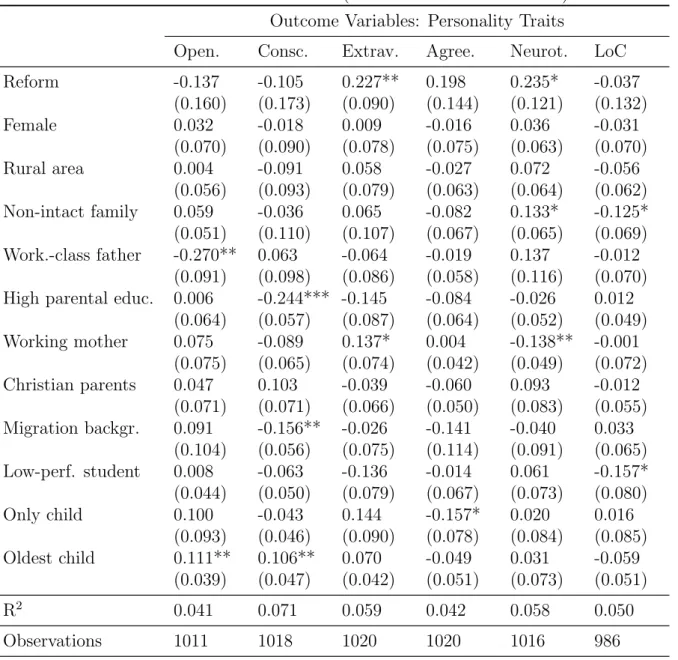
In an extended specification, we further include family characteristics related to the number of siblings and birth order for a subsample of students with the relevant infor-mation (see Table 12 in the appendix). While the reform effects prove to be stable, these estimates reveal that students without any siblings are less agreeable and that first-born individuals are more open and conscientious. In an additional specification, we include the respective parental personality trait in each regression for a subsample of our students.27 The respective coefficients stand out in both magnitude and significance, pointing to a strong intergenerational transmission of personality.28 However, their inclusion makes little difference concerning the reform coefficients other than a small loss in significance due to a reduction in sample size.
26Note that this applies to the sample of high school students. Being raised in a non-intact family may
have larger effects on neuroticism in the overall population.
27The results are available from the authors upon request.
28The intergenerational effects are between 0.104 and 0.173 for the Big Five personality traits and 0.248
for locus of control. These results are largely in line with the intergenerational correlation coefficients reported by Anger (2012) for children of all school types.
5.1
Heterogeneous Effects
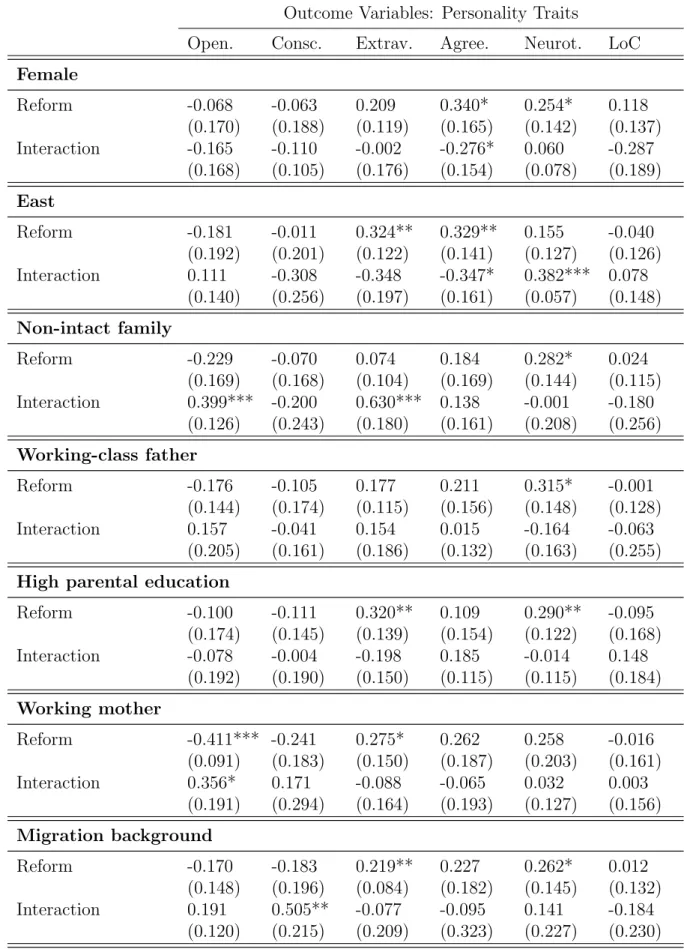
So far, the estimates show average effects for the overall population of high school stu-dents. Following the high school reform, students tend to be more extroverted and pos-sibly more agreeable, but also less emotionally stable. To truly shed light on the effects of the reform, however, it is important to consider how the policy change has affected particular subgroups of students differently. This may not only reveal which students’ personality traits are especially susceptible to a change in the educational system, but possibly also illustrate the different mechanisms by which the reform impacts personality. A natural distinction here is bygender, since boys and girls of a given age not only differ in their stage of physical and mental development but also in their behavior. As shown in Table 4, the increase in agreeableness is driven by male students, for whom this effect is statistically significant and economically large, amounting to one-third of a standard deviation in magnitude. In contrast, the estimates reveal that there is hardly any in-crease in agreeableness for female students. Since boys are usually observed to be more competitive and less agreeable than girls, the exogenous variation in social interaction or necessity for cooperation may have forced boys in particular to become more sociable and cooperative. This finding therefore illustrates how a change in the educational sys-tem also could mitigate gender differences in personality or behavior and bring initially different levels of development into closer alignment across genders.
Additionally, we investigate differential impacts of the high school reform in former East and West Germany, as there are not only persistent differences with respect to the socio-economic environment, but also differences in educational policies between the two parts of Germany. Especially the long-standing tradition of the former 13-year school system is not present in the former East. Those Eastern states that reduced high school by one year in the 2000s prolonged high school by one year just a decade before. This could mitigate any changes induced by the recent high school reform, which may be perceived as less dramatic by the affected population. In line with these expectations, the estimates in Table 4 reveal that the increases in extraversion and agreeableness are entirely driven by students in West Germany. Contrary to this intuition, however, the
Table 4: Heterogeneous Effects of the Reform
Outcome Variables: Personality Traits
Open. Consc. Extrav. Agree. Neurot. LoC
Female Reform -0.068 -0.063 0.209 0.340* 0.254* 0.118 (0.170) (0.188) (0.119) (0.165) (0.142) (0.137) Interaction -0.165 -0.110 -0.002 -0.276* 0.060 -0.287 (0.168) (0.105) (0.176) (0.154) (0.078) (0.189) East Reform -0.181 -0.011 0.324** 0.329** 0.155 -0.040 (0.192) (0.201) (0.122) (0.141) (0.127) (0.126) Interaction 0.111 -0.308 -0.348 -0.347* 0.382*** 0.078 (0.140) (0.256) (0.197) (0.161) (0.057) (0.148) Non-intact family Reform -0.229 -0.070 0.074 0.184 0.282* 0.024 (0.169) (0.168) (0.104) (0.169) (0.144) (0.115) Interaction 0.399*** -0.200 0.630*** 0.138 -0.001 -0.180 (0.126) (0.243) (0.180) (0.161) (0.208) (0.256) Working-class father Reform -0.176 -0.105 0.177 0.211 0.315* -0.001 (0.144) (0.174) (0.115) (0.156) (0.148) (0.128) Interaction 0.157 -0.041 0.154 0.015 -0.164 -0.063 (0.205) (0.161) (0.186) (0.132) (0.163) (0.255) High parental education
Reform -0.100 -0.111 0.320** 0.109 0.290** -0.095 (0.174) (0.145) (0.139) (0.154) (0.122) (0.168) Interaction -0.078 -0.004 -0.198 0.185 -0.014 0.148 (0.192) (0.190) (0.150) (0.115) (0.115) (0.184) Working mother Reform -0.411*** -0.241 0.275* 0.262 0.258 -0.016 (0.091) (0.183) (0.150) (0.187) (0.203) (0.161) Interaction 0.356* 0.171 -0.088 -0.065 0.032 0.003 (0.191) (0.294) (0.164) (0.193) (0.127) (0.156) Migration background Reform -0.170 -0.183 0.219** 0.227 0.262* 0.012 (0.148) (0.196) (0.084) (0.182) (0.145) (0.132) Interaction 0.191 0.505** -0.077 -0.095 0.141 -0.184 (0.120) (0.215) (0.209) (0.323) (0.227) (0.230)
Low-performing student Reform -0.049 -0.105 0.232* 0.197 0.223 -0.078 (0.182) (0.187) (0.111) (0.152) (0.138) (0.169) Interaction -0.307 -0.026 -0.078 0.054 0.191 0.210 (0.193) (0.093) (0.242) (0.206) (0.232) (0.246) Observations 1047 1054 1055 1056 1052 1015
Notes: SOEPv29 waves 2005 to 2012. OLS regressions, separately for each interaction considered. Only the coefficients ofREFORM and the respective interaction withREFORM are presented. Age, age squared, female, rural area, non-intact family, working-class father, high parental education, working mother, Christian parents, migration background, low-performing student and a maximum set of state dummies, year of school entry dummies, dummies for the different SOEP samples, and a constant are included. Standard errors, reported in parentheses, are clustered at the state level.* p<0.1, ** p<0.05, *** p<0.01.
increase in neuroticism is significantly more pronounced among students in East Germany. The only reasonable explanation we can think of is that in Eastern states, where students normally attend elementary school for their first six years of schooling, seventh-grade students were confronted with the transition to high school and with a higher workload at the same time. In contrast, West German seventh-graders already had two years to acclimatize themselves to high school before being confronted with the higher workload. Hence, this finding may demonstrate the importance of gradually changing the learning environment of students who may feel stressed if several features are altered at the same time.
In the next step, we look into heterogeneous effects by family structure. For students from non-intact families, the increase in time spent at school may have created a more stable environment with stronger interactions with teachers as additional adult reference persons. In contrast, these students may also receive less support at home to cope with the increased learning. The estimates provide suggestive evidence for the former hypothesis; students who did not live with both parents during their entire childhood benefit from the educational change in terms of openness, and particularly drive the overall increase in extraversion. In contrast, there is no evidence to support the hypothesis that these students have an even higher increase in neuroticism due to a potential lack of support at home: the increase in neuroticism is identical for students of all family circumstances.29
29It would, however, be interesting in a next step to compare the absolute levels of the score on
We hypothesized that children with a large number of siblings and with a high birth order may have greater difficulties coping with the higher workload after the reform as they may not receive the same amount of parental support as a first child or only child. However, we do not find any significant differences between the respective groups in their responses to the reform.30
Furthermore, it is of interest how students from different socio-economic backgrounds respond to educational changes. To this end, we investigate heterogeneous effects by the occupational status of the father as well as by parental education. It is conceivable that students with a lower socio-economic status are less likely to receive (adequate) support from their parents to meet the increased demands at school. Hence, the higher workload induced by the reform may lead to a higher stress level for this group. However, we do not find any significant differences in the impact of the reform on neuroticism, neither by occupational status of the father nor by parental education. The estimates even indicate a smaller albeit insignificant increase in emotional instability for students with a working-class father.
Moreover, we investigate whether students with aworking mother respond differently to the high school reform. Since the reform led to longer school days and thus to a better infrastructure for organized afternoon activities, students with working mothers may benefit from having improved supervision in the afternoon. However, we do not find such differences in the impact of the reform by the employment status of the mother, except for the effect on openness. While there is no clear impact of the educational change on openness of students with a working mother, the estimates reveal that students with a non-working mother showed a significant decrease in openness by more than 0.4 of a standard deviation. This may be a result of the reduction in time spent at home and in the time available for extracurricular or family activities after the reform.
Furthermore, students with a migration background may respond differently to the reform than students from non-migrant families. One could hypothesize that the former
scale, there is less scope for increases in individuals who already scored high on a personality trait before the reform.
benefit from longer school days by becoming better integrated into their peer groups and by improving their language skills. If so, this reform could help to reduce initial and persistent differences between these two groups and foster integration and educational performance of students from migrant families. However, we only find differential effects of the reform for one personality trait: students with a migration background appear to show increased conscientiousness. Migrant and non-migrant students appear to respond similarly to the reform in all other personality traits.
A general concern is that low-performing students are particularly vulnerable to the educational reform as they are most at risk of being ‘the first to be left behind’ by the higher requirements at school. Hence, we investigate whether students with low perfor-mance prior to high school show differential effects. Though the increase in neuroticism following the reform is indeed even higher for this group, we fail to find a statistically significant difference.31
5.2
Potential Mechanisms
So far, we find evidence of a causal effect of the high school reform on adolescents’ personality traits, in particular on emotional stability, extraversion, and agreeableness. However, the effect of the reform on students’ personalities still remains largely a black box because the compression of schooling had a number of implications. Affected students faced a higher learning intensity especially between ages 13 and 16, spent more time per day in school, and were expected to achieve a higher level of learning achievement by age 17 due to the higher number of cumulative school hours. Hence, the reform could have impacted students’ personalities through various distinct channels.
First, the increase in learning intensity due to the compressed curriculum may have led to higher pressure on students, leading to adverse health effects. Previous research on working conditions and health has shown that an increase in workload negatively affects health related outcomes (Proctor et al., 1996), which may be related to an individual’s
31Note, however, that the share of low-performing students, identified through the teacher’s
recom-mendation at the end of elementary school, is naturally very low among high school students, making it difficult to clearly interpret our results.
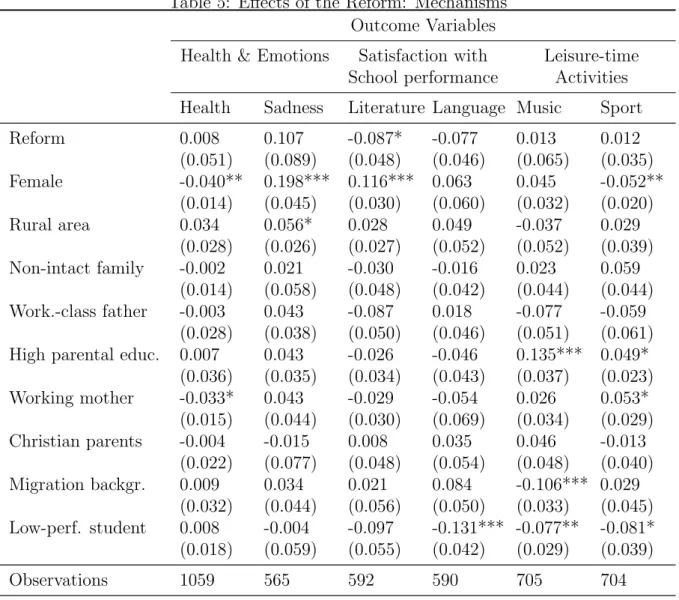
emotional stability.32 To shed more light on this potential mechanism, we investigate whether the reform has impacted students’ health related characteristics. We find that the reform had no adverse effects on the perceived health status of the students (see Table 5). This holds true regardless of whether we investigate a change in the binary variable (very good or good health, as opposed to satisfactory, not so good, or bad health), or a change in the categorical variable by means of an ordered probit model. We find, however, that shortening the high school track increases feelings of sadness. Following the reform, the probability of being sad at least sometimes (as opposed to seldom or very seldom) rose by ten percentage points among affected students. The lack of statistical significance may be at least in part attributable to the small number of observations.33 We take this result as suggestive evidence that emotions are a relevant transmission channel.
Moreover, the high learning intensity may have directly affected students’ perfor-mance. As shown by Proctor et al. (1996), an increase in workload is in some cases significantly associated with impaired performance on tests of attention and executive function. In the educational context, an increase in learning intensity may therefore also decrease attention and cognitive functioning among students, resulting in inferior school performance. B¨uttner and Thomsen (2014) show for the double cohort in the state of Saxony-Anhalt that an increase in learning intensity indeed negatively affected students’ grades in Mathematics and English.34 This in turn may have increased the feeling of pressure and stress due to fear of failure among students who were affected by the re-form. In additional regressions, we actually find that the high school reform decreased students’ satisfaction with their school performance. The share of students who were very satisfied with their performance in the subjects German literature and first foreign language decreased by about eight percentage points (see Table 5), although the latter
32Taking automotive workers as an example, Proctor et al. (1996) find overtime work to be associated
with increased feelings of depression, fatigue, and confusion.
33The information of the frequency of being sad in the past four weeks is only available for half of our
original sample, as the question was not part of the survey every year.
34Unfortunately, we cannot investigate reform effects on school performance, as the students’ school
grades are not comparable across our sample. While the grades of students in our control group only counted on their annual school report card, the grades of students in our treatment group were already counted into their final high school grades and hence were much more relevant.
Table 5: Effects of the Reform: Mechanisms Outcome Variables
Health & Emotions Satisfaction with Leisure-time School performance Activities Health Sadness Literature Language Music Sport
Reform 0.008 0.107 -0.087* -0.077 0.013 0.012 (0.051) (0.089) (0.048) (0.046) (0.065) (0.035) Female -0.040** 0.198*** 0.116*** 0.063 0.045 -0.052** (0.014) (0.045) (0.030) (0.060) (0.032) (0.020) Rural area 0.034 0.056* 0.028 0.049 -0.037 0.029 (0.028) (0.026) (0.027) (0.052) (0.052) (0.039) Non-intact family -0.002 0.021 -0.030 -0.016 0.023 0.059 (0.014) (0.058) (0.048) (0.042) (0.044) (0.044) Work.-class father -0.003 0.043 -0.087 0.018 -0.077 -0.059 (0.028) (0.038) (0.050) (0.046) (0.051) (0.061) High parental educ. 0.007 0.043 -0.026 -0.046 0.135*** 0.049*
(0.036) (0.035) (0.034) (0.043) (0.037) (0.023) Working mother -0.033* 0.043 -0.029 -0.054 0.026 0.053* (0.015) (0.044) (0.030) (0.069) (0.034) (0.029) Christian parents -0.004 -0.015 0.008 0.035 0.046 -0.013 (0.022) (0.077) (0.048) (0.054) (0.048) (0.040) Migration backgr. 0.009 0.034 0.021 0.084 -0.106*** 0.029 (0.032) (0.044) (0.056) (0.050) (0.033) (0.045) Low-perf. student 0.008 -0.004 -0.097 -0.131*** -0.077** -0.081* (0.018) (0.059) (0.055) (0.042) (0.029) (0.039) Observations 1059 565 592 590 705 704
Notes: SOEPv29 waves 2005 to 2012. OLS regressions. A maximum set of state dummies, year of school entry dummies, dummies for the different SOEP samples, and a constant are included. Standard errors, reported in parentheses, are clustered at the state level.* p<0.1, ** p<0.05, *** p<0.01.
effect barely fails to attain statistical significance at conventional levels.35 Unreported regressions show that this decrease is considerably larger in East Germany, which is in line with the decrease in emotional stability being much more pronounced in the East. In addition, we find suggestive evidence that the high school reform increased students’ need for paid tutor lessons (not reported).36 Overall, we conclude that the increase in
35We define students as being very satisfied with their educational performance if they rate their
satisfaction either 9 or 10 on a scale from 0 (low) to 10 (high). Among the control group, 23 percent reported very high satisfaction with literature and 26 percent with the first foreign language. Levels of satisfaction with the subject Maths was not significantly affected by the reform.
36Following the reform, the percentage of students attending paid tutor lessons in addition to their
regular school attendance increased by almost six percentage points, though we fail to prove statistical significance at conventional levels.
workload following the high school reform caused lower school performance and emotional difficulties among students, which explains the decrease in emotional stability particularly among East German students.
Second, the change in the institutional framework may have affected students through the change in time allocation, as those who were affected by the reform spent more time per week in school. They not only attended additional classes, which often took place in the afternoon, but also spent lunch together, which in most schools was introduced with the reform. Hence, the reform led to more social interactions with teachers and other students and fostered independence from the parents. This stimulation of interpersonal behavior may positively affect extraversion and agreeableness. At the same time, however, students have less leisure-time, which could adversely affect personality traits related to social behavior. Furthermore, openness could be reduced through less diversity in the activities students engage in. To examine whether and how students’ time allocation was affected by the reform, we investigate their participation in two leisure-time activities: music and sports (see Table 5). We do not find any evidence of the reform having affected participation in either of these activities.37 Both the treatment and the control group seem to engage equally in both. These findings suggest that our results are more likely driven by the stronger student-teacher or student-student interactions as a result of longer school days and not by the change in time allocation away from non-academic activities. Third, the higher level of learning achievement by age 17 due to more cumulative school hours may have impacted personality traits through changes in cognition. Since the great majority of schools increased hours between grades seven and nine (ages 13-16), the adolescents in our treatment group have typically accumulated a full year of additional learning over the control group. The earlier learning may increase cognitive skills at a younger age. This in turn may improve non-cognitive skills through the dy-namic complementarity and the cross-effects suggested by Cunha and Heckman (2007) in their skill formation model. It would therefore be of high interest in further research to investigate this reform’s effects on cognitive skills.
37This holds true not only for whether students participate in these activities at all, but also for the
6
Sensitivity Analyses
For a causal interpretation of the high school reform effect we have to rule out that any other factors than the ones considered might drive our estimates. This section discusses several sensitivity analyses that we carr