Information Systems Research
Articles in Advance, pp. 1–10
issn1047-7047eissn1526-5536 doi10.1287/isre.1110.0358
© 2011 INFORMS
Research Note
Lock-In Strategy in Software Competition:
Open-Source Software vs. Proprietary Software
Kevin Xiaoguo Zhu, Zach Zhizhong Zhou
The Rady School of Management, University of California, San Diego, La Jolla, California 92093 {[email protected], [email protected]}
O
pen-source software poses a serious challenge to proprietary software vendors. “Lock in customers” seems a tempting strategy for proprietary software vendors, who attempt to lock in customers by creating switching costs. This paper examines whether such a lock-in strategy will indeed benefit proprietary software vendors facing competition from open-source software, who can credibly commit future prices. Developing a two-period duopoly model in which software products are differentiated and customers are heterogeneous, we find that the lock-in strategy is actually counterproductive in competing against open-source software. In fact, giving customers the freedom of choice may end up benefiting the proprietary software vendor. In terms of the broader effect, we find that lock-in reduces overall social welfare, but certain customers may actually be better off with it. Finally, we show that the lock-in strategy works differently for different types of customers in the software market (i.e., foresighted versus myopic customers). This suggests that customer behavior could significantly alter the equilibrium strategy of software vendors.Key words: software; competition; lock-in; open-source software; proprietary software; game theory; switching cost
History: Vallabh Sambamurthy, Senior Editor; Gautam Ray, Associate Editor. This paper was received on December 6, 2007, and was with the authors 18 months for 6 revisions. Published online inArticles in Advance.
1.
Introduction
With the emergence of new technologies such as on-demand computing and cloud computing, “vendor lock-in” becomes one of the major concerns of chief information officers (Computer World 2004). The term “lock-in” refers to a situation in which a customer is dependent on a vendor for products and services such that he or she cannot switch to another vendor with-out suffering substantial costs. It is often observed in the computer industry that the substantial costs to switch between different software systems force a cus-tomer to continue to use products and services from a particular vendor (Zhu et al. 2006).
A software vendor can lock in customers in several ways: (1) by designing a system incompatible with software developed by other vendors; (2) by using proprietary standards or closed architectures that lack interoperability with other applications; (3) by licens-ing the software under exclusive conditions (Kucharik 2003). Then, “lock-in” can be a deliberate strategy for a software firm. Conventional wisdom suggested that such a strategy benefits software vendors because vendor lock-in may reduce the bargaining power of customers and increase that of vendors in the postadoption period; proprietary vendors may gain
competitive advantages (or even monopoly power) from a lock-in strategy.
It seems intuitive that proprietary software ven-dors should always prefer lock-in. However, prior literature has shown that this is not always the case when the competition is between two proprietary vendors. The key reason for this is that the two ven-dors could engage in fierce competition for market share (e.g., through deep discounts) in anticipation of postadoption monopolistic profits. Under certain con-ditions, such intensified competition for market share could backfire and hurt them.
Klemperer (1987b) considers a two-period
duopolistic competition with switching costs. He shows that switching costs may lead to monopoly rents, but these rents can be competed away when firms entice customers to sign up. Specifically, each firm would like to give up its first-period profit for its
second-period gainsat the margin.1However, thetotal
first-period profit given up can be in any relationship
1Suppose that the decision variable of a firm is pricep. The firm’s
total profit is=1+2, whereiis the profit earned in periodi (i=112). Then the first-order conditiond/dp=d1/dp+d2/dp=0
leads to−d1/dp=d2/dp. That is, the marginal gain in the second
period equals the marginal loss in the first period. 1 Cop yright: INFORMS holds cop yr ight to this Ar ticles in Adv ance version, which is made av ailab le to subscr ibers . The file ma y not be posted on an y other w ebsite , including the author’ s site . Please send an y questions regarding this policy to per missions@inf or ms .org.
to the total second-period gains. Thus, switching costs can either help or hurt firms overall. Klemperer (1987a) uses a two-period horizontal differentiation model to study the competitiveness of markets with switching costs. A proportion of consumers’ tastes for underlying product characteristics in the second period are independent of their tastes in the first period. He shows that if the proportion of such kind of consumers increases, switching costs make firms worse off. Caminal and Matutes (1990) examine two policies that create endogenous switching costs. The first policy precommits a second-period price to loyal consumers while charging a higher price to new consumers. The second policy gives coupons to loyal consumers while charging the same price to all consumers in the second period. The second policy (offering coupons) tends to generate higher equi-librium profits for firms than the first policy (price commitment). Viswanathan (2005) uses a spatial differentiation model to study channel competition and shows how switching costs affect the prices and profits of a given channel. These studies show that switching costs or lock-in may or may not benefit competing firms, depending on specificity of the competition.
As a response to the concern of “lock-in,” open-source movement is gaining momentum in the soft-ware industry. Open source refers to free access, free distribution, and free modification of software source codes (OSI 2011b). According to a survey by Computer Economics (2005), the key advantage of open source is not cost savings but reduced depen-dence on proprietary software vendors. The main rea-son is that there is no forced upgrade, and the soft-ware can be supported by an open community, as opposed to a proprietary vendor. The competition in the open community reduces the price of supporting and maintaining the legacy software. In contrast, pro-prietary software vendors often release new versions of software, force customers to upgrade and make them more dependent on vendor support, or else the customer would be stranded with an outdated sys-tem. The Open Source Initiative, a nonprofit organi-zation formed to promote open source, claims that
“the promise of open source is0 0 0an end to predatory
vendor lock-in” (OSI 2011a).
Earlier studies in the literature mainly focused on the competition between two proprietary products.
Little is known about the competition between
not-for-profit open-source and proprietary software with lock-in. The competition is different when an open-source software (OSS) is involved. Compared with propri-etary software, OSS is developed by open-source com-munities, which typically are not profit-maximizing entities. Further, OSS can be freely distributed among
open-source communities, whereas the price of pro-prietary software is set by a strategic profit-seeking vendor. The free distribution of OSS ensures that cus-tomers are able to get the software free or at a low price that covers the distribution cost. This is because it is difficult for a software vendor to get a decent profit from distributing OSS, given the fact that there are many potential competitors (that is, OSS users),
who may freely distrubte OSS as well.2
As illustrated above, the literature on the competi-tion between two proprietary firms (e.g., Klemperer 1987a, b) shows that the effect of lock-in is driven by two forces: loss caused by intensified competition for market share in period 1 and gains from exploiting customers in period 2. The overall effect of switch-ing costs can benefit or hurt competswitch-ing firms. It is not clear if the same logic can be applied to
competi-tion between astrategicproprietary software provider
and a nonstrategic OSS. Unlike proprietary software,
the OSS does not behave strategically and thus would not use deep discounts to fight for market share in the first period and then raise its price in the second period. Thus the game will be different from that ana-lyzed in the literature. Will a lock-in strategy benefit the proprietary software vendor when it faces a com-petitive threat from OSS?
By developing a two-period model where target customers are differentiated by their tastes and reser-vation value, we show that the lock-in strategy can be counterproductive for the proprietary software ven-dor. A key feature of our model is that the OSS hasa nonstrategic but credible commitment to its future prices (i.e., it is still free in the future) as guaran-teed by OSS licenses such as the GNU General Pub-lic License (GPL) agreement (GNU 2007). The GPL “free distribution” term ensures that nobody gains a monopoly power as an OSS distributor. This allows users to obtain OSS at a minimum cost. The other GPL term, “free modification,” ensures that nobody can offer a free software product now and then charge a high price for an upgraded version in the future. With free modification, OSS users can always write codes to upgrade the software. Nobody gains a monopoly power as a software upgrade provider. Thus, this term introduces full competition into soft-ware upgrade and ensures that the price of service in the future cannot be a monopoly price.
2For example, users may download the following OSS products for
free from the Internet: Python (programming/scripting language), OpenOffice (office suite), Apache (Web server), LaTeX (typeset-ting language), Zope (Web application server), UPortal (Web portal framework), Blender (3D graphics and animation package), Mozilla (Web browser and email client), Plone (content management sys-tem), OSS version of MySQL (database), and Samba (file and print server). Cop yright: INFORMS holds cop yr ight to this Ar ticles in Adv ance version, which is made av ailab le to subscr ibers . The file ma y not be posted on an y other w ebsite , including the author’ s site . Please send an y questions regarding this policy to per missions@inf or ms .org.
The price commitment of OSS makes it difficult for the proprietary software vendor to capture forward-looking customers who can sense the coming danger of being locked in. If the proprietary software vendor uses the lock-in strategy, a forward-looking customer will expect to be charged a high price in the future. Then he would demand a deep discount or even a subsidy before adopting the proprietary software in the first place. We show that the total subsidies used to capture customers in the first period is so large that the lock-in strategy hurts the proprietary soft-ware vendor.
We further show that the lock-in strategy works differently for different types of customers in the software market (i.e., foresighted versus myopic cus-tomers). When customers are myopic instead of fore-sighted, the lock-in strategy turns out to benefit the proprietary software vendor in the competition between proprietary software and OSS—a different result than when customers are foresighted. We also examine the broader effects of lock-in on customer welfare and social welfare.
1.1. Related Literature
There is a growing literature on OSS (see von Krogh and von Hippel 2006 for a review). These studies focus on different aspects of the open-source phe-nomenon, especially along the lines of user-developer participation incentives. For example, Lerner and Tirole (2002) analyze OSS as private provision of a public good and suggest that participation in OSS may be driven by career benefits such as signal-ing skill and peer recognition. Roberts et al. (2006), through a longitudinal study of the Apache projects, examine the motivation for open-source contributors, such as status, use-value, and intrinsic and extrinsic motives. Mustonen (2002) studies open-source qual-ity and shows that the occupational choices of pro-grammers based on reputation incentives determine the quality of programs. Economides and Katsamakas (2006) examine platform competition where each platform can support complementary applications. Casadesus-Masanell and Ghemawat (2006) analyze the competition between Linux and Windows, which features demand-side learning and the survival of the for-profit firm is based on the existence of net-work effects on the demand side. “This competitive strand of research on OSS is much less developed than the organizational strand discussed above, even
though the rhetoric about it0 0 0can get quite heated”
(Casadesus-Masanell and Ghemawat 2006, p. 1074). Bitzer (2004) argues that product differentiation is critical for the proprietary software to compete with the OSS.
Our study is along this line, but it differs from prior OSS literature in the following sense: we focus
onlock-inas a possible competitive weapon and look at this from the standpoint of a proprietary software vendor as opposed to OSS. These two clearly have different objective functions. Furthermore, we model price commitment as an important feature of the OSS, whereas the existing literature studied OSS from other aspects (e.g., incentives of contributors or demand-sided learning), as described above. Price commit-ment has not been formally modeled as an important feature of the OSS, but we believe that it needs to be examined carefully. Along this line, our paper fills a gap and adds new insights to the OSS literature.
The remainder of the paper is organized as follows. Section 2 describes the model setup and assump-tions. Section 3 analyzes the competition between pro-prietary and OSS. Section 4 shows how customer behaviors influence software vendors’ desire to lock-in customers. Section 5 shows the effects of lock-lock-in on consumer surplus and social welfare. Section 6 con-cludes the paper. Detailed mathematical proofs are presented in the online e-companion on the journal’s website.
2.
The Model
Two software vendors compete in the same market. They license their software in two periods, namely, the current and future periods. Prices are announced simultaneously at the beginning of each period. Nei-ther vendor can set prices based on customer types, because an individual customer’s type is private
information. Software is labeled by A or O, where
A stands for proprietary software and O for
open-source software. It is well known that software prod-ucts tend to have low or even zero marginal costs (Shapiro and Varian 1999). For technical simplicity, marginal costs of both vendors are normalized to zero in our model. In particular, OSS can be obtained at a minimum cost (e.g., by freely downloading from host servers or purchasing a CD for a few dollars). We follow prior literature (Economides and Katsamakas 2006, Casadesus-Masanell and Ghemawat 2006) by assuming that:
Assumption 1. The cost of obtaining OSS is
normal-ized to zero.
Denotepit4i=A1 O3 t=1125as the cost of
obtain-ing software i in period t. We havepO1=pO2=0 by
Assumption 1. Because pO1 and pO2 are not strategic
decision variables in this paper, we rescale them to zero for technical convenience. Later it will be clear
that even though we set pO1 and pO2 as positive
con-stants, it will not change the major results of this paper.
OSS and proprietary software are clearly differ-entiated. Schmidt and Schnitzer (2002) modeled this
Cop yright: INFORMS holds cop yr ight to this Ar ticles in Adv ance version, which is made av ailab le to subscr ibers . The file ma y not be posted on an y other w ebsite , including the author’ s site . Please send an y questions regarding this policy to per missions@inf or ms .org.
as a horizontal differentiation. Following the liter-ature (Caminal and Matutes 1990, Klemperer 1995, Marinoso 2001), we capture software differentiation
via ahorizontal differentiation model.
Assumption 2. OSS and proprietary software are
hor-izontally differentiated.
The defining characteristic of horizontal differenti-ation is “if all the variants of a product are sold at the same price, there is a positive demand for each of them” (Cremer and Thisse 1991, p. 383). That is,
if both A and O are sold at the same price, some
customers would chooseAand others would choose
Obecause they rank product features differently. For
example, OSS is easier to customize and reuse, can be developed collaboratively, and helps users learn programming techniques from open-source commu-nities. Compared with OSS, proprietary software does not open access to its source codes, thus it is diffi-cult to be customized. Meanwhile, it tends to have a higher degree of usability in the sense of documen-tation and user interface and is easier to maintain by a clear vendor. Those customers who prefer a higher usability would prefer proprietary software, whereas those who want to customize software would prefer OSS, even if they are sold at the same price (Lerner and Tirole 2002). Take the choice between J2EE and .NET as an example. Estes and Maxime (2003) sum-marize a list of comparisons between J2EE and .NET, and then propose that the choice depends on the needs and preference of the user company. Most arti-cles conclude that there is no clear winner or obvious choice, which conforms to the basic idea of horizontal differentiation.
Motivated by such observation in practice, we
introduce another dimension of heterogeneity:
reser-vation utility. This makes our model two-dimensional differentiation. It is different from the literature, which either considers one-dimensional horizontal differentiation or one-dimensional vertical differentia-tion. For any given software, customers may have het-erogeneous use for the software. Some customers can be heavy users of the software, and others are light users. It leads to different reservation utility among customers because of their differences in valuation, budget, or cost (Gartner Research Note 2003).
Assumption 3. Customers are vertically differentiated
in their reservation utility.
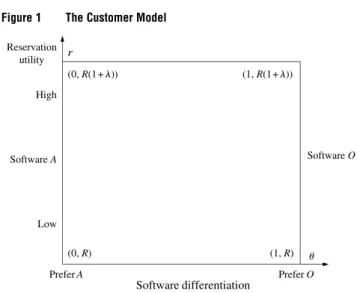
To sum up, our model captures heterogeneity along two dimensions: (1) customers’ reservation utility
(r) and (2) their preferences for horizontally
differ-entiated software (). Mathematically, any customer
can be represented by parameters 4r1 5 in a
two-dimentional map as illustrated in Figure 1.
Figure 1 The Customer Model
SoftwareO High (0,R(1 +)) (0,R) (1,R) (1,R(1 +)) PreferA SoftwareA r Reservation utility Software differentiation PreferO Low
Along the horizontal axis,Ais located at 0 and the
competing software is located at 1. A customer with
preference is located in the spectrum with a
dis-tance fromAand41−5fromO, where∼U 40115
is uniformly distributed with unit density on 60117.3
The customer’s reservation utility, r, is independent
ofand is uniformly distributed on6R1 41+5R7with
a density function 1/4R5, whereRis the lower bound
of customers’ reservation utility (in other words, it has to do with the extent to which customers can be
exploited). We further assume that R is sufficiently
large that OSS is affordable to all customers. In our
model, R≥1 is sufficient to satisfy this condition.
Figure 1 shows that the market size is 1 (because
R41+5R R
R1
041/R5 d dr=1). For simplicity, we assume
that 0< ≤1. Because =R/R, the dispersion of
reservation utility divided byR, we callrelative
dis-persion. If =0, our two-dimensional model would collapse into a one-dimensional model. We summa-rize the above into the following assumption:
Assumption 4. Customers are represented by 41 r5,
with ∼U 40115andr∼U 4R1 R41+55.
If a customer indexed with 4r1 5 adoptsA, it gets
a net surplus4r−−pAt5in periodt. If he adoptsO,
then hist-period surplus isr−41−5. If the customer
does not adopt any software, his net surplus is zero.
A customer’stotal net surplusis the discounted sum of
net surplus in two periods. For simplicity, we assume that the discount factor is 1 for all.
There are two periods in the game. In period 1,
software vendors simultaneously announce pi1, the
3Note that we have normalized on a scale of60117. Because we
use a two-dimensional model, we can always change scales. For example, if customers’ willingness-to-pay is uniformly distributed on6201257and software differentiation is 10 (Alocates at 0 andO locates at 10), we can normalize this to 1 and the willingness-to-pay distribution toU 6212057. Cop yright: INFORMS holds cop yr ight to this Ar ticles in Adv ance version, which is made av ailab le to subscr ibers . The file ma y not be posted on an y other w ebsite , including the author’ s site . Please send an y questions regarding this policy to per missions@inf or ms .org.
software price in period 1. Given pi1, customers form rational expectations about the second-period
price pi2, then make adoption decisions by
compar-ing the total net surplus from both periods from each software. In period 2, software vendors upgrade their
software and chargepi2. A customer may continue to
pay for the originally adopted software, stop the sub-scription, or switch to the other software.
Assumption 5. A customer will incur a switching
costs(s≥0) when he switches from the originally adopted software to the other software.
Customers generally incur costs of reconfiguring hardware, rewriting customized applications, and retraining employees when they switch to a different software. Software vendors upgrade their software in period 2. This increases customers’ reservation utility
byvup≥0. If a customer chooses not to upgrade the
adopted software, he obtains a basic net surplus of 0≤vb< R.
Last, we assume that a customer uses at most one software product in each period. Generally, a firm would not use more than one software product to do the same thing, because of cost or efficiency con-cerns. Under the above assumptions, we analyze the competition between proprietary software and OSS
(AversusO).
3.
Open Source vs. Proprietary
Software
Prior literature assumes that sellers do not commit future prices before customers make adoption deci-sions. Typically, it is impractical to design a complete contract for proprietary service in period 2. Thus, the price commitment, if any, would not be
credi-ble (Fudenberg and Tirole 2002).4 Software is much
different from standardized physical goods because it is even more difficult for a third party (say, the judge) to determine whether the service is really pro-vided at a precommitted price (Shapiro 1986). When customers face high switching costs in period 2, the profit-seeking proprietary software vendor has every incentive to exploit them. This natually casts doubt on the credibility of the software vendor’s price com-mitment, if any.
In contrast to proprietary software, a key feature of OSS is that its commitment of low cost is credible. As defined by the Open Source Initiative (OSI 2011b), open source does not merely mean “free software”;
4For example, a proprietary software provider may commit
“life-time free software upgrade” to its customers. However, after cus-tomers adopt its software, the proprietary vendor may sell a “new add-on function” with a high price tag rather than really providing the upgrade service for free.
its license terms must satisfy a series of legal crite-ria (as defined in such open-source license as GPL). First, source code of OSS shall be publicly available. Second, the license of OSS shall not require a roy-alty or other fees for redistribution. Third, the license of OSS shall allow modifications and redistribution of derived work under the same license terms. As a result, it is difficult for any party to gain monopoly power on an OSS product and then exploit customers after they adopt the OSS. This changes the nature of the game.
Now we proceed to analyze the competition between OSS and proprietary software under the assumptions defined in the previous section. After a customer chooses a software product in period 1, he faces three choices in period 2: (1) upgrade the orig-inally adopted software, (2) not upgrade but keep using the original software, or (3) switch to the other software. Therefore, there are five possible types of
customers:AA,OO,AO,OA, andAN, where the first
letter stands for the software chosen in period 1 and the second letter stands for the software chosen in period 2.
Accordingly, denote by UAA, UOO, UAO, UOA, and
UAN the net surplus of a customer, corresponding
to the type as defined above, respectively. The net
surplus of type AA customers can be computed as
follows:
UAA=6r−−pA17+6r+vup−−pA271
wherevupis the incremental reservation utility for the
software upgrade. The first term is the net surplus obtained in period 1, and the second term is the net surplus obtained in period 2. Similarly,
UOO=6r−41−57+6r+vup−41−571
UAO=6r−−pA17+6r+vup−41−5−s71
noting that the customer incurs a switching cost of s
when he switches from A to O (or vice versa) in
period 2:
UOA=6r−41−57+6r+vup−−pA2−s71
UAN =6r−−pA17+vb1
wherevb is the net surplus obtained in period 2 if the
customer keeps using the original software without upgrading.
In this section, we focus on the customers who
are foresighted. When vendor A announces pA1 in
period 1, foresighted customers would form a rational
expectation ofpA2. After comparing their net surplus
in both periods from adopting Aversus adoptingO,
customers decide which software to adopt in period 1 and which action to take in period 2. Intuitively, when
Cop yright: INFORMS holds cop yr ight to this Ar ticles in Adv ance version, which is made av ailab le to subscr ibers . The file ma y not be posted on an y other w ebsite , including the author’ s site . Please send an y questions regarding this policy to per missions@inf or ms .org.
Figure 2 Segments of TypeAA, TypeAN, and TypeOOCustomers UAN = UOO UAA=UAN A B TypeOO customers TypeAA customers TypeAN customers UAA = UOO (R, 0) (R, 1) (R, 0) (R, 1) (R(1 +), 0) (R(1 +), 1) (R(1 +), 0) (R(1 +), 1) C G D E F H J (a) TypeOO customers TypeAA customers UAA = UOO G D E F H J (b)
customers face switching costs in period 2, vendorA
may charge a higher price in period 2 than in period 1;
that is,pA2> pA1. One might expect that if the
switch-ing cost is not too high, some customers could switch
to O if the price of A becomes too high.
Surpris-ingly, our analytical result shows that such switching behavior will not happen under the optimal pricing
of vendorA.
Lemma 1. In the competition between proprietary
soft-ware and OSS, under the optimal pricing, no customers will switch to the other software in period 2.
The key reason for the above is that vendorAwill
carefully setpA1andpA2such that nobody switches to
Oin period 2. The intuition is as follows. Foresighted
customers know that they will be charged a higher
price in period 2. Thus, vendorAneeds to set a
suf-ficiently low price to gain customers in period 1. In
period 2, ifpA2is set so high that some customers ofA
would switch toO, then these customers must include
high-reservation-utility customers5 with r close to
R41+5. These high-reservation-utility customers are
more valuable to vendor A in period 2 than in
period 1, because vendor A could charge pA2≥pA1
without losing them. If these high-reservation-utility
customers were not valuable to vendorAin period 2,
then they should not be valuable in period 1 either.
Vendor Ashould have charged a higher pA1 to drop
them in period 1 rather than charging a high pA2
to drop them in period 2. Thus, vendor A would
5Solving U
AA=UAO for marginal customers, we get customers
4r1 5with≥1241+s−pA25switch to softwareO. Note that there
is no restriction onr. It shows that high-r type customers would also switch to softwareOif switching toOwere ever to happen.
strategically set pA1 and pA2 such that the target
high-reservation-utility customers would not switch in period 2.
Although switching to the other software does not
happen under the optimal pricing of vendor A, it
is possible that some customers may choose not to upgrade in period 2. Then two possibilities exist:
(1) some of vendor A’s customers upgrade and the
others keep using A, or (2) all vendorA’s customers
upgrade in period 2.
Consider the first possibility. There are two kinds of marginal customers in period 1: (1) those who are
indifferent between being type AA customers and
being typeOOcustomers and (2) those who are
indif-ferent between being type AN customers and being
type OO customers. Both kinds of customers use A
in period 1. Solving UAA=UOO and UAN =UOO for
marginal customers, we obtain=1442−pA1−pA25and
=1342−r−pA1+vb−vup5. In period 2, typeAA
cus-tomers upgrade, and type AN cuscus-tomers do not. The
marginal customers are defined byUAA=UAN, or=
r−pA2+vup−vb. Figure 2(a) illustrates the three
pos-sible regions: type AA customers in Region FABDE,
type AN in Region ABC, and typeOO customers in
Region DBCJH.
A counterintuitive result is that customers in
Region ABC would chooseAeven though they know
that they cannot afford pA2 in period 2. One might
argue that these customers are myopic and irrational. But our result suggests that it could be a rational choice for them, because the subsidy offered by a proprietary software vendor in period 1 can be so attractive to these low-reservation-utility customers that they find it better off just to bite the “marketing
bait” than to useOin both periods.
Cop yright: INFORMS holds cop yr ight to this Ar ticles in Adv ance version, which is made av ailab le to subscr ibers . The file ma y not be posted on an y other w ebsite , including the author’ s site . Please send an y questions regarding this policy to per missions@inf or ms .org.
Now consider the second possibility, where all
vendor A’s customers upgrade in period 2 (see
Figure 2(b)). The marginal customers in this case are those who are indifferent between being type
AAcustomers and being typeOOcustomers. Solving
UAA=UOO, we obtain the location of marginal
cus-tomers:=1442−pA1−pA25.
It can be shown that whens=0, thenp∗
A1=p
∗
A2=12,
∗
A=14, and all vendorA’s customers will upgrade in
period 2. Next, we use∗
A4s=05=14 as a benchmark
for comparison. We obtain the following result:
Lemma 2. If some of vendor A’s customers do not
upgrade in period 2, then vendorAwould obtain a lower profit than that in an identical market with no switching cost (i.e., ∗
A4s=05), where all of vendor A’s customers
upgrade in period 2.
Lemma 2 shows a situation that A would try
to avoid. Based on this, we can now give
condi-tions under which vendor A (1) loses some
low-reservation-utility customers in period 2 or (2) retains all its customers in period 2.
Proposition 1. When switching cost is low (s≤sL),
the proprietary software vendor obtains the same profit as it would in an identical market with no switching cost. When switching cost is high (s > sL), the vendor obtains a
lower profit than it would in an identical market with no switching cost. HeresL=R−vb+vup−34.
The proof is provided in the appendix. The intu-ition is as follows. OSS commits its second period price for continuing usage and upgrade. Such a
com-mitment turns out to be O’s killer advantage.
Ratio-nal customers know that if they adoptAin period 1,
they will be heavily exploited in period 2 when the switching cost is high. To attract these customers,
vendor A needs to set a substantially low pA1. It
is true that a higher switching cost enables
ven-dor A to charge a higher price in period 2, yet it
also forces vendor Ato charge a lower price to sign
up customers in period 1. However, a low pA1 not
only attracts high-reservation-utility customers but also opens the gate for low-reservation-utility cus-tomers. Those low-reservation-utility customers will
choose not to upgrade in period 2. That is, vendorA
captures some “unworthy” customers, who enjoy the subsidy in period 1 but do not bring any profits in period 2. Thus, the existence of low-reservation-utility
customers reduces vendor A’s profit. Surprisingly, a
higher switching cost makes it more difficult for vendorA
to capture its desired customers.
When the switching cost is sufficiently low,
ven-dor Ais unable to exploit its customers in period 2.
Customers are comfortable adopting A in period 1
because they do not worry about period 2, when they
can always switch to O at a low cost. Thus, vendor
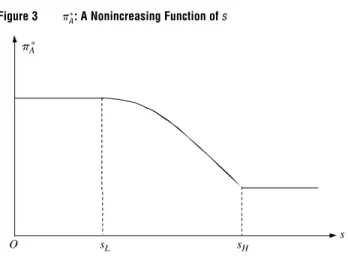
Figure 3 ∗ A: A Nonincreasing Function ofs sL sH s * A O
A does not need to use a lot of resources to
subsi-dize customers in period 1. This explains why giving
customers the freedom of choice could in fact benefit the proprietary software vendor.
Notice from sL = R−vb +vup − 34 that sL is a
decreasing (increasing) function ofvb (vup). This helps
explain how the basic net surplus in period 2 (vb) and
the incremental reservation utility for upgrade (vup)
would affect vendorA’s profit. Given switching cost
(s), a smaller vb or a largervup relaxess≤sL (that is,
shifting sL to the right in Figure 3). If s≤sL is
satis-fied, vendor A may obtain a higher profit than that
fors > sL. Thus, vendorAhas incentives to reducevb
or increase vup.
A managerial implication follows. Vendor A may
want to stop technical support for nonupgraded soft-ware in period 2 such that the customer net surplus
obtained from the nonupgraded software (vb) is low.
Then vendor A may offer an attractive upgrade
ser-vice in period 2 such that customers have highvup for
such upgrade in period 2.
Proposition 2. There exists ansH such that: (1) when
sL< s < sH, vendorA’s profit is a decreasing function ofs (i.e., ¡∗
A/¡s <0); (2) when s≥sH, vendor A’s profit is
not affected by s(i.e.,¡∗
A/¡s=0).
If vendor A is able to manipulate the switching
cost (s) (say, by increasing the compatibility between
A and O), it is possible for that vendor to earn a
higher profit by reducing s, when sL< s < sH. But
when s≥sH, vendorA needs to reduce s to at least
below sH. When s≤sL, reducing switching cost
fur-ther does not benefitAany more (see Figure 3).
As shown in the proof of Proposition 2, when
sL< s≤sH, vendor A charges pA2 in period 2 such
that high-reservation-utility customers are
indiffer-ent between upgrading A and switching toO; when
s > sH, vendor A charges a monopolistic price in period 2 because switching cost is so high that
cus-tomers are locked in. But vendor A would have to
use too many resources to lure customers in period 1,
Cop yright: INFORMS holds cop yr ight to this Ar ticles in Adv ance version, which is made av ailab le to subscr ibers . The file ma y not be posted on an y other w ebsite , including the author’ s site . Please send an y questions regarding this policy to per missions@inf or ms .org.
resulting in a overall profit that is actually lower than
∗
A4s5with s < sH. Thus, we can conclude:
Corollary 1. Locking in customers would hurt
the proprietary software vendor in the competition against OSS.
It can be shown that if vendorAwere able to
cred-ibly precommit its price in period 2, then it would be able to obtain the highest possible profit regardless of
the switching cost.6 If the licensing price of OSS were
not zero but a positive value, which would soften the competition, the lock-in strategy is still sub-optimal
to vendor A. Note that the proof of Lemma 2 does
not rely on the assumption pO1=pO2=0. Using the
similar proof, one can easily show that the result of Lemma 2 also holds when the price of OSS is positive. Prior literature on switching cost has shown that the intensified competition for market share is a key factor that drives the competition between two pro-prietary products. However, we show in this model that it is the OSS’s credible commitment to future price that determines the competition between a pro-prietary software and an OSS. This illustrates a key difference between these two types of competition. Also, it shows the differentiation between our paper and the prior studies—the models work through dif-ferent mechanisms, as shown below.
4.
Foresighted Customers vs.
Myopic Customers
The above analysis assumes that customers are “fore-sighted” and make adoption decisions based on rational expectations of future payoffs. Yet not all customers behave this way. This is because the pay-off of a decision maker who represents the customer
is not necessarily linked to the total net surplus in
two periods. A customer in our model is more likely a company rather than as an individual consumer. For example, a chief information officer works for a company in period 1 only. And his salary is linked to period 1 net surplus of the company, rather than the total net surplus in both periods. We label cus-tomers who tend to make decisions based on the cur-rent period only as “myopic.” We realize that the case of “myopic” customers in itself is not that interesting, but we do this analysis mainly as a comparison on which some insights might be drawn.
A “myopic” customer4r1 5 decides to adoptAor
O(or nothing) by comparingUA4r1 5=max401 r−−
pA15versusUO4r1 5=max401 r−41−55. IfUA4r1 5≥
UO4r1 5, then it would adopt A; otherwise it would
adoptO. We obtain the following result.
6This is because vendorAmay “copy” the optimal pricing strategy
fors=0 by announcingpA1=21and precommitingpA2=12. Then it
would obtain∗=1 4.
Proposition 3. Given that customers are “myopic,”
lock-in will benefit the proprietary software vendor, which will find it optimal to employ the lock-in strategy.
This is a result opposite to our earlier findings.
First, in the competition between A and O, as
dis-cussed earlier, OSS’ key competitive advantage is its price commitment. However, if customers behave myopically and do not count future payoffs in deci-sion making, such a price commitment is no longer
useful. Then it would be less costly forAto compete
withO. The above proposition shows that under such
a condition, A would find it optimal to employ the
lock-in strategy. The above analysis shows that
cus-tomer behaviors could significantly alter equilibrium strat-egy of software vendors.
5.
Broader Effects on Consumers and
Social Welfare
So far, we have focused mainly on the effects of lock-in on software vendors. In this section, we look lock-into the broader effects on customers and social welfare. We return to the world of forward-looking customers
and focus on the case whereRis sufficiently largethat
closed-form solutions can be obtained as follows.
Lemma 3. WhenRis sufficiently largeand the
compe-tition isAversusO, the equilibrium prices and profit are: p∗ A1= 15+ 246+5−R1 p∗ A2= 34−15 246+5+R1 ∗ A= 3 246+50 (1)
Now we can examine the lock-in effect on an
arbi-trary customer4r1 5. Such effect can be measured by
the change of consumer surplus (CS):
ãCS4r1 5=CS4r1 5−CSN4r1 51
where CS4r1 5 is customer 4r1 5’s surplus with
lock-in, andCSN4r1 5is its counterpart without
lock-in. As shown above, low-reservation-utility customers
cannot affordpi24i=A1 B5, whereas
high-reservation-utility customers can. Considering the effect of lock-in on these two types of customers, we obtain the fol-lowing result.
Proposition 4. Lock-in tends to benefit certain
low-reservation-utility customers but hurts high-reservation-utility customers.
Intuition suggests that customers should always refuse lock-in. Proposition 4 confirms this intuition on the one hand, but on the other hand it indicates that lock-in may benefit some customers under cer-tain conditions. This is because lock-in leads to a “bargain-then-rip-off” pricing scheme. The subsidy in period 1 gives low-reservation-utility customers
Cop yright: INFORMS holds cop yr ight to this Ar ticles in Adv ance version, which is made av ailab le to subscr ibers . The file ma y not be posted on an y other w ebsite , including the author’ s site . Please send an y questions regarding this policy to per missions@inf or ms .org.
greater surplus in a single period than in two periods combined where no switching costs exist.
Still, it remains unanswered whether lock-in in-creases the overall social welfare. This question is important for social planners and policy makers. Motivated by these considerations, we examine the
lock-in effects on total consumer surplus and social
welfare and obtain the following result.
Proposition 5. Lock-in reduces social welfare and
total consumer surplus.
Overall, from a social planner’s perspective, lock-in should always be discouraged because lock-in gener-ates social inefficiency for those customers who are locked in but cannot afford the monopolist price in period 2.
6.
Closing Remarks
This paper studies the question of how a propri-etary software provider competes against not-for-profit OSS. In particular, it examines the incentives for software providers to employ the lock-in strategy and the effects of such a strategy on competitive behavior, customers, and social welfare. In this closing section, we try to pull the results together without being bur-dened by the mathematical details.
Previous literature has shown that lock-in could hurt or benefit customers, depending on whether the overall competition is intensified (Klemperer 1987b). Several papers have examined the effects of switching cost on competition between two proprietary firms. Our paper differs from the literature in that we con-sider a new type of competition: the competition between a strategic proprietary software vendor and a not-for-profit OSS, whose commitment to future price is made credible by the open source licensing scheme (such as GPL). Hence, the switching cost does not nec-essarily intensify the competition in period 1 as would happen in the competition between two proprietary firms.
Our model shows that switching cost hurts, rather than benefits, the proprietary software provider. The key reason is that the OSS can credibly precommit its future price. This would induce the proprietary soft-ware provider to change its pricing behavior. That is, it has to use a subsidy to attract customers in the first period; this would capture not only desirable high-reservation-utility customers but also some low-reservation-utility customers. The latter would not generate profits in the postadoption period. Thus, the lock-in strategy is too costly for the proprietary soft-ware provider when it competes with OSS. Hence we predict that giving customers freedom of choice could in fact benefit the proprietary software provider.
Our finding is supported by the industry trend of increasing interoperability between OSS and propri-etary software. Microsoft launched its “open source project” and announced that it would promote inter-operability between its own software and OSS. Ora-cle is also moving toward compatibility with open source. Existing theories on switching costs do not rationalize such behavior very well, but such moves seem quite rational in the context of our model.
In contrast to popular belief, we show that it is not necessarily true that all customers would be worse off with lock-in. The intensified price competition could benefit some customers (especially those with low-reservation-utility). This is because software ven-dors use subsidy to attract desirable high-reservation-utility customers in period 1, but such subsidy turns out to be “candy” to low-reservation-utility customers, which would otherwise not be available in a market without lock-in. Farrell and Klemperer (2004) suggest that switching costs generally harms consumers. In contrast, we show that lock-in actu-ally always benefits certain low-reservation-utility customers.
Although lock-in could benefit some customers, it is always socially undesirable when its overall effect is counted in. Its social inefficiency should raise red flags for policy makers. This also helps clarify why governments in many countries are promoting OSS and discouraging “lock-in” by software providers (Evans and Reddy 2003). For example, Microsoft pledged broad support for interoperability and open standards under the pressures of the European Com-mission (McDougall 2008). The French Parliament passed a law that requires vendors of digital-music players and online music services to open their tech-nical standards and become entirely interoperable. It is widely seen as an attack on Apple, whose iTunes tracks are playable only on its iPod music player. The law, if enacted, will free consumers from digital lock-in.
The above results must be interpreted within the assumptions and limitations of our analytical model. We hope future research will relax some of these assumptions and extend the model. For example, our model has two periods. It might be interest-ing to examine whether a multiperiod or infinite game would bring additional insights. Intuitively, soft-ware vendors might get higher monopoly profits if they lock in adopters for additional periods. How-ever, as we have shown in this paper, greater future profits could also intensify the initial competition for market share. Thus, a greater number of peri-ods could increase or decrease vendors’ desire to use the lock-in strategy. We hope that the initial results presented in this paper will motivate more research in this important area.
Cop yright: INFORMS holds cop yr ight to this Ar ticles in Adv ance version, which is made av ailab le to subscr ibers . The file ma y not be posted on an y other w ebsite , including the author’ s site . Please send an y questions regarding this policy to per missions@inf or ms .org.
7.
Notation
Customer’s preference for horizontally
differ-entiated software
r Customer’s willingness to pay for a software
product
R Lower bound of customers’ willingness to pay
Relative dispersion of customers’ willingness to
pay
s Cost of switching to the other software product
in period 2
pit Price of software i (i=A1 O) in period t (t=
112)
vup Incremental willingness to pay for the
upgraded software
vb Basic net surplus of a customer who does not
upgrade software in period 2
UAA Net surplus of a customer using software Ain
period 1 and upgrading it in period 2
UAO Net surplus of a customer who uses software
A in period 1 but switches to software O in
period 2
UOO Net surplus of a customer using softwareOin
two periods
UOA Net surplus of a customer who uses software
O in period 1 but switches to software A in
period 2
UAN Net surplus of a customer using software Ain
period 1 but not upgrading it in period 2
8.
Electronic Companion
An electronic companion to this paper is available as part of the online version that can be found at http:// isr.journal.informs.org/.
Acknowledgments
Kevin Zhu acknowledges the financial support of the CAREER Award from the U.S. National Science Foundation (NSF 0654400), the financial support of the National Natu-ral Science Foundation of China (Grant 70728002), and the support of PuJiang Plan #10PJ1431100 of Shanghai Science and Technology Fund. Zach Zhou acknowledges the finan-cial support from the Rady School of Management, Univer-sity of California, San Diego. Both authors thank the editors and anonymous referees for their comments and sugges-tions. The paper has benefited from feedback received from conferences and seminars in the field.
References
Bitzer, J. 2004. Commercial versus open source software: The role of product heterogeneity in competition.Econom. Systems28(4) 369–381.
Caminal, R., C. Matutes. 1990. Endogenous switching costs in a duopoly model.Internat. J. Indust. Organ.8(3) 353–373. Casadesus-Masanell, R., P. Ghemawat. 2006. Dynamic mixed
duopoly: A model motivated by Linux vs. Windows. Manage-ment Sci.52(7) 1072–1084.
Computer Economics. 2005. Key advantage of open source is not cost savings.Computer Economics. http://www.computereconomics .com/article.cfm?id=1043.
Computer World. 2004. On-demand computing survey results. Computer World. http://www.computerworld.com/action/article .do?command=printArticleBasic&articleId=94026.
Cremer, H., J.-F. Thisse. 1991. Location models of horizontal dif-ferentiation: A special case of vertical differentiation models. J. Indust. Econom.39(4) 383–390.
Economides, N., E. Katsamakas. 2006. Two-sided competition of proprietary vs. open source technology platforms and the implications for the software industry. Management Sci.52(7) 1057–1071.
Estes, B. T., O. Maxime. 2003. J2EE vs .NET: The choice depends on your needs. Computer World. Accessed 2003, http:// www.computerworld.com/s/article/84155/J2EE_vs_.Net_The _choice_depends_on_your_needs.
Evans, D. S., B. J. Reddy. 2003. Government preferences for promot-ing open-source software: A solution in search of a problem. Michigan Telecom. Tech. Law Rev.9(2) 313–394.
Farrell, J., P. Klemperer. 2006. Coordination and lock-in: Competi-tion with switching costs and network effects. Working paper, http://papers.ssrn.com/sol3/papers.cfm?abstract_id=917785. Fudenberg, D., J. Tirole. 2002. Game Theory. The MIT Press,
Cambridge, MA.
Gartner Research Note. 2003. J2EE and .NET will vie for e-business development efforts. http://gartner.metrostate.edu/research/ 114600/114609/114609.pdf. Gartner, Stamford, CT.
GNU. 2007. GNU general public license (GPL). http://www.gnu .org/copyleft/gpl.html.
Halloween Documents.1998.http://www.catb.org/~esr/halloween. McDougall, P. 2008. Microsoft pledges broad support for inter-operability, open standards. Inform. Week. http://www .informationweek.com/news/windows/showArticle.jhtml ?articleID=206801067.
Klemperer, P. 1987a. The competitiveness of markets with switching costs.RAND J. Econom.18(1) 138–150.
Klemperer, P. 1987b. Markets with consumer switching costs.Quart. J. Econom.102(2) 375–394.
Kucharik, A. 2003. Vendor lock-in. http://searchopensource.tech-target.com/qna/0,289202,sid39_gci913129,00.html.
Lerner, J., J. Tirole. 2002. Some simple economics of open source. J. Indust. Econom.50(2) 197–234.
Marinoso, B. G. 2001. Technological incompatibility, endogenous switching costs and lock-in.J. Indust. Econom.49(3) 281–298. Mustonen, M. 2002. Copyleft—The economics of Linux and other
open source software.Inform. Econom. Policy15(1) 99–121. OSI. 2011a. OSI mission: http://www.opensource.org/.
OSI 2011b. OSS definition: http://www.opensource.org/docs/osd. Roberts, J., I. Hann, S. Slaughter. 2006. Understanding the
motiva-tions, participation, and performance of open source software developers: A longitudinal study of the Apache projects. Man-agement Sci.52(7) 984–999.
Schmidt, K., M. Schnitzer. 2002. Public subsidies for open source? Some economic policy issues of the software market. Work-ing paper, http://papers.ssrn.com/sol3/papers.cfm?abstract _id=395461.
Shapiro, C. 1986. Investment, moral hazard, and occupational licensing.Rev. Econom. Stud.53(5) 843–862.
Shapiro, C., H. Varian. 1999.Information Rules: A Strategic Guide to the Network Economy. Harvard Business School Press, Boston. Viswanathan, S. 2005. Competing across technology-differentiated
channels: The impact of network externalities and switching costs.Management Sci.51(3) 483–496.
von Krogh, G., E. von Hippel. 2006. The promise of research on open source software.Management Sci.52(7) 975–983. Zhu, K., K. Kraemer, V. Gurbaxani, S. Xu. 2006. Migration to
open-standard interorganizational systems: Network effects, switch-ing costs, and path dependency.MIS Quart.30515–539.
Cop yright: INFORMS holds cop yr ight to this Ar ticles in Adv ance version, which is made av ailab le to subscr ibers . The file ma y not be posted on an y other w ebsite , including the author’ s site . Please send an y questions regarding this policy to per missions@inf or ms .org.