QoE-Traffic Optimization Through Collaborative
Edge Caching in Adaptive Mobile Video Streaming
ABBAS MEHRABI , (Member, IEEE), MATTI SIEKKINEN , (Member, IEEE),AND ANTTI YLÄ-JÄÄSKI , (Member, IEEE)
Department of Computer Science, Aalto University, FI-00076 Espoo, Finland
Corresponding author: Abbas Mehrabi ([email protected])
This work was supported in part by the Academy of Finland under Grant 278207 and Grant 297892, in part by the Tekes - the Finnish Funding Agency for Innovation, and in part by the Nokia Center for Advanced Research.
ABSTRACT Multi-access edge computing has been proposed as a promising approach to localize the access of mobile clients to the network edges, therefore, reducing significantly the traffic congestion on the backhaul network. Due to time-varying wireless channel condition, the video caching at the mobile edges for dynamic adaptive video streaming over HTTP (DASH) needs to be efficiently handled to alleviate the high bandwidth demand on the backhaul network and improve the quality of experience (QoE) of end users. We investigate the impact of collaborative mobile edge caching on joint QoE and backhaul data traffic by proposing the joint QoE-traffic optimization with collaborative edge caching which introduces the BFTR (backhaul/fronthaul traffic ratio) parameter adjustable by the mobile network operator. We then design a self-tuned bitrate selection algorithm with low complexity to solve the optimization problem and further propose an efficient cache replacement strategy called retention-based collaborative caching. Through simulation-based evaluations, we show a noticeable gain in the percentage of cache miss and specify some threshold for BFTR parameter after which the significant reduction in the data traffic with further improvement in average video bitrate is obtained using collaborative caching. Our findings help mobile edge system developers design an efficient collaborative caching mechanism for 5G networks.
INDEX TERMS Collaborative caching, dynamic adaptive video streaming over HTTP (DASH), fairness, integer non-linear programming, multi-access edge computing (MEC), NP-hardness, quality of experience.
I. INTRODUCTION
According to statistics, the majority of Internet traffic is generated by video streaming applications, such as Netflix, YouTube etc. [37]. By 2019, about 70% of the traffic in the Internet is expected to be from video streaming services [15]. In future 5G mobile networks, the low end-to-end communi-cation delay and high available bandwidth enables the mobile clients to watch the videos with high quality [21], [15]. Toward enabling this objective, Multi-access Edge Comput-ing (MEC) has been proposed in conjunction with network virtualization in which the video contents are localized at the network edges within the radio access network (RAN), therefore, reducing the delivery delay and alleviating the traffic congestion on the backhaul network [17].
At the network edge within the RAN, the time varying wireless channel quality and the clients’ mobility signifi-cantly affects the video quality when multiple clients compete for the shared bandwidth simultaneously. As a solution to
improve the quality of experience (QoE) of the viewers, dynamic adaptive video streaming over HTTP (DASH) pro-tocols [38] are implemented on the clients’ side which react to the varying network conditions by adapting dynamically to the most suitable video bitrate. Furthermore, with the advent of MEC, video caching and delivery at the network edge provides means for Internet service providers (ISPs) to econ-omize by reducing backhaul and inter-ISP data traffic [19].
In dynamic adaptive video streaming, the video content caching at the network edge is more challenging since for each request from a mobile client, not only the requested chunk but also its specific bitrate must be available in the cache. To improve the cache hit rate, solutions based on joint bitrate adaptation and edge caching have recently emerged. Joint optimization of QoE and backhaul data traffic takes this approach one step further. The key insight is that allowing slight degradation in video quality may sometimes substan-tially reduce the data traffic on the backhaul network. In other
VOLUME 6, 2018
2169-35362018 IEEE. Translations and content mining are permitted for academic research only.
words, by fetching cached chunks with somewhat lower bitrate than that sustainable by the network, we can reduce backhaul traffic by avoiding the download of not (yet) cached higher bitrate versions of the same chunks from the origin server. Further noticeable reduction in the backhaul traffic could be achieved when the neighborhood edge servers col-laborate with each other to serve the requested chunks/bitrates in the case of their unavailability in the local caches.
In this paper, we aim to quantify the achievable gain from jointly optimizing the QoE of the clients with the network data traffic in collaborative mobile edge caching environ-ments. We further explore under which circumstances the collaborative edge caching brings noticeable improvements in QoE-traffic compared to non-collaborative strategies. Our simulation results reveal that the network-assisted bitrate adaptation combined with collaborative edge caching indeed helps to improve the QoE of the clients and alleviate signifi-cantly the network traffic burden compared to other collabo-rative edge caching mechanisms.
A. CONTRIBUTIONS
Our main contributions are summarized as follows:
• We explore the potential of collaborative video caching in joint QoE-traffic optimization for edge-assisted DASH in MEC environments.
• We formulate the joint QoE-traffic optimization with collaborative edge caching as an integer non-linear programming (INLP) optimization problem which also introduces the backhaul/fronthaul traffic ratio (BFTR) parameter adjustable by mobile network operator (MNO).
• An online network-assisted bitrate adaptation algorithm with performance guarantee is designed for the opti-mization problem which can be easily deployed by MNOs. An efficient edge cache replacement heuristic called retention-based collaborative caching (RBCC) is also designed which takes into account not only the retention of the clients toward different video requests but also the inter-collaboration between the edge servers. • The results of our simulation-based evaluation confirm that the network-assisted bitrate adaptation with collabo-rative edge caching indeed helps to improve the average bitrate of the clients with significant reduction in the backhaul network traffic.
B. PAPER ORGANIZATION
The remaining parts of the paper are organized as follows: SectionIIdiscusses the related works. In SectionIII, the sys-tem design for collaborative edge caching adaptive video streaming is introduced. The QoE and data traffic compo-nents are also discussed in this section. The joint QoE-traffic optimization problem is formulated in Section IV and the proposed bitrate allocation algorithm, the cache replace-ment heuristic and their complexity analysis are presented in Section V. Section VI is devoted to the results of our
conducted simulations and finally, SectionVIIconcludes the paper.
II. RELATED WORK
High available bandwidth and low end-to-end communi-cation latency are the primary objectives of future mobile networks. Gupta and Jha [21] discuss in a comprehensive survey the architecture of 5G mobile network, the funda-mental requirements and emerging technologies involved. Multi-access edge computing (MEC) proposed by European Telecommunication Standard Institute (ETSI) is an emerging solution to meet these requirements [15], [17]. In MEC, plac-ing the content at the edge within the radio access network (RAN) has been proved to reduce the end-to-end latency and degrade the traffic on the backhaul network [19], [36]. A com-prehensive survey on mobile edge computing, its advantages and comparison with the centralized cloud-based architecture are provided in [23] and [27].
In mobile video streaming, the bandwidth demand of the clients is expected to increase dramatically in the next gen-eration of mobile networks [15], [17]. In on-demand video streaming, caching the most popular video contents with large size at the network edge can help to reduce significantly the high contention on the origin server [17]. In contrast to static HTTP-based video streaming, the edge caching is however more challenging in dynamic adaptive video stream-ing since for each request from a mobile client, not only the requested chunk but also its specific bitrate should be efficiently cached [36]. Zhang et al. [35] have proposed cooperative caching among mobile users with the help of edge computing facilities. Leiet al.[34] discuss the existing challenges in the practical implementation of mobile edge caching.
Another aspect of mobile edge computing and caching is designing solutions for enhancing the security for the mobile users [29], [30], [33]. Romanet al.[29] provide a compre-hensive survey on the security challenges in mobile edge and fog computing environments. A jammer can interrupt the radio communication between the mobile users and edge servers and, therefore, prevent the clients from accessing the cache [30], [33]. Xiaoet al. [30] propose an efficient rein-forcement learning algorithm to protect mobile clients from jammer attacks in accessing the edge contents.
During the past years, several research efforts have been proposed for improving the QoE of the mobile clients in DASH video streaming [7], [8], [10], [13]. Seufertet al.[5] provides a comprehensive study on DASH quality adaptation and the major factors that both client and network have to take into account. Majority of the works on QoE consider the quality adaptation algorithms merely on the client side which in turn causes the suboptimal bitrate allocation and the under-utilization of the network resources when multiple streaming clients compete on the shared bandwidth. Although some research works have investigated the scalability of DASH strategies [1]–[4], the client-based adaptation heuristics may still lead to unfair bitrate allocation among the clients due
to the lack of coordination among them in some situations such as the interleaving of their arrival and departure times. Furthermore, the major factors that directly impact the QoE of the clients have not been considered in these works.
Server and network assisted DASH (SAND-DASH) stan-dard which has been recently published is a progress toward the collaboration between the mobile clients, servers and in-network elements [39]. The preliminary research works on SAND-DASH [9], [11], [12] fail to provide a concrete optimization framework for jointly maximizing the QoE of the clients and the fair allocation of the wireless network resources. Toward this step, Mehrabi et al. [18] design an optimization problem for jointly maximizing the QoE, the fair bitrate allocation among the competing clients as well as balancing the utilized resources among multiple edge servers. However, the assumption of the availability of all variations of the video chunks in all edge servers is not realistic in the practical situations when the cache size is constrained.
For addressing the challenges posed on edge-assisted DASH, the joint adaptive video streaming, caching and pro-cessing at the edge servers has been recently suggested. Pedersen and Dey [20] propose the joint optimization of adaptive video streaming, backhaul resource allocation, and video content caching at RAN. The proposed adaptive video streaming and caching model in this work assumes that the clients request to the chunks with lower bitrates may be served from the cache by transcoding from the available chunks with higher bitrates at the edges. Further reduction in cache miss can be achieved by the collaboration among the edge servers within a cluster [24], [22], [15]. Tran and Pompili [24] propose Octopus, a cooperative hierarchical caching for cloud radio access networks [24]. In addition to the clients access to the cloud-cache in the case of miss in the local cache, they utilize the potential of inter-communication among the neighborhood edge servers to serve the requested chunks in a collaborative manner. However, their system model does not take into account the clients mobility and it is assumed that the requested bitrates by the clients are initialized in the caches using a random distribution.
None of the above-mentioned papers propose an in-network adaptation solution that can guide the clients toward a fair and optimal bitrate allocation by utilizing their radio access link level information at the network edges. Further-more, in contrast to the common least recently used (LRU) cache replacement strategy, which has been utilized in some of the prior work, the heuristics based on the statistical infor-mation about the clients’ retention behavior can be designed for the collaborative edge caching scenarios in order to further improve the cache hit rate.
In scenarios with limited processing capabilities at the edges and high bandwidth capacity on the backhaul network, the encoding of the video chunks can be performed at the origin server while the caching and clients information pro-cessing are handled at the edges. With low access delay to the cloud server using ultra-fast communication lines in next generation of mobile networks [26], the joint optimization of
FIGURE 1. Collaborative caching at the network edges.
QoE and data traffic is a promising solution to address the challenges of edge-assisted on-demand DASH video stream-ing. According to the best of our knowledge, the impact of collaborative edge caching on joint QoE-traffic optimization for edge-assisted DASH has not been yet addressed. To this end, we propose the joint QoE maximization, fairness among the competing clients and the data traffic (backhaul and fron-thaul) minimization in collaborative mobile edge-assisted DASH video streaming scenarios. Using a self-tuning mech-anism, we design an online greedy-based algorithm with per-formance guarantee to solve the joint optimization problem. Inspired by the research study in [32], we further propose an efficient edge cache replacement heuristic which takes into account not only the statistical information about the clients’ retention pattern but also the inter-collaboration among the edge servers. Our simulation results show that the network-assisted bitrate adaptation combined with retention-based collaborative edge caching indeed helps to improve the QoE of the clients while obtaining the significant reduction in the network backhaul traffic.
III. MOBILE EDGE ASSISTED DASH WITH COLLABORATIVE CACHING
A. SYSTEM OVERVIEW
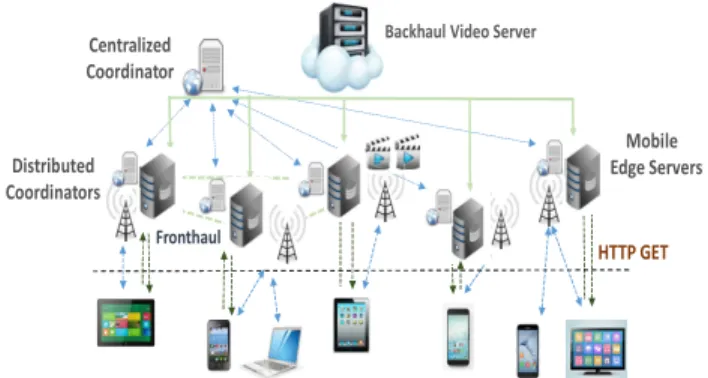
Fig.1 illustrates a schematic view of mobile edge assisted adaptive video streaming with collaborative caching. Associ-ated with the edge servers, the cellular base stations allocate the available downlink radio resource blocks among the set of local clients based on the proportional fair (PF) policy. The clients radio access link level information and the video content caching are handled at the network edges. The set of neighborhood edge servers form the edge clusters in which they collaborate with each other to serve the request of mobile clients. We design in-network bitrate adaptation solution such that with the instantaneous radio link level information of the clients, the coordinators first resolve the clients to server mapping based on per chunk signal-to-noise ratio (SNR) values and then solve the joint QoE-traffic optimization prob-lem according to the weighting adjustment by MNO. The most sustainable bitrates are allocated to the clients at each time slot based on the results of the optimization problem.
The decision on bitrate allocation to each chunk is made taking into account the existence of chunks in the caches in a down-to-up hierarchical manner. In other words, the chunk/bitrate of the client’s requested video is searched in the cache of first the local and then the neighborhood edge servers in the case that it does not exist in the local cache. Upon the failure to find the chunk/bitrate in the edges, then the possibility of transferring from the origin server is investigated. The actual bitrate allocation is performed based on the maximization of joint QoE-traffic utility objective. After the bitrate allocation, the possibility of caching among multiple served chunks/bitrates for future clients’ access is then investigated.
It should be noted that the edge-assisted bitrate adaptation is independent from the collaborative edge caching. In the former, clients and edge servers coordinate with each other in order to achieve optimal and fair bitrate allocation among the clients. In the latter, the edge servers collaborate with each other to improve the overall cache hit rate. In this work, we do not address the mechanisms required to forward clients’ requests to the chosen edge or origin server. We also do not address security aspects of collaborative edge caching.
B. SYSTEM NOTATIONS
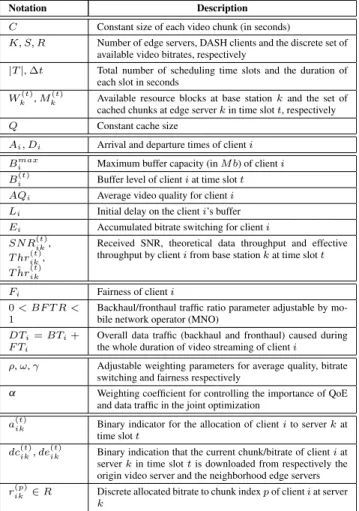
We consider the scheduling of S number of DASH mobile clients during|T| time slots with the duration of each slot of1t seconds. The contents of multiple videos are initially placed at the origin server such that each video is divided into consecutive chunks with fixed size of each chunk equal to C seconds and available in multiple discrete bitrates repre-sented by setR.Kedge servers are deployed in the system and associated with each server, the base station (eNodeB) allo-cates the downlink resource blocks to the subscribing clients according to PF policy. The available downlink resource blocks at edge serverkin time slottis represented byWk(t). The arrival and departure times of client i are denoted by respectivelyAiandDi. Also, the media player of each client
contains a video buffer with maximum capacity ofBmaxi and the amount of video data at the buffer of the client at time slottis represented byB(it). Depending on the client mobility, the receivable signal to noise ratio (SNR) of clientifrom the base stationkat time slottis denoted bySNR(ikt). Furthermore, rik(t) represents the allocated bitrate to the current chunk of clientiassigned to serverkat time slott. The binary variable a(ikt)is defined such thata(ikt) = 1 indicates the allocation of clientito edge serverkat time slott.
In our system model, we assume that the server allocation is decided at the beginning of each new chunk and the current server remains unchanged if the client is downloading at the middle of the chunk. At the beginning of the new chunk, the client is first assigned to the base station from where it receives the highest SNR and the edge server associated to that BS. Then, the next video chunk delivered to the client is fetched either from the cache of the local (the edge server associated to the BS) or another edge server in the neighbor-hood, or from the origin server. Regardless of which server
the content is fetched from, it passes through the edge server of the BS the client is associated to and gets transmitted over the air by that BS. In other words, that edge server acts as a proxy to the client.
The fixed cache capacity at each edge server is denoted byQand the set of available chunks in the cache of edge server k at time slot t is denoted by Mk(t). Furthermore, two binary decision variablesdc(ikt)andde(ikt)are also defined such thatdc(ikt) = 1 indicates that the chunk/bitrate of the video watching by clienti assigned to serverk at timet is downloaded from the origin server. Similarly,de(ikt)=1 states that clientidownloads the chunk/bitrate of its requested video from the other edge servers else than serverkat time slott. It is noted that at each time slott, the equalitydc(ikt)·de(ikt)=0 holds meaning that the client cannot download its requested chunk simultaneously from the origin and the edge servers at the same time slot. The notations BTi and FTi (in Mb)
denote the overall data traffic on respectively the origin server and the fronthaul network resulted during the whole duration of video streaming of clienti. Furthermore, the parameter BFTR(backhaul/fronthaul traffic ratio) is also defined which takes a value between zero and one and is adjustable by MNO. This parameter is included in the system to indicate the significant of data traffic on the fronthaul network compared to the traffic on the backhaul network from MNO point of view. It enables to access the locality of the traffic and, hence, the effectiveness of caching that happens at the edge of the network.
The list of system parameters and their descriptions have been summarized in Table1.
C. QUALITY OF EXPERIENCE
In conventional video streaming systems, the quality of expe-rience (QoE) of the clients is measured using the tradi-tional subjective metrics such as the mean opinion score (MOS) or the objective metrics such as peak signal-to-noise ratio (PSNR). However, these metrics are not commonly used nowadays by video providers because they are difficult to measure in a large scale operational system, especially MOS which requires explicit participation of the users. As pointed out by several research works in DASH literature, the main factors that affect the QoE in dynamic adaptive video stream-ing are video stalling, video quality,bitrate switching and initial playback buffering time known asinitial/startup delay.
1) VIDEO QUALITY
The quality that clients perceive during the streaming session is directly related with the streaming bitrate as the video chunks are streamed with high bitrate, the watching quality increases. We rely on the average bitrate that clientiwatches the video during the whole time duration of its streaming session which is given by the following equation:
AQi= C |Di−Ai| X ∀Ai≤t≤Di X 1≤k≤K a(ikt)·rik(t) (1)
TABLE 1. System notations and their descriptions.
2) BITRATE SWITCHING
High bitrate switching also negatively impacts the satisfac-tion of the mobile clients. The accumulated bitrate switching (magnitude) of clientiduring its streaming session from the arrival to departure is obtained as follows:
Ei= |Di−Ai|/C X p=2 X ∀1≤k≤K (a(Ai+(p−1)·C) ik ·r (p) ik −a(Ai+(p−2)·C) ik ·r (p−1) ik (2)
3) INITIAL BUFFER DELAY
Initial buffer delay denoted byL refers to the time duration from the arrival time of the client until the time that the data in the playback buffer reaches the maximum capacity. As a trade-off, longer initial buffer delay helps to reduce significantly the video stalling events during the streaming session. Although long delay slightly impacts QoE, most of the clients however tend to tolerate longer initial delay in order to experience smoother video without interruption [6]. Since the impact of delay on the QoE is not significant as the impact of video bitrate and switching, we ignore the buffer delay in our analytical model for the sake of simplicity.
4) STALLING RATIO
Video stall event refers to the time when the client’s buffer gets empty (playback freezes) due to streaming the video on the player with high bitrates under low achievable through-put. To quantitatively express the stalling in the optimization problem, we need to derive first the relation for the buffer filling level of the client at each time slot.
B(it)= ( B(it−1)+Thrˆ (ikt)·1t, Ai≤t≤Ai+Li B(it−1)+(Thrˆ (ikt)−r(p) ik )·1t, Ai+Li<t≤Di (3)
where1t is the fixed duration of each time slot andThrˆik(t) represents the effective (achievable) throughput by clienti allocated to serverkat time slott. It is noted that in the startup phase which lasts for the time duration of initial buffer delay, there is no video streaming on the client’s player. At a given time slot, the effective throughput of each client is obtained based on its theoretical throughput,Thr, and the number of other simultaneous clients at that time slot.
In order to ensure that no stalling event happens during the whole time duration of video streaming, the following constraint should be satisfied at each time slot:
0≤B(it)≤Bimax, ∀Ai≤t ≤Di (4)
5) FAIRNESS
As mentioned earlier in the system model, the downlink radio resources are allocated to the clients according to the PF policy at the base station. The client-side adaptation heuristics allocate the most sustainable bitrates to the clients based on their share of throughput (wireless channel quality). However, in some situations, the client-based solutions may not fairly allocate the bitrates resulting in unfairness among the competing clients. To avoid unfair situations, for each current client, we strive to allocate the best sustainable bitrate which has the least difference with the average of bitrates allocated to the other simultaneous active clients at the same server. More precisely, the objective of fair bitrate allocation is to minimize the overall deviation of the allocated bitrates to each clientifrom the average during its whole streaming session given by the following summation:
Fi= Di X t=Ai X 1≤k≤K aik(t)· |rik(t)− ¯r(t)| (5)
wherer¯(t)is the average bitrate of other simultaneous clients at time slot t. The minimization of (5) should also sat-isfy the instantaneous available resource blocks at the base station.
D. BACKHAUL AND FRONTHAUL DATA TRAFFIC
As mentioned in the system model, the allocation of bitrates are decided based on the existence of the chunk/bitrate of the requested video in down-to-up hierarchical caches. If the requested chunk is not available in the local cache, it is
then searched in the cache of the neighborhood edges taking into account the data traffic that it will add to the fronthaul network within the edge cluster. If it is not also found in the neighborhoods, then, transferring the chunk from the cloud server with the cost of adding to the backhaul traffic is investigated. Considering two decision variablesdc(ikt)and de(ikt), the overall backhaul and fronthaul data traffic caused during the video streaming of clientiare therefore obtained using the following summations:
BTi = Di X t=Ai X 1≤k≤K a(ikt)·dcik(t)·1t·rik(t) (6) FTi = Di X t=Ai X 1≤k≤K a(ikt)·de(ikt)·1t·BFTR·rik(t) (7) And, the overall data traffic resulted from the video stream-ing of client i is given by DTi = BTi + FTi. System
model assumes that there is no traffic incurred when the requested chunks are retrieved from the local caches. It is noted that there is no basically a trade-off between the back-haul and frontback-haul data traffics since reducing the traffic on the backhaul network does not necessarily mean increasing the data traffic on the fronthaul network. In fact, efficient opti-mal heuristics can be designed for updating the cache con-tents which minimize both the backhaul and fronthaul data traffic.
IV. JOINT QoE-TRAFFIC OPTIMIZATION
In this section, we formulate the problem of jointly max-imizing the QoE, fairness and minmax-imizing the overall data traffic for each individual client. The optimization problem is formulated considering the discrete time slotted DASH scheduling with fixed duration1t for each time slot. Three adjustable weighting parametersρ, ω, γ are defined to con-trol the importance of each component video quality, bitrate switching and fairness in QoE term. The weighting parameter
α is defined for adjusting the balance between QoE of the clients and the video data traffic (backhaul and fronthaul). With the relations (1), (2), (4), (5), (6) and (7), the joint QoE-traffic optimization in collaborative edge caching is defined as the following integer non-linear programming (INLP) opti-mization problem: Maximize dc,de,r Ui =α(ρAQi−ωEi−γFi)1t−(1−α)DTi (8) Subject to: X j∈S a(jkt)· dr (dt/Ce) jk Thrjk(t) e ≤Wk(t), ∀1≤k≤K, ≤t ≤ |T| (9) 0<B(it)≤Bimax, ∀Ai ≤t≤Di (10) dcik(t)=I((vi,d(t−Ai)/Ce,rik(t))∈/Mk(t0), ∀1≤k0≤K), ∀1≤k≤K, Ai≤t ≤Di (11) de(ikt)=I((vi,d(t−Ai)/Ce,rik(t))∈/Mk(t) (12) ∧ ∃ 1≤k0≤K 3(vi,d(t−Ai)/Ce,rik(t))∈M (t) k0 ), ∀1≤k≤K, Ai≤t ≤Di aik(t)·dcik(t)·de(ikt)=0, ∀1≤k≤K, Ai≤t ≤Di (13) a(ikt)= a(ikt−1), t mod C6=1
1, t mod C=1∧k=arg max{SNR(ikt)}
0, Otherwise
(14)
rik(p)∈R, dcik(t),de(ikt)∈ {0,1},
∀1≤k≤K, Ai≤t ≤Di, 1≤p≤(Di−Ai)/C (15)
In the above optimization problem, variablesrik(t) anddc(ikt) and de(ikt) are the integer and binary decision variables, respectively, and, the values of other parameters are known in advance. Constraint (9) ensures that at each time slot, the available resource blocks at the BS are allocated to the requested clients according to their wireless link quality. Inequality (10) ensures avoiding the stalling at each time slot as mentioned in the previous section and constraint (11) states that the client downloads the chunk/bitrate of its video from the origin server at time slottif it is not available in the cache of any local or neighborhood edge servers. Constraint (12) states that the client downloads its chunk/bitrate from a neigh-borhood edge server within the same cluster if its request does not exist in the local cache. Constraint (13) ensures that the client cannot download the requested chunk/bitrate of its video from the origin and the edge server simultaneously at the same time slot. Constraint (14) determines the edge server to which the client is mapped at each time slot and finally, the relations in (15) specify the range of decision variables.
V. ONLINE SCHEDULING ALGORITHM
The existence of integer decision variables makes the optimization problem (8)-(15) NP-hard and, therefore, the exhaustive search strategies do not scale. Furthermore, the problem (8-(15) is formulated in an offline manner assuming that all the information about the clients and edge servers are available in advance, which is not practically fea-sible. We design an online greedy-based algorithm with low computational complexity which also requires the minimum need for parameter tuning making it suitable for practical deployment. The proposed algorithm utilizes a self-tuned bitrate selection procedure which allocates the most suitable bitrates to each client and dynamically adjusts the weighting parameters in QoE term of the objective function. However, the flexibility of adjusting the weighting of QoE and data traffic along with the setting of BFTR parameter are left to the MNO itself depending on its desired operational point. Pseudo-code of the algorithm called Collaborative Cache-aware Bitrate Allocation Algorithm (CCBAA) is shown in Algorithm1.
Algorithm 1Collaborative Cache-Aware Bitrate Allocation Algorithm (CCBAA) (Run by the Coordinators)
1: Input: |T|,K,R:Number of scheduling time slots, number of edge servers, set of available discrete bitrates on the origin server.
2: Output: Binary allocation dc(ikt), de(ikt) and integer bitrate allocation rik(t) for each client i, edge server 1 ≤ k ≤ K and time slot 1 ≤ t ≤ |T|,totalUtility, totalTraffic
3: Mk(t)= ∅ ∀1≤k≤K,∀1≤t ≤ |T|;
4: foreach time slot 1≤t≤ |T|do
5: foreach clientisuch thatAi≤t ≤Dido 6: Allocateclientito server 1≤k≤K
according to (14)
7: ift =Aithen
8: InitializeBufferStatus,DTiandLi 9: if(t−Ai)modC6=1then
10: Allocateclientito the same server and with the same bitrate as with time slott−1;
11: UpdateB(it),DTi;
12: ifBufferStatus=FalseAnd B(it)=Bmaxi then
13: BuffetrStatus=True;Li=t−Ai;
14: if(t−Ai) modC=1then
15: CallSubroutine Self-tuned Bitrate Selection;
16: ift =Dithen
17: totalUtility=totalUtility+Ui 18: totalTraffic=totalTraffic+DTi 19: ReturntotalUtility,totalTraffic;
A. COLLABORATIVE CACHE-AWARE BITRATE ALLOCATION ALGORITHM
In discrete time slotted scheduling, the CCBAA algorithm first resolves the clients to servers mapping at each time slot using the relation (14) (line 6). At each time slot, a client is mapped to the server (base station) with maximum receivable downlink SNR value if the client is about to download a new chunk and it remains allocated to the same server as in the previous time slot if a chunk download is in progress. Buffer status of the client is also initialized if the client arrives to the system at the current time slot (lines 7-8). Then, the same bitrate as the bitrate of the previous time slot is allocated if the client is currently downloading a chunk. Otherwise, if a new chunk download is about to start, the self-tuned bitrate selection procedure (Subroutine 1) is called to determine the best possible bitrate for the new chunk (lines 9-15).
1) SELF-TUNED BITRATE SELECTION
As part of the algorithm, the self-tuned bitrate selection pro-cedure is executed if the client is about to download the new chunk and hence, the most suitable bitrate should be decided for the new chunk.
As demonstrated in Subroutine 1, it first chooses the high-est available bitrate if the client is downloading the first chunk of the video (lines 1-3). For the consecutive chunks, the pro-cedure chooses the largest sustainable bitrate (in decreasing order of setR) that results in fewer bitrate switches and higher fairness than observed with the previous chunk. In other words, the chosen bitrate for the current chunk should result in a switching less than some thresholdδSand a fairness value
greater than or equal to the given thresholdδF. Switching
threshold δS is derived (line 4) knowing the fact that the
highest bitrate switchings between the chunks happen when the bitrates are allocated merely based on the buffer status of the client [18] and fairness threshold δF is given at the
deployment phase.
Among those bitrates that satisfy the base station resource allocation constraint (9) and both switching and fairness thresholds (lines 5-7), the one which maximizes the utility value (8) is chosen as the bitrate for the current chunk of the client. Note that for each bitrate, the evaluation of utility objective (8) is based on the availability of the chunk/bitrate in down-to-top hierarchical caches as well as the weighting parameters in the objective function (lines 8-17). If there is no available bitrate in setRwhich satisfies both thresholds, the availability of those bitrates which satisfy the switching thresholdδS is investigated. Among those eligible bitrates,
the one which maximizes the utility objective is selected as the bitrate for the current chunk (lines 18-22). Finally, if no such bitrate is available, the best sustainable bitrate that maximizes the utility value is chosen as the bitrate for the current chunk (lines 23-26). In this way, the bitrates are allocated to the client such that they satisfy the switch-ing and fairness thresholds while maximizswitch-ing the client utility.
Afterwards, the values of the weighting parameters in QoE term are automatically computed at the current time slot (line 27). More precisely, the weight of the video quality (ρ) is determined based on how far is the selected bitrate from the highest available one in set R. The switching weight (ω) is determined based on how far is the selected bitrate from the one which results in no switching with the bitrate of the previous chunk. Similarly, the fairness weight (γ) is determined based on the distance between the selected bitrate with the average bitrate of other simul-taneous clients. The utility value of the client, its buffer status and the associated backhaul/fronthaul data traffic are also accordingly updated (lines 28-35). After the bitrates are allocated to the chunks, the cache replacement heuris-tic is executed by the edge servers in the current time slot if some of the allocated chunks/bitrates are down-loaded from either the origin or the neighborhood edge servers.
It is noteworthy to mention that although the cache replace-ment heuristic is executed by the edge servers, the chunk eviction at the edge cache implicitly impacts the performance of CCBAA algorithm in terms of resulting QoE-traffic as we show later in simulation results.
Subroutine 1Self-tuned Bitrate Selection
1: ift−Ai≤Cthen
2: Allocatethe highest available bitrate;
3: UpdateBufferStatus,B(it),DTi
4: ComputeestThr and thresholdδS; maxUtility= −∞; 5: foreach bitrater∈Rin decreasing orderdo
6: ifallocation ofrsatisfy (9)AND r≤max(estThr,Thrˆ ik(t),B(it))then
7: if|r−rik(t−1)| ≤δSAND
1− |r− ¯r|/(Rmax−Rmin)>=δFthen
8: Data=0; 9: if(vi,dt−CAie,r)∈/Mk(t0),∀1≤k0≤K then 10: Data=1t·r; 11: if(vi,dt−CAie,r)∈/Mk(t)AND 12: ∃1≤k0≤K 3(vi,dt−CAie,r)∈Mk(t0) 13: thenData=BFTR·1t·r;
14: Computeweightingsρ, ωandγ;
15: QE=ρr−ω|r−rik(t−1)| −γ|r− ¯r|;
16: ifβQE−(1−β)Data>maxUtilitythen
17: maxUtility=βQE−(1−β)Data;rik(t)=r;
18: ifrik(t)=0then
19: foreach bitrater∈Rin decreasing orderdo
20: ifallocation ofrsatisfy (9)AND r≤max(estThr,Thrˆ ik(t),B(it))then
21: if|r−rik(t−1)| ≤δSthen Data=0; 22: Performthe same operations as in lines
(9)-(17);
23: ifrik(t)=0then
24: foreach bitrater∈Rin decreasing orderdo
25: ifallocation ofrsatisfy (9)AND
r≤max(estThr,Thrˆ (ikt),B(it))then Data=0; 26: Performthe same operations as in lines
(9)-(17);
27: Updateweighting parametersρ,ω γ at time slott;
28: ComputeAQi,Ei,FiandUiup to time slott
accord-ing to respectively (1), (2), (5) and (8); UpdateB(it)
29: ifB(it)=Bmaxi ANDBufferStatus=Falsethen
30: BufferStatus=True; Li=t−Ai; 31: if(vi,d(t−Ai)/Ce,rik(t))∈/M (t) k0 ,∀1≤k0≤Kthen 32: dc(ikt)=1; BTi=BTi+1t·rik(t); 33: if(vi,d(t−Ai)/Ce,rik(t))∈/M (t) k AND ∃1 ≤ k0 ≤ K 3 (vi,d(t−Ai)/Ce,rik(t)) ∈ M (t) k0 then 34: de(ikt)=1; FTi=FTi+1t·rik(t); 35: DTi=BTi+BFTR·FTi; 36: ReturnUi,DTi;
B. RETENTION-BASED COLLABORATIVE CACHING (RBCC) HEURISTIC
Varying wireless link quality and the bitrates request during different time periods makes the proactive cache updating
more challenging [25]. Since the future arrival/departure or the requested chunks by the clients are not known in advance, we design a probabilistic collaborative heuristic that relies on two separate sources of information: 1) Video viewing statistics 2) current clients’ bitrate allocation history. To efficiently utilize the limited cache size, the retention of the clients helps to have some prior knowledge on their viewing behavior. The clients’ bitrate history is also used to prioritize between different representations of specific segments. Each time there is need for cache replacement, the proposed cache updating strategy in this work computes a probability value when not only the local clients but also the clients associated to the neighborhood edge servers request a specific video chunk using these two sources of information. The pseudo-code of the proposed cache replacement heuris-tic called retention-based collaborative caching (RBCC) is in Subroutine 2.
We do not address the challenge of efficient computing of per-video retention but instead expect it to be handled by the video service provider who has access to all the view-ing statistics (e.g., YouTube provides audience retention). We note that the accuracy of RBCC heuristic is dependent on how well the retention really reflects user behavior, which in turn is affected by the number of samples. Hence, the larger number of views a computed retention is based on, the more accurate predictor of future viewer’s behavior we can expect it to be. Some results on the effect of number of views with such a predictor, although for a slightly different problem, are presented in [32]. The authors conclude that performance is fairly good already after 50 views and after 100 views the performance improvements are marginal.
Once the cache update procedure is executed at each edge server, the heuristic computesweightandvaluefor each set of chunk/bitrate of different requested videos at the current time slot. The weight (occupied space in the cache) of video chunk is equal to the multiplication of chunk size and its allocated bitrate. The value of a chunk is a unitless quantity describing the probability that it will be requested in the future. This value is computed considering all those clients streaming from either the same edge server (lines 4-10) or from other edge servers (lines 11-17) and are currently downloading earlier chunks of the same video. In other words, these clients will request the chunk in question, or another one with same index but different bitrate, unless they abandon viewing the video before that point of time. The calculation needs to con-sider both the index of chunk as well as its bitrate: For each of those clients, the heuristic first computes the likelihood that client will be still active in its streaming session when it reaches the point of video corresponding to the chunk whose value is being computed. Second, it measures how frequently the bitrate of that chunk has been accessed by each of these other clients during the past.
Mathematically speaking, consider updating the cache contents at edge server 1 ≤ k ≤ K. For every client i allocated to serverk at time slott (a(ikt) = 1), to compute
Subroutine 2 Retention-Based Collaborative Caching (RBCC) Heuristic (Run by the Edge Server)
1: foreach edge server 1≤k≤Kdo
2: if dc(ikt) = 1 or de(ikt) = 1, for at least one client i:a(ikt)=1then
3: SetV,I,W,P=Lists of respectively the videos, chunk indexes, the weights and the updated values of the existing chunks in cache;
4: foreach each clientisuch thata(ikt)=1do
5: ifvi∈/V ORd(t−Ai)/Ce∈/I
ORrik(t)·C∈/W then
6: CreatesetSLfrom (16); 7: ComputePLreach(j,i,k,t) and
PLacc(j,i,k,t)
from (19) and (20) for each clientj∈SL; 8: ComputePLcache(i,k,t) value for
clienti
according to relation (17);
9: Appendvideovi, chunk index d(t−Ai)/Ceand its weightC·rik(t)
to lists respectivelyV,I andW;
10: AppendPLcache(i,k,t) value toP 11: foreach each clienti0such thataik(t)0 =1(k0 6=k)
do 12: if(vi0 ∈/V ORd(t−Ai0)/Ce∈/I ORri(0tk)0·C ∈/W)AND (vi0,d(t−Ai0)/Ce,r(t) i0k0)∈/M (t) s )(∀s6=K0)then 13: CreatesetSN from (22);
14: ComputePNreach(j,i0,k0,t) and
PNacc(j,i0,k0,t) for each clientj∈SN; 15: ComputePNcache(i0,k0,t) value
clienti0according to relation (23);
16: Appendvideovi0, chunk index
d(t−Ai0)/Ceand its weightC·r(t)
i0k0 to lists respectivelyV,IandW;
17: AppendPNcache(i0,k0,t) value toP 18: SortlistPand accordingly listsV,I,W in
decreasing order of caching values;
19: sum_of_weights=0;
20: forindex=1 tosize(P)do
21: sum_of_weights=
sum_of_weights+W(index);
22: ifsum_of_weights>Qthen
23: Break;
24: Mk(t)=Mk(t)∪
(V(index),I(index),R(index));
the value of its current chunk with indexdt−Ai
C e, the heuristic
first creates the following list of potential clients which are allocated to the same server as client i and streaming the earlier chunks of the same video:
SL = {j|a(jkt)=1,vj=vi,d
t−Aj
C e ≤ d
t−Ai
C e} (16)
The likelihood of caching the chunk of clientiallocated to serverkat time slott,PLcache(i,k,t), is then computed using
the following union probability:
PLcache(i,k,t)=P((∪L(j,i,k,t) ∀j∈SL)∪L(new,i,k,t)) (17)
where for each clientj ∈ SL at time slot t, the notation
L(j,i,k,t)denotes the event that clientjhas perceived the bitrate
of client i’s chunk during the past time slots and will be still active in its session until it reaches the clienti’s chunk. In order to consider the effect of clients’ arrival/departure interleaving, we also take into account the arrival of a new client in the caching probability computation. The similar eventL(new,i,k,t) is also considered for the new arrival. The
probability of the corresponding event for each clientj∈SL
is derived using the following multiplication:
P(L(j,i,k,t))=PLreach(j,i,k,t)×PLacc(j,i,k,t) (18)
where the first term,PLreach(j,i,k,t), is the probability that
the clientj∈SLwill not abandon the stream before reaching
the chunk of clienti. The second term,PLacc(j,i,k,t), states
how frequently the bitrate of considered chunk of clientihas been accessed by clientjduring the past time slots.
We note that in the computation of the caching probability, we assume that all clients in set SL stream the video
con-tinuously without interruption, however, our methodology can be easily adapted to the case when some of the clients may jump form one part of the video to the later parts. This adaptation can be achieved by dynamically updating the set of clients inSL at each time slot and computing the caching
value, accordingly. Assuming that the retention functionPact,
which specifies the probability of a newly arrived client to view different parts of the video, is known and provided by the origin video server, the probability PLreach(j,i,k,t) is
therefore estimated using the following relation:
PLreach(j,i,k,t)≈1−(Pact(d t−Aj C e)−Pact(d t−Ai C e)) (19)
If a given client is currently downloading a chunk of video before the chunk index of clienti, it is evident that the closer it is to the chunk index of clientithe higher probability that clientjwill request that other chunk in the future. The second term in (18) is obtained as follows:
PLacc(j,i,k,t)= Pt t0=A ja (t0) jk ·I(r (t0) jk =r (t) ik ) Pt t0=A ja (t0) jk (20)
where the identity functionI(r(t
0)
jk =r
(t)
ik )=1 if the allocated
bitrate to clientjon serverk at time slot t0 is equal to the bitrate of client i at time slot t and I(r(t
0 ) jk = r (t) ik ) = 0, otherwise.
Similarly, the likelihood that the new arrival reaches the current chunk of clientiis given by:
Since a new arrival has not yet started the video streaming, we estimate the probability that the new arrival has accessed the same bitrate as clientiduring the past time slots with the equal probabilityPLacc(new,i,k,t) ≈1/|R|, whereRis the
set of available bitrates at the origin server.
Now, to consider the effect of collaboration among the edge servers in the cache updating heuristic (the operations in lines 11-17), similarly, for every client i0 allocated to edge serverk06=k, the following list of clients is first created:
SN = {j|a(jkt)0(k06=k)=1,vj=vi0,d t−Aj C e ≤ d t−Ai0 C e} (22)
The likelihood of caching the chunk of clienti0allocated to serverk0(k0 6= k) at time slott,PNcache(i0,k0,t), is then
computed using the following union probability:
PNcache(i0,k0,t)=P((∪N(j,i0,k0,t) ∀j∈SN)
∪ N(new,i0,k0,t)) (23) Since the existence of any chunk/bitrate in the neighborhood caches helps to reduce the backhaul data traffic by the factor ofBFTR, therefore, this weighting value is considered in the computation ofP(Nj,i0,k0,t) andP(N(new,i0,k0,t)) as follows:
P(N(j,i0,k0,t)) =BFTR×PNreach(j,i0,k0,t)
×PNacc(j,i0,k0,t) (24)
P(N(new,i0,k0,t)) =BFTR×PNreach(new,i0,k0,t)
×PNacc(new,i0,k0,t) (25)
QuantitiesPNreach andPNacc for each clientj ∈ SN and the
new arrival are computed in a similar manner as for the clients j∈SLgiven in relations (19), (20) and (21).
We assume the events L(j,i,k,t) and L(new,i,k,t) in
rela-tion (17) and similarly the eventsN(j,i0,k0,t)andN(new,i0,k0,t)in relation (23) to be independent ignoring the complex inter-dependencies among the clients for the sake of analytical simplicity. At each edge server, the heuristic then sorts the current chunks in decreasing order of their computed caching values PLcache and PNcache (line 18). In the sorted order,
the chunks are then inserted into the cache until the sum of the weights of the chunks exceeds the cache capacity (19-24). It is noteworthy to mention that although theforloop in Subroutine 2 is taken over the edge servers, it does not imply that the edge servers update their cache contents independent from each other. In other words, they exchange explicitly the information about the status of neighborhood clients when making the caching decisions.
C. COMPLEXITY ANALYSIS
In this section, we derive the worst case time complexity of algorithm CCBAA and the cache replacement heuristic RBCC, separately. At each time slot and for each client, the client to server mapping part in Algorithm 1 takes worst case time ofO(K), whereK is the number of edge servers. Obviously, the most computational tasks in Algorithm 1 is taken by running the subroutine Self-tuned Bitrate Selection
at each time slot. In the following, we analyze the worst time complexity of Subroutine 1 in one time slot.
The computation of estimated throughputestThr during one previous chunk (with sizeCseconds) results in the worst case complexity ofO(C·S), whereSis the number of clients in the system. Also, the estimation of switching threshold
δS demands forO(|R|) time where,|R|is the size of
avail-able bitrates at the origin server. For every availavail-able bitrate, the assignment of data traffic variableDataaccording to the cache status of the local and the neighborhood edge servers leads to the worst case time complexity of orderO(K) and computing each of the weighting parameters in the QoE term (ρ, ω, γ) requiresO(|R|) time. Updating the QoE weighting parameters at the current time slot (line 43) again requires O(|R|) time in the worst case. Finally, updating the data traffic values and the corresponding binary variables (lines 47-50) takes the computation time ofO(K) in the worst case. Putting the above complexities together results in the following worst case time complexity for running the Subroutine 1 at each time slot:
TSubroutine1=O(C·S+ |R| + |R|(K+ |R|)+ |R| +K) =O(C·S+ |R| +(|R| +1)(K+ |R|)) (26)
Now, within |T| time slots and with S number of clients, the execution of Algorithm 1 including the clients to server mapping results in the following worst case time complexity:
TCCBAA=O(|T| ·S·(K+TSubroutine1)) =O(|T| ·S·(K+C·S+ |R|
+(|R| +1)(K+ |R|))) (27)
In the following, we derive the worst case complexity of running RBCC heuristic at one edge server. In the worst case, the cache replacement is performed at|T|time slots. At each time slot, the heuristic first updates the caching value of the current existing chunks in the local cache. In the worst case, the maximum number of available chunks in the cache is C·RQ
min, where Q is the fixed cache size and Rmin is the
smallest available bitrate in setR. For each of these chunks, the computation ofPLcache takesO(S(|T| +1)) time in the
worst case. This is because forS clients, the estimation of PLreachrequiresO(1) time when the retention functionPactis
known in advance, and, the computation ofPLacctakesO(|T|)
time in the worst case.
The heuristic then computes the caching value for all the clients allocated to the local and the neighborhood edge servers. In the worst case with overallS clients, this process takesO(S·S·(|T| +1)) time. Also, there are C·RQ
min chunks
already in the cache in the worst case and, withSnumber of other chunks (number of clients), the sorting process takes thereforeO((C·RQ
min+S)log(
Q
C·Rmin+S)) time. Further,
insert-ing the sorted chunks in the cache demands for the time of orderO(C·RQ
min+S). Now, putting the above time complexities
case time complexity for RBCC heuristic: TRBCC =O(|T|(( Q C·Rmin +S)(S(|T| +1) +log( Q C·Rmin +S)+1))) (28)
VI. SIMULATION RESULTS
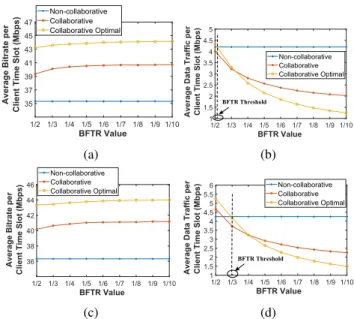
In this section, we present simulation results conducted for evaluating the performance of the proposed system. Our objectives are the following: 1) To compare our bitrate adaptation combined with collaborative edge caching solu-tion against another network-assisted and collaborative edge caching approach in terms of both QoE and data traffic, 2) to evaluate the performance of the proposed RBCC cache replacement heuristic through comparison with other existing methods, and 3) evaluate the impact of BFTR parameter in collaborative caching on both average video bitrate and data traffic with respect to non-collaborative caching.
A. SIMULATION SETUP
The simulations are conducted with a network setup in SimuLTE simulator [40] using the radio access link level traces of 100 UEs (mobile clients) and 10 eNodeBs (base stations). The edge servers associated with these base stations form one single edge cluster i.e. each edge server has all the other servers as its neighborhood. With time slot duration of 1t = 1s, the total time dura-tion of 300s (time slots) is considered for the simula-tion. All the clients have the constant speed of 8.33 m/s adopted from [16] with linear mobility and their downlink SNR values during different time slots are obtained accord-ing to LTE downlink throughput specifications reported in [41]. The chunks of four videos with different popular-ities are available initially at the origin server in ten dif-ferent bitrates [15,17,22,26,30,35,38,43,45,50 Mbps]. Each video lasts for 270s(time duration of the video) while each chunk is 5s. Unless explicitly mentioned, the mobile clients arrival time is a random value chosen from the uniform interval [1,30s] and also, the linear curve is used to represent the clients retention toward different videos.
Constant buffer size of 250Mbis considered for all the clients and the cache size at each edge server is fixed at Q = 2Gb. With total of 5MHzavailable bandwidth at each time slot, the number of 28 downlink LTE resource blocks are available per slot at each base station. The weighting value
α = 0.5 is considered in joint QoE-traffic optimization and unless explicitly mentioned, the value of parameter BFTR is set to 1/3. Furthermore, the fairness threshold ofδF = 0.5
is considered in the simulations. At each simulation part, the average of the results taken over 20 runs of simulation with confidence interval of 95% is presented.
B. QoE-TRAFFIC COMPARISON
1) COMPARISON TO NON-COLLABORATIVE CACHING
We first compare the collaborative and non-collaborative edge caching strategies in terms of QoE metrics and the
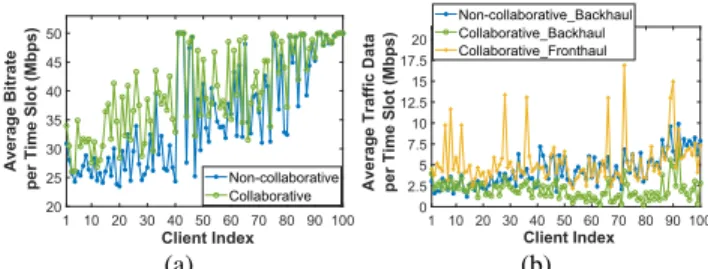
FIGURE 2. Comparison between collaborative and non-collaborative edge caching in terms of (a) average video bitrate (b) average data traffic.
backhaul/fronthaul data traffic. For each client, the resulting average video bitrate and data traffic are plotted in Fig. 2a to Fig. 2b. Fig. 2a shows that mobile clients perceive higher video bitrate with collaborative caching by exploring not only the local but also the neighborhood caches. Although the collaborative edge caching adds some traffic to the fronthaul network, it also reduces significantly the backhaul traffic (Fig. 2b), as intended. An average improvement of 12% in video bitrate and the reduction of 53% in backhaul data traffic is achieved with collaborative edge caching compared to non-collaborative strategy. We conclude that with this param-eterization, the collaborative edge caching is more effec-tive in reducing backhaul data traffic than increasing video bitrate.
We note that the collaborative edge caching causes slightly more bitrate switching compared to non-collaborative caching. The reason is that in some situations, the clients download the chunks from the neighborhood edges in order to substantially reduce the backhaul traffic although it leads to slightly increased bitrate switching.
2) COMPARISON TO ANOTHER SAND-DASH SOLUTION
We have also compared the proposed edge-assisted adapta-tion algorithm CCBAA with another SAND-DASH soluadapta-tion which was adapted from [9]. The network-assisted solution in this work solves a QoE-driven utility maximization problem subject to the limited available bandwidth to determine the allocated bitrates to the set of competing clients. For the purpose of fair comparison, we adapt this solution using the same objective function (8) with α = 0.5 and the equal weighting valuesρ = ω = γ = 1/3 in the QoE term. A simple greedy algorithm is then employed to deter-mine the allocated bitrate to each client at each time slot. Cache updating procedure RBCC is also used for updating the cache contents at the edge servers.
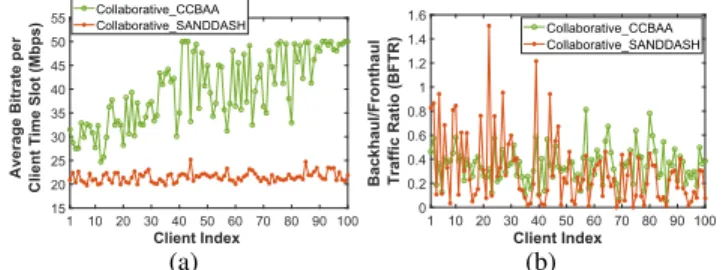
The results of the comparison of CCBAA to the other SAND-DASH solution are shown in Fig. 3. As Fig. 3a shows, our algorithm yields roughly 85% higher average video bitrate than the other algorithm, which is due to the fact that our algorithm uses a self-tuning mechanism which strives to allocate the highest bitrates at each time slot in the best pos-sible way of satisfying the switching and fairness thresholds. However, using our algorithm leads to about 16% (in average)
FIGURE 3. Comparison between CCBAA algorithm and another SAND-DASH solution. (a) Average bitrate. (b) BFTR value.
increase in the backhaul/fronthaul traffic ratio per client as shown in Fig. 3b. Taking into account the QoE-traffic trade-off, the significant improvement obtained in average video bitrate compared to the smaller increase in BFTR however confirms the superiority of our algorithm with respect to the other network-assisted solution.
It is worth pointing out that our solution can be parame-terized such that it generates smaller BFTR values compared to the other SAND-DASH solution, while sacrificing slightly the average video bitrate per client.
We have shown in [18] that the network-assisted bitrate adaptation part of the solution outperforms client-based DASH reference heuristics rate based adaptation (RBA) and buffer based adaptation (BBA). We expect that the collabo-rative edge-assisted bitrate adaptation and caching solution proposed in this work brings the noticeable improvement in average bitrate with small increase in BFTR value when compared to strategies that combine client-based adaptation heuristics with non-collaborative edge caching.
3) COMPARISON TO ANOTHER COLLABORATIVE CACHING SOLUTION
Next, we compare our solution to the hierarchical collabora-tive edge caching algorithm called Octopus presented in [24]. Octopus uses a client-based heuristic for the bitrate selection among the clients and the requested chunk/bitrate of the clients can be fetched from the neighborhood caches when it is not available in the local cache. Furthermore, the cache contents at the edge servers are dynamically updated using the LRU policy without considering collaboration between the edge servers in the caching process. To have a fair comparison under the same setup, we adapt the bitrate allocation of Octo-pus to our network-assisted bitrate adaptation solution while using the same cache replacement heuristic LRU without edge collaboration.
The comparison in terms of backhaul and fronthaul data traffics is shown in Fig. 4a and 4b, respectively. Incorpo-rating RBCC cache replacement heuristic in our solution indeed helps to reduce the backhaul and fronthaul data traffic in average about respectively 42% and 20% compared to Octopus. Considering the QoE-traffic trade-off, our algo-rithm yields almost the same average video bitrates than Octopus.
FIGURE 4. Comparison between the proposed collaborative caching and Octopus in terms of backhaul/fronthaul traffic. (a) Average backhaul data. (b) Average fronthaul data.
C. PERFORMANCE EVALUATION OF RBCC HEURISTIC Next, we evaluate the performance of the proposed cache replacement heuristic and compare it to other cache updating strategies. The heuristics are compared in term of the percent-age of cache miss per client chunk, i.e., the ratio between the number of times that the allocated chunks/bitrates to the all clients are fetched from the origin server and the overall num-ber of allocated chunks/bitrates. We evaluate the following four different cache replacement strategies (the optimal ones are obviously impossible to implement for real systems).
• Non-collaborative Retention-based Caching (RBC): This strategy uses the same retention-based cache updating logic as in this work but without the inter-collaboration between the edge servers in the caching process. Also, the clients fetch the chunk/bitrates from either the local edge or the origin server.
• Non-collaborative Optimal: Without collaboration among the edge servers in caching and content fetching, the optimal approach assumes the availability of one time slot ahead clients status at each slot in an offline manner. More precisely, at each time slot, the opti-mal approach caches the best chunks/bitrates which are immediately requested by the clients in next time slot. • Retention-based Collaborative Caching (RBCC):
The proposed cache replacement strategy in this work which accounts for the possibility of collaborative con-tent fetching and, also takes into account the values of the requested chunks from the neighborhood clients for caching at each local edge server.
• Collaborative Optimal: Collaborative optimal approach caches the best possible chunks/bitrates at each time slot assuming the availability of one time slot ahead information about the requests of not only the local but also the neighborhood clients.
1) IMPACT OF ARRIVAL TIME
The results of comparing the heuristics in term of cache miss percentage for different arrival intervals of the clients are plotted in Fig. 5a. For different arrival intervals, the collab-orative caching performs better than all the non-collabcollab-orative ones, even the offline optimal. On average, the proposed heuristic reduces cache misses by 55% and 38% compared to Non-collaborative_RBC and Non-collaborative_Optimal,
FIGURE 5. Comparison between cache replacement heuristics in term of percentage of cache miss per chunk for different (a) Clients arrival time interval (b) Retention curves.
respectively. Optimal collaborative caching further reduces the cache miss by average about 77% compared to our heuristic. The gap between the optimal collaborative and our heuristic in term of cache miss tends to be bigger than the gap between the collaborative_RBC and Non-Collaborative_Optimal. This in turn reveals the interesting fact that relying on the statistical information for caching is more accurate with respect to the optimal one when there is no collaboration among the edge servers. In fact, the con-sideration of the requests from neighborhood clients when updating the cache contents at the local edge server may lead to the replacement of some of the chunks which will be most likely requested by the local clients in the future time slots. This in turn causes higher percentage of cache miss under the collaborative cache updating due to under/over estimation of the future bitrates request.
2) ROBUSTNESS
We further study the performance of Collaborative_RBCC heuristic from the robustness point of view. To measure its robustness when the clients show different retentions toward the requested videos, we generate randomly dif-ferent retention curves (RCs) and then compare the four above-mentioned cache replacement scenarios in term of cache miss. RCs are generated using the polynomial func-tion P(t) = at2 + bt + c by changing the curvature of the polynomial and determining the corresponding coeffi-cients a,b and c. Here, P(t) specifies the probability that the client leaves its session at time slot t. The results for five different retention curves (RC1-RC5) are shown in Fig. 5b. It is noted that the sharpness of the polyno-mial gets larger as the curve index increases, for instance, the probability that the clients depart from their streaming session is higher under the retention curve RC5 than the curve RC4.
The results are qualitatively similar to those where arrival time was varied. On average, our heuristic reduces the cache miss by 44% and 27% compared to Non-collaborative_RBC and Non-collaborative_Optimal, respectively. The optimal collaborative strategy further reduces the cache miss by 84% compared to our heuristic.
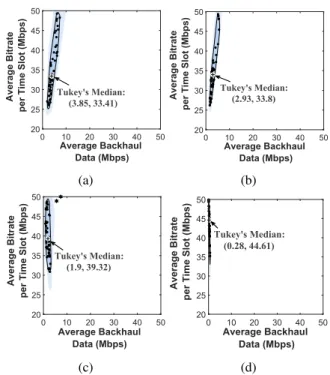
3) QoE-TRAFFIC BAG PLOT VISUALIZATION
We now visualize the resulting QoE and backhaul data traffic for four different caching strategies using Bag
FIGURE 6. Comparison between non-collaborative and collaborative cache replacement in term of QoE/traffic using Bag plot with half space Tukey’s median representation. (a) Non-collaborative_RBC.
(b) N-collaborative_Optimal. (c) Collaborative_RBCC. (d) Collaborative_Optimal.
plots [42] with Tukey’s half-space median representa-tion. Matlab libraries LIBRA [43] are used to draw the plots shown in Fig. 6a–6b. The bag of the collabora-tive_RBCC is narrower, which shows that the video stream-ing of the majority of the clients generates less data traf-fic on the origin server compared to non-collaborative caching (Fig. 6a). Improvement in average video bitrate with collaborative caching is also confirmed from the plots.
D. REMARKS ON THE OPTIMALITY
As mentioned in Subsection V, the optimization problem (8)-(15) belongs to the class of NP-hard problems and therefore, the proposed edge-assisted adaptation algo-rithm CCBAA is a suboptimal solution for the problem. As our simulation results in [18] show the proposed edge-assisted adaptation solution provides an approximation factor of about 1.2 in terms of average bitrate with respect to the optimal solution under the assumption that every edge server holds all the video chunks/bitrates (unlimited size fully populated edge caches).
Furthermore, the results in Subsection VI-C show that our RBCC cache replacement heuristic updates the cache contents such that the percentage of cache miss is in average about three times worse than the percentage of cache miss when using the optimal collaborative solu-tion. This in turn implies that our algorithm provides an approximation factor of about 3 in term of data traffic minimization.