Managing Exclusivity and Windowing in
Digital Content Value Chain
Completed Research Paper
I. Robert Chiang
Gabelli School of Business
Fordham University
Bronx, NY 10458 USA
Jhih-Hua Jhang-Li
Dept. of Information Management
Hsing Wu University
New Taipei City, Taiwan 24452
[email protected]
Abstract
The web streaming’s ease of content search, on-demand access, and wide viewing device options have helped create a distribution channel that complements and competes with cable. From the cable operator’s perspective, not only there are long-term concerns on the erosion of subscribership with the emergence of “cord cutters” and “cord nevers,” the shift to streaming during the online pay-tv window also diminishes the cable’s advertising revenue that depends on content popularity. By using Hotelling model with multihoming and Nash bargaining solution, we capture provider and subscriber heterogeneities and optimize payments among service providers along the content value chain. By deriving the equilibrium windowing delays under three contract negotiation settings, we also show how content quality and quantity would cause the title catalogs stay exclusive, shown syndicated, or redistributed with windowing delays.
Keywords: digital content distribution, windowing, multihoming, content exclusivity
Introduction
Major movie studios and TV networks have long cycled their titles through different distribution outlets with a distinct pattern; a practice dubbed “windowing”.1 For instance, following theatrical run, titles
become available for hospitality pay-per-views (during the premium video-on-demand window), then
DVD purchases (during the early electronic sell-through/rental window), before being featured in cable’s scheduled programs (during the first pay-tv window). In all, it could take months or even years for a title to reach the free-tv window of over-the-air broadcasting.
Advancements in processing, storage, and networking technologies have created another outlet for content distribution: online media streaming. Taking advantage of the web’s ease of search, on-demand access, interactive interface (for reviews, recommendations, and personalized watch lists), and wide device options (e.g., via game consoles and mobile devices), online streaming has carved out a second pay-tv window following the cable run. With the size of subscribership surpassing that of premium cable channels, however, leading streaming providers are well positioned to challenge the “pecking order” imposed by second pay windows. Movie studios and TV networks are thus faced with the decision of either maintaining the status quo of using cable channels as the “content redistributor,” or opening up separate negotiations with streaming outlets.
1 Disney and Netflix just pushed streaming video into its next era
Even though details of content distribution contracts are finalized behind closed doors, news releases have reported that a premium cable channel used to hold content for 90 days before redistributing it to a streaming provider;2 another premium cable network’s original series are kept from streaming for three
years.3 While content owners often grant months-long cable exclusives and designate cable networks as
content redistributor,4 there has been evidence of streaming’s hefty investment in securing new TV series
and first-run movies.5 Most major broadcasting networks also arrange to have their TV episodes streamed
following a range of time lags. For streaming providers, the ability to properly manage content quality, cost, and windowing delays is of strategical importance to sustain subscriber growth and to finance in-house productions.
In this study, we apply the Hotelling model with multihoming to study the contracting and windowing strategies. Using Nash bargaining solution, we show how factors of interest affect the length of pay windows and suggest how content owners, cable channels, and streaming providers can reach contract equilibrium. To better reflect reality, we augment two direct negotiation models to the more traditional approach of designating a cable network as content redistributor. Our analysis prescribes the conditions under which the content owner would select one of the three distribution models. Though streaming outlets now have direct lines to studios and production companies, our finding suggests that granting cable networks the first pay window may still be preferred for high-value titles. We also show granting a second pay-tv window for streaming is profitable for the cable channel only if the content quality falls within a specific range. Finally, we show how the cable channel should adjust the length of windowing delays based on content popularity and the number of titles involved in the contract discussion.
Literature Review
Whether digital content is kept exclusive or multihomed could be affected by the content owner’s decision to either delegate its content redistribution or hold separate negotiations with different outlets. Hagiu and Lee (2011) find that the content provider/owner prefers exclusive contract if it delegates redistribution and there is no market expansion effect; the opposite holds when both content quality and market expansion effects are high. If the content owner maintains its redistributing rights, average-quality content tends to generate an exclusive contract while content with quality of too high or too low will be multihomed among distributors. Ganuza and Viecens (2013) indicate that a content provider that bills consumers directly has no incentive to sign an exclusive contract with a platform operator when the content is highly valued. Overall, Eliashberg et al. (2007) suggest content owners should evaluate returns from the various distribution channels to arrange the licensing accordingly.
Analyzing when to best introduce a movie into theater and video channels, Prasad et al. (2004) indicate that the optimal theater-to-video window increases with theater margins but decreases with large video revenues. In addition, the faster a movie declines in popularity the shorter the window should be. To
maintain profitability for theaters, Swami et al. (1999) use a behavioral heuristic to show that
theaters/exhibitors should make their windowing decisions more selectively rather than accommodating the distributors and studios. Krider et al. (2005) propose a graphical method to examine exhibitors’ windowing decisions and find evidence that demand drives distribution for most movies, and the timing of dropping movies depends on a revenue threshold. In a supply chain composed of studios, exhibitors/theaters, and distribution channels (e.g., DVD stores), Calzada and Valletti (2012) indicate that a windowing strategy is often preferred when a studio negotiates with members in the distribution chain
2 Starz to Introduce 90-Day Netflix Delay for Original Series
http://www.hollywoodreporter.com/news/starz-introduce-90-day-netflix-171231 3 Amazon strikes deal with HBO to stream The Sopranos and The Wire
http://www.theguardian.com/media/2014/apr/23/amazon-deal-hbo-stream-sopranos-the-wire 4 Disney to switch from Starz to Netflix for new movies
http://www.bizjournals.com/denver/news/2012/12/04/disney-to-switch-from-starz-to-netflix.html 5Netflix, Disney Reach Exclusive Streaming Pact for Canada for First-Run Films
http://variety.com/2014/digital/news/netflix-disney-reach-exclusive-streaming-pact-for-canada-for-first-run-films-1201263977/
individually. A simultaneous release would be optimal when different outlets on the distribution chain are integrated.
The current work is a very early effort concerning the competition through temporal exclusivity between cable and streaming providers. In particular, we analyze the change of dynamics when the content owner switches from granting a cable channel the redistribution rights to handling the negotiation with the various distribution outlets itself.
Content Contracting with Redistribution
Consider a content delivery value chain with a content owner (CO), a cable channel/network (CN), a cable provider/platform (CP), and a streaming provider (SP). The CO licenses its digital content to CN for a stated duration and with the right to redistribute. The CN, being part of the CP’s channel lineup, receives a share of monthly fee paid by each subscriber. In addition to subscription, advertising is another revenue source for most cable channels and streaming providers. We here assume both CN and SP show advertisements to diversify their revenue sources, though it is straightforward to suppress the effect of advertising in our models. In addition, we model the amount of viewing (and advertising rate) to go down with time due to diminished novelty value. We also normalize the contract period to one time unit and assume the advertising revenue decreases linearly within the contract period.
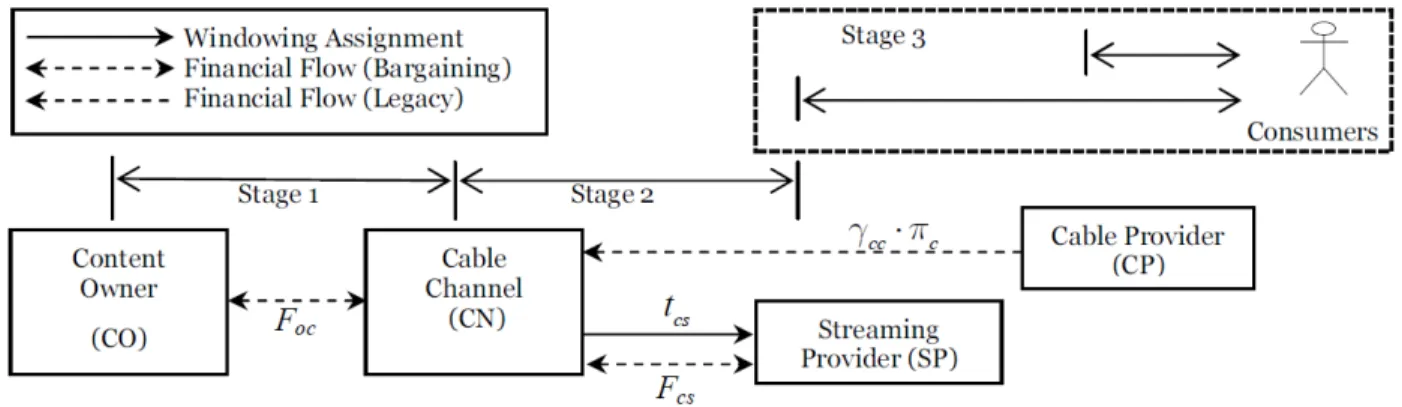
The CP contracts with CN so that CP’s subscribers can access titles on the cable channel. The SP, a relatively new market entrant, also has to negotiate for CO’s digital content. When CN is designated as the redistributor for CO (under Model 1 of contract distribution), CN can keep CO’s titles exclusive, make them available to cable and streaming simultaneously (i.e., to syndicate), or delay the release to streaming (i.e., until the start of the second pay-tv window). The sequence of negotiation is shown in Figure 1.
To analyze how CP and SP compete in digital content distribution, we use the Hotelling model with multihoming and place them on either end of a unit line (i.e., at point 0 and point 1) with consumers uniformly distributed on the line. The stylized horizontal differentiation model that characterizes the competition between cable network and streaming providers here has been used in other studies
concerning the market competition for digital content (Hagiu and Lee, 2011; Choi 2010, Hogendorn and
Yuen 2009; Fan et al., 2007). By designating consumers of the same “realized” utility to the same location of the Hotelling line, we capture a diverse range of subscriber preferences and demands.
Cable and streaming providers price their services at
p
c andp
s , and consumers make theirsubscription decisions based on their utilities. A consumer’s location on the line, denoted as
q
, represents his/her ideal service (Choi 2010); consumers incur a misfit cost ofkq
andk
(
1
-
q
)
from the streaming and cable services, respectively.Figure 1. Content owner grants redistribution rights to cable network (Model 1)
Though both service providers rely on IP-based network technology for content delivery, several key factors affect consumers’ subscription decisions. Firstly, the content mix on CP could differ significantly from that of SP due to titles acquired from other owners/studios. To capture the impact of existing
content between the two services is denoted as
l
and the values for exclusive contents are denoted asu
c (for CP) andu
s(for SP). A summary of all decision variables and model parameters can be found in Table 1 and Table 2.The size (or “quantity effect”) of CN’s content is not a major factor attracting consumers due to its linear scheduling/viewing. On the other hand, with SP’s content searchable and accessible on-demand, the size of its library may affect the consumer’s intention to subscribe. We denote
H
as the value of CO’s titles in terms of content quality ande
as a proxy for CO’s library size. For simplicity, we assume there is no quantity effect on CP’s platform and letH
>
e
to highlight quality over quantity. The quantity effect depends on content size as well as consumer preference. For example, a streaming platform carrying TV episodes of slow-developing story plots would attract binge-watching viewers who find the on-demand access valuable. On the other hand, cable subscribers who enjoy well-curated movies being featured at their preferred times and days will deem the quantity effect not significant.Decision Variables cs
t
The window length granted by cable network in Model 1oc
t
(
t
os)
The window length granted by content owner in Model 2 (Model 3)oc
F
(
F
os)
The license fee that cable network (streaming provider) pays the content ownercs
F
The license fee that streaming provider pays the cable networkTable 1. Decision Variables Model Parameters
H The value of new content in quality
e
The value of new content in quantity (H
> ³
e
0
)c
b
(b
s) The cable network’s (streaming provider’s) marginal advertising revenuecc
g
(g
cs) The cable network’s bargaining power when negotiating with cable (streaming) provideroc
g
(g
os) The content owner’s bargaining power when negotiating with cable network (streaming provider)c
u
(u
s) The value of existing exclusive content offered by the cable provider (streaming provider)l
The value of existing shared content for both providerssp
p
(p
cc;p
o) The profit of streaming provider (cable network; content owner)c
p
(p
s) The gain of cable provider (streaming provider) from subscription revenuesc
N
(N
s) The total demand of consumers subscribing cable service (streaming service)c
n
(n
s) The demand of consumers subscribing cable service (streaming service) onlyTable 2. Model Parameters
The timing of CO’s titles becoming available on SP materially affects subscriber intention. To measure the impact of window
t
on the perceived content value from CO, we use(
1
- ⋅
t
) (
H
+
e
)
to express the perceived value for streaming-only consumers. CO’s titles are not available on the streaming platform if1
t
=
(when CN opts for exclusivity strategy), are available on both platforms simultaneously ift
=
0
(for syndication strategy), or somewhere in between (delayed release to streaming for windowing strategy). For multihoming subscribers, their perceived value from shared content should be counted only once.Since the content can be accessed on-demand through streaming after a window t, multihomed
Multihoming Equilibrium
We now consider how CO’s content affects both providers’ subscription revenues. Let
I
c andI
s be binary indicators on whether CO’s content is available for cable and streaming, and there are four possible cases. In Case A (I
c=
I
s=
1
), both providers acquire CO’s content but there is a window t before SP’ssubscribers would gain access. In Case B (
I
c=
0,
I
s=
1
), CO’s titles are only available for streaming and there is no window (t
=
0
). Case B involves no content redistribution and thus will be analyzed in latter sections. In Case C (I
c=
1,
I
s=
0
), CO’s titles are only available on cable. In Case D (I
c=
I
s=
0
), noprovider gains access to CO’s content.
The utility of a typical consumer at location
q
isU
c( )
q
=
u
c+ + ⋅ -
l
I H
ck
(
1
- -
q
)
p
c forcable-only subscription. Streaming service has access to CO’s content after a window of
t
, so if subscribing to streaming service only, the utility isU
s( )
q
=
u
s+ + ⋅ - ⋅
l
I
s(
1
t
) (
H
+ -
e
)
kq
-
p
s. If a consumer is multihomed, her utility is( )
(
1
)
b s c s c
U
q
=
u
+
u
+ + -
l f kq k
-
- -
q
p
-
p
, (1) wheref
º ⋅ -
I
c(
1
I
s)
⋅ + ⋅
H
I
s(
H
+ - ⋅
(
1
t
)
e
)
.Let
N
s andN
c be the total (i.e., including multihomed) demands, andn
s andn
c the “pure” demands for streaming and cable services, respectively. IfU x
s( )
=
U x
b( )
, consumers with preferencex
are indifferent between subscribing to the streaming service and subscribing both. Likewise, if( )
( )
c b
U y
=
U y
, consumers with preference y are indifferent between subscribing the cable service andsubscribing both. Thus, we have
N
s=
y
,N
c= -
1
x
,n
s=
x
, andn
c= -
1
y
. CP and SP’s subscription revenues are given byp
c=
p N
c c andp
s=
p N
s s. Table 3 shows the service providers’ indifference pointsx
andy
and their subscription revenuesp
sandp
c.CP
SP With Content Without Content
With Content Case A:
(
I I
c,
s) ( )
=
1,1
(
2
c) ( )
2
x
=
k u
- - ⋅
t H
k
,y
=
(
u
s+ -
(
1
t
)
e
)
( )
2
k
(
)
(
)
2( )
,( )1
4
s A st
p
=
u
+ -
e
k
,(
) ( )
2 ,( )4
c A ct H
p
=
u
+ ⋅
k
Case B:(
I I
c,
s) ( )
=
0,1
(
2
c) ( )
2
x
=
k u
-
k
,y
=
(
u
s+ +
H
e
) ( )
2
k
(
) ( )
2 ,( )4
s B sH
p
=
u
+
+
e
k
,( )
2 ,( )4
c B cp
=
u
k
Withou t Content Case C:(
I I
c,
s) ( )
=
1, 0
(
2
c) ( )
2
x
=
k u
- -
H
k
,y
=
u
s( )
2
k
( )
2 ,( )4
s C sp
=
u
k
,p
c C,( )=
(
u
c+
H
) ( )
24
k
Case D:(
I I
c,
s) (
=
0, 0
)
(
2
c) ( )
2
x
=
k u
-
k
,y
=
u
s( )
2
k
( )
2 ( )4
s D sp
=
u
k
,p
c D,( )=
u
c2( )
4
k
Table 3. The equilibrium demands and subscription revenue
The multihomed equilibrium requires the conditions of
0
< < <
x
y
1
to ensure there are demands forcable subscription (
n
c>
0
), streaming subscription (n
s>
0
), and multihoming subscription(
N
s- =
n
sN
c- >
n
c0
). In the following, we specify the parameter values that satisfy these conditions in Table 3.Assumption 1.
max
{
u
c+
H
,
u
s+
H
+
e
}
<
2
k u
<
s+
u
cThe inequality 2
k u
<
s+
u
c states that contents from both providers are sufficiently valuable to makesome subscribers to multihome; however, values from CO’s titles are not sufficient to turn all single-homed subscribers to multihome due to
max
{
u
c+
H
,
u
s+
H
+
e
}
<
2
k
.Windowing and Advertising Revenue
Following the work of Fan et al. (2007), we let
b
c andb
s be CN’s and SP’s marginal advertising revenue from CO’s content. Therefore, CN’s advertising revenue when maintaining content exclusivity (Case C) is(
)
{
1}
,( ) , ,( ) 01
2
c c C c N c c CN
N
x dx
b
b
F
=
ò
-
=
(2)Making content available for streaming causes CN’s advertising revenue to decline because
multi-homed subscribers will likely view shared content via streaming. With a window t, CN’s advertising
revenue in Case A is
(
)
(
)
{
1}
, ,( ) 01
,( )1
t c Yb
cN
c Ax dx n
c A tx dx
F =
ò
-
+
ò
-
(3)Figure 2 shows how CN’s advertising revenue is affected by the window t. With multihomed subscribers steaming CO’s content, SP benefits from the “residual” advertising revenue from cable, as in Figure 3.
For consumers who only subscribe to the streaming service, we follow the approach similar to equation (2), with the “regular” ads revenue starting to declines after window t as in Figure 4. SP’s ad revenue from CO’s digital content is the sum of the residual revenue from multihoming subscribers and regular revenue from single-homed SP subscribers:
(
)
1(
)
1(
(
)
)
, ,( ) ,( )
1
,( )1
s Y s s A s A t s s A t
residual advertising revenue regular advertising revenue
N
n
x dx
n
x t dx
b
b
F =
⋅
-
ò
-
+ ⋅
ò
-
(4)Though their shapes are different, the area for the loss of ad revenue in Figure 2, in fact, is equivalent to the triangle area in Figure 3.
Figure 2. Cable channel’s ads revenue
F
c Y, Figure 3. Streaming provider’s “residual” ads revenueModel 1: Sequential Negotiations (through Redistribution)
Splitting the revenue between content sellers and buyers often leads to complex channel contracting; however, Raut et al. (2008) find that current contracting practices don’t perform significantly better than simple two-part tariff or 50/50 splits. In addition, sequential bargaining helps a firm extract more surplus
from its downstream retailers under certain conditions (Guo and Iyer 2013); therefore, we use Nash
bargaining solution to derive payments during sequential negotiation: CO negotiate with CN for both media and redistribution rights; CN in turn acts as a redistributor to bargains with SP over CO’s content. The game stages for the contracting through redistribution are as the following:
Stage 1: CO bargains with CN over the license fee
F
oc for the media and redistribution rights. Stage 2: CN announces a windowing delay of
t
csfollowing cable debut and negotiates with SP over the license feeF
cs. Stage 3: Both SP and CP price their delivery services, and the contract expires after one time unit. Denote
g
oc (g
cs) as CO’s (CN’s) bargaining powers when negotiating with CN (SP), and letg
cc be an exogenous revenue split between CN and CP. CN can receives partial subscription revenueg p
cc⋅
c i,( ) from CP when Case i holds.Using backward induction, the gains of SP and CP from subscribers in stage 3 can come from the four cases in Table 3. In stage 2, CN bargains with SP over a license fee
F
cs for the availability of CO’s content after windowt
cs. If they can reach an agreement, CN receives partial subscription revenueg p
cc⋅
c A,( ) from CP and ads revenueF
c Y, while SP gainsp
s A,( ) from subscribers plus ads revenueF
s Y, . If the negotiation between CN and SP breaks down, CN receives partial subscription revenueg p
cc⋅
c C,( ) from CP plus ads revenueF
c N, while SP gainsp
s C,( ) from subscription.Lemma 1. (Optimal licensing fee to redistribute content)
The license fee that the cable network receives from redistributing the new digital content to streaming is:
,( ) ,( ) , , ,
,( ) ,( )
,( ) ,( )
, ,cs cs s A s C s Y c Y c N cc c A c C cs cc c A c C c Y c N
F
If both CN and SP reach an agreement, CN’s optimization problem for redistributing CO’s digital content is: ,( ) , cs cc cc c A c Y cs oc t
Max
p
=
g p
⋅
+F +
F
*-
F
(5)Given the license fee
F
cs in Lemma 1, CN in turn derives its optimal redistributing strategy as follows.Lemma 2. (Optimal redistributing strategy for cable network)
(1) If
10
and
0
, the cable channel will adopti. syndication strategy when
0
or3
1 ii. windowing strategy when
3
1iv. either syndication or windowing strategy when
3
1v. either syndication or exclusivity strategy when
3
1 (2) If
10
and
0
, the cable channel will adopti. exclusivity strategy when
0
or
3
1 ii. windowing strategy when
3
1 iii. syndication strategy when
1 iv. either exclusivity or windowing strategy when
3
1 v. either exclusivity or syndication strategy when
0
3
1 (3) If
0
, the cable channel would adopt either exclusivity or syndication strategy.(4) When windowing is the optimal redistributing strategy for the cable channel, the optimal
windowing delay is
2 2 2 2 2 ε ε ε 3ε 2 β 1 2 2 ε β ε 2β ε cc c s s c s cs s c s s cc H H H t H H H H H
if
10
; otherwise,t
cs
1
2
3
1 , whereD
1º
(
β
c-
β
s)(
H
- -
ε
)
b
sH
,(
)
(
)
(
)
(
)
2 1=
ε
+
u
s+
2
u
c-
4
k
β
s+
g
ccH
-
2
β
s+
2
β
cH
+
2
k u
- -
su
cβ
c+
β
s-
β
c3
ε
, and
2 2
13
12
ccH
c2
s c2
β
cβ
s3
β
cβ ε
s2
sε ε
.In the following, we consider the case of
b
s»
b
c for additional insights on CN’s optimal redistributing strategy.Proposition 1. (Necessary Conditions for Windowing Strategy)
If cable channel and streaming provider have similar marginal advertising revenue, the windowing strategy is optimal only if the content under negotiation is of average quality. Formally, given
b
s»
b
c, there existst
cs*>
0
if(
ε ε
) (
)
(
(
2
)
β
ε
2)
s cc c
H
c s ccu
+
g u
<
<
k u
-
-
g
.From Proposition 1, although the windowing strategy may not be optimal when CO’s content is highly valued, high marginal advertising revenue makes windowing more attractive. While content exclusivity can help raise cable’s market share, higher advertising revenue is an incentive to redistribute CO’s content to streaming. Also, when CO’s content is available for streaming (in Case A), the demand from multihomed subscribers is linked to SP’s existing exclusive content (
u
s) and the quantity effect due to the on-demand access to CO’s content (e
). When the benefit of on-demand access is not significant or when SP’s existing program quality is not high, CN loses little on advertising revenue while receiving a payment from SP. Overall, the popularity of CO’s content, the value of SP’s existing titles, and the benefit of on-demand access for CO’s content collectively determine whether CN should redistribute CO’s content.Using Proposition 1, it is straightforward to show the region that the windowing strategy prevails. Given
u
s=
u
c=
1.5
,k
=
1.2
,g
cc=
0.55
,b
c=
b
s=
1
, andg
cs=
0.5
, Figure 5 shows when a windowing strategy could be optimal.Figure 4. Streaming provider’s “regular
advertising revenue” Figure 5windowing strategy . The area for the potential adoption of
In Figure 5, H1 and H2 are the higher bound and lower bound for the value of CO’s content in
Proposition 1. Multihoming equilibrium, denotes by H3, also limits the CO’s content value. When
e
=
0.1
, Figure 6 shows that CN’s profit from the windowing strategy is better than that from the syndication strategy; the exclusivity strategy yields the highest profit for CN when the value of H is high (H
³
0.44
). Figure 7 shows that windowing strategy may not be a globally optimal solution, so CN still needs to check for possible content exclusivity even when CO’s content quality falls within the region derived in Proposition 1.We next examine how market factors affect the windowing strategy.
Proposition 2. (Factors affecting the streaming providers’ windowing strategy)
1. Higher streaming’s and lower cable’s marginal advertising revenue will lead to a shorter window. Formally,
t
cs
s0
and
t
cs
c0
.2. When the content owner offers high-value content or the cable provider has acquired high-value content elsewhere, a longer window should be granted if the cable channel has higher marginal advertising revenue than the streaming provider. Formally,
t
cs
H
0
and
t
cs
c0
whenc s
b
³
b
.3. When the streaming provider has acquired high-value content form other content owners or when the quantity effect from the on-demand access increases, a shorter window should be granted if the cable channel has lower marginal advertising revenue than the streaming provider. However, the opposite holds when cable channel’s marginal advertising revenue is too high. Formally, tcs
s 0 when
βcβsε 1tcs ; otherwise,0
cs st
.
t
cs
0
when βc βs+
2
s
1 tcs
4ε
3 1
tcs
; otherwise,
t
cs
0
.Both advertising and subscription revenues are affected by the market share, so a delayed release affects the consumers’ subscription decision as well as the windowing decision. The existence of the Pay-TV window is to “harmonize” adverting revenues for CN and SP. Thus, CN under the windowing strategy (i.e., Case A) would grant an earlier content release if its marginal advertising revenue decreases or SP’s marginal advertising revenue increases.
0.78 0.79 0.81 0.83 0.85 0.35 0.37 0.39 0.41 0.43 0.45 0.832 0.835 0.837 0.840 0.842 0.00 0.20 0.40 0.60 0.80 1.00
Figure 6. Profit for cable channel
p
cc Figure 7. Local and global optimum for the profit of cable channel (e
=
0.1
and H=0.45)When CN has higher marginal advertising revenue than SP, our numerical results support the Part 3 of Proposition 2 that the contracting decision, the window length with respect to the quantity benefit derived from CO’s content, and SP’s existing content value, can be reversed (
t
cs
s0
and
t
cs
0
). CN’s advertising revenue declines when CN’s market share decreases, prompting CN to hold on to temporal exclusivity by granting a longer window. This approach, however, is not a good solution if SP has acquired highly valued content elsewhere or the benefit of on-demand access is important to the consumers.In stage 1, CO gains the license fee
F
oc if both CO and CN can reach an agreement but nothing if the negotiation breaks down. As for CN, its profit is given by equation (5) following a successful contracting with CO but only partial subscription revenueg p
cc⋅
c D,( ) from CP if its negotiation with CO breaks down.Lemma 3. (Owner’s profit when following the “Sequential Negotiations” model) The content owner’s optimal profit is:
( ) ( )
(
, ,)
(
,)
o
F
oc oc cc c A c D oc c YF
csp
*=
*=
g g p
-
p
+
g
F +
* .Direct Negotiations (without Redistribution)
We now consider a “direct sale” model in which CO determines the window length before negotiating separately with CN and SP over transfer payments. The negotiation process is referred to as Model 2 when CO negotiates with CN first and as Model 3 when with SP first. The steps are:
Stage 1: Under Model 2 (Model 3), CO announces a window
t
oc (t
os ). Subsequently, COnegotiates with CN (SP) over the license fee
F
oc (F
os). Stage 2: Under Model 2 (Model 3), CO negotiates with SP (CN) over the license fee
F
os (F
oc). Stage 3: Both SP and CP price their delivery services and the agreements made in the previous
stages will be expired after one-unit time.
Content Value H Window t
πcc πcc (exclusivity) πcc (windowing) πcc (syndication) t=0 t=1 t=
t
cs* * windowing *exclusivityModel 2: Cable-First Direct Bargaining
Using backward induction, the equilibrium in stage 3 was shown in Table 3. In stage 2, SP is aware of whether CO and CN have reached an agreement. Let
F
os I,( ) (F
os II,( )) be the transfer payment for CO and SP when the negotiation between CO and CN was a success (a failure).If the negotiation between CO and CN is successful, SP, after paying
F
os I,( ) to CO, receives subscription revenuep
s A,( ) plus adverting revenueF
s Y, following a successful negotiation with CO. In such a case, CO receives both paymentsF
oc+
F
os I,( ) from CN and SP. On the other hand, if the negotiation between CO and SP breaks down, SP receives only subscription revenuep
s C,( ) and CO receives only the license feeoc
F
from CN.If CO and CN cannot reach an agreement in stage 1, SP, after paying
F
os II,( ) to CO, receives subscription revenuep
s B,( ) plus adverting revenueF
s Z, following a successful negotiation with CO, where(
)
{
1}
,( ) , ,( ) 01
2
s s B s Z s s BN
N
x dx
b
b
⋅
F
=
⋅
ò
-
=
. (6)In such a case, only the subscribers of SP can access CO’s digital content and CO receives the payments
,( )
os II
F
from SP. In addition, SP only receives subscription revenuep
s D,( ) and CO gains nothing if the negotiation between CO and SP also breaks down.In stage 1, CO anticipates total revenue
F
os I,( )+
F
oc following a success negotiation with CN, or receivesF
os II,( ) when its negotiation with CN fails. If CO and CN can reach an agreement, CN, after paying the transfer paymentF
oc to CO, receives partial subscription revenueg p
cc⋅
c A,( ) from CP plus advertising revenueF
c Y, . On the other hand, CN receives partial subscription revenueg p
cc⋅
c B,( ) from CP if its negotiation with CO breaks down. Finally, CO decides the optimal delayt
oc for the release of its content on the steaming site, which can be solved by:,( )
oc o os I oc
t
Max
p
=
F
+
F
(7)Model 3: Streaming-First Direct Bargaining
The game structure of Model 3 mirrors that of Model 2. Let
F
oc I,( ) (F
oc II,( )) be the transfer payment for CO and CN when the negotiation between CO and SP is a success (a failure). In stage 2, if the negotiation between CO and SP is successful, CN, after payingF
oc I,( ) to CO, receives partial subscription revenue,( )
cc c A
g p
⋅
from CP. It also receives adverting revenueF
c Y, when the negotiation with CO is successful. CO receives both paymentsF
os+
F
oc I,( )from SP and CN. On the other hand, if the negotiation between CO and CN breaks down, CN only receives partial subscription revenueg p
cc⋅
c B,( ) from CP, and CO receives only the license feeF
os from SP.When CO and SP cannot reach an agreement in stage 1, CN, after paying
F
oc II,( ) to CO, receives partial subscription revenueg p
cc⋅
c C,( ) from CP. CN also receives adverting revenueF
c N, if the contracting withCO is successful; otherwise, CN only receives partial subscription revenue
g p
cc⋅
c D,( ) from CP, and CO gains nothing if the negotiation between CO and CN also breaks down.In stage 1, CO anticipates total revenue is
F
oc I,( )+
F
os when contracting with SP, orF
oc II,( ) if its negotiation with SP fails. If CO and SP can reach an agreement, SP, after paying the transfer paymentF
osto CO, receives subscription revenue
p
s A,( ) plus advertising revenueF
s Y, . On the other hand, SP just receives subscription revenuep
s C,( ) if its negotiation with CO breaks down. Finally, CO decides the optimal delayt
os for the release of its content to streaming, which can be derived from:,( )
os o oc I os
t
Max
p
=
F
+
F
(8)In the following, we compare the three models on the windowing strategy.
Proposition 3. (Effect of bargaining types on the optimal windowing strategy)
1. When the cable channel’s share from the cable provider’s subscription revenue increases, a longer window will be granted regardless whether the decision is made by the cable channel or the content owner. Formally,
t
cs
cc
0
,0
oc cc
t
, and
t
os
cc
0
.2. The higher the content owner’s bargaining power over the cable channel, the longer the window will be when bargaining with the streaming provider first; the higher the content owner’s bargaining power over the streaming provider, the shorter the window will be when bargaining with the cable channel first. Formally,
t
os
oc0
andt
oc
os0
.3. When compared to the windowing decision made by the cable channel acting as content redistributor, the window granted by the content owner will be shorter when negotiating first with streaming provider but longer when negotiating first with cable channel. Formally,
t
os
t
cs
t
oc .We find the impact of market factors on the windowing strategy to be consistent among all three models, as shown in Table 4. The impact of the negotiation powers on the windowing strategy is also similar. For instance, CO and CN will grant a longer window when they can gain more subscription revenue from the cable service. Moreover, a firm with a higher bargaining power during the negotiation process means the firm can gain a higher payment or pay a lower licensee fee. Therefore, CO will shorten the window in Model 2 but lengthen the window in Model 3 if it has a higher bargaining power over SP and CN, respectively. However, these strategic responses are only applicable under certain mode of negotiation.
Taking Model 2 as an example, the payment from SP in stage 2 becomes a leverage when CO negotiates with CN in stage 1. Thus, CO’s bargaining power over SP will affect its widowing policy. However, there is no change when CO’s position over CN changes because CO and CN aim to maximize their overall trade value from their contract so that CO’s bargaining power over CN only affects how the trade value is split (“NA” in Table 4). We find similar phenomena in the other models, and the different window lengths can be attributed to the bargaining position that CO gains from the Stages 2 under Model 2 and Model 3. Market factor Window
H
b
cb
su
se
u
cg
ccg
ocg
os cst
/ ?
+
+
-
+ -
/
+ -
/
+
/ ?
+
NA NA oct
NA − ost
+ NAUnder the extreme case of having full bargaining power (
g
os=
1
) over SP in Model 2, CO gains all of the increased revenue from SP. In such a case, CO bargains with CN similarly to how CN bargains with SP in Model 1. Therefore, CO will propose the same window length in Model 2 as the one made by CN in Model 1. CO with more realistic bargaining power (g
os<
1
), however, will grant a longer window to SP to secure the optimal revenue from CN.Proposition 4. (Comparingthecontent owner’s profit)
The content owner is worse off with windowing under redistribution (i.e., Model 1) when
g
os=
g
oc and bothg
os andg
oc are not too large.Compared to Model 1, Model 2 and 3 enable CO to gain bargaining position by leveraging the possible payment in stage 2. In addition, if CN has high bargaining power over SP for holding must-have contents, CO can delegate CN as a redistributor to extract more revenue from SP indirectly via Model 1; however, how much CO can receive from CN is still tied to its bargaining power when negotiating with CN.
The numerical example in Figure 8 shows that when the difference between
g
os andg
oc is large enough, using Model 1 can be better than the other two wheng
csis high enough. On the other hand, the numerical example in Figure 9 shows the opposite result when the difference betweeng
os andg
oc is small. The numerical example in Figure 9 also reveals that negotiating using Model 3 is no better than using Model 2 when the quality of CO’s content is high enough.When CO’s content is available on both platforms, CP’s market share is mainly linked to the advantage of temporal exclusivity from CO’s content quality (H), whereas SP’s market share is mainly linked to the advantage of on-demand access to the quantity effect for CO’s content (ε). If CO’s negotiation with CN breaks down, SP will be the only distributor for CO’s content without delay. CN thus has to pay more for this potential threat. Essentially, due to the subsequent negotiation with SP, CO in Model 2 can indirectly extract the benefit of on-demand access paid by CN.
0.180 0.188 0.195 0.203 0.210 0.70 0.76 0.82 0.88 0.94 1.00 M1 M2 M3 0.170 0.178 0.186 0.194 0.202 0.11 0.12 0.13 0.14 0.15 0.16 M1 M2 M3
Figure 8. Content owner profit (H=0.14,goc=0.95) Figure 9. Content owner profit(gcs =1,goc =0.88)
1.2
s c
u
=
u
=
,
b
s=
b
c=
0.38
,
e
=
0.02
,
g
cc=
g
os=
0.7
CO in Model 3 can also demand higher payment from SP by using its subsequent negotiation with CN as leverage. However, the advantage is not as prominent when compared with the subscription revenues from cable service in Model 2. Notice that granting a long window to SP is similar to CP being the sole content distributor for. In addition, the window length granted by CO increases with CO’s program quality and the window length granted by CO in Model 2 is the longest among the three models. Thus, from the perspective of CP’s subscription revenue, as compared with Model 2, Model 3 doesn’t support a significant advantage for CO when its content is highly valued. The same argument applied to advertising revenue so
that CO may gain more from Model 2 than Model 3 when its program quality is high enough and both SP and CP have roughly the same market share and marginal ads revenue (namely,
u
s»
u
candb
s»
b
c) before delivering CO’s content.Conclusion
The emergence of SVoD (subscription video-on-demand) services has appeared to equalize movies and TV shows. On one side, the injection of streaming revenue has increased the production budget (and end quality) for broadcast, cable, and streaming TV series.6 On the other, we see the popularity of TV-like
serialization in studio films.7 By making quality content easily accessible at a reasonable pricing point,
streaming service has also appeared to curb illegal behavior. 8, 9
In this study, we show how Pay-TV windows can be analytically derived to maximize provider profits. Prior works have focused on making content either exclusive or syndicated throughout a contract term. We here show how a windowing strategy can create temporal exclusivity to more precisely “harmonize” the short-term benefit of advertisement and the long-term effect of subscriber growth. We find windowing would be ideal when licensing contents of average quality (Proposition 1). High-quality content either leads to exclusive contracting or prolongs the Pay-TV window. However, the quantity effect due to streaming’s on-demand access and the difference in marginal advertising revenues between platforms would have the opposite effect on the length of the Pay-TV window (Proposition 2).
The streaming providers’ aggressive pursue of content exclusivity and early pay-tv window has led to different formats and sequencing of contract negotiation. We were able to show how the optimal window is influenced by the relative bargain power among owners, distributors, and platforms. An interesting observation is that the content owner creates additional leverage when holding negotiation with cable channel and streaming providers in sequence. This in turn leads to a distinct pattern of window lengths (reported in Proposition 3). We were able to show that bargaining directly with content owners indeed leads to the desired equilibrium of shorter Pay-TV window and higher profit for streaming providers. Finally, the conditions of when a content owner should control or delegate the negotiation for content distributed is reported in Proposition 4. Essentially, controlling the negotiation is preferred over delegating if the difference in the bargaining powers against the two distributors is not significant.
One interesting extension will be to incorporate the effect of in-house production in future models. While producing exclusive contents attracts cable subscribers to multihomed or even entices streaming-only subscribers, doing so requires significant up-front investment with little assurance on content quality. Another possible extension will be to consider the emergence of non-linear version of cable networks, such as the recently-launched “Now” version of a premium movie channel.
Acknowledgements
Jhih-Hua Jhang-Li gratefully acknowledges support from the Ministry of Science and Technology, Taiwan, R.O.C. under Grant no. MOST 104-2410-H-266-003-MY3.
6 Experts: Cable TV has taken the place of the mid-budget movies studios abandoned
http://www.foxnews.com/entertainment/2013/09/12/experts-cable-tv-has-taken-place-mid-budget-movies-studios-abandoned/
7 TV and movies are melting into the same thing, and tech is stirring the pot
http://www.digitaltrends.com/home-theater/tv-and-movies-are-blurring-together-into-one-medium/ 8 Netflix's Gain Is Piracy's Loss in U.K. and Europe
http://www.streamingmediaglobal.com/Articles/Editorial/Featured-Articles/Netflixs-Gain-Is-Piracys-Loss-in-U.K.-and-Europe-98470.aspx
9 Piracy is way down in Norway. Is this a worldwide trend?
Appendix - Sketch of Proofs
Proof of Lemma 1. Solving
¶W 
F
cs=
0
yieldsF
cs, where
(
) (
)
(
)
(
(
)
)
1 ,( ) , ,( ) , ,( ) , ,( ) cs cs cc c A c YF
cs cc c C c N s A s YF
cs s C g gg p
g p
p
p
-W =
⋅
+F +
-
⋅
+F
⋅
+F -
-Proof of Lemma 2. Solving cc
0
cs
t
p

=

yieldst
cs3
β
cβ
s
H
ε
β
sH
. Note that only the root
ˆ
3
β
β
ε
β
cs c s st
H
H
can satisfy 2 20
cc cst
; the other root leads to2 2
0
cc cst
, where
2 2 13
β
β
ε
β
2
cs c cct
cs
t
s c sH
sH
. Moreover,
3 33
β
β
ε
β
2
cs c s s s cct
c
H
H
may imply two scenarios: (1)
β
c
β
s
H
ε
β
sH
0
and (2)
β
c
β
s
H
ε
β
sH
0
with similar solution approach. Let(
)(
)
(
)
3
β
c-
β
sH
- -
ε
β
sH
º
, we knowˆ
cst
when (1) holds ( 3 30
cct
cs
). As a result, wehave the following six cases. First, when
t
ˆ
cs
0
,
cc
t
cs0
fort
cs
0,1
so thatt
cs
0
. Second, when
0
t
ˆ
cs
1
,t
cs
t
ˆ
cs. Third, when
0
andt
ˆ
cs
1
,
cc
t
cs0
fort
cs
0,1
so that1
cs
t
. Fourth, when0
t
ˆ
cs
1
,
cc
t
cs0
whent
cs
0,
andt
cs
t
ˆ ,1
cs
, but0
cc
t
cs
whent
cs
, ˆ
t
cs
. Thus, in addition tot
ˆ
cs, we have to consider the boundary condition0
cs
t
. Fifth, when 0
1
andt
ˆ
cs
1
, the only possible extreme values occur whent
cs
0
or1
cs
t
. Finally, when 1
,
cc
t
cs0
whent
cs
0,1
so thatt
cs
0
. For brevity, the analysis of1
0
is not shown.Proof of Proposition 1. Given
b
c=
b
s, we have 2(
)
21
=
ccH
c2
β
sε
V g
+
u
-
k
+
andς
2
12
3
sH
,where
2
s
ε ε
2
ccH
c . NoticeD
1=
-
b
sH
<
0
so
12
3
10
requires2 1
3
1
, which is a preliminary condition. We then examine the inequalities listed in the second partof Lemma 2. The necessary condition for adopting the windowing strategy is
1
3
. However,
10
leads to
0
. Moreover, if
10
,0
still holds when
0
. Therefore,
10
and
0
are equivalent conditions to
.Proof of Proposition 2.If granting a window is the optimal redistributing solution for the cable channel, we have
2
cc
t
cs20
and
cc
t
cs0
. Therefore, we examine¶ 
(
p
cc
t
cs)

y
instead ofcs
t
y


to analyze how parameter y affects the optimal windowt
cs.Proof of Lemma 3. The approach of the proof is the same as that of Lemma 1.
Proof of Proposition 4.To clearly differentiae the profits of the content owner in the three models, we use
I
,II
, andIII
as subscripts. Note that the revenue of the content owner can be classified into subscriptionrevenue (namely,
p
s andp
c) and advertising revenue (namely,Φ
). Next, we considerg
cs=
1
whencomparing
p
o I, withp
o II, andp
o III, because the value ofp
o I, reaches the maximal in such a case. If the values ofg
oc andg
os are not too large,p
o II, andp
o III, lead to higher advertising revenue than,
o I
p
becauset
os
t
cs
t
oc ,,
Φ
,Y s Z sF >
, andΦ
c N,>
Φ
c Y,.
Under the same conditions,p
o II, andp
o III, lead to higher subscription revenue thanp
o I, becausep
s B,( )>
p
s A,( ),p
c C,( )>
p
c A,( ),p
s C,( )=
p
s D,( ),and,( ) ,( )
c B c D
p
=
p
.References
Calzada, J., and Valletti, T.M. 2012. "Intertemporal Movie Distribution: Versioning When Customers Can Buy Both Versions," Marketing Science (31:4), pp. 649-667.
Choi, J.P. 2010. "Tying in Two-Sided Markets with Multi-Homing," The Journal of Industrial Economics
(58:3), pp. 607-626.
Eliashberg, J., Hui, S.K., and Zhang, Z.J. 2007. "From Story Line to Box Office: A New Approach for Green-Lighting Movie Scripts," Management Science (53:6), pp. 881-893.
Fan, M., Kumar, S., and Whinston, A. 2007. "Selling or Advertising: Strategies for Providing Digital Media Online," Journal of Management Information Systems (24:3), pp. 143-166.
Ganuza, J., and Viecens, M. 2013. "Exclusive Contents and Next Generation Networks," Information Economics and Policy (25:3), pp. 154-170.
Guo, L., and Iyer, G. 2013. "Multilateral Bargaining and Downstream Competition," Marketing Science
(32:3), pp. 411-430.
Hagiu, A., and Lee, R.S. 2011. "Exclusivity and Control," Journal of Economics & Management Strategy
(20:3), pp. 679-708.
Hogendorn, C., and Yuen, S. K. Y. 2009. "Platform competition with 'must-have' components," The Journal of Industrial Economics (57:2), pp. 294-318.
Krider, R.E., Li, T., Liu, Y., and Weinberg, C.B. 2005. "The Lead-Lag Puzzle of Demand and Distribution: A Graphical Method Applied to Movies," Marketing Science (24:4), pp. 635-645.
Prasad, A., Bronnenberg, B., and Mahajan, V. 2004. "Product Entry Timing in Dual Distribution Channels: The Case of the Movie Industry," Review of Marketing Science (2:1), Article 4
Raut, S., Swami, S., Lee, E., and Weinberg, C.B. 2008. "How Complex Do Movie Channel Contracts Need to Be?," Marketing Science (27:4), pp. 627-641.
Swami, S., Eliashberg, J., and Weinberg, C.B. 1999. "Silverscreener: A Modeling Approach to Movie Screens Management," Marketing Science (18:3), pp. 352-372.