Getting back to basics: using road accident
investigation to identify the desirable functionality
of longitudinal control systems.
Nikolaos Gkikas
1, Julian R. Hill, John H. Richardson
Abstract
ABS (antilock brake system), EBA (emergency brake assist), ACC (adaptive cruise control) and alternative examples of intelligent vehicle control systems aspire to support the driver in controlling the vehicle and alleviate the incidents that would lead to collisions and injuries. This paper considers some requirements for such systems based on a study of accidents occurring in the real-world. While systems are rationally developed in the engineering laboratory, on the test track and through use of simulations, the need for a thorough understanding of the design needs as observed in the real-world of current day accidents is increasingly recognized. This paper overviews the range of data available on the causes of accidents in the UK. A fresh look is taken at some issues relating to braking by specific reference to data from the On-The-Spot (OTS) accident research study in an attempt to consider the necessary functionality of active safety systems pertinent to longitudinal control failures. The road user interactions file from 3024 road accidents in Thames Valley and South Nottinghamshire regions of the UK, as covered by OTS study, were analysed. Significant contributory factors where “failure to stop the vehicle” was identified as the accident precipitating factor were seen to be “following too close”, “disobeyed automatic traffic signal”, “careless/reckless/in a hurry”, “failure to look” and “failure to judge other person’s path or speed”. On the other hand, where “sudden braking” is identified as the accident precipitating factor, contributory factors included “sudden braking” (as a contributor), distraction, aggressive driving, failure to judge other person’s path, “masked road markings”, “excessive speed”, “following too close”, and “road layout”. Current systems address some of these issues, while possibly overlooking others; recommendations for future safety engineering designs are made accordingly.
Introduction
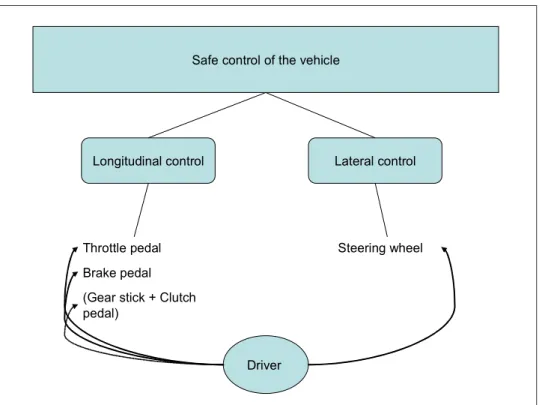
The driving task has been described from many different perspectives. Early theories suggested a versatile safe field in which the driver aims to navigate the vehicle (Gibson & Crooks, 1938). More recent work considers time related descriptions (Senders, Kristofferson, Levison, Dietrich, & Ward, 1967; Van Winsum & Brouwer, 1997; Van Winsum, 1998), motivation (Fuller, 1984; Naatanen & Summala, 1976; Näätänen & Summala, 1974/12; Wilde & Murdoch, 1982) and control-based models (Lee & Strayer, 2004; Mcruer, Allen, Weir, & Klein, 1977; Sheridan, 2004; Summala, 1996/0; Weir & McRuer, 1970). All such models, however, suggest or assume a basic driving task involving longitudinal and lateral control of the vehicle. The initiation of this task for a typical driver-vehicle interface (figure 1) is the operation of the steering wheel, the throttle and the brake pedals, plus the clutch and gear stick (in the case of manual transmission).
Emergency Brake Assist (EBA), Adaptive Cruise Control (ACC), Electronic Stability Control (ESC), Lane Change Support (LCS) and alternative intelligent vehicle control systems claim to support drivers in controlling the vehicle and alleviate the incidents that would lead to collisions and injury (BOSCH, 2000; Society for Automotive Engineers, 1999; Delphi active safety products for automotive manufacturers.; Honda safety - active safety). Manufacturers’
1 Correspondence: Ergonomics & Safety Research Institute, Vehicle Safety Research Centre,
Loughborough, LE11 3UZ, UK Tel: +44 (0)1509 22 6900 Fax: +44 (0)1509 22 6960 Email: [email protected]
claims have been supported by statistical evidence (Breuer, Faulhaber, Frank, & Gleissner, 2007; Coelingh, Jakobsson, Lind, & Lindman, 2007; Lie, Tingvall, Krafft, & Kullgren, 2006; Page, Foret-Bruno, & Cuny, 2005; Thomas, 2006). However, those studies had to simplify many aspects of an accident event and make assumptions about some factors in order to proceed with data analysis.
Insert figure 1 about here
Within this maze of different systems and component configurations, safety engineers and researchers can focus overly on the means – i.e. the safety system – rather than the problem itself – the accident. Therefore, it is necessary to examine detailed characteristics from accident investigations cases and include findings in the safety design process. This paper makes use of data from the On-the-Spot (OTS) accident investigation study and presents an examination of road user interactions in accidents where one of two specific circumstances had been defined as the initiating (or precipitating) factor in causing an accident, namely a) failure to stop a vehicle and b) sudden braking.
Background - Recording the Causes of Accidents in the British National Data
Data on road accidents has been collected since at least 1909 (Hillard, Logan, & Fildes, 2005). However, it was not until 1949 that a nationwide system for accident data collection was introduced, namely STATS19. The original system collected both objective factors (speed limit, time, weather etc.) as well as contributory factors, i.e. the factors which the reporting officer on the accident scene believed had contributed to accident occurrence. The system has been reviewed and improved every five years since its introduction. After some debate about the reliability of the subjective nature of contributory factors, such data ceased to be a national requirement following a review in 1959. However, in 1994 half the country’s police forces still used some kind of contributory factors coding in accident data collection (Broughton, 1997).
From then onwards, a continuous process of developing a constant accident data collection system throughout the country commenced with a series of studies and subsequent reports supporting that (Maycock, 1995; Broughton, 1997). Through developing the practical system used by Devon and Cornwall police forces at the time (figure 2) and amalgamating the theoretical model developed in Leeds University during the late 80’s (Carsten, Tight, Southwell, & Plows, 1989), with the aggregated experience and practical needs indicated by the police forces, a two-level hierarchy with the following terminology was developed:
Precipitating factors are the failures and manoeuvres that immediately led to the accident.
Contributory factors are the causes for these failures and manoeuvres. A recorded contributory factor always relates to a precipitating factor that has already been recorded.
Figure 2 about here
Later consecutive reviews in the year 2000 (Neilson & Condon, 2000) and 2002 (Wilding, 2002) suggested itemised amendments and especially the latter acknowledged the internal “blame machine” of the system, as it tended to lay blame on an individual and was totally inappropriate for accidents were there was contribution from multiple road users. The issues identified in the review in conjunction with the previous paper by Neilson and Condon lead the Department for Transport to commission the Transportation Research Group in Southampton University to go one step further and make suggestions to the Standing Committee on Road Accident Statistics (SCRAS) for the improvement of the contributory system. The subsequent report (Hickford & Hall, 2004), among other recommendations, suggested a revised form for collecting contributory data. However, for ease of use, after consultation with the local authorities and the police, a different layout was adopted by
SCRAS. The outcome of that work was the STATS19 contributory factors form now in use, including seventy-six contributory factors and also an option to report “other factor” by text description. The factors are grouped in five main categories: road environment contributed (nine factors); vehicle defects (six factors); driver/rider only (forty-seven factors); pedestrian only (ten factors); and four factors for special codes (stolen vehicle, vehicle in course of crime, emergency vehicle on call, vehicle door open/closed negligently). The driver/rider category is further subdivided into five subcategories: injudicious action, error or reaction, impairment or distraction, behaviour or inexperience and vision affected (by). The reporting officer can select up to six factors from the grid, relevant to the accident. Previously suggested three and four-point scales of confidence are now substituted by a simple two-point scale: the officer indicates for each factor whether he/she considers it “very likely” or just “possible”. The system allows for more than one factor to be related to the same road user and for the same factor to be related to more than one road user, if appropriate. This allows the police officer sufficient flexibility to include the necessary details and in a concise manner.
In-depth OTS Causation Studies
The current UK On-The-Spot accident research study commenced in 2000. Unlike the more traditional retrospective research studies, where accident data is collected several days after an accident occurred, the OTS study offers the ability to collect invaluable data which would otherwise be lost such as vehicle rest position, debris locations, weather conditions, road surface conditions, tyre pressures, temporary changes in the road environment at the time of impact, immediate driver and witness descriptions. Expert research teams attend the scene of road accidents, typically within 20 minutes of the incident occurring to make an in-depth investigation that includes the highway, vehicles and human factors present. In addition to this, it includes data which is collected retrospectively in days or months after the accident (road signs, impact damage on vehicles, road dimensions, injury details, etc.).
The procedure starts with the arrival of the investigation team at the scene of an accident. The serving police officer on the OTS team makes contact with the police officer in charge of the accident scene and briefs him/her about the intended activities of the investigators. After fulfilment of protocols and safety issues, the team makes contact with the people and the various elements involved in the crash. Data is coded in a library of some 200 forms with over 3000 individual variables
OTS investigators analyse the causes of accidents in detail and record their findings using a suite of causation coding systems. National contributory factors forms (both the current (Hickford & Hall, 2004) and previous (Broughton, 1997) forms, as described above, are routinely coded for all OTS cases according to the same protocols followed by police officers. Thus accident causation is coded in two levels: a precipitating factor and up to six contributory ones.
OTS cases are further analysed to determine more complex descriptions of accident causation in terms of possible interactions between the active road users. A system called “interactions” has been developed to allow analyses and recording of one or more interactions between each road user and his environment to provide a description of events leading to impact at any degree of necessary complexity. All information is held on an anonymous accident database and does not include personal identifying details or other such documents.
Methodology
Accident cases were studied from Phase 2 of the OTS project covering the period from September 2003 to October 2006 and include detailed, disaggregated data from 3024 accidens in the Thames Valley and South Nottinghamshire regions. This study selected accidents where “failure to stop” or “sudden braking” had been coded as the factor initiating the accident sequence. While other precipitating factors are also relevant for the study of longitudinal control failures, those two factors were considered to be of prime interest within the scope of the current study.
It should be noted that “failure to stop” here defines a very specific set of accidents where that is the single, precipitating factor causing the accident. Clearly all accidents are in some way the result of a failure to stop before the collision occurs, but the sub-set under study here represent drivers who were considered to be the predominate, precipitating cause of their accident by failing to stop their vehicle in time. Each “failure to stop” will have been assigned as the precipitating factor following an accident investigation to eliminate other possible precipitating factors, such as for example, the driver travelling too fast, or a pedestrian stepping into the road. This is therefore a set of drivers who were not able to stop for a variety of (personal psychological or other) reasons. There will of course be other drivers who did not stop before collision (all the other drivers in the database). This study, focuses, however, on the unique group for which “failed to stop” was the precipitating factor (together with the additional “sudden braking” group, as explained above). This study does not therefore attempt to consider all possible reasons for drivers failing to stop in time to avoid their accident.
Case selection resulted in 301 cases involving “failure to stop” and 39 cases involving “sudden braking”. The study went on to analyse precipitative and causal factors in the context of driver behaviour and longitudinal control of the vehicle. While not explicitly detailed in the results presented, case analyses also focused on the more detailed OTS road-user Interactions coding system, as has been described above. The Interactions file included 1099 interactions in “failure to stop” accidents and 152 interactions in “sudden braking” accidents. The database has been compared against the national data for Great Britain (STATS19) and validated as broadly representative of accidents occurring over Great Britain (Hill, Thomas, Smith, & Byard, 2006).
.
Results
“Failure to stop”
Failure of a driver or vehicle to stop in time to avoid a collision with another road user or object is identified as the precipitating factor in 301 cases investigated by the OTS team. However these cases were the result of interactions of more than one road users at a time. Browsing through the cases one by one, it is very rare – and naïve – to attribute accidents to a single factor. This is in accordance with experience of accident investigation in high-hazard industry, aerospace and space applications (Kirwan, 1994; Reason, 1990; United States. Columbia Accident Investigation Board., 2003; Whittingham, 2004). Therefore it is necessary to look further into the factors that contributed to the precipitating factor.
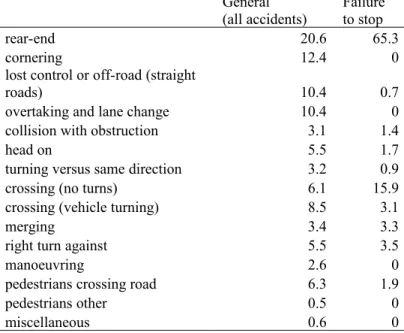
Collision types resulting from “failure to stop” are shown in table 1. One might expect junction overshoots and rear-end collisions to predominate, however the OTS cases show a wider variety of collisions. Common collision types associated with such accidents include crossing, merging, turning, and others.
Table 1 about here
Table 1 also makes a comparison with the overall collision-type frequency distribution from the OTS database and that comparison underlines differences in the result of failure to stop in particular collisions. Apart from the widely acknowledged predominance of rear-end collisions (+44.7%= 3 times as common as in general accident data), crossing without turning is particularly common (+9.8%, about 3 times more common), while cornering, overtaking, manoeuvring do not appear at all, and pedestrian crossings are less common (-4.4%, about 3 times less common).
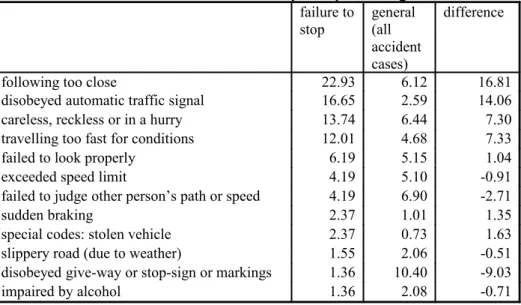
In terms of contributory factors (Table 2) drivers’ “too close” car-following strategy is identified as the most common contributory factor, followed by non-adherence to automatic traffic signals and speeding. Cognitive failures – to look and to judge other paths – and inappropriate reactions – sudden braking – are also commonly found in such accidents. Comparing that with the general OTS distribution (table 2), “too close” car-following
behaviour is more than three times more frequent as a contributor (+16.81%), non-adherence to automatic traffic signals is more than four times more common in failures to stop (14.06%), while too-fast driving is two and a half times more frequent (+7.33) and psychological parameters (reckless/in hurry) two times more common (+7.30%). On the contrary, non-adherence to give-way signals and more than five times less common factor (-9.03) and failure to judge other paths is somewhat less frequent (-2.71%).
Table 2 about here
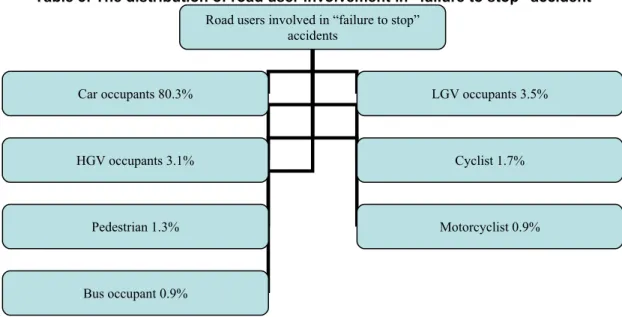
To make the picture clearer it is necessary to check the type of road users involved in such accidents (table 3). About 80% of road users are car occupants, 3.5% are Light Goods Vehicle (LGV) occupants and 3.1% are Heavy Goods Vehicle occupants. Motorcyclists and bus occupants each constitute about 1% of the road users involved in such accidents. Vulnerable road-users comprise 3% in total, 1.3% are pedestrians and 1.7% are pedal cyclists.
Table 3 about here
“Sudden braking”
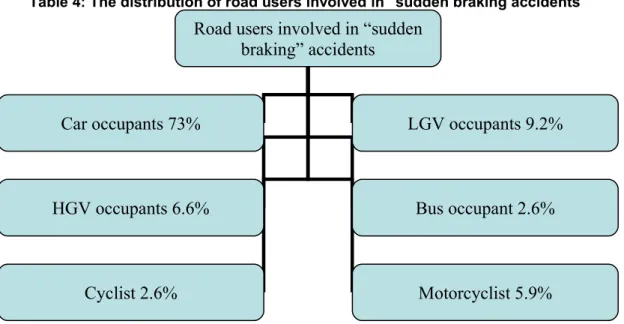
“Inappropriate reaction-sudden braking” is identified as the precipitating factor in 39 cases investigated by the OTS team. The interactions files of those cases include 152 road-user interactions. 73% of those involved are car occupants, while 9.2% are Light Goods Vehicle (LGV) and 6.6% are Heavy Goods Vehicle (HGV) occupants. Bus occupants and cyclists each consist 2.6% of total road users and motorcyclists are 5.9%.
Table 4 about here
Compared to “failure to stop” cases, there is more frequent involvement of LGVs (about 2.5 times) and HGVs (more than 2 times) and motorcyclists (more than 6 times more common). On the other hand, there have been, as might be expected, no pedestrians involved in this type of accident (compared to 1.3% in failures to stop), and differences below 1% exist in bus occupant and cyclist involvement.
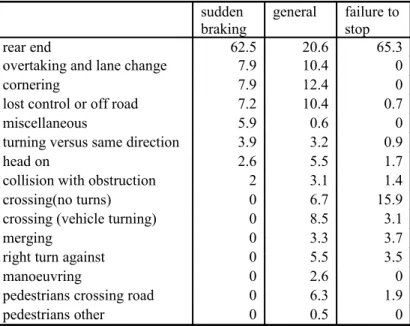
Comparison of collision types in “sudden braking” cases with the general and the “failure to stop” cases reveals some interesting differences (table 5). While the predominance of rear-end collisions is there, as expected, collisions commonly associated with lateral control such as overtaking, cornering and loss of control collisions are initiated by a sudden-braking reaction. Furthermore, miscellaneous collisions (with a trailer mostly) are common results of sudden-braking, unlike other precipitating factors. On the other hand, collisions while crossing and collisions with pedestrians are not found at all in “sudden braking” accidents, unlike “failure to stop” accidents and the database generally.
Table 5 about here
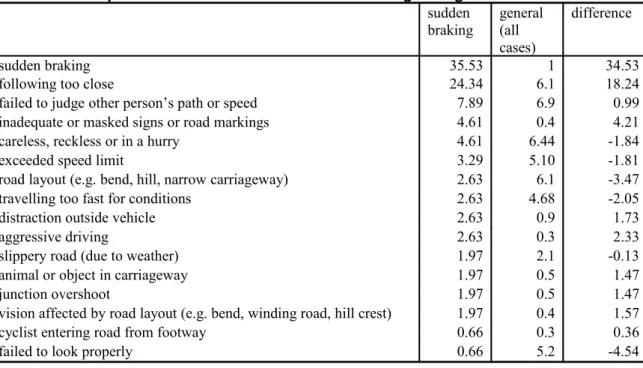
Examination of the contributory factors in accidents initiated by a sudden-braking reaction indicated a “wave effect” of sudden braking reaction in response to one or more other drivers also braking suddenly ahead to be the most common factor (table 6). Similarly with “failure to stop”, close car-following behaviour is a major contributor in this type of accident. Failures of judgement and masked road markings and signs are among the most common contributors as well as distraction, however failure to look properly, junction overshooting and cyclists’ intrusions are not common as in “failure to stop” cases.
Discussion
This paper has made a brief overview of the rich and varied range of data describing the causes of road accidents in the UK, from the macroscopic data gathered by the police to microscopic data gathered by the OTS teams. The authors have presented a modest selection of the OTS data of relevance to the study of longitudinal control systems, and with the intention of highlighting the value and importance of real-world data both for a comprehensive understanding of how drivers use these systems and for the most effective safety design.
The data presented here are not intended to represent the full range and variety of circumstances where braking plays a role in causing accidents. Rather the intention was to focus on two braking situations as specifically defined in the methodology, involving some (but not all) accidents where the driver fails to stop in time, and others where there was sudden braking. Further work is planned to more fully describe the role of braking in accidents, however the current study raises some notable points for discussion at this stage. The design of safety systems such as ACC and EBA must focus on the “genetic make up” of the accident scenarios (Hollnagel, 2004), the detailed failure types (Wagenaar & Reason, 1990) and contributory factors if these systems are to best function under the real world conditions involving driver and vehicle interactions. The predominance of rear-end collisions and the contribution of close car-following and speeding imply that ACC, EBA and Intelligent Speed Adaptation (ISA) are all steps towards the right direction. However, there are many other characteristics of the examined accident types that should be considered carefully.
In the case of “failure to stop”, a collision when crossing junctions is the second most common collision type recorded. In parallel, the contribution of cognitive failures (to look and to judge) and inappropriate reactions might ideally call for a cognitive/decision making assistant; a system that can track other road vehicles and users, predict their trajectories and provide the driver with a more sophisticated system of prompts to keep him on the “safe path” (as suggested in the very early description of the driving task by Gibson & Crooks in 1938). Certainly, such a system would come with a series of ergonomic issues, including the possibility of unwanted behavioural adaptations to the new system, but possibly no more issues than the problems inherent in any new automated process.
Key contributors to the cause of accidents which – to the knowledge of the authors – has barely been addressed by system developers are the psychological parameters. Recklessness, carelessness etc. are left to the transport authorities to deal with and are sometimes not currently possible to address at all. Future in-vehicle technologies may well offer more dynamic solutions in combination with education and enforcement. Where we currently rely, to a large extent, on road policing to identify drivers in need of behavioural modification, future technologies might help address a wider range of misdemeanours exhibited by the wider driving population and provide instantaneous support to the driving task. Given that all drivers can be and are careless, to a greater or lesser extent, measures able to react to the temporal fluctuation of these parameters therefore offer new and interesting possibilities for accident prevention. Possibly a merge of psychological experience with engineering could offer such solution.
Examination of “sudden braking” cases underlines the strong systemic nature of these accidents. An abrupt reaction of one road user can lead to the abrupt reaction of another user which then initiates an accident (see sudden-braking as contributor). This phenomenon points to the need to account for this systemic nature of accidents when designing safety systems, ensuring multi-vehicle incidents are also considered. Accordingly, current systems should first tune their intervention according to user responses (mostly applicable to EBA) and second, tune their intervention according to other road-user responses (mostly applicable to ACC). Conceptually, ACC systems are highly relevant here as they are intended to assist drivers in close following situations, however system limitations are recognised in consideration of the effectiveness of humans when monitoring the driving task rather than actively operating the vehicle. Such issues will need to be better understood before ACC can be fully developed and deployed as system primarily intended for collision mitigation..
Failures of judgement and inability to see masked road markings are another factor that a visual aid or active decision-aid system as the one described previously could address, while contribution of distraction could be mitigated by a more controlled external environment and an integrated-device manager inside the vehicle (Amditis, Kussmann, Polychronopoulos, Engstrom, & Andreone, 2006).
The low incidence of accidents involving pedestrians was noted, however, the authors wish to examine a more extensive range of accident scenarios within the OTS database before drawing conclusions regarding these road users. Over 5% of users involved in “sudden braking” cases are motorcyclists. These are some of the few single-vehicle cases, where the braking reaction is followed by loss of control with fatal consequences. Although the number of cases was low, the fatality rate suggests the importance of developing intelligent braking systems in two-wheeled motor vehicles.
Acknowledgements
The OTS project is funded by the UK Department for Transport and the Highways Agency. The project would not be possible without help and ongoing support from many individuals, especially including the Chief Constables of Nottinghamshire and Thames Valley Police Forces and their officers. In addition the authors of this paper would like to thank the staff at Loughborough University and TRL Ltd who have helped to establish and carry out this project. The views expressed in this paper belong to the authors and are not necessarily those of the Department for Transport, Highways Agency, Nottinghamshire Police or Thames Valley Police.
References
Amditis, A., Kussmann, H., Polychronopoulos, A., Engstrom, J., & Andreone, L. (2006). System architecture for integrated adaptive HMI solutions. 2006 IEEE Intelligent Vehicles Symposium, Meguro-ku, Japan. 13-18.
BOSCH. (2000). In BAUER H. (Ed.), BOSCH automotive handbook. Stuttgart: Robert Bosch GmbH.
Breuer, J. J., Faulhaber, A., Frank, P., & Gleissner, S. (2007). Real world benefits of brake assistance systems. Proceedings of the 20th Enhanced Safety of Vehicles Conference, Lyon. (Paper Number 07-0103)
Broughton, J. (1997). A new system for recording contributory factors in road accidents. , 9A(Part 5) 53-70.
Carsten, O. M. J., Tight, M. R., Southwell, M. T., & Plows, B. (1989). Urban accidents: Why do they happen. Basingstoke, Hants: AA FOUNDATION FOR ROAD SAFETY
RESEARCH.
Coelingh, E., Jakobsson, L., Lind, H., & Lindman, M. (2007). Collision warning with auto brake - a real-life safety perspective. Proceedings of the 20th Enhanced Safety of Vehicles Conference, Lyon. (Paper Number 07-0450)
Delphi active safety products for automotive manufacturers. Retrieved 12/06/2007, 2007, from http://delphi.com/manufacturers/auto/safety/active/
Fuller, R. (1984). A conceptualization of driving behaviour as threat avoidance. Ergonomics, 27(11), 1139.
Gibson, J. J., & Crooks, L. E. (1938). A theoretical field-analysis of automobile-driving. American Journal of Psychology, 51, 453-471.
Girard, Y. (1993). In-depth investigations of accidents: The experience of INRETS at Salon-de Provence. Safety Evaluation of Traffic Systems, Traffic Conflicts and Other
Measures; Proceedings of the International on Theories and Concepts on Traffic Safety (ICTCT) Workshop, Salzburg.
Hickford, A. J., & Hall, R. D. (2004). Road safety research report no 43. review of the contributory factors system. London: Department for Transport [DfT].
Hill, J. R., Thomas, P. D., Smith, M., & Byard, N. (2006). The methodology of on the spot accident investigations in the UK. Enhanced Safety in Vehicles 2001, Amsterdam. Hillard, P. J., Logan, D., & Fildes, B. (2005). The application of systems engineering
techniques to the modelling of crash causation. In L. Dorn (Ed.), Driver behaviour and training (pp. 407-415). Aldershot: Ashgate,.
Hollnagel, E. (2004). Barriers and accident prevention. Aldershot: Ashgate. Honda safety - active safety. Retrieved 12/06/2007, 2007, from
http://corporate.honda.com/safety/details.aspx?id=active_safety
Kirwan, B. (1994). A guide to practical human reliability assessment. London: Taylor & Francis.
Lee, J. D., & Strayer, D. L. (2004). Preface to a special section on driver distraction. Human Factors, 46(4), 583-586.
Lie, A., Tingvall, C., Krafft, M., & Kullgren, A. (2006). The effectiveness of electronic stability control (ESC) in reducing real life crashes and injuries. Traffic Injury Prevention, 7(1), 38-43.
Mackay, G. M. (1969). Some features of traffic accidents. British medical journal, 4(5686), 799-&.
Maycock, G. (1995). Contributory factors in accidents; police databases (Project Report No. PR/SE/083/95). Crowthorne: Transport Research Laboratory.
Mcruer, D. T., Allen, R. W., Weir, D. H., & Klein, R. H. (1977). New results in driver steering control models. Human factors, 19(4), 381-397.
Naatanen, R., & Summala, H. (1976). Road-user behavior and traffic accidents. Amsterdam ; Oxford: North-Holland Publishing Co. etc.
Näätänen, R., & Summala, H. (1974/12). A model for the role of motivational factors in drivers' decision-making*. Accident Analysis & Prevention, 6(3-4), 243-261.
Neilson, I., & Condon, R. (2000). Desirable improvements in road accident and related data (Research Paper No. 1). London: Parliamentary Advisory Council for Transport Safety. Otte, D. (1999). Description of in-depth investigation team ARU/Medical university
Page, Y., Foret-Bruno, J. & Cuny, S. Are expected and observed effectiveness of emergency brake assist in preventing road injury accidents consistent? Retrieved 02/05/2007, 2007, from http://www-nrd.nhtsa.dot.gov/pdf/nrd-01/esv/esv19/05-0268-O.pdf
Reason, J. (1990). Human error. New York: Cambridge University Press.
Sabey, B. E., & Staughton, G. C. (1975). Interacting roles of road environment, vehicle and road user in accidents. Fifth International Conference of the International Association for Accident and Traffic Medicine, London, UK.
Senders, J. W., Kristofferson, A. B., Levison, W. H., Dietrich, C. W., & Ward, J. L. (1967). The attentional demand of automobile driving. Highway Research Record, 195, 15-33. Sheridan, T. B. (2004). Driver distraction from a control theory perspective. Human factors,
46(4), 587-599.
Society for Automotive Engineers. (1999). ESP electronic stability programme. Driving safety systems (pp. 206-242). Germany: Robert Bosch GmbH.
Summala, H. (1996/0). Accident risk and driver behaviour. Safety Science, 22(1-3), 103-117. Thomas, P. (2006). Crash involvement risks of cars with electronic stability control systems
in Great Britain. International Journal of Vehicle Safety, 1(4), 267-281. United States. Columbia Accident Investigation Board. (2003). In Godwin R. (Ed.),
Columbia accident investigation board : Report. Burlington, Ont.: Apogee Books. Van Winsum, W. (1998). Preferred time headway in car-following and individual differences
in perceptual-motor skills. Perceptual and Motor Skills, 87(3 PART 1), 863-873. Van Winsum, W., & Brouwer, W. (1997). Time headway in car following and operational
performance during unexpected braking. Perceptual and Motor Skills, 84(3 PART II), 1247-1257.
Wagenaar, W. A., & Reason, J. T. (1990). Types and tokens in road accident causation. Ergonomics, 33(10-11), 1365-1375.
Weir, D. H., & McRuer, D. T. (1970). Dynamics of driver vehicle steering control
Whittingham, R. B. (2004). The blame machine : Why human error causes accidents. Oxford: Elsevier Butterworth-Heinemann.
Wilde, G. J. S., & Murdoch, P. A. (1982). Incentive systems for accident-free and violation-free driving in the general population. Ergonomics, 25, 879-90. Oct.
Wilding, P. (2002). The 2002 quality review of road accident injury statistics interim report: Extension of timetable. London: Department for Transport.
Safe control of the vehicle
Longitudinal control Lateral control
Throttle pedal
(Gear stick + Clutch pedal)
Brake pedal
Steering wheel
Driver
Figure 1: the instruments of basic vehicle control
Table 1: Collision type as a result of failure to stop compared to general accident data
General
(all accidents) Failure to stop
rear-end 20.6 65.3
cornering 12.4 0
lost control or off-road (straight
roads) 10.4 0.7
overtaking and lane change 10.4 0 collision with obstruction 3.1 1.4
head on 5.5 1.7
turning versus same direction 3.2 0.9 crossing (no turns) 6.1 15.9 crossing (vehicle turning) 8.5 3.1
merging 3.4 3.3
right turn against 5.5 3.5
manoeuvring 2.6 0
pedestrians crossing road 6.3 1.9 pedestrians other 0.5 0
Table 2: Common contributors in failure to stop compared to general accident data
failure to
stop general (all accident cases)
difference
following too close 22.93 6.12 16.81 disobeyed automatic traffic signal 16.65 2.59 14.06 careless, reckless or in a hurry 13.74 6.44 7.30 travelling too fast for conditions 12.01 4.68 7.33 failed to look properly 6.19 5.15 1.04 exceeded speed limit 4.19 5.10 -0.91 failed to judge other person’s path or speed 4.19 6.90 -2.71
sudden braking 2.37 1.01 1.35
special codes: stolen vehicle 2.37 0.73 1.63 slippery road (due to weather) 1.55 2.06 -0.51 disobeyed give-way or stop-sign or markings 1.36 10.40 -9.03 impaired by alcohol 1.36 2.08 -0.71
Table 3: The distribution of road user involvement in “failure to stop” accident
Road users involved in “failure to stop” accidents
Car occupants 80.3% LGV occupants 3.5%
HGV occupants 3.1%
Pedestrian 1.3%
Cyclist 1.7%
Motorcyclist 0.9%
Table 4: The distribution of road users involved in "sudden braking accidents"
Road users involved in “sudden
braking” accidents
Car occupants 73%
LGV occupants 9.2%
HGV occupants 6.6%
Bus occupant 2.6%
Table 5: Collision type frequencies in "sudden braking", "failure to stop" and general accident data
sudden
braking general failure to stop rear end 62.5 20.6 65.3 overtaking and lane change 7.9 10.4 0
cornering 7.9 12.4 0
lost control or off road 7.2 10.4 0.7 miscellaneous 5.9 0.6 0 turning versus same direction 3.9 3.2 0.9
head on 2.6 5.5 1.7
collision with obstruction 2 3.1 1.4 crossing(no turns) 0 6.7 15.9 crossing (vehicle turning) 0 8.5 3.1
merging 0 3.3 3.7
right turn against 0 5.5 3.5
manoeuvring 0 2.6 0
pedestrians crossing road 0 6.3 1.9 pedestrians other 0 0.5 0
Table 6: Comparison of contributors in "sudden braking" and general accident data
sudden
braking general (all cases)
difference
sudden braking 35.53 1 34.53
following too close 24.34 6.1 18.24
failed to judge other person’s path or speed 7.89 6.9 0.99 inadequate or masked signs or road markings 4.61 0.4 4.21 careless, reckless or in a hurry 4.61 6.44 -1.84
exceeded speed limit 3.29 5.10 -1.81
road layout (e.g. bend, hill, narrow carriageway) 2.63 6.1 -3.47 travelling too fast for conditions 2.63 4.68 -2.05 distraction outside vehicle 2.63 0.9 1.73
aggressive driving 2.63 0.3 2.33
slippery road (due to weather) 1.97 2.1 -0.13 animal or object in carriageway 1.97 0.5 1.47
junction overshoot 1.97 0.5 1.47
vision affected by road layout (e.g. bend, winding road, hill crest) 1.97 0.4 1.57 cyclist entering road from footway 0.66 0.3 0.36 failed to look properly 0.66 5.2 -4.54