1
For students admitted Fall 2005
Undergraduate
Handbook
Electrical Engineering
Computer Engineering
Computer Science
For students admitted
to the EECS Program in Fall 2005
The Department of Electrical Engineering
and Computer Science
School of Engineering
The University of Kansas
1520 West 15th Street
2001 Eaton Hall
Lawrence, Kansas 66045-7621
Phone: 785/864-4620
Fax: 785/864-3226
Website: www.eecs.ku.edu
Last updated 6/10/2005
2
For students admitted Fall 2005
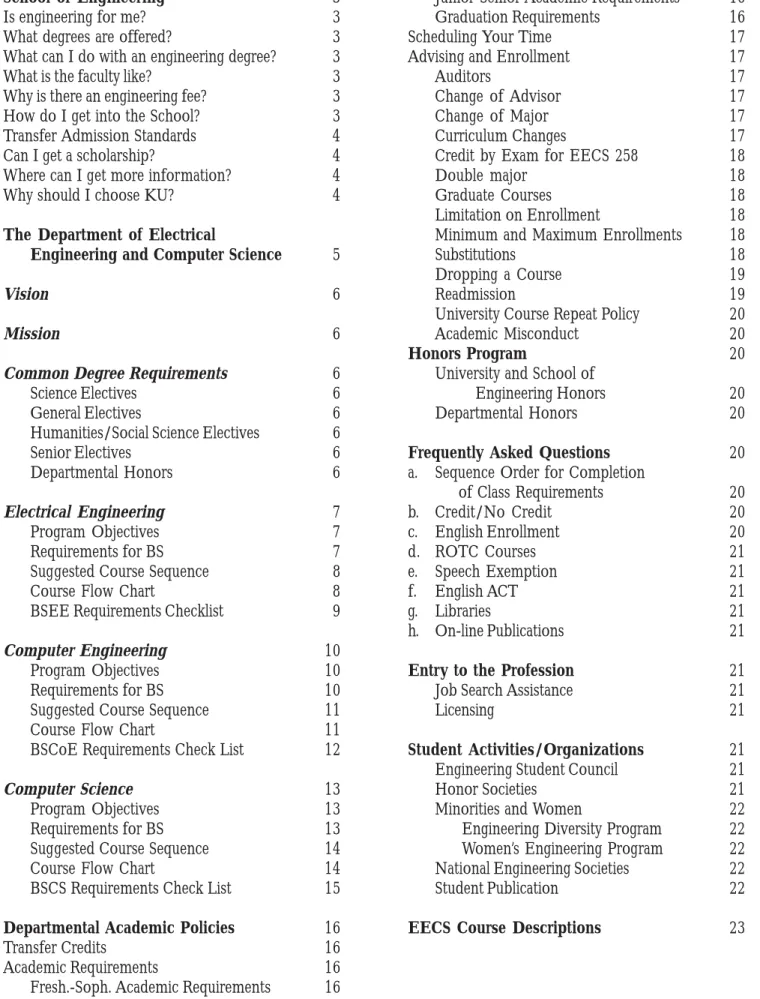
Table of Contents
School of Engineering 3
Is engineering for me? 3
What degrees are offered? 3
What can I do with an engineering degree? 3
What is the faculty like? 3
Why is there an engineering fee? 3 How do I get into the School? 3 Transfer Admission Standards 4
Can I get a scholarship? 4
Where can I get more information? 4
Why should I choose KU? 4
The Department of Electrical
Engineering and Computer Science 5
Vision 6
Mission 6
Common Degree Requirements 6
Science Electives 6
General Electives 6
Humanities/Social Science Electives 6
Senior Electives 6
Departmental Honors 6
Electrical Engineering 7
Program Objectives 7
Requirements for BS 7
Suggested Course Sequence 8
Course Flow Chart 8
BSEE Requirements Checklist 9
Computer Engineering 10
Program Objectives 10
Requirements for BS 10
Suggested Course Sequence 11
Course Flow Chart 11
BSCoE Requirements Check List 12
Computer Science 13
Program Objectives 13
Requirements for BS 13
Suggested Course Sequence 14
Course Flow Chart 14
BSCS Requirements Check List 15
Departmental Academic Policies 16
Transfer Credits 16
Academic Requirements 16
Fresh.-Soph. Academic Requirements 16
Junior-Senior Academic Requirements 16
Graduation Requirements 16
Scheduling Your Time 17
Advising and Enrollment 17
Auditors 17
Change of Advisor 17
Change of Major 17
Curriculum Changes 17
Credit by Exam for EECS 258 18
Double major 18
Graduate Courses 18
Limitation on Enrollment 18 Minimum and Maximum Enrollments 18
Substitutions 18
Dropping a Course 19
Readmission 19
University Course Repeat Policy 20
Academic Misconduct 20
Honors Program 20
University and School of
Engineering Honors 20
Departmental Honors 20
Frequently Asked Questions 20 a. Sequence Order for Completion
of Class Requirements 20 b. Credit/No Credit 20 c. English Enrollment 20 d. ROTC Courses 21 e. Speech Exemption 21 f. English ACT 21 g. Libraries 21 h. On-line Publications 21
Entry to the Profession 21
Job Search Assistance 21
Licensing 21
Student Activities/Organizations 21 Engineering Student Council 21
Honor Societies 21
Minorities and Women 22
Engineering Diversity Program 22 Women’s Engineering Program 22 National Engineering Societies 22
Student Publication 22
3
For students admitted Fall 2005
Is engineering for me?
To find out, ask yourself:• Do I like to design and build things?
• Am I a creative thinker who likes to solve complex problems? • Do I enjoy math and science?
• Am I curious about how things work? • Am I precise in my work and study habits?
• Do I budget my time so I can finish all the work required of me?
• Do I have a history of performing well academically? • Am I ready to enter a demanding curriculum?
What degrees are offered?
The School of Engineering offers the Bachelor of Science (BS) in engineering with majors in 10 disciplines. They are aerospace engineering, architectural engineering, chemical engineering, civil engineering, computer engineering, com-puter science, electrical engineering, engineering physics, mechanical engineering, and petroleum engineering.
with potential employers. The Center schedules interviews and conducts workshops on resumes, interviewing, and searching for either permanent or summer jobs.
School of Engineering
Stuart Bell, Dean
Robert Sorem, Associate Dean of Undergraduate Studies
Glen Marotz, Associate Dean of Research and Graduate Studies
1 Eaton Hall
Phone: 785/864-3881
E-mail: [email protected]
Website: www.engr.ku.edu
What is the faculty like?
Engineering faculty members are nationally recognized leaders in education and research. KU faculty members are leaders in many engineering societies. Their work is widely published in professional journals. You will get the chance to interact with faculty members outside the classroom and lab. Engineering faculty members participate in a variety of activities with students. For example, civil engineering faculty, join annually with students to build and race concrete canoes in an American Society of Civil Engineers competition.
Why is there an engineering
fee?
As an engineering student, you will pay a special fee in addition to regular tuition and fees for engineering courses. The fee, calculated at a rate of $30 per credit hour of engineer-ing courses you take, helps the School maintain and operate lab equipment and computers. Because you will take more engineering courses each semester as you advance, the engineering fee you pay will increase each year.
How do I get into the School?
First-year students may enter the School of Engineering, but admission is selective. Applications are judged on several factors, including but not limited to, high school record, scores on national tests, academic record at college orWhat can I do with an
engineering degree?
Whatever your engineering major, you will find many job opportunities. Most KU graduates earn more than the national average starting salary. Many companies and govern-mental agencies are aware of the high quality of KU gradu-ates, so they are eager to hire them and pay premium salaries. The School’s Career Services Center will help put you in touch
4
For students admitted Fall 2005
66045-1920, 785/864-4700 or visit their website at www.ku.edu/~osfa/.
Where can I get more
information?
Write or call the University of Kansas, School of Engineering, Robert Sorem, Associate Dean, 1520 West 15th Street, 1 Eaton Hall, Lawrence, KS 66045, 785/864-3881; or visit the website at www.engr.ku.edu.
With so many engineering
programs in the country, why
should I choose KU?
• Program Quality
KU’s undergraduate engineering programs are accredited by the Engineering Accreditation Commission of the Accreditation Board for Engineering and Technology (EAC/ ABET). The computer science program is accredited by the
Computing Accreditation Commission of ABET.
• Your Overall Education
The overall quality and breadth of your education is one great reason for coming to KU. The College of Liberal Arts and Sciences offers hundreds of courses and has excellent teachers. You will meet many international students and teachers who bring a cultural richness to campus and who will expose you to the diverse viewpoints and customs so important to your under-graduate education.
• Student Organizations
Engineering students can supplement and advance their academic programs by participating in student chapters of national engineering societies. The School has active support groups for women and minority students, and all student groups can participate in the annual Engineering Exposition, creating exhibits that describe areas of engineering and demonstrate engineering processes.
• Research Opportunities
Undergraduates can participate in KU’s top-flight research programs in computer-aided aircraft design, architec-tural lighting and visibility, enhanced oil recovery, strucarchitec-tural mechanics and stress analysis, telecommunications and information systems, computer-integrated manufacturing, automatic control systems, and other fields.
university level, and trend of grades. High school transcripts and ACT scores are required. Equivalent SAT scores may be substituted.
You must have graduated in the top half of your high school class and have a mathematics score of 28 or higher on the ACT exam (or be otherwise eligible to take Math 121) to be directly admitted into the EECS Department. Take a standard college-preparatory curriculum in high school, including courses in chemistry, economics, English, physics, and mathematics (through trigonometry). If you already have some college credits and you have a cumulative grade-point average of 2.5 or higher, you may qualify to transfer in to the School of Engineering .
Transfer Admission Standards
All applications from transfer students either from other KU units or from other institutions are evaluated on a case-by-case basis.In general, students with grade-point averages under 2.5 are not considered for admission. Students must submit
mathematics ACT or SAT scores or proof of competence in calculus for consideration.
Can I get a scholarship?
The School of Engineering offers scholarships to incoming freshman and transfer students with outstanding academic credentials. There are no scholarship forms to complete. Each student admitted to the School of Engineer-ing is reviewed for scholarships. The deadline for consider-ation is January 15.The Engineering Diversity Program also makes scholar-ships available to female and minority engineering students. Call the Diversity director at 785/864-3620 for more information.
For more information about grants, loans, and other need-based financial aid, write or call the University of Kansas Office of Student Financial Aid, 50 Strong Hall, Lawrence, KS
5
For students admitted Fall 2005
The technological advancesthat have made our modern society what it is today are due largely to the efforts of electrical engineers, computer engineers, and computer scientists. Among these advances are radio, television, telephones, wireless commu-nications, cellular telephones, personal computers, worksta-tions, mainframe computers, aircraft avionics, satellite electronics, automobile electronics, office machinery, medical electronic equipment, video games, electric power generation and distribution systems, telecommunications, computer networks (including the Internet), home entertainment products, radar, defense electronics, artificial intelligence, and a wide variety of computer software.
The EECS Department offers three Bachelor of Science degrees: Electrical Engineering (BSEE), Computer Engineer-ing (BSCoE), and Computer Science (BSCS). Each features a firm grounding in fundamentals of mathematics, basic science, and computer science and/or engineering science, and advanced studies in the theory and design of systems of various kinds, as well as hands-on experience. All degree programs are accredited.
Electrical engineers work with a broad range of electrical and electronic devices and systems. Electrical engineers may work in the areas of circuit design, electronic devices, electrical and optical communications, control and automation, electromagnetics, instrumentation, energy and power, or signal processing. While computers are involved in many of these areas, either as components or as design/analysis tools, an electrical engineer’s work often extends beyond the computing aspects of a problem or system.
Electrical engineers find professional opportunities in a multitude of environments and locations both in this country and abroad. Many opportunities are obvious, such as the telecommunications and computer industries, but there are many other employers who need electrical engineers. For example, industries using technology seek the expertise of electrical engineers for developing microelectronic integrated circuits, electrical and electronic consumer products, electrical power generation and distribution, industrial instrumentation and control systems, and radar. Electrical engineers also provide expertise for incorporating equipment for communication, computer-aided manufacturing, control, and data acquisition.
Computer engineers focus on all aspects of computa-tional devices and systems, including both hardware and software. Wherever computers can be found, computer engineers are needed. In addition to the computer system
The Department of Electrical Engineering
and Computer Science
Costas Tsatsoulis, Chair
aspects of the electrical engineering and computer science areas listed, computer engineers may work in the areas of computer elements and architectures, very large scale integrated (VLSI) circuits for data processing and storage, embedded and real-time computer systems, or computer networking.
Computer engineering graduates can expect to find jobs in digital hardware design, software engineering, computer communications, the integration of hardware and software, and in developing microprocessors, personal computers, workstations, mainframe computers, software, and computer networks. As more industries come to rely on computers to carry out office automation, communications, manufacturing and robotics, process control, computer-aided design, and computer manufacturing, the demand for engineers to design and implement such systems will continue to rise.
Computer scientists focus on the theory and practice of computing. They may pursue the design, analysis, and implementation of computer algorithms, study the theory of programming methods and languages, or design and develop new programming languages and software systems. Com-puter scientists may also work in the areas of artificial intelligence, database systems, parallel and distributed computation, human-computer interaction, computer graphics, operating systems, or computer systems analysis.
Computer science graduates find jobs in a variety of industrial and governmental settings. As computer hardware and communications technologies have advanced, an explosive demand has emerged for software systems to exploit the ever-increasing potential. The need for software system design, development, and maintenance is not restricted to those companies whose main business is software development. Virtually every major company and governmental agency has found the need to develop and maintain specialized software for specific purposes. This trend is sure to continue in the future.
Career opportunities for electrical engineers, computer engineers, and computer scientists are available in many areas of specialization, in many industrial, commercial, academic, and government environments, and in many geographic locations in this country and abroad. Expertise in electrical engineering, computer engineering, and computer science is of vital importance to any high technology organization. Many such organizations actively recruit majors in all three disciplines. In addition, a bachelor of science degree in one of these three areas prepares a student for continued studies in graduate school or in other professional schools such as medicine or law.
The pages that follow outline the degree requirements for the BSEE, BSCoE, and the BSCS degrees.
6
For students admitted Fall 2005
Common Degree Requirements
Science Electives
Courses satisfying science electives for CS and CoE Majors must be chosen from the following list: ASTR 291, BIOL 150, BIOL 152, CHEM 184, CHEM 188, GEOG (104 + 105), GEOG 304, or GEOL 101. To count as one elective both GEOG 104 and GEOG 105 must be taken.
General Electives
All majors may choose classes from the following list of approved technical, scientific, and professional classes: • EECS: Any course except EECS 100, EECS 128, EECS
138, EECS 498, and EECS 603.
• Engineering: Any course from any Engineering
Department numbered 200 or above, except for ENGR 300, ENGR 504, ME 328 and CE 390.
• Natural Science: Any course designated as NB, NE, or NP by CLAS except PHSX 111, PHSX 112, PHSX 114, PHSX 115, PHSX 212 and CHEM 125 (if CHEM 184 or its equivalent was not taken for Basic Science). If a science course used for the science elective exceeds the required science elective hours, then excess hours will be considered general elective hours.
• Math: Any MATH course numbered 500 or above, except MATH 701.
• Business: Any course from the School of Business, except statistics and computing.
Humanities/Social Science Electives
H/SS Electives must be selected from the list of Principal Courses (or Honors Principal Courses) in the Humanities and the SocialSciences. This list is found in the College of Liberal Arts and
Sciences section of the Undergraduate Catalog. Any course
designated “H” (humanities) or “S” (social sciences) which has a principal course as a prerequisite is also acceptable. Foreign language courses (other than English or a student’s native language) may be used for up to 3 credit hours. Additionally, all western civilization (HWC) courses and non-western culture courses (see University Undergraduate Catalog) can count as humanities (H) courses.
Senior Electives
EE and CoE majors may choose any EECS course 400 or above, excluding EECS 603. Under unusual circumstances other courses can be considered, but only with an accompanying petition.
For CS Majors, EECS 638, 647, 648, 649, 663, 665, 672, 690 and any 700 EECS course. Under unusual circumstances other courses can be considered, but only with an accompanying petition.
Departmental Honors
A student may graduate with departmental honors in electrical engineering, computer engineering or computer science by satisfying the requirements below. Most of the requirements for graduation with Departmental Honors are completed during the final two semesters of a student’s undergraduate program. 1. Upon entrance to the Departmental Honors program, a
student must achieve and maintain until graduation a minimum overall GPA of 3.25 and minimum engineering GPA of 3.5 while maintaining full-time status.
2. The student must file an application to graduate with Departmental Honors during the semester preceding the student’s final two semesters. This must be done prior to enrolling in EECS 498. These forms are available in the EECS Office in 2001 Eaton Hall.
3. The student must enroll in EECS 498: Honors Research for one credit hour for his/her last two semesters under the supervision of a faculty member willing to serve as an honors advisor. These credits are in addition to those required for the degree.
4. The student must complete an independent research project paper and oral presentation to a panel of three judges approved by the undergraduate director. This panel makes the recommendation concerning graduating with honors.
Vision
The Vision of the EECS Department is to provide a stimulating and challenging intellectual environment: • to have our classes populated by outstanding students
• to be world-class in an increasing number of selected areas of research • to have faculty with high visibility among their peers
Mission
The Mission of the EECS Dept. is:
• to educate the next generation of electrical engineers, computer engineers and computer scientists • to discover, apply and disseminate knowledge
7
For students admitted Fall 2005
Electrical Engineering
Electrical engineers work with a broad range of electrical and electronic devices and systems. Electrical engineers may work in the areas of circuit design, electronic devices, electrical and optical communications, control and automation, electromagnetics, instrumentation, energy and power, or signal processing. While computers are involved in many of these areas, either as components or as design/ analysis tools, an electrical engineer’s work often extends beyond the computing aspects of a problem or system.
Objectives of the Electrical Engineering program are to produce graduates who:
1. Have an understanding of the fundamental concepts in basic sciences and mathematics, and can apply them to the solution ofelectrical engineering problems.
2. Are proficient in the use of laboratory and test equipment, computer aided design tools, computer software, and other tools used in engineering practice.
3. Can design components, experiments, and complex systems to meet specific requirements.
4. Have a broad education with exposure to humanities, professional ethics and responsibilities, and the role of engineer in global society. 5. Have the skills necessary to function in multidisciplinary, diverse and changing engineering environments.
Requirements for the Bachelor of Science in Electrical Engineering Degree
A total of 128 credit hours is required for the BSEE degree, as follows:Electrical Engineering (63 credit hours)
EECS 140 Introduction to Digital Logic Design 4
EECS 168 Programming I 4
EECS 211 Circuits I 3
EECS 212 Circuits II 4
EECS 312 Electronic Circuits I 3
EECS 360 Signal & System Analysis 4 EECS 388 Computer Systems & Assembly Language 4
EECS 412 Electronics Circuits II 4
EECS 420 Electromagnetics II 4
EECS 443 Digital Systems Design 4
EECS 444 Control Systems 3
EECS 470 Electrical Devices & Properties of Materials 3
EECS 501 Senior Design Laboratory I 3
EECS 502 Senior Design Laboratory II 3
EECS 562 Introduction to Communication Systems 4
Senior electives 9
Mathematics (18 credit hours)
MATH 121 Calculus I 5
MATH 122 Calculus II 5
MATH 220 Applied Differential Equations 3
MATH 290 Elementary Linear Algebra 2
EECS 461 Probability and Statistics 3
Basic Science (17 credit hours)
CHEM 184 Chemistry I 5
PHSX 211 Physics I 4
EECS 220 Electromagnetics I 4
PHSX 313 Physics III 3
PHSX 316 Physics lab 1
General Electives (6 credit hours)
General Electives 6
English (6 credit hours)
ENGL 101 Composition 3
ENGL 102 Composition and Literature 3
Communications Elective (3 credit hours)
One of the following courses: 3
ENGL 362 Professional Writing: Technical Writing or COMS 130 Speaker-Audience Communications
Humanities/Social Science (15 credit hours)
Economics Elective:: 3
ECON 142 Principles of Microeconomics (preferred) or ECON 144 Principles of Macroeconomics
Political Science Elective: 3 POLS 110 Introduction to US Politics or
POLS 150 Introduction to Comparative Politics or POLS 170 Introduction to International Politics
Ethics Elective: 3
PHIL 365 Moral Issues in the Professions or PHIL 375 Moral Issues in the Computer Technology
H/SS Elective 4 3
H/SS Elective 5 3
Students with even KUIDs (7 digit) take EECS 140 in fall and EECS
168 in spring. Those with odd KUIDs (7 digit) take EECS 168 in fall and EECS 140 in spring.
Humanities and Social Science Electives are: ECON 142 or 144;
POLS 110 or 150 or 170; PHIL 365 or 375; two 3-hour humanities or social science electives from the list of Principal Courses in the University Undergraduate Catalog.
Six hours of General Electives are chosen from a list of natural
science, math, business, or engineering courses as identified on page 6 of this handbook.
Nine hours of Senior Electives are chosen from EECS courses at
8
For students admitted Fall 2005
Electrical Engineering Course Flow Chart
The following flow chart shows the prerequisite relationships among the technical portions of the BSEE program. This chart, the latest catalog, and your advisor should be consulted if deviations from the suggested course sequence are contemplated.
FALL 1st Sem. 15 hours 1 lab SPRING 2nd Sem. 16 hours 2 labs FALL 3rd Sem. 16 hours 1 labs SPRING 4th Sem. 15 hours 2 labs FALL 5th Sem. 17 hours 2 labs SPRING 6th Sem. 17 hours 2 labs FALL 7th Sem. 16 hours 2 labs SPRING 8th Sem. 16 hours 2 labs ENGL 101 ENGL 102 CHEM 184 H/SS 3 EECS 360 F/S EECS 312 F/S H/SS 4 EECS 461 S/SU EECS 420 S EECS 443 S Gn. Elect. 1 Sr. Elect. 1 EECS 470 F EECS 562 S EECS 501 F H/SS 5 Sr. Elect. 3 Gn. Elect. 2 Sr. Elect. 2 EECS 502 S EECS 412 F MATH 122 FALL 1st Semester ENGL 101 3 MATH 121 5 EECS 140 or 168 4 H/SS 1 3 15 hrs. SPRING 2nd Semester ENGL 102 3 MATH 122 5 PHSX 211 4 EECS 168 or 140 4 16 hrs. FALL 3rd Semester EECS 211 3 MATH 220 3 MATH 290 2 CHEM 184 5 H/SS 2 3 16 hrs. SPRING 4th Semester EECS 212 4 EECS 220 4 EECS 388 4 H/SS 3 3 15 hrs. FALL 5th Semester EECS 312 3 PHSX 313 & 316 4 EECS 360 4 H/SS 4 3 COMS 130/ENGL 362 3 17 hrs. SPRING 6th Semester EECS 420 4 EECS 443 4 EECS 444 3 EECS 461 3 General Elective 3 17 hrs. FALL 7th Semester EECS 412 4 EECS 470 3 EECS 501 3 Sr. Elective 1 3 General Elective 2 3 16 hrs. SPRING 8th Semester EECS 502 3 EECS 562 4 Sr. Elective 2 3 Sr. Elective 3 3 H/SS 5 3 16 hrs.
Electrical Engineering Suggested Course Sequence
(Symbol key on previous page)
Eligibility Established Prerequisite Corequisite
H/SS 1
*Assumes even KUID.
EECS 444 S COMS 130 or ENGL 362 EECS 168 * F/S MATH 121 MATH 220 MATH 290 PHSX 313 & 316 PHSX 211 EECS 211 F/S EECS 220 F/S H/SS 2
For students admitted Fall 2005
EECS 212 F/S EECS 140 * F/S EECS 388 F/S
9
For students admitted Fall 2005
BSEE Requirements Checklist
Name: _________________________________________
Advisor: ________________________________________
SEM. GRADE COURSE
Computer & Engineering Science & Design (63)
EECS 140 Intro to Digital Logic Design _______ _______ 4 4 EECS 168 Programming I _______ _______ 4 4 EECS 211 Circuits I _______ _______ 3 3 EECS 212 Circuits II _______ _______ 4 4 EECS 312 Electronic Circuits I _______ _______ 3 3 EECS 360 Signal & Systems Analysis _______ _______ 4 4 EECS 388 Computer Systems & Assembly Lang. _______ _______ 4 4 EECS 412 Electronic Circuits II _______ _______ 4 4 EECS 420 Electromagnetics II _______ _______ 4 4 EECS 443 Digital Systems Design _______ _______ 4 4 EECS 444 Control Systems _______ _______ 3 3 EECS 470 Elect. Devices and Prop. of Materials _______ _______ 3 3 EECS 501 Senior Design Lab I _______ _______ 3 3 EECS 502 Senior Design Lab II _______ _______ 3 3 EECS 562 Intro to Communication Systems _______ _______ 4 4
Senior Electives (3 classes, 9 hrs.)
EECS____ __________________________ _______ _______ 3 3 EECS____ __________________________ _______ _______ 3 3 EECS____ __________________________ _______ _______ 3 3 Mathematics (18) MATH 121 Calculus I _______ _______ 5 5 MATH 122 Calculus II _______ _______ 5 5 MATH 220 Applied Differential Equations _______ _______ 3 3 MATH 290 Elementary Linear Algebra _______ _______ 2 2 EECS 461 Probability & Statistics _______ _______ 3 3
Basic Science (17)
CHEM 184 Chemistry I _______ _______ 5 5 PHSX 211 General Physics I _______ _______ 4 4 EECS 220 Electromagnetics I _______ _______ 4 4 PHSX 313 General Physics III _______ _______ 3 3 PHSX 316 Physics Lab _______ _______ 1 1
General Electives (6 hrs. total)
_________ __________________________ _______ _______ 3 3
_________ __________________________ _______ _______ 3 3
English, Comms., Humanities & Social Science (24)
ENGL 101 Composition _______ _______ 3 3 ENGL 102 Composition & Literature _______ _______ 3 3 ________ Communications Elective _______ _______ 3 3 ECON 14_ ______________________________ _______ _______ 3 3 POLS____ ______________________________ _______ _______ 3 3 PHIL____ ______________________________ _______ _______ 3 3
H&SS Electives 4 & 5 (2 classes)
________ ______________________________ ________________ 3 3 ________ ______________________________ ________________ 3 3 18 17 63 24 6 128 T O T A L M A T H S C I E N C E E N G I N E E R I N G G E N E R A L O T H E R
TOTALS
T O P I C S E D U C A T I O N H O U R S10
For students admitted Fall 2005
Computer Engineering
Computer engineers focus on all aspects of computational devices and systems, including both hardware and software. Wherever computers can be found, computer engineers are needed. In addition to the computer system aspects of the electrical engineering and computer science areas listed, computer engineers may work in the areas of computer elements and architectures, very large scale integrated (VLSI) circuits for data processing and storage, embedded and real-time computer systems, or computer networking.
Objectives of the Computer Engineering program are to produce graduates who:
1. Have an understanding of the fundamental concepts in basic sciences and mathematics, and can apply them to the solution ofcomputer engineering problems.
2. Are proficient in the use of laboratory and test equipment, computer aided design tools, computer software, and other tools used in engineering practice.
3. Can design components, experiments, and complex systems to meet specific requirements.
4. Have a broad education with exposure to humanities, professional ethics and responsibilities, and the role of engineers in global society. 5. Have the skills necessary to function in multidisciplinary, diverse and changing engineering environments.
Requirements for the Bachelor of Science in Computer Engineering Degree
A total of 130 credit hours is required for the BSCoE degree, as follows:Computer Engineering (64 credit hours)
EECS 140 Introduction to Digital Logic Design 4 EECS 168 Programming I 4 EECS 211 Circuits I 3 EECS 212 Circuits II 4 EECS 268 Programming II 4 EECS 312 Electronic Circuits I 3 EECS 360 Signal & System Analysis 4 EECS 368 Programming Language Paradigms 3 EECS 388 Computer Systems & Assembly Language 4 EECS 443 Digital Systems Design 4 EECS 448 Software Engineering I 3 EECS 541 Computer Systems Design Laboratory I 3 EECS 542 Computer Systems Design Laboratory II 3 EECS 645 Computer Architecture and Networks 3 EECS 663 Introduction to Communication Networks 3 EECS 678 Introduction to Operating Systems 3 Senior electives 9
Mathematics (22 credit hours)
MATH 121 Calculus I 5 MATH 122 Calculus II 5 MATH 220 Applied Differential Equations 3 MATH 290 Elementary Linear Algebra 2 EECS 210 Discrete Structures 4 EECS 461 Probability and Statistics 3
Basic Science (15 credit hours)
PHSX 211 Physics I 4 EECS 220 Electromagnetics I 4 PHSX 313 Physics III 3 PHSX 316 Physics lab 1 Science Elective 3
General Electives (5 credit hours)
General Electives 5
English (6 credit hours)
ENGL 101 Composition 3 ENGL 102 Composition and Literature 3
Communications Elective (3 credit hours)
One of the following courses: 3 ENGL 362 Professional Writing: Technical Writing or COMS 130 Speaker-Audience Communications
Humanities/Social Science (15 credit hours)
Economics Elective: 3
ECON 142 Principles of Microeconomics (preferred) or ECON 144 Principles of Macroeconomics
Political Science Elective: 3
POLS 110 Introduction to US Politics or
POLS 150 Introduction to Comparative Politics or POLS 170 Introduction to International Politics
Ethics Elective: 3
PHIL 365 Moral Issues in the Professions or PHIL 375 Moral Issues in the Computer Technology H/SS Elective 4 3 H/SS Elective 5 3 Students with even KUIDs (7 digit) take EECS 140 in fall and EECS
168 in spring. Those with odd KUIDs (7 digit) take EECS 168 in fall and EECS 140 in spring.
Humanities and Social Science Electives are: ECON 142 or 144;
POLS 110 or 150 or 170; PHIL 365 or 375; two 3-hour humanities or social science electives from the list of Principal Courses in the University Undergraduate Catalog.
Five hours of General Electives are chosen from a list of natural
science, math, business, or engineering courses as identified on page 6 of this handbook.
Natural Science Elective is chosen from ASTR 391, BIOL 150, BIOL 152, CHEM 184, CHEM 188, GEOG 104 and 105, GEOG 304, GEOL 101. Excess natural science hours count as General Elective hours.
Assumes a 5-hour Science Elective chosen, with 2 excess hours fulfilling General Elective requirement. Alternative would be a 3-hour Science Elective plus a 3-hour General Elective.
Nine hours of Senior Electives are chosen from EECS courses at
11
For students admitted Fall 2005
Computer Engineering Suggested Course Sequence
Computer Engineering Course Flow Chart
The following flow chart shows the prerequisite relationships among the technical portions of the BSCoE program. This chart, the latest catalog, and your advisor should be consulted if deviations from the suggested course sequence are contemplated.
FALL 1st Semester ENGL 101 3 MATH 121 5 EECS 140 or 168 4 H/SS 1 3 15 hrs. SPRING 2nd Semester ENGL 102 3 MATH 122 5 PHSX 211 4 EECS 168 or 140 4 16 hrs. FALL 3rd Semester MATH 220 3 MATH 290 2 EECS 210 4 EECS 211 3 EECS 268 4 16 hrs. SPRING 4th Semester EECS 212 4 EECS 220 4 EECS 368 3 COMS 130 or ENGL 362 3 H/SS 2 3 17 hrs. FALL 5th Semester EECS 312 3 EECS 388 4 EECS 448 3 PHSX 313 & 316 4 H/SS 3 3 17 hrs. SPRING 6th Semester EECS 360 4 EECS 443 4 EECS 461 3 H/SS 4 3 Gen. Elective 3 17 hrs. FALL 7th Semester EECS 541 3 EECS 645 3 EECS 663 3 Sr. Elective 1 3 Nat. Science 5 17 hrs. SPRING 8th Semester EECS 542 3 EECS 678 3 Sr. Elective 2 3 Sr. Elective 3 3 H/SS 5 3 15 hrs. FALL 1st Sem. 15 Hours 1 lab SPRING 2nd Sem. 16 hours 2 labs FALL 3rd Sem. 16 hours 1 lab SPRING 4th Sem. 17 hours 1 lab FALL 5th Sem. 17 hours 2 labs SPRING 6th Sem. 17 hours 2 labs FALL 7th Sem. 17 hours 2 lab SPRING 8th Sem. 15 hours 1 lab
Eligibility Established Prerequisite Corequisite
H/SS 1 ENGL 101 ENGL 102 H/SS 4 COMS 130 or ENGL 362 Sr. Elect 1 Sr. Elect. 2 Sr. Elect. 3 Nat. Sci. H/SS 2 Gen. Elect. H/SS 3 EECS 211 F/S MATH 122 PHSX 211 EECS 312 F/S EECS 212 F/S EECS 360 F/S EECS 542 S EECS 678 F/S EECS 645 F/S PHSX 313 & 316 EECS 443 S EECS 461 S/SU EECS 663 F EECS 368 F/S EECS 220 F/S H/SS 5 MATH 220 MATH 290
For students admitted Fall 2005
EECS 140 * F/S EECS 168 * F/S
(Symbol key on previous page)
* Assumes even KUID.
EECS 541 F EECS 448 F/S MATH 121 EECS 210 F/S EECS 388 F/S EECS 268 F/S
12
For students admitted Fall 2005
BSCoE Requirements Checklist
Name: _________________________________________
Advisor: ________________________________________
SEM. GRADE COURSE
Computer & Engineering Science & Design (64)
EECS 140 Intro to Digital Logic Design _______ _______ 4 4 EECS 168 Programming I _______ _______ 4 4 EECS 211 Circuits I _______ _______ 3 3 EECS 212 Circuits II _______ _______ 4 4 EECS 268 Programming II _______ _______ 4 4 EECS 312 Electronic Circuits I _______ _______ 3 3 EECS 360 Signal & Systems Analysis _______ _______ 4 4 EECS 368 Programming Language Paradigms _______ _______ 3 3 EECS 388 Computer Systems & Assembly Lang. _______ _______ 4 4 EECS 443 Digital Systems Design _______ _______ 4 4 EECS 448 Software Engineering I _______ _______ 3 3 EECS 541 Computer Systems Design Lab I _______ _______ 3 3 EECS 542 Computer Systems Design Lab II _______ _______ 3 3 EECS 645 Computer Architecture and Networks _______ _______ 3 3 EECS 663 Introduction to Communication Networks _______ _______ 3 3 EECS 678 Introduction to Operating Systems _______ _______ 3 3
Senior Electives (3 classes, 9 hrs.)
EECS____ __________________________ _______ _______ 3 3 EECS____ __________________________ _______ _______ 3 3 EECS____ __________________________ _______ _______ 3 3 Mathematics (22) MATH 121 Calculus I _______ _______ 5 5 MATH 122 Calculus II _______ _______ 5 5 MATH 220 Applied Differential Equations _______ _______ 3 3 MATH 290 Elementary Linear Algebra ______ _______ 2 2 EECS 210 Discrete Structures _______ _______ 4 4 EECS 461 Probability & Statistics _______ _______ 3 3
Basic Science (15)
PHSX 211 General Physics I _______ _______ 4 4 EECS 220 Electromagnetics I _______ _______ 4 4 PHSX 313 General Physics III _______ _______ 3 3 PHSX 316 Physics Lab _______ _______ 1 1 ________ Natural Science _______ _______ 3 3
General Electives (5 hrs. total)
_________ __________________________ _______ _______ 5 5
_________ __________________________ _______ _______
English, Comms., Humanities & Social Science (24)
ENGL 101 Composition _______ _______ 3 3 ENGL 102 Composition & Literature _______ _______ 3 3 ________ Communications Elective _______ _______ 3 3 ECON 14_ ______________________________ _______ _______ 3 3 POLS____ ______________________________ _______ _______ 3 3 PHIL____ ______________________________ _______ _______ 3 3
H&SS Electives 4 & 5 (2 classes)
________ ______________________________ ________________ 3 3 ________ ______________________________ ________________ 3 3 22 15 64 24 5 130 T O T A L M A T H S C I E N C E E N G I N E E R I N G G E N E R A L O T H E R
TOTALS
T O P I C S E D U C A T I O N H O U R S13
For students admitted Fall 2005
Computer Science
Computer scientists focus on the theory and practice of computing. They may pursue the design, analysis, and implementation of computer algorithms, study the theory of programming methods and languages, or design and develop software systems. Com-puter scientists may also work in the areas of artificial intelligence, database systems, parallel and distributed computation, human-computer interaction, human-computer graphics, operating systems, or human-computer systems analysis and administration.
Objectives of the Computer Science Program
Our program seeks to ensure that our graduates have the solid preparation necessary for a successful career or entry into a graduate degree program. To this end our objectives are to provide the student with:
1. An understanding of the fundamental concepts in basic sciences and mathematics and how these concepts can be applied to the solution of science and engineering problems,
2. Meaningful studies in the humanities and social sciences, including an appreciation of ethical issues in the use of technology, 3. A solid foundation in oral and written communications,
4. Experience with the design, maintenance and implementation of software systems,
5. An understanding of computer hardware and software architectures and the ability to design software systems that run effi-ciently on conventional computing systems.
Requirements for the Bachelor of Science in Computer Science Degree
A total of 126 credit hours are required for the BSCS degree, as follows:Computer Science (52 credit hours)
EECS 140 Introduction to Digital Logic Design 4 EECS 168 Programming I 4 EECS 268 Programming II 4 EECS 368 Programming Language Paradigms 3 EECS 388 Computer Systems & Assembly Language 4 EECS 448 Software Engineering I 3 EECS 510 Introduction to the Theory of Computing 3 EECS 560 Data Structures 3 EECS 645 Computer Architecture 3 EECS 660 Fundamentals of Computer Algorithms 3 EECS 662 Programming Languages 3 EECS 678 Introduction to Operating Systems 3 Senior Electives 12
Mathematics (22 credit hours)
MATH 121 Calculus I 5 MATH 122 Calculus II 5 MATH 220 Applied Differential Equations or 3
MATH 223 Vector Calculus
MATH 290 Elementary Linear Algebra 2 EECS 210 Discrete Structures 4 EECS 461 Probability and Statistics 3
Basic Science (14 credit hours)
PHSX 211 Physics I 4 PHSX 212 Physics II 4 Science Electives (two courses) 6
General Electives (5 credit hours)
General Electives 5
English (9 credit hours)
ENGL 101 Composition 3 ENGL 102 Composition & Literature 3
ENGL 362 Professional Writing: Technical Writing or 3 ENGL 2XX
Professional Writing: Technical Writing (ENGL 362) is strongly recommended as the third course when enrollment is possible.
Communications (3 credit hours)
COMS 130 Speaker-Audience Communication 3
Humanities/Social Science (21 credit hours)
Ethics Course: 3
PHIL 375 Moral Issues in Computer Technology (offered fall semesters only)
Three courses from Humanities 9 (from at least two different departments)
Three courses from Social Sciences 9 (from at least two different departments)
Students with even KUIDs (7 digit) take EECS 140 in fall and EECS
168 in spring. Those with odd KUIDs (7 digit) take EECS 168 in fall and EECS 140 in spring.
Humanities and Social Science Electives are three humanities courses
and three social science courses that are identified as Principal Courses in the University Undergraduate Catalog.
Five hours of General Electives are chosen from a list of natural
science, math, business, or engineering courses as identified on page 6 of this handbook.
Natural Science Electives (2 courses, 6 hours) are chosen from ASTR
391, BIOL 150, BIOL 152, CHEM 184, CHEM 188, GEOG 104 and 105, GEOG 304, GEOL 101. Excess natural science hours count as General Elective hours.
⌧ ⌧⌧
⌧⌧ Assumes a 3-hour Science Elective.
Assumes a 5-hour Science Elective chosen, with 2 excess hours
fulfilling General Elective requirement. Alternative would be a 3-hour Science Elective plus a 3-hour General Elective.
Twelve hours of Senior Electives are chosen from EECS 638, EECS
647, EECS 648, EECS 649, EECS 663, EECS 665, EECS 672, EECS 690, and any EECS course 700 level or above.
14
For students admitted Fall 2005
Computer Science Suggested Course Sequence
FALL 1st Semester ENGL 101 3 MATH 121 5 EECS 140 or 168 4 H/SS 1 3 15 hrs. SPRING 2nd Semester ENGL 102 3 MATH 122 5 PHSX 211 4 EECS 168 or 140 4 16 hrs. FALL 3rd Semester EECS 210 4 EECS 268 4 PHSX 212 4 MATH 220 or 223 3 MATH 290 2 17 hrs. SPRING 4th Semester EECS 368 3 EECS 388 4 ENGL 362 3 H/SS 2 3 Nat. Science 1 ⌧⌧⌧⌧⌧ 3 16 hrs. FALL 5th Semester EECS 448 3 EECS 645 3 PHIL 375 3 COMS 130 3 Nat. Science 2 5 17 hrs. SPRING 6th Semester EECS 461 3 EECS 510 3 EECS 560 3 H/SS 3 3 General Elective 3 15 hrs. FALL 7th Semester EECS 660 3 EECS 662 3 H/SS 4 3 Sr. Elective 1 3 Sr. Elective 2 3 15 hrs. SPRING 8th Semester EECS 678 3 Sr. Elective 3 3 Sr. Elective 4 3 H/SS 5 3 H/SS 6 3 15 hrs.
Computer Science Course Flow Chart
The following flow chart shows the prerequisite relationships among the technical portions of the BSCS program. This chart, the latest catalog, and your advisor should be consulted if deviations from the suggested course sequence are contemplated.
FALL 1st Sem. 15 hours 1 labs SPRING 2nd Sem. 16 hours 2 lab FALL 3rd Sem. 17 hours 2 labs SPRING 4th Sem. 16 hours 1 labs FALL 5th Sem. 17 hours 1 lab SPRING 6th Sem. 15 hours 0 labs FALL 7th Sem. 15 hours 0 labs SPRING 8th Sem. 15 hours 0 labs
Eligibility Established Prerequisite Corequisite
H/SS 1 ENGL 101 ENGL 102 ENGL 362 H/SS 4 Sci. Elect. 1 ⌧⌧⌧⌧⌧ H/SS 2 Sci. Elect. 2 COMS 130 H/SS 5 H/SS 3 Sr. Elect. 2 PHIL 375 F Sr. Elect. 1 H/SS 6 Gen. Elect. Sr. Elect. 4 Sr. Elect. 3 MATH 121 MATH 122 PHSX 211 EECS 678 F/S EECS 645 F/S EECS 560 S EECS 660 F EECS 662 F EECS 510 S EECS 461 S/SU EECS 448 F/S EECS 368 F/S PHSX 212 MATH 220 or 223 MATH 290 EECS 210 F/S
For students admitted Fall 2005
EECS 140 * F/S EECS 388 F/S EECS 268 F/S
(Symbol key on previous page)
* Assumes even KUID. EECS 168 *
15
For students admitted Fall 2005
BSCS Requirements Checklist
Name: ______________________________________________ Advisor: ____________________________________________
SEMESTER GRADE COURSE
Core Computer Science Classes 22 hrs. total)
________ ________ ________ ________ ________ ________ ________ ________ ________ ________ ________ ________ EECS 140 EECS 168 EECS 268 EECS 368 EECS 388 EECS 448
Intro. to Digital Logic Design Programming I
Programming II Functional Programming Cmptr Systms & Assembly Lang. Software Engineering ________ ________ ________ ________ ________ ________ ________ ________ ________ ________ ________ ________ ________ ________ ________ ________ ________ ________ ________ ________ EECS 510 EECS 560 EECS 645 EECS 660 EECS 662 EECS 678 EECS___ EECS___ EECS___ EECS___
Intro to Theory of Computing Data Structures
Computer Architecture & Networks Fundamentals of Cmptr Algorithms Programming Languages
Intro. to Operating Systems
__________________________ __________________________ __________________________ __________________________
Advanced Computer Science Classes (30 hrs. total)
4 4 4 3 4 3 22 3 3 3 3 3 3 3 3 3 3 30 3 3 1 1 .5 1 3.5 1 3 .5 4.5 .5 2 .5 3 2 2 1 3 4 .5 .5 1.5 1 2 1 5.5 3 3 4 2 6 3 2 5 Total Core Accreditation Minima (16-24 hrs. required)
Total Advanced Accreditation Minima (16-24 hrs. required)
T H O O T U A R L S T H E O R E T A L G O R I T H M S D A T A S O F T W A R E P R O G R A M C O M P U T E R S T R U C T U R E S D E S I G N C O N C E P T S A R C H I T E C
ENROLLED GRADE COURSE Mathematics (22 hrs. total) ________ ________ ________ ________ ________ ________ ________ ________ ________ ________ MATH 121 MATH 122 MATH___ MATH 290 EECS 210 EECS 461 Calculus I Calculus II 223 or 220
Elementary Linear Algebra Discrete Structures Probability and Statistics ________ ________ ________ ________ ________ ________ ________ ________ PHSX 211 PHSX 212 ________ ________ Physics I Physics II Natural Science Natural Science Science (14 hrs. total) 5 5 3 2 4 3 4 4 3 3 3 3 3 3 3 3 3 3 3 3 3 5 74 5 5 3 2 4 3 22 4 4 3 3 14 5 5 HOURS ________ ________ ________ ________ ________ ________ ________ ________ ________ ________ ________ ________ ________ ________ ________ ________ ________ ________ ________ ________ ________ ________ ENGL 101 ENGL 102 ENGL___ PHIL 375 COMS 130 ________ ________ ________ ________ ________ ________ Composition
Composition & Literature 362 or 200 level
Moral Issues in Computer Technology Speaker-Audience Communication __________________________ __________________________ __________________________ __________________________ __________________________ __________________________
Humanities, Social Science, English, and Communications (33 hrs. total)
MATH SCIENCE GENERAL OTHER
________ ________ ________ ________ ________ ________ ___________________________ ___________________________
General Electives (5 hrs. total)
F O U N D A T N S
TOTALS
3 3 3 3 3 3 3 3 3 3 3 33Senior Electives (4 classes, 12 hrs)
16
For students admitted Fall 2005
Departmental Academic Policies
and which provide for dismissal from the School for failure to do so. Students are expected to be familiar with these requirements.
In addition, EECS undergraduates are required to earn
Upper Level Course Eligibility by attaining grades of C or better
in each of the following courses:
EE Major (13 courses)
ENGL 101, 102 PHSX 211, CHEM 184 MATH 121, 122, 220, 290 EECS 140, 168, 211, 212, 220
CoE Major (14 courses)
ENGL 101, 102 PHSX 211 MATH 121, 122, 220, 290 EECS 140, 168, 210, 211, 212, 220, 268 CS Major (12 courses) ENGL 101, 102 PHSX 211, 212
MATH 121, 122, 220, 290 (or MATH 223) EECS 140, 168, 210, 268
Should less than a C be earned in any of the above listed courses, the student must repeat the course at the next available opportunity and must not take a course for which that course is a prerequisite. It is the responsibility of the student to contact his/her advisor before beginning the new semester regarding this required repetition and the associated “drops” and “adds.”
Junior-Senior Academic Requirements
To enroll in any upper-level EECS course (numbered 300 and above), an EECS student must have fulfilled the
Freshman-Sophomore Academic Requirements detailed above and
thus acquired Upper Level Course Eligibility. Exceptions: EECS 312, EECS 368 and EECS 388 may be taken at the same time as you are completing your upper level eligibility. To preserve
Upper Level Course Eligibility, a student must maintain a 2.0
grade point average for all required EECS courses. Should eligibility be lost because the grade point average drops below 2.0, the student must retake one or more required courses in the major in which a D or F was earned the last time the course was taken. Once the grade point average for all required courses in the major is raised to 2.0, Upper Level
Course Eligibility status is reestablished. In the meantime, the
student will not be allowed to take additional courses in the major.
Graduation Requirements
In addition to completing each of the required and elective courses listed in the curriculum, a student must: 1. Attain a cumulative grade-point average of at least 2.0 in
courses applied toward the degree. A student must also have a KU cumulative grade-point average of 2.0 even if This section details department policies and procedures
concerning completion of the curricula. In addition, each student is responsible for seeking out and complying with policies of the School of Engineering and the University. These are contained in the current Undergraduate Catalog of the University, or in sources referred to therein.
Transfer Credits
The University accepts and will place on the student’s permanent KU record credits for all academic courses taken at an accredited college or university. Vocational and remedial courses are excluded.
Not all courses accepted by the University will apply toward a degree in engineering. A student will not receive engineering degree transfer credit for:
a. Courses in which the grade was lower than C, or which were graded credit/no-credit or pass/fail.
b. More than 64 hours from community or junior colleges. c. Courses in advanced engineering sciences or engineering
design unless they were taken in an engineering program accredited by ABET or CSAB.
To clearly document the application of engineering transfer course credits toward a specific degree in engineering, there is a “transfer contract” form, to be completed by the student and submitted for approval by the appropriate Department and School representatives. Copies of this form are available in the Department or School office. This process should normally be completed no later than the student’s first semester in the Department.
In cases where it appears that a strong case can be made for transferring freshman or sophomore-level courses from a foreign school, or other school from which credits are not routinely accepted by the School of Engineering, a process called “Advanced Standing Credit by Validation” is available. Information about this process and the necessary forms are available from the Engineering Dean’s office. All such validations should be petitioned during the student’s first semester in the Department.
Academic Requirements
Progress through the curriculum requires not just passing all courses required for a particular degree, but passing them at certain levels or before certain key places in the curriculum.Course Prerequisites and Co-requisites
All prerequisite courses for a given course must be passed before taking the follow-on course. Co-requisite courses may be taken concurrently.
Freshman-Sophomore Academic Requirements
All School of Engineering undergraduates are subject to certain academic requirements (detailed in the Undergraduate Catalog) which call for maintaining a GPA of 2.0 or better,
17
For students admitted Fall 2005
all courses are not being applied to the degree.2. In addition to the requirements in item 1, attain a cumulative grade-point average of at least 2.0 in all courses taken in the School of Engineering, including courses not applied toward a degree.
3. Attain (if entering with advanced standing) a cumulative grade-point average of at least 2.0 in the resident courses applied toward the degree, and at least a 2.0 in all courses taken in the School of Engineering.
4. Take the last 30 hours of credit toward the degree at KU and be officially enrolled in the School of Engineering during this time.
Scheduling Your Time
Obtaining a degree in Electrical Engineering, Computer Engineering, or Computer Science requires a commitment to organization and planning, as well as dedicating a large portion of time to in-class work, lab-work, and home-work. The EECS Department suggests that students develop a plan of study. First you must select the EECS courses you wish to take and work out a schedule based on class prerequi-sites and when courses are offered.
Time is probably the most important factor when deciding how many classes to take each semester. Students with job commitments need to consider taking fewer courses in order to successfully proceed through the curriculum. The Department suggests planning for two- to three-hours out of class study time for every one-hour spent in the classroom. Students are strongly discouraged from violating the
following “60-hour rule”. (Total-credit-hours x 3) + weekly-employment-hours≤60 hours.
Advising and Enrollment
Each entering freshman is encouraged to supply the School of Engineering with a final high school transcript and to attend the University’s summer orientation program. At the summer orientation program, students are advised on course selection for the fall semester and given the opportu-nity to enroll. Students who cannot attend the orientation program confer with their advisors a day or two before enrollment for the fall semester. Similar orientation pro-grams are offered in January.Every EECS undergraduate is assigned a permanent faculty advisor with whom he/she is to consult at enrollment time and at any other time when questions or problems arise concerning their progress at the University.
All continuing EECS students are to enroll during the regular enrollment periods that occur about half way through a given semester for courses to be taken in the subsequent semester, i.e. in October/November for the following Spring semester, and in March/April for the following Summer session and Fall semester. Residual enrollment is only for new students and for continuing students who, for very good reasons, were unable to utilize the regular enrollment periods.
Each semester, a few days ahead of the start of enroll-ment itself, students see their faculty advisors to plan schedules and discuss other academic and career interests.
Watch for department notices informing you of the days set aside for advising by the EECS department. Students sign-up on an appointment schedule available at their advisor’s office. At the time of the appointment the student should arrive with definite notions (preferably written down so they will not be forgotten) about both (a) what he/she is sure of for the coming semester and about degree requirements in general, and (b) what he/she is unsure of and needs to discuss. This will make it possible for the student and advisor to deal effectively with whatever problems or concerns the student has.
Students are encouraged to call on their advisors any time during the school year if they wish to change their schedules or discuss other matters. Consultation with an advisor is required before making schedule changes.
There are a number of Department and School policies concerning course selection and enrollment in both engineer-ing and non-engineerengineer-ing courses. Many of these are dis-cussed below. For further information see the latest Univer-sity catalog and check the EECS Department main bulletin boards at least weekly. The bulletin boards are located near 2001 Eaton Hall. Also, check regularly the EECS web site at www.eecs.ku.edu. Frequently notices are sent in mass to all EECS student email accounts. Make sure you check your EECS email account regularly.
Auditors
A person enrolled at KU may, with permission of the instructor of the course involved, audit a course. Auditors may not take examinations, submit daily assignments, or use laboratory equipment if a laboratory is part of the course. When auditing is allowed, students enroll and pay tuition, but not fees. No University credit is awarded.
Change of Advisor
If for good reason (change of major, extreme conflict) you need to change advisor, you must seek permission of the person with whom you wish to be assigned. The new advisor must inform the department undergraduate records staff of their acceptance of an existing student as a new advisee. This must be done by e-mail or signed note.
Change of Major
A student wishing to change majors within the School of Engineering must complete a Change of Major form available in the Engineering Dean’s Office or the Electrical Engineering and Computer Science Department Office or online at: www.eecs.ku.edu/undergraduate/documents. Completed Change of Major forms should be turned in to the Engineer-ing Dean’s Office in 1 Eaton Hall.
Students wishing to change majors to something other than engineering need to complete a Change of School Application form. Forms are available in the Engineering Dean’s Office or online at: http://www.registrar.ku.edu/forms/
forms.shtml. Completed forms should be turned in to the
School in which you wish to change.
Curriculum Changes
When degree requirements are revised, students already admitted to that degree and making normal progress toward
18
For students admitted Fall 2005
that degree generally have two options: (1) change to the revised curriculum, or (2) continue under the curriculum in effect when entering the degree program. If no additional time is needed for completion, it is generally advisable to choose the new curriculum.
Credit By Exam for EECS 168
Students who feel that they have a significant knowledge of programming and meet the requirements outlined below, may be issued, upon satisfactory completion of a compre-hensive exam covering the materials for EECS 168, credit for the course.
Application Process
A student must apply to take the test and be granted permission by the EECS department and by the University Registrar. The first step is to complete an application form at the Registrar’s Office in 123 Strong Hall. Application to the department will include the following criteria:
1. The student must meet the prerequisites for EECS 168, having received a “C” or better in each prerequisite course.
2. The student must demonstrate that they have direct programming experience in C++, Java or C (others may be allowed as well) but the test will assume fluency in C++, and the follow-on course (EECS 268) assumes C++ fluency. The demonstration of experience must be accomplished in at least one of the following ways: a. They must have taken one or more programming
courses in high school.
b. They must have job experience in programming. c. They must be able to show that they have learned
programming skills on their own by showing us code that they have written and explaining its operation.
3. The student must not have been previously enrolled in EECS 138, EECS 168, or an equivalent course taken at KU or other post-secondary school.
4. The student is allowed to take the test once. If they do not pass, they will not be allowed to take the test again. Official credit by exam application forms are available at the Office of the University Registrar in Strong Hall. It requires an endorsement by the department. Our endorsement will be given only if the criteria noted above are satisfied.
Frequency of Offering
The examination for credit in EECS 168 will be offered once immediately before the start of the fall and spring semesters. Students interested in taking the exam must take it at the single common time or wait until the next semester.
Test Contents and Structure
The test will be somewhat deeper than a comprehensive final examination over the entire contents of the EECS 168 course. It will be conducted in a lab with GTA proctors. Test questions will include:
• Several programming problems. This will be at least 60 percent of the total test points. Students will be required to read program specifications and then write, compile,
and debug programs which meet the specifications. • Definitions of key concepts.
• Short answers to questions.
• Multiple choice and true/false questions, if any, will not comprise more than 15 percent of the total test points. Students will be allowed 3 1/2 hours to take the test.
Grading and Credit
The University allows either letter grades or credit (“CR”) to be assigned. We will only award credit; we will not assign a letter grade. To receive credit, the student must earn an 80 percent score on the test.
Double Major in EECS
A student who wishes to double major (earn two of the three degrees) must fulfill all the requirements for the degrees in question. A student must take a minimum of 30
additional credit hours in required courses in order to earn the second degree.
Graduate Courses
Courses 700-999 are designed for graduate students. Undergraduates may NOT enroll in courses numbered 800-999. An undergraduate student may not enroll in an EECS course numbered 700-799 unless the student’s engineering GPA is 3.0 or higher. In addition, it is strongly recommended that the student have a grade of B or higher in each prerequisite course.
Limitation on Enrollment in Engineering Courses
After the 14th calendar day from the beginning of classes, enrollment in a course offered by the School of Engineering is permissible only with approval of the instructor and special permission of the dean.
The School of Engineering reserves the right to deny admission to courses offered by the school to any student who is officially enrolled in another division of the university and who does not meet the standards established by the School of Engineering for admission or readmission.
Minimum and Maximum Enrollments
The maximum enrollment without the permission of the Dean of the School of Engineering is 19 hours in a semester and 9 hours in a summer session. There is no general minimum enrollment. However, for a particular student, a minimum enrollment requirement may be specified by the terms of a scholarship, student visa, or readmission agreement.
Substitutions
There are frequently times when it is necessary or desirable to make substitutions for a required course. This may occur when courses are transferred from another institution, or when there is a sound reason to substitute a course that lies outside the stated guidelines of the stated curriculum. Substitutions fall into one of the following five categories. Specific forms for cases 2, 3, 4, and 5 are available from the Department.
19
For students admitted Fall 2005
Case 1:
Courses transferred from another institution that automatically fulfill a course requirement. This occurs when the “ARTS” (Academic Requirements Tracking System) form transcript shows this course with the necessary KU course equivalent number. These courses should also appear in the appropriate slots at the top section of the ARTS form, but if they don’t, have your advisor get this straight with the Dean’s office. (The ARTS form is a computer generated form that shows all courses for which KU gives you credit hours and other pertinent information to track your progress as a student at KU).
Case 2:
Technical courses transferred from another institution that clearly contained the appropriate course material for required courses, but did not appear on the ARTS form with the necessary KU course number. In this case, a Transfer
Contract form should be filled out, signed by the advisor and
then sent to the undergraduate director through the EECS Office.
Case 3:
Courses transferred from another institution or KU courses that contained the appropriate course material for required courses, but this equivalence is not obvious. In this case, a Course Substitution Petition should be filled out, signed by the advisor, and then sent to the undergraduate director through the EECS office. To the maximum extent possible these petitions are to be submitted for approval before the substituting courses are taken, and in any case at the earliest possible time.
Case 4:
Engineering courses which are not routinely transferred to the University of Kansas, but for which strong reasons can be advanced for their applicability toward degree require-ments. In these cases, a petition for Advanced Standing Credit
by Validation should be filled out. Case 4 applies only to
100-and 200-level courses.
Case 5:
Non-engineering courses which are not routinely transferred to the University of Kansas, but for which strong reasons can be advanced for their applicability toward degree requirements. These courses are handled by a petition for
Advanced Standing Credit by Validation. To the maximum
extent possible these petitions are to be submitted for approval before the substituting courses are taken, and in any case at the earliest possible time.
Dropping a Course
General Procedure:
1. Consult with the instructor and advisor as soon as possible (at least five days before the relevant deadline); get advisor’s approval if dropping is truly the right action. Your advising folder will be needed during the consultation. You can pick it up in 2001 Eaton Hall. 2. Get Dean’s stamp and go promptly to the enrollment
center.
Your advisor’s signature is always required on your enrollment form. This is to ensure that the student has consulted with his/her advisor and understands the various implications of enrollment. Other faculty members should not be asked to sign your enrollment materials. During the second and third period add/drop dates, the instructor’s signature is needed on the add/drop cards.
Procedural Details:
Deadline dates and the latest information on dropping procedures and conditions for a given semester are available in the timetable in effect for that semester. In general the conditions have been:
1. During the first five weeks of the semester, dropping a course erases the enrollment from your permanent record.
2. During the second five weeks of the semester, the effect of dropping a course depends on what School or College in the University teaches the course. If the course is taught by the Engineering School, a “W” is recorded on the student’s transcript.
3. During the third five weeks of the semester, in most parts of the university, withdrawal from a course is by petition only, such petition is accepted only under unusual circumstances, and is graded W/F (not auto-matic W) if the petition is granted.
Note: W means the student was earning at least a D at the time of dropping; the W has no effect on the GPA. F means the performance was not of passing quality; it is identical to an F at the end of the course and effects the GPA in precisely the same way.
During advising and enrollment students will be strongly discouraged from enrolling in more courses than they can realistically be expected to complete. The practice of over enrolling and dropping excess courses denies other students the opportunity to enroll in the first place. If a student is insistent about enrolling in more courses than the advisor believes is appropriate, the advisor may choose to approve ‘with reservations’, by recording these reservations in the student’s folder. The advisor may then refuse to approve subsequent drops without very strong justification on the part of the student.
Readmission
Under various circumstances a student may leave the School of Engineering. Depending upon the reason for leaving and the student’s current status, there are different procedures to be followed to be reconsidered for a major in the Electrical Engineering and Computer Science Department. 1. If a student left the School of Engineering and
re-mained a student in good standing at the University of Kansas and then wished to return to the School of Engineering, the currently enrolled student should file an
Application for Change of School. (Change of School
Applications are available in the Engineering Dean’s Office, 1 Eaton Hall or online at: http://
www.registrar.ku.edu/forms/forms.shtml ). 2. If a student left the School of Engineering and the
20
For students admitted Fall 2005
School of Engineering, she/he should file an Application
for Readmission. (Applications are available at the
Admissions Office, KU Visitors Center, 1402 Iowa Street or the School of Engineering Dean’s Office, 1 Eaton Hall).
3. A student who has been dismissed from the School of Engineering for poor scholarship must not only file the appropriate application mentioned in 1 or 2 above, but they must also file a Petition for Reinstatement to the School of Engineering. Petition forms are available from the School of Engineering Dean’s office, 1 Eaton Hall. The signed petition must be turned in to the Dean’s office, for review and decision.
If a student has completed additional course work since being dropped from the School of Engineering or leaving the University, the student will need to include an up-to-date transcript or a combination of a previous transcript and grade reports for all subsequent work.
University Course Repeat Policy
A student can replace up to five grades of D or F in their GPA calculation when the student repeats a course and meets all eight (yes, 8) of the following criteria:
• The original course (must be graded D or F) has to be taken Fall 2001or later at KU.
• The student must be an undergraduate.
• The original course must be taken in the student’s first 60 credit hours attempted or, if the student has 60 or more attempted transfer hours, the original course must be taken in the student’s first semester at KU.
• The student cannot have previously repeated the course. • The original grade cannot be the result of recorded
academic or disciplinary misconduct.
• The student cannot retake the course using the credit/no credit option.
• The student must retake the course at KU.
• The repeated course is not a prerequisite for a course already passed.
If you feel you meet the eight criteria you must file a course repeat petition form with the Engineering Dean’s Office before the sixth week of classes. More information can be found at www.registrar.ku.edu/repeat.
Academic Misconduct
The EECS Department regards academic misconduct as a very serious matter. Students who violate conduct policies will be subject to severe penalties, up through and including dismissal from the School of Engineering. Please refer to the Student Handbook web site under Codes Policies, Laws & Guidelines at www.studenthandbook.ku.edu for specific guidelines about actions considered to be academic miscon-duct and the repercussions of such action.
These actions include, but are not limited to disruption of classes, threatening an instructor or fellow student in an academic setting; giving or receiving of unauthorized aid on examinations or in the preparation of notebooks, themes, reports or other assignments; knowingly misrepresenting the source of any academic work; unauthorized changing of grades; unauthorized use of University approvals or forging
of signatures; falsification of research results; plagiarizing of another’s work; violation of regulations or ethical codes for the treatment of human and animal subjects; or otherwise acting