University of Richmond
UR Scholarship Repository
Law Faculty Publications
School of Law
2015
Criminal Law and Procedure: An Overview
Ronald J. Bacigal
University of Richmond
Mary Kelly Tate
University of Richmond
Follow this and additional works at:
http://scholarship.richmond.edu/law-faculty-publications
Part of the
Criminal Law Commons
This Book is brought to you for free and open access by the School of Law at UR Scholarship Repository. It has been accepted for inclusion in Law Faculty Publications by an authorized administrator of UR Scholarship Repository. For more information, please contact
Recommended Citation
..
....
CENGAGE
Learning·
Criminal Law and Procedure: An Overview, Fourth Edition
Ronald J. Bacigal Mary Kelly Tate
Vice President and General Manager-Skills and Planning: Dawn Gerrain
Senior Product Manager: Shelley Esposito
Senior Director, Development-Skills and Planning: Marah Be11egarde
Senior Product Development Manager: Larry Main
Content Developers: Mary Clyne, Melissa Riveglia
Product Assistani: Diane Chrysler Marketing Manager: Scott Chrysler
Market Development Manager: Jonathan Sheehan
Senior Production Director: Wendy Traeger Production Manager: Mark Bernard
Senior Content Project Manager:
Betty L Dickson
Art Director: Heather Marshall, PMG Media Developer: Deborah Bordeaux Cover image(s):
Shutterstock #8684233
Laptop in classic library with books in background series
Copyright: photogl iStock #i2267621 Police car lights close up. Contributor: Antonprado iStock •3856979 Holding on to the bars Contributor: he!enecanada Shutterstock #s6567635
An United States Court House in New York City. Copyright: SeanPavonePhoto
Shutterstock #44848705 fingerprints are being taken Copyright: kilukilu
Cover Design Credit: Riezebos Holzbaur/ Brieanna Hattey
Printed in the United States of America 1 2 3 4 5 6 7 17 16 15 14 13
© 2015, 2009, 2002, 1995
ALL RIGHTS RESERVED. No part of this work covered by the copyright herein may be reproduced, transmitted, stored, or used in any form or by any means graphic, electronic, or mechanical, including but not limited to photocopying, recording, scanning, digitizing, taping, Web distribution, information networks, or information storage and retrieval systems, except as permitted under Section 107or108 of the 1976 United States Copyright Act, without the prior written permission of the publisher.
For product information and technology assistance, contact us at Cengage Learning Customer & Sales Support, 1-800-354-9706
For permission to use material from this text or product, submit all requests on line at www.cengage.com/permissions.
Further permissions questions can be e-mailed to [email protected]
library of Congress Control Number: 2013939026 ISBN-13: 978-1-1335-9188-7
Cengage Learning
200 First Stamford Place, 4th Floor Stamford, CT 06902
USA
Cengage Learning is a leading provider of customized learning solutions with office locations around the globe, including Singapore, the United Kingdom, Australia, Mexico, Brazil, and Japan. Locate your local office at:
www.cengage.com/global
Cengage Learning products are represented in Canada by Nelson Education, Ltd.
To learn more about Cengage Learning, visit www.cengage.com
Purchase any of our products at your local college store or at our preferred on line store www.cengagebrain.com
Notice to the Reader
Publisher does not warrant or guarantee any of the products described herein or perform any independent analysis in connection with any of the product information contained herein. Publisher does not assume, and expressly disclaims, any obligation to obtain and include information other than that provided to it by the manufacturer. The reader is expressly warned to consider and adopt all safety precautions that might be indicated by the activities described herein and to avoid all potential hazards. By following the instruc-tions contained herein, the reader willingly assumes all risks in connection with such in-structions. The reader is notified that this text is an educational tool, not a practice book. Since the law is in constant change, no rule or statement of law in this book should be relied upon for any service to any client. The reader should always refer to standard legal sources for the current rule or law. If legal advice or other expert assistance is required, the services of the appropriate professional should be sought. The publisher makes no representations or warranties of any kind, including but not limited to, the warranties of fitness for particular purpose or merchantability, nor are any such representations implied with respect to the material set forth herein, and the publisher takes no respon-sibility with respect to such material. The publisher shall not be liable for any special, consequential, or exemplary damages resulting, in whole or part, from the readers' use of, or reliance upon, this material.
r
It<F
q;;_;9
'/3-2
3
c/JO/(;
TO GRANT, PEYTON, EMMY, AND JAMES
-RONALD BACIGAL
TO MY CHILDREN: JOHN, STEPHEN, AND CLAIRE TATE
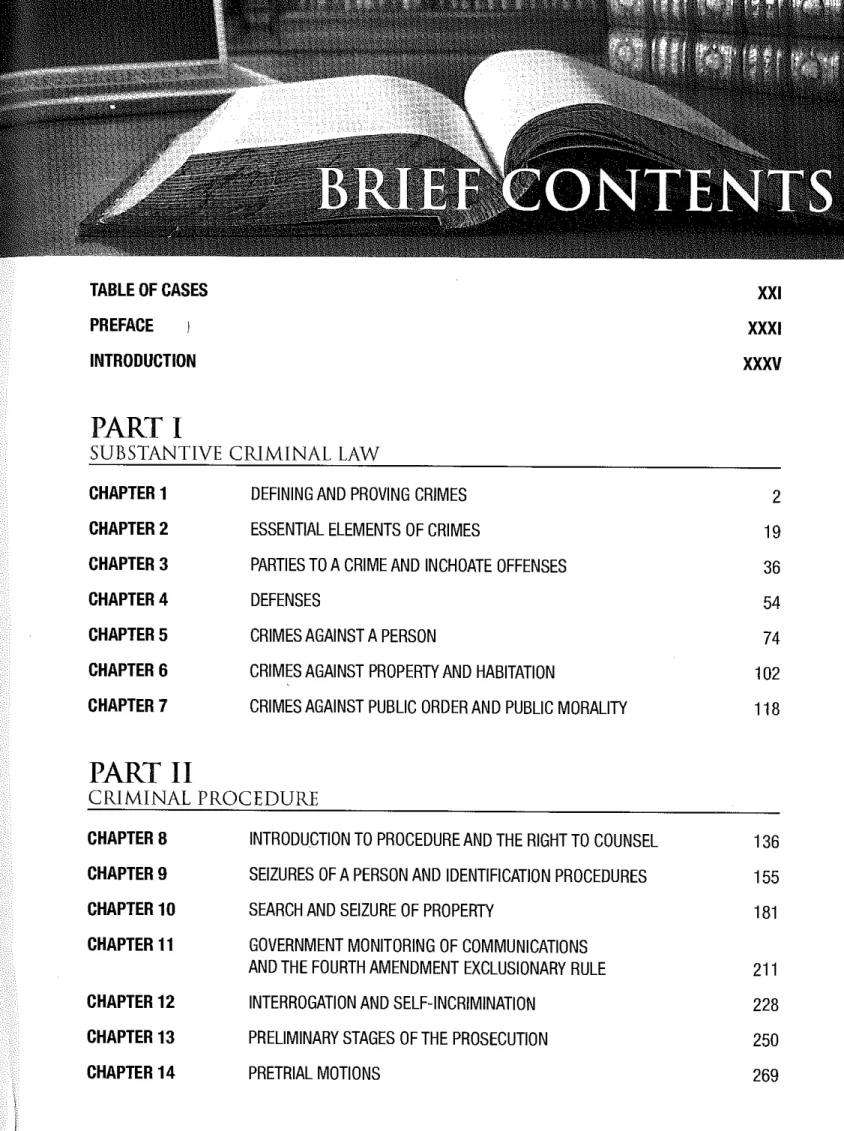
TABLE OF CASES
PREFACE
INTRODUCTION
PART I
SUBSTANTIVE CRIMINAL LAW
CHAPTER 1
DEFINING AND PROVING CRIMES
CHAPTER2
ESSENTIAL ELEMENTS OF CRIMES
CHAPTER 3
PARTIES TO A CRIME AND INCHOATE OFFENSES
CHAPTER4
DEFENSES
CHAPTERS
CRIMES AGAINST A PERSON
CHAPTER 6
CRIMES AGAINST PROPERTY AND HABITATION
CHAPTER 7
CRIMES AGAINST PUBLIC ORDER AND PUBLIC MORALITY
PART II
CRIMINAL PROCEDURE
CHAPTER 8
INTRODUCTION TO PROCEDURE AND THE RIGHT TO COUNSEL
CHAPTER 9
SEIZURES OF A PERSON AND IDENTIFICATION PROCEDURES
CHAPTER 10
SEARCH AND SEIZURE OF PROPERTY
CHAPTER 11
GOVERNMENT MONITORING OF COMMUNICATIONS
AND THE FOURTH AMENDMENT EXCLUSIONARY RULE
CHAPTER 12
INTERROGATION AND SELF-INCRIMINATION
CHAPTER 13
PRELIMINARY STAGES OF THE PROSECUTION
CHAPTER 14
PRETRIAL MOTIONS
XXI
XXXI
xxxv
2
19
36
54
74
102
118
136
155
181
211
228
250
269
BRIEF CONTENTS
CHAPTER 15
CHAPTER 16
APPENDIX A
APPENDIX B
GLOSSARY
INDEX
TRIAL
VERDICT, PUNISHMENT, AND JUDICIAL REVIEW
292
312
339
349
361
371
TABLE OF CASES
PREFACE
1INTRODUCTION
OVERVIEW OF A CRIMINAL CASE
Prearrest Investigation
Arrest
Booking Process
First Appearance before a Judicial Officer
Preliminary Hearing
Grand Jury Indictment/Information
Arraignment and Plea
Pretrial Motions
Trial
Sentencing
Appeal and Habeas Corpus
CRIMINAL JUSTICE PROFESSIONALS
Law Enforcement Agencies
Prosecutorial Agencies
Defense Bar
Courts
Coroners
Magistrates
Court Clerks
Probation Officers
Paralegals
SUMMARY
XXI
XXXI
xxxv
XXXVI
xxxvi
xxxvi
xxxvii
xxxvii
xxxvii
xxxvii
xxxviii
xxxviii
xxxviii
xxxviii
xxxviii
XXXIX
xxxix
xxxix
xxxix
xi
xi
xi
xi
xi
xi
XU
PART
I
SUBSTANTIVE CRIMINAL LAW
1
CHAPTER!
DEFINING AND PROVING CRIMES
2
THE PURPOSES OF CRIMINAL LAW
3
Theories of Punishment
3
THE SOURCES OF CRIMINAL LAW
4
Co,mmon Law
4
Model Penal Code
6
Statutory Law
6
Administrative Regulations
9
Constitutional Limitations
11
PROVING THE CRIME
12
Burden of Proof
12
Burden of Proof on Subordinate Issues
15
Presumptions and Permissible Inferences
15
SUMMARY
16
CHAPTER2
1I
I
ESSENTIAL ELEMENTS OF CRIMES
19
'
A DEFINITION OF CRIME
21
SOCIAL HARM
23
THE PHYSICAL ACT
24
Evil Thought
25
Express Thought
25
Request
26
Agreement
26
Attempt
26
Consummation
27
Summary
27
MENTAL STATE
(MENS
REA)
27
An Example of Assessing
Mens Rea
28
CAUSATION
Factual Cause
Legal Cause
SUMMARY
CHAPTER3
PARTIES TO A CRIME AND INCHOATE OFFENSES
PARTIES TO A CRIME
Perpetrators
Aiders iand Abettors
Accessories before the Fact
Triggermen
Accessories after the Fact
INCHOATE CRIMES
Solicitation
Attempt
Impossible Attempts
Abandoned Attempts
Conspiracy
Liability of Coconspirators
SUMMARY
CHAPTER4
DEFENSES
COMPULSION, NECESSITY, AND DURESS
Necessity
Duress
MISTAKE AS A DEFENSE
Mistake of Fact
Mistake of Law
INTOXICATION
INSANITY
Competency to Stand Trial
Mental Illness at the Time of Punishment
Insanity as a Defense
Guilty But Mentally Ill
Contents
32
32
32
33
36
37
37
38
39
41
42
43
44
44
45
47
47
50
50
54
56
57
58
59
59
59
60
61
61
62
62
64
'
JUSTIFIABLE USE OF FORCE
Self-Defense
Defense of Others
Defense of Property and Habitation
Forcible Arrest and Force Used to Resist Arrest
ENTRAPMENT
SUMMARY
CHAPTERS
CRIMES AGAINST A PERSON
CRIMINAL HOMICIDE
Suicide
Murder
Manslaughter
Other Forms of Homicide
ASSAULT AND BATTERY
Battery
Assault
Stalking
Aggravated Assault and Battery
ROBBERY
VIOLENT SEX CRIMES
Rape
KIDNAPPING AND FALSE IMPRISONMENT
CIVIL RIGHTS AND HATE CRIMES
Civil Rights Statutes
Hate Crimes
SUMMARY
CHAPTER6
CRIMES AGAINST PROPERTY AND HABITATION
THEFT OF PRIVATE PROPERTY
Larceny
Embezzlement
64
65
67
68
68
69
70
74
75
77
78
83
87
87
87
88
89
89
90
92
92
94
96
96
97
97
102
103
103
106
False Pretenses
Receiving Stolen Property
CRIMES AGAINST HABITATION
Burglary
Arson
SUMMARY
CHAPTER?
Contents107
109
111
111
113
115
CRIMES AGAINST PUBLIC ORDERAND PUBLIC MORALITY
118
IDISORDERLY CONDUCT
119
UNLAWFUL ASSEMBLY AND RIOT
121
TERRORISM
123
PUBLIC INTOXICATION
124
Driving Under the Influence
124
DRUG CRIMES
125
NONVIOLENT SEX OFFENSES
127
SUMMARY
130
PART II
CRIMINAL PROCEDURE
CHAPTERS
INTRODUCTION TO PROCEDURE AND THE RIGHT
TO COUNSEL
SOURCES OF PROCEDURAL LAW
THE PURPOSE OF PROCEDURE
The Crime Control Model
The Due Process Model
STAGES OF A CRIMINAL PROSECUTION
Investigatory Stage
Adjudicatory Stage
135
136
137
140
140
141
142
142
142
- f r h
CONTENTSTHE RIGHT TO COUNSEL
The Right to Counsel at Critical Stages
INDIGENTS' RIGHT TO COUNSEL
WAIVER OF COUNSEL AND THE RIGHT
OF SELF-REPRESENTATION
Standby Counsel
WITHDRAWAL OF COUNSEL
EFFECTIVE ASSISTANCE OF COUNSEL
REPRE5ENTATION OF MULTIPLE CLIENTS
ATTORNEY-CLIENT COMMUNICATIONS
Attorney-Client Privilege
CONTRACT TO RETAIN COUNSEL
SUMMARY
CHAPTER9
SEIZURES OF A PERSON AND IDENTIFICATION
PROCEDURES
ARRESTS
Arrest Warrants
Warrantless Arrests ·
Consequences of an Illegal Arrest
TEMPORARY DETENTION
Definition of a Temporary Detention
Grounds for a Detention
Grounds for an Investigation Following the Stop
Scope of the Investigation
IDENTIFICATION PROCEDURES
Lineups and Showups
Due Process and Impermissible Suggestiveness
Right to Counsel at Lineups
Excluding Identification Evidence at Trial
Voice Identification
Scientific Identifications
SUMMARY
142
143
143
146
146
148
148
149
150
150
151
151
155
156
156
159
161
162
163
165
167
168
169
170
171
173
174
175
175
177
CHAPTER10
SEARCH AND SEIZURE OF PROPERTY
REASONABLE SEARCHES AND SEIZURES
Definition of a Search
Probable Cause for a Search
Execution of a Search Warrant
WARRANTLESS SEARCHES
Search Incident to Arrest
Automobile Searches
Searches
Searches under Exigent Circumstances
Administrative Searches
SUMMARY
CHAPTER11
GOVERNMENT MONITORING OF COMMUNICATIONS
AND THE FOURTH AMENDMENT EXCLUSIONARY RULE
GOVERNMENT EAVESDROPPING
Warrantless Eavesdropping
Warrantless Electronic Eavesdropping
Court-Ordered Electronic Eavesdropping
ELECTRONIC VIDEO SURVEILLANCE
THE EXCLUSIONARY RULE
The Purpose of the Exclusionary Rule
Government Participation in Illegal Searches
Standing to Invoke the Exclusionary Rule
Derivative Evidence: "The Fruit of the Poisonous Tree"
Collateral Use of Illegally Seized Evidence
Good Faith Exception to the Exclusionary Rule
Disposition of Seized Property
SUMMARY
CHAPTER12
INTERROGATION AND SELF-INCRIMINATION
CONFESSIONS
Voluntariness of Confessions
The
Miranda
Decision
Contents
181
182
183
187
194
196
196
198
201
204
206
206
211
212
212
213
214
216
216
216
218
219
220
222
223
224
224
228
229
229
231
--
CONTENTSCustody for Purposes of
Miranda
232
Interrogation within the Meaning of
Miranda
233
Waiver of
Miranda
Rights
236
Sixth Amendment Right to Counsel
237
Corroboration of Confessions
239
Suppression of Illegally Obtained Confessions
239
Third-Party Confessions
240
SELF-INCRIMINATION
241
The Privilege against Self-Incrimination
241
Compulsion
241
Incrimination
243
Testimonial Communications
243
Invoking the Fifth Amendment Privilege
244
Waivers and Grants of Immunity
244
Consequences of Asserting the Privilege
245
SUMMARY
246
CHAPTER13
PRELIMINARY STAGES OF THE PROSECUTION
250
PRETRIAL RELEASE AND BAIL
251
Bail Reform
252
Violation of Pretrial Release Conditions
254
PRELIMINARY HEARING
257
Discovery
258
Future Impeachment of Witnesses
258
Preservation of Testimony
258
GRAND JURY REVIEW
258
Selection of the Grand Jury
260
Scope of Grand Jury Investigations
260
Witnesses' Rights before a Grand Jury
261
Grand Jury Secrecy
262
PERFECTING THE CHARGE
262
Identifying the Accused
Describing the Offense Charged
263
Identifying the Place the Offense Was Committed
263
DUPLICITY, JOINDER AND CHARGING IN THE ALTERNATIVE
264
AMENDING THE INDICTMENT
265
BILL OF PARTICULARS
265
SUMMARY
266
CHAPTER14
PRETRIAL MOTIONS
OVERV
1
IEW OF PRETRIAL MOTIONS
DISCOVERY
Scope of Discovery
Constitutional Discovery
Discovery Orders against the Victims or Third Parties
Prosecution's Right to Discovery
Remedies for Violation of Discovery Orders
STATUTES OF LIMITATIONS
SPEEDY TRIAL
DOUBLE JEOPARDY
Legislative Intent
Separate Transactions
Separate Sovereigns ·
Collateral Estoppel
SEVERANCE OF OFFENSES AND/OR PARTIES
Joinder and Severance of Offenses
Joinder and Severance of Defendants
MOTION TO CHANGE VENUE
SUMMARY
CHAPTER15
TRIAL
RIGHT TO A FAIRAND PUBLIC TRIAL
ARRAIGNMENT
269
270
271
271
273
278
278
279
280
280
282
284
284
284
285
285
286
287
287
288
292
293
295
ENTRY OF THE PLEA AND PLEA AGREEMENTS
Plea Bargaining
JURY TRIAL
JURY SELECTION
Vair Dire
Peremptory Challenges
PRESENTATION OF EVIDENCE
Opening Statements
Venue and Jurisdiction
Witnesses
Real and Scientific Evidence
Objections and Offers of Proof
DEFENDANT'S CHARACTER
Character Evidence
Evidence of Other Crimes
MOTION FOR MISTRIAL
MOTION FORACQVITTAL
SUMMARY
CHAPTER16
VERDICT, PUNISHMENT, AND JUDICIAL REVIEW
VERDICT AND PUNISHMENT
Closing Arguments and Summations
Instructions to the Jury
Verdicts, Polling the Jury, and Impeaching the Verdict
Sentencing
Probation or Suspension of Sentence
Resentencing
Sentencing for Contempt of Court
JUDICIAL REVIEW
Trial de Novo
Motions to Set Aside the Verdict
Preserving an Issue for Appeal
The Right to Appeal
296
297
299
300
300
302
302
302
302
303
304
305
305
305
306
307
307
308
312
313
313
314
316
317
320
322
322
323
325
325
326
328
Contents
Fiif
-Prosecution Appeals
329
Habeas Corpus
329
Claims of Innocence
333
Nonjudicial Review of Convictions
333
SUMMARY
APPENDIX A
APPENDIX B
GLOSSARY
I
INDEX
334
339
349
361
371
T
HE GOAL OF THIS BOOK is to provide an introduction to both the practice and the theory of criminal law. Thus, it may be used in a number of diverse educationalprograms ruch as undergraduate criminal law classes, associate-degree criminal justice programs, or paralegal courses. Depending on the needs of the students, sections of the book addressing either theory or practice can be emphasized, ignored, or given cursory- coverage. For example, in a course emphasizing theoretical aspects of the criminal justice system, the
contractual relationship between counsel and client (Chapter 8) can be deleted in favor of focusing on the coverage of the fundamental conflict between individual privacy and the
government's use of electronic surveillance (Chapter 11 }. In contrast, a course stressing the pragmatic aspects of criminal practice might cover the contractual nature of the attorney-client relationship, while omitting coverage of electronic surveillance, which is used in only a small number of actual cases. The first half of the book covers substantive criminal law, while the second half discusses both the constitutional dimensions of criminal procedure and practical aspects of the criminal justice process.
Because this text covers both substantive criminal law and criminal procedure, it is suitable for a single course designed to provide an overview of the entire criminal justice system, or it can be used in separate courses focusing on either substantive or procedural law. If this book is used in separate courses covering substantive and procedural law, the text can be augmented with materials or lecture references to the laws of a specific jurisdiction. Chapters 1 through 7 define criminal responsibility and address the major felonies recognized in most if not all jurisdictions. Although these chapters provide a textual foundation for a course on substantive criminal law, they can be tailored to a particular jurisdiction by supplementing the text with statutory and case law from a specific locality. For example, Chapter 6 acquaints students with the elements of common law burglary, but students preparing for careers as paralegals will need to become familiar with specific forms of statutory burglary in their own states.
In a course limited to the procedural aspects of criminal law, Chapters 8 through 16 con-tain enough material to support a semester-long course. Because a great deal of criminal procedure is of constitutional dimension, these chapters have universal application. There remains, however, ample opportunity to supplement constitutional procedure with the rules of a particular locality. For example, Chapter 14 notes that each jurisdiction has rules gov-erning the timing and content of motions for pretrial discovery.
Whatever the nature of the course in which this book is used, the text material consti-tutes a narrative account of the law. Abundant case summaries are interwoven with the text to bring the "real world" into the classroom. The use of these case excerpts can be varied to suit individual tastes. The cases enhance the textual discussion of law, but for the most part, any case may be eliminated without depriving the student of exposure to the relevant law.
PREFACE
NEW TO THE FOURTH EDITION
• New Leaming Objectives focus readers' attention on key concepts within each
chapter and reinforce the most important concepts and law practices to direct students' review and study.
• New Practice Exercises and Discussion Questions help readers apply concepts in a
hands-on environment and encourage critical thinking about key legal issues. Two new Essay Assignments in every chapter provide opportunities to frame detailed arguments and demonstrate comprehension.
• New Sidebar features add current perspective on key legal concepts by highlighting
and clarifying significant chapter topics.
• Fresh emphasis on Case excerpts helps readers fully understand legal changes and
rulings. The authors have thoroughly updated the text with new excerpts and expla-nations to ensure students gain a full understanding of criminal law practices today.
• Updated Exhibits clarify key points. Recognized for a clear, reader-focused
presenta-tion, this edition continues to clarify even the most difficult legal concepts and rul-ings with useful illustrations, sample forms, and meaningful exhibits.
• Updated Companion Websites for instructors and students provide instructional
re-sources and the latest rulings. These companion websites are more helpful than ever with an online instructor's manual, Powerpoint® slides, computerized test bank, study resources and Web links, and more. You'll also find the latest relevant Supreme Court decisions to keep your course as current as possible.
CHAPTER FORMAT
• Chapter outlines open each chapter to focus attention on the main elements students
will encounter.
• Learning Objectives identify key concepts for each chapter and reinforce important
law practices.
• Key terms are set in boldface type and defined in the margin where they first appear
within the chapter.
• Exhibits, such as jury instructions, sample documents, and forms, illustrate how
theories discussed in the chapter appear in the "real world."
• Case excerpts help readers apply legal concepts to real-world situations.
• Sidebars highlighting and clarifying significant chapter topics add current
perspec-tive on key legal concepts.
• A chapter summary provides a brief review of the main points covered.
• Concept summary charts at the end of many chapters depict and contrast the key
points covered.
• Discussion questions and practice exercises are designed to stimulate deliberation
and practical application of the chapter material.
• Essay assignments provide opportunities to frame detailed arguments and
demon-strate comprehension.
• At the end of each chapter is a list of helpful websites that are germane to chapter
SUPPORT MATERIAL
This book is accompanied by a support package that will assist students in learning and aid instructors in teaching. The following supplements accompany this text:
• An instructor's manual and test bank is available online and includes suggestions on classroom coverage, descriptions of hypothetical situations to stimulate class-room discussion, suggested "answers" or approaches to the discussion questions, and a brief summary of the facts and holding of each case cited within the chapter. A comprehensive test bank provides objective test questions and answers. To access this resource, please visit www.cenagagebrain.com, and search on this book's ISBN {located on the back cover and the copyright page).
• A student companion website contains chapter outlines, Web links, exhibit down-loads, and quizzes to help you study. To access this resource, please visit www
.cengagebfain.com, and search on this book's ISBN (located on the back cover and the copyright page).
ACKNOWLEDGMENTS
The authors extend their appreciation to the reviewers of the text for their ideas and suggestions on how to improve the text.
Mary Atwell
Radford University, Virginia Donna Bennett
Trinity Valley Community College, Texas Tara L. Glasford
Dakota State University, South Dakota Mercedes Prieto Alonso-Knapp Florida International University Todd Richardson
Daytona State College, Florida Scott Silvis
Griffin Technical College, Florida
Special thanks go to Lindsey Vann for her research and editorial assistance while working on the manuscript, to JeffEinhaus, and to the editors at Cengage Learning, including: Shelley Esposito, Senior Product Manager; Melissa Riveglia, Senior Content Developer; and Diane Chrysler, Product Assistant. Also, I would like to thank Lindsey Vann and Jeff Einhaus, my research assistants, for their able assistance.
OUTLINE
OVERVIEW OF A CRIMINAL CASE
Prearrest Investigation
Arrest
Booking Process
First Appearance before a Judicial Officer
Preliminary Hearing
Grand Jury Indictment/Information
Arraignment and Plea
Pretrial Motions
Trial
Sentencing
Appeal and Habeas Corpus
CRIMINAL JUSTICE PROFESSIONALS
Law Enforcement Agencies
Prosecutorial Agencies
Defense Bar
Courts
Coroners
Magistrates
Court Clerks
Probation Officers
Paralegals
SUMMARY
INTRODUCTION
,,
I
i.
Criminal law is an intricate and fascinating subject. The American Bar Association maintains that criminal law is the proper concern of all lawyers, and it also is of primary concern to the general public. Any skeptics may view a typical night of television programs and compare the number of "cop" shows with the number of shows that focus on contract law or property law. People have an understandable curiosity and fascination with a branch of law that deals with thieves, rapists, robbers, and murderers-the seamy side of life. At the other end of the spectrum, however, criminal law, primarily constitutional procedure, addresses our highest aspirations: the right to privacy, liberty, freedom, and the need to limit government power over "we the people." Prosecutors often see themselves as protecting the community from dangerous lawbreakers, while defense counsel frequently characterize themselves as "Lib-erty's Last Champion," the motto of the National Association of Criminal Defense Lawyers.
These diametrically opposed views of criminal law have produced a criminal justice system that is like no other in the world. The United States leads the Western world in the number of persons incarcerated and condemned to death. At the same time, this country outstrips all nations in the constitutional and procedural protections given to those accused of crime. Similar paradoxes are manifested in the substantive law that defines criminal conduct. For example, the U.S. Supreme Court has elevated freedom of speech to unprecedented heights and guards against legislative attempts to criminalize the exercise of free speech (e.g., burn-ing the American flag). The same court, however, has deferred to state legislatures that promulgate what some perceive to be puritanical laws against private sexual conduct (e.g., premarital or same-gender sex). You may judge for yourself whether these contradictions are part of the strength or weakness of the American criminal justice system. ·
The first part of this book addresses substantive criminal law, which declares what conduct is criminal. Chapters 1 through 4 discuss general principles of criminality that apply to most if not all crimes. Chapters 5, 6, and 7 address the definition of specific offenses like murder or larceny. The second part of the book (Chapters 8 through 16) addresses the procedures through which the substantive law is enforced. However, considering the complexity of criminal procedure, an overview of the criminal justice process and the steps that carry an individual case from start to finish is a helpful place to start.
OVERVIEW OF
A CRIMINAL CASE
The procedural stages in a criminal case are not the same in all states. This overview presents a "typical felony case" in a "typical" jurisdiction.
Prearrest Investigation
When an alleged crime is reported or discovered, the police must investigate to determine whether a crime was committed, and if so, by whom. The principal participants in this "cops and robbers" stage are the police and those whom they suspect of criminal activity. The courts, prosecutors, and defense counsel normally address the investigatory process in retrospect when determining whether the police acted in accordance with constitutional or statutory provisions governing police investigative practices. Chapters 9, 10, and 11 address the most frequently litigated prearrest investigative procedures: temporary detentions, search and seizure, and electronic surveillance.
Arrest
An arrest generally occurs when the police investigation uncovers facts sufficient to consti-tute probable cause to arrest-in other words, a reasonable belief that the suspect committed a crime. Although a judicial officer, normally a magistrate, may determine the adequacy of the facts constituting probable cause and issue an arrest warrant, most arrests are made by police officers acting without a judicially issued warrant
An arrest, of course, does not mean the end of police investigation of the crime. Incident to arrest, the police officer usually will search the suspect's person and remove any weapons, contraband, or evidence relating to the crime. Following arrest, police investigation may continue in the form of interrogating the suspect, conducting further searches for additional evidence, or placing the suspect in a lineup or other identification procedure.
Booking Process
In a typical arrest, the arrestee is transported to the police station and subjected to what is known as a booking process. The process, which is primarily clerical, consists of (1) complet-ing the arrest report and preparcomplet-ing the arrestee's permanent police record, (2) fcomplet-ingerprintcomplet-ing and photographing the arrestee, and (3) entering on the police "blotter" the name of the ar-restee, the personal effects found in that person's possession, and the date, time, and place of arrest.
I
First Appearance before a Judicial Officer
A person held in police custody has a right to a judicial hearing on the grounds for detaining the person. If the suspect was arrested without an arrest warrant, a judicial officer {perhaps a lower court judge, often a magistrate) must determine whether the police had probable cause to arrest the accused. If probable cause is lacking, the suspect must be released from custody. If the arrest was lawful, the judicial officer must determine whether to hold the arrestee in pretrial custody or to set bail-in which case the accused will be released pending trial. Bail may consist of posting cash or a secured bond with the court, or the accused may be released into the custody of another or released on "personal recognizance," which is an unsecured promise to appear for trial.
Preliminary Hearing
Many jurisdictions have eliminated the preliminary hearing stage and allow the prosecutor to go forward with the case by filing an "information" stating the charges, or by taking the case directly to a grand jury, which may indict the accused for specific crimes. A preliminary hearing is a judicial proceeding to determine whether there are reasonable grounds to require the accused to stand trial. The prime distinction between a preliminary hearing and a first appearance is that the preliminary hearing is an adversary proceeding in which the accused is
allowed to introduce evidence, whereas a first appearance is normally an ex parte proceeding
in which the judge or magistrate hears only the evidence that constituted probable cause to arrest the accused.
If the preliminary hearing judge determines that reasonable grounds to try the accused have not been shown, the accused must be released from custody. This release, however, is not an acquittal; a grand jury may subsequently indict the accused for the crime and force the accused to stand trial on the indictment.
Grand Jury Indictment/Information
Many jurisdictions require that all felony charges be submitted to a grand jury composed of citizens selected to review the evidence and determine whether the evidence is sufficient to justify a trial on the charge sought by the prosecuHon. A grand jury has significant power to investigate crime, primarily by subpoenaing witnesses and documentary evidence relevant to the charge. Generally, only the prosecution's evidence is presented to the grand jury; the accused is not heard, nor is defense counsel permitted to be present or offer any
evidence.
Some jurisdictions have eliminated grand juries or permit, at least in some cases, pros-ecutors to bypass existing grand juries and present the charged crimes in the fonn of an information. An information is a written accusation of a crime, unilateraily prepared by the prosecutor.
' I
INTRODUCTION 111
1
11 L = = = = = = = = '
-@:lt
i·
Arraignment ancl Plea
ii
ii : :Arraignment consists of bringing the accused before the court, informing that person of the charges, and asking the accused to enter a plea to the charges. In some jurisdictions, arraign-ment may take place weeks in advance of the actual trial, while other jurisdictions postpone arraignment until the trial is scheduled to begin.
In most jurisdictions, the accused may enter a plea of guilty, not guilty, or nolo contcndere.
A plea of nolo contenderc has the same effect as a plea of guilty, except that the admission of guilt cannot be used as evidence in any other action. For example, former Vice President Spiro Agnew plcd nolo contendere to bribery charges, but the plea was not admissible in subsequent civil litigation concerning whether taxes were due on the unreported bribes.
In the majority of cases, the defendant's guilt and the applicable range of sentences are determined by a plea agreement struck between the prosecutor and defense counsel. In most plea agreements, the defendant agrees to plead guilty to a charge in exchange for the pros-ecutor's promise to drop other charges or to recommend a reduced sentence.
Pretrial Motions
Pretrial motions are requests that the trial court take some action, such as dismissing a de-fective indictment, ruling on the admissibility of illegally obtained evidence, or ordering the parties to disclose certain information. ln essence, these matters can or must be disposed of prior to the trial on the merits of the case. All jurisdictions have rules governing the time period within which pretrial motions must be filed with the trial court.
Trial
The American criminal justice systen1 is an adversarial process that assigns each participant
in the trial a defined role. The judge is not an advocate for either side, but is concerned with
enforcing procedural rules. The prosecutor's primary task is to marshal the evidence against the defendant. The defendant has no obligation to present any evidence or play any part in the trial, because a defendant may rely on the presumption of innocence and remain pas-sive during the trial. The defense attorney is an advocate for the accused, with the primary responsibility of winning the case without violating the law. The jury {or the judge alone in a bench trial) hears the evidence from both sides and must decide whether the defendant committed the charged offense.
Sentencing
Some states permit the jury to set the punishment, but most jurisdictions entrust sentencing to the trial judge. By statute, certain convictions require a mandatory sentence, in which case the judge has no discretion. In most cases, the judge exercises some discretion and may impose any sentence within statutory limitations, or the judge may determine the
appropri-ate sentence according to sentencing guidelines enacted by the legislature. AB part of the
sentencing detennination, the judge also may be empowered to suspend a portion of the sentence and place the defendant on probation. Parole and time off for "good behavior" are awarded by correctional authorities and are not part of the initial sentencing process.
Appeal ancl Habeas Corpus
A convicted defendant may appeal a conviction to an appellate court, which will review the trial proceedings and either reverse or affirm the trial court decision. lf the conviction is "re-versed and remanded," then the defendant's conviction is set aside, although the defendant may be required to stand trial again. A second trial may be precluded, however, if the appel-late court reverses the conviction because of insufficient evidence to justify the conviction.
The excerpts of cases in this book are the written opinions of appellate courts,
joined by a majority of the judges, this opinion constitutes the judgment of the court. Judges who agree with the decision but wish to address other considerations may write separate concurring opinions. Judges who disagree with the court's decision may write dissenting opinions.
If the attempt to obtain a reversal of the conviction on appeal fails, the defendant may file a collateral attack on the conviction, the most common form of collateral attack being a habeas corpus petition. A habeas corpus petition is a collateral attack because it is not a continuation of the criminal process, but a civil suit brought to challenge the legality of the restraint under which a person is held. (Habeas corpus is a Latin term meaning "you have the body.") Because the action is a civil suit, the petitioner (the confined person) has the burden to prove that the confinement is illegal.
CRIMINAL JUSTICE
PROFESSIONALS
Like any organization, the operation of our criminal justice system is dependent on the people who administer the system. Because of the popularity of movies and television shows about criminal justice, most people are familiar with the roles played by police officers, pros-ecutors, defense attorneys, and judges. Less publicized, but no less important, is the vital role played by coroners, magistrates, court clerks, probation officers, and paralegals.
law Enforcement Agencies
Law enforcement agencies are charged with enforcing criminal laws that range from traffic offenses to serious felonies. At the national level, the Federal Bureau of Investigation (FBI) is the largest agency empowered to deal with violations of federal criminal laws. In addi-tion to the FBI, other federal agencies investigate specific types of violaaddi-tions of federal law: for example, the Drug Enforcement Administration; the Bureau of Alcohol, Tobacco, and Firearms; the Customs Service; the Secret Service; and the Immigration and Naturalization Service.
At the state level, the state police are charged with prevention and investigation of all crimes covered by state law. At the local level, police departments or sheriffs offices exercise broad powers as the chief law enforcement officers of their communities. Their responsibili-ties include enforcing state law as well as local ordinances.
Prosecutorial Agencies
Prosecutorial agencies review the information gathered by law enforcement agencies and decide whether to proceed with formal charges. At the national level, the U.S. Department of Justice and U.S. Attorney's offices, distributed geographically throughout the country, initi-ate a prosecution for a federal offense. At the stiniti-ate level, the stiniti-ate attorney general's office may initiate certain prosecutions, but such offices normally limit their function to handling appeals of convictions. Most state prosecutions are initiated by district attorneys geographi-cally distributed throughout the state.
Defense Bar
Criminal defendants may hire attorneys to represent them in all criminal prosecutions, no matter how minor the offense. Indigents, who cannot afford to hire counsel, may have de-fense counsel appointed at public expense whenever the indigent faces possible imprison-ment. Many states have established a public defender's office to represent indigents. As a supplement to, or in place of, a public defender's office, many states utilize a court-appointed list of attorneys who have volunteered or been recruited to represent indigents.
!
,,,,',•,,'
Courts
In the federal system, the principal trial court is the U.S. District Court, which presides over the prosecution of serious federal crimes. Trials of federal misdemeanors are often handled
[_ by federal magistrates, who are appointed by federal district judges. The U.S. Circuit Courts of Appeal hear appeals from convictions in the District Court. Thirteen judicial circuits cover the United States and its possessions. The U.S. Supreme Court reviews the decisions of the lower federal courts and many decisions of the state courts.
The structure of state court systems varies considerably, but every state has one or more levels
of trial courts and at least one appellate court. A common arrangement of a state court system includes a lower court-often called police court, magistrate court, or a court not of record-wbich tries minor or petty offenses; a higher trial court, often called a court of record, which tries more serious offenses; and an appellate court, which reviews the decisions of the lower courts.
Coroners
A coroner's inquest is peculiar to homicide cases, and its function is to determine the cause of death. Although this determination is merely advisory and can be either accepted or ignored by the prosecutor, the inquest may uncover evidence useful to both the prosecution and the defense. Many jurisdictions have replaced the coroner system (which sometimes required a finding by the coroner's jury made up of six laypersons) with a medical examiner system staffed by forensic pathologists,
Magistrates
In some jurisdictions, magistrates are judges who preside over lower courts (often called magistrate or police court) in which traffic violations and minor misdemeanors are tried. In other jurisdictions, magistrates have no trial jurisdiction. As their primary function, they determine whether there is probable cause to issue search or arrest warrants. They also deter-mine the conditions of any pretrial release of an arrested suspect.
Court Clerks
Court clerks, who may be elected or appointed in a given jurisdiction, handle the vast amount of paperwork involved in bringing a case to trial. For example, the clerk's office may be tesponsible for issuing subpoenas for witnesses or documents; filing the formal charge upon which the accused will stand trial; summoning the jurors and administering requests to be excused from jury duty; scheduling the court's docket and use of multiple courtrooms; and receiving pretrial motions requesting the court to take some form of action.
Probation Officers
Convicted defendants are sometimes granted a suspended sentence and may avoid incarcera-tion as long as they demonstrate good behavior and comply with the terms of the court's granting of probation. Probation officers supervise the conduct of the individual on proba-tion by monitoring whether the individual is gainfully employed, has made restituproba-tion to any victim of the crime, and is avoiding further breaches of the law. Prior to conviction, proba-tion officers may be ordered to investigate the background of the defendant and prepare a presentence report recommending an appropriate sentence.
Paralegals
Like court clerks, paralegals may be responsible for organizing the vast amount of paperwork often generated by a criminal case: for example, obtaining and filing police reports, coroner's finding, transcripts of a preliminary hearing, grand jury indictments, and requests for and responses to pretrial discovery motions. What may be unique to criminal justice paralegals is their involvement in the factual investigation and legal research surrounding the case.
As part of their tasks related to factual investigation, paralegals may be asked to interview victims, witnesses, and police officers; draft preliminary charges when assisting a prosecu-tor; draft motions to dismiss the complaint when assisting defense counsel; draft subpoenas and locate witnesses; and prepare trial notebooks that organize the presentation of evidence, particularly any documents or exhibits to be used at trial.
Criminal justice paralegals are also responsible for many legal tasks requiring them to re-search the substantive law governing the charged offense, draft pretrial motions or responses to such motions, draft legal memoranda and briefs on contested points of law, prepare pre-sentence reports or responses to such reports, and draft post-trial motions.
SUMMARY
Although the sptcific tasks of criminal justice professionals vary, a fundamental knowledge of the substantiVe criminal law and the essence of criminal procedure is crucial to the perfor-mance of a criminal justice professional. In simplified form, the foundation for this special-ized knowledge of the criminal justice system is the subject matter of this book.