9
Interacting with Virtual Reconstructions in Museums:
The Etruscanning Project
EVA PIETRONI and ANDREA ADAMI, CNR-ITABC, Italy
Starting from our experience in this domain, we discuss some fundamental concepts about the potentialities of the virtual re-constructions of cultural sites inside museums, with a specific focus on the communication needs, the design, the combination of media, the interaction interfaces, and the embodiment. We conceive a virtual reconstruction as a digital ecosystem, whose main peculiarities are (1) 3D reconstruction, (2) inclusivity, and (3) interactivity. A virtual reconstruction, in a wide sense, should integrate different levels of visualization, both realistic and symbolic; 3D models; metadata; storytelling; behaviors; and tools of visualization and interaction, in order to “reconstruct” and communicate a cultural context, an ecosystem where all the informa-tion is integrated. Despite the great advancements of the last years in the digitizainforma-tion process, computer graphics techniques, and archiving strategies, a basic limit of most of virtual museums is that they do not fire up the attention and the involvement of the public: they lack stimulating activities for visitors, narratives metaphors, and emotional impact. The interaction interfaces are not always simple to understand and to control in a few minutes, and they can generate a sense of frustration that causes users to abandon the application after a short and superficial approach. No gap should exist between knowledge and commu-nication. But how can we translate the complexity of the knowledge in appealing to users and into simple applications that fit with the public’s need? This article focuses on some communication rules and criteria that are often considered of minor impor-tance by the researchers working in the field of digital cultural heritage but that are really essential to cultural transmission, especially inside museums. We believe that a stronger collaboration between research institutions and museums and among different disciplines would be recommended. Given this premise, we present the Etruscanning EU project, developed in 2011– 2013, focused on the virtual reconstruction of two important Etruscan tombs of the Orientalizing period: the Regolini-Galassi tomb in Cerveteri and the tomb n.5 of Monte Michele in Veii.
Categories and Subject Descriptors: [Applied Computing]: Physical Sciences and Engineering, Archaeology; [ Human-Centered Computing]: Human Computer Interaction (HCI): Interaction Paradigms, Virtual Reality; [Human-Centered Computing]: Human Computer Interaction (HCI): Interaction Techniques, Gestural Input
General Terms: Interaction
Additional Key Words and Phrases: 3D reconstruction, natural interaction, user interface, communication, virtual museums ACM Reference Format:
Eva Pietroni and Andrea Adami. 2014. Interacting with virtual reconstructions in museums: The etruscanning project. ACM J. Comput. Cult. Herit. 7, 2, Article 9 (May 2014), 29 pages.
DOI: http://dx.doi.org/10.1145/2611375
Etruscanning 3D is a two-year project founded by the European Commission within the Culture 2007 framework (G.A. n. 2011 – 1786/001-001).
The project saw the cooperation between the Allard Pierson Museum of Amsterdam, the National Museum for Antiquities of Leiden (NL), the Gallo - Roman Museum of Tongeren (BE), Visual Dimension (BE) and the CNR ITABC of Rome, the Vatican Museums, the Soprintendenza ai Beni Archeologici dell’Etruria Meridionale, the Agro Veientano Museum, and E.V.O.CA.srl. Authors’ addresses: Eva Pietroni and Andrea Adami, Virtual Heritage Group of CNR-ITABC, Via Salaria km 29,3,00015, Monterotondo, Rome, Italy; emails: [email protected]; [email protected].
Permission to make digital or hard copies of part or all of this work for personal or classroom use is granted without fee provided that copies are not made or distributed for profit or commercial advantage and that copies show this notice on the first page or initial screen of a display along with the full citation. Copyrights for components of this work owned by others than ACM must be honored. Abstracting with credit is permitted. To copy otherwise, to republish, to post on servers, to redistribute to lists, or to use any component of this work in other works requires prior specific permission and/or a fee. Permissions may be requested from Publications Dept., ACM, Inc., 2 Penn Plaza, Suite 701, New York, NY 10121-0701 USA, fax+1 (212) 869-0481, or [email protected].
c
2014 ACM 1556-4673/2014/05-ART9 $15.00 DOI: http://dx.doi.org/10.1145/2611375
1. VIRTUAL RECONSTRUCTION AS A DIGITAL ECOSYSTEM
The reconstruction of a cultural site is characterized by intense activity of topographical, archaeolog-ical, and architectonic surveys with the goal of acquiring data at many different levels of detail, and elaborating them in order to integrate all the spatial information in a multidimensional and multidis-ciplinary virtual reality system [Forte 2008].
Three-dimensional perception and action are essential in the cognitive process based on experience, because the possibility to explore and perceive the space and the information from different points of view enhances our sense of presence and learning. The third dimension creates a difference between who is interacting and the environment, and we learn through the perception and interpretation of these differences [Bateson 1972]: we try, we act in the surrounding environment while observing the results of our behaviors, and we try again till we understand and obtain what we are looking for. To receive and elaborate on information means to acquire new differences, to establish and modify relations in the space-time. This is a fundamental rule both in the real and in the virtual world.
It is very important to preserve the link between the fieldwork and relief activities and VR environ-ments for communication, and a steady protocol is needed to manage data without losing information during the successive phases of elaboration and communication.
Although visualization and exploration of the 3D space are necessary first steps toward knowledge, they are not sufficient to understand, learn, and experience cultural contents. We should not be lim-ited to the formal aspects of the cultural heritage and to the analytic organization of the knowledge, following criteria oriented to classification and taxonomy. A 3D reconstruction has to be considered as an “interface” whose final aim is to multiply the communicative potentialities of the cultural heritage, reactivating its relations in the space and time and its connections of meanings [Forte et al. 2002; Pietroni et al. 2006]. Virtual reconstructions, in fact, can illuminate what is illegible, contextualize what is fragmented or isolated, and put back together cultural ties essential to the cultural identity of the object [Antinucci 2004, 2007].
We also believe that a cultural context has to be considered as the result of all the transformations and evolutions through time, determined by the natural, human, and social activities from the past to nowadays. The interpretation of this continuity (observed, interpreted, reconstructed landscape/site) can help us to make hypotheses, interpret relations, and understand cultural contents (bottom-up and top-down approaches) [Forte 2008].
Scientific, geographical, anthropological, and historical aspects are fundamental elements of the history of a cultural site; they belong to its memory and they need to be transmitted. The more the information enhances difference and connectivity, the more the symbolic associations grow up and the more the possibility for visitors to assimilate and elaborate cultural contents.
Definitively, we conceive a virtual reconstruction as a digital ecosystem, whose main peculiarities are:
(1) 3D reconstruction of a cultural context;
(2) inclusivity: all the data are integrated in the scenario and are in 3D; the user is part of this context and he or she is surrounded by the information;
(3) interactivity, which is, basically, the possibility to build a personalized approach to knowledge, acting in the digital world and choosing contents and paths.
This ecosystem needs to be well organized but also communicated in the simplest way for the public. No gap should exist between knowledge and communication; there is no context without commu-nication and there is no commucommu-nication without a context [Bateson 1979]. So, how can we translate
Interacting with Virtual Reconstructions in Museums: The Etruscanning Project • 9:3
the complexity of the knowledge in appealing to users and into simple applications that fit with the public’s need?
This is not obvious at all and requires constant research and a long experience. Despite the great improvement of the discipline, most parts of the digital applications presented inside museums for communication purposes are still lacking in terms of real impact [Annunziato et al. 2008]. They still appear like “experiments” born inside laboratories, and the target is not always so clear. As the learn-ing faculties are deeply influenced by emotional engagement, we have to consider not only the scientific aspects but also other values, more connected to the artistic impact and the interaction design.
In the last years the Virtual Heritage Group at CNR ITABC has oriented the efforts toward the creation of emotional, multisensorial scenarios, inside which visitors can feel immersed and involved and acquire cultural contents in a pleasant and nonfrustrating way. Many factors contribute to create such a condition, such as narrative plots and nonlinear interactive storytelling, interaction design, interface design, gaming rules, user profiling methods, and immersivity level (soundscapes, stereo visualization, etc.). In the case studies developed and in the user analyses carried out, we have found how important it is to achieve a good compromise between freedom of exploration, ease of use of the interfaces, and possibility to guide the public during the learning process, giving progressive objectives and stimuli in order to not disorient them in such a complex world. In this perspective, cognitive sciences and arts are as fundamental as the other, more consolidated disciplines; definitively, a stronger collaboration between science, art, and technology and museums and researchers is recommended [Pietroni 2013].
2. VIRTUAL RECONSTRUCTIONS: MEDIA, STORYTELLING, EMOTIONAL IMPACT
The creation of a virtual ecosystem for museums is a complex work and requires a specific alphabet and languages. All the media allowing us to learn through a direct and sensorial experience have to be employed—visual, audio, animations, and so on—integrated in the 3D space and accessible interac-tively by the users. The more the combinations of elements and contents change in an unpredictable way, the more we feel incited to continue the interaction. In other words, we acquire and exchange information within the virtual environment and become able to create new mental maps.
The aim of storytelling is to make cultural content more attractive for the public and, consequently, the learning process easier. What storytelling is in the digital cultural heritage (CH) domain is not always very clear, as many scripts and sceneries are wrongly defined as “storytelling” without being storytelling in effect [Aylett et al. 2010]. For instance, an archaeological text referred in first person cannot be considered storytelling. A typical element in storytelling is the creation of a story/fiction (real or invented but reliable), living in a wider cultural and scientifically based context. Cinema and games have developed a professional approach to storytelling in terms of format, screenplay, scripts and di-alogues, languages, soundscapes, photography, and technical means. Their fundamental components are script/story, visualization, soundscape, and, in the case of games, interaction.
In the field of CH and virtual museums, the state of the art of storytelling is still very primitive. There are good examples, but they are isolated cases. Perhaps there is still a common, bad assumption that CH is self-explaining and a purely aesthetic experience is sufficient. We often attend movies or interactive applications with high-quality graphic contents but that are boring and scant from the point of view of narration. Stories are still weak (probably because of the lack of writers and set designers supporting historians and archaeologists), music and sounds are often considered of mi-nor importance, and camera movements and direction are not pondered and follow quite a naive ap-proach not connected to cinematographic rules. At the beginning of the digital heritage era, the great challenge was, most likely, to be able to simulate reality, creating more and more precise and accu-rate digitizations and digital replicas of monuments, sites, and artifacts and following an educational
purpose. On the contrary, cinema, at its beginning, developed a symbolic aesthetics and later on the ability to create marvellous realistic stories, involving people from a perceptive and emotional point of view. Cinema did/does not aim at educational purposes; on the contrary, its purpose has always been to let people dream or feel involved in a fiction; in this purpose it has experienced a long evolution.
Definitively, in the field of virtual museums, we still have three challenges to pursue: (1) creation of good interactive storytelling formats, based on scientific contents; (2) combination of good storytelling with users’ profiling rules, in order to provide different contents to different targets; and (3) definition of new interaction paradigms to let the public enjoy digital contents without any frustration.
In the examples that will be discussed in the next sections, we propose new interaction paradigms and an innovative approach to storytelling but not new solutions for users’ profiling. We shall exper-iment with user profiling methods in projects in the next future, in order to let users evolve their experience through contents able to fit dynamically according to their interests, abilities, and levels of attention. An interesting approach in this domain is represented by BRAVO: BRAin Virtual Opera-tor (http://www.vhlab.itabc.cnr.it/archeovirtual/2012/bravo.htm), a user-centered and portable solution that applies brain–computer interfaces to e-learning. Another approach is proposed by the CHESS project: “Cultural Heritage Experiences through Socio-personal interactions and Storytelling,” where personalization of contents is applied to digital applications in the Acropolis Museum of Athens [Ioan-nidis, Roussou]. Both examples present possible solutions to better understand the user and how to better tell the story depending on the user profile.
3. GESTURE-BASED INTERACTION IN VR ENVIRONMENTS: A NEW FRONTIER
One of the critical aspects is that visitors of museums still have problems managing common input devices for interacting inside the 3D space and with cultural objects: the mouse, joystick, keyboard, and console are not natural interfaces; time is required to become familiar with them. This condition can produce uneasiness and effort in establishing a contact between us, the digital environment, and the technologies. Traditional input devices, which have been based on the WIMP paradigm (Windows, Icons, Menus, and Pointing devices) for 35 years [Karam et al. 2005; Sutherland 1964], are not ready to go along with the normal processes of human interaction, and improvements of this aspect are quite hard and expensive.
Traditionally, gesture-based interaction has mainly been of interest in the virtual reality research community [Sutherland 1964; Bowman et al. 2004; Wigdor 2011]. However, in the last couple of years, we have seen an “evolutionary leap” in technology enabling gesture-based interaction in personal com-puters, smartphones, tablets, gaming consoles, and so forth. The Xbox Kinect and LEAP Motion Con-troller are two famous examples. A good definition of what a gesture means in the area of human– computer interaction comes from Turk [2002]: “. . .expressive, meaningful body motions—i.e. physical movements of the fingers, hands, arms, head, face or body with the intent to convey information or interact with the environment.”
Two paradigms in gesture-based interaction exist: (1) gestures in touch-based user interfaces and (2) midair gestures. Our dissertation refers to this second paradigm.
Midair gesture-based interaction constitutes a new paradigm in human–machine interaction as it allows the users to give input within digital environments just by using their body movements.
This means that the public has the possibility to explore the 3D space without any of the traditional devices like a mouse, joystick, keyboard, console, and so forth, in the simplest and most natural way. This is possible thanks to a simple, low-cost, and standardized sensor, a depth camera, like Microsoft Kinect [Microsoft 2014]. This sensor does not require the user to wear any marker (which is beneficial in public spaces) and does not need expensive licenses to operate. The availability of such sensors,
Interacting with Virtual Reconstructions in Museums: The Etruscanning Project • 9:5
coming from the video game domain, will likely stimulate the use of natural interaction (NI) solutions within museums for years to come.
However, the application of gesture-based interaction in the heritage domain is still in an experimen-tal phase. When asking a visitor to interact using gestures, we need to take into consideration what are natural gestures for him or her based on, for example, nationality and culture [Kurtenbach et al. 1990; Turk 2002; Morris et al. 2009]. There are a lot of factors in NI influencing the user’s feedback: easiness, physical stress, harmony and balance in the body, noise of the sensor, environmental condi-tions, affectability/responsiveness of the system, level of embodiment, and so forth [Microsoft 2012]. Technology imposes some constraints and programming requires a strong logic, and these elements don’t always comply with the immediate spontaneity of the gestures that people would expect or would like to perform. Sometimes solutions seem theoretically logical and good but in practice they discour-age the user because they are tiring. We have to find a good balance among these needs, with the awareness that the next technological improvements will be consistent and fast.
As we are going to explain in the next paragraphs with concrete examples of applications, the choice of natural interaction is not a purely technical solution for input. It strongly influences the user ex-perience, the perceptive impact of the real-time exploration, the embodiment (the real user and the digital world are in effect in the same space and the user is completely involved with his or her body) and the sensorial participation, the object selection and manipulation metaphors, the combination of media, the duration of the narrative contents, the motivations to continue the experience, the way to provide instructions and tutorials to get the user acquainted with gestures grammar (we are going to explain how difficult it is to find a natural set of gestures), and, finally, the way to propose continuous feedback of the digital environment to user gestures.
Some pioneering experiences in the domain of gesture-based interaction in heritage VR environ-ments have been done in the last 3 years by CNR ITABC [Pietroni et al. 2012a, 2012b; Pescarin et al. 2013].
In the virtual museums we are going to present in the next paragraphs, we propose a methodolog-ical approach in terms of communication that arises from this theoretmethodolog-ical premise. Of course, these examples are still pioneering, as this domain will still require several years to grow wiser. One of the obstacles, besides the “youth” of the domain, is the lack of financial resources and economic invest-ments for the museum sector, which represents a common problem at the international level, even if with some gradations in the different countries.
4. THE ETRUSCANNING PROJECT
Etruscanning is a European project in the Culture 2007 framework that involves a consortium of museums and research organizations from three European countries for the purpose of exploring the possibilities of new digitization and visualization techniques, in order to re-create and restore the original context of the Etruscan graves.
The main objectives of the project are:
—International cooperation in digital acquisition, digital restoration, and 3D representation;
—Communication of Etruscan tombs and collections during exhibitions in the Netherlands, Belgium, and Germany and, at the end of the project, for permanent use in Italian museums;
—Enable and support cultural heritage institutions to create, run, and exchange digital 3D reconstruc-tions.
We focus on two important Etruscan tombs: Regolini Galassi, the grave of a princess in the Sorbo necropolis of Cerveteri, and Tomb n.5 in Monte Michele, the grave of a warrior, in Veii.
The finds from these tombs are mostly in museum collections, and the existing (empty) tombs are not always open to the public. By making 3D reconstructions of the tombs and of the objects that originally were found inside, we can re-create the archaeological context of these Etruscan tombs.
The two different graves have different physical characteristics about their shape and structure, the objects they contained, and their importance. But, above all, they allow us to think about the communicative goal, which is a relevant topic in the Etruscanning project. The two different aims allow us to explore different relationships between the public and the museum and to investigate the best choice in terms of interface, interaction, and storytelling.
The application about the Regolini Galassi tomb is evocative: visitors should experience the feeling of entering a real Etruscan tomb, just closed after the funeral rites. This is a way to let them know about the funeral rites and the relationship of the Etruscans with life and death. The choice of the Re-golini Galassi was dictated by its importance, the rich grave goods, and a good documentation. For the Monte Michele tomb, on the other hand, the goal is to communicate the process and the methodological approach followed in an archaeological excavation: from the excavation itself up to the interpretations on the objects found, a reconstruction of the whole context and its use. In this case, the tomb was cho-sen because its excavation is recent (1980) and the archaeologist who discovered the grave is a partner of the project (Francesca Boitani of Museo Nazionale Etrusco di Villa Giulia).
The project has just been completed and the results were presented in several exhibitions in which it was possible to assess the impact on the public. The application on Regolini Galassi, in two differ-ent releases, was first presdiffer-ented in the Netherlands,Riches and Religion of the Etruscans—Princes
and Priests (in Amsterdam) and Princesses and Goddesses (in Leiden), open from October 13, 2011
[Hupperetz et al. 2011]. Moreover, it was presented at the Archeovirtual exhibition in Paestum at the Mediterranean Archaeological Tourism Exchange, in November 2011 (first release) and Novem-ber 2012 (second release). The second release of Regolini Galassi was presented also at theScience
Festivalin Genoa in November 2012, and it allowed us to test the application not only on individual
visitors but also on collective groups (schoolchildren). Finally, the virtual application has been perma-nently installed at the Vatican Museums since April 4, 2013, where the marvellous funerary goods are preserved in a dedicated room of the Gregorian Etruscan section.
The application on the n.5 Tomb ofMonte Michele, Veii,has been developed in the second year of the project and it is going to be installed permanently in the Museo Nazionale Etrusco di Villa Giulia in Rome and in the Museo dell’Agro Veientano in Formello (Rome).
4.1 Regolini-Galassi Tomb
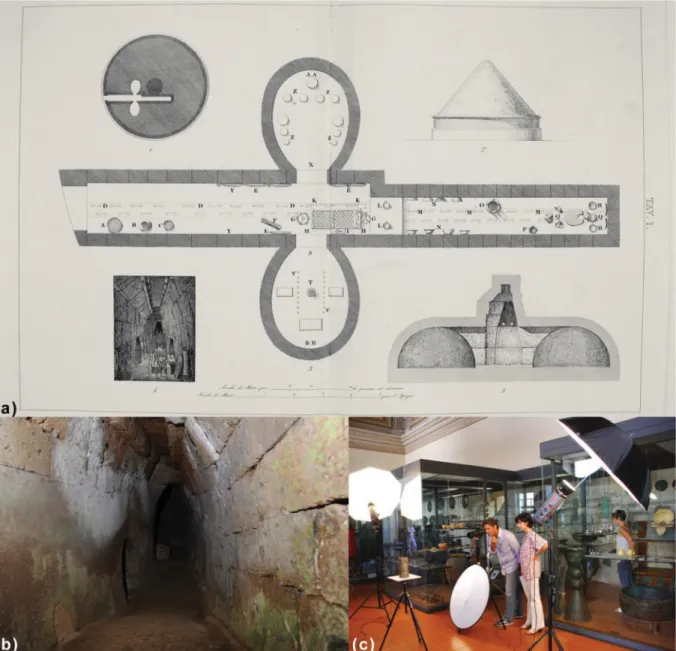
Regarding the Regolini-Galassi tomb, we realized a VR installation characterized by gesture-based interaction interfaces. Through a virtual reconstruction, we have put back together the tomb and the funerary goods, entities that remained separate since their discovery in 1836 when the objects were immediately removed from their original location and brought to the Vatican Museums. They are still preserved and exhibited in this location, in a dedicated room of the Gregorian Etruscan section (Figure 1). They can be enjoyed through the showcases, but the experience is purely aesthetic, limited to the observation and analyses of their formal aspects rather than extended to the comprehension of their intrinsic meaning.
On the other hand, today the Regolini-Galassi tomb is completely empty and not accessible to the general public, as it is in a private ownership. It can be visited only on demand for study purposes.
This tomb hosts two very important characters, a princess and a warrior, and it has been dated around 675–650 BC [Colonna 1997]. It is one of the richest and most famous tombs of the Orientaliz-ing period, a time when the circulation of knowledge and ideas among the Etruscan princes and the Mediterranean cultures became stronger [Sannibale 2008].
Interacting with Virtual Reconstructions in Museums: The Etruscanning Project • 9:7
Fig. 1. The Regolini Galassi Tomb: (a) TAV. I. from Grifi, 1841, with a plan of the whole tumulus, a front view of the tomb, the detailed plan of the inner space, an inner view, and a section; (b) the interior of the tomb at the present day; (c) the room of the Vatican Museums with the objects from Regolini Galassi. The image has been acquired during the photogrammetric digitization with permission of the Photographic Service of the Vatican Museums.
The outstanding quality of the objects of goldsmithery and the fact that they remained together after having been excavated—which is exceptional for that time—make the Regolini-Galassi tomb one of the most important and well-known Etruscan graves.
The structure, partly carved into the rock and partly built with blocks, was covered by a monumental mound with a diameter of 48m. Adromos(corridor), with functions of an antechamber, allows one to
enter the inner chamber where the main burial stays. The two rooms were separated by a low wall that partially closed the passage, forming a ritual open window. Two small elliptical rooms, calledcellae, are carved on the sides of the antechamber. The cell on the right kept a large ceramic olla containing the remains of an individual cremation: relatively poor grave goods were located in thiscella. In the left cell, there were not any burials but grave goods of controversial identification. The inner chamber was reserved for a woman buried of high rank, that is, of royal lineage. The rich personal collection consists of refined jewels, silverware, bronze pottery, and fabrics decorated with golden plates. In the antechamber, there were the funeral bed in bronze and opulent furnishings that have a ritual use and references to the practice of aristocratic banquets and power. This oldest tomb, dating between 675 and 650 BC, was later incorporated into a massive mound of larger diameter, including five other tombs (known as peripherals). It was used at least till the first half of the fifth century BC, probably from the same noble family.
Starting from an accurate 3D digital acquisition of the tomb and of its artifacts through integrated technologies (scanner laser, digital photos, photogrammetry), we tried to reconstruct a 3D model of the tomb as it could be when it was closed, at the half of the seventh century BC, with its funerary goods contextualized inside and digitally restored.
This process was not so easy because we had to reinterpret many discordant historical, literary, and iconographic sources, coming from the fact that the tomb was not well documented at the moment of the discovery and all the drawings and maps of the context were realized after the removal of the objects [Pletinckx et al. 2012].
The first publication of Regolini Galassi (after the preliminary report of Grifi and Braun) is due to L. Canina, which reproduces the first map with the disposition of the grave goods [Canina 1838; Grifi 1841]. The map made by Canina was also used by L. Grifi in his book in 1841. Some differences in the location and characterization of the objects can be noticed: different sizes and even shapes from the real one for some objects, as well as diverse locations in the tomb; also, the size of the tomb itself is different from actual one. The reconstruction here proposed is neither complete nor definitive, but it is an effort to find the most reliable solution so it became a good tool for interpretation. It is based on the reinterpretation of the first documentation of the 19th century and therefore receives only part of the location of the grave goods finally proposed by L. Pareti in 1947.
4.2 Monte Michele Tomb n. 5
In 1980, during excavations in a section of the Monte Michele necropolis at Veii, six chamber tombs with their grave goods still in situ were found (Figure 2).
Tomb n. 5 was a princely tomb from the middle Orientalizing period, dated 670–650 BC. It is a chamber tomb approximately 4.5 by 4.5 m2, with two smallcellae(side chambers) accessed from the
dromos, the entrance passage. It contained four interments, probably of members from the same family.
Although this Monte Michele tomb did not display the wealth found in contemporary tombs, such as those in Cerveteri, it is one of the richest tombs to date in Veii [Boitani 1985].
In the left-side chamber, the skeleton of a child without grave goods was found on the ground. In the right-side chamber, the cremated remains of a man aged 18–20 have been found, identified as such from bone fragments in the ashes. These remains were contained in a largestamnos (a vessel for storing and mixing liquids) in Etruscan-geometric ware, painted on the shoulder with a motif of snakes. The grave goods included three spearheads, six plates, and a largedolium, or storage jar, containing a proto-Corinthian subgeometricaryballos(a small oil or perfume flask), which allowed the interment to be dated around 670 BC.
Interacting with Virtual Reconstructions in Museums: The Etruscanning Project • 9:9
Fig. 2. The tomb of Monte Michele: (a) Plan and section of the tomb in the drawings of the excavation in 1980; (b) an image of the tomb taken from the dromos, where we can see the actual state of preservation of the tomb; (c) the showcase of Monte Michele findings in Villa Giulia Museum.
In the large chamber, there were two interments. To the left there was a woman; in the absence of bones she was identified as such from the grave goods, which chiefly comprised ceramics and feminine jewelry.
The male interment was placed along the right side of the chamber, although its rich grave goods occupied almost the entire space. A cinerary urn made of sheet bronze in the form of an oblong “house” with sloping roof contained the cremated remains of a grown man, on account of the cinerary urn’s modest dimensions.
The urn is richly decorated with ornamental and figurative motifs. The cremated remains inside the urn were carefully wrapped in a piece of cloth in “anatomical” order. The urn stood on a rectangular wooden chest, which must have formed part of a four-wheeled wagon, used during the funeral.
Part of the comparatively low sides of the wagon’s box has survived, covered with ornamental bronze plates on all sides. In the chest beside the cinerary urn were the warrior’s weapons: a dagger and at
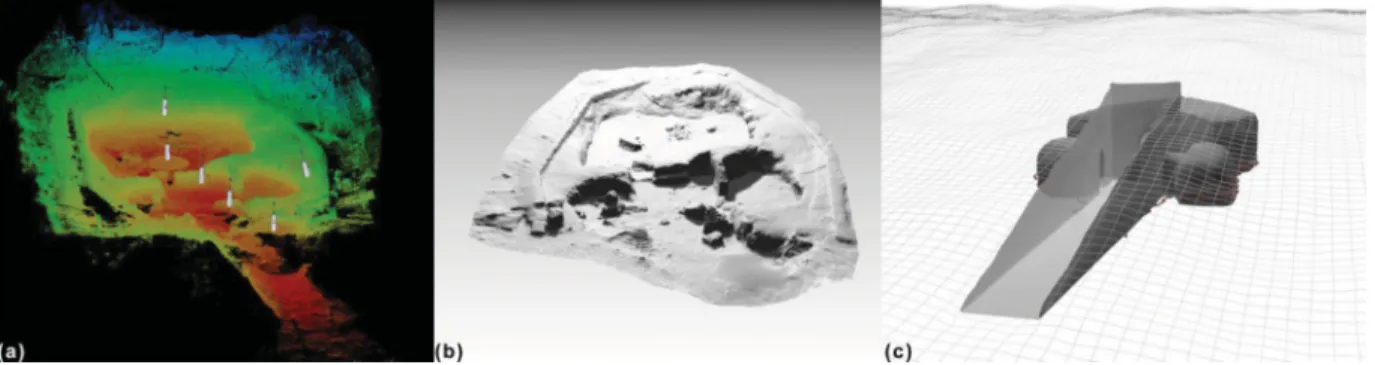
Fig. 3. The digitization and virtual reconstruction of Monte Michele tomb: (a) the point cloud acquired by laser scanner and represented in false colors according to the height; it’s possible to recognize the positions of laser scanner; (b) the 3D model in a shaded visualization; (c) a hypothesis of the original tomb in its context with the maincella, the lateralcellas,and thedromos. least three spearheads with their shafts. This regal set of weapons was accompanied by a sceptre. The wooden chest also contained two large terracotta shields.
The banqueting service in the burial chamber comprised large storage jars in impasto rosso and fine clay and smaller vessels for scooping, pouring, and drinking in brown impasto sottile and fine clay. Sophisticated examples of Veii’s first bucchero production were also found [Boitani et al. 2011].
5. DIGITIZATION AND VIRTUAL RESTORATION OF THE GRAVES
Digitization and virtual reconstruction represent two important steps of the Etruscanning project since they prepare the contents of communication. In these two phases, innovative digital techniques have been used, both for the acquisition of three-dimensional objects and for virtual restoration. In this article, we touch on a few aspects and principles, as its main topic of focus is on interaction metaphors and communication needs. For any deeper interest in the digitization process, the reader can refer to previous publications [Adami et al. 2012].
In the passage from the real object to the digital representation, the main goal was to obtain a complex virtual environment based on geometry, texture, and color We applied different methodologies to obtain the most suitable 3D models: from the topographic approach with photogrammetry and laser scanner to computer graphics to optimize the model.
We tried to identify for each acquisition system the positives and less in order to define an operational protocol related to the choice of the most suitable method, its implementation, and the results that can be achieved. To do this, we considered the accuracy and precision of the method/instrument, the possibility of acquiring geometry and color, the working condition, the data processing and optimization stage, and results.
We applied laser scanning techniques to acquire the two Etruscan graves (Figure 3). The choice of this technology was driven by the possibility of obtaining a precise and accurate 3D model in a fairly short time. For this reason, laser scanning technology is widely used in the field of CH. Although there is no universally accepted protocol for the acquisition due to the different instruments, the character-istics of the objects to be surveyed, and the goals, there is vast literature on these topics and we can assume a general pipeline to obtain correct digital models [Guidi et al. 2010].
About the laser scanning technique, we cannot neglect some aspects. Indeed, it is necessary to take into account the large amount and complexity of data and its disk occupation. On the one hand, it is necessary to use very costly computing systems. But it is even more important to establish how the model will be used to realize, from the beginning, the most appropriate solution (such as a low
Interacting with Virtual Reconstructions in Museums: The Etruscanning Project • 9:11
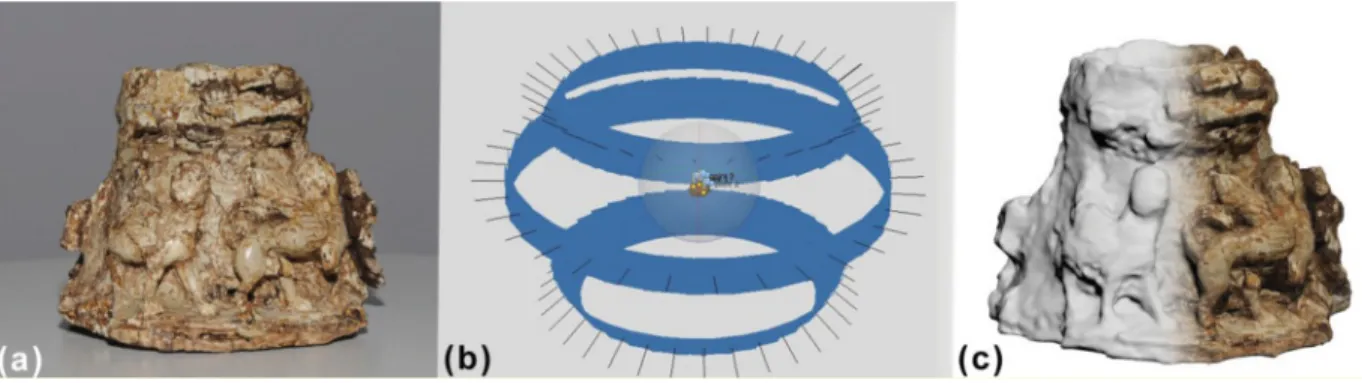
Fig. 4. The unknown ivory object of the tomb Mont Michele, digitized by photogrammetry: (a) the detail of one of 108; (b) the images oriented and represented around the object; (c) a double visualization of the 3D model with shading or with texture.
poly model for real-time navigation). Another problem is related to the color description of the objects. Depending on the instrument, we can acquire the color simultaneously with geometric information, or we need to acquire external images and then project them onto the objects. These two systems give very different outcomes in terms of precision of projection and resolution.
Regardless of the tool and the pipeline, the last step of digitization consists of the optimization, to import the model in the game engine, Unity 3D [2014].
Another approach is based on digital photogrammetry and computer vision. This recent method (based on Structure from Motion and Dense Stereo Matching algorithms [Remondino et al. 2008]) allows us to build 3D models simply by acquiring a set of images [Callieri et al. 2011]. It is necessary to acquire many images of the object with high overlapping and some measurements. Then the software allows us to extract some feature points, to orientate the images, to calculate a dense point cloud, to triangulate it in a mesh, and to build the texture (or an orthophoto).
This approach is very suitable for the digitization of objects because of its simplicity and rapidity. In addition, we take into account that no special instruments are required (just a digital camera), and there are good commercial software (Agisoft Photoscan [AGISOFT PHOTOSCAN], 123dCatch [Autodesk 2014]) and also open-source software (Photosynth [2014], Bundler [Snavely 2014], and PMVS2 or Apero). The geometry and the aspect (color) of the model can be acquired at the same time, and this is very time saving. This method allows us to obtain good results both in terms of accu-racy and in terms of appearance and communicative impact. As for the previous method, in this case it is also necessary to optimize the model by decimating the number of polygons (usually in excess), by closing some holes in the geometry, and by chromatically correcting texture and color. We chose to ap-ply this digitization method on the most complex objects such as the mourning statues of the Regolini Galassi and the ivory object of the Monte Michele Tomb (Figure 4). For these applications, we decided to work with Agisoft Photoscan because it is reliable and has interesting and easy-to-use tools (image masking, georeferencing and scale with known coordinates, possibility of extracting high-resolution texture).
Finally, we used manual modeling for the most complex objects we could not acquire by photogram-metry or laser scanner because of their material (golden silver) or their very sophisticated details (e.g., the golden fibula from the Regolini-Galassi tomb, with many little ducks). We built 3D models relying on all available sources (graphic and photographic documentation) and by using the traditional oper-ations of polygonal modeling (extrusion, Boolean operoper-ations, digital sculpting, etc.). It is evident that in these cases the result is mainly related to how the object is seen and perceived. For this reason, the
Fig. 5. The ceremonial golden fibula of Regolini Galassi. The initial documentation was made up of photos and drawings as the (a) Tav. LIV by Canina, 1846. The 3D model has been modeled by a manual approach; in (b) some views of the model: the overview and a detail.
modeler tries to reconstruct the object according to the available documents, paying attention to the correct dimensions and, above all, to the aesthetic aspects.
The ceremonial golden fibula (Figure 6) testifies to the good results that can be achieved through manual modeling. Also, in this case, we produced a high-resolution model that was after reduced for real-time implementation, using normal maps to simulate the original geometry.
In the final virtual reconstruction, we had to focus not only on geometry and diffuse maps but also on material appearance and the shaders, global illumination and light probes, normal maps generation and management, occlusion culling, and so forth. In the case of the Regolini-Galassi tomb, the editing related to the render quality of the scene has been realized directly inside Unity 3D, the real-time graphic engine used to develop the VR application. In the case of the Monte Michele tomb, the setup of the scene has been created and optimized in 3D Studio Max and VRay as the final output is a movie.
An important part of the virtual reconstruction is the digital restoration of the objects, as the virtual reconstruction tries to show the state of the tomb at the moment it was finally closed after the second burial. Several techniques were used to this end. For the objects with existing physical restorations (such as the chariot), 3D models were hand modeled and texture mapped with photographs of the restored object. For objects that were too heavily corroded to be restored but had simple shapes (such as the shields), objects were hand modeled and mapped with textures that were digitally restored in Photoshop. Many objects, however, were engraved and embossed and had missing parts. For these objects, we developed a technique based on grayscale depth maps created in Photoshop (Figure 5). These maps simulate the decoration and have been used as normal maps in Unity 3D [Pletinckx et al. 2012]. The process of knowledge that leads from the current state of the object to the reconstructive hypothesis is essentially based on detailed observations and comparisons with other objects that are coeval, from the same place, or with the same cultural influences.
It is also necessary to implement a good annotation system in order to make it easy to publish the 3D models in a proper way. This is one of the practical issues that has to be developed as a follow-up to the ethical and theoretical framework that can be derived from the London Charter on computer-based visualizations of cultural heritage [London Charter 2009]. By sharing the process that allowed us to obtain the virtual reconstruction (initial data, assumptions, and documentation), it is possible to validate the reconstructed model.
Interacting with Virtual Reconstructions in Museums: The Etruscanning Project • 9:13
Fig. 6. The virtual restoration of the patera with a technique based on normal map: (a) the current patera with the permission of the Photographic Service of the Vatican Museums, (b) the drawing of the current situation, (c) the hypothesis of reconstruction with gaps filled in, and (d) the final model. In (c), the gray tones correspond to the engraving.
Therefore, 3D reconstructions are confronting researchers with new questions and visual perspec-tives. Virtual reconstructions can be developed through a multidisciplinary work, since the develop-ment of 3D reconstructions requires considerable teamwork.
We also experimented with a different use of a virtual reconstruction. It is not only a tool for visual-ization and representation but also a tool to simulate and verify different hypotheses and interpretations.
6. REGOLINI-GALASSI VR APPLICATION
6.1 3D Visualization, Storytelling, and Soundscape
As the goal of the Regolini Galassi application is evocative, in the final 3D visualization we tried to create a deep emotional involvement, using different means regarding dramatic light, storytelling, and sounds.
As concerning light, we have tested a different type of lighting in the 3D model of the tomb and, at the end, we decided for a torch. Its light is trembling, not continuous and homogeneous. The light of the torch reveals the objects gradually, when the space is penetrated, and produces an impression of strong sensorial immersion.
When the user enters the tomb, the voices of the dead emerge, telling stories about their identity, culture, and objects. The princess and the warrior speak not from the past but from today, knowing our world, but nevertheless from their point of view as rulers of an Etruscan city-state, with aristocratic authority, but open to and welcoming the people at the exhibition, just as they have welcomed so many people in their lifetime. This approach allows avoiding a major pitfall: we don’t know the Etruscan soci-ety well enough to create stories “from the past.” So, the characters tell their story for us to understand their lives and opinions, but they also deliberately avoid or refuse to tell certain aspects.
The storytelling is not unique and continuous; on the contrary, it has been shaped in accordance with the interactive experience. At the beginning, the two personages welcome the visitor, presenting themselves and their tomb; this introduction lasts about a 1 minute and half and is associated with a predefined camera animation inside the tomb. In every moment the user can skip this introduction and go directly to the interaction. During the exploration, users can choose and select an object and listen to a story directly by the voice of the warrior or the princess to whom that object belonged in life. Each narrative fragment lasts 1 minute or less. Despite the reciprocal interconnections, each fragment is self-contained and can be understood and appreciated without hearing the other stories.
Other tricks, together with the storytelling, help the visitor to deepen the atmosphere of the grave. Music is surely one of those. We composed music especially for this application. We don’t propose a philological reconstruction but a soundscape that evokes the past and the contemporary culture. We have used Supercollider [Supercollider] as the generator of synthetic sounds (cymbals, little bells, bass drum) using granular synthesis, and we have also recorded “live” melodic instruments—bass flute and alto flute—as a similar timbre is documented in the Etruscan world, especially connected to religious ceremonies. Sounds are combined with noises remembering the meaning of each object: water, wheels of the chariot, horses’ gallop, fire, and so on. In this way, each object, when selected, reveals its own story and the universe of sounds enhancing its symbolic value. All of the fragments are related and connected by a similar style. During the free exploration of the space, when no stories are activated, there is a delicate musical pad, not boring if the application is left passive.
6.2 Interaction
The public has the possibility to explore the virtual Regolini-Galassi tomb, to get near to the artifacts, and to touch them and activate stories just by moving in the space in front of the projection.
We developed two main versions of the application: the first one, simpler, was realized in 2011 in three to four months; the second one, more complex, is the result of a longer experimentation on the public that allowed us to improve the interface, to enhance the embodiment and the gestures gram-mar step by step. This latter is now accessible, as a permanent installation, both at the Allard Pierson Museum of Amsterdam and at the Vatican Museums (Gregorian Etruscan section) where it was pre-sented to the public on April 4, 2013 (Figure 11).
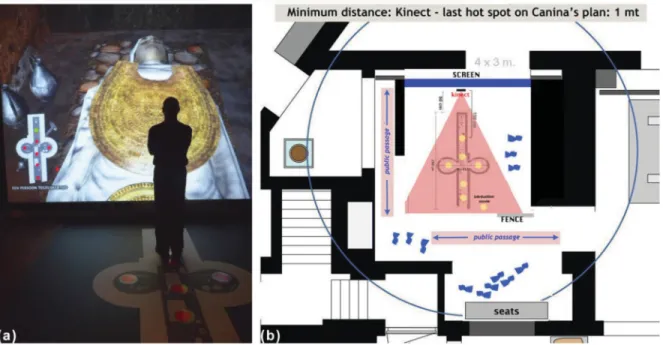
The two different versions have been implemented in Unity3D, using the first generation of the Kinect sensor. The sensor [Microsoft 2014a] camera creates an interactive area with a cone shape, 5m long×5m wide (the device constitutes the vertex of this cone). The minimum distance between the sensor and the user is 1m.
In our applications, the sensor is fixed in front of the user, 20cm up from the floor, as we wanted to keep the projection as large as possible (about 12m2) in order to involve the user in an immersive experience.
The system has been introduced by the last generation of games and we decided to test it in museums where it is still new and unusual.
6.2.1 First Version. The user walks on a real map of the grave placed on the floor, onto which some “hotspots” are attached (Figure 7).
The hotspots are viewpoints from which the user can perceive in the best way specific areas of the tomb: entrance,dromos, left cell, right cell, and main chamber. This map works as an interface to let the user move inside the virtual tomb: when he or she walks to a hotspot and stays, the camera automatically moves in the 3D model from the current viewpoint to the new position. Once it has arrived in the new viewpoint, it stays and the storytelling emerges from the objects that are all around, following a predetermined succession. Each hotspot has three to five “speaking” objects, each one with a storytelling fragment. The order in the choice of the hotspot activation is free, so every sequence inside the tomb can be activated. While the active user is guiding the system, other visitors can sit down in the area all around it, visualizing and listening to the cultural contents in a passive way, always with the opportunity to engage in active exploration.
This version of the application is something in between an interactive movie and a VR exploration, controlled by NI interfaces. The public had only to walk in front of the projection: no gestures were required (so no skeleton recognition nor calibration by Kinect) nor selection possibilities were given. The interface was really simple and intuitive and we provided only one initial instruction: “enter in the
Interacting with Virtual Reconstructions in Museums: The Etruscanning Project • 9:15
Fig. 7. The first application in Amsterdam. On the left (a), we can see the carpet map with hotspot (red) on the floor. The user can move on the map and activate different contents. On the right (b) is the scheme of the interactive space. In red is the cone of Kinect.
interactive area and go on a hotspot.” In just a few seconds, users were able to understand how they
should relate with the map on the floor. Even if it was a single-user application, it was able to attract the attention and the participation of a collectivity.
The framework to interfaceKinect for XBoxand the computer (a Mac) wasOpenNI[2011], an open-source application programming interface (API) developed by Prime Sense and Willow Garage indus-tries for writing applications using natural interaction.
In the temporary exhibitions in the Netherlands dedicated to the Etruscans (Amsterdam and Leiden, October 2011–March 2012) [Hupperetz et al. 2011, and in Italy the Archeovirtual in Paestum (November 2011), we could evaluate the user experience. In Amsterdam, we observed that this solu-tion made the interacsolu-tion amazing for the public; it allowed people of every age and every “technical” skill to enjoy the virtual contents. The median time of interaction for each user was about 12 minutes (the total amount of narrative contents is about 22 minutes), a very good result according to our expec-tations. Some papers [Pescarin et al. 2012; Pietroni et al. 2012b] refer to this survey in terms of results and methodology; the person responsible for this investigation is Christie Ray, from the Allard Pierson Museum.
The same observations we made in Paestum in 2011, atArcheovirtual[http://www.vhlab.itabc.cnr.it/ archeovirtual/2011/], where we evaluated the user experience in terms of design usability, overall in-volvement, and content (13 observations, seven interviews, 34 written surveys). Also in this case we presented detailed information about the results of the evaluation in a specific paper at Digital Her-itage 2013 [Pietroni et al. 2013]. We can summarize the results: the immersion level experienced by users, the arrangement and the darkness of the installation space, the environment, and the context into which the installation was placed had a definite impact on the user’s sense of it. Indeed, 58% of testers said they felt a high level of immersion. From a content point of view, users agreed that the
information provided by the application was clearly structured and easy to understand. Indeed, 70% found the content to be accessible and referable to users’ level of knowledge of such historical top-ics. The majority of testers also found the installation quite adequate with regard to usability. They considered the Etruscanning project easy to use and interact with, with 67% rating the usability as highly simple, and 50% also rating the usability as undemanding. Thus, the ability of the developers to create a digital product that was both usable and comprehensible for a range of audiences is quite revealed. Unlike this outcome, few users found the application difficult to interact with: 10% found it complicated and 17% said it was challenging (Figure 11(b)) (thanks to Alfonsina Pagano responsible for the User Experience evaluation in Paestum; these data have been taken from her report).
6.2.2 Second Version. In the following months we wanted to go further and a second version of the application was implemented. The goal was to increase the level of interaction of the user inside the virtual reconstruction of the tomb and make him or her feel like a leading actor of the experience. This version is based on the skeleton recognition and on a limited grammar of simple gestures to perform with the arms.
As in the first version, also in this case no calibration is needed, as the system is able to adapt automatically to the user’s size. This condition determines a great advantage in museums as it favors an immediate alternation of the users.
The second version is no longer based on an interactive map of the tomb on the floor, with automatic movements of the camera. On the contrary, the user is left completely free to walk through the grave and rotate his or her point of view in every direction, using his or her arms. Also, a “selection mode” in 3D has been implemented. It opens very interesting possibilities: it allows the visitor to select some objects and access the storytelling directly from the voices of the two personages buried inside the tomb. In this way, users can find a balance between active interaction and relaxation while listening to the stories.
The different functions are activated through some hotspots on the floor, among which the user is required to move (Figure 8):
(1) HotspotLanguages:choice of language: Italian, English, Dutch;
(2) HotspotExploration: free exploration (using arms to move and rotate on xyz axes);
(3) Hotspot Selection and Storytelling: in this position the visitor is asked to use his or her right hand and to move it over the objects menu on the right; once an object is selected, a dedicated camera looks at it, inside the tomb, and a specific spotlight switches on; meanwhile, the storytelling emerges. Sometimes the object animates while speaking, coming in front of the eyes of the visitor; (4) HotspotStart: a short tutorial is given to the user in order to teach him or her how to interact
inside the 3D space. This section also includes a short historical introduction about the tomb. The hotspot interface is doubled: it appears physically attached on the floor and also digitally in the layout on the screen where the user’s position is visualized as a blue feet icon, moving among the hotspots. So the visitor can recognize immediately his or her position and understand where he or she has to go.
In order to support the user and give instructions about the gestures grammars, the following solu-tions have been adopted:
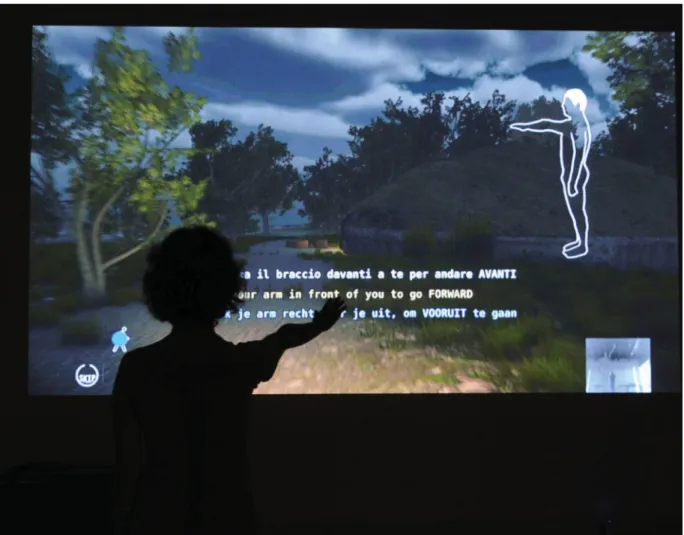
(1) A tutorial is activated walking until the “Start” hotspot is covered on the floor; the tutorial asks the user to emulate a pose for each gesture, as showed by a figure (the pose is accompanied by a short caption explaining the gesture). Following the tutorial the user is guided from the outside until the entrance of the tumulus (Figure 9).
Interacting with Virtual Reconstructions in Museums: The Etruscanning Project • 9:17
Fig. 8. The appearance of the last application at the Vatican Museums. We can notice the viewport on the right with the dynamic menu of objects, intro, and credits. On the left, there are all the hotspots for navigation, selection, languages and start, as well as some helps for the user (the silhouette and the schematic map).
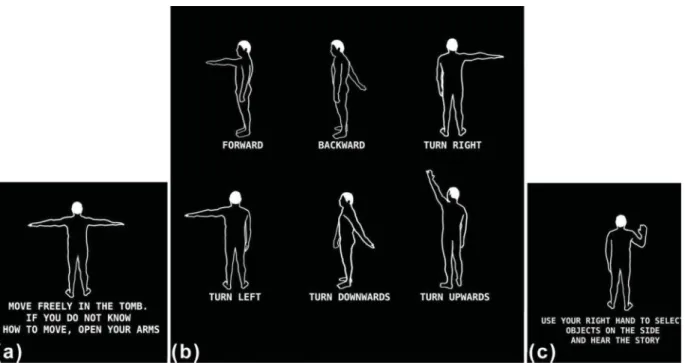
(2) A “Help” pose is allowed to be performed in every moment to recall the grammar of gestures (Figure 10).
(3) Text messages are available that in every moment suggest what the user has to do, according to the hotspot he or she is occupying.
(4) The user has a feedback of his or her movements by a skeleton, which reproduces the user’s ges-tures in real time.
The screen (full HD, 16:9 ratio) has been divided into many viewports. Two of them are the most important: the larger one (4:3 ratio) is for the immersive visualization and 3D exploration; the sec-ond one, on the right, is a dynamic menu of the objects staying all around the position occupied by the user in the 3D space (Figure 8). This second viewport is useful for the selection function. In fact, the object selection in the 3D space should work through a ray being cast by the hand and hitting the desired object. Because the first-generation sensors like Kinect still have problems of noise depend-ing on environmental conditions (infrared light, direct sunlight, reflectdepend-ing and refractdepend-ing objects, etc.), and, even more, in consideration of the narrow space of the tomb (less than 2m wide), it would have been very difficult for the user to select objects directly in the 3D space. So a dynamic menu on the right was added, where the objects that are visible in the other immersive 3D viewport are presented vertically aligned (Figure 8); this solution makes selection very easy. In fact, no ray casting is needed and selection is possible by directly touching a trigger.
This second release uses the Kinect for Windows and the Microsoft SDK [Microsoft 2014b] that, in this phase, seems to be more precise and responsive than the OpenNI framework. At the Vatican
Fig. 9. The tutorial of the application. The user can learn the gestures in order to move in the virtual space. The tutorial takes place in a hypothetical environment, outside the grave, and the user has to discover the entrance of the tomb and arrive there.
Museums, the final installation uses a video projector and a screen 3m wide. In other temporary occa-sions, the application has been shown using projectors or TV screens (60 inches minimum).
Also in this case we tested the public’s reactions at the Science Festival in Genoa (October 2012) and at Archeovirtual (November 2012). Differently from the previous user experience evaluation campaign, the focus of the 2012 edition was mainly on few of the interactions’ aspects that take place between the system and user. Specifically regarding interaction, the evaluation investigated utility (Does the application support functions that are desired by the users?), learnability (How easy is it for the users to use the application the first time they encounter it?), efficiency (Is the workload for the interaction with the application kept to a minimum?), and stimulation (Does the virtual museum captivate the user?). For the elevation of data, a combination of two methods was chosen, which collected informa-tion provided directly from both parties: developers and users. Direct interviews and quesinforma-tionnaires have been essential tools to capture ground truth data on expectations in terms of realization, inter-action, and graphic computer interface (GUI). Twenty-four written surveys and 10 interviews were
Interacting with Virtual Reconstructions in Museums: The Etruscanning Project • 9:19
Fig. 10. The help for visitors: (a) when the user open his or her arms the help panel appears; (b) the list of all gestures to move in the grave; (c) the gesture for the selection of objects.
conducted. In both groups, a main part was represented by experts—either from the CH domain or the ICT sector—with around 42% within the written survey and 40% within the interview. Participants rated the application as involving, useful, and interesting. They had good opinions about the starting tutorial, the free navigation, and the selection of objects. Some people found it hard to use the applica-tion in the beginning, but it became easier after a while. Some critics noted that there was too much text, which led to skipping the instructions, and that the gestures of the movements were not always very natural (these data have been taken from the report by Alfonsina Pagano) [Pietroni et al. 2013].
In conclusion, natural interaction can produce less precise input in comparison with traditional interfaces (mouse click, keyboard, joystick, etc.), but this limit does not generate any frustration in visitors; on the contrary, it encourages people to try, explore, and learn until they obtain good results. Moreover, visitors reveal a creative/emphatic approach in performing the required movements, as they have the feeling of being in a game.
The second version of the Etruscanning/Regolini Galassi application won the Best Award in the cat-egory “New Interaction” during Archeovirtual 2012, organized by the European Network of Excellence on Virtual Museum, V-Must.Net [2011]; on the same occasion, it also won the Public Appreciation Award on a total amount of 20 applications.
Actually, the application is permanently accessible in the Vatican Museums, in a room of the Gre-gorian Etruscan section, not far from the Regolini Galassi collection (Figure 11). The interactive area has been fenced to avoid too many people entering into it, which may cause problems with the systems, and the room has been darkened to allow the best perception.
We still need to start the evaluation in the Vatican Museums; this will be started in mid-2014. How-ever, we have observed that in this location the median time of fruition by a user is about 15 minutes;
Fig. 11. The permanent application at the Vatican Museums: (a) the scheme of the interactive space; (b) a visitor navigating the virtual grave while others attend to the experience.
Interacting with Virtual Reconstructions in Museums: The Etruscanning Project • 9:21
this seems a good result in consideration of the continuous and immense flow of the public in this museum.
In October 2013, the application won the first Italian Heritage Award, an international competi-tion (www.italianheritageaward.org), in the category Communicacompeti-tion and Disseminacompeti-tion of Cultural Heritage.
We are now continuing to work on the definition of a proper grammar of gestures, continuously testing it on public. In fact, gestures need to be really intuitive, responsive, and well designed by the authors as not all people have the same perception, coordination, and awareness of their own movements.
7. MONTE MICHELE N. 5 APPLICATION
The second application of the Etruscanning project is going to be permanently installed in March 2014 in the Museo Nazionale Etrusco di Villa Giulia in Rome and in the Museo dell’Agro Veientano in Formello. It was already presented to the public at the Digital Heritage Expo in Marseille in October 2013.
This application has a very different nature from the previous one. In fact, the main objective is to make the public understand the archaeological excavation and stratigraphy. In particular, it is im-portant that people know the whole process starting from the reasons for the excavation, through excavation methodologies and documentation procedures, up to the conservative and reconstructive aspects. We wanted to let the user see the tomb through the eyes of the archaeologists who found it.
From the beginning, some choices were very clear. The lack of the strongly evocative and immersive purpose, together with the limited space available for the installation in the museum, led us to abandon the paradigm of natural interaction. Moreover, we considered also the physical characteristic of the tomb in the actual state. Because of its poor state of preservation, the visitor has some difficulties to understand the shape of the grave and the position of the wall tuff and of the dromos itself: he or she would be disoriented in that space. For these reasons we decided to avoid, in this application, the paradigm of free navigation in a virtual space and introduce a new one [Adami et al. 2013].
We create and test for the first time a new framework, called MAVRA, “Multi Angle Virtual Reality Application.”
The most innovative idea is the possibility to play some parallel video tracks with different con-tents but with the identical camera animation through the tomb, obtained through camera tracking techniques (Figure 12).
The user can switch among the video tracks, listening to a common audio comment. We call this concept “multiangle” because we look at the same context but with three different representations.
The storytelling, in first person, simulates the archaeologist who discovered the tomb coming back today to the site, entering the tomb, and remembering her past wonder at the moment of the discovery and also all the questions she was asking herself about the identification and the meaning of the objects.
The visitor can visit the tomb and choose between these three tracks (Figure 12):
(1) The first track is a movie acquired by a steadicam in the actual tomb (Smart System/Glidecam mounting a GH3 photo-camera). The choice of a steadi allows a personal visit of the tomb, with the same subjective approach as in reality. Some people in the scene show the digital acquisition work (the surveyor, the photographer, the archaeologist);
(2) The second parallel track is the 3D model of the tomb (actual state of preservation), obtained from the digitization work (scanner laser and dense stereo matching) as presented in Section 5. Despite
Fig. 12. On the left, the same frame from the parallel tracks: (a) the steadicam track with operators on the excavation; (b) the 3D model of the actual tomb with the objects; (c) the 3D reconstruction of the tomb. In the third image (c), the visitor can see the entrance of the maincella: today’s view is very different. On the right, there are different visualizations of the second track: in (b1), the tomb is represented by a pointcloud; in (b2), by a shaded model with placeholder objects; and in (b3), by a model textured with real images.
the unique and coherent camera path, in this video track the visualization shows the different steps of the digitization process, alternating them during the sequence:
—Model shown as a point cloud: starting rough data (Figure 12(b1));
—Model shown as mesh without textures to enhance the perception of its geometry and also to let the user focus on the stratigraphy: in fact, in this visualization, the main objects are lying on the floor, in the same position of their discovery (Figure 12(b2));
Interacting with Virtual Reconstructions in Museums: The Etruscanning Project • 9:23
(3) The third parallel track is the 3D reconstruction of the tomb representing how it could be in the seventh century BC (reconstructed as in Section 5). It gives the opportunity to enter the tomb and explore the dromos, the lateral cells, and the main chamber. Through the MAVRA paradigm, the visitor can create his or her own personalized visit, always following the path proposed by the archaeologist-guide: changing track, he or she could focus on the real state of the tomb, on its original aspect, or on the position and characteristics of the objects found in the tomb.
On the right part of the screen, we have a dynamic menu of the objects that can be selected. They apply to the objects positioned in the tomb that enter in the camera field of view (as mentioned, objects are recontextualized in the stratigraphy in the second video track). In every moment the user can touch an object in the menu to select it and open a “side story” related to that specific object (about 1 minute long); the metaphor is again the first-person tale.
The application is developed with Unity 3D, but in this case we do not visualize 3D contents in real time: the three parallel tracks are movies. Their synchronization is obtained through “camera tracking” techniques. Through these algorithms, it is possible to extract the camera path from a movie. Generally, this process is used to import 3D objects into a movie: the result is to see a virtual object moving in the real space. However, in the case of Monte Michele, the camera path is imported into completely new virtual scenes: the 3D model of the current state and the reconstructed model. Thus, we had to render new movies where the virtual camera follows the same path but frames different worlds.
The first steadicam track is the base for camera tracking. So it had to be carefully designed because all the movements of the camera should be applied also to the models of the first and second track. The operator had to make the movie paying attention to moving only in the true position and avoiding crossing the walls. It is important to know exactly the position of all the openings and walls.
We had some problems in the creation of a perfect camera path that could fit in every point the 3D space. The irregular shape of the tomb did not allow us to use some important constraints (such as a planar floor to describe the xy plane). The lack of well-defined points (such as targets) did not allow us to georeference correctly the path on the 3D model of the actual tomb. In the end, we found a very good solution from a perceptive point of view, but it is just a good approximation.
The interface of this application (Figure 13) is very similar to the Regolini Galassi application. In the main frame of the application, a movie is playing. On the top band, together with the button of languages, all the parallel tracks play together in small views (thumbnail). So the user can see in each moment what happens in the parallel tracks and he or she can decide the kind of representation he or she wants to switch on.
Finally, another independent movie, not following the parallel tracks approach, is integrated in the application, showing the interview with the real archaeologist who discovered the tomb, Francesca Boitani, speaking in the museum near the artifacts. The interview is edited together with video shots of the real context of the tomb in the landscape of Monte Michele in Veii and historical photos from the discovery and the excavation in 1980.
In the Museo Nazionale Etrusco di Villa Giulia, Rome, the application will be installed beside the showcases with the funerary goods coming from this tomb. This will give the visitor the chance to compare the real objects with their digital contextualization.
The application is designed for a single user, but the widescreen monitor will also allow entire groups to follow the virtual tour of the tomb. Visitors will interact with the application by a wireless touchpad in a single-cursor interaction modality.
Since the application has not been installed yet, there are no data referred from the user experience and the effectiveness of the application itself.
Fig. 13. The layout of the application is very similar to the Regolini Galassi one. On the top, the thumbnails of the three parallel video tracks, the button for languages (on the left), and the thumbnail of the interview with the archaeologist (right). In the right band, we find the objects we can query.
8. FURTHER DEVELOPMENTS: OBJECTS MANIPULATION WITH KINECT 1.0
Objects manipulation is perhaps one of the next frontiers. Within the Etruscanning and V-Must projects framework, the team composed by CNR ITABC and E.V.O.CA. srl is testing two initial ap-proaches using the Kinect and Unity 3D, but these first attempts still need to be verified on the public. First, it is fundamental to establish what we mean by “manipulation” and what it is for. One answer could be that the main goal of manipulation is to explore and analyze an object in every detail according to a personalized approach. In this case, it is very similar to rotation, or rotation and selection of a part of the object. In traditional desktop VR systems, this action is usually performed by a mouse, for example: first, the object is pointed by the cursor, and second, the combined actions “mouse down” and “drag” let the user rotate the object in every direction. For instance, it could be possible to rotate using mouse left down and select using mouse right down. The use of a joystick makes interactive rotation much more problematic because the joystick keeps the cursor always in the middle of the viewport and no drag is allowed; we should choose different buttons for the different directions.
A second meaning of “manipulation” could be simulation of how an object can be transformed, an-imated, activated, and changed in its shape or volume in order to be used. Again, in traditional VR applications, these kinds of actions are performed through combined and multiple actions, made with a mouse.
Natural interaction allows less precise input than a mouse and involves the visitor in a more re-alistic, “embodied” experience. When we deal with manipulation, in every acceptation we intend it,