Xiang Fu, Tevfik Bultan, and Jianwen Su
University of California at Santa Barbara
Abstract. There are two main challenges in the verification of composite web services: 1) Asynchronous messaging makes most interesting problems undecid-able, and 2) rich data representation (XML) and data manipulation (e.g. XPath query) forbids direct application of model checking tools. In this paper, we present a top-down specification and verification approach to tackle both of these prob-lems. In our framework, each peer (individual web accessible program) interacts with other peers via asynchronous messages. We define a conversation among the peers as the global sequence of messages exchanged by the peers. We propose a top-down approach where the set of desired conversations of a web service is specified as a guarded automaton, which we call a conversation protocol. Guards of the automata are XPath queries that manipulate message contents. We show that if four realizability conditions are satisfied by a conversation protocol, the projections of the protocol to each peer are guaranteed to preserve any LTL prop-erties satisfied by the protocol. We also present the translation from a guarded conversation protocol to a Promela specification that can be verified by the SPIN model checker.
1
Introduction
Web services can be described as web accessible software that provide interfaces for ser-vice description, discovery and interaction [7]. By introducing a framework for decou-pling service descriptions from their implementations, web services provide a promis-ing technology for interoperability and integration. There are many challenges in devel-oping web services: a) Web services implemented using different platforms (e.g. .Net or J2EE) should be able to interact with each other; b) It should be possible to modify an existing web service without modifying other services that interact with it; c) Web services should be able tolerate pauses in availability of other services and slow data transmission. Web services address these challenges with the following common char-acteristics: 1) standardized data transmission via XML, 2) loose coupling among inter-acting web services through standardized interfaces, 3) asynchronous message passing. In this paper, we address the specification and verification of interaction in com-posite web services. We model a comcom-posite web service as a set of peers interacting with asynchronous messages in XML format. Due to the distributed nature of web ser-vices, it is not possible to assume that their interaction will be controlled by a central coordinating process. In a typical scenario, the interacting peers will be running au-tonomously, on different servers belonging to different organizations and no single peer will have control over the global interaction. Such a distributed nature and asynchronous message passing make it extremely hard to ensure the “correctness” of the interaction
merely through the design of each peer individually. The solution we propose is to use a protocol which specifies the interaction patterns among communicating web services. We call such protocols conversation protocols.
In our model of a composite web service, each peer has a queue for all of its in-put messages and may send messages to the inin-put queues of other peers. To model the global behavior of the composite web service we define a virtual watcher that records the sequence of messages as they are sent by the peers [4]. We call the message se-quences observed by the watcher the conversations of the composite web service. A conversation protocol defines the set of allowed conversations of a composite web ser-vice [9]. Our contributions in this paper are: 1) We present a language for specification of guarded conversation protocols on XML messages. We use XPath expressions [16] for specification of the guards and the assignments of the protocols, and MSL type ex-pressions [3] for the message type declarations. 2) We present and implement realizabil-ity tests for guarded conversation protocols. For a conversation protocol which passes the realizability tests, we automatically synthesize peers that generate only the conver-sations specified by the conversation protocol. 3) We present a translator that translates the conversation protocols to Promela (the input language of the SPIN model checker [10]), and we show that properties of the conversation protocols can be automatically verified using the SPIN model checker.
Related Work: In [11] verification and composition of web services specified in
a Petri Net model is investigated. In [8] web service compositions are specified using message sequence charts and modeled using finite state machines. Both models charac-terize only individual behaviors of the peers in our model, rather than global behavior of peers which communicate with asynchronous message passing via unbounded queues. Also, XML data manipulation is not addressed in [11] or [8].
Realizability of Message Sequence Chart (MSC) Graphs [1] is similar to the real-izability problem discussed in this paper with the following differences: 1) the MSC Graph model captures both “send” and “receive” events, while we are interested in the ordering of “send” events only, 2) our results are on protocols with XML messages and XPath guards, 3) even if the message contents are ignored, the realizability conditions used in this paper and in [1] are different, and 4) we implement the realizability checks for the specification language presented in this paper.
Our previous work on web services focused on formally characterizing conversa-tions generated by composite web services [4] and realizability condiconversa-tions for conver-sation protocols specified as finite state machines with asynchronous messages without data content [9]. This paper extends the earlier work with 1) a specification language for conversation protocols with messages with XML data content, 2) extension of the realizability conditions in [9] to protocols with XML messages, 3) implementation of the realizability checks and peer synthesis, and 4) a model checking technique for con-versation protocols via translation to Promela.
2
Web Services
In this section we show how web service standards can be used to specify web services, using a “stock analysis” service (SAS) example. Fig. 1 shows the overall structure of
request() Service Port Output Port RIlink BRlink IBlink Research Dept. <receive> IBlink: register() <invoke> IBlink: reject() <invoke> IBlink: accept() <invoke> BRlink: request() <receive> IBlink: ack() <receive> IBlink: cancel() <invoke> RIlink: bill() <invoke> RIlink: bill()
Stock Broker Firm
register() cancel() Service Port Delegate Port ack() <invoke> IBlink: register() <On Message> IBlink: reject() <On Message> IBlink: accept() <receive> RIlink: report() <invoke> IBlink: ack() <invoke> IBlink: cancel() <receive> RIlink: bill() <receive> RIlink: bill() Investor reject() accept() bill() Callback Port report() Data Port <receive> BRlink: request() <invoke> RIlink: report()
Fig. 1. Stock Analysis Service
the SAS. It involves three peers: Investor (Inv), Stock Broker Firm (SB), and Research Department (RD). Inv initiates the stock analysis service by sending aregister mes-sage to SB. SB mayacceptorrejectthe registration. If the registration is accepted, SB sends an analysisrequestto RD. RD sends the results of the analysis directly to the Inv as areport. After receiving areport, Inv can either send anackto SB or cancelthe service. Then, SB either sends thebillfor the services to Inv, or continues the service with another analysisrequest.
We now discuss how different parts of the web service in Fig. 1 are modeled using the web services standards. In particular the message contents are specified as XML documents with the message types in XML Schema and MSL, expressions on messages are specified in XPath, the communication ports are specified in WSDL, and the three peers are specified in BPEL.
XML: Extensible Markup Language (XML) is a markup language for describing
data [15]. As the universal data transfer format over the Internet, XML plays a central role in specifying semi-structured data in a way that is platform and language neutral, and in some sense, self-explanatory. It is widely agreed that messages exchanged among web services should be in the XML format. Similar to HTML, XML tags are written as<tag>followed by</tag>. However, tags in XML describe the content of the data rather than the appearance. Fig. 2(a) shows an XML document containing the data for aregistermessage for the stock analysis service. Aregistermessage is sent from Inv to SB to register for the stock analysis service. It consists of a string containing the identification of the Inv, a list of stock identifiers that the investor is interested in, and payment information. XML documents can be modeled as trees where each internal node corresponds to a tag and leaf nodes correspond to basic types. The document in Fig. 2(a) corresponds to the tree in Fig. 2(b).
XML Schema and MSL: XML provides a standard way to exchange data over the
Internet. However, the parties that exchange XML documents still have to agree on the
type of the data, i.e., what are the tags that will appear in the document, in what order,
etc. XML Schema [17] is a language for defining XML data types. Model Schema Language (MSL) [3] is a compact formal model that captures most features of XML Schema. We use a slightly simplified version of MSL with type expressions defined as:
<Register> <investorID> 1234 </investorID> <requestList> <stockID> AAAA </stockID> <stockID> BBBB </stockID> </requestList> <payment> <accountNum> 56 </accountNum> </payment> </Register> investorID Register 1234 requestList AAAA BBBB payment accountNum 56 stockID stockID Register[ investorID[xsd:int], requestList[ stockID[xsd:string]{1,10} ], payment[ creditCardNum[xsd:int] | accountNum[xsd:int] ] ] (a) (b) (c)
Fig. 2. An XML document (a), the corresponding tree (b), and its type declaration in MSL (c)
wheregis an XML type (i.e. an MSL type expression),is the empty sequence,bis
a basic type such as string, boolean, int, etc.,tis a tag,mandnare positive integers,
and ‘[]’, ‘{}’, ‘,’ and ‘|’ are MSL type constructors. The semantics of MSL type constructors can be summarized as follows:t[g]denotes a type with root node labeled twith children of typeg;g{m;n}denotes a sequence of size at leastmand at mostn
where each member is of typeg;g
1,
g
2denotes an ordered sequence where the first
member is of typeg
1and the second member is of type g 2; and, g 1| g 2denotes a choice between typeg 1and type g
2, i.e., either type g
1or type g
2, but not both.
Fig. 2(c) shows the MSL type declaration for theregister message. Accord-ing to the MSL declaration, aregistermessage consists of an ordered sequence of investorID,requestList, andpayment, where elementinvestorIDis an inte-ger,requestListis an ordered sequence of elements of typestockID(the size of the sequence is at least 1 and at most 10),stockIDis string, andpaymentis either a creditCardNum, which is an integer, or anaccountNum, which is also an integer.
XPath: In order to write specifications or programs that manipulate XML
docu-ments we need an expression language to access values and nodes in XML docudocu-ments. We use a subset of XPath [16] to navigate through XML trees and return the answer nodes. The fragment of XPath we use consists of the following operators: node name test (t), the child axis (/), the descendant axis (//), wildcard (*), self-reference (.),
parent-reference (..), and qualifiers[]. An XPath queryqis defined with the
follow-ing grammar:
q!.j..jbjtj*j/qj//qjq/qjq//qjq[q]jq[exp]
where exp denotes a predicate on basic types (i.e. on the leaf nodes of the XML tree),
bdenotes a basic type such as string, boolean, int, etc., andtdenotes a tag. Semantics
of each XPath operator can be defined as a function which takes an XML tree and a set of context nodes (in the same XML tree) as input and returns a set of nodes in the same XML tree as output. The result of an XPath query is obtained by evaluating its operators from left to right. The semantics of the XPath operators are defined as follows. Given a set of XML tree nodes:.returns the same nodes;*returns all of their children;..returns their parents;breturns the children that are of basic typeb;treturns
the children which are labeled witht;=qexecutesqon input nodes;==qexecutesqon
any descendant of input nodes;q 1/
q
2executes q
1first and then q
2on the result of q
q
1//
q
2executes q
1first, and then executes q
2on descendants of the results returned by q
1; q
1[ q
2]selects from the nodes returned by q
1 which makes q
2 evaluate to at least
one node;q[exp]returns the nodes in the result ofqwhich makes the expression exp
evaluate to true.
For example, given the XML document in Fig. 2, the query//payment/* re-turns the node labeledaccountNum,/Register/requestList/stockID/string returns the nodes labeledAAAA andBBBB,//stockID[string=AAAA]/string re-turns the node labeledAAAA, and//[int>0]returns the nodes labeled1234and56.
XPath queries can be combined with operators and predicates on basic types to form XPath expressions. Note that since XPath queries can result in a set of values, XPath expressions are also evaluated on a set of values. For example,//[int>0] + 1 is an XPath expression which will evaluate to two values,1235and57, for the above example.
SOAP and WSDL: Simple Object Access Protocol (SOAP) [12] is a standard
messaging protocol for exchanging XML documents. Built upon XML Schema and SOAP, WSDL (Web Services Description Language) [13] is an XML-based language used to publish the public “hook-up” interfaces of Web services. In WSDL, message types are declared using XML Schema. For example, the WSDL specification for the SAS example contains a message type declaration for theRegistermessage XML Schema, which corresponds to the MSL type declaration in Fig. 2(c). In WSDL, each port can host one or more functions, and the input/output message types are specified for each function. For the SAS example, the WSDL specification for the SB contains a port declaration calledService Portwith three input functions:register,cancel, and ack. Hence, using the WSDL type and port declarations we can specify the messages that are serviced by each peer.
BPEL: The simple function call model employed by WSDL makes it hard to
cap-ture long running complex composite web services. Many competing standards such as BPEL (Business Process Execution Language for Web Services) [2], WSCI (Web Service Choreography Interface) [14] have been proposed to address this problem.
In a BPEL specification, a partner link connects a pair of port declared in the WSDL specification. A BPEL specification for a peer also includes the control flow with the as-sociated receive and send operations through the partner links and WSDL ports. BPEL has many control structures, such as “sequence”, “while”, “switch”, etc. The atomic op-erations in BPEL are: “invoke”, “receive”, and “reply” for sending and receiving mes-sages; and “assign” for updating values of the variables. Assignments are conducted on complex type variables with XPath expressions to identify the sources and the destina-tions of the assignments statements. The state machines for the peers in Fig. 1 can be specified using one BPEL specification for each peer.
3
Conversation Protocols
Although parts of the SAS example in Fig. 1 can be specified using the existing stan-dards no languages can specify the global interaction among them. We propose a top-down approach in which the interaction patterns among communicating web services are specified as conversation protocols: A conversation protocol is a guarded automaton
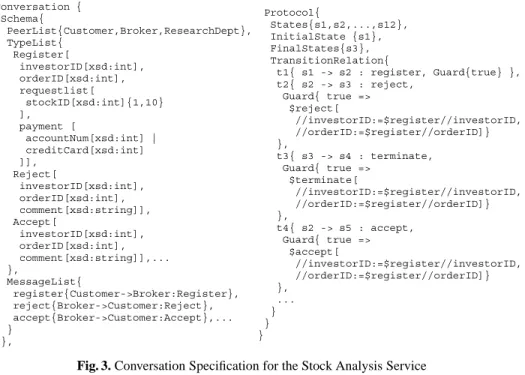
Conversation { Schema{ PeerList{Customer,Broker,ResearchDept}, TypeList{ Register[ investorID[xsd:int], orderID[xsd:int], requestlist[ stockID[xsd:int]{1,10} ], payment [ accountNum[xsd:int] | creditCard[xsd:int] ]], Reject[ investorID[xsd:int], orderID[xsd:int], comment[xsd:string]], Accept[ investorID[xsd:int], orderID[xsd:int], comment[xsd:string]],... }, MessageList{ register{Customer->Broker:Register}, reject{Broker->Customer:Reject}, accept{Broker->Customer:Accept},... } }, Protocol{ States{s1,s2,...,s12}, InitialState {s1}, FinalStates{s3}, TransitionRelation{ t1{ s1 -> s2 : register, Guard{true} }, t2{ s2 -> s3 : reject, Guard{ true => $reject[ //investorID:=$register//investorID, //orderID:=$register//orderID]} }, t3{ s3 -> s4 : terminate, Guard{ true => $terminate[ //investorID:=$register//investorID, //orderID:=$register//orderID]} }, t4{ s2 -> s5 : accept, Guard{ true => $accept[ //investorID:=$register//investorID, //orderID:=$register//orderID]} }, ... } } }
Fig. 3. Conversation Specification for the Stock Analysis Service
that describes the set of desired conversations (sequence of messages) generated by a set of interacting web services.
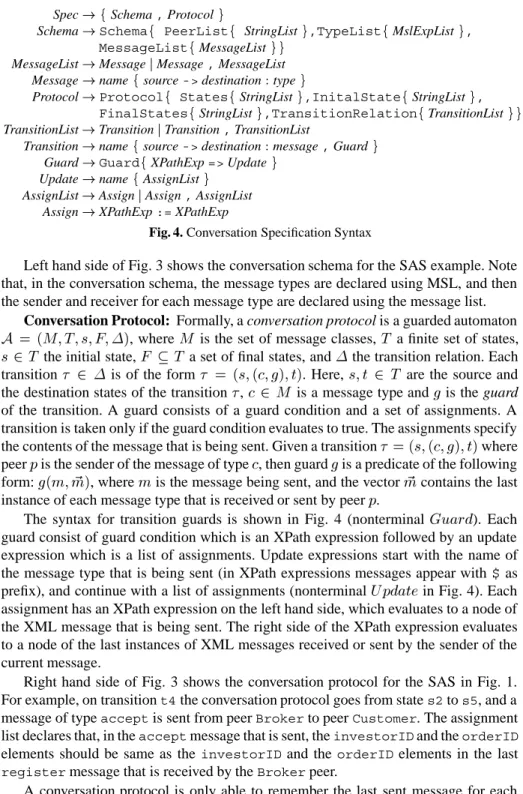
A conversation specification consists of a conversation schema that specifies the peers and the communication channels, and a conversation protocol. Fig. 3 shows parts of the conversation specification for the SAS in Fig. 1. The abstract syntax of the lan-guage we developed for specification of conversations is shown in Fig. 4. The non-terminals name, source, destination, type, and message all denote strings. The nonter-minal StringList denotes a list of strings separated by commas, and the nonternonter-minal
MslExpList denotes a list of MSL expressions separated by commas. The nonterminal XPathExp denotes an XPath expression. In a valid specification, source and destination
should be state names, type should be name of an MSL type and message should be a message name all defined in the specification.
Conversation Schema: Formally, a conversation specification is a tuple P =
h(P;M);Aiwhere(P;M)is a conversation schema and Ais a conversation
proto-col. A conversation schema is a pair(P;M)whereP is a finite set of peers andM a
finite set of message types. Each message typec 2 M is transmitted on exactly one
peer-to-peer channel.
In our specification language messages are XML documents. For each message typec 2M, letDOM(c)denote all the XML documents that match to the type
decla-ration ofc. Given a set of message typesM, we define the message alphabet as = S
c2M
fcgDOM(c). Each elementm2is called a message. LetTYPE(m)2M
Spec!{Schema,Protocol}
Schema!Schema{ PeerList{ StringList},TypeList{MslExpList},
MessageList{MessageList}}
MessageList!MessagejMessage,MessageList
Message!name{source->destination:type}
Protocol!Protocol{ States{StringList},InitalState{StringList}, FinalStates{StringList},TransitionRelation{TransitionList}}
TransitionList!TransitionjTransition,TransitionList
Transition!name{source->destination:message,Guard}
Guard!Guard{XPathExp=>Update}
Update!name{AssignList}
AssignList!AssignjAssign,AssignList
Assign!XPathExp:=XPathExp
Fig. 4. Conversation Specification Syntax
Left hand side of Fig. 3 shows the conversation schema for the SAS example. Note that, in the conversation schema, the message types are declared using MSL, and then the sender and receiver for each message type are declared using the message list.
Conversation Protocol: Formally, a conversation protocol is a guarded automaton A = (M;T;s;F;), whereM is the set of message classes,T a finite set of states, s2 T the initial state,F T a set of final states, andthe transition relation. Each
transition 2 is of the form = (s;(c;g);t). Here,s;t 2 T are the source and
the destination states of the transition,c 2M is a message type andgis the guard
of the transition. A guard consists of a guard condition and a set of assignments. A transition is taken only if the guard condition evaluates to true. The assignments specify the contents of the message that is being sent. Given a transition =(s;(c;g);t)where
peerpis the sender of the message of typec, then guardgis a predicate of the following
form:g(m;m)~ , wheremis the message being sent, and the vectorm~ contains the last
instance of each message type that is received or sent by peerp.
The syntax for transition guards is shown in Fig. 4 (nonterminalGuard). Each
guard consist of guard condition which is an XPath expression followed by an update expression which is a list of assignments. Update expressions start with the name of the message type that is being sent (in XPath expressions messages appear with$as prefix), and continue with a list of assignments (nonterminalUpdatein Fig. 4). Each
assignment has an XPath expression on the left hand side, which evaluates to a node of the XML message that is being sent. The right side of the XPath expression evaluates to a node of the last instances of XML messages received or sent by the sender of the current message.
Right hand side of Fig. 3 shows the conversation protocol for the SAS in Fig. 1. For example, on transitiont4the conversation protocol goes from states2tos5, and a message of typeacceptis sent from peerBrokerto peerCustomer. The assignment list declares that, in theacceptmessage that is sent, theinvestorIDand theorderID elements should be same as theinvestorIDand theorderIDelements in the last registermessage that is received by theBrokerpeer.
A conversation protocol is only able to remember the last sent message for each class. This is not a significant restriction based on the web services we have examined.
Note that more information about the sent and received messages can be stored in the states of the conversation protocol. Another approach would be to extend the guard definition so that the guards can refer to the last ` instances of each message class
where`is a fixed integer value. Such an extension would not effect the approach and
the results discussed in this paper.
Conversations: Given a conversation specificationP = h(P;M);Ai, a
configu-ration of the conversation protocolA=(M;T;s;F;)is a tuple(t;m)~ wheret 2T
and message vectorm~ 2DOM(c 1
)DOM(c
k
),k=jMj, keeps track of the latest
instance of each message type. For a vectorm~ and message typec, letm[c]~ denote its
projection toDOM(c). A configuration(t 1
;m~ 1
)is said to derive another configuration (t
2 ;m~
2
)via a messagem2, written as(t 1 ;m~ 1 ) m !(t 2 ;m~ 2 ), if there is a transition (t 1 ;(c;g);t 2 )2such that – messagemandm~
1satisfy the guard
g, i.e.,g(m;m~ 1 )is true, and – m~ 2 [TYPE(m)] = mandm~ 1 and ~ m
2 have same instances for all other message
types, i.e., for allc2Msuch thatc6=TYPE(m),m~ 1
[c]=m~
2 [c].
LetA = (M;T;s;F;)be a conversation protocol and letw = w 0
;w
1
;:::be a
finite word over, i.e.,w 2
. A run ofAfor the wordwis a finite sequence of
configurations 0 ; 1 ;:::such that, 0
= (s;(?;:::;?))wheresis the initial state of
the conversation protocol,?denotes an uninitialized message, and for all0 i <
jwj, i w i ! i+1. A word w 2
is accepted by the conversation protocolAif there
exists a run forw, such that jwj
=(t;m)~ andt 2 F. We define,L(P), the set of
conversations defined by a conversation specificationP =h(P;M);Ai, as the set of
words accepted by the conversation protocolA.
We use the temporal logic LTL to express properties of conversations. We define the set of atomic propositions as follows: Each atomic proposition is either of the formc
wherecis a message class (i.e.,c2M), or c.pred, wherec2Mand pred is a predicate
over the content ofc. We denote that a messagem2satisfies an atomic proposition
bymj= , where
mj= iff
TYPE(m)= if 2M
TYPE(m)=c ^ pred(m)=true if =c:pred
LTL formulas are constructed from atomic propositions, logical operators^;_;:,
and temporal operators X, G, U, and F. The semantics of LTL temporal operators can be easily defined on finite length conversations [9]. Given a conversation specification
Pand each LTL property, we say thatP j=, iff for allw2L(P),wj=.
For example, two sample LTL properties of the conversation protocol in Fig. 1 are: 1. G($register!F($accept_$reject)): Eachregisterwill be eventually
followed by arejectoracceptmessage.
2. G($register//stockID==a!F($request//stockID==a)): EverystockID
appeared in theregistermessage will eventually appear in therequestmessage from Broker to ResearchDept.
A conversation specificationP over a schema(P;M)is finite state if for eachc2 Mmessage typechas a finite domain. Given a finite state specification, we can translate
the guarded automaton of a finite state conversation protocol to a standard automaton without any guards and then use the results for finite state LTL model checking. In particular, we can prove the following:
Theorem 1. Given a finite-state conversation specificationP = h(P;M);Aiwhere
M =fc
1 ;:::;c
k
g, and an LTL property, determiningP j=takesjTjDOM(c 1 )j jDOM(c k )j2 O(jj) time.
The above result follows from the size of the standard automaton constructed from the given conversation protocol specification and the results on LTL model checking [5]. Note that the exponential complexity in the size of the LTL formula is not a prohibitive factor since sizes of typical LTL formulas tend to be small. In section 5 we exploit the above result by translating conversation protocols to input language of the SPIN model checker and then use SPIN model checker to verify properties of conversations.
4
Realizable Protocols and Peer Synthesis
In this section, we give a formal model for a composite web service which consists of multiple peers communicating with asynchronous messaging. A composite web service is a tupleS =h(P;M);A
1 ;:::;A
n
i, where(P;M)is a conversation schema,n=jPj
and eachA
iis an implementation for peer p
i
2P. For each peerp
i, its implementation A i is a guarded automaton (M in i ;M out i ;T i ;s i ;F i ; i ), whereM in i ( M out i ) are incoming (outgoing) message types forp
i, and T i, s i, F
iare the set of states, the initial state, and
the set of final states, resp. Each transition 2
i has a source state q 1 2 T i and a destination stateq 2 2 T
i and is in one of the following three forms: 1)
-move where
=(q
1
;;q
2
), which only changes the state, 2) consuming an input message where = (q 1 ;?a;q 2 )anda2M in i
, which changes the state and removes the consumed message from the input queue, or 3) producing an output message where = (q
1 ;(!b;g);q 2 ) andb 2 M out i
andg is the transition guard, which changes the state and appends the
produced message to the input queue of the receiving peer.
The global configuration of a composite web serviceSis a(2n+3)-tuple of form (Q 1 ;t 1 ;:::;Q n ;t n
;w;~s ;~c)where for eachj2[1::n],Q j
2
is the content of the in-put queue of peerp
j, t jis the state of p j, w2
is the sequence of messages recorded by the global watcher, and message vectors~s;~c record the latest sent and consumed
instances (resp.) for each message type. It is straightforward to define a derivation rela-tion between two configurarela-tions based on the transirela-tion relarela-tions of the peers such that
!
0
if and only if there exists a peerp
iand a transition
2
isuch that executing
the transitionin configurationresults in the configuration 0
[9]. Note that each send operation appends the message 1) to the input queue of the receiver and 2) to the global watcher at the same time.
A run ofSis a finite sequence of configurations= 0
;
1
;
2
;:::that satisfies the
following conditions: 0 = (;s 1 ;:::;;s n
;;[?;:::;?];[?;:::;?])is the initial
con-figuration, wheres
i is the initial state of p
i for each
i 2 [1::n], and for eachi 0,
i ! i+1, and jj =(;s 0 ;:::;;s 0
peerp i, s 0 i 2 F i. A finite word w 2
is a conversation of a composite web service
Sif there exists a run= 0
;
1
;
2
;:::ofSsuch that, the value of the watcher in the
final configuration isw. LetL(S)denote the set of conversations ofS.
Given a composite web serviceSand an LTL property, we say thatS j=, iff for
allw 2L(S),wj=. We say that a composite web serviceSover a schema(P;M)
has finite message content if for each message typec2M,DOM(c)is finite. In contrast
to Theorem 1 we have the following property: Given a composite web serviceS with
finite message content and an LTL property, testingS j=is undecidable [9].
We now formalize the relationship between a conversation protocol and a composite web service. A composite web serviceSconforms to a conversation specificationPiff L(S)L(P), andSrealizesPiffL(S)=L(P).
Given a conversation specificationP =h(P;M);Ai, let i
(A)denote the
projec-tion of the conversaprojec-tion protocolAonto a peerp i
2P.
i
(A)is a guarded automaton
obtained fromAby replacing each move for a message that is not related to peerp
iwith
an-move, and dropping guards of the transition edges that are labeled with incoming
messages. Let(P) = h(P;M); 1
(A);:::;
n
(A)i be the composite web service
derived from the conversation specificationP. Of course the interesting question is, if L((P))=L(P), i.e., is the conversation specification and the composite web service
which corresponds to its projection generate the same set of conversations? Below we present a set of realizability conditions which ensures that this is the case.
Realizability Conditions: In [9] we defined three realizability conditions for
guard-less conversation protocols. Here we extend these conditions by presenting an extra condition for the transition guards (i.e., that concerns the message contents). Then the realizability check is implemented by checking the first three realizability conditions on the skeleton of the conversation protocol (i.e, without considering the guards), and then checking the fourth realizability condition on the guards.
For a conversation protocolA=(M;T;s;F;), its skeleton is a standard
(guard-less) automatonA 0
=(M;T;s;F;
0
)where each transition 0
2
0
is generated by dropping the guard of a corresponding transition in. Note that the language
recog-nized by skeletonA 0 , i.e.,L(A 0 )is a subset ofM , whileL(A) .
The skeleton of a conversation protocols is realizable if it satisfies the following three realizability conditions [9]:
1) Synchronous compatibility: A conversation protocol skeleton is synchronous
com-patible if when we project the skeleton onto each peer and construct the Cartesian
prod-uct of the projections, the resulting automaton does not contain a state where a peerp i
is ready to send a message to peerp
jbut peer p
jis not ready to receive the message.
2) Autonomy: A conversation protocol skeleton is autonomous if for each peerp
iand
each finite prefix wof a conversation, at most one of the following three conditions
hold: a) the next transitions ofp
i (including transitions that are reachable through
-transitions) are all send operations, b) the next transitions ofp
i(including transitions
that are reachable through-transitions) are all receive operations, or c)p
iis either in a
final state or it can reach a final state through-transitions.
3) Lossless join: A conversation protocol skeleton is a lossless join if we project the
conversations allowed by the protocol to the alphabet of each peer and compute the join of the projected sets, the result is equal to the original conversation set.
Finally, we need a new fourth realizability condition that restricts the guards of a conversation protocol as follows:
4) Deterministic guards: To check the deterministic guard condition, for each peerp
i,
we analyze the projected automaton i
(A). We determinize i
(A)as a guardless
stan-dard FSA, ignoring the guards. Each state in this determinized automaton corresponds to a set of states in
i
(A). For each state in the determinized automaton we collect
all the transitions which have the same source, destination and message classes in the corresponding states in
i
(A). We require that at each state for all send transitions at
that state there can be at most one guard for each message type, i.e., if there are two send transitions with the same message type, their guards have to be identical.
Theorem 2. LetP = h(P;M);Aibe a conversation specification whereAhas
de-terministic guards and the skeleton ofAis synchronous compatible, autonomous, and
lossless join. ThenL((P))=L(P).
The proof can be easily extended from our results for conversation protocols without message contents and guards in [9].
5
Translation to Promela
In this section, we discuss the translation of a conversation protocol to Promela, the input language of the SPIN model checker [10]. We first introduce the mapping of an MSL type declaration to a Promela type definition, and then we show how to translate an XPath expression into an equivalent Promela code based on this mapping.
Translating MSL Type Expressions: Each MSL simple type has a counterpart in
Promela. For example, “xsd:int” and “xsd:boolean” are mapped to Promela types “int” and “bool”, respectively. As strings are used solely as constants in our frame-work, all string constants in a protocol are collected and declared as symbolic constants using an “mtype” declaration in Promela and the type “xsd:string” is mapped to type “mtype”. MSL complex types are mapped to “typedef” record constructs in Promela. In the following we present the Promela translation for theRegistertype declared in Fig. 2(c). typedef t2_requestlist{ int stockID [10]; int stockID_occ; } typedef t3_payment{ int accountNum; int creditCard; mtype choice; }
mtype {m_accountNum, m_creditCard};
typedef Register{ int investorID; int orderID; t2_requestlist requestlist; t3_payment payment; }
In the above Promela code, two additional type declarations are generated for ele-mentsrequestlistandpayment(prefixes"t2 "and"t3 "are generated to avoid name collisions). Since elementstockIDhas max occurrence of 10, it is declared as an array in the translation, and an additional variablestockID occis used to record the actual occurrence ofstockID. Also, note that, in the mapping ofpayment, an addi-tional variablechoiceis declared to record which element ofpayment(accountNum orcreditCard) is selected in each instance.
Translating XPath expressions without function calls: Before discussing the
translation algorithm, let us first study one example. Given two messagesregInfo1 andregInfo2of typeRegister, the query “Is there anystockIDthat appears in both messages?” can be captured by the boolean XPath expression$regInfo1//stockID == $regInfo2//stockID. The translation of this XPath expression to Promela is as follows, and note that prefix “v_” is attached to message name to avoid name collisions.
bool b1 = false; int i1=0, i2=0;
do :: i1 < v_regInfo1.requestlist.stockID_occ -> do :: i2 < v_regInfo2.requestlist.stockID_occ -> if ::v_regInfo1.requestlist.stockID[i1] == v_regInfo2.requestlist.stockID[i2] -> b1 = true; :: else -> skip; fi; :: else -> break; od; :: else -> break; od;
The main body of the above Promela code is a nested loop that searches for the array indices which makes the equality test succeed. Integer variablesi1andi2 are used as indices, and boolean variableb1is used to record the final result.
The translation algorithm we used in our implementation generates the above code in two stages. In the first stage, each XPath query is symbolically evaluated while recording the required information to generate the Promela code for enumerating all the nodes that match the query. The second stage generates the Promela code by traversing the trees generated in the first stage.
An XPath expressions consists of a set of XPath queries (as described in Section 2) which are combined using operations and predicates on basic types (such as addition, equality, etc.). Each XPath query consists of a set of XPATH operators. In the first stage of the algorithm, we traverse each XML query in the XPath expression from left to right, one operator at a time. During this traversal we generate a tree. The root node of the tree (at level 0) corresponds to the root node of the XML tree. A node in leveliis obtained
by applying the operatorito a node in leveli 1. The leaf nodes of the generated tree
correspond to XML nodes which match the corresponding query. Some nodes in the generated tree correspond to arrays and represent all the elements in an array. We call such nodes parameterized nodes. At the end of the first stage we end up with one tree for each XPath query in the XPath expression. We can generate Promela code which traverses all the XML nodes that match an XPath query by traversing the tree generated for it in the first stage. Note that, in order to to do that, we need to generate loops for the parameterized nodes.
The second stage generates the Promela code for the XPath expression using the trees generated in the first stage. The generated code consists of a set of nested loops which are used for traversing arrays. The innermost statement in each nested loop block corresponds to the input XPath expression where each XPath query in the XPath ex-pression is replaced with a string that corresponds to the XML nodes which match that query. For the above example, the innermost statement is:
v_regInfo1.requestlist.stockID[i1] == v_regInfo2.requestlist.stockID[i2] -> b1 = true;
which corresponds to the XPath expression
$regInfo1//stockID == $regInfo2//stockID
$regInfo1//stockIDand$regInfo2//stockID
are replaced with strings
v_regInfo1.requestlist.stockID[i1]andv_regInfo2.requestlist.stockID[i2]
Note that, the indicesi1andi2indicate that this statement is generated within a pair of nested loops which will enumerate all the elements in the two arrays.
Translating XPath expressions with function calls: We support two function
calls:position()andlast(). They are useful to enumerate and traverse through XML documents. For example, XPath expression
$request//stockID = $register//stockID[position()==last()]
assignsstockIDof arequestwith the laststockIDinregister. The Promela code generated for the above query is given below. The key point in the translation is to map each appearance of aposition()andlast()to an integer variable, and update values of these variables in the translated code. We omit the details of the code generation for function calls due to lack of space.
/* calculate last() */ //last() replaced by i1 int i1=0; int i2=0; //position() replaced by i3 int i3=0; do :: i2 < v_register.requestlist.stockID_occ -> i1++; i2++; :: else -> break; od;
/* calculate the statement */ i2 =0; do :: i2 < v_register.requestlist.stockID_occ -> i2++; /* update position() */ i3++; if :: (i3==i1) -> v_request.id = v_register.requestlist.stockID[i2]; :: else -> skip; fi; :: else -> break; od;
Translating a Conversation Protocol: Finally, we briefly present the layout of the
Promela translation of a guarded conversation protocol below.
/*1. type declaration */ typedef Register{ ... } /*2. message variables */ Register v_register; ... /*3. system variable */
mtype = {m_register, m_reject ... }; mtype state;
mtype msg;
/*4. local variables */ int i1, i2 ...
active proctype GProtocol{ /* 5. initialize all variables */ do
::
/* 6. evaluate last() calls */
/* 7. evaluate guards of each transition */
... bGuard_1 = true ...
if
/* 8. each transition */ //transition 1
:: state == s1 && bGuard1 -> state = s2;
msg = m_register;
... assignmentlist ...
/* 9. termination code for final states */ :: state == s3 -> break;
fi; od; }
The first part of the translation contains type declarations which is followed by variable declarations for messages. There are two system variables: “state” is used to record the current state of the guarded automaton, and “msg” is used to record the current message that is being transmitted. The main body of the protocol is a “do” loop. During each iteration of the loop, first the enabling conditions of all the transitions are evaluated and the results are stored in boolean variables (one for each transition). Then, using a nondeterministic “if” statement an enabled transition is nondeterministically chosen and executed. Finally, if the current state is a final state, the protocol can jump out of the loop and terminate.
6
Experimental Results and Conclusions
We ran experiments on samples from major web service solution vendors and web ser-vice standard specifications. The following table summarizes our datasets and the cor-responding experimental results. All conversation protocol source files, Promela trans-lations, and verification results can be downloaded at web address [6].
Problem Set Size Realizability Check Verification
Source Name #msg #states #transition C1 C2 C3 C4 Promela length StateVector(Byte) Time(sec) Depth
- SAS 9 12 15 p p p p 1904 204 166 405 ConvSetup 4 4 4 p p p p 340 32 43 187 IBM MetaConv 4 4 6 p p p - - - -Conversation Chat 2 4 5 p p p p 354 36 0 243 Support BuyStuff 5 5 6 p p p p 436 40 0.08 245 Project Haggle 8 5 8 p p p - - - -AMAB 8 10 15 p p p p 783 52 0.01 475 BPEL1.1 shipping 2 3 3 p p - - - -spec. loan 6 6 6 p p p - - - -auction 9 9 10 p p p p 767 64 71 543 Collaxa.com StarLoan 6 7 7 p p p p 624 80 0.02 357 auction 5 7 6 p p p p 462 64 78 254
As shown in the table, four of six examples from IBM, one of three examples from BPEL, and two examples from Collaxa.com satisfy all the realizability conditions. All failed examples do not satisfy autonomous property, mostly due to scenarios where two peers are in a racing to send each other a message. Since neither the BPEL standard nor the IBM conversation project clarify the assumptions about the underlying communi-cation infrastructure, we suspect that these failed examples may be originally designed assuming synchronous communication.
We generated Promela translations for all examples which satisfy realizability con-ditions, and checked one property for each example. For example, we checked the fol-lowing LTL property for the SAS protocol, whereindexandvalueare two predefined
constants.
G((index<v_register.requestlist.stockID_occ
&& v_register.requestlist.stockID[index]==value)!F(v_request.stockID==value))
This property states that if somestockIDappears in the registration request, then it should eventually appear in the request from Broker to ResearchDept. For all other examples, we checked LTL properties in the form “G(p !Fq)”. For some of the
ex-amples we intentionally checked properties that were not satisfied by the specification. The rightmost four columns of the table present the performance of the SPIN. Since we used the bitstate hashing optimization provided by SPIN, memory consumption for all examples are similar (around 20MB), so we gave the size of the State Vector to indi-cate the size of the state space. As suggested by the table, verification cost increases with the number of states, and transitions, and especially with the Promela translation size. SAS example has the highest verification cost, because its XPath expressions are the most complicated among all examples. There are some examples with verification time less than one second, this is because SPIN detect the error and ends the exhaustive search early. All the realizability tests were completed in a fraction of a second for all the examples.
In this paper, we studied verification of composite web services in terms of their conversations (i.e. message interactions). The novelty of the model beyond our earlier models is a specification language that uses XML schema and XPath, which brings our model much closer to standards such as BPEL. We obtained sufficient conditions for realizability of conversation protocols and implemented the algorithm to check re-alizability. We also developed an algorithm to translate conversation specifications to Promela.
Design of composite web services has many challenging problems and developing tools and techniques for studying global behavior of web services is an interesting topic. This paper presents a promising approach to meeting some of the challenges.
References
1. R. Alur, K. Etessami, and M. Yannakakis. Realizability and verification of MSC graphs. In
Proc. 28th Int. Colloq. on Automata, Languages, and Programming, 2001.
2. Business process execution language for web services (BPEL), version 1.1. available at http://www.ibm.com/developerworks/library/ws-bpel.
3. A. Brown, M. Fuchs, J. Robie, and P. Wadler. MSL a model for W3C XML Schema. In
Proc. of 10th World Wide Web Conference (WWW), pages 191–200, 2001.
4. T. Bultan, X. Fu, R. Hull, and J. Su. Conversation specification: A new approach to design and analysis of e-service composition. In Proceedings of the Twelfth International World
Wide Web Conference (WWW 2003), pages 403–410, May 2003.
5. E.M. Clarke, O. Grumberg, and D. A. Peled. Model Checking. The MIT Press, Cambridge, Massachusetts, 1999.
6. Experimental data sets. available at http://cs.ucsb.edu/˜fuxiang/tacas data/.
7. Christopher Ferris and Joel Farrell. What are web services? Comm. of the ACM, 46(6):31–31, June 2003.
8. H. Foster, S. Uchitel, J. Magee, and J. Kramer. Model-based verification of web service compositions. In Proceedings of the 18th IEEE International Conference on Automated
Software Engineering Conference (ASE 2003), 2003.
9. X. Fu, T. Bultan, and J. Su. Conversation protocols: A formalism for specification and verification of reactive electronic services. In Proc. 8th Int. Conf. on Implementation and
Application of Automata (CIAA 2003), volume 2759 of LNCS, pages 188–200, 2003.
10. G. J. Holzmann. The SPIN Model Checker: Primer and Reference Manual. Addison-Wesley, Boston, Massachusetts, 2003.
11. S. Narayanan and S. A. Mcllraith. Simulation, verification and automated composition of web services. In Proceedings of the 11th International World Wide Web Conference, 2002. 12. Simple object access protocol (soap) 1.1. W3C Note 08, May 2000.
(http://www.w3.org/TR/SOAP/).
13. W3C. Web services description language (WSDL) version 1.1. available at
http://www.w3.org/TR/wsdl, 2001.
14. Web Service Choreography Interface (WSCI) Version 1.0.
http://www.w3.org/2003/01/wscwg-charter.
15. Extensible markup language (XML). available at http://www.w3c.org/XML. 16. XML Path Language version 1.0. available at http://www.w3.org/TR/xpath. 17. XML Schema. available at http://www.w3c.org/XML/Schema.