A Computer Assisted Optimal Depth Lower Bound for
Nine-Input Sorting Networks
Ian Parberry∗
Department of Computer Science Penn State University
Abstract
It is demonstrated, using a combination of theoretical and experimental computer science, that there is no nine-input sorting network of depth six. If a nine-input sorting network of depth six exists, then there exists one with very special structure. There is an efficient algorithm for constructing and testing comparator networks of this form. This algorithm was implemented and executed on a supercomputer.
1
Introduction
Oblivious comparison-based sorting received much attention early in the history of parallel computing, and has continued to be the subject of much research. The central problem, dubbed the Bose-Nelson sorting problem by Floyd and Knuth [6] (after Bose and Nel-son [5]), is to devise the most efficient method of sortingnvalues using a fixed sequence of comparison-swap operations. Many popular sequential sorting algorithms such as merge-sort are not oblivious, since the sequence of comparisons performed is not the same for all inputs of any given size. In contrast,bubblesort is oblivious. An oblivious comparison-based algorithm for sortingnvalues is called ann-inputsorting network. One measure of the per-formance a sorting network is itsdepth, defined to be the number of parallel steps that the algorithm takes given that in one step any number of disjoint comparison-swap operations can take place simultaneously. Sorting networks have a particularly elegant implementation as circuits. Since the comparison-swap operations are oblivious, they can be hard-wired into place.
Optimal sorting networks forn≤8 and the most efficient sorting networks constructed to date for n≤16 can be found in Knuth [7] (see Table 1). There are several methods for recursively constructing sorting networks of depthO(log2n) (see, for example, Batcher [3], Parberry [8]), Their depth can be improved by a constant by interrupting the recursive construction early and substituting the best known sorting network on a small fixed number of inputs. For extremely largenthe asymptotically optimalO(logn) depth sorting network of Ajtai, Koml´os and Szemer´edi [1, 2] has superior depth.
It was known that no nine-input sorting network of depth five can exist, but the best that had been obtained was depth seven. These bounds remained unimproved for over fifteen years. We undertook to determine by exhaustive search whether a nine-input sorting ∗Research supported by NSF Grant CCR-8801659 and a Research Initiation Grant from the Pennsylvania
State University. Author’s current address: Department of Computer Sciences, University of North Texas, P.O. Box 13886, Denton, TX 76203-3886, U.S.A. Electronic mail: [email protected].
n 1 2 3 4 5 6 7 8 9 10 11 12 13 14 15 16
Upper 0 1 3 3 5 5 6 6 7 7 8 8 9 9 9 9
Lower 0 1 3 3 5 5 6 6 7* 7* 7 7 7 7 7 7
Table 1: Current upper and lower bounds on the depth of n-input sorting networks. The starred values are demonstrated here, and were previously equal to six.
network of depth six exists. It is reasonable to ask why we believed that such a naive approach could work now, as opposed to fifteen years ago. The answer is that the fruits of the last fifteen years of research in Computer Science have included impressive tools for the design and analysis of algorithms (theoretical computer science), the implementation of algorithms as programs (structured programming), the translation of programs into object code (compilers), and the execution of object code (supercomputers). Without any one of these tools, the search would not have been feasible. Even with these tools, its feasibility is not immediately apparent.
If our exhaustive search had found a sorting network of depth six, we would now conclude this paper by exhibiting it. However, no such sorting network was found. We can deduce (assuming that the program was correct) that no such sorting network exists. There is much contention in the mathematical community over whether such a computer-assisted “proof” of nonexistence really constitutes a proof in the formal sense. We prefer to regard this type of result as experimental computer science rather than mathematics. In the spirit of traditional experimental science, we will attempt to describe the experiment in sufficient detail for it to be believable and verifiable. Although it is clear that our program could not be used for sorting networks with more than ten inputs, it is hoped that the insights we have gained and techniques we have developed may serve as inspiration and tools for further research.
The remainder of the paper is divided into seven sections. We start with a formal defi-nition of a sorting network (Section 1). It is easy to see that the search-space is far too large for a naive exhaustive search to be feasible using current technology (Section 3). Generating the candidates is fairly straightforward (Section 4), and the number of candidates can be substantially reduced by considering symmetries (Section 5). Testing of the candidates can be achieved quickly by using standard techniques, and information obtained during testing can further reduce the number of candidates (Section 6). A heuristic which rejects almost all and only non-sorting networks (Section 7) further reduces running time to the point where it can be implemented (Section 8). A preliminary version of this paper appeared in [10].
2
Sorting Networks
It will be convenient to adopt a formal notation for specifying sorting networks, in the interest of clarity and conciseness. Formally, a comparator network with n inputs is an ordered tuple (L1, L2, . . . , Ld, n). Each Lk is called a level, and is is a set of ordered pairs
k. The values i and j are called channels. We insist that every channel is involved in at most one comparison at each level, that is,
|{i, j ∈Lk|i < j ≤n}|+|{j, i ∈Lk|1≤j < i}| ≤1, for all 1≤i≤nand 1≤k≤d.
Comparator networks are used to sort an input x=x1, . . . , xn of ndistinct values as follows. Let C = (L1, L2, . . . , Ld, n) be a comparator network. Define the value of C in channeliat levelkon inputxto beV(i, k), whereV(i,0) =xifor 1≤i≤n, and fork >0,
V(i, k) = min(V(i, k−1), V(j, k−1)) ifi, j ∈Lk max(V(i, k−1), V(j, k−1)) ifj, i ∈Lk V(i, k−1) otherwise.
Theoutput of C on inputx is defined to beV(1, d), V(2, d), . . . , V(n, d). If the output of
C is in ascending order for all inputsx, then C is called asorting network.
Each level of a comparator network consists of a set of independent comparisons which may be performed in parallel. The number of levels is thus a reasonable measure of parallel time. We will call this thedepth of the network. We are also interested in thesize of the network, which we define to be the total number of comparators used,
d i=1
|Li|.
3
Exhaustive Search
Before investing a large amount of time in writing a program which implements a naive exhaustive search algorithm, it is prudent to estimate its running time. The size of the search space should be calculated, and some simple experiments should be performed to determine how much time is required to test each candidate. The product of these two values will be a reasonable estimate of the running time of the search program.
We say that a comparator network hasmaximal size if it has the maximum number of comparators for its depth. A maximal-size comparator network of depth d with n inputs hasd n/2 comparators. Let C(n, d) be the number of maximal-size comparator networks of depth d. Then C(n, d) =M(n)d, where M(n) is the number of different candidates for a single level.
If nis even, each level consists ofn channels which are matched perfectly into pairs by
n/2 comparators. Therefore there are as many different candidates for a single level as there are perfect matchings of nitems. Ifnis even, there aren−1 choices for the channel to be matched to channel 1, n−3 choices for the channel to be matched to the next unmatched channel, etc. That is, M(n) is the product of the odd numbers less than n. If n is odd, then there are as many different candidates for a single level as there are perfect matchings of n+ 1 items. Therefore,
M(n) =
(n−1)/2 i=1
(2i+ 1)
for all n≥1. The number of candidate comparator networks of maximal size is therefore
Improvement Running Time Naive Algorithm 4×10¹¹ years First level symmetries 4×10⁸ years Second level symmetries 2×10⁷ years Construction of last level 2×10⁴ years
Heuristic 20 years
CRAY-2 200 hours
Table 2: Estimated running time for the naive exhaustive search algorithm and for each of the successive improvements.
A maximal-size sorting network of depth six with nine inputs has 24 comparators. From Van Voorhis [12], all nine-input sorting networks must have at least 23 comparators. There-fore every non-maximal-size candidate can be generated from a maximal-size one by deleting a single comparator. Of the 24 comparators, only 16 are candidates for deletion since every sorting network which is missing a comparator from the first or last level still sorts when the comparator is replaced. (Note that, contrary to intuition, this is not the case for arbitrary comparators: inserting a comparator into the centre of one of the small but deep sorting networks in Knuth [7] will cause it to fail.) Thus there are 16C(9,6) candidate comparator networks which are not maximal-size, making a total of 17C(9,6)≈1.2×10¹⁹.
Suppose that it is possible to generate and test 100 comparator networks per second (preliminary experiments indicated that this is a reasonable assumption for a program written in Berkeley UNIX1 Pascal and executed on a VAX 11/7802). The running time of the naive exhaustive search program would then be 3.8×10¹¹years. We can conclude that a naive exhaustive search is not a feasible option.
However, we will see in the remainder of the paper that the running time can be re-duced by the use of slightly more sophisticated techniques. In Section 5 we will learn that the number of candidates for the first level can be reduced to 1, and that the number of candidates for the second level can be reduced to 57. In Section 6 we will see how to con-struct the last level on-the-fly during testing, given the first five levels. In Section 7 we will develop a heuristic which can be applied to the first four levels of the network. It will be proved that the heuristic, which in preliminary experiments rejected more than 99.9% of the bad candidates (which cannot be completed to give a sorting network), does not reject any good candidates. Finally, by implementing the algorithm on a CRAY-23 supercomputer (which is approximately 1000 times faster than the VAX 11/780 used for the preliminary experiments), the run-time can be brought down to a practical level. Table 2 shows the effect of each of these successive improvements.
1UNIX is a trademark of AT&T Bell Labs. 2VAX is a trademark of Digital Equipment Corp. 3CRAY is a trademark of Cray Research.
4
Generating Comparator Networks
The problem of generating all n-input comparator networks of depth dcan be reduced to generating all possible candidates for a single level. We omit the details of this standard reduction, which is a simple exercise using recursion. We can restrict ourselves to generating maximal-size comparator networks, since we observed in Section 3 that non-maximal-size networks can be generated by the selective deletion of comparators from a network of maximal size. We also saw in Section 3 that this problem is reducible to the problem of generating all perfect matchings of an even number of items.
Suppose n is even. Consider the problem of generating the perfect matchings of the valuesa1, a2, . . . , an which are initially stored in an array nameditem, withitem[i] =ai for 1 ≤ i≤ n. Procedure match will permute the contents of item in such a manner that all perfect matchings are generated, where the value initem[2i−1] is to be matched with the value in item[2i], for 1 ≤i≤n/2. It would be sufficient to generate all permutations, but our aim is to keep the running time to a minimum by generating only permutations which are perfect matchings. We assume the existence of a procedure called process, which takes an array as a parameter and processes the perfect matching contained therein.
1. procedure match(item,n); 2. begin
3. ifn= 2then process(item)
4. else
5. begin
6. match(item,n−2);
7. fori:=n−2 downto1do
8. begin
9. swapitem[i] with item[n−1]; 10. match(item,n−2) 11. end; 12. temp:= item[n−1]; 13. fori:=n−1 downto2do 14. item[i] := item[i−1]; 15. item[1] :=temp 16. end 17. end;
The perfect matchings of the nvalues in item[1],item[2], . . . ,item[n] are processed with a call to match(item,n). The correctness of the procedure can be verified by induction on even n. The hypothesis is certainly true for n = 2. Now suppose that the hypothesis is true for match(item,n−2). In line 6, all perfect matchings of n items with an matched to an−1 are processed. In lines 7 through 11, each iteration of the for-loop processes the perfect matchings of n items with an successively matched with an−2, an−3,. . . , a1. Upon termination of the for-loop, item[n] =an,item[1] = an−1, and for 2 ≤i≤n−1, item[i] =
ai−1. This permutation (a cyclic shift of item[1] through item[n−1]) is undone in lines 12 through 15.
Let T(n) be the running-time of procedure match with second parameter n, where n
is even. We claim that T(n) =O(M(n)); that is, the amount of time required to process all perfect matchings of nitems is linear in the number of perfect matchings. We know by inspection of the algorithm thatT(2) =cand for n≥4, T(n) = (n−1)T(n−2) +dn, for
some natural numbersc, d.
Lemma 4.1 If 2≤i≤n/2−1, and n≥4 is even, then: i k=1 k j=1 (n−2j+ 1)≤2 i j=1 (n−2j+ 1). (1) Proof: The proof follows by induction on i. The hypothesis holds for i = 2, since (n−1) + (n−1)(n−3)≤2(n−1)(n−3) forn≥4. Now suppose that
i−1 k=1 k j=1 (n−2j+ 1)≤2 i−1 j=1 (n−2j+ 1). (2) From inequality (1), it is sufficient to prove that
i−1 k=1 k j=1 (n−2j+ 1)≤ i j=1 (n−2j+ 1). (3) By inequality (2), inequality (3) holds if
2 i−1 j=1 (n−2j+ 1)≤ i j=1 (n−2j+ 1),
that is,n−2i+ 1≥2, which certainly holds for i≤n/2−1. ✷ It can be demonstrated by induction oni≤n/2−1 that
T(n)≤ i j=1 (n−2j+ 1)T(n−2i) + 2d i k=1 k j=1 (n−2j+ 1).
Therefore by Lemma 4.1 with i=n/2−1,
T(n)≤c n/2−1 j=1 (n−2j+ 1)T(n−2i) + 4d n/2−1 j=1 (n−2j+ 1). That is, T(n)≤(c+ 4d)M(n).
The recursion can be removed from procedurematchwithout asymptotic time loss using standard techniques. Both the recursive and the non-recursive versions of this algorithm generate the perfect matchings in the same order. We will number them consecutively, starting at one. We call this thelexicographic number of the perfect matching.
5
Symmetries
We have chosen to build our sorting networks usingmin-max comparators, which send the smallest value to the left and the largest to the right, as opposed tomax-min comparators, which send the largest to the left and the smallest to the right. Formally, a generalized
comparator network is an ordered tuple (L1, L2, . . . , Ld, n), where eachLkis a set of ordered pairsi, j, such that 1≤i, j≤n,i= j and for all 1≤i≤n, 1≤k≤d,
|{j| i, j ∈Lk}|+|{j| j, i ∈Lk}| ≤1.
Each ordered pair i, j ∈ Lk is called a min-max comparator if i < j, and a max-min comparator ifi > j. Intuitively, each comparator is an ordered pair of channels. The first is the channel which receives the minimum of the two inputs, and the second is the channel which receives the maximum of the two inputs. LetCbe a generalized comparator network. Suppose that the output ofC on input x=x1, x2, . . . , xn isy1, y2, . . . , yn. C is said to be a generalized sorting network if there exists a permutation Π :{1, . . . , n}→{1, . . . , n}
such that for all inputs x, the output is sorted after application of the permutation Π, that is,yΠ(1), yΠ(2), . . . , yΠ(n)is in sorted order. Generalized sorting networks are no more powerful than sorting networks:
Theorem 5.1 (Floyd-Knuth) For every generalized sorting network there is a sorting net-work with the same size and depth. If the former has onlymin-max comparators in the first
k levels, then the latter is identical in the first k levels.
Proof: See Knuth [7] or Parberry [9]. ✷ Let Π :{1, . . . , n}→{1, . . . , n}be a permutation. Ifi, jis a comparator, define Π(i, j) =
Π(i),Π(j). If L = {C1, . . . , Cr}, where each Ci is a comparator for 1 ≤ i ≤ r, define Π(L) = {Π(C1), . . . ,Π(Cr)}. If C = (L1, . . . , Ld, n) is a generalized comparator network, define Π(C) = (Π(L1), . . . ,Π(Ld), n).
Intuitively, Π(C) is the generalized comparator network obtained from C by permuting the channels according to the permutation Π, changing min-max comparators to max-min comparators (and vice-versa) as appropriate.
Lemma 5.2 If C is a generalized sorting network, then Π(C) is a generalized sorting net-work for everypermutation Π.
Proof: If the output of C is always in sorted order after it is permuted according to the permutation ΠC, then the output of Π(C) is in sorted order after application of the permutation Π−1 followed by application of ΠC. ✷
5.1 The First Level
There is no need to check all comparator networks to see if they sort. In fact, due to the following result we can fix the first level. We say that a comparator network is in first normal form if the first level has comparators between channel 2i−1 and channel 2i for 1≤i≤ n/2.
Theorem 5.3 If there is an n-input sorting network of depth d then there is an n-input sorting network of depth dthat is in first normal form.
Proof: LetC be a sorting network of depth d. Without loss of generality we can assume that the first layer of C is maximal-size. Clearly, there exists a permutation Π such that Π(C) is a generalized comparator network in first normal form. By Lemma 5.2, Π(C) is a
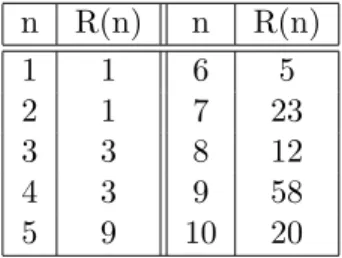
n R(n) n R(n) 1 1 6 5 2 1 7 23 3 3 8 12 4 3 9 58 5 9 10 20
Table 3: The value ofR(n), the number of representative second levels with
ninputs, for n≤10.
generalized sorting network. Therefore, by Theorem 5.1, there exists a sorting network of
depthdthat is in first normal form. ✷
5.2 The Second Level
The number of candidates for the second level of the comparator network can be reduced significantly. A permutation Π :{1, . . . , n}→{1, . . . , n} is called first-normal-form preserv-ing if for all n-input comparator networks C in first normal form, Π(C) is also in first normal form. Let ρ(n) be the set of first-normal-form preserving permutations. Then ρ(n) partitions the set of candidates for the second level of a comparator network into equivalence classes; two candidatesL1 andL2 are in the same equivalence class iff there exists Π∈ρ(n) such that Π(L1) = Π(L2). A level Lis called representative ifLhas minimal lexicographic number within its equivalence class. A comparator network is said to be insecond normal form if it is in first normal form and its second level is representative.
Theorem 5.4 If there is an n-input sorting network of depth d, then there is an n-input sorting network of depth dthat is in second normal form.
Proof: LetC be a sorting network of depth d. Without loss of generality we can assume thatCis in first normal form (by Theorem 5.3). Clearly, there exists a permutation Π∈ρ(n) such that Π(C) is a generalized comparator network in second normal form. By Lemma 5.2, Π(C) is a generalized sorting network. Therefore, by Theorem 5.1, there exists a sorting network of depthdthat is in second normal form. ✷ The representative perfect matchings which are candidates for the second level of a second normal form sorting network with n inputs can be pre-computed by generating equivalence classes by brute force. The number of representatives, denoted R(n), is easily computed for n ≤ 10 (see Table 3). We are particularly interested in R(9) = 58. This includes the lexicographically first perfect matching (which is in an equivalence class by itself). This is not a candidate for the second level of a first normal form sorting network since it is the same as the first level and thus could be deleted to give a sorting network of depth 5, which is known to be impossible (see Table 1).
It may at first seem puzzling that for large enough odd n,R(n)> R(n+ 1). Although the number of matchings is the same in both cases, there are more equivalence classes in the
former case than the latter, since the equivalence classes in the former case are in general smaller. This is due to the fact that first-normal-form preserving permutations must leave the last channel (which is the one without a comparator on the first level in first normal form) invariant when the number of inputs is odd.
6
Testing Sorting Networks
We store the current comparator network C = (L1, . . . , Ld, n) using two two-dimensional arrays max and min, in order to make the testing process as efficient as possible. For 1≤i≤n and 1≤k≤d,
min[i, k] =
j if there exists j < i such thatj, i ∈Lk
i otherwise
and max[i, k] is defined similarly. Intuitively, if there is a comparator on channeli at level
k then min[i, k] is the channel on which the minimum output of the comparator emerges, and max[i, k] is the channel on which the maximum output of the comparator emerges. It is a fairly straightforward task to translate from the perfect matching representation used in Section 5 to this new representation, or rather, to update the new representation of the current comparator network as changes are required.
6.1 The Zero-one Principle
One obvious way to verify that a comparator network sorts is to try all permutations of the numbers one through n as inputs. Fortunately, many fewer trials are sufficient. The following result is often called thezero-one principle.
Theorem 6.1 (Bouricious) Ann-input comparator network is a sorting network iff it sorts all sequences of nzeros and ones.
Proof: See Knuth [7] or Parberry [9]. ✷ By Theorem 6.1, we only need to check whether a comparator network sorts all 2n zero-one inputs. Suppose we check them in binaryreflected Graycode order. This ordering of the inputs has the useful property that each input differs from the previous one in exactly one bit. Bitner, Ehrlich and Reingold [4] provide algorithms for generating then-bit binary reflected Gray code in time O(2n) (that is, linear in the number of inputs generated). We will assume the existence of three sub-algorithms; procedurefirstinputwhich initializes the appropriate global variables to represent the all-zero input, functionfinishedwhich returns true if the global variables indicate that all inputs have been generated, and procedure
nextinput which updates the appropriate global variables to represent the next input in binary reflected Gray code order. In particular, a call tonextinput(channel,delta,zeros) will set variable channelto be the index of the bit which was changed (in the range 1 through
n),deltato be the value that it was changed to, and zeros to be the number of zeros in the current input. The details of these sub-algorithms are left to the interested reader. The following Boolean functionsorts returns true if the comparator network represented by the arraysmin and max is a sorting network.
1. function sorts(min,max); 2. begin 3. fori:= 1 tondo 4. fork:= 1 toddo 5. ones[i, k] := 0; 6. firstinput;
7. nextinput(channel,delta,zeros); 8. failed:=false;
9. whilenot failedand notfinisheddo
10. begin
11. failed:= notsortscurrent(channel,delta,zeros,min,max,ones); 12. nextinput(channel,delta,zeros)
13. end
14. return(notfailed) 15. end;
Functionsortsuses a Boolean functionsortscurrentwhich returns true if the current
com-parator network sorts the current input. In particular,sortscurrent(channel,delta,zeros,min,max,ones) assumes that:
1. The comparator network represented by the arrays min and max (which we will call the “current comparator network”) sorts the previous input.
2. The arrayonesrepresents the state of the current comparator network on the previous input in the sense that ones[i, k] contains the number of ones which are input to the comparator on channel i at level k if such a comparator exists, and is undefined otherwise.
3. The current input differs from the previous one in the bit whose index is given as the parameterchannel. The modified bit was changed to the value given as the parameter
delta. The number of zeros in the current input is given as the parameterzeros. IfC= (L1, L2, . . . , Ld, n) is a comparator network of sizesand depthd, thegraph ofC, denotedG(C), is defined as follows. It has a vertex for each channel at every level, and edges which indicate possible routes for the values being sorted. More formally, G(C) = (V, E) where
V ={(i, j)|1≤i≤n, 0≤j≤d},
and ((i1, j1),(i2, j2))∈E iff i2=i1+ 1 and eitherj1 =j2 orj1, j2 ∈Li2 orj2, j1 ∈Li2.
Ifx=x1, x2, . . . , xn ∈ {0,1}n, define the value of a vertex (i, j) ∈V on inputx, denoted
vx(i, j), to be the value of C in channeliat level j on input x(see Section 2). Let G(C, x) denote the labelled graph obtained by labelling the vertices of G(C) with their respective values on inputx.
Lemma 6.2 Let g(x) be the input which follows x in the binaryreflected Graycode or-dering. Then G(C, g(x)) differs from G(C, x) onlyin the labels of a sequence of vertices (0, j0),(1, j1), . . . ,(d, jd) which form a path inG(C).
Proof: The result follows by induction on d. Suppose that d = 1. Suppose that g(x) differs fromx in theith bit. There are three cases to consider.
Case 1. i, k ∈L1 for some i < k≤n. Let vi =vx(i,0) and vk=vx(k,0). There are four sub-cases to consider.
1. vi= 0, vk= 0. Thenvg(x)(i,1) = 0 andvg(x)(k,1) = 1. 2. vi= 0, vk= 1. Thenvg(x)(i,1) = 1 andvg(x)(k,1) = 1. 3. vi= 1, vk= 0. Thenvg(x)(i,1) = 0 andvg(x)(k,1) = 0. 4. vi= 1, vk= 1. Thenvg(x)(i,1) = 0 andvg(x)(k,1) = 1. The required result follows since (i,0,i,1),(i,0,k,1) ∈L1. Case 2. k, i ∈L1 for some 1≤k < i. The proof is similar to Case 1.
Case 3. i, k,k, i ∈E for all k=i. The required result follows since (i,0,i,1)∈L1. This completes the proof for d= 1. Now suppose that d >1 and the hypothesis holds for all sorting networks of depthd−1. By an argument similar to the above, the sequence
vg(x)(1,1), vg(x)(2,1), . . . , vg(x)(n,1) differs from
vx(1,1), vx(2,1), . . . , vx(n,1)
in exactly one bit. The required result then holds by the induction hypothesis. ✷ Thus in proceduresortscurrent(channel,delta,zeros,min,max,ones), changing the bit num-beredchannelin the current input to the valuedelta will cause 2dvalues in onesto change in a pattern which corresponds to a path in the graph of the current comparator network. Observation 1. Note that (by a case analysis) the changed bit affects the max output of the comparator on its channel iff the number of ones input to that comparator on inputx, plus one if the changed bit was changed to a one, equals one (and affects the min-output of that comparator otherwise).
Observation 2. It is particularly easy to check whether the current comparator network sorts the current input since we need only verify that the value on channel zeros+delta
changes at the outputs.
Thus proceduresortscurrent can be implemented as follows. A variablecurrent contains the channel whose value is changed at the current level; the current level is contained in variablelevel. By Lemma 6.2, there will be only one such channel at each level.
1. function sortscurrent(channel,delta,zeros,min,max,ones); 2. begin
3. current := channel; 4. forlevel := 1toddo
5. if there is a comparator on the current channel at this levelthen
6. begin
7. minimum:= min[level,current]; 8. maximum:= max[level,current];
9. newones := ones[level,current] +2·delta−1; 10. ifones[level,current] +delta= 1
11. thencurrent := maximum
12. else current :=minimum; 13. ones[level,minimum] := newones; 14. ones[level,maximum] := newones;
15. end
16. return(current=zeros+delta) 17. end;
Line 3 initializes the current channel to be the channel that has its value changed at level 0. Lines 4-15 set the current channel to the channel whose value is changed at levels 1 through d in turn. Lines 7 and 8 compute the channels on which the min-output and max-output of the comparator on the current channel at the current level emerge. Line 9 computes the new number of ones which are input to that comparator (one more than before if delta = 1 and one less than before if delta = 0). Lines 10-12 update the current channel (see Observation 1 above), and lines 13 and 14 update the number of ones input to the current comparator using the value computed in line 9. Line 16 computes the final result (see Observation 2).
The correctness of procedure sortscurrent can be proved by induction on the number of iterations of the for-loop. Clearly it runs in time O(d). Therefore procedure sorts runs in time O(2nd). The sorting network verification problem is co-NP complete even for shallow sorting networks (Parberry [11]), hence it seems unlikely that a sub-exponential time algorithm for checking optimal sorting networks is possible. However, a significant savings in time can be made by noticing that we are checking only comparator networks in first normal form. It is sufficient to check only the 3n/2 strings ofn/2 bit-pairs with each pair either 00, 01, or 11, since the first level of such a comparator network permutes all bit-strings into this form. Generation of the appropriate inputs can be achieved by generating the 3n/2 strings ofn/2 ternary digits (the ternary digit 0 represents the binary string 00, the ternary digit 1 represents the binary string 01 and the ternary digit 2 represents the binary string 11) internaryreflected Graycode order in linear time by modifying the algorithms of Bitner, Ehrlich and Reingold [4]. Thus the time to check each first normal form comparator network is O(3n/2d).
6.2 The Last Level
The last level of a sorting network can be constructed on-the-fly during the testing process if we use the algorithms of Section 6.1. We test each comparator network of depth d−1 to see if one more level can be added to make it a sorting network, as follows. Given a comparator network of depthd−1, check whether it sorts the current input. If so, then go
on to check the next input. Note that the subsequent addition of more comparators at level
d will not change its ability to sort this input. If it does not sort the current input, that is,current =zeros+delta in line 16 of function sortscurrent (see Section 6.1), then insert a comparator between channelscurrentandzeros+deltaon leveld. If this is acceptable, then go on to check the next input. If it is not acceptable (that is, there is already a comparator on one or both of the channels at leveld, inserted while testing a previous input), then reject the current comparator network. In this case the current comparator network of depthd−1 cannot be completed to give a sorting network of depthd.
7
The Heuristic
If c is a channel, let to(c) be the set of channels which can send a value to channel c in a two-level comparator network. Similarly, letfrom(c) be the set of channels which can receive a value from channelcin a two-level comparator network. More formally, if (L1, L2, n) is a two-level comparator network, andS ⊆ {1,2, . . . , n}, define fori= 1,2,
connecti(S) =S∪ {t|there exists s∈S such thats, t ∈Li ort, s ∈Li}.
Then to(c) = connect1(connect2({c})), and from(c) = connect2(connect1({c})). Clearly
|to(c)| ≤4 and |from(c)| ≤4. Furthermore:
Lemma 7.1 For anychannel c, |to(c)∪from(c)| ≤5.
Proof: Let C= (L1, L2, n) be a two-level comparator network, and 1≤c≤n. Without loss of generality, we will assume that C has maximal size. Supposeto(c) ={c, c1, c2, c3}, where there is a comparator between channelsc3andcinL1, there is a comparator between channelsc1 andc2 inL1, and there is a comparator between channelsc2 and cinL2. Then
c, c2, c3∈from(c). Therefore|to(c)∪from(c)| ≤5. ✷ The bound of Lemma 7.1 is easily seen to be tight.
When generating depthdcomparator networks, we pause after generation of leveld−2 and apply a further test to the first d−2 levels of the network. We call the latter a stub. If the stub fails the test, we move on to the next stub. Otherwise, we continue as before (generating all possible candidates for level d−1 in turn and testing whether the network can be completed by the construction of leveldto give a sorting network). This test prunes branches of the search tree at bad stubs. We must ensure that our test rejects only bad stubs, that is, stubs that cannot be extended to sorting networks by the addition of two levels of comparators. Stubs are tested by using the algorithms of Section 6 to construct for each channelca set reach(c) which consists of those channels that must either send a value to channelc in the last two levels or receive a value from channel c in the last two levels. That is,reach(c) consists of those channelsdsuch that for some input, in line 16 of function
sortscurrent, either c= current and d=zeros+delta or vice-versa. By Lemma 7.1 we can reject stubs that have a channel c with |reach(c)| >5. Although the test does not reject good stubs, it will not make a useful heuristic unless very few bad stubs pass. Preliminary experiments indicated that this would be the case.
8
Conclusion
The algorithms described in this paper were initially coded in Berkeley Unix Pascal and tested on a VAX 11/780. A moderate increase in speed (around 20%) was obtained by using the programming language C.
Some further small optimizations were implemented in the final version, for example, the search tree is pruned slightly by keeping track of redundant comparators. If a comparator is duplicated on two consecutive levels, then the second occurrence can be removed. As observed in Section 3, a 9-input sorting network of depth 6 can have only one redundant comparator. The search tree can be pruned at comparator networks which have more redundant comparators.
The final version of the program was run at low priority on a CRAY-2 supercomputer, and terminated correctly without finding any nine-input sorting networks of depth six. We have shown that if any such sorting network existed, then the program would have found a canonical version in the candidates that it tested. Therefore we conclude that no such sorting network exists. The program has also been used to enumerate the ten-input sorting networks of depth seven. A total of 87 sorting networks were found, including the previously known network listed by Knuth [7].
9
Acknowledgements
The author wishes to thank Bruce Parker for assistance with the implementation of the improvements to the sorting network testing routine using the ternary reflected Gray code (see Section 6.1), construction of the last level of the candidate comparator network on-the-fly (see Section 6.2), and for the translation of the source code from Pascal to C.
References
[1] M. Ajtai, J. Koml´os, and E. Szemer´edi. An O(nlogn) sorting network. Proc. 15th Ann. ACM Symp. on Theory of Computing, pages 1–9, April 1983.
[2] M. Ajtai, J. Koml´os, and E. Szemer´edi. Sorting inclognparallel steps.Combinatorica, 3:1–48, 1983.
[3] K. E. Batcher. Sorting networks and their applications. In Proc. AFIPS Spring Joint Computer Conference, volume 32, pages 307–314, April 1968.
[4] J. R. Bitner, G. Ehrlich, and E. M. Reingold. Efficient generation of the binary reflected gray code and its applications. Commun. ACM, 19(9):517–521, September 1976. [5] R. C. Bose and R. J. Nelson. A sorting problem. J. Assoc. Comput. Mach., 9:282–296,
1962.
[6] R. W. F loyd and D. E. Knuth. The Bose-Nelson sorting problem. In J. N. Srivastava, editor, A Surveyof Combinatorial Theory. North-Holland, 1973.
[7] D. E. Knuth. Sorting and Searching, volume 3 of The Art of Computer Programming. Addison-Wesley, 1973.
[8] I. Parberry. The alternating sorting network. Technical Report CS-87-26, Dept. of Computer Science, Penn. State Univ., September 1987.
[9] I. Parberry. Parallel ComplexityTheory. Research Notes in Theoretical Computer Science. Pitman Publishing, London, 1987.
[10] I. Parberry. A computer-assisted optimal depth lower bound for sorting networks with nine inputs. In Proceedings of Supercomputing ’89, pages 152–161, 1989.
[11] I. Parberry. Single-exception sorting networks and the computational complexity of optimal sorting network verification. Mathematical Systems Theory, 23:81–93, 1990. [12] D. C. Van Voorhis. An improved lower bound for sorting networks. IEEE Trans.