Future Architectures1
LEONIDAS I. KONTOTHANASSIS AND MICHAEL L. SCOTT^
Department o f Computer Science, University o f Rochester, Rochester, New York 14627-0226
Shared memory provides an attractive and intuitive pro- gramming model for large-scale parallel computing, but re- quires a coherence mechanism to allow caching for performance while ensuring that processors do not use stale data in their computation. Implementation options range from distributed shared memory emulations on networks of workstations to tightly coupled fully cache-coherent distributed shared memory multiprocessors. Previous work indicates that performance var- ies dramatically from one end of this spectrum to the other. Hardware cache coherence is fast, but also costly and time- consuming to design and implement, while DSM systems pro- vide acceptable performance on only a limit class of applica- tions. We claim that an intermediate hardware option- memory-mapped network interfaces that support a global physical address space, without cache coherence-can provide most of the performance benefits of fully cache-coherent hard- ware, at a fraction of the cost. To support this claim we present a software coherence protocol that runs on this class of ma- chines, and use simulation to conduct a performance study. We look at both programming and architectural issues in the context of software and hardware coherence protocols. Our results suggest that software coherence on NCC-NUMA ma- chines in a more cost-effective approach to large-scale shared- memory multiprocessing than either pure distributed shared memory or hardware cache coherence. a 1995 Academic press, I ~ C .
1. INTRODUCTION
It is widely accepted that the shared memory program- ming model is easier to use than the message passing model. This belief is supported by the dominance of (small- scale) shared memory multiprocessors in the market and by the efforts of compiler and operating system developers to provide programmers with a shared memory program- ming model on machines with message-passing hardware. In the high-end market, however, shared memory ma- chines have been scarce, and with few exceptions limited to research projects in academic institutions; implementing
This work was supported in part by NSF Institutional Infrastructure Grant CDA-8822724 and ONR Research Grant N00014-92-J-1801 (in conjunction with the DARPA Research in Information Science and Tech- nology-High Performance Computing, Software Science and Technol- ogy Program, ARPA Order 8930.
E-mail: {kthanasi,scott}@cs.rochester.edu.
shared memory efficiently on a very large machine is an extremely difficult task. By far the most challenging part of the problem is maintaining cache coherence.
Coherence is easy to achieve on small, bus-based ma- chines, where every processor can see the memory traffic of the others [2, 121. Coherence is substantially harder to achieve on large-scale multiprocessors [I, 15, 19, 231; it increases both the cost of the machine and the time and intellectual effort required to bring it to market. Given the speed of advances in microprocessor technology, long development times generally lead to machines with out- of-date processors. If coherence could be maintained effi- ciently in software, the resulting reduction in design and development times could lead to a highly attractive alterna- tive for high-end parallel computing. Moreover, the combi- nation of efficient software coherence with fast (e.g., ATM) networks would make parallel programming on networks of workstations a practical reality [ll].
Unfortunately, the current state of the art in software coherence for message-passing machines provides perfor- mance nowhere close to that of hardware cache coherence. To make software coherence efficient, one would need to overcome several fundamental problems with existing distributed shared memory (DSM) emulations [6, 18, 351. First, because they are based on messages, DSM systems must interrupt the execution of remote processors in order to perform any time-critical interprocessor operations. Sec- ond, because they are based on virtual memory, most DSM systems copy entire pages from one processor to another, regardless of the true granularity of sharing. Third, in order to maximize concurrency in the face of false sharing in page-size blocks, the fastest DSM systems permit multiple writable copies of a page, forcing them to compute diffs with older versions in order to merge the changes [6,18]. Hardware cache coherence avoids these problems by work- ing at the granularity of cache lines and by allowing in- ternode communication without interrupting normal pro- cessor execution.
Our contribution is to demonstrate that most of the benefits of hardware cache coherence can be obtained on large machines simply by providing a global physical ad- dress space, with per-processor caches but without hard- ware cache coherence. Machines in this non-cache-coher- ent, non-uniform memory access (NCC-NUMA) class
0743-7315195 $12.00
Copyright 0 1995 by Academic Press, Inc. All rights of reproduction in any form reserved.
180 KONTOTHANASSIS AND SCOTT
include the Cray Research T3D and the Princeton Shrimp [4]. In comparison to hardware-coherent machines, NCC- NUMAs can more easily be built from commodity parts, with only a small incremental cost per processor for large systems and can follow improvements in microprocessors and other hardware technologies closely. In another paper [20], we show that NCC-NUMAs provide performance advantages over DSM systems ranging from 50% to as much as an order of magnitude. On the downside, our NCC-NUMA protocols require the ability to control a processor's cache explicitly, a capability provided by many but not all current microprocessors.
In this paper, we present a software coherence protocol for NCC-NUMA machines that scales well to large num- bers of processors. To achieve the best possible perfor- mance, we exploit the global address space in three specific ways. First, we maintain directory information for the co- herence protocol in nonreplicated shared locations, and access it with ordinary loads and stores, avoiding the need to interrupt remote processors in almost all circumstances. Second, while using virtual memory to maintain coherence at the granularity of pages, we never copy pages. Instead, we map them remotely and allow the hardware to fetch cache lines on demand. Third, while allowing multiple writ- ers for concurrency, we avoid the need to keep old copies and compute diffs by using ordinary hardware write- through or write-back to the unique main-memory copy of each page.
For the purposes of this paper we define a system to be hardware coherent if coherence transactions are handled by a system component other than the main processor. Under this definition hardware coherence retains two prin- cipal advantages over our protocol. It is less susceptible to false sharing because it maintains coherence at the gran- ularity of cache lines instead of pages, and it is faster be- cause it executes protocol operations in a cache controller that operates concurrently with the processor. Current trends, however, are reducing the importance of each of these advantages. Relaxed consistency models mitigate the impact of false sharing by limiting spurious coherence oper- ations to synchronization points, and programmers and compilers are becoming better at avoiding false sharing as well [9, 141.
While any operation implemented in hardware is likely to be faster than equivalent software, particularly complex operations cannot always be implemented in hardware at reasonable cost. Software coherence therefore enjoys the potential advantage of being able to employ techniques that are too complicated to implement reliably in hardware at acceptable cost. It also offers the possibility of adapting protocols to individual programs or data regions with a level of flexibility that is difficult to duplicate in h a r d ~ a r e . ~ We exploit this advantage in part in our work by employing
T h e advent of protocol processors [21, 281 can make it possible to combine the flexibility of software with the speed and parallelism provided by hardware.
a relatively complicated eight-state protocol, by using un- cached references for application-level data structures that are accessed at a very fine grain, and by introducing user- level annotations that can impact the behavior of the coher- ence protocol. We are exploring additional protocol enhancements (not reported here) that should further improve the performance of software coherence.
The rest of the paper is organized as follows. We present our software protocol in Section 2. We then describe our experimental methodology and application suite in Section 3 and present results in Section 4. We compare our protocol to a variety of existing alternatives, including release-con- sistent hardware, straightforward sequentially-consistent software, and a coherence scheme for small-scale NCC- NUMAs due to Petersen and Li [26]. We show that certain simple program modifications can improve the perfor- mance of software coherence substantially. Specifically, we identify the need to mark reader-writer locks, to avoid certain interations between program synchronization and the coherence protocol, to align data structures with page boundaries whenever possible, and to use uncached refer- ences for certain fine grained shared data structures. With these modifications in place, our protocol performs sub- stantially better than the other software schemes, enough in most cases to bring software coherence within sight of the hardware alternatives-for three applications slightly better, usually only slightly worse, and never more than 55% worse.
In Section 5, we examine the impact of several architec- tural alternatives on the effectiveness of software coher- ence. We study the choice of write policy (write-through, write-back, write-through with a write-merge buffer) for the cache and examine the impact of architectural parame- ters on the performance of software and hardware coher- ence. We look at page and cache line sizes, overall cache size, cache line invalidate and flush costs, TLB manage- ment and interrupt handling costs, and networklmemory latency and bandwidth. Our experiments document the effectiveness of software coherence for a wide range of hardware parameters. Based on current trends, we predict that software coherence can provide an even more cost- effective alternative to hardware-based cache coherence on future generations of machines. The final two sections of the paper discuss related work and summarize our con- clusions.
2. A SCALABLE SOFTWARE CACHE COHERENCEPROTOCOL
In this section, we present a protocol for software cache coherence on large-scale NCC-NUMA machines. As in most software coherence systems, we use virtual memory protection bits to enforce consistency at the granularity of pages. As in Munin [6], Treadmarks [IS], and the work of Petersen and Li [26], we allow more than one processor to write a page concurrently, and we use a variant of release consistency [23] to limit coherence operations to synchro-
nization points. (Between these points, processors can con- tinue to use stale data in their caches.) As in the work of Petersen and Li, we exploit the global physical address space to move data at the granularity of cache lines: instead of copying pages we map them remotely, and allow the hardware to fetch cache lines on demand.
The novelty of our protocol lies in the mechanism used to maintain and propagate directory information. Most of the information about each page is located at the (unique) processor in whose memory the page can be found (this is the page's home node). The information includes a list of the current readers and writers of the page, and an indication of the page's state, which may be one of the following: Uncached-No processor has a mapping to the page. This is the initial state for all pages. Shared-One or more processors have read-only mappings to the page. Dirty-A single processor has both read and write map- pings to the page. Weak-Two or more processors have mappings to the page and at least one has both read and write mappings to it. A page leaves the weak state and becomes uncached when no processor has a mapping to the page anymore.
The state of a page is a property of the system as a whole, not (as in most procotols) the viewpoint of a single processor. Borrowing terminology from Platinum [lo], the distributed data structure consisting of this information stored at home nodes is called the coherent map.
In addition to its portion of the coherent map, each processor also holds a local weak list that indicates which of the pages for which there are local mappings are cur- rently in the weak state. When a processor takes a page fault it locks the coherent map entry representing the page on which the fault was taken. It then changes the entry to reflect the new state of the page. If necessary (i.e., if the page has made the transition from shared or dirty to weak), the processor updates the weak lists of all processors that have mappings for the page. It then unlocks the entry in the coherent map. On an acquire operation, a processor must remove all mappings and purge from its cache all lines of all pages found in its local weak list. It must also update the coherent map entries of the pages it invalidates to reflect the fact that it no longer caches these pages.
At first glance, one might think that modifying the coher- ent map with uncached memory references would be sub- stantially more expensive than performing a directory op- eration on a machine with hardware cache coherence. In reality, however, we can fetch the data for a directory entry into a processor's cache and then flush it back before the lock is released. If lock operations are properly designed we can also hide the latency for the data transfers behind the latency for the lock operations themselves. If we em- ploy a distributed queue-based lock [25], a read of the coherent map entry can be initiated immediately after starting the fetch-and-store operation that retrieves the lock's tail pointer. If the fetch-and-store returns nil (indi- cating that the lock was free), then the data will arrive right away. The write that releases the lock can subsequently be
pipelined immediately after the write of the modified data, and the processor can continue execution. If the lock is held when first requested, then the original fetch-and-store will return the address of the previous processor in line. The queue-based lock algorithm will spin on a local flag, after writing that flag's address into a pointer in the prede- cessor's memory. When the predecessor finishes its update of the coherent map entry, it can write the data directly into the memory of the spinning processor, and can pipeline immediately afterward a write that ends the spin. The end result of these optimizations is that the update of a coher- ent map entry requires little more than three end-to-end message latencies (two before the processor continues exe- cution) in the case of no contention. When contention occurs, little more than one message latency is required to pass both the ownership of the lock and the data the lock protects from one processor to the next. Inexpensive up- date of remote weak lists is accomplished in the same manner.
Additional optimizations are possible. When a processor takes a page fault on a write to a shared (nonweak) page, we could choose to make the transition to weak and post appropriate write notices immediately or, alternatively, we could wait until the processor's next release operation: the semantics of release consistency do not require us to make writes visible before then. Similarly, a page fault on a write to an unmapped page could take the page to the dirty state immediately, or at the time of the subsequent release. The advantage of delayed transitions is that any processor that executes an acquire operation before the writing proces- sor's next release will not have to invalidate the page. This serves to reduce the overall number of invalidations. The disadvantage is that delayed transitions may lengthen the critical path of the computation by introducing contention, especially for programs with barriers, in which many pro- cessors may attempt to post notices for the same page at roughly the same time, and will therefore serialize on the lock of the coherent map entry. Delayed write notices were shown to improve performance in the Munin distributed shared memory system [6], which runs on networks of workstations and communicates solely via messages. Though the relative costs of operations are quite different, experiments indicate (see section 4) that delayed transi- tions are generally beneficial in our environment as well. As described thus far, our protocol incurs at each release point the cost of updating the coherent map and (possibly) posting write notices for each page that has been modified by the processor performing the release. At each acquire point the protocol incurs the cost of invalidating (unmap- ping and flushing from the cache) any locally accessible pages that have been modified recently by other proces- sors. Whenever an invalidated page is used again, the pro- tocol incurs the cost of fielding a page fault, modifying the coherent map, and reloading any accessed lines. (It also incurs the cost of flushing the write-merge buffer at re- leases, but this is comparatively minor.) In the aggregate, each processor pays overhead proportional to the number
182 KONTOTHANASSIS AND SCOTT
of pages it is actively sharing. By comparison, a protocol based on a centralized weak list requires a processor to scan the entire list at a lock acquisition point, incurring overhead proportional to the number of pages being shared by any processors.
In reality, most pages are shared by a modest number of processors for the applications we have examined, and so local weak lists make sense when the number of proces- sors is large. Distributing the coherent map and weak list eliminates both the problem of centralization (i.e., memory contention) and the need for processors to do unnecessary work at acquire points (scanning weak list entries in which they have no interest). For poorly structured programs, or for the occasional widely shared page in a well-structured program, a central weak list would make sense: it would replace the serialized posting of many write notices at a release operation with individual checks of the weak list on the part of many processors at acquire operations. To accommodate these cases, we modify our protocol to adopt the better strategy, dynamically, for each individual page. Our modification takes advantage of the fact that page behavior tends to be relatively constant over the execution of a program, or at least a large portion of it. Pages that are weak at one acquire point are likely to be weak at another. We therefore introduce an additional pair of states, called safe and unsafe. These new states, which are
orthogonal to the others (for a total of eight distinct states), reflect the past behavior of the page. A page that has made the transition to weak several times and is about to be marked weak again is also marked as unsafe. Future transi- tions to the weak state will no longer require the sending of write notices. Instead the processor that causes the tran- sition to the weak state changes only the entry in the coherent map, and then continues. The acquire part of the protocol now requires that the acquiring processor check the coherent map entry for all its unsafe pages and invali- date the ones that are also marked as weak. A processor knows which of its pages are unsafe because it maintains a local list of them (this list is never modified remotely). A page changes from unsafe back to safe if it has been checked at several acquire operations and found not to be weak. In practice, we find that the distinction between safe and unsafe pages makes a modest, though not dramatic, contribution to performance in programs with low degrees of sharing (up to 5% improvement in our application suite). It is more effective for programs with pages shared across a large number of processors (up to 35% for earlier versions of our programs), for which it provides a "safety net," allowing their performance to be merely poor, instead of really bad.4
In future work, we intend to investigate protocol in which processors always invalidate unsafe pages at an acquire operation, without checking the coherent map. This protocol may incur less overhead for coherent map operations, but will perform some unnecessary invalidations, and provides no obvious mechanism by which an unsafe page could be reclassi- fied as safe.
One final question that has to be addressed is the mecha- nism whereby written data makes its way back into main memory. Petersen and Li found a write-through cache to work best on small machines, but this could lead to a potentially unacceptable amount of memory traffic in large-scale systems. Assuming a write-back cache either requires that no two processors write to the same cache line of a weak page-an unreasonable assumption-or a mechanism to keep track of which individual words are dirty. We ran our experiments under three different as- sumptions: write-through caches where each individual write is immediately sent to memory, write-back caches with per-word hardware dirty bits in the cache, and write- through caches with a write-merge buffer [7] that hangs onto recently written lines and coalesces any writes that are directed to the same line. The write-merge buffer also requires per-word dirty bits to make sure that falsely shared lines are merged correctly. Depending on the write policy, the coherence protocol at a release operation must force a write-back of all dirty lines, purge the write-merge buffer, or wait for acknowledgements of write-throughs. Our ex- periments (see Section 5.1) indicate that performance is generally best with write-back for private data and write- through with write-merge for shared data.
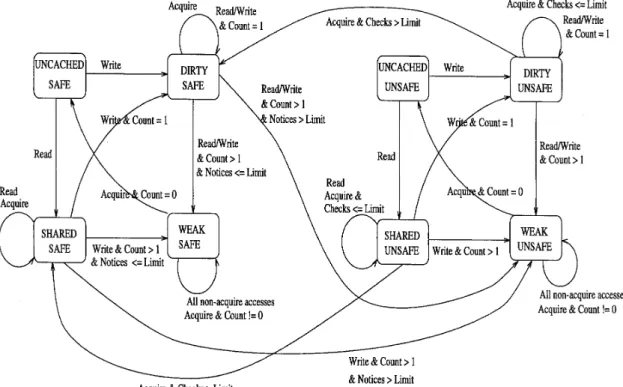
The state diagram for a page in our protocol appears in Fig. 1. The transactions represent read, write, and acquire accesses on the part of any processor. Count is the number of processors having mappings to the page; n o t i c e s is the number of notices that have been sent on behalf of a safe page; and checks is the number of times that a proces- sor has checked the coherent map regarding an unsafe page and found it not to be weak.
3. METHODOLOGY
We use execution-driven simulation to simulate a mesh- connected multiprocessor with up to 64 nodes. Our simula- tor consists of two parts: a front end, Mint [34], that simu- lates the execution of the processors, and a back end that simulates the memory system. The front end is the same in all our experiments. It implements the MIPS I1 instruc- tion set. Interchangeable modules in the back end allow us to explore the design space of software and hardware coherence. Our hardware-coherent modules are quite de- tailed, with finite-size caches, full protocol emulation, dis- tance-dependent network delays, and memory access costs (including memory contention). Our simulator is capable of capturing contention within the network, but only at a substantial cost in execution time; the results reported here model network contention at the sending and receiving nodes of a message, but not at the nodes in-between. Our software-coherent modules add a detailed simulation of TLB behavior, since it is the protection mechanism used for coherence and can be crucial to performance. To avoid the complexities of instruction-level simulation of interrupt handlers, we assume a constant overhead for page faults. For the software-coherent systems we assume that all data
Acquire & Checks <=Limit
UNCACHED Write
ReadNrite &Count > 1
& Notices <=Limit
WEAK
All non-acquire accesses All non-acquire accesses
Acquire & Count != 0
Write & Count > 1 &Notices >Limit Acquire & Checks > Limit
FIG. 1. Scalable software cache coherence state diagram.
transfers are completed without software intervention. The only software operations are modifying coherent map en- tries and updating remote weak lists. Table I summarizes the default parameters used in our simulations. For these parameters remote cache miss latencies are approximately 100 cycles, while misses to local memory are significantly cheaper (20 cycles).
Some of the transactions required by our coherence pro- tocols require a collection of the operations shown in Table I and therefore incur the aggregate cost of their constit- uents. For example a page fault on a read to an unmapped page consists of the following: (a) a TLB fault service (24 cycles), (b) a processor interrupt caused by the absence of read rights (140 cycles), (c) a coherent map entry lock acquisition, and (d) a coherent map entry modification
ration, which is the largest machine we simulate. Of our applications, three are best described as computational kernels: gauss, sor, and fft. Three are complete ap- plications: mp3d, water, and appbt. The kernels are local creations.
Gauss performs Gaussian elimination without pivoting on a 448 X 448 matrix. Sor computes the steady-state temperature of a metal sheet using a banded parallelization of red-black successive overrelaxation on a 640 X 640 grid.
~ f t computes a one-dimensional FFT on a 65,536-element
TABLE I
Default Values for System Parameters followed by the lock release (160 cycles). Lock acquisition System constant name Default value itself requires traversing the network and accessing the
memory module where the lock is located. Assuming that accessing the lock requires traversing 10 intermediate nodes, that there is no contention in the network, and that the lock is found to be free, the cost for lock acquisition is the roundtrip latency of the network plus the memory access cost, or (2
+
1)*
10*
2+
12+
1 = 73 cycles. The total cost for the above transaction would then be 24+
140+
73+
160 = 398 cycles.We report results for six parallel programs. We have run each application on the largest input size that could be simulated in a reasonable amount of time and that provided good load-balancing for a 64-processor configu-
TLB size
TLB fault service time Interrupt cost
Coherent map modification Memory setup time Memory bandwidth Page size
Total cache per processor Cache line size
Network path width Switch latency Wire latency Directory lookup cost Cache purge time
128 entries 24 cycles 140 cycles 160 cycles 12 cycles 4 byteslcycle 4K bytes 128K bytes 32 bytes 16 bits (bidirectional) 2 cycles 1 cycle 10 cycles 1 cyclelline
184 KONTOTHANASSIS AND SCOTT
array of complex numbers. Mp3d and water are part of the SPLASH suite [33]. Mp3d is a wind-tunnel airflow simulation. We simulated 40,000 particles for 10 steps in our studies. Water is a molecular dynamics simulation computing inter- and intramolecule forces for a set of water molecules. We used 256 molecules and 3 time steps. Finally
appbt is from the NASA parallel benchmarks suite [3]. It computes an approximation to Navier-Stokes equations. It was translated to shared memory from the original mes- sage-based form by Doug Burger and Sanjay Mehta at the University of Wisconsin. Due to simulation constraints, our input data sizes for all programs are smaller than what would be run on a real machine. We have also chosen smaller caches than are common on real machines, in order to capture the effect of capacity and conflict misses. Our caches are still large enough to hold the working set of our applications, with capacity and conflict misses being the exception rather than the rule. The main reason for this choice is the desire to evaluate the impact of protocol performance on the applications rather than just remote memory latency. Section 5.4 studies the impact of cache size on the relative performance of our protocols. Since we still observe reasonable scalability for most of our appli- cations, we believe that the data set sizes do not compro- mise our results.'
4. PERFORMANCE RESULTS
Our principal goal is to determine whether one can ap- proach the performance of hardware cache coherence without the special hardware. To that end, we begin in Section 4.1 by presenting our applications and the changes we made to improve their performance on a software co- herence protocol. We continue in Section 4.2 by evaluating the trade-offs between different software protocols. Fi- nally, in Section 4.3, we compare the best of the software results to the corresponding results on release-consistent hardware.
4.1. Program Modifications to Support Software Cache Coherence
In this section, we show that programming for software- coherent systems requires paying attention to the same issues that are important for hardware-coherent environ- ments, and that simple program changes can greatly im- prove program performance. Most of the applications in our suite were written with a small coherence block in mind, which could unfairly penalize software-coherent sys- tems. These applications could easily be modified, how- ever, to work well with large coherence blocks. Further- more we show that the flexibility of software coherence can allow for optimization that may be too hard to imple- ment in a hardware-coherent system and that can further improve performance.
Mp3d does not scale to 64 processors, but we use it as a stress test to compare the performance of different coherence mechanisms.
Our program modifications are also beneficial for hard- ware-coherent systems; several are advocated in the litera- ture [16]. Our contribution lies in quantifying their impact on performance in the context of a software coherent sys- tem and attributing the performance loss observed in the unmodified applications to specific interactions between the application and the coherence protocol. The remaining optimizations take advantage of program semantics to give hints to the coherence protocol on how to reduce coher- ence management costs and are applicable only in the context of the software protocols. Our four modifica- tions are:
Separation of synchronization variables from other writable program data (Sync-fix).
Data structure alignment and padding at page or sub- page boundaries (pad).
Identification of reader-writer locks and avoidance of coherence overhead when releasing a reader lock (RW- locks).
Identification of fine grained shared data structures and use of uncached references for their access, to avoid coherence management (R-ref).
All our changes produced dramatic improvements on the runtime of one or more applications, with some show- ing improvements of well over 50% under our software coherence protocols. Results for hardware-based systems (not shown here) also reveal benefits from these program changes, but to a lesser degree, with mp3d showing the largest improvement, at 22%.
Colocation of application data and locks on software coherent systems severely degrades performance due to an adverse interaction between the application locks and the locks protecting coherent map entries at the OS level. A processor that attempts to access an application lock for the first time will take a page fault and will attempt to map the page containing the lock. This requires the acquisition of the OS lock protecting the coherent map entry for that page. The processor that attempts to release the application lock must also acquire the lock for the coherent map entry representing the page that contains the lock and the data it protects, in order to update the page state to reflect the fact that the page has been modified. In cases of contention the lock protecting the coherent map entry is unavailable: it is owned by the processor(s) at- tempting to map the page for access.
Data structure alignment and padding are well-known methods of reducing false sharing [16]. Since coherence blocks in software coherent systems are large (4K bytes in our case), it is unreasonable to require padding of data structures to that size. However we can often pad data structures to subpage boundaries so that a collection of them will fit exactly in a page. This approach coupled with a careful distribution of work, ensuring that processor data is contiguous in memory, can greatly improve the locality properties of the application. Water and appbt already had good contiguity, so padding was sufficient to achieve
aPPbt water
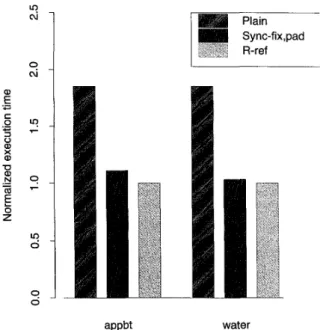
FIG. 2. Normalized runtime of appbt and water with different levels of restructuring.
good performance. Mp3d, on the other hand, starts by assigning molecules to random coordinates in the three- dimensional space. As a result, interacting particles are seldom contiguous in memory, and generate large amounts of sharing. We fixed this problem by sorting the particles according to their slow-moving ^-coordinate and assigned each processor a contiguous set of particles. Interacting particles are now likely to belong to the same page and processor, reducing the amount of sharing (see the sort bar in Fig. 3 below).
We were motivated to give special treatment to reader- writer locks after studying the Gaussian elimination pro- gram. Gauss uses locks to test for the readiness of pivot rows. In the process of eliminating a given row, a processor acquires (and immediately releases) the locks on the previ- ous rows one by one. With regular exclusive locks, the processor is forced on each release to notify other proces- sors of its most recent (single-element) change to its own row, even though no other processor will attempt to use that element until the entire row is finished. Our change is to observe that the critical section protected by the pivot row lock does not modify any data (it is in fact empty!), so no coherence operations are needed at the time of the release. We communicate this information to the coher- ence protocol by identifying the critical section as being protected by a reader's lock. A "skip coherence operations on release" annotation could be applied even to critical sections that modify data, if the programmer or compiler is sure that the data will not be used by any other processor until after some subsequent release. This style of annota- tion is reminiscent of entry consistency [35], but with a critical difference: Entry consistency requires the program- mer to identify the data protected by particular locks-in
effect, to identify all situations in which the protocol must
not skip coherence operations. Errors of omission affect
the correctness of the program. In our case correctness is affected only by an error of commission (i.e., marking a critical section as protected by a reader's lock when this is not the case).
Even with the changes just described, there may be pro- gram data structures that are shared at a very fine grain (both spatial and temporal), and that can therefore cause performance degradations. It can be beneficial to disallow caching for such data structures, and to access the memory module in which they reside directly. We term this kind of access uncached reference. We expect this annotation to be effective only when used on a very small percentage of a program's references to shared data.
The performance improvements for our four modified applications when running under the protocol described in Section 2 can be seen in Figs. 2 and 3. The performance impact of each modification is not independent of previous changes; the graphs show the aggregate performance im- provement for each successive optimization.
As can be seen from the graphs, Gauss improves mark- edly when relocating synchronization variables to fix the lock interference problem and also benefits from the identi- fication of reader-writer locks. Uncached reference helps only a little. Water gains most of its performance improve- ment by padding the molecule data structures to subpage boundaries and relocating synchronization variables. Mp3d benefits from relocating synchronization variables and pad- ding the molecule data structure to subpage boundaries. It benefits even more from improving the locality of particle interactions via sorting, and uncached reference shaves off another 50%. Finally, appbt sees dramatic improvements after relocating one of its data structures to achieve good
Plain Sync-fix,pad Sort RW-locks R-ref mp3d gauss
FIG. 3. Normalized runtime of g a u s s and mp3d with different levels of restructuring.
186 KONTOTHANASSIS AND SCOTT
page alignment and benefits nicely from the use of un- cached references as well. The performance of the re- maining two programs in our application suite was insensi- tive to the changes described here.
Our program changes were simple: identifying and fixing the problems was a mechanical process that consumed at most a few hours. The process was aided by simulation results that identified pages with particularly high coher- ence overhead. In practice, similar assistance could be ob- tained from performance monitoring tools. The most diffi- cult application was mp3d which, apart from the mechanical changes, required an understanding of pro- gram semantics for the sorting of particles. Even in that case identifying the problem was an effort of less than a day; fixing it was even simpler: a call to a sorting routine. We believe that such modest forms of tuning represent a reasonable demand on the programmer. We are also hope- ful that smarter compilers will be able to make many of the changes automatically.
4.2. Software Coherence Protocol Alternatives
This section compares our software protocol (presented in Section 2) to the protocol devised by Petersen and Li [26] (modified to distribute the centralized weak list among the memories of the machine), and to a sequentially consis- tent page-based cache coherence protocol. For each of the first two protocols, we present two variants: one that delays write-driven state transitions until the subsequent release operation, and one that performs them immediately. The comparisons assume a write-back cache. Coherence mes- sages (if needed) can be overlapped with the flush opera- tions, once the writes have entered the network. The proto- cols are named as follows:
re1
.
distr.
del : The delayed version of our distrib- uted protocol, with safe and unsafe pages. Write notices are posted at the time of a release and invalidations are done at the time of an acquire. At release time, the protocol scans the TLBIpage table dirty bits to determine which pages have been written. Pages can therefore be mapped readlwrite on the first miss, eliminating the need for a second trap if a read to an unmapped page is followed by a write. This protocol has slightly higher bookkeeping overhead than re1.
distr.
node1 below, but reduces trap costs and possible coherence overhead by delaying transitions to the dirty or weak state (and posting of associ- ated write notices) for as long as possible. It provides the unit of comparison (normalized running time of 1) in our graphs.re1
.
distr .nodel : Same as re1.
distr.
del, ex- cept that write notices are posted as soon as an inconsis- tency occurs. The TLBIpage table dirty bits do not suffice to drive the protocol here, since we want to take action the moment an inconsistency occurs. We must use the write-protect bits to generate page faults.re1
.
centr. node1 : Same as re1.
distr.
nodel, ex- cept that write notices are propagated by inserting weakpages in a global list which is traversed on acquires. This is the protocol of Petersen and Li [26], with the exception that while the weak list is conceptually centralized, its en- tries are distributed physically among the nodes of the machine.
re1
.
centr.
del : Same as re1.
distr.
del, except that write notices are propagated by inserting weak pages in a global list which is traversed on acquires.seq : A sequentially consistent software protocol that allows only a single writer for every page at any given point in time. Interprocessor interrupts are used to enforce coherence when an access fault occurs. Interprocessor in- terrupts present several problems for our simulation envi- ronment (fortunately this is the only protocol that needs them) and the level of detail at which they are simulated is significantly lower than that of other system aspects. Results for this protocol underestimate the cost of coher- ence management but since it is the worst protocol in most cases, the inaccuracy has no effect on our conclusions.
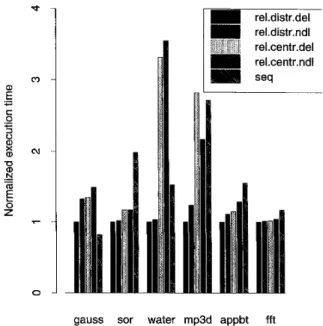
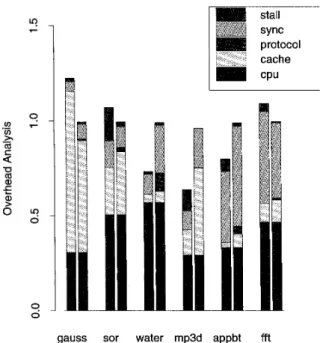
Figure 4 presents the normalized execution time of the different software protocols on our set of partially modified applications. We have used the versions of the applications whose data structures are aligned and padded, and whose synchronization variables are decoupled from the data they protect (see Section 4.1). We have not used the versions
that require annotations: the identification of reader locks or of variables that should be accessed with uncached refer- ences. The distributed protocols outperform the central- ized implementations, often by a significant margin. The largest improvements (almost threefold) are realized on
water and mp3d, the two applications for which software coherence lags the most behind hardware coherence (see Section 4.3). This is predictable behavior: applications in
gauss sor water mp3d appbt fft
FIG. 4. Comparative performance of different software protocols on 64 processors.
~ P C
m
syncprotocol
f l cache
cpu
gauss sor water mp3d appbt fft
FIG. 5. Overhead analysis of different software protocols on 64 pro- cessors.
which the impact of coherence is important are expected to show the greatest variance with different coherence algorithms. However, it is important to note the difference in the scales of Figs. 4 and 6. While the distributed protocols improve performance over the centralized ones by a factor of three for water and mp3d, they are only 38 and 55% worse than their hardware competitors. In programs in which coherence is less important, the decentralized proto- cols still provide reasonable performance improvements over the centralized ones, ranging from 2 to 35%.
It is surprising to see the sequentially consistent protocol outperform the relaxed alternatives on gauss. The expla- nation lies in the use of locks as flags, as described in Section 4.1. It is also surprising to see the sequentially consistent protocol outperform the centralized relaxed protocols on water. The main reason is that restructuring has reduced the amount of false sharing in the program, negating the main advantage of relaxed consistency, and the sharing patterns in the program force all shared pages into the weak list, making processors pay very high penal- ties at lock-acquisition points.
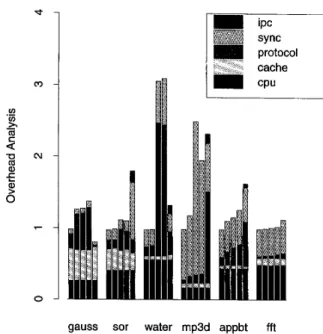
While run time is the most important metric for applica- tion performance it does not capture the full impact of a coherence algorithm. Figure 5 shows the breakdown of overhead into its major components for the five software protocols on our six applications. These components are: interrupt handling overhead (ipc) (sequentially consistent protocol only), time spent waiting for application locks (sync), coherence protocol overhead (including waiting for system locks and flushing and purging cache lines) (proto- col), time spent waiting for cache misses (cache), and useful processing cycles (cpu). Coherence protocol overhead has an impact on the time spent waiting for application locks-
the two are not easily separable. The relative heights of the bars are slightly off in Figs. 4 and 5, because the former pertains to the parallel part of the computation, while the latter includes initialization overheads as well. Since initial- ization overheads were small the differences between the relative heights of bars in the graphs are minor. As can be seen from the graph, cache wait time is virtually identical for the relaxed consistency protocol. This is consistent with the fact that the protocols use the same rules for identifying which pages are weak and therefore invalidate the same pages. The performance advantage of the distributed pro- tocols stems from reduced protocol and synchronization overhead.
4.3. Hardware us Software Coherence
Figure 6 shows the normalized execution times of our best software protocol and that of a relaxed-consistency DASH-like hardware protocol [23] on 64 processors. Time is normalized with respect to the software protocol. The hardware protocol assumes single-processor nodes, and the consistency model allows reads to bypass writes in the write-buffers. Only one write-miss request can be outstand- ing at any point time; subsequent writes queue in the write buffer. If the write buffer capacity is exceeded the proces- sor stalls. The software protocol is the one described in Section 2, with a distributed coherence map and weak list, safelunsafe states, delayed transitions to the weak state, and write-through caches with a write-merge buffer. The applications include all the program modifications de- scribed in Section 4.1, though uncached reference is used only in the context of software coherence; it does not make sense in the hardware-coherent case.
gauss sor water mp3d appbt fft
FIG. 6. Comparative software and hardware system performance on 64 processors.
KONTOTHANASSIS AND SCOTT stall sync protocol
'
cache cpugauss sor water mp3d appbt fft
FIG. 7. Overhead analysis of software and hardware protocols on 64 processors.
In all cases, with the exception of m p 3 d , the performance of the software protocol is within 40% of the relaxed consis- tency hardware protocol (termed hw-best in our graphs). For three of the applications, the software protocol is actu- ally slightly faster. The write-through mode eliminates three-hop transaction on cache misses reducing the miss overhead. One can argue that the hardware protocol could also use a write-through cache, but that would be detrimen- tal to the performance of other applications. The software- based protocol also does not need to get write-access rights for each cache line. As a result writes retire immediately if the cache line is present, and write-buffer stall time is reduced.
On the other hand m p 3 d and water demonstrate cases in which software coherence has disadvantages over a hardware implementation. For water the main problem is the extremely high frequency of synchronization, while for m p 3 d the presence of both fine-grained sharing and frequent synchronization affects performance. Still the per- formance of water is within 38% of the hardware imple-
mentation. M p 3 d on 64 processors is actually 55% worse under software coherence, but this program is known for its poor scalability. We regard its execution on 64 proces- sors as more of a "stress test" for the protocols than a realistic example. On 16 processors (a point at which rea- sonable speedups for m p 3 d may still be attainable), the performance of the software protocol is only 33% worse than that of the hardware protocol. The 16-processor graphs are not shown here due to lack of space.
Figure 7 shows the breakdown of overhead for the two protocols into its major components. These components are: write-buffer stall time (stall), synchronization over- head (sync), protocol processing overheads (protocol), cache miss latency (cache) which for the software protocol also includes time spent in uncached references, and useful cpu cycles (cpu). Results indicate that the coherence over- head induced by our protocol is minimal, and in most cases the larger coherence block size does not cause any increase in the miss rate and consequently the miss latency experi- enced by the programs. Table I1 shows the miss rates and other categories of overhead for the programs in our appli- cation suite. The left number in the "Miss rate" column corresponds to the miss rate for the hardware-coherent system, while the right number corresponds to the soft- ware-coherent system. For the applications that exhibit a higher miss rate for the hardware system the additional misses come mainly from the introduction of exclusive requests and from a slight increase in conflict misses (use of uncached reference reduced the working set size for the software protocol). The results in the table correlate directly with the results shown in Fig. 7. Higher miss rates result in higher miss penalties, while the low page miss rate is in accordance with the low protocol overhead expe- rienced by the applications.
5. THE IMPACT OF ARCHITECTURE ON COHERENCE PROTOCOLS
Our second goal in this work is to study the relative performance of hardware and software coherence across a wide variety of architectural settings. We start in Section 5.1 by examining the impact of the write policy on the performance of software coherence. We then proceed to examine a variety of architectural parameters that affect the performance of parallel applications. These include
TABLE I1
Application Behavior under Software and Hardware Protocols
Application Refs X lo6 Miss rate (HW, SW) Page miss rate Uncached refs
gauss 91.5 6.3%, 5.7% 0.03% -0% sor 20.6 3.6%, 2.7% 0.02% 0% water 249.9 0.34%, 0.33% 0.05% -0% m p 3 d 73.1 3.2%, 1.8% 0.01% 3.3% appbt 281.5 0.35%, 0.71% 0.04% 0.25% fft 209.2 0.87%, 0.65% 0.01 % 0%
page and cache line granularity, cache size, cache line inval- idate and flush costs, TLB management and interrupt han- dling costs, and networklmemory latency and bandwidth. The results of this study suggest that software coherence on NCC-NUMA machines may become an even more attractive alternative to hardware cache coherence for fu- ture multiprocessors.
5.1. Write Policies
In this section, we consider the choice of write policy for the cache. Specifically, we compare the performance obtained with a write-through cache, a write-back cache, and a write-through cache with a buffer for merging writes [7]. The policy is applied on only shared data. Private data uses by default a write-back policy.
Write-back caches impose the minimum load on the memory and network, since they write blocks back only on eviction, or when explicitly flushed. In a software-coherent system, however, write-back caches have two undesirable qualities. The first of these is that they delay the execution of synchronization operations, since dirty lines must be flushed at the time of a release. Write-through caches have the potential to overlap memory accesses with useful com- putation. The second problem is more serious, because it affects program correctness in addition to performance. Because a software-coherent system allows multiple writ- ers for the same page, it is possible for different portions of a cache line to be written by different processors. When those lines are flushed back to memory we must make sure that changes are correctly merged so no data modifications are lost. The best way to achieve this is to have the hard- ware maintain per-word dirty bits, and then to write back only those words in the cache that have actually been mod- ified.
Write-through caches can potentially benefit relaxed consistency protocols by reducing the amount of time spent at release points. They also eliminate the need for per- word dirty bits. Unfortunately, they may cause a large amount of traffic, delaying the service of cache misses and in general degrading performance. In fact, if the memory subsystem is not able to keep up with all the traffic, write- through caches are unlikely to actually speed up releases, because at a release point we have to make sure that all writes have been globally performed before allowing the processor to continue. With a large amount of write traffic we may have simply replaced waiting for the write-back with waiting for missing acknowledgments.
Write-through caches with a write-merge buffer [7] em- ploy a small fully associative buffer between the cache and the interconnection network. The buffer merges writes to the same cache line, and allocates a new entry for a write to a nonresident cache line. When it runs out of entries it randomly chooses a line for eviction and writes it back to memory. The write-merge buffer reduces memory and network traffic when compared to a plain write-through cache and has a shorter latency at release points when
compared to a write-back cache. Per-word dirty bits are required at the buffer to allow successful merging of cache lines into memory. In our experiments, we have used a 16- entry write-merge buffer.
Figure 8 presents the relative performance of the differ- ent cache architectures when using the best relaxed proto- col on our best version of the applications. For almost all programs the write-through cache with the write-merge buffer outperforms the others. The exceptions are mp3d, in which a simple write-through cache is better, and gauss, in which a write-back cache provides the best performance. In both cases however the performance of the write- through cache with the write-merge buffer is within 5% of the better alternative.
We also looked at the impact of the write policy on main memory system performance. Both write-through policies generate more traffic and thus have the potential to deteri- orate memory response times for other memory opera- tions. Figure 9 presents the average cache miss latency under different cache policies. As can be seen the write- through cache with the write-merge is only marginally worse in this metric than the write-back cache. The plain write-through cache creates significantly more traffic, thus causing a much larger number of cache misses to be de- layed and increasing miss latency.
Finally, we ran experiments using a single policy for both private and shared data. These experiments capture the behavior of an architecture in which write policies cannot be varied among pages. If a single policy has to be used for both shared and private data, a write-back cache pro- vides the best performance. As a matter of fact, the write- through policies degrade significantly, with plain write- through being as much as 50 times worse in w a t e r .
gauss sor water mp3d appbt fft
FIG. 8. Comparative performance of different cache architectures on 64 processors.
KONTOTHANASSIS AND SCOTT 190 FIG. 9. Gauss 112.1 Mp3d 62.8 88.3
Average read miss latency in cycles for different cache types.
5.2. Page
Size
The choice of page size primarily affects the performance of software coherence, since pages are the unit of coher- ence. Hardware coherence may also be affected, due to the placement of pages in memory modules, but this is a secondary effect we have chosen to ignore in our study. Previous studies on the impact of page size on the perfor- mance of Software DSM systems [5] indicate that the smaller pages can provide significant performance im- provements. The main reason for this result is the reduction in false sharing achieved by smaller coherence units. Mov- ing to relaxed consistency, however, and to an architecture that uses pages for the unit of coherence but cache lines for the data fetch unit, reverses the decision in favor of large pages [26]. Relaxed consistency mitigates the impact of false sharing, and the larger page size reduces the length of the weak list that needs to be traversed on an acquire op- eration.
In our protocol, the absence of a centralized weak list removes one of the factors (length of the weak list) that favors larger pages. Furthermore the choice among mecha- nisms for data access (caching vs uncached reference) can only be made at page granularity. Smaller pages can make for more accurate decisions. On the other hand smaller pages will require a larger number of coherence transac- tions to maintain the same amount of shared data. When true sharing is the reason for coherence transactions, smaller pages will induce unnecessary overhead.
To evaluate the relative impact of these effects, we have run a series of experiments, varying the page size from as small as 256 bytes to as large as 16K bytes. Figure 10 shows the normalized running time of our applications as a function of page size. The normalization is with respect to the running time of the relaxed consistency hardware system using 4K-byte pages. We observe that performance improves as the page size increases for all applications. For four of our applications a 4K-byte page size provides the best performance; for the other two performance con- tinues to improve marginally as the page size increases even further. The applications that degrade after the 4K- byte point have been restructured to work well under soft- ware coherence, with data structures aligned on 4K-byte boundaries. It is reasonable to assume that for larger data-
set sizes (for which alignment to large page sizes is feasible) performance would keep improving with an increase in page size. For the unmodified versions of the programs (not shown) smaller page sizes provided a small performance advantage over larger ones, but the overall performance of software coherence was not in par with that of hard- ware coherence.
5.3. Cache Line Size
The choice of cache line size affects hardware and soft- ware coherence in similar ways. Increases in cache line size reduce the miss rate, by taking advantage of the spatial locality in programs. However when the cache line size gets too large it has the potential to introduce false sharing in hardware coherent systems, and unnecessary data trans- fers in software coherent systems. Furthermore, larger lines cause higher degrees of contention for memory modules and the network interconnect since they have longer occu- pancy times for those resources.
We have run experiments in which the cache line size varies between 16 and 256 bytes for both release-consistent hardware and our software coherence protocol. Figure 11 shows the normalized running times of our applications as
Page size (bytes)
l
' 0.6
256 512 1024 2048 4096 8192 16384
Page size (bytes)
FIG. 10. Normalized execution time for our applications using differ- ent page sizes.
Appbt-HW
-
Appbt-sw - . Fft-HW-
Fft-SW ..+... Gauss- HW-
0.6 16 32 64. 128 256Cache line size (bytes)
16 32 64. 128 256
Cache line size (bytes)
FIG. 11. Normalized execution time for our applications using differ- ent cache line sizes.
a function of cache line size. (Running time is normalized with respect to the hardware system with 16-byte cache lines.) Performance initially improves for both systems as the cache line size increases, with the optimal point oc- curring at either 64- or 128-byte lines. We believe that the degradation seen at larger sizes is due to a lack of band- width in our system. We note that the performance im- provements seen by increasing the line size are progres- sively smaller for each increase. The exception to the above observations is mp3d under software coherence, where increases in line size hurt performance. The reason for this anomalous behavior is the interaction between cache accesses and uncached references. Longer cache lines have higher memory occupancy and therefore block uncached references for a longer period of time. The uncached refer- ences in the software-coherent version of the program end up waiting behind the large line accesses, degrading over- all performance.
5.4. Cache Size
Varying the cache size allows us to capture how the different protocols handle conflictlcapacity misses. Smaller caches increase the number of evictions, while large caches
reduce misses to the intrinsic rate (that which is due to sharing and coherence) of the program in question. While there is no universal agreement on the appropriate cache size for simulations with a given data set size, recent work confirms that the relative sizes of per-processor caches and working sets are a crucial factor in performance [29]. All the results in previous sections were obtained with caches sufficiently large to hold the working set, in order to sepa- rate the performance of the coherence protocols from the effect of conflictlcapacity misses. Experience suggests, however, that programmers write applications that exploit the amount of available memory as opposed to the amount of available cache. When the working set exceeds the cache size, the handling of conflictlcapacity misses may have a significant impact on performance.
To assess this impact we have run experiments in which the cache size varies between 8K and 128K bytes for both the hardware and software coherent systems. While these numbers are all small by modern standards, they span the border between "too small" and "large enough" for our experiments. Figure 12 shows the normalized running time of our applications as a function of cache size. Running time is normalized with respect to the hardware system
I
8 16 32 64 128
Cache size (Kbytes)
8 16 32 64 128
Cache size (Kbytes)
FIG. 12. Normalized execution time for our applications using differ- ent cache sizes.
192 KONTOTHANASSIS AND SCOTT
with an 8K-byte cache size. The results show the perfor- mance of hardware coherence improving more quickly than that of software coherence with increases in cache size. This is to be expected, since the hardware system was shown in previous sections to handle coherence-related communication more efficiently than the software system. For smaller caches, where conflictlcapacity misses consti- tute a larger fraction of the total miss rate, the more compli- cated directory structure of the hardware system (with ownership and forwarding) imposes a higher penalty on refills than is suffered by the software system. As the cache size increases the elimination of conflictlcapacity misses improves the performance of both systems, with the hard- ware system enjoying the largest benefits.
5.5. Processor Constants
The performance of software coherent systems is also dependent on the cost of cache management instructions, interrupt handling, and TLB management. We evaluated the performance of our application suite under a variety of assumptions for these costs, but found very little variation. Specifically, we ran experiments with the following range of values:
Cache purge: 1, 2, 4, or 6 cycles to purge a line from the cache.
Interrupt handling: 40,140, or 500 cycles between inter-
rupt occurrence and start of execution of the interrupt handler. These values represent the expected cost of an interrupt for a very fast interrupt mechanism (e.g., Sparcle [I], a normal one, and a particularly slow one.
T L B Management: 24, 48, or 120 cycles for tlb service
fault. These values represent the expected cost of a tlb fill when done in fast hardware, somewhat slower hardware, or entirely in software.
Across this range, the largest performance variation dis- played by any application was less than 3% (for w a t e r ) . Statistics gathered by the simulator confirm that the cache, interrupt, and TLB operations are simply not very fre- quent. As a result, their individual cost, within reason, has a negligible effect on performance. (We have omitted graphs for these results; they are essentially flat lines.)
5.6. Latency and Bandwidth
The final dimension of our architectural study is memory and interconnect latency and bandwidth. Latency and bandwidth directly affect the cost of memory references and coherence protocol transactions. Current technologi- cal trends indicate that memory (DRAM) latencies and bandwidth will continue to increase in comparison to proc- essor speeds. Network bandwidths will also continue to increase, with network latencies keeping pace with proces- sors speeds.
We have run experiments varying the memory startup cost between 12 and 30 cycles. Given a cache line size of
8 words and memory bandwidth of 1 word per cycle, the latency for a local cache miss ranges between 20 and 38 cycles. For these experiments, we have kept the network bandwidth at 4 bytelcycle. The results show that the impact of latency variation on the performance of the hardware and software coherence protocols is application depen- dent. In general, the steepness of the curves is directly related to the miss rates of the applications under each protocol: the higher the miss rate the more sensitive the application is to an increase in latency. The exception to the observation is mp3d. Although the software protocol has a lower miss rate than the hardware alternative, it performs more uncached references, and these are also susceptible to the increase in memory latency. Figure 13 shows the normalized execution time of our applications under hardware and software coherence for different mem- ory latencies. Running time is normalized with respect to the hardware system with a 12-cycle memory startup cost. Bandwidth increases have the opposite effect of in- creases in latency on the performance of hardware and software coherence. Where an increase in latency tends to exaggerate the performance discrepancies between the
0 . 8 ~ '
20 22 24 26 28 30 32 34 36 38
Memory Latency (cycles)
20 22 24 26 28 30 32 34 36 38
Memory Latency (cycles)
FIG. 13. Normalized execution time for our applications under differ- ent memory latencies.
I I
8 16 32
Network Bandwidth (bitslcycle)
8 16 32
Network Bandwidth (bitslcycle)
FIG. 14. Normalized execution time for our applications for different network bandwidths.
protocols, an increase in bandwidth softens them. We have run experiments varying network (point-to-point) and memory bandwidth between 1 and 4 bytes per cycle- varying them together to maintain a balanced system. Startup cost for memory access was set to 30 cycles. Figure 14 shows the normalized execution times of the applica- tions under different bandwidth values. Running time is normalized with respect to the hardware system with a 1 bytelcycle memorylnetwork bandwidth. Once again, in general, the steepness of the curve is directly related to the miss rates of the applications under each protocol. Higher miss rates imply a need for communication, which can best be met when a lot of bandwidth is available.
Water, which has a very low communication to computa- tion ratio, exhibits a relatively flat line; consistent with what we saw in almost all of the graphs, it has little use for long cache lines, low latency, or high bandwidth. Mp3d under software coherence once again fails to make efficient use of extra available bandwidth. The program suffers more from the cost of initiating uncached references than from a lack of bandwidth: its performance improves only moderately as bandwidth increases.
6. RELATED WORK
Our work is most closely related to that of Petersen and Li [26]: we both use the notion of weak pages, and purge caches on acquire operations. The difference is scalability: we distribute the coherent map and weak list, distinguish between safe and unsafe pages, check the weak list only for unsafe pages mapped by the current processor, and multicast write notices for safe pages that turn out to be weak. We have also examined architectural alternatives and program-structuring issues that were not addressed by Petersen and Li. Our work resembles Munin [6] and lazy release consistency [17] in its use of delayed write notices, but we take advantage of the globally accessible physical address space for cache fills and for access to the coherent map and the local weak lists.
Our use of uncached references to reduce the overhead of coherence management can also be found in systems for NUMA memory management [5, 10, 221. Designed for machines without caches, these systems migrate and replicate pages in the manner of distributed shared mem- ory systems, but also make on-line decisions between page movement and uncached reference. We have experi- mented with dynamic page movement in conjunction with software coherence on NCC-NUMA machines [24], and have found that while appropriate placement of a unique page copy reduces the average cache fill cost appreciably, replication of pages provides no significant benefit in the presence of hardware caches. Moreover, we have found that relaxed consistency greatly reduces the opportunities for profitable uncached data access. In fact, early experi- ments we have conducted with on-line NUMA policies and relaxed consistency have failed badly in their attempt to determine when to use uncached references.
On the hardware side, our work bears a resemblance to the Stanford Dash project [23] in the use of a relaxed consistency model and to the Georgia Tech Beehive proj- ect [32] in the use of relaxed consistency and per-word dirty bits for successful merging of inconsistent cache lines. Both these systems use their extra hardware to overlap coherence processing and computation (possibly at the expense of extra coherence traffic) in order to avoid a higher waiting penalty at synchronization operations.
Coherence for distributed memory with per-processor caches can also be maintained entirely by a compiler [8]. Under this approach the compiler inserts the appropriate cache flush and invalidation instructions in the code, to enforce data consistency. The static nature of the approach, however, and the difficulty of determining access patterns for arbitrary programs, often dictates conservative deci- sions that result in higher miss rates and reduced perfor- mance. Alternatively, coherence can be maintained in object-oriented systems by tracking method calls or by identifying the specific data structures protected by particu- lar synchronization operations [13, 30, 351. Such an ap- proach can make it substantially easier for the compiler to implement consistency, but only for restricted program- ming models.