Improving the oat crop
L. C. Burnett
Iowa State College
Follow this and additional works at:
http://lib.dr.iastate.edu/bulletin
Part of the
Agriculture Commons
, and the
Agronomy and Crop Sciences Commons
This Article is brought to you for free and open access by the Extension and Experiment Station Publications at Iowa State University Digital Repository. It has been accepted for inclusion in Bulletin by an authorized editor of Iowa State University Digital Repository. For more information, please [email protected].
Recommended Citation
Burnett, L. C. (2017) "Improving the oat crop,"Bulletin: Vol. 15 : No. 175 , Article 1. Available at:http://lib.dr.iastate.edu/bulletin/vol15/iss175/1
IMPROVING THE OAT CROP
AGRICULTURAL EXPERIM ENT STATION IO W A STATE COLLEGE OF AGRICULTURE
AN D MECHANIC A R TS
AGRONOM Y SECTION FARM CROPS
In co-operation with Bureau of Plant Industry U . S . D ep t, of Agriculture, C ereal Investigations
Library, Arnes, Iowa
SUMMARY
1. The total value and acreage of Iowa’s oat crop surpasses that of all cereals except com. • It is greater than that of all the other small grains combined.
2. The fact that we will continue to grow a large acreage of oats in spite of its low acre value makes the need for im provement apparent.
3. An important factor in increasing the yield of oats is the use of varieties suited to the local conditions.
4. Varieties that give consistently high yields season after sea son are preferable to those that show a relatively high aver age because of an occasional high yield.
: 5. Home grown seed is preferable to seed of the same variety obtained elsewhere.
6. The use of the drill increases the yield of oats over broad casting 5 bushels per acre.
7. A t the ordinary rates of seeding (about 3 bushels per acre) the use of a 6 or an 8 inch drill appears to give higher yields than where the seed is drilled 4 inches apart. 8. Three bushels per acre is a sufficiently heavy raté of seed
ing to drill Silvermine. From 3 to 4 bushels per acre is profitable with Kherson.
9. The use of manure in the rotation increases the yield of oats.
10. Treating seed oats for smut is inexpensive and profitable. 11. Early sown oats outyield late soym oats.
12. Considerable loss is occasioned by cutting oats that are over
ripe.
13. Oats are damaged by cutting when damp.*
14. Oats should he shocked the same day that they are cut.
IMPROVING THE O AT CROP
B Y L. C. BURNETT
Oats are the most useful cereal crop grown in Iowa with the
exception of corn. The farmers of the state grow six times as
many acres o f oats as wheat and more than three times as many
as of all the other small grains combined. Of the land devoted
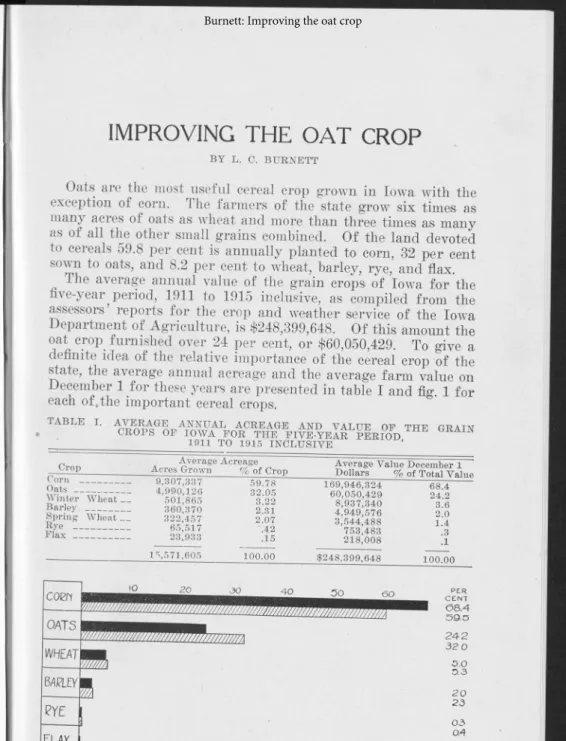
to cereals 59.8 per cent is annually planted to com, 32 per cent sown to oats, and 8.2 per cent to wheat, barley, rye, and flax.
The average annual value of the grain crops of Iowa for the five-year period, 1911 to 1915 inclusive, as compiled from the assessors reports for the crop and weather service of the Iowa
Department of Agriculture, is $248,399,648. O f this amount the
oat crop furnished over 24 per cent, or $60,050,429. To give a
definite idea of the relative importance of the cereal crop of the state, the average annual acreage and the average farm value on December 1 for these years are presented in table I and fig. 1 for each of, the important cereal crops.
TABLE I. AVERAGE ANNUAL ACREAGE AND VALUE OP1 TUE UR atat
CROPS OF IOW A FOR T H E ^ I V E -Y EaS PERIO D 1911 TO 1915 INCLUSIVE
Crop Acres Grown Average Acreage % of Crop Average Value December 1 Dollars % of Total Value Corn Oats Winter W heat__ Barley-Spring W heat__ Rye Flax _ 9,307,337 4,990,126 501,865 360,370 322,457 65,517 23,933 59.78 32.05 3.22 2.31 2.07 '.42 .15 169,946,324 60,050,429 8,937,340 4,949,576 3,544,488 753,483 218,008 68.4 24.2 3.6 2.0 1.4 .3 .1 1 *>,571,605 100.00 $248,399,648 100.00
M R R R J Per cent of to ta l valu e U////////M P a r ca n t o f to ta l a c r e a g e .
Tig. 1. Graphic comparison of the acreage and value of the grain crops in for the five years 1911-1915 inclusive
PER CEINT 0 8 .4 SO. 5 2 4 2 3 2 0 5.0 0.3 2 0 23 0 3 0 4 0.1 0.2 Iowa
The figures of table I show that while 32 per cent of the land in cereals is sown to oats, the oat crop supplies only 24.2 per cent of the total value of the cereals produced. The average of oats in Iowa for the five years 1911 to 1915 inclusive was only 35.1 bushel
per acre (table II.) This is not more than three-fourths the
yield that can be obtained by the use of the best method of cul ture and improved seed and suggests the importance of better development of the oat crop.
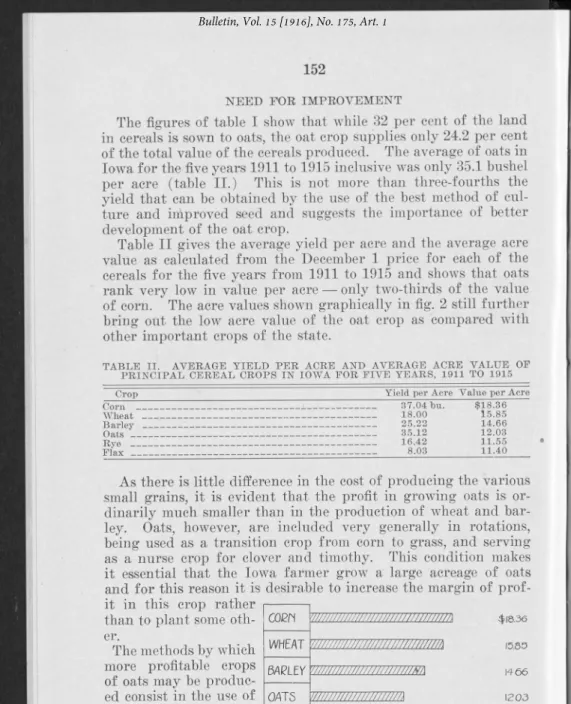
Table II gives the average yield per acre and the average acre value as calculated from the December 1 price for each of the cereals for the five years from 1911 to 1915 and shows that oats rank very low in value per acre — only two-thirds o f the value of com. The acre values shown graphically in fig. 2 still further bring out the low acre value of the oat crop as compared with other important crops of the state.
TABLE II. AVERAGE YIE L D P E R ACRE AND AVERAGE ACRE VALUE OP P R IN CIPAL CEREAL CROPS IN IOW A FOR F IVE YEARS, 1911 TO 1915
Crop Yield per Acre Vaine per Acre
Corn _ Wheat Barley O a t s _. R y e __ F l a x _ 37.04 bu. $18.36 18.00 15.85 25.22 14.66 35.12 12.03 16.42 11.55 8.03 11.40
As there is little difference in the cost of producing the various small grains, it is evident that the profit in growing oats is or dinarily much smaller than in the production of wheat and bar
ley. Oats, however, are included very generally in rotations,
being used as a transition crop from corn to grass, and serving
as a nurse crop for clover and timothy. This condition makes
it essential that the Iowa farmer grow a large acreage of oats and for this reason it is desirable to increase the margin of prof it in this crop rather
than to plant some oth er.
The methods by which more profitable crops of oats may be produc ed consist in the use of improved varieties and the adoption of better cultural methods. The following pages show what may be accom plished by these means.
C O 0 Y W777777777777TZ77777TZT7TZ77T7777A 4 i W H E A T / / / / / / / / ¡ / / / / / / / / / / / / / / / / / / / / / / / / A ir>*r5 B A P L E Y V / / / / / / / / / / / / / / / / / W / Ì / / M A O A T S I / / / / / / / / / / / / / / / / / / / / / / X I P 0 3 P Y E '/ /// / / / / / / / / / / / Z / Z / Z / A 1 F L A X V //Z ////Z Z /Z /////Z Z Z /A 1 1 .4 0
Fig. 2. Comparison of the acerage acreage value of the cereals of Iowa for the five years
PRACTICES T H A T WILL IMPROVE THE CROP
Fig. 3. The oat variety test plats at the Iowa Agricultural Experiment station
THE USE OF SUITABLE TYPES
im D oLST f p ? t ° f -he- beSt suited1V pes or varieties is the most
important factor m improving the oat crop. Certain types of
SwedTr? t0i he l0ng5 C00i seasons of Scotland and southern
Sweden; others thrive best m the hot, moist climate o f the southeastern United States, while still a different type gives the
best results m and and semi-arid sections. There are Certain
Than are, undoubtedly best adapted to Iowa conditions,
far oni f Umi)er o f. ™ e t y names under which seed oats are offered tor sale m Iowa is probably not less than 100. These 100 varie-
ty names, however, do not represent more than 10 distinct ty p e s
« M * ot than 5 arc suited to any considerable area
THE V A R IE T Y TEST
The growing of a large number of varieties in test plats, under he same soil and climatic conditions in which they are to be grown commercially, is an essential part of the study o f any rop which it is proposed to improve. The variety test at the
Iowa agncuitura1 experiment station has eliminated many
M l
ties from consideration for this state. A t present, 22 varieties th!t*T ng>frQWn 0n the/ tatlon Plats- These represent the types
at can be grown profitably m Iowa. Prior to 1911 a greater t i ^ o f r n°f va™ ties,wer® ^eluded-in the test, but the
accumula-for J ; r: e e t T M r “ and thos8 that were “ itebk
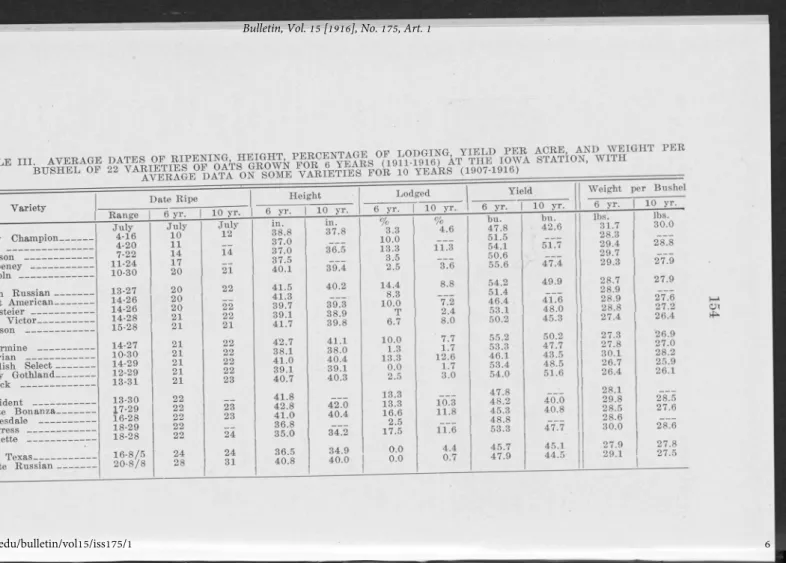
TABLE III. AVERAGE BUSHEL OF
DATES OF RIPENING, HEIGHT, PERCENTAGE OF L °D G IN G Y IELD PER ACRE, AND W EIGHT PER STATION, W ITH
Date Ripe Height Lodged
Bushel Variety July 4-16 July 10 10 yr. 1 July 12 6 yr. 1 38.8 37.0 37.0 37.5 40.1 10 yr. 37.8 6 yr. 1 3.3 10.0 13.3 3.5 2.5 10 yr. 1 4.6 b yr. 1 47.8 51.5 J.U yr. bu. . 42.6 lbs'. 31.7 28.3 lbs. 30.0 4-20 11 — 11.3 54.1 51.7 29.4 28.8 7-22 14 14 50.6 29.7 27.9 11-24 17 — 3~9.4 3.6 55.6 47.4 29.3 10-30 20 21 27.9 13-27 20 22 41.5 41.3 39.7 39J1 41.7 40.2 14.4 8.3 10.0 8.8 54.2 51.4 49.9 28.7 28.9 14-26 20 — 39.3 38.9 39.8 7.2 2.4 8.0 46.4 41.6 28.9 27.6 14-26 20 22 53.1 48.0 28.8 27.2 14-28 21 22 6.7 50.2 45.3 27.4 26.4 15-28 21 21 26.9 27.0 14-27 21 22 42.7 38.1 41.0 41.1 38.0 40.4 39.1 40.3 10.0 1.3 13.3 0.0 2.5 7.7 1.7 12.6 1.7 3.0 55.2 53.3 50.2 47.7 27.3 27.8 10-30 21 22 46.1 43.5 30.1 28.2 14-29 21 22 53.4 48.5 26.7 25.9 12-29 21 22 39.1 40.7 54.0 51.6 26.4 26.1 13-31 21 23 13-30 22 41.8 42.8 41.0 36.8 35.0 4-2~0 40.4 13.3 13.3 io~3 11.8 47.8 48.2 4015 28.1 29.8 28.5 17-29 16-28 22 23 45.3 40.8 28.5 27.6 22 23 2.5 17.5 48.8 28.6 ___ 18-29 22 — 3 Ï 2 11.6 53.3 47.7 30.0 28.6 18-28 22 24 27.8 27.5 16-8/5 24 24 36.5 40.8 34.9 40.0 0.0 0.0 4.4 0.7 45.7 47.9 45.1 44.5 27.9 29.1 White R ussian--- 20-8/8 28 31 1 5 4
yield per acre and weight per bushel of 22 varieties that have been grown continuously for six years, 1911 to 1916, are shown in table III. The averages for ten years are also shown for the
The figures given are those o f greatest importance to the com belt farmer. A complete record o f each variety is on file at the Iowa station and will be sent to any one upon request. Table IY shows the annual yield in bushels per acre. In table Y the annual yields have been converted to acre value at the annual farm price per bushel on December 1 as given by the crop and weather service of the Iowa Department o f Agriculture.
Varieties that yield well in unfavorable growing seasons are the varieties that give the highest average profit. A study of the annual yields and prices in table IY shows that the high yields of certain varieties are always associated with the seasons of low price. For example, the highest yields o f Lincoln, John son and Myrick were made when oats were worth 27 cents per bushel, while their lowest yields were made in a season when oats were worth 39 cents. The Kherson type, however, has given consistent yields season after season. Wfiile in the favorable oat seasons it has never been the most productive in the test, it has given the highest ten-year average and when figured to acre value has been worth nearly a dollar per acre more than its near est competitor, the Silvermine, which is only 1.5 bushels lower in average yield.
A study of these fluctuations in yield in connection with the price per bushel shows that in seasons of high production of varieties with a wide range in annual yields, oats sell for a low price per bushel. This indicates that the great bulk of the oats grown in Iowa are of these varieties that respond generously to favorable climatic conditions and this excess in yield of oats, to gether with the increased production in other crops caused by the same conditions, is the cause o f the low price. The varieties least affected by climatic conditions are the ones which are likely to produce a crop of the greatest market value.
Table Y shows the annual acre value for the varieties shown m tables III and IY.
TEN V A R IE T IE S COMMON IN IOW A
The oat varieties which are suited to Iowa conditions and are commonly grown in the state are very few in number. To afford a better opportunity for comparison, a summary of the data for 10 of the better known varieties is given in table Y I, showing the maturity, height o f straw, per cent lodged, yield, weight per bushel, and value per acre, as they have grown on the station plats for the last 10 years. Fig. 4 presents; in a graphic form the comparative acre value of these varieties compared with Kherson.
TABLE IV. ANNUAL AND AVERAGE YIE L D S IN BUSHELS PER ACRE OP 22 V A R IET IE S OP OATS GROWN AT THE IOW A
STATION DURING THE 10 YEARS, 1907 TO 1916 ________
Average 1907 bn. 1908 bu. 1909 bu. 1910 bu. 1911bu. 1912 bu. 1913 bu. 1914 bu. 1915bu. 1916 bu. 1911-16 bu. 1907-16 bu. Early Champion 29.3 37.5 24.7 61.9 43.8 35.0 40.6 48.1 60.6 50.652.1 48.445.6 42.2 54.7 48.7 55.3 47.851.5 42.6 45.6 48.8 35.3 62.2 38.1 65.6 62.8 55.3 49.1 53.8 54.1 51.7 D a n b e n e y ---Lincoln 16.2 2_8_.l 38.1 34.4 53.7 62.2 31.036.1 71.2 80.6 50.3 55.0 48.1 45.0 50.959.2 52.4 57.7 50.655.6 4 L 4 36.2 39.4 33.4 64.1 31.8 83.7 53.4 45.7 57.6 53.6 54.2 49.9 Great American lib 3 20.0 28.1 34.4 27.5 61.6 61.9 28.8 25.5 84.4 56.9 57.251.2 40.338.4 51.2 53.1 48.251.5 51.4 46.4 4 L 6 28.0 33.8 33.4 66.2 37.4 79.4 57.2 43.8 54.3 46.7 53.1 48.0 Johnson 21.5 37.8 32.8 59.7 33.8 83.1 50.3 40.6 39.5 53.9 50-.2 45.3 31.5 36.6 31.6 70.6 36.3 81.9 60.3 46.8 55.2 51.7 55.2 50.2 29.2 36.6 31.9 59.4 20.5 88.1 59.4 40.0 59.8 52.1 53.3 47.7 32.0 31.0 33.1 62.2 25.5 75.0 50.6 37.6 44.8 43.0 46.1 43.5 Early Gothland Myrick 25.0 26.2 33.738.1 35.932.5 70.6 91.9 23.631.1 80.0 91.9 62.857.5 43.144.1 60.7 61.8 50.037.7 53.4 54.0 48.5 51.3 President ---White Bonanza--- ; Clydesdale A---P r o g r e s s ________________ Joanette |— j---6.2 26.2 66.6 25.8 75.0 55.3 38.7 52.3 39.6 47.8
_
17.1 20.6 26.9 30.6 15 6 29.7 30.3 23.1 57.2 54.7 57.2 21.8 21.2 27.3 76.9 86.9 78.1 49.7 45.6 53.7 36.9 29.1 36.6 49.2 41.3 59.1 34.7 47.4 37.9 48.2 45.3 48.8 40.0 40.8 * 35.6 23.4 33.1 60.3 23.9 88.7 I 50.2 1 I 43.7 60.6 1 52.6 1 53.3 47.7 35.8 41.9 32.8 66.6 5.9 68.7 | 49.1 44.7 54.4 51.2 1 45.7 ' 45.1 White Russian _ 27.1 25.6 45.6 60.0 19.8 83.1 46.6 44.4 52.3 41.4 47.9 44.5 Price December 1st 39 43 35 - 27 41 27 34 41 32 49 cn 05D B C ra B liB OF V ^ # i i ST I E r 0LFP 0 A T iKa B 0W M Variety. Early Champion -B u r t __i_________ Kherson _______ D a u b e n e y ______ L in e o ln ______ _ 1907 Green R u s s ia n ___ Great American__ P r o b s t e ie r ___ ;___ Irish Victor____ ■_ Johnson ______ Silvermine ____ S ib e r ia n _____ 1 Swedish Select . Early Gothland. Myrick ________ P r e s id e n t _____ White Bonanza. Clydesdale ____ Progress gj_____ J o a n e tt e ______ $11.43 17.78 6J12 14.12 7753 10.92 $.38 12.29 11.39 12.48 9.75 10.22 6.67 8.03 13.£ 13.96 10.57 1908 $16.13 20^98 12.08 16.94 8.60 12.08 14.53 16.25 15.74 15.74 13.33 14.49 16.38 2.67 11.57 13.16 6.71 12.21 18.02 11.01 1909 1911 $ 8.65 12156 13.33 12.04 11.69 12.04 9.62 11.69 11.48 11.06 11.16 11.59 12.56 11.37 9.17 10.39 10.60 8.08 11.58 11.48 15.96 $16.71 11.83 16.79 14.50 16.79 17.31 16.63 16.71 17.87 16.12 19.06 16.04 16.79 19.06 24.81 17.98 15.44 14.77 15.44 16.28 17.98 16.20 $14.35 16.65 15.62 12.71 14.80 13.04 11.81 10.45 15.33 13.86 14.88 8.40 10.46 9.68 12.75 10.58 8.94 8.69 11.i9 9.80 2.42 8.12 $12.99 16.36 17.71 19.22 21.76 22.60 22.79 15.36 21.44 22.44 22.11 23.79 20.25 21.60 24.81 20.25 20.76 23.46 21.09 23.95 18.55 22.44 1913 $17.20 17.71 21.35 17.10 18.70 18.16 19.45 17.41 19.45 17.10 20.50 20.20 17.20 21.35 19.55 18.80 16.90 15.50 18.26 17.07 .16.69 15.84 1915 $19.84 18.70 22.67 19.72 18.45 18.74 15.74 16.52 17.96 16.65 19.19 16.40 15.42 17.67 18.08 15.87 15.13 11.93 15.01 17.92 18^33 18.20 $13.50 17.50 15.71 16.29 18.94 18.43 16.38 16.99 17.38 12.64 17.66 19.14 14.34 19.42 19.78 16.74 15.74 13.22 18.91 19.39 17.41 16.74 1916 $23.86 27.10 26.36 25.68 28.27 26.26 23.62 25.23 22.88 26.41 25.33 25.53 21.07 24.50 18.47 19.40 17.00 23.23 18.57 25.77 24.09 20.29 Average 1911-16 1907-16 $16.96 19.00 19.90 18.45 20.15 19.54 18.30 16.99 19.07 18.17 19.94 18.91 16.45 19.04 18.91 16.94 15.74 16.00 17.17 18.98 $15.47 18773 16!81 17.73 14779 16.94 16.13 17.78 16.78 15.29 17.01 17.62 13.85 14.26 16.78 16.25 | 15.89 16.94 I 15.54 Red Texas.____ White Russian.
K H E R S O h 51.7 ßu $18-73
5 IO 15 T
'llïl?//i/iïnilll/l////////////7//////U//. //////////'//////////////llLUJIUlLUJllnlA
5ILVERM IITE 50.2 Bu $1778
‘t///i/iii///i)/////um/ini)i)/i/iuuiii mu i/lini/uim/i///////i/iiluua^
GREEN RUSSIAN 49.9Bu $17.73 ’////////////////////////u////n//////////////////////////////////////u/jmumm IRISH VICTOR 4ÖOBu. $16.94 iiuii)U)D)/))iinii))))i)/))/i//))///////)/)///////////////////lutiaiiin no! JO A N E T T E 47.7Bu $16.70
\imii ))))/)/) ui»))))//)/)))) nun)/um////////////////uu /ummm--- Lggi
R E P T E X A S 45.16u $15 89
'//////////////////urn/////mum urn/////////////////////////Z///\
WHITE RUSSIAN 44.5&J. $15.54
\rnTTTrii/i///iii/i iiii))i)in/ii )i)i)/i ll)il//iiiiiiiiiiiiii///iii-uu---a i»J
EARLY CHAHPIOH 42.6 Bu $15.47 ’//////////////////////////////////////////////U/f////////////z//////\---SM SWEDISH SELECT 435Bu $15.29 \/n//uu/u/uum/uum///u/uu/u//////////n///////uu///A--- 5ddJ CLYDESDALE 40.8 Bu. $14.26 \r/i/////ii/i)i//)inun/nnmnmmnnmmii/i/i//uiii////K ---^
Legend Relative* value per acre
Value Iq s s thon that o f Kherson
Fig 4 Graphic illustration of the relative acre value of the common variety of oats
ë shown by tests at the Iowa Agricultural Experiment station 1907 1916
Early Champion is the earliest of the varieties common to the state. This oat is a very early white variety known hy various names, two o f the more common being Fourth of July and White Alaska. Before the introduction of the Kherson this was a very popular variety, its early maturing making it ripen m time to avoid the most serious attacks o f rust and giving it an ad vantage as a nurse crop. It is very thin hulled and, hence, one of the heaviest in weight per bushel. Its greatest faults are the ease with which it smuts and its tendency to produce low yields.
Kherson, the second variety in table V I was brought from
southern Russia by F. W. Taylor in the nineties* Since that
time it has continued to win popular favor m all corn-belt states. It is an early yellow variety. It is usually somewhat lighter m weight per bushel than the Early Champion and the plant seems better able to withstand unfavorable weather conditions. An oat, known as the Sixty Day, imported by the U. S. Department of Agriculture, is similar to Kherson and the two varieties are considered identical by this station. Kherson is the name of the province from which the variety was imported, and tbe oat is better known by that name than by that of Sixty Day. A number of selections have been made from Kherson by plant breeders in the com belt and the majority of the selections that
Earliest _ 7-4 7-7 7-13 7-14 7-14 7-14 7-16 7-18 7-16 7-20 Average _ 7-12 7-15 7-22 7-22 7-22 7-23 7-23 7-24 7-25 7-31 HEIGHT Tallest (inches) 48 45 52 46 53 53 49 45 44 50 Shortest 31 31 33 34 36 34 35 29 29 34 Average _ _ 37.8 36.5 40.2 38.9 41.1 40.4 40.4 34.2 34.9 40.0 LODGED
Highest (per cent) 25 80 65 12 40 60 90 80 44 7
Number years 0% _____ ____ 7 7 6 7 6 6 7 5 9 9
Average (per cent) 4.6 11.3 8.8 2.4 7.7 12.6 11.8 11.6 4.4 0.7
YIELD PER ACRE, bu.
1907 29.3 45.6 36.2 28.0 31.5 32.0 20.6 35.6 35.8 27.1 1908 37.5 48.8 39.4 33.8 36.6 31.0 30.6 28.4 41.9 25.6 1909 24.7 35.3 33.4 33.4 31.6 33.1 30.3 33.1 32.8 45.6 1910 _ _ 61.9 62.2 64.1 66.2 70.6 62.2 54.7 60.3 66.6 60.0 1911 35.0 38.1 31.8 37.4 36.3 25.5 21.2 23.9 5.9 19.8 1912 ____ ___ 48.1 65.6 83.7 79.4 81.9 75.0 86.9 88.7 68.7 83.1 1918 _ _ 1 50.6 1 62.8 ' 53.4 57.2 60.3 50.6 45.6 50.2 49.1 46.6 1914 48.4 • 55.3 45.7 43.8 46.8 37.6 29.1 43.7 44.7 44.4 1915 42.2 49.1 57.6 54.3 55.2 44.8 41.3 60.6 54.4 52.3 1916 48.7 53.8 53.6 46.7 51.7 43.0 47.4 52.6 51.2 41.4 Average 42.6 51.7 49.9 48.0 50.2 43.5 40.8 47.7 45.1 44.5
W EIGH T PER BUSHEL, lbs.
Highest 35 1 32 32 32 34% 34 35% 34% 35 32
Lowest ■ • ■ _ _ 23 % 1 24% 23 19 19% 20% 16% 22% 22 18
Average _ - 30 28.8 . 27.9 27.2 26.9 28.2 27.6 28.6 27.8 27.5
Number years over 28 lbs_____ 7 v. 7 6 6 3 5 6 7 5 7
VALUE PER ACRE
1907 @ 39 cents ( $ ) - 11.43 17.78 14.12 10.92 12.29 12.4Ö 8.03 13.88 13.96 10.57 1908 @ 43 cents _____ __ 16.13 20.98 16.94 14.53 15.74 13.33 13.16 12.21 18.02 11.01 1909 @ 35 cents 8.65 12.36 11.69 11.69 11.06 11.59 10.60 11.58 11.48 15.96 1910 (a) 27 cents 16.71 16:79 17.31 17.87 19.06 16.79 14.77 16.28 17.98 16.20 1911 @ 41 cents 14.35 15:62 13.04 15.33 14.88 10.46 8.69 9.80 2.42 8.12 1912 @ 27 cents 12.99 17.71 22.60 21.44 22.11 20.25 23.46 23.95 18.54 22.44 1913 @ 34 cents ___ _ 17.20 21.35 18.16 19.45 20.50 17.20 15.50 17.07 16.69 15.84 1914 @ 41 cents 19.84 22.67 18.74 17.96 19.19 15.42 11.93 17.92 18.33 18.20 1915 (a) 32 cents _ 13.50 15.71 18.43 17.38 17.66 14.34 13.22 19.39 17.41 16.74 1916 @ 49 cents 23.86 26.36 26.26 22.88 25.33 21.07 23.23 25.77 24.09 20.29 Average 15.47 . 18.73 17.73 16.94 17.78 15.29 14.26 16.78 15.89 15.54 1 5 9
importations.
Green Russian, a yellow or greenish-yellow oat, is one of the old varieties which can be found in all parts of Iowa. When or from where it was originally secured is not definitely known. It is a medium thick hulled variety, and seems especially well adapted to the conditions of the northern part o f the com belt. The name is somewhat misleading, as this variety has a medium length straw, and an open or spreading head, rather than a one sided panicle, and is in no way related to the Tartar or Russian group. It grows more like the Kherson, but is several days later and taller. (See table V I.)
Irish Victor is a medium variety of the Silvermine type. It was brought to this country some years ago by a seed company of the state and since that time has been grown to some extent, especially in the south central counties.
Silvermine is the standard medium maturing white variety of the com belt. It is supposed to have been brought to this state from Illinois by the early settlers. Other varieties have challenged its popularity from time to time, but have never dis placed it after a series o f trials. It is grown thruout the com belt under scores of names and stands second only to the Kherson in production per acre. Its greatest faults are its weakness of straw and its light weight per bushel in unfavorable seasons. It produces larger yields and a better quality o f grain farther north than in Central Iowa.
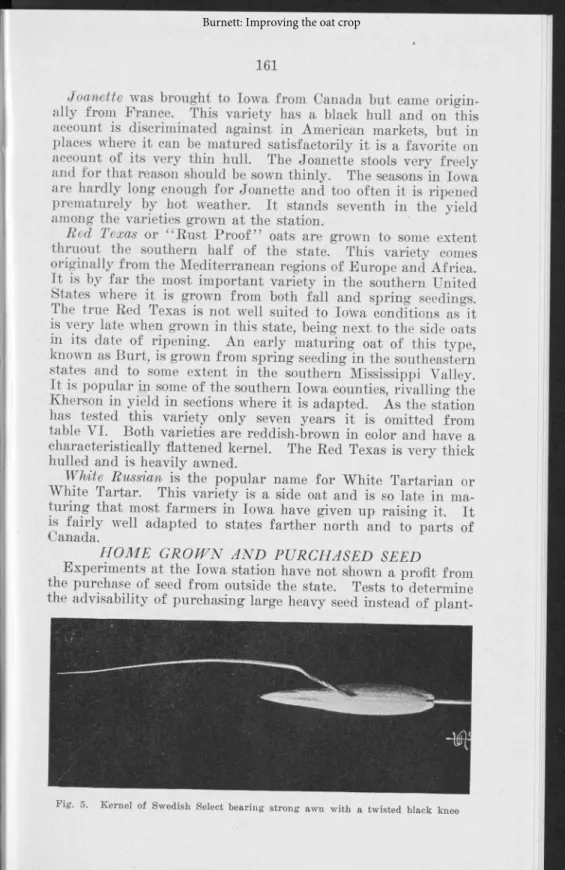
Swedish Select* was introduced into the United States from the cold and semi-arid regions of Russia and Siberia in 1899 by (M. A. Carlton) the U. S. Department of Agriculture. It originated many years ago in Sweden as a pedigree variety de veloped by selection and was afterwards grown in Finland and in north central Russia. The Swedish Select is a, large grained, white oat with a spreading head and is characterized by its blunt kernel which bears a strong awn with a twisted black knee. In sections where this variety thrives it is outstanding because of its thin hull and its heavy weight per bushel. It is well adapted to the region north of the com belt. In the com belt it is adapt ed to only the most northern portion, and even at that latitude other varieties will outyield it in most seasons.
Clydesdale is an old Scotch variety. The kernel is thickest about one-third of the way from the base. It is not well adapt ed to Iowa conditions, but oats of this type are grown to some extent, in the northeastern quarter of the state. It requires a longer and cooler season than is found in Iowa, and consequently' cannot be produced economically in this state.
* Carleton, Mark Alfred. Ten years’ experience with the Swedish Select Oats. U. S. Dept. Agri., Bureau of Plant Industry. Bulletin No. 182. 1910.
Joanette was brought to Iowa from Canada but came origin ally from France. This variety has a black hull and on this account is discriminated against in American markets, but in places where it can be matured satisfactorily it is a favorite on account of its very thin hull. The Joanette stools very freely and for that reason should be sown thinly. The seasons in Iowa are hardly long enough for Joanette and too often it is ripened prematurely by hot weather. It stands seventh in the yield among the varieties grown at the
station.-Bed Texas or “ Rust P ro o f” oats are grown to some extent thruout the southern half of the state. This variety comes originally from the Mediterranean regions of Europe and Africa. It is by far the most important variety in the southern United States where it is grown from both fall and spring seeding®. The true Red Texas is not well suited to IoWa conditions as it is very late when grown in this state, being next to the side oats in its date o f ripening. An early maturing oat o f this type, known as Burt, is grown from spring seeding in the southeastern states and to some extent in the southern Mississippi Valley. It is popular in some of the southern Iowa counties, rivalling the Kherson in yield in sections where it is adapted. As the station has tested this variety only seven years it is omitted from table VI. Both varieties are reddish-brown in color and have a characteristically flattened kernel. The Red Texas is very thick hulled and is heavily awned.
White Russian is the popular name for tVhite Tartarian or V/Tute Tartar. This variety is a side oat and is so late in ma turing that most farmers in Iowa, have given up raising it. It is fairly well adapted to states farther north and to parts of Canada.
HOM E GROW N AND PURCHASED SEED
Experiments at the Iowa station have not shown a profit from the purchase of seed from outside the state. Tests to determine the advisability of purchasing large heavy seed instead o f
Fig. 6. Harvesting oat variety of plats at Iowa Agricultural Experiment station
ing our own lighter seed were begun in 1908. In 1907 the Iowa crop was very light in weight per bushel and seed obtained from
it was below standard weight. The average weight per bushel
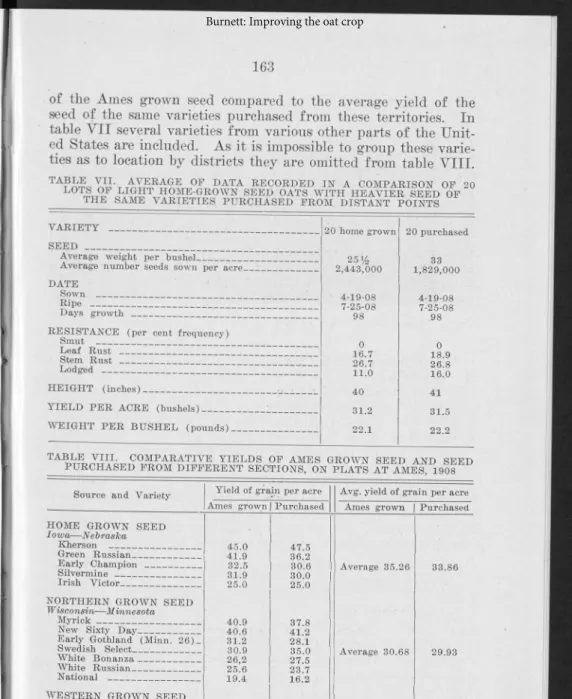
of 20 lots o f seed taken from as many different varieties grown on the station plats was 25% pounds per bushel. For this first experiment the station bought in the open market the heaviest seed obtainable o f each of these varieties. The average weight per bushel of these lots was 33 pounds per bushel.
When in 1908 plats were sown from each of the 40 lots, the light home grown seed produced an average of 31.2 bushels per acre with an average weight of 22.1 pounds per bushel. The heavy, purchased seed produced an average of 31.5 bushels per acre with an average weight per bushel of 22.2 pounds.
In 12 eases the light-weight home-grown seed outyielded the purchased seed. In 1 ease the light-w eight home-grown seed equalled the purchased seed. In 7 cases the purchased seed outyielded the home grown seed.
In considering the results of this experiment the following factors must be taken into consideration: The light seed was acclimated and as both lots were sown by weight more kernels of
the light were sown per acre than of the heavy seed. The data
in the summary in table V II shows the averages for each o f the two lots o f 20.
The seed that was purchased for this experiment may be dir vided roughly into four classes: 1, seed from Iowa and Nebraska; 2, northern grown seed from Wisconsin and Minnesota ; 3, 'west ern grown seed from Colorado, Wyoming, and Montana; 4, for eign grown seed from Scotland and England. The yields comr pared to the yield of the same variety from Ames grown seed is shown in table V III. This table also shows the average yie]d
of the Ames grown seed compared to the average yield of the seed of the same varieties purchased from these territories. In table V II several varieties from various other parts o f the Unit ed States are included. As it is impossible to group these varie ties as to location by districts they are omitted from table V III. TA? n ^ o T V T 0 F DATA RECORDED IN A COMPARISON OP 20 LQTS OF LIGHT HOME-GROWN SEED OATS W IT H H E A V IE R SEED OP
THE SAME V A RIETIES PURCHASED PROM DISTANT POINTS
V A R IET Y ________________\___ ______ S E E D _______.______________
Average weight per bushel-,.____ _ Average number seeds sown per acr DATE
Sow n___________■___________________ Ripe ________________________ ______ Days growth _ ____ ,______ ._______ RESISTANCE (per cent frequency)
Smut _.____________ ________ |_____ Leaf R u s t _________j_____ ________ Stem R u s t _________________ L o d g e d ________ ____L.____________ HEIGH T (inches)__________ '________ _ YIELD PER ACRE (bushels)_______ W EIGHT P E R BUSHEL (p ou n d s)..
20 home grown 20 purchased
25% 33 2,443,000 1,829,000 4-19-08 4-19-08 7-25-08 7-25-08 98 .98 0 0 16.7 18.9 26.7 26.8 11.0 16.0 40 41 31.2 31.5 22.1 22.2
TABLE V III. COMPARATIVE Y IELD S OP AMES GROWN SEED AND SEED PURCHASED PROM DIFFERENT SECTIONS, ON PLATS AT AMES, 1908
Source and Variety Yield of grain per acre Ames grown Purchased
HOME GROWN SEED
Iowa— Nebraska Kherson 45.0 47.5 Green Russian 41.9 36.2 Early Champion 32.5 30.6 1’ Silvermine 31.9 30.0 Irish Victor 25.0 25.0 n o r t h e r n GROWN SEED Wisconsin— Minnesota Myrick 40.9 37.8
New Sixty Day 40.6 41.2
Early Gothland (Minn. 2 6 ) . 31.2 28.1
Swedish Select 30.9 35.0
White Bonanza 26,2 27.5
White Russian 25.6 23.7
National 19.4 16.2
WESTERN GROWN SEED
Colorado, Wyoming, Montand
Swedish Select (M ont.)___ 30.9 26,2 Swedish Select (Colo.) 30.9 17.2
Lincoln 28.1 31.1
Irish Victor _ 28.0 18.7
FOREIGN GROWN SEED
Scotland— England
Clydesdale 30.6 26.9
Swedish Select 22.5 15. Ö 1
1
Avg. yield of grain per acre Ames grown | Purchased
)| Average 35.26 Average 30.68 Average 29.47 Average 26.55 33.86 29.93 23.30 20.95
Fig. 7. Threshing oats from the seed variety tests at the Iowa Agricultural Experi ment station
Seed of several o f the varieties that had been purchased for the preceding experiment was bought again from the same sources and the experiment was continued in 1909-1910 and 1911.
Table I X shows the average yields of the varieties secured dur ing the four years compared to the average yields o f the same varieties from Ames grown seed.
It will he seen from the average results shown in the table that none o f the purchased seed was better than the home grown seed when compared for a series of years, but that on certain seasons, notably 1910, which was a particularly favorable grow ing season, the differences were touch less pronounced.
TABLE IX . COM PARATIVE Y IE L D S OF SEED OF THE SAME V A R IET IE S FROM AMES GROWN SEED AND SEED PURCHASED FROM DIFFERENT
SECTIONS ON PLATS AT AMES IN 1908-1909, 1910-1911
Source and Variety Yield of grain per acre Avg. yield of grain per acre Ames grown Purchased Ames grown Purchased
NORTHERN GROWN SEED
Wisconsin— Minnesota
1908 average 7 varieties___ 30.68 ■ 29.93 1909 average 6 varieties___ 36.67 35.57
1910 average 5 varieties___ 65.36 60.24 Average 39.20 38.79 1911 average 4 varieties___ 25.77 31.87
W ESTERN GROWN SEED
Wyoming, Montana, Colorado
1908 average 4 varieties___ 29.47 23.30 1909 average 4 varieties___ 30.92 32.17
1910 average 4 varieties___ 64.22 67.57 Average 38.68 38.36 1911 average 3 varieties___ 30.10 30.4.0
FOREIGN GROWN SEED
England— Sc o tland
1908 average 2 varieties___ 26.55 20.95 1909 average 2 varieties___ 29.55 31.20
1910 average 2 varieties__■ 60.60 57.00 Average 35.35 31.06 1911 average 2 varieties___ 24.70 14.95
FANNING SEED OATS
As no gain was obtained from the nse of heavy imported seed the station began an experiment to determine whether thru the use o f a fanning mill the selection and sowing of the larger and heavier kernels in seed of varieties grown here thru a series of years would result in an increased yield. Two varieties were used, Kherson and Silvermine.
During the earlier years o f this test fresh seed was taken each season. A half bushel of the unfanned seed was reserved and labeled “ not fanned. ’ ’ The remainder was run thru the fanning mill and a half bushel taken out and labeled “ once fa n n e d /’ The remainder was again fanned and a half bushel reserved as “ twice fanned,” the remainder again fanned and labeled “ three times fanned.” Each lot of seed was sown at the rate of 3 bushels (96 pounds) per acre. Owing to the fact that by sowing an equal number of pounds the plats from the unfanned seed received a greater number of kernels than those that received fanned seed, the seedings were repeated varying the rate so that each plat would receive as nearly as possible the same number of kernels as that sown on the not fanned plat at the 3 bushel rate.
A study o f the results of two years’ tests showed that a lim ited increase had been gained for fanning and grading, but it became evident that the real problem was to determine wheth er or not there might be an accumulative effect from fanning
year after year. Consequently the experiment was changed
somewhat in 1910, and instead of obtaining seed from common stock each year, the seed was to be carried on from the original stock used to sow the 1910 plats. Seed for the “ not fanned” plat was to be taken from the not-fanned plat of the previous year. The straw and trash were to be screened out without wind so that no change in the grading took place. The seed for the once-fanned, the twice-fanned, and the 3 times-fanned plats were to be taken from the corresponding plats of the prev ious year. Each variety was to be sown as in the original ex periment, first, each plat receiving 3 bushels per acre and re peated at an increased rate to provide as nearly as: possible the same number of plants on each plat.
It was originally planned to continue this experiment at least ten generations before quoting yields. Unusual soil conditions . have made the data so far somewhat conflicting and the yields have not shown the uniformity that we might wish.
While the fanned seed has in most instances given larger yields than the unfanned seed, the data from the first seven gen erations o f this test are not sufficiently consistent to warrant us
in concluding that this increase is due to the accumulatwe ef
Since 1907 the experiment station has conducted 16 trials of drilling; vs. broadcasting. In the 16 trials the broadcast plats have outyielded the drilled plats only three times and in three they have equalled them. In 10 trials the drilled plats have outyielded the broadcast plats. When all the trials are aver aged by seasons we find that the drilled plats have outyielded the broadcast plats in every year except 1908. From this aver age we also find that the drilled plats, have outyielded the broad cast plats at the rate of 5.01 bushels (worth $1.77) per acre in the 9 seasons in which the tests have been conducted.
In years when the early growing season is moist and warm the difference in yield between broadcast and drilled seedings is often greatly reduced; under such conditions broadcast seed ing may yield as well as drilling. The data in table X shows that these conditions occur infrequently at Ames.
In seasons when the land stays cold and damp it is very easy to drill the seed so deeply that the crop is damaged. Special care should always be practiced, with regard to the depth of
drilling. Plants require heat, moisture and air. The seed
should never be planted down in the wet earth where heat and air are reduced. I f it can be placed at the junction of the moist soil below, and the dryer soil above, the best results will be obtained.
SPACE BETW EEN D RILL ROWS
In 1915 an experiment was started, to determine the proper distance between the drill rows for the seeding o f oats. Plats were sown with the regular drill in rows of 4, 6, and 8 inches apart and one was cross-drilled in squares 8"x8/V. Plats o f each of the above descriptions were sown at the rates of 2, 3, and 4 bushels per acre with Iowa No. 105 oats (a Kherson pure-line).
The experiment has now been conducted two seasons and while the data are far from conclusive the two> seasons’ results indi cate that at the two bushel rate the yields increase as the dis^ tance between the rows decreases. A t 3 bushels per acre the yields increase as the distance between the rows, increases. At 4 bushels per acre the yields increase more rapidly than at 3 bushels per acre, as the distance between the rows increase.
The cross-drilling in squares 8r,x 8 " seems to have the effect of
P R IL L E D
5474
Bu. IO20
30
40
50
7
J /777777
T777777777
TT77
TT7
T n77
/77777777777
T777
T T /777
T m m BROADCAST49
.73
Bu V777
T7
T77777
T7
T777777
T77777777777
T77777
T7
T77
T7
T777777
A IO20
¿on <viPig. 8. Graphic comparison of the average yields from oats drilled and sown broad cast 9 years 1907-1909, 1911-1916
TABLE X. ANNUAL AND AVERAGE Y IELDS IN BUSHELS P E R ACRE FROM DRILLIN G AND BROADCAST SEEDING OF OATS AT THE IOW A STATION FOR NINE YEARS (1907-09 AND 1911-16), W IT H THE FARM VALUE PER ACRE OF THE
GAIN FROM DRILLIN G
Season Variety Rate of
seeding
Yield per acre Average annual yield Annual
diffeivalue of *ence Drilled Broadcast Drilled Broadcast Difference
Price Value
bn. bu. bu. bu. bu. cents $
1907 Kherson
HI
54.3 46.4 Silvermine 2% 35.6 24.2 44.95 35.30 9.65 39 3.76 1908 Kherson 3 41.4 41.4 Silvermine 3 17.6 17.9 29.50 29.65 — .15 43 — .06 1909 Kherson 3 37.8 ' 35.0 Silvermine 3 55.3 55.3 46.55 45.15 1.40 35 .49 1911 Iowa No. 156 3 43.1 33.1 Iowa No. 157' 3 40.6 41.9 41.85 37.50 4.35 41 1.78 1912 Iowa No. 105 3 — --- . 75.00 70.30 4.70 27 1.27 1913 Iowa No. 105 3 — 72.50 67.40 5.10 34 1.73 1914 Iowa No. 105 3 ■---
— 36.90 33.40 3.50 41 1.43 1915 Iowa No. 105 3 — 82.30 67.50 14.80 32 4.74 1916 Iowa No. 105 3 57.0 57.0 Iowa No. 129 3 68.7 77.5 Iowa No. 386 3 63.7 48.7 Iowa No. 48 3 63.1 62.5 63.12 61.42 1.70 49 .83 Average --- 1 54.74 | 49.73 | 5.01 | 1 1.77yields increase for the low rates of seeding and decrease for the lighter rates.
RATE OF SEEDING
As will be seen from a study of table X I and fig. 9 the proper rate of seeding oats is governed by the variety that is used. The Iowa station has conducted experiments: to determine this factor
since 1906. The experiments were standardized in 1908. Since
that time plats have been sown annually at the following rates
of seeding: 2, 2% , 3, 2A/2, 4 and 4 % bushels per acre. All
measurements are made by weight, 32 pounds equalling 1 bushel. During the seasons 1908, 1909, 1910, 1911, and 1916 an early
and a medium late variety were used. The early variety was
represented by the Kherson and the medium late by the Silver- mine type, except in 1916 when the medium late type was repre sented by two varieties, a white and a yellow.
From table X I it may be concluded that it is not profitable to seed more than 3 bushels of the Silvermine variety while we may profitably seed 4 bushels per acre o f Kherson. It may be ex plained that the character o f the Kherson plant allows much more sunlight to reach the ground than is the case with the Silvermine. The leaves o f the Silvermine are much larger than those of the Kherson and the straw is taller.
In 1912, 1913, 1914, 1915, and 1916, a pure line from Kherson, TABLE X I. ANNUAL AND AVERAGE YIE L D S IN BUSHELS P E R ACRE OBTAINED FROM SEEDING OATS AT RATES VARYIN G PROM TWO '
TO POUR AND ONE-HALP BUSHELS IN THE NINE YEARS PROM 1908 TO 1916
V A R IE T Y AND YEAR RATE OP SEEDING, BUSHELS
2 2y2 3 3 y2 4 1 1 SILVERMI NE 1908 .. ... 21.9 25.6 29.7 30.6 29.7 31.1 1909________________ 24.1 24.1 42.2 40.0 42.2 46.9 1910 67.9 66.5 71.2 69.9 71.2 66.5 1911 52.7 53.9 54.3 52.3 53.3 50.4 Iowa Nos. 48-386 1916 62.5 62.8 62.8 63.7 67.2 64.0 Average___________ 45.82 46.68 52.04 51.30 52.32 51.78 Gain or loss for the addi’ al % bu. of. seed .76 5.46 -.7 4 1.02 -.5 4
KHERSON 1908 31.1 37.5 44.1 46.2 46.2 49.4 1909________________ 26.4 30.6 28.8 34.4 40.0 42.2 1910 79.2 78.5 80.5 78.5 78.5 79.2 1911-;_______________ 60.8 60.2 61.2 61.6 60.8 58.5 Iowa Nos. 105-129 1916 62.0 61.2 62.8 62.5 64.3 61.4 Average___________ 51.90 53.60 55.48 56.64 57.96 58.14 Gain for the additional % bushel of seed 1.70 1.88 1.16 1.32 .18
IOW A NO. 105 1912 83.6 80.5 79.7 78.1 75.8 72.7 1913 70.6 68.7 72.5 76.9 72.8 67.5 1914 51.4 51.4 59.0 55.2 55.6 55.0 1915 82.3 83.4 82.3 83.6 81.6 83.6 1916______________ 55.6 55.0 57.0 58.8 58.2 53.5 Average___________ 68.70 67.80 70.10 70.521 68.80 66.46 Gain for the additional 14 bushel of seed -.9 0 2.30 .42 -1 .7 2 ¡1—2.34
160
SILVER MINE AV. YIELl
IN B U . 45.
a
•46.6 5 2 O 5 I .O 5 2 O 5 / S KHERSONFig. 9. A graphic comparison of 5 years average yearsf 3 varieties of oats°sofn in o different rates of seeding
Iowa No. 105, was used in this experiment to ascertain whether pure lines could be expected to follow the parent type in this
character. The data m the last section of table X I show that
increasing the^ rate of seeding above 3 bushels per acre was unprofitable with Iowa No. 105, while the previous figures show a profit up to 4 bushels per acre for Kherson. It may be o f in terest to the reader to know that the kernels o f Io w a No. 105 are somewhat smaller than those of the original Kherson.
MANURE ON LAND FOR OATS
Experiments in progress since 1904 at the Iowa agricultural expenment station show that fertilizer increases the production
t oats, the field where this experiment is conducted is divided
into four parts, two of which are planted each year to corn the lrd is sown to1 oats and on the fourth clover is grown. On these four sections a 4 year rotation is practiced. The
<A?7e,^ls „cu^.f.or hay and second growth is allowed to grow.
A l l the fertilizers are applied to this second growth and are plowed under with it in the fall. The following season the land
is planted to corn This crop is picked and the stalks are cut
and plowed under for a second crop of corn. This second crop
f corn is picked, the stalks are again returned to the land and
tfie following year it is seeded to oats, with clover. The oats
are cut and both the grain and straw are removed from the land. he clover is allowed to grow after harvest but is not cut. The tollowmg year a hay crop is cut.
I h i s i a /o u r sections o f the field has been divided into
MO TREATMENT7777777777777T77777T7777777777777777777777777TA MAMUC E /77//77///77777/7//777/77777777777/7/77777//7/7/7777777\ MANURE -BONE77777777777777777777777777777777777777777777777777777771 MAn-B0riE-P0T7//7////////7/7////////7/7///777//7///77//77//////////7\ 2 0 5 5 2 4 4 4 2 4 8 0 2 49 8 GPA/M b u. IO 2 0 3 0 4 0 5 0 6 0 mOTPEATflETfr777777777777T777777777777777777777T77T7777T77777T77777777\ MANURE > / / / ? 7 / / / / 7 7 / 7 7 l / / / / / / / / / / / / / / / / m / / / / / / / / / / / / / / / / / / / / / / / / / / / / / / / m MANURE-BONEm / / / / / / / / m 7 7 / / / / / / / / / m / / / / / / / / / / / / / / / / / / / / / / / / / / / / / / / / / f m m MAN-BONE-POT> / / / / / / / / / / / / / / / / / / / / / / / / / / / / / / / / / / / / / / / 7 / 7 / / / / / / / / / / / / / / / / / / / / / / 7 7 7 7 / W / m
Fig. 10. Graphic showing relative effect of manure and fertilizers upon yield of straw and oats as shown in 4 year’ s rotation.
mentioned above, are plowed under with the second growth of clover. The results of 11 treatments included in the experi ment show that the plats which received no fertilizer give the lowest yields of oats. The plats that have received manure have outyielded those where no manure was applied, and those that have received manure reinforced with commercial fertilizing ma terials have given correspondingly higher yields as the manure was enriched
TABLE X II. EFFECT UPON THE YIE L D OF OATS, OF APPLY IN G MANURE AND FERT IL IZE R TO THE LAND ONCE IN A FOUR-YEAR ROTATION
TREATMENT
No Treatment___________________________ Manure __________________________ __,___ Manure, Bonemeal____________ ___________ Manure, Bonemeal. Potasium chloride__
Yield Per Acre | Gain for Fertilizer I ---:--- ■--- 1--- ;---| Straw, lbs. I Grain, bu. | Straw, lbs. ¡Grain, bu.
2055 I 57.11 I I
2444 1 63.65 I ■389 1 6.54 2480 1 65.84 I 425 I 8.73 2498 !1 69.40 1 423 1 12.29 Table X I I shows the average yields obtained for the ten years 1907 to 1916 on plats that received no treatment, those that re ceived 8 tons o f manure per acre, those that received 8 tons of manure reinforced with 800 pounds of steamed bonemeal and those that received 8 tons of manure reinforced with 800 pounds of bonemeal and 400 pounds of potasium chloride per acre. These yields show increases that indicate ^hat the soil on the Ames plats; is not ‘ ‘ too rich for oats. ’ ’
TIM E OF SEEDING
The experimental evidence at hand to show the beneficial ef fect of early seeding is very meager. It is an established cus tom to sow oats at the earliest possible date and this custom is based upon the common experience of many farmers. In 1916 the Station sowed 18 twientieth-acre plats: of Silvermine oats, nine o f which were drilled on April 15, and nine on April 27. Table X I I I shows that the early seeded plats; ripened three days
—Su wÌN A B R IL 15 || SOWN A PRÎT. 9.7 -t lfli t
No. -uate Ripe | Yield per | Wt. per | Plat lbs. | bu. lbs. I Plat
1 No. DateRipe Yield per I Wt. per 1710 1720 1730 1740 1750 1760 1770 1780 22 22 21 22 22 23 22 22 78 26 97 24 95 26 105 27 84 ] 29 107 | 28 95 1 26 96 27% 99 1 29 1800 1810 1820 1830 1840 1850 1860 1870 I 1880 7 /2 5 25 25 25 25 25 25 27 54 54 52 43 64 57 75 60 25 27 23 23 24 25y2 24 24
Bu. per acre 95.1 1 59.4 1 .26.9 7/2 5 58.8
36.8 24.3 ’ earlier and averaged 22.6 bushels per acre more than the late
and, that the Srain from the early sown plats
weighed 2.6 pounds more per bushel. These late seeded plats • ^ m e?urse5 sown. Yery late and in consequence the difference
m yields is very striking. umeience
TREATING SEED OATS FOR SMUT
atiou p treating seed oats fo r smut needs no recommend
ation in the form o f experimental evidence. Practically everv
experiment station* has published data showing the M o e c l
sioned by oat smut to crops where the seed has not been treated
yea5 s: These same reports show that the formaldy-
y f treatment is a safe, sure, and inexpensive method This
method is given below in b rie f.- im s
One pound (pint) o f formaldehyde in 30 to 40 gallons of water will treat 40 bushels of oats. The equipment nfeded is a clean floor, a barrel, a sprinkling can, a scoopshovel and plenty
of blankets, sacks or tarpaulin. Proceed as follows 7
dePep ° Ut 0n ^ fl° ° r 40 bUSheb of oate five or six Mix one pound of formaldehyde (40% ) with from 30 to 40 gallons of water. Stir well.
S l d n t * w ^ l°atS- H E t h e m ature in the barrel until each gram is well-moistened. It is well during this operation'
sprinkles.^11 *° ^ 11)6 ° atS “ to a Pile w h i l e " “
H B pile at B with the blankets and sacks in order
to keep the gas m where it will be effective. (It is this free gas that does the work-)
5. Leave the pile covered for six to ten hours (it may be left
W ■ ~ the blankets and W B l
T t0 dry' Shovel them over from time to time.
bft f aIlons,?f
W B B
B used for
40
bushels of seed it mayhe_found expedient to put on only half o f the solution and to * See Bui. Ia. Ag. Exp. Sta. 96, p. 18.
3.
without difficulty and will require less labor than when the entire 40 gallons are put on at one time. The barrel of solution and the seed, should be kept covered during the intermission.
Recent experiments have indicated that less water may he used with equal success; some recommend one pound of for maldehyde to as little as 20 gallons for 40 bushels o f oats. These experiments have not been thoroughly demonstrated at the Iowa Station and will have further investigation. However, the ex periments to date indicate that 1 pound to 30 gallons is safe.
CUTTING
Oats should usually be cut before the heads turn yellow. I f the weather is normal, there will be two or three days when the heads are a greenish white. Oats cut at this period will ripen and cure out in the shock, and will shatter much less than those
cut when they are ripe. Oats should not be cut when they are
damp with rain or dew as they may discolor more or less.
SHOCKING
Oats should he shocked as soon as they are cut. It is doubtful economy to leave them on the ground over night as they gather dampness and require considerable time to dry out. Opinions differ as to the best form of shock, hut the 8 to 10 bundle round shock seems to he preferred on the prairies.
STACKING
The common custom in Iowa is to thresh from the shock. Too often, however, shock threshed grain is taken to the machine damp or even wet and the loss of grain that is left in the straw, together with the damage in quality o f that which is threshed out, costs the average farmer many dollars. I f the weather and the shocks, are very dry the loss from this practice is lessened considerably.
Oats that go thru the sweat in the stack before they are put in the bin are always brighter and heavier than those threshed from the shock. Buyers on the Grain Exchange floor claim that there is usually at least one grade difference between stacked and shock threshed oats.
It should be borne in mind that when grain is threshed from the stack home labor is utilized for all the hauling. This, labor is always more economical than hired or exchanged labor. The actual amount of increase in labor for stack threshing is repre sented by the work of the man who stacks the grain and of the men who pitch the stacks to the separator.
The advantages in stack threshing are: 1. Saving in grain.
2. Improvement in quality. 3. Replacing high priced labor on threshing day with home labor at a time when it is less ex pensive.