Based on the Introduction of Chaos Theory of Web Server Performance
WANG Yue-min
Computer Science Department, Suqian college, Jiangsu Suqian 223800, China
Abstract
Web is currently widely developed service, and the daily customer access data is exponentially increasing. The Web service is quite important for daily life, but the increasing demands propose more requirements for the Web servers. This paper proposes a performance detection technique based on chaotic theory and visibly display the fading of the Web server in order to predict and maintain the fading performance of the current Web servers ensuring the utility and efficiency of the Web servers. The intent maintains can extend the utility cycle and efficiency of the Web servers.
Keywords:
Web Server, Chaotic Technique, Fading Characteristics1. Introduction
The rapid development of the network techniques brings convenience for human beings. The increasing demands of the Web server software increases the complexity of the Web servers [1]. There are many problems in the area, such as Web server software aging. For example, the sudden down of the website of Morgan bank in 2010 and the malfunctions of Facebook servers will shock the peoples’ daily life greatly [2]. Thus, the fading situation of the Web servers should be paid more attentions when maintain the servers.
With the continuous development of the Internet and Internet users increase gradually, Web server request quantity presents the fast growth trend, cause server performance decline, Web application will appear a lot of abnormal phenomenon, can not meet the needs of users, so related to the effective measures to ensure that the effectiveness of the Web application performance, become the focus of scholars analysis problems. Web server system is a random system, including a large number of dynamic information. Web server software own drawbacks and Web server environment configuration will have a corresponding Web application performance defects. Web server software performance analysis and diagnosis for improving Web application performance has important significance. Software in long-term continuous operation process, the inner defect with the increase of time will reduce the performance of the software, and finally lead to the collapse of the whole software system, the process is the software aging phenomenon. Usually by based on method and basis of the measurement method of software aging analysis. The test tool collection client response time, according to the server program testing and acquisition Web server average load, memory variation of the parameters such as state, for the performance analysis indicators evaluation server aging.
The server software performance measurement and analysis method for parallel program performance of related principles, such as based on the program execution state and execution trace analysis, but these methods mainly to small range of parallel program, to meet a wide range of Web server applications with persistent object, mass execution trace quantity, and produce results in error sex.
According to the performance of the Web server, the current log mining analysis methods, the use of statistical methods to analyze users browse or access mode, the invasion of model, and then planning mass log analysis algorithm for Web server software performance analysis, but the method for Web server software performance analysis and diagnosis support limited, the effect of the poor, get the results of the analysis has limitations. Therefore, to carry out Web server software performance analysis and diagnosis research to solve Web application performance defects, is an important and meaningful work.
There are already numerous scientists carrying researches on Web servers fading situation. However, majority parts of the researches purely consider the Web server software as a whole part neglecting the change of the performance parameters with time and the importance of the prediction data for software anti-fading. Therefore, in actual operation the system service will extend the time and the flexibility can’t meet the changing requirements [3]. This paper applies measurement method and completely utilizes chaotic theories to judge the aging situation of the software and analyze the corresponding
Journal of Convergence Information Technology(JCIT) Volume8, Number6,Mar 2013
particle software anti-fading which can ensure the high efficiency and time of the operation for the Web servers.
2. Web server chaotic performance parameter analysis
The basic construction of the Web application contains client, browser, the Internet and Web server. The detailed operation scheme is as follows [4]. When there is one customer request, the browser will send a Web request page first. The client complied and executed by the browser executes the scripts by Web pages during which other controls, such as Java Applet, Active X and plug-in will interact with browsers and web pages [5]. Finally, the interact results will display the visual interface in browser. The detailed Web server operation scheme is as shown in figure 1.
Figure. 1 Web server basic flow chart
The flow chart of the Web server is shown in figure 1. The performance of the Web server will greatly depends on the customer access process which has close relationship with its own parameters [6]. As we known, the parameters of the Web server generally contain system memory, disk access, network parameters, number of customers, average loading and response time.
There is one concept involving attractive sub-dimension and embedded dimension in chaotic theory
[7]. Based on the theoretic analysis, the system model can be reconstructed by measurements. The
definitions of the basic reconstruction method are as follows [8]. According to Taken embedded theory, assuming the embedded dimension is m, dynamic system dimension is d and combining the recovery of the dynamic property, when m>2d+1, the phrase space is defined as equation 1:
t
x
,
,
,
1
Y
i
t
ix
t
i
x
t
i
m
i=1,2,...,N (1)
From another aspect of the chaotic theory, when G-P algorithm is introduced, the attractive factor and embedded dimension can be further solved and the relationship will be attained. The detailed computation procedure is as follows [9~10]. First, different r can solve corresponding dimensions m by applying G-P algorithm. Then the different r and embedded m are put to equation 2. Finally the attractive dimension d is solved. In the following equation 2, for fixed r, C(m,r) represents that the probability of the distance between two points is less than r. When r is increasing, C(m,r) will gradually increase according to
r
d, which means there is positive proportion relationship between C(m,r) andd
r
. After getting logarithmic of the both sides, lnC(m,r) is proportional with dlnr. For different r, the corresponding C(m,r) can be solved. Finally the fitting attractive sub-factor dimension d can be solved by equation 2.
N j kj
Y
k
Y
r
N
, 1 21
r
m,
C
(2)In the equation, when r is not larger than 0,
r
is 0; when r is larger than 0,
r
is 1.According to the identification method of the chaotic characteristics for the key performance, when embedded dimensions m increase to some value, the attractive dimension d will reach saturation state for the chaotic coefficients which illustrates there is chaotic attractive factor in any basic web server. Thus the performance coefficients of the Web server satisfy chaotic theory. In order to enforce the performance of Web server, this paper picks up two main performance parameters-response time and average loading [11~12]. The response time is an important index for evaluating the health performance of the Web server. There is one judgment itself. When the response is not too large, it will enter the execution stage if it does not excess the preset standard to answer the customer request [13].If the response time excesses some range, it will present anti-fading state in order to extend boot time or customer requests [14].For average loading, it's key factor affecting response time. In summary, these two performance parameters are more clear and suitable for the whole Web servers compared to other factors.
3. Anti-fading model research based on chaotic theory
Many current anti-fading researches only focus the whole Web server, but neglect some key performance parameters [15]. There are three construction levels in the Web server-component level, application level and system level. In component level, the functions of the components are to form server system which is key component [16].Its anti-fading cost is comparatively low and it can store the customer request information related to the components which can restore the information when the software restarts. The application level contains multiple application services. Due to there are multiple application services related states and customer information, its anti-fading cost will larger than component level [17].The system level is the key level whose crucial characteristic is that the fading can’t be restored by application level recoveries and it can store the customers’ request information and properties [18]. These factors will lead the increase of cost and affect the final services, which will extent the boot time. This paper focuses on the two key performance parameters and fading situations stated in the second part on the basis of the three-layer construction hierarchy.
Figure2. Web server structure
In the context, we choose two key performance parameters and prove these two coefficients can meet the chaotic analysis mechanism. At the same time, we further analyze the components structure of the whole Web server. This paper proposes a detection performance technique pointing to the previous obvious issue which integrates previous mechanisms and equations. We apply the scheme in figure3 to research on the performance characteristics and fading of the Web server.
Figure. 3 Web server anti-fading prediction scheme
This paper introduces the concept of maximum Lyapunov exponent for exponent prediction in order to enforce conveniently the chaotic performance of the parameter. The basic concept is to quantity describe the separate ratio of the two contiguous orbits with different initials in the whole phrase space when the time is passing. It quantifies the exponent divergence and estimation of the initial orbit. We build corresponding multiple-particle software fading detection procedure combining the Web server fading detection scheme. The figure 3 illustrates the multiple-particle fading detection scheme and further indicates the performance fading situation of Web server.
Start Predict corresponding time p Yni Request quatity Execution End Predict average loading 1 R Xni 2 R Xni
Component Level Application Level System Level
No No No No Yes Yes Yes Yes
Figure. 4 The detailed fading detection flow chart
It’s convenient for Lyapunov exponents to solve and it has been well applied. Additionally, it can highlight the chaotic characteristics of average loading and response time of the web servers. The detailed computation method is as follows.
1st step: FFT transformation to compute the average periods.
2nd step: Reconstruct in the phrase space which applies G-P theory in the chaotic theory to solve d, m.
3rd step: Determine the contiguous node of each node to separate with constrains to attain the separate distance and average distance in Kth step.
P
i
j
Y
Y
d
j
min
j
i
(3)
jk
dj
t
q
k
y
1ln
1
(4)5th step: Least squares linear fit to gain final prediction results as equation 5.
2 1,
n k k kf
x
y
b
a
(5)4. Experiments
According to previous mechanisms and equations, this paper applies JSP, Servlet, EJB and combine the hardware RBM to build a typical experimental platform in figure 3[19~21]. The experimental platform has some basic functions of Web servers which is general and can simulate some amounts of customers’ access [22~23]. It can ensure the Web server to provide accurate Web service to operate well. For average loading, the noise can desalinate the chaotic characteristics of the system. Thus, this paper pre-processes the noise before taking the average loading. During the experiment operation, the loading measurement surveillance tool can monitor 2408 response time samples and the time interval is 1 hour.
Figure.5 Experiment platform
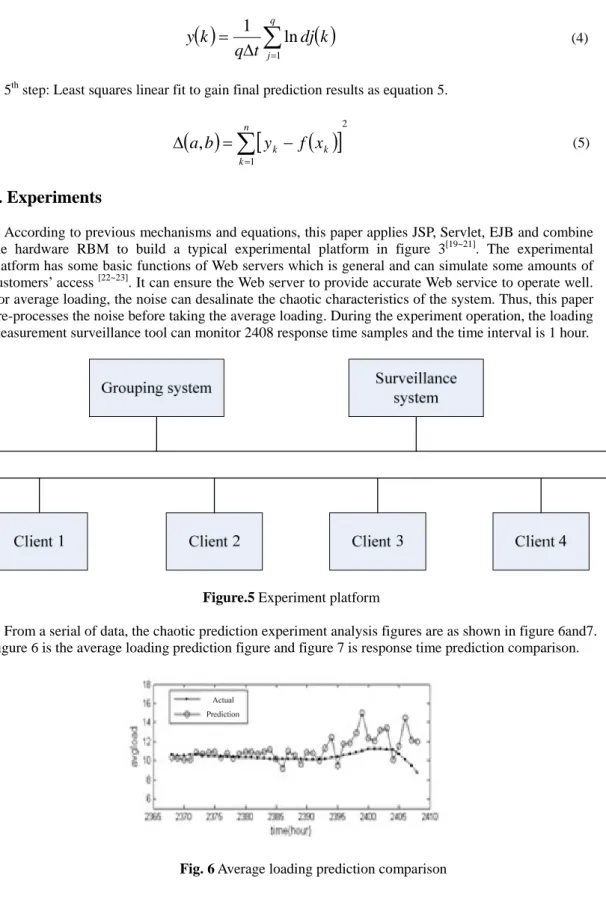
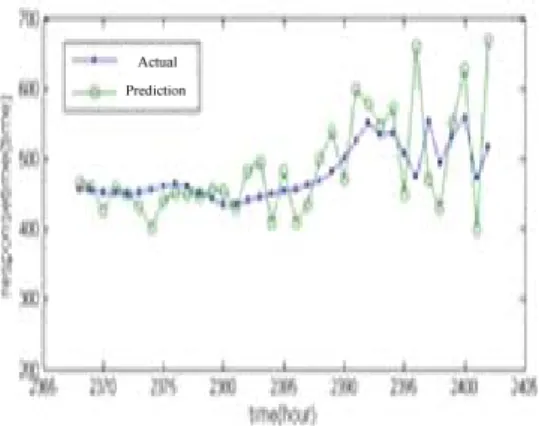
From a serial of data, the chaotic prediction experiment analysis figures are as shown in figure 6and7. Figure 6 is the average loading prediction figure and figure 7 is response time prediction comparison.
Fig.7Response time prediction comparison
When the fading doesn’t reach some level that’s there are large amounts of customer requests, the algorithm can accurately control and the errors level is comparatively less between 2368 hour and 2402 hour.
The experimental data can be attained from the procedure of figure 5 and 6 together with the equation 3, 4 and 5, which is as shown in table 1.
Table 1 Experiment results
Construction level Prediction length Average relative errors Max relative errors Errors
Component Level 43hour 7.65% 21.6% 1.7%
Application Level 39hour 9.98% 27.8% 2.3%
System Level 36hour 10.89% 34.0% 3.5%
From the table 1 of the experiment results, the fading of components level is less than the application level and system level and it can last for more time. The average loading and relative time errors are less than the prediction data.
5. Conclusions
The above experiment proves the chaos theory with proposed performance parameters the weights to evaluate the effect of each construct level on aging [24]. It can fulfill the attenuation prediction of the web server to some extent [25]. The proposed theory can scientifically estimate the soft aging progress rate through the attenuation model with the prediction data which can increase the reliability and accessibility of the system. It can reduce the operation lost due to the software aging and less the malfunction parts and time.
6. References
[1] Ma Shu-yue, "Research on Dynamic Image Encryption Algorithm Based on Maximum Entropy of Chaotic Sequence", AISS, Vol. 4, No. 13, pp. 76 ~ 84, 2012
[2] Yudong Zhang, Lenan Wu, "Weights Optimization of FNN by Scaled Chaotic ABC Algorithm", JDCTA, Vol. 6, No. 13, pp. 132 ~ 140, 2012
[3] Wang Jian, "The Research of Neural Network Mixed with Image Encryption Based on Chaotic Encryption Technology", AISS, Vol. 4, No. 9, pp. 1 ~ 8, 2012
[4] Shao Jun, "Research on the Application of Non-Linear Model based on Chaos Theory in Economy Prediction", JCIT, Vol. 7, No. 16, pp. 385 ~ 392, 2012
[5] Jianbo Yi, Yongbin Li, Qi Huang, Sihai He, "Application Study on Distribution Network Operations Management System Based on Smart phones", JCIT, Vol. 7, No. 23, pp. 476 ~ 483, 2012
[6] Liwei Ning, Linfeng Bai, Xilong Qu, "Research on Virtual Experiment Platform Based on Matlab Web Server", JCIT, Vol. 7, No. 13, pp. 143 ~ 152, 2012
[7] Sang-Woong Lee, Jeong-Seon Park, "Microscopic Image Recognition-based Fish Disease Diagnosis System", JCIT, Vol. 6, No. 10, pp. 355 ~ 364, 2011
[8] Juan M. Sola-Sloan, Isidoro Couvertier-Reyes, "TOE-Em: The TCP Offload Engine Emulator for Approximating the Impact of Removing TCP/IP Protocol Processing From Apache HTTP Server", IJEI, Vol. 2, No. 4, pp. 1 ~ 11, 2011
[9] MA Jun, SHE Jun, "Research on Cyber Security Segregation for Industrial Control Systems", JDCTA, Vol. 5, No. 8, pp. 9 ~ 15, 2011
[10] Yunlu Cai, Guodong He, Yuguang Chen, "MATLAB Web Application and Method Discussion", JCIT, Vol. 7, No. 4, pp. 175 ~ 182, 2012
[11] Kaiyu Wang, Zheng Li, "Power and Performance Analysis for Web Server Cluster", AISS, Vol. 4, No. 12, pp. 285 ~ 293, 2012
[12] Huiyang Wang, Xiangdong You, Ran Wang, "An Image Monitoring System based on V4L2 and Web", IJIPM, Vol. 3, No. 4, pp. 79 ~ 87, 2012
[13] Wen-Jye Shyr , Chia-Ming Lin, Wei-Ting Chiang, "WebAccess Based Remote Graphic Surveillance System for Mechatronics", JDCTA, Vol. 4, No. 3, pp. 110 ~ 116, 2010
[14] Anirban Kundu, , Sutirtha Kr. Guha , Tanmoy Chakraborty , Subhadip Chakraborty , Snehashish Pal , and Debajyoti Mukhopadhyay, , "Multi-Agent System for Search Engine based Web Server: A Conceptual Framework ", JDCTA, Vol. 3, No. 4, pp. 44 ~ 59, 2009
[15] Kazuya Odagiri, Rihito Yaegashi, Masaharu Tadauchi, Naohiro Ishii , "Basic Portal System with the Function of Communication Control for Each User", JCIT, Vol. 3, No. 1, pp. pp.20 ~ pp.30, 2008
[16] Marini Othman, Abdullah Mohd Zain, Abdul Razak Hamdan, "A Survey on Chaotic Disruption of ICT Project Management and Planning: Triggers, Impact, Challenges, and Recommended Measures", JDCTA, Vol. 3, No. 1, pp. 46 ~ 50, 2009
[17] Youxin LUO, Bin ZENG, Xiaoyi CHE, "Forward Displacement Analysis of Generalized Parallel Manipulator Based on Parameter Coupled Mapping Hyper-chaotic Method", JCIT, Vol. 7, No. 22, pp. 468 ~ 475, 2012
[18] Dongming Chen, Yunpeng Chang, "A Novel Image Encryption Algorithm based on Logistic Maps", AISS, Vol. 3, No. 7, pp. 364 ~ 372, 2011
[19] Dongming Chen, Yongming Liu, Xiaodong Chen, Yunpeng Chang, Jing Wang, "A Novel Chaotic Map and DES based File Encryption Algorithm", IJACT, Vol. 3, No. 7, pp. 198 ~ 205, 2011 [20] Xiangdong Liu, Xiqin He, Xueye ANG, Nan Jiang, "A New Chaotic FH Sequences Generator
based On Dynamic Quantization", JCIS, Vol. 1, No. 1, pp. 49 ~ 55, 2011
[21] Gang Liu, Yuanxiang Li, Xin Nie, Yu Sun, "Improving Clustering-based Differential Evolution with Chaotic Sequences and New Mutation Operator", IJACT, Vol. 3, No. 6, pp. 276 ~ 286, 2011 [22] Wang xiao-hua , Zhang yong-mei, "Chaotic quantum-behaved PSO Algorithm for Power System
Economic Load Dispatch", JDCTA, Vol. 5, No. 8, pp. 290 ~ 297, 2011
[23] Wei Niu, Guoqing Wang, Zhengjun Zhai, Juan Cheng, "Prediction of Chaotic Time Series based on Rough Sets and Support Vector Machine", JDCTA, Vol. 5, No. 9, pp. 145 ~ 152, 2011
[24] Gang Liu, Yuanxiang Li, Xin Nie, Yu Sun, "Design of Two-dimensional IIR Digital Filters by using a Clustering-based Differential Evolution with Chaotic Sequences", JDCTA, Vol. 5, No. 9, pp. 153 ~ 163, 2011
[25] Qi-bin Hou, Hao-xiang Wen, , Chong Fu, Hao-tian Wu, Xin Li, "A Fast Chaos-based Image Cipher with a Novel Key-stream Generation Scheme", IJACT, Vol. 4, No. 16, pp. 101 ~ 109, 2012