Are Reporting Errors Due to Encoding Limitations
or Retrieval Failure? Surveys of Child Vaccination
as a Case Study
LISA LEE,
1* ANGELA BRITTINGHAM,
1ROGER TOURANGEAU,
1GORDON WILLIS,
2PAMELA CHING,
2JARED JOBE,
2and STEVEN BLACK
31National Opinion Research Center, USA 2Centers for Disease Control and Prevention, USA 3Kaiser Permanente Pediatric Vaccine Study Center, USA
SUMMARY
Surveys of childhood vaccinations are often highly inaccurate, due to parental misreporting. We conducted three experiments to examine the source of the inaccuracies. In Experiment 1, we provided parents with memory aids; these aids did little to improve reporting accuracy. Two further experiments asked whether parents forgot what they knew about their children's vaccinations, or whether theynever knewthe information. In Experiment 2 we surveyed parents both immediately and ten weeks after their child's medical visit. Accuracy was only slightly better than chance immediately afterwards; ten weeks later performance had not changed signi®cantly. Experiment 3 compared reports in both recall and recognition conditions. Although the recognition condition lowered the response burden on parents it did not produce more accurate reports. We conclude that low levels of accuracy in parental reports on vaccinations appear to re¯ect poor initial encoding rather than retrieval failure. Copyright #1999 John Wiley & Sons, Ltd.
Appl. Cognit. Psychol.13: 43±63 (1999)
Household surveys conducted by government agencies, university researchers, and private research ®rms are replete with detailed questions about the behaviours of both the respondents and their family members. Often, these questions are about relatively common or mundane events and it is reasonable to expect that the task will be dicult for respondents unless steps are taken to improve recall of the target events. In fact, it has been found that, in many cases, recall is incomplete; several studies have made attempts to improve reporting through the use of eective retrieval cues (for a summary see Jobe and Mingay, 1991). However, retrieval cues will be eective only if a memory trace has been stored, so that improvement in reporting is fundamentally a matter of enhancing the respondent's access to that memory. An alternative possibility that has been less emphasized by researchers who apply cognitive methods to surveys is that the information sought may have been insuciently encoded
CCC 0888±4080/99/010043±21 $17.50
*Correspondence to: Lisa Lee, National Opinion Research Center, 55 East Monroe, 48th Floor, Chicago, IL 60603, USA.
initially. In this case, it is impossible to supply retrieval cues that will provide access to the information; it is very likely that respondents will instead engage in reconstructive or guessing behaviour.
To study the relative importance of encoding limitation versus retrieval failure in a realistic applied survey setting, we investigated parental reports of their young children's vaccinations. Currently two national surveys monitor childhood vaccina-tion coverage rates ± the Navaccina-tional Immunizavaccina-tion Survey (NIS) and the Navaccina-tional Health Interview Survey (NHIS), both sponsored by the Centers for Disease Control and Prevention (CDC). A key estimate derived from both surveys is the proportion of children who have received all their recommended vaccinations by the age of two. Both surveys solicit information from adult respondents ± typically, the parents of sample children.
Even very conscientious parents may have diculty answering detailed questions about their children's vaccinations. Currently, children are supposed to have received at least 14 doses of ®ve dierent vaccines by their second birthday. The vaccines are for polio; measles, mumps and rubella (MMR); diphtheria, tetanus, and pertussis (DTP); hepatitis B; and Hemophilus in¯uenzae type b disease (Hib). Recently, a vaccine for chicken pox (varicella) has been added to this list. The names of the diseases the vaccines are intended to prevent are long and dicult to pronounce and the diseases themselves may be unfamiliar to many parents. Fortunately, many paediatricians provide parents with a vaccination card that lists the vaccinations their children have received. Respondents in both national vaccination coverage surveys are encouraged to consult these cards in reporting about sample children. Despite these eorts, approximately half of respondents provide vaccination data without the aid of cards or other records.
The accuracy of these unaided reports in the national surveys is still being explored. However, earlier evaluations of the accuracy of parental responses to questions about vaccinations in other surveys suggest that there is considerable error in the reports. For example, Goldstein and her colleagues found that parents overreported the number of vaccinations their children had received (Goldstein, Kviz and Daum, 1993). Across a number of studies that compare parental reports with provider records, overreporting of vaccinations appears to be the rule (Goldsteinet al., 1993; Haweet al., 1991; Kalsbeeket al., 1991; Killewoet al., 1991; McKinneyet al., 1991), although a few studies also ®nd underreporting (Gergen, Ezzati and Russell, 1988; Valadez and Weld, 1992).
The three experiments described here investigate sources of error in parents' reports about their children's vaccinations and explore methods for improving the accuracy of those reports. The speci®c hypotheses they test are partly derived from a model of the process of answering questions. Over the last two decades, several models of the survey response process have appeared (e.g. Cannell, Miller and Oksenberg, 1981; Strack and Martin, 1987; Tourangeau, 1984; Tourangeau and Rasinski, 1988; Willis, Royston and Bercini, 1991; see Jobe and Herrmann, 1996, for a review comparing several of these models). Although the models dier in many particulars, they share the assumption that reporting errors arise in surveys because of problems in one of the underlying cognitive operations through which survey reports are generated. As applied to reports about children's vaccinations, these models point to ®ve potential sources of error. First, some parents may never have encoded the relevant information. Several characteristics of vaccination episodes may discourage careful
encoding: Vaccinations have become routine; the child may receive multiple vaccina-tions during a single visit to the paediatrician; the doctor or nurse may not take the time to identify the shots being administered during that visit; and parents may be too distracted to assimilate this information. Second, parents may have diculty understanding the vaccination questions when the survey interview is administered. Comprehension of the questions would seem to require that the respondents recog-nize the relevant terms (e.g. oral polio vaccine) and dierentiate each vaccine from the others. It is possible that parents lack the requisite background knowledge to under-stand the questions fully. Third, at the time of the interview, the respondent must recall information about each vaccine in question (unless he or she can retrieve this information from a vaccination card). Given the number of vaccinations and the similarity of the episodes in which they were administered, recall is likely to present a formidable challenge. Fourth, some respondents may simply report that their children have received all the recommended doses, and their judgement about this may be mistaken. Finally, some respondents may recognize that their children are not fully vaccinated but be embarrassed to admit this.
The current investigation focuses on encoding and memory processes as potential sources of reporting error in vaccination surveys. Our ®rst experiment examined whether memory aids such as a medical history calendar or a card displaying the number of recommended doses for each vaccine could improve recall. As in many investigations of memory, this approach presupposes that the information in question had been initially encoded and stored in long-term memory; thus the key issue was how to prompt its retrieval when the survey questions were administered. However, even assuming that parents were aware of each vaccination their child had received, we felt that the number and routine character of the vaccinations would encourage the formation of a `generic' memory, in which the details of the individual vaccinations would blur together (Means and Loftus, 1991; Smith, Jobe and Mingay, 1991). Providing memory aids represented an attempt to assist the respondents in decom-posing the generic memory, and in reconstructing detailed information about which vaccinations the children had actually received.
We were also concerned, however, that the initial encoding of information about vaccinations might be inadequate to permit accurate recall about individual vaccina-tions at the time of the survey interview. A number of studies have demonstrated the importance of initial encoding processes on subsequent retrieval (e.g. Anderson and Reder, 1978; Craik and Lockhart, 1972; Craik and Tulving, 1975). In the limiting case, the trace left by the initial experience might be virtually non-existent or inaccurate ± parents may have only a hazy sense of the shots administered on a speci®c occasion or they may be completely mistaken about which shots their children received. To investigate this possibility, two further experiments were conducted to examine parents' initial encoding of information about vaccinations. In Experiment 2, parents were questioned about the vaccines their child received both immediately and ten weeks after the doctor's appointment. In Experiment 3, we compared parents' performance when questions were asked in recall and recognition formats.
EXPERIMENT 1
The initial experiment examined two potential sources of reporting error that relate to the retrieval and reporting of vaccination information. The ®rst of these involved
memory retrieval failures, in which respondents are unable to distinguish dierent episodes in which the child received a vaccination. If memories for individual vaccination episodes had merged into a generic memory, a medical events calendar might help respondents to reconstruct the speci®c episodes (Means and Loftus, 1991). To test whether such a calendar might improve recall, half of the respondents were asked to record information about their child's medical providers, illnesses, and paediatric visits on a grid in which the columns represented the months of the child's life; the other half were not asked to use this calendar, but were administered a standard set of questions about their children's vaccinations.
The second potential source of error studied involved the use of ¯awed estimation strategies. Respondents who cannot retrieve information about individual vaccina-tions may attempt to answer the quesvaccina-tions by estimating the number of vaccinavaccina-tions their children have received. These estimates may be based on easily retrieved information, such as the overall frequency of visits to the paediatrician . Based on the hypothesis that some answers are estimates, we sought to determine whether the answers might be improved if respondents had accurate information to anchor these estimates. We therefore varied whether the respondents received a show card listing the names of the vaccines and the number of doses recommended for each. Finally, as a methodological precaution, we varied whether the questions concerning each vaccine came before or after a global question asking whether the child had received all the recommended vaccinations.
Method
Sample
The 221 respondents in the experiment were the adults responsible for two- and three-year-old children who attended a paediatric clinic in Chicago. The clinic provided NORC with a list of all two- and three-year-old children ± ranging in age from 24 to 47 months ± who were patients there. We sampled children from this list and randomly assigned them to experimental groups. The respondent to the interview was typically, though not always, the child's parent ± in recruiting respondents to report about the sample child, we asked for the person who usually took him or her for visits to the doctor.
A very high percentage of respondents (94%) were mothers or female guardians of the sample child; another 5% were grandparents, and the remaining few were fathers, aunts, or uncles. The clinic serves a low-income area in the city of Chicago. About 85% of the respondents had completed high school, and 46% had some college education.
Questionnaire
The key questionnaire items were the same vaccination history questions used in the NIS and NHIS immunization surveys. This standard set of questions ®rst asks respondents whether the child had ever received any vaccinations, in the form of either shots or drops. If the child had ever received a vaccination, respondents are then asked whether the child had received each speci®c vaccine (DTP, polio, MMR, Hib, and hepatitis B), and, if so, the number of doses they had received for each one. Besides including the standard questions about the ®ve recommended vaccines, we added similar items about vaccinations for smallpox, chicken pox, and pneumococcal
disease; children were unlikely to have received any of these vaccinations, and these items were included to determine whether respondents had a general tendency to overreport vaccinations. Finally, the standard vaccination history questions included an item assessing the child's global vaccination status (`In your opinion, has [child name] received all of the recommended shots for his/her age?').
In addition to the vaccination history items, the questionnaire included items assessing the respondents' knowledge about vaccinations. For each vaccine, the respondent was asked what illness the vaccination was intended to prevent, and how many doses children are supposed to receive by the time they are two years old. Finally, the last section of the questionnaire collected basic demographic information about the respondent.
Procedure
Each of the 221 respondents was paid $30 to come to NORC's Chicago oce and participate in a 20-minute face-to-face interview. Respondents completed the questionnaire under one of eight conditions produced by the 222 combination of calendar presentation (medical-history calendar versus no calendar), showcard presentation(immunization showcard versus no card), andquestion order(global or speci®c vaccination items ®rst). The calendar-aided questionnaire attempted to create a rich set of contextual and chronological cues to prompt accurate recall of the number and dates of each vaccination. Under this approach, half of the respondents recorded health-related information on an event history calendar before they answered the standard vaccination questions. First, the respondent identi®ed the child's source of medical care during each period of his or her life. Both the usual source of care (if there was one) and any other sources of medical care were noted on the calendar. Next, major events in the child's medical history, such as serious illnesses or injuries, were noted on the calendar, followed by speci®c visits to each caregiver. In the ®nal step, respondents indicated whether vaccinations were given during each visit. After completing the calendar, the respondents were administered the standard question-naire items. The calendar-aided questionquestion-naires were contrasted with questionquestion-naires that included only the standard vaccination questions.
The second experimental variable was whether the respondent was presented with a showcard that listed each vaccination and the number of doses recommended by age two years. In half of the questionnaires, respondents viewed a showcard while answering the standard vaccination questions; in the remaining half, respondents answered the vaccination questions without the aid of the showcard. The ®nal experimental variable was the order in which global and speci®c vaccination questions were asked. In half the questionnaires, the global vaccination status item came after the questions about the speci®c vaccines; in the remaining half of the questionnaires, the global item preceded the items on each vaccination series.
Collection of vaccination records data
At the conclusion of the interview, respondents were asked to list all the medical providers from which the child had received medical care and to sign a permission form giving us access to the child's medical records. Any additional medical providers (besides the clinic from which the children had originally been selected) were con-tacted and asked to provide information about the vaccinations they administered to
the sample child. We obtained complete medical records for 189 of the 221 sample children.
Results
Overall accuracy
The main dependent variables were the accuracy of the respondents' reports about their children's global vaccination status, and the accuracy of their reports about each speci®c vaccine. These dependent variables were derived by comparing the respond-ents' answers to the questionnaire items with the child's medical records. The parent's assessment of the child's status on each vaccine was based on the questions asking how many doses the child received. Children were classi®ed as reported as up to date for each vaccine if the number of doses reported for the vaccine matched or exceeded the recommended number; otherwise they were classi®ed as reported not up to date. The parent's assessment of the child's overall status was based on the global question. The child's actual up-to-date status was determined from the medical records. From these classi®cations, we constructed, for each vaccine, four measures of the accuracy of the respondent's reports:
(1) The net bias (the dierence between the percent classi®ed as up-to-date in the two data sources)
(2) The false negative rate (the proportion of children classi®ed as up-to-date based on medical records data who were reported asnotup-to-date in the questionnaire) (3) The false positive rate (the proportion of children classi®ed as not up-to-date based on medical records data who were reported as being up-to-up-to-date in the questionnaire)
(4) The phi correlation between the questionnaire report and medical records regarding up-to-date status.
Table 1 shows the overall levels of accuracy by vaccine and for the global status question. There is a signi®cant relationship between the child's actual status (accord-ing to the medical records data) and reported status only for the global status item (w2(1)10.11,p50.01) and for the item on MMR (w2(1)4.55,p50.05). However,
even on those items, there are high levels of error in the respondent's reports. On the global status item, about 83% of the respondents whose children werenotup-to-date, according to medical records, reported that the children had received all their recommended vaccinations. Approximately 98% of the parents whose children were up-to-date according to the records reported that their children had received all their recommended vaccinations. Thus, the net bias on the global status item is quite large (53.4%), with the reports biased in the direction of overreporting. Similarly, almost all the respondents indicated their children had received one or more doses of the MMR vaccine (only one dose is recommended), including 26 of 27 of the respondents reporting about children who had not received that vaccine.
Although responses to the global status and MMR questions show high rates of overreporting of up-to-date status, responses to the questions about three of the four other speci®c vaccines show underreporting to be quite common as well. These four vaccines all require three to four doses. The false negative rates for these vaccines ranged from 44% for polio to 56% for Hib; that is, about half the respondents whose children had received all the recommended doses for these vaccines did not report that
the child had received enough doses for them to be up-to-date. The false positive rates for these same four vaccines (ranging from about 41% to 44%) indicate that the number of parents who mistakenly overreport their child's status is also high. Chance levels of accuracy would yield false negative and false positive rates that do not dier signi®cantly from 50%. In fact, for the four vaccines involving multiple recommended doses, the phi correlations, false positive rates, and false negative rates all indicate approximately chance levels of accuracy.
Overall, then, respondents were not very accurate in reporting how many vaccina-tions their children received. Were they more accurate about whether the children had
ever received the vaccine? Table 2 shows the accuracy of parents' responses to questions concerning whether their child had ever received a particular vaccine. Although responses for children who had received a vaccine appear highly accurate, with false negative rates generally below 5% (Hib is the exception), the false positive rates are quite high, ranging from 67% to 100%, indicating that regardless of whether the child had received a given vaccine, the respondents were prone to report that he or she had received it. It should be noted, however, that the sample sizes used to calculate false-positives were generally small, due to the fact that most children have received at least one dose of each vaccine. We also examined the relationship between respond-ents' reports about whether the child had ever received any doses of a particular
Table 1. Experiment 1: child's vaccination status according to medical records and respondents, and parental response accuracy measures, by vaccination
Vaccine (n) Percentage up to date according to records Percentage up to date according to respondent Accuracy measure Net bias False negative rate (%) (n) False positive rate (%) (n) Phi Hepatitis B (142) 45.8 47.2 1.4 49.2 44.2 0.07 (65) (77) DTP (158) 70.9 45.6 ÿ25.3 52.7 41.3 0.05 (112) (46) Polio (165) 78.2 52.7 ÿ25.5 44.2 41.7 0.12 (129) (36) Hib (123) 81.3 43.9 ÿ37.4 56.0 43.5 0.00 (100) (23) MMR (149) 81.9 99.3 17.4 0.0 96.3 0.17c (122) (27) Meana 71.6 57.7 ÿ13.9 40.4 53.4 0.08 Global (189) 34.9 88.4 53.4 1.5 82.9 0.23d Statusb (66) (123)
Note: The scores on hepatitis B, DTP, Polio, Hib and MMR are based on the respondent's answer to the question, `How many vaccines did [child] ever receive?' Sample sizes on which each rate is based appear in parentheses.
aThe mean scores are averages calculated across the ®ve individual vaccines.
bThe global status scores are based on the question `In your opinion, has [child name] received all the recommended shots for his/her age?'
cp50.05. dp50.01.
vaccine and whether the medical records indicated at least one dose had been received. The relationship was signi®cant for the hepatitis B vaccine (w2(1)10.47, p50.01) and for MMR (w2(1)10.14,p50.01).
Responses to the questions on the smallpox, chicken pox, and pneumococcal vaccines also suggest overreporting is common. Sample children were very unlikely to have received any of these vaccines (the smallpox vaccine is no longer administered in the United States, the chicken pox vaccine was just being introduced at the time of this survey, and the pneumococcal vaccine is rarely given to children). However, 24.3% of the respondents reported that the child received the smallpox vaccination, 30.2% reported the chicken pox vaccine, and 2.6% reported the vaccine for pneumococcal disease.
The data suggest that many respondents were uncertain about their child's vaccination status and had a strong tendency to respond that the child had received all the vaccinations they were asked about. This leads to overreporting on the global question and the questions concerning whether the child had ever received a particular vaccine. Further, because respondents were uncertain about the number of doses the child received, those reporting about up-to-date children often under-report.
Eects of the experimental variables
The three experimental variables (presence or absence of the calendar, presence or absence of the showcard, and question order) had little impact on whether the respondent's report agreed with the records regarding the child's up-to-date status. Parents' accuracy was similar across versions of the questionnaire. The mean number
Table 2. Experiment 1: percentage of children who had ever received a vaccination according to medical records and respondents
Vaccine (n) Percentage who received according to records Percentage who received according to respondent Accuracy measure Net bias False negative rate (%) (n) False positive rate (%) (n) Phi Hepatitis B (176) 75.6 92.6 17.0 3.8 81.4 0.24b (133) (43) DTP (185) 95.1 99.5 4.3 0.6 100.0 ÿ0.02 (176) (9) Polio (185) 94.6 98.9 4.3 1.1 100.0 ÿ0.02 (175) (10) Hib (166) 94.6 81.3 ÿ13.3 17.8 66.7 0.09 (157) (9) MMR (181) 80.1 92.8 12.7 4.1 80.6 0.24b (145) (36) Meana 88.0 93.0 5.0 5.5 85.7 0.11
Note: Reports are in response to the question `Has [child] ever received a shot?' Sample sizes on which each rate is based appear in parentheses.
aThe mean scores are averages calculated across questions on the ®ve individual vaccines. bp50.01.
of vaccines on which parents reported their child's status accurately did not dier signi®cantly across versions of the questionnaire (means2.1 versus 2.2 vaccines for global question order ®rst versus last; 2.2 versus 2.1 for calendar versus no calendar; 2.3 versus 2.0 for showcard versus no showcard;F(7, 181)0.77, n.s.). We carried out logit analyses examining the eects of these variables on answers to the global questions and the questions on each speci®c vaccine. In these analyses, the dependent variable was the accuracy of the respondent's report about the child's up-to-date status.
In a three-way logit analysis on accuracy, only one eect emerged as signi®cant in the six analyses, involving the reporting of Hib. A signi®cant interaction was observed between the calendar and the question order variable (z1.98,p50.05); no other main eects or interactions were signi®cant for reports on Hib, the other four vaccines, or global vaccination status. Since these analyses tested a total of 42 main eect and interaction terms, the interaction eect for Hib reporting is quite likely due to chance.
Knowledge about vaccinations
One possible explanation for the respondents' low accuracy is their poor encoding of the relevant information when the vaccines were given. Even if respondents knew the child had been vaccinated, they may not have been told by the physician what the vaccine was for or they may have found it dicult to take in the information. We tested this hypothesis by comparing the reports of parents who demonstrated a high level of knowledge about vaccinations with those demonstrating a low level. A knowledge score which combined accuracy in naming the diseases the vaccines are intended to prevent and accuracy regarding the number of recommended doses was calculated for each respondent. Because respondents had answered four questions on the diseases prevented by the vaccines (we left out the polio vaccine), this provided an opportunity to name eight diseases. In addition, they answered ®ve items on the number of doses recommended for each vaccine. In total, respondents could give up to 13 correct answers on the knowledge questions.
Respondents' knowledge was found to be quite limited. For DTP, 47% of the respondents were unable to name even one disease prevented by the vaccine, and only 9% could name all three. Similarly, only 13% could state the disease prevented by the Hib vaccine. Performance on MMR was somewhat better, with 63% able to name at least one of the diseases the MMR vaccine prevents and 40% able to name all three. Perhaps because of its name, 78% answered the question about the hepatitis B vaccine correctly. Performance was also poor on the items assessing knowledge of the number of doses recommended for each vaccine.
We divided respondents into two groups based on the median knowledge score. Respondents above the median in their knowledge about vaccinations gave more accurate reports than the less knowledgeable respondents, correctly reporting the child's status on an average of 2.6 out of the ®ve vaccines (versus 1.7 for the respondents below the median);t(186) ÿ4.14,p50.01.
Because half of the respondents received a showcard listing the vaccines and their recommended doses, this should have improved their knowledge scores. Respondents who received the showcard were more accurate on the questions about the number of recommended doses for each vaccine (answering an average of 2.1 versus 1.5 for
no-showcard group); t(187) ÿ2.45, p50.05. However, as already reported, the showcard did not improve accuracy on the key vaccination history questions. Discussion
The most striking ®ndings in Experiment 1 were the low levels of reporting accuracy and the eects of knowledge about vaccinations on accuracy. Overall, respondents performed barely above chance levels of accuracy in reporting the vaccination status of sample children. Further, the best predictor of accuracy was the level of knowledge about the vaccinations. It is likely that many respondents encoded little information about the vaccinations their children received at each visit to the doctor because they never learned much about the dierent vaccines and lacked the background knowledge needed to encode what happened during each visit. This suggests that procedural variations designed to prompt fuller recall ± such as those tested in Experiment 1 ± are likely to fail since respondents have stored little information in memory in the ®rst place. In the next two experiments, we examined parents' encod-ing of information about the vaccines their children received.
EXPERIMENT 2
In the second experiment, we attempted to measure directly the accuracy with which parents encode information about a vaccination episode and the extent to which this information becomes lost or distorted over time. Parents whose children had just received one or more vaccinations were interviewed as they left a vaccination clinic at a health maintenance organization in Oakland, California. The parents responded to a general question asking them to describe in their own words what treatments the child had received that day; they were also speci®cally probed about whether the child had received any vaccinations. The parents' reports were coded and compared with the clinic's records as to what shots the child had actually received. Because the interval between encoding and retrieval was so short ± a matter of minutes ± this comparison provided a basis for assessing the accuracy of the initial encoding of information about the visit. To examine how this information was transformed in memory over time, we contacted these respondents again after ten weeks had elapsed. At the same time, we interviewed an additional group of parents whose children had also been vaccinated at the clinic during the same period as the ®rst group of respondents but who were not interviewed until ten weeks later; this comparison group allowed us to determine whether the initial interview aected the storage and retention of information in memory.
Method
Sample
The sample for this experiment consisted of parents whose children were patients at a paediatric clinic in Oakland, California. All the children were less than seven years of age. Of the parents interviewed, 81% were mothers and 19% were fathers. The sample was 39% white, 29% black, 14% Hispanic, 16% Asian, and 3% other races or
ethnicities. Respondents were highly educated, with 97% having completed high school, and 46% having obtained a college degree.
Questionnaires
The Wave 1 questionnaire gave respondents two opportunities to report vaccina-tions ± ®rst, in response to a general question that asked what had happened during the medical visit that day (`To start o, would you tell me in your own words what happened during the child's visit today?') and later in response to more speci®c questions that asked whether the child had received any shots that day and if so, what those shots were for (`Did [child] get any shots today? What were the shots for?'). The Wave 2 questionnaire was essentially the same as the Wave 1 questionnaire, with appropriate changes in wording to re¯ect the passage of several weeks since the visit to the clinic.
Procedure
Data were collected in two waves. During the ®rst wave, two interviewers were stationed outside of the clinic exit. Each parent arrived at the clinic with their child and signed the clinic's consent form, which listed the names of the vaccines that the child was to receive. Then, they were given an information sheet that described the risks and bene®ts of each vaccine, saw their child being vaccinated, and received the updated vaccination card for the child. As they were leaving the clinic, one of the two interviewers approached and asked if they would participate in a survey. A total of 103 parents agreed to take part. About two-thirds of these parents (70) completed the interview about their child's medical visit and also provided information to enable us to contact them in the future. Parents in the other third of the initial sample (33 parents) were asked only for the locating information. In addition, we asked every respondent to sign a form giving the researchers permission to obtain information from the child's medical record.
The Wave 2 data were collected by telephone ten weeks after the initial data collection. Eighty of the 103 respondents were successfully contacted and reinter-viewed. Of the 80, 54 had completed the full Wave 1 interview and 26 had provided only locating information during Wave 1. All 80 of the Wave 2 respondents were asked about the medical treatment the child received during his or her doctor visit ten weeks earlier.
Coding of the parents' data
We refer to answers to the general question concerning what happened during the medical visit asfree recallresponses and answers to the more speci®c questions pertaining to the administration of any shots ascued recallresponses. A comparison of answers to these questions revealed virtually no dierences between the two sets of responses. For example, 36 parents reported the polio vaccine in response to the free recall question and 38 reported it in the cued recall question. The phi correlations between the two types of questions were highly signi®cant for all ®ve vaccines, with the weakest one being 0.71 for Hib. We combined responses to the two types of questions in the remaining analyses, so that if a parent reported the child had received a vaccine in response to either item, we counted the parent as reporting the vaccine. Further, we counted a parent as reporting a particular vaccination even if the respondent only named one component of the vaccine (e.g. `measles' for MMR). If a parent had
indicated that the child received the combination Hib/DTP shot, or `Tetramune', they were counted as having reported both Hib and DTP.
Results
Wave 1 accuracy
The focus of the analysis was on the accuracy of the parent's reports. We constructed four measures of accuracy, similar to those constructed for the ®rst experiment, by comparing the parent's report with the medical record of what had happened during the visit. As in Experiment 1, the accuracy measures were the net bias (the dier-ence between the proportion of children who received the vaccine according to the medical record and the parent's report), the false negative rate for each vaccine (the proportion of children who received the vaccine according to the record whose parents who did not report it), the false positive rate (the proportion of children who did not receive the vaccine but whose parents reported it), and the phi correlation between the parent's report and the medical record.
Even immediately after the vaccinations had been administered, most parents had little idea about which vaccinations their children had received that day. The children had received an average of 3.3 vaccines during their visit to the clinic. On average, parents correctly named only half of these; across the ®ve shots, the false negative rate averaged 49%. Parents also occasionally reported shots their children had not received (the average false positive rate was 18%), but, overall, underreporting was more prevalent than overreporting. There was a signi®cant relationship between whether the parent reported the vaccine and whether the child had actually received it during the visit for DTP (w2(1)7.01,p50.01) and polio (w2(1)12.17,p50.01),
and a marginally signi®cant relation for MMR (w2(1)3.81,p50.06).
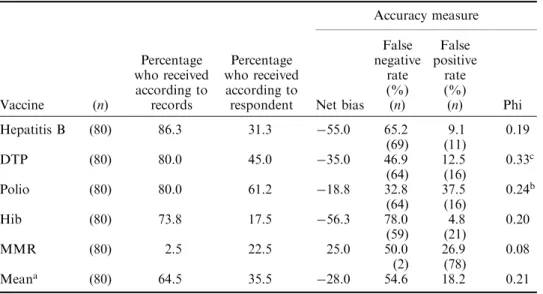
Table 3 shows the four accuracy measures by vaccine for the Wave 1 reports. The type and magnitude of the reporting errors diered greatly by vaccine. The four vaccines that most of the children had received ± hepatitis B, DTP, polio, and Hib ± were generally underreported, with the net bias ranging fromÿ24.3% to ÿ64.3%. This tendency towards underreporting of these four vaccines was also apparent in the high false negative rates, which ranged from 33.9% for polio to 86.5% for Hib. Averaging across the ®ve vaccines, parents were about as likelynotto report a vaccine their child had received as to report it (the mean false negative rate was 49.4%).
Hib was the most underreported vaccine of all, which is consistent with the results of the ®rst experiment. Hib tends to stand out from the other vaccines in terms of its net bias, false positive, and false negative rates. The tendency not to report Hib ± whether or not the child actually received it ± could be due to its complicated name and the unfamiliarity of the relevant disease (a form of meningitis). The overall tendency to underreport was apparent for all the vaccines except MMR. MMR was administered much less often than the other vaccines and, perhaps as a consequence, was overreported rather than underreported; only 4.3% of the children received the vaccine during this visit and 21.4% of the parents reported it. This resulted in a false negative rate of 33.3%, but a false positive rate of 19.4%. Another possible reason that the pattern of reporting for MMR is unique could be the same reason that the knowledge scores from Experiment 1 were high for this vaccine: parents have a greater familiarity with the vaccine and the diseases it prevents.
We tested the hypothesis that the reporting errors for each shot were not random, but were biased in the direction of either over- or underreporting. We used McNemar tests for this purpose, comparing the sizes of the two o-diagonal cells; this yields a
z-statistic, with positive values indicating overreporting and negative values indicating underreporting. Signi®cant underreporting was found for every shot except MMR (allp's50.01), which was signi®cantly overreported (z3.21). Overall, then, only two vaccines (DTP and polio) were reported with better than chance accuracy and even these two were systematically underreported.
We also explored whether the accuracy of reports varied according to the respondent's characteristics. We compared the performance of respondents reporting about ®rst-born versus later-born children, only-children versus children with siblings, and children less than two years old versus older children; we also compared mothers with fathers, and respondents with dierent levels of education. Only one of the comparisons yielded a signi®cant result ± the false negative rate was lower for children with no siblings than for children with siblings (mean false negative rate of 42% versus 56%;F(1, 66)4.25,p50.05).
Wave 2 accuracy
After a ten-week period, parental reports were only slightly less accurate than they were in Wave 1. In the second wave, reports about DTP and polio were still signi®cantly related to whether the child had received these vaccinations (for DTP,
w2(1)8.54, p50.01; for polio, w2(1)4.75, p50.05). The average false negative
rate in Wave 2 was 54.6%, only a slight increase over the 49.4% average rate in Wave 1. The average false positive rate across the ®ve vaccines, 14.1% in Wave 1, rose only
Table 3. Experiment 2, Wave 1: percentage of children who received a vaccination during a speci®c visit, according to medical records and respondents, and parental response accuracy measures Vaccine (n) Percentage who received according to records Percentage who received according to respondent Accuracy measure Net bias False negative rate (%) (n) False positive rate (%) (n) Phi Hepatitis B (70) 85.7 44.3 ÿ41.4 51.7 20.0 0.20 (60) (10) DTP (70) 82.9 51.5 ÿ31.4 41.4 16.7 0.32b (58) (12) Polio (70) 80.0 55.7 ÿ24.3 33.9 14.3 0.42b (56) (14) Hib (70) 74.3 10.0 ÿ64.3 86.5 0.0 0.20 (52) (18) MMR (70) 4.3 21.4 17.1 33.3 19.4 0.23 (3) (67) Meana (70) 65.4 36.6 ÿ28.9 49.4 14.1 0.27
Note: Reports are in response to the question `What were the shots or immunizations [child] received for?' asked as parents were leaving the clinic. Sample sizes on which each rate is based appear in parentheses. aThe mean scores are averages calculated across the ®ve individual vaccines.
to 18.2% in Wave 2. These increases in the error rates may re¯ect some loss of information from memory.
Table 4 reveals that dierences in accuracy across the types of vaccines are just as apparent in Wave 2 as they were in Wave 1. For the four shots received by most of the children (hepatitis B, DTP, polio, Hib), underreporting was common and the net biases were negative (this is doubtless due to the fact that so many children received these four shots, creating more opportunities for false negatives than for false positives). For MMR, which few of the sample children actually received, overreporting was the rule.
Comparison of Wave 1 and Wave 2
We created four indices that examined the consistency between Wave 1 and Wave 2 reports for the 54 respondents who completed the full questionnaires in both waves of the experiment:
(1) The forgetting rate (the proportion of parents reporting the vaccine in Wave 1 who did not report it in Wave 2)
(2) The `invention' rate (the proportion of the parents not reporting the vaccine in Wave 1 who did report it in Wave 2)
(3) The phi correlation between reports in the two waves
(4) The net dierence between the proportions reporting the vaccine in the two waves.
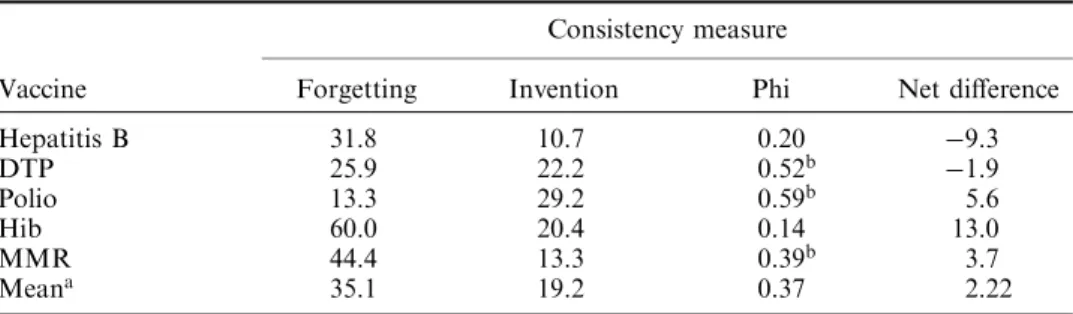
Table 5 displays the consistency measures by vaccine. For three of the ®ve vaccines, the phi correlation was statistically signi®cant (DTP, phi0.52; polio, phi0.59;
Table 4. Experiment 2, Wave 2: percentage of children who received a vaccination during a speci®c visit, according to medical records and respondents, and parental response accuracy measures Vaccine (n) Percentage who received according to records Percentage who received according to respondent Accuracy measure Net bias False negative rate (%) (n) False positive rate (%) (n) Phi Hepatitis B (80) 86.3 31.3 ÿ55.0 65.2 9.1 0.19 (69) (11) DTP (80) 80.0 45.0 ÿ35.0 46.9 12.5 0.33c (64) (16) Polio (80) 80.0 61.2 ÿ18.8 32.8 37.5 0.24b (64) (16) Hib (80) 73.8 17.5 ÿ56.3 78.0 4.8 0.20 (59) (21) MMR (80) 2.5 22.5 25.0 50.0 26.9 0.08 (2) (78) Meana (80) 64.5 35.5 ÿ28.0 54.6 18.2 0.21
Note: Reports are in response to the question `What were the shots or immunizations [child] received for?' asked 10 weeks after the clinic visit. Sample sizes on which each rate is based appear in parentheses. aThe mean scores are averages calculated across the ®ve individual vaccines.
bp50.05. cp50.01.
MMR, phi0.39; p50.01 for all comparisons). In fact, the phi correlations in Table 5 are generally much higher than those in Tables 3 and 4. For four of the ®ve vaccines, there is greater consistency between the parents' reports in the two waves than there is agreement with the medical records in either wave. The exception is Hib, where the correlation across waves is only 0.14. This suggests that, for most vaccines, parents tend to reproduce their previous answers, regardless of their accuracy.
Finally, to test the hypothesis that previous questioning aected recall, we compared Wave 2 accuracy measures for the group that was questioned about vaccines during Wave 1 (n54) and the group that was not (n26). Neither group performed better than the other in terms of false negatives or false positives. We then carried out chi-square tests of independence to determine whether there was a relationship between being questioned previously and reporting each vaccine (regardless of whether vaccine was actually received), or between being questioned previously and reporting each vaccine accurately. Those respondents who were previously questioned were more likely to report hepatitis B and less likely to report MMR vaccinations than were respondents not previously questioned (for hepatitis B, 38.9% versus 15.4% and, for MMR, 20.4% versus 42.3%;p50.05 for both comparisons). However, there were no signi®cant eects for the other types of vaccines, and most importantly, there were no signi®cant relationships between being questioned previously and reporting accurately. Although previous questioning did increase the number of reports for hepatitis B and MMR, it did not increase theaccuracyof the reports for any vaccines. Discussion
A major source of reporting error appears to be that parents fail to encode accurately what happened during the vaccination episode, rather than to retrieve that informa-tion later. In both waves of Experiment 2, respondents systematically underreported all the vaccines that involved multiple doses and systematically overreported the one vaccine (MMR) for which only one dose is recommended. The relation between which shots were reported and which the child received was little better than chance, despite the fact that parents had signed consent forms which listed the vaccines the child was getting, received information sheets about the vaccines, were present when the vaccinations were given, and got a shot record to take home. It seems quite likely that many respondents were aware that the child received one or more vaccinations
Table 5. Experiment 2: measures of consistency between Wave 1 and Wave 2 reports
Vaccine
Consistency measure
Forgetting Invention Phi Net dierence
Hepatitis B 31.8 10.7 0.20 ÿ9.3 DTP 25.9 22.2 0.52b ÿ1.9 Polio 13.3 29.2 0.59b 5.6 Hib 60.0 20.4 0.14 13.0 MMR 44.4 13.3 0.39b 3.7 Meana 35.1 19.2 0.37 2.22
Note: Sample size equals 54.
aThe mean scores are averages calculated across the ®ve individual vaccines. bp50.01.
during the visit, but that they were simply guessing about which ones. None of the characteristics of the respondents or of the sample children were strongly related to accuracy of reporting in the second experiment.
The procedure used in Experiment 2 did not completely eliminate the possibility of retrieval failure, as opposed to encoding limitation, as an explanation for the observed reporting diculties. In particular, it is possible that a recognition test, in which the names of vaccines are presented to respondents, would have produced more accurate reports than the recall task we used. Recognition imposes fewer demands on retrieval than either free recall or cued recall items, like those included in Experiment 2. Experiment 3 compares performance in recall and recognition conditions.
EXPERIMENT 3
Experiment 3 compared the accuracy of parents' reports on their child's vaccinations, immediately after the child received the vaccines, using two dierent question formats. In therecallcondition, parents named vaccines in response to free recall and cued recall questions, as in Experiment 2. Respondents were asked what happened during the doctor's visit and whether any shots were received. This task may have been dicult for parents because they may have had only limited knowledge of the vaccines or they simply may have been unsure of how to pronounce the names of the vaccines. In the recognition condition parents were asked speci®cally about each vaccine. The recognition format reduces reporting demands because respondents do not have to generate the names of the vaccines themselves but merely respond `yes' or `no' to each question. If parent's inaccuracy in reporting is due to diculty retrieving the required information, recognition performance should be better than recall. However, if parents are inaccurate because they never encoded the vaccines to begin with, recognition performance will also be poor.
Method
Sample
The sample of parents and children was drawn from the same paediatric clinic used in Experiment 2. We approached 320 adults leaving the clinic, of which 182 were eligible for the experiment. Each adult was accompanying a child who was less than seven years of age and who had received at least one vaccination during the visit (according to the parent). In addition, to be eligible, the adult had to be able to respond in English. Of those who were eligible, 42 refused to participate and 140 completed the short face-to-face interview.
Questionnaires and procedure
Of the 140 respondents, 82% were the mothers of the child, 16% were the fathers, and the remainder were other relatives. As in Experiment 2, most of the respondents had completed high school (88%) and 64% had completed at least some college education. The respondents represented a diverse mix of racial backgrounds: 34% Black, 26% White, 18% Hispanic, 16% Asian, and 6% other races or ethnicities.
As parents left the paediatric clinic, they were asked to participate in the experiment and sign a consent form giving us permission to obtain medical records regarding that
day's visit to the clinic. Respondents were then randomly assigned one of the two questionnaire versions. In one version, respondents were asked a separate yes/no question for each vaccine (e.g. `Did your child receive a polio vaccine?'). In the other version, respondents were ®rst asked to name the vaccines the child received, as in Experiment 2 (`Did CHILD get any shots or vaccines today?' followed by `What were these shots for?'); they were then asked the same recognition questions as in the ®rst version.
Results
Levels of reporting
As seen in Table 6, the recognition and recall questions resulted in similar levels of reporting for most of the vaccines (e.g. the percentage reporting that their child received the DTP vaccine was 54.3% for those answering the recognition question and 46.4% for those answering the recall question). However, there was a signi®cantly higher percentage reporting Hemophilus in¯uenzae b in response to the recognition (47.1%) than to the recall question (14.5%,w2(1)17.3,p50.001).
Accuracy by version
We also examined the accuracy of the reports about each vaccine by version of the questionnaire. Table 6 shows that, overall, there were few dierences in the accuracy of the reports from the two versions. We carried out logit analyses examining
Table 6. Experiment 3: percentage of children who received a vaccine that day, percentage of parents reporting a vaccination, and response accuracy measures, by question format
Vaccine
(n) Percentagereceiving Percentagereporting Net bias Recog Recall Recog Recall Recog Recall Recog Recall
Hepatitis B 70 69 37.1 44.9 37.1 39.1 0.0 ÿ2.9 DTP 70 69 61.4 68.1 54.3 46.4 ÿ7.1 ÿ21.7 Polio 71 69 42.3 56.5 47.9 60.9 5.6 4.3 Hib 70 69 37.1 39.1 47.1c 14.5c 10.0 ÿ24.6 MMR 70 69 35.7 36.2 42.9 27.5 7.1 ÿ8.7 Meana 42.7 49.0 45.9 37.7 3.1 ÿ10.7 Vaccine
False negative rate False positive rate Phi
Recog Recall Recog Recall Recog Recall
Hepatitis B 30.8 (26) 25.8 (31) 18.2 (44) 10.5 (38) 0.51 0.65 DTP 18.6 (43) 34.0 (47) 11.1 (27) 4.6 (22) 0.69 0.57 Polio 0.0 (30) 5.1 (39) 9.8 (41) 16.7 (30) 0.89 0.79 Hib 7.7c(26) 66.7c(21) 20.4c(44) 6.2c(48) 0.70 0.35 MMR 4.0b(25) 28.0b(25) 13.3b(45) 2.3b(44) 0.80 0.75 Meana 12.2 31.9 14.6 8.1 0.72 0.62
Note: Recog (Recognition): `Did your child receive a vaccine today?' Recall: `Did your child get any shots or vaccines today? [If so,] what were these shots for?'
aThe mean scores are averages calculated across the ®ve individual vaccines. bp50.05.
accuracy for each vaccine by version and by whether the child had actually received the vaccine. There were no main eects for version. However, for Hib and MMR, there was an interaction eect between version and whether or not the child actually received those shots. This interaction was signi®cant for both vaccines (w2(1)15.67, p50.001 for Hib andw2(1)7.52, p50.01 for MMR). For both vaccines, if the
child received the shot, responses to recall questions were more accurate than responses to recognition questions, but the opposite was true if the child did not receive the shot. For example, for the Hib vaccine, the false positive rate was signi®cantly higher with the recognition than with the recall questions (20.4 versus 6.2, w2(1)4.08, p50.05), but the false negative rate was signi®cantly lower (7.7
versus 66.7,w2(1)18.00,p50.001). In both cases, the eect seems to re¯ect higher
levels of reporting with the recognition questions.
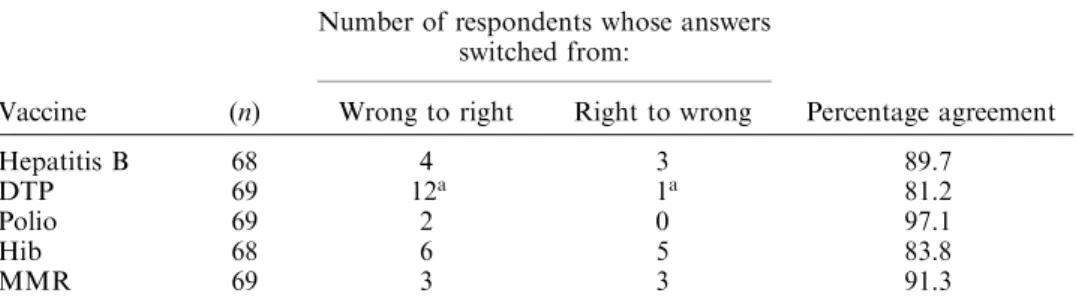
For respondents who received the second version of the questionnaire, which included both types of questions, we could also carry out a within-subject comparison of the recognition and recall questions. For each vaccine, only a small number of respondents ± ranging from two respondents out of 69 for polio to 13 for DTP ± gave dierent answers to the two questions; as a result, the recall and recognition questions did not dier much in accuracy. As is apparent from Table 7, answers to the recognition questions were signi®cantly more accurate only for DTP.
The overall level of accuracy was higher in this experiment than in Experiment 2. However, much of the dierence can be attributed to the fact that the children in Experiment 3, on average, received fewer vaccinations than those in Experiment 2 (mean vaccines received was 3.3 in Experiment 2 and 2.3 in Experiment 3). As seen in Table 8, accuracy of responses is strongly related to the number of vaccinations the child received during the visit. We carried out an analysis of variance that examined the number of vaccines out of ®ve that were reported correctly as a function of the number the child had actually received. In both studies, the impact of the number of vaccines was signi®cant (see Table 8). There were also some dierences in the clinic procedures that may have aected the results of Experiment 3. An experimental vaccine was being tested at the same time that our experiment was carried out and more careful consent procedures were being used. In addition, a sign in the waiting room indicated that there was a vaccination study in progress, and this may have tipped respondents o that they would be questioned.
Table 7. Experiment 3: agreement between recall question responses and recognition question responses (recall questions were asked before recognition questions)
Vaccine (n)
Number of respondents whose answers switched from:
Wrong to right Right to wrong Percentage agreement
Hepatitis B 68 4 3 89.7
DTP 69 12a 1a 81.2
Polio 69 2 0 97.1
Hib 68 6 5 83.8
MMR 69 3 3 91.3
Note: Percentage agreement refers to the percentage of respondents giving the same answer to both versions of the questions.
Discussion
Accuracy in reporting vaccinations is not aected strongly by the form of the questions. Inaccurate reports seem to be due mainly to encoding problems rather than problems with retrieval. We found only scattered evidence that parents answer recognition questions more accurately than recall questions about vaccinations ± the recognition questions did lead to more accurate responses for vaccines with more complicated or dicult names, such as Hemophilus in¯uenzae type b, or diphtheria-tetanus-pertussis, but the high rate of false alarms in this situation suggests that respondents were guessing.
Coupled with the results of Experiment 2, these results suggest not that parents are having diculty remembering the vaccinations or generating the vaccine names, but that they simply never encoded the information about which vaccines were administered at the time they were given. In addition, a key factor aecting accuracy was the number of shots the child received. In both Experiment 2 and 3, respondents encoded the information better when there was less information to be encoded.
GENERAL DISCUSSION
Taken together, the three experiments provide converging evidence that the inaccuracy of parental reports arises at encoding and not at retrieval. The standard questions used in Experiment 1 function as a kind of recognition test in which respondents were asked whether their child received any doses of each vaccine (e.g. `Has [child] ever received a DTP shot?'). Around half of the respondents could not report accurately on hepatitis b, DTP, Polio or Hib. Further, they seemed to have considerable diculty in saying how many doses of each vaccine their children had received thus far, even when prompted with the calendar or showcard. In Experiment 2, even immediately after the child received a vaccination, parents had diculty reporting accurately. Somewhat surprisingly, their accuracy did not decline
Table 8. Mean number of vaccines parents reported correctly (yes or no) out of 5, by the number of vaccinations the child received that day and experiment
Number of vaccines received that day
Experiment 2 Experiment 3
Mean number
reported correctly (n) reported correctlyMean number (n)
0 4.00 3 5.00 10 1 4.44 9 4.91 11 2 3.33 3 3.44 9 3 3.33 6 4.00 23 4±5 2.63 49 3.56 16 Total 3.01 70 4.12 69 F-value 4.70a df4, 65 7.52a df4, 64 ap50.01.
much when they were questioned again ten weeks later. This suggests that parents have diculty encoding vaccination information in the ®rst place but that once they encode information about the episode (even if that information is inaccurate), they do not have much diculty retaining it. The lack of dierence in recall and recognition conditions in Experiment 3 provides further evidence that it is encoding problems and not retrieval failure that accounts for parents' low accuracy.
None of the three experimental variables included in the ®rst experiment, involving the calendar, showcard, or order of the questions, had consistent eects on reporting accuracy. The only measurable predictor of report accuracy was simply the respondent's knowledge about vaccinations. If the chief barrier to accurate reporting is encoding the information correctly in the ®rst place, respondents with some knowledge about the vaccines would appear to have an important advant-age over those with little knowledge. The results of the experiments suggest that further eorts to improve recall for speci®c vaccinations (i.e. through enhance-ments to the calendar) are likely to yield little payo. Instead, vaccination surveys must acknowledge the limitations of the information in parents' memories and rely instead on `external' forms of memory, such as vaccination records and provider data.
Finally, these results have general implications for survey practice. It is possible that there are many domains other than vaccination reporting in which the requested information simply was never encoded into the long-term memory of many respond-ents. In such domains increased attempts to enhance memory for the information sought will not represent a useful approach since one cannot cue memories that are not there. Despite the very real need for the information, it may be that, with-out the use of written or administrative records, there may simply be no way to obtain data that are accurate enough to ful®l the objectives of the survey. It is worth knowing when poor encoding puts information outside the reach of standard survey questions.
ACKNOWLEDGEMENTS
Roger Tourangeau is now at The Gallup Organization, Rockville, MD; Gordon Willis at the National Center for Health Statistics, CDC, Hyattsville, MD; Pamela Ching at the National Immunization Program, CDC, Atlanta, GA; Jared Jobe at the National Institute on Aging, Bethesda, MD.
This research was carried out under US Department of Health and Human Services contract 200-95-7009 from the National Center for Health Statistics to the National Opinion Research Center. Roger Tourangeau, PhD, was the principal investigator. Gordon Willis, PhD, and Pamela Ching, ScD, were the project ocers for the contract. This research was supported in part by the CDC National Immunization Program and in part from a grant to NCHS by the National Science Foundation. The authors thank Larry Barsalou, Karen Goldstein, Kenneth Rasinski and Fred Smith for their help in reviewing earlier versions of this manuscript. We thank Curtis Bailey, Cheryl Gilbert and Cathy Haggerty, who skilfully provided much-needed operations assistance. We also thank Kathleen Ensor and Karen Walsh at the paediatric clinics, without whose help this project would not have been possible.
REFERENCES
Anderson, J. R. and Reder, L. (1978). An elaborative processing explanation of depth of processing. In L. Cermak and F. I. M. Craik (Eds.),Levels of processing and human memory (pp. 385±403). Hillsdale, NJ: Erlbaum.
Cannell, C., Miller, P. and Oksenberg, L. (1981). Research on interviewing techniques. In S. Leinhardt (Ed.),Sociological methodology(pp. 389±437). San Francisco: Jossey-Bass. Craik, F. I. M. and Lockhart, R. (1972). Levels of processing: A framework for memory
research.Journal of Verbal Learning and Verbal Behavior,11, 671±684.
Craik, F. I. M. and Tulving, E. (1975). Depth of processing and the retention of words in episodic memory.Journal of Experimental Psychology: General,104, 268±294.
Gergen, P. J., Ezzati, T. and Russell, H. (1988). DTP immunization status and tetanus anti-toxin titers of Mexican American children ages six months through eleven years.American Journal of Public Health,78, 1446±1450.
Goldstein, K. P., Kviz, F. J. and Daum, R. S. (1993). Accuracy of immunization histories provided by adults accompanying preschool children to a pediatric emergency department. Journal of the American Medical Association,270, 2190±2194.
Hawe, P., Wilson, A., Fahey, P., Field, P., Cunningham, A., Barker, M. and Leeder, S. (1991). The validity of parental report of vaccination as a measure of a child's measles immun-ization status.The Medical Journal of Australia,155, 681±686.
Jobe, J. and Herrmann, D. (1996). Implications of models of survey cognition for memory theory. In M. Johnson, D. Herrmann, C. McEvoy, C. Hertzog and P. Hertel (Eds.),Basic and applied memory research: Practical Applications. Mahwah, NJ: Erlbaum.
Jobe, J. and Mingay, D. (1991). Cognition and survey measurement: History and overview. Applied Cognitive Psychology,5, 175±192.
Kalsbeek, W., Weigle, K., Allred, N. and Liu, P. (1991). A comparison of survey designs for estimating childhood immunization rates. InProceedings of the Section on Survey Research Methods(pp. 175±180).
Killewo, J. Makwaya, C., Munubhi, E. and Mpembeni, R. (1991). The protective eect of measles vaccine under routine vaccination conditions in Dar Es Salaam, Tanzania: A case-control study.International Journal of Epidemiology,20, 508±514.
McKinney, P., Alexander, F., Nicholson, C., Cartwright, R. and Carrette, J. (1991). Mothers' reports of childhood vaccinations and infections and their concordance with general practitioner records.Journal of Public Health Medicine,13, 13±22.
Means, B. and Loftus, E. (1991). When personal history repeats itself: Decomposing memories for recurring events.Applied Cognitive Psychology,5, 297±318.
Smith, A. F., Jobe, J. and Mingay, D. (1991). Retrieval from memory of dietary information. Applied Cognitive Psychology,5, 269±296.
Strack, F. and Martin, L. (1991). Thinking, judging, and communicating: A process account of context eects in attitude surveys. In H. Hippler, N. Schwarz, and S. Sudman (Eds.),Social information processing and survey methodology(pp. 123±148). New York: Springer-Verlag. Tourangeau, R. (1984). Cognitive science and survey methods. In T. Jabine et al. (Eds.),
Cognitive aspects of survey design: Building a bridge between disciplines (pp. 73±100). Washington, DC: National Academy Press.
Tourangeau, R. and Rasinski, K. (1988). Cognitive processes underlying context eects in attitude measurement.Psychological Bulletin,103, 229±314.
Valadez, J. and Weld, L. (1992). Maternal recall error of child vaccination status in a developing country.American Journal of Public Health,82, 120±122.
Willis, G., Royston, P. and Bercini, D. (1991). The use of verbal report methods in the development and testing of survey questionnaires.Applied Cognitive Psychology,5, 251±267.