Development and Validation of a Multidimensional
Measure of Sport-Specific Psychological Skills:
The Athletic Coping Skills Inventory-28
Ronald E. Smith
Robert W. Schutz
University of Washington University of British Columbia
Frank L. Smoll
University of Washington
J.T.
Ptacek
Bucknell UniversityConfirmatory factor analysis was used as the basis for a new form of the Athletic Coping Skills Inventory (ACSI). The ACSI-28 contains seven sport- specific subscales: Coping With Adversity, Peaking Under Pressure, Goal Settingwental Preparation, Concentration, Freedom From Worry, Confi- dence and Achievement Motivation, and Coachability. The scales can be summed to yield a Personal Coping Resources score, which is assumed to reflect a multifaceted psychological skills construct. Confirmatory factor analyses demonstrated the factorial validity of the ACSI-28, as the seven subscales conform well to the underlying factor structure for both male and female athletes. Psychometric characteristics are described, and preliminary evidence for construct and predictive validity is presented.
Key words: scale development, self-regulation, sport performance
Interest in the role of individual difference variables that are related to psychological and performance outcomes has stimulated the development of a number of sport-specific instruments, such as the Sport Competition Anxiety Test (SCAT; Martens, 1977), the Competitive Sport Anxiety Inventory-2 (CSAI- 2; Martens, Vealey, & Burton, 1990), the Sport Anxiety Scale (Smith, Smoll, & Schutz, 1990), and the Group Environment Questionnaire (Brawley, Carron, & Widmeyer, 1987). In recent years, sport-specific instruments have largely sup- planted more general measures of psychological functioning, such as Cattell's
Ronald E. Smith and Frank L. Smoll are with the Department of Psychology at
the University of Washington, Box 351525, Seattle, WA 98195-1525. Robert W. Schutz is with the School of Human Kinetics at the University of British Columbia, Vancouver, BC Canada V6T 124. J.T. Ptacek is with the Department of Psychology at Bucknell
380 / Smith, Schutz, Smoll, and Ptacek
(1965) 16-PF, the Minnesota Multiphasic Personality Inventory, and the Trait Anxiety Inventory (Spielberger, Gorsuch, & Lushene, 1970) because domain- specific measures tend to have higher predictive ability in their relevant domains than do more global measures (Buss & Cantor, 1989; Martens, 1977; Ozer & Reise, 1994; Sarason, 1978).
A major tenet of sport psychology is that psychological skills are important determinants of sport performance, and considerable emphasis has been directed at identifying relevant skills and instructing sport consultants, coaches, and ath- letes in how to teach, learn, and apply them (see, for example, Williams, 1993). Moreover, there is evidence that psychological skills are related to a number of outcome variables, such as performance (Gould, Weiss, & Weinberg, 1981; Greenspan & Feltz, 1989; Mahoney, 1989; Mahoney, Gabriel, & Perkins, 1987) and injury vulnerability (Hanson, McCullagh, & Tonymon, 1992; Smith, Smoll, & Ptacek, 1990; Williams, Tonymon, & Wadsworth, 1986). Finally, psychological skills are often important outcome variables in performance enhancement inter- vention programs, and it is therefore important to be able to assess changes in such skills as a means of evaluating program efficacy (Smith, 1980, 1989b). For all of these reasons, there is a need for psychometrically sound measures of sport- related coping skills.
Several psychological skills measures have been used in previous research. In their search for moderator variables in the life stress-injury relation, Hanson et al. (1992) and Williams et al. (1986) adapted the Coping Resources subscale from the Stress Audit Questionnaire (Miller & Smith, 1982). However, this scale measures a variety of coping resources in addition to stress management skills, including such resources as social support and regular exercise. Thus, it does not have the degree of specificity that would be desirable in a psychological skills measure. Ideally, such a scale would contain subscales that measure a range of relatively specific psychological skills, such as mental preparation, stress management, and concentration.
In an attempt to develop such a measure, Mahoney and his coworkers (Mahoney & Avener, 1977; Mahoney et al., 1987) have developed the Psycho- logical Skills Inventory for Sport (PSIS). The scale has undergone continuous development, and the most recently studied version (PSIS R-5) consists of 45 items that are arranged into six subscales: Anxiety Control, Concentration, Confi- dence, Mental Preparation, Motivation, and Team Focus. In its various forms, the PSIS has been successfully employed by a number of investigators to differentiate between elite athletes and nonathletes, male and female athletes, athletes in various sports, and athletes of different nationalities (Cox & Liu, 1993; Mahoney, 1989; Mahoney & Avener, 1977; Mahoney et al., 1987; White, 1993).
Despite its promise as a research instrument, however, the PSIS R-5 appears to have a number of serious psychometric shortcomings that limit its potential usefulness. Chartrand, Jowdy, and Danish (1992) tested the hypothesized six- factor (subscale) model advanced by Mahoney et al. (1987) using confirmatory factor analysis. They found no evidence for the factorial validity of the scale, nor for any of the alternative models that they tested using structural equation modeling. Many of the items loaded on several of the factors, indicating that the subscales were not measuring distinct constructs, and seven of the items failed to load on any factor. It thus appears that in its present form, the PSIS R-5 does
not meet the factorial validity standards required of a multidimensional instrument that is to be used for research or applied purposes.
This article describes the development of a new multidimensional scale that measures seven classes of psychological coping skills with high factorial validity. The Athletic Coping Skills Inventory-28 (ACSI-28) is a refined 28-item version of a 42-item ACSI that has been used in several previous studies to measure individual differences in psychological skills within a sport context (Petrie, 1993; Smith, Smoll, & Ptacek, 1990; Smith, Ptacek, & Smoll, 1992). It was developed by means of a psychometric strategy that involved the use of confirmatory factor analysis to derive subscales that conformed closely to an underlying structural model of psychological skills.
Study
1
MethodThe ACSI was originally developed in the mid-1980s as part of a research project on psychosocial vulnerability and resiliency factors related to athletic injury. The theoretical model on which the research was based gave prominent causal roles to the factors of life stress, social support, and psychological coping skills (see Smith & Smoll, 1990). To measure the latter variable, we needed a scale that would measure individual differences in general psychological coping resources and that also might yield subscales to measure specific psychological skills such as stress management, concentration, control of worry, and mental preparation.
The first version of the ACSI consisted of 87 items of widely varied content that was entitled Survey of Athletic Experiences. Our strategy was to begin with an intuitively derived item set of varying content that would eventually be pared to a smaller number of items by identifying, through exploratory factor analysis, item clusters corresponding to specific psychological skills. The 87-item scale was administered to an initial sample of 637 male and female athletes who responded to each item on a 4-point scale: 0 = almost never, 1 = sometimes, 2 = often, and 3 = almost always. The sample included 41 high school teams in three sports, and 135 college football players at a Division I university.
Results
Principal component analyses of the 87-item instrument followed by a varimax rotation yielded eight factors with eigenvalues exceeding 1.00, which accounted for 49% of the response variance. Similar factor structures were found in the male and female subsamples. By selecting the items that met the dual criteria of loading at .55 or above on a single factor and below .30 on all others, we pruned the 87 items to a new scale consisting of 42 items. We named the eight subscales Preparation, Freedom From Worry, Positive Orientation, Resourcefulness, Coachability, Concentration, Peaking Under Pressure, and Stress Management. Coefficient alphas for the subscales ranged from .64 to .8 1, and the total-scale internal consistency was .90. Analysis of the 42 items with the college football sample and with a cross-validation sample of 579 male and female high school athletes revealed the same eight-factor structure.
382 1 Smith, Schutz, Smoll, and Ptacek
This 42-item scale is the one described in subsequent research reports (Petrie, 1993; Smith, Smoll, & Ptacek, 1990; Smith, Srnoll, & Schutz, 1990; Smith et al., 1992). In the Petrie (1993), Smith, Smoll, and Ptacek (1990), and Smith, Smoll, and Schutz (1990) reports, the primary focus was on the total ACSI score rather than on the subscales because the investigators were interested in a total coping resources score as a potential moderator variable in the life stress-athletic injury relation. In the 1992 study, Smith et al. used the subscales to assess coping skill differences between high and low sensation seekers, but the total score was used to test sensation seeking as a moderator variable with coping skill variation partialed out.
Study 2
MethodIn Study 2, we evaluated the eight-factor structure identified through the exploratory principal component analyses using the more rigorous approach of confirmatory factor analysis. Confirmatory factor analysis allows test developers to evaluate the degree to which the structural characteristics of a scale conform to a hypothesized~underlying model, as well as the degree to which each item maps appropriately onto the underlying subscale structure (Nunnally & Bernstein,
1994).
All confirmatory factor analyses (CFAs) were conducted with LISREL 8 (Joreskog & Sorbom, 1993) maximum likelihood procedures, using a covariance matrix as data input. The fit of each model was evaluated with a number of indices, including the p value associated with the chi-square statistic, Steiger's (1990) root mean square error of approximation (RMSEA), the parsimony good- ness-of-fit index (PGFI; Mulaik et al., 1989), and Bentler's (1990) comparative fit index
(CFI).
A RMSEA of .05 or less indicates that the model based on the sample data represents a "close fit" to the population, and a value less than .08 indicates a "reasonable fit" (Joreskog & Sorbom, 1993). The PGFI was selected because of' its utility in comparing competing models (the larger the PGFI, the more parsimonious the model), and CFI was chosen over other normed fit indices because it is contained in the 0-1 interval. CFI values of .90 and larger were deemed to indicate an adequate fit of the model to the data, even with a PGFI as low as .50 (Mulaik et al., 1989). To test if a reduced or alternative model was a statistically significant improvement (or decrement) over another model, the chi-square difference(xZdiff),
or Q test (i.e., the difference in the chi-square values of the two models evaluated in terms of the difference in the degrees of freedom) was employed. A Q value of around 2.0 is considered good, and one of less than 5.0 is often deemed acceptable.Results
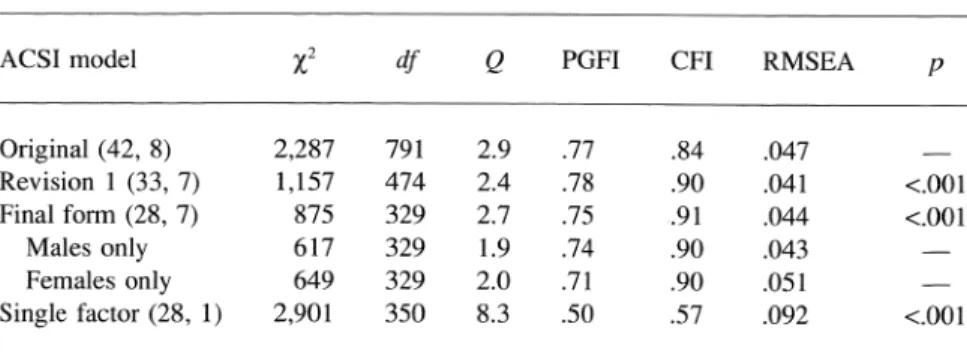
The results of the confirmatory factor analyses (CFAs) are presented in Table 1. Four different models were tested with the entire sample. The final model was also tested with separate male and female subsarnples.
Table 1 Model-Testing Results From Confirmatory Factor Analyses ACSI model Original (42, 8) 2,287 791 2.9 .77 .84 .047 - Revision 1 (33, 7) 1,157 474 2.4 .78 .90 .041 <.001 Final form (28, 7) 875 329 2.7 .75 .91 .044 <.001 Males only 617 329 1.9 .74 .90 ,043 - Females only 649 329 2.0 .71 .90 .051 - Single factor (28, 1) 2,901 350 8.3 .50 .57 .092 <.001
Note. Values in parentheses are number of items and number of factors in the model.
Q = ratio of
xZ
to d j PGFI = parsimonious goodness-of-fit index; C H = comparativefit index; RMSEA = root mean square error of approximation; p = the probability asso-
ciated with the chi-square difference test with the preceding model.
In the first analysis, the 42-item, eight-factor ACSI scale was evaluated. The goodness-of-fit statistics indicated that the data did not conform well to the hypothesized eight-factor structure. Inspection of the interfactor correlations, modification indices, and normalized residuals suggested that a better-fitting model could be achieved by combining the Positive Orientation and Stress Man- agement subscales (whose raw scores correlated 3 3 ) into a new Coping With Adversity scale and deleting 9 items from the total scale because of low loadings, large residuals, or large modification indices. Doing so resulted in a new 33- item, seven-factor scale. This revised model (Revision 1 in Table 1) was a significant improvement over the original model,
xZdiff
= 1,130, dfdifi = 317, p <.001. However, the modification indices and t statistics suggested that 4 items were of questionable validity.
A series of controlled sequential steps (removing one item at a time) resulted in a new 28-item, 7-factor scale that proved to have the strongest dimensional structure.' As can be seen in Table 1, the CFI (.91) and the RMSEA (.044) indicate a good fit of the model to the data. Additionally, all factor loadings were significant at p < .001, and 26 of the 28 loadings exceeded .50 (the other two were .46). When reanalyzed separately for the male and female subsarnples, the model fit the male data well, and although the fit indices were not as good in the female data, it is still a reasonably good model for these data and, as indicated by the Q statistic, significantly better than the 33-item, seven-factor revision2 Follow-up principal component analyses of the final form revealed that the seven factors accounted for 53% of the total scale variance for males and 58% of the variance for females.
Based on their item content, the subscales were given the following labels: Coping With Adversity, Peaking Under Pressure, Goal SettingIMental Prepara- tion, Concentration, Freedom From Worry, Confidence and Achievement Motiva- tion, and Coachability. The items of the ACSI-28 that comprise each subscale, together with the individual item means and their factor loadings, are presented in Table 2.
384 / Smith, Schutz, Smoll, and Ptacek
Table 2 ACSI-28 Item Means, Factor Loadings, and Subscale Items
Factor
Subscale M loading Item
Coping With Adversity
1.5 .60
Peaking Under Pressure
1.6 .77
Goal Settingmental Preparation
1.2 .69
Concentration
1.8 .63
Freedom From Worry
1.7* .76
I maintain emotional control no matter how things are going for me. (24)
When things are going badly, I tell myself to keep calm, and this works for me. (17)
When I feel myself getting too tense, I can quickly relax my body and calm myself. (21)
I remain positive and enthusiastic during competition, no matter how badly things are going. (5)
To me, pressure situations are challenges that I wel- come. (22)
The more pressure there is during a game, the more I enjoy it. (18)
I tend to play better under pressure because I think more clearly. (6)
I make fewer mistakes when the pressure's on be-
cause I concentrate better. (28)
On a daily or weekly basis, I set very specific goals
for myself that guide what I do. (1)
I tend to do lots of planning about how to reach my
goals. (8)
I set my own performance goals for each practice. (13)
I have my own game plan worked out in my head
long before the game begins. (20)
I handle unexpected situations in my sport very well. (16)
When I am playing sports, I can focus my attention and block out distractions. (4)
It is easy for me to keep distracting thoughts from in-
terfering with something I am watching or lis-
tening to. (1 1)
It is easy for me to direct my attention and focus on
a single object or person. (25)
While competing, I worry about making mistakes or
failing to come through. (19)
I put a lot of pressure on myself by worrying how I
will perform. (12)
Table 2 (continued)
Factor
Subscale M loading Item
1.7* .65 I think about and imagine what will happen if I fail
or screw up. (23)
1.3* .61 I wony quite a bit about what others think about my
performance. (7) Confidence and Achievement Motivation
1.9 .65 I feel confident that I will play well. (9)
1.8 .62 I get the most out of my talent and skills. (2)
2.2 .52 When I fail to reach my goals, it makes me try even
harder. (26)
2.0 .51 I don't have to be pushed to practice or play hard; I
give 100%. (14) Coachability
1.9 .77 If a coach criticizes or yells at me, I correct the mis-
take without getting upset about it. (15)
2.3* .57 When a coach or manager criticizes me, I become up-
set rather than helped. (10)
2.3 .57 I improve my skills by listening carefully to advice
and instruciton from coaches and managers. (27)
2.5* .56 When a coach or manager tells me how to correct a
mistake I've made, I tend to take it personally and feel upset. (3)
Note. Item number on the ACSI-28 is given in parentheses after each item. Asterisks indicate items that are reverse scored. The scale is titled "Survey of Athletic Experi- ences" and contains the following written instructions: "A number of statements that athletes have used to describe their experiences are given below. Please read each state- ment carefully and then recall as accurately as possible how often you experience the same thing. There are no right or wrong answers. Do not spend too much time on any
one statement." Items are scored on a 4-point scale with the following labels: 0 = al-
most never; l = sometimes; 2 = ofen; and 3 = almost always.
The final model that we tested was a single-factor, 28-item model. This model did not fare nearly as well as the 7-factor model, as is indicated by the very poor fit statistics in Table 1. Ten of the 2 8 items had factor loadings of less
than .40, with 5 of them being less than .30. This is in contrast to the 7-factor
model in which the two lowest factor loadings were .46, and all others ranged
from .51 to .77. In general, items associated with the Freedom From Wony and Coachability factors exhibited the weakest loadings on the general factor. This pattern of results indicates that the construct of Personal Coping Resources as indexed by the ACSI-28 total score is best regarded as a multifaceted construct (Carver, 1989), having seven underlying coping skill facets.
386 / Smith, Schutz, Smoll, and Ptacek Psychometric Characteristics
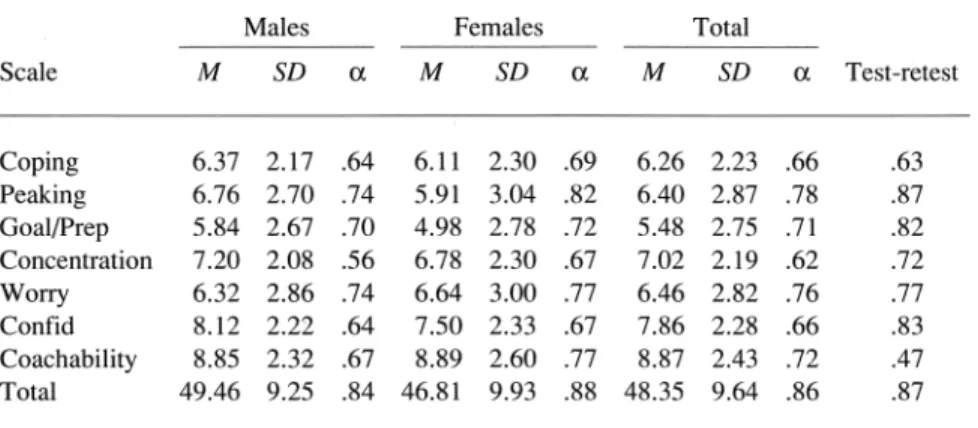
Table 3 shows the male and female means, standard deviations, and internal consistency statistics (Cronbach's alphas) for the seven subscales and for the Personal Coping Resources score based on the sum of the subscales. Also included are one-week test-retest reliability coefficients derived from a sample of 94 male and female college-age athletes who participated in a variety of intramural and club sports.
The alpha coefficients are not large, but this is not surprising, given that the scales contain only four items and sample fairly broad coping skill constructs; in such instances, factorial validity and high factor loadings are more meaningful indices of scale integrity. (Pedhazur & Schmelkin, 1991). The Concentration subscale is the weakest one from an intemal consistency perspective, and in the male sample, all four of the item-total correlations were low (.35 to .40). These low correlations help account for the CFA finding that the Concentration factor contained the only two items with loadings of less than .50. On all seven of the subscales, internal consistency was higher in the female sample than it was in the male sample.
For the ACSI-28 total (Personal Coping Resources) score, internal consis- tencies were high for both males (24) and females (38). As alphas are highly influenced by the number of items in the scale, this result is more a function of the number of items than of the greater validity of a single factor scale (as was demonstrated in the models tested by CFA). The item-total score correlations for the Freedom From Worry items were all low (.26 to .37), as were two of the items on the Coachability subscale. These results support the CFA findings, which indicated that these two factors did not fit well into the single-factor model.
Table 3 Descriptive Statistics, Internal Consistency, and Test-Retest Reliabilities of the ACSI-28 Subscales and Total (Personal Coping Resources) Score
Males Females Total
Scale M SD a M SD a M SD a Test-retest Coping Peaking Goal/Prep Concentration w o w Confid Coachability Total
Note. Descriptive statistics and alphas (intemal consistency coefficients) are based on a standardization sample of 594 male and 433 female varsity high school athletes. Test- retest coefficients are based on 97 college athletes who were tested at one-week inter- vals.
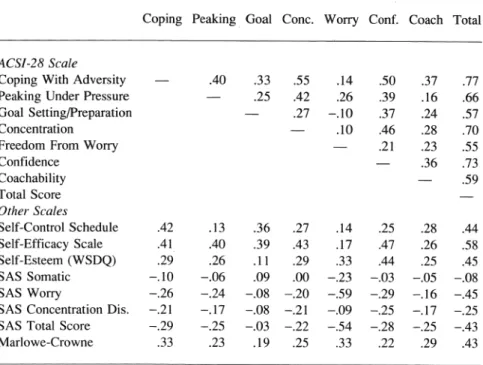
Table 4 ACSI-28 Interscale Correlations and Correlations With Other Scales
Coping Peaking Goal Conc. Worry Conf. Coach Total
ACSI-28 Scale
Coping With Adversity Peaking Under Pressure Goal Setting/Preparation Concentration
Freedom From Worry Confidence Coachability Total Score Other Scales Self-Control Schedule Self-Efficacy Scale Self-Esteem (WSDQ) SAS Somatic SAS Worry
SAS Concentration Dis. SAS Total Score Marlowe-Crowne
Note. Sample sizes range from 295 to 771 male and female varsity high school ath- letes. In the smallest sample, a correlation of .08 is significant at p < .05.
The interscale correlations calculated from the raw score item totals for each subscale are shown in Table 4. The factors show no evidence of multicollin- earity, as evidenced. by the relatively small correlations among them, and they can therefore be treated as measures of reasonably distinct psychological charac- teristics in multivariate analyses and in other types of research as well. Correla- tions between the latent constructs (the PHI matrix in LISREL) were somewhat larger, being free of measurement error, but these correlations (not shown in Table 4) also indicate the presence of relatively independent psychological skills that, together, constitute a multifaceted coping skills construct.
Validation Studies
Correlations With Other MeasuresIn order to assess convergent and discriminant validity, athletes in the valida- tion sample were administered a number of other relevant measures, including Rosenbaum's (1980) Self-Control Schedule (a measure of cognitive-behavioral coping skills), the Ways of Coping Checklist (Vitaliano, Russo, Carr, Maiuro, &
Becker, 1985), the Sport Anxiety Scale (Smith, Smoll, & Schutz, 1990), the Mental Health Inventory (Veit and Ware, 1983), the Washington Self-Description Question- naire (WSDQ, a measure of global self-esteem; Smoll, Smith, Barnett, & Everett,
388 / Smith, Schutz, Srnoll, and Ptacek
1993), and Coppel's (1980) Self-Efficacy Scale (a measure of generalized self- efficacy). The athletes also completed the Marlowe-Crowne Social Desirability Scale (Crowne & Marlowe, 1960).
Correlations between the ACSI-28 subscales and selected measures are presented in Table 4. Relations with the other measures will be summarized in the text.
Correlations with other coping measures were higher in the case of the Self-Control Schedule (SCS), which measures cognitive-behavioral skills, than they were with the more general Ways of Coping (WOC) scale, which measures coping preferences, not skills. As shown in Table 4, Coping With Adversity and the total ACSI-28 score correlated .42 and .44, respectively, with the SCS score. The only WOC subscale that related significantly to the ACSI-28 total score was Problem-Focused Coping, r = .30. This is the only WOC coping strategy that would be expected to relate to self-control skills on conceptual grounds.
As shown in Table 4, significant relations were found with the sport- specific subscales of the Sport Anxiety Scale (SAS), as well as with the SAS total score. In order to clarify the nature of these relations, the SAS was factor analyzed and rotated to an orthogonal solution in order to obtain uncorrelated factor scores for somatic anxiety, worry, and concentration disruption (see Smith, 1989a, for a discussion of this strategy). The correlations in Table 4 represent the SAS subscale factor scores, as well as the SAS total raw score. Evidence for convergent and discriminant validity of the Freedom From Worry subscale resides in the substantial negative relation (r = -.59) of this scale with the SAS worry factor, but not with the somatic or concentration disruption factors. In contrast, the Concentration scale of the ACSI-28 did not demonstrate a similar specific relation with the concentration disruption scale of the SAS, perhaps because the ACSI subscale is less oriented toward anxiety-produced interference. Total score on the ACSI-28 was most strongly related to the wony factor of the SAS, and it correlated -.43 with the SAS total score.
The strongest pattern of correlations with another measure occurred on the Self-Efficacy Scale, which measures generalized self-efficacy (Coppel, 1980). Increases in scores on this scale have previously been shown to be significantly correlated with increases in cognitive-behavioral coping skills achieved through a stress management intervention (Smith, 1989b). Concentration, Confidence and Achievement Motivation, Coping With Adversity, Goal Settingmental Prepara- tion, and Peaking Under Pressure were most highly related to general self- efficacy, and the ACSI-28 total score correlated .58 with the Self-Efficacy Scale. This pattern of results provides evidence for convergent validity, for both scales are assumed to measure perceived effectiveness in behaving adaptively.
Scores on the ACSI-28 did not correlate significantly with any of the mental health subscales of the Mental Health Inventory, indicating that the sport-specific skills are not related to global psychological distress or well-being. On the other hand, as shown in Table 4, several of the ACSI-28 subscales, as well as the total score, were positively related to the measure of general self-esteem. This result is consistent with speculations that an important factor in self-esteem is perceived possession of important domain-specific skills (Harter, 1983; Rosenberg, 1979). The positive correlations between the ACSI-28 and the Marlowe-Crowne Social Desirability Scale shown in Table 4 are not surprising. Their magnitudes (particularly with total score) are similar to correlations obtained with other
nonpathological scales in which the socially desirable response is obvious. It is noteworthy that higher correlations with social desirability measures are obtained
j when subjects identify themselves, as they did in this research. In other studies
in which anonymous ACSI-28 data were provided, correlations with the Marlowe- Crowne tend to be approximately 10 points lower. Nonetheless, it is clear that ACSI-28 scores can beinfluenced by adesire to project an unrealistically positive image of oneself.
Relations With Per$ormance
As noted above, psychological skills are thought to contribute in important ways to quality of sport performance. We should therefore expect to find positive relations between scores on the ACSI-28 and performance indices. However, psychological skills are not the only factor that might influence performance. In particular, it is important to rule out the influence of individual differences in physical skills when evaluating the role of psychological skills, lest the two classes of skills be confounded. We summarize two studies in which physical, as well as psychological, skills were taken into account.
Study 1: High School Athletic Pe$omzance. The first study related the ACSI-28 to postseason coach ratings of performance. It was conducted with a portion of the high school sample used in the factorial validity studies described above. The participants were 762 male and female athletes who competed in the sports of football, soccer, basketball, gymnastics, cross-country, and wrestling at 13 high schools. The athletes completed the psychological skills measure in group sessions prior to the season. At the end of the season, each athlete's coach rated him or her on the variables of physical ability and quality of athletic performance.
Instructions for the rating of physical ability read, "Rate this athlete's level of physical ability and skills in comparison with other high school athletes in his or her sport." A 6-point rating scale ranging from 6 = superior (top 5%) to
1 =far below average (bottom 20%) was used for the evaluation. The same scale was used to rate performance level during the season, with the following instructions: "How well did this athlete perform this season in comparison with other high school athletes in his or her sport?"
When we correlated ACSI-28 scores with the physical skill and performance ratings, we found no significant relations between the two coach ratings and any of the subscales or the total score. Thus, psychological and physical skills seem relatively independent of one another, and the psychological skills did not predict level of performance.
Because talent and performance were rated on the same scale, we were then able to take physicaltalent into account by studying levels of discrepancy between talent and performance. The following three athlete groups were formed by subtracting the coach's physical talent rating from the performance rating for each athlete: (a) underachievers, whose talent ratings exceeded their performance ratings; (b) normal achievers, whose performance ratings were identical with their talent ratings; and (c) overachievers, whose performance ratings exceeded their physical talent ratings. The discrepancy scores in the under- and overachiever groups ranged from 1 to 3 points. These three groups were then compared by means of planned contrasts using the error terms derived from one-way analyses
390 1 Smith, Schutz, Smoll, and Ptacek
Table 5 Mean ACSI-28 Scores for Overachieving, Underachieving, and Normally Achieving High School Athletes, Based on Coach Ratings of Physical Ability and Performance
Group
Overachievers Normal achievers Underachievers
ACSI-28 scale ( n = 125) ( n = 469) ( n = 164) F(2, 755) p
Coping With Adversity Peaking Under Pressure Goal Settingpreparation Concentration
Freedom From Wony Confidence
Coachability Total score
Note. Means having common superscripts do not differ significantly from one another
by the Tukey (b) procedure for testing planned contrasts.
of variance on the ACSI-28 subscales and total score. Group contrasts were tested using the Tukey,,, procedure to maintain a constant alpha level of .05 for the multiple contrasts.
The results are presented in Table 5. Our interest was in the group contrasts, which do not require a significant omnibus F value (OYBrien, 1983; Rosenthal & Rosnow, 1985; Wilcox, 1987); nonetheless, the F values are presented for infor- mational purposes. As shown in Table 5, the means of the overachievers as defined by coaches' ratings were highest on all of the ACSI-28 subscales and on the total score, and they differed significantly @ < .05) from at least one of the other groups on the Coachability, Concentration, and Coping With Adversity subscales, as well as the total Personal Coping Resources score. In no instance did the normal achievers and underachievers differ from one another. Thus, in this sample, overachievement was more strongly related to high psychological skills scores than was underachievement related to low scores, and several of the ACSI-28 measures were predictive of overachiever status.
Study 2: Perjformance in Professional Baseball. The second performance prediction study involved an elite athlete population, namely professional baseball players (Smith & Christensen, 1995). The participants were 104 minor league baseball. players (47 pitchers and 57 position players). The athletes completed the ACSI-28 in group sessions during spring training. Organizational ratings of their physical skills were also available. The two sets of measures were used to predict performance during the season following spring training.
The performance measure for position players was batting average, and earned run average was the performance variable for pitchers. Correlations be- tween the ACSI-28 subscales and the performance measures were generally low and nonsignificant. For position players, the only significant predictor of batting
average was Confidence and Achievement Motivation, r,,, = -44, p < .01. For pitchers, high Confidence and Peaking Under Pressure scores were significantly related to a low (desirable) earned run average, rs,, = -.46 and -.37, respectively, p < .01. The total score did not achieve significance for either performance measure.
As in the high school sample, we found expert ratings of physical skills to be unrelated to any of the ACSI-28 scores, again indicating that physical and psychological skills are relatively independent of one another. This does not mean, however, that physical and psychological skills do not jointly influence performance. In order to assess relations between the psychological skills and performance with physical skill differences partialed out, we conducted hierarchi- cal regression analyses of the two performance outcome measures. In each analy- sis, the summary measure of physical skills was entered into the equation first, followed on the second step with the block of seven ACSI-28 subscale scores. Of interest was the increment in performance variance accounted for by the best linear combination of psychological skills when variance attributable to physical skill differences had been removed.
Psychological skills accounted for statistically significant increments in performance variance for both batting and pitching. For batting average, physical skills accounted for 21% of the performance variance (p < .001). When the linear combination of ACSI-28 subscale scores was then entered on the second step of the hierarchical analysis, the psychological skills accounted for an additional 23% of the variance in batting average (p < .05). For pitchers, the contribution of psychological skills was even greater. Physical skills accounted for a nonsignifi- cant 3% of the variance in earned run average. Addition of the ACSI-28 subscale scores to the hierarchical analysis accounted for an additional 34% of performance variance ( p < .01). Thus, performance in an elite sport was shown to be signifi- cantly related to individual differences in psychological skills when physical skill differences were partialed out. Semipartial correlations between the scale scores and performance measures indicated that the Confidence and Achievement Moti- vation scale was the strongest predictor of both batting (.34) and pitching (.33) performance, with lesser contributions being made by Coping With Adversity and Goal Setting/Mental Preparation, each of which accounted for approximately 6% of the performance variance in both groups.
Discussion
Measures of psychological skills are being used in a variety of ways to study the role of psychological factors in sport. Existing measures have found applicability in such areas as sport performance and prediction of injuries. The evaluation of psychologically based performance enhancement programs also requires the assessment of changes in the coping skills that are the focus of intervention. In many instances, a global measure of psychological coping skills such as that provided by the Personal Coping Resources total score is sufficient, but in others, investigators need a measure of specific and relatively distinct psychological characteristics. The ACSI-28 is our initial attempt to provide a psychometrically sound measure that can meet both needs.
392 / Smith, Schutz, Smoll, and Ptacek
tool, both in evaluating the factorial validity of existing measures and in devel- oping new ones (Judd, Jessor, & Donovan, 1986; Smith, Smoll, & Schutz, 1990). The use of CFA to evaluate several widely used sport psychology measures has cast doubt on their adequacy as valid measures of multidimensional constructs. For example, the results of recent CFA studies have raised serious questions concerning the factorial validity of the Test of Attentional and Interpersonal Style (Ford & Summers, 1992), the Group Environment Questionnaire (Schutz, Eom, Smoll, & Smith, 1994), and the PSIS-R5 (Chartrand et al., 1992). In each case, the measure in question has failed to conform to its hypothesized factor structure, suggesting that the underlying theoretical model (where one exists) is invalid, that the items designed to measure the constructs in the model are inadequate, or both. Such results demand new research efforts to either revise the underlying model or to refine the test (or, perhaps, both). It has become abundantly clear (as in our own experience with the earlier 42-item version of the ACSI) that a test that appears to have a solid factor structure using exploratory factor analysis may fail the more stringent test of factorial validity that is provided by CFA (Nunnally & Bemstein, 1994).
More recently, researchers have begun to use CFA as a basis for designing new measures (e.g., Judd et al., 1986; Smith, Smoll, & Schutz, 1990). Using this approach early in the test construction phase can assist researchers in developing measures that conform to an underlying structure of latent variables (Nunnally & Bernstein, 1994). This structure may be derived from a formal theoretical model, or it may emerge in the course of test development. In the case of the ACSI-28, we had a general idea of the range of psychological skills that we wanted to measure, but no explicit theory. We do not in any way assume that the variables that we are measuring exhaust the domain of psychological skills that may contribute to performance (or even that they are as important as other, unmeasured, variables), but we do appear to have a measure that maps onto a set of seven latent variables that conform to current conceptions of important psychological skills. In this regard, it is well to keep in mind that (as in the case of exploratory factor analysis) what one gets out of CFA depends on what one puts into it. A different set of items could produce a different set of "athletic coping skills." In the final analysis, the value of the ACSI-28 and other potential psychological skills measures will be defined by the construct validity they demonstrate in their relations with other meaningful variables.
A factorial validity approach to instrument development gives primacy to the fit of the scale or subscales with the underlying factor structure. Achieving such a fit may come at the cost of other aesthetic and psychometric considerations. In some ways, we "liked" the eight-factor model of the longer 42-item measure better, but the CFA data clearly indicated that two of the subscales should be combined and that a number of items that appeared useful should be dropped in order to achieve acceptable goodness of fit to the underlying factor structure. Moreover, the internal consistencies of some of the original subscales were higher because they had more items than the current 4-item subscales do.
Indeed, the fact that several of our subscales have alphas in the .60s may be regarded as problematic by some researchers. However, as Cronbach (1951) pointed out, alpha is heavily influenced by test length. Given a small number of items per subscale, low alphas can provide a practical underestimate of subscale item intercorrelations, which are the basis for internal consistency (Nunnally &
Bemstein, 1994). For example, the average item intercorrelations ( r = -26; mean item-total r = .68) that produced a modest alpha of .56 for males in our four- item Concentration subscale would yield an alpha of .72 if there were eight items; for the combined genders, alpha would be .76 (Nunnally & Bernstein, 1994, p. 263). In short scales of this type, the goodness of fit between the subscales and the underlying model in a CFA may be more indicative of the adequacy of construct measurement than is a borderline level of internal consis- tency (Nunnally & Bemstein, 1994; Pedhazur & Schmelkin, 1991 ; see also Green, Lissitz, & Mulaik, 1977). However, this is not to suggest that increasing the number of items in the subscales would not be useful in the future, as long as the factorial integrity of the measure is preserved. It is also worth noting that it is not necessary to use all seven of the subscales; each of them has a sufficiently strong factor structure to be used as a specific measure if this is desired.
Test-retest reliability coefficients were reasonably high for most of the subscales and for the total score. One notable exception was the Coachability subscale, which exhibited relatively low stability over the one-week period. This evidence of modest stability must be viewed with caution, however. A severe problem with range restriction existed in this particular sample, and its Coachabil- ity variances on both the pretest and posttest measures (slightly greater than 1 on a 12-point scale) were 3-10 times smaller than those of other samples we have tested, and at least 3 times smaller than any of their variances on the other six subscales. This factor could be expected to severely attenuate the test-retest correlation coefficient in this sample. Although range restriction is the most likely reason for the atypically low test-retest coefficient, the stability of the Coachability subscale clearly needs to be assessed in other athlete populations, because our assumption is that the skills indexed by the ACSI-28 are relatively stable. Al- though we would expect some variation in coachability across differing situations as a function of coach-athlete relationships, the relative transituational consis- tency of Coachability (as well as the other psychological skills) is not known at this time. Our preliminaly evidence suggests that there may be some degree of variation in stability coefficients across the skill categories.
Relations between the ACSI-28 and other scales provided evidence for both convergent and discriminant validity. The measure correlated most highly with measures of cognitive-behavioral coping skills (Self-Control Schedule) and generalized behavioral self-efficacy (Self-Efficacy Scale). The fact that the only significant correlations with the Ways of Coping subscales occurred for Problem- Focused Coping is also consistent with our conception of the ACSI-28 skills as methods for coping directly with challenging and threatening sport-specific situations. However, the fact that the highest correlations indicated only about 20-25% common variance suggests that the ACSI-28 may be relatively sport- specific. The extent to which these skills generalize to other life situations is an intriguing question that deserves empirical attention.
Correlations with the factors of the Sport Anxiety Scale provided mixed evidence for convergent validity. The Freedom From Worry subscale correlated most strongly (and negatively) with the worry factor of the SAS. On the other hand, the Concentration subscale failed to correlate highly with the concentration disruption factor on the SAS. None of the subscales correlated highly with the somatic anxiety factor on the SAS, suggesting the need for a subscale that measures arousal-control skills, specifically relaxation, more effectively than our
394 / Smith, Schutz, Srnoll, and Ptacek
scale does. There is no reason why additional items or even subscales could not be added to the scale, as long as they can be shown through CFA and other research methods to maintain or enhance factorial, predictive, or construct va- lidity.
High scores on the ACSI-28 correlated positively and significantly with a measure of general self-esteem, but no relations were found with the Mental Health Inventory measures of psychological distress and well-being. This indi- cates that the ACSI-28 is not a measure of general psychological adjustment, but that the skills it measures are related to positive self-evaluations.
Preliminary research relating the ACSI-28 to performance measures indi- cates that the subscales and the total score are unrelated to expert ratings of physical skills. Thus, physical and psychological skills appear to be relatively independent of one another. In both studies, relations between subscale scores and performance were enhanced when physical skills were taken into account. In the study of over- and underachievers, the results indicated that the predictive accuracy of high scores in identifying overachievement may exceed the predictive accuracy of low scores in identifying underachievers. The athletes whose level of performance exceeded their level of physical skills had significantly higher scores on several of the subscales, as well as higher total scores. This result tends to support the common assumption that psychological skills can assist athletes in getting the most out of their physical abilities. The overachievers were signifi- cantly higher in their self-reported abilities to profit from coaching, to manage stress and cope with adversity, and to control attentional focus.
In the study of professional baseball players, psychological skills accounted for as much performance variance in batting average as did physical skills. In the case of pitchers, the linear combination of ACSI-28 subscales accounted for appreciably more performance variance than did physical skills. The Confidence and Achievement Motivation subscale correlated significantly with both batting and pitching performance, and Peaking Under Pressure was also related to pitching performance. The hierarchical regression analyses revealed that even after the performance variance attributable to physical skill differences was partialed out, psychological skills accounted for significant increments in explained variance. The results of the two validation studies suggests the importance of taking into account the influence of physical skills when evaluating the role of psychological factors in performance.
The ACSI-28 was developed as a research instrument. Like most other self-report measures of psychological skills, its items are quite transparent, and the socially desirable response is evident in most cases. This fact makes it potentially susceptible to response distortion; athletes could respond in such a way as to present either a positive or negative image of themselves. In the majority of instances of distortion, we might expect athletes to respond to the test items in such a way as to project an overly positive image of themselves, and the positive relations that we found with the Marlowe-Crowne Social Desir- ability Scale are consistent with this expectation. Paulhus (1986) has suggested that socially desirable responding is of two varieties: impression management and self-deception. Impression management is a conscious effort to project a positive image to others that is not in accord with the individual's own self- concept; it is, essentially, "faking good." In contrast, self-deception reflects a
is honestly held by the respondent. Measures like the ACSI-28 are obviously vulnerable to either of these response tendencies, and Paulhus (1986) found that the Marlowe-Crowne loads on both impression management and self-deception factors.
Several measures can be taken to reduce impression management. First, attempts may be made to enlist the cooperation of the participants and to induce them to respond honestly to the items. For example, both the Competitive State Anxiety Inventory-:! (Martens et al., 1990) and the Sport Anxiety Scale (Smith, Smoll, & Schutz, 1990) contain instructions designed to normalize reports of experiencing anxiety and thereby counter tendencies to deny such reactions. Second, as noted above, a common finding is that impression management re- sponding is less likely to occur when participants are not asked to identify themselves. Whenever possible, it is advisable to obtain data in an anonymous fashion. If identification is needed to match scores with other variables, a subject- generated code number may help preserve anonymity. A third suggestion, made by Williams and Krane (1992), is that social desirability should be assessed in future studies that use self-report measures, and participants who obtain very favorable scores along with high social desirability scores might well be excluded from data analyses in order to reduce error variance.
Self-deception is more difficult to control than is impression management because self-deception occurs with minimal awareness on the part of the individ- ual. It is clear, however, that either process is likely to reduce the magnitude of relations between self-report instruments like the ACSI-28 and outcome measures that are not subject to the same defensive influences. Where sport performance is concerned, for example, it seems highly unlikely that either impression manage- ment or self-deception will help to enhance performance. In contrast, both ACSI- 28 scores and scores on other measures of adjustment (including behavioral ones) may be increased by these processes. In such cases, removing the influence of these "response sets" from the ACSI-28 could actually attenuate relations be- tween the scale and the criterion variables.
Given the potential influence of social desirability, we therefore wish to emphasize that the ACSI-28 (as well as similar self-report measures) should not be used for selection purposes, because it is too susceptible to response distortion to be a basis for practical decisions of this nature. Under conditions where athletes might be particularly motivated to present a positive image of themselves, high scores and low scores may have differential validity. The high scores will be difficult to interpret. For some subjects (true positives), the scores will be rela- tively accurate reflections of their psychological skills. An unknown number of other high scorers will be false positives (impression managers or self-deceivers) who do not possess the skills they profess to have, and predictive validity will be poor for this subsample. In contrast, low scores may be very meaningful under such conditions, and a substantial proportion of low scorers are likely to be true negatives who are accurately representing a low level of skill development. Predictive validity may be quite impressive for such subjects.
Although preliminary results obtained with the ACSI-28 are encouraging, much additional research is needed to assess its construct validity and its predictive utility within various populations of athletes. Much remains to be learned about the role of psychological factors in sport performance and in the physical and psychological well-being of athletes. Our goal in developing the ACSI-28 is
396 / Smith, Schutz, Smoll, and Ptacek
to help advance research in this area by developing a psychometrically sound multidimensional measure of coping skills. The availability of such a scale (and future scales that improve upon it) may assist researchers in exploring the many theoretical and practical issues that merit empirical attention.
References
Bentler, P.M. (1990). Comparative fit indexes in structural models. Psychological Bulletin, 107, 238-246.
Brawley, L.R., Carron, A.V., & Widmeyer, W.N. (1987). Assessing the cohesion of teams: Validity of the Group Environment Questionnaire. Journal of Sport Psychology,
9, 275-294.
Buss, D.M., & Cantor, N. (Eds.) (1989). Personality psychology: Recent trends and emerging directions. New York: Springer-Verlag.
Carver, C.S. (1989). How should multifaceted constructs be tested? Issues illustrated by self-monitoring, attributional style, and hardiness. Journal of Personality and Social Psychology, 56, 577-585.
Cattell, R.B. (1965). The scientific analysis of personality. Baltimore, MD: Penguin. Chartrand, J., Jowdy, D.P., & Danish, S.J. (1992). The Psychological Skills Inventory for
Sports: Psychometric characteristics and applied implications. Journal of Sport & Exercise Psychology, 14, 405-413.
Coppel, D.B. (1 980). The relationship ofperceived social support and self-eficacy to major and minor stressors. Unpublished doctoral dissertation, University of Washington. Cox, R.H., & Liu, Z. (1993). Psychological skills: A cross-cultural investigation. Interna-
tional Journal of Sport Psychology, 24, 326-340.
Cronbach, L.J. (195 1). Coefficient alpha and the internal structure of tests. Psychometrika, 16, 297-334.
Crowne, D.P., & Marlowe, D. (1960). A new scale of social desirability independent of psychopathology. Journal of Consulting Psychology, 24, 349-354.
Ford, S.K., & Summers, J.J. (1992). The factorial validity of the TAIS attentional-style subscales. Journal of Sport & Exercise Psychology, 14, 283-297.
Gould, D., Weiss, M.,& Weinberg, R. (1981). Psychological characteristics of successful and unsuccessful Big Ten wrestlers. Journal of Sport Psychology, 3, 69-81.
Green, S.B., Lissitz, R.W., & Mulaik, S.A. (1977). Limitations of coefficient alpha as an index of test unidimensionality. Educational and Psychological Measurement, 37,
827-838.
Greenspan, M.J., & Feltz, D.M. (1989). Psychological interventions with athletes in competitive situations: A review. The Sport Psychologist, 3, 219-236.
Hanson, S.J., McCullagh, P., & Tonymon, P. (1992). The relationship of personality characteristics, life stress, and coping resources to athletic injury. Journal of Sport &
Exercise Psychology, 14, 262-272.
Harter, S. (1983). Developmental perspectives on the self-system. In M. Hetherington (Ed.), Handbook of child psychology: Social and personality development (Vol. 4, pp. 275-385). New York: Wiley.
Jiireskog, K.G., & Sijrbom, D. (1993). U R E L 8: Structural equation modeling with the SIMPLIS command language. Mooresville, IN: Scientific Software.
Judd, C.M., Jessor, R., & Donovan, J.E. (1986). Structural equation models and personality research. Journal of Personality, 54, 149-198.
Mahoney, M.J. (1989). Psychological predictors of elite and nonelite performance in Olympic weightlifting. International Journal of Sport Psychology, 20, 1-12.
Mahoney, M.J., & Avener, M. (1977). Psychology of the elite athlete: An exploratory study. Cognitive Therapy and Research, 1, 135-141.
Mahoney, M.J., Gabriel, T.J., & Perkins, T.S. (1987). Psychological skills and exceptional athletic performance. The Sport Psychologist, 1, 181-199.
Martens, R. (1977). Sport Competition Anxiety Test. Champaign, IL: Human Kinetics. Martens, R., Vealey, R.S., & Burton, D. (1990). Competitive anxiety in sport. Champaign,
IL: Human Kinetics.
Miller, L.H., & Smith, A.D. (1982, December). Stress audit questionnaire. Bostonia: In-
depth, pp. 39-54.
Mulaik, S.A., James, L.R., Van Alstine, J., Bennett, N., Lind, S., & Stilwell, C.D. (1989). Evaluation of goodness-of-fit indices for structural models. Psychological Bulletin,
105, 430-445.
Nunnally, J.C., & Bemstein, I.H. (1994). Psychometric theory (3rd ed.). New York: McGraw-Hill.
O'Brien, P.C. (1983). The appropriateness of analysis of variance and multiple comparison procedures. Biometrika, 39, 327-342.
Ozer, D.J., & Reise, S.P. (1994). Personality assessment. Annual Review of Psychology, 45, 357-388.
Paulhus, D. L. (1986). Self-deception and impression management in test responses. In A. Angleitner & J.S. Wiggins (Eds.), Personality assessment via questionnaires: Current issues in theory and measurement (pp. 143-165). New York: Springer- Verlag.
Pedhazur, E.J., & Schmelkin, L.P. (1991). Measurement, design, and analysis: An inte- grated approach. Hillsdale, NJ: Erlbaum.
Petrie, T.A. (1993). Coping skills, competitive trait anxiety, and playing status: Moderating effects on the life stress-injury relationship. Journal of Sport & Exercise Psychology, 15, 261-274.
Rosenbaum, M. (1980). A schedule for assessing self-control behaviors: Preliminary findings. Behavior Therapy, 11, 109-121.
Rosenberg, M. (1979). Conceiving the self. New York: Basic Books.
Rosenthal, R., & Rosnow, R.L. (1985). Contrast analysis. New York: Cambridge Univer- sity Press.
Sarason, I.G. (1978). The Test Anxiety Scale: Concept and research. In C.D. Spielberger &
I.G. Sarason (Eds.), Stress and anxiety (Vol. 5, pp. 193-216). Washington, DC: Hemisphere.
Schutz, R.W., Eom, H.J., Smoll, F.L., & Smith, R.E. (1994). Examination of the factorial validity of the Group Environment Questionnaire. Research Quarterly for Exercise and Sport, 65, 226-236.
Smith, R.E. (1980). A cognitive-affective approach to stress management training for athletes. In C.H. Nadeau, W. Halliwell, K.M. Newell, & G.C. Roberts (Eds.),
Psychology of motor behavior and sport-1979 (pp. 54-72). Champaign, IL: Human Kinetics.
Smith, R.E. (1989a). Conceptual and statistical issues in research involving multidimen- sional anxiety scales. Journal of Sport & Exercise Psychology, 11, 452-457.
Smith, R.E. (1989b). Effects of coping skills training on generalized self-efficacy and locus of control. Journal of Personality and Social Psychology, 56, 228-233.
Smith, R.E., & Christensen, D.S. (1995). Psychological skills as predictors of performance and survival in professional baseball. Journal of Sport & Exercise Psychology, 17,
399-415.
Smith, R.E., Ptacek, J.T., & Smoll, F.L. (1992). Sensation seeking, stress, and adolescent injuries: A test of stress-buffering, risk-taking, and coping skills hypotheses. Journal of Personality and Social Psychology, 62, 1016-1024.
Smith, R.E., & Smoll, F.L. (1990). Behavioral research and intervention in youth sports.
Behavior Therapy, 22, 329-344.
398 / Smith, Schutz, Smoll, and Ptacek
vulnerability and resiliency research: Life stress, social support and coping skills, and adolescent sport injuries. Journal of Personality and Social Psychology, 58, 360-370.
Smith, R.E., Smoll, F.L., & Schutz, R.W. (1990). Measurement and correlates of sport-
specific cognitive and somatic trait anxiety: The Sport Anxiety Scale. Anxiety Research, 2, 263-280.
Smoll, F.L., Smith, R.E., Barnett, N.P., & Everett, J.J. (1993). Enhancement of children's
self-esteem through social support training for youth sport coaches. Journal of Applied Psychology, 7 8 , 602-610.
Spielberger, C.D., Gorsuch, R.L., & Lushene, R.E. (1970). Manual for the State-Trait
Anxiety Inventory (STAI). Palo Alto, CA: Consulting Psychologists Press. Steiger, J.H. (1990). Structural model evaluation and modification: An interval estimation
approach. Multivariate Behavioral Research, 25, 173-180.
Veit, C.T., & Ware, J.E. (1983). The structure of psychological distress and well-being
in general populations. Journal of Consulting and Clinical Psychology, 51, 730-
742.
Vitaliano, P.P., Russo, J., Carr, J.E., Maiuro, R.D., & Becker, J. (1985). The Ways of
Coping Checklist: Revision and psychometric properties. Multivariate Behavioral Research, 20, 3-26.
White, S.A. (1993). The relationship between psychological skills, experience, and practice commitment among male and female skiers. The Sport Psychologist, 7 , 49-57. Wilcox,, R.R. (1987). New designs in analysis of variance. Annual Review of Psychology,
38, 29-60.
Williams, J.M. (1993). Applied sport psychology: Personal growth to peak perjormance (2nd ed.). Mountain View, CA: Mayfield.
Williams, J.M., & Krane, V. (1992). Coping style and self-reported measures of state
anxiety and self-confidence. Journal of Applied Sport Psychology, 4 , 134-143.
Williams, J.M., Tonymon, P., & Wadsworth, W.A. (1986). Relationship of stress to injury
in intercollegiate volleyball. Journal of Human Stress, 12, 38-43.
Notes
'Technically, the model changes can be construed as a specification search, a data- driven process that can result in nonreplicable models if done in a nonsystematic fashion that, for example, allows new factors to be created. Our procedure was systematic and controlled, involving testing one item at a time and not allowing discarded items to load on other factors, thereby conforming to standard psychometric methods used in contemporary modifications of psychological scales.
'Because of our interest in determining whether the underlying model applied to both genders, the gender analysis was given priority over a cross-validation analysis that would have entailed splitting the sample into halves and repeating the CFAs. Cross- validation within genders was not carried out because the subsamples would have been too small by CFA standards, and replication of the model in both genders already provided convincing evidence of the model's stability.
Manuscript submitted: January 4, 1995 Revision received: June 6, 1995