Integrated Access Control and Intrusion Detection for Web Servers
Tatyana Ryutov, Clifford Neuman, Dongho Kim and Li Zhou
Information Sciences Institute
University of Southern California
tryutov, bcn, dongho, zhou
@isi.edu
Abstract
Current intrusion detection systems work in isolation from access control for the application the systems aim to protect. The lack of coordination and inter-operation be-tween these components prevents detecting and responding to ongoing attacks in real time, before they cause damage. To address this, we apply dynamic authorization techniques to support fine-grained access control and application level intrusion detection and response capabilities. This paper describes our experience with integration of the Generic Au-thorization and Access Control API (GAA-API) to provide dynamic intrusion detection and response for the Apache Web Server. The GAA-API is a generic interface which may be used to enable such dynamic authorization and intrusion response capabilities for many applications.
1
Introduction and Motivation
Web servers continue to be attractive targets for attack-ers seeking to steal or destroy data, deny user access or em-barrass organizations by changing web site contents. Fur-thermore, because web servers must be publicly available around the clock, the server is an easy target for outside in-truders. In order to penetrate their targets, attackers may
Effort sponsored by the Defense Advanced Research Projects Agency (DARPA) and Air Force Research Laboratory, Air Force Materiel Com-mand, USAF, and the Xerox Corporation under the following agreements: (1) F30602-00-2-0595, Dynamic Policy Evaluation of Containing Network Attacks Project (DEFCN); (2) DABT63-94-C-0034, Security Infrastruc-ture for Large Distributed Systems Project (SILDS); (3) J-FBI-95-204, Global Operating System Technologies Project (GOST); and (4) DE-FC03-99ER25397, Diplomat project. The U.S. Government is authorized to re-produce and distribute reprints for Governmental purposes notwithstanding any copyright annotation thereon. The views and conclusions contained herein are those of the authors and should not be interpreted as necessar-ily representing the official policies or endorsements, either expressed or implied, of the Defense Advanced Research Projects Agency (DARPA), the Air Force Research Laboratory, U.S. Department of Energy or the U.S. Government. Figures and descriptions were provided by the authors and are used with permission.
exploit well-known service vulnerabilities. A web server can be subverted through vulnerable CGI scripts, which may be exploited by meta characters or buffer overflow attacks. These vulnerabilities may be related to the default installa-tion of the server or may be introduced by careless writing of custom scripts.
Web servers are also popular targets for Denial of Service (DoS) attacks. An attacker sends a stream of connection re-quests to a server in an attempt to crash or slow down the service. Launching a DoS attack against a web server can be accomplished in many ways, including ill-formed HTTP re-quests (e.g., a large number of HTTP headers). As the server tries to process such requests it slows down and becomes un-able to process other requests. In addition, web servers ex-hibit susceptibility to password guessing attacks.
To address these risks, web servers require increased se-curity protection. Effective system sese-curity starts with secu-rity policies that are supported by an access control mech-anism. Access control policy to be enforced should de-pend on the current state of the system, e.g., time of day, system load or system threat level. More restrictive orga-nizational policies may be enforced after hours, when the system is busy or if suspicious activity has been detected. Unfortunately, many web servers (e.g., Apache and IIS) support only limited identity- and host-based policies that deny/allow access to protected resources. The policies are checked only when an access request is received to deter-mine whether the request should be permitted or forbidden. These policies do not support observing and reporting sus-picious activity (e.g., embedding hexadecimal characters in a query) and modifying system protection as a result.
Thus, the security policies must not only specify legiti-mate user privileges but also aid in the detection of threats and adapt their behavior based on perceived system threat conditions. Even a single instance of a request for a vul-nerable CGI script or malformed request should be reported immediately and countermeasures should be applied. Such countermeasures may include:
- generating audit records;
rel-evant events in the system;
- tightening local policies (e.g., restricting access to local users only or requesting extra credentials);
- modifying overall system protection. Examples include terminating the session, logging the user off the system, dis-abling local account or blocking connections from particular parts of the network or stopping selected services (e.g., dis-able ssh connections).
These actions would be followed by an alert to the se-curity administrator, who can then assess the situation and take the appropriate corrective actions. This step is impor-tant, since an automated response to attacks can be used by an intruder in order to stage a DoS (the intruder could have impersonated a host or a user).
Traditional access control mechanisms were not de-signed to aid the detection of threats or to adjust their behav-ior based on perceived threat conditions. Common counter-measures to web server threats depend on separate compo-nents like firewalls, Intrusion Detection Systems (IDSs), and code integrity checkers. While these components are useful in detecting some kinds of attacks, they do not fully address a web server’s security needs. For example, firewalls can deny access to unauthorized network connections, but they can not stop attacks coming in via authorized ports. In the general case, IDSs provide only incomplete coverage, leav-ing sophisticated attacks undetected. Other disadvantages include: large number of false positives and inability to pre-emptively respond to attacks. Integrity checkers can detect unauthorized changes to files on a web site, but only after the damage has been done.
Motivated by the multitude of web server vulnerabilities and generally unsatisfactory server protection, we propose integrated approach to web server security - the Generic Au-thorization and Access-control API (GAA-API) that sup-ports fine-grained access control and application level intru-sion detection and response.
The GAA-API evaluates HTTP requests and determines whether the requests are allowed and if they represent a threat according to a policy. Our approach differs from other work done in this area by supporting access control policies extended with the capability to identify (and possibly clas-sify) intrusions and respond to the intrusions in real time. The policy enforcement takes three phases:
1. Before requested operation (e.g., display an HTML file or run a CGI program) starts; to decide whether this operation is authorized.
2. During the execution of the authorized operation; to de-tect malicious behavior in real-time (e.g., a user process con-sumes excessive system resources).
3. When the operation is completed; to activate post exe-cution actions, such as logging and notification whether the operation succeeds/fails. For example, alerting that a partic-ular critical file (e.g., /etc/passwd) was modified can trigger
a process to check the contents of the file (e.g., check for a null password).
By being integrated with the web server and having the ability to control the three processing steps of the requested operation, the GAA-API can respond to suspected intrusion in real-time before it causes damage, whether it is site de-facement, data theft or a DoS attack.
The disadvantage of the proposed approach is that a web server has to be modified in order to utilize the GAA-API. However, once the relatively easy integration is completed, it becomes possible to handle access control decisions and application level intrusion detection simultaneously. Fur-thermore, since the GAA-API is a generic tool, it can be used by a number of different applications with no modifi-cations to the API code. In this paper we focus on the web server. However, the API can provide enhanced security for applications with different security requirements. We have integrated the GAA-API with Apache web server, sshd and FreeS/WAN IPsec for Linux.
2
Policy Representation
The Extended Access Control List (EACL) is a simple language that we implemented to describe security policies that govern access to protected resources, identify threats that may occur within application and specify intrusion re-sponse actions. An EACL is associated with an object to be protected and specifies positive and negative access rights with optional set of associated conditions that describe the context in which each access right is granted or denied. An EACL describes more than one set of disjoint policies. The policy evaluation mechanism is extended with the ability to read and write system state. The implementation is based on conditions that provide support for monitoring and updating internal system structures and their runtime behaviors.
A condition may either explicitly list the value of a con-straint or specify where the value can be obtained at run time. The latter allows for adaptive constraint specification, since alowble times, locations and thresholds can change in the event of possible security attacks. The value of condition can be supplied by other services, e.g., an IDS.
In our framework, all conditions are classified as: 1. pre-conditions specify what must be true in order to
grant or deny the request, e.g.,access identity,
time,locationandsystem threat level. 2. request-result conditions must be activated whether
the authorization request is granted or whether the re-quest is denied, e.g.,auditandnotification. 3. mid-conditions specify what must be true during the
execution of the requested operation, e.g., a CPU us-agethresholdthat must hold during the operation execution.
4. post-conditions are used to activate post execution ac-tions, such as logging and notification whether the op-eration succeeds/fails.
Failure of some of these conditions may signal suspicious behavior,e.g., access is requested at unexpected times or un-usual locations. Some conditions can trigger defensive mea-sures in response to a perceived system threat level, e.g., im-pose a limit on resource consumption or increase auditing.
A condition block defines a conjunction of a totally dered set of conditions. Conditions are evaluated in the or-der they appear within a condition block.
An EACL entry consists of a positive or negative ac-cess right and four optional condition blocks: a set of pre-conditions, a set of request-result pre-conditions, a set of mid-conditions and a set of post-mid-conditions.
An EACL consists of an ordered set of disjunctive EACL entries. An EACL representation supports disjunc-tion and conjuncdisjunc-tion of condidisjunc-tions to activate different con-trol modes. A transition between the disjoint EACL entries is regulated automatically by reading the system state (e.g., time of day or the system threat level). Detailed EACL syn-tax is given in the Appendix.
In the current framework, the evaluation of entries within an EACL and evaluation of conditions within an EACL en-try is totally ordered. Evaluation of an EACL starts from the first to the last in the list of EACL entries. The resolu-tion of inconsistent authorizaresolu-tions is based on ordering. The entries which already have been examined take precedence over new entries.
The order has to be assessed before EACL evaluation starts. Determining the evaluation order is currently done by a policy officer. We recognize that the function of defin-ing the order of EACL entries and conditions within an en-try can be best served by an automated tool to ensure policy correctness and consistency and to ease the policy specifi-cation burden on the policy officer. We plan to design and implement such tool in the future. For further details about the authorization model see [4].
The GAA-API provides a general-purpose execution en-vironment in which EACLs are evaluated.
2.1 Policy Composition
Policy Composition is a process of relating separately specified policies. Our framework supports system-wide and local policies. This separation is useful for efficient pol-icy management. Instead of repeating policies that apply to all applications in individual application policies, we define these policies as a separate system-wide policy that is applied globally and is consulted on all the accesses to all applica-tions. Local policies allow users and applications to define their own policy in addition to the global one.
The composed policy is constructed by merging the system-wide and local policies. First, system-wide policies are retrieved and placed at the beginning of the list of poli-cies. Then the local policies are retrieved and added to the list. Thus, system-wide policies implicitly have higher pri-ority than the local policies.
A system-wide policy specifies a composition mode that describes how local policies are to be composed with the system-wide policy. The framework supports three compo-sition modes:
expand
A system-wide policy broadens the access rights beyond those granted by local policies. It is the equivalent of a dis-junction of the rights. The access is allowed if either the system-wide or the local policy allows the access. This is useful to ensure that a request permitted by the system-wide policy can not fail due to access rejection at the local level.
narrow
A system-wide policy narrows the access rights so that ob-jects can not be accessed under particular conditions regard-less of the local policies. The policy that controls access to an object may have mandatory and discretionary compo-nents. Generally, mandatory policy is set by the domain ad-ministrator, while discretionary policy is set by individuals or applications. The mandatory policies must always hold. The discretionary policies must be satisfied in addition to the mandatory policies. Thus, the resulting policy represents the conjunction of the mandatory and discretionary policies.
stop
If a system-wide policy exists, that policy is applied and lo-cal policies are ignored. An administrator may require com-plete overriding of the local policies with the system-wide policies. This is useful in order to react quickly to an attack. One might use the stop mode to shut down certain compo-nent systems. This is also useful when the administrator wants to, for example, allow access to a document (e.g., a system log file) only to himself. If he specifies a policy us-ing the expand mode, then additional access can be granted at the local level. If he uses narrow mode, the local policies could add additional restrictions that can deny the access.
To evaluate several separately specified local (or system-wide) policies, we take a conjunction of the policies.
3
GAA-API and IDS interactions
The data extracted from an application at the access con-trol time can be supplemented with data from a network- and host-based IDSs to detect attacks not visible at the applica-tion level and reduce false alarm rate.
The current GAA-API interaction with an IDS is limited to determining the current system threat profile and adapt-ing the security policy to respond to changadapt-ing security re-quirements. Our next task is to support closer interaction
be-tween the GAA-API and different IDSs. Here are the kinds of information that the GAA-API can report to IDS:
1. Ill-formed access requests, which may signal an at-tack. Because the GAA-API processes access requests by applications, the API can apply application level knowledge to determine whether the request is prop-erly formed.
2. Accesses requests with parameters that are abnormally large or violate site’s policy.
3. Access denial to sensitive system objects.
4. Violating threshold conditions, e.g., the number of failed login attempts within a given period of time. 5. Detected application level attacks. The report may
in-clude threat characteristics, such as attack type and severity, confidence value and defensive recommenda-tions.
6. Unusual or suspicious application behavior such as cre-ating files.
7. Legitimate access request patterns. This information can be used to derive profiles that describe typical be-havior of users working with different applications. The GAA-API can request a network-based IDS to re-port, for example, indications of address spoofing. This in-formation can be used in addition to the application level at-tack signatures to further reduce the false positive rate and avoid DoS attacks. This is particularly important for apply-ing pro active countermeasures, such as updatapply-ing firewall rules and dropping connections.
The API can request information for adjusting policies, such as values for thresholds, times and locations. The val-ues may depend on many factors and can be determined by a host-based IDS and communicated to the GAA-API.
4
The Apache Access Control
Apache’s access control system provides a method for web masters to allow or deny access to certain URL paths, files, or directories. Access can be controlled by requir-ing username and password information or by restrictrequir-ing the originating IP address of the client request. Access control is usually confined to specific directories of the document tree. When processing client’s request to access a document Apache looks for an access control file called .htaccess in every directory of the path to the document. Here is a sam-ple .htaccess file:
This information can be used locally by modules that implement the application level intrusion/misuse detection, as described in Section 7 and/or forwarded the information to IDSs for analysis.
Order Deny, Allow Deny from All
Allow from 10.0.0.0/255.0.0.0 AuthType Basic
AuthUserFile /usr/local/apache2/.htpasswd-isi-staff Require valid-user
Satisfy All
The “Allow from 10.0.0.0/255.0.0.0” allows connections only from hosts within the specified IP range. All other hosts will get a “Permission Denied” message. The “Re-quire valid-user” re“Re-quires that the user enter a username and password. These username/password pairs are stored in a separate file specified by the “AuthUserFile” directive.
5
Adding GAA-API to Enhance the Access
Control of the Apache Server
Unfortunately, the current version of Apache does not support flexible fine-grained policies. Within the Apache configuration file, the directive Satisfy All specifies that both of the constraints on IP address and user authentication should be satisfied to authorize an access request. Satisfy
Any means that the request will be granted if either of the
two constraints is met. However, these directives can not express a policy with logical relations among three or more constraints. Therefore, new semantics must be introduced to specify a more flexible access control policy. Here are the major advantages of the integration:
1. Besides making decisions of whether a request is ac-cepted or rejected, the GAA-API libraries provide rou-tines that can execute certain actions, such as log-ging information, notifying administrator, etc. Fur-thermore, the routines can be activated whether the request succeeds/fails (when defined as request-result conditions) or whether the requested operation suc-ceeds/fails (when defined as post-conditions). Thus, the GAA-API supports fine-tuning of the notification and audit services.
2. The GAA-API is structured to support the addition of modules for evaluation of new conditions. Web mas-ters can write their own routines to evaluate conditions or execute actions and register them with the GAA-API. Moreover, the routines can be loaded dynami-cally so that one does not need to recompile the whole Apache package to add new routines.
3. The semantics of EACL format supported by the GAA-API can represent all logical combinations of security constraints.
4. The GAA-API supports adaptive security policies, which detect security breaches and respond to attacks by modifying security measures automatically.
System Configuration File
Initialize GAA-API
Build list of EACLs
System Policy File Local Configuration File
Local Policy File
Post Execution Actions Check Authorization
list of requested rights registered routines and internal stractures
Initialization Phase
Request
request_rec Build list of requested rights
4 1 Per-request Phases Apache Modules HTTP_DECLINED HTTP_OK list of EACLs operation status 3 Execution Control HTTP_AUTHREQUIRED 2.b 2.c 2.d 2.a S Sm
Translate access decision
p
Sa
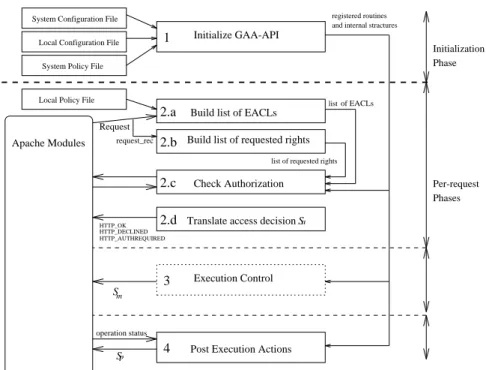
Figure 1. GAA-Apache integration
6
GAA-Apache Access Control
The GAA-API is integrated into Apache by modifying
the function. The “glue” code extracts
the information about requests from the Apache core mod-ules, initializes the GAA-API, calls the API functions to evaluate policies, and finally returns access control decision and status values to the modules. The GAA-Apache inte-gration is shown in Figure 1. The GAA-API makes use of system-wide and local configuration and policy files. The configuration files list routines and parameters for evaluat-ing conditions specified in the policy files. The system-wide policy applies to all applications in the system. The local 3 status values:
1. authorization status indicates whether the request is
authorized, not authorized or uncertain. 2. mid-condition enforcement status .
3. post-condition enforcement status .
The status values ( "!$#% &(')#% *+),- ) are
obtained during the evaluation of conditions in the relevant EACL entries:
"! - all conditions are met;
&(' - at least one of the conditions fails;
*+),- - none of the conditions fails but there is at
least one condition that is left unevaluated. The GAA-API returns *+",- if the corresponding condition
evalua-tion funcevalua-tion is not registered with the API.
1. Initialization phase. When the server daemon of Apache starts, first the GAA-API is initialized by
call-ing ./ 0213465476 and .8 0 9 that extract and
register condition evaluation and policy retrieval rou-tines from the system and local configuration files, fetch the system policy file, and generate internal struc-tures for later use.
2. The access control phase starts with receiving a re-quest to access an object (e.g., HTML file or CGI script).
(a) The./ ./ %1 :$;=<> =1 ?:54@ 0A: function is
called to obtain the security policies associated with the requested object. The function reads the system-wide policy file, converts it to the inter-nal EACL representation and places it at the be-ginning of the list of EACLs. Next, the function retrieves and translates the local policy file and adds it to the list. The system and local policies are composed as described in Section 2.1. (b) The request is converted into a list of requested
rights. The context information (e.g., system con-figuration, server status, client status and the de-tails of access request) that may be used by the condition evaluation routines is extracted from the $ B$C %1 $ structure and is added to
re-quested right structure as a list of parameters. These parameters are classified with “type” and “authority” so that GAA-API routines that eval-uate conditions with the same type and authority could find the relevant parameters.
(c) Next, the.8 D C13:$$476E134:$0 function is
called to check whether the requested right is au-thorized by the the ordered list of EACLs. This function finds the EACL entries where the the re-quested right appears and calls the registered rou-tines to evaluate pre- and request-result condi-tions in the entries. If there are no pre-condicondi-tions, the authorization status is set to "! .
Oth-erwise, the pre-conditions are evaluated and the result is stored in the authorization status .
If the request-result conditions are present in the entry, the conditions are evaluated and the inter-mediate result is calculated. The conjunction of the intermediate result and
is stored in the
au-thorization status .
(d) Finally, the status is translated to the Apache
format and is passed to the Apache core mod-ules as a return value of the
function. -"! is translated to FHGGI 'J
(Apache can grant the request). &K' is
trans-lated toFLGGI ML NO/P%&Q)M (Apache should reject
the request). In some cases, the
*+",-is translated toFHGGRI )SGFUT V)SP%T-M , in other
cases toFLGGRI ML"NO/P%&U-M .
In particular, the *+",- is used to enforce
adaptive redirection policies. Apache may use the redirection for minimizing the network de-lay, load balancing or security reasons. For ex-ample, redirect to a replica server that is clos-est to the client in terms of network distance. The redirection policies encoded in the pre-conditions specify, characteristics of a client, cur-rent system state and URL that must serve the client. With this setup, the GAA-API first checks the pre-conditions that encode client’s informa-tion and system state. The condition of type
pre cond redirect encodes the URL and is returned unevaluated. When Apache receives the FHGGI )SGFUT V)SP3T-M , the server checks
whether there is only one unevaluated condition of the type pre cond redirectand creates a redirected request using the URL from the con-dition value.
3. The execution control phase consists of starting the operation execution process and calling the
.8 W C13:$0 :$0X13$:5 function which checks if the
mid-conditions associated with the granted access right are met. The result is returned in . The
implemen-tation of this phase has not been completed yet. 4. During the post-execution action phase
the.8 ?:$Y1 W DC13:$0 =13:$0 function is called to
enforce the post-conditions associated with the granted rights. This function performs policy enforcement af-ter the operation completes by executing actions such as notifying by email, modifying system variables, writing log file, etc. The operation execution status (indicating whether the operation succeeded/failed) is passed to the.8 ?:$Y1 W C8134:$0 =13:$0 . If no
post-conditions are found, "! is returned, otherwise
the post-conditions are evaluated and the result is re-turned in .
7
Deployments
In this section we describe several examples to illustrate how our framework can be deployed to enable fine-grained access control and intrusion detection and response.
7.1 Network Lockdown
We first show how our system adapts the applied authen-tication policies to require more information from a user when system threat level changes. Consider an organization with the following characteristics:
Z
Mixed access to web services. Access to some web re-sources require user authentication, some do not.
Z
An IDS supplies a system threat level. For example, low threat level means normal system operational state, medium threat level indicates suspicious behavior and high threat level means that the system is under attack.
Z
Policy: When system threat level is higher than low,
lock down the system and require user authentication for all accesses within the network. Strong
authentica-tion protects against outside intruders. To some extent, authentication may help to reduce insider misuse. In particular, insiders are discouraged if the identity of a user can be established reliably.
System-wide policy:
eacl mode 1 # composition mode narrow # EACL entry 1
neg access right * *
pre cond system threat level local =high
Local policy:
# EACL entry 1
pos access right apache *
pre cond system threat level local >low pre cond accessID USER apache *
The system-wide policy specifies mandatory requirement “No access is allowed when system threat level is high” that
can not be bypassed by a local policy. The local policy spec-ifies that all Apache accesses have to be authenticated if the system threat level is higher than “low”.
7.2 Application level Intrusion Detection
We next show how the system supports prevention of penetration and/or surveillance attacks by detecting a CGI script abuse.
System-wide policy:
eacl mode 1 # composition mode narrow # EACL entry 1
neg access right * *
pre cond accessID GROUP local BadGuys
Local policy:
# EACL entry 1
neg access right apache *
pre cond regex gnu ‘‘’*phf*’ ’*test-cgi*’’’ rr cond notify local
on:failure/email:sysadmin/info:CGIexploit rr cond update log local
on:failure/BadGuys/info:IP # EACL entry 2
pos access right apache *
Entry 1 in the system-wide policy specifies mandatory re-quirement that members of the groupBadGuysare denied access. Evaluation of the pre-conditionpre cond group
includes reading a log file of the suspicious IP addresses and trying to find an IP address that matches the address the request was sent from. Entry 1 in the local policy con-tains a pre-conditionpre cond regexthat examines the request for occurrence of regular expressions *phf* and
*test-cgi*. If no match is found, the GAA-API pro-ceeds to the next EACL entry that grants the request.
If this condition is met, the request is rejected.
Therr cond notifycondition sends e-mail to the sys-tem administrator reporting time, IP address, URL at-tempted and a threat type.
Next, therr cond update logupdates the group
BadGuysto include new suspicious IP address from the re-quest.
New signatures can be specified using regular expres-sions and numeric comparison. For example, the following pre-condition detects a particular DoS attack:
pre cond regex gnu ’*///////////////////*’
Evaluation of this condition includes checking the request for presence of a large number of ”/” characters that most likely indicates an attempt to exploit a well-known apache bug that slows down Apache and fills up logs fast.
The pre-conditionpre cond regex gnu ’*%*’
detects malformed URLs (part of the URL contains the per-cent character). This may indicate ongoing attack, such as
NIMDA. NIMDA exploits Microsoft IIS vulnerabilities by sending a malformed GET request.
The pre-conditionpre cond expr local >1000
checks that the length of input to a CGI script is no longer than 1000 characters. This condition detects a buffer over-flow attacks, e.g., Code Red IIS attack.
Adding suspicious hosts to theBadGuysmay allow our system to stop attacks with unknown signatures. Often vul-nerabilities are tested by scripts that generate a number of re-quests. Each request exploits a particular bug. If the system identifies requests from an address as matching known at-tack signature, then subsequent requests from that host (ini-tiated by the same script), checking for vulnerabilities we might not yet know about, can still be blocked. Further, since this blacklist is specified in a system-wide policy, the list is shared by many of our hosts that improves security of the system overall.
8
Performance
In our experiment, we used the system-wide and local policy files shown in Sections 7.1 and 7.2, respectively. The experiment was performed 20 times on a PC with an Intel 1.8GHz Pentium 4 CPU, running RedHat Linux v7.1.
On average, GAA-API functions took 5.9 milliseconds (ms) without email notification (53.3 ms with email notifica-tion) while running Apache functions including GAA-API functions took 19.4 ms (66.8 ms with email notification). The overhead introduced by the GAA-API is 30% if email notification is not taken into account. If the email notifica-tion is enabled, the overhead increases to 80%.
9
Implementation Status and Future Work
The GAA-API implementation is available at http://www.isi.edu/gost/info/gaaapi/source.
The API has been integrated with several applications, in-cluding Apache, sshd and FreeS/WAN IPsec for Linux.
To improve efficiency of the GAA-Apache integration we will add support for caching of the retrieved and trans-lated policies for later reuse by subsequent requests. We will investigate a possibility of implementing a simple profile building module and anomaly detector (implemented using conditions) to support anomaly-based intrusion detection in addition to the signature-based.
We plan to implement the execution control phase for Apache. We will explore the utility of mid-conditions for protection from untrusted downloaded code, such as Java applets and Netscape plug-ins. The mid-conditions will control actions of the downloaded content on a client ma-chine throughout the execution of the content.
We plan to design a policy-controlled interface for estab-lishing a subscription-based communication channels to al-low GAA-API and IDSs to communicate.
10
Related Work
AppShield [5] is a proprietary policy-based system that protects web servers. The AppShield intercepts and ana-lyzes all requests and dynamically adjusts its security policy to prevent attackers from exploiting application-level vul-nerabilities. It uses dynamic policy not by looking for the signatures of suspicious behavior but by knowing the in-tended behavior of the site and rejecting all other uses of the system.
Emerald architecture [2] includes a data-collection mod-ule integrated with Apache Web server. The modmod-ule ex-tracts the request information internal to the Apache server and forwards it to an intrusion detection component that an-alyzes HTTP traffic.
Both AppShield and Emerald systems are designed specifically for the web servers and can not be used for other types of applications. In contrast, the GAA-API provides a generic policy evaluation and an application-level intrusion detection environment that can be used by different applica-tions.
Almgren, et. al., [1] provide an overview of the occur-rences of web server attacks and describe an intrusion de-tection tool that analyzes the CLF logs. The tool finds and reports intrusions by looking for attack signatures in the log entries. However, the monitor can not directly interact with a web server and, thus, can not stop the ongoing attacks.
11
Conclusions
Traditional access control mechanisms have little abil-ity to support or respond to the detection of attacks. In this paper we presented a generic authorization framework that supports security policies that can detect attempted and ac-tual security breaches and which can actively respond by modifying security policies dynamically. The GAA-API combines policy enforcement with application-level intru-sion detection and response, allowing countermeasures to be applied to ongoing attacks before they cause damage. Be-cause the API processes access control request by applica-tions, it is ideally placed to apply application-level knowl-edge about policies and activities to identify suspicious ac-tivity and apply appropriate responses.
12
Appendix
We use the Backus-Naur Form to denote the elements of our
EACL language. Items inside round brackets,() are optional.
Curly brackets,[\ , surround items that can repeat zero or more
times. A vertical line,|, separates alternatives. Items inside dou-ble quotes are the terminal symbols. An EACL is specified accord-ing to the followaccord-ing format:
eacl ::= (composition mode) [ entry\ entry ::= pright conds | nright pre cond block rr cond block
pright ::= "pos access right" def auth value nright ::= "neg access right" def auth value conds ::= pre cond block rr cond block
mid cond block post cond block pre cond block ::= [ condition\ rr cond block ::= [ condition\ mid cond block ::= [ condition\ post cond block ::= [ condition\
condition ::= cond type def auth value composition mode ::= "0"|"1"|"2" cond type ::= alphanumeric string def auth ::= alphanumeric string value ::= alphanumeric string
References
[1] M. Almgren, H. Debar, and M. Dacier.
A lightweight tool for detecting web server attacks.
In Proceedings of NDSS 2000, Network and Dis-tributed System Security Symposium. The Internet
So-ciety, February 2000.
[2] M. Almgren and U. Lindqvist. Application-Integrated Data Collection for Security Monitoring. Proceedings
of the Fourth International Symposium on the Recent Advances in Intrusion Detection (RAID’2001),
num-ber 2212 in LNCS, pages 22-36, 2001. [3] R. Bace and P. Mell.
Intrusion Detection Systems. NIST Special
Publica-tion on Intrusion DetecPublica-tion Systems. NaPublica-tional Institute
of Standards and Technology, August, 2001. [4] T. V. Ryutov and B. C. Neuman.
The Set and Function Approach to Modeling Autho-rization in Distributed Systems.
In Proceedings of the Workshop on Mathematical Methods and Models and Architecture for Computer Networks Security, May 2001, St. Petersburg Russia.