Junior Management Science
journal homepage:www.jums.academy
Advisory Editorial Board:
DOMINIK VAN AAKEN FREDERIK AHLEMANNCHRISTOPH BODE ROLF BRÜHL JOACHIM BÜSCHKEN LEONHARD DOBUSCH RALF ELSAS DAVID FLORYSIAK GUNTHER FRIEDL WOLFGANG GÜTTEL CHRISTIAN HOFMANN KATJA HUTTER LUTZ JOHANNINGSTEPHAN KAISER ALFRED KIESER NATALIA KLIEWER DODO ZU KNYPHAUSEN-AUFSEß SABINE T. KÖSZEGI ARJAN KOZICA TOBIAS KRETSCHMER HANS-ULRICH KÜPPER REINER LEIDL ANTON MEYER GORDON MÜLLER-SEITZ GÜNTER MÜLLER-STEWENSBURKHARD PEDELL MARCEL PROKOPCZUK TANJA RABL SASCHA RAITHEL ASTRID REICHELKATJA ROST MARKO SARSTEDT DEBORAH SCHANZ ANDREAS G. SCHERER STEFAN SCHMID UTE SCHMIEL CHRISTIAN SCHMITZ PHILIPP SCHRECK GEORG SCHREYÖGGLARS SCHWEIZER DAVID SEIDL THORSTEN SELLHORN ANDREAS SUCHANEK ORESTIS TERZIDIS ANJA TUSCHKE SABINE URNIK STEPHAN WAGNER BARBARA E. WEIßENBERGERISABELL M. WELPE HANNES WINNER CLAUDIA B. WÖHLE THOMAS WRONA THOMAS ZWICK
Volume 3, Issue 1, March 2018 JUNIOR MANAGEMENT SCIENCE Jean-Maxime Rivière,Blockchain technology and IP –
investigating benefits and acceptance in governments and legislations
Niklas T. Bretschneider,Revenue Sharing in European Football: An Assessment of the Bundesliga’s New Four-Pillar Model
Regina Ulrike Endres,Unternehmensreputation von Onlineunternehmen - Eine Empirische Analyse
Rafael Daniel Schlatter,The impact of tax differentials on pre-tax income of Swiss MNEs
Alexander Deneke,The influence on process performance in Integrated information systems: management accounting
Maximilian Metz,Der Einfluss der Unternehmenskultur auf die Auswahl von M&A-Targets
1 16 38 88 123 160
Published by Junior Management Science e. V.
Integrated information systems: The influence on process performance in
management accounting
Alexander Deneke Otto Beisheim School of Management
Abstract
The main argument within management accounting for why integrated information systems create value has been that they increase process efficiency. However, the implementation of more sophisticated information systems also changes the relation-ship between the manager and the management accountant. The aim of this thesis is to determine if improved relationrelation-ship quality between the manager and the management accountant is one mechanism by which integrated information systems improve the process performance in management accounting. I used structural equation modeling for a sample of 406 valid respondents consisting of management accountants from various industries. The analysis shows that integrated information systems indeed also create value through a better relationship quality between the manager and the management accountant.
Keywords: Integrated information systems, Management accounting, Process performance, Structural equation modelling
1. Introduction
With the development of more sophisticated IT systems, the business environment for organizations has become more competitive, as it gives organizations not only more possibil-ities but also new challenges (Pavlou and El Sawy (2006);
Andersen(2005);Bettis and Hitt(1995)). These IT systems allow firms to implement new and more sophisticated inte-grated information systems. The enhancement of inteinte-grated information systems is driven by the fast innovation of new IT systems. Enhanced integrated information systems help management accountants to better perform their tasks (Rom and Rohde(2007)). In fact, the objective of integrated infor-mation systems is to connect the employees and the activities around them (Dechow et al.(2006)). Formerly, each depart-ment within an organization had its own information system and no access to the information systems of the other de-partments (Davenport(1998)). However, the development of systems such as enterprise-resource-planning (ERP)1has given organizations new opportunities. For example, new in-formation systems enable organizations to have ad-hoc data from every department available for every position within the organization (Rom and Rohde (2007); Dechow et al. 1ERP systems allow organizations to have an overview of all their busi-ness activities and customers (Davenport(1998))
(2006)). This means that every division can have access to the information systems of every other department. Further-more, the information is integrated into the systems auto-matically, and thus an automatization and standardization process is being enhanced within organizations.
Literature has shown that IT systems create value by in-creasing process efficiency (Granlund(2011);Fulk and De-Sanctis(1995)). Nevertheless, the literature has mostly ne-glected that IT systems and thus more sophisticated inte-grated information systems enable management accountants to change their job tasks for the better (Rom and Rohde
(2007)). Moreover, it makes them more powerful and allows them to take over more value creating tasks. Consequently, the goal of this thesis is to investigate whether integrated in-formation systems also create value through a higher rela-tionship quality between the management accountants and the managers. Furthermore, I have analyzed the direct and indirect influence of the relationship quality on process per-formance in management accounting.
The accounting literature has not incorporated enough on the importance of the evolving developments of IT sys-tems for management accounting (Rom and Rohde(2007)). For too long, accounting researchers have given IT only a supporting role within management accounting (Granlund
(2009)). Very little research has been done on the increasing
role change of management accountants towards business consultants, and how management acountants create value and influence performance (Hartmann and Maas (2011)). Thus, this thesis investigates the changing relationship qual-ity between management accountants and managers and its effect on the process performance within management ac-counting. Furthermore, I will evaluate the influence of IT sys-tem sophistication on IT information quality, which both are latent variables2. Both variables are positively influenced by
the developing IT systems. Furthermore, these variables de-scribe the integrated information systems within my model. I will further elaborate on all variables in section 4.3.
In order to investigate my model, I made use of data from the WHU Controllerpanel 2015. The WHU Controllerpanel is summarized in section 4.1. The respondents within this data set are management accountants from various industries. Re-garding my method, I will use of a structural equation model-ing (SEM). This analysis helps me to identify the relationships between the variables within my model. SEM also allows me to investigate the effect of unobserved variables and to ana-lyze indirect effects of variables on other variables, which are not directly connected. SEM will be explained in more detail in section 5.
This thesis is structured as follows. I will first provide a literature review about advanced IT systems and sophis-ticated information systems and their effect on management accounting, performance and the organization in general. Af-terwards, I will develop my eight hypotheses, present my re-search model and explain the control variables used in my model. Next, I will present the method I used to analyze the data. Within that section, I will give an overview of how I conducted the data collection. In addition, I will give an overview of the sample and the responses. The last part of the method section describes how the variables in my model were measured. The section after that will give an overview of my results and consists of two parts, namely the measure-ment model and the structural model. In the section about the measurement model, I will explain how I prepared the data for the analysis. Within the structural model section, I will explain my analysis. Afterwards, I present my discussion and conclusion including managerial implications. Finally, I will point out the limitations of this thesis and give recom-mendations for future research.
2. Literature review
2.1. Introduction
In the following, I will give an overview about the current literature regarding the effects of enhanced IT systems and integrated information systems on management accounting. I structured the literature review as follows. First, I will give an overview of the enhanced development of IT systems and
2A latent variable is not directly observed, but inferred from other in-dicators (Acock(2013)); indicators are directly observed variables (Acock
(2013))
how this facilitates business competition between organiza-tions. Second, I will briefly elaborate on integrated informa-tion systems. This will directly lead me to a short overview of big data and business intelligence (BI). Afterwards, I will elaborate on the current state of the literature on the impact of integrated information systems on performance measures within organizations. In a fourth step, I will summarize the current research about the effects of advanced integrated in-formation systems on management accounting tools. In sec-tion 2.7, we will see that management accountants move to-wards the role of business consultants and I will give a short overview of this topic. This role change is adjacent to a cul-ture change within organizations, which influences the re-lationship quality between managers and management ac-countants. I will discuss this topic in the following section. In section 2.9, I will discuss the current research regarding the risks that come along with implementing advanced IT systems within the organization. Finally, I will give a short overview of the actor network theory (ANT) and explain the link of the ANT to the enhancing IT systems and its impact on management accounting systems and moreover, on orga-nizations in general.
2.2. Advanced IT systems drive business competition First, it is important to understand why advanced IT sys-tems are an important topic for organizations and why they need to manage advanced IT systems so intensively. In or-der to give an overview of this topic, I separated this section into three parts. First, I will elaborate on how the current business environment became more dynamic. Next, I will summarize what the current literature advises organizations to do in order to react to this development. Finally, I will ex-amine a potential other direction of the relationship between IT Systems and performance measures.
2.2.1. The emerging of a more dynamic business environ-ment
Organizations face a more dynamic and turbulent busi-ness landscape, which includes new challenges, but also new concepts (Pavlou and El Sawy(2006);Bettis and Hitt
(1995)). The changing business environment gets increas-ingly competitive, which is largely driven by quickly devel-oping IT systems (Andersen(2005)). The pace of the devel-opment of IT systems in the recent past has been astonishing (Granlund and Mouritsen(2003)).
From the late 19th century on, organizations have re-sponded to this development by adopting their management accounting systems to the new IT systems (Bhimani and Will-cocks(2014)). Organizations make more and more use of these IT systems in order to support their business processes. The quickly developing IT systems lead to an emerging need of more reliable and timely accounting tools. Moreover, IT systems are required to report more detailed information on an ad hoc basis (Prasad and Green(2015)). As many orga-nizations implement new IT systems and thereby gain an ad-vantage in timely and detailed information gathering, other
organizations need to follow. This fact enhances business competition, which increases the variance within the indus-tries in which the organizations operate (Thomas (1996)). This variance is driven by the diverse pace of the implemen-tation of new IT systems within the different organizations. 2.2.2. How to stay competitive as an organization
Organizations need to keep pace with the development of new IT systems in order to stay competitive. IT systems help organizations to gain competitive advantages by improving operational efficiency and reducing human errors leading to economic benefits and improved decision-making of man-agers and management accountants (Abu-Musa(2008)). To improve business efficiency, organizations need to provide timely and easily accessible accounting information through the accounting systems (Granlund (2011); Dechow et al.
(2006)). As accounting systems store large quantities of in-formation within an organization, they need to prove confor-mity with the underlying IT systems. In fact, technology is the mediator between information systems and accounting ( De-chow et al.(2006)). Thus, organizations need to use infor-mation technology to align its management accounting sys-tems with the changing business environment in order to stay competitive (Kloviene and Gimzauskiene (2014)). Align-ing the management accountAlign-ing systems with the changAlign-ing business environment is one important part within a gen-eral alignment of the organization with its business environ-ment (Powell(1992)). I will examine a cultural alignment that comes along with the integration of advanced IT sys-tems within organizations in later sections. The next section reveals important insights about the proper implementation of integrated information systems, and thus further gives in-sights into how to stay competitive as an organization. 2.2.3. A possible two-direction road
So far I have only looked at the influence of IT sys-tems and integrated information syssys-tems on management accounting. However, the relationship between IT systems and management accounting may be bidirectional. This means that increased sophistication in management account-ing demandaccount-ing for better IT systems could be the underlyaccount-ing driver for the observed performance rather than the mere advance in IT. In fact, changing demands of management accounting reports could demand a change in the IT systems (Rom and Rohde (2007)). Nevertheless, this change in di-rection creates tension, as, e.g., ERP systems are not easy to change (Davenport(1998)). Moreover, integrated informa-tion systems are difficult to change in general and thus this is the reason why the direction from IT systems towards man-agement accounting is unidirectional (Granlund and Malmi
(2002)).
Still, it is important to investigate the other direction of this relationship (Luft and Shields (2003)). This becomes especially important within the implementation phase of new IT systems and furthermore of new integrated infor-mation systems. As these systems are most easy to change during this phase, management accounting techniques and
reporting needs should be considered when implementing them (Hyvönen et al.(2009)). This is also important, since the organizations buy and do not create the new software in order to implement new integrated information systems (Granlund(2011)). Thus, the organizations should prevent a state where the software vendors just assume the needs of the organization. This is critical as the implementation of new integrated information systems may define certain aspects of management accounting (Dechow and Mouritsen
(2005)). These effects might not be visible for managers at first sight, but they bear large consequences and thus managers should give the implementation of new integrated information systems a high importance. Those arguments can get linked to a point already made earlier. As the busi-ness environment is getting more and more competitive and organizations need to implement systems already used by competitors, the compatibility of the integrated information systems becomes heavily important. The reason why many organizations have not yet implemented tools such as the Balanced Scorecard3is the lack of compatible integrated in-formation systems (Rom and Rohde(2007)). The potential change in direction will not be part of my research and is open to be investigated by the research community.
2.3. Advanced information systems
After I have elaborated on the background of the devel-oping IT systems and a more competitive business environ-ment, I will now give an overview of integrated information systems and shortly define them. At the end of this section, I will briefly present the ERP as one important information system within organizations.
2.3.1. Information system quality
At this point, I want to single out the difference between IT systems and integrated information systems once again. The enhancement of information systems is due to the steady development of IT systems. In fact, IT systems are the tech-nology behind integrated information systems and make them possible.
As enhanced information systems help organizations to stay competitive in the changing business environment, or-ganizations need to enforce their development. Informa-tion system quality consists of the three components: system quality, information quality and service quality (Gorla et al.
(2010)). Furthermore,Gorla et al.(2010) investigated the impact of these three components on the organization. Ad-ditionally, they determined the effect of system quality on in-formation quality. The authors used survey data4to test their hypotheses. They used a confirmatory factor analysis (CFA)5
3A concept for measuring and controlling the activities of an organization with regards to the organization’s strategy (Kaplan and Norton(1992))
4Survey data collection includes any way in which data can be collected for empirical research (Couper(2005))
5CFA is a certain version of the factor analysis (Acock(2013)); the factor analysis will be explained further in section 5.1
to examine the psychometric properties of their model. Ad-ditionally, they used PLS modeling in order to confirm the validity of the constructs system quality, information quality and service quality and organizational impact. In addition, PLS modeling6was used to test the hypotheses.
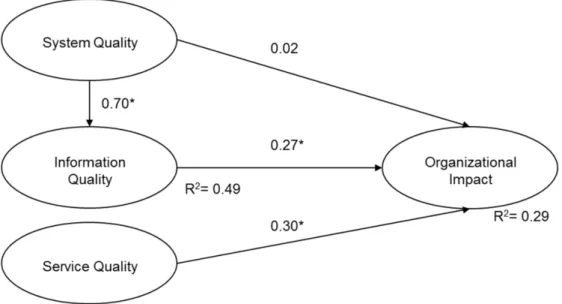
The research ofGorla et al. (2010) shows that service quality has the largest organizational impact among the three components. This impact is significant (p<0.05). System quality has a positive and significant impact on information quality. Furthermore, information quality has a positive and significant relation to organizational impact. Yet, this effect is lower than the one of service quality on the organizational impact (Gorla et al.(2010)). System quality only has an in-direct effect on the organization through information quality. The results of their study can be seen in Figure1.
Some literature suggests that the important factor for or-ganizations is not the use of the information systems, but rather the impact they generate (Bradley et al.(2006)). The impact leads to real success and measurable results. Still, the actual use of the IT system is the important link between the design of the IT system and its impact (Den Hertog and Wielinga(1992)). When new implemented IT systems do not lead to a change in behavior and use, the implementation is useless (Rom and Rohde(2007)). However, employees can only be trained to a limited extent. They have to adapt the use and their behavior on their own. Thus, integrated infor-mation systems influence the behavior of employees within organizations. Nevertheless, the behavior of employees can also influence the information systems, especially in the im-plementation phase, as the success of the imim-plementation of new integrated information systems not only depends on the technical conformity but also on the organization’s peo-ple (Elbashir et al.(2011)). Furthermore, one needs to be careful when organizations announce to implement a new integrated information system, which will include the whole entity. The infrastructure of this new implementation and the scale and scope might not be as sophisticated as stated by the organization (Quattrone and Hopper(2005)). Once again, the actual use and impact the new implementations of IISs generate is the important piece. Additionally, this impact first comes into sight after a long learning phase following the implementation (Dechow et al.(2006)). Thus, organizations should not panic if the positive impact of the new information systems does not appear right away.
2.3.2. Various information systems of organizations
Organizations have various information systems such as the ERP (Rom and Rohde(2007)). The Balanced Scorecard, e.g., is implemented with the help of software such as Hype-rion and QPR, whereas budgeting is backed by software such as Cognos (Granlund and Malmi(2002)). Consequently, in-formation systems other than ERP should be incorporated in the list of information systems supporting management ac-counting as well (Rom and Rohde (2007)). However, ERP
6PLS is a variance based method belonging to SEM (Acock(2013))
systems also facilitate the use of accounting tools such as the Balanced Scorecard activity based costing (ABC)7( Hyvö-nen(2003)). Another characteristic of information systems is how well these systems are integrated within the organi-zation (Rom and Rohde(2007)). This is consistent with the findings of Gorla et al. (2010), who used this indicator of how well the information system is integrated to evaluate the variable system quality. I will go into deeper detail of how to measure information system quality and come back to the findings ofGorla et al.(2010) in section 4.3.
2.4. Big data and business intelligence
As this thesis deals with the enhancement of IT systems and integrated information systems, I will shortly elaborate on big data and BI systems. Big data and BI are two of the most relevant terms within times of enhanced information systems. Thus, I will briefly define them within this section and furthermore explain the importance of big data for man-agement accounting. In the next step, I will elaborate on how BI helps organizations to make decisions. Afterwards, I will suggest how organizations successfully implement BI systems. Finally, I will explain the need for future research on the topic of BI systems.
2.4.1. The definition of big data
Big data describes “data sets whose size is beyond the ability of typical database software tools to capture, store, manage, and analyze” (Manyika et al.(2011), p. 1). 2.4.2. The definition of BI
BI has grown in importance for organizations considering the growing amount of data among the departments and in the business environment as well as the need of the organi-zations to make data-related decisions (Chen et al.(2012)). BI systems comprise tools for the transformation of raw data into useful data content that can be analyzed within the busi-ness (Rud (2009)). In fact, they leverage systems such as ERP. BI systems help organizations to implement strategies in order to gain a competitive advantage over competitors (Elbashir et al.(2008)). Organizations can analyze their ac-counting data with help of BI systems, which help to find important patterns within the data. Thus, BI systems are im-portant for organizations in order to cope with the more dy-namic business environment (Prasad and Green(2015)). 2.4.3. The importance of big data for management
account-ing
As new types and a larger amount of data emerges, big data is gaining in importance for the accounting functions (WWarren Jr et al.(2015)). The larger and broader amount of data will indeed help to improve the management account-ing function and help managers to make better decisions. Moreover, this information can help organizations adapt to a
7An accounting technique classifying organizational activities and then assigning indirect costs to products (Turney(1992))
Figure 1: Path coefficients. Reprinted fromGorla et al.(2010).
more dynamic and competitive environment (Warren Jr et al.
(2015)). Big data can create value for organizations in var-ious ways (Manyika et al. (2011)). They make all the in-formation transparent and store data already before the first production step. Furthermore, big data allows organizations to target specific customers more thoroughly, as it enables a narrower segmentation. Additionally, big data enhances the process of new product innovations, as it gives the pos-sibility to store after-sales data by incorporating sensors into products. As big data will become one of the key issues in competition, organizations should take the topic of big data seriously (Manyika et al.(2011)).
2.4.4. How BI helps managers and management accountants to make decisions
Managers within organizations make strategy decisions on different bases. Many managers use their experience to make daily decisions and others try to find as much scien-tific data as possible in order to have a solid ground for de-cisions (Rousseau(2006)). The adhered question is how to decide on the right and fitting strategy for the organization. In the times of the digital revolution, more and more data gets produced, but at the same time solutions to deal with this amount of data and to compute existing data arise. BI so-lutions enhance the ability of companies to deal with its data and to compute it faster and better. This makes it easier for managers and management accountants to ground every-day decisions on real-time data, as the information is available on an ad hoc basis (Prasad and Green(2015)). This process is enhanced by the standardization and automatization process induced by the IT systems among the different departments as mentioned above (Rom and Rohde(2007)).
2.4.5. How to successfully implement BI systems
In order to create value, organizations need to con-centrate on the assimilation of BI systems (Elbashir et al.
(2013)). Additionally, it is important for organizations that both the strategic and the operational levels share their knowledge. In fact, this leads to a higher BI assimilation and thus to a higher organizational performance (Elbashir et al.
(2013)). Furthermore,Elbashir et al.(2011) found that the ability of organizations to absorb and leverage new exter-nal data is a critical factor in order for the implemented IT systems and assimilated BI systems to have a positive organi-zational performance impact. The authors called the ability to absorb and leverage new external information absorptive capacity. Elbashir et al.(2011) showed that the absorptive capacity of the top management team (TMT) only plays an indirect role on the success of the BI deployment and furthermore is a function of the operational managers’ ab-sorptive capacity. Thus,Elbashir et al.(2011) show that the successful leveraging of the BI systems is bottom up driven. This is consistent with the argument made in section 2.2.3. Moreover, within the implementation of new IT systems and integrated information systems it is crucial to know the need of the future adopters and thus especially of the management accountants.
2.4.6. The need for future research
Although some research about BI exists, it seems that still a great potential for studying BI solutions and their impact on decision-making in general exists (Granlund(2011)). In fact, the current perceptiveness of these developments within the accounting research is rather narrow.
2.5. Performance gains through integrated information sys-tems
Integrated information systems give organizations a com-petitive advantage, as you will see in the following sub-sections. I will first elaborate on performance gains in business processes. Afterwards, I will give an overview of how information systems can lead to economic performance gains and how they enable managers and management ac-countants to make better and faster decisions. Finally, I will briefly present the need for future research on the effects of integrated information systems on different parts of the organization, as researchers have given too little importance to this topic (Rom and Rohde(2007)).
2.5.1. Performance gains in business processes
Integrated information systems have an effect on pro-cesses within organizations (Huber (1990)). Literature shows that information systems enhance process efficiency (Granlund(2011)). IT enhances the development of automa-tion and informaautoma-tion processes by facilitating the develop-ment of technologies such as ERP. This changes the business processes of organizations (Dechow et al. (2006)). These findings are consistent with the results that information sys-tems can decrease communication and coordination costs between middle managers and thus facilitate the organiza-tional process efficiency (Huber(1990);Fulk and DeSanctis
(1995)).
Furthermore, integrated information systems also allow shop floor workers to post within the stock and payables ac-counts (Quattrone and Hopper (2001)). Thus, at a trans-actional level management accounting is not only carried out by accountants anymore but also by non-accountants. The ledgers throughout the organizations and among differ-ent departmdiffer-ents are updated automatically through informa-tion systems such as ERP (Rom and Rohde(2007)). Conse-quently, the integrated information systems enable line man-agers with accounting knowledge to have a real-time knowl-edge about their budget and current spending. Thus, infor-mation systems can decrease the costs of obtaining informa-tion about the activities of departments. This leads to a de-centralization of control within organizations, which could lead to a state within organizations where everyone could exercise control (Quattrone and Hopper(2001)). Moreover, a decentralization of decisions can be more effective within the increasingly dynamic business environment, as it enables managers to react faster to environmental developments and thus to make faster and better decisions (Huber(1990)).
Organizations can improve their internal efficiency by leveraging their information systems in the right way (Gorla et al.(2010)). The reason for this is the fact that advanced information systems allow organizations to manage their internal resources more effectively and efficiently. Addition-ally, integrated information systems allow organizations to improve their customer service operations and thus to attain strategic advantages (Gorla et al.(2010)). Consequently, this shows again the importance of having high quality IT
sys-tems in order to stay competitive with the most sophisticated integrated information systems in place.
Literature states that investments in IT need to have a positive influence on business processes in order to have a positive effect on performance (Rom and Rohde (2007)). The increasing integration of information systems leads to a state of more sophisticated management accounting systems (Joseph et al.(1996)). Furthermore, literature shows that a dynamic accounting information systems (AIS) capability enhances the accounting process performance (Prasad and Green(2015)).
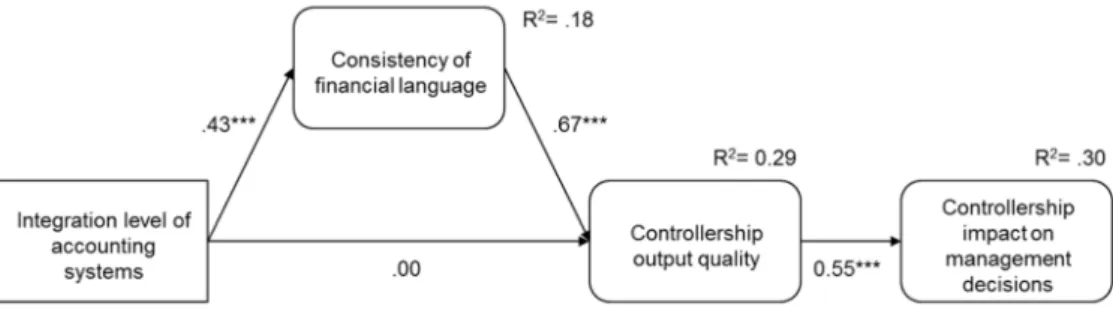
Weißenberger and Angelkort (2011) conducted a study, where they investigated if an increased level of integration of management accounting systems has a positive influence on controllership effectiveness. Furthermore, the authors stud-ied if a direct relation exists or if they are related indirectly through an intermediated variable. You can see their re-search model including their results in Figure 2. Weißen-berger and Angelkort(2011) have tested four relationships within their model. First, they evaluated if a direct effect from the level of integration of accounting systems on the output quality of controllership exists. Second, they ana-lyzed if an indirect relation of the latter variables exists, in fact through the mediate variable Consistency of financial language. Finally, the authors investigated if Controllership output quality has an influence on the impact that controllers have on management decisions. Controllership effectiveness is considered as both Controllership output quality and the Controllership impact on management decisions. The au-thors made use of SEM in order to analyze their model. In terms of data collection,Weißenberger and Angelkort(2011) contacted 1269 companies. The authors adopted a didac-tic research design, meaning that they contacted managers and controllers in every company. Within this research de-sign, the variable Integration level of accounting systems was assessed by controllers’ answers. The remaining three vari-ables Consistency of financial language, Controllership out-put quality and Controllership impact on management de-cisions were surveyed with the help of the managers of the respective companies.
As Figure2shows, no direct effect of the Integration level of accounting systems on Controllership output quality exists. However, an indirect relationship exists through the interme-diating variable Consistency of financial language. The indi-rect effect amounts to 0.29 (0.43*0.67=0.29). This finding implies that the technical systems supporting the controllers’ tasks do not directly influence the management’s opinion about the controllership effectiveness. Rather, the effective-ness of controllers is perceived as higher when they are able to report a business model which proves to be consistent with the financial accounting model of the organization. Thus, the Consistency of financial language is the important link between advanced accounting systems and the effectiveness of controllers. At this point we can relate to the fact that more advanced integrated information systems improve the consistency of management accounting reports and will thus also improve the effectiveness of management accountants
(Granlund(2009);Rom and Rohde(2007)).
Furthermore, a direct and significant relation exists from Controllership output quality to Controllership impact on management decisions. Thus, a higher perceived controller-ship effectiveness has a larger impact on management de-cisions than a lower perceived controllership effectiveness. I will give an overview of the current literature about the impact of more advanced integrated information systems on decision-making within organizations in section 2.5.3.
The data ofWeißenberger and Angelkort(2011) shows a good fit. The goodness-of-fit values largely exceed the critical values (e.g. RMSEA=0.00; critical value<0.08).
2.5.2. Economic performance gains
Advanced integrated information systems that are aligned with management accounting processes do not only improve accounting process performance but also stock market per-formance (Ittner et al.(2003)). In fact,Ittner et al.(2003) showed that organizations that make more use of both finan-cial and non-finanfinan-cial measures have a higher accounting process and stock market performance than organizations with similar strategies and value drivers. Before the time of these findings, researchers were not able to find a significant positive relationship between investments in information systems and firm performance or market value (Rom and Rohde(2007)). This circumstance is known as the produc-tivity paradox (Brynjolfsson (1993)). One possible reason for researchers to find no significant positive relationship be-tween investments in information systems and performance can be the fact that the investments in information systems might have offset the gains from it for organizations. Nev-ertheless, another reason can be that the cost/value ratio for organizations implementing new information system de-creases more than in the past, as the information systems become more and more sophisticated. Thus, organizations might not have had a benefit at the beginning of the devel-opment of information systems.
As a matter of fact, investments in information systems combined with a good management accounting in place leads to a better firm performance and thus a higher market value of the firm (Dos Santos et al.(1993);Hayes et al.(2001)). Right after Poston and Grabski (2001) found out that the im-plementation of ERP has no influence on firm performance,
Hunton et al.(2003) found out that organizations that do not adopt ERP face decreasing firm performance in contrast to or-ganizations adopting ERP. As a consequence of these findings, the research question has moved from whether investments in information systems lead to performance gains to the ques-tions why and when they lead to performance gains (Dehning and Richardson (2002)). In fact,Dehning and Richardson
(2002) contributed a literature review about this topic using data from the archives and performance measures such as accounting and market measures.
Furthermore, Barua et al.(1995) have come up with a model measuring the economic gains realized through the benefits of information systems. The authors tested this model empirically by concentrating on intermediate levels
of analysis and using industry-specific and economy-wide exogenous8variables. By following this method, they found out that many of the information systems’ impact happens at the lower level of the organization.
Moreover, the performance of an organization might have an impact on the relationship between integrated informa-tion systems and management accounting. It seems logi-cal that better performing organizations can integrate new information systems easier than other organizations. They develop their management accounting accordingly. Again, the question of the direction of influence between informa-tion systems and management accounting comes into play here. However, as already mentioned above, I will concen-trate on the influence of information systems on management accounting.
2.5.3. Better and faster decision-making
Information systems have a noticeable influence on decision-making within organizations (Huber(1990)). They are used to enhance the process of decision-making within organizations (Sutton(2000)). Integrated information sys-tems play a major role in the decision-making process by providing the financial data of the organization. The positive performance effects of advanced management accounting systems include better strategic analyses and operational-level analyses as well as higher-quality decision-making by management (Sutton(2000)). In fact, better and more fit-ting strategic decisions can be made by the TMT when the amount and type of information they have improves (Dooley and Fryxell(1999)). This is particularly important as strate-gic decision-making can be very complex and thus requires a lot of information combined from the different departments. The strategic decisions are critical for the performance of the organization (Eisenhardt (1989)). In many organizations the TMT is reliant on the information provision of the mid-dle managers or management accountants of the different departments (Raes et al.(2011)). Consequently, when the enhancement of the integrated information systems leads to a state where everyone within the organization can enter and access any data, no matter from which department or which country, the management can make better decisions (Sutton(2000)). The management might not have had ac-cess to such high quality data before the implementation of the more sophisticated information systems.
Furthermore, integrated information systems facilitate the pace of the decision- making process as managers have instantaneous access to all the relevant information they need for the decision-making process. This supersedes the process of formal approvals among the different hierarchical levels, where managers often see an overflow of information and thus need their time for decision-making (Andersen and Segars(2001)).
Organizations hope that the integrated information sys-tems support its business strategy (Dechow et al. (2006)).
8An exogenous variable is a variable that affects other variables within a model without being affected by any variables (Pearl(2000))
Figure 2: Standardized path coefficiencts. Reprinted fromWeißenberger and Angelkort(2011).
The literature has come up with various stage maturity mod-els, one of them is shown in Table1. In the left column you can see the type of planning and the right column explains the interaction of the integrated information system. The goal of many organizations, namely the integrated planning, means that the planning of the information systems and the organization itself has become indistinguishable.
2.5.4. The need for future research
As seen in the previous chapters, organizations are in-creasingly dependent on integrated information systems. This leads to the fact that managers and management ac-countants more and more drive their attention towards the implementation of new integrated information systems and look out for the newest and most sophisticated IT systems in existence (Gorla et al.(2010)). Although IT has gained a lot of importance within organizations, and namely for accounting and control systems, researchers of accounting developments have not given it enough attention (Rom and Rohde (2007)). The reason is that accounting researchers see IT systems to have a supporting role within management accounting and take the relationship for granted, as man-agement accounting and IT systems were related from their early days on (Granlund (2009); Granlund and Mouritsen
(2003)). This comes from the fact that IT within organiza-tions is often about storing the financial numbers and ensur-ing the reportensur-ing (Granlund and Mouritsen(2003)). Thus, researchers need to concentrate more on the important role of IT systems. Eventually, IT can generate a large amount of complex issues which no researcher has seen in the past or that ever existed (Chapman (2005)). Thus, accounting researchers should follow the fast development of IT systems and its impact on management accounting.
2.6. The effects of advanced integrated information systems on management accounting tools
In this section I will specifically give an overview of the influence of integrated information systems on management accounting tools. I separated this section into two parts. In the first part I will elaborate on the important determinants
for integrated information systems to have a successful im-pact on management accounting tools. In the second part I will give a specific example of an integrated information sys-tem part, namely an ERP syssys-tem.
2.6.1. The determinants for a successful impact of integrated information systems on management accounting tools The positive performance impact of advanced infor-mation systems on the organization comes from detailed management accounting information. However, this man-agement accounting information not only needs to be very accurate and timely but also consistent for the user ( Weißen-berger and Angelkort(2011)). Consequently, it is very im-portant for organizations to standardize the information systems across its various departments. Additionally, lit-erature shows that the successful integration of advanced management accounting systems is dependent on both tech-nical and social aspects within the organization (Elbashir et al. (2011)). Thus, the culture and the relationship be-tween management accountants and managers grow in im-portance. Moreover, the successful performance impact of advanced management accounting systems is not achieved by just acquiring the “state-of-the-art” software, but rather by aligning the organization’s culture and developing the skills of both management accountants and operational level man-agers. Consequently, the technology-driven systems’ success is driven from the bottom-up by the operational managers within organizations (Elbashir et al. (2011)). This makes sense, since it is the operational managers who enter a lot of data into the system. This data, of course, is the foundation of the management decisions.
2.6.2. A specific example of integrated information systems: The integration of ERP systems
ERP systems reflect one of the most advanced IT solu-tions for corporate administration at this time (Granlund and Malmi (2002)). The goal of ERP systems is to integrate all corporate information into one central database. Fur-thermore, they allow many organizational positions to ac-cess all the data within this database (Dechow and Mourit-sen (2005)). Namely, ERP systems are module-based
in-Table 1: A five-stage maturity model for strategic alignment. Reprinted fromSynnott(1987)
1 No planning No formal planning either for the business or for the information system
2 Stand-alone planning The company may have either a business plan or an information systems plan, but not both 3 Reactive planning A business plan is prepared and the information systems function reacts to it. This is a
tradi-tional passive systems role
4 Linked planning Business planning is interfaced with information systems planning. Systems resources are matched against business needs
5 Integrated planning Business and information systems planning have become indistinguishable. Both occur si-multaneously and interactively
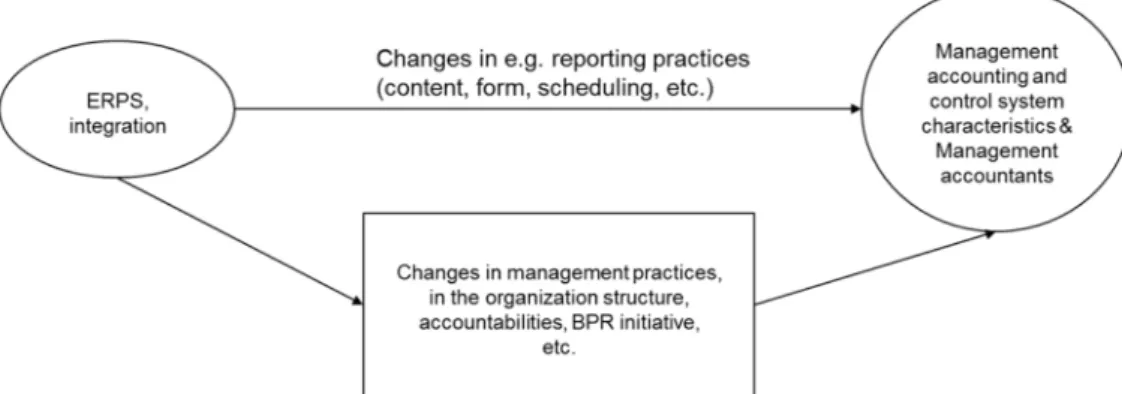
tegrated software packages which control several variables such as material, personnel, monetary and information flows of a company (Davenport (1998)). In fact, Granlund and Malmi(2002) looked at a specific example in their study and showed evidence that management accountants need to ac-quire new additional skills. They tested if the implementa-tion of ERP systems has led to changes within management accounting and control methods in the companies they have studied (Figure3).
Regarding the method,Granlund and Malmi(2002) have collected their data through interviews and written docu-ments. The authors have undertaken interviews with ac-counting professionals, project managers and IT managers of large SAP R/3 adopters, since R/3 has been the market leader in the Finnish ERP systems market during the time of the authors’ research. The empirical results ofGranlund and Malmi(2002) show that ERP systems neither have a major direct or indirect impact on management accounting or man-agement control systems. The main impact of new integrated information systems for accounting is the possibility of mass processing of documents. When evaluating the impact of the implemented ERP systems it is important to be aware of the fact that it is crucial for the adopters of the systems to under-stand the basics of the technology (Dechow and Mouritsen
(2005)).
The findings ofGranlund and Malmi(2002) show that the implementation of ERP systems within organizations has put the emphasis to the management accounting processes, the automation of internal transactions, the redesign of informa-tion documents, analyses of informainforma-tion needs and the imple-mentation of new and enhanced information systems. The development and implementation of new information sys-tems is based on the fact that not all management accounting systems are operated within the ERP systems. Consequently, management accountants not only have to get familiar with new information systems and work on their developments but also work on the interfaces between the several account-ing tools (Granlund and Malmi(2002)).
Moreover, the authors noticed that the tasks of manage-ment accountants within the companies of the data set varied from bean counters to business consultants. Thus, it seems that some management accountants will still be responsible for information collection and aggregation in the near future (Granlund and Malmi (2002)). Nevertheless, the ERP
sys-tems have facilitated the work shift towards more analyti-cal work for management accountants. Furthermore, ERP systems enable management accountants to concentrate on more value-adding tasks and more decision-making. The rel-atively small impact of ERP systems on management account-ing in total, which was revealed in the study ofGranlund and Malmi(2002), can be explained through a time lag, meaning that it takes time until the new integrated information sys-tems turn out in performance impacts. In fact, organizations implementing ERP systems most often go through a learning curve before gaining an advantage from the new ERP system (Ross and Vitale(2000)).
A part of the literature suggests the huge potential of ERP systems, which have the possibility to take over all the calculations and governance issues of the organization ( De-chow and Mouritsen(2005)). Moreover,Cooper and Kaplan
(1998) predict thorough effects for management accounting. Yet, only a small amount of literature has come up with em-pirical evidence for these predictions. In fact, two parts of the literature exist that each predict a different future im-pact of ERP systems (Dechow and Mouritsen (2005)). As already hinted above, Granlund and Malmi(2002) expect a more moderate impact from ERP systems since they are not constructed together with a change in mind regarding the use of them. They would just use the structure of the al-ready existing systems (Dechow and Mouritsen(2005)). The other part of the literature states that ERP systems are jugger-nauts which are extremely powerful (Hanseth et al.(2001)). This part of the literature even goes a step further, as the au-thors say that these systems could be different to control and that they could work in the wrong direction (Hanseth et al.
(2001)). Furthermore, the authors warn of possible disrup-tive effects induced by integrated information systems, which would lead to disintegration.
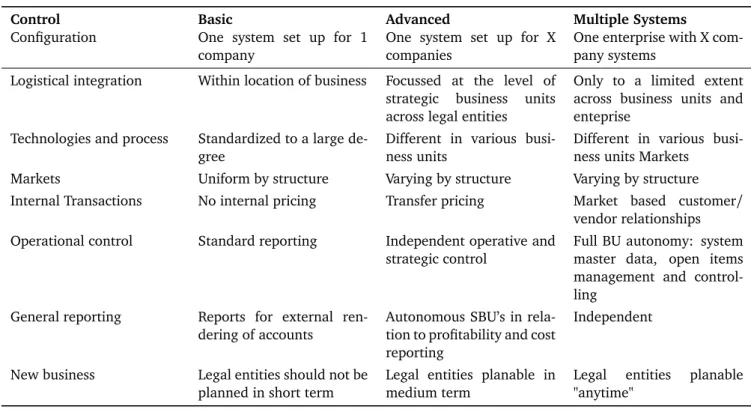
Organizations can decide between different levels of ad-vancements when implementing an ERP system. Three dif-ferent scenarios can be seen in Table 2. The first column shows the specific configuration an organization might want to undertake. For every specific configuration, you can see what it makes possible for the organization. The second col-umn shows the most basic level of the three scenarios. An advanced level can be seen in the third column. The fourth column shows the most advanced level, namely Multiple Sys-tems. The complexity of the different scenarios increases
Figure 3: Changes through ERPS integration. Reprinted fromGranlund and Malmi(2002).
from the left to the right. Thus, a higher IT investment is required for the Multiple Systems (Dechow and Mouritsen
(2005)). However, the scenario of Multiple Systems also en-ables a maximum level of system and management control flexibility. The basic scenario enables a maximum level of data integration, as Table2reveals.
2.7. Management accountants become business consultants One of the most important drivers of the changing re-lationship quality between managers and management ac-countants is the new evolving role of management accoun-tants, namely they move towards the role of a business con-sultant. This section consists out of five parts. First, I will elaborate on the role of the management accountants today and in the past. Afterwards, I will give an overview of the ongoing role change of management accountants induced by IT systems and integrated information systems. In the third section I will deal with the new tasks that evolve out of this circumstance for management accountants. Afterwards, I will explain what the literature has reported about the evolv-ing dual responsibility of management accountants, which is also caused by their role change. Finally, I will give a short overview of the need for future research regarding the role change of management accountants.
2.7.1. The role of management accountants today and in the past
As already mentioned, controllers are currently moving towards the role of business consultants. In the past, collect-ing and aggregatcollect-ing data and providcollect-ing this data to managers has been one of the main tasks of controllers (Weißenberger and Angelkort(2011)). In fact, the role of controllers could be described as a watchdog (Pierce and O’Dea(2003)).
Nevertheless, controllers pursue the management ac-counting function. This is especially the case in German-speaking countries (Weber and Schäffer(2008)). This means that responsibilities such as administrating tax issues or man-aging investor relations are being handled by other depart-ments, e.g. financial accounting. Controllers, especially in Germany, undertake tasks within the processes of plan-ning and budgeting. They are also involved in preparing
and analyzing performance reports (Ewert and Wagenhofer
(2006)). Management accountants work with the Manage-ment Accounting System. This system contains all numbers regarding the different departments. Thus, management accountants have quite a powerful position within organiza-tions (Wagenhofer(2006)). Controllers have been referred to as management accountants in the literature in the past (Ahrens(1996)). Within this thesis, I will also refer to con-trollers when speaking of management accountants out of the prior reasons. In the following, I will elaborate on the ongoing role change of management accountants.
2.7.2. Advanced information systems lead to an ongoing role change for management accountants
The role and tasks of management accountants have changed. The literature shows that IT systems influence the relationships between people and organizational entities within companies (Dechow et al.(2006)). As the IT systems within organizations enable automatic processes within the accounting systems, the role of the management accoun-tant has changed towards the role of a business consulaccoun-tant (Rom and Rohde (2007)). This means that management accountants now analyze data and come up with solutions for current challenges rather than just collect data. This also includes making recommendations to management for the future strategy of the organization.
The developments and enhancements of IT systems and furthermore information systems regarding automatization processes facilitate the role change of management accoun-tants towards business consulaccoun-tants (Dechow et al. (2006)). As many information systems already automatically calcu-late important measures, management accountants often do not need to collect or aggregate the data anymore. They rather analyze them with regards to the organization’s strat-egy. Additionally, tasks of management accountants increas-ingly include internal analyses and risk management activi-ties (Elbashir et al.(2011)). Furthermore, the enhancement of IT systems moves management accountants towards the responsibility of taking outsourcing decisions. They need to be able to determine which tasks can be done in- house and which parts can be outsourced (Feussler, Jarvis, Lin &
Nord-Table 2: Three different technology levels at the first of five ERP configuration scenarios. Reprinted from Dechow and Mouritsen(2005); &SAP(1997) - CA- Consultants handbook
Control Basic Advanced Multiple Systems
Configuration One system set up for 1 company
One system set up for X companies
One enterprise with X com-pany systems
Logistical integration Within location of business Focussed at the level of strategic business units across legal entities
Only to a limited extent across business units and enteprise
Technologies and process Standardized to a large de-gree
Different in various busi-ness units
Different in various busi-ness units Markets
Markets Uniform by structure Varying by structure Varying by structure Internal Transactions No internal pricing Transfer pricing Market based customer/
vendor relationships Operational control Standard reporting Independent operative and
strategic control
Full BU autonomy: system master data, open items management and control-ling
General reporting Reports for external ren-dering of accounts
Autonomous SBU’s in rela-tion to profitability and cost reporting
Independent
New business Legal entities should not be planned in short term
Legal entities planable in medium term
Legal entities planable "anytime"
man, 2013). These tasks reflect the role change of manage-ment accountants.
2.7.3. Management accountants need to acquire new skills In order to successfully fulfill the new tasks management accountants need to develop various new skills. These in-clude overlapping knowledge across departments, interper-sonal skills as well as a more detailed understanding of the organization’s strategy (Elbashir et al.(2011)). In fact, man-agement accountants will not need to develop their skills within data aggregation but need to understand the impact of these data numbers on the organization’s strategy and its implications for the financial intelligence (Bhimani and Will-cocks(2014)). At the same time they need to be taught about consequent risks of a technologizing business world and be informed about the dangers that might come along and how to successfully face them. One of these challenges is the in-creased velocity of new information coming into the account-ing systems as well as the extreme velocity of IT systems en-hancement in general (Bhimani and Willcocks(2014)). Man-agement accountants need to keep an overview of more ac-cessible data within the information systems. This specific point will be especially challenging for the management ac-counting community, as in the past the literature has argued that the practices of management accounting are slow to change (Granlund(2001)).
Furthermore, management accountants need to be aware of the fact that decision-makers need their support for formu-lating strategies (Stambaugh and Carpenter(1992)). Conse-quently, it is important for management accountants to
un-derstand the various decision processes of executives used for different types of decisions.
2.7.4. The developing dual responsibility of management ac-countants
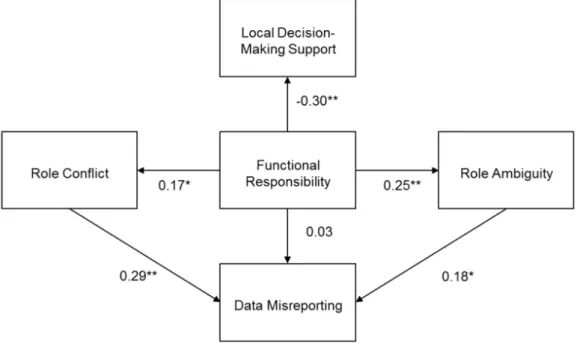
The enhancing development of integrated information systems also leads to the fact, that management accountants within organizations face a dual responsibility, namely a lo-cal responsibility and a functional responsibility (Maas and Matejka (2009)). Literature states that organizations can improve their financial reporting quality when the respon-sibility of management accountants moves towards a func-tional role (Indjejikian and Matejka(2006)).Indjejikian and Matejka(2006) claim that management accountants increas-ingly prevent data misreporting and enhance corporate con-trol when their role moves more towards a functional respon-sibility. However, Maas and Matejka (2009) used a survey study in order to show that an increased functional responsi-bility leads to both role ambiguity and role conflict for man-agement accountants. The authors made use of a data size of 134 business unit (BU) controllers working in large- and medium-sized companies located in the Netherlands. The authors showed that role ambiguity as well as role conflict are related to data misreporting at the BU level. This result is consistent with empirical findings that these variables lead to dysfunctional behavior (Grover and Hui(1994); Grover
(1993)). Moreover, this means that BU controllers cannot prevent themselves from the negative effects of Role Con-flict (Maas and Matejka(2009)). This is very critical since one of the tasks of BU controllers is to prevent
misreport-ing. Although no direct relation exists from Functional Re-sponsibility to Data Misreporting, an indirect relation exists through the mediating variables Role Conflict and Role Am-biguity. The finding that Functional Responsibility is not di-rectly related to Data Misreporting is in contrast to the find-ings ofIndjejikian and Matejka (2006). Additionally,Maas and Matejka(2009) find evidence in their study that an in-creased Functional Responsibility of controllers compromises their ability to support the local decision-making within the organization.
The research model ofMaas and Matejka(2009) includ-ing the path estimates can be seen in Figure4. The authors have also found a good fit for their model (e.g. RMSEA = 0.03; critical value: <0.08).
Consequently,Maas and Matejka(2009) contrast with the prior literature that suggests that a greater functional respon-sibility of BU controllers leads to an improved quality of fi-nancial reporting. Moreover, the authors found out that the respondents of their survey see their responsibility to sup-port local decision-making as the primary one. Nevertheless, when coping with functional duties it becomes more difficult for them to fulfill the job duties of both, as the study has shown.
2.7.5. The need for future research
Although a substantial amount of research has been con-ducted in the field of the role change of management accoun-tants, little research exists about the link between the role of management accountants and performance at various levels within the organization. In the future, research is needed on the impact of the changing role of management accountants as business consultants on organizational performance, and how exactly they create value (Hartmann and Maas(2011)). 2.8. The effect of advanced information systems on the orga-nization’s culture and the relationship quality between management accountants and managers
In this section I will specifically give an overview of the existing literature about the influence of integrated informa-tion systems on the relainforma-tionship quality between managers and management accountants. In fact, I will elaborate on the cultural and relationship change within the organization induced by new integrated information systems. Finally, I will discuss the need for further research on this topic. 2.8.1. A cultural and relationship change within
organiza-tions with integrated information systems
The underlying role change of the management accoun-tants leads to a cultural change within organizations (Rom and Rohde(2007)). This finding is enhanced by the fact that knowledge is power and that this knowledge is generated by information systems (Granlund(2011)). Thus, management accountants within organizations could gain power by man-aging and mastering the different types of integrated infor-mation systems. Yet, this depends on how the management accountants use the information systems (Rom and Rohde
(2007)). Management accountants can add a lot of value by mastering the integrated information systems. They could be able to go through huge amounts of data and to find cer-tain patterns, which could influence the organizational goals (Sutton(2006)). This again illustrates the connection to the fact mentioned in section 2.7, that management accountants are moving towards the role of business consultants.
However, a change in power after implementations of new information systems does not always take place within organizations. No power changes are solely due to a cultural fit between the integrated information systems and the social structure and values in place within the organization (Rom and Rohde(2007)). In fact, the future role of management accountants depends on themselves, as they can choose if they want to take charge of the new information systems or to transfer that responsibility to someone else (Rom and Ro-hde(2007)). This power gain also goes along with a higher responsibility and higher pressure within the organization, as many people in the organization are dependent upon the in-tegrated information systems working properly and to have access to all the information needed (Caglio(2003)). Man-agement accountants need to be aware of the fact that groups such as information system professionals could also be in-terested in taking charge of these (Sangster(1996)). Thus, management accountants should act determinant when they want to take charge of the new integrated information sys-tems within organizations.
In particular, enterprise systems facilitate the ongoing change within the business environment and within the or-ganizational environment (Sutton(2006)). The increasing influence of IT systems on accounting leads to more complex organizations. Only those who have access to all kinds of in-formation and calculations are able to control these complex organizations (Dechow et al.(2006)). This potential power shift enhances the cultural change within companies. The new importance of information systems and the role change of management accountants makes it very important to clar-ify the roles and tasks of experts within organizations. This will not be easy for organizations as a complex relation ex-ists between accounting, control and integrated information systems (Granlund(2011)).
2.8.2. The need for future research
Moreover, research is needed on the link between man-agement accountant roles and enactment with performance at various levels, as currently there is a scarcity of research done on this topic (Hartmann and Maas(2011)).
2.9. Risks of advanced information systems
The literature has not found only positive impacts of the increasing amount of more sophisticated integrated informa-tion systems, but also warns of some risks. This part consists out of two sub-sections. First, I elaborate on the risks with regards to the fact that professionals within the organization need to acquire new skills. The second section deals with the
Figure 4: Path coefficients. Reprinted fromMaas and Matejka(2009).
risks of the automatization and standardization process en-hanced by the implementation of new integrated information systems.
2.9.1. Professionals within the organization need to acquire new skills
Advanced integrated information systems do not only lead to positive outcomes, but also bear some risks (Granlund
(2011)). As mentioned, management accountants need to be prepared for these risks. Moreover, both managers and management accountants need to be prepared for the fact that the volume of information will increase rapidly. Their role in interpreting the new mass of data will be increasingly important in the future (Granlund(2011)). This importance is enhanced by the fact that IT systems might also misinter-pret the goals of managers and the actual realized outcomes (Granlund(2011)).
As discussed, management accountants and operational managers need to acquire new skills when a new system such as ERP is being implemented (Granlund and Malmi(2002);
Elbashir et al.(2011)). The design of new management ac-counting tools, due to the enhancement of technical tools, bears the risk of not integrating the operational managers into the process (Van der Veeken and Wouters(2002)). How-ever, operational managers are essential for the success of the new technical systems within the organization as explained earlier (Elbashir et al.(2011)).Van der Veeken and Wouters
(2002) show in their case study that new information systems will be of lower use when operational managers do not un-derstand them thoroughly. Thus, the implementation of new management accounting tools should be driven by an
accu-rate understanding of the staccu-rategies of operational managers regarding fulfilling the financial goals and how they make use of the information systems within this process (Van der Veeken and Wouters(2002)).
2.9.2. The risks of automation and standardization
The enhancing and developing information systems also bear another risk. As IT systems enhance the standardization processes of management accounting tools, these processes remain unchallenged by management accounting profession-als (Hyvönen et al.(2006)). This fact is very critical since information systems are among the most important informa-tion carriers within organizainforma-tions (Hyvönen et al.(2006)). Still, no management accounting professional or manager questions these processes, as they are not willing to open up the highly technical IT processes that stand behind the standardization processes (Granlund(2009)). Consequently, a potential flaw will remain unseen when it is present in the process and be repeated over and over again. More-over, wrong output data can lead to wrong strategy decisions. Thus, it is very important for organizations to consequently question their management accounting processes as they are being standardized and automated among the several depart-ments within the organization (Rom and Rohde(2007)).
Furthermore, the fact that every position within the or-ganization can access the data of every other department leads to the risk of fraud and privacy violations (Abu- Musa, 2008;Anandarajan and Wen (1999)). In fact, managers of other departments, which might want to show that they pro-vide better numbers than the other managers, might try to use other departments’ information for their own advantage.
However, this circumstance of transparency should lead to a higher motivation of the managers to perform well and to learn from best practices. On the other hand, the decentral-ization of decision-making, made possible through the imple-mentation of new integrated information systems, may lead to higher agency costs if the middle managers use this cir-cumstance to operate in greater disharmony with the corpo-rate owners of the organization than the TMT does (Andersen
(2005)). Organizations need to be aware of these risks when implementing new integrated information systems.
As already stated in section 2.6.2, some researchers suggest that integrated information systems and in detail ERP systems could possibly lead to disruptive effects, which would lead to disintegration (Hanseth et al.(2001)). Nev-ertheless, another division of the researchers also suggest that ERP systems can have a positive impact on management accounting (Granlund and Malmi (2002)). Organizations need to be aware of the warnings of some researchers when implementing new integrated information systems and in detail ERP systems.
2.10. The ANT
The last section of my literature review deals with the ANT. I will first define the theory and then elaborate on the connection between it and IT systems.
2.10.1. The definition of the ANT
The last risk from section 2.9.2 can be connected to the ANT. The ANT states that nothing is either purely human or purely technical, but rather always a combination of both (Latour (1999)). Consequently, it is important for organi-zations to understand how their people and IT systems in-teract with each other and influence one another (Dechow and Mouritsen(2005)). Moreover, the people (e.g. profes-sionals) and IT systems build networks out of humans and non-humans, which either facilitate or constrain the devel-opment of new innovations. In fact, no action takes place outside these networks (Callon(1990)). Thus, IT system can facilitate or constrain their own development.
2.10.2. The connection between the ANT and IT systems Following the argumentation of section 2.10.1, IT systems can be seen as non-human actors (Dechow and Mouritsen
(2005)). As non-human actors within organizations and be-tween organizations, IT systems influence the information flow, management accounting and decision-making within organizations. Following, the ANT is able to explain how IT mediates management accounting within and between orga-nizations (Granlund (2009)). Hence, it can be seen again that IT systems have a fundamental influence on organiza-tional practices. Furthermore, the developing ERP systems can become actors given the current technological trends (Dechow and Mouritsen(2005)). As already seen in section 2.6.2, ERP systems will play an important role within the or-ganization and in management accounting.
However, Dechow and Mouritsen (2005) show, that IT and information systems configuration already have an im-pact on management accounting. Thus, the imim-pact begins with the time of implementation of these system. Neverthe-less, these effects are not always recognizable for managers and management accountants. Consequently, the outcome of their choices during the time of implementation is not always clear to them (Granlund(2011)). For this reason, managers and management accountants should pay close attention to the implementation of new integrated information systems. This supports an earlier argument stating that managers and management accountants need to consider the exact needs of management accounting for the new information systems so that they can be adopted to the exact needs of the organi-zation and processes (Hyvönen et al.(2009)).
3. Research model and hypothesis development
3.1. Hypothesis development
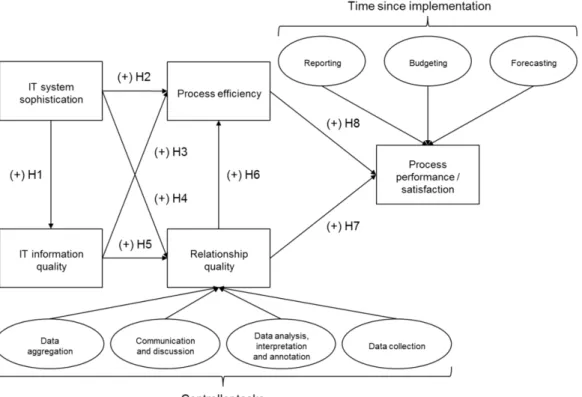
As seen in the literature review, research has shown that integrated information systems create value because they in-crease process efficiency (Granlund (2011); Fulk and De-Sanctis(1995)). The literature has also shown that manage-ment accountants are increasingly moving towards the role of a business consultant (Elbashir et al.(2011);Rom and Ro-hde(2007);Dechow et al.(2006)). Further, management ac-countants can gain power within organizations by mastering the information systems. These factors change the relation-ship between the manager and the management accountant (Granlund(2011);Rom and Rohde(2007)). However, only few studies exist about the value creation through a better relationship between the management accountant and the manager (Hartmann and Maas(2011)). Consequently, I will investigate if IT systems, and in more detail integrated infor-mation systems, increase process performance/satisfaction through the variable relationship quality.
The first hypothesis of my model relates to integrated in-formation systems. In fact, I have looked at the IT systems behind these integrated information systems as they make the implementation possible. Furthermore, I have separated the variable belonging to IT systems into the variables IT sys-tem sophistication and IT information quality. They describe the integrated information systems within my model. I will further elaborate on my variables in section 4.3. I have sepa-rated IT systems into two variables for two reasons. First, as stated in the literature review,Gorla et al.(2010) have found a positive and significant relationship between system quality and information quality. Second, my factor analysis, which I will describe in more detail in section 5.1, proposes splitting the variable IT Systems. Consequently, I hypothesize:
H1: An increased level of IT system sophistica-tion leads to a facilitated level of IT informasophistica-tion quality.
My second and third hypotheses relate to the fact that IT Sys-tems enhance process efficiency (Granlund(2011);Fulk and