20052
*ff
Financing
the Transition
to Multipillar
Robert
Holzmann
December 1998
3
'.irot_on
LABOR MARKETS, PENSIONS, SOCIAL ASSISTANCE
T H E W O R L D B A N K
Public Disclosure Authorized
Public Disclosure Authorized
Public Disclosure Authorized
Robert Holzmann
December 1998
Financing the transition to multipillar
Tables of Contents
I. Introduction 3
II. Defining, Measuring, and Changing the Stock of Liabilities 3 Defining the scope ofpension liabilities -alternative definitions 3
Measuring the social security debt 4
Social security debt, pension expenditure and policy reforms 7 III. Strategies for Limiting the Debt to be made Explicit 10 IV. Changes in the Composition of Debt and Fiscal Requirements 13
V. Assessing the Options for Financing the Transition 23
Debt versus budgetary financing -the importance of externalities 23
Debt and budgetary financing -some guidelznes 27
The Chilean experience 29
I. Introduction'
As it is well known, an unfunded pension scheme constitutes a obligation towards current retirees and workers (a contingent liability), and thus is equivalent to a hidden public debt. Shifting to a funded scheme makes this high implicit debt explicit, which has eventually to be repaid. For this very reason, countries generally have been reluctant to undertake such a reform approach since repayment of this debt amounts to a reversal of the initial intergenerational redistribution, shifting income back from the current to the future generations and raising the issue of the double burden on the transition generation. This double burden is unavoidable unless the economic externalities of the reform such as fewer distortions in labor and saving decisions or more efficient financial markets allow for a compensation of the transition generation, and there are indications that this may be the case (Holzmann, 1997a). In the context of an aging population, a double burden may be justified if it leads to a more equitable intergenerational income distribution.
This paper concentrates primarily on the mechanics of financing the transition, and on the financial stocks and flows involved. Only if the problem is treated in a consistent stock/flow concept can the true costs or benefits of transition, and its economic and distributive implications be fully assessed. To this end, the structure of the paper is as follows: Section II elaborates on the appropriate definition of the scope of the obligations that become explicit, the way these are measured and how they change under reform. Section III presents the main strategies for reducing the debt to be made explicit. Section IV highlights the changes in the composition of total (i.e. implicit and explicit) debt and the related fiscal requirements during the transition under alternative reforms. Section V presents the options to finance the transition through debt or budgetary financing.
II. Defining, Measuring, and Changing the Stock of Liabilities
There is surprising confusion about what constitutes the appropriate concept to define and measure the stock of liabilities that potentially become explicit and have to be repaid. This chapter attempts a clarification, develops a thumb-rule to estimate the accrued to date liabilities - the relevant definition -, and presents simulations on how these liabilities are influenced by policy reforms.
Defining the scope of pension liabilities - alternative definitions
There exist three main definitions of pension liabilities, i.e. the stock of commitment (Franco,
1995) :2
' This paper draws heavily on Holzmann (1997c), but contains also extensions and corrections. It has profited from valuable comments by Roberto Rocha, Robert Palacios and Anita Schwarz- The remaining errors are all my doing.
2 For an alternative terminology on pension liabilities taken from the US private sector context and further
considerations, see Kane and Palacios (1997). There the roughly equivalent concepts are named: (a) accrued termination liability; (b) present value of anticipated benefit payments to current participants; and (c) "going
4
(a) Accrued-to-date liabilities: these represent the present value of pensions to be paid in
the future on the basis of accrued rights; neither the future contributions, nor the accrual of new rights they imply are considered.
(b) Current workers and pensioner's liabilities: in this case it is assumed that pension
schemes continue their existence until the last contributor dies, while no new entrants are allowed; both the future contribution of existing members and their new rights are therefore allowed under current rules.
(c) Open-system liabilities: these also include the present value of contributions and
pensions of new workers under current rules; the range of options extends from including only children not yet in the labor force, to an infinite perspective.
Table 1 highlights the interrelation between the alternative definitions of pension's liabilities, the corresponding and alternatively vsed concept of social security debt or wealth, and the concept of actuarial deficit, the balancing item. The difference between the three main definitions of pension liabilities reflects alternative views of which generations, and their claims, should be considered. The difference between the gross and net concept results from taking account of assets (financial reserves and present value of future contributions); the net concept is equivalent to the balancing item, the actuarial deficit. The concept of debt or wealth represents alternative views from the side of government (debt) or individuals (wealth). For example, the gross social security debt of the current generation (as seen from government) corresponds to the gross social security wealth (as seen from the individuals); and the net social
security wealth corresponds to the actuarial deficit of the current generation. The concept of
net/gross social security wealth was introduced into the pension discussion by Feldstein (1974)3.
For an unfunded/fully funded pension shift (UF-FF shift), it is the first definition which is relevant, since it is the value of accrued rights which has to be potentially compensated and thus becomes explicit debt (unless the government defaults on its pension commitments). For a given pension system, the main economic assumptions which determine the level of the accrued pension liabilities (or social security debt I, henceforth SSD) are the real interest rate, real wage growth, inflation rate, and survival probabilities. For countries where the public pension system has accumulated financial reserves, the existing assets have to be subtracted.
Measuring the Social Security Debt
As noted above, the accrued-to-date liabilities represent the present value of pensions to
be paid in the future on the basis of accrued rights. The measurement is relatively easy for those already retired, but requires stronger assumptions for those currently in the labor force. For example, how should one calculate the accrued rights of a worker with 10 years of contributions, if the eligibility requirement is 15 years, the annual accrual rate is higher for the first 20 years, and the assessed income is that of the best 10 contribution years yet to come? There is no best answer and often pro-rata apportioning is undertaken, i.e. the full pension is
apportioned according to the actual length of the contribution record. If the actual
3 In the steady state, with an actuariallv fair pension system without financial reserves, both accrued-to-date liabilities (the gross social security debt 1 and the net-social wealth coincide since the present value of further liabilities resulting from future contributions and the present value of future contributions cancel out.
compensation paid for the transition to a funded scheme differs, this would have to show-up as valuation adjustments.
Table 1. Alternative Definitions of Pension Liabilities/ Social Security Debts or Social Security Wealths/Actuarial Deficits and their Interrelation
Assets Liabilities Detinition of Balance Detinition of Liability
Financial reserves Present value of pensions in disbursement
Actuarial Deficit I Present value of future
pensions due to past contri-butions of current workers
Uross Social Security Debt I Gross Social Security Debt I Actuarial Deict IAccrued to Da
L__
LiabilityPresent value of future Present value of future contributions of current pensions due to future workers contributions of current
workers
Actuarial Deficit 11
-iross Social Secunty Debt 11 Dross Social Security Debt 11
(iross Social Security Debt (ross Social Security Debt Actuarial Dencit 1+11 Current Workers and
of Current Generation of Current Generation Net Social Securit Pensioner's Liability|
L~~
Wealth/DebtlPresent value of contributions Present value of pensions of future generations due to contributions of
future generations
Actuarial Deficit III
Dross Social Security Debt Dross Social Security Debt of Future Generation of Future Generation
D3ross Social Security Debt ross Socal Security Debt Actuaral Deicit l+1+111 =- Open System
of all Generations of all Generations Total Actuarial Deficiq Liabilit
Source: Own preseniation.
Estimating the accrued-to-date liabilities (the implicit debt) should be part-and-parcel of any projection model of pension reform. The PROST model of the World Bank contains such estimations, and model simulations highlight, as to be expected, the main assumptions which determine the size in percent of GDP: the population structure, pension coverage, and benefit level; indexation arrangements, the difference between the wage growth and inflation; and the rate of discount. For the latter, the market-determined costs of government borrowing -- the interest rate? - should be taken as this is price which the government has to pay once the implicit debt is made explicit. While a higher interest reduces the estimated implicit debt it increases the interest payments on the explicit debt, and under the appropriate financing arrangement, elaborated below, the impact on government budget cancels out.
For a mature unfunded pension system, a rough rule-of-thumb can be used to capture the size of implicit debt in percent of GDP as a multiple of annual pension expenditure in percent of GDP. The upper estimate of this multiple is derived under the assumption of wage growth equal to the interest rate. With, on average, some 10 to 20 years expected in retirement, the accrued liabilities amounts to 5 to 10 times the annual expenditure since half of the retirement has already passed. In addition, the accrued liabilities with regard to the current working generations have to be taken into account. With some 30 to 40 years of average activity, the accrued obligation amounts to some 15 to 20 times the annual expenditure. Taking both upper estimates for the retired and working generation together results in accrued obligations of 30 times the annual expenditure; a lower estimate is 20 times annual expenditure. Of course, price indexation instead of wage indexation or a positive interest-wage growth difference reduces this estimate, while an aging population increases it.
Table 2 illustrates the scope of the SSD for selected OECD countries in 1990. The estimates have only illustrative character and constitute a lower bound, since they often concentrate on the main schemes only (disregarding, for example, civil servants' pensions), leave out disability and survivors pensions, or ignore social pensions and means-tested and
related supplements4, and differ from other estimates in methodology and assumptions (see,
Van den Noord and Hurd, 1994, OECD 1996, Kane and Palacios, 1997). Nevertheless, those estimates indicate that the hidden public debt, the SSD, is extremely important and dwarfs the explicit financial debt existing in those countries. Comparing the SSD with the annual pension expenditure also confirms a rule of thumb that for reasonable parameter assumptions the ratio is in the range of 20 to 30.
Table 2: Net Accrued Pension Liabilities and Financial Debt for Selected OECD Countries, 1990
(in percent of GDP)
Country Gross Liabilities | Existing Net Pension Gross Liabilit./ Financial Total gross Retired Workforce Total Assets Liabilities Expend. 1/ Pension Exp. Liabilities Liabilities (1) (2) 3) =(I)+(2' (4) (5)=(3)-(4) (6) (7) (3)/(6) (8) (9)=(3)+(8) France 77 139' 216 0 216 9,0 24,0 40 256 Germnany 55 102 157 0 157 6,9 22,8 44 201 Italy 94 165 259 0 259 10,6 24,4 101 360 (after 1992 reform) 94, 148 242 0 242 10.,6 22,8 101 343 United Kingdom 58, 81 139 0 139 6,6 21.1 35 174 Canada 42 71 113 8 105 3,9 29,0 73 186 Japan 51 112 163 18 145 5.7 28,6 70 233 Unites States 42 70 112 23 89,0 5,1 22,0 55 167 Assumptions: Pension benefits are price indexed; real earnings grow by 2 percent;
discount rate is selected at 4 percent from 1990 to 2010. declinding to 3 percent in 2050. Source: Van den Noord and Herd (1994), OECD data base. and own calculations.
11 OnIx old-age pension expenditure around 1990; figures for Japan include survivors and disability pensions.
4 The overall pension expenditure in most OECD countries are much higher and national estimates of the (net)
7
Social Security Debt, Pension Expenditure and Policy Reforms
The size of the SSD at any moment is very sensitive to policy changes and shifts in the demographic and economic environment since the impact on current and future benefit streams is immediately capitalized. In contrast, current expenditures react only to changes in current events. This difference is important in order to gauge the need of reform, the effects of different policy options, and the impact on the fiscal requirements of moving toward funded provisions.
Figure la and b sketches the scope and changes of the SSD under different benefit reform options, and Figure ic the divergence in development betweern .ocks and flows. The results are based on a heuristic overlapping generation-type simulation model that mimics the essential features of an unfunded, two-tier pension scheme5:
Benefit indexation (Figure la): Starting out with price indexation under the base-line scenario (implying a steady-state SSD of some 160 percent of GDP), with a change to wage indexation in period 0, the SSD jumps immediately by over 20 percent of GDP and continues further to increase for some 30 years till the difference to the baseline scenario reaches almost 40 percent of GDP, or 1/5 of the original SSD level. With initial wage indexation, a change to price indexation in period 0 leads to an immediate drop in the SSD level by some 24 percent of GDP before gradually approaching the baseline level after some 40 years.
Retirement age and accrual rate (Figure lb): Changing the retirement age from 60 to 65, or even from 60 to 70 dulring the periods 1 to 20 has an effect on the SSD well before the implementation of the reform, and the long-term impact on SSD is substantial. However, the results also reveal that in an earnings-relatpJ scheme the effects are somewhat compensated if the accrual rate is not adjusted accordingly ki.e. if individuals working longer and retiring later accrue further pension rights). Linking a strong increase in the RA with a decrease in the accrual rate essentially halves the SSD.
Both changes in policy parameters and their effects on SSD are a first indication of the importance of introducing policy changes well in advance of a UF-FF shift if the transition costs are to be minimized. Figure la also indicates the increase of the SSD as a result of rising life expectancy (as of period 1). Again, SSD jumps with the future change in life-expectancy, i.e., the stock effects of future changes are immediately capitalized. Figure lc exhibits this difference between stock and flow developments with regard to SSD and pension expenditure (each measured as a percent of GDP). While the fiscal flow variable the pension expenditure -is initially identical, differences in future life expectancy and policy setting have an immediate impact on SSD. The initial difference amounts to almost 30 percent of GDP.
The model has been calibrated to reflect economies with a comprehensive two-tier pension system consisting of a basic tier and an earnings-related tier. Under the base-line assumption, the life-expectancy (LE) is 70 years, the basic tier amounts to 20 percent of average wage, the accrual rate in the earnings-related tier to 1.5% p.a., and the retirement age is 60. The model assumptions imply a gross wage share of 44 percent of GDP and this results in an average replacement rate of some 50% (net of contribution payments), a contribution rate on net wages of some 30 percent, and an expenditure share of some 9% of GDP. The baseline scenario implies a SSD of some 163 percent of GDP, with a real interest -real growth rate differential of 3pp. Reducing this gap to 2pp increases the SSD by some 30pp of GDP. For the motivation of the specific model approach and basic model features, see Holzmann (1997c).
Figure Ia: Social Security Debt under Alternative Policy Scenarios I 220% 21 0% --- -- - -- -- - - -- - - - --- ~-~~ --- -- - --- --- -- --- e $ / --- 2)180% _ X'.. .... a-Q Period 0 50% COC) co to C O co It r, O n mD : C 1 C1 v! , CSI N N C O n CO C, It Lo LO U),C 4
+(1) baseline: r=-5%; g=2%; p=2%/; LE=70years; price indexation; accrual rate=1.5%p.a. _(2) initial price then wage indexation
(3) initial wage then price indexation
-(4) increasing life expectancy LE (1.5 years every 1 0 year)
Figure lb: Social Security Debt under Alternative Policy Scenarios
170% 160% , (L 1 40% ' ---. ....- ... C 130% \- 1 20% .... 90% > Period ---- --80%
0 N CD O CD CN 'IT CO N N (oSD N CO ° CN s C ON CODO 1O C0 +(1) baseline: r=5%; 9=2%; p=2%: LE=70years; price indexation; accrual rate=1.5%p.a.
(5) increase inretirement age RA(60to65) (6) increase in retirement age RA (60to7n)
9
Figure Ic: Social Security Debt and Pension Expenditure
250% 10% 225% . 9% 0 175% .- _--- --- --- - ---- - ---- - -- - - -- - -- - --- -_ 7% 0 O 175% ... ... IL~~~~~~~~~~~~~~~~~~~~~~~~~~~~~~~~~~~~~~~~~C i 1501,x 100 L,,,...P, lil I ii 4 75% ... 3%/. . .. , .... . . ... .. .. CD co =1 0) N N N, m n co C> C m l LO 00 Sli N0r a,~~~~~~~~~~~~~~~C I U)U,c wl Period
SSD wi~th nsing Ilif-e e-x-pecta-ncy
SSD with constant LE and pension refom
+Pension expenditure with rising life expectance (LE) Pension expemditure with constant LE and pension reform
Ill. Strategies for Limiting the Debt to be made Explicit
Given the actual pension expenditure level in OECD countries and in the emerging market economies of Eastern Europe and Latin America of 5 to 15 percent of GDP, this
amounts to a SSD of some 100 to 300 percent of GDP, and sometimes above, with rising tendency due to population aging. Making the debt of such an amount fully explicit, and eventually having to repay it, may often be not feasible. This begs for strategies to reduce the amount of SSD made explicit. The main strategies, which can be applied simultaneously, are fourfold and differ in their impact on the net-asset position of government.
Strategy I consists of a partial shift towards a funded system, thereby making only part of the SSD explicit. The resulting mandatory pension scheme consists of an unfunded and a funded pillar, and the distribution between both is determined by fiscal and other considerations. Such an approach is applied in Argentina and other Latin American countries, and is under preparation or implementation in Eastern European reform countries such as Hungary, Poland, and Croatia. All things equal, this strategy does not change the overall level of debt nor the net asset-position of government; it only reduces the about of implicit debt made explicit.
Strategy II consists in reducing the SSD via a reduction of future commitments through an increase in the retirement age, decrease in the annual accrual factor or change in the indexation procedure (say, from wage to price indexation). In fiscal parlance, the government partially defaults on its pension commitments. The reduction in total debt improves the balance sheet of government.
A reform of the unfunded scheme in parallel with a partial or full shift to a funded scheme appears required in most countries since the unfunded schemes are essentially financially unsustainable, and a mere shift in the financing mechanism is of little help. So far,
all reform countries in Latin America have adjusted eligibility and benefit rules before or in parallel with a shift in the financing mechanism. In order to reduce the amount of SSD made explicit, the reform has to be implemented as early as possible.
Table 3 attempts to summarize the reform-induced changes in the composition of the SSD for Chile and Colombia. Both reforms entail a similar estimated level of the SSD to be made explicit, and in both countries the corresponding fiscal flows are predominantly generated by the operational deficit.
Strategy III consists in applying an expenditure-minimizing procedure for the determination of the compensatory amount for those individuals willing to switch to the funded scheme, and hence forgoing the benefits of the unfunded one.' The move to a funded scheme which promises a higher rate of return (and hence a higher benefit level for a given contribution rate, or an equal benefit level for a lower contribution rate) suggests that no compensation for a major segment of the age cohorts is at all required. If, despite the lower contribution record, the higher rate of return under the funded scheme allows the individual to achieve a benefit level at least as high as remaining with the unfunded scheme, he has an 6 Palacios and Whitehouse (1998) provide a switching analysis and review the empirical evidence from ten
11
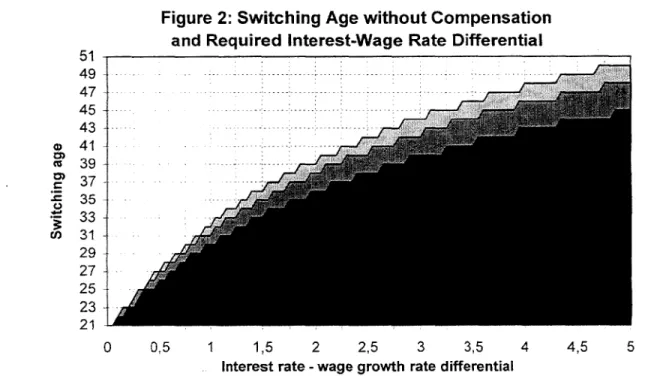
incentive to switch to the new scheme without any compensation. Figure 2 highlights the interest rate-wage growth rate differential required in order to induce an age cohort (consisting of identical individuals with perfect foresight, hence abstracting from uncertainty and risk aversion, but including survivor probabilities, and a potential span of activity between age 21 to 60/65/70, and of retirement between age 61/66/71 and 100) to switch to the funded scheme. The results suggest that for reasonable rate' differentials (in the range of 1.5 to 3 percentage points) no compensation for individuals in the age range of 33 and 44 (and below) may be required.
Table 3. Shifting from Unfunded to Funded Pensions: .The Restructuring of SSD
Chile (1981) Colombia (1994)
(in % of GDP) (in % of GDP)
Social Security Debt
of unreformed system 195.011/ 125.7 2/
-reform of
unfunded scheme -32.0l -37.6 3/
- reformed
unfunded scheme -37.0 4/ 4.5
Social Security Debt in percent in percent
made explicit 126.01 100% 83,6 100%
operational deficit 5/ 99.91 79% 69,2 83%
compensation amount 5/ 26.1, 21% 14,4 17%
1/ Estimated from annual expenditure prior to reform (7.8 percent) times 25.
2/ Estimated from accumulated deficits under alternative scenario simulations and the assumption of interest
rate equal the growth rate. See Schmidt-Hebbel (1995).
3/ Includes effects from higher contribution rates beside increased retirement age and changes in benefit structure.
4/ Estimate for unfunded scheme of security forces and minimum pension guarantee. 5/ Estimated from discounted flow projections and interest/growth rate equality assumption.
Source: Arrau (1992), Schmidt-Hebbel (1995), and own calculations.
The resulting savings, however, are likely to be small, or actually may be non-existent. On the one hand, the present value of future benefit claims of that age segment is modest. On the other hand, a compensation at the present value level of future benefit claims would actually increase the total debt. The switching of this age group takes place because they can
buy the same level of annuity at a lower price. An additional compensation would further increase their welfare position. A fiscal neutral transition in the absence of externalities implies that the welfare position of individuals is not enhanced. This requires that original income (welfare) position is reestablished through additional taxes. The lower annuity price necessitates the levying of an additional a wage tax equal to the difference of the old contribution rate and the premium rate required to achieve the old benefit level in order to finance the true transition deficit (discussed below). A compensation for forgone benefits would necessitate an additional tax of equal present value but increase temporarily the total (implicit and explicit) debt.
Yet savings may occur if the risk of the implicit rate of return of unfunded schemes is taken into account. In financially unsustainable schemes there is high policy risk to the individual that future benefit levels will be reduced. This risk is likely to increase with (i) the current debt level, and (ii) the projected general government deficits. While the returns of funded schemes are also risky, a compensation of acquired rights with explicit government bonds - a, perhaps, much less riskier asset - may allow a discount on the face value of statutory future benefits.
Figure 2: Switching Age without Compensation and Required Interest-Wage Rate Differential
51 49 - -- ----47 ----45 - -- -- -- - ---- 43-o 43 - --- - --- -- ---041 co 39 - ---37 * 33 ue 31 29 27- 25 ; 23 -, 21 0 0,5 1 1,5 2 2,5 3 3,5 4 4,5 5
Interest rate - wage growth rate differential
* Switching age frontier (RA=60) E3 Switching age frontier (RA=65) D Switching age frontier (RA=70)
Strategy IV consists in swapping the implicit debt with government assets. In countries with assets to be privatized the option of a direct swap has been raised, or at least the use of privatization proceeds to cover the "costs" of transition. At the macroeconomic level, the scope of assets to be swapped against existing SSD appears limited even for economies transforming from 100 percent public ownership, with estimated swap ratios ranging from some 3 to 70 percent with most countries in the lower range (Holzmann, 1994). At the microeconomic level a direct swap raises issues of liquidity of the assets to pay annuities, of
13
corporate governance since pension funds are traditionally not equipped to run enterprises, and asset diversification of the emerging funds since all the assets would initially be held in equities. Yet, as the example of Bolivia indicates privatization assets can be used in an innovative way to finance a (modest) universal basic pension.
In contrast to swaps, privatization proceeds are scheduled in most countries to co-finance the fiscal requirements of transition (for example in Argentina, Mexico, Poland, Kazakhstan, and Croatia). The projections, however, indicate the amounts will be modest and time-bound, reaching at most one or two percent of GDP annually for a period of 5 to 10 years. While modest, these contributions appear important for reducing the political resistance against such a reform.
While the use of privatization assets contributes to a reduction of financing needs when the debt is made explicit, it does not improve the net-asset position of the government. The privatization proceeds could have also been used to retire public debt to shorten the asset/liability balance while leaving the net-asset position unchanged. An improvement of the latter requires an improved fiscal stance through higher taxes or lower expenditure, discussed below.
IV. Changes in the Composition of Debt and Fiscal Requirements
In the discussion of pension reforms the costs of transition are often equated with the fiscal requirements to finance the implicit debt made explicit. These fiscal requirements essentially emerge in the form of the operational deficit in the unfunded scheme due to the shortfall of those contributons which have been diverted, and in the form of compensation payments for forgone benefits of the switchers. Yet, the financing of these fiscal needs itself
does not constitute an economic cost; it reflects financial flows linked with change in the
composition of total public debt. Under some assumptions, no economic costs (or benefits) emerge.
This chapter highlights how the fiscal requirements are impacted by the speed of transition and by the form of disbursing compensation payments, and presents the importance of an early reform of the unfunded scheme to reduce the overall debt.
(i) The speed of transition is determined by the decision at which age a switch to the
funded scheme should take place. There are two extreme options: Under the radical option, all commitments - for those who have just entered the labor force to those who are already retired - are compensated. Thus, the total SSD is made explicit in one stroke and has to be financed on the financial market; the cash flow requirements equal the SSD. Under the minimal option, only the new entrants to the labor market participate in the funded scheme. This reduces the cash flow requirements to the rising operational deficit (the difference between revenue and expenditure). since the expenditure remains for many years while the
contributions decrease continuously. As a result, the transition is only completed once the last
eligible person dies (after some 80 years). Most reforms will choose a switching age among the
current working generation, say age 40, as a compromise between considerations to speed-up
Figures 3a to 5a highlight the change in the composition of the total public pension debt under different assumptions about the age of the switching cohort and over time. The decision takes place at the end of period 0 and the switch in period 1. Since the interest rate in this simulation is set equal to the growth rate, the overall debt level in percent of GDP remains unchanged. Despite the fact that all fiscal requirements are debt financed, only the composition of debt becomes different7. The corresponding b-Figures exhibit the cash-flow requirements of those changes: the operational deficit, the compensation for forgone unfunded benefits (paid at retirement, or at death to the survivors when active), and the interest on the now explicit fiscal debt.
In Figure 3, all workers below retirement age shift to the funded (earnings-related) scheme and are compensated for their accrued pension rights by recognition bonds (RB). These bonds earn the market rate of return (equal to the rate of discount) and are disbursed at retirement (inclusive of the accumulated interest earnings). The affiliation to the basic scheme remains unchanged for all workers. As a result, almost 2/3 of the SSD of the earnings related scheme is exchanged against RB. The overall amount of RB decreases with the retirement of each cohort and the redemption of each bond. The corresponding cash flow requirement is presented in Figure 3b. The expenditure consists of four elements: (i) the operational deficit since the earnings-related system is left with no contributors but all retirees, (ii) the RB disbursed to the retiring cohort in each year, (iii) the value of RB of those workers dying before retirement (and for which it is assumed that this value is handed over to the family), and (iv) the interest on the now explicit fiscal debt. It is assumed that all cash-flow requirements are debt financed. The total cash-flow requirement is extremely front-loaded and peaks in the first year of transition.
In Figure 4, all workers prior to the change remain with the old system and hence no RB are required. The change in the debt composition takes place between SSD and accumulated deficits which consist of the operational deficit and interest payments only. The cash-flow requirement is very much back-loaded and peaks after 40 years. The transition is completed only after 80 years.
In Figure 5, a medium scenario is presented since only workers 41 years of age and below switch to the new system. Since their acquired rights under the unfunded scheme are relatively low so is the level of RB issued for compensation. Consequently the ,,recognition bond carrot" is slim and long. As a result of this intermediate switching approach, the cash-flow requirements are largely centered, peaking after 20 years (as in the Hungarian case, see Palacios and Rocha, 1998).
Figures 3 to 5 demonstrate the trade-off between the speed of transition and the timing of the cash-flow requirement. The faster the envisaged transition, the more the cash-flow requirement is front-loaded.
Under the assumption of the above simulation - the interest rate r equals the growth rate g - no deficit in the economic sense emerges from the UF-FF shift since the liability
7 Under the steady state conditions assumed in the model, the implicit SSD grows with the national wage bill
(equal to the growth rate of GDP), while the SSD made explicit grows with the interest rate if cash-flow requirements are debt financed. This leaves the total debt in percent of GDP unchanged.
15
position of government remains unchanged. In the more relevant case of r > g a true transition deficit emerges which is equivalent to interest rate-growth rate difference times the
SSD made explicit.8 A capitalization of that true transition deficit would make the financial
debt in percent of GDP grow without bounds, violating the conventional solvency condition for government, and thus has to be financed by general revenue (discussed below). In a perfect foresight economy this is the only deficit which matters economically.
(ii) Cash-flow considerations are also important for the timing of the disbursement of the compensatory amount, if such a payment is deemed necessary. The result in Figure 2 was derived in a perfect foresight economy; however, under uncertainty and risk aversion, individuals may not be willing to switch unless some compensation is provided (as done in most Latin American reforms so far). The highest cash-flow requirement occurs if the compensation is paid at switching age. It amounts to the disbursement and financing of the corresponding SSD for all switchers, but the financing of government debt instruments would be provided by the individuals receiving the compensation amount (or their financial intermediaries in which the money is invested). To my knowledge, no country has used this approach. An intermediate cash-flow requirement takes place if the compensation (inclusive of
s In real economies there is no single interest rate but a whole range of assets with different return-risk profiles. Measured against the risk-free return on government bonds, the implicit rate/the wage growth faired better in the period of 1953-95 in the big OECD countries, except the USA. Compared with capital market returns, a very risky asset, the wage growth was always much lower. An economic meaningful comparison of r and g requires appropriate risk adjustment of all returns, which is no easy and uncontroversial undertaking. But comparing capital return and wage growth without such an adjustment is clearly misleading.
Average Real "Rates of Return" 1953-95
Germany Japan UK USA
Wages growth 4.8 5.2 3.6 1.0
(variance) - (11.8) (37.7) (8.8) (6.0)
Interest rate (10 year government bonds) 3.9 3.8 1.0 2.3
(variance) (1.3) (5.4) (9.3) (8.2)
Capital market return - 10.1 10.8 10.8 9.8
(variance) (689.5) (612.1) (638.6) (333.2)
interest payments) is paid only at retirement (such as the recognition bonds in the Chilean reform). In this case, -the payment is distributed over the span of all switching cohorts and under a model-like setting, the bonds mature with each switching cohort retiring. The minimum cash-flow requirement occurs if, further on, the recognition bonds are annuitized at retirement (similar to the compensatory pension in the Argentinean reform or the pro-rata benefit in the Kasakhstan reform). In this case, the cash-flow requirement is restricted to the sum of the annuity payments and spread to the year when the last pensioner dies. Thus, in fact, the RB or annuity solution is equivalent to a forced credit by the switching individuals.
17
Figure 3.a: Total Public Pensions Debt (r=g=p=2%; switching till RA=60) 300% 280% 260% 240% 0 020 o.2000% 180% 160% -10 0 10 20 30 40 50 Period
;gSSD-BS *SSD-ES C3Recognition Bonds D3Accum. Fiscal Deficit
Figure 3.b: Cash Flow Requirements during Transition
(r=g=p=2%; switching till RA=60)
5,0% 4,5% -4,0% 3,5% 's 3, 0 %-N %-N %-N %-N - --- - -- - --- ----2,5%T t" 2,0% ' X In p t of GDP i
1,0%I
.
0,0% : / ' ~ - - _ -10 0 10 20 30 40 50Figure 4.a: Total Public Pension Debt (r=g=p=2%; new entrants only) 300% 280% 260% D 240% 0 = 220% a) = 200%. 180% 160% -140% _ _" -10 0 10 20 30 40 50 Period
1 SSD-BS MSSD-ES a Accum. Fiscal Deficit
Figure 4.b: Cash Flow Requrements during Transition (r=g=p=2%; new entrants only)
4,5% -_-- 4,0%-3,5% cL 3,0%-0 0 2,5% -2,0%/' CL C1,5%-/ 1,0% 0,5%- / 0,0% - - - - _ . _ --10 0 10 20 30 40 50
19
Figure 5.a: Total Public Pension Debt
(rg=p=2%; switching below age 42)
300% 280% 260% 240% 0 - 220% C.,~~~~~~~~~~~~~~~~~~~~~~~~~~~MN c 200% 180% 160% 140% -10 0 10 20 30 40 50 Period
3SSD-BS * SSD-ES 3 Recognition Bonds E3Accum. Fiscal Deficit
Figure 5.b: Cash Flow Requirements during Transition (r-g=p=2%; switching below age 42)
4,5% _______ _ 4,0%-/ 3,5% C, 3,0% 2,0 C, o 2,5% I ,. - 1,5% I N" 1,0% , 0,5%- .'' ~ ~~ I "N 0, 0 % : : : t _. I N -10 0 10 20 30 40 50
Operational Deficit ---- RB-Death related
Special cash-flow requirements occur under the Mexican reform where individuals at retirement can decide to stay with the funded provision or take up benefits under the (old but reformed) unfunded scheme while forfeiting the accumulated individual fund. This approach frontloads the financing requirements since contribution payments are forgone, leads to inflows if the public benefit option is chosen, followed by gradual outflows whose present value exceeds the prior inflow.
(iii) The timing of the reforms of the unfunded scheme linked with the switch to a funded scheme is, in principle, of primordial importance for the economic costs of transition, and the size and path of the cash flows involved. The reform of the unfunded scheme serves, inter alia, to reduce the outstanding social security debt. Consequently, such a reform should, in principle, be in place prior to the shift towards the funded scheme: This reduces the implicit debt to be made explicit, and hence the fiscal flow requirements involved. Yet, the political economy of pension reforms which makes a concurrent reform of the unfunded system and a shift towards funded provision politically more palatable is likely to be the binding constraint.
The principle importance of an early reform is highlighted in Figures 6 and 7 under the assumption that the real interest rate is 5 percent (i.e. discount rate and rate of return of funded scheme), and that the prices and real wages increase by 2 percent p.a. (the latter rate is equal to the rate of return from the unfunded scheme since no population growth is assumed). In both figures an identical reform of the unfunded scheme takes place: an increase in the retirement age from 60 to 70 over a span of 20 years/periods (with an increase by one year every two years for computational reasons) and a reduction in the annual accrual rate from 1.5 percent to
1 percent over the same time span. The only difF-ence is the timing of the reform. In Figure 6, the reform starts 20 years before the switch to the funded scheme, and hence is completed at the time of shifting from the earnings-related unfunded to the earnings-related funded scheme; in Figure 7, the reform starts concurrent with the shift. The switching decision by the individuals, and hence the age cohorts concerned, is endogenously determined, with no compensation paid. This results in a switch of all cohorts aged 44 and below under both reforms (since anybody aged 44 and below at the time of reform anyhow retires at age 70).
Figures 6 and 7 indicate the desirability of an early reform. In Figure 6.a. - the early reform scenario - the SSD (for both the basic and earnings-related scheme) is almost halved at a time of the financing shift, and the SSD of the earnings-related scheme made explicit is a mere 42 percent of GDP. The operational deficit (Figure 6.b) is frontloaded and reaches a maximum of some 2% of GDP after 30 years; the true transition deficit, which has to be budget-financed in order to avoid an increase in explicit debt rises slowly from slightly below to above one percentage point of GDP. The slight initial fluctuations are due to the discontinuous increase in the retirement age. This result contrasts with the late reform scenario (Figure 7). Due to the parallel implementation of benefit and financing reform the SSD continues to decrease initially, albeit slightly and remains constant once the reform is fully effective in period 20. The implicit SSD made explicit amounts to almost 82 percent of GDP. Also, the operational deficit and true transition deficit follow a higher path. The fluctuation in the latter are due to the discontinuous increase in the retirement age (one year every two calendar years); while keeping the total debt constant, this reduces the budgetary financing requirement every other year.
21
Figure 6.a: Total Public Pension Debt
(r=5%; g=p=2%; Unfunded benefit reform in period -20 to -1) 180% 160% 140% o. 120% 0 100% = 80% a) E 60% 40% 20% 0% -30 -20 -10 0 10 20 30 40 50 Period
*SSD-BS *SSD-ES DAccum. Fiscal Deficit:
Figure 6.b: Cash Flow Requirements and True Transition Deficit
(r=5%; g=p=2%; unfunded benefit reform in period -20 to -1)
2,5%
2,0% -/ \ .'~~~ 0~ D 1,5% 0,0 C.~~~~~/, _ * /\ X. 1,0% - /, \ C~~ /'\ 0,5% / 0,0% . -30 -20 -10 0 10 20 30 40 50Figure 7.a: Total Public Pension Debt
(r5%; g=p=2%; unfunded benefit refonn in period 0 to 19)
180% 160% 140% g 120% 100% 180% 60% 4 0% 4,0% 20% 10% L'--10 0 10 P20d 30 40 50
atSSD-BS D SSD-ES - Accum. Fiscal Deficit
Figure 7.b: Cash Flow Requirements and True Transition Deficit (r=5%; g=p=2%; unfunded benefit reformn in period 0 to 19)
4,0% ---- ---- _ _______ 3,5% - , 3,0% - . . a 2,5% . * / -' 2,0%e : : ' \ X 1,5 - zt 1, 0%:'e -\ 0,5% ::, : . '.7. 0, 0%__...__. -10 0 10 20 30 40 50
23
V. Assessing the Options for Financing the Transition
An assessment of the options for financing the transition (the fiscal requirements) has to take place against welfare economic considerations, the assumptions about the environment the economy is working in, and the conjectured impact of different financing forms on individual labor supply and saving decisions. The central decision is the scope and timing of debt versus budgetary financing for which guidelines are provided. To this end, the structure of this chapter is as follows: In a first part, the issue of debt versus tax financing under
neoclassical and endogenous growth considerations are highlighted; in a second part arguments
are developed for a temporary debt built-up versus a rapid repayment of the implicit debt made explicit; in the last part, the financing of the Chilean reform is sketched-out.
Debt versus budgetary financing - the importance of externalities
(i) In the neo-classical world, an unfunded pension scheme is Pareto-efficient even when
the interest rate permanently exceeds the natural growth rate if the given scheme does not create economic distortions. Although only the first generation gains and all later generations are worse off, there exists no mechanism to reverse the situation and to improve the welfare position of at least one generation (Breyer 1989). The result is intuitively and immediately understandable, since it amounts to an application of the second basic theorem of welfare economics: any lump-sum redistribution of income entails an allocation which is different but also Pareto-efficient (Homburg 1990). Hence, in the absence of economic distortions, the
economic effects of debt versus budgetary financing are thus easily derived.
Under pure debt financing, all the SSD made explicit is added to the financial debt since no debt repayment takes place. As noted above, with the interest rate above the natural growth rate a true transition deficit emerges which describes that part of the interest payment on the now explicit debt that has to financed from the budget to keep total debt in percent of GDP constant. Yet this deficit does not constitute an additional burden since a financing mechanism can be established which allows a transition in a generationally neutral manner.
Shifting toward funded provisions under the condition that the interest rate exceeds the wage growth rate allows the purchase of the old benefit level with a premium below the prior contribution rate. Levying a wage tax in the size of this difference provides revenues which exactly match the true transition deficit as highlighted in a simple numerical example in an overlapping generations framework (Table 4). A central assumption for this result is unchanged labor supply (and saving).
Until period 2, the model economy runs an unfunded system, providing in old-age a replacement rate of 50 percent of young generation wage which is financed by a contribution rate of 32.1 percent and implies a SSD of equivalent size in percent of GDP. In period 3, the economy changes to a two-pillar system with the same replacement rate, of which 1/3 is provided by the unfunded and 2/3 by a funded scheme. Since the interest rate r is well above the natural growth rate g (i.e. population and productivity growth), the funded pension can be achieved by a lower premia rate. With the transition however, a main share of the implicit debt becomes explicit, and with g > r results in a true transition deficit which needs to be serviced. A wage tax preempting the difference between the old contribution rate and the neW
contribution rate phl. premia provides ex -lv the required resources. In the unfunded system,
the worker pays a c ribution ate of 3 2.i percent. Under the two pillar system, he pays 10.7
percent for the reduced unfunded scheme, 11.1 percent of premia for the funded system, and 10.3 percent wage tax in order to service the true transition deficit, totaling the old rate of 32.1 percent.
Table 4: Transition to a two-pillar System in generationally neutral manner
Generation 0 1 2 3 4 5
Single pillar unfunded system Multi-pillar unfunded/funded system
(1) young (number) 100.0 120.0 144.0 172.8 207.4 248.8
(2) old (number) 83.3 100.0 120.0 144.0 172.8 207.4
(3) wage (average) 100.0 130.0 169.0 219.7 285.6 371.3
(4) gdp (1)x(3) 10,000.0 15,600.0 24,336.0 37,964.2 59,224.1 92,389.6 (5) pension (replacement rate) 0.5 0.5 0.5 0.5 0.5 0.5 (6) unfunded (average) 38.5 50.0 65.01 28.2 36.6 47.6
(7) funded (average) 0 0 0 56.3 73.2 95.2
(8) ssdebt (2)x(6) 3,205.1 5,000.0 7,800.0 4,056.0 6,327.4 9,870.7 ssdebt (in percent of gdp) 32% 32% 32% 11% 11% 11%
(9) fiscal debt 0 0 0 8,112.0 12,654.7 19,741.4
fiscal debt (in percent of gdp) 0% 0% 0% 21% 21% 21% (10) total debt (8)+(9) 3,205.1 5,000.0 7,800.0 12,168.0 18,982.1 29,612.0 total debt (in percent of gdp) 32% 32% 32% 32% 32% 32%
(11) sscontribution rate (8)/(4) 32.1% 32.1% 32.1% 10.7% 10.7% 10.7% (12) premia rate (2/3)*0.5/(1+(d)) 0.0% 0.0% 0.0% 11.1% 11.1% 11.1% (13) wagetaxrate (14)-(12)-(11) 0.0% 0.0% 0.0% 10.3% 10.3% 10.3% (14) total rate (held constant) 32.1% 32.1% 32.1% 32.1% 32.1% 32.1%
(15) true transition deficit (9)x[((d)-(c))1(1 +(d))] 0 0 0 3,893.8 6,074.3 9,475.9 (16) wage tax (13)x(9) 0 0 0 3,893.8 6,074.3 9,475.9
Notes:
(a) Population growth per generation 20% equal to an annual growth rate of 0.9% 1/ (b) Productivity growth per generation 30% equal to an annual growth rate of 1.3% 11 (c) Natural Qrowth per generation 56% equal to an annual growth rate of 2.2% 1/ (d) Finan_,_. market returns per generation 200% equal to an annual growth rate of 5.6% 1!
1! This assume the length of generation of 20 years.
Under pure budgetary financing (through higher revenue or lower expenditure,
keeping the sustainable fiscal position constant), the government combines a pension reform with a contractionary fiscal policy. The latter policy reverses the initial intergenerational distribution, and burdens the transition generation in favor of all future generations. In the setting of a traditional OLG-model, such a policy causes first-order increases in the level of national saving, capital, output and real wages. These increases rise with the share of pensioners in the population and the degree to which the economy is closed, and falls with the prevalence of voluntary intergenerational transfers (see, for example, Schmidt-Hebbel, 1993). While output increases, in neo-classic models with exogenous technical progress the additional
growth is only transitory until the new steady-state is reached.
(ii) Still, even in this neo-classic model world the costs of transition can be reduced or even eliminated under both debt and budgetary financing if the new pension scheme exhibits lower negative externalities compared to the unreformed scheme. Lower negative externalities can be motivated by the many distortions an unfunded scheme may exert on intertemporal
25
shift, the reduction or elimination of the excess burden may be used to repay the implicit debt of an unfunded scheme within finite time (Homburg 1990). Since public pension schemes and the way they are financed, quite definitely entail numerous distortions, a change in the funding
mechanism may thus actually improve welfare. The conclusion rests, however, on the assumption that the funded scheme is less distortionar,y for individual saving decisions and labor supply than the unfunded one.
Simulation studies with OLG-models a la Auerbach-Kotlikoff (1987) suggest that the welfare gains resulting from the elimination of labor market distortions are comparatively
small. A model calibrated on the German pension system exhibits welfare gains of some 9 percent of life-time resources to future generations if the transition generation is not
compensated. With compensation, the welfare gains to future generations are reduced to some
2 percent (Raffelhiischen 1993). Simulations by Kotlikoff (1996) provide higher welfare gains
to future generations of 4.5 percent (while compensating the transition generation) when assuming that the benefit-tax linkage is low, that the initial tax structure features a progressive income tax, and that consumption tax is used to finance the transition. However, when the initial tax structure is a proportionate income tax, the tax-benefit linkage is strong, when income taxes are raised to finance the transition, and when the transition generation is fully
compensated, there is a 3.1 percent welfare loss to future generations.
Deviating from a general equilibrium framework without compensation resuls sometimes in estimations which suggest high future benefits bought by only a small transitory burden (see, for example, Feldstein and Samwick, 1996). Yet these results need to be treated w^7ith a grain of salt both with regard to their assumptions (such as the assumed very high rate of return from funded provisions) as well as their partial equilibrium nature.
(iii) The considerations in traditional OLG-models highlight the critical assumption for a Pareto-improving transition in a neo-classical model setting, namely that the benefit-tax link of the system to be replaced is weak, and that general taxation (income or consumption tax) is at the margin less distortionary than social security contributions (payroll taxation). This is not necessary the case in a closed economy, even less so in an open economy. Furthermore, the net efficiency gain declines with the incidence of worker-consumption myopia.
In a closed economy setting, the results depend on the particular structure of preferences. Simulation results indicate that for particular parameter combinations, a shift between wage and income taxation usually, but not always produce efficiency gains (Auerbach and Kotlikoff, 1987), and Auerbach, Kotlikoff and Skinner (1983) conclude from second-best theory that income taxation will not always be more efficient than wage or payroll taxation.
In an open economy, the probability of net efficiency gains is likely to be further reduced. With capital much more mobile than labor, the effective taxation of capital income is reduced or even eliminated so that the tax incidence falls essentially on the less mobile factors of production (labor and land). In consequence, shifting from payroll taxation to general taxation as part of the pension reform may not change the tax incidence and the distortionary effects, only the way taxes are levied.
The welfare economic effects get even more uncertain if social security contributions are used to finance the cash requirements of transition. Such an approach is under consideration in various countries of eastern Europe (see Holzmann, 1997b), and has recently also been proposed for Spain (Pifiera, 1996). It consists in curtailing the expenditure for the unfunded tier (through increase in retirement age and change in the benefit structure) while keeping the contribution rate for switchers and non-switchers till the implicit debt made explicit is repaid. Since this approach further loosens the contribution/benefit link for both switchers and non-switchers, the excess burden of the wage taxation may even increase.
(iv) Under a traditional neo-classical framework, the financing of an UF-FF shift is technically feasible but difficult to justify in economic terms: the long-term welfare gains are small and can be achieved only at the expense of the transition generation unless net-efficiency gains through the corresponding shift in the mode of taxation are realized. The likelihood for those gains, however, are small. Thus, additional positive economic effects of such a pension reform are required in order to justify such a shift in welfare economic terms, and provide the necessary financing in fiscal terms. They may be found in the impact on economic growth.
There are four main avenues a U.F-FF shift may introduce positive externalities, leading to a higher growth rate than otherwise: (1) a higher and more productive employment level; (2) a higher national saving rate; (3) a higher rate of capital accumulation; and (4) a higher rate of technical progress. While effect (2) and (3) are identical in a closed economy, in an open economy they can diverge. All four effects (or a subset) can interact and strengthen each other once considerations of endogenous growth are taken into account.
At the labor market level, the type of pension scheme - unfunded or funded - and the perceived link between contributions and benefits can determine the distribution of labor supply between the formal and informal sectors. If the latter is less productive because higher transactions costs (e.g. bribes) or lower technology, a pension reform that moves labor supply to the formal sector will enhance overall productivity and in an endogenous growth model can lead to a higher growth path. At the financial market level, a shift from an unfunded to a funded scheme can promote the development of financ.il markets, by making them deeper, more liquid, and more competitive. The resulting enhanced resource allocation may lead not only to a one-time efficiency gain but also to a permanently higher growth path. The evidence for the Chilean pension reform can be interpreted in this direction resulting in an additional growth of up to 2 percentage points p.a. (Holzmann, 1997b).
While a higher growth path allows the compensation of the transition generation in accounting terms, and hence a long-term budgetary financing of the transition, in actual fiscal terms the situation is still complicated for three main reasons: First, the enhanced output accrues to the private sector. In the absence of lump-sum taxation and under a constant tax rate to keep the tax burden constant only a share of the additional resources accrues to the budget (around 1/3). Hence, even with gains in growth rate of 2 percentage points of which some 0.6 percentage points go to the budget (compared to fiscal requirements of 1 to 5 percent of GDP p.a.) suggest a temporary debt financing. Second, a higher growth rate is mostly linked with higher returns on the capital market, including for government borrowing. Hence, in order to contain the impact on fiscal requirements, compensation arrangements which fix the interest rate are required (as done in Chile where the recognition bonds pay 4
27
percent p.a. compared to the market rate of almost 8 percent). Last but not least, a higher growth rate leads to also to higher pensions for those retiring under the old scheme leading to a higher operational deficit. While this effect could be constraint through the provision of pensions according to the old growth path, this may prove politically difficult.
Debt and budgetary financing - some guidelines
The theoretical analysis and the likely magnitude of additional resources compared with the fiscal requirements suggest a mixed financing with the split determined by country's circumstances. The same applies to the form of budgetary financing (expenditure cuts versus tax increase), and the taxes applied. To assess the situation, the following guidelines are proposed:
There are three main arguments for a temporary build-up of explicit debt:
(i) Intergenerational equity considerations suggest that only that part of fiscal requirements is to be covered by budgetary resources which is derived in non-distortion-enhancing manner from additional output and wage taxes on the difference of prior and current forced saving rates. The remainder is to be debt financed in order to avoid a double burden on the transition generation.
(ii) Independent of the double burden, tax smoothing considerations suggest a constant tax rate over the planning horizon and imply a temporary build-up of debt. The argument is that temporary higher tax rates imply a much stronger increase in the excess burden which makes a constant tax rate welfare improving.
(iii) Transition economies reforming their pension system are mostly also plagued with an inefficient tax system/expenditure programs. Raising taxes or cutting expenditure in an unreformed environment leads to an even higher excess burden. Yet improvements on both the revenue and expenditure side take time, suggesting an initially higher level of debt financing until the reforms become effective.
There are also three main arguments for higher share of budgetary financing:
(iv) While UF-FF shift does not change the level of overall debt, the financial market may react adversely leading to a higher risk premium on the total fiscal debt - the old and transition-determined. Such a financial market reaction is not necessarily irrational, or the outcome of insufficient information. It may reflect differences in the assessment of the default probability with regard to both kinds of debt (implicit and explicit), and their interaction.
If financial markets perceive that governments will never default on their pension obligations (i.e. introduce a reform of the unfunded tier which reduces their commitments towards current retirees and workforce), with a rising SSD the risk of a default on their financial debt should increase since the set of policy options to repay that debt is reduced (there is less scope for tax increases, but scope for inflation tax since pension benefits are typically secured in real terms). Accordingly, a rise in the SSD should increase the risk premium on financial debt, while a decline should reduce it, and any UF-FF shift leaving the
total debt constant would be inconsequential. On the other hand, if financial markets are convinced that governments will first default on their pension commitment before defaulting on their financial obligations, the level of the SSD and thus any change should be inconsequential for the imposed risk premium on financial market debt. In such a case, however, a reform of the pension system which reduces the implicit debt, but increases the stock of financial debt, would tend to increase the risk premium, with negative impacts on the budget and the economy. If the default on both kinds of debt is considered equally likely, the risk premium should be driven by the size of the total debt. Hence, an undeveloped financial market would suggest a higher budgetary financing to free-up financial resources to be intermediated.
The apparent irrelevance of SSD for risk premia on the fiscal debt in the past is consistent with the second conjecture and a possible increase in the risk premia once the debt is made explicit. This suggests a stronger budgetary financing.
(v) A high share of debt financing may slow-down the development of financial markets
since the as-ets of the emerging pens - funds may be become concentrated in government debt instruments. In a developed financial market, even complete debt financing would not
imply that all additional government debt has to and will be bought by pension funds since
other institutions and the private sector would also buy these instruments for portfolio reasons leaving room for asset diversification of the pension fund. In infant financial markets, however, the government has an incentive to force the pension funds to purchase their bonds, and the pension fund has an incentive to buy given the absence of other instruments. Under
such circumstances the creation of other instruments by the funds will be slow, delaying the
development of financial markets and its potential growth effects.
(vi) There is growing evidence that it is economic growth that primarily drives the saving
rate of the private sector which only in a second round provides for higher and sustained growth. This inverse causality, however, requires an initial impact to get growth started. Such an impact may be derived from public saving as a result of a tight fiscal stance to finance the shift toward funded pensions. Furthermore, a tight fiscal stance signals also credibility to the private sector and frees-up resources for private sector investment. This also begs for a lower share of debt for financing the transition.
To provide the budgetary resources the following main considerations are suggest:
(vii) International evidence from growth analysis and budgetary consolidation analysis suggest that at the margin expenditure cuts should be given predominance to raising taxes. Lc- r current expenditure are often favorably linked with high growth rates, and a tighter fiscal stance as a result of expenditure cuts instead of tax rises has a higher chance to be sustainable. While cuts in some areas such as subsidies can be easily implemented (albeit politically difficult), cuts in other areas such as in the public wage bill require concurrent reforms of the public sector to be sustainable.
(viii) Theoretical models and some evidence for highly industrialized economies suggest that income taxes, or even more so general and specific consumption taxes are to be preferred to wage taxes in order to raise budgetary resources. Yet in countries with weak tax enforcement
29
the same conclusions do not necessarily hold and the short-term decision of what taxes to raise has to be based on local circumstances. Whatever the conclusion, in parallel with the pension reform, or even better before, an improvement of tax administration should take place.
(ix) Moving to funded pension raises the issue of which taxation model to follow: an
expenditure tax-type treatment (EET or TEE) or a comprehensive income tax-type treatment (TTE*); in general preferences is given to the former since it reduces distortions. Whatever the treatment, consistency with similar old-age saving should be applied (which in many transition economies implies that social security pensions should be taxed). Yet, since an EET treatment shifts the tax revenue to the future, and allows some tax smoothing for the individual, variants such as the TEE treatment should be seriously considered (see, Whitehouse, 1998).
The Chilean experience
No comprehensive multi-country study is yet available which covers the actual or even projected financing of the transition. For the reform pioneer, Chile, the data suggest the following (Chart 9, and Holzmann 1997a):
(i) A pre-financing of the reform took place. The fiscal stance tightened a few years before the,
reform in 1981 to make room for the envisaged fiscal requirements.
(ii) The tight fiscal policy was strengthened with the implementation of the reform and resulted again in a budgetary surplus as early as 1987.
(iii) The share of debt financing was very modest even during these early years - less then 2 percent of GDP in the peak year, compared to fiscal requirements of some 5 percent. The estimated SSD to be made explicit is 126 percent (see Table 2).
(iv) The improvement in the fiscal stance/the contribution of public saving was exclusively the
result of cuts in other current expenditure (linked with program reforms) since the current revenue in percent of GDP decreased almost continuously even prior to reform.
Despite the success of the Chilean pension reform the largely budgetary financing cannot be taken as a clear example to follow, but it is suggestive.
Figure 9. Chile: Fiscal Stance, 1970-95 40 30 20 0 -- 1 0 - \ \, , I~~~~---.- 10 \ ', .1N -2 \I. -20 __ __ __ __ 1970 1975 1980 1985 1990 1995
Current revenue Current expenditure -_ General govemment balance