Archive of SID
Original Article
Does Injection of Lidocaine with 1/100000 Epinephrine Immediately
before Lateral Osteotomy Reduce Post-Operative Periorbital Edema
and Ecchymosis in Rhinoplasty?
Mansoor Zojajy1, Nadereh Alani1, Samaneh Abdi-Soofi1, Nader Akbari-Dilmaghani1*
1
Shahid Beheshti University of Medical Sciences, Loghman Hakim Hospital, Tehran, Iran
Abstract
Background: Postoperative periorbital edema and ecchymosis are common after rhinoplasty. We studied the effect of local injection of Lidocaine/Adrenaline immediately before osteotomy on prevention of post-operative periorbital edema and ecchymosis in rhinoplasty.
Materials and Methods: Thirty healthy candidates for rhinoplasty were enrolled in the self-controlled clinical trial study. Lidocaine/Adrenaline solution injected randomly to one side just prior to the lateral osteotomy. The opposite side used as a control. The degree of edema/ecchymosis on both sides was compared on the 1st, 2nd and 7th day postoperatively.
Results: Mean of severity of edema, 24 hours after operation was 3in both sides, (Mann-whitney U; p=0.829). Mean of severity of edema, 48 hours after operation was 2 in both sides (Mann-whitney U; p=0.867) and it was 1 in both sides 7 days after operation (Mann-whitney U; p=0.756).There was no significant difference between two sides. Mean of severity of ecchymosis, 24 hours after operation was 3 in both sides (Mann-whitney U; p=0.692). Mean of severity of ecchymosis, 48 hours after operation was 2 in both sides (Mann-whitney U; p=0.655) and it was 1 in both sides 7 days after operation (Mann-whitney U; p=0.873). There was no significant difference between two sides.
Conclusion: local injection of Lidocaine/Adrenaline solution immediately before lateral osteotomy could not reduce postoperative edema and ecchymosis in rhinoplasty.
Keywords: Rhinoplasty, Osteotomy, Edema, Ecchymosis
*Corresponding Author: Nader Akbari-Dilmaghani. Shahid Beheshti University of Medical Sciences, Loghman Hakim Hospital, Tehran, Iran. Tel: +98 (21) 982155419005-11, Email: [email protected].
Please cite this article as: Mansoor Zojajy, Nadereh Alani, Samaneh Abdi-Soofi, Nader Akbari-Dilmaghani. Does Injection of Lidocaine with 1/100000 Epinephrine Immediately before Lateral Osteotomy Reduce Post-Operative Periorbital Edema and Ecchymosis in Rhinoplasty?. Novel Biomed 2014;2(2):59-63.
Introduction
Cosmetic surgeries are of the most common surgical procedures in our modern world. Although the exact number of cosmetic surgeries in Iran is not clear, but trend to perform the cosmetic surgery and on the top of
them, Rhinoplasty is increasing day to day1. during the
assess this aim, different methods have suggested to access the cartilaginous and internal architecture of
nose3,4. Rhinoplasty is an invasive procedure and has
some side effects and complications that are not desirable
for both patient and surgeon5. Studies on the results of the
surgery in Rhinoplasty indicates that complications are seen in 4-18 percent of operations and depends on
Archive of SID
and connective tissue characteristics of the patient6,7.
Two of the most common side effects of rhinoplasty are periorbital edema and ecchymosis that influences both short term and long term cosmetic results and can be result in patient and surgeon dissatisfaction and can be result in temporary visual defects during early
post-operative period8,9. Hemorrhage during rhinoplasty has
three different origins. damage to big vessels (angular vessels) at the site of osteotomy, periosteal small vessels tearing during osteotomy and damage to small subdermal vessels during inserting the osteotome and
performing osteotomy4,10. To reduce this side effects,
different methods like the use of anti-inflammatory drugs and steroids, lidocaine/epinephrine injection, head
elevation, Ice packing, have been used1,4,9-11. The goal of
using these drugs and methods is to decrease hemorrhage at the time of surgery by induction of vasoconstriction and reducing fluid extravasation which
will decrease postoperative edema and ecchymosis11.
The comment about the effect of these drugs requires investigation. Lidocaine/Epinephrine Injections provide an average anesthesia and vasoconstriction at least 60 minutes with an average duration of approximately 2.5 hours. The time of onset of action for Lidocaine and Epinephrine Injection averages 2-4 minutes. Studies of lidocaine metabolism following intravenous bolus injections have shown that the elimination half-life of
this agent is typically 1.5 to 2.0 hours12. So we
hypothesized that injection of this solution makes a vasoconstriction that reduce hemorrhage during last steps of surgery and early postoperative recovery period and will cause reduction in postoperative edema and ecchymosis.
In this study we attempted to assess the effect of injection of subperiostal, 1/100000 lidocaine/epinephrine immediately before lateral osteotomy on postoperative edema and ecchymosis.
Methods
This is a self-controlled clinical trial accomplished at Loghman hospital in Tehran in 2012. The study samples were individuals undergoing rhinoplasty, with informed consent and no sensitivity to Lidocaine and epinephrine whom could be followed for at least one week after the
surgery.
The exclusion criteria was, patients with no possibility to be followed, concomitant surgery over the head and face, those with consumption of antiplatelet or anticoagulant agents, Patients with significantly impaired coagulation factors, patients with high blood pressure during surgery and patients who need more than one type of osteotomy on each side.
The study was reviewed and approved by the hospital ethics committee and it was performed under the ethical standards laid down in an appropriate version of the 2000 Declaration of Helsinki. Information about trial was given comprehensively both orally and in written form to all patients or their accompanying adult. They gave their informed consents prior to their inclusion in the study
according to University Hospital Ethical Board
Committee.
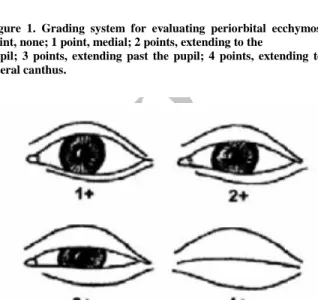
At the beginning of operation, routine injections with Lidocaine/Epinephrine (1/100000) performed including in both lateral osteotomy sites and surgery started 10 minutes after injection. Immediately before osteotomy, another injection with 2 cc of the same solution injected with No. 27 needle subperiostal on one side (case side) randomly, and no injection performed in the control side. All osteotomies were performed with a 4 mm guarded lateral osteotome (Karl Storz). Surgical team in all operations was similar and methods of surgery and anesthetic drugs and procedures were the same. Open approach reduction rhinoplasty was performed in all the patients. General anesthesia was used for all the patients. Only one low to high lateral osteotomy was performed in both sides by one master surgeon. A thirty-degree head elevation and an intermittent 6-hour ice packing on periorbital area were used in recovery room for all patients. No steroid types were administered. The nasal dressing was removed on the 3rd postoperative day. Edema and ecchymosis were assessed and recorded by another colleague who was unaware of the injected site, in 24h, 48h and 1week post-operative days and they were categorized as the
classification described by Kargi et al.13, figure 1& 2.
The obtained results for each patient were compared in both sides. Using SPSS 15 the Chi-square and Mann-Whitney U tests were used to analyze the ratios and medians, respectively. The significant level was set at 0.05.
Archive of SID
Results
In this study, 30 patients (24 women and 6 men) were
enrolled. The mean age was 24.1±4.1 with the ranging
from 18 to 33 years. Results for edema are shown in table 1.
Comparison of the ratio of edema severity was not statistically significant, 24 hours after surgery (Chi-2; p=0.222). There was not a statistically significant difference between the median of edema severity that was 3 at both sides (Mann-whitney U; p=0.829).
There was not a statistically significant difference between the ratio of edema severity 48 hours after surgery (Chi-2; p=0.696). The median of edema severity on both sides that was 2, were not statistically significant (Mann-whitney U; p=0.867).
At 7th post-operative day, by comparison the ratio of
edema severity, there was no significant difference (Chi-2; p=0.754). The median of edema was +1 at both sides in 7days after surgery with no significant differences (Mann-whitney U; p=0.756).
Results for ecchymosis are shown in table 2.
24 hours after surgery, comparison of the ratio of severity of ecchymosis was not statistically significant (Chi-2; p=0.440). The median of ecchymosis was 3 at both sides with no statistically significant difference (Mann-whitney U; p=0.692).
48 hours after surgery, there was no statistically significant difference in ratio of severity (Chi-2; p=0.277). The median ecchymosis severity at both sides was 2 with no statistically significant difference (Mann-whitney U; p=0.655).
At 7th post-operative day, comparison of severity was
not statistically significant (Chi-2; p=0.781). The median of ecchymosis was 1 at both sides with no statistically significant difference (Mann-whitney U; p=0.873).
Discussion
Many techniques have been used to reduce postoperative edema and ecchymosis in rhinoplasty. All of them have one target; to decrease extravasation of blood from damaged blood vessels and periosteum into interstitial space. So, we designed this study to assess a new simple technique to examine periorbital edema and ecchymosis.
This study performed as a self-controlled clinical trial. The importance of these studies is that many of confounding factors such as age, gender, surgical techniques and team works are under control and same in both sides. Our results show that severity of postsurgical edema and ecchymosis was not different in both sides. In the majority of patients, the grade of postoperative edema and ecchymosis of both injected and non-injected sides decreased after the first day postoperatively; this finding is consistent with the other studies. The injection of Lidocaine/Epinephrine solution is simple and does not have serious complications because epinephrine causes local vasoconstriction and prevents rapid washing and systemic circulation of Lidocaine. Therefore, injection of
another dose of Lidocaine/Epinephrine solution
immediately before osteotomy does not have any effect on the course of post-operative edema and ecchymosis in short time (24h, 48h)
Figure 1. Grading system for evaluating periorbital ecchymosis. 0 point, none; 1 point, medial; 2 points, extending to the
pupil; 3 points, extending past the pupil; 4 points, extending to the lateral canthus.
Figure 2. Grading system for evaluating eyelid edema. 0 point, none; 1 point, minimal; 2 points, extending on to the
iris; 3 points, covering the iris; 4 points, massive edema with the eyelid swollen shut.
Archive of SID
Table 1: Edema severity in injected and non-injected group24 hours 48 hours 7th day
Edema Injected Control Injected Control Injected Control
Grade Ι 3 0 8 7 24 23
Grade ΙΙ 11 14 16 19 6 7
Grade ΙΙΙ 15 16 6 4 0 0
Grade ΙV 1 0 0 0 0 0
Table 2: Ecchymosis severity in injected and non-injected group 24 hours 48 hours 7th day Ecchymosis Injected Control Injected Control Injected Control Grade Ι 0 1 4 4 21 20
Grade ΙΙ 14 9 17 22 9 10
Grade ΙΙΙ 11 15 9 4 0 0
Grade ΙV 5 5 0 0 0 0
or long time (7 days). Lidocaine/Epinephrine solution
injection facilitates cleaner dissection, reduces
intraoperative bleeding and decreases postoperative pain in rhinoplasty, but it increases interstitial fluid and
pressure10. Our results were somehow similar to GUN’s
results study in Turkey. In GUN’s study
Lidocaine/Epinephrine solution was injected in one side at the beginning of operation and contralateral side was assumed as control and severity of periorbital edema and ecchymosis were assessed on first, third and seventh days and both sides were compared. In spite of reducing of hemorrhage during operation, no significant differences in edema and ecchymosis were seen in both sides10.
The same results were seen in Kalantari Hormozi et al. In that study epinephrine 1in 100000 was injected in 39 patients and was not injected in 74 patients (control). Results showed that injection of epinephrine does not
reduce bleeding or post-surgical edema and
ecchymosis11.
Conclusion
All the obtained results show that injection of
Lidocaine/Epinephrine just before osteotomy in
rhinoplasty does not reduce postoperative edema and ecchymosis significantly.
References
1. Ghazipour A, Akbari Dilmaghani N. Effect of Dexamethasone on Postoperative Periorbital Edema And Ecchymosis In Rhinoplasty. Iranian Journal Of Otorhinolaryngology. 2007.
2. Sarwer DB, Pertschuk MJ, Wadden TA, Whitaker LA. Psychological investigations in cosmetic surgery: A look back and a look ahead. Plastic and reconstructive surgery. 1998;101(4):1136-42.
3. Eloy JA, Jacobson AS, Elahi E, Shohet MR. Enophthalmos as a complication of rhinoplasty. The Laryngoscope. 2006;116(6):1035-8. 4. Hatef DA, Ellsworth WA, Allen JN, Bullocks JM, Hollier LH, Stal S. Perioperative Steroids for Minimizing Edema and Ecchymosis After Rhinoplasty A Meta-Analysis. Aesthetic Surgery Journal. 2011;31(6):648-57.
5. Rettinger G, Steininger H. Lipogranulomas as complications of septorhinoplasty. Archives of Otolaryngology–Head & Neck Surgery. 1997;123(8):809-14.
6. Lawson W, Kessler S, Biller HF. Unusual and fatal complications of rhinoplasty. Archives of Otolaryngology—Head & Neck Surgery. 1983;109(3):164.
7. Teichgraeber JF, Riley WB, Parks DH. Nasal surgery complications. Plastic and reconstructive surgery. 1990;85(4):527-31.
8. Goldfarb M, Gallups JM, Gerwin JM. Perforating osteotomies in rhinoplasty. Archives of Otolaryngology–Head & Neck Surgery. 1993;119(6):624-7.
9. Hoffmann DF, Cook TA, Quatela VC, Wang TD, Brownrigg PJ, Brummett RE. Steroids and rhinoplasty: a double-blind study. Archives of Otolaryngology–Head & Neck Surgery. 1991;117(9):990-3.
10. Gun R, Yorgancılar E, Yıldırım M, Bakır S, Topcu I, Akkus Z. Effects of lidocaine and adrenaline combination on postoperative edema and ecchymosis in rhinoplasty. International journal of oral and maxillofacial surgery. 2011;40(7):722-9.
Archive of SID
N, Yazdanshenas H, Bazargan-Hejazi S. Can Elimination ofEpinephrine in Rhinoplasty Reduce the Side Effects: Introduction of a New Technique. Aesthetic plastic surgery. 2011;35(4):582-7.
12. Available from the address:
http://dailymed.nlm.nih.gov/dailymed/drugInfo.cfm?id=49391.
13. Kargi E, Hosnuter M, Babucçu O, Altunkaya H, Altinyazar C. Effect of steroids on edema, ecchymosis, and intraoperative bleeding in rhinoplasty. Annals of plastic surgery. 2003;51(6):570-4.