Available Online atwww.ijcsmc.com
International Journal of Computer Science and Mobile Computing
A Monthly Journal of Computer Science and Information Technology
ISSN 2320–088X
IMPACT FACTOR: 6.017
IJCSMC, Vol. 7, Issue. 9, September 2018, pg.37 – 42
Analysis of Information System
Impact on Web-Based Directory for
“UMKM” by User Satisfaction Index
Inna Sabily Karima
Faculty of Computer Science, Universitas Mercu Buana, Jakarta, Indonesia
Abstract— Indonesia's good economic development helped create the development of diverse micro, small & medium enterprises better known as UMKM in Indonesia. UMKM is present in the midst of the community to help meet the needs of the community in the local area where UMKM are located. Unfortunately when people want to find UMKM to meet the needs, faced with the problem of location search & categorization of UMKM that are around their environment. From the problems presented, the research aims to create a directory system for MSMEs that store location data & web-based UMKM categorization with the aim of facilitating the public in finding information related to UMKM data. In developing the system, this study uses the waterfall method approach. This method used because it is easier to understand with good documentation.
Keywords—UMKM directory, UMKM, Information System Impact, User Satisfaction Index, Web Based Directory
I. INTRODUCTION
Indonesia's economic conditions are getting better every year it has supported the creation of a competitive business climate, the immediate impact that can be seen is the growing development of micro, small & medium enterprises which are increasingly easy to find around the community and in the current era of globalization, The development of technology can grow rapidly due to the progress of culture and civilization levels in humans[1].
With the diverse activities of UMKM in the local area, the community has a choice when they want to use services or buy products from various UMKM. UMKM activities usually use the location of the house that the business owner is the place for MSME activities. So the problem is down somewhere within the location of activities that are not in the location of shops or offices, it is difficult to find the locations by people who want to use services or buy products from UMKM.
help the community in determining the UMKM that are in accordance with the needs of the community concerned.
Facilitate the reader in understanding the results of this study, then the author split the result of this study into five parts: I. Introduction. In this section, describe the background, the problem, the purpose of writing and systematic of this study. II. Fundamental Theory. In this section, author describe the theory used as the basis of the study. III. Methods, Contains some explanation of the methods used in order to do in this study. IV. Results and Discussions. Contains analysis result and implementation result of the method. V. Conclusions.
Contains the conclusions of the overall research framework
II. FUNDAMENTALTHEORY
A. Information System
According to O'Brian cited by Jacob in the introductory book Information System, information systems are a regular combination of the people, hardware, software, communication networks, and data resources that collect, change, information within an organization[2]
B. Geographic Information Systems
Geographic Information System (GIS) according to Riyanto is a special information system that manages data that has spatial information (spatial reference). Or in a narrower sense, is a computer system that has the ability to build, store, manage and display geographic reference information, for example data identified according to its location, in a database[3].
Meanwhile, according to Budiyanto, Geographic Information System is an organized collection of hardware, software, geographic data, and personnel designed to obtain, store, repair, manipulate, analyze, and display all forms of information that are geographic references. Geographic information system data is one of the crucial and important components. In GIS there are two types of data, namely spatial data and attribute / non-spatial data. Spatial data is data that describes a dimension of space. Some types of spatial data include points, lines, and polygons. Point is the simplest graphic representation. This representation has no dimensions but can be identified on a map and can be displayed on the monitor screen. On a certain scale is usually the point used to describe the location of a city, the location of a building or other objects.[4] C. Customer Satisfaction
Customer satisfactions are a very important factor and determine the success of an enterprise[5]. Customer Satisfaction According to Oliver, as quoted by J. Supranto[6] satisfaction is the level of one's feelings after comparing the performance / results they feel with their expectations. So, the level of satisfaction is a function of the difference between perceived performance and expectations. Basically the definition of customer satisfaction includes the difference between the level of importance and performance or perceived results. Engel and Pawitra[7] say that In determining the level of customer satisfaction, there are five main factors that must be considered by the company, namely: 1. Product quality. Consumers will feel satisfied if the results of their evaluation show that the products they use are of high quality. 2. Quality of service, especially for the service industry. Consumers will feel satisfied if they get good service or what is expected.
3. Emotional, consumers feel proud and get the confidence that others will be amazed by him when using products with certain brands that tend to have a higher level of satisfaction. Satisfaction obtained is not due to the quality of the product but the social value that makes consumers satisfied with a particular brand. D. Unified Modelling Language
According to Dennis, Unified Modelling Language (UML) is the standard language for visualization, specification, construction and documentation of the artefacts of a software, and can be used for all stages in the system development process from analysis, design to implementation, according to Denn [8]. UML provides some standard notation and diagrams that can be used as a communication tool for system developers in the process of system analysis and design. Diagrams in UML are defined as information in various forms that are used or produced in the software development process.
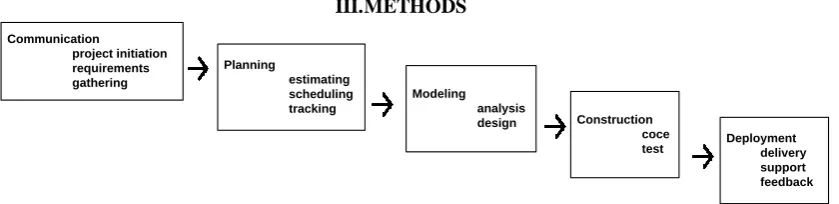
III.METHODS Communication project initiation requirements gathering Planning estimating scheduling tracking Modeling analysis design Construction coce
test Deployment delivery support feedback
In Fig. 1 an explanation of the steps taken in the Waterfall Model[9]:
1. Communication: The initial stage requires communication with the user to achieve the goal to be achieved. The result of such communication is the initialization of the project, such as analyzing problems encountered and gathering the necessary data, and helps determine the features and functions of the software. Additional data collection can be taken from journals, articles, and the internet. 2. Planning: After the communication, then set the plan describes the software workmanship that includes
the technical tasks to be done, the risks that can occur, the resources required in the system creation, product work to be generated, scheduling work to be done, and tracking system work processes. 3. Modelling: This modelling stage is a design stage in software that focuses on designing data structures,
software architectures, interface views, and programming algorithms. The goal is to know what to do. 4. Construction: At this stage described the process of translation in the form of design into a code or
language that can be read by the machine. After the encoding results are complete, testing is required from pre-made systems and codes. Aim to find any errors that may occur for later repair.
5. Deployment: Stages of deployment are the stages of software implementation to the user, regular software maintenance, software upgrades, software evaluation, and software development based on the feedback provided so that the system can continue to run and evolve according to its function
IV.RESULTANDDISCUSSIONS
A. System Requirement Analysis
In this stage, I do some things that are needed in the analysis phase, namely the Feasibility Study and determines the business process of the UMKM
1. Feasibility Study
The analysis that will be carried out is analyzing the procedure or method of work for each data needed as well as data generated from the existing system in UMKM. Problem identification is the first step taken in the system analysis phase. Problems that exist in UMKM are: a. Difficulty in finding UMKM which are in a certain area, b. UMKM find it difficult to market their products more widely, c. The existing UMKM data collection is still done manually
2. Problems Identification
In this study developed a directory system of UMKM to help market products from several UMKM that are in an area. Then it is necessary to identify the users involved in the MSME marketing and data collection process, the information processes that are available, the data needed. Here are some issues that need to be known: a. Knowing system development policies, b. Knowing the actors involved in the product catalog process, business profile, product data, c. The process of finding UMKM according to the appropriate categories, d. Data relating to product catalogs, business profiles, business categories, e. User of information on local UMKM directory, f. The marketing process of UMKM businesses registered is still manual so that they cannot reach interested ones from outside the city
3. Data Requirement Identification
Based on the discussion of the identification of problems and information of the data needed, the proposal for business process of the local UMKM directory is like the diagram below:
UMKM Owner System Admin
Login
Username not found
Entry UMKM Data Registry
Username Found
UMKM Data verification
Data view on Category
Local User for UMKM Search
Search for UMKM on Home Page
Search Category Option
Get Map Location
Fig 2. Propose business process
when they search. Second is the local user for UMKM search can search for UMKM data on the home page then choose the search category option. Then system will show the map location.
4. User Identification
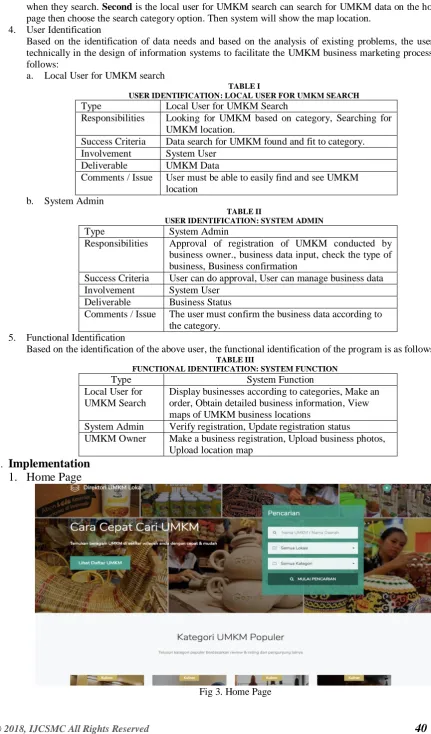
Based on the identification of data needs and based on the analysis of existing problems, the user is technically in the design of information systems to facilitate the UMKM business marketing process as follows:
a. Local User for UMKM search
TABLE I
USER IDENTIFICATION: LOCAL USER FOR UMKM SEARCH
Type Local User for UMKM Search
Responsibilities Looking for UMKM based on category, Searching for UMKM location.
Success Criteria Data search for UMKM found and fit to category. Involvement System User
Deliverable UMKM Data
Comments / Issue User must be able to easily find and see UMKM location
b. System Admin
TABLE II
USER IDENTIFICATION: SYSTEM ADMIN
Type System Admin
Responsibilities Approval of registration of UMKM conducted by business owner., business data input, check the type of business, Business confirmation
Success Criteria User can do approval, User can manage business data Involvement System User
Deliverable Business Status
Comments / Issue The user must confirm the business data according to the category.
5. Functional Identification
Based on the identification of the above user, the functional identification of the program is as follows:
TABLE III
FUNCTIONAL IDENTIFICATION: SYSTEM FUNCTION
Type System Function
Local User for UMKM Search
Display businesses according to categories, Make an order, Obtain detailed business information, View maps of UMKM business locations
System Admin Verify registration, Update registration status
UMKM Owner Make a business registration, Upload business photos, Upload location map
B.
Implementation
1.
Home Page
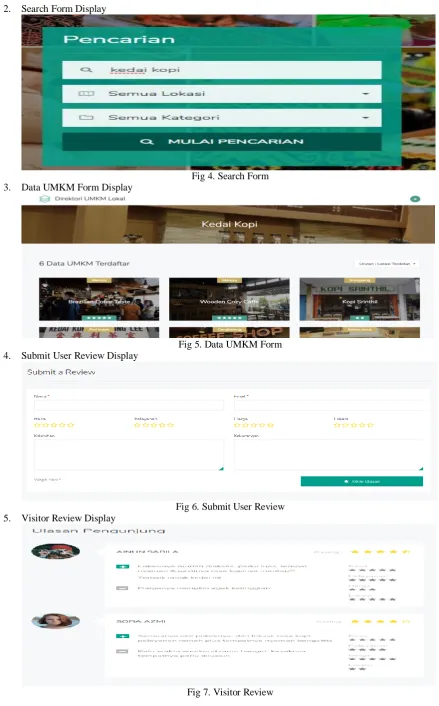
2. Search Form Display
Fig 4. Search Form 3. Data UMKM Form Display
Fig 5. Data UMKM Form 4. Submit User Review Display
Fig 6. Submit User Review 5. Visitor Review Display
6. User Rating Display
Fig 8. User Rating
V. CONCLUTIONS
Based on the results obtained in this study, it can be concluded as follows:
A. E-Commerce that is built can help the store in promoting its products and make it easier for consumers from outside the city to know the information of each product offered to consumers without having to go to the store.
B. The e-Commerce built can facilitate the marketing of products sold in Jihan Baby Shop to consumers who are outside the city.
C. E-Commerce built can make it easier for shop owners to manage sales reports.
ACKNOWLEDGEMENT
By this acknowledgment, I express our sincere gratitude to all those people who have been associated with this paper directly or indirectly. I sincerely thank respected guide Mr. Rahmat Oktavian dan Mrs. Nia Rahma, who has guided me and cooperated with me at different stages during the preparation of this paper. I bid my thank you for Universitas Mercu Buana whom had support me to conduct and finance the research.
REFERENCES
[1] Yaya Sudarya Triana, Indah Syahputri, Implementation Floyd-Warshall Algorithm for the Shortest Path of Garage, Vol 3, Issue 2, February 2018.
[2] Jacob, Introduction to Information Systems, Yogyakarta: Graha Ilmu, Indonesia, 2010.
[3] Riyanto, Pengembangan Aplikasi Sistem Informasi Geografis Berbasis Desktop dan Web, Jakarta: Gava Media, Indonesia, 2009.
[4] Budiyanto, Eko, Sistem Informasi Geografis Menggunakan ARC VIEW GIS. Yogyakarta: Andi, Indonesia, 2005.
[5] Moedjiono, Nia Rahma Kurnianda , Aries Kusdaryono, Decision Support Model for User Submission Approval Energy Partners Candidate Using Profile Matching Method and Analytical Hierarchy Process. Scientific Journal of Informatics, Vol. 3 No. 2, Indonesia, 2016.
[6] J. Supranto, Pengukuran Tingkat Kepuasan Pelanggan, Jakarta: Rineka Ipta, Indonesia, 1997.
[7] Pawitra, T, Kepuasan Pelanggan Sebagai Keunggulan Daya Saing: Konsep, Pengukuran dan Implikasi Stratejik. Jurnal Prasetiya Mulya Vol. 1 No. 1, Indonesia, 1993.
[8] Alan Dennis, Barbara Haley Wixom, Roberta M. Roth, System Analysis and Design: An Object-Oriented Approach with UML. 5 Edition, John Wiley & Sons, Inc., United States of America, 2015.