I T S P O W E R
Igor Semaev and Mehdi M. Hassanzadeh
The Selmer Center,
Department of Informatics, University of Bergen
PB 7803, N-5020 Bergen, Norway,
e-mails: [email protected] and
[email protected].
7 July 2011
Abstract.In this paper, statistical testing ofNmultinomial probabilities is studied and a new box-test, calledQuadratic Box-Test, is introduced. The statistics of the new test hasχ2s
limit distribution asN and the number of trialsn tend to infinity, wheresis a parameter. The well-known empty-box test is a particular case fors=1. The proposal is quite differ-ent from Pearson’s goodness-of-fit test, which requires fixed
Nwhile the number of trials is growing, and linear box-tests. We prove that under some conditions on tested distribution the new test’s power tends to 1. That defines a wide region of non-uniform multinomial probabilities distinguishable from the uniform. For moderateNan efficient algorithm to compute the exact values of the first kind error probability is devised.
1 I
N T R O D U C T I O NThe security of most cryptographic systems depends upon a random se-quence. For example, the secret key in block ciphers and stream ciphers, the primes p,qin RSA encryption and digital signature schemes, the nonce in most authentication protocols. As "a true random sequence" is a theoretical abstraction, its producing is not possible. Therefore a
pseudorandom sequence, often generated by a deterministic algorithm, is used in cryptography instead. Ideally, it should be indistinguishable from a true random sequence within available computer power. Various statistical tests can be applied to check this.
In this paper, a new statistical test, namedQuadratic Box-Test, is pre-sented. It can be used for randomness evaluation and distinguishing attacks in cryptography. The main idea of our approach is to compare the distribution of repeated patterns in the tested data with a true random data. In Section 2, a theoretical background and related work are presented. In Section 3 the new test is introduced and in Section 4, which is the main part of our contribution, we will prove that its power tends to 1 when Ntends to infinity. The first kind error probability of the test for low and moderate Nis computed in Section 5, where a relatively efficient algorithm is devised. In Section 6, an application to functions with finite number of outputs is discussed. We will conclude in Section 7.
2 T
H E O R E T I C A LB
A C K G R O U N D O FB
O X- T
E S TThe problem of computing the box-test is related to the classical shot problem. Letnparticles be allocated intoNboxes, where thek-th box appears with the probabilityak anda= (a1, . . . ,aN). Letµr(a)denote
the number of boxes with exactlyrparticles. In Theorem 2.1.1 of [6] it was proved that in casea=h, whereh= (N1, . . . ,N1), we have:
Eµr(h) =N pr+O(1),
Cov(µr(h),µt(h)) =Nσrt+O(1),
whereα= Nn,pr= α
r
r!e
−α, andσ
rtare entries of the limit covariance
matrixB. They are defined by
σrr = pr(1−pr−pr
(α−r)2
α ), (1)
σrt = −prpt(1+
(α−r)(α−t)
Generally, for the box probabilitiesa= (a1, . . . ,aN)we have:
prk =
(αNak)r
r! e
−αNak, pr(a) = 1 N
N
∑
k=1
prk,
σrr(a) = 1
N
N
∑
k=1
prk−
1
N
N
∑
k=1
p2rk−1
α " 1 N N
∑
k=1
prk(αNak−r)
#2
,(2)
σrt(a) = − 1
N
N
∑
k=1
prkptk
− 1 α " 1 N N
∑
k=1
prk(αNak−r)
# "
1
N
N
∑
k=1
ptk(αNak−t)
#
.
whereσrt(a)are entries of a matrixA. Theorem 3.1.5 in [6] states that
ifNtends to infinity andNak ≤Cfor a constantC, andα0≤α≤α1, then
Eµr(a) = N pr(a) +O(1),
Cov(µr(a),µt(a)) = Nσrt(a) +O(1).
Additionally, according to the Theorem 3.5.2 in [6], under the same conditions the multivariate random variable
ν(a) =
µr1(a)−Eµr1(a)
√
N , . . . ,
µrs(a)√−Eµrs(a) N
asymptotically has multivariate normal distribution as Nandntend to infinity. We assume those conditions fulfilled throughout this article. The asymptotical normality ofν(a)may be used to check whether a multinomial sample was produced with prescribed box probabilities for large enoughN. We are going to test the hypothesisa=h.
Any such test is naturally to call abox-test. For instance, a test based on the distribution of µ0√−Eµ0
N is calledempty box-testand was introduced by
David in [3]. It may have some advantage over Pearson’sχ2 goodness-of-fit test, which requiresα= Nn →∞to approach limit distribution; see [5, 8].
2 . 1 LI N E A R BO X- TE S T
constant vector of lengths. Linear box-test statistic has asymptotically normal distribution too. The random vector
µr1(a)√−N pr1(a)
N , . . . ,
µrs(a)−√N prs(a) N
has the same limit distribution as ν(a)and is denoted with the same character in this section. Similarly, we put
η(a) =
µr1(a)−√N pr1(h)
N , . . . ,
µrs(a)−√N prs(h) N
.
Letc= (c1, . . . ,cs)be any real vector, whose entries do not depend
on N. The random variable νcasymptotically as N tends to infinity has normal distribution with variancecBcand expectation 0, denoted
N(0,√cBc). Let 0 < e < 1 be a required significance level. From
N(0,√cBc)distribution tables one findsDesuch that
Pr(|N(0,√cBc)| ≥De) =e.
An allocation ofn particles into N boxes is observed and statistic η(a)c is computed. If|η(a)c| ≤ De, then the hypothesis a = h is
ac-cepted and otherwise rejected.
Example I:We take the statisticη(a)cto depend only onµ0andµ1 and putc= (1, 1). Letα=1, thenp0=p1=e−1. Therefore,
η(a)c= µ0(a) +µ1(a)−2Ne
−1 √
N
and
B= 1
e2×
e−2 −1
−1 e−1
.
Then cBc = 2ee−25. The distribution of νc = η(h)c becomes close to
N(0,q2ee−25) as N grows. We put, for instance,e = 0.1 and find the quantileDe=0.3998.
Letn=N=20 and the observed sequences of outcomes(boxes) is
19, 18, 5, 6, 17, 20, 14, 17, 3, 16, 20, 6, 3, 15, 7, 8, 7, 12, 14, 5. (3)
more than twice. So η(a)c = −0.3835 and as |η(a)c| ≤ 0.3998 the hypothesis "multinomial distribution is uniform" is accepted with the first kind error probability at most 10%(in fact, the real value of the error probability is something different asNis fairly small here).
3 Q
U A D R AT I CB
O X- T
E S TIn this section, our statistical test, calledQuadratic Box-Test, is defined. It will be proved in Section 4 that under conditionN32∑N
k=1(ak−N1)2→∞
for non-uniform distributiona, the power of quadratic box-test tends to 1 when the number of possible patterns,N, tends to infinity. That defines a set of non-uniform distributionsadistinguishable by this test with probability tending to 1.
The test was found during a study on cryptographic hash-functions. A good hash-function should have values indistinguishable from those produced with multinomial uniform probabilities. Hash-function values are naturally to consider as allocations into boxes labeled with its different values. According to NIST requirements, the total number of a hash function different values may be as big as 2512[7]. Therefore, in order to apply a box-test the values are split into Nregions of equal probability.
Suppose that an allocation ofn particles intoN boxes is observed and only the valuesµr1, . . . ,µrs are computed. Let again
η(a) =
µr1(a)√−N pr1(h)
N , . . . ,
µrs(a)√−N prs(h) N
,
whereais the tested box distribution. The statistic of quadratic box-test is the quadratic formηB−1ηwhereBis the limit covariance matrix for ν=ν(h)with entriesσrtdefined by (1).
Standard argument ([5], Section 15.10) shows thatνB−1νhas asymp-totically χ2s-distribution as N tends to infinity. From χ2s-distribution tables one finds Cε such that Pr(χ2s ≥ Cε) = ε, whereεis the
signif-icance level probability. If ηB−1η ≤Ce, then the hypothesisa = h is
accepted, otherwise rejected. Whens=1 andr1=0 the quadratic test is equivalent to the empty-box test.
Fora=hwe haveηB−1η=νB−1ν. By the limit Theorem, the test’s first kind error probabilityPr(νB−1ν≥Cε)→εasN→∞. In Section
that the convergence rate depends onri and may be slow. Therefore, a
test only based on the limit probability might not be reliable for such
N.
Example II:We want the statisticηB−1ηto depend only onµ0and µ1. Letα=1 as Example I. One computes
B−1= e
2
e2−3e+1×
e−1 1
1 e−2
and
η(a) =
µ0(a)√−Ne−1
N ,
µ1(a)√−Ne−1
N
.
Therefore,
ηB−1η = e 2N−1
(e2−3e+1) ×
µ0−Ne−1 µ1−Ne−1
t
e−1 1
1 e−2
µ0−Ne−1 µ1−Ne−1
. (4)
AsNgrows, the distribution ofηB−1ηbecomes close toχ22fora=h. We pute=0.1 and findCe =4.6051. For the outcomes (3), wheren=N,
µ0 =7 andµ1=6, we computeηB−1η=3.9664<Ce. Therefore the
hypothesis "multinomial distribution is uniform" is accepted with the first kind error probability at most 10%. With the method described in Section 5 we compute that the real error probability is about 8%.
4 P
O W E R O F T H EQ
U A D R AT I CB
O X- T
E S TIn this section, we prove that our test is consistent whennandNtends to infinity for some non-uniforma. The second kind error probability is the probability to accepta=h, whereas this is wrong. It is defined by β(a) =Pr(ηB−1η≤Ce). We will proveβ(a)tends to zero for thosea,
or, in other words, the test’s powerWn,N(a)tends to 1 if(n,N)−→∞,
asWn,N(a) =1−β(a).
uniform, then the expectation ofηB−1ηtends to infinity. Then we will prove thatWn,N(a)→1 when(n,N)→∞. Let
δ=
Eµr1(a)√−Eµr1(h)
N , . . . ,
Eµrs(a)√−Eµrs(h) N
(5)
so thatη(a) =ν(a) +δ.
Theorem 1. E(ηB−1η)→∞if and only if|δ| →∞.
Proof. We writeη=ν+δ. Therefore,
E(ηB−1η) =E(νB−1ν) +2E(δB−1ν) +δB−1δ,
whereE(δB−1ν) =δB−1E(ν) =0. ThenνB−1ν≥0 asB−1is positive definite. So ifδB−1δtends to infinity, thenE(ηB−1η)tends to infinity. The former is true if and only if|δ| →∞.
We can writeE(νB−1ν)≤cE(|ν|2), wherecis a constant dependent onB. The latter is bounded by the maximal of
E
µrk(a)√−Eµrk(a) N
2
= Cov(µrk(a),µrk(a))
N (6)
times a positive constant defined byB. With (2), the value (6) is bounded in caseNak ≤Candα0≤α≤α1. So asNtends to infinityE(νB−1ν) is bounded too. Therefore,E(ηB−1η)→∞if and only ifδB−1δ→∞. That proves the Theorem.
We sayNak→1 if for anyτ>0 there existsNτsuch that|Nak−1|<
τfor allN> Nτandk=1, . . . ,N.
Theorem 2. Assume Nak → 1 for each k as N tends to infinity. Then
|δ|=o(
√
N). If additionally(α−ri)2=6 rifor some i, then|δ| →∞if and
only if N32 ∑N
k=1(ak−N1)2→∞.
That defines the area ofa, where Theorem 4 is valid. For instance,
ak= N1 +Nγ5/4k , whereγktends to infinity such thatγk=o(N1/4). We now study conditions for|δ| →∞. Consider two events:
Eµr(a)√−Eµr(h)
N
→∞, (7)
N32
N
∑
k=1
whereak= N1 +bk. Theorem 3 implies that if(α−ri)26=rifor somei,
then|δ| →∞if and only if (8).
Theorem 3. Let Nak→1for each k as N tends to infinity.
1. (7)is o(√N),
2. If (7)is hold, then(8)is correct,
3. Assume(α−r)26=r, then(7)is hold if and only if (8)is hold.
Proof. Nak → 1 if and only if xk = Nbk → 0. We put f(x) = (1+
x)re−αxand with (2) compute
Eµr(a)√−Eµr(h)
N =
αre−α
r!√N
N
∑
k=1
(f(xk)−f(0) ) +O(
1
√
N)
= α
re−α
r!√N
N
∑
k=1
(r−α)xk+f00(θkxk)
x2
k
2
!
+O(√1
N)
= α
re−α
r!√N
N
∑
k=1
f00(θkxk)
x2
k
2 +O( 1
√
N)
where 0≤θk≤1 and because∑kN=1xk =0. There exist two constants
c1andc2such thatc1≤ f00(x)≤c2for all small enoughx. Therefore, αre−αc1
2r! N 3 2
N
∑
k=1
b2k
!
≤ Eµr(a)√−Eµr(h)
N +O(
1
√
N)
≤ α
re−αc
2 2r! N
3 2
N
∑
k=1
bk2
!
(9)
That implies the first and second statements. We compute f00(0) = (α−r)2−r. If(α−r)26=r, thenc1andc2may be taken both positive or both negative. That implies the last statement.
Theorem 4. Let|δ| →∞as N tends to infinity, thenβ(a) =O(|δ|−2)→0,
therefore Wn,N(a)→1.
Proof. First, we estimate the variance ofηB−1ηand then prove the state-ment with the Chebyshev inequality. We use the notation in Theorem 1, whereη(a) =ν(a) +δ, so
ηB−1η=νB−1ν+2δB−1ν+δB−1δ.
Then Var(ηB−1η) = Var(U1+U2), where U1 = νB−1ν and U2 = 2δB−1νasδB−1δis not a random variable. Therefore,
Var(ηB−1η) =Var(U1) +Var(U2) +2Cov(U1,U2).
The variance ofU1=νB−1νis bounded as the coordinates ofν(a)are asymptotically normal with zero means and bounded covariance matrix
Adefined by (2). The latter follows asNak ≤C. Then
Var(U2) =4δB−1AB−1δ=O(|δ|2). We also have
|Cov(U1,U2)| ≤
q
Var(U1)Var(U2) =O(|δ|).
All this impliesVar(ηB−1η) =O(|δ|2). By the Chebyshev inequality, we get
β(a) = Pr
ηB−1η≤Ce
≤ Pr|ηB−1η−E(ηB−1η)| ≥E(ηB−1η)−Ce
≤ Var(ηB
−1η)
(E(ηB−1η)−Ce)2
=O
1
|δ|2
→0
as in Theorem’s conditionE(ηB−1η)≥c|δ|2for a positive constantc; see the proof of Theorem 1. By assumption|δ|tends to infinity andCe
5 F
I R S TK
I N DE
R R O RP
R O B A B I L I T Y F O RL
O WN
In this section, the first error probability for low N is studied. For enough largeN, this type of error tends toεwhich is the significance level, but for lowNit is different and calculated in this section. In case ofa=hfor low and moderateN, the statisticQs =ηB−1η=νB−1νis a function ofµ= (µr1, . . . ,µrs).
The goal is to compute Pr(Qs ≥ Cε), where Cε is the χ2s-quantile
of level ε. This is the first error probability of test. The probability
Pr(Q1(µ0) ≥ Cε) is computed with a simplified method, where the
valuesPr(µ0=k)are found by the recurrent relation (5) in Chapter 1 of [6]. As above we denote
ν=
µr1(h)√−N pr1
N , . . . ,
µrs(h)√−N prs N
.
ForC=Cε we are to compute the probability
Pr(Qs ≤Cε) =Pr
νB−1ν≤C
=
∑
K
Pr(µ=K). (10)
Over all integers-vectorsKwith zero or positive entries such that
(K√−N p
N )B
−1(K√−N p
N )≤C,
wherep= (pr1, . . . ,prs). Letµ(n,N) = (µr1(n,N), . . . ,µrs(n,N)), then by formula (35) in Chapter 2 of [6],
Pr[µ(n,N) =K] = Pr[µ(n−(k,r),N−k) =0]×
× N
[k]n[(k,r)] ∏s
i=1ki!(ri!)ki
× (1−
k N)n−(k,r)
N(k,r) , (11)
wherek=k1+. . .+ks,x[k]=x(x−1). . .(x−k+1)and(k,r) =k1r1+ . . .+ksrs. The probabilityPr[µ(n−(k,r),N−k) =0]is computed with the recurrent relation:
Pr[µ(n,N) =0] = Pr[µ(n−t,N−1) =0]×
× Pr[µ(t, 1) =0]×
n
∑
t=0
n
t
(N−1)n−t
Nn , (12)
where the initial values are
Pr[µ(n, 1) =0)] =0, n∈ {r1, . . . ,rs},
Sometimes it is better to use a more general recurrence. Let 1≤N1<N, then
Pr[µ(n,N) =0] =
n
∑
t=0
n t
N1
N
t
1− N1
N
n−t
× Pr[µ(t,N1) =0]×Pr[µ(n−t,N−N1) =0]. Cauchy-Schwarz inequality impliesxB−1x≥b−1
jj |xj|2, whereB= (bij).
From the inequalityxB−1x≤Cwe get
|xj| ≤
q
Cbjj. (13)
Therefore the valueski used in computing by (10) are restricted by
kj−N prj
√
N
≤qC bjj. (14)
and may be searched.
We however explain a better approach now. As B−1 is symmetric positive definite, the decompositionB−1=UUTis possible, whereUis an upper triangular square matrix. Algorithm 1 can be used to compute
Usuch thatV=UUT.
Algorithm 1Compute the upper triangular real matrixUs×s
Input:Real symmetric positive definites×smatrixV
1. Compute
vij←vij−
visvjs
vss , and vis
← √vis
vss,
fori = 1, . . . ,s and j = 1, . . . ,s−1. So that vsj = 0 for j =
1, . . . ,s−1.
2. Firsts−1 rows and firsts−1 columns ofVmake a symmetric positive definite matrix. Puts←s−1 and apply step 1 to that matrix.
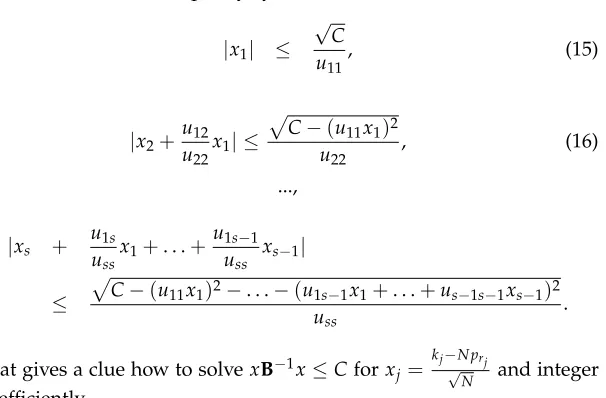
Algorithm 1 is in fact reducing the quadratic formxVx. AfterB−1was decomposed, we getxB−1x= (xU)(xU)T. So the inequalityxB−1x≤C
is equivalent to
(u11x1)2+ (u12x1+u22x2)2+. . .+ (u1sx1+. . .+ussxs)2≤C
and therefore to the inequality system
|x1| ≤ √
C u11
, (15)
|x2+u12
u22x1 | ≤
p
C−(u11x1)2
u22 , (16)
...,
|xs + u1s
ussx1
+. . .+u1s−1 uss xs−1
|
≤
p
C−(u11x1)2−. . .−(u1s−1x1+. . .+us−1s−1xs−1)2
uss .
That gives a clue how to solvexB−1x≤Cforxj= kj−√N prj
N and integer
kj efficiently.
Algorithm 2 efficiently computes the first error probability for low
N. This algorithm is used to calculate the exact value of first error probability in case ofa=hfor low and moderateN. Table 1 is calculated fors=3 andµ= (µ2,µ4,µ5). Tables 2-5 are calculated fors=1, 2, 3, 4 andµ= (µ0, ...,µs−1)respectively. We takeε=0.01 and 0.05. So thatε is the limiting value for the probability asNgrows to infinity. However even for relatively large Nthis is not true.
Table 1: Pr(Q3(µ2,µ4,µ5)≥Cε)
ε,N 24 25 26 27 28 29
Algorithm 2Compute the first kind error probability for lowN
Input:N,eor significant level,sand(r1,r2, ...,rs).
1. Pre-compute probabilitiesPr(µ(n2,N2) = 0) for all n2 ≤ n1 andN2≤N1with (12), which simplifies to
Pr(µ(n,N) = 0)
=
n−sN+s
∑
t=s
n t
(N−1)n−t
Nn Pr(µ(n−t,N−1) =0)
in caseµ= (µ0, . . . ,µs−1). The valuesn1,N1are defined below. 2. To compute with (11), we haven−(k,r)≤n1andN−k≤N1,
where we can put
n1=bn−
s
∑
j=1
rj(N prj−
q
C bjjN)c
and
N1=bN−
s
∑
j=1
(N prj−
q
C bjjN)c
askj =N prj+δj
√
Nand|δj| ≤
q
C bjjby (14).
3. One runs over allK= (k1, . . . ,ks)such that
(K√−N p
N )B
−1(K√−N p
N )≤C. (17)
Sok1 is taken such thatx1 =
k1−√N pr1
N satisfies (15), that iski
belongs to some interval. Upon fixedk1, integer k2 is taken such thatx2=
k2−√N pr2
N satisfies (16), that is from some interval,
and so on. If the interval for kj is empty or exhausted, the
algorithm backtracks and takes anotherkj−1. AnyKproduced is a solution to (17). The search space is further reduced with the restrictions:
k=
s
∑
i=1
ki≤N,
(k,r) =
s
∑
i=1
kiri≤n.
In caseµ = (µ0, . . . ,µs−1)we have additional restrictionn−
Table 2: Pr(Q1(µ0)≥Cε)
ε,N 24 25 26 27 28 29 210
0.05 0.0460 0.0505 0.0440 0.0496 0.0565 0.0472 0.0508 0.01 0.0044 0.0114 0.0155 0.0114 0.0093 0.0107 0.0106
Table 3: Pr(Q2(µ0,µ1)≥Cε)
ε,N 24 25 26 27 28 29 210
0.05 0.0354 0.0450 0.0503 0.0476 0.0493 0.0498 0.0499 0.01 0.0066 0.0069 0.0095 0.0093 0.0094 0.0101 0.0099
Table 4: Pr(Q3(µ0,µ1,µ2)≥Cε)
ε,N 24 25 26 27 28 29 210
0.05 0.0306 0.0373 0.0468 0.0491 0.0489 0.0490 0.0494 0.01 0.0099 0.0138 0.0121 0.0111 0.0106 0.0102 0.0101
Table 5: Pr(Q4(µ0,µ1,µ2,µ3)≥Cε)
ε,N 24 25 26 27 28 29 210
0.05 0.0564 0.0403 0.0621 0.0579 0.0527 0.0515 0.0507 0.01 0.0200 0.0229 0.0178 0.0171 0.0153 0.0134 0.0120
6 S
TAT I S T I C A LA
N A LY S I SLetF be a function withNvalues. For instance,F may be produced from a hash function H, where the output was restricted to log2N
bits. Let x1, . . . ,xn be the sequence of inputs and y1, . . . ,yn be the
sequence of related outputs: yi = F(xi). The function is considered
good if for anyx1, . . . ,xnwithout repetitions the sequencey1, . . . ,yn is
indistinguishable from a multinomial uniform distribution sample. Let a statistical test with significance levelεbe used. For instance, quadratic box-test withε=0.05. In fact one should use exact probabilities from Section 5. Assumemexperiments, where the output wereyi1, . . . ,yin,
i=1, ..,mand they are produced for different input stringsxi1, . . . ,xin.
rejection for one output stringyi1, . . . ,yin. The success probability isε.
One counts the numberSmof strings , where the uniformity hypothesis
was rejected. Letq= Sm
m. Under uniformity condition,Pr(Smm = q)≤
e−2(q−ε)2mby Chernoff’s inequality. Therefore, one says: The uniformity
hypothesis was rejected with error probability at moste−2(q−ε)2m.
Example. Letε = 0.05 and q = 0.07, and m = 100000. Then F is rejected with error probability at most 1.81×10⁻³⁵.
Remark that one can also use the exact value
Pr(Sm=qm) =
m qm
εqm(1−ε)m−qm.
7 C
O N C L U S I O NIn this paper, we propose a new statistical test, calledQuadratic Box-Test, of N multinomial probabilities a. For some non-uniform a the power of the test tends to 1 when the number of trialsnandNtend to infinity. In other words, our test is consistent for large Nand thosea. Also we present an efficient algorithm to compute the exact first error probability and calculate it for low and moderate N. Finally, testing discrete functions is discussed.
R
E F E R E N C E S[1] E. Filiol, "A new statistical testing for symmetric ciphers and hash functions". In V. Varadharajan and Y. Mu, editors, International Conference on Information, Communications and Signal Processing, volume 2119 of Lecture Notes in Computer Science, pages 21-35. Springer-Verlag, 2001.
[2] H. Englund, T. Johansson, and M. S. Turan, "A Framework for Chosen IV Statistical Analysis of Stream Ciphers", In INDOCRYPT 2007. See also Tools for Cryptoanalysis 2007.
[3] F.N. David,Two combinatorial tests whether a sample has come from a given population,Biometrika, vol. 37(1950), 97–110.
[4] S.W. Golomb, “Shift Register Sequences”, Revised Edition, Aegean Park Press, 1982, Chapter 3.
[6] V.F. Kolchin, B.A. Sevast’ynov, V.P. Chistyakov,Random Allocations,
V.H. Winston & Sons, Washington, D.C., 1978.
[7] National Institute of Standards and Technology of the United States;
http://csrc.nist.gov/groups/ST/hash/documents/FR_Notice_ Nov07.pdf