A preliminary version of this paper appeared in:
T. Ristenpart, H. Shacham, and T. Shrimpton. Careful with Composition: Limitations of the Indifferentia-bility Framework. Advances in Cryptology – EUROCRYPT ’11, LNCS vol. 6632, pp. 487–506, Kenneth Paterson ed., Springer, 2011.
Careful with Composition:
Limitations of Indifferentiability and Universal Composability
Thomas Ristenpart∗ Hovav Shacham† Thomas Shrimpton‡
June 22, 2011 Abstract
We exhibit a hash-based storage auditing scheme which is provably secure in the random-oracle model (ROM), but easily broken when one instead uses typical indifferentiable hash constructions. This contradicts the widely accepted belief that the indifferentiability composition theorem applies to any
cryptosystem. We characterize the uncovered limitation of the indifferentiability framework by show-ing that the formalizations used thus far implicitly exclude security notions captured by experiments that have multiple, disjoint adversarial stages. Examples include deterministic public-key encryption (PKE), password-based cryptography, hash function nonmalleability, key-dependent message security, and more. We formalize a stronger notion, reset indifferentiability, that enables an indifferentiability-style composition theorem covering such multi-stage security notions, but then show that practical hash constructions cannot be reset indifferentiable. We discuss how these limitations also affect the universal composability framework. We finish by showing the chosen-distribution attack security (which requires a multi-stage game) of some important public-key encryption schemes built using a hash construction paradigm introduced by Dodis, Ristenpart, and Shrimpton.
1
Introduction
The indifferentiability framework of Maurer, Renner, and Holenstein (MRH) [51] supports modular proofs of security for cryptosystems. It can be viewed, informally, as a special case of the Universal Composition (UC) framework [27, 53], which inspired it. A crucial application of the indifferentiability framework has been to allow proofs in the random oracle model (ROM) [19] to be transferred to other idealized models of computation, where a monolithic random oracle is replaced by a hash function constructed from (say) an ideal compression function. This happens via an elegant composition theorem, the usual interpretation of which is: A proof of security for an arbitrary cryptosystem using functionality F (e.g., a random oracle) continues to hold when the cryptosystem instead uses a second functionalityF0(e.g., a hash function built from an ideal compression function), so long asF0isindifferentiablefromF.
∗
Department of Computer Sciences, University of Wisconsin–Madison, USA. Email: [email protected] URL:
http://pages.cs.wisc.edu/˜rist/
†
Department of Computer Science and Engineering, University of California, San Diego, USA. Email:
[email protected]:http://www.cs.ucsd.edu/˜hovav/
‡
Department of Computer Science, Portland State University, Portland, USA. Email: [email protected] URL:
In this paper, we show that this interpretation is too generous. We uncover an application (in the con-text of secure distributed storage) for which composition fails completely. For this application there is a simple scheme provably secure in the ROM, and yet easily broken when using typical indifferentiable hash constructions. We then begin an exploration of the fall out.
RANDOM ORACLES AND INDIFFERENTIABILITY. Let us give a bit more background on why indifferentia-bility has proved so useful. A wide range of practical, in-use cryptographic schemes enjoy proofs of security in the ROM [19]; for some schemes, ROM proofs are the only ones known. But most in-use hash-function constructions are not suitable for modeling as a RO, even when assuming the primitive underlying the hash function is ideal (e.g., an ideal compression function), because they admit length-extension attacks [56]. These attacks abuse the structure of the iterative modes-of-operation underlying hash functions such as MD5, SHA-1, and SHA-2. And the weakness they expose has led to practical insecurities [36]. Of course, we can build hash functions that resist known length-extension attacks, but it remains unclear whether the resulting functions would also prevent other, unforeseen structure-abusing attacks.
Coron et al. [31] instead suggest an approach to design hash functions that “behave like” random oracles in a provable sense. Specifically, this requires that a hash function will provide security anywhere a random oracle would. The MRH composition theorem seems to give exactly this, takingF = ROandF0 =Hf, the latter being a hash function constructed from an (ideal) primitivef. Thus the needed hash function property is thatHfbe indifferentiable from a RO. Importantly, this approach preserves proofs of security as well: the MRH theorem transports a cryptosystem’s proof of security in the ROM to a proof of security when using an indifferentiable hash function. A number of recent works prove constructions to be indifferentiable from a RO (e.g., [5, 18, 21, 30, 34, 35, 41]), including many candidates for the NIST SHA-3 competition. Given all this, the consensus opinion appears to be that indifferentiability exactly captures “behaving like” a RO, rules out structure-abusing attacks, and that once a cryptosystem is proven in the ROM it is secure using any compatible indifferentiable hash construction. We now describe an application that shows this consensus opinion to be wrong.
HASH-BASED STORAGE AUDITING. In the design of secure distributed systems, the following problem arises: How can parties in a system verify that a storage server is actually storing the files that it should be? A malicious server might tamper arbitrarily with the data entrusted to it; a rational one might discard the file to save space if detection is unlikely. This problem has received much attention since being formalized in 2007 [7, 43]. The particular example we consider in this paper is inspired by a proof-of-storage challenge-response protocol proposed as part of an earlier system, SafeStore [46]. Consider the following protocol. The client sends a random challengeCto the server; the server proves possession of the fileMby computing
Z ← Hash(MkC)using a cryptographic hash functionHashand sendingZ to the client, who performs the same computation using her copy ofMand compares the result to that sent by the server.
Suppose, for simplicity, that both the fileM and the challengeCaredbits long, and consider the case thatHash =Hf, wheref is an ideal compression function outputting strings of lengthn < dbits andH
returns the firstn/2bits off(f(IV, M), C). (IV is a fixed constant string.) This construction was shown indifferentiable from a RO in [31]. Thus, the MRH composition theorem combined with the fact that the protocol is secure in the ROM assuredly proves that the protocol is secure when usingHf. Quite baffling, then, is the observation that the server can cheat! The server simply computes Y ← f(IV, M) when it first getsM, and then deletesM and stores the (shorter)Y. To answer a challengeC, the server computes
Z ←f(Y, C)and returns the first half ofZas its response. The client’s check will succeed even thoughM
is not stored.
Let us pause to take stock of the situation. In Section 4 we prove that the SafeStore-inspired auditing scheme is, indeed, secure in the ROM. The proof of indifferentiability for our Hash = Hf provided by
Coron et al. [31] and the proof of the MRH composition theorem are also both correct. But the server is still somehow able to abuse the structure ofHf. So what is going on here?
CHARACTERIZING THE PROBLEM. The gap is that the MRH theorem does not apply. The problem is subtle. Carefully revisiting the MRH theorem and its proof, we find that (loosely speaking) they only apply when a cryptosystem’s security is measured relative to a security game using a single, stateful adversary. For example, left-or-right indistinguishability [38] for encryption schemes and unforgeability under chosen message attacks [39] each use just a single, stateful adversary. But the security of the challenge-response auditing protocol we just described is fundamentally two-stage. In the first stage, the adversary (the server) receives the messageM, derives fromM some statestthat is smaller than the size ofM, and forgetsM. In a second stage it attempts to answer challenges using just st. This is an example of what we call a multi-stage game, a notion we will make formal.
In prior treatments of indifferentiability, the restriction to single-stage games is implicit in the underlying formalization of cryptosystems and adversaries. This restriction has not been mentioned in the literature, and our sense is that no researchers (until now) realized it. For completeness, we restate the MRH indiffer-entiability composition theorem and give its proof for single-stage games (see Section 3). We note that the same implicit limitations exist in the Universal Composability (UC) framework [27, 53]. While it has previ-ously been observed in the context of collusion-free protocols [3, 4, 44] that UC does not cater to multiple, disjoint adversaries, we are the first to observe the broad implications of this restriction. We discuss UC in more detail in Section 7.
REPERCUSSIONS. We do not necessarily expect that practitioners would (or have) deployed the hash-based auditing scheme above. One can simply useHf(CkM)to achieve (provable) security, and in fact this is the actual protocol used in SafeStore [46]. But the flaw this example uncovers is that the common interpretation of composition might actuallyencourageuse of an insecure auditing mechanism. This is exactly the opposite of how provable security should guide protocol design.
All of this casts doubt on the security of any scheme relative to a multi-stage game. The scheme may well have provable security in the ROM, but this does not imply the inexistence of dangerous structure-abusing attacks, even when using indifferentiable hash constructions. And unfortunately the use of multi-stage games is widespread. The recent security notions for deterministic [10, 14, 24], hedged [11], and efficiently searchable [10] public-key encryption (PKE) are all multi-stage. Key-dependent message security [22] is multi-stage. Related-key attack security [16] when one allows ideal-primitive-dependent related key func-tions [2] is multi-stage. When formalizing password-based cryptography (e.g. [17, 57]) to allow arbitrary, hash-dependent password sampling algorithms, one uses multi-stage games. A recently proposed hash func-tion nonmalleability security nofunc-tion [23] is multi-stage. Interestingly, this is the only nofunc-tion (we are aware of) that formalizes security against length-extension attacks, and so although we expect them to, we do not haveproof that current indifferentiable hash constructions resist length-extension attacks.
STORAGE-AUGMENTED PRIMITIVES. So, we cannot generically use composition to modularly argue secu-rity in the context of multi-stage games. But it could be that indifferentiability remains a sufficient property to establish security in settings beyond hash-based challenge-response auditing. One might hope to prove, without relying on the MRH composition theorem, that a ROM proof of (say) a deterministic PKE scheme holds still when using any indifferentiable hash construction. This seems reasonable since for the applica-tions just listed, online computability of the hash function does not obviously compromise security.
We note that this does leave open the possibility for general results showing that indifferentiability for a certain restricted class of underlying primitivesf is sufficient for security in some multi-stage settings. We leave finding such general positive results as an important open question.
RESET INDIFFERENTIABILITY. We present a new notion, reset indifferentiability, that does admit a com-position theorem covering both single-stage and multi-stage games. In the indifferentiability framework, functionalities have both an honest and an adversarial interface, e.g. F.hon, F.adv and F0.hon, F0.adv. FunctionalityF0 is indifferentiable fromF if there exists a simulator S such that no distinguisher can de-termine when it has access to oraclesF.honandF.advor toF0.honandSF0.adv
. Reset indifferentiability asks that no distinguisher can differentiate those two sets of oracles, but when the distinguisher can reset the simulator to its initial state at arbitrary times. Randomized simulators use freshly-chosen coins after each reset.
The inability to distinguish when resets are allowed enables proving a composition theorem for multi-stage games because the resets allow one to restart the simulator for each multi-stage. We show that establishing (regular) indifferentiability via a stateless simulator immediately yields a proof of reset indifferentiability. However, this is of limited applicability since most indifferentiability results, including all those known for hash constructions, are not stateless. Moreover, our results thus far already rule out typical hash construc-tions from being reset indifferentiable since they have online computability. Still, that leaves open if other constructions perform better.
We show that no practical domain extension transforms can be reset indifferentiable from a RO. The result is quite general, ruling out all known single-pass constructions. We leave open the problem of proving the existence (or inexistence) of a domain extender, even an impractical one (i.e., one that makes two or more passes over the message), that is reset indifferentiable.
DIRECT PROOFS. Having lost composition as a general way to transport ROM proofs of security for multi-stage games to the setting where one uses a hash constructed from an ideal primitive, we take up con-sideration of a specific security goal from public-key encryption. We prove a theorem establishing the chosen-distribution attack (CDA) security for a number of related, ROM-secure, PKE schemes when these are used with any indifferentiable hash function built according to a design paradigm introduced by Dodis, Ristenpart and Shrimpton [35]. The CDA security notion [11] captures message privacy of a PKE scheme when messages and randomness are (jointly) unpredictable, but otherwise adversarially controlled. In par-ticular, this notion is the goal in the context of deterministic PKE [10, 14, 24], hedged PKE (which provides message privacy even in the face of poor randomness) [11, 55], and efficiently searchable encryption (an extension of deterministic PKE) [10]. As expected, this direct proof of security is complex because we have to work directly in the model of the ideal primitive underlying the hash function. This case study shows that direct security results are possible, restoring confidence that in some multi-stage settings security holds with proposed indifferentiable hash constructions.
FURTHER ISSUES WITH COMPOSITION. We have focused on hash functions and the ROM, but the limi-tation of composition to single-stage games affects any use of indifferentiability. Moreover, the limilimi-tations extend to other composition frameworks such as universal composability (UC) [27], which have mechanics similar to indifferentiability. We discuss UC in Section 7.
Finally, in the course of understanding the hash-based auditing counter-example, we uncovered other potentially subtle ways in which composition may fail to help one establish security. We catalogue these issues in Section 8.
2
Preliminaries
NOTATION. WhenX is a non-empty finite set, we writex←$X to mean that a value is sampled uniformly
at random fromX and assigned tox. We overload this notation to extend to probabilistic algorithms, so thatx←$Ameans thatxis assigned a value according to the distribution induced by algorithmA. (More
intuitively,Ais run andxis assigned its output.) WhenXandY are strings, we writeXkY to mean the string created by appending Y toX. When n > 0 is an integer we write{0,1}n for the set of alln-bit
strings, and({0,1}n)+for the set of all stringsM such that|M|is a positive multiple ofn.
A CODE-BASED GAMES FRAMEWORK. We formalize a version of the code-based games framework of Bellare and Rogaway [20] for representing security experiments, indifferentiability, and the like. We find code-based games useful for formalizing security definitions, in particular, because they allow us to specify execution semantics (i.e. what runs what, and in what order). We use procedures, variables, and typical pro-gramming statements (operators, loops, procedure calls, etc.). Types are understood from context, and the names of syntactic objects must be distinct (e.g., a variable and procedure cannot have the same name). Vari-ables are implicitly set initially to default values, i.e. integer variVari-ables are set to 0, arrays are everywhere⊥, etc.
Aprocedureis a sequence of statements together with zero or more inputs (variables) and zero or more outputs (variables). Anunspecified procedureis one whose pseudocode, inputs, and outputs are understood from context. An adversary is an example of an unspecifired procedure. Calling a procedure P means providing it with inputs and running its sequence of statements. During its execution P may itself call other procedures. Say that the code ofP expects to be able to callk distinct procedures. We will write
PQ1,Q2,...,Qk to denote that these calls are handled byQ
1, Q2, . . . , Qkand implicitly assume (for alli∈[k])
that there are no syntactic mismatches between the calls thatP makes toQiand the inputs ofQi, as well as
between the return values ofQi and the return values expected byP. We stress thatP does not callQi by
name, but rather calls to a procedure that is instantiated byQi.
We assume that all procedures eventually halt, returning their outputs, at which point execution returns to the calling procedure. ProceduresP1 andP2 are said toexport the same interfaceif their inputs and
outputs agree in number and type. This will typically be clear from context.
Variables are by default local, meaning they can only be used within a single procedure. The variables used within a procedure maintain their state between calls. Acollection of proceduresis a set of one or more procedures that may instead share their variables. We denote a collection of procedures by using a common prefix ending with a period, e.g.(P.x, P.y, . . .)and we use the common prefixP to refer to the collection. We will sometimes refer to the unique suffixes, e.g.x, y, as interfaces ofP.
Amain procedureis a distinguished procedure that takes no inputs and has some output. We mark it by main. No procedure may callmain, andmaincan access all variables of other specified procedures. (But not other unspecified procedures.)
FUNCTIONALITIES AND GAMES. Collections of procedures will sometimes implement particular abstract functionalities, for example that of some idealized primitive (e.g. a random oracle). A functionality is a collectionF = (F.hon, F.adv); the names of these interfaces,honandadv are suggestive as we will see in a moment. When games and adversaries are given access to a functionality a model of computation is induced, for example when the functionality is that of a random oracle, we have the random-oracle model. Thus one can think of functionalities and models somewhat interchangeably. For this work we specifically designate two models. FirstRO= (RO.hon,RO.adv), shown on the left-hand side of Figure 1, implements a random oracle (with two interfaces) and will give rise to the random-oracle model. Second, let P = (P.hon, P.adv) implement some (ideal) primitive that underlies some understood construction H. Then IP = (IP.hon,IP.adv) shown on the right-side of Figure 1 gives rise to an (ideal) primitive model. For notational compactness, each time we useIPwe will specify a constructionHand a primitiveP and assume these are the ones referred to in Figure 1.
procedureRO.hon(x): IfT[x]6=⊥then
T[x]←${0,1}r
RetT[x]
procedureRO.adv(x):
RetRO.hon(x) procedureIP.hon(x):
RetHP.hon(x)
procedureIP.adv(x): RetP.adv(x)
Figure 1:Procedures implementing the functionality of the random oracle model (ROM)(left)and the ideal primitive model (IPM)(right). The numberris set as appropriate for a given context.
allows querying(F1.hon, F2.hon)and a procedure that gives access to(F1.adv, F2.adv).
AgameGconsists of a single main procedure, denoted “mainG”, together with a set of zero or more other specified procedures. (See for example Figure 2.) A game can make use of a functionality F and a number of adversarial proceduresA1, . . . ,Am together referred to as theadversary. We denote this by
GF,A1,...,Am. For anyF
1,A1, . . . ,Am andF10,A01, . . . ,A0m such that F1.hon, F2.honare interface
com-patible andAi,A0i are interface compatible for1 ≤ i ≤ m, we can write GF1,A1,...,Am to mean running
game G with one set of external procedures and GF2,A01,...,A0m to mean running the same game but now
with the second set of external procedures. Running a gameGF,A1,...,Ammeans executing the sequence of
statements of the game’smain procedure and the output ofGis the value returned bymain. We denote byGF,A1,...,Am ⇒y the event that the game’s output isy, taken over the probability space defined by the
coins used to executeGand the coins used in each invocation of the proceduresF.hon, F.adv,A1, . . . ,Am.
ShouldGand the adversary not useF.hon, F.advthen we instead writeGA1,...,Am⇒y. As examples, games
that do not use a functionalityFare given in Figure 2 while games that do are given in Figures 3 and 5. For any fixed functionalityF and adversaryA1, . . . ,Am, two gamesGandHareequivalentif
PrGF,A1,...,Am⇒y= PrHF,A1,...,Am⇒y
for all valuesy.
RESOURCES. For simplicity, we fix the convention that each statement of a procedure runs in unit time. The running time of a procedure, then, is the maximum number of statements executed, where the maximum is taken over all possible inputs and over all coins used by the procedure. The number of queries of a procedure is the maximum number of procedure calls it makes in one execution, again with the maximum taken over all possible inputs and all possible coins used by the procedure.
ENTROPY MEASURES. The min-entropy of a random variableX isH∞(X) =−log (maxxPr [X =x])
measures the unpredictability ofX, and2−H∞(X) is an upperbound on the probability that any adversary can guess the value of X. When X and Y are two (possibly correlated) random variables the average min-entropyof Dodis et al. [33]
˜
H∞(X |Y) =−log X y
max
x Pr [X=x|Y =y]
Pr [Y =y]
!
correspondingly measures the unpredictability ofXgiven knowledge ofY, and2−H˜∞(X|Y)upper bounds the chance that computationally unbounded adversary can guess X after Y is revealed to it. Lemma 2.2 from [33], which relates average min-entropy and min-entropy, is particularly useful for our work.
Lemma 2.1 (Lemma 2.2 [33]) IfY can take on2rpossible values, thenH˜∞(X|Y)≥H∞(X)−r.
3
Indifferentiability and Composition for Single-stage Games
mainReal
b0←$DFunc,Prim
Retb0
procedureFunc(m): RetF1.hon(m)
procedurePrim(u): RetF1.adv(u)
mainIdealS
b0←$DFunc,Prim
Retb0
procedureFunc(m): RetF2.hon(m)
procedurePrim(u): RetSF2.adv(u)
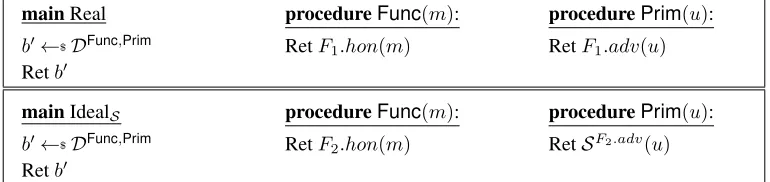
Figure 2: The games that define indifferentiability. AdversaryDand functionalitiesF1, F2are unspecified.
The simulatorS is a parameter of the game.
as syntactic conditions on the class of games considered. In addition to defining indifferentiability, we will provide a concrete version of the composition theorem given in [51] and characterize its limitations. INDIFFERENTIABILITY. Fix two functionalitiesF1 andF2. When thinking of indifferentiability from
ran-dom oracles, for example, we useF1 =IP(for some understoodH, P) andF2 =RO. A distinguisherDis
an adversary that outputs a bit. A simulator is a procedure, usually denotedS. Figure 2 defines two games Real and Ideal. Fix some valuey(e.g.,y= 1). The indifferentiability advantage ofDis defined as
AdvindiffF1,F2,S(D) = Pr
RealF1,D ⇒y
−PrhIdealF2,D
S ⇒y
i
.
We use a concrete security approach, i.e. not providing a strict definition of achieving indifferentiability. However, informally we will say that a functionalityF1is indifferentiable from a functionalityF2if for any
“reasonable” adversaryDthere exists an “efficient” simulatorSsuch thatAdvindiffF1,F2,S(D)is “small”. The meanings of “reasonable”, “efficient”, and “small” will be clear from context.
To get an asymptotic notion, we can assume an implicit security parameterkthroughout, and then use the definition of [31]:F1is indifferentiable fromF2if there exists a PT simulatorSsuch that for any PTDit
is the case thatAdvindiffF1,F2,S(D)is negligible in the security parameter. Note that in [51] a different quantifier ordering was used. It said that for all PTDthere must exist a PT simulatorSsuch thatAdvindiffF1,F2,S(D)is negligible in the security parameter. We refer to the [51] notion as weak indifferentiability and to the [31] notion as strong indifferentiability. We will focus on strong indifferentiability here since it implies weak. TYPES OF GAMES. Before giving the composition theorem from [51] we first give definitions for various restrictions on games. LetG be the set of all gamesG, i.e. any that fits our definitions from the previous section. Then a gameGisfunctionality respectingif the game’s main and specified procedures do not call
F.adv. This means in particular that only adversarial procedure(s) may callF.adv. LetLG⊂ G be the set of all functionality respecting gamesG.
We go on to partitionLGinto two parts. The first is all gamesG∈ LGthat use only a single adversarial procedure. We call these single stage games. Let SG ⊂ LG be the set of all single stage games that are functionality respecting. The second part is all other games in LG, meaning ones that usem ≥ 2
adversarial procedures. LetMG ⊂ LGbe the set of allmulti-stage gamesthat are functionality respecting. ThenLG=SG ∪ MG.
The setSG includes the games defining indifferentiability above, the classic notions of encryption se-curity such as IND-CPA [38] (see Figure 8) or IND-CCA [52], unforgeability under chosen message attack UF-CMA [39], and many others. The setMGincludes the games defining chosen distribution attack secu-rity for public-key encryption [11] (see Figure 5), non-malleability of hash functions [23], password-based key exchange [17], key-dependent message security [22], related-key attack security [2, 16], and others.
that anm-stage gameGisstage minimalif it is not equivalent to any gameHwith less thanmadversarial procedures.
COMPOSITION. One goal of indifferentiability is to allow the security analysis of a cryptographic scheme when using one functionality to imply security holds when using another. This is enabled by the following, which is a concrete security version of the original composition theorem of Maurer, Renner, and Holen-stein [51].
Theorem 3.1 LetG ∈ SG. LetF1, F2 be two functionalities with compatible honest interfaces. LetAbe
an adversary with one oracle. LetS be a simulator that exports the same interface asF1.adv. Then there
exist adversaryBand distinguisherDsuch that for all valuesy
PrGF1,A ⇒y≤PrGF2,B ⇒y+Advindiff
F1,F2,S(D).
Moreover
tB≤tA+qA·tS qB ≤qA·qS tD ≤tG+qG,1·tA qD ≤qG,0+qG,1·qA
wheretA, tB, tD are the maximum running times ofA,B,D;qA, qB are the maximum number of queries
made byAandBin a single execution; andqG,0, qG,1 are the maximum number of queries made byGto
the honest interface and to the adversarial procedure.
The proof of Theorem 3.1 is readily established by adapting the proof of [51, Th. 1]. We provide a proof here to help support our upcoming discussion.
Proof:Fix any value y. LetF = (F.hon, F.adv)be some unspecified functionality that export the same interface as(F1.hon, F1.adv). Let indifferentiability adversaryDbe defined as follows. AdversaryDruns
gameG. WheneverGcalls its honest interface, adversaryDqueriesF.honand returns the result. Whenever
GcallsA, adversary Druns AforG usingF.adv to answer any queries made byA. FinallyD outputs whateverGoutputs. Then by constructionqD ≤qG,0+qG,1qA;tD ≤tG+qG,1tA; and
PrRealD ⇒y= PrGF1,A⇒y (1)
in the case thatF = F1. Now we define adversaryB as follows. AdversaryB runsA. When Aqueries
its oracle, adversaryBrunsSusing itsF2.advoracle to answer any queriesSmakes. AdversaryBoutputs
whateverAoutputs. By construction, then, we have thatqB ≤qA·qS;tB ≤tA+qA·tS; and PrIdealDS ⇒y
= Pr
h
GF2,AS ⇒y
i
= PrGF2,B ⇒y (2)
in the case thatF =F2. By substituting according to Equations 1 and 2 into the definition of
indifferentia-bility advantage we derive the advantage relation of the theorem statement.
INAPPLICABILITY TO MULTI-STAGE GAMES. The theorem above explicitly restricts attention to games that only use a single adversarial procedure. At first glance, this restriction may seem artificial. Suppose a gameG∈ MGexpects access to adversarial proceduresA1, . . . ,Am. now consider extending Theorem 3.1 to account forG. Recall that these adversarial procedures do not necessarily share state. In the proof, a key step is defining the adversaryB. Following that proof, for this generalization we could define adversarial proceduresB1, . . . ,BmbyBi =AS
i for alli. One may think a proof has been arrived at. HoweverSis only
guaranteed to simulate properly when it maintains its state across all invocations throughout the course of the indifferentiability game. Technically, then, the problem is that the analogue of equation (2) for this proof attempt would fail:
PrGF2,B1,...,Bm ⇒y= PrhGF2,AS1,...,ASm ⇒y
i
6= Pr
IdealDS ⇒y
.
This is true regardless of how we defineD. In the next section, we provide a counterexample showing that there is no hope of a proof for this generalization.
main CRPF,A1,A2
p,n,s
M←${0,1}p
st←$AF.adv1 (M)
If|st|> nthen Retfalse
C←${0,1}s
Z←$AF.adv2 (st, C)
Ret Z=F.hon(MkC)
Figure 3: Game capturing our challenge-response hash function property.
security notions definable via single-stage games. (As mentioned above, a multi-stage game that is equiv-alent to a single-stage game can also be treated.) We note that some multi-stage games pass some small amount of state between adversarial procedures. See for example the hash auditing security property for-malized in Figure 3. Here, however, the state is not arbitrary —its length is a fixed constant— and so this game is not equivalent to a single stage game.
We do note, however, that we may extend Theorem 3.1 to cover multi-stage games that directly share some limited amount of state, but an amount sufficient to enable composition. That is, the shared state must be large enough to transport the state ofSbetweenBicalls (in addition to whatever other state an adversary
might use). We do not know of any examples of such multi-stage games, and so do not spell out the details of such an extension.
OTHER SUBTLETIES OF COMPOSITION. There are other subtleties of composition that might lead to its inapplicability. We discuss these further in Section 8.
4
A Counterexample to Multi-stage Composition
In this section we define a simple hash function property that is met by a RO, but not met by a broad class of hash functions provento be indifferentiable from a RO. Together these results give a counterexample disproving the desired generalization of Theorem 3.1 to multi-stage games.
HASH-BASED STORAGE AUDITING. The property we study, denoted CRP, is motivated by challenge-response auditing protocols for secure distributed storage [46]. Consider that a client wishes to store some dataMon a remote server. It will later verify thatMis in fact being stored by sending a random challengeC
to the server, and then checking that the server’s response matches the hashH(M kC). Intuitively, ifHis a random oracle, there is no way for the server to “cheat”: It must actually storeM, or guess the challenge in advance, if it is to respond correctly. (Drawing the challenges from a sufficiently large space or repeating the protocol will make the chance that the server guesses the challenges arbitrarily small.) In particular, if the server stores some statestinstead ofM, and|st| |M|, then we expect the server will fail to respond properly. The CRP experiment in Figure 3 captures a slightly simplified version of this example.
Informally, a CRP-secure hash functionHshould not admit the storage of a short string (much shorter than the fileM) that later allows the server to answer auditing challengesC, except with negligible prob-ability. This guarantees that a rational server interested in saving storage space but subject to auditing will not store some short digest in place of the file. For completeness, we show in Appendix A that CRP is not equivalent to the standard notions of hash function security.
The following theorem shows that, as expected, a random oracle possesses property CRP. Theorem 4.1 Fixp, n, s >0. LetA= (A1,A2)be an adversary that makes a total ofqcalls. Then
Pr
h
CRPRO,A1,A2
p,n,s ⇒true
i
≤ q 2p−n +
1 2r +
q
2s
Proof:LetQbe the event that the stringM kC is queried by eitherA1 orA2 during execution of CRP. Then by conditioning onQwe have
Pr
h
CRPRO,A1,A2⇒true
i
≤Pr [Q] + Pr
h
CRPRO,A1,A2 ⇒true| ¬Q
i
≤Pr [Q] + 1 2r
where the final inequality follows because ifMkCis not queried, the output ofRO.hon(MkC)is uniformly random and independent of the rest of the experiment. LetQ1be the event thatA1 queriesM kC, andQ2
the event thatA2queriesMkC. ClearlyPr [Q1]≤q/2ssinceCis not sampled until afterA1finishes its
execution. We assume thatA1outputs a stringstof length exactlynbits. This is without loss of generality,
since any stof fewer bits can be padded, and if|st| > nthe game returns false. Thus ARO.adv
1 (M) is a
random variable taking on at most2nvalues, and by Lemma 2.1 we haveH˜∞(M | ARO.adv
1 (M))≥p−n.
It follows thatPr [Q2]≤q/2p−n, and a union bound yields the claim.
ONLINE COMPUTABILITY AND CRP. We now define a structural property of hash functions, which we refer to as online computability. Consider a hash function Hf: {0,1}∗ → {0,1}r using some
under-lying primitive f. Then we say that Hf is (p, n, s)-online computable if for p, n, s > 0 there exist functions H1f: {0,1}p → {0,1}n and Hf
2 : {0,1}n × {0,1}s → {0,1}r such thatHf(M1 kM2) =
H2f(H1f(M1), M2))for any(M1, M2)∈ {0,1}p× {0,1}s. Moreover, we require that the time to compute
H1f andH2f is within a small, absolute constant of the time to computeHf. In words, the hash functionHf
can be computed in two stages, processingM1 and thenM2 sequentially.
We note that most iterative hash function constructions are online computable for a variety of values
p, n, s. For example, the so-called NMAC construction from [31]. It uses two underlying ideal objects
f:{0,1}2n → {0,1}nandg:{0,1}n → {0,1}n. Letf+: ({0,1}n)+ → {0,1}nbe the mapping defined
as follows: on inputM =M1k . . . kMb, for eachi∈ {1, . . . , b}computeVi =f(Vi−1kMi), whereV0
is some fixedn-bit string, and returnVb. Now, letHf,g(M) =g(f+(M)), where the domain is({0,1}n)+.
This construction is(p, n, s)-online computable for anypandsthat are multiples ofn. Sayp=infor any
iands=n. Then letH1f(M1) =f+(M1)andH2f(V, M2) =g(f(V, M2)). Similarly, many other iterative
constructions are online computable for such parameters, for example EMD [18], MDP [41], the Chop and so-called HMAC constructions [31], and numerous SHA-3 candidates.
It is clear to see that any (p, n, s)-online computable hash function cannot be CRP for those same parameters. For the NMAC example above, let A1 output st = H1f(M) = f+(M). Let A2 output
H2(st, C) =g(f(st, C)). The adversary wins with probability 1.
SAFESTORE AND STORAGE AUDITING IN PRACTICE. The SafeStore protocol used exactly the opposite ordering ofN andM, specifying that audit responses be computed byHf(NkM). This construction does
indeed have CRP (though one cannot use composition to establish it). The point is that indifferentiability appears to imply thatNkMandMkNare equivalently secure. Given the widespread use of hash functions as random oracles in practice (implicitly or explicitly), this shows that one must be careful to analyze security starting (at least) with the setting of the ideal primitive and applying composition only when it applies.
5
Indifferentiability Fails for Many Multi-stage Games
In the last section we saw how indifferentiability-based composition fails for a particular game, this being the CRP game. Here we extend that negative result to show how indifferentiability-based composition fails for many multi-stage games, including ones covering security of password-based key exchange, deterministic public-key encryption, non-malleability of hash functions, and more. To do so, we give a general method to show that indifferentiability does not imply security for gamesG∈ MG.
This augmentation does not affect any existing indifferentiability results involving the primitive — as we show below, a simulator for the original ideal primitive is easily converted to a simulator for the augmented primitive. Finally, we will show how cryptosystems cannot meet some multi-stage notions of security in the augmented primitive model.
Formally, let F1 be a functionality. Let Stbe the procedure that exposes a hash table T. That is, on
input a pair of strings(X, Y), it setsT[X] ← Y and returns nothing. On input a string(X,⊥) it outputs
T[X], which is⊥ if T[X] has yet to be set to another value. Then the storage-augmented functionality
F1∗= (F1.hon, F1∗.adv)has the same honest interface asF1butF1∗.advexposes bothF1.advandSt. That
is,F1∗.adv= (F1.adv, St).
The following theorem states that if F1 is indifferentiable from some functionalityF2, thenF1∗ is also
indifferentiable fromF2. Its proof is straightforward and omitted.
Theorem 5.1 LetF1, F2 be functionalities andF1∗ be the storage-augmented version of F1. Let SB be a
simulator. Then there exists a simulatorSAsuch that for all distinguishersAthere exists a distinguisherB
such that
AdvindiffF∗
1,F2,SA(A) =Adv
indiff
F1,F2,SB(B)
B runs in time that ofA and uses the same number of queries; SA runs in time that of SB plus a small
constant and uses the same number of queries.
What Theorem 5.1 shows is that, as far as indifferentiability is concerned, it does not matter if some portion of the distinguisher’s state is exported to an oracle. The intuition behind this result is straightforward: distinguishers in indifferentiability maintain state throughout the experiment and so it hardly matters whether one stores its state in an oracle or locally. But the ability to store data in an oracle obviates security for many multi-stage games. Here are some examples of cryptographic security goals that are not achievable in a storage-augmented primitive model.
Example 1: CDA security for public-key encryption. Public-key encryption (PKE) and the chosen-distribution attack (CDA) security goal are defined in Section 9. CDA generalizes deterministic PKE secu-rity notions [10, 14, 24], and CDA-secure PKE is also used in the context of efficient search over encrypted data [10] and defense-in-depth against randomness failures [11, 55]. It is easy to see that if one is working in theF1∗model, this being a storage-augmented primitive model, then the security notion is unachievable. To attack any scheme, a first-stage adversaryA1picks(m0, m1, r)uniformly, and queriesSt(0,(m0, m1, r)).
The second-stage adversaryA2 queriesSt(0,⊥)to retrieve(m0, m1, r), encrypts both messages underr,
compares the results with the challenge ciphertext, and outputs the appropriate bit. This adversary wins with probability one.
We point out that the adaptive version of CDA security as defined in [11] is our first example of a multi-stage game formany polynomial. This is because it allows an attacker to adaptively query its oracle with a message sampling algorithmqtimes. Each invocation uses fresh, independent coins and has access to the RO and so we end up in a setting wherem=q.
Example 2: Nonmalleable hashing. Boldyreva et al. [23] give a notion of nonmalleability for hash func-tions. At a high level it requires that no efficient adversary can find a distributionX such that for a message
xsampled from X, the adversary, givenH(x), can find another messagex∗ and range pointy∗ such that
formulation of length extension attack resistance. This is especially troubling because provable resistance to length extension attacks was a primary motivation for building indifferentiable hash constructions [31]. Example 3: Password-based cryptography. To model arbitrary password selection, one uses an adver-sarial procedure together with some requirement on the unpredictability of its outputs. Moreover, for full generality, one should provide this password sampler with access to the ideal functionality used. This allows consideration of passwords that are computed as a function of a hash function, a situation occurring when, for example, users hash a large file to derive a password or generate a random password using a system random number generator (which itself uses the hash function). For example, the password-based authen-ticated key exchange security notion of Bellare et al. [17] explicitly uses such a functionality-dependent password sampler. As in the nonmalleable hashing example, it is clear that security cannot be achieved in a storage-augmented primitive model for such password-based cryptography security notions.
Example 4: Key-dependent message security.In a key-dependent message (KDM) attack [22], the adver-sary obtains encryptions of messages that are chosen via some adversarially chosen function whose input is the secret key used by encryption. The first constructions, due to [22], are given in the ROM — the message-derivation function is assumed to have access to the RO. Of course it is easy to see that no scheme is secure in the storage-augmented primitive model because the message function could just store the key (to which it has access) and the distinguishing stage could then retrieve the secret key. While recent results on KDM secure primitives in the standard model [1, 6, 9, 25, 26, 42] are not directly affected by this prob-lem, the most efficient constructions to date enjoy analyses only in an idealized model [8, 15, 22, 40]. Here indifferentiability doesn’t apply, and whether there exist structure-abusing attacks remains an open question. Example 5: Related-key attacks. Bellare and Kohno first formalized related-key attacks (RKAs) against block ciphers [16]. In general, an RKA occurs when an adversary can obtain outputs of a cryptographic construction used with multiple, related secret keys. The adversary chooses the relation, and this relation should have access to any ideal primitive used by the construction [2]. For primitives like block ciphers, one does not typically prove RKA resistance but rather establishes it via cryptanalytic analysis. However, for other primitives like encryption the most practical RKA constructions only have analyses in the ROM [12]. As with KDM security, it is easy to see that in the storage-augmented primitive model security is obviated. Again, it is unclear if structure abusing attacks exist against typical constructions.
DISCUSSION. The negative results presented in this section rely on augmenting primitives to incorporate a storage procedure. Of course in the context of hash function design, no one would consider using such a primitive (nor would there necessarily be any way to instantiate one!). Rather these results are used to show that indifferentiability cannot imply security in the context of the multi-stage games considered. For these examples, then, we do not know whether security holds (or not) when using hash constructions built from more typical underlying primitives (i.e., ones that are not storage augmented). It may be that clever structure abusing attacks exist. We will rule out such attacks in one setting in Section 9. This leaves the other settings as important areas for future analysis.
The notions above are only multi-stage because all adversarial algorithms are allowed access to the random oracle or underlying ideal primitive. We can circumvent the limitations of indifferentiability by tar-geting weaker security notions for which only one stage is given access to the RO. With CDA, for example, one could choose a weaker security setting in which the message samplers are not hash dependent. However, it is unlikely that such weakenings are sufficient in many applications.
Another point is that avoiding ideal primitive models would obviate these concerns, since one wouldn’t be relying on a random oracle or ideal cipher in the first place. Of course, for many constructions whose security is meaured by multi-stage games the ROM or ICM remains the only ones in which proofs are known or (in some cases) appear possible [32, 45].
6
Indifferentiability with Simulator Resets
We propose a strengthening of indifferentiability that supports composition for both single-stage and multi-stage games. The counter-example of Section 4 indicates that typical indifferentiable hash constructions cannot enjoy such a notion. Indeed, no online computable hash function can meet a strengthening whose associated composition theorem covers the CRP game. Nevertheless, we may hope to design new hash functions that do meet our stronger notion. As we’ll see, though, there doesn’t seem to be much hope for (efficient) hash domain extensions that support composition for multi-stage games.
RESET INDIFFERENTIABILITY. We define a version of indifferentiability that requires simulators to func-tion even under resets. For any simulator S we define the procedure pair Sx = (Sx.S,Sx.Rst). The for-mer procedure is simply a renaming ofS. The latter procedure takes no input and when run reinitializes all of Sx.S’s internal variables to their initial values. Likewise, let F = (F.hon, F.adv) be any func-tionality. Let functionality −→F = (−→F .hon,−→F .adv) = (F.hon,(F.adv, nop)) where the procedure pair
− →
F .adv = (F.adv, nop)includes a procedurenopthat takes no input and does nothing. LetF1 andF2 be
functionalities. LetDbe an adversary that outputs a bit (the distinguisher). LetSbe a simulator. Then we define the reset indifferentiability advantage ofDas
AdvresetF1,F2-indiff,S (D) = PrhReal
− →
F1,D ⇒yi−PrhIdealF2,D x
S ⇒y
i
.
For consistency with our definition of the games Real and Ideal (Figure 2), we implicitly assume there is some distinguished symbol that, when received as input by the procedurePrim, causes the execution ofnop
orSx.Rst, respectively.
We have the following composition theorem.
Theorem 6.1 LetG ∈ LG. Let F1 andF2 be functionalities. LetA1, . . . ,Am be an adversary and let SF2.adv be a simulator that exports the same interface asF
1.adv. Then there exist an adversaryB1, . . . ,Bm
and distinguisherDsuch that for all valuesy
PrGF1,A1,...,Am ⇒y≤PrGF2,B1,...,Bm ⇒y+Advreset-indiff
F1,F2,S (D).
Moreover
tBi ≤tAi+qAitS qBi ≤qAi·qS tD≤m+tG+ m
X
i=1
qG,i·tAi qD ≤qG,0+ m
X
i=1
qG,i·qAi
wheretA, tB, tD are the maximum running times ofA,B,D;qA, qB are the maximum number of queries
made byAandBin a single execution; andqG,0, qG,iare the maximum number of queries made byGto
the honest interface and theithadversarial procedure (respectively).
The proof of the above is readily established by adapting the proof of Theorem 3.1. For1 ≤ i ≤ m, letBF2.adv
i =A
SF2.adv
i . This means in particular that a separate instance ofSis used in each procedureBi.
Then define the distinguisher D, for any compatible functionality F = (F.hon, F.adv), by modifying
DF.hon,F.adv =GF,A1,...,Amso that a reset call immediately precedes eachA
icall.
We point out that reset indifferentiability is not only sufficient, but necessary, for secure general com-position for games in G. Following the reasoning given in [51] for indifferentiability, we note that if a construction is not reset indifferentiable then there exists a multi-stage game for which the construction does not yield security.
Reset indifferentiability can be achieved when one establishes (conventional) indifferentiability using a stateless simulator. This is because it is clear resetting such a simulator does not affect its subsequent behavior. However most existing indifferentiability results use stateful simulators.
some efficient hash constructions do meet the CRP property, and so the question remains if any efficient construction meets reset indifferentiability. We rule out the existence of single-pass hash domain extenders that are reset indifferentiable.
Fix some p, n, s, r > 0such that p > n and letN = p+s. Let P be an arbitrary ideal primitive. We restrict our attention to domain-extension constructionsHf:{0,1}N → {0,1}rthat can be written as
HP(hM1, M2i) =H2P(H1P(M1)kM2)for any(M1, M2)∈ {0,1}p× {0,1}s. HerehM1, M2irepresents
a unique encoding ofM1, M2 into anN-bit string;H1:{0,1}p → {0,1}n; andH2:{0,1}n× {0,1}s →
{0,1}r. Importantly, thatp > nmeans that H
1 is compressing. We require that the time to compute one
each of the encoding, H1, and H2 is within a small, absolute constant of the time to compute HP. As
concrete examples, all online computable functions are trivially included by settinghM1, M2i=M1kM2.
But the flexibility endowed by the arbitrary encoding also means we encompass a wider range ofH that do not allow online computing. For example, any single pass hash function that can be written in the form above. On the other hand, constructions such as the zipper hash [48] (which makes two passes over a message) are not considered.
The following theorem below shows that no construction fitting the form above is reset indifferentiable, no matter what underlying primitiveP is used.
Theorem 6.2 Let integers p, n, s, r, N, functionality P, and construction HP be as just described. Let
functionality ROimplement a random oracle with range {0,1}r. There exists a reset-indifferentiability
adversaryDsuch that for all simulatorsSasking at mostqqueries, AdvresetIP,RO-indiff,S (D)≥1−
q
2s +
q
2p−n + 1 2r
.
The general nature of Theorem 6.2 may make it somewhat hard to appreciate, so we give the following illustrative corollary. Consider the case of a 2n-bit to n-bit ideal compression functionP, and a “first” sectionH1 that outputsn-bit strings. (Think, for example, of iterative constructions such as EMD, MDP,
andgf+.) Then whenHP extends the domain ofP to at least3nbits, we have the following.
Corollary 6.3 Lets=r=n,`=s+r= 2n,N ≥3n, and letHP be as in Theorem 6.2. Then for anyS
making at mostqcalls, there exists anDsuch that
AdvresetIP,RO-indiff,S (D)≥1− 2q+ 1
2n .
Proof of Theorem 6.2: AdversaryDbegins by selectingM1←${0,1}pand then computesv←H1(M1)
by making the necessary calls to its right procedure (either theP.advprocedure of−→P .adv, orSx.Sprocedure ofSx). It then issues a reset call to its right procedure (either noporSx.Rst). After the reset, it samples
M2←${0,1}s. Using v and M2, adversaryD proceeds to compute Z0 ← H2(v kM2) by making the
necessary calls to its right procedure. Finally it calls its left procedure onhM1, M2i, receivingZ in return.
IfZ0 =Z, thenDreturns 1, otherwise it returns 0. We note immediately that in the case thatD’s procedure calls are serviced by−→IP.hon=HP.honand−→IP.adv= (P.adv, nop), it will always be the case thatDreturns 1. ThusPr
h Real
− →
IP,D⇒1i= 1.
Now consider the case that RO.honand SxRO.adv service D’s calls. Unless Sxcalls RO.adv(hM1, M2i)
during its execution (before or after the reset), the value Z = RO.adv(hM1, M2i) is independent of all
quantities determined prior toD’s final call, and so the chance thatZ = Z0 is at most1/2r. Lettingbad indicate the event thatSxqueriesRO.adv(hM1, M2i), we have
PrhIdealROx ,D
S ⇒1
i
≤Pr [bad] + PrhIdealROx ,D
S ⇒1| ¬bad
i
≤Pr [bad] + 1 2r
and so it remains for us to boundPr [bad]. Let bad1 indicate the event that x
S callsRO.adv(hM1, M2i)
note that one implication ofbad1not occurring is that the simulator cannot somehow construct its responses
toDpre-reset so thatvcould revealZ to the simulator post-reset. (Intuitively, passingZ across the reset might allowSxto respond properly post-reset without queryingRO.adv(hM1kM2i.) We will now argue
that the simulator likewise cannot usevto leakM1across the reset.
Recall that H1(M1) is compressing p bits to n bits, and consider the following experiment. Let A =
(A1,A2)be a pair of adversarial procedures. A stringM1←${0,1}p is sampled and given toA1as input.
ProcedureA1 ends its execution by outputting a stringv ∈ {0,1}n. ProcedureA
2 is then run on inputv,
outputting a stringM ∈ {0,1}p, andAis said to win ifM = M
1. Without loss, we assume thatA1 has
hardcoded into its description the coins that maximize the probability ofAwinning this game. ThusA1 is
deterministic, and
Pr [M1←${0,1}p;v← A1(M1);M ←$A2(v):M =M1]
is the probability we want to bound. Since A1(M1) is a random variable, the chance that A2 correctly
guessesM1is at most2− ˜
H∞(M1| A1(M1)); Lemma 2.1 gives us thatH˜∞(M
1 | A1(M1))≥H∞(M1)−n=
p−n. Thus the chance thatAwins the game we’ve described is at most2−(p−n). Translating this back to our setting, we can think ofA1 andA2 as
x
S before and after the reset (respectively). In factSxis more restricted, since we assumed thatA1used the best coins and could output an arbitrary string (without regard
for observing any particular distribution). AsM2 is independent ofM1, and x
S makes at mostq calls over its entire execution, we can conclude that that the chance thatSxcallsRO.adv(hM1, M2i)after the reset is
at mostq/2p−n. Collecting results, we have
PrhIdealROx ,D
S ⇒1
i
≤Pr [bad] + 1 2r ≤
q
2s +
q
2p−n+ 1 2r
proving our claim.
7
Universal Composability and Multi-stage Games
The paper thus far has focused on the indifferentiability framework. What about other composition frame-works? Indifferentiability was inspired by universal composability [27] and reactive simulatability [53]. All these frameworks share similar mechanics, including the use of simulators, ideal functionalities, and general composition theorems. We here give a high-level discussion of how one translates our multi-stage counter example to the setting of universal composability (UC). The limitations seem to extend to other settings as well, such as the JUC [29] framework. We will then discuss the implications.
The stated goal of UC is to prove that a cryptographic protocol is secure regardless of the environment it operates within [27]. The approach builds upon the simulation-based paradigm of secure multiparty computation [37]. One defines an ideal functionality that captures a perfectly secure realization of the protocol. Then one shows that a protocol UC-emulates this ideal functionality. That is, one shows, for any environment, that for any attacker against the real protocol there exists an equally successful attacker (the simulator) against the ideal functionality. Most often the analysis stops here, in the hope that the ideal functionality by its very nature provides the properties required by applications.
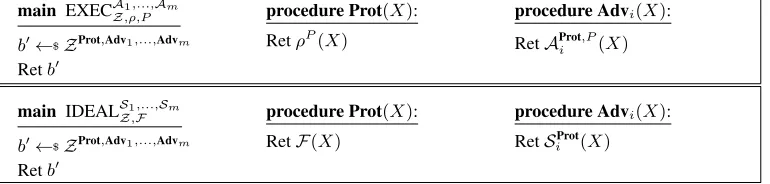
main EXECA1,...,Am Z,ρ,P
b0←$ZProt,Adv1,...,Advm
Retb0
procedure Prot(X):
RetρP(X)
procedure Advi(X):
RetAProti ,P(X)
main IDEALS1,...,Sm Z,F b0←$ZProt,Adv1,...,Advm
Retb0
procedure Prot(X):
RetF(X)
procedure Advi(X):
RetSProt
i (X)
Figure 4: Games defining multistage UC (mUC) security for a single protocol instance. The top box is the execution of the real protocol in the P-hybrid model. The bottom box is the execution for the ideal functionality.
the more general setting in a natural way. We are in the P-hybrid model ifρ uses as subroutine an ideal functionalityP. The adversaryAis also assumed to have access toP. We writeρP to denote thatρusesP
as a subroutine. We can define this (special case) UC execution using game EXECAZ,ρ,P withm = 1. See
Figure 4.
We also consider execution with an idealized version of a protocol. Here the same environment Z
interacts instead with an ideal functionalityF and a simulator adversary S. The adversary here also has access toF. Note that we do not needP (F does not rely on an underlying primitive). This ideal execution is defined as the game IDEALSZ,F withm= 1as shown in Figure 4.
We say thatρ UC-emulatesF in theP-hybrid model if for any environmentZ and adversaryAthere exists a simulatorS such that
Pr
EXECAZ,ρ,P ⇒1
−Pr
IDEALSZ,F ⇒1 is bounded by a negligible function in the (implicit) security parameter.
Consider a protocol ITM Πthat uses as a subroutine F. Then the protocol ITMΠρ/F is the same as
Πexcept that all calls toF are replaced by calls toρ. (It is implicit in the notation thatρhas access to an underlying primitiveP if it needs one.) The following is reproduced from [27] and is a special case of the main UC composition theorem.
Corollary 7.1 ([27, Cor. 15])Letρ,Π,F be ITMs such thatρUC-emulatesFin theP-model. ThenΠρ/F
UC-emulatesΠ.
UNIVERSAL COMPOSABILITY FOR MULTI-STAGE ENVIRONMENTS. The restriction in both the real and ideal executions to asingleadversarial ITM (or, in our games parlance, a single stateful adversarial proce-dure) gives rise to the implicit restriction on composition that it only applies when one is working relative to a single-stage environment. Thus we expand the UC executions to allow multi-stage adversaries. We refer to this as multi-stage UC (mUC).
Now an adversary is a tuple ofmITMsA1, . . . ,Am. An environment is multi-stage if it expects access tom > 1 adversarial ITMs. Real execution proceeds by first having the multi-stage environmentZ run. It can invoke the different ITMsA1, . . . ,Amas it sees fit. Ideal execution is similarly generalized to work
withmsimulator adversariesS1, . . . ,Sm. The adversarial ITMs in either world do not share state, and in particular all communication between the adversaries must be throughZ. This is similar to the UC variant defined in [3] for collusion-free multi-party computation. We say that a protocolρmUC-emulates an ideal functionalityFin theP-hybrid model if
Pr
h
EXECA1,...,Am Z,ρ,P ⇒1
i
−Pr
h
IDEALS1,...,Sm Z,F ⇒1
i
We are now in a position to transport the negative result from indifferentiability to mUC. That is, we show that even if one UC-emulates an ideal functionality, this does not mean one mUC-emulates the ideal functionality and, in particular, it may not be secure using the construction at all. Takeρ =H,F = RO, andPto be a (say) ideal compression function. Then we have the following easy proposition which follows. Proposition 7.2 (informal) IfH is indifferentiable from a random oracle when using primitive P, then protocolρ=HUC-emulatesF = ROin theP-hybrid model.
To see why, letS0be the simulator given byHbeing indifferentiable from a RO. Then the UC adversary
Sworks by running the real world adversaryAand answering itsP queries by executingS0. This can then
be used to show thatHUC-emulates aRO.
But then it is easy to see that, in fact, H does not mUC-emulate a RO. Why? Assume that H is
(p, n, s)-online computable, fix the mUC environment Z = CRPp,n,s. Then the adversary A1,A2 that
works as described in Section 4 causesZto output 1 (representing a win) with probability 1. However, we showed that no adversary can causeZ to output 1 with more than negligible probability when using aRO. Thus,Hcannot mUC-emulate aRO.
DISCUSSION. The above is at a high level, and pinning down formal details would require an appropriately detailed formalization of UC. Such details are beyond the scope of this work. The take away, however, is that UC does not work for multi-stage games. More precisely: showing an ideal functionality UC-emulates a protocol doesnotimply that the protocol is safe to use when security is measured by a multi-stage game. This stands in contrast to the usual claims made about the generality of UC security.
Others have pointed out limitations of the UC framework. Canetti and Rabin [29] introduce a joint-state UC (JUC) model to expand UC composition to the setting in which different protocols use common components. They introduce a joint-state UC (JUC) model which also does not cover multi-stage games. Canetti et al. [28] point out that for applications like deniability, the environment must have access to setup functionalities. In normal (J)UC the environment does not, and so they introduce the generalized UC (GUC) framework. As neither JUC nor GUC allow environments that treat multi-stage games, the limitations we point out seem to apply. One caveat is that GUC does give the environment direct access to the underlying primitiveP, which in our treatment means they consider games outside ofLG. An interesting open problem is characterizing the extent to which GUC composition covers multi-stage games.
Closer to our work is collusion-free protocols [3, 4, 44]. In this setting separate adversaries are assumed to only be able to communicate via some (semi-trusted) mediator and the task is to prove collusion-freeness of a protocol running on top of that channel. In [4] it is pointed out that UC cannot be used to treat collusion-freeness because it does not include disjoint adversaries. They give their own framework which includes multiple disjoint adversaries and where showing security requires simulators for each adversary. This frame-work is conceptually close to reset indifferentiability and may be a good starting point for future frame-work on results that use composition to analyze multi-stage games. That said, we expect that our negative results about hash constructions from Section 6 would extend to this kind of setting.
8
Other Limitations of Composition
and Tessaro [49] construction, which has less additive loss, to potentitally avoid this.) Another loss is in the running time of the adversary due to the simulator’s overhead. Theorem 3.1 makes clear that if one uses an inefficient simulator, then after composition security may no longer hold in the case that computational assumptions are needed to establish security of a cryptosystem in the ROM.
GAMES THAT USE THE F.adv INTERFACE. We only consider gamesG ∈ LG, meaning that the game cannot access the adversarial interface of a functionality. In Section 9 we will give the PrA security notion, which does not abide by this convention. Both Theorem 3.1 and Theorem 6.1 therefore do not apply to the PrA game. Trying to generalize composition to cover such games proves unsuccessful: the simulator would have to also be run by the game, and this changes the game behavior.
As another example, consider a formalization of PrA that only has the adversary given direct access toF.adv. Instead, the security notion restricts attention only to adversaries that output a transcript of all queries and their responses toF.adv. This notion is equivalent to PrA, and may (at first glance) seem to avoid violating the convention. But still this should be considered a violation, because the correctness of the transcript relies on the interface. Another point is that the adversaryBbuilt by composition may fail to abide by the restriction.
GAMES MAKING NON-BLACK-BOX USE OF A FUNCTIONALITY. The composition theorem requires that the game makes essentially black-box use of the functionality. So if the game instead relies in some non-black-box way on the functionality, then it is unclear how composition can apply — the game will change between one functionality and the next. This means that Theorem 3.1 will apply, but that the right-hand side gameGF2,B will not be the one appropriately measuring security for theF
2model.
RESTRICTIONS ON ADVERSARIES. The composition theorem may not explicitly maintain properties of an adversary desired. For example, one might desire information theoretic security in the ROM, but this would fail should composition be used with a hash construction enjoying indifferentiability only with respect to complexity-theoretic adversaries [47, 54]. (This issue was first pointed out in [54].) Precise bounds on running time may also not be preserved, as mentioned above in the discussion of concrete security.
9
Deterministic, Hedged, and Efficiently-Searchable Encryption
The results thus far reveal that schemes proven secure in the ROM may not be secure when using practical hash function constructions, when security is measured by a multi-stage game. As seen in Section 5 this includes numerous important cryptographic tasks. As a first step, we here take one example, that of de-terministic, hedged, or efficiently-searchable public-key encryption, and provide a proof of security when using any one of a number of indifferentiable hash constructions. We choose this example due to the exten-sive use of the ROM in prior results and the practical importance of the schemes [10, 11, 55]. Of course we cannot rely on Theorem 3.1, so our proof is done directly in the ideal primitive model. Nevertheless, our main result covers a relatively large mix of PKE schemes and hash functions.
We focus on the hash construction from [35], which composes a preimage-aware function (see below) with a fixed-input-length RO. While we can do analysis without relying on preimage-awareness, doing so simplifies and modularizes our result. Let hf: {0,1}∗ → {0,1}n be a function using some
underly-ing primitivef. Let g: {0,1}n → {0,1}n be a function. LetHf,g: {0,1}∗ → {0,1}n be defined by
Hf,g(M) = g(hf(M)). We point out that many hash functions fall into this form, including the so-called NMAC construction [31], MCM [54], NIRP [47], and various SHA-3 competitors.
main CDAF,A1,A2
AE b←${0,1}
(pk,sk)←$K
(m0,m1,r)←$AF.adv1
c← EF.hon
(pk,mb;r)
b0←$AF.adv2 (pk,c)
Ret(b=b0)
main IND-SIMFAE,A,S
b←${0,1}
(pk,sk)←$K
b0← ARoS,F.adv (pk)
Ret(b=b0)
procedureRoS(m, r):
Ifb= 1then RetEF.hon(pk, m;r)
RetSF.hon(pk,|m|)
main PrAF,H,AX
x←$APrim,Ext
z←HF.hon(x)
Ret(x6=V[z]∧Q[z] = 1)
procedurePrim(m):
c←F.adv(m)
α←αk(m, c)
Retc
procedureExt(z):
Q[z]←1 V[z]← X(z, α)
RetV[z]
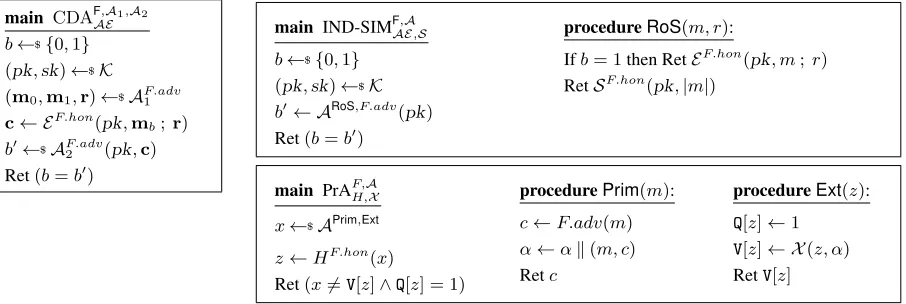
Figure 5:(Left)The non-adaptive CDA game.(Right)The IND-SIM and PrA games. maximum public-key collision probability by
maxpkAE = max
w∈{0,1}∗Pr [pk=w : (pk, sk)←
$K] .
CDASECURITY. In Figure 5 we detail the security game for (non-adaptive) chosen-distribution attacks [11]. (We conjecture that our main result below, Theorem 9.1, can be extended to cover adaptive adversaries as well, but do not provide proof.) This notion, orthogonal to the traditional notion of IND-CPA, captures the security of a PKE scheme when the randomnessr used may not be a (sufficiently long) string of uniform bits. For the remainder of this section, fix a randomness length ρ ≥ 0 and a message length ω > 0. An(µ, ν)-mmr-sourceMis a randomized algorithm that outputs a triple of vectors(m0,m1,r)such that
|m0|=|m0|=|r|=ν, all components ofm0andm1are bit strings of lengthω, all components ofrare
bit strings of lengthρ, and(mb[i],r[i])6= (mb[j],r[j])for all1≤i < j ≤ν and allb∈ {0,1}. Moreover, the source has min-entropyµ, meaning
Pr
(mb[i],r[i]) = (m0, r0) | (m0,m1,r)←$M≤2−µ
for allb∈ {0,1}, all1≤i≤ν, and all(m0, r0).
A CDA adversaryA1,A2 is a pair of procedures, the first of which is a(µ, ν)-mmr-source. The CDA
advantage for a CDA adversaryA1,A2 against schemeAEis defined by AdvcdaAE,F(A1,A2) = 2·Pr
h
CDAF,A1,A2
AE ⇒true
i
−1.
PREIMAGE AWARENESS. Dodis, Ristenpart, and Shrimpton’s preimage awareness notion [35] generalizes collision resistance to include extractability. Game PrA is defined in Figure 5. We associate to any function-alityF, hash constructionH, extractorX, and adversaryAthe PrA advantage defined by
AdvpraH,F,X(A) = PrhPrAF,AH,X ⇒true i
.
We point out that the game PrA does not abide by our convention that only the adversary queries F.adv, meaning PrA ∈ L/ G. Thus Theorems 3.1 and 6.1 do not apply to PrA. This is not a problem for past results or for our results below, both of which do not attempt to conclude PrA via indifferentiability-based composition.