on GPU
Yosuke Katoh1, Yun-Ju Huang2, Chen-Mou Cheng3, and Tsuyoshi Takagi4
1
Graduate School of Mathematics, Kyushu University, 744 Motooka, Nishi-ku, Fukuoka, 819-0395, Japan.
2 Institute of Information Science, Academia Sinica,
128, Section 2, Academia Road, Taipei, 115, Taiwan.
3 Department of Electrical Engineering, National Taiwan University,
1, Section 4, Roosevelt Road, Taipei, 106, Taiwan.
4 Institute of Mathematics for Industry, Kyushu University,
744 Motooka, Nishi-ku, Fukuoka, 819-0395, Japan.
Abstract. Recently, efficient implementation of cryptographic algorithms on graphics processing units (GPUs) has attracted a lot of attention in the cryptologic research community. In this paper, we deal with efficient implementation of theηTpairing on supersingular curves over finite fields
of characteristics 3. We report the performance results of implementa-tions on NVIDIA GTX 285, GTX 480, Tesla C1060, and Tesla C2050 graphics cards. We have implementedηTpairing in three different ways,
namely, one pairing by one thread (Implementation I), one pairing by multiple threads (Implementation II), and multiple pairings by multiple threads in a bitsliced fashion (Implementation III). The timing for Imple-mentation III on a single GTX 285 is 1.47, 8.15, and 140.7 milliseconds forηT pairing overF397,F3193, andF3509, respectively. On a single GTX
480, the throughput performance of Implementation III is 33710, 4970, and 332ηT pairings per second overF397,F3193, andF3509, respectively.
To the best of our knowledge, this is the first implementation ofηT
pair-ing on GPU. Furthermore, it is currently the software implementation that achieves the highest single-chip throughput forηT pairing.
Key words:ηT pairing, graphics processing unit
1
Introduction
In recent years, GPGPU has attracted a lot of attention in computational research communities. For example, cryptographic algorithms are studied and implemented on GPU, such as AES [9], RSA [10], and elliptic-curve point scalar arithmetic [17]. Furthermore, cryptanalysis computation can also be carried out with GPU [5, 6]. In particular, Bernstein et al.has demonstrated that GPGPU can be more efficient and cost-effective than traditional CPU, e.g., a single NVIDIA GTX 295 graphics card can complete 41.88 million modular multipli-cations every second for 280-bit moduli, compared with 14.85 million achieved by an Intel Core 2 Quad Q9550 CPU [5]. It is also shown that GPGPU can be more efficient than several other platforms including AMD Phemon III and Sony PlayStation3 [4]. Furthermore, it is shown that GPUs can perform not only modular multiplications but also binary-field multiplications in, e.g.,F2131 [2].
Recently, pairing-based cryptography has attracted a lot of attention in cryp-tography due to its novel cryptographic applications such as identity-based en-cryption. In this paper, we deal with efficient implementation of theηT pairing on supersingular curves over finite fields of characteristics 3. The timing of sev-eral previously reported implementations of the Tate pairing is quite efficient in both software and hardware platforms [7, 13]. However, to the best of our knowledge, there are no reports on implementations of theηT pairing.
We first report our experience implementing ηT pairing on NVIDIA GTX 285, GTX 480, Tesla C1060, and Tesla C2050 graphics cards. For multi-threaded GPU implementation, efficient exploitation of the inherent parallelism in the algorithms is of vital importance. We will show three different ηT pairing
im-plementation strategies in the following sections. In Imim-plementation I, we use one single thread per pairing computation, while in Implementation II, we use multiple threads per pairing computation. In Implementation III, we compute several parings using multiple threads in a bitsliced fashion at the same time. For Implementation III, it takes 1.47, 8.15, and 140.7 milliseconds to compute one ηT pairing over F397, F3193, and F3509, respectively. On a single GTX 480, the throughput performance of Implementation III is 33710, 4970, and 332 ηT
pairings per second over F397,F3193, andF3509, respectively. To the best of our knowledge, this is the first GPU implementation result for ηT pairing.
The rest of this paper is organized as follows. In Section 2, we will give some necessary background information about the development environment and the various NVIDIA GPUs that we use for our implementations. In Section 3, we will present ηT pairing over F3m and our design that maps the mathematical computation onto GPU. We will then describe our implementation in detail and present the performance results in Section 4. Finally, we will conclude this paper in Section 5.
2
NVIDIA GPU
NVIDIA GPU, as well as the various NVIDIA GPUs that we use for our imple-mentations.
2.1 CUDA
CUDA allows application programmers to program NVIDIA GPU using a high-level, C-like programming language [15]. A GPU program is then compiled as follows. First, the usual C/C++ code running on CPU is separated and compiled using a standard C/C++ compiler such asgcc. The other part of the program, called the “kernel,” which is written with CUDA extension and targeted for running on GPU, is compiled bynvcc, a proprietary CUDA compiler. The output of nvcc is in a format called PTX (Parallel Thread eXecution), an assembly-language-like intermediary language, which is translated into the real machine code by CUDA driver before loading onto GPU.
CUDA adopts an SPMD paradigm, in which multiple data are processed simultaneously. When launching a kernel, usually a large number of threads are created to process a large amount of data in parallel. In order to reduce hardware cost and allow transparent scalability, threads are organized according to a two-level hierarchy in CUDA. Under this thread organization, each kernel uses one single grid of thread blocks, each of which can consist up to several hundreds of threads. The threads from a same thread block can share data and cooperate with each other via shared memory and barrier synchronization primitives. Threads from different thread blocks can not cooperate and hence must be able to run independently.
2.2 G2xx series cards
We use NVIDIA GeForce 200 series cards as one of our target platforms. Each GPU on such a card contains 2–30 streaming multiprocessors (SMs). Each SM contains 8 ALUs (arithmetic-logic units; in CUDA’s own terminology, streaming processors, or SPs) and 2 super function units (SFUs). For example, the GT200b GPU on a GTX 285 graphics card contains 30 SMs, meaning that it has 240 SPs (or “cores,”as NVIDIA puts it). Moreover, each SM has only one instruction de-code and dispatch unit, so all of its 8 ALUs must execute the same instructions simultaneously. In fact, to accommodate the throughput difference between in-struction decoding and execution, CUDA defines a notion of minimal scheduling unit called a “thread warp,” or simply a warp. On GT200b, one thread warp consists of 32 threads. Therefore, on GT200b, each normal instruction for the 32 threads in a warp can be processed by the 8 SPs in 4 cycles.
the execution engine. Therefore, it is very important to use the warp unit wisely to have an efficient GPU implementation.
CUDA also uses a multi-level memory model, which will be described in detail below. We also describe the available memory for Compute Capability 1.3, which is a way that NVIDIA differentiates the capabilities of GPUs of different generations.
– Register file: 16384 32-bit registers, or a 64 KB register file on each SM. It allows the fastest read-write operation to the data stored in it. Registers are private and can only be read and written by the owning threads.
– Shared memory: 16 KB read-write memory on each SM. It is organized into 16 32-bit banks and allows fast access (same speed as register file if no bank conflict). Shared memory can only be read and written by the threads belonging to the same thread block.
– Global memory: 1–2 GB read-write memory. This is known to be 100 times slower in terms of latency than accessing shared memory. Global memory can be read and written by all the threads on the GPU.
– Constant memory: 64 KB read-only memory. It is faster than global memory because it is cached. Constant memory can only be read by all the threads on the GPU.
Finally, we note that though each SM has a larger register file than shared memory, registers are private to each thread and hence can not be shared across different threads. Furthermore, registers can only be addressed from within in-structions and hence are not as flexible as shared memory in terms of address-ing modes. Therefore, it is important to use the shared memory efficiently. For compute Capability 1.3, each SM can have up to 32 simultaneous warps (1024 threads), 16384 32-bit registers, and 16 KB shared memory. We are advised to run as many thread blocks as possible under the resource constraints to allow ef-ficient latency hiding. For example, consider a thread block consisting of 4 warps. If we consider the maximal number warps per SM, then we are able to run up to 8 thread blocks per SM. However, if each thread uses 20 registers, then we can only run 6 thread blocks per SM. If one thread block uses 4 KB shared memory, then we are restricted to 4 blocks per SM. In conclusion, in order to obtain the maximal performance, it is important to balance the number of parallel threads per SM with register and shared memory usage.
2.3 G4xx series cards
In the new Fermi architecture, NVIDIA has renamed an SP to a CUDA core. The number of CUDA cores per GPU is increased from 240 to 512, and each SM now has 32 CUDA cores instead of 8 SPs. As a result, the total number of SMs per GPU is decreased from 30 to 16. Furthermore, in order to have better manufacturing yield, NVIDIA disables one SM per GTX 480, leaving only 15 active SMs (or 480 CUDA cores). For the high-end server market, they disable two SMs per Telsa C2050 card, leaving only 14 active SMs (or 448 CUDA cores).
Each SM on GF100 has two instruction units (or warp scheduler) instead of one in the previous generation. The number of SFUs is also doubled from two to four. It now takes two cycles to execute one instruction for one warp. Moreover, each SM now has 16–48 KB of L1 cache, and all SMs share 768 KB of coherent L2 cache. The latency of accessing L1 and L2 caches is dozens and hundreds of clock cycles, respectively. The shared memory is increased from 16 to 48 KB, and the number of shared memory banks is also increased from 16 to 32. However, shared memory and L1 cache must add up to 64 KB in total, as they are implemented using the same physical memory. In other words, if we use 48 KB of shared memory, then we can only have up to 16 KB of L1 cache, and vice versa. As the primary cache of the global memory, L1 cache is automatically handled by GPU. Therefore, unlike in the previous architecture, even if there is no special memory management on the shared memory, the performance will also be somewhat improved. Of course, in order to get better performance, we need to manage the fast on-die memory by ourselves. There are 32768 32-bit registers in one SM, totaling about 128 KB. However, the overall fast memory on GPU is only slightly increased from 1920 to 2048 KB.
It is of crucial importance to consider the trade-off between number of threads, available registers, and amount of shared memory per thread in the Fermi ar-chitecture, just as it was for GPUs of previous generations. Within the limit of memory resource consumption, we would like to run as many thread blocks as possible to maximize the GPU utilization. With the G2xx series cards, we are able to use a large number of threads to hide the memory latency and use a small amount of shared memory efficiently to speed up the calculation. In con-trast, the Fermi architecture has a larger amount of shared and register memory per SM, which has even a smaller latency. Therefore, it would result in further performance improvement if we use the on-die memory efficiently. When we fix the number of threads, we can use more registers on Fermi than G2xx series GPU in order to maximally utilize all compute resources.
Table 1.Specifications of several NVIDIA graphics cards
Specifications GTX 285 GTX 480 Tesla C1060 Tesla C2050
CUDA Cores 240 480 240 448
Arithmetic Clock (GHz) 1.476 1.401 1.296 1.15
Single-precision GFLOPS 1063 1345 933 1030
Standard Memory Configuration (GB) 1 1.536 4 3
Memory Bandwidth (GB/sec) 159 177.4 102 144
3
Parallel
η
Tpairing computation
In this section, we will describe in detail the ηT pairing over F3m, the optimal representation of elements, multiplication inF3m for GPU, as well as the parallel thread assignment.
3.1 Definition of ηT pairing
TheηT pairing with characteristic 3 can be defined on the supersingular elliptic
curve
E:y2=x3−x+b, b=±1.
Letrbe the largest prime such thatr|#E(F3m), and r|(36m−1). Let the
subgroup with orderrinE(F3m) be denoted asE(F3m)[r]. Then theηT pairing is a bilinear mapping
ηT :E(F3m)[r]×E(F36m)/rE(F36m)−→F∗36m/(F∗36m)r.
3.2 Representation of elements in F3m
We have tried three approaches for parallel computation ofηT paring on GPU. One approach is to use multiple threads to calculate one single element inF3min parallel, while another approach is to use multiple threads to calculate multiple elements inF3m in a bitsliced fashion. In this paper, we call the former approach Implementation II (Parallel), and the latter, Implementation III (Bitsliced). For comparison purposes, we also include the basic approach that does not use any parallel computation, which we call Implementation I (Serial). We are going to describe the representation of elements inF3m for Implementation I, II, and III, as summarized in Table 2.
Table 2.Characteristics of the implementations
Implementation I II III
Implementation I and II. Let F3[x] be the set of polynomials with
coeffi-cient from the prime field F3 = {0,1,2}. Let f(x) be an irreducible
polyno-mial with degree m in F3[x]. In this case, the field F3m can be expressed as
F3m = F3[x]/(f(x)). Two bits are necessary to represent an element in F3. In
this paper, we use representation given by Kawahara, which uses one “hi bit”and one “lo bit”to represent each element in F3 [11]. For A(x)∈ F3m with degree
m−1,
A(x) =am−1xm−1+am−2xm−2+· · ·+a1x+a0
is the representation of A(x). To represent A(x), we need m hi bits and m lo bits, that is, with 32 bits in a word, 2× dm/32ewords are needed. For example, ifmis 97, then an element inF397 is represented as follows.
Ahi[3] = (0, . . . ,0,(a96)hi)
Alo[3] = (0, . . . ,0,(a96)lo)
Ahi[2] = ((a95)hi, . . . ,(a65)hi,(a64)hi)
Alo[2] = ((a95)lo, . . . ,(a65)lo,(a64)lo)
Ahi[1] = ((a63)hi, . . . ,(a33)hi,(a32)hi)
Alo[1] = ((a63)lo, . . . ,(a33)lo,(a32)lo)
Ahi[0] = ((a31)hi, . . . ,(a1)hi,(a0)hi)
Alo[0] = ((a31)lo, . . . ,(a1)lo,(a0)lo)
Implementation III. Similar to Implementation II, Implementation III uses hi bits and lo bits to representA(x), too. Specifically, it uses 2×mwords, with 32 bits in a word to store 32F3m elements. This strategy is known as bitslicing, in which a word is treated as a vector of bits from different elements [2]. In this paper, the notation of the j-th elementA(x)[j] in F3m is
A(x)[j]=a(m−1)[j]xm−1+· · ·+a1[j]x+a0[j].
For example, ifmis 97, then the 32 elements inF397 are represented as follows.
Ahi[96] = ((a96 [31])hi,· · ·,(a96 [1])hi,(a96 [0])hi) Alo[96] = ((a96 [31])lo,· · · ,(a96 [1])lo,(a96 [0])lo)
.. .
Ahi[0] = ((a0 [31])hi,· · ·,(a0 [1])hi,(a0 [0])hi) Alo[0] = ((a0 [31])lo,· · · ,(a0 [1])lo,(a0 [0])lo)
3.3 Multiplication in F3m
The bulk of the ηT pairing computation is multiplication. We will show the multiplication algorithms of Implementation I, II, and III in F3m. To obtain the optimal performance, we try our best to fit the entire input in the shared memory and perform all operations within the shared memory to avoid going to the slow global memory. However, for the Implementation III over F3509 in pre-Fermi architecture, we are unable to store all the data in shared memory, and hence some temporary data have to be stored in global memory.
Implementation I. For elementsA(x), B(x) in F3m with irreducible polyno-mial f(x), the multiplication C(x) =A(x)·B(x) modf(x) over the finite field F3m requires a polynomial multiplication ofA(x)·B(x) followed by a reduction by f(x). The Comb method [12] is used as the polynomial multiplication in Implementation I, as shown in Algorithm 1.
Algorithm 1Comb multiplication inF3m [12]
INPUT: A(x), B(x)∈F3m, W
OUTPUT: C(x) =A(x)·B(x) 1: C(x)←0
2: fori←1 toW−1do
3: forj←0 tobm/Wcdo
4: C(x)←C(x) +A[j]i·B(x)xjW+i
5: end for
6: end for
7: return C(x)←Reduction(C(x))
For the reduction, we use the ROT method (Reduction Optimal Trinomials) proposed by Nakajimaet al.[14] However, since there is no parallel processing in Implementation I, we use only one thread here.
Implementation II. Implementation II is basically Implementation I with parallelism. In order to perform in parallel the operationsA[j]i·B(x)xjW+i at
Step 4 in Algorithm 1, we assign the word lengthW as one block in the Comb method and perform the addition on F3m dm/We times in each thread. Thus, each thread’s main work is the expanded computation in the nested loops from Step 2 to 6. Since the number of threads needs to be the same as the word length 32, we can simply use an entire warp for this part so that the SIMD efficiency is maximized at the same time. The total number of bit operations needed is 6× dm/32e ×m+ (2× dm/32e)×31×32.
will offset any benefits parallelization can bring when a table is simultaneously accessed by multiple threads.
Implementation III. The method used in Implementation III to perform 32 multiplications is shown in Algorithm 2. Implementation III works with 2×m
arrays for hi bits and lo bits. We use m threads to operate on these arrays in order to maximize parallelism. Thus, for the expanded operations in each loop at Step 2 and 3, each array is assigned to one thread to compute.
Algorithm 2Multiplication of Implementation III inF3m
INPUT: A(x)[j], B(x)[j]∈F3m,j={0, . . . , m−1} OUTPUT: C(x)[j]=A(x)[j]·B(x)[j]
1: C(x)[2·j]←0
2: fori←0 tom−1do
3: fork←0 tom−1do
4: C´hi[i+k]←Ahi[i] &Blo[k]|Alo[i] &Bhi[k]
5: C´lo[i+k]←Ahi[i] &Bhi[k]|Alo[i] &Blo[k]
6: C(x)[i+k]←C(x)[i+k]+ ´C(x)[i+k]
7: end for
8: end for
9: return C(x)[j]←Reduction(C(x)[2·j])
The total number of bit operations needed is 6×m2+ 6×m2. We note
that although the Karatsuba algorithm is also known as a fast multiplication method, it may not be as efficient for our representation of F3m elements, in which addition is as expensive as multiplication. In addition, at Step 4 and 5, each array only needs to be accessed by the corresponding thread. Thus, we are able to obtain a further speed-up by storing these arrays in thread-private registers. Reduction is also done by the same threads in parallel. However, same as in Implementation II, the parallelization of reduction is not as efficient due the SPMD constraints.
4
Implementation results
In this section, we first describe three different types of implementation of ηT
pairing on GTX 285 that we have considered in this paper. Next, we report the performance of the best one, Implementation III, on GTX 285, GTX 480, Tesla C1060, and Tesla C2050. Then we show the experiment result of multiplication throughput forηT pairing.
4.1 Implementation techniques
to achieve optimal performance, we would need to minimize use of conditional branches in the code. We achieve so whenever possible by choosing appropriate algorithms for the operations inF3m that are needed for computingηT pairing. For example, since the cubing calculation ofA(x) inF3mis fast and parallelizable, we use Fermat’s method to calculate the inverse ofA(x) inF3m by takingA(x) to the power of (3m−2). We also use the algorithm proposed by Shiraseet al.[3]
as the main loop for ourηT pairing computation and the algorithm implemented with torus stated by Shiraseet al. [16] Some temporary data produced in the pairing computation need to be cached in registers. If we finish the entire pairing computation in one kernel launch, it would require a large number of registers for storing the temporary data. Thus, in order to balance the register usage, we split the computation into two parts, namely, the Miller loop in Algorithm 2 and the final exponentiation in Algorithm 3 [16].
As of the time of writing, the NVIDIA GeForce GTX 285 is considered as a mid-class graphics card. It has a GPU that runs at 1476 MHz. We are able to fit the entire computation on one single SM because our design allows all critical data structures stored entirely on the on-die memory of GT200b, as shown in Section 4.2. Then, we implementηT pairing and multiplication inF3m on 30 SMs and summarize our results in Section 4.3. In the reports, we usecudaEvent, part of the CUDA API, for time measurement. To match the security levels of 66-, 89-, and 128-bit AES, we choose three finite fields,F397,F3193, andF3509 for our implementation ofηT pairing.
4.2 Performance results I
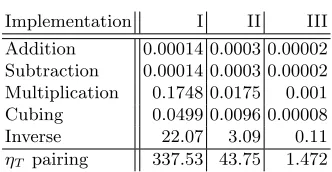
The performance results on GTX 285 over F397, F3193, and F3509 are shown in Table 3, Table 4, and Table 5, respectively.
In the above tables, the running time for Implementation III is normalized to per F3m element for comparison purposes. As we have mentioned in Section 3, the number of bit operations in multiplication in Implementation III (12×m2)
is more than that in Implementation I and II ((192×m+ 1984)× dm/32e). However, from Table 3, 4, and 5, we can see that Implementation III is faster than Implementation I and II in all cases. According to Section 3.2, this is possible because the total computation time of GPU also depends on the amount of data transfer; compared to the memory footprint of Implementation I and II (32×dm/32e×2 32-bit arrays), that of Implementation III is more compact (m×2 arrays) and thus incurs a smaller amount of memory transfer. Moreover, unlike Implementation I and II, the polynomials multiplication in Implementation III, not including reduction, does not result in any warp divergences. That is, there are no divergent branches in the multiplication of Implementation III, which makes it much faster than its counterparts in Implementation I and II.
Table 3.Per-SM running time (ms) forF397
Implementation I II III
Addition 0.00014 0.0003 0.00002
Subtraction 0.00014 0.0003 0.00002 Multiplication 0.1748 0.0175 0.001
Cubing 0.0499 0.0096 0.00008
Inverse 22.07 3.09 0.11
ηT pairing 337.53 43.75 1.472
Table 4.Per-SM running time (ms) forF3193
Implementation I II III
Addition 0.00023 0.0003 0.00002
Subtraction 0.00024 0.0003 0.00002
Multiplication 0.38 0.025 0.003
Cubing 0.052 0.0116 0.0001
Inverse 83.88 7.79 0.63
ηT pairing 1323.01 109.42 8.15
Table 5.Per-SM running time (ms) forF3509
Implementation I II III
Addition 0.00044 0.00078 0.00003 Subtraction 0.00043 0.00080 0.00003
Multiplication 1.02 0.135 0.023
Cubing 0.194 0.029 0.0004
Inverse 421.57 52.69 10.4
ηT pairing 6100.5 732.3 140.73
32 parings in one block. Such a design turns out to be slower than implementa-tion III. It is a trade-off between efficiency (the number of threads should be an integral multiple of 32, the number of threads in a warp) and flexibility (being able to use an arbitrary number of threads).
4.3 Performance results II
In this section, we are going to show the throughput performance ofηT pairing
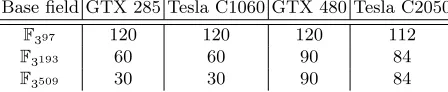
resources. That is, the number of active thread blocks per SM is an important performance index. For this purpose, we choose the number of thread blocks to be an integral multiple of the number of SMs on the target GPU, which is 30 for GTX 285 and Tesla C1060, 15 for GTX 480, and 14 for Tesla C2050. We show the total number of thread blocks used inηT pairing in Table 6 and in multipli-cation in Table 7. Also, the throughput ofηT pairing is shown in Table 8, while the throughput ofF3m shown in Table 9.
Table 6.Total number of blocks used forηT pairing
Base field GTX 285 Tesla C1060 GTX 480 Tesla C2050
F397 60 60 60 98
F3193 30 30 30 56
F3509 20 20 30 28
Table 7.Total number of blocks used for multiplication in F3m
Base field GTX 285 Tesla C1060 GTX 480 Tesla C2050
F397 120 120 120 112
F3193 60 60 90 84
F3509 30 30 90 84
For multiplications inF3m, we store half of the temporary data in registers and half in shared memory. As a result, the maximal number of blocks per SM is limited by the number of available registers. For GTX 285 and Tesla C1060,
Table 8.Throughput performance ofηT pairing on NVIDIA GPUs (1/sec)
Base field GTX 285 Tesla C1060 GTX 480 Tesla C2050
F397 23496 20619 33712 31250
F3193 3257 2874 4975 4425
F3509 81 53 332 254
Table 9.Throughput performance of multiplication on NVIDIA GPUs (106/sec)
Base field GTX 285 Tesla C1060 GTX 480 Tesla C2050
F397 41.20 36.23 61.43 47.45
F3193 11.20 9.80 17.50 13.87
F3509 0.57 0.38 2.85 2.21
shared memory, we have to store some of them in global memory instead. On the other hand, for GTX 480 and Tesla C2050 (Fermi architecture), since the number of registers and shared memory are both increased, the memory limitation is no longer a problem. As the result, performance on GTX 480 and Tesla C2050 is better than that on GTX 285 and Tesla C1060.
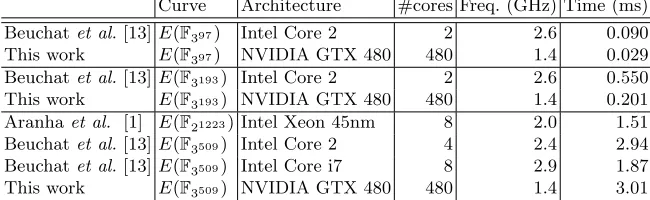
There have been several efficient implementations of cryptographic pairings on multi-core CPUs [1, 8, 13]. We will now compare our results with those ob-tained on multi-core CPUs in the literature [1, 13]. The experiment results are summarized in Table 10, in which we compare the execution time perηT pairing on GPU and various multi-core CPU implementations of a cyptographic pairing on supersingular curves in characteristics 2 and 3. The acceleration on multi-core CPUs achieved by ann-core implementation is almost always less than the ideal n× speed-up. The timing shown in Table 10 is the normalized time per
Table 10.Performance comparison ofηT pairings on multi-core processors
Curve Architecture #cores Freq. (GHz) Time (ms)
Beuchatet al.[13]E(F397) Intel Core 2 2 2.6 0.090
This work E(F397) NVIDIA GTX 480 480 1.4 0.029
Beuchatet al.[13]E(F3193) Intel Core 2 2 2.6 0.550
This work E(F3193) NVIDIA GTX 480 480 1.4 0.201
Aranhaet al. [1] E(F21223) Intel Xeon 45nm 8 2.0 1.51
Beuchatet al.[13]E(F3509) Intel Core 2 4 2.4 2.94
Beuchatet al.[13]E(F3509) Intel Core i7 8 2.9 1.87
This work E(F3509) NVIDIA GTX 480 480 1.4 3.01
ηT pairing, i.e., the total compute time divided by the total number of pairings. From the comparison, we can see that GTX 480 has the highest throughput performance over smaller finite fields.
Based on our experiment data on GTX 480, it would be possible to achieve 61.43 million multiplications per second inF397. ForηT pairing overF397, GPU’s
running time is around 29 microseconds. This is much faster than the best result on a dual-core 2.6 GHz Intel Core 2 processor [13]. However, forηT pairing over F3509, GPU’s running time is around 3.01 milliseconds. This is slower than the best result on an eight-core 2.9 GHz Intel i7 processor [13] . We conclude that for larger fields, GPU implementation might be slower than CPU implementa-tions because of the limited fast on-die memory on GPU. However, for smaller fields, GPU can easily outperform CPU because the computation uses a rela-tively smaller number of registers, and the large-scale parallel computing is more efficient on GPU.
5
Conclusion
one pairing, Implementation II uses multiple threads to compute one pairing in parallel, and Implementation III uses multiple threads to compute multiple pairings in a bitsliced fashion. The best result among the three implementations on a single GTX 285 is obtained with Implementation III, which takes 1.47, 8.15, and 140.7 milliseconds to compute one pairing overF397,F3193, andF3509, respectively. On a single GTX 480, the throughput performance of Implementa-tion III is 33710, 4970, and 332ηT pairings per second overF397,F3193, andF3509, respectively. This is the first implementation result of the ηT pairing on GPU. To the best of our knowledge, this is also the fastest single-chip software imple-mentation over smaller finite fields. Though the result over larger finite fields such asF3509 is not as ideal as it is over smaller finite fields, the implementation should be sufficient for some real-world applications.
We have implemented theηT pairing over finite fieldsF3m of characteristic 3. Another efficient class of cryptographic pairings can be constructed on the ordinary curves over finite fieldsFpof large characteristicp. The implementation
of pairings over large characteristics and its comparison with our implementation are future works.
Acknowledgements. This work was supported in part by National Science Council, National Taiwan University, and Intel Corporation under Grants NSC99-2911-I-002-001, 99R70600, and 10R80800 when the first author was visiting Na-tional Taiwan University.
References
1. D. F. Aranha, J. L´opez, and D. Hankerson, “High-speed parallel software imple-mentation of theηT pairing”, CT-RSA 2010, LNCS 5985 pp.89–105, 2010.
2. D. V. Bailey, L. Batina, D. J. Bernstein, P. Birkner, J. W. Bos, H.-C. Chen, C.-M. Cheng, G. van Damme, G. de Meulenaer, L. J. Dominguez Perez, J. Fan, T. Gu´neysu, F. Gurkaynak, T. Kleinjung, T. Lange, N. Mentens, R. Niederhagen, C. Paar and F. R, “Breaking ECC2K-130”, Cryptology ePrint, http://eprint.iacr.org/2009/541, 2009.
3. M. Shirase, Y. Kawahara, T. Takagi, and E. Okamoto, “UniversalηT Pairing
Algo-rithm over Arbitrary Extension Degree”, WISA 2007, LNCS 4867, pp.1–15, 2007. 4. D. J. Bernstein, H.-C. Chen, M.-S. Chen, C.-M. Cheng, C.-H. Hsiao, T. Lange,
Z.-C. Lin, and B.-Y. Yang, “The Billion-Mulmod-Per-Second PC”, SHARCS 2009, pp. 131–144, 2009.
5. D. J. Bernstein, T.-R. Chen, C.-M. Cheng, T. Lange, and B.-Y. Yang, “ECM on Graphics Cards”, Eurocrypt 2009, LNCS 5479, pp. 483–501, 2009.
6. C. Bouillaguet, H.-C. Chen, C.-M. Cheng, T. Chou, R. Niederhagen, A. Shamir, and B.-Y. Yang, “Fast Exhaustive Search for Polynomial Systems in F2”, CHES
2010, LNCS 6225, pp. 230–218, 2010.
7. N. Estibals, “Compact hardware for computing the Tate pairing over 128-bitsecurity supersingular curves”, Pairing-Based Cryptography 2010, LNCS 6487, pp. 397–416, 2010.
9. O. Harrison and J. Waldron, “Practical Symmetric Key Cryptography on Modern Graphics Hardware”, USENIX 2008, pp.195–210, 2008.
10. O. Harrison and J. Waldron, “Efficient Acceleration of Asymmetric Cryptography on Graphics Hardware”, AFRICACRYPT 2009, LNCS 5580, pp. 350–367, 2009. 11. Y. Kawahara, K. Aoki, and T. Takagi, “Faster Implementation ofηT Pairing over
GF(3m) Using Minimum Number of Logical Instructions for GF(3) Addition”, Pair-ing 2008, LNCS 5209, pp.289–296, 2008.
12. D. Hankerson, A. Menezes, and S. Vanstone,Guide to Elliptic Curve Cryptography, Springer, 2004.
13. J.-L. Beuchat, E. L´opez-Trejo, L. Mart´ınez-Ramos, S. Mitsunari, and F. Rodr´ıguez-Henr´ıquez, “Multi-core Implementation of the Tate Pairing over Supersingular El-liptic Curves”, CANS 2009, LNCS 5888, pp. 413–432, 2009.
14. T. Nakajima, T. Izu, and T. Takagi, “Reduction Optimal Trinomials for Efficient Software Implementation of the ηT Pairing”, IWSEC 2007, LNCS 4752, pp.44–57,
2007.
15. NVIDIA, CUDA Zone, http://www.nvidia.com/object/cuda home new.html. 16. M. Shirase, T. Takagi , and E. Okamoto, “Some Efficient Algorithms for the Final
Exponentiation ofηT Pairing”, IPSEC 2007, LNCS 4464, pp. 254–268, 2007.