A Multi-Receiver ID-Based Generalized Signcryption Scheme
Caixue Zhou*
School of Information Science and Technology, University of Jiujiang, JiuJiang 332005, China
ABSTRACT
Generalized signcryption(GSC) can adaptively work as an encryption scheme, a signature scheme
or a signcryption scheme with only one algorithm. In this paper, the formal definition and security notions of multi-receiver identity-based generalized signcryption (MID-GSC) are defined. A concrete scheme is also proposed and proved to be confidential under the Bilinear Diffie-Hellman
(BDH) assumption and existential unforgeable under the Computational Diffie-Hellman(CDH) assumption in the random oracle model, which only needs one pairing computation to generalized
signcrypt a single message for n receivers using the randomness re-use technique. Compared with other multi-receiver ID-based signcryption schemes, the new scheme is also of high efficiency.
Keywords: Multi-receiver identity-based generalized signcryption; Bilinear pairing; Provable security; Randomness re-use; Selective identity security; Random oracle model
1. Introduction
Identity based(ID-based) cryptosystem was introduced by Shamir[1] in 1984. Its main idea is that public keys can be derived from arbitrary strings while private keys can be generated by the trusted Private Key Generator(PKG). This removes the need for senders to look up the receiver’s public key before sending out an encrypted message. ID-based cryptography is supposed to provide a more convenient alternative to conventional public key infrastructure.
Signcryption, first proposed by Zheng[2], is a cryptographic primitive that performs signature and encryption simultaneously, at lower computational costs and communication overheads than those required by the traditional sign-then-encrypt approach. Due to its advantages, there have been many signcryption schemes proposed after Zheng’s publication. However, in some applications, sometimes people need both confidentiality and authentication and sometimes they just need confidentiality or authentication separately. For that case, applications must often contain at least three cryptographic primitives: signcryption, signature, and encryption, which will definitely increase the corresponding computation and implementation complexity and even will be infeasible in some resources-constrained environments such as embedded systems, sensor networks, and ubiquitous computing. Motivated by this, in 2006, Han et al.[3] proposed the concept of GSC which can implement the separate or joint encryption and signature functions in a single primitive, meanwhile
* Corresponding author. E-mail address: [email protected] (C.Zhou). Postal Address:
they gave a GSC scheme based on ECDSA[4]. Wang et al.[5] gave the first security model for a GSC scheme and modified the scheme proposed in [3]. The first ID-GSC scheme along with a security model was proposed by Lal and Kushwah[6] in 2008. However, Yu et al.[7] show that the security model proposed in [6] is not complete. They modified the security model and proposed a concrete scheme which is secure in this model. In 2010, Kushwahand Lal[8] simplified the security model proposed in [7] and gave an efficient ID-GSC scheme.
However, all the above GSC schemes consist of only one receiver. In 2000, Bellare et al.[9], and Baudron et al.[10] independently formalized the concept of multi- receiver public key encryption. Their main result is that the security of public key encryption in the single-receiver setting implies the security in the multi-receiver setting. Hence, one can construct a semantically secure multi-receiver public key encryption scheme by simply encrypting a message under n different public keys of a semantically secure single-receiver public key encryption scheme. Later a novel technique called randomness re-use[11] was presented to enhance the efficiency and bandwidths. Bellare et al.[12,13] investigated the property of randomness reusing- based multi-recipient encryption schemes (RR-MRES) and found that some RR- MRES keep the high security for the differences of the distinct recipient’s public keys. They proved that if the underlying base scheme is reproducible and semantically secure, then the corresponding RR-MRES is semantically secure too. These results give a solution to construct a secure MRES with a semantically secure base scheme. Particularly, randomness re-use is a novel technique that can be used to reduce overheads of batch encryption. In PKC2005, baek et al.[14] first proposed an ID-based MRES which used the technique of randomness re-use, where only one pairing computation is needed to encrypt a single message for n receivers. In 2006, Duan et al.[15] first proposed an ID-based multi-receiver signcryption scheme which also used the technique of randomness re-use, where only one pairing computation is needed to signcrypt a single message for n receivers too. Since then, many ID-based multi-receiver signcryption schemes were proposed[16-19]. In GSC aspects, Han[20] first proposed a multi-receiver GSC scheme, but his scheme is a trivial n-recipient scheme that runs GSC repeatedly n times, which obviously is very inefficient. In 2008, Yang et al.[21] proposed a multi-receiver GSC scheme which used the technique of randomness re-use. In 2009, Han and Gui[22] proposed a multi-receiver GSC scheme which also used the technique of randomness re-use. However their schemes are not identity based ones. To the best of our knowledge, there has been no MID-GSC scheme proposed in the literature till date.
CDH[26] assumption in the random oracle model[27]. The paper is organized as follows: in the next section, we give the definition of bilinear pairings and related computational hard problems. The definition and the security model of MID-GSC are given in Section 3. In Section 4 we give the concrete MID-GSC scheme. The efficiency is analyzed in Section 5. Section 6 concludes the paper.
2. Preliminary
Definition 1 (Bilinear pairings)
Let be a cyclic additive group, whose order is a prime , and be a cyclic
multiplicative group of the same order. Let be a mapping with the
following properties:
1
G q G2
2 1 1
:
ˆ G G G e
(1). Bilinearity: ab for all
Q P e bQ aP
eˆ( , )ˆ( , ) P,QG1,a,bZq.
(2). Non-degeneracy: There existsP,QG1such that eˆ(P,Q)1G2.
(3). Computability: There exists an efficient algorithm to compute , for
all .
) , ( ˆ PQ e
1
,Q G P
Definition 2. (BDH problem)
The BDH problem is, given P,aP,bP,cPG1, for unknown , to compute
.
*
, ,bc Zq a
abc
Q P eˆ( , )
The advantage of any probabilistic polynomial time(PPT) algorithm in solving
BDH problem in is defined to be: .
G
, , :ab
1
G Pr[ ( , , , ) ˆ( , ) *]
q abc
BDH
G G PaPbPcP eP P c Z
ADV
BDH assumption: For every PPT algorithm G, BDH is negligible.
G
ADV
Definition 3. (CDH problem)
The CDH problem is, given P,aP,bPG1for unknown , to compute . *
,b Zq
a abP
The advantage of any probabilistic polynomial time(PPT) algorithm in solving
CDH problem in is defined to be: .
G
]
1
G Pr[ ( , , ) : , *
q CDH
G G PaPbP abP ab Z
ADV
CDH assumption: For every PPT algorithm G, CDH is negligible
G
ADV
3. MID-GSC and its security notions
3.1Syntax
In the setting of MID-GSC, either a single message or multiple messages can be generalized signcrypted. In our context, we assume that a single message is generalized signcrypted to multiple receivers. Actually, it’s very easy to modify our scheme to become a multi-message multi-receiver scheme.
Definition 4 (MID-GSC):
An MID-GSC scheme =(Setup,Extract,GSC,UGSC) consists of four algorithms.
Setup: Given a security parameter , the k generates a master key
1 PKG s and a
common parameter params.params is given to all interested parties while s is kept
secret.
Extract: This is the user key generation algorithm. Providing an identity received
from a user and its master key
ID
s as input, the runs this algorithm to generate a
private key associated with , denoted by .
PKG
ID DID
the sender A, the multiple receivers’ identities and message m to return
ciphertext
n
ID ID1,..., )
,..., , ,
(mDA ID1 IDn
GSC
.
UGSC: This is a deterministic algorithm. The receiver IDi computes UGSC(,IDA,IDi)
with the corresponding private key DIDi, obtains m or an invalid symbol .
ID IDn A
For consistency, we require UGSC(GSC(m,DA,ID1,..., ), ,IDi)m.
MID-GSC is an adaptive scheme which implies three modes in this case. If the sender and all of the receivers are determined, it runs in signcryption mode. If all of the receivers are vacant and the sender is determined, it runs in signature mode. If the sender is vacant and all of the receivers are determined, it runs in encryption mode. Other inputs are not allowed. The three modes are transparent to applications, namely, the algorithm can produce the specific outputs according to the inputs of identities of the sender and the receivers adaptively. Applications need not care about which mode should be taken.
3.2Security model for MID-GSC
Now we present security notions for MID-GSC schemes. Recall that the selective identity attack means that an adversary commits ahead of time to the identity on which it will be challenged. We extend this notion to MID-GSC setting. Thus in our models, the adversary is assumed to output ahead of time multiple identities that it wishes to attack. Besides, due to the identity based nature, we should assume that the adversary may obtain any private key other than those of the multiple target identities. Note that in the description of the models, we often equate a user with its identity. With respect to confidentiality, the widely accepted notion is indistinguishability of ciphertexts under chosen ciphertext attacks. we adapt it to the MID-GSC setting and refer to it as indistinguishability of ciphertexts under selective multi-ID generalized signcryption, chosen ciphertext attacks (IND-sMIDGSC-CCA). Analogously, existential unforgeability under selective multi-ID generalized signcryption, adaptive chosen message attacks is UF-sMIDGSC-CMA for short.
In our security models, by reference to the simplified security models of [8] and the security models of [17], we give out the MID-GSC security models.
Definition 5(confidentiality)
An MID-GSC scheme is IND-sMIDGSC-CCA if no probabilistic polynomial time adversary A has a non-negligible advantage in the following game.
(1) Setup : The challenger runs the Setup algorithm to generate a master key and
a common parameter ( ). gives to
C Params
s, C Params A while he keeps s secret
from A. After receiving the system parameters , the adversary A outputs the set
of target identities *}.
n
,..., { *
1 *
ID S ID
(2) Phase 1: A makes polynomially bounded number of queries to the following
seven oracles.
(a) Extract Oracle — A produces an identity and queries for the secret key
of . The Extract Oracle returns to
ID
ID DID A provided .
*
S ID
(b) GSC Oracle — A produces a message , n receivers’ identities
, the sender’s identity . The challenger returns
to
m
A n
ID ID2
) ,..., ,
, 1 2 n
A ID ID ID
ID GSC
ID C
ID1,
,...,
,
(m A. Here if the sender and all of the receivers are
(c) UGSC Oracle — A produces a ciphertext , the receiver’s identity
, the sender’s identity . The challenger returns to
,
i
ID i
mor
] , 1 [ n A
ID C UGSC(,IDA.IDi)
A. Here if the sender and all of the receivers are not vacant, it equals
to un-signcryption oracle, if all of the receivers are vacant, it equals to signature verify oracle, if the sender is vacant, it equals to decryption oracle.
(3) Challenge: A produces two equal length different plaintexts , an arbitrary
sender , n receivers’ identities .
1 0,m
m
*
A
ID * * *
1,...,ID S
ID n B flips a coin b←{0, 1} to
compute a ciphertext , *,..., *) to
1 Qn
Q , ( * * A b ID m GSC
A as a challenge.
(4) Phase 2: A is allowed to make polynomially bounded number of new queries
as in phase 1 with the restrictions that it should not query the
and the extract oracle for the secret keys of .
) , , ( * * * i A ID ID UGSC ) ,..., 1 ( * * n i S IDi
(5) Guess: At the end of this game, A outputs a bit b0. A wins the game if b0b.
We define the advantage of the adversary A as: ( ):2Pr[ 0 ]1.
b b A
AdvINDsMIDGSCCCA
Note: In the above challenge stage, the sender * can be vacant. In this case,
A
ID
algorithm runs in encryption mode otherwise it runs in signcryption mode, so encryption mode and signcryption mode share the same game.
Definition 6 (unforgeability)
An MID-GSC scheme is UF-sMIDGSC-CMA if no probabilistic polynomial time adversary A has a non-negligible advantage in the following game.
(1) Setup: The challenger runs the Setup algorithm to generate a master key and a
common parameter ( ). gives to
C Params
s, C Params A while he keeps s secret from
A. After receiving the system parameters , the adversary A outputs the target
identity * on which he would like to challenge.
ID
(2) Attack: A issues queries to the same oracles as those in the confidentiality game .
(3) Forgery: A eventually produces a ciphertext and n arbitrary receivers’
identities ID1,ID2,...,IDn, A wins if the result of for some results in a valid message m, the private key of was not queriedand
) , , ( * i ID ID
UGSC i[1,n]
*
ID was not
the output of ( , *, ,...,IDn).
ID m ID1 GSC
Note: In the above forgery stage, all of the receivers (ID1,...,IDn) can be vacant. In that case, algorithm runs in signature mode otherwise it runs in signcryption mode, so signature mode and signcryption mode share the same game.
4. Our scheme
4.1Description of our scheme
Setup: Given the security parameter , this algorithm outputs: two cycle groups
and of prime order , a generator , a bilinear map ,
three hash functions: , , .
k
1
1:{0
) ,
(G1 (G2,) q
1 G 1 G P 1 G G 2 1 1 :
ˆ G G G
e
2 1
0:{0,1}
H n
1 1 ) 1 ( } 1 ,
H zn n
2 2: {0,1}
n z
G
H
Here n1,n2 and z are the number of bits required to represent an identity, an element of and a message respectively. needs to satisfy an additional
property: , where
1 G ) 0 ( 0 2 0,H H 0 ) 1 ( 2
,H
H denotes the infinite element in group .
chooses
1
G PKG
s randomly from Zq* as his master key, and computes as his
public key. The system parameters are .
sP
}
Ppub
, ,H1 H2
, , , ˆ , , ,
,n1 n2 z ePP H0 params
pub
, , {G1G2 q
Define a special function f(ID), where {0,1}n1. If identity is vacant, that is
ID
Extract: Each user in the system with identity , his public key is a
simple transform from his identity. Then computes private key for
. If
U
ID QU H0(IDU)
U
U s Q
D PKG
U
ID IDU, ( , ) ( ,1k).
U Gen
GSC: Suppose Alice with identity wants to send a message to n different
receivers : select any one from
A ID B ID m ) 1 (i ton
IDi IDi(i1ton)
- Computes f(IDA) and f(IDB) (B[1,n])
- Selects *
q
Z ,QRG1
k randomly, Computes RkP
- Computes HH1(m,R,IDA,ID1,...,IDn)G1
- Computes S f(IDA)DAkH
- Computes ( )
) , (
ˆ kfIDB R pub Q
P e
Y
- Computes C(m||S)H2(Y)
- Computes Uik(QRQIDi) (i1,...,n) - The ciphertext is (R,C,U1,...,Un).
UGSC: Each receiver IDi uses his private key DIDi to decrypts (R,C,U1,...,Un):
- Computes f(IDi)
- Computes ' ( ) ( )
) , ( ˆ ) , (
ˆ f IDi
i ID i ID f i
pubU e RD
P e
Y
- Computes || ( ')
2 Y
H C S m
- Checks if ˆ( , ) ˆ( , ) ( )ˆ( , ), where
R H e P Q e P S
e f IDA
pub A
HH1(m,R,IDA,ID1,...,IDn)G1.
Output m if the above verification is true, or output if false.
Correctness: It is easy to see that the above UGSC algorithm is consistent if is a valid ciphertext, since:
) ( ) ( ' ) , ( ˆ ) , (
ˆ f IDi
i ID i ID f i
pubU e RD
P e
Y
) (ID
f ( )
) , ( ˆ ) , (
ˆ f IDi
i ID i i ID
R kQ e RD
kQ sP
e
) ( )
(ID fID
f ) , ( ˆ ) , ( ˆ i i ID i i ID
R sQ eR D
sQ kP e ) ( )
(ID f ID
f ( )
) , ( ˆ ) , ( ˆ ) , (
ˆ f IDi
i ID i i ID i
R ekPsQ eRD
sQ kP e ) ( ) ( )
(ID f ID f ID
f ) , ( ˆ ) , ( ˆ ) , ( ˆ i i ID i i ID i
R eR D eR D
sQ kP e ) (ID f ) , ( ˆ i R sQ kP e ) (ID f ) , ( ˆ i R kQ sP e ) ( ) , (
ˆ kf IDi R pub Q P e ) ( ( ˆ )
,P e f ID D S A A
Y kH . . )) ( ) (
(as f IDi f IDB
, ( ˆ ) , ) ( (
ˆ f ID D PekH
e A A ) ˆ( , ) ˆ( , )
) , ( ˆ ( ) R H e P Q e P P
e f IDA
pub A
Then receiver IDi can decrypt the ciphertext and obtain the signed message. 4.2 Adaptation
MID-GSC is an adaptive scheme that can seamlessly switch to different modes according to the inputs of users’ identities, applications need not care about all of these works. Note that the scheme seamlessly switches to three modes without any other additional operation.
Signcryption mode: when IDA and IDi(i1ton), then f(IDA)1 and f(IDi)1
]) , 1 [
(i n .Algorithm runs in signcryption mode.
Encryption mode: when and , then and
. Algorithm runs in encryption mode. In this case,
A
ID IDi(i1ton) f(IDA)0
kH
1 ) (IDi
f
]) , 1 [
(i n S , the check equation
becomes: eˆ(S,P)eˆ(H,R), where HH1(m,R,,ID1,...,IDn).
Signature mode: when and , then and
. Algorithm runs in signature mode. In this case, ,
A
ID IDi(i1ton) f(IDA)1
( ˆ e Y 0 ) (IDi
f
1 )kf(IDi)
R
]) , 1 [
S m H S m Y H S m
C( || ) 2( )( || ) 2(1) || , The ciphertext is (R,C,U1,...,Un)(R,m||S,U1,...,Un),
namely (R,S) is the signature of m.
5. Security and efficiency analyses of MID-GSC
5.1. Security of MID-GSC
Theorem 1. In the random oracle model, if an adversary A has non-negligible
advantage against the IND-sMIDGSC-CCA security of our scheme running in signcryption mode or encryption mode when running in time t and performing
generalized signcryption queries, generalized un-signcryption queries and
queries to oracles , then there is an algorithm
GSC
q
i H
q
UGSC
q
) 2 , 1 , 0 (fori
Hi B that solves the BDH
problem with probability and within running time
where denotes the time required for one pairing evaluation. )
2 /
2
k UGSC
H q
q
(
2
H
q
/ 1
'
e GSC
UGSC q t
q t
t' (2 )/
e
t
The corresponding proof will be given in the full version.
Theorem 2. In the random oracle model, if a forger F has non-negligible
advantage against the UF-sMIDGSC-CMA security of our scheme running in signcryption mode or signature mode, then B can solve the CDH problem with
probability k.
B1/2
The corresponding proof will be given in the full version. 5.2 Efficiency
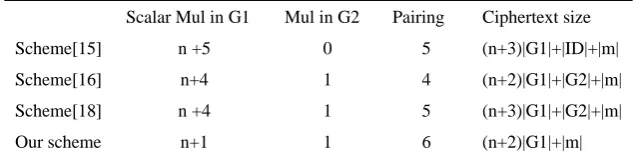
As far as we know, there has been no MID-GSC scheme proposed in the literature till date. So, we compare the efficiency of our scheme with several multi-receiver ID-based signcryption schemes which also use randomness re-use technique. Since computation time and ciphertext size are two important factors affecting the efficiency, we present the comparisons with respect to them. Table 1 shows the comparisons. From table 1, we can conclude that the ciphertext size of our scheme is the shortest one, our scheme is of high efficiency.
Table 1 Efficiency comparisons with other schemes
Scalar Mul in G1 Mul in G2 Pairing Ciphertext size
Scheme[15] n +5 0 5 (n+3)|G1|+|ID|+|m|
Scheme[16] n+4 1 4 (n+2)|G1|+|G2|+|m|
Scheme[18] n +4 1 5 (n+3)|G1|+|G2|+|m|
Our scheme n+1 1 6 (n+2)|G1|+|m|
6. Conclusion
References
[1] A. Shamir, Identity-based cryptosystem and signature scheme, in: G. R. Blakley,D. Chaum
(Eds.), Advances in Cryptology–CRYPTO’ 84, Vol. 196 of Lecture Notes in Computer
Science, International Association for Cryptologic Research, Springer-Verlag, Berlin Germany, 1985, pp. 120-126.
[2] Y. Zheng, Digital signcryption or how to achieve cost (signature &
encryption)<<cost(signature) + cost (encryption). In Advances in Cryptology— CRYPTO’1997, Lecture Notes in Computer Science, vol. 1294. Springer: Heidelberg, 1997;
165-179.
[3] Y. Han and X. Yang, ECGSC: Elliptic curve based generalized signcryption scheme. Cryptology ePrint Archive, Report 2006/126, 2006, http:/eprint.iacr.org/.
[4] ANSI X9.62. Public Key Cryptography for the Financial Services Industry: The Elliptic Curve Digital Signature Algorithm (ECDSA), 1999.
[5] X. Wang, Y. Yang and Y. Han, Provable secure generalized signcryption. Cryptology ePrint Archive, Report 2007/173, 2007, http:/eprint.iacr.org/.
[6] S. Lal and P. Kushwah, ID based generalized signcryption. Cryptology ePrint Archive,
Report 2008/84, http://eprint.iacr.org/ 2008/84.pdf, 2008.
[7] G. Yu, X. Ma, Y. Shen et al., Provable secure identity based generalized signcryption
scheme . Theoretical Compute Science, 2010, 411(40-42): 3614-3624.
[8] P. Kushwah, S. Lai, Efficient generalized signcryption schemes. http://eprint.iacr.org/2010/ 346.pdf.
[9] M. Bellare, A. Boldyreva, S. Micali, Public-key Encryption in a Multi-User Setting: Security
Proofs and Improvements, In Eurocrypt 2000, LNCS 1807, pp. 259-274, Springer-Verlag, 2000.
[10] O. Baudron, D. Pointcheval, J. Stern, Extended Notions of Security for Multicast Public Key
Cryptosystems, In ICALP 2000, LNCS 1853, pp. 499-511, Springer-Verlag, 2000.
[11] K. Kurosawa, Multi-recipient public-key encryption with shortened ciphertext. In Public Key
Cryptography 2002, Naccache D, Paillier P (eds). Springer: Heidelberg, 2002; 48-63.
[12] M. Bellare, A. Boldyreva, J. Staddon, Randomness re-use in multi-recipient encryption scheme. In Public KeyCryptography 2003, Desmedt YG (ed.). Springer: Heidelberg, 2003;
85-99.
[13] M. Bellare, A. Boldyreva, K. Kurosawa et al., Multi-recipient encryption schemes: how to
save on bandwidth and computation without sacrificing security. IEEE Transactions on Information Theory 2007; 53(11):3927-3943. DOI: 10.1109/TIT.2007.907471.
[14] J. Baek, R. Safavi-Naini, W. Susilo, Efficient multi-receiver identity based encryption and its
application to broad encryption. In: Vaudenay, S. (ed.) PKC 2005. LNCS, vol. 3386, pp. 380-397. Springer, Heidelberg (2005)
[15] S. Duan, Z. Cao, Efficient and provably secure multi-receiver identity-based signcryption. In: Batten, L.M., Safavi-Naini, R. (eds.) ACISP 2006. LNCS, vol. 4058, pp. 195-206. Springer, Heidelberg (2006)
[16] Y. Yu, B. Yang, X. Huang, et al., Efficient identity-based signcryption scheme for multiple receivers. In ATC, pages 13-21, 2007.
Scheme for Multiple Receivers. Cryptology ePrint Archive, Report 2008/341, http://eprint.iacr.org/2008/341.pdf, 2008.
[18] S. S. D. Selvi, S. S. Vivek, R. Gopalakrishnan, et al., On the provable security of
multi-receiver signcryption schemes, Cryptology ePrint Archive, Report 2008/238, http://eprint.iacr.org/ 2008/238.pdf, 2008.
[19] F. Li, H. Xiong, and X. Nie, A new multi-receiver ID-based signcryption scheme for group communications. in Proc. International Conference on Communications, Circuits and Systems-ICCCAS 2009, San Jose, USA, pp. 296-300, 2009.
[20] Y. Han, Generalization of Signcryption for Resources-constrained Environments. Wireless Communication and Mobile Computing, pages. 919-931, 2007. DOI: 10.1002/wcm.504
[21] X. Yang, M. Li, L. Wei et al., New ECDSA-Verifiable Multi-Receiver Generalization Signcryption. The 10th IEEE International Conference on High Performance Computing and Communications, pages 1042-1047, 2008. DOI 10.1109/HPCC.2008.82
[22] Y. Han, X. Gui, Adaptive secure multicast in wireless networks. International Journal Of Communication Systems 2009; 22:1213-1239. DOI: 10.1002/dac.1023
[23] B. Libert, J. Quisquater, The exact security of an identity based signature and its applications . http://eprint.iacr.org/2004/102.pdf
[24] R. Canetti, S. Halevi, and J. Katz, A Forward-Secure Public-Key Encryption Scheme, Advances in Cryptology - In Eurocrypt 2003, LNCS 2656, pp. 255-271, Springer-Verlag,
2003.
[25] D. Boneh and M. Franklin, Identity-Based Encryption from the Weil Pairing, Advances in Cryptology - In Crypto 2001, LNCS 2139, pp. 213-229, Springer-Verlag, 2001.
[26] D. Whitfield, H. Martin, New directions in cryptography.IEEE Transactions on Information
Theory, 1976,22 (6):644-654