CLINICAL ANDDIAGNOSTICLABORATORYIMMUNOLOGY, July 1995, p. 387–394 Vol. 2, No. 4 1071-412X/95/$04.0010
Copyrightq1995, American Society for Microbiology
Structural and Functional Properties of Human
l
-Light-Chain
Variable-Region Subgroups
ALAN SOLOMON*ANDDEBORAH T. WEISS
Human Immunology & Cancer Program, Department of Medicine, University of Tennessee Medical Center/Graduate School of Medicine, Knoxville, Tennessee 37920
INTRODUCTION
The two types of human light chains,k and l, are found among all classes of immunoglobulin (Ig) molecules and are characterized by a common structure consisting of;107 ami-no-terminal amino acid residues, which is the variable (V) region, and;107 carboxyl-terminal residues, which is the con-stant (C) region. The light-chain V region (VL) is specified by two gene segments, V and J, that encode the first 95 to 98 amino acids and the following 12 (k) or 13 (l) joining (J)-region residues, respectively. The light-chain C (J)-region (CL) is encoded by a third gene, C. Despite their structural similarity, k and l light chains are the products of genes that differ profoundly in location, number, and organization. The human k-light-chain locus, found on chromosome 2, contains multiple Vkgenes, five tandemly arranged J-gene segments, and one Ck gene. The humanl-light-chain locus, situated on chromosome 22, also contains multiple Vlgenes but differs fromk in the number of Clgenes (at least seven, of which four are func-tional) and by the association of each with a particular Jl -encoding segment. Notably,l-light-chain-gene recombination occurs only after failure of eitherkallele to rearrange produc-tively. The extensive diversity in human light-chain V-region sequences reflects primarily the number of functional Vkor Vl genes (;40 each), as well as substitutions caused by somatic mutation. Additional diversity results from the combinatorial joining of V- and J-gene segments and the variation introduced at the site of V-J recombination, including the insertion of extra bases (P or N nucleotides).
The elucidation of human light-chain-related genes and their regulatory factors is fundamentally important to under-standing B-cell development as well as antibody structure and function. Especially relevant is the pathogenic relationship be-tween light-chain-gene expression and neoplastic and autoim-mune disease. Compared withk, considerably less information is available onl, particularly in regard to the structural fea-tures of Vl genes. However, l light chains are biologically important, as evidenced by the fact that they are found on;30 to 40% of human Ig molecules in the normal state and to an even greater extent in individuals with certain malignant and inflammatory disorders. The purpose of this minireview is to summarize the existing knowledge on the human Vllocus and to elucidate the biologic, chemical, and functional properties of its protein products as well as their clinical relevance.
HUMAN VlGENES
Sequence and immunochemical analyses of Bence Jones proteins and light chains isolated from monoclonal Igs have
provided considerable insight into the structural diversity of human light chains. Notably, the VLcontains three regions of extensive sequence variability termed the hypervariable or complementarity-determining regions (CDRs); these areas are involved in the antigen-binding and idiotype sites. The remain-ing portions of the VL consist of four regions of lesser se-quence variability that provide a structural framework for the CDRs and are thus designated the framework regions (FRs). Homologies in sequence, especially in FR1, initially provided the chemical basis for classification ofl (andk) light chains into multiple subgroups (28). These VLsubgroups are isotypic in nature; i.e., molecules representative of each are found among Ig light chains in normal serum (2). Five of the six Vl
subgroups (VlI, VlII, VlIII, VlIV, and VlVI) were recognized by polyclonal and monoclonal anti-light-chain reagents (1, 40). However, in the case of the sixth subgroup, VlV, those proteins originally designated as members of this subgroup reacted ex-clusively with anti-VlII-specific reagents and were thus reclas-sified aslII (1, 40). Subsequently, at the molecular level, the genes encoding the five Vlsubgroups were identified (3, 4, 7,
9, 12, 14–17, 22–24, 27, 38, 46, 49, 51), and Southern blotting data confirmed that the VlVand VlIIsubgroups were indis-tinguishable (15).
Through isolation and amplification of cDNA libraries de-rived from monoclonal B-cell populations of RNA and cloning and sequencing of genomic DNA with subgroup-specific prim-ers, seven additional Vl-gene families have since been
recog-nized. They were termed VlVII(5, 14), VlVIII(11, 18, 36, 42), VlIX(18, 49), VlX(43), T1 (6), VlN.2 (15), and Vl8/DPL21
(49, 50). Furthermore, the multigene nature of certain Vl-gene families (particularly VlI, VlII, and VlIII) has been evidenced by Southern blotting under conditions of high stringency. These Vlsubgroups have been divided into sub-subgroups on the basis of sequence and/or serologic similarities (14–17, 19, 21, 22, 24, 27, 40, 44, 49).
Thus, among the;70 genes that make up the human Vl locus (5) (of which about one-half are potentially functional [17, 49]), it is probable that virtually all of the Vl-gene families have been identified. Although the criteria as to what consti-tutes a distinct family or subgroup have not been firmly estab-lished, traditionally, this differentiation has been made on the basis of a.90 or.80% sequence homology at the nucleotide or protein level, respectively. Sub-subgroups display an even higher degree of identity among family members.
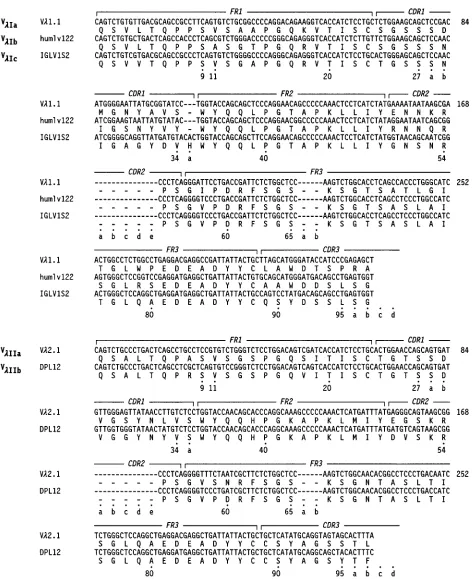
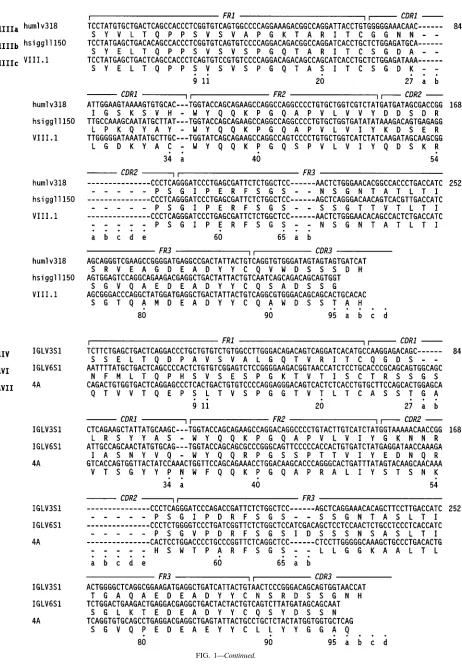
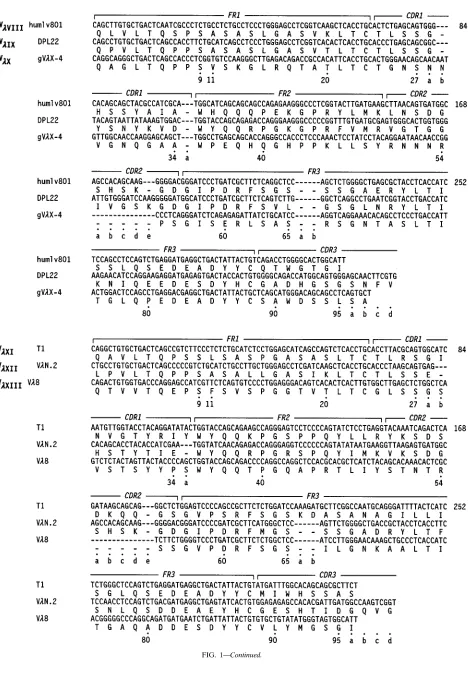
The prototypic nucleotide and translated protein sequences of the functional human Vlgermline genes encoding the 12 presently characterized Vlsubgroups (and sub-subgroups) are given in Fig. 1.
Vl-gene-family nomenclature.As stated above, the
classifi-cation of Vlgenes and their expressed products into distinct subgroups or families (designated by Roman numerals) has been based on sequence homologies and serologic analyses.
* Corresponding author. Mailing address: Human Immunology & Cancer Program, Department of Medicine, University of Tennessee Medical Center/Graduate School of Medicine, 1924 Alcoa Highway, Knoxville, TN 37920. Phone: (615) 544-9165. Fax: (615) 544-6865.
387
on August 17, 2020 by guest
http://cvi.asm.org/
Unfortunately, considerable confusion concerning nomencla-ture has been generated because of misclassification (23, 28, 29), arbitrary reassignment of newly recognized Vlsubgroups into previously defined categories (14), and use of previously
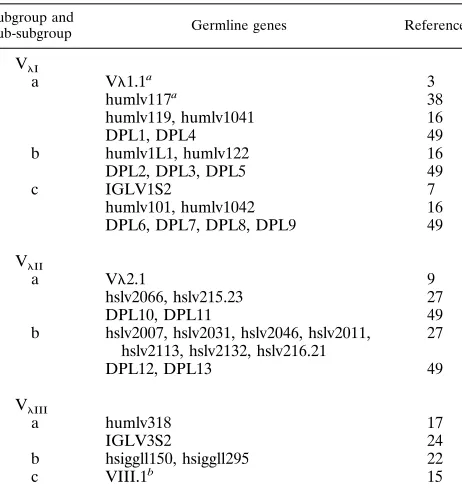
termed Vlsubgroup numbers for completely different Vl-gene families (14, 50). A summary of published Vl-subgroup or -gene-family designations, as well as our proposed nomencla-ture system, is given in Table 1. A listing of the VlI, VlII, and
FIG. 1. Nucleotide and deduced amino acid sequences of prototypic germline genes encoding human Vlsubgroups and sub-subgroups. The numbering system used is that of Kabat et al. (28). The presence of additional FR and CDR residues is indicated by lowercase letters.
on August 17, 2020 by guest
http://cvi.asm.org/
FIG. 1—Continued.
VOL. 2, 1995 MINIREVIEW 389
on August 17, 2020 by guest
http://cvi.asm.org/
FIG. 1—Continued.
on August 17, 2020 by guest
http://cvi.asm.org/
VlIII sub-subgroups and their corresponding germline genes are provided in Table 2. For purposes of consistency in naming Vlsubgroups, we recommend that any newly recognized Vl
-gene families or sub-subgroups be indicated by consecutive Roman numerals or letters, respectively, on the basis of the order of discovery as determined by publication date. Final terminology will ultimately depend on elucidation of the entire human Vllocus.
Organization of human Vlgenes.In contrast to the
exten-sive molecular characterization of the human Vklocus (for a review, see reference 52), similar information on Vlhas only recently become available. Studies to date indicate that VlVI, VlX, and VlIgenes are most distant from the Jl-Clcomplexes,
while VlIIIand VlIIare closest in proximity (15, 24, 43). The positions of these gene families along the chromosome and that of the JlClsegments are schematically indicated in Fig. 2. It should be noted that (as for Vk) these Vl-gene families are not necessarily segregated but can be interspersed; e.g., while the majority of VlIand VlIIgenes have been mapped to the 59 and 39portions of the Vllocus, respectively, members of both gene families have been identified in opposite locations.
Although sequence variations have been noted in the Vl -associated promoter, TATA box, and leader exons (12, 24, 43, 46, 49), subgroup-related differences have not as yet been found. All Vlexons have an identical nonamer and heptamer recombination signal sequence and can combine with any of the four functional Jlgenes (43, 45). Furthermore, as in the
case ofk genes, Vl-Jlrecombination results from a deletion mechanism (15, 24).
Structural characteristics of human Vlsubgroups.The
hu-man Vlsubgroups are distinguished not only by amino acid
sequence homologies but also by the presence of characteristic numbers of residues within CDRs as well as FRs. As indicated in Table 3, these differences are most evident in CDR1 (11 to 14 residues), CDR2 (7 to 12 residues), and CDR3 (7 to 11 residues). The number of CDR3 residues reflects not only Vl exon nucleotide composition but also the variation resulting from V-J recombinational events and the introduction of P or N nucleotides (30, 47). In FR1, certainlIII light chains contain 21, rather than 22, residues, andlVI and lXI (T1) compo-nents are characterized by two additional FR3 residues. Al-though data on the tertiary structural features ofllight chains are limited, it would be expected that the compositional dif-ferences found among the Vlsubgroups, particularly those in the CDRs, would significantly affect the nature of the antigen-binding site (13).
Expression of human Vlgenes in normal and disease states.
The light-chain products of the .40 functional human Vl genes identified to date have been found among monoclonal serum and urinaryl-type Igs and/or sIgl1B-cell populations. That these Vl-gene products are expressed in the normal state has been evidenced through serologic analyses of serum and lymphocytes taken from healthy individuals. We have used our monoclonal antibodies specific forlI,lII,lIII (lIIIa,lIIIb,
FIG. 2. Characterization of the humanl-light-chain locus. The relative positions of the Vl- and JlCl-gene families are based on data given previously (15, 24, 43, 45). Distance within the V region is not to scale; the 39 lenhancer (E) is 11.7 kb 39of Cl7 (the figure was modified from reference 8). n, tentative location of other human Vl-gene families.
TABLE 1. Designation of human Vlsubgroups or gene families
Subgroup or gene family
Kabat et al. (29)a Chuchana et al. (14)a Combriato and Klobeck (15)a Solomon and Weiss (40)b Recommended
VlI VlI VlI VlI VlI
VlII
c V
lII VlII VlII VlII
VlIII VlIIId VlIII VlIII VlIII
VlIV New VlIV(PK) VlIV VlIV VlIV
VlV New VV(T1) (VlII)e (VlII)e —f
VlVI VlVI N1 (VlVI) VlVI VlVI
— VlVII N2 (V4A) — VlVII(4A)
— — N4 (VPK) VlVIII(PK) VlVIII(PK)
— — — — VlIX(DPL22)
— — — — VlX
— — N3 (VT1) — VlXI(T1)
— — — — VlXII(VlN.2)
— — — — VlXIII(Vl8/DPL21)
aClassification based on perceived protein and/or nucleotide sequence homologies.
bClassification based on serologic differentiation with polyclonal (40) and monoclonal (2) reagents.
cIncluded within the V
lIIsubgroup werelVII (5) andlVIII (31) proteins.
dIncluded within the V
lIIIsubgroup were chemically (28, 29) and serologically (2, 40) definedlIV proteins.
eThe V
lVand VlIIsubgroups were considered synonymous.
f—, V
lVdesignation omitted.
VOL. 2, 1995 MINIREVIEW 391
on August 17, 2020 by guest
http://cvi.asm.org/
lIIIc),lIV,lVI, andlVIII light chains (1, 2, 34) to determine the concentrations and relative distributions of these particular subgroups and sub-subgroups among polyclonall-type Ig mol-ecules contained in the serum of healthy adults (Table 4). Summation of the relative concentration of each of these six Vl subgroups was comparable to that of total l chains as determined with an anti-Clreagent. This finding would indi-cate that the lIX, lX, lXI (T1), lXII (VlN.2), and lXIII (Vl8/DPL21) subgroups (for which there are as yet no
avail-able antibodies) represent,1% of the totall-light-chain pop-ulation. Additionally, the Vl-subgroup distribution among sIgl1B-cell populations in healthy adults was comparable to that of polyclonal seruml-type Igs (42a).
In contrast to the healthy state, in which IglI, IglII, IglIII, IglIV, IglVI, and IglVIII molecules represent;40, 3, 43, 5, 5, and 3%, respectively, of the total Igl population, certain Vl-gene families are preferentially expressed in individuals with monoclonal plasma cell- and B-cell-related neoplastic or immunoproliferative disorders (34) (Table 5). Serologic anal-yses ofl-type IgG, IgA, and IgD myeloma proteins and Bence Jones proteins obtained from 196 patients with multiple my-eloma and related gammopathies and 41 patients with light-chain-associated (AL) amyloidosis revealed approximately nine- and sevenfold higher percentages of lII components, respectively; among 16 Waldenstro¨m’s macroglobulins, two-thirds were classified as IgMlII. The functional importance of this Vlsubgroup has been evidenced by its association with certain autoimmune and antibacterial antibodies; e.g., the VlII-gene family encodes exclusively for the l -light-chain-re-lated 8.12 idiotype present on one-third of anti-DNA antibod-ies found in the sera of patients with systemic lupus erythem-atosus (35).
Our analyses of associated Igs confirmed that the VlVI sub-group is preferentially associated with this form of amyloidosis (39); 17 of 41 amyloid-associated proteins were classified as IglVI. To date, we have found no VlVI-related components amongl-type myeloma proteins, Waldenstro¨m’s macroglobu-lins, IgM rheumatoid factors, or sIgl1 chronic lymphocytic leukemia cell populations (34, 41).
TABLE 2. Nomenclature and germline equivalents of Vl sub-subgroups
Subgroup and
sub-subgroup Germline genes Reference
VlI
a Vl1.1a 3
humlv117a 38
humlv119, humlv1041 16
DPL1, DPL4 49
b humlv1L1, humlv122 16
DPL2, DPL3, DPL5 49
c IGLV1S2 7
humlv101, humlv1042 16
DPL6, DPL7, DPL8, DPL9 49
VlII
a Vl2.1 9
hslv2066, hslv215.23 27
DPL10, DPL11 49
b hslv2007, hslv2031, hslv2046, hslv2011, hslv2113, hslv2132, hslv216.21
27
DPL12, DPL13 49
VlIII
a humlv318 17
IGLV3S2 24
b hsiggll150, hsiggll295 22
c VIII.1b 15
a
Vl1.1 and humlv117 were assigned to the VlIbsub-subgroup by Combriato
and Klobeck (15). b
DesignatedlIIId by Frippiat and LeFranc (24).
TABLE 3. Number of residues comprising FRs and CDRs of human Vlsubgroups
Subgroup
No. of residues
FR1a CDR1 FR2 CDR2 FR3 CDR3
VlIa 22 13 15 7 32 9
VlIb 22 13 15 7 32 9
VlIc 22 14 15 7 32 9
VlIIa 22 14 15 7 32 9
VlIIb 22 14 15 7 32 9
VlIIIa 22 11 15 7 32 9
VlIIIb 22 11 15 7 32 7
VlIIIc 22 11 15 7 32 9
VlIV 22 11 15 7 32 9
VlVI 22 13 15 7 34 7
VlVII 22 14 15 7 32 8
VlVIII 22 12 15 11 32 7
VlIX 22 12 15 12 32 11
VlX 22 13 15 7 32 9
VlXI 22 14 15 11 34 7
VlXII 22 12 15 11 32 11
VlXIII 22 14 15 7 32 8
a
FR1 of certain expressedlIIIa,lIIIb,lIIIc, andlIV light chains contains 21 residues (20, 21).
TABLE 4. Vl-subgroup distribution amongl-type Igs in normal seruma
Subgroup Mean concn6SD
(mg/ml) Relative %
VlI 1,7756404 39.9
VlII 134636 3.0
VlIII 1,9176725 43.1
VlIV 241650 5.4
VlVI 238697 5.4
VlVIII 140651 3.2
Totall 4,4456821 100.0
aData are from reference 34.
TABLE 5. Vl-subgroup distribution amongl-type polyclonal and monoclonal Igs Subgroup % Distribution Normala MMb ALb WMb RFc
VlI 40 27 10 22 11
VlII 3 28 20 64 7
VlIII 43 39 29 7 44
VlIV 5 5 0 7 19
VlVI 5 0 41 0 0
VlVIII 3 1 0 0 19
a
Polyclonal Iglin serum from 20 healthy adults. b
Monoclonal IgG, IgA, IgD, and Bence Jones proteins obtained from 196 patients with multiple myeloma (MM), 41 with light-chain-associated amyloi-dosis (AL), and 16 with Waldenstro¨m’s macroglobulinemia (WM). Data are from reference 34.
c
Monoclonal IgMlrheumatoid factors (RFs) produced by 27 immortalized peripheral blood or synovial B cells from patients with rheumatoid arthritis (11, 20, 34a).
on August 17, 2020 by guest
http://cvi.asm.org/
Other examples of the skewed distribution of Vlsubgroups
include monoclonal IgMlrheumatoid factors produced by Ep-stein-Barr virus-immortalized cell lines prepared from periph-eral blood or synovial B cells from patients with rheumatoid arthritis (22, 36) (Table 5). In these cases, we have found that the percentages of the relatively uncommon VlIVand VlVIII subgroups were increased approximately four- and sixfold, re-spectively, above normal (20, 42). Additionally, a predomi-nance oflIIIb-containing proteins was evidenced among IgMl rheumatoid factors having specificity for rabbit IgG (19, 22). An apparently biased expression of the VlIVsubgroup with other types of autoantibodies has also been demonstrated, e.g., among anti-D(Rh) (10), antilysozyme (33), antithyroglobulin (26), and antisperm antibodies (51), as well as in sIgl1chronic lymphocytic leukemia cell populations (41). ThelVII nature of vaccine-induced anti-Haemophilus influenzae type b polysac-charide antibodies bearing the cross-reactive idiotype HibId-2 (25) and the association oflIX andlXIII (Vl8/DPL21) light chains with other types of autoantibodies have also been re-ported (32, 49, 50). Additionally, a preferential usage of lI light chains was noted among anti-gp120 antibodies in the sera of human immunodeficiency virus type 1-infected individuals (48).
The molecular basis for the nonstochastic expression of Vl subgroups in patients with neoplastic and inflammatory dis-eases is unknown. Whether the use of specific Vl-gene families in these disorders reflects (i) the propensity of particular B cells to undergo Epstein-Barr virus-induced transformation, (ii) a unique antibody response, (iii) chromosomal location (i.e., the proximity to JlCl segments), or (iv) alterations in transcriptional regulation remains to be established. Alterna-tively, the apparent overexpression of particular Vlgenes may
be related to their possible overrepresentation in the fetal repertoire, as has been found for certain VH-gene families (37).
ACKNOWLEDGMENTS
We thank Julie Ottinger for manuscript preparation.
This work was supported by Public Health Service research grant CA10056 from the National Cancer Institute. A.S. is an American Cancer Society Clinical Research Professor.
REFERENCES
1. Abe, M., T. Goto, S. J. Kennel, D. Wolfenbarger, S. D. Macy, D. T. Weiss,
and A. Solomon.1993. Production and immunodiagnostic applications of antihuman light chain monoclonal antibodies. Am. J. Clin. Pathol. 100:67– 74.
2. Abe, M., S. Ozaki, D. Wolfenbarger, M. deBram-Hart, D. T. Weiss, and A.
Solomon.1994. Variable-region subgroup distribution amongl-type immu-noglobulins in normal human serum. J. Clin. Lab. Anal. 8:4–9.
3. Alexandre, D., P. Chuchana, F. Brockly, A. Blancher, G. Lefranc, and M.-P.
Lefranc.1989. First genomic sequence of a human Ig variablelgene be-longing to subgroup I. Functional genes, pseudogenes and vestigial se-quences are interspersed in the IGLV locus. Nucleic Acids Res. 17:3975. 4. Anderson, M. L. M., L. Brown, E. McKenzie, J. E. Kellow, and B. D. Young.
1985. Cloning and sequence analysis of an Igllight chain mRNA expressed in the Burkitt’s lymphoma cell line EB4. Nucleic Acids Res. 13:2931–2941. 5. Anderson, M. L. M., M. F. Szajnert, J. C. Kaplan, L. McColl, and B. D.
Young. 1984. The isolation of a human Ig Vlgene from a recombinant library of chromosome 22 and estimation of its copy number. Nucleic Acids Res. 12:6647–6661.
6. Berinstein, N., S. Levy, and R. Levy. 1989. Activation of an excluded immu-noglobulin allele in a human B lymphoma cell line. Science 244:337–339. 7. Bernard, F., P. Chuchana, J.-P. Frippiat, L. Buluwela, and M.-P. Lefranc.
1990. Genomic sequence of IGLV1S2, a human immunoglobulin variable lambda gene belonging to subgroup I. Nucleic Acids Res. 18:7139. 8. Blomberg, B. B., and A. Solomon. The murine and human lambda light chain
immunoglobulin loci: organization and expression. In Weir Handbook of Immunology, in press.
9. Brockly, F., D. Alexandre, P. Chuchana, S. Huck, G. Lefranc, and M.-P.
Lefranc.1989. First nucleotide sequence of a human immunoglobulin
vari-ablelgene belonging to subgroup II. Nucleic Acids Res. 17:3976. 10. Bye, J. M., C. Carter, Y. Cui, B. D. Gorick, S. Songsivilai, G. Winter, N. C.
Hughes-Jones, and J. D. Marks.1992. Germline variable region gene seg-ment derivation of human monoclonal anti-Rh(D) antibodies. J. Clin. Invest.
90:2481–2490.
11. Ch’ang, L.-Y., M. Schell, C. Ringelberg, D. T. Weiss, and A. Solomon. 1995. Molecular characterization of a human VlVIIIgermline gene. Mol. Immunol.
32:49–55.
12. Ch’ang, L.-Y., C.-P. Yen, L. Besl, M. Schell, and A. Solomon. 1994. Identi-fication and characterization of a functional human Ig VlVI germline gene. Mol. Immunol. 31:531–536.
13. Chothia, C., and A. M. Lesk. 1987. Canonical structures for the hypervari-able regions of immunoglobulins. J. Mol. Biol. 196:901–917.
14. Chuchana, P., A. Blancher, F. Brockly, D. Alexandre, G. Lefranc, and M.-P.
Lefranc.1990. Definition of the human immunoglobulin variable lambda (IGLV) gene subgroups. Eur. J. Immunol. 20:1317–1325.
15. Combriato, G., and H.-G. Klobeck. 1991. Vland Jl-Clgene segments of the human immunoglobulinllight chain locus are separated by 14 kb and rearrange by a deletion mechanism. Eur. J. Immunol. 21:1513–1522. 16. Daley, M. D., T. Olee, H.-Q. Peng, R. W. Soto-Gil, P. P. Chen, and K. A.
Siminovitch.1992. Molecular characterization of the human immunoglobu-lin VlI germline gene sequence. Mol. Immunol. 29:1031–1042.
17. Daley, M. D., H.-Q. Peng, V. Misener, X.-Y. Liu, P. P. Chen, and K. A.
Siminovitch.1992. Molecular analysis of human immunoglobulin Vl germ-line genes: subgroups VlIII and VlIV. Mol. Immunol. 29:1515–1518. 18. Deftos, M., R. Soto-Gil, M. Quant, T. Olee, and P. P. Chen. 1994. Utilization
of a potentially universal downstream primer in the rapid identification and characterization of Vlgenes from two new human Vlgene families. Scand. J. Immunol. 39:95–103.
19. Ermel, R. W., T. P. Kenny, A. Wong, A. Solomon, P. P. Chen, and D. L.
Robbins.1994. Preferential utilization of a novel Vl3 gene in monoclonal rheumatoid factors derived from the synovial cells of rheumatoid arthritis patients. Arthritis Rheum. 37:860–868.
20. Eulitz, M., L.-Y. Ch’ang, C. Zirkel, M. Schell, D. T. Weiss, and A. Solomon. 1995. Distinctive serological, chemical, and molecular properties of human
lIV light chains. J. Immunol. 154:3256–3265.
21. Eulitz, M., C. Murphy, D. T. Weiss, and A. Solomon. 1991. Serological and chemical differentiation of humanlIII light chain variable regions. J. Im-munol. 146:3091–3096.
22. Fang, Q., C. C. Kannapell, F. Gaskin, A. Solomon, W. J. Koopman, and
S. M. Fu.1994. Human rheumatoid factors with restrictive specificity for rabbit immunoglobulin G: auto- and multi-reactivity, diverse VH gene seg-ment usage and preferential usage of VlIIIb. J. Exp. Med. 179:1445–1456. 23. Frippiat, J.-P., P. Chuchana, F. Bernard, L. Buluwela, G. Lefranc, and M.-P.
Lefranc.1990. First genomic sequence of a human Ig variable lambda gene belonging to subgroup III. Nucleic Acids Res. 18:7134.
24. Frippiat, J.-P., and M.-P. LeFranc. 1994. Genomic organisation of 34 kb of the human immunoglobulin lambda locus (IGLV): restriction map and se-quences of new VlIII genes. Mol. Immunol. 31:657–670.
25. Granoff, D. M., P. G. Shackelford, S. J. Holmes, The Collaborative Vaccine
Study Group, and A. H. Lucas.1993. Variable region expression in the antibody responses of infants vaccinated with Haemophilus influenzae type b polysaccharide-protein conjugates. J. Clin. Invest. 91:788–796.
26. Griffiths, A. D., M. Malmqvist, J. D. Marks, J. M. Bye, M. J. Embleton, J.
McCafferty, M. Baier, K. P. Holliger, B. D. Gorick, N. C. Hughes-Jones, H. R. Hoogenboom, and G. Winter.1993. Human anti-self antibodies with high specificity from phage display libraries. EMBO J. 12:725–734. 27. Irigoyen, M., A. Manheimer-Lory, B. Gaynor, and B. Diamond. 1994.
Mo-lecular analysis of the human immunoglobulin VlII gene family. J. Clin. Invest. 94:532–538.
28. Kabat, E. A., T. T. Wu, and H. Bilofsky. 1979. Sequences of immunoglobulin chains. Tabulations and analysis of amino acid sequences of precursors, V-regions, C-regions, J-chains, andb2-microglobulins. U.S. Department of Health, Education and Welfare, Washington, D.C.
29. Kabat, E. H., T. T. Wu, H. M. Perry, K. S. Gottesman, and C. Foeller. 1991. Sequences of proteins of immunological interest, vol. 1, 5th ed. U.S. Depart-ment of Health and Human Services, Washington, D.C.
30. Lafaille, J. J., A. DeCloux, M. Bonneville, Y. Takagaki, and S. Tonegawa. 1989. Junctional sequences of T cell receptorgDgenes: implications forgD T cell lineages and for a novel intermediate of V-(D)-J joining. Cell 59:859– 870.
31. Levy, S., E. Mendel, S. Kon, Z. Avnur, and R. Levy. 1988. Mutational hot spots in Ig V region genes of human follicular lymphomas. J. Exp. Med.
168:475–489.
32. Lu, E. W., M. Deftos, T. Olee, D.-F. Huang, R. W. Soto-Gil, D. A. Carson,
and P. P. Chen.1993. Generation and molecular analyses of two rheumatoid synovial fluid-derived IgG rheumatoid factors. Arthritis Rheum. 36:927–937. 33. Marks, J. D., H. R. Hoogenboom, T. P. Bonnert, J. McCafferty, A. D.
Grif-fiths, and G. Winter.1991. By-passing immunization. Human antibodies from V-gene libraries displayed on phage. J. Mol. Biol. 222:581–597. 34. Ozaki, S., M. Abe, D. Wolfenbarger, D. T. Weiss, and A. Solomon. 1994.
Preferential expression of humanl-light-chain variable-region subgroups in
VOL. 2, 1995 MINIREVIEW 393
on August 17, 2020 by guest
http://cvi.asm.org/
multiple myeloma, AL amyloidosis, and Waldenstro¨m’s macroglobulinemia. Clin. Immunol. Immunopathol. 71:183–189.
34a.Ozaki, S., et al. Unpublished data.
35. Paul, E., A. A. Iliev, A. Livneh, and B. Diamond. 1992. The anti-DNA-associated idiotype 8.12 is encoded by the VlII gene family and maps to the vicinity of L chain CDR1. J. Immunol. 149:3588–3595.
36. Robbins, D. L., T. P. Kenny, M. J. Coloma, J. V. Gavilondo-Cowley, R. W.
Soto-Gil, P. P. Chen, and J. W. Larrick. 1990. Serologic and molecular characterization of a human monoclonal rheumatoid factor derived from rheumatoid synovial cells. Arthritis Rheum. 33:1188–1195.
37. Schroeder, H. W., Jr., and J. Y. Wang. 1990. Preferential utilization of conserved immunoglobulin heavy chain variable gene segments during hu-man fetal life. Proc. Natl. Acad. Sci. USA 87:6146–6150.
38. Siminovitch, K. A., V. Misener, P. C. Kwong, Q.-L. Song, and P. P. Chen. 1989. A natural autoantibody is encoded by germline heavy and lambda light chain variable region genes without somatic mutation. J. Clin. Invest. 84: 1675–1678.
39. Solomon, A., B. Frangione, and E. C. Franklin. 1982. Bence Jones proteins and light chains of immunoglobulins. Preferential association of the VlVI subgroup of human light chains with amyloidosis AL(l). J. Clin. Invest.
70:453–460.
40. Solomon, A., and D. T. Weiss. 1987. Serologically defined V region sub-groups of humanllight chains. J. Immunol. 139:824–830.
41. Solomon, A., D. T. Weiss, S. D. Macy, and R. A. Antonucci. 1990. Immuno-cytochemical detection of kappa and lambda light chain V region subgroups in human B-cell malignancies. Am. J. Pathol. 137:855–862.
42. Solomon, A., D. T. Weiss, C. Murphy, S. M. Fu, and D. L. Robbins. 1994.
Chemical and serologic characterization of humanlVIII light chains. J. Immunol. 153:1658–1664.
42a.Solomon, A., et al. Unpublished data.
43. Stiernholm, N. B. J., B. Kuzniar, and N. L. Berinstein. 1994. Identification of a new human Vlgene family-VlX. J. Immunol. 152:4969–4975. 44. Suleyman, S., O. Hosono, M. Sioud, I. Randen, K. M. Thompson, Ø. Førre,
and J. B. Natvig.1993. Differentiation of humanl1 variable regions with a monoclonal antibody to a defined, germ-line-encoded idiotope correlates with Vl1achemical structure. J. Immunol. 150:5466–5475.
45. Udey, J. A., and B. Blomberg. 1987. Humanllight chain locus: organization and DNA sequences of three genomic J regions. Immunogenetics 25:63–70. 46. Vasicek, T. J., and P. Leder. 1990. Structure and expression of the human
immunoglobulinlgenes. J. Exp. Med. 172:609–620.
47. Victor, K. D., and J. D. Capra. 1994. An apparently common mechanism of generating antibody diversity: length variation of the VL-JL junction. Mol. Immunol. 31:39–46.
48. Wang, Q., A. Solomon, D. Weiss, H. Ko¨hler, S. Pahwa, P.-A. Tovo, and S. Mu¨ller.Fed. Proc., in press.
49. Williams, S. C., and G. Winter. 1993. Cloning and sequencing of human immunoglobulin Vlgene segments. Eur. J. Immunol. 23:1456–1461. 50. Winkler, T. H., H. Fehr, and J. R. Kalden. 1992. Analysis of immunoglobulin
variable region genes from human IgG anti-DNA hybridomas. Eur. J. Im-munol. 22:1719–1728.
51. Yamasaki, N., S. Komori, and T. Watanabe. 1987. Complementary DNA for a human subgroup IV immunoglobulinl-chain. Mol. Immunol. 24:981–985. 52. Zachau, H. G. The human immunoglobulinkgenes. In T. Honjo and F. Alt (ed.), Immunoglobulin genes, 2nd ed., in press. Academic Press, London.