Available Online at www.ijcsmc.com
International Journal of Computer Science and Mobile Computing
A Monthly Journal of Computer Science and Information Technology
ISSN 2320–088X
IJCSMC, Vol. 4, Issue. 7, July 2015, pg.204 – 211
RESEARCH ARTICLE
EVALUATION OF TREE BASED DATA
AGGREGATION TECHNIQUES
Manpreet Kaur
1, Er. Varinderjit Kaur
21P.G Student, Department Of CSE, RIET, Phagwara 2
HOD, Department Of M.TECH CSE, RIET, Phagwara
1Email: [email protected] 2Email: [email protected]
ABSTRACT: The quick growth in network multimedia equipments have allow additional real-time digital services such as video-conferencing, online games and distance education to grow to be the conventional internet tasks. WSNs have become major area of research in computational theory due to its wide range of applications. But due to limited battery power the energy consumption has become major limitations of WSNs protocols. Though many protocols has been proposed so far to improve the energy efficiency further but still much enhancement can be done. In this paper, a survey on various routing protocols has been discussed. From the survey, it has been concluded that none of the protocol performs effectively in all fields. Therefore the paper ends with the future scope to overcome these issues. KEYWORDS:- WSN, BASE STATION, GSTEB
1. INTRODUCTION
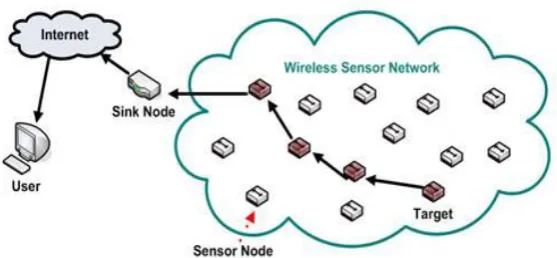
A Wireless Sensor Network (WSN) [1] contains large number of small sensor nodes with restricted computation capacity, low memory, limited power, and limited range communication device. All nodes send their data to a Base Station (BS) or sink, which performs calculation and decision-making, and can be compared with the functionalities of server or in some cases as a gateway in a computer network.
Fig 1: A sensor network[1]
2. COMPONENTS OF WSN Sensor nodes
The Sensor Node is a basic element of WSN and it consists of Sensing, Computation and wireless Communication unit. Therefore sensor nodes are able to observe physical phenomenon, process the observed and received information and communicate the observed or processed information to the nearby sensor nodes to form a network of sensor nodes called Wireless Sensor Networks (WSNs). The wireless networking capability of the sensor enabled nodes, have resulted in various interesting applications ranging from surveillance, smart homes, precision agriculture, disaster detection and supply chain management applications. A sensor node might vary in size from that of a shoebox down to the size of a grain of dust. The cost of sensor nodes is similarly variable, ranging from a few to hundreds of dollars, depending on the complexity of the individual sensor nodes. Size and cost constraints on sensor nodes result in corresponding constraints on resources such as energy, memory, computational speed and communications bandwidth. The topology of the WSNs can vary from a simple star network to an advanced multi-hop wireless mesh network. The propagation technique between the hops of the network can be routing or flooding.
A typical sensor node consists of four components:
A power unit, responsible for supplying energy to other components;
A sensing unit, that actually contains the sensor, for instance, of light, humidity, temperature, etc;
A computing unit, composed of RAM and flash memories and a processor that typically uses a set of analog-to-digital converters (ADCs) to obtain data from sensors and communications protocols;
A communication unit, used to send and receive radio signals.
Components of a sensor node [2] are:
Power Unit: Power is stored either in batteries or capacitors. Batteries, both rechargeable and non-rechargeable, are the main source of power supply for sensor nodes. The sensor node consumes power for sensing, communicating and data processing.
Sensing Unit: Sensors are hardware devices that produce a measurable response to a change in a physical condition like temperature or pressure. A sensor node should be small in size, consume extremely low energy, operate in high volumetric densities, be autonomous and operate unattended, and be adaptive to the environment. Sensors measure physical data of the parameter to be monitored.
Computation Unit: A computing unit, composed of RAM and flash memories and a processor.
Microcontroller: The controller performs tasks, processes data and controls the functionality of other components in the sensor node. Some characteristics of microcontroller are: low cost, flexibility to connect to other devices, ease of programming, and low power consumption.
External Memory: From an energy perspective, the most relevant kinds of memory are the on-chip memory of a microcontroller and Flash memory—off-chip RAM. Two categories of memory based on the purpose of storage are: user memory used for storing application related or personal data, and program memory used for programming the device.
Communication Unit: The functionality of both transmitter and receiver are combined into a single device known as a transceiver. The operational states are transmit, receive, idle, and sleep.
Sensor nodes can be imagined as small computers, extremely basic in terms of their interfaces and their components. They usually consist of a processing unit with limited computational power and limited memory, sensors or MEMS (including specific conditioning circuitry), a communication device (usually radio transceivers or alternatively optical), and a power source usually in the form of a battery. Other possible inclusions are energy harvesting modules, secondary ASICs, and possibly secondary communication interface (e.g. RS-232 or USB).
Base Station (BS)
The base stations are one or more components of the WSN with much more computational, energy and communication resources. They act as a gateway between sensor nodes and the end user as they typically forward data from the WSN on to a server. Other special components in routing based networks are routers, designed to compute, calculate and distribute the routing tables.
Fig 3: A Typical Wireless Sensor Network
Characteristics of WSN:
The main characteristics [3] of a WSN include:
Power consumption constrains for nodes using batteries or energy harvesting
Ability to cope with node failures
Mobility of nodes
Communication failures
Heterogeneity of nodes
Scalability to large scale of deployment
Ability to withstand harsh environmental conditions
Platforms Hardware
Major challenge in a WSN is to make cheap and small sensor nodes. There are an increasing number of small companies producing WSN hardware and the commercial situation can be compared to home computing in the 1970s. Many of the nodes are still in the research and development stage, particularly their software. Also they need to use energy efficient methods for signal transmission and data gathering.
In many applications, a WSN communicates with a Local Area Network or Wide Area Network through a gateway. The Gateway acts as a bridge between the WSN and the other network. This enables data to be stored and processed by devices with more resources, for example, in a remotely located server.
Software
WSN nodes are usually deployed in remote areas so it is not feasible to recharge them often so these nodes mostly suffer energy constraints as a result in a WSN energy is the scarcest resource and it decides the network. For this reason, algorithms and protocols need to address the following issues:
Lifetime maximization
Robustness and fault tolerance
Self-configuration
Lifetime maximization: Energy/Power Consumption of the sensing device should be minimized and sensor nodes should be energy efficient since their limited energy resource determines their lifetime. To conserve power the nodes normally turn off the radio transceiver when not in use. Different protocols such as LEACH, HEED, PEGASIS and GSTEB etc. are developed so as to achieve even distribution of load among nodes and maximize network lifetime.
Operating systems
Operating systems for wireless sensor network nodes are typically simpler as compared to general-purpose operating systems. They mostly resemble embedded systems because of two reasons. First, wireless sensor networks are typically deployed with a particular application in mind, rather than as a general platform. Second, a need for low costs and low power leads most wireless sensor nodes to have low-power microcontrollers ensuring that mechanisms such as virtual memory are either unnecessary or too expensive to implement.
3. APPLICATIONS Area monitoring
The most straightforward application of wireless sensor network technology is to monitor remote environments for low frequency data trends. For area monitoring, the WSN is deployed over an area where some event is to be monitored. Examples include use of sensors to detect enemy invasion in military or we can consider the geo-fencing of gas or oil pipelines.
Health care monitoring
Medical applications can be of two types: wearable and implanted. WSNs can be used for both kinds of medical applications. Body-area networks can collect information about an individual's health, fitness, and energy expenditure.
Environmental data collection
The term Environmental Sensor Networks has evolved to cover many applications of WSNs to earth science research. This includes sensing volcanoes, oceans, glaciers, forests etc. Some of the major areas are air pollution monitoring, landslide detection, forest fire detection etc.
Machine health monitoring
Wireless sensor networks have been developed for machinery condition-based maintenance (CBM) as they offer significant cost savings and enable new functionality. In wired systems, the installation of enough sensors is often limited by the cost of wiring. Previously inaccessible locations, rotating machinery, hazardous or restricted areas, and mobile assets can now be reached with wireless sensors.
Data logging
4. A General Self-Organized Tree-Based Energy-Balance Routing Protocol for Wireless Sensor Network (GSTEB)
General Self-Organized Tree-Based Energy-Balance routing protocol (GSTEB) [4] constructs a routing tree by means of a method in which, for every round, Base station (BS) chooses a root node and broadcasts this choice to each node. Then, every node chooses its parent node by taking into consideration just itself and its neighbors’ information. This makes GSTEB a dynamic protocol. Goal of GSTEB is to increase network lifetime of different applications. There are two definitions for network life time and two extreme case of data fusion are considered in the paper under consideration which are described as follows:
Network lifetime can be defined in two ways:
a) The time from the beginning of the operation until first node dies. b) The time from the beginning of the operation until last node is dead.
Also two cases in data fusion are considered:
a) Case (1) The data among sensor nodes can be completely fused. Every node transmits the same amount of data regardless of the amount it receives.
b) Case (2) The data cannot be fused. Each relay node sends data which is an addition of its individually sensed data and data received from its child nodes.
5. LITERATURE SURVEY
6. LIMITATIONS OF THE EARLIER WORK
The review has shown that the majority of algorithms has the following limitations.
1. Compressive sensing:- The use of the compressive sensing is also ignored in the GSTEB routing protocol.
2. Reactivity: The GSTEB is proactive protocol so the use of reactivity i.e. hard and soft thresholding to reduce the number of communications between the sink and the member nodes.
3. Mobile sink: The effect of the mobile sink on the GSTEB has been neglected.
7. CONCLUSION AND FUTURE SCOPE
From the survey, it has been found that GSTEB has shown quite significant results over the available WSNs protocols. But it has neglected the use of the three things like the effect of the mobile sink has also been neglected by the most of the existing researchers. The compressive sensing has also been neglected, one can offer level wise clustering to enhance the results further. Moreover the effect of the reactivity has also been neglected as the GSTEB is proactive routing protocol.
Therefore, in near future, in order to overcome the constraints of the earlier work a new improved technique can be proposed which has the ability to overcome the limitations of the GSTEB routing protocol by using the principle of reactivity, mobile sink and the lossless data compression technique.
REFERENCES
[1] Shamani, M. J., et al. "Adaptive Energy Aware Cooperation Strategy in Heterogeneous Multi-domain Sensor Networks."Procedia Computer Science 19 (2013): 1047-1052.
[2] Manzoor, Basit, et al. "Q-LEACH: A New Routing Protocol for WSNs." Procedia Computer Science 19 (2013): 926-931.
[3] Kumar, Dilip, Trilok C. Aseri, and R. B. Patel. "EEHC: Energy efficient heterogeneous clustered scheme for wireless sensor networks." Computer Communications 32.4 (2009): 662-667.
[4] Han, Zhao, Jie Wu, Jie Zhang, Liefeng Liu, and Kaiyun Tian. "A General Self-Organized Tree-Based
Energy-Balance Routing Protocol for Wireless Sensor Network.", IEEE Transaction, 1-1, 2014.
[5] Lindsey, Stephanie, and Cauligi S. Raghavendra. "PEGASIS: Power-efficient gathering in sensor information systems."Aerospace conference proceedings, 2002. IEEE. Vol. 3. IEEE, 2002.
[6] Younis, Ossama, and Sonia Fahmy. "HEED: a hybrid, energy-efficient, distributed clustering approach for ad hoc sensor networks."Mobile Computing, IEEE Transactions on 3.4 (2004): 366-379.
[15] Qureshi, T. N., Nadeem Javaid, A. H. Khan, Adeel Iqbal, E. Akhtar, and M. Ishfaq. "BEENISH: Balanced Energy
Efficient Network Integrated Super Heterogeneous Protocol for Wireless Sensor Networks."Procedia Computer
Science 19 (2013): 920-925.
[8] Heinzelman, Wendi B., Anantha P. Chandrakasan, and Hari Balakrishnan. "An application-specific protocol architecture for wireless microsensor networks." Wireless Communications, IEEE Transactions on 1.4 (2002): 660-670.
[9] Tan, Hüseyin Özgür, and Ibrahim Körpeoǧlu. "Power efficient data gathering and aggregation in wireless sensor networks." ACM Sigmod Record 32.4 (2003): 66-71.
[10] Liang, Weifa, and Yuzhen Liu. "Online data gathering for maximizing network lifetime in sensor networks."
Mobile Computing, IEEE Transactions on 6.1 (2007): 2-11.
[11] Mohammad El-Basioni, B. M., Abd El-kader, S. M., Eissa, H. S., & Zahra, M. M. (2011). An optimized energy-aware routing protocol for wireless sensor network. Egyptian Informatics Journal, 12(2), 61-72.
![Fig 1: A sensor network[1]](https://thumb-us.123doks.com/thumbv2/123dok_us/1943250.1255579/2.595.187.411.557.708/fig-a-sensor-network.webp)